
Seeds of Wisdom RV and Economics Updates Thursday Morning 7-30-26
Good Morning Dinar Recaps,
Global Digital Asset Rules Gain Momentum as Senate Faces Critical CLARITY Act Deadline
Growing bipartisan support and renewed pressure ahead of the Senate recess are keeping U.S. digital asset legislation at the center of efforts to modernize the financial system.
Good Morning Dinar Recaps,
Global Digital Asset Rules Gain Momentum as Senate Faces Critical CLARITY Act Deadline
Growing bipartisan support and renewed pressure ahead of the Senate recess are keeping U.S. digital asset legislation at the center of efforts to modernize the financial system.
Overview
Support continues to build for the CLARITY Act as lawmakers push to complete negotiations before the Senate's August recess.
Ethics provisions remain the primary obstacle, even as many lawmakers agree on the need for clear digital asset regulations.
A successful vote would establish one of the most comprehensive federal regulatory frameworks for digital assets, potentially strengthening America's leadership in financial innovation.
Key Developments
1. Senate Faces Narrow Legislative Window
With only a limited number of legislative days remaining before the August recess, Senate leaders continue working to advance the CLARITY Act. The compressed schedule has increased pressure on negotiators to resolve remaining issues quickly while maintaining bipartisan support.
2. Ethics Negotiations Continue
The largest remaining challenge centers on ethics language governing public officials' involvement with digital assets. While revisions have narrowed differences, several senators continue seeking stronger safeguards before supporting final passage.
3. House Support Remains Strong
Representative Mike Haridopolos publicly reaffirmed support for the legislation, arguing that regulatory clarity is essential for keeping blockchain development, investment, and innovation inside the United States rather than moving overseas.
4. Regulatory Certainty Could Unlock Institutional Growth
The legislation would clarify which digital assets fall under SEC oversight and which belong under CFTC jurisdiction. Industry participants believe greater certainty could encourage additional institutional participation while improving investor protections and reducing regulatory uncertainty.
Why It Matters
The CLARITY Act represents far more than a cryptocurrency bill. It is part of a broader transition toward digitally integrated financial markets, where tokenized assets, blockchain infrastructure, and regulated digital payments increasingly become part of mainstream finance. Clear regulatory rules may also influence how global investors allocate capital and how other nations design their own digital asset frameworks.
Why It Matters to Foreign Currency Holders
Many observers of international monetary reform believe digital asset regulation represents one building block of the evolving financial system. While the CLARITY Act does not change currency values or trigger any revaluation, it could strengthen confidence in regulated digital markets that increasingly interact with traditional banking and payment systems.
Implications for the Global Reset
Pillar 2: Trade
Clear digital asset regulations could improve cross-border financial transactions by reducing legal uncertainty for blockchain-based commerce and digital settlement.
Pillar 4: Technology
The legislation supports continued development of tokenization, blockchain infrastructure, and regulated digital financial markets that are becoming increasingly important to next-generation financial systems.
This is not simply about cryptocurrency legislation—it reflects the broader modernization of financial infrastructure as governments work to balance innovation, regulation, and trust in the evolving global monetary system.
Sources
~~~~~~~~~~
🌱 A Message to Our Currency Holders🌱
If you’ve been holding foreign currency for many years, you were not foolish.
You were not wrong to believe the global financial system would change.
What failed was not your patience — it was the information you were given.
For years, dates, rumors, and personalities replaced facts, structure, and proof. “This week” predictions created cycles of hope and disappointment that were never based on how currencies actually change.
That is not your failure.
Our mission here is different: • No dates • No rates • No hype • No gurus
Instead, we focus on:
• Verifiable developments • Institutional evidence
• Global financial structure • Where countries actually sit in the process
Currency value changes only come after sovereignty, trade, banking, settlement systems, and fiscal coordination are in place. History and institutions confirm this sequence.
You will see silence. You will see denials. That is not delay — that is discipline.
Protect your identity. Organize your documents. Verify everything.
Never hand your discernment to anyone who cannot show proof.
You deserve truth — not timelines.
Seeds of Wisdom Team
Newshounds News
~~~~~~~~~~
Seeds of Wisdom Team RV Currency Facts Youtube and Rumble
Newshound's News Telegram Room Link
RV Facts with Proof Links Link
RV Updates Proof links - Facts Link
Start Here room with Most Asked Questions Link
Follow the Gold/Silver Rate COMEX
Follow Fast Facts
Seeds of Wisdom Team™Website
Thank you Dinar Recaps
Iraq and Vietnam News Posted by Tishwash at TNT 7-30-2026
TNT:
Tishwash: this is a really long report that goes into other parts of that area so if you want to read the rest just click the link it will take you there
Ascott Accelerates Vietnam Expansion With Nine Signings in 1H 2026, Growing Portfolio by Over 30%
Signs four new projects with longstanding partner Sun Group and five with owners new to Ascott, adding over 3,200 units
Deepens presence in Hanoi, Ho Chi Minh City and Hai Phong, expands along the coast in Da Nang and Phu Quoc, and enters Quy Nhon for the first time
TNT:
Tishwash: this is a really long report that goes into other parts of that area so if you want to read the rest just click the link it will take you there
Ascott Accelerates Vietnam Expansion With Nine Signings in 1H 2026, Growing Portfolio by Over 30%
Signs four new projects with longstanding partner Sun Group and five with owners new to Ascott, adding over 3,200 units
Deepens presence in Hanoi, Ho Chi Minh City and Hai Phong, expands along the coast in Da Nang and Phu Quoc, and enters Quy Nhon for the first time
Debuts The Crest Collection in Vietnam, with signings spanning seven brands
Expects signing momentum to continue in 2H 2026 link
Tishwash: Iraq Launches Starlink Satellite Internet Services Nationwide
At a Glance
Iraq officially activates Starlink satellite internet services.
The project utilizes low Earth orbit technology to connect rural areas, bypassing damaged ground-based infrastructure.
Iraq’s Communications and Media Commission announced the official launch of Starlink internet services across the country.
Key Statements and Focus Area
CMC Executive Authority Head confirmed the launch, enabling citizens to utilize the service under new regulatory guidelines.
The initiative is part of a broader technology initiative backed by the Prime Minister.
Baligh Abu Kalal, Head of the CMC's Executive Authority, stated on Wednesday that “the Starlink service has now been officially launched in Iraq.”
This announcement follows the completion of technical and legal procedures that spanned several months. Moving forward, citizens can utilize the service in accordance with established regulatory guidelines.
The official launch follows a landmark licensing agreement signed by Abu Kalal in Washington on July 17, under a broader technology initiative backed by Prime Minister Ali Faleh al-Zaidi.
The deployment aims to overcome Iraq’s historical broadband deficits by utilizing low Earth orbit (LEO) satellite technology to instantly connect remote and rural regions without relying on fragile ground infrastructure.
Technical negotiations took several months because Baghdad mandated strict data sovereignty, implementing dedicated API monitoring systems for the Iraqi National Security and Intelligence services. link
FYI:
Starlink is a global satellite internet service developed by Elon Musk’s SpaceX. The primary objective of the project is to deliver high-speed internet to every corner of the world, particularly to remote areas that lack access to standard internet lines or suffer from weak communications infrastructure.
According to technical data, standard download speeds on the Starlink service range between 25 and 220 Mbps, while upload speeds consistently average between 15 and 35 Mbps.
Regarding the financial cost, the monthly subscription fee for users inside Iraq is expected to be above $50, which is considered a reasonable price relative to its performance capability.
To date, SpaceX has deployed a massive constellation featuring over 10,800 active Starlink satellites in orbit, moving steadily toward its ultimate long-term target of 42,000 satellites.
Operating in LEO, Starlink delivers an ultra-responsive latency of 25 to 60 milliseconds. While local, regional fiber-optic networks can offer slightly lower latency and higher top-tier consistency in heavily urbanized zones, Starlink bridges the digital divide seamlessly by providing instant, high-speed connectivity to rural and infrastructure-depleted areas without any reliance on ground-based cabling.
***************
Tishwash: these are the ones they use now not the ones we are waiting for
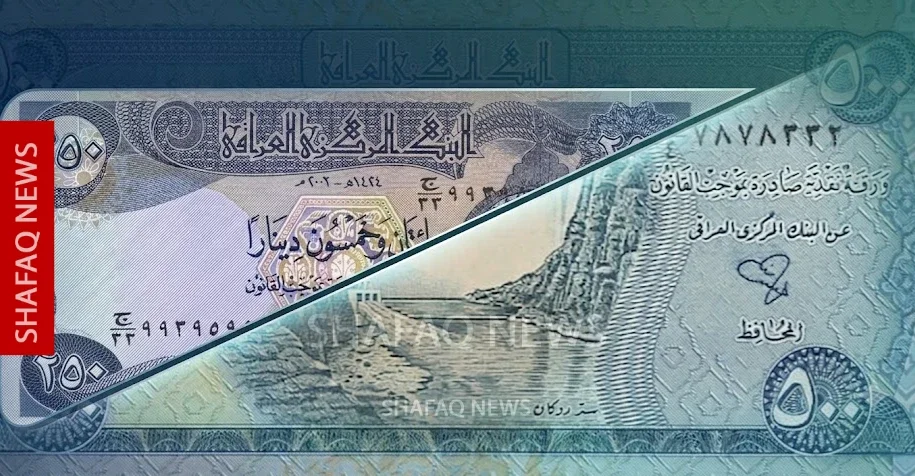
Why have small denominations disappeared from the markets? Al-Zaydi's advisor reveals the reasons.
The Prime Minister's financial advisor, Mazhar Muhammad Salih, revealed on Wednesday the reasons for the scarcity of small denominations of currency in Iraqi markets, stressing that this is mainly related to their paper nature and the high speed of their circulation, which leads to their deterioration within a short period of time.
Saleh told Shafaq News Agency that issuing currency in its various denominations is one of the core tasks of the Central Bank of Iraq, which is responsible for managing the currency and providing the necessary liquidity to meet the needs of economic activity and ensure the smooth flow of payments and the stability of cash transactions.
He explained that small denominations of currency represent the primary tool for conducting low-value daily transactions, which makes them the most commonly traded among citizens and markets, and therefore the most susceptible to wear and tear.
Saleh added that Iraq, unlike many countries that rely on coins for small denominations, still uses paper denominations, noting that the lifespan of these denominations does not exceed about one year according to international standards, due to the intensity of their use and their continuous transfer between hands, at a time when reliance on paper money remains high while electronic payment methods continue to grow.
He pointed out that the Central Bank has accurate indicators and statistics to measure the demand for different denominations of currency, and it is the first entity to sense the market’s need to issue or reprint any denomination, especially the small denominations, which are characterized by their rapid circulation compared to the large denominations, which tend to be more towards saving or hoarding.
The government advisor concluded his remarks by saying that "providing small denominations is not just about issuing currency, but also represents one of the indicators of efficient cash management, and contributes to ensuring the smooth flow of economic activity and the stability of the payments system," stressing that "these denominations are continuously monitored by the Central Bank of Iraq."
Iraqi markets are experiencing ongoing suffering due to the scarcity of small denominations of currency, such as 250 and 500 dinars, which puts citizens and shop owners in front of frequent difficulties in completing daily buying and selling transactions.
Sellers often resort to compensating for the shortage by giving alternative goods such as gum, tissues, or sweets instead of returning the change as in the markets, while others are forced to round up or down prices, which provokes consumer dissatisfaction. link
Tishwash: Coordination framework: Iraq's security and sovereignty cannot be violated or compromised under any circumstances.
The Coordination Framework affirmed that "Iraq's security and sovereignty are inviolable and cannot be compromised under any circumstances, and it rejects turning Iraq into an arena for regional and international conflicts."
A statement from the Coordination Framework's media office indicated that "the Framework held an emergency meeting Wednesday evening at the Government Palace to discuss the American-Saudi attacks on Iraq's sovereignty."
According to the statement, the Coordination Framework condemned the aggression targeting Iraqi territory, which resulted in the martyrdom of several members of the Popular Mobilization Forces and the injury of others, in a blatant violation of Iraq's sovereignty and territorial integrity, and in contravention of the principles of international law and the UN Charter.
The Framework expressed its astonishment at this attack, especially given the government's adoption of a balanced foreign policy based on building cooperative and partnership relations with its regional neighbors and the international community.
He offered his sincere condolences to the families of the martyrs and wished a speedy recovery to the wounded. He affirmed that Iraq's security and sovereignty are inviolable and cannot be compromised under any circumstances, and he rejected turning Iraq into an arena for regional and international conflicts.
He emphasized that "the attacks targeting Iraq and violating its sovereignty do not serve regional and international efforts aimed at containing the crisis and de-escalating tensions, but rather contribute to complicating the situation and threaten security and stability in the entire region." link
***************
Tishwash: Al-Aboudi: Three factions have begun handing over their weapons to the state, and talks are underway with Washington and Tehran to support the monopoly of arms.
National Security Advisor Qasim al-Aboudi revealed new developments in the file of restricting weapons to the state, stressing that the government held talks with the United States and Iran to support this path, while announcing that three factions have begun procedures to hand over their weapons to official institutions.
Al-Aboudi said in a televised statement that Prime Minister Ali Faleh al-Zaidi’s visit to Washington contributed to developing the course of Iraqi-American relations and moving them to the framework of economic partnership and security cooperation, indicating that the two sides agreed to resume training programs and security coordination, as well as discussing a number of joint files.
He explained that the issue of restricting weapons to the state requires dialogue with the various concerned parties, noting that some factions were linking their continued possession of weapons to the presence of American forces, and that an understanding regarding the end of their presence removes one of the justifications that were being put forward in this context.
He added that the government discussed the issue with the Iranian side, noting that Tehran expressed its readiness to support efforts to restrict weapons after being convinced of the withdrawal of US forces, stressing that Baghdad emphasized during the meetings its rejection of the use of Iraqi territory or targeting it in any conflict.
Al-Aboudi stressed that the government is committed to ending the presence of any weapons outside the framework of the state, noting that the next phase will witness new steps to strengthen the authority of official security institutions and consolidate the state’s monopoly on weapons. link
FRANK26….7-29-26…..THE FATHER OF ALL BANK STORIES
KTFA
Wednesday Night Video
FRANK26….7-29-26…..THE FATHER OF ALL BANK STORIES
This video is in Frank’s and his team’s opinion only
Frank’s team is Walkingstick, Eddie and Omar in Iraq and guests
Playback Number: 605-313-5163 PIN: 156996#
KTFA
Wednesday Night Video
FRANK26….7-29-26…..THE FATHER OF ALL BANK STORIES
This video is in Frank’s and his team’s opinion only
Frank’s team is Walkingstick, Eddie and Omar in Iraq and guests
Playback Number: 605-313-5163 PIN: 156996#
Bruce’s Big Call Dinar Intel Tuesday Night 7-28-26
Bruce’s Big Call Dinar Intel Tuesday Night 7-28-26
Transcribed By WiserNow Emailed To Recaps (INTEL ONLY)
Welcome everybody to the big call tonight. It's Tuesday, july 28, and you're listening to the big call. Welcome everybody, and I hope everybody is finding themselves in a nice state of mind and state of health, and looking forward to everything that we have to say on tonight's call.
And I'm looking forward to giving my segment, but listening to Sue and Bob.
Now I'm going to get into the Intel portion of my segment. So thanks, Sue, for participating, and everybody else.
Okay, we got some really interesting things today, and I was almost hoping I would get a call during the big call to confirm something that I'm going to talk about in a minute.
Bruce’s Big Call Dinar Intel Tuesday Night 7-28-26
Transcribed By WiserNow Emailed To Recaps (INTEL ONLY)
Welcome everybody to the big call tonight. It's Tuesday, july 28, and you're listening to the big call. Welcome everybody, and I hope everybody is finding themselves in a nice state of mind and state of health, and looking forward to everything that we have to say on tonight's call.
And I'm looking forward to giving my segment, but listening to Sue and Bob.
Now I'm going to get into the Intel portion of my segment. So thanks, Sue, for participating, and everybody else.
Okay, we got some really interesting things today, and I was almost hoping I would get a call during the big call to confirm something that I'm going to talk about in a minute.
You know, you guys know that we're very close on this thing. You know how antsy I get when we get toward the end of the month.
What do we have left in the month? Three days left: 29, 30/31, Right. And I'm thinking, okay, all right. Well, what we've heard today.
Remember, a lot of sources have dried up, but we do have some information that came from a couple of different sources that are that are very reliable. First of all, let me just say what we're getting is that Redemption Center leaders have been contacted, and they've been told that they have to go in to the Redemption Center before noon on Thursday,
and this is where it gets really interesting.
And continue on a schedule to go 21 days, beginning Thursday for 21 days, including Sundays, ostensibly, this is for exchanges to be taking place, redemption of Zim, and exchanges of currencies at the redemption centers.
I have to be very clear in saying that at redemption centers, which use the toll-free number to set the appointments for those redemption centers that are close to your zip code.
All right. Now I'm making a point of this because what we're hearing is, we have some information that says that we will be able to exchange starting as early as Friday, and it appears that it could be as early as Thursday afternoon, or Friday, and we've also heard that from one of the bond paymasters that they are supposed to be receiving the fund for bondholders into the paymaster's accounts on Friday, so they can disseminate or distribute those funds beginning on Saturday to the actual bondholders' individual accounts.
So it's a Friday Saturday start that is projected for the bondholders - Friday into the paymaster's accounts, and then he turns around and puts them into the bondholders' accounts on Saturday.
Saturday is guess what, the first day of August, and you know I get squirrely about the end of the month thing. Are they going to do something with us on the last day or last two days of the month, or are they going to defer to the first of August, which would be Saturday?
Now I'm being told the people that are in the exchange positions that we could start as early as Thursday afternoon. That's only a few days away, or maybe on Friday.
Now, this is the interesting thing that's coming to me now. We heard this piece of information that came this afternoon, and I can't tell you where it came from exactly, but what I find interesting is the intel, which I have not proven. We haven't confirmed it. This is right now is what we would call hyperbole or unproven.
Supposedly, the banks will are not "quote unquote" ready to exchange yet, and that they would be ready to exchange starting the 20th or 21st of August.
Now, isn't that interesting?
So, banks might not be ready to exchange until the 20th or 21st first of August, and yet redemptions are prepared to exchange as early as the 20 or the 30th of July and go 21 days, which would take them to the 20th of of August.
You see what I'm trying to get at here? Are we literally going first with redemption centers with banks to follow, and them, yeah.
See, the reason I say that, Sue, is all right. Here's my theory. This is only my theory on it. I don't have this proven, but we know that when we go to redemption centers, the first thing we do is KYC, know your customer.
They'll take your picture, make sure you're not a mass murderer, make sure you're okay, make sure you're not on some kind of wanted list, and then boom, you get started with know your customer.
They they sit you down and all that good stuff. Basically, it's a simple thing. They know who the Zim holders are, except for people that were gifted Zim.
They've approximated the number of people who have been gifted Zim. They don't absolutely know, but they've got an idea. All right, here's the point: they've got us in there, and they want this incredible exchange, not only current currencies, but redemption of ZIM, not to go to the deep state, not to go to bad people.
Okay, so is it conceivable that we are going first Because everybody essentially, if they want to get exchanged and they have Zim to redeem, they have to use the redemption centers.
It's a theory, and it sort of makes sense because that way everybody need even if they go to a bank and a bank says no. Listen, you need to make an appointment.
Here's the number to call to set your appointment to go to a redemption center because they're not going to exchange. They're not going to redeem them at the banks anyway, and the rates on the dinar are not going to be what the contract rate is at the redemption center.
I've told you guys this for how long? Two years, so so that's a theory. I just I think that's so. There's no such thing as coincidence, and I think this makes sense that the banks would actually start after the redemption centers went for three weeks, 21 days.
So. I think that's interesting that we got that information. I hoped I would be able to prove it before the call and confirm it, but I'm just going to say let's take this as hearsay.
It may be true, but it does not affect our start date at the Redemption Centers, we should start Thursday or Friday of this week, based on the information that we're getting.
And I'm going with it. I'm going with it Now there are rates that are populating on the screens in the last two days and today, there were no rates.
The last two days prior, there were rates on screens, and I know that Sunday and Monday. I know that today, no rates doesn't mean a thing. They'll bring their rates up when we get started, when we get ready to go.
And guess how many rates are on the screens? How many positions for rates? 51 - 51currencies. That's fantastic. That's a lot of currencies.
And our understanding is there's no second or third basket. One and done. One basket.
One currency. You got them. Smoke them.
That's the old expression from World War II. We don't smoke. We don't believe in smoking, but you got them. Exchange them.
So I think that's amazing.
And other intel type information. I understand that we're going to have a memorandum of Understanding with Iran that they will sign on Friday that essentially give us what we need to move forward with Iran. They have no money.
They the there's no money coming in from UK or other. They've basically been frozen out. They're they they're surrendering. Finally, they're doing a surrender. That's what it amounts to. They may not call it that, but that's what it amounts to.
And I think that's great. It comes down to the fact that President Trump knows what he's doing-it might not look pretty all the time, but I think it's it's a good thing. And if we can put that to bed and get something going between Zelensky, who was supposed to be today, I didn't see him on. Said I didn't watch the news at all, but I don't know if he was in meeting with the president or not today.
Theoretically, was going to be there for the funeral of Lindsey Graham. So I don't know what happened or if they met before or after that. But I'm hoping we can get a deal with Zelensky and Russia and put that whole thing to bed. Cuba is in the new sum now.
I know we want to make a move to to change their form of government to get out of communism, and so that's that's what should be happening.
I know that there is so much. You guys know when I say there's cleanup on aisle 3 / 4 / 5, and so on. What that's referring to, there's a lot of cleanup underway, a lot of it globally.
It should. I mean, I can't even tell you how many. It's big numbers, and it should be done theoretically by Sunday. Quite possibly by Sunday.
But I'm hoping and believing that we will get those numbers.
Listen, if we're going to be exchanging Thursday afternoon, we need to get numbers by either tomorrow or Thursday morning.
So I'm just going to leave you with that.
I'm excited about this information. I'd love to confirm that whole thing about are the banks ready or not ready? Why? Why wouldn't they be ready?
I don't know. I just I think it's being done to stagger this Exchange opportunity so that Zim holders obviously they want us to get in go first we know that you know but are we literally going to redemption centers only no bank until the 20th or 21st of August now that's what we've heard I'm not confirming it. I'm just saying it's out there.
We'll see, and hopefully we have this thing confirmed or denied by Thursday night's call, and maybe we'll have our numbers by then, and it'll be a moot point, won't it? At least For us, I'm glad that Sue was here tonight and Bob to hear this, and also to hear about the food loops. ? Thank you, Sue, for for knowing about that.
So let's just-and I have to thank Big Call Universe, you guys, for just being a part of the big call, I can't wait to tell you guys everything one day, but stay tuned even after this goes.
Maybe not live calls anymore, but yeah, I'll do a recorded call and put it in an email that'll go out to everybody that wants to be part of Rebuild America.
Okay, so let's just let's just go ahead and look forward to the next couple of days, and let's see if we get our notifications tomorrow or Thursday. All right, so let's pray the call out.
Well, good night, everybody, and have a good night. And we look forward to talking with you on Thursday night. Okay. God bless
Bruce’s Big Call Dinar Intel Tuesday Night 7-28-26 REPLAY LINK Intel Begins 1:34:24
Bruce’s Big Call Dinar Intel Thursday Night 7-23-26 REPLAY LINK Intel Begins 1:27:10
Bruce’s Big Call Dinar Intel Tuesday Night 7-21-26 REPLAY LINK Intel Begins 1:30:35
Bruce’s Big Call Dinar Intel Thursday Night 7-16-26 REPLAY LINK Intel Begins 1:14:00
Bruce’s Big Call Dinar Intel Tuesday Night 7-7-26 REPLAY LINK Intel Begins 1:03:15
https://www.freeconferencecallhd.com/wall/recorded_audio?audioRecordingUrl=https%3A%2F%2Frs0002.freeconferencecall.com%2Fstorage%2FsgetHD%2FHsCgW%2FO7eM
Bruce’s Big Call Dinar Intel Thursday Night 7-9-26 REPLAY LINK Intel Begins 1:10:20
Bruce’s Big Call Dinar Intel Tuesday Night 7-7-26 REPLAY LINK Intel Begins 1:19:00
https://www.freeconferencecallhd.com/wall/recorded_audio?audioRecordingUrl=https%3A%2F%2Frs0002.freeconferencecall.com%2Fstorage%2FsgetHD%2FHsCgW%2FO79O
Bruce’s Big Call Dinar Intel Thursday Night 7-2-26 REPLAY LINK Intel Begins 1:14:14
Bruce’s Big Call Dinar Intel Tuesday Night 6-30-26 REPLAY LINK Intel Begins 1:13:15
Seeds of Wisdom RV and Economics Updates Wednesday Evening 7-29-26
Good Evening Dinar Recaps,
U.S.-Iran Conflict Escalates Again: Military Strikes, Hormuz Tensions, and New Sanctions Raise Global Economic Risks
Renewed military action, expanded sanctions, and growing instability in the Strait of Hormuz are increasing pressure on global energy markets while further complicating diplomatic efforts between Washington and Tehran.
Good Evening Dinar Recaps,
U.S.-Iran Conflict Escalates Again: Military Strikes, Hormuz Tensions, and New Sanctions Raise Global Economic Risks
Renewed military action, expanded sanctions, and growing instability in the Strait of Hormuz are increasing pressure on global energy markets while further complicating diplomatic efforts between Washington and Tehran.
Overview
The U.S.-Iran conflict intensified again as Iran launched missile attacks targeting U.S. forces in Jordan, prompting retaliatory U.S. and allied military operations against Iran-backed militias in Iraq. Diplomatic efforts have not completely collapsed, but active military operations have once again taken center stage.
The Strait of Hormuz remains the central flashpoint. Iran has rejected proposals regarding management of the strategic waterway while renewed attacks on shipping continue to disrupt one of the world's most important energy corridors.
The United States simultaneously expanded economic pressure, announcing new sanctions targeting Iranian shipping, maritime insurance networks, and vessels linked to Iran's energy exports, demonstrating that Washington is combining military, diplomatic, and financial pressure.
Key Developments
1. Military Confrontation Intensifies
The conflict entered another dangerous phase after Iran launched ballistic missile attacks against U.S. forces stationed in Jordan.
The United States reported intercepting the incoming missiles before responding with coordinated strikes against Iran-backed militia positions in Iraq, signaling that military deterrence remains a central component of U.S. strategy.
2. Strait of Hormuz Remains the Critical Battleground
The Strait of Hormuz continues to be the world's most strategically important oil chokepoint, carrying a significant portion of global crude oil and liquefied natural gas shipments.
Recent attacks on vessels, combined with Iran's rejection of new proposals concerning management of the waterway, have renewed fears that shipping disruptions could continue well into the summer.
3. Sanctions Campaign Expands
Rather than relying solely on military action, the U.S. Treasury announced another round of sanctions targeting companies, insurers, and tankers connected to Iran's maritime operations.
The expanded sanctions are designed to restrict Iran's ability to finance military activities through oil exports while increasing economic pressure on the Iranian government.
4. Diplomacy Has Not Ended—But It Has Become More Difficult
Although fighting has intensified, communications between Washington and Tehran have not completely disappeared.
The earlier Memorandum of Understanding and previous indirect negotiations created channels for future discussions. However, continued military exchanges have significantly reduced confidence and complicated efforts to return to meaningful negotiations.
5. Markets Respond to Growing Uncertainty
Energy markets immediately reacted to the renewed escalation.
Oil prices moved higher as investors priced in increased geopolitical risk, while global markets monitored the potential impact on inflation, shipping costs, and central bank policy if disruptions continue.
Why It Matters
The renewed escalation demonstrates how quickly geopolitical conflict can affect energy markets, inflation, global trade, and financial stability.
The combination of military operations, sanctions, and uncertainty surrounding the Strait of Hormuz places additional pressure on central banks already attempting to balance inflation control with slowing economic growth. Continued instability also increases risks for global supply chains and international commerce.
Why It Matters to Foreign Currency Holders
Higher oil prices can strengthen inflationary pressures across many economies.
Rising geopolitical uncertainty often increases demand for safe-haven assets and reserve currencies.
Currency markets may remain volatile as investors respond to developments affecting global energy supplies and international trade.
Implications for the Global Reset
Pillar 1: Energy
Continued instability in the Strait of Hormuz highlights how critical energy security remains to the global financial system. Disruptions to oil shipments influence inflation, central bank policy, and economic growth around the world.
Pillar 2: Trade
The conflict demonstrates how strategic shipping routes have become central to global commerce. Prolonged disruptions could increase transportation costs, alter supply chains, and accelerate efforts by many nations to diversify critical trade routes.
Conclusion
The latest developments show that the U.S.-Iran conflict has entered another period of heightened uncertainty despite earlier diplomatic progress.
While negotiations have not formally ended, military actions and expanding sanctions are currently driving events far more than diplomacy.
This is not simply about another military confrontation—it reflects the growing intersection of geopolitics, global energy security, international trade, and financial stability as governments navigate an increasingly fragile global economic system.
Seeds of Wisdom Team
Newshounds News™ Exclusive
Sources
~~~~~~~~~~
Seeds of Wisdom Team RV Currency Facts Youtube and Rumble
Newshound's News Telegram Room Link
RV Facts with Proof Links Link
RV Updates Proof links - Facts Link
Start Here room with Most Asked Questions Link
Follow the Gold/Silver Rate COMEX
Follow Fast Facts
Seeds of Wisdom Team™Website
Thank you Dinar Recaps
Rob Cunningham: The Emerging Blockchain-based Financial System
Rob Cunningham: The Emerging Blockchain-based Financial System
7-29-2026
If we treat the emerging blockchain-based financial system as an integrated monetary architecture, these four functions are not equally scarce or economically valuable.
A reasonable ranking is:
1: Liquidity
The irreplaceable “bloodstream” of the system. Without available capital to bridge buyers and sellers, markets seize regardless of how perfect the technology is.
Rob Cunningham: The Emerging Blockchain-based Financial System
7-29-2026
If we treat the emerging blockchain-based financial system as an integrated monetary architecture, these four functions are not equally scarce or economically valuable.
A reasonable ranking is:
1: Liquidity
The irreplaceable “bloodstream” of the system. Without available capital to bridge buyers and sellers, markets seize regardless of how perfect the technology is.
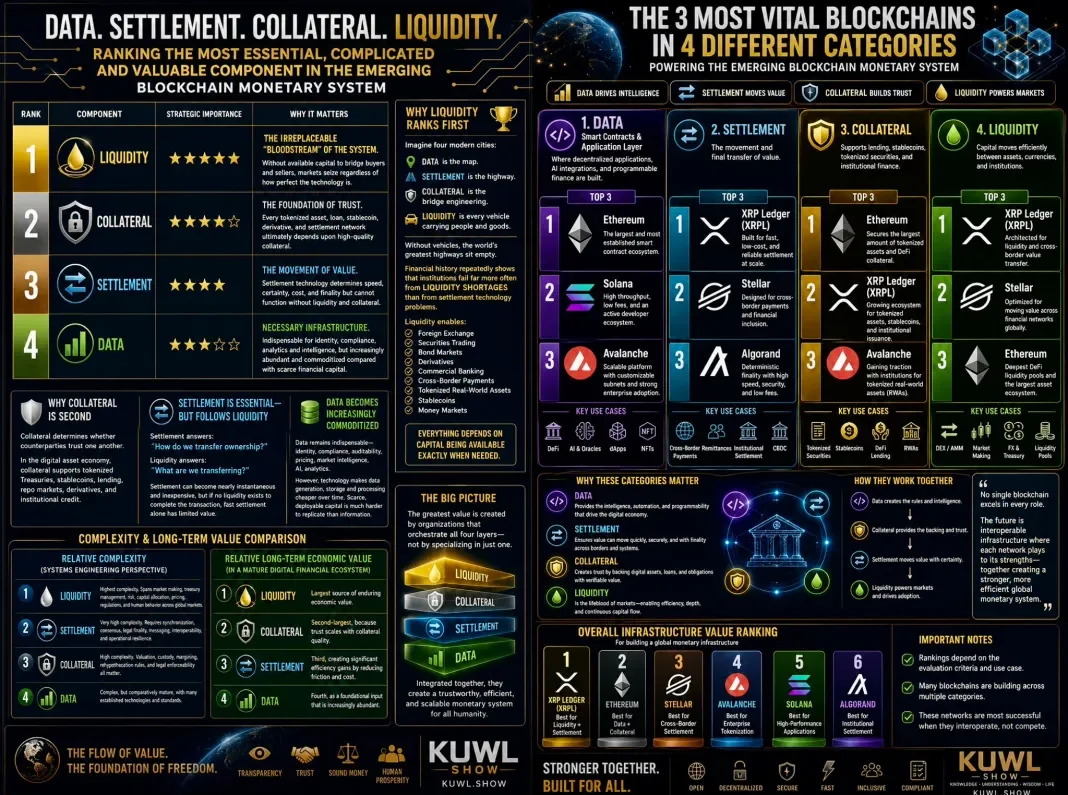
2: Collateral
The foundation of trust. Every tokenized asset, loan, stablecoin, derivative, and settlement network ultimately depends upon high-quality collateral.
3: Settlement
The movement of value. Settlement technology determines speed, certainty, cost, and finality but cannot function without liquidity and collateral.
4: Data
Necessary infrastructure, but increasingly abundant and commoditized compared with scarce financial capital.
Why liquidity ranks first
Imagine four modern cities:
1 – Data is the map.
2 – Settlement is the highway.
3 – Collateral is the bridge engineering.
4 – Liquidity is every vehicle carrying people and goods.
Without vehicles, the world’s greatest highways sit empty.
Financial history repeatedly shows that institutions fail far more often from liquidity shortages than from settlement technology problems. Even solvent organizations can collapse if they cannot access liquidity when needed.
Liquidity enables:
Foreign exchange
Securities trading
Bond markets
Derivatives
Commercial banking
Cross-border payments
Tokenized real-world assets
Stablecoins
Money markets
Everything depends on capital being available exactly when needed.
Why collateral is second
Collateral determines whether counterparties trust one another.
In the digital asset economy, collateral supports:
tokenized Treasuries
stablecoins
lending
repo markets
derivatives
institutional credit
The larger the economy becomes, the more valuable transparent, high-quality collateral becomes.
Settlement is essential – but follows liquidity
Settlement answers:
“How do we transfer ownership?”
Liquidity answers:
“What are we transferring?”
Settlement technology can become nearly instantaneous, inexpensive, and automated. That improves efficiency, but if no liquidity exists to complete the transaction, fast settlement alone has limited value.
Data becomes increasingly commoditized
Data remains indispensable:
identity
compliance
auditability
pricing
market intelligence
AI
analytics
However, technological progress generally makes data generation, storage, and processing cheaper over time.
Scarce, deployable capital is much harder to replicate than information.
Overall Relative Complexity
From a systems engineering perspective:
1) Liquidity – Highest complexity. It spans market making, treasury management, risk, capital allocation, pricing, regulations, and behavior across global markets.
2) Settlement – Very high complexity. It requires synchronization, consensus, legal finality, messaging, interoperability, and operational resilience.
3) Collateral – High complexity. Valuation, custody, margining, rehypothecation rules, and legal enforceability all matter.
4) Data – Complex, but comparatively mature, with many established technologies and standards.
Relative long-term value
As a broad conceptual framework for a mature digital financial ecosystem:
1) Liquidity – Largest source of enduring economic value.
2) Collateral – Second-largest, because trust scales with collateral quality.
3) Settlement – Third, creating significant efficiency gains by reducing friction and cost.
4) Data – Fourth, as a foundational input that is increasingly abundant.
In practice, the greatest value is often created by organizations that combine these layers rather than specializing in only one. A platform that can orchestrate liquidity, collateral, settlement, and trusted data together is positioned to capture more of the economic value than one that optimizes a single function.
Source(s):
• https://x.com/KuwlShow/status/2082248991782076843
The Next Market Crash will be Nothing like 2008: Mark Moss
The Next Market Crash will be Nothing like 2008: Mark Moss
7-29-2026
For decades, the standard playbook for navigating a major market downturn has been relatively straightforward: liquidate risky positions, move to cash, and wait for the dust to settle before buying back in at undervalued prices.
However, according to an insightful analysis by financial educator Mark Moss, this traditional strategy may no longer be viable. The modern economic landscape is shaped by unprecedented forces—specifically, record-breaking levels of institutional leverage and the certainty of rapid government intervention—meaning the next market correction will behave very differently than those of the past.
The Next Market Crash will be Nothing like 2008: Mark Moss
7-29-2026
For decades, the standard playbook for navigating a major market downturn has been relatively straightforward: liquidate risky positions, move to cash, and wait for the dust to settle before buying back in at undervalued prices.
However, according to an insightful analysis by financial educator Mark Moss, this traditional strategy may no longer be viable. The modern economic landscape is shaped by unprecedented forces—specifically, record-breaking levels of institutional leverage and the certainty of rapid government intervention—meaning the next market correction will behave very differently than those of the past.
Investors who rely solely on holding cash risk being left behind in the subsequent recovery.
The primary catalyst for the next major market disruption lies in the extreme leverage embedded within institutional trading and complex derivative markets.
Today, financial institutions operate with massive debt-to-equity ratios, meaning that even a minor, unexpected economic trigger can set off a domino effect of margin calls and forced liquidations.
When highly leveraged entities are forced to sell assets to cover their debts, it creates a rapid, cascading downward spiral. While this sounds like a traditional market correction, the speed and velocity of these modern, automated sell-offs mean that a downturn could occur much faster than in previous eras, catching unprepared investors off guard.
However, the real danger for investors is not just the initial drop in asset prices, but the inevitable policy response that will follow.
In a highly interconnected global economy, central banks and governments cannot afford a prolonged, systemic deleveraging process without risking a complete economic freeze. As a result, any sharp market decline is highly likely to be met with swift and aggressive policy rescues, such as interest rate cuts and massive liquidity (often referred to as money printing).
This intervention will effectively cut the market correction short, rapidly pushing asset prices back up before a traditional, prolonged “market bottom” can fully form. Consequently, the window of opportunity to buy assets at deep discounts will be incredibly narrow.
Because of this rapid-intervention cycle, holding cash for too long poses a major strategic risk. While cash provides necessary liquidity during a panic, its purchasing power is rapidly eroded when central banks flood the system with new currency to rescue the economy.
The key to surviving and thriving in this environment is owning genuinely scarce assets. Assets with a fixed or strictly limited supply—such as gold, prime real estate, scarce energy resources, critical infrastructure, and Bitcoin—serve as a crucial hedge.
These assets are uniquely positioned to absorb the massive influx of newly created currency, causing their valuations to soar even as the broader economy faces structural challenges.
Furthermore, the rise of artificial intelligence and advanced technology is driving down the cost of producing abundant goods, making true physical and digital scarcity even more valuable. In a world where technology can replicate and produce almost anything in abundance, assets that cannot be easily copied or inflated become the ultimate store of value.
Therefore, successful portfolio positioning in the modern era requires a delicate balancing act. Investors must maintain enough liquidity (cash or cash equivalents) to withstand sudden market volatility and meet immediate obligations, while simultaneously ensuring they hold deep exposure to scarce, hard assets that will capture the massive upside once the inevitable policy-driven rescue begins.
Navigating the complexities of modern financial markets requires moving away from outdated investment dogmas and adapting to a world of high leverage and rapid central bank intervention.
To gain a deeper understanding of these macroeconomic shifts and learn how to position your wealth for the future, be sure to watch the full video from Mark Moss on YouTube, where he breaks down these concepts with detailed data and actionable insights.
0:00 - China Just Attacked the Gold Market
1:12 - The Reverse Market Crash
3:15 - The Leverage Time Bomb
5:42 - What Could Trigger the Next Crash?
12:30 - Why 2008 was Different
15:34 - Why the Rescue Makes it Worse
19:05 - How to Position Before the Rescue
Seeds of Wisdom RV and Economics Updates Wednesday Afternoon 7-29-26
Good Afternoon Dinar Recaps,
Federal Reserve Holds Rates Steady: Inflation Progress Meets Rising Global Risks
The Federal Reserve kept interest rates unchanged as easing inflation was balanced against higher energy prices and geopolitical uncertainty, signaling that policymakers remain cautious about the next move.
Good Afternoon Dinar Recaps,
Federal Reserve Holds Rates Steady: Inflation Progress Meets Rising Global Risks
The Federal Reserve kept interest rates unchanged as easing inflation was balanced against higher energy prices and geopolitical uncertainty, signaling that policymakers remain cautious about the next move.
Overview
The Federal Reserve voted on July 29, 2026, to leave its benchmark interest rate unchanged at 3.50%–3.75%. The decision reflects confidence that inflation has moderated while recognizing that new risks have emerged from rising oil prices and global instability.
Although inflation has cooled in recent months, it remains above the Fed's long-term 2% target. Policymakers indicated they need additional evidence before making another policy adjustment, particularly as Middle East tensions continue influencing energy markets.
The decision underscores the delicate balance facing central banks worldwide. Stable interest rates may support economic growth, but persistent inflation and geopolitical shocks could still require tighter monetary policy later this year.
Key Developments
1. Federal Reserve Holds Rates Steady
The Federal Open Market Committee voted to maintain the federal funds rate at 3.50%–3.75%, extending its pause while evaluating incoming economic data.
Officials stated that the U.S. economy continues to expand, employment remains stable, and inflation has eased but has not yet returned to the Fed's objective.
2. Inflation Has Improved but Risks Remain
Recent inflation readings have shown encouraging progress, giving policymakers room to pause.
However, higher energy prices linked to renewed Middle East tensions could place upward pressure on future inflation, making the Fed cautious about declaring victory.
3. Rare Division Among Federal Reserve Officials
The vote was 9-3, with three Federal Reserve officials favoring an immediate quarter-point rate increase rather than holding rates steady.
The unusual level of dissent illustrates that policymakers remain divided over whether inflation risks have truly subsided.
4. Markets Shift Focus to the Next Meeting
Financial markets are now closely watching upcoming inflation reports, employment data, and developments in global energy markets before the Fed's September meeting.
Any renewed inflation pressure could increase expectations for another rate hike later this year.
Why It Matters
The Federal Reserve's decision affects borrowing costs, investment activity, housing, consumer spending, and financial markets throughout the global economy.
For investors, today's announcement reinforces that monetary policy remains data dependent, with inflation and geopolitical developments likely determining the Fed's next move. Central banks worldwide continue facing the challenge of supporting economic growth while maintaining price stability.
Why It Matters to Foreign Currency Holders
Stable U.S. interest rates help support confidence in the U.S. dollar.
Future inflation and energy prices will influence global capital flows and currency values.
Any future rate increases could strengthen the dollar while placing pressure on many foreign currencies.
Implications for the Global Reset
Pillar 1: Debt
Higher-for-longer interest rates continue increasing borrowing costs for governments, businesses, and consumers. Elevated financing costs place additional pressure on highly indebted economies while reinforcing the importance of fiscal discipline.
Pillar 2: Energy
Renewed geopolitical tensions affecting global oil supplies demonstrate how energy prices remain one of the most important drivers of inflation. Energy market disruptions continue influencing central bank policy decisions worldwide.
Conclusion
The Federal Reserve's decision to leave rates unchanged reflects growing confidence that inflation is moving in the right direction while recognizing that important risks remain.
Although inflation has eased, policymakers are unwilling to declare victory until price stability becomes more firmly established.
This is not simply about one interest-rate decision—it reflects how central banks are navigating the intersection of inflation, energy security, and global geopolitical risk as the international financial system continues to evolve.
Seeds of Wisdom Team
Newshounds News™ Exclusive
Sources
CNBC — Fed Meeting Live Updates: Federal Reserve Holds Rates Steady
Reuters — Uncertainty Creeps Into Fed's Rate Decision as Warsh Keeps His Cards Hidden
~~~~~~~~~~
Seeds of Wisdom Team RV Currency Facts Youtube and Rumble
Newshound's News Telegram Room Link
RV Facts with Proof Links Link
RV Updates Proof links - Facts Link
Start Here room with Most Asked Questions Link
Follow the Gold/Silver Rate COMEX
Follow Fast Facts
Seeds of Wisdom Team™Website
Thank you Dinar Recaps
The Biggest Winners Of This War Don't Pump A Single Barrel
The Biggest Winners Of This War Don't Pump A Single Barrel
Notes From the Field By James Hickman (Simon Black / Sovereign Man) July 28, 2026
How much do you think it would cost to send a supertanker, one of the giant ships that move the world's crude oil, through a narrow stretch of water that is full of mines, where missiles hit two tankers in early July, and where a crew member has already been killed?
Last month, one shipowner agreed to make that run— through the Strait of Hormuz— for nearly $470,000 per day.
The Biggest Winners Of This War Don't Pump A Single Barrel
Notes From the Field By James Hickman (Simon Black / Sovereign Man) July 28, 2026
How much do you think it would cost to send a supertanker, one of the giant ships that move the world's crude oil, through a narrow stretch of water that is full of mines, where missiles hit two tankers in early July, and where a crew member has already been killed?
Last month, one shipowner agreed to make that run— through the Strait of Hormuz— for nearly $470,000 per day.
For perspective, in the first few months of last year, before the war, the biggest crude tankers on earth were earning as little as $36,000 a day.
The ships collecting these fortunes don't produce anything at all. They don't pump oil, they don't refine it, and they don't sell it. They just carry it from one place to another.
And that is exactly why they have become the biggest winners of this war.
When Iran effectively closed the Strait of Hormuz in late February, oil spiked to $120 a barrel in March, then calmed as ceasefires came and went. But all the while, tanker rates just kept climbing.
That's because of the arithmetic that drives the shipping business; it’s simple to understand— when the strait became too dangerous to navigate, everything had to be rerouted. So instead of a quick voyage through the strait, cargo had to be transported through far more complicated means... and ships had to sail much longer routes to avoid the danger.
The end result is that oil from the region now crosses far more ocean, and every voyage takes a LOT longer. This means ships are tied up for longer... driving demand higher for shipping.
And it’s not like this problem can be eliminated by simply adding more ships to the global fleet; supertankers take years to build, and shipyards spent the past decade producing very few.
That last part matters, because it is the reason this windfall was visible long before anyone had heard of this war.
One of the largest supertanker owners earned more than $100 million in the first quarter, excluding one-off gains from selling ships, as its fleet was making roughly two and a half times as much per day as a year earlier.
The company paid out every penny of it as a dividend, extending a streak of quarterly payouts stretching back more than fifteen years. And the second quarter will be even better: by early May, it had already booked most of its available days at nearly double its first-quarter rate.
Another major tanker owner reported nearly $200 million in profit for the quarter and declared the largest dividend in its history.
Tankers are not the only winners. One owner of bulk carriers— the ships that haul iron ore, grain, and coal— has become the target of a takeover battle in which a rival has raised its offer again and again, and the board keeps rejecting bids it says still undervalue the fleet.
All three companies are on the research list of Schiff Sovereign's investment newsletter, Strategic Assets.
They were featured in 2023 and 2024, back when shipping was about as unloved as a business can be. That was the point. Shipping moves in long cycles, and the bottom is where the next shortage is easiest to see... because years of terrible rates had stopped owners from ordering ships, and a ship ordered today does not carry cargo for three years.
Counting the ships that would exist in 2026 took no view on Iran— only a public order book.
They met a strict set of criteria: profitable, little or no debt, trading cheap against current cash flow, and operating in an industry with an aging fleet and hardly any new construction on order.
The war revealed that setup; it did not create it. As of early July, one tanker owner had more than doubled since being featured, the other was up more than 90%, and the bulk carrier owner was up more than 50% on a takeover bid rather than a rate spike.
The tankers keep paying quarterly dividends, and one payout alone equals almost 10% of the share price when that company was first featured.
We expect this pattern to repeat across real assets.
The world spent a decade underinvesting in the physical things civilization runs on: ships, mines, oil fields, refineries, smelters. Now geopolitics has turned violent. When there is no spare capacity, every disruption has to be resolved by price, and the companies that own the scarce assets collect the difference.
To be clear, we are not permabulls, and rates like these will not last forever. A durable peace would bring tanker earnings down hard, and shipping has punished euphoric buyers many times before.
Our edge is not predicting wars or commodity prices. It is applying strict criteria to well-run companies, making the case to buy when they meet the bar, and to sell when they no longer do.
That discipline is working. Of the more than twenty companies currently on the research list, six are showing a loss. The companies that we closed out returned an average of 172%.
A silver producer gained more than 950% in under a year, and others returned 540%, 240%, and 150%.
To your freedom, James Hickman Co-Founder, Schiff Sovereign LLC
MilitiaMan & Crew: Latest Iraq Dinar News & Intel: Militia Man Crew Analysis
MilitiaMan & Crew: Latest Iraq Dinar News & Intel: Militia Man Crew Analysis
7-29-2026
The Crew: Samson, PompeyPeter, Petra, Daytrader, Sunkissed, GIGI and Militia Man
No drama. No intrigue. No songs and dances. Just straight, factual news that I read and interpret to the best of my ability after being an avid Dinar investor and insanely obsessed Dinarian for over 15 years.
Follow MM on X == https://x.com/Slashn
MilitiaMan & Crew: Latest Iraq Dinar News & Intel: Militia Man Crew Analysis
7-29-2026
The Crew: Samson, PompeyPeter, Petra, Daytrader, Sunkissed, GIGI and Militia Man
No drama. No intrigue. No songs and dances. Just straight, factual news that I read and interpret to the best of my ability after being an avid Dinar investor and insanely obsessed Dinarian for over 15 years.
Follow MM on X == https://x.com/Slashn
Be sure to listen to full video for all the news……..
Ross: IQD Revaluation Stuff Right here
Ross: IQD Revaluation Stuff Right here
7-29-2026
IQD RV stuff right here, I don’t care what anyone says.
Why this matters for the revaluation of IQD.
Watch on X: https://twitter.com/i/status/2082166344217149740
1. Authority is being asserted, not negotiated.
Ross: IQD Revaluation Stuff Right here
7-29-2026
IQD RV stuff right here, I don’t care what anyone says.
Why this matters for the revaluation of IQD.
Watch on X: https://twitter.com/i/status/2082166344217149740
1. Authority is being asserted, not negotiated.
Old Iraq style = ministers can stall mega-projects for factional, Iranian, or personal reasons and nothing happens.
New Iraq under al-Zaidi = the PM humiliates you on live TV next to a major foreign leader until you execute. That is a different operating system.
2. Development Road is not a side project.
This is the multi-billion-dollar rail + highway corridor from Al-Faw Grand Port up through Iraq into Turkey and then Europe.
It is the single biggest non-oil economic bet Iraq has. It turns the country into a transit hub, generates real non-oil revenue, and is designed to pull serious FDI.
Delaying the signature was not bureaucracy — it was resistance. Al-Zaidi just crushed that resistance in public.
3. Optics + substance landed together.
This happened during a visit that also delivered:
Turkish state oil company TPAO taking a 15% stake in the BP-operated Kirkuk fields (3 billion barrels).
Talk of ramping Iraqi oil to Turkey toward 1 million bpd.
New pipeline discussion.
So you get both the infrastructure corridor and deeper energy integration with Turkey in the same trip.
That is economic sovereignty work, not photo-op diplomacy.
4. The resistance itself is the tell.
The minister’s hesitation (and the “WhatsApp” reply) fits the pattern of the old guard / Iranian-leaning elements still trying to slow-walk strategic files.
Al-Zaidi overrode it on camera.
That is the exact behavior IQD investors have been waiting to see from the new government: less consensus theater, more forced execution on the files that actually matter for fiscal strength and investor confidence.
Source(s):
• https://x.com/Ross_ptm/status/2082254083843621247
https://dinarchronicles.com/2026/07/29/ross-iqd-revaluation-stuff-right-here/