
Iraq Economic News and Points To Ponder Wednesday Evening 7-22-26
Oil Prices Climb To Five-Week High On US-Iran Conflict
2026-07-22 01:18 Shafaq News Oil prices extended gains on Wednesday as fears of further supply disruptions intensified after U.S. forces struck Iranian military targets for the 11th straight night, while oil tankers made U-turns in the Red Sea after warnings by Iran-backed Houthi militia.
Brent crude futures rose $1, or 1.1%, to $92.01 a barrel at 0330 GMT. U.S. West Texas Intermediate crude climbed 82 cents, or 1.0%, to $85.16.
Oil Prices Climb To Five-Week High On US-Iran Conflict
2026-07-22 01:18 Shafaq News Oil prices extended gains on Wednesday as fears of further supply disruptions intensified after U.S. forces struck Iranian military targets for the 11th straight night, while oil tankers made U-turns in the Red Sea after warnings by Iran-backed Houthi militia.
Brent crude futures rose $1, or 1.1%, to $92.01 a barrel at 0330 GMT. U.S. West Texas Intermediate crude climbed 82 cents, or 1.0%, to $85.16.
The gains came after oil settled at a five-week high on Tuesday in the wake of U.S. forces striking targets in southern and western Iran, while Iran attacked U.S. facilities in Bahrain, Kuwait and Jordan.
The U.S. military said it began its latest strikes on Iran late on Tuesday in the United States, or early Wednesday in Iran. The U.S. attacks came a short while after the Kuwaiti army said its air defences were intercepting Iranian drones on Wednesday.
The constant trading of strikes have raised fears of further disruptions to global energy supplies after Yemen's Iran-aligned Houthis opened a new front in the Iran war by threatening to target vessels carrying Saudi oil in the Bab el-Mandeb Strait and announcing a naval blockade of Saudi Arabia.
The Bab el-Mandeb waterway at the southern entrance to the Red Sea has become an increasingly important route for Saudi crude exports as traffic through the Strait of Hormuz has fallen sharply since a ceasefire between the United States and Iran collapsed earlier this month.
Three oil tankers loaded with Saudi crude for China and India made U-turns in the Red Sea on Tuesday, heading towards the Suez Canal rather than braving the Yemeni coast following a warning from Yemen's Iran-aligned Houthi militia.
"This would force tankers to enter and exit the Red Sea via the Suez Canal, adding significant time and expense to voyages to Asia," said ING commodity strategists on Wednesday, adding that tensions in the Black Sea also added to supply uncertainty.
The Caspian Pipeline Consortium has stopped receiving oil from Kazakhstan after suspending loadings on Monday due to attacks on oil tankers at its Black Sea terminal blamed on Ukrainian drones. Ukraine has not commented on the attacks.
"The longer the suspension drags on, the greater the likelihood that Kazakhstan will be forced to curb upstream production," said ING.
Meanwhile, data from the American Petroleum Institute showed that U.S. crude and distillate inventories rose last week, while gasoline stockpiles fell, market sources said. The inventory data comes ahead of official figures from the U.S. Energy Information Administration on Wednesday. (Reuters)
https://www.shafaq.com/en/Economy/Oil-prices-climb-to-five-week-high-on-US-Iran-conflict
Basrah Crude Prices Climb With Global Oil Rally
2026-07-22 02:29 Shafaq News- Basrah Iraq’s Basrah crude prices rose more than 4% on Wednesday, tracking gains in global oil markets after the United States and Iran exchanged strikes, according to oil price data reviewed by Shafaq News.
Basrah Heavy crude increased by $2.54, or 4.63%, to $57.43 per barrel, while Basrah Medium crude climbed 4.44% to $59.73 per barrel.
Global benchmarks also moved higher, with Brent crude gaining $1, or 1.1%, to $92.01 a barrel. US West Texas Intermediate (WTI) rose 82 cents, or 1.0%, to $85.16.
Among Arab OPEC grades, Kuwait Export crude recorded the largest increase, rising by $5.14, or 6.25%, to $87.39 a barrel. Saudi Arabian Light crude advanced by $3, or 4.02%, to $77.61 a barrel, while the UAE’s Das crude rose to $80.94 a barrel.
https://www.shafaq.com/en/Economy/Basrah-crude-prices-climb-with-global-oil-rally-5
Gold Rebounds To Two-Week High On Middle East Friction
2026-07-22 03:32 Shafaq News Gold rose to a two-week high on Wednesday on technical buying as investors assessed the widening Middle East conflict and awaited the U.S. Federal Reserve meeting next week for clues on the interest rate outlook.
Spot gold climbed 0.9% to $4,112.70 per ounce by 0705 GMT, having hit its highest level since July 7 earlier in the day. U.S. gold futures for August delivery jumped 1% to $4,116.90.
Escalating tensions in the Middle East have lifted oil prices and stoked inflation concerns, strengthening expectations of interest rate hikes that led gold to its steepest weekly drop since early June last week.
"Buyers have been stepping in seeking a value play after the recent pullback, while hopes for diplomatic progress between the U.S. and Iran are also assisting price moves," said Tim Waterer, chief market analyst at KCM Trade.
U.S. Secretary of State Marco Rubio said on Wednesday that Washington is still willing to negotiate an end to the Iran crisis but Tehran is not serious about talks.
Three oil tankers carrying Saudi crude to Asia reversed course in the Red Sea on Tuesday after threats from Yemen's Iran-aligned Houthis, raising concerns about energy supply.
The Fed will keep its key interest rate steady for the rest of 2026, according to a Reuters poll, although a majority of those who answered a separate question about the chance of a hike this year described the likelihood as "high", a reversal from last month when most saw it as "low".
Higher-for-longer interest rates increase the opportunity cost of holding non-yielding bullion.
Among other metals, spot silver was up 0.7% at $59.18 per ounce after reaching its highest point since July 10 earlier in the day.
Platinum climbed 1.2% to $1,649.03 and palladium rose 1.5% to $1,300.58. (Reuters)
https://www.shafaq.com/en/Economy/Gold-rebounds-to-two-week-high-on-Middle-East-friction
Dollar Edges Up In Baghdad And Erbil
2026-07-22 04:25 Shafaq News- Baghdad/ Erbil The US dollar opened Wednesday’s trading higher in Iraq, hovering around 150,000 dinars per 100 dollars.
According to Shafaq News market survey, the dollar traded in Baghdad’s Al-Kifah and Al-Harithiya exchanges at 150,250 dinars per 100 dollars, up from the previous session’s 149,600 dinars.
In the Iraqi capital, exchange shops sold the dollar at 150,750 dinars and bought it at 149,750 dinars, while in Erbil, selling prices stood at 150,750 dinars and buying prices at 150,650 dinars.
https://www.shafaq.com/en/Economy/Dollar-edges-up-in-Baghdad-and-Erbil-0
Rob Cunningham: The Goal is the Get it Right
Rob Cunningham: The Goal is the Get it Right
7-22-2026
If your house is the largest, most valuable and most connected home in the neighborhood…
Do you connect it to a brand-new power grid first…
…or after the grid has been built, tested, strengthened and proven?
Rob Cunningham: The Goal is the Get it Right
7-22-2026
If your house is the largest, most valuable and most connected home in the neighborhood…
Do you connect it to a brand-new power grid first…
…or after the grid has been built, tested, strengthened and proven?
That’s not hesitation.
That’s common sense.
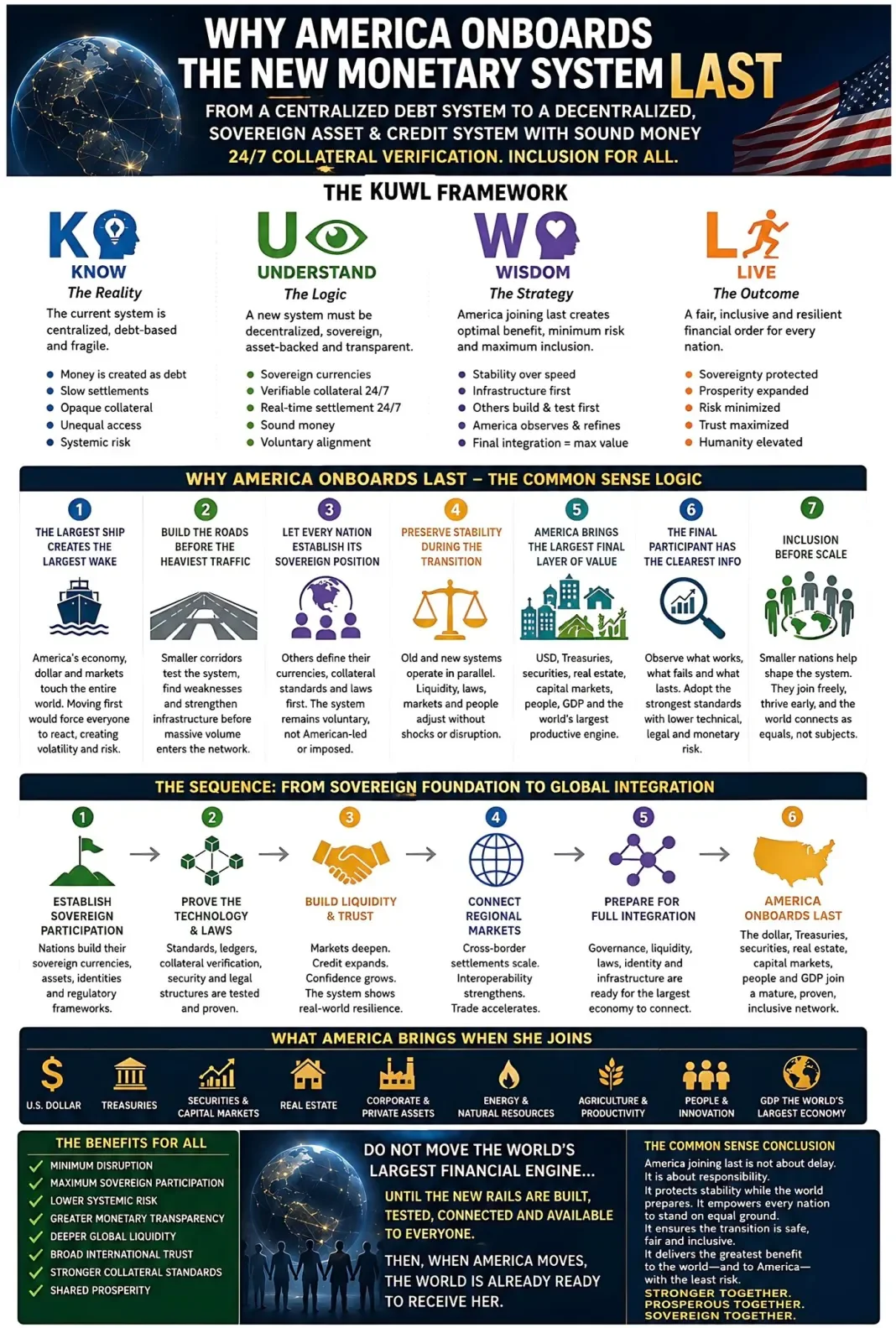
America is the world’s largest economy.
The U.S. dollar, Treasury market, capital markets and consumers touch virtually every nation on Earth.
If the U.S. transitions first, the entire world must instantly adjust.
If the world builds the rails first – and America connects last – the transition can occur with:
Less disruption
Lower systemic risk
Better-tested infrastructure
Greater sovereign participation
Stronger global liquidity
Maximum inclusion
The goal isn’t to be first.
The goal is to get it right.
Obviously the largest engine should be the last one placed on the new tracks – not because it’s least important…
…because everything else must be ready to carry its weight.
That’s not a delay.
That’s responsible sequencing.
Sometimes the smartest move isn’t being first.
It’s ensuring everyone else is ready before the world’s largest financial engine comes online.
Common sense. Enjoy the show.
Nothing Can Stop What’s Coming
Source(s):
• https://x.com/KuwlShow/status/2079651128506204465
https://dinarchronicles.com/2026/07/22/rob-cunningham-the-goal-is-the-get-it-right/
Everything About To Be RESET? | Michael Pento
Everything About To Be RESET? | Michael Pento
Liberty and Finance: 7-21-2026
Michael Pento, active money manager and founder of PentoPort.com, joins Liberty & Finance to explain why he believes the next recession could trigger a prolonged period of poor returns for traditional stock and bond investors.
He outlines how automatic federal deficits, renewed monetary expansion, and deeply overvalued asset markets could combine to reshape the financial landscape.
Everything About To Be RESET? | Michael Pento
Liberty and Finance: 7-21-2026
Michael Pento, active money manager and founder of PentoPort.com, joins Liberty & Finance to explain why he believes the next recession could trigger a prolonged period of poor returns for traditional stock and bond investors.
He outlines how automatic federal deficits, renewed monetary expansion, and deeply overvalued asset markets could combine to reshape the financial landscape.
Pento also discusses why he sees gold, silver, and mining stocks as potential beneficiaries if policymakers respond with another wave of money creation.
The conversation covers the AI investment boom, the risks facing retirement portfolios, and the possibility of a major reset in stocks, real estate, and credit markets. Is a "lost decade" for investors approaching, or will policymakers find another way to postpone the reckoning?
INTERVIEW TIMELINE:
0:00 Intro
1:30 Lost decade coming
12:30 Interest hikes
17:20 Warning signs of collapse
28:45 Data centers
Bruce’s Big Call Dinar Intel Tuesday Night 7-21-26
Bruce’s Big Call Dinar Intel Tuesday Night 7-21-26
Transcribed By WiserNow Emailed To Recaps (INTEL ONLY)
Welcome, everybody. The big call tonight is Tuesday, July 21 and you're listening to the Big Call. Thanks for tuning in again, everybody. And gosh, Bob, you have been with me on the Big Call now for 11 years, and Sue has been on for just about that same amount of time. Amazing, and I want to. want to welcome everybody in tonight.
Yeah, we're looking forward to having a great call. So, thanks for that, Bob. Appreciate it. Let's go into where we stand on the intel right now.
Bruce’s Big Call Dinar Intel Tuesday Night 7-21-26
Transcribed By WiserNow Emailed To Recaps (INTEL ONLY)
Welcome, everybody. The big call tonight is Tuesday, July 21 and you're listening to the Big Call. Thanks for tuning in again, everybody. And gosh, Bob, you have been with me on the Big Call now for 11 years, and Sue has been on for just about that same amount of time. Amazing, and I want to. want to welcome everybody in tonight.
Yeah, we're looking forward to having a great call. So, thanks for that, Bob. Appreciate it. Let's go into where we stand on the intel right now.
Now, things, as you guys know, are tightening up. By that I mean NDAs, new NDAs are coming. We've got to sign NDAs if you're a ZIM holder. Normal other currencies will not need to sign an NDA if you don't have ZIM.
But because of the value of the ZIM being so high, they don't want that talked about at all.
So we're going to be under NDA for probably two to three months, and they'll assign that to us when we go into the redemption center for our exchanges. But the latest information that we got, and even as late as this evening before the big call tonight, was saying that give it another 48 hours, which takes us to Thursday.
Another source says he's getting that we will have new rates on forex on Wednesday, and that we would have those new rates reflected at the redemption centers and banks on Thursday morning, and that we would, in the opinion of this person who's got the connection to the forex, he said we should be getting notified Thursday and start exchanges on Thursday, and that would be two days from now. That would be the 23rd
So, the other contact said, "This is military contact. Said we are everything is still on track.
So, it appears that this will happen for us this week.
That's what we're trying to determine. That's where we're trying to say yes. Is it going to be this week? Are we going to get this before the end of July?
And we have heard the possibility of getting our Doge payments and our R and R, our tariff dividends, all of that coming in, starting by the end of the month. This is assuming that we are going in for exchanges because we need the 800 numbers to set up for appointments at the call centers to go into the redemption centers.
So it follows that they're not going to put out tariff dividend checks or direct deposits or R and R in our case at the redemption center and Doge payments. All of that should not precede us getting notified with the 800 numbers, and the hope is that those will come in a couple of days, and we will set appointments and start exchanges as early as Thursday.
So that's my hope, that's our prayer, and that's where we're going as far as that goes. As far as any additional information, we don't really have anything additional right now.
This is what we all are looking for. When are the numbers coming out, and when are the exchanges, and how soon are the are the holographic medical beds going to be available?
I can tell you they're available as soon as we finish our exchange, and then we get our appointments set to go into those medical beds. That is the plan, and I can't go into the detail I'd like to about those holographic medical beds, but all I can say is, they are free.
There's no fee to reserve it. Unemployment. There's no fee to be trained on it. You're not going to be trained on it. You're going to be enjoying it. So don't fall for anything that's out there that says it's going to cost you money. It is free.
That's the beauty of it. And so I want everybody to be be aware.
Don't be scammed by saying you have to pay certain amount of money to be registered to go into the med bed. Not true.
All right, that's what I wanted to bring tonight, and let's guess. Let's just pray tonight that everything is on track and stays on track, and the information that I've got about a couple more days is going to hold off.
Let's do that, and then we'll pray the call out now, but before we do, I do want to thank Sue and Bob, my co-hosts on the big call for all their work over the last 10 and a half and 11 years in the case of Bob, and thank all of the people that have also helped, like GCK, great creative Kendall, on helping all the project artwork that he did, and also Doug, who's helping on technical aspects with the pod, and thank you, Big Call Universe, for listening to Big Call for the last 15 years.
So we're looking forward to this coming through. We're still looking forward to it this week, and so I want everybody to stay in faith for it and speak that, just as I prayed a new existence in your own lives. All right, so let's go ahead and pray the call out.
All right, everybody. Good night, and we will look forward to talking with you on Thursday. So God bless you
Bruce’s Big Call Dinar Intel Tuesday Night 7-21-26 REPLAY LINK Intel Begins 1:30:35
Bruce’s Big Call Dinar Intel Thursday Night 7-16-26 REPLAY LINK Intel Begins 1:14:00
Bruce’s Big Call Dinar Intel Tuesday Night 7-7-26 REPLAY LINK Intel Begins 1:03:15
https://www.freeconferencecallhd.com/wall/recorded_audio?audioRecordingUrl=https%3A%2F%2Frs0002.freeconferencecall.com%2Fstorage%2FsgetHD%2FHsCgW%2FO7eM
Bruce’s Big Call Dinar Intel Thursday Night 7-9-26 REPLAY LINK Intel Begins 1:10:20
Bruce’s Big Call Dinar Intel Tuesday Night 7-7-26 REPLAY LINK Intel Begins 1:19:00
https://www.freeconferencecallhd.com/wall/recorded_audio?audioRecordingUrl=https%3A%2F%2Frs0002.freeconferencecall.com%2Fstorage%2FsgetHD%2FHsCgW%2FO79O
Bruce’s Big Call Dinar Intel Thursday Night 7-2-26 REPLAY LINK Intel Begins 1:14:14
Bruce’s Big Call Dinar Intel Tuesday Night 6-30-26 REPLAY LINK Intel Begins 1:13:15
Seeds of Wisdom RV and Economics Updates Wednesday Afternoon 7-22-26
Good Afternoon Dinar Recaps,
U.S.-Iran Conflict Expands as Dual Shipping Crisis Pushes Oil to Five-Week High
Military escalation between the United States and Iran is now disrupting two of the world's most critical energy corridors, driving oil prices sharply higher and increasing pressure on global inflation, trade, and financial markets.
Good Afternoon Dinar Recaps,
U.S.-Iran Conflict Expands as Dual Shipping Crisis Pushes Oil to Five-Week High
Military escalation between the United States and Iran is now disrupting two of the world's most critical energy corridors, driving oil prices sharply higher and increasing pressure on global inflation, trade, and financial markets.
Overview
Oil prices climbed to a five-week high after Iran-backed Houthis expanded maritime threats beyond the Strait of Hormuz to the Bab el-Mandeb Strait.
President Donald Trump warned that future attacks on commercial shipping could trigger direct strikes on Iranian infrastructure, raising fears of broader regional conflict.
The disruption of two strategic shipping lanes is increasing concerns over inflation, interest rates, and the stability of global energy markets.
Key Developments
1. Conflict Expands to Two Global Energy Chokepoints
The conflict has widened beyond the Strait of Hormuz, with Iran-backed Houthi forces announcing a naval blockade targeting Saudi Arabia and warning they could attack ships transporting Saudi crude through the Bab el-Mandeb Strait.
Together, these two waterways normally handle a substantial share of global oil and liquefied natural gas shipments. Shipping companies have already begun rerouting vessels, increasing transportation costs and delivery times.
2. Oil Prices Reach Five-Week High
Growing fears of supply disruptions pushed Brent crude above $95 per barrel, while West Texas Intermediate (WTI) also posted strong gains.
Energy analysts noted that physical oil markets are tightening as tanker operators divert around conflict zones and insurers raise premiums for vessels operating in the region.
3. Trump Issues New Warning to Iran
President Donald Trump stated that any future Iranian attack on commercial shipping in the Strait of Hormuz could result in immediate U.S. strikes against Iranian bridges, power plants, and other critical infrastructure.
Iranian officials responded that attacks on Iranian infrastructure would trigger retaliation against regional infrastructure, signaling another significant escalation in the conflict.
4. Financial Markets React
Energy markets immediately priced in greater geopolitical risk as crude oil advanced sharply.
Investors are also reassessing inflation expectations. Higher energy prices could place renewed pressure on central banks to maintain tighter monetary policy, despite recent improvements in inflation data.
Bitcoin traded lower as investors evaluated the potential impact of prolonged geopolitical instability and rising interest-rate expectations.
Why It Matters
The conflict is no longer affecting only one shipping corridor. Disruptions involving both the Strait of Hormuz and the Bab el-Mandeb Strait threaten two of the world's most strategically important maritime routes for energy exports.
If shipping disruptions continue, higher transportation costs and elevated oil prices could increase inflation worldwide, complicating central bank policy and slowing economic growth
Why It Matters to Foreign Currency Holders
Energy prices have historically been one of the strongest drivers of inflation and monetary policy.
Extended supply disruptions could delay interest-rate cuts, strengthen demand for safe-haven assets, and increase volatility across foreign exchange markets as investors react to changing economic conditions.
Implications for the Global Reset
Pillar 1: Debt
Higher energy costs increase inflationary pressures, making it more difficult for central banks to reduce interest rates while raising borrowing costs for governments, businesses, and consumers.
Pillar 2: Trade
Disruptions in two major shipping corridors threaten global supply chains, increase transportation costs, and place additional pressure on international commerce.
Pillar 5: Energy
The Strait of Hormuz and Bab el-Mandeb remain among the world's most important energy chokepoints. Continued instability could reshape global energy flows and accelerate efforts to diversify transportation routes and supply sources.
Future Outlook
Markets will closely monitor whether military tensions continue to escalate or whether renewed diplomatic efforts can stabilize shipping through the Gulf and Red Sea.
Investors will also watch upcoming Federal Reserve meetings for signs that higher energy prices may influence future monetary policy decisions. If oil prices remain elevated, inflation could prove more persistent than previously expected, affecting global markets well beyond the Middle East.
This is not simply about rising oil prices—it reflects the broader transformation of the global financial system as energy security, inflation, trade routes, and geopolitical conflict increasingly shape the future of the world economy.
Seeds of Wisdom Team
Newshounds News™ Exclusive
Sources
~~~~~~~~~~
Seeds of Wisdom Team RV Currency Facts Youtube and Rumble
Newshound's News Telegram Room Link
RV Facts with Proof Links Link
RV Updates Proof links - Facts Link
Start Here room with Most Asked Questions Link
Follow the Gold/Silver Rate COMEX
Follow Fast Facts
Seeds of Wisdom Team™Website
Thank you Dinar Recaps
QFS Payments, Great Wealth Transfer, Crypto System, July 2026: Holly Celiano
QFS Payments, Great Wealth Transfer, Crypto System, July 2026: Holly Celiano
7-22-2026
The global financial system is undergoing a silent but monumental paradigm shift. For decades, international commerce has relied on legacy architectures established in the late 20th century—systems characterized by batch processing, multi-day settlement delays, and high intermediary costs.
Today, however, a new digital financial infrastructure is quietly emerging. Built on the pillars of multi-chain blockchain technology, stablecoins, and artificial intelligence, this modern framework is transitioning global banking from slow, manual processes to a real-time, highly interoperable ecosystem.
QFS Payments, Great Wealth Transfer, Crypto System, July 2026: Holly Celiano
7-22-2026
The global financial system is undergoing a silent but monumental paradigm shift. For decades, international commerce has relied on legacy architectures established in the late 20th century—systems characterized by batch processing, multi-day settlement delays, and high intermediary costs.
Today, however, a new digital financial infrastructure is quietly emerging. Built on the pillars of multi-chain blockchain technology, stablecoins, and artificial intelligence, this modern framework is transitioning global banking from slow, manual processes to a real-time, highly interoperable ecosystem.
This transformation is not happening overnight through a single centralized technology. Instead, it is a gradual, highly coordinated rollout of decentralized networks working in tandem with traditional institutions.
By examining the integration of digital assets into everyday banking, the democratization of assets through tokenization, and the crucial role of AI in managing these complex systems, we can begin to see the outline of a truly modern global economy.
Great systemic shifts often begin far from the spotlight of official press conferences. In geopolitics, unconventional diplomacy has frequently paved the way for major realignments.
A prime historical example is the informal ambassadorship of figures like Dennis Rodman, whose visits to North Korea demonstrated how non-traditional, behind-the-scenes channels can break the ice between isolated nations.
Similarly, quiet cross-border financial negotiations—such as recent diplomatic and economic engagements in the Middle East—signal that the global monetary landscape is reorganizing behind closed doors.
This pattern of quiet, incremental preparation is highly visible in the financial sector today. While public debate often focuses on the volatility of speculative digital assets, global central banks, commercial institutions, and technology providers have been diligently constructing the rails for a new monetary system.
This parallel financial infrastructure is designed to coexist with and eventually modernize traditional banking, preparing the world for a seamless transition to digital-first liquidity.
Perhaps the most significant milestone in this evolution is the direct integration of stablecoins into traditional banking applications. Historically, accessing digital assets required navigating complex user interfaces, managing cryptographic keys, and utilizing third-party digital wallets. This steep learning curve kept many retail consumers and conservative businesses on the sidelines.
The integration of stablecoins like Zel directly into mobile and desktop banking apps changes the game entirely. By embedding digital cash directly into recognized bank portals, financial institutions are removing the traditional barriers to entry.
Users can now interact with dollar-pegged digital assets with the same ease as checking their savings balances. This integration serves as a foundational proof point for the scale of the new financial system, blending the security and familiarity of licensed banks with the speed and utility of decentralized ledgers.
At the heart of this upgrade is the concept of instant atomic settlement. Traditional international wire transfer systems, such as SWIFT, rely on a series of correspondent banks to clear and settle transactions, a process that can take several business days and introduce counterparty risk.
By leveraging real-time gross settlement (RTGS) protocols on blockchain networks, the Zel network and similar platforms enable bi-directional communication between sender and receiver. This allows transactions to be settled instantly and securely. Atomic settlement ensures that the transfer of an asset occurs only if the corresponding payment is successfully executed, eliminating settlement risk entirely. This capability vastly improves liquidity management for corporations and financial institutions, allowing capital to be deployed instantly where it is needed most.
Rather than a single, monopolized digital currency, the future of finance points toward a multi-chain environment featuring a diverse array of stablecoins. Today, we see a wide variety of tokens pegged to the US dollar but issued by different entities, including commercially backed tokens like JPM Coin, decentralized options, and widely accepted public stables like USDC and USDT.
This multiplicity of digital dollars reflects a decentralized and competitive financial ecosystem. The demand for diverse digital currencies is driven by both commercial interests and geopolitical realities.
For instance, multinational corporations and regional trade blocs seek monetary independence and customized settlement terms, prompting them to adopt bespoke stablecoins that suit their specific regulatory and operational needs. These varied tokens do not exist in isolation; instead, they operate across multiple blockchain networks, tied together by advanced routing and interoperability protocols.
Beyond daily payments, the new digital financial infrastructure is poised to revolutionize wealth management through the tokenization of real-world assets (RWAs). Tokenization is the process of converting ownership rights of a physical or financial asset into a digital token on a blockchain.
By enabling fractional ownership, tokenization democratizes access to historically exclusive investment classes. Investors no longer need millions of dollars to participate in commercial real estate or institutional bond markets; instead, they can purchase fractional shares corresponding to their budget. Crucially, public and private sectors are collaborating on this front. Government regulators are actively working alongside fintech innovators to establish compliant, secure frameworks that ensure tokenized securities meet strict legal and financial standards.
Operating a global financial system across multiple independent blockchains and legacy bank networks introduces immense complexity. This is where artificial intelligence (AI) and advanced orchestration platforms, such as Quant’s Overledger technology, become indispensable.
Quant acts as an enterprise-grade operating system that sits above various blockchains and legacy systems, allowing them to communicate without friction. Within this architecture, AI serves as an intelligent routing engine and compliance monitor.
Operating at speeds of thousands of transactions per second, AI algorithms optimize payment flows, detect fraudulent patterns, monitor liquidity levels, and ensure instant compliance with local and international sanctions. This intelligent automation ensures that despite the diversity of the underlying technology, transactions remain safe, efficient, and fully compliant.
The transition from traditional, batch-processed systems to instant, round-the-clock digital networks can be compared to upgrading from horse-drawn carriages to modern high-speed highways. The legacy financial infrastructure was simply not built for an era where information travels instantly.
Today’s emerging payment networks integrate various specialized rails—including Ripple, Stellar, and domestic instant payment systems like FedNow—to create a resilient, scalable, and highly redundant financial matrix. In this new paradigm, money behaves exactly like data on the internet: it moves globally, instantaneously, and continuously, regardless of weekends, holidays, or time zones.
The ongoing modernization of the global financial system is not a sudden revolution, but a highly sophisticated, gradual upgrade of our economic engine.
By combining the stability of traditional banking with the agility of blockchain networks, stablecoins, and AI-driven orchestration, the future of finance promises to be more accessible, secure, and efficient than ever before.
Coffee with MarkZ, joined by Militia Man and Zester. 07/22/2026
Coffee with MarkZ, joined by Militia Man and Zester. 07/22/2026
MarkZ Disclaimer: Please consider everything on this call as my opinion. Be sure to consult a professional for any financial decisions
MZ: World power continues to shift, we cover the latest, check in with MM and Crew before being joined by Zester for some clarity on the Clarity act
THE CONTENT IN THIS PODCAST IS FOR GENERAL & EDUCATIONAL PURPOSES ONLY&NOT INTENDED TO PROVIDE ANY PROFESSIONAL, FINANCIAL OR LEGAL ADVICE. PLEASE CONSIDER EVERYTHING DISCUSSED IN MARKZ’S OPINION ONLY
Coffee with MarkZ, joined by Militia Man and Zester. 07/22/2026
MarkZ Disclaimer: Please consider everything on this call as my opinion. Be sure to consult a professional for any financial decisions
MZ: World power continues to shift, we cover the latest, check in with MM and Crew before being joined by Zester for some clarity on the Clarity act
THE CONTENT IN THIS PODCAST IS FOR GENERAL & EDUCATIONAL PURPOSES ONLY&NOT INTENDED TO PROVIDE ANY PROFESSIONAL, FINANCIAL OR LEGAL ADVICE. PLEASE CONSIDER EVERYTHING DISCUSSED IN MARKZ’S OPINION ONLY
https://rumble.com/user/theoriginalmarkz
Kick: https://kick.com/theoriginalmarkz
Markz's linktree https://linktr.ee/theMarkZshow
FOLLOW MARKZ : TWITTER . https://twitter.com/originalmarkz?s=21. TRUTH SOCIAL . https://truthsocial.com/@theoriginalm...
Mod: MarkZ "Back To Basics" Pre-Recorded Call" for Newbies 10-19-2022 )https://www.youtube.com/watch?v=37oILmAlptM
MARKZ DAILY LINKS: https://theoriginalmarkz.com/home/
THANK YOU FOR JOINING. HAVE A BLESSED DAY. SEE YOU IN THE MORNING FOR COFFEE @ 10:00 AM EST ~ UNLESS BREAKING NEWS HAPPENS! FOR UPDATES ON MARK’S PODCAST GO TO: https://t.me/+b3hYhYlhKM1hYzcx
News, Rumors and Opinions Wednesday 7-22-2026
Reset Intelligence: 23 Years in Baghdad
7-21-2026
23 Years in Baghdad
By Reset Intelligence | @EXIT_FIAT
On Saturday the Central Bank of Iraq and the US Treasury reached an understanding. 7 Iraqi banks that had been shut out of the world’s payment system were let back toward it.
Reset Intelligence: 23 Years in Baghdad
7-21-2026
23 Years in Baghdad
By Reset Intelligence | @EXIT_FIAT
On Saturday the Central Bank of Iraq and the US Treasury reached an understanding. 7 Iraqi banks that had been shut out of the world’s payment system were let back toward it.
The headline that ran everywhere said they were cleared for dollar transactions. They were not. The Arabic in the statement excludes the dollar by name.
The moves on the record
• 7 banks readmitted – to external correspondent channels in currencies other than the dollar. Dollar eligibility is a second phase, conditional on finishing the central bank’s re-licensing programme. No date was attached by anyone.
• 48 agreements – signed during the Washington visit, announced Saturday. The Iraqi prime minister’s office counted 48. The summit host counted more than 50. Initial value above $60 billion.
• A JPMorgan branch – the prime minister’s office announced an agreement to open one in Iraq, to finance American company projects.
• 9 ministries – still have nobody sitting in them. Parliament has not voted on them since the recess ended on 1 July.
• FATF – Iraq remains on the list of jurisdictions under increased monitoring, added 19 June. Nothing about that can change before the October plenary.
That is the short version, and it is the version everyone has.
The part nobody connected
On 14 July 2003 the Coalition Provisional Authority signed Order Number 20 and created the Trade Bank of Iraq. That August, JPMorgan Chase won the contract to run it, beating consortia led by Citigroup, Bank of America, Wachovia and Bank One. No source we can find states the arrangement ever ended.
The bank being reported as arriving in Iraq has been clearing Iraqi trade paper for 23 years.
Today’s briefing walks the whole thing. What Order Number 20 actually says in plain text. Why the fee was never the point. The 2 earlier occasions the same house did the same thing when a state’s money stopped working. And what all of it means for the rate.
Read the full daily briefing free for 5 days. Sign up here: resetintelligence.com
The brief is free every day at that page, so it is worth bookmarking rather than waiting on the next piece.
If you want the background, Head of the Snake maps the route the money took, and the code 25XOFF is still running. The free resources library carries the guides and the scenario reports.
Nobody announces the room they never left.
https://dinarchronicles.com/2026/07/20/reset-intelligence-23-years-in-baghdad/
Courtesy of Dinar Guru: https://www.dinarguru.com/
Jeff An audit on the budget periods from 2012- to 2025...They've never done an audit of this level before in the history of this investment...They're going to review this audit at today's session of parliament. Very significant towards your investment...What they're reviewing in today's session of parliament is very significant towards them going international...This is something they would do only if they're really preparing to adjust their currency's value.
Stephen This past week one of the largest and most important meetings was with al-Zaidi and the US Treasury. He met directly with Scott Bessent who runs the US Treasury. They're directly responsible for facilitating and helping Iraq revalue or reinstate the Iraqi dinar...When you see articles talking about the partnership between the Central Bank of Iraq, the US Treasury and how it's directly expected to strengthen the stability of the Iraqi dinar, I don't understand how people don't see this...Even if you didn't have dinar goggles on...or...not invested at all...if you can't look at the news...and ask yourself...a country attracting this much investment from the US directly, billions and trillions of dollars worth of deals, are they able to do this with a currency worth 1/10 of a penny?
Frank26 [Iraq boots-on-the-ground report] OMAR: Television says our dinar [market rate] has gained 3.66% in just 17 days...that isn't normal. It's really really looking good. It's growing fast. FRANK: it's so exciting to see the evidence of your currency gaining value as the American dollar is being used less and less inside of Iraq. The gap is closing. The black market is going away so you can reach the 1 to 1. I've been waiting for this evidence to start. It looks like it started way before July 10th...It is moving at an incredible speed.
************
China’s Gold Buying Is Surging — Is a New Gold Standard Coming?
Maneco64: 7-21-2026
Seeds of Wisdom RV and Economics Updates Wednesday Morning 7-22-26
Good Morning Dinar Recaps,
Central Banks Balance Inflation Risks as Digital Currency Plans Continue to Advance
The European Central Bank is weighing inflation pressures alongside continued progress on the digital euro, highlighting how monetary policy and financial innovation are reshaping the global financial system.
Good Morning Dinar Recaps,
Central Banks Balance Inflation Risks as Digital Currency Plans Continue to Advance
The European Central Bank is weighing inflation pressures alongside continued progress on the digital euro, highlighting how monetary policy and financial innovation are reshaping the global financial system.
Overview
The European Central Bank is expected to keep interest rates steady while monitoring renewed inflation risks tied to higher energy prices.
Officials are also reviewing progress on the digital euro, reflecting Europe's long-term effort to modernize its payment infrastructure.
The combination of monetary policy and digital finance underscores the ongoing transformation of the global financial system.
Key Developments
1. ECB Balances Inflation With Economic Stability
The European Central Bank enters its latest policy meeting facing two competing challenges: maintaining price stability while avoiding unnecessary pressure on economic growth.
Although inflation has eased from previous highs, policymakers remain cautious as energy markets continue reacting to geopolitical tensions in the Middle East. Higher oil and natural gas prices could slow progress toward the ECB's long-term inflation objective.
2. Digital Euro Project Continues Moving Forward
Alongside interest-rate discussions, ECB officials are reviewing continued progress on the digital euro initiative.
The project is designed to provide a secure digital form of central bank money that complements cash while supporting Europe's payment infrastructure in an increasingly digital economy. Officials continue to emphasize that the digital euro is intended to improve payment efficiency while preserving financial stability.
3. Energy Markets Continue Influencing Monetary Policy
Recent volatility in global energy markets has reminded policymakers that geopolitical events remain an important driver of inflation.
Central banks are closely monitoring how energy prices affect transportation costs, manufacturing, food production, and overall consumer prices before making additional monetary policy decisions.
4. Financial Modernization Continues Worldwide
The ECB's discussions illustrate a broader trend taking place across many major economies.
While central banks remain focused on controlling inflation today, they are also investing in the payment systems, settlement infrastructure, and digital technologies expected to support tomorrow's financial system.
Why It Matters
Central banks are managing two historic transitions simultaneously: maintaining economic stability in an uncertain geopolitical environment while modernizing the financial infrastructure that supports global commerce.
The decisions made today will influence interest rates, payment systems, banking innovation, and the future direction of international finance for years to come.
Why It Matters to Foreign Currency Holders
For foreign currency holders, central bank policy remains one of the strongest long-term influences on currency values. At the same time, continued development of digital payment infrastructure demonstrates how global finance is evolving toward faster, more efficient cross-border transactions.
Implications for the Global Reset
Pillar 1: Debt
Interest-rate policy directly affects sovereign borrowing costs, debt servicing, and overall financial stability throughout the global economy.
Pillar 4: Technology
The continued development of the digital euro reflects the modernization of payment systems and digital financial infrastructure that could reshape international commerce over the coming decade.
Future Outlook
Markets will closely watch the ECB's policy announcement and any guidance regarding future interest-rate decisions. Investors will also monitor further progress on the digital euro as Europe continues developing its long-term digital payments strategy.
As central banks around the world balance inflation, financial stability, and technological innovation, today's policy decisions are helping shape the architecture of tomorrow's international monetary system.
This is not simply about interest rates—it reflects the broader transformation of the global financial system as central banks modernize monetary policy, payment infrastructure, and digital finance for the next generation of global commerce.
Seeds of Wisdom Team
Newshounds News™ Exclusive
Sources
~~~~~~~~~~
🌱 A Message to Our Currency Holders🌱
If you’ve been holding foreign currency for many years, you were not foolish.
You were not wrong to believe the global financial system would change.
What failed was not your patience — it was the information you were given.
For years, dates, rumors, and personalities replaced facts, structure, and proof. “This week” predictions created cycles of hope and disappointment that were never based on how currencies actually change.
That is not your failure.
Our mission here is different: • No dates • No rates • No hype • No gurus
Instead, we focus on:
• Verifiable developments • Institutional evidence
• Global financial structure • Where countries actually sit in the process
Currency value changes only come after sovereignty, trade, banking, settlement systems, and fiscal coordination are in place. History and institutions confirm this sequence.
You will see silence. You will see denials. That is not delay — that is discipline.
Protect your identity. Organize your documents. Verify everything.
Never hand your discernment to anyone who cannot show proof.
You deserve truth — not timelines.
Seeds of Wisdom Team
Newshounds News
~~~~~~~~~~
Seeds of Wisdom Team RV Currency Facts Youtube and Rumble
Newshound's News Telegram Room Link
RV Facts with Proof Links Link
RV Updates Proof links - Facts Link
Start Here room with Most Asked Questions Link
Follow the Gold/Silver Rate COMEX
Follow Fast Facts
Seeds of Wisdom Team™Website
Thank you Dinar Recaps
Iraq Economic News and Points To Ponder Wednesday Morning 7-22-26
The Hand That Will Disarm The Factions Is Not Iraqi… Middle East Monitor: US Special Operations May Target Factions Refusing To Surrender Their Weapons - 7/22/2026
Baghdad - One News - 7/22/2026 The British website Middle East Monitor said that Iraq is facing a pivotal stage that could reshape its political, security and economic reality, in light of simultaneous American moves aimed at ending the issue of armed factions, reducing Iranian influence and rearranging the American presence in the country.
The Hand That Will Disarm The Factions Is Not Iraqi… Middle East Monitor: US Special Operations May Target Factions Refusing To Surrender Their Weapons - 7/22/2026
Baghdad - One News - 7/22/2026 The British website Middle East Monitor said that Iraq is facing a pivotal stage that could reshape its political, security and economic reality, in light of simultaneous American moves aimed at ending the issue of armed factions, reducing Iranian influence and rearranging the American presence in the country.
The website stated, in an analytical report, that September 30th represents the date on which all armed factions are supposed to be dissolved and hand over their weapons to the state, coinciding with the withdrawal of US combat forces from Iraq, with the exception of Erbil, which the report considered Washington to be determined to maintain its presence in due to its strategic importance, to monitor Iran, as well as to maintain the Kurdistan Region’s connection with the United States.
The report added that the United States, in addition to its military influence, relies on extensive financial and economic leverage. It explained that approximately 90% of Iraq's budget revenues come from oil proceeds deposited in an account at the Federal Reserve Bank of New York, which, according to the report, gives Washington significant power to influence Iraqi financial decisions.
The report also noted that Washington froze approximately $500 million of Iraqi funds last April, a move described by a Kurdish official as the "nuclear option" available to the US Treasury Department.
The website noted that US envoy Thomas Barak has become the central figure in managing the Iraqi file, considering that his main mission is to dismantle the armed factions and separate Iraq from Iranian influence, based on an American vision that considers that Iraq, during the past two decades, has constituted an economic outlet for Tehran to circumvent international sanctions.
The report indicated that some factions have already agreed to place their weapons under the authority of the state, while the factions closest to Iran still refuse to do so, noting that Washington has threatened to continue sanctions and military operations against those who do not comply with the specified deadline.
The report also addressed the anti-corruption campaign in Iraq, noting that the recent security and judicial measures, which included the arrest of 47 people, including 12 members of parliament, may expand to include senior officials, former prime ministers, and faction leaders, in conjunction with the freezing of financial assets. The report emphasized that corruption has cost the Iraqi economy, according to the report, about $776 billion since 2003.
In a regional context, Middle East Monitor considered that what is known as the "Shia Crescent," extending from Iran through Iraq and Syria to Lebanon, is undergoing a gradual reshaping, pointing to the transformations witnessed in Syria, the pressures imposed on Iran, and the ongoing developments in Lebanon, culminating in Iraq, which it described as the final link in this trajectory. https://1news-iq.net/اليد-التي-ستنزع-سلاح-الفصائل-ليست-عراق/
Iraqi MP Urges Corruption Probe After Audit Report
2026-07-21 / 10:11 Shafaq News- Baghdad The Federal Board of Supreme Audit’s 2025 report is “late and incomplete,” an Iraqi lawmaker said on Tuesday, arguing that it failed to quantify financial losses or identify those responsible for corruption. ( https://shafaq.com/en/Iraq/Iraqi-MP-urges-corruption-probe-after-audit-report. )
Miqdad Al-Khafaji, an MP from the Hoqooq parliamentary bloc, within the Shiite Coordination Framework, told Shafaq News that board officials offered “unconvincing” explanations during Tuesday’s parliamentary session.
He urged the Federal Commission of Integrity to investigate cases lawmakers believe have cost Iraq billions of dollars over recent years.
Earlier today, the Federal Board of Supreme Audit’s report, obtained by Shafaq News, identified major delays in resolving corruption cases, failures to exercise key legal powers, and widespread financial violations across several government sectors. https://shafaq.com/en/Iraq/Iraqi-MP-urges-corruption-probe-after-audit-report
Central Bank Governor Discusses Development Of Electronic Payment
An expanded meeting was held, chaired by His Excellency the Governor of the Central Bank of Iraq, which included licensed electronic payment companies in Iraq, to enhance its role in supporting digital transformation and implementing the Central Bank’s strategy aimed at developing the electronic payments system and promoting financial inclusion.
His Excellency the Governor stressed that the next stage requires electronic payment companies to raise the level of services provided to beneficiaries, and to adhere to the highest standards of quality, efficiency and reliability, in order to enhance citizens’ confidence in using electronic payment methods, encourage the expansion of adopting digital payment solutions, and contribute to reducing reliance on cash and promoting the digital economy.
He stressed the importance of electronic payment companies adhering to international standards, especially with regard to foreign financial transactions and operations, to provide broader opportunities for developing the sector, including increasing card usage limits and adding new financial services and products that meet citizens’ needs and keep pace with global developments.
The meeting also discussed the joint instructions and procedures that the Central Bank of Iraq will work with electronic payment companies to implement in order to reduce card misuse, enhance the safety and efficiency of the payment system, raise operational limits, and open new horizons for providing innovative and advanced services to citizens.
The governor called for the importance of strengthening cooperation and coordination between electronic payment companies, which would contribute to expanding the network for accepting electronic cards, developing collection and processing services, as well as strengthening the partnership with banks licensed by the Central Bank of Iraq, in order to achieve integration between the various parties of the financial sector, to develop a modern, secure and advanced payment system that is in line with best practices and international standards.
Baghdad – Media Office, July 21, 2026 https://cbi.iq/news/view/3270
The Prime Minister's Advisor Clarifies The Borrowing Law: Will It Replace The Budget?
2026-07-21 | Alsumaria News- Economy: The Prime Minister's financial advisor confirmed,Mazhar Muhammad Salih On Tuesday, he said that the adoption of the borrowing and grants law is a temporary measure to ensure the continuation of spending until the budget is approved, and does not represent a permanent alternative to the general budget, while he pointed out that the volatility of oil prices and the expansion of the size of expenditures reinforce the need to borrow to cover the deficit and secure the necessary financing.
Saleh said in a statement to the official news agency, which was followed by Alsumaria News He said: “If the borrowing and grants law is adopted as an alternative to the budget law, the government will resort to a temporary financing mechanism that will allow it to continue to cover basic expenses and meet its financial obligations until the general budget is approved.”
He pointed out that "Asylum This option, instead of passing the budget law, is often linked to budget delays and the resulting lack of legal cover for government spending, which compels the government to seek temporary financing tools to ensure the continued payment of salaries and funding.public services"
And to fulfill urgent financial obligations," he explained, adding that "weak liquidity or a decline in public revenues, especially given the volatility of oil prices and the expansion of expenditures, may be an additional factor that reinforces the need for borrowing to cover the deficit and secure the necessary financing."
He further stated that "adopting the borrowing and grants law is not a permanent alternative to the budget, but rather an exceptional and temporary measure aimed at ensuring the continued operation of state institutions until the completion of the constitutional and legislative procedures for approving the general budget."
Why Britain's New Marxist Leader Suddenly Loves Oil
Why Britain's New Marxist Leader Suddenly Loves Oil
Notes From the Field By James Hickman (Simon Black / Sovereign Man) July 21, 2026
On November 27th in the year 176 AD, Marcus Aurelius promoted his 15-year old biological son Commodus to be Co-emperor of Rome. Marcus Aurelius never realized it, but he was sealing Rome’s fate… and essentially marking an end to the Empire’s golden age.
Why Britain's New Marxist Leader Suddenly Loves Oil
Notes From the Field By James Hickman (Simon Black / Sovereign Man) July 21, 2026
On November 27th in the year 176 AD, Marcus Aurelius promoted his 15-year old biological son Commodus to be Co-emperor of Rome. Marcus Aurelius never realized it, but he was sealing Rome’s fate… and essentially marking an end to the Empire’s golden age.
Commodus was quite popular in his youth— reportedly handsome, athletic, and gregarious. But after Marcus Aurelius died a few years later, the popularity and support that Commodus had enjoyed for so long began to wane.
It didn’t help that he heavily debased Rome’s currency, contributing to widespread inflation and economic decline. He spent lavishly at taxpayer expense, ignored even the most basic affairs of imperial administration, and murdered his enemies.
Finally, on New Year’s Eve in 192 AD, Commodus was assassinated, kicking off a period of political instability in which five different men would sit on the throne in a single year; in fact 193 AD became known as the Year of the Five Emperors.
Eventually Rome landed on Septimius Severus, who ruled for nearly two decades with an iron fist. His reign— though stable— is regarded as one of the cruelest in Roman history. And he, too, contributed immensely to inflation and rising taxes.
His successor, Caracalla, ruled briefly and incompetently. Soon came Elagabalus— history’s first transgender emperor who promised to give away half of the empire to any physician who could turn him into a woman.
Along the way the infamous “Crisis of the Third Century” became worse and worse: migrant invasions, economic depression, hyperinflation, plague, and unprecedented political instability— including the year 238 AD in which six different men claimed the title of Emperor.
It was as if Rome lost the ability to produce a decent, capable leader anymore.
I thought of this historical lesson yesterday morning watching Andy Burnham, the former mayor of Greater Manchester, become Britain's seventh prime minister in a decade.
That’s an unprecedented level of instability for a modern, major power. Even worse, Britain’s leaders have become more incompetent over time, each one chipping away at the country’s economy and social stability.
Liz Truss lasted just 49 days, the shortest tenure of any prime minister in British history. Her plan for £45 billion in unfunded tax cuts set off a panic in the bond market, launching the pound into freefall.
And government borrowing costs spiked so violently as a result of Ms. Truss that the Bank of England had to step in to prevent British pension funds from collapsing.
Prior to Truss was Boris Johnson— a one-man scandal machine who was fined for quite hypocritically throwing big parties in Downing Street during his own COVID lockdowns.
Then came Rishi Sunak, who threw Britain's doors wide open to immigration. Sunak seemingly woke up every morning and said: Give me more Somalis. Give me more Islamic terrorists.
Along the way, Britain imported some of the worst ideas of the American Left and made them its own.
Britain is now the wokest place on the planet, and to an Orwellian standard; British police arrest people over tweets, and the England flag itself is now treated as a symbol of racism.
To cap it all off, Sunak was succeeded by Keir Starmer, probably the worst leader of a major power in modern history— and that includes Joe Biden.
When Parliament took up a national inquiry into the grooming gangs that had raped thousands of English girls over decades while local officials looked away, Starmer's party voted it down, and Starmer dismissed the calls as "the bandwagon [of] the far right."
Starmer spent his tenure finishing off the oil industry, taking the headline tax rate on North Sea producers to 78% and banning new exploration licenses.
By the time Starmer resigned last month, the UK had a tax burden heading to its highest level since records began in 1948. Borrowing costs are higher than any other major economy, with 10-year government bond yields well above those in the US, France, Germany, and Japan.
Plus, wealthy Brits are heading for the exits in record numbers after Starmer abolished the centuries-old non-dom tax regime.
Starmer was so widely despised that his own party finally threw him out. Their solution? A slightly younger, slightly less vapid version of Starmer.
His name is Andy Burnham, and all of his ideas come straight from the Communist Manifesto.
In his opening remarks as prime minister, Burnham said not one word about the national debt or Britain's borrowing costs. Nothing about the migration crisis. Nothing about justice for the grooming gang victims. Nothing about turning the economy around.
His first order of business, Burnham announced, was taking care of homeless/migrants with a new £340 million benefit program.
To his credit, Burnham has sense enough to know that he cannot throw around that kind of money without a way to pay for it. Borrowing more money is out; in fact he spent the past year complaining that Britain must get beyond "being in hock to the bond markets."
That only means one thing: higher taxes.
So, days before taking office, his team began preparing approvals for two North Sea oil and gas fields— the same ones that his own party spent years trying to shut down.
This is not because Burnham suddenly cares about energy security. He’s just looking for more money to steal.
All of those homeless migrants need handouts, so Burnham needs a new revenue stream, i.e. something else to tax.
So he’s allowing two new North Sea fields— with the existing 78% rate in place.
In short, Burnham did not decide that energy matters. He decided it hasn’t been milked entirely dry yet.
This is a cannibalist mentality. Britain is sliding into its own Crisis of the 21st Century, and the "conservative" politicians who presided over the first half of the decline were anything but. Starmer and now Burnham are straight-up Marxists.
We wrote about Argentina just yesterday, where nearly every asset in the country is surging. It’s not hard to understand why: Argentina hit rock bottom, threw out the people who destroyed the country, and started climbing under new leadership.
Britain can reverse its fortunes the same way. Unfortunately, it is probably going to have to hit rock bottom first. And we can already see the shape of how this ends.
First the money will run out, the benefits will be cut, and the people who came for free stuff will go home.
Then, with markets in the dumps, this highly educated and productive country will eventually reverse all of its idiotic policies from the past and one day become among the most interesting places in the world to invest.
There’s an old saying credited to a Rothschild about investing when there’s “blood in the streets.” He may turn out to be right. But he probably wasn't picturing London when he said it.
To your freedom, James Hickman Co-Founder, Schiff Sovereign LLC