Get Ready for “Business Friendly Socialism”
Get Ready for “Business Friendly Socialism”
Notes From the Field By James Hickman (Simon Black / Sovereign Man) June 22, 2026
On New Year's Day in the year 1829, a 29-year-old young lady from Washington DC named Peggy Timberlake married John Eaton— a powerful senator from Tennessee. Eaton was also close friends with the incoming president Andrew Jackson.
Peggy, on the other hand, was rumored to be somewhat of a harlot. She was openly flirtatious and allegedly promiscuous, and her wedding to Sen. Eaton came only a few months after the mysterious death of her first husband.
Get Ready for “Business Friendly Socialism”
Notes From the Field By James Hickman (Simon Black / Sovereign Man) June 22, 2026
On New Year's Day in the year 1829, a 29-year-old young lady from Washington DC named Peggy Timberlake married John Eaton— a powerful senator from Tennessee. Eaton was also close friends with the incoming president Andrew Jackson.
Peggy, on the other hand, was rumored to be somewhat of a harlot. She was openly flirtatious and allegedly promiscuous, and her wedding to Sen. Eaton came only a few months after the mysterious death of her first husband.
The elite “power wives” of Washington DC considered Peggy scandalous and immoral, and so they simply refused to engage with her. They would not attend any event where Peggy would be present. They would not invite her to their parties. They spoke ill of her behind her back.
So when Andrew Jackson made Sen. Eaton his Secretary of War in March of 1829, the snub against Peggy became a federal problem.
President Jackson, whose own late wife had been savaged by similar gossip during the brutal 1828 campaign, took the shunning of Peggy as a personal insult. And he actually demanded that his cabinet bring their wives into line and accept her.
Jackson’s cabinet could not (or would not) demand this of their wives. And for more than two years, the so-called “Petticoat Affair” consumed federal attention.
It finally ended in the spring of 1831 with something America had never seen: Jackson’s entire cabinet resigned except for the Postmaster General. The Secretaries of State, Treasury, etc. all left. Even Eaton as Secretary of War resigned.
In short, a dispute over whether the power wives of Washington were willing to invite another lady to dinner had resulted in the effective dissolution of the executive branch.
Nearly two centuries later, that remains almost unimaginable. High-level resignation is something the American government simply does not do.
In its entire history exactly one president has resigned— Richard Nixon, in 1974, and only to avoid impeachment.
Only two vice presidents have resigned, including Spiro Agnew in 1973 due to pending criminal charges.
American politicians only give up power under extreme duress— likely a family emergency... or the imminent arrival of a criminal indictment. It is a “from-my-cold-dead-hands” political culture. We even treat a President declining to seek reelection as a major event.
In Britain, by contrast, prime ministers resign all the time. When they lose the confidence of their party, they step down... and the machine produces another.
I used to think that was a genuine strength— that American politics might be healthier if resigning were less taboo.
Keir Starmer is the perfect illustration. By this spring his net approval had collapsed to the lowest rating recorded for any prime minister since Ipsos began measuring in 1977.
Failure didn’t bother him. In fact Starmer’s government kept criminalizing criticism— Britain now jails its own citizens for anti-migrant posts while the actual migrant criminals walk free and receive taxpayer assistance.
Even last month, with dozens in his own party urging him to resign, Starmer remained defiant: "The country expects us to get on with governing. That is what I am doing and what we must do as a cabinet."
What finally forced him out was not voters. Yes, his own party helped push him out after disastrous local elections cost Labour more than a thousand races last month.
But underneath that sat the bond market.
Investors had been dumping British government debt for weeks, and in early May the yield on the 30-year gilt spiked to the highest level in decades.
Bond investors want fiscal restraint. And they had concluded that Starmer would respond to his electoral beating by spending even more money.
So naturally, investors sold their UK government bonds... and the British government’s borrowing costs soared.
This is nothing new; less than four years ago, then Prime Minister Liz Truss resigned after just 44 days because the bond market didn’t like her economic plan. Bond yields surged and the British pound went into free fall.
Calm returned only after Truss resigned in disgrace.
The sad irony is that Starmer's likely successor is worse. Andy Burnham— the longtime mayor of Greater Manchester— campaigns on what he calls "business friendly socialism", which makes as much sense as “vegan wolf”.
He also wants more borrowing, higher taxes, and bringing utilities and "public essentials" back under state control.
Bizarrely, Burnham has complained that Britain is "in hock to the bond markets," as though the people lending to the government should simply hand over their capital with no questions asked.
(Given Mr. Burnham’s penchant for nationalization, he may in fact get his way. I wouldn’t be surprised to see more wealth tax proposals in the UK.)
The actual solution is embarrassingly simple. You are only “in hock to the bond market” if you borrow. Balance the budget, live within your means, and the bond market gets no vote at all.
Yet basic fiscal responsibility is an impossible idea— and it tells you everything about the modern Western politician. This most certainly will not improve under a "business friendly" socialist.
Ultimately, the last institution still imposing any discipline on government is not the voter— it's the creditor. And the United States, with its own debt arithmetic getting worse every year, is approaching that the same line.
One day the bond market will start calling the shots in Washington too, voters' wishes be damned, and it will do it through higher yields and a weaker dollar.
To your freedom, James Hickman Co-Founder, Schiff Sovereign LLC
P.S. In the US, the bond market is already voting, with higher yields and a weaker dollar. And the bill lands on anyone holding those dollars.
The sensible hedge is to own real assets no government can print.
Real assets are tangible things with intrinsic worth— gold and silver, energy, productive land, and the companies that own them— and because no central bank can conjure them into existence, they hold their purchasing power while paper currencies lose theirs.
That's what Schiff Sovereign's investment research newsletter, Strategic Assets, is built to find: companies trading at low multiples of current free cash flow, carrying little or no debt, with strong earnings and a catalyst the market hasn't priced yet.
Reset Intelligence: The New Quantum Order
Reset Intelligence: The New Quantum Order
6-24-2026
Q Is for Quantum
By Reset Intelligence | @EXIT_FIAT
The White House posted four words and a wink, Q is for quantum, and the same afternoon President Trump signed two executive orders on quantum computing.
Scrap the wink and it is the encryption under the whole money system being rebuilt in the open.
Reset Intelligence: The New Quantum Order
6-24-2026
Q Is for Quantum
By Reset Intelligence | @EXIT_FIAT
The White House posted four words and a wink, Q is for quantum, and the same afternoon President Trump signed two executive orders on quantum computing.
Scrap the wink and it is the encryption under the whole money system being rebuilt in the open.
The wink and the orders
The official White House feed and the Department of War’s technology account both posted Q-coded language this week, with more than a million views between them. The same afternoon the President signed two orders: one to build a research-grade quantum computer by 2028, the other to prepare the government for machines that c***k today’s encryption. Commerce is already moving billions to the firms racing to get there first.
Why it matters
A working quantum computer breaks the codes that lock every bank account and every transfer. That threat has been on the record since 1994, when a mathematician named Peter Shor proved it. For 30 years it stayed a lab curiosity. This week it became a national sprint, announced from the podium. You do not rebuild the lock on the money unless you are about to run something across it worth that much trouble.
Baghdad on the same clock
Iraq’s central bank issued its first policy statement under its new anti-fraud governor, clearing its restricted banks for re-entry into the dollar system while flatly denying any change to the exchange rate. Clean the books, get counted, get let back in. Same motion as Washington, different capital.
The wider board
• Quantum orders – 2 executive orders, a research-grade quantum computer targeted by 2028, plus a national push to post-quantum encryption
• Iraq CBI – first policy statement under new governor Nizar Nasser, banks in the final stage of dollar re-entry, any rate change denied
• Iran oil – Treasury 60-day license, Iranian crude back on the world market for the first time since 2018
• London – Keir Starmer resigns as UK Prime Minister, Labour leadership contest opens July 9
• The Fed – projections turn hawkish, Bank of America calls 3 hikes by December, with oil the deciding variable
That is the short version, and the moves are public. The daily connection – what it means for the dinar holder and where it points next – is in the brief.
Read the full daily briefing free for 5 days. Sign up here: resetintelligence.com
Go deeper: Head of the Snake (25% off with code 25XOFF), and the free Resources library.
Watch what gets cleaned, and watch who gets let in. That is the reset, and it is running in plain sight.
https://dinarchronicles.com/2026/06/23/reset-intelligence-the-new-quantum-order/
Wed. Iraq News Posted by Tishwash at TNT 6-24-2026
TNT:
Tishwash: The Iraqi parliament will resume its work at the beginning of July, with the cabinet reshuffle on the agenda.
Tuesday, MP Duha al-Sadkhan, from the “National Approach” bloc, revealed the date for the start of the second legislative session of the House of Representatives, confirming that the parliament’s leadership will determine during the month of July a date for the resumption of sessions, including a session to complete the vote on the ministerial cabinet.
Al-Sadkhan said that the House of Representatives' legislative recess will end next week, with the second legislative session beginning on July 1st.
TNT:
Tishwash: The Iraqi parliament will resume its work at the beginning of July, with the cabinet reshuffle on the agenda.
Tuesday, MP Duha al-Sadkhan, from the “National Approach” bloc, revealed the date for the start of the second legislative session of the House of Representatives, confirming that the parliament’s leadership will determine during the month of July a date for the resumption of sessions, including a session to complete the vote on the ministerial cabinet.
Al-Sadkhan said that the House of Representatives' legislative recess will end next week, with the second legislative session beginning on July 1st.
She added that the Speaker of the House of Representatives will set the date for the first session after the start of the new legislative term, noting that the agenda will include reading and discussing a number of draft laws, while other laws need to be voted on within the council.
She indicated that the parliament's leadership will determine, during the second or third week of July, a date for holding a session to complete the vote on the cabinet.
The resumption of the House of Representatives' work comes amid anticipation of discussing and approving a number of important and postponed laws, as Al-Sadkhan had previously confirmed the existence of more than 100 draft laws in the halls of parliament, distributed between laws that need to be read and discussed and others that are waiting for amendment or voting.
According to Al-Sadkhan, the new legislative session is expected to witness the discussion and voting on a number of prominent pieces of legislation, most notably the Oil and Gas Law, the Popular Mobilization Forces Law, the Federal Court Law, the Federal Civil Service Council Law, the Retirement Law, and the Salary Scale Law.
The First Deputy Speaker of Parliament, Adnan Faihan, had previously confirmed that there was parliamentary activity to proceed with the legislation of a number of important and delayed laws, most notably the Oil and Gas Law, the Popular Mobilization Forces Law, and the Federal Civil Service Law.
These laws are among the most prominent legislative files postponed during recent parliamentary sessions, especially the oil and gas law, which is still subject to disputes regarding the management of natural resources and the distribution of revenues between the federal government, the Kurdistan Region, and the oil-producing governorates. link
************
Tishwash: Iraq enters the era of space communications... and "Starlink" is the latest fruit of the technological openness led by the Al-Zaidi government.
After years of discussing digital infrastructure modernization and attracting global technology companies, Prime Minister Ali al-Zubaidi's government has achieved a new breakthrough in the telecommunications sector by finalizing the procedures for bringing Starlink service to Iraq.
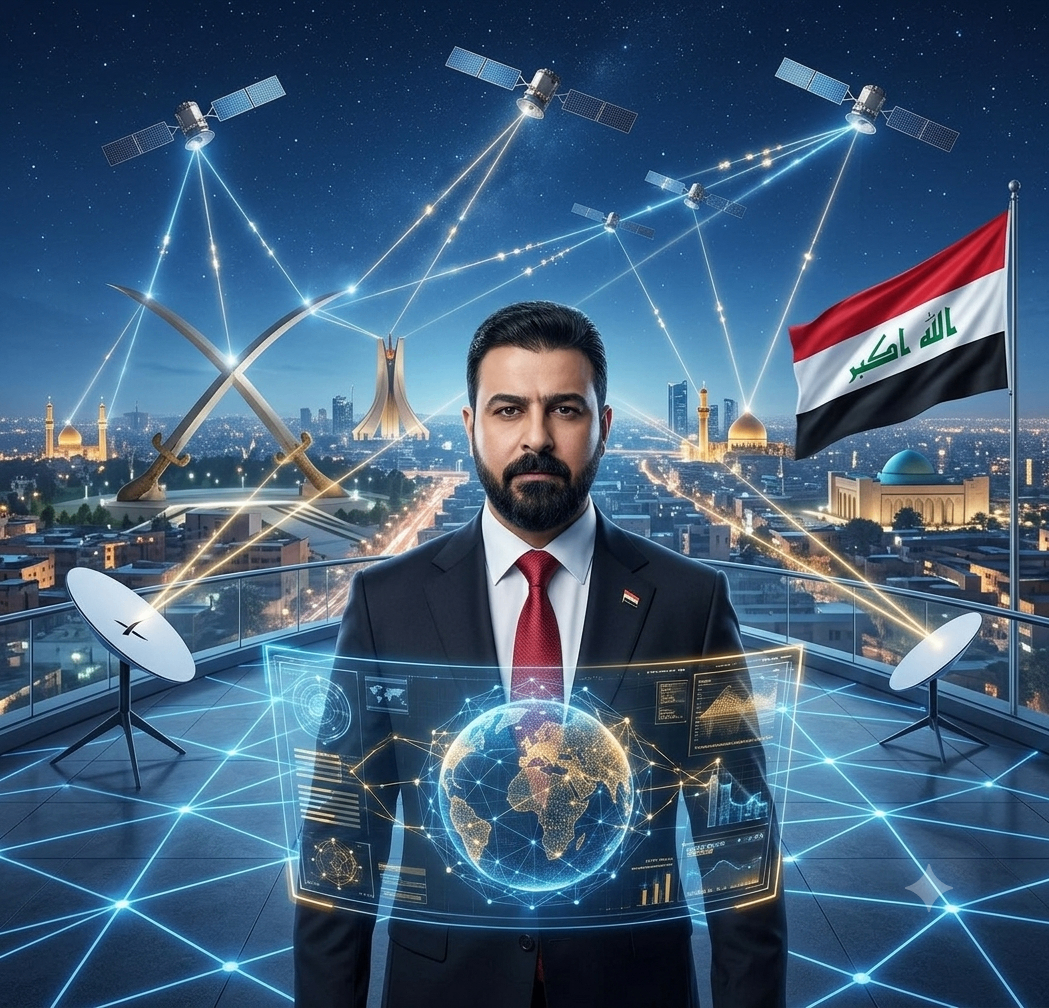
Experts view this as part of a broader strategy adopted by the government to develop digital infrastructure, promote technological transformation, and open the Iraqi market to global investments in a sector closely linked to economic development and modern services.
American billionaire Elon Musk recently announced the launch of Starlink satellite internet service in Iraq following the official approval of its operating license. This opens the door to a new era of high-speed communication services and reflects the success of the government's efforts to attract global technology companies and modernize the country's digital infrastructure.
Musk stated in a post on the X platform that Iraq had approved the Starlink operating license, paving the way for the launch of satellite internet services within the country. Prime Minister Ali al-Zubaidi and US Special Envoy to Iraq Tom Barrack welcomed the license approval, indicating the project's importance to Iraq and its international partners.
Following directives from Prime Minister Ali al-Zaidi, the past period witnessed intensive government meetings and discussions regarding the company's operational mechanisms within Iraq and the requirements for granting a license. This aligns with the government's strategy to attract global technology companies and expand internet service options for citizens.
Starlink's entry represents a strategic development for the Iraqi telecommunications sector, as the service provides internet access to remote, border, and desert areas that have suffered for years from weak traditional infrastructure. Furthermore, it offers higher connection speeds and greater service stability compared to many currently available alternatives.
This development comes after months of government initiatives and technical discussions led by relevant telecommunications sector stakeholders, within a broader approach adopted by al-Zaidi's government to promote digital transformation and attract global technology investments, in parallel with programs to develop electronic infrastructure and expand the scope of government digital services.
Experts believe that the entry of the giant American company represents a new message of confidence in the Iraqi investment environment, especially since Starlink is one of the largest satellite internet projects in the world, and operates in dozens of countries through a wide network of low-orbit satellites.
The project’s benefits are not limited to improving internet services for citizens, but extend to supporting the economic, educational, health and security sectors, by providing more stable communications for government institutions, companies and investment projects, as well as supporting e-government and digital transformation projects that Baghdad seeks to accelerate in the coming years.
Technology expert Nawras Aref said that “Starlink’s entry into Iraq represents an important step towards modernizing the communications sector and raising the efficiency of digital services, especially as the world is rapidly moving towards relying on smart infrastructure and high-speed sustainable connectivity.”
Aref added to Iraq Observer that “Iraq needs such advanced services because they give users super speeds and internet access in areas that are difficult to cover with traditional terrestrial networks, and they also provide future solutions that support e-learning, digital commerce and smart government services.”
He explained that “the presence of global companies the size of Starlink within the Iraqi market will create a positive competitive environment that will drive the development of local services and raise quality levels, as well as enhance Iraq’s attractiveness to international technology investments.”
In keeping with global trends, experts confirm that the government's success in completing the licensing procedures reflects a clear desire to keep pace with global technological advancements, especially given the growing need for a modern communications infrastructure capable of supporting the demands of the digital economy, foreign investment, artificial intelligence projects, and cloud services.
As the official launch of the service approaches, Iraqis anticipate a new era of internet services, with expectations that Starlink's entry will help bridge the digital divide between cities and remote areas, and open broader horizons for the digital economy and the technological transformation that the government seeks to establish within its development vision for the coming years. link
***************
Tishwash: Will the "programs and performance" budget succeed in converting funds into services?
Specialists and experts have confirmed that the program and performance budget the government is moving towards implementing represents a significant shift in public spending management. However, it faces implementation challenges related to the readiness of ministries, the efficiency of monitoring, and the ability of institutions to translate financial allocations into tangible services for citizens.
The Prime Minister's financial advisor, Mazhar Muhammad Salih, told Al-Mada that the government is proceeding with the implementation of the program and performance budget, which links financial allocations to measurable performance indicators and results within state institutions. This aims to improve spending efficiency and direct resources towards the most effective programs.
He explained that the new system enhances transparency and financial governance and raises the level of accountability, which could lead to improved public services. However, he also pointed to challenges related to the varying levels of readiness among ministries, weak institutional and information infrastructure, and the need to develop monitoring systems and build administrative capacity.
For her part, Suad al-Maliki, a former member of the Parliamentary Strategic Planning Committee, warned in an interview with Al-Mada against proceeding with a program-based budget for 2027 without evaluating the results of the current budgets. She emphasized that the success of the experiment hinges on the government's ability to effectively implement the 2025 and 2026 budgets.
She explained that the delays in the 2025 budget schedules and the lack of clarity regarding implementation results raise questions about the readiness for the transition to the new system.
She added that the success of this transformation requires political will and coordination between the executive and legislative branches, along with the adoption of transparent standards and each ministry accurately identifying its needs before auditing by central authorities. She noted that the transitional phase may witness gaps due to administrative changes.
Similarly, economic expert Duraid al-Anzi believes that the success of a program-based budget is not linked to changing its name or form, but rather to the state's ability to implement and monitor it.
Speaking to Al-Mada, he said that the fundamental problem lies not in preparing the budgets, but in converting funds into actual projects and services, warning against the continuation of stalled projects that hinder the achievement of results. He added that weak executive efficiency and the absence of integrated economic planning lead to continued waste and a diminished impact of public spending, stressing that genuine reform begins with improving management before increasing allocations.
Al-Anzi pointed out that building an effective economic planning system requires extensive institutional reform that will extend over several years, potentially up to ten, to achieve comprehensive sustainable development. He believes the greatest challenge lies in implementation, not in the plans themselves.
While the government is banking on program and performance budgeting to reorganize public spending and link it to results, the real test remains the ability of state institutions to translate allocations into tangible services that citizens can actually experience. link
Tishwash: Al-Zaidi to Washington: A partnership of equals to finance productive projects
All eyes are on the upcoming visit of Prime Minister Ali Faleh al-Zaidi to the United States as a pivotal economic milestone, given the regional and international changes taking place in the region, and the need to reformulate economic relations between Baghdad and Washington on new and viable foundations based on investment, production, and technology transfer, moving beyond just security and oil issues.
Experts believe that the success of the visit scheduled for the middle of next month depends on turning it into a platform for launching strategic projects and feasible economic agreements that contribute to diversifying the Iraqi economy, improving the investment environment, and enhancing Iraq’s position as a regional and international economic partner.
Comprehensive vision
Amer Al-Jawahiri, an advisor on development and investment, said that the importance of the visit comes after the peace agreements witnessed in the region, and the accompanying comprehensive vision to strengthen economic relations between its countries, which opens the door for the participation of international companies in major reconstruction and development projects, including Iraqi projects.
Al-Jawahiri explained in an interview with Al-Sabah that Iraq faces major challenges, including the delay in implementing steps to diversify the economy and invest its natural resources, in addition to the large size of projects whose implementation requires a long-term government program to which successive governments are committed. He pointed out that addressing the electricity crisis represents one of the most prominent economic tests for the government, in light of the escalating financial obligations and concerns about the inadequacy of oil revenues to cover operational expenses and finance strategic projects.
Visit files
Al-Jawahiri stressed that the current stage requires unifying the economic vision among all concerned parties, calling for the Ministerial Council for the Economy to hold periodic sessions with specialists from outside government institutions and economic advisors to benefit from their expertise in preparing visit files, as well as drawing up the paths of the economic program for Iraq during the next stage.
He pointed out the need for the visit to include presenting specific economic files to the American side, foremost among them addressing the restrictions imposed on a number of Iraqi banks, and increasing flexibility in dealing with the US Federal Reserve, which would positively affect the financial sector and the movement of trade transfers. He stressed the importance of attracting direct American investments or implementing projects in partnership between the Iraqi government and the private sector, according to the model of joint-stock companies with the possibility of offering their shares to finance and operate the projects.
Investment opportunities
He pointed out that Iraq has a number of major investment opportunities, including the Al-Nibras Petrochemical Project, nitrogen fertilizer projects in Basra and Baiji, phosphate fertilizers in Al-Qaim-Akashat, the silica manufacturing project in Anbar, and the extraction and manufacturing of sulfur in Nineveh. He noted that one of the important files is also involving American companies in implementing the Development Road project, which includes railway lines, industrial cities, and production projects aimed at meeting the needs of the local market and boosting exports.
Al-Jawahiri proposed the idea of establishing an Iraqi-American financial investment fund, financed by a portion of Iraqi oil exports to the United States, to be allocated to financing well-studied productive projects that achieve sustainable economic returns. He stressed that the success of this initiative depends on the existence of a clear program and efficient management mechanisms that ensure the actual implementation of the projects.
He emphasized that the success of any economic understandings requires taking practical steps to improve the business and investment environment through continuous consultation with the Private Sector Development Council, and holding a weekly roundtable that includes specialists and those concerned with the economy and business inside and outside government institutions, in order to give the Iraqi delegation a comprehensive vision that can be presented during its meetings in Washington. He also stressed the importance of stimulating competition among countries and international companies wishing to invest in Iraq, in order to ensure the best offers and the maximum benefit from the available economic potential.
Comprehensive economic partnership
For his part, financial expert Dr. Nabil Al-Abadi stressed that the visit should not be viewed as a passing diplomatic event, but rather as an economic necessity imposed by the nature of the stage that Iraq is going through, noting that the relationship with the United States has remained for years within the framework of oil and security, while the current stage provides an opportunity to move towards a comprehensive economic partnership.
Al-Abadi told Al-Sabah: “Iraq is not just a source of oil, but it possesses the potential to be a promising market for investments and modern technology, as well as being an important arena for reconstruction and an active partner in supporting the stability of global energy markets.”
He added that the visit represents a practical opportunity to implement the concept of “oil for technology and investment” by attracting major American companies to invest in advanced petrochemical industries, associated gas investment, and renewable energy, which are sectors that would add value to the national economy, support the path of economic diversification, and reduce dependence on oil revenues.
Financial and banking sector
Al-Abadi pointed out that the most prominent challenge facing the Iraqi economy is the reality of the financial and banking sector, and the challenges it faces related to financial compliance and combating money laundering, which makes it necessary to take advantage of the visit to conduct a direct dialogue with the US Treasury Department and the Federal Reserve with the aim of establishing a safe financial corridor that ensures the smooth flow of financial transfers, enhances the stability of the exchange rate, and raises the level of confidence of international investors in the Iraqi market.
He stressed that Iraq is not looking for aid or grants, but rather for a strategic economic partnership based on common interests, indicating that the success of the visit should be measured by the practical results it achieves, represented in the signing of investment agreements, and the launching of projects in the fields of gas, agriculture, industry and infrastructure, in addition to putting in place clear implementation and follow-up mechanisms that ensure that understandings are transformed into real projects that contribute to building a more diversified and productive Iraqi economy. link
News, Rumors and Opinions Wednesday 6-24-2026
KTFA:
Clare: Mustafa Sand announces the recovery of 85 billion dinars that had been embezzled and returned to the ministry's account.
6/23/2026- Baghdad
Communications Minister Mustafa Sand announced on Tuesday that 85 billion dinars that had been embezzled have been recovered and returned to the ministry's account.
Sand said in a post on social media: “I thank the head of the Supreme Judicial Council, Faiq Zaidan, for protecting public funds and returning 85 billion dinars to our ministry’s account and the state treasury.”
KTFA:
Clare: Mustafa Sand announces the recovery of 85 billion dinars that had been embezzled and returned to the ministry's account.
6/23/2026- Baghdad
Communications Minister Mustafa Sand announced on Tuesday that 85 billion dinars that had been embezzled have been recovered and returned to the ministry's account.
Sand said in a post on social media: “I thank the head of the Supreme Judicial Council, Faiq Zaidan, for protecting public funds and returning 85 billion dinars to our ministry’s account and the state treasury.” LINK
Clare: Judiciary: More than 67 billion new dinars seized in the Adnan al-Jumaili case
Baghdad
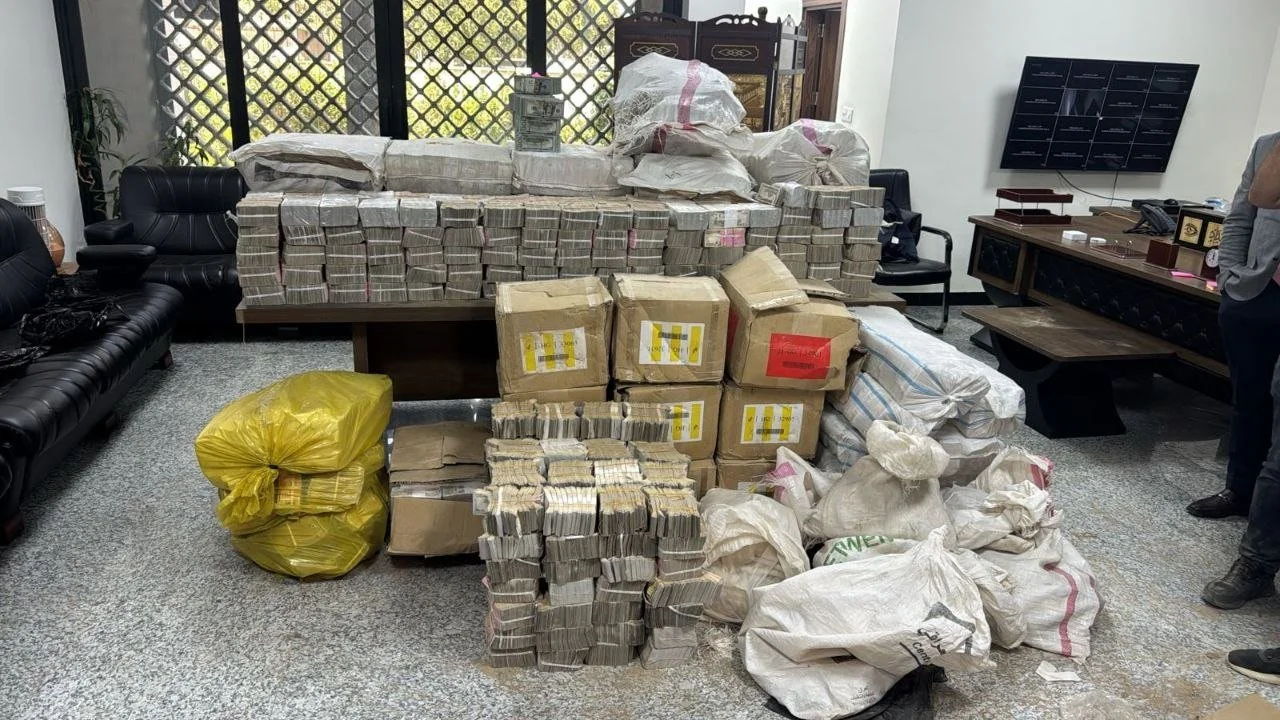
The Supreme Judicial Council announced on Tuesday the seizure of more than 67 billion new dinars in the case of the detained Undersecretary of the Ministry of Oil for Liquidation Affairs, Adnan al-Jumaili.
The Judicial Council stated in a statement received by “Al-Eqtisad News” that “the investigating judge of the Central Anti-Corruption Criminal Court explained developments in the case of the detained accused Adnan Al-Jumaili, Undersecretary of the Ministry of Oil for Liquidation Affairs, which resulted in the arrest of the former governor of Salah al-Din and current Director of Health in it, Raed Al-Jubouri, based on confessions made by Al-Jumaili during his interrogation.”
He added that “the investigations into this case are ongoing, and as a result of the careful follow-up to seize the financial proceeds resulting from the waste in the projects implemented by the accused and the parties to the case, today cash amounts amounting to more than (67) billion dinars and (one million dollars) were seized, part of which was hidden in the homes of a number of people.”
He continued: “As for the other part, it was hidden underground at a depth of four meters, and it was found after digging the ground with specialized machinery, so that the amount of money seized in the case exceeds (98) billion dinars and (11) million dollars.” LINK
Courtesy of Dinar Guru: https://www.dinarguru.com/
Stephen If you hold Iraqi dinar and you're hoping, speculating that the dinar will revalue in the near future, I don't see how you cannot be excited right now...Stay grounded. Stay steadfast because we are entering uncharted territory. In the last 15 years since I've held Iraqi dinar more has gotten done in the last four months than the entire 15 years combined...We have never seen so much acceleration, so much movement. It's almost like there's a deadline somewhere in the near future.
Frank26 Elon Musk made thousands of millionaires last week for the United States of America's economy....[Iraqi's] currency is about to do the same thing. It is going to explode out GDP power of our economy. The United States of America will explode, which will only benefit many other nations ...We are about to make many millionaires through the Iraqi dinar investment. Same as Musk. Our country is about to explode...You have a new exchange rate coming...Get ready.
Mnt Goat ...there is now a solid benchmark set of at least 45% of the economy generating revenues of non-oil based. If you think about this goal then you can clearly see additional revenues being generated in the future besides what they have today to meet their budgets ....with these surplus revenues, the CBI can then be able hoard more of the surplus oil revenues to put towards its reserves, gold, and other investments bringing Iraq into more light with the international scene...
************
G. Edward Griffin & Lynette Zang LIVE | Debt Crisis, Hyperinflation & the Future of Money
6-23-2026
Join Lynette Zang and special guest G. Edward Griffin LIVE as they discuss the growing debt crisis, the risks of hyperinflation, the future of money, and what these changes could mean for your savings, retirement, and financial freedom.
Iraq Economic News and Points To Ponder Late Tuesday Evening 6-23-26
Iraq And The Dollar: Parallel Market Surges Amid Speculation And Regional Tensions
June 23, 2026Last updated: June 23, 2026 The Independent - The parallel market witnessed a remarkable rise in the dollar exchange rate in recent days, exceeding the 157,000 dinar mark per 100 dollars, amid anticipation and concern in economic and commercial circles regarding the repercussions of regional developments and their impact on local markets.
Iraq And The Dollar: Parallel Market Surges Amid Speculation And Regional Tensions
June 23, 2026Last updated: June 23, 2026 The Independent - The parallel market witnessed a remarkable rise in the dollar exchange rate in recent days, exceeding the 157,000 dinar mark per 100 dollars, amid anticipation and concern in economic and commercial circles regarding the repercussions of regional developments and their impact on local markets.
Financial experts believe that this rise is not related to any change in the official monetary policy or the exchange rate adopted by the state, but rather is due to a set of overlapping factors, most notably speculation, rumors and regional tensions that have led to an increase in demand for foreign currency in the parallel market.
Experts confirm that Iraqi markets are directly affected by political and security developments in the region, especially those related to international trade and energy markets, which is reflected in the behavior of traders, importers, and speculators in the exchange market.
Financial and banking expert Dr. Mustafa Hantoush said that the current rise in the price of the dollar is mainly due to speculation and rumors circulating about the possibility of amending the official exchange rate in the coming period, despite the absence of any official indicators or decisions in this regard.
He explained that the circulation of this news prompted some traders and speculators to increase their demand for the dollar in anticipation of any future changes, which caused a rise in demand in the parallel market and was directly reflected in prices.
He added that these practices negatively affect the national economy by raising import costs and creating pressure on the prices of basic commodities, as well as increasing anxiety and instability in the markets.
Hantoush pointed out that any decision regarding the exchange rate is subject exclusively to the policies of the Central Bank of Iraq, stressing that no official announcement has been issued regarding amending the adopted rate so far, despite talk of future possibilities without a clear basis.
For his part, economist Haider Al-Sheikh said that part of the increased demand for the dollar is related to the rapid regional developments, especially concerns about shipping traffic in the Strait of Hormuz and its potential impact on global trade and supply chains.
He explained that these developments prompted some traders to increase their demand for the dollar as a precautionary measure, in addition to the impact of rumors about the exchange rate, which contributed to a temporary rise in prices in the parallel market.
The Sheikh confirmed that monetary policy in Iraq has not witnessed any change, and that the official price of the dinar remains fixed, predicting a gradual return to stability as psychological pressures in the market subside.
For his part, economic researcher Ahmed Eid explained that the rise of the dollar is due to internal and external factors at the same time, most notably geopolitical tensions and concerns related to the security of navigation and Iraqi oil flows.
He pointed out that these concerns have prompted traders to increase their demand for foreign currency, coinciding with the continuation of some restrictions on external transfers, which widens the gap between the official and parallel exchange rates.
He also pointed out that Iraq’s inclusion on the Financial Action Task Force (FATF) grey list has increased caution among some traders, which has indirectly affected market activity.
Economic estimates indicate that continued speculation and rumors may keep the market in a state of temporary fluctuation, while the central bank’s ability to control the market remains a crucial factor in stabilizing the exchange rate in the coming period. https://mustaqila.com/العراق-والدولار-ارتفاعات-السوق-الموا/
Shenkali Warns Against Raising The Value Of The Dollar And Harming The Poor And Middle Classes.
Information/Baghdad... Former MP Majid Shenkali warned against raising the value of the dollar against the dinar and harming the poor and middle classes.
Shankali said via social media, as reported by Al-Maalomah, that “the difference today between the official and parallel price of the dollar is 250 dinars, meaning that every 100 S bill has a difference of 25,000 dinars, and no one is talking about it under the pretext that the newly formed government.”
He added that "this excuse is completely unacceptable, especially since the government's supporters are praising the Prime Minister's economic and financial expertise and skill," noting that "if the government is serious about reducing the price of the dinar to reduce the budget deficit and bear the expenses, it must first work to ensure that the difference between the official and parallel prices is no more than 10-20 dinars only."
He explained that "raising the dollar's price and maintaining a large gap means destroying the poor and middle classes, both in terms of their livelihoods and the economy." (End of 25)
Actions, Not Words... The US State Department Presents Baghdad With A Clear Equation: Genuine Reforms, Strong Institutions, And Full Sovereignty
Baghdad - One News - 6/23/2026 The US State Department stressed the importance of completing the formation of the Iraqi government and cabinet as soon as possible, in order to enhance the ability of state institutions to implement political, security and economic reforms.
The US State Department, in a statement to One News, said that the selection of security leaders should be based on criteria of competence, professionalism and integrity, stressing the need for these leaders to work under the authority of the state and the constitution, away from any other loyalties or affiliations outside official frameworks.
She added that building professional national security institutions is a fundamental pillar for consolidating Iraq’s sovereignty and enhancing stability, stressing that the state’s success in this path requires independent security institutions capable of performing their duties away from the influence of armed groups.
The US State Department reiterated its support for Prime Minister Ali al-Zaidi's government in its efforts to complete the building of state institutions and enhance their efficiency, which contributes to consolidating the strategic partnership between Baghdad and Washington and supporting the path of reform and stability in the country. https://1news-iq.net/مرحلة-الأفعال-لا-الأقوال-الخارجية-الأ/
The Central Bank Announces The Completion Of The Requirements For Reintegrating Banks Restricted From Dealing In US Dollars
Baghdad - WAA The Central Bank of Iraq announced on Monday the completion of procedures and requirements for the reintegration of a number of banks restricted from dealing in US dollars in foreign currency transfer operations.
The bank stated in a statement received by the Iraqi News Agency (INA): “Within the framework of the Central Bank of Iraq’s efforts to enhance monetary and financial stability, develop the banking sector, and raise its level of integration into the global financial system, the bank continues to implement its reform program in coordination with relevant international institutions, focusing on several key areas.”
The statement added that "the Central Bank of Iraq has completed the procedures and requirements for the reintegration of a number of banks restricted from dealing in US dollars in foreign currency transfer operations, after they met the requirements of the reform plan and the relevant supervisory and technical standards, and strengthened their frameworks for combating money laundering and terrorist financing," explaining that "this file has reached its final stages in preparation for the gradual and organized reintegration, which will enhance the ability of these banks to serve their customers and support the expansion of their foreign correspondent relationships in accordance with best practices and international standards."
He added that “the Central Bank has completed the necessary technical and procedural requirements to raise the limits of electronic payment cards for the category of registered companies and businesses, which contributes to expanding the scope of digital financial services, enhancing financial inclusion, and meeting the needs of various segments of customers with payment tools.
The bank is proceeding with the implementation of the subsequent phases of this project in a gradual and deliberate manner, in a way that ensures the consolidation of regulatory controls that will enhance the integrity and effectiveness of the system, and keep pace with the rapid developments in the financial sector.”
The Central Bank of Iraq, according to the statement, affirmed its commitment to “meeting the demand for the US dollar in accordance with the approved controls and standards, ensuring the smooth flow of transfers and covering the legitimate needs of the public and private sectors, based on strong foreign reserves and effective monetary tools.
This is done with full commitment to compliance requirements and standards for combating money laundering and terrorist financing, and a monetary policy based on the stability of the exchange rate and the integrity of financial channels.”
The bank stressed, according to the statement, that "these measures are part of a comprehensive reform program aimed at addressing existing challenges and resolving priority issues, thereby strengthening confidence in the Iraqi banking sector, supporting the foundations of financial and monetary stability, and backing the country's economic development."
He concluded that he “will continue to take the necessary measures and policies to develop the banking environment, raise the efficiency of the financial system, and provide the necessary elements to support sustainable economic growth, thereby achieving long-term financial stability and preserving the stability of the exchange rate and the integrity of financial channels.”
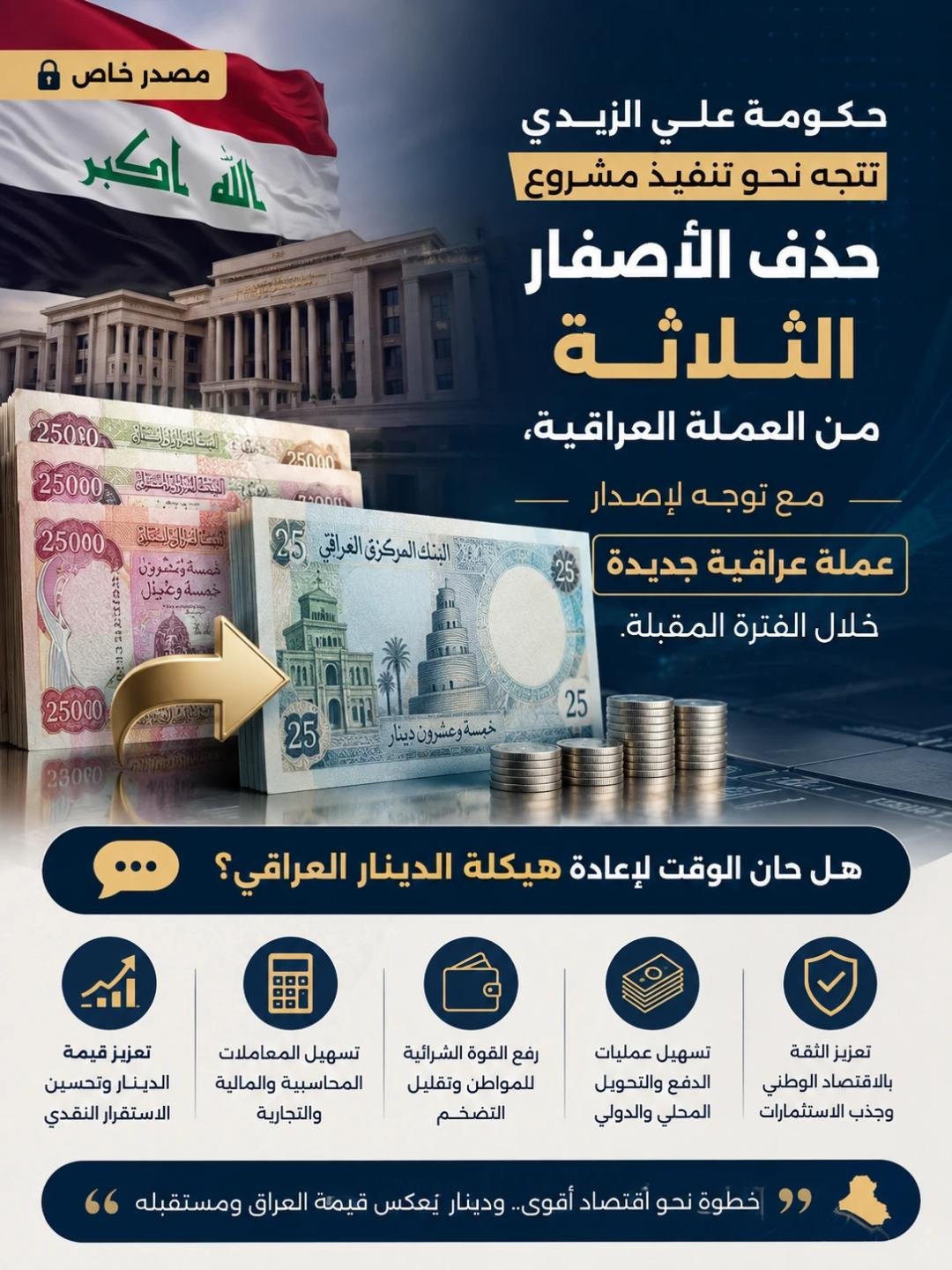
A Source Reveals to *Al-Mustaqila*: The Government Is Moving Toward Removing Three Zeros From The Iraqi Dinar And Issuing A New Currency
June 21, 2026 — Last Updated: June 21, 2026 *Al-Mustaqila* / An exclusive source told *Al-Mustaqila* that the Iraqi government, headed by Ali Al-Zaidi, is moving toward studying and implementing a major economic project involving the removal of three zeros from the Iraqi currency as part of a package of monetary reforms aimed at restructuring the financial system and facilitating everyday transactions.
According to the source, the project also includes a gradual move toward issuing a new Iraqi currency while maintaining the dinar's real value and purchasing power, should the plan be officially implemented by the Iraqi Central Bank.
Reasons behind the move include:
- Continued heavy reliance on oil revenues
- Exchange rate fluctuations against the U.S. dollar
- Inflation in liquidity and expansion of the money supply in circulation
- Weak confidence in the banking system
Experts believe that the "removal of the zeros" project is generally classified as a currency redenomination. This means it does not change the real value of salaries or prices but instead aims to simplify figures and make daily financial transactions easier.
**International Experiences and Local Concerns**
Experiences from other countries indicate that such measures can technically succeed in simplifying the monetary system. However, they require economic stability and strong confidence in the banking sector to ensure that market disruption does not occur.
On the other hand, specialists warn that any poorly planned implementation could lead to:
- Confusion over prices during the transition period
- Public concerns about losing value
- Temporary difficulties in controlling the cash market
**Iraq's Economy Between Reform and Pressure**
This discussion comes at a time when Iraq is trying to balance financial reforms with mounting economic challenges, making the currency issue one of the most sensitive topics in the coming period, especially if the country actually transitions to a new currency.
While supporters view the move as "a necessary modernization," opponents see it as "more cosmetic than a fundamental reform." The final decision remains tied to the readiness of financial institutions and their ability to manage the transition without causing economic shocks.
Will this mark the beginning of a real transformation in the Iraqi dinar, or is it simply another discussion within monetary policy circles? https://mustaqila.com/مصدر-يكشف-لـالمستقلة-الحكومة-تتجه/
A Source Denies Any Change In The Exchange Rate And Confirms A Plan To Control The Parallel Market In Iraq.
June 23, 2026Last updated: June 23, 2026 Al-Mustaqilla - An informed source confirmed to Al-Mustaqilla on Tuesday that what has been circulating in recent days regarding the Iraqi Central Bank's intention to raise or change the exchange rate of the dinar against the dollar is "completely untrue," categorically denying any official intention to amend the rate currently adopted in monetary policy.
The source explained that the official exchange rate will remain fixed without any change in the coming period, stressing that there are no decisions or discussions regarding raising or lowering it, as is being circulated in some media outlets and social media sites.
In contrast, the source indicated that the Central Bank, in coordination with the Iraqi government, is working on a new plan aimed at reducing the gap between the official price and the parallel market price, through regulatory and supervisory measures aimed at enhancing market stability and preventing speculation.
He added that the next phase will witness stricter steps towards unregulated transactions in the exchange market, with the aim of reducing the price difference and gradually restoring balance to the financial market in Iraq.
The source emphasized that “all news circulating about an intention to raise the exchange rate is baseless,” urging reliance on official sources regarding monetary policies and cautioning against being swayed by rumors that undermine market stability and public confidence. https://mustaqila.com/مصدر-ينفي-تغيير-سعر-الصرف-ويؤكد-خطة-للس/
Seeds of Wisdom RV and Economics Updates Wednesday Morning 6-24-26
Good Morning Dinar Recaps,
Stocks Stabilize After Tech Selloff as Dollar Climbs to One-Year High
Global markets steadied after a sharp technology-led selloff, while a stronger U.S. dollar and easing oil prices reflected growing investor caution over artificial intelligence valuations, interest rates, and geopolitical uncertainty.
Good Morning Dinar Recaps,
Stocks Stabilize After Tech Selloff as Dollar Climbs to One-Year High
Global markets steadied after a sharp technology-led selloff, while a stronger U.S. dollar and easing oil prices reflected growing investor caution over artificial intelligence valuations, interest rates, and geopolitical uncertainty.
Overview
Global stock markets stabilized after heavy losses in technology shares earlier this week.
The U.S. dollar reached its strongest level in one year as investors sought safety amid geopolitical and monetary policy uncertainty.
Markets remain focused on AI valuations, Federal Reserve policy, and U.S.-Iran negotiations, all of which could shape financial markets in the weeks ahead.
Key Developments
1. Technology Stocks Attempt a Rebound
Technology shares recovered modestly after suffering a broad selloff driven by concerns that artificial intelligence-related companies may have become overvalued following months of rapid gains.
Investors are closely watching Micron Technology's earnings, viewing the semiconductor manufacturer as an important indicator of continued demand for AI infrastructure, data centers, and advanced computing.
While long-term optimism surrounding AI remains intact, markets are becoming increasingly selective as investors evaluate whether corporate earnings can justify current valuations.
2. U.S. Dollar Strengthens as Investors Seek Safety
The U.S. dollar climbed to its highest level in a year, supported by expectations that the Federal Reserve may keep interest rates elevated if inflation remains persistent.
Geopolitical uncertainty surrounding the evolving U.S.-Iran peace negotiations also encouraged investors to move toward traditional safe-haven assets, further strengthening the dollar.
The stronger dollar placed additional pressure on other major currencies, particularly the euro and Japanese yen.
3. Falling Oil Prices Ease Inflation Pressures
Oil prices continued to decline as expectations grew that shipping through the Strait of Hormuz would gradually normalize following recent diplomatic developments.
Lower crude prices could reduce inflationary pressures worldwide by lowering transportation and energy costs, potentially easing some pressure on consumers and central banks.
However, markets remain cautious as negotiations between Washington and Tehran continue to evolve and regional tensions have not been fully resolved.
Why It Matters
Global financial markets are currently being influenced by three powerful forces: artificial intelligence investment, central bank policy, and geopolitical developments.
Technology companies continue to drive much of the market's performance, while interest rate expectations and global conflicts are shaping currency markets, commodity prices, and investor confidence.
Why It Matters to Foreign Currency Holders
Foreign currency holders should continue monitoring U.S. monetary policy, the strength of the U.S. dollar, and geopolitical developments.
A stronger dollar, changing energy prices, and continued progress toward digital financial infrastructure all influence global capital flows, international trade, and long-term monetary policy discussions that remain important to those following future currency realignment developments.
Implications for the Global Reset
Pillar 1: Monetary Policy
Higher interest rates and a stronger U.S. dollar continue influencing global liquidity, capital flows, and international investment decisions.
Pillar 2: Financial Infrastructure
AI investment, digital technologies, and shifting geopolitical alliances are accelerating structural changes across the global financial system that could shape the next generation of finance.
Closing Thought
Markets are increasingly responding not only to economic data, but also to technology innovation, geopolitical negotiations, and central bank policy. The interaction of these forces will likely continue driving volatility while reshaping investment strategies across global markets.
This is not just about stock prices—it reflects the growing connection between technology, monetary policy, and geopolitical developments as the global financial system continues to evolve.
Seeds of Wisdom Team
Newshounds News™ Exclusive
Sources
~~~~~~~~~~
🌱 A Message to Our Currency Holders🌱
If you’ve been holding foreign currency for many years, you were not foolish.
You were not wrong to believe the global financial system would change.
What failed was not your patience — it was the information you were given.
For years, dates, rumors, and personalities replaced facts, structure, and proof. “This week” predictions created cycles of hope and disappointment that were never based on how currencies actually change.
That is not your failure.
Our mission here is different: • No dates • No rates • No hype • No gurus
Instead, we focus on:
• Verifiable developments • Institutional evidence
• Global financial structure • Where countries actually sit in the process
Currency value changes only come after sovereignty, trade, banking, settlement systems, and fiscal coordination are in place. History and institutions confirm this sequence.
You will see silence. You will see denials. That is not delay — that is discipline.
Protect your identity. Organize your documents. Verify everything.
Never hand your discernment to anyone who cannot show proof.
You deserve truth — not timelines.
Seeds of Wisdom Team
Newshounds News
~~~~~~~~~~
Seeds of Wisdom Team RV Currency Facts Youtube and Rumble
Newshound's News Telegram Room Link
RV Facts with Proof Links Link
RV Updates Proof links - Facts Link
Start Here room with Most Asked Questions Link
Follow the Gold/Silver Rate COMEX
Follow Fast Facts
Seeds of Wisdom Team™Website
Thank you Dinar Recaps
MilitiaMan & CREW IRAQ DINAR UPDATE-"By Design: Major Convergences Stacking Up Before the Washington Visit"
MilitiaMan & CREW IRAQ DINAR UPDATE-"By Design: Major Convergences Stacking Up Before the Washington Visit"
6-23-2026
The Crew: Samson, PompeyPeter, Petra, Daytrader, Sunkissed, GIGI and Militia Man
No drama. No intrigue. No songs and dances. Just straight, factual news that I read and interpret to the best of my ability after being an avid Dinar investor and insanely obsessed Dinarian for over 15 years.
Follow MM on X == https://x.com/Slashn
MilitiaMan & CREW IRAQ DINAR UPDATE-"By Design: Major Convergences Stacking Up Before the Washington Visit"
6-23-2026
The Crew: Samson, PompeyPeter, Petra, Daytrader, Sunkissed, GIGI and Militia Man
No drama. No intrigue. No songs and dances. Just straight, factual news that I read and interpret to the best of my ability after being an avid Dinar investor and insanely obsessed Dinarian for over 15 years.
Follow MM on X == https://x.com/Slashn
Be sure to listen to full video for all the news……..
FRANK26….6-23-26….COCKROACH FACADE
KTFA
Tuesday Night Video
FRANK26….6-23-26….COCKROACH FACADE
This video is in Frank’s and his team’s opinion only
Frank’s team is Walkingstick, Eddie and Omar in Iraq and guests
Playback Number: 605-313-5163 PIN: 156996#
KTFA
Tuesday Night Video
FRANK26….6-23-26….COCKROACH FACADE
This video is in Frank’s and his team’s opinion only
Frank’s team is Walkingstick, Eddie and Omar in Iraq and guests
Playback Number: 605-313-5163 PIN: 156996#
Iraq Economic News and Points To Ponder Tuesday Evening 6-23-26
Iraq Purchases $17M In Kuwaiti Non-Oil Goods
2026-06-22 Shafaq News- Baghdad Iraq ranked fifth among the largest importers of Kuwaiti non-oil goods in March 2026, with imports valued at 5.24 million Kuwaiti dinars (about $17.1M), according to data released by Kuwait's Central Statistical Bureau. The figures showed that Saudi Arabia topped the list of importers of Kuwaiti non-oil products, with imports worth 26.52 million Kuwaiti dinars (about $86.6M).
Iraq Purchases $17M In Kuwaiti Non-Oil Goods
2026-06-22 Shafaq News- Baghdad Iraq ranked fifth among the largest importers of Kuwaiti non-oil goods in March 2026, with imports valued at 5.24 million Kuwaiti dinars (about $17.1M), according to data released by Kuwait's Central Statistical Bureau. The figures showed that Saudi Arabia topped the list of importers of Kuwaiti non-oil products, with imports worth 26.52 million Kuwaiti dinars (about $86.6M).
It was followed by United Arab Emirates at 17.14 million dinars (about $56.0M), Jordan at 7.51 million dinars (about $24.5M), and India at 7.47 million dinars (about $24.4M).
Kuwait recorded a trade surplus of 1.768 billion Kuwaiti dinars (about $5.77B) during the first quarter of 2026, a 30.6% decline compared with the same period in 2025, amid decreases in exports, imports, and overall trade volume.
https://www.shafaq.com/en/Economy/Iraq-purchases-17M-in-Kuwaiti-non-oil-goods
Dollar Falls In Baghdad, Erbil Markets
2026-06-23 Shafaq News- Baghdad/ Erbil The US dollar closed Tuesday’s trading lower in Iraq, hovering around 157,000 dinars per 100 dollars.
According to Shafaq News market survey, the dollar traded in Baghdad's Al-Kifah and Al-Harithiya exchanges at 157,000 dinars per 100 dollars, down from the morning session’s 157,250 dinars.
In the Iraqi capital, exchange shops sold the dollar at 157,500 dinars and bought it at 156,500 dinars, while in Erbil, selling prices stood at 156,800 dinars and buying prices at 156,750 dinars.
https://www.shafaq.com/en/Economy/Dollar-falls-in-Baghdad-Erbil-markets-5
Gold Prices Fall In Baghdad And Erbil
2026-06-23 Shafaq News- Baghdad/ Erbil Gold prices fell in Baghdad and Erbil on Tuesday, hovering around 900,000 IQD per mithqal, according to a Shafaq News market survey.
Wholesale prices on Baghdad's Al-Nahr Street recorded a selling price of 905,000 IQD per mithqal (equivalent to five grams) for 21-carat gold, including Gulf, Turkish, and European varieties, with a buying price of 901,000 IQD, down from Monday's 922,000 IQD.
The selling price for 21-carat Iraqi gold stood at 875,000 IQD, with a buying price of 871,000 IQD.
In jewelry stores, the selling price per mithqal of 21-carat Gulf gold ranged between 905,000 and 915,000 IQD, while Iraqi gold sold for between 875,000 and 885,000 IQD, with variation subject to craftsmanship fees and store location.
In Erbil, 22-carat gold was sold at 957,000 IQD per mithqal, 21-carat gold at 915,000 IQD, and 18-carat gold at 783,000 IQD.
https://www.shafaq.com/en/Economy/Gold-prices-fall-in-Baghdad-and-Erbil-3
Oil Ministry: We Aim to Increase Production to 4.3 Million Barrels per Day
Iraqi News Agency INA – Baghdad - 6/22/2026 The Ministry of Oil affirmed on Sunday its commitment to increasing production to approximately 4.3 million barrels per day and working to boost oil exports.
The Undersecretary for Extraction Affairs, Nasir Aziz, stated in a statement received by the Iraqi News Agency (INA) that “one of his top priorities at this stage is overseeing plans to rehabilitate and develop the southern oil fields, whose production declined to varying degrees due to the Gulf War crisis, in line with domestic needs and oil export requirements.”
“I have directed the management of oil companies to reassess the conditions of the fields, expedite production and pumping operations, and address technical and operational obstacles, with the aim of increasing oil exports through the southern ports and ensuring the continued supply of crude oil to national refineries,” he said.
The Undersecretary affirmed that initial plans aim to gradually restore national production to pre-crisis levels, estimated at between 4.2 and 4.3 million barrels per day, while also working to increase oil exports—particularly through the southern ports—to their previous levels of nearly 3.5 million barrels per day, depending on the readiness of the fields and facilities, as well as pumping, storage, and export plans.
“The Ministry is relying on national efforts, in cooperation with international contracting companies, to restore production capacities that declined during the crisis and to gradually increase production over an appropriate period until the targeted levels are reached, despite the significant technical and logistical challenges facing the sector,” Aziz added.
“Among the priorities of the extraction sector are monitoring production at the North Oil Company and enhancing oil transportation operations from the southern fields, which will contribute to supporting oil exports through the Turkish port of Ceyhan and diversifying export outlets in line with the ministry's plans for sustainable production and maximizing national revenues, in addition to overseeing production operations in the central oil fields,” he stated.
“The extraction sector will pay special attention to exploration blocks and oil and gas fields and work to develop them in a manner that strengthens national reserves and increases production capacity. This also includes supporting associated and non-associated gas investment projects, given their strategic importance in securing the needs of the energy and industrial sectors and reducing reliance on imports,” he added.
Aziz emphasized his commitment to strengthening relations with oil companies operating in Iraq and providing an appropriate environment to support their activities.
He also stressed the importance of encouraging reputable investment companies to participate in developing the oil industry, in line with the ministry's plans to improve operational efficiency and expand investment opportunities in the extraction sector.
World Bank Ranks Iraq Among Top Gas-Flaring Countries
2026-06-23 Shafaq News- Washington Iraq ranked alongside Russia and Iran among the world's largest gas-flaring countries in 2025, with the three nations collectively burning about 84 billion cubic meters of gas, nearly half of all gas flared globally, the World Bank reported on Tuesday.
The Bank’s Global Gas Flaring Tracker found that the burned gas quantity rose for the third consecutive year, reaching 167 billion cubic meters, with an estimated market value of $54 billion. Iraq was among nine countries responsible for more than 80% the flaring.
Read more: Iraq's gas flaring paradox: a wealth of resources, a nation in need
The World Bank noted that capturing gas currently burned at oil fields could help strengthen energy security, expand electricity generation, support economic activity, and reduce emissions, adding that reducing flaring depends largely on stronger regulations, investment, infrastructure, and political commitment rather than technological limitations.
https://www.shafaq.com/en/Economy/World-Bank-ranks-Iraq-among-top-gas-flaring-countries
To continue reading, click here.
Global Flaring Rises Three Years In A Row, Undermining Energy Security
Secure Access to Energy is Fundamental to Economic Growth and Job Creation
Washington, D.C., June 23—Global gas flaring rose for the third consecutive year, surging to 167 billion cubic meters (bcm) in 2025 and wasting an estimated $54 billion worth of gas. As many countries, especially the poorest, face energy shortages, capturing this wasted gas could strengthen energy security, generate power, support economic activity that’s key to job creation, and reduce emissions.
The annual Global Gas Flaring Tracker, released today by the World Bank Group, finds flaring volumes in 2025 nearly equal Africa's entire annual gas consumption and exceed annual LNG (liquefied natural gas) volumes transiting the Persian Gulf.
Nine countries, Russia, Iran, Iraq, Venezuela, Mexico, Libya, Algeria, Nigeria, and the United States, account for more than four-fifths of global flaring while accounting for nearly half of the world's oil production.
"At a time when many countries are struggling to increase affordable and reliable energy, the economic development costs of continued flaring are simply too high," said Demetrios Papathanasiou, World Bank Group Global Director for Energy. "The gas currently flared could be captured to power industries and businesses, create jobs, and strengthen energy security."
Many countries import costly gas while also flaring vast amounts of it at their oilfields. Eliminating routine flaring globally would require an estimated $70–100 billion, less than twice the annual value of the gas currently being wasted. Countries facing high import costs and domestic energy shortfalls stand to benefit from increased energy access, new gas revenues, and lower energy bills.
Yet despite the tools needed to end routine flaring being well established, it persists; what holds back progress is not technical but structural — inadequate regulation, insufficient capital, limited market infrastructure, and a failure by operators and governments to treat reduction as a priority.
Where effective policies and regulations, targeted investment, and leadership come together, flaring declines. Governments and operators that act decisively get results. For instance, Kazakhstan has reduced flaring by 87% since 2012, including a further 16% reduction in 2025 alone.
"The technologies, policies, regulations, and financing mechanisms needed to capture and utilize associated gas are available. What is missing, in too many places, is the leadership, prioritization, and governance needed to put these solutions into practice, creating access to markets and infrastructure." said Zubin Bamji, World Bank Manager for the Global Flaring and Methane Reduction (GFMR) Partnership.
“The cost of inaction will be measured in wasted billions in revenue and energy insecurity for millions of people.”
https://www.worldbank.org/en/news/press-release/2026/06/23/global-gas-flaring-rises-energy-security
Seeds of Wisdom RV and Economics Updates Tuesday Evening 6-23-26
Good Evening Dinar Recaps,
CLARITY Act Could Open the Door to Massive Institutional Investment in Crypto, Says Ric Edelman
Industry veteran Ric Edelman believes passage of the CLARITY Act could unlock institutional capital that has remained on the sidelines, potentially accelerating mainstream adoption of Bitcoin and digital assets.
Good Evening Dinar Recaps,
CLARITY Act Could Open the Door to Massive Institutional Investment in Crypto, Says Ric Edelman
Industry veteran Ric Edelman believes passage of the CLARITY Act could unlock institutional capital that has remained on the sidelines, potentially accelerating mainstream adoption of Bitcoin and digital assets.
Overview
Ric Edelman says the CLARITY Act could become the key catalyst that brings institutional investors into the cryptocurrency market.
An estimated 95% of institutions that currently hold no crypto may begin allocating assets once regulatory clarity is established.
Edelman believes Bitcoin could reach $150,000 or higher if favorable legislation and institutional participation continue to expand.
Key Developments
1. Regulatory Clarity Seen as the Missing Piece
Ric Edelman, founder of the Digital Assets Council of Financial Professionals, believes the CLARITY Act represents the most important regulatory milestone for the U.S. digital asset industry. He argues that many institutional investors remain interested in cryptocurrency but have delayed participation because clear federal rules have not yet been established.
According to Edelman, passage of the legislation would remove much of the legal uncertainty surrounding digital assets and provide traditional financial firms with the confidence to enter the market.
2. Institutional Demand Continues to Build
Despite recent market volatility, Edelman says institutional interest has continued to grow behind the scenes.
He noted that major financial firms including BlackRock, JPMorgan, Morgan Stanley, Fidelity, Franklin Templeton, State Street, and Invesco continue expanding blockchain, tokenization, and digital asset initiatives.
Edelman estimates that 95% of institutions that currently do not own cryptocurrency plan to make their first allocation, while roughly three-quarters of existing institutional investors intend to increase their exposure.
3. Bitcoin Could Benefit Significantly
Edelman believes regulatory certainty could trigger a new phase of institutional investment into Bitcoin and other digital assets.
If the CLARITY Act becomes law, he expects many investors to view it as the turning point that finally opens crypto to mainstream institutional capital. Based on that outlook, he projects Bitcoin could rise to $150,000 or higher over time.
He cautioned, however, that any delay or failure to pass the legislation could temporarily weaken market sentiment as investors reassess expectations.
Why It Matters
The CLARITY Act is designed to establish clear regulatory responsibilities for digital assets, providing guidance for financial institutions, investment firms, exchanges, and blockchain companies.
For many institutional investors, regulatory uncertainty—not technology—has remained the largest barrier to entering the crypto market. If Congress delivers a comprehensive framework, significant new capital could flow into digital assets.
Why It Matters to Foreign Currency Holders
Foreign currency holders closely monitor developments that influence global financial infrastructure. Increased institutional adoption of blockchain technology, tokenized assets, and regulated digital currencies could accelerate modernization of international payment systems and capital markets.
While the CLARITY Act does not directly affect foreign currency revaluation, it represents another step toward the broader digital transformation occurring within the global financial system.
Implications for the Global Reset
Pillar 1: Financial Infrastructure
Regulatory clarity could encourage broader institutional adoption of blockchain-based financial services and tokenized assets.
Pillar 2: Capital Markets
Large-scale institutional participation may further integrate digital assets into traditional investment portfolios and reshape global financial markets over time.
Closing Thought
The CLARITY Act is increasingly being viewed as more than cryptocurrency legislation. Its broader significance lies in establishing the regulatory foundation that could connect traditional finance with the rapidly expanding digital asset economy.
This is not just about cryptocurrency—it reflects the continuing transformation of financial infrastructure as governments prepare for the next generation of digital finance.
Seeds of Wisdom Team
Newshounds News™ Exclusive
Sources
~~~~~~~~~~
Seeds of Wisdom Team RV Currency Facts Youtube and Rumble
Newshound's News Telegram Room Link
RV Facts with Proof Links Link
RV Updates Proof links - Facts Link
Start Here room with Most Asked Questions Link
Follow the Gold/Silver Rate COMEX
Follow Fast Facts
Seeds of Wisdom Team™Website
Thank you Dinar Recaps
Tuesday Iraq News Posted by Tishwash at TNT 6-23-2026
TNT:
Tishwash: More than 100 draft laws await action in Iraq’s parliament, lawmaker says
More than 100 draft laws remain pending in Iraq’s parliament awaiting reading, debate and voting, a member of the parliamentary Legal Committee said.
Ibtisam al-Hilali told the Iraqi News Agency on Sunday that the previous government had withdrawn a number of bills from parliament to “amend and redraft some of their provisions.” She expressed hope the current government would resubmit them to complete the legislative process, and called for several to be put to a vote during the second legislative term, scheduled to begin in July.
TNT:
Tishwash: More than 100 draft laws await action in Iraq’s parliament, lawmaker says
More than 100 draft laws remain pending in Iraq’s parliament awaiting reading, debate and voting, a member of the parliamentary Legal Committee said.
Ibtisam al-Hilali told the Iraqi News Agency on Sunday that the previous government had withdrawn a number of bills from parliament to “amend and redraft some of their provisions.” She expressed hope the current government would resubmit them to complete the legislative process, and called for several to be put to a vote during the second legislative term, scheduled to begin in July.
Among the bills she identified were the Popular Mobilization Forces draft law, the Civil Service Law and a draft amendment to the public employee salary scale.
Iraq’s Council of Representatives opened its current legislative term in late December 2025 and elected Haibat al-Halbousi as speaker. link
Tishwash: Parliamentary moves to amend the investment law and activate the private sector
Parliamentary calls have been renewed to amend the investment law, as well as to adopt an effective policy to support the private sector as one of the main solutions to address unemployment and reduce the pressure of absorbing graduates on the government sector.
Member of Parliament Taqi al-Waeli told Al-Sabah newspaper: “There should be laws supporting the private sector, and what was stated in the ministerial program regarding government support for this sector should be translated into concrete measures on the ground.” He explained that most of the current pressure to provide job opportunities falls on the public sector, which cannot absorb the numbers. The large number of graduates.
He added that harnessing these energies requires a clear policy to support the private sector by backing local industries, encouraging investment, and establishing projects capable of absorbing the workforce. He pointed out that the projects exist and the vision is clear, but the problem lies ... In the weakness of activation and implementation.
Al-Waili explained that investors still face many obstacles when entering the Iraqi market, including administrative red tape and complex procedures, as well as cases of extortion that raise the cost of establishing industrial projects, which leads some investors to prefer importing instead of manufacturing inside Iraq.
He stressed the need to review and amend the investment law to facilitate procedures and remove obstacles for investors, noting that supporting national industry requires financial allocations and well-thought-out policies that ensure real results in terms of job creation.
He pointed out that the success of these steps is linked to the existence of a genuine will to address the issue of unemployment and absorb graduates, indicating that launching service projects alone is not enough unless the necessary financial liquidity and capabilities are available to complete them and turn them into productive job opportunities that contribute to revitalizing the national economy. link
************
Tishwash: Zidane and the Central Bank Governor discuss strengthening financial stability
The President of the Supreme Judicial Council, Judge Faiq Zaidan, and the Governor of the Central Bank, Nizar Nasser, discussed matters related to strengthening financial stability on Monday. This comes as the new Governor of the Central Bank officially assumed his duties and emphasized the importance of continuing efforts to consolidate financial and monetary stability.
In a press statement, the Supreme Judicial Council stated that "the President of the Supreme Judicial Council, Judge Faiq Zaidan, received the new Governor of the Central Bank, Nizar Nasser, and congratulated him on assuming his position, wishing him success in his duties." The statement added that "the President of the Supreme Judicial Council discussed with the Governor of the Central Bank a number of issues of mutual interest related to strengthening financial stability and supporting the legal procedures of the Central Bank."
In addition, a statement from the Central Bank indicated that "the new governor, Nizar Nasser, assumed his official duties, accompanied by the former governor, Ali Mohsen Al-Alaq, and they conducted a field tour that included various offices and departments of the Central Bank of Iraq to review the workflow and understand the nature of the tasks and duties carried out by the departments and directorates."
The new governor of the Central Bank of Iraq, Nizar Nasser, emphasized during his tour "the importance of continuing institutional work and enhancing performance efficiency to contribute to achieving the goals of the Central Bank of Iraq and consolidating financial and monetary stability." Nasser also commended "the efforts exerted during the previous phase under the leadership of the former governor, Ali Mohsen Al-Alaq, and the achievements that contributed to developing the banking sector and strengthening the national economy." link
Tishwash: Central Bank of Iraq: Reintegration of dollar-denominated banks is in its final stages
The Central Bank of Iraq confirmed on Monday that the process of reintegrating banks restricted from dealing in US dollars in foreign transfer operations has reached its final stages, while reiterating its commitment to meeting the demand for dollars in accordance with the approved regulations and standards.
The bank stated in a statement received by (Mawazin News) that it continues to implement its reform program in coordination with the relevant international institutions, with the aim of strengthening monetary and financial stability, developing the banking sector and raising its level of integration into the global financial system.
He explained that "the bank has completed the requirements and procedures for reintegrating a number of dollar-denominated banks into foreign currency transfer operations, after they met the reform conditions and regulatory and technical standards, in addition to strengthening anti-money laundering and counter-terrorism financing measures."
He indicated that the process has entered its final stages in preparation for a gradual and organized reintegration. He added that "the bank has also completed the technical and procedural requirements for raising the limits on electronic payment cards for the corporate and business sectors, in a step aimed at expanding digital financial services and enhancing financial inclusion."
Regarding the currency market, the Central Bank affirmed its commitment to meeting the demand for US dollars and covering the legitimate needs of the public and private sectors, relying on strong foreign reserves and effective monetary tools, while fully adhering to compliance standards and anti-money laundering and counter-terrorism financing measures.
The bank stressed that "these measures are part of a comprehensive reform program aimed at strengthening confidence in the Iraqi banking sector, supporting financial and monetary stability, and contributing to achieving sustainable economic development." link