TNT:
Tishwash: The Iraqi parliament will resume its work at the beginning of July, with the cabinet reshuffle on the agenda.
Tuesday, MP Duha al-Sadkhan, from the “National Approach” bloc, revealed the date for the start of the second legislative session of the House of Representatives, confirming that the parliament’s leadership will determine during the month of July a date for the resumption of sessions, including a session to complete the vote on the ministerial cabinet.
Al-Sadkhan said that the House of Representatives' legislative recess will end next week, with the second legislative session beginning on July 1st.
She added that the Speaker of the House of Representatives will set the date for the first session after the start of the new legislative term, noting that the agenda will include reading and discussing a number of draft laws, while other laws need to be voted on within the council.
She indicated that the parliament's leadership will determine, during the second or third week of July, a date for holding a session to complete the vote on the cabinet.
The resumption of the House of Representatives' work comes amid anticipation of discussing and approving a number of important and postponed laws, as Al-Sadkhan had previously confirmed the existence of more than 100 draft laws in the halls of parliament, distributed between laws that need to be read and discussed and others that are waiting for amendment or voting.
According to Al-Sadkhan, the new legislative session is expected to witness the discussion and voting on a number of prominent pieces of legislation, most notably the Oil and Gas Law, the Popular Mobilization Forces Law, the Federal Court Law, the Federal Civil Service Council Law, the Retirement Law, and the Salary Scale Law.
The First Deputy Speaker of Parliament, Adnan Faihan, had previously confirmed that there was parliamentary activity to proceed with the legislation of a number of important and delayed laws, most notably the Oil and Gas Law, the Popular Mobilization Forces Law, and the Federal Civil Service Law.
These laws are among the most prominent legislative files postponed during recent parliamentary sessions, especially the oil and gas law, which is still subject to disputes regarding the management of natural resources and the distribution of revenues between the federal government, the Kurdistan Region, and the oil-producing governorates. link
************
Tishwash: Iraq enters the era of space communications... and "Starlink" is the latest fruit of the technological openness led by the Al-Zaidi government.
After years of discussing digital infrastructure modernization and attracting global technology companies, Prime Minister Ali al-Zubaidi's government has achieved a new breakthrough in the telecommunications sector by finalizing the procedures for bringing Starlink service to Iraq.
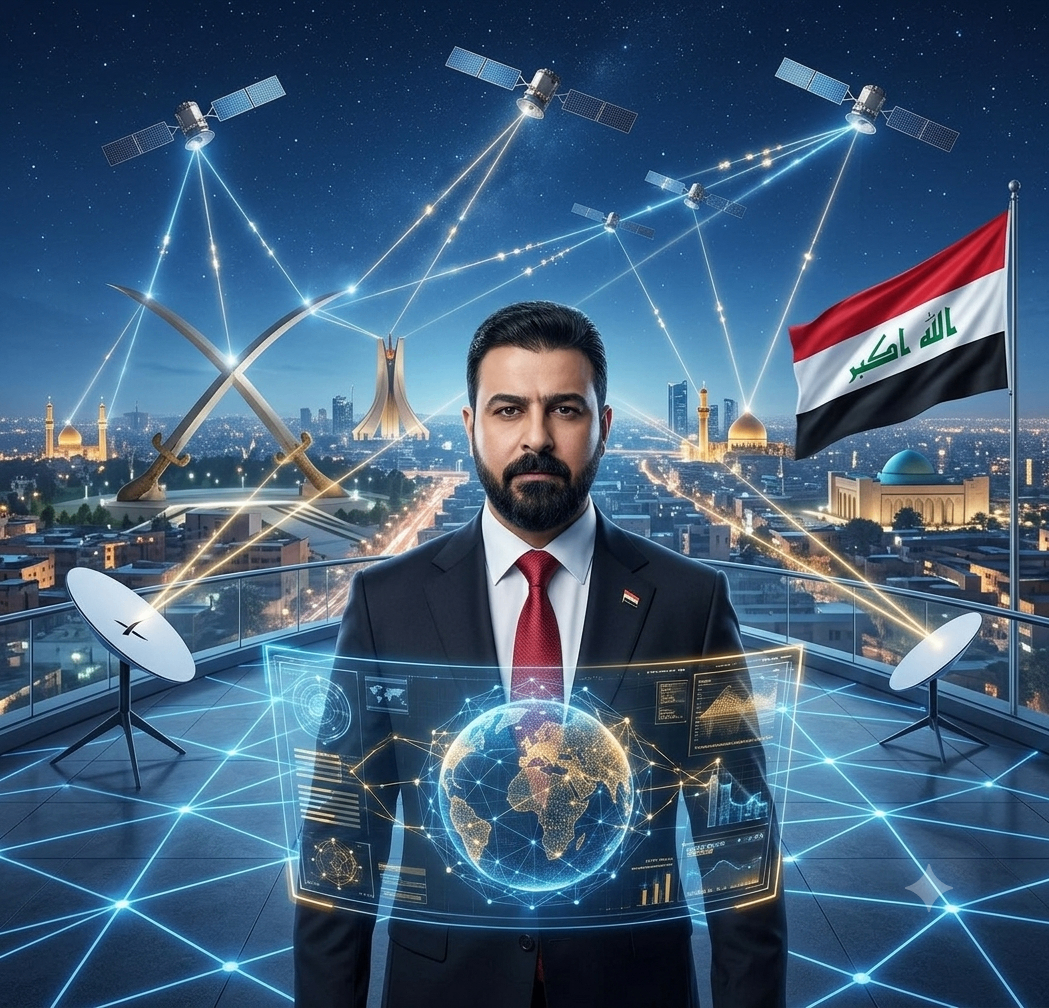
Experts view this as part of a broader strategy adopted by the government to develop digital infrastructure, promote technological transformation, and open the Iraqi market to global investments in a sector closely linked to economic development and modern services.
American billionaire Elon Musk recently announced the launch of Starlink satellite internet service in Iraq following the official approval of its operating license. This opens the door to a new era of high-speed communication services and reflects the success of the government's efforts to attract global technology companies and modernize the country's digital infrastructure.
Musk stated in a post on the X platform that Iraq had approved the Starlink operating license, paving the way for the launch of satellite internet services within the country. Prime Minister Ali al-Zubaidi and US Special Envoy to Iraq Tom Barrack welcomed the license approval, indicating the project's importance to Iraq and its international partners.
Following directives from Prime Minister Ali al-Zaidi, the past period witnessed intensive government meetings and discussions regarding the company's operational mechanisms within Iraq and the requirements for granting a license. This aligns with the government's strategy to attract global technology companies and expand internet service options for citizens.
Starlink's entry represents a strategic development for the Iraqi telecommunications sector, as the service provides internet access to remote, border, and desert areas that have suffered for years from weak traditional infrastructure. Furthermore, it offers higher connection speeds and greater service stability compared to many currently available alternatives.
This development comes after months of government initiatives and technical discussions led by relevant telecommunications sector stakeholders, within a broader approach adopted by al-Zaidi's government to promote digital transformation and attract global technology investments, in parallel with programs to develop electronic infrastructure and expand the scope of government digital services.
Experts believe that the entry of the giant American company represents a new message of confidence in the Iraqi investment environment, especially since Starlink is one of the largest satellite internet projects in the world, and operates in dozens of countries through a wide network of low-orbit satellites.
The project’s benefits are not limited to improving internet services for citizens, but extend to supporting the economic, educational, health and security sectors, by providing more stable communications for government institutions, companies and investment projects, as well as supporting e-government and digital transformation projects that Baghdad seeks to accelerate in the coming years.
Technology expert Nawras Aref said that “Starlink’s entry into Iraq represents an important step towards modernizing the communications sector and raising the efficiency of digital services, especially as the world is rapidly moving towards relying on smart infrastructure and high-speed sustainable connectivity.”
Aref added to Iraq Observer that “Iraq needs such advanced services because they give users super speeds and internet access in areas that are difficult to cover with traditional terrestrial networks, and they also provide future solutions that support e-learning, digital commerce and smart government services.”
He explained that “the presence of global companies the size of Starlink within the Iraqi market will create a positive competitive environment that will drive the development of local services and raise quality levels, as well as enhance Iraq’s attractiveness to international technology investments.”
In keeping with global trends, experts confirm that the government's success in completing the licensing procedures reflects a clear desire to keep pace with global technological advancements, especially given the growing need for a modern communications infrastructure capable of supporting the demands of the digital economy, foreign investment, artificial intelligence projects, and cloud services.
As the official launch of the service approaches, Iraqis anticipate a new era of internet services, with expectations that Starlink's entry will help bridge the digital divide between cities and remote areas, and open broader horizons for the digital economy and the technological transformation that the government seeks to establish within its development vision for the coming years. link
***************
Tishwash: Will the "programs and performance" budget succeed in converting funds into services?
Specialists and experts have confirmed that the program and performance budget the government is moving towards implementing represents a significant shift in public spending management. However, it faces implementation challenges related to the readiness of ministries, the efficiency of monitoring, and the ability of institutions to translate financial allocations into tangible services for citizens.
The Prime Minister's financial advisor, Mazhar Muhammad Salih, told Al-Mada that the government is proceeding with the implementation of the program and performance budget, which links financial allocations to measurable performance indicators and results within state institutions. This aims to improve spending efficiency and direct resources towards the most effective programs.
He explained that the new system enhances transparency and financial governance and raises the level of accountability, which could lead to improved public services. However, he also pointed to challenges related to the varying levels of readiness among ministries, weak institutional and information infrastructure, and the need to develop monitoring systems and build administrative capacity.
For her part, Suad al-Maliki, a former member of the Parliamentary Strategic Planning Committee, warned in an interview with Al-Mada against proceeding with a program-based budget for 2027 without evaluating the results of the current budgets. She emphasized that the success of the experiment hinges on the government's ability to effectively implement the 2025 and 2026 budgets.
She explained that the delays in the 2025 budget schedules and the lack of clarity regarding implementation results raise questions about the readiness for the transition to the new system.
She added that the success of this transformation requires political will and coordination between the executive and legislative branches, along with the adoption of transparent standards and each ministry accurately identifying its needs before auditing by central authorities. She noted that the transitional phase may witness gaps due to administrative changes.
Similarly, economic expert Duraid al-Anzi believes that the success of a program-based budget is not linked to changing its name or form, but rather to the state's ability to implement and monitor it.
Speaking to Al-Mada, he said that the fundamental problem lies not in preparing the budgets, but in converting funds into actual projects and services, warning against the continuation of stalled projects that hinder the achievement of results. He added that weak executive efficiency and the absence of integrated economic planning lead to continued waste and a diminished impact of public spending, stressing that genuine reform begins with improving management before increasing allocations.
Al-Anzi pointed out that building an effective economic planning system requires extensive institutional reform that will extend over several years, potentially up to ten, to achieve comprehensive sustainable development. He believes the greatest challenge lies in implementation, not in the plans themselves.
While the government is banking on program and performance budgeting to reorganize public spending and link it to results, the real test remains the ability of state institutions to translate allocations into tangible services that citizens can actually experience. link
Tishwash: Al-Zaidi to Washington: A partnership of equals to finance productive projects
All eyes are on the upcoming visit of Prime Minister Ali Faleh al-Zaidi to the United States as a pivotal economic milestone, given the regional and international changes taking place in the region, and the need to reformulate economic relations between Baghdad and Washington on new and viable foundations based on investment, production, and technology transfer, moving beyond just security and oil issues.
Experts believe that the success of the visit scheduled for the middle of next month depends on turning it into a platform for launching strategic projects and feasible economic agreements that contribute to diversifying the Iraqi economy, improving the investment environment, and enhancing Iraq’s position as a regional and international economic partner.
Comprehensive vision
Amer Al-Jawahiri, an advisor on development and investment, said that the importance of the visit comes after the peace agreements witnessed in the region, and the accompanying comprehensive vision to strengthen economic relations between its countries, which opens the door for the participation of international companies in major reconstruction and development projects, including Iraqi projects.
Al-Jawahiri explained in an interview with Al-Sabah that Iraq faces major challenges, including the delay in implementing steps to diversify the economy and invest its natural resources, in addition to the large size of projects whose implementation requires a long-term government program to which successive governments are committed. He pointed out that addressing the electricity crisis represents one of the most prominent economic tests for the government, in light of the escalating financial obligations and concerns about the inadequacy of oil revenues to cover operational expenses and finance strategic projects.
Visit files
Al-Jawahiri stressed that the current stage requires unifying the economic vision among all concerned parties, calling for the Ministerial Council for the Economy to hold periodic sessions with specialists from outside government institutions and economic advisors to benefit from their expertise in preparing visit files, as well as drawing up the paths of the economic program for Iraq during the next stage.
He pointed out the need for the visit to include presenting specific economic files to the American side, foremost among them addressing the restrictions imposed on a number of Iraqi banks, and increasing flexibility in dealing with the US Federal Reserve, which would positively affect the financial sector and the movement of trade transfers. He stressed the importance of attracting direct American investments or implementing projects in partnership between the Iraqi government and the private sector, according to the model of joint-stock companies with the possibility of offering their shares to finance and operate the projects.
Investment opportunities
He pointed out that Iraq has a number of major investment opportunities, including the Al-Nibras Petrochemical Project, nitrogen fertilizer projects in Basra and Baiji, phosphate fertilizers in Al-Qaim-Akashat, the silica manufacturing project in Anbar, and the extraction and manufacturing of sulfur in Nineveh. He noted that one of the important files is also involving American companies in implementing the Development Road project, which includes railway lines, industrial cities, and production projects aimed at meeting the needs of the local market and boosting exports.
Al-Jawahiri proposed the idea of establishing an Iraqi-American financial investment fund, financed by a portion of Iraqi oil exports to the United States, to be allocated to financing well-studied productive projects that achieve sustainable economic returns. He stressed that the success of this initiative depends on the existence of a clear program and efficient management mechanisms that ensure the actual implementation of the projects.
He emphasized that the success of any economic understandings requires taking practical steps to improve the business and investment environment through continuous consultation with the Private Sector Development Council, and holding a weekly roundtable that includes specialists and those concerned with the economy and business inside and outside government institutions, in order to give the Iraqi delegation a comprehensive vision that can be presented during its meetings in Washington. He also stressed the importance of stimulating competition among countries and international companies wishing to invest in Iraq, in order to ensure the best offers and the maximum benefit from the available economic potential.
Comprehensive economic partnership
For his part, financial expert Dr. Nabil Al-Abadi stressed that the visit should not be viewed as a passing diplomatic event, but rather as an economic necessity imposed by the nature of the stage that Iraq is going through, noting that the relationship with the United States has remained for years within the framework of oil and security, while the current stage provides an opportunity to move towards a comprehensive economic partnership.
Al-Abadi told Al-Sabah: “Iraq is not just a source of oil, but it possesses the potential to be a promising market for investments and modern technology, as well as being an important arena for reconstruction and an active partner in supporting the stability of global energy markets.”
He added that the visit represents a practical opportunity to implement the concept of “oil for technology and investment” by attracting major American companies to invest in advanced petrochemical industries, associated gas investment, and renewable energy, which are sectors that would add value to the national economy, support the path of economic diversification, and reduce dependence on oil revenues.
Financial and banking sector
Al-Abadi pointed out that the most prominent challenge facing the Iraqi economy is the reality of the financial and banking sector, and the challenges it faces related to financial compliance and combating money laundering, which makes it necessary to take advantage of the visit to conduct a direct dialogue with the US Treasury Department and the Federal Reserve with the aim of establishing a safe financial corridor that ensures the smooth flow of financial transfers, enhances the stability of the exchange rate, and raises the level of confidence of international investors in the Iraqi market.
He stressed that Iraq is not looking for aid or grants, but rather for a strategic economic partnership based on common interests, indicating that the success of the visit should be measured by the practical results it achieves, represented in the signing of investment agreements, and the launching of projects in the fields of gas, agriculture, industry and infrastructure, in addition to putting in place clear implementation and follow-up mechanisms that ensure that understandings are transformed into real projects that contribute to building a more diversified and productive Iraqi economy. link