
FRANK26…4-13-26….IN 48 HOURS
KTFA
Monday Night Video
FRANK26…4-13-26….IN 48 HOURS
This video is in Frank’s and his team’s opinion only
Frank’s team is Walkingstick, Eddie and Omar in Iraq and guests
Playback Number: 605-313-5163 PIN: 156996#
KTFA
Monday Night Video
FRANK26…4-13-26….IN 48 HOURS
This video is in Frank’s and his team’s opinion only
Frank’s team is Walkingstick, Eddie and Omar in Iraq and guests
Playback Number: 605-313-5163 PIN: 156996#
Iraq Economic News And Points To Ponder Monday Evening 4-13-26
The Iraqi Banking Sector Is At A Crossroads… Either Reform Or Forced Merger
April 13, 2026Last updated: April 13, 2026
The Iraqi banking sector stands at a pivotal moment in 2026 that could completely reshape its landscape, amid mounting internal pressures and escalating external challenges related to international compliance, the flow of the dollar, and its relationship with the global financial system. Between talk of structural reforms and more stringent options that may include mergers or closures, the banking landscape in Iraq appears poised for profound changes that extend beyond the purely technical to encompass broader economic and political dimensions.
The Iraqi Banking Sector Is At A Crossroads… Either Reform Or Forced Merger
April 13, 2026Last updated: April 13, 2026
The Iraqi banking sector stands at a pivotal moment in 2026 that could completely reshape its landscape, amid mounting internal pressures and escalating external challenges related to international compliance, the flow of the dollar, and its relationship with the global financial system. Between talk of structural reforms and more stringent options that may include mergers or closures, the banking landscape in Iraq appears poised for profound changes that extend beyond the purely technical to encompass broader economic and political dimensions.
Iraq has more than 75 banks, including government, private, and foreign institutions, but actual activity is concentrated in a limited number of them. Government banks hold the largest share of deposits and transactions related to government salaries and public spending. In contrast, private banks face increasing challenges related to liquidity, compliance, and foreign exchange requirements, especially after the tightening of controls on dollar transactions in recent years.
Financial sources indicate that the Central Bank of Iraq is considering several avenues for restructuring the sector, ranging from tightening solvency and compliance standards and mandating mergers between small and weak banks, to potentially revoking the licenses of institutions unable to adapt to the new standards. These steps, if implemented, would effectively mean a shift from a phase of "gradual reform" to a more profound restructuring that may be imposed by the realities on the ground.
The exchange rate remains at the heart of this equation. The gap that has emerged between the official and parallel market rates in recent years has presented monetary policy with a significant challenge, especially given the Iraqi economy's near-total dependence on dollar-denominated oil revenues. Any disruption to the flow of hard currency or to the external transfer mechanism is immediately reflected in imports, prices, and market confidence.
The future of the foreign currency auction window remains one of the most sensitive issues. This mechanism, which for years served as a primary tool for supplying the market with dollars, is now subject to rigorous scrutiny, amid discussions about restructuring it to align with international standards for combating money laundering and terrorist financing. Restructuring this window effectively means changing the way private banks, money transfer networks, and foreign trade operate.
The biggest challenge is not limited to regulatory aspects, but extends to a crisis of confidence. A large segment of the Iraqi population still prefers to keep cash outside the banking system, due to past experiences, withdrawal restrictions, and weak digital services. Unofficial estimates indicate that a significant portion of the circulating cash does not pass through banking channels, limiting the central bank's ability to manage liquidity effectively.
In the background, integration with the global financial system stands out as a crucial test. Fully reintegrating Iraqi banks into international banking networks requires rigorous transparency standards, modernized compliance systems, and a rebuilding of trust with global financial institutions. Without this, the sector will remain vulnerable to restrictions, sanctions, or partial isolation.
Based on these facts, Iraq appears to face only two options: either to proceed with gradual reforms that calmly restructure the sector and gradually restore confidence, or to confront a scenario of mergers and coercive measures imposed by financial and regulatory pressures. In either case, this year could represent a turning point in the history of the Iraqi banking system, where the question is no longer whether change will occur, but how, when, and at what cost.
Iraq Has Fallen Out Of The Economic Equation... Huge Reserves With No Trace, And The Dinar Faces Ongoing Challenges
Baghdad Today – Baghdad Economic expert Duraid Al-Anzi confirmed on Wednesday (April 8, 2026) that Iraq’s gold reserves do not play a direct role in improving the performance of the local economy, noting that they are effectively isolated within the management of the Central Bank and are used primarily to enhance its international standing.
Al-Anzi explained in a statement to “Baghdad Today” that Iraq possesses one of the most prominent gold reserves in the Arab world, and occupies advanced positions compared to a number of countries, but this has not been reflected in its credit rating, which is still within the (B) category, reflecting a clear gap between the size of the reserve and the overall economic performance.
He explained that owning gold gives the Central Bank of Iraq financial strength, and may indirectly support the dinar within the local market, but it has not succeeded in strengthening the position of the Iraqi currency globally, as the dinar is still among the weakest currencies, and the effect of the reserve is limited to achieving limited internal stability.
He pointed out that the relationship between the government and the central bank is governed by a strict legal framework that prevents the use of reserves, whether gold or cash, to finance the deficit or support the budget, except in exceptional cases that require special legislation, such as severe crises related to the cessation of oil revenues.
He added that the dollar reserve, which exceeds $100 billion and is deposited with international financial institutions, is subject to strict restrictions and controls, and cannot be used freely to address internal crises, which reduces the government's ability to rely on it as a direct solution.
He stressed that addressing the financial crises in Iraq cannot rely on cash or gold reserves, but requires activating internal revenues such as taxes, customs and fees, in addition to combating corruption and reducing financial waste, noting that there are internal files that can contribute to solving the crisis within a short period if they are managed seriously.
Al-Anzi cited the experiences of countries such as Lebanon, Turkey and Iran, which have large gold reserves, but at the same time suffer from severe monetary crises, which confirms that gold does not represent a direct solution to economic crises.
He added that the impact of Iraq’s gold reserves remains symbolic and indirect, and cannot be relied upon as a tool to address financial or monetary crises, considering that employing it in this way is not in line with sound economic principles.
The economies of countries, including Iraq, rely on a mix of financial and monetary tools to achieve stability. Gold reserves are one element of financial strength, but they are often used as currency cover or to boost international confidence, rather than as a direct tool for addressing crises.
Given the Iraqi economy's heavy reliance on oil revenues, challenges remain in diversifying income sources and strengthening non-oil sectors, meaning any decline in oil prices or revenues will directly impact financial stability. https://baghdadtoday.news/296735-.html
The Reconstruction And Development Coalition: There Is A Possibility That Al-Sudani Will Be Tasked With Forming The New Government Within The Next 48 Hours
Baghdad – One News 4/13/2026 The Reconstruction and Development Coalition confirmed the possibility of assigning its leader, Mohammed Shia al-Sudani, the task of forming the new Iraqi government within the next 48 hours.
A leader in the coalition said that the Reconstruction and Development bloc is strongly putting forward the coalition’s leader, Mohammed Shia al-Sudani, as a candidate to form the next Iraqi government. Al-Sudani currently has a very large majority within the coordination framework, as there are more than 9 leaders of the framework who support al-Sudani and his renewal for a second term.
He indicated that at the national level, outside the coordination framework of other Iraqi political parties, there is support from a majority of those parties for Al-Sudani to be tasked with forming the new government.
He added that the Sudanese candidate is the best option in light of the challenges facing Iraq, which needs to form a government with broad political support capable of overcoming all the crises the country is going through.
https://1news-iq.net/ائتلاف-الإعمار-والتنمية-هناك-إمكانية/
Iraq’s Premiership: Al-Maliki Signals Willingness To Drop In Exchange For Blocking Al-Sudani
2026-04-13 Shafaq News- Baghdad Nouri al-Maliki, head of the State of Law Coalition, has told Coordination Framework leaders he is willing to withdraw his candidacy for prime minister on the condition that incumbent PM Mohammed Shia al-Sudani is not nominated for a second term, a source told Shafaq News Monday.
Read more: Iraq Government Formation: The Constitution that cannot enforce its own deadlines
Al-Maliki also stipulated that no figure who previously served as prime minister be nominated, a condition, the source pointed out, understood by other figures, to target Haider al-Abadi, leader of the al-Nasr Coalition, who previously served as prime minister from 2014 to 2018 during the war against ISIS.
According to the source, several names are under consideration for the post, though no candidate has been finalized, and today’s Coordination Framework meeting is expected to discuss al-Maliki's conditions and examine alternative candidates.
The source noted that PMF (Popular Mobilization Forces) leadership is expected to play a role in determining the final nominee, and that the meeting may not produce a conclusive decision, with a final choice potentially deferred to a subsequent session.
Read more: Nouri Al-Maliki’s return rekindles Iraq’s divisions as Iran and the US pull apart
The Reconstruction and Development Coalition (Al-Ima'ar wal-Tanmiya) confirmed Monday it is strongly pushing its leader, al-Sudani, as its candidate to form the next Iraqi government, with a decision potentially expected within 48 hours.
The Coordination Framework, which holds the largest bloc in parliament, was formally tasked by the Speaker of the Council of Representatives on April 11 to nominate a prime ministerial candidate within 15 days. Once a candidate is approved, the designated premier has 30 days to present a cabinet and secure a parliamentary confidence vote, in accordance with Article 76 of the Iraqi constitution. Read more: Al-Maliki sounds different this time — the world is not convinced yet
Central Banks Are Hoarding Gold. Governments are Starting to Hoard People.
Central Banks Are Hoarding Gold. Governments are Starting to Hoard People.
Notes From the Field By James Hickman (Simon Black / Sovereign Man April 13, 2026
A few months sago, the German government quietly passed a law requiring men between the ages of 17 and 45 to obtain permission before leaving the country for more than three months. It wasn't announced in a press conference. It wasn't debated on the front page of any newspaper. It was buried in a routine update to the country's military service law, tucked in alongside provisions about registration systems and NATO readiness targets.
Nobody noticed for months— until a local newspaper flagged it last week.
Central Banks Are Hoarding Gold. Governments are Starting to Hoard People.
Notes From the Field By James Hickman (Simon Black / Sovereign Man April 13, 2026
A few months sago, the German government quietly passed a law requiring men between the ages of 17 and 45 to obtain permission before leaving the country for more than three months. It wasn't announced in a press conference. It wasn't debated on the front page of any newspaper. It was buried in a routine update to the country's military service law, tucked in alongside provisions about registration systems and NATO readiness targets.
Nobody noticed for months— until a local newspaper flagged it last week.
The defense ministry is currently "drafting specific regulations for granting exemptions from the requirement for approval."
Translation: the law is already on the books, and they'll tell you what it means later.
But don’t worry— a defense ministry spokesperson stressed that military service remains "voluntary."
Germany isn't at war. This isn't martial law. It’s preparing for a changing world. And they’re not alone.
The US is also making its own updates. Starting in December, eligible men will automatically be registered for the military draft. Instead of relying on 18-year olds to fill out Selective Service forms on their own, the government will simply pull from federal databases and register on your behalf.
Congress also appears to be working on making it harder for Americans to take their money and leave.
On March 26, Senator Elizabeth Warren reintroduced the Ultra-Millionaire Tax Act, backed by more than 45 lawmakers. The bill proposes a 2% annual tax on net worth above $50 million, an additional 1% surtax on billionaires, and a 40% exit tax on wealthy Americans who try to renounce their citizenship to escape it.
It also includes aggressive new enforcement provisions: third-party reporting on hard-to-value assets, formulaic IRS valuation rules for private businesses and real estate, and a 30% minimum audit rate on everyone the bill covers.
The most productive people in America will be forced to waste countless hours on compliance, instead of working to create prosperity.
That isn't just a tax. It's a framework for tracking private wealth— and penalizing anyone who tries to opt out and take it somewhere else.
Governments don't build this kind of infrastructure unless they think they might use it. Germany is making sure it can stop fighting-age men from leaving. The United States is making sure it is ready to press people into service.
And it is building a stronger fence around the most productive tax cattle so it can milk them for all they’re worth.
Governments are clearly planning for a period of conflict.
One other sign is that they are securing physical, real asset reserves.
For the last two years, the world's central banks have been buying physical gold faster than at any point in modern history.
At the same time, they have been quietly selling US Treasuries. And the old dynamic has inverted: the kinds of global shocks that used to send investors stampeding into Treasuries as the world's safe haven are now sending them the other way.
Take the Iran war as an example: normally when there’s a major conflict, foreign countries BUY lots of US government bonds as a safe haven. But since late February, foreign central banks have SOLD over $80 billion worth of US Treasury securities.
This reduction in foreign demand for US government bonds is also a key reason why interest rates have risen— from 3.97% before the war started, to 4.33% today.
But this isn’t a sudden change of heart. Foreign governments and central banks have been losing faith in the US for years.
For decades after World War II, countries around the world relied on an America-dominated framework regarding trade, capital, and energy.
This postwar system required trust in the United States, trust that the rules would be stable, and trust that agreements would be honored.
But that trust is vanishing quickly.
The humiliating withdrawal from Afghanistan. Routine weaponization of the US dollar for political goals. Budget deficits spiraling and a $39 trillion national debt. A government that shuts down every time it tries to pass a budget.
From a foreign government official's perspective, physical gold sitting in a vault is a much safer bet than loaning money to the US Treasury.
Near-record gold prices and surging interest rates in the Treasury market are the surest signs yet that the postwar era of seamless global cooperation is unwinding... and inverting.
In a cooperative world, foreign nations are willing to depend on others. In a fragmented, conflict-prone world, governments secure resources. They secure their supply chains. They secure their energy. They secure their financial reserves.
And eventually... inevitably... they secure their people — the livestock can't be allowed to wander off the farm before it's time to milk them for taxes or march them off to war.
For now, capital can still flow somewhat freely. You can still apply for legal residency in another country. You can still hold gold overseas in a stable, neutral jurisdiction.
The window is still open to create a Plan B so you can have the options to come at whatever happens from a position of strength. And if you’re not sure how to get started, I would really encourage you to check out our publication Plan B Confidential.
To your freedom, James Hickman Co-Founder, Schiff Sovereign LLC
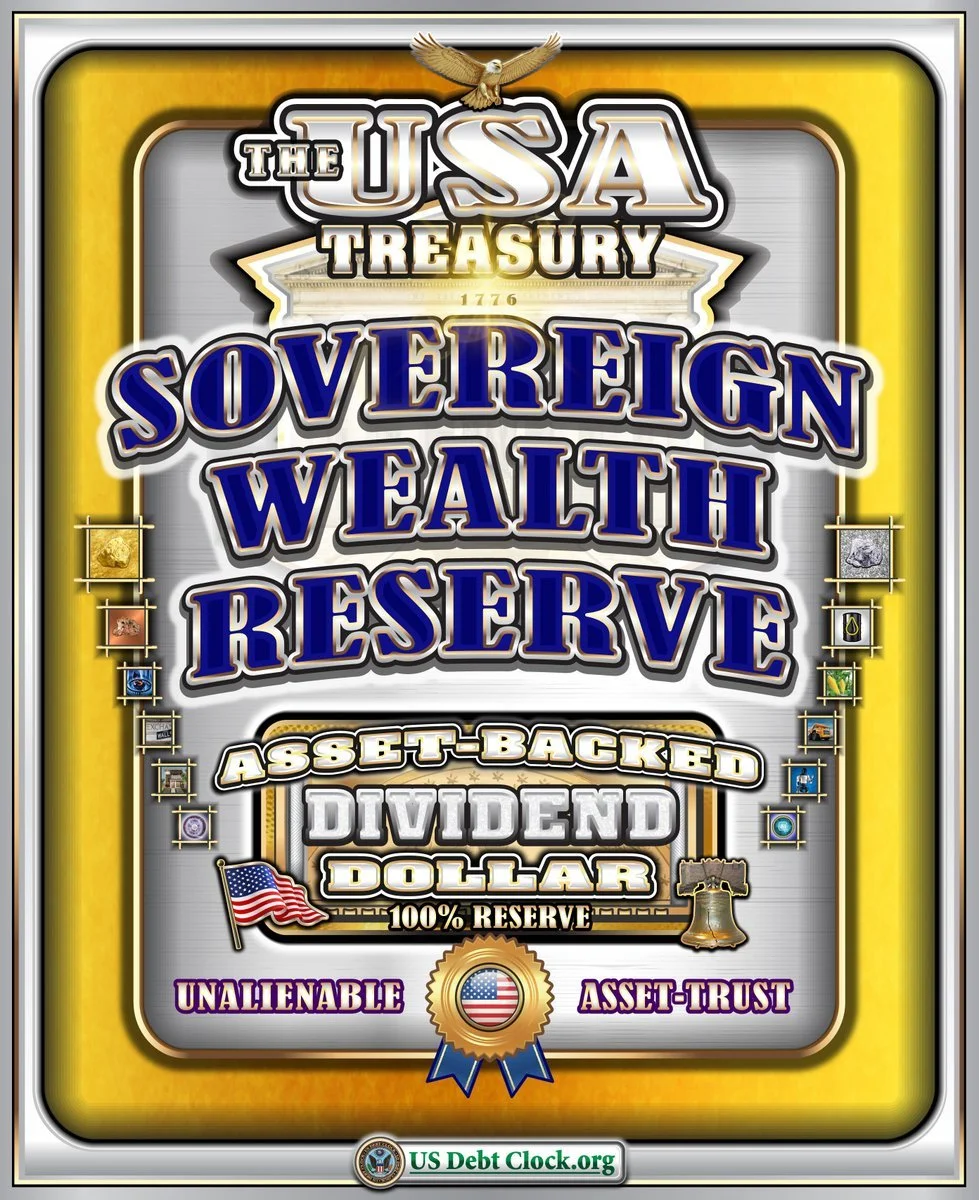
Echo X: Sovereign Wealth Reserve
Echo X: Sovereign Wealth Reserve
4-13-2026
Echo 𝕏@echodatruth
Look closer…
“The USA Treasury – Sovereign Wealth Reserve”
“Asset-Backed Dividend Dollar”
“100% Reserve”
Echo X: Sovereign Wealth Reserve
4-13-2026
Echo 𝕏@echodatruth
Look closer…
“The USA Treasury – Sovereign Wealth Reserve”
“Asset-Backed Dividend Dollar”
“100% Reserve”
They’re not even hiding the direction anymore.
But here’s what most people will miss…
The PURPLE
Not red. Not green. Not blue.
Purple.
If you’ve been paying attention, you already know…
There’s only ONE ecosystem consistently tied to that color while building real DeFi + regulatory compliance at the same time.
Asset-backed.
KYC/AML ready.
Built for institutions AND on-chain users.
So I’ll ask you this…
Can you name the purple coin that actually checks both boxes?
US Debt Clock.org: usdebtclock.org
Devalued Overnight: The Biggest Reset is NOW
Devalued Overnight: The Biggest Reset is NOW
Dalio Mindset: 4-12-2026
Goldman Sachs, UBS, and JPMorgan all published research within 48 hours pointing to the same structural shift — and almost none of it reached retail investors.
This video breaks down what they actually wrote: the stagflation risk, the dollar trajectory, the Federal Reserve's fiscal trap, and why China's insurance company gold allocation program is one of the most underreported stories in global finance.
The reset is already underway.
Devalued Overnight: The Biggest Reset is NOW
Dalio Mindset: 4-12-2026
Goldman Sachs, UBS, and JPMorgan all published research within 48 hours pointing to the same structural shift — and almost none of it reached retail investors.
This video breaks down what they actually wrote: the stagflation risk, the dollar trajectory, the Federal Reserve's fiscal trap, and why China's insurance company gold allocation program is one of the most underreported stories in global finance.
The reset is already underway.
Across history, major financial resets have often happened suddenly — catching most people unprepared.
Today, rising debt, inflation, and global economic shifts are creating the same conditions again.
In this video, we break down:
What “currency devaluation” really means
Why financial resets happen suddenly
The warning signs most people ignore
How inflation silently erodes your wealth
What you can do to protect your money
This is not just theory — it’s a pattern repeating itself.
Iraq Economic News And Points To Ponder Monday Afternoon 4-13-26
IEA Declares Worst Energy Crisis In History
2026-04-13 Shafaq News- Middle East The International Energy Agency (IEA) on Monday called for urgent demand reduction measures as its executive director warned that the Iran war had led to the worst global energy disruption in history, with more than 80 oil and gas facilities across the Middle East damaged and the Strait of Hormuz effectively closed.
IEA Declares Worst Energy Crisis In History
2026-04-13 Shafaq News- Middle East The International Energy Agency (IEA) on Monday called for urgent demand reduction measures as its executive director warned that the Iran war had led to the worst global energy disruption in history, with more than 80 oil and gas facilities across the Middle East damaged and the Strait of Hormuz effectively closed.
"The only real solution is ensuring the free flow of oil and gas through Hormuz," IEA Executive Director Fatih Birol said in a statement, adding that the agency had asked member countries to identify rapid ways to cut energy consumption, with some already responding.
On strategic petroleum reserves, Birol cautioned that releasing stockpiles would not resolve the underlying crisis. "Given the scale of production shutdowns and the Hormuz closure, releasing oil is not a solution -it is a painkiller," he said, adding that the IEA nonetheless remained prepared to authorize a coordinated release if conditions deteriorated further.
The US naval blockade of Hormuz took effect today with more than 15 warships deployed. President Trump warned that any vessel approaching the blockade zone would be "immediately destroyed," while the Khatam al-Anbiya Central Headquarters, Iran's armed forces central command, warned that no port in the Gulf or the Sea of Oman would be safe if Iran's ports were targeted.
The blockade follows six weeks of conflict triggered by US-Israeli strikes on Iran, bringing shipping through the strait to a near-complete halt and threatening a fragile ceasefire.
https://www.shafaq.com/en/Economy/IEA-declares-worst-energy-crisis-in-history
Read more: Iraq's energy vulnerability: When a petro-state has no buffer
Iraq Oil Revenue Drops To $1.95B In March
2026-04- Shafaq News- Baghdad Iraq, OPEC’s second-largest oil producer, generated more than $1.95 billion in oil export revenues in March 2026, down from $6.814 billion the previous month, the Oil Ministry said on Monday.
Citing data from the State Organization for Marketing of Oil (SOMO), the ministry reported total crude exports, including condensates, at 18.6 million barrels during the month.
Exports from central and southern oilfields accounted for the largest share at 14.56 million barrels, while shipments from the Kurdistan Region through Turkiye’s Ceyhan port stood at 1.27 million barrels, alongside 2.77 million barrels exported from Kirkuk via the same route. https://www.shafaq.com/en/Economy/Iraq-oil-revenue-drops-to-1-95B-in-March
Dollar Rises In Baghdad And Erbil Markets
2026-04-13 Shafaq News- Baghdad/ Erbil The US dollar opened Monday’s trading higher in Iraq, hovering around 154,000 dinars per 100 dollars.
According to a Shafaq News market survey, the dollar traded in Baghdad's Al-Kifah and Al-Harithiya exchanges at 154,150 dinars per 100 dollars, up from the previous session’s 153,600 dinars.
In the Iraqi capital, exchange shops sold the dollar at 154,500 dinars and bought it at 153,500 dinars, while in Erbil, selling prices stood at 154,300 dinars and buying prices at 154,200 dinars.
https://www.shafaq.com/en/Economy/Dollar-rises-in-Baghdad-and-Erbil-markets-0
Gold Prices Fall In Baghdad And Erbil Markets
2026-04-13 Shafaq News- Baghdad/ Erbil On Monday, gold prices hovered around 1.03 million IQD per mithqal in Baghdad and Erbil markets, according to a survey by Shafaq News Agency.
Gold prices on Baghdad's Al-Nahr Street recorded a selling price of 1,025,000 IQD per mithqal (equivalent to five grams) for 21-carat gold, including Gulf, Turkish, and European varieties, with a buying price of 1,026,000 IQD. The same gold had sold for 1,030,000 IQD on Sunday.
The selling price for 21-carat Iraqi gold stood at 995,000 IQD, with a buying price of 991,000 IQD.
In jewelry stores, the selling price per mithqal of 21-carat Gulf gold ranged between 1,025,000 and 1,035,000 IQD, while Iraqi gold sold for between 995,000 and 1,005,000 IQD.
In Erbil, 22-carat gold was sold at 1,071,000 IQD per mithqal, 21-carat gold at 1,023,000 IQD, and 18-carat gold at 876,000 IQD.https://www.shafaq.com/en/Economy/Gold-prices-fall-in-Baghdad-and-Erbil-markets-7-6-2
USD/IQD Exchange Rates Decrease In Baghdad And Erbil
2026-04-13 Shafaq News- Baghdad/ Erbil The US dollar closure Monday’s trading higher in Iraq, nearing 154,000 dinars per 100 dollars, according to a survey by Shafaq News Agency.
The dollar traded in Baghdad's Al-Kifah and Al-Harithiya exchanges at 153,900 dinars per 100 dollars, up from the morning session’s 154,150.
In the Iraqi capital, exchange shops sold the dollar at 154,500 dinars and bought it at 153,500 dinars, while in Erbil, selling prices stood at 154,050 dinars per 100 dollars and buying prices at 153,900 dinars.
https://www.shafaq.com/en/Economy/USD-IQD-exchange-rates-decrease-in-Baghdad-and-Erbil
IMO, UN Warn Of Global Food Disruption As Hormuz Shipping Collapses
2026-04-13 Shafaq News- Middle East No state has the right to block innocent passage through international straits, International Maritime Organization (IMO) Secretary-General Arsenio Dominguez Velasco affirmed Monday, as the United Nations warned that a drop of more than 90% in tanker traffic through Hormuz is threatening food supplies across Asia and Africa.
Dominguez added that IMO was in talks with Iran and Oman to evacuate crew members from ships stranded in the waterway and coordinating with Gulf states to supply food to those on board.
The UN's Food and Agriculture Organization (FAO) said the near-total halt in shipping posed a direct threat to agricultural production and global food security. The UN Office for Project Services said intensive meetings had been held in New York over the past two weeks to develop a mechanism for the safe passage of fertilizer shipments through Hormuz, with Executive Director Jorge Moreira da Silva leading efforts to protect countries dependent on those supplies.
The US naval blockade of Hormuz took effect today with more than 15 warships deployed. President Trump warned that any vessel approaching the blockade zone would be "immediately destroyed," while the Khatam al-Anbiya Central Headquarters, Iran's armed forces central command, warned that no port in the Gulf or the Sea of Oman would be safe if Iran's ports were targeted.
The blockade follows six weeks of conflict triggered by US-Israeli strikes on Iran, bringing shipping through the strait to a near-complete halt and threatening a fragile ceasefire.
https://www.shafaq.com/en/Middle-East/UN-Hormuz-crisis-heading-toward-global-food-catastrophe
Coordination Framework Postpones Meeting Amid Internal Disagreements
2026-04-13 Shafaq News- Baghdad The Coordination Framework's meeting, scheduled for Monday at the residence of Ammar al-Hakim, leader of the Al-Hikma (Wisdom) National Movement, has been postponed after several Framework leaders boycotted the session, a political source told Shafaq News.
The postponement will hold until attendance of all leadership is confirmed, to settle the prime ministerial file within the constitutional 15-day window following the election of the president.
Amer al-Fayez, head of the Tasmeem Alliance, had revealed that the Framework was intended to discuss nine prime ministerial candidates at Monday's meeting.
https://www.shafaq.com/en/Iraq/Coordination-Framework-postpones-meeting-amid-internal-disagreements
Read More: Iraq Government Formation: The Constitution that cannot enforce its own deadlines
Ayatollah Al-Sistani's Authority Rejects Role In Iraq PM Selection
2026-04-13 Shafaq News- Baghdad Iraq’s Shiite clerical authority in Najaf, led by Ayatollah Ali Al-Sistani, reaffirmed it will not intervene in selecting a prime minister candidate, a source told Shafaq News on Monday, as Shiite political forces move to choose a premier.
The authority has “repeatedly conveyed” this stance to Coordination Framework (CF) leaders and closed its doors to politicians, signaling it will not engage in consultations over top posts.
The CF was set to meet today to discuss nine candidates for prime minister, including a potential compromise figure; however, another source confirmed that the talks has been postponed due to disagreements among its members
Under Article 76 of the constitution, the largest parliamentary bloc has 15 days to nominate a prime minister following the election of a president, a step that formally begins the government formation process. Parliament elected Nizar Amedi on Saturday, completing the constitutional requirement before assigning the largest bloc to form a government.
Read more: Iraq's premiership battle has already begun
https://www.shafaq.com/en/Iraq/Ayatollah-Al-Sistani-s-authority-rejects-role-in-Iraq-PM-selection
Seeds of Wisdom RV and Economics Updates Monday Evening 4-13-26
Good Evening Dinar Recaps
Oil Surge, Growth Downgrades, and Policy Limits Signal Deepening Systemic Strain
Energy shocks are spreading into inflation, global growth, and financial stability as pressure builds across the system
Good Evening Dinar Recaps
Oil Surge, Growth Downgrades, and Policy Limits Signal Deepening Systemic Strain
Energy shocks are spreading into inflation, global growth, and financial stability as pressure builds across the system
Overview
Recent developments show the global financial landscape shifting into broad-based stress, as the energy crisis intensifies and begins to directly impact growth forecasts, monetary policy, and global markets.
Oil prices have surged back above $100 per barrel, while global institutions warn that the economic impact is already “baked in” and likely to persist.
This marks a transition from initial shock to sustained economic pressure, with consequences extending into the core structure of the global financial system.
Key Developments
1. Oil Prices Surge Back Above $100, Reigniting Inflation Risk
Energy markets have reacted sharply to escalating tensions, pushing oil prices back into triple-digit territory.
Brent crude rising above $100 per barrel
Markets reversing earlier optimism from ceasefire headlines
Renewed fears of supply disruption and prolonged instability
Why it matters: Energy costs are a primary driver of global inflation, and sustained elevation feeds directly into higher living costs and economic slowdown.
2. IMF Signals Economic Impact Is Already Embedded
Global financial leaders indicate that the damage from the crisis is already working through the system.
Disrupted supply chains affecting global pricing structures
Delays and infrastructure strain creating lasting economic drag
Recovery dependent on restoration of stable energy flows
Why it matters: This confirms the situation is no longer avoidable—it is now a managed economic outcome with long-term implications.
3. Global Growth Outlook Weakening
Institutions are signaling downward pressure on global growth expectations.
Emerging markets expected to face greater strain
Rising fuel costs increasing economic burden worldwide
Governments beginning to respond with support measures
Why it matters: Slower growth combined with high inflation raises the risk of stagflation, a difficult environment for both policymakers and markets.
4. Central Banks Face Tightening Constraints
Policymakers are increasingly limited in how they can respond to current conditions.
Energy-driven inflation is less responsive to rate policy
Risk of secondary inflation effects spreading
Markets adjusting expectations for longer periods of tight conditions
Why it matters: Central banks are losing flexibility, signaling a shift toward a system where external shocks outweigh policy control.
Why It Matters
These developments point to a broader transition:
Energy shocks driving economic conditions globally
Growth slowing while inflation remains elevated
Policy tools becoming less effective
Financial systems adjusting to sustained pressure
This reflects a move away from stability supported by policy toward structural stress shaped by external forces.
Why It Matters to Foreign Currency Holders
Persistent inflation may erode purchasing power across currencies
Diverging economic conditions can trigger currency volatility and repricing
Emerging markets face heightened risk of capital outflows
Resource-linked economies and assets may gain relative strength
Implications for the Global Reset
Pillar 1: Energy-Driven Economic Realignment
The global economy is increasingly influenced by energy access and pricing, shifting power toward resource control.
Pillar 2: Policy Constraint & Stagflation Risk
With inflation elevated and growth slowing, central banks face a structural limitation that reduces the effectiveness of traditional tools.
Closing Perspective
The crisis has moved beyond geopolitics—it is now embedded in the global economy.
When oil prices surge, growth weakens, and policy tools lose effectiveness simultaneously, the result is not temporary disruption—it is systemic transition.
This is not just an energy shock — it’s a turning point for the global financial system.
Seeds of Wisdom Team
Newshounds News™ Exclusive
Sources
Oil prices top $100 a barrel after talks fail and U.S. blockade announced – The Guardian
IMF says shock from U.S.–Iran war is already “baked” into global economy – Business Insider
~~~~~~~~~~
Seeds of Wisdom Team RV Currency Facts Youtube and Rumble
Newshound's News Telegram Room Link
RV Facts with Proof Links Link
RV Updates Proof links - Facts Link
Follow the Gold/Silver Rate COMEX
Follow Fast Facts
Seeds of Wisdom Team™Website
Thank you Dinar Recaps
“Iraq News” Posted by Tishwash at TNT Monday 4-13-2026
TNT:
Tishwash: America announces a complete naval blockade of Iranian ports
The United Kingdom welcomed the election of the President of the Republic and affirmed its commitment to strengthening cooperation with Iraq.
The Presidency of the Republic stated in a press release that "the United Kingdom expressed its welcome for the election of His Excellency President Nizar Amidi as President of the Republic of Iraq, affirming its aspiration for a new phase of joint cooperation."
TNT:
Tishwash: America announces a complete naval blockade of Iranian ports
The United Kingdom welcomed the election of the President of the Republic and affirmed its commitment to strengthening cooperation with Iraq.
The Presidency of the Republic stated in a press release that "the United Kingdom expressed its welcome for the election of His Excellency President Nizar Amidi as President of the Republic of Iraq, affirming its aspiration for a new phase of joint cooperation."
It added that "the UK Minister for the Middle East at the Foreign, Commonwealth and Development Office, Hamish Faulkner, affirmed his country's desire to continue working with the new Iraqi leadership in a way that contributes to strengthening bilateral relations and supporting stability and development in Iraq." link
Tishwash: The coordinating body will meet tomorrow to decide on the prime ministerial candidate.
Badr Organization leader Mu’in Al-Kadhimi revealed that a crucial meeting of the coordination framework will be held tomorrow, Monday, to decide on the prime minister candidate if he obtains the approval of two-thirds of the framework’s forces.
Al-Kadhimi said, during his appearance on the “On the Ruler” program broadcast by Al-Furat satellite channel, that “the coordination framework will hold a meeting tomorrow, Monday, to discuss the file of the prime minister candidate,” indicating that “the candidate will be assigned if he obtains the approval of two-thirds of the members of the framework.”
He added that "the election of the President of the Republic by the House of Representatives represents an important step after nearly 100 days since the convening of its first session," stressing that "there is no room for interpretations or delays in deciding on the nomination of the Prime Minister."
Al-Kadhimi pointed out that "the names previously put forward for the premiership have expired, and the coordination framework is now faced with the option of choosing a new candidate capable of running the state, especially in light of the current economic and financial challenges and regional conditions."
He noted that "there is some opposition to granting a second term," suggesting that "the most likely option is to move towards a new candidate for prime minister," stressing that "the 15-day deadline is sufficient to appoint the candidate."
He explained that "the Badr bloc supports the consensus of the Coordination Framework and will work to ensure the success of the next government in various fields," stressing that "the nomination of the President of the Republic was not conditional on the nomination of the Prime Minister and that the file is still in the hands of the Coordination Framework, which has 181 seats."
Al-Kadhimi concluded by saying that "the next stage requires the Prime Minister to work on passing the project of liberation from American hegemony over Iraq's resources." link
************
Tishwash: Al-Mar'idi: Barzani's refusal to recognize the president of the republic places him outside the framework of the political process.
MP Mansour Al-Maridi indicated today, Sunday, that Barzani’s refusal to recognize the President of the Republic puts him outside the framework of the political process.
Al-Mar’idi told Al-Ma’louma News Agency that “such steps would create a new political crisis in the country,” explaining that “the political process is based on consensus and respect for the results, and any party that rejects it puts itself outside this framework.”
Al-Maridi added that "what is happening does not serve the stability of Iraq and increases tension between political forces," stressing "the need for calm and a return to dialogue because the country cannot bear more disputes at this stage."
It should be noted that the Kurdistan Democratic Party, headed by Masoud Barzani, rejected the election of the new president, Nizar Amidi, and announced the withdrawal of its representatives from Baghdad to Erbil. link
Tishwash: Back to square one: 9 candidates for prime minister before the coordination framework
The head of the Design Alliance, Amer Al-Fayez, revealed on Sunday that the coordinating framework intends to discuss the names of 9 candidates for the premiership at its meeting tomorrow.
Al-Fayez told Shafaq News Agency that "among the nominated names are the head of the State of Law Coalition, Nouri al-Maliki, the caretaker Prime Minister, Mohammed Shia al-Sudani, former Prime Minister Haider al-Abadi, the head of the Accountability and Justice Commission, Basim al-Badri, the leader of the Asas Party, Mohsen al-Mandalawi, the head of the Intelligence Service, Hamid al-Shatri, the Prime Minister's advisor, Mohammed Sahib al-Daraji, the former Minister of Planning, Ali Shukri, and the National Security Advisor, Qasim al-Araji."
He added that there is no preference between the candidates, indicating that tomorrow’s meeting will determine the mechanisms for selecting the most suitable among them.
Al-Fayez explained that "Al-Maliki is still holding on to his nomination, despite objections from several political forces and blocs."
He pointed out that "the meeting, which will be held at the home of the leader of the Wisdom Movement, Ammar al-Hakim, will be attended by Maliki, and the meeting may conclude with an agreement on a candidate or mechanisms that determine the person of the next prime minister."
For his part, Abu Mithaq Al-Masari, a member of the Coordination Framework, confirmed that Al-Maliki was the only candidate who received the Coordination Framework’s vote.
Al-Masari told Shafaq News Agency that if the framework wants to discuss a list of names of candidates for the next government, it must officially withdraw its nomination and inform the leader of the State of Law coalition of this officially and in writing, and then the discussion will return to choosing the person qualified for the position.
He added, "The coordination framework was supposed to inform the President of the Republic of his candidate for the premiership, who is Maliki, but there is talk of political agreements, and therefore everyone is waiting for what will result from tomorrow's meeting."
This comes after the Speaker of Parliament called on the largest parliamentary bloc to nominate its candidate for Prime Minister within a maximum period of 15 days, based on Article 76 of the Constitution, following the election of the President of the Republic.
The process of forming a government faces additional complications, most notably the declared American position regarding al-Maliki’s return to power, and the escalating security tensions in the region, which puts political forces before the challenge of maintaining the “quota system” that has been in place since 2003 or sliding towards a comprehensive political deadlock.
Earlier on Sunday, the new President of the Republic, Nizar Amidi, officially assumed his duties as President of the Republic of Iraq, during a presidential ceremony held at the Baghdad Palace.
The Iraqi parliament elected, on Saturday, the Patriotic Union of Kurdistan party candidate Nizar Amidi as the new president of the republic.
A political source revealed on Saturday that Basim al-Badri is considered a compromise candidate within the coordination framework for the position of the next Iraqi Prime Minister, at a time when the leaders of the framework are preparing to hold a meeting soon to officially decide on the candidate’s name. link
************
Tishwash: Moves to reshuffle the Sudanese government… and warnings of fragile balances and silent objections
Informed sources revealed that there are ongoing political moves to rearrange the governmental landscape in Iraq, through unannounced understandings between Prime Minister Mohammed Shia al-Sudani and former Speaker of Parliament Mohammed al-Halbousi, aimed at recycling the current government instead of forming a completely new one.
Hassan Al-Amiri, a political writer, told Al-Jarida that these moves are accompanied by interventions in the files of the presidency of the parliament and the republic, which may pave the way for broader understandings that lead to the renewal of the government in a modified form, which gives some parties greater influence in managing the political decision.
He added that Al-Sudani is seeking to establish himself as a man of political balances, by opening up to influential figures, including Ammar Al-Hakim and Qais Al-Khazali, with the aim of securing multi-directional support, including parliamentary, political and factional dimensions, in addition to trying to build a political cover that transcends the components.
Al-Amiri pointed out that what is happening does not represent a radical change in the structure of power, but is closer to reproducing the current government with partial modifications, in light of the absence of a comprehensive consensus within the coordinating framework, which is expected to face these moves with clear reservations.
He pointed out that there are silent objections within the Shiite community, along with Kurdish reservations, especially from Erbil, as well as differences within the Sunni forces, which reflects the fragility of the current understandings and their susceptibility to disintegration at the first political test.
Al-Amiri stressed that the challenges are not limited to political disputes, but extend to a struggle over the distribution of ministries that are still run according to sectarian considerations, in addition to the possibility of escalating corruption cases, and the complexities of the relationship with armed factions.
He concluded by saying that the future of these understandings will remain contingent on the government's ability to manage internal balances, achieve progress on economic and service-related issues, and maintain a balance in foreign relations, particularly between the United States and Iran, amid anticipation of the Iraqi public's stance. link
Monday Coffee with MarkZ and joined by MilitiaMan. 04/13/2026
Monday Coffee with MarkZ and joined by MilitiaMan. 04/13/2026
Some highlights by PDK-Not verbatim
MarkZ Disclaimer: Please consider everything on this call as my opinion. People who take notes do not catch everything and its best to watch the video so that you get everything in context. Be sure to consult a professional for any financial decisions
Member: Hello Mark and mods….., hope you got some good news.
Member: Currency calculators are putting 1 million of the VES at 2100
Monday Coffee with MarkZ and joined by MilitiaMan. 04/13/2026
Some highlights by PDK-Not verbatim
MarkZ Disclaimer: Please consider everything on this call as my opinion. People who take notes do not catch everything and its best to watch the video so that you get everything in context. Be sure to consult a professional for any financial decisions
Member: Hello Mark and mods….., hope you got some good news.
Member: Currency calculators are putting 1 million of the VES at 2100
MZ: We are seeing some craziness. Yes -for a short bit we saw some different values on the dinar as it fluctuated . Probably just testing. Noone is exchanging and the rate is totally normal this morning.
Member: On April 8, 2026, Venezuela’s acting president Delcy Rodríguez announced a “responsible” wage increase that will take effect on May 1
Member: I wonder- Will Europe return to separate currencies. End of the euro?
Member: Mike Bara pretty convinced on values last night VND $2.12
Member: In Iraq they seated the new president and now they have 2 weeks to pick the Prime minister.
Member: Based on Iraq''s speed, they will select a pm in 2028
Member: Sudani swore to increase the value of dinar by end if year but didn’t do it. Maybe a different guy will????
Member: Well do you think what they are saying it’s going to be another 15 days before they let the Rv go?????
Member: Iraq pm had 15 days from April 11th so April 26th to elect PM then 30 days to elect cabinet so May 26th ish!
Member: For the folks who think this war is holding up the RV......Do you remember Kuwait? no power, no computers, in a war.....what did they do?
Member: Erbil: Meeting between delegations from the Kurdistan Regional Government and the Federal Government regarding customs and ASYCUDA
Member: any bond updates?
MZ: No
Member: I hope the Clarity Act passes this week. It's looking good.
Member: Many are now saying the US will have a asset/gold backed currency by July 4th. Maybe they are waiting for that…to release the RV??????
Member: if the new treasury notes are to come out the 3rd of July I see the RV happening right after memorial day wknd pushing it to the last minute
Member: Good morning Militia Man thanks for being here
MilitiaMan joins the stream today. Please listen to the replay for his information and opinions
THE CONTENT IN THIS PODCAST IS FOR GENERAL & EDUCATIONAL PURPOSES ONLY&NOT INTENDED TO PROVIDE ANY PROFESSIONAL, FINANCIAL OR LEGAL ADVICE. PLEASE CONSIDER EVERYTHING DISCUSSED IN MARKZ’S OPINION ONLY
https://rumble.com/user/theoriginalmarkz
Kick: https://kick.com/theoriginalmarkz
FOLLOW MARKZ : TWITTER . https://twitter.com/originalmarkz?s=21. TRUTH SOCIAL . https://truthsocial.com/@theoriginalm...
Mod: MarkZ "Back To Basics" Pre-Recorded Call" for Newbies 10-19-2022 )https://www.youtube.com/watch?v=37oILmAlptM
MARKZ DAILY LINKS: https://theoriginalmarkz.com/home/
Note from PDK: Please listen to the replay for all the details and entire stream….I do not transcribe political opinions, medical opinions or many guests on this stream……just RV/currency related topics.
THANK YOU FOR JOINING. HAVE A BLESSED DAY. SEE YOU IN THE MORNING FOR COFFEE @ 10:00 AM EST ~ UNLESS BREAKING NEWS HAPPENS! FOR UPDATES ON MARK’S PODCAST GO TO: https://t.me/+b3hYhYlhKM1hYzcx
News, Rumors and Opinions Monday 4-13-2026
Note: All intel should be considered as "Rumors" until we receive official announcements ...and “Rates and Dates” could change anytime until we get to the banks/redemption centers.
RV Excerpts from the Restored Republic via a GCR Update as of Mon. 13 April 2026
Compiled Mon. 13 April 2026 12:01 am EST by Judy Byington
Global Currency Reset:
On Tues. 7 April 2026 at midnight the Petrodollar (allegedly) died. This was code word for the end of the SWIFT System. Four countries were still (allegedly) trying to use SWIFT but it was no longer available.
Note: All intel should be considered as "Rumors" until we receive official announcements ...and “Rates and Dates” could change anytime until we get to the banks/redemption centers.
RV Excerpts from the Restored Republic via a GCR Update as of Mon. 13 April 2026
Compiled Mon. 13 April 2026 12:01 am EST by Judy Byington
Global Currency Reset:
On Tues. 7 April 2026 at midnight the Petrodollar (allegedly) died. This was code word for the end of the SWIFT System. Four countries were still (allegedly) trying to use SWIFT but it was no longer available.
Thurs. 9 April 2026 Bruce, The Big Call The Big Call Universe (ibize.com) 667-770-1866, pin123456# A person working with a Redemption Center was told to stay not go out of state and stay up to 17 days after exchanges started. A source said Tier4b (us, the Internet Group) notification were pending for Tues. 14 April, but Wed. 15 April was a “Shoe In.”Another source saidTues. 14 April or Wed. 15 April with exchanges Wed. 15 April or Thurs. 16 April. Another source said notification would happen Tues, Wed. or Thurs.14, 15, 16 April. There was supposed to be an announcement about how much gold the US has some time between Sat. 11 April and Wed. 15 April.
Fri. 10 April 2026 Over $106,000,000,000 (Hundred And Six Billions) Are (allegedly) In Circulation Payments To All Citizens. These Funds Are Obtainable Through Your Q Phones! …Ten Days of Darkness on Telegram
Sun. 12 April 2026 Bond funds delivered to paymasters was coming in so fast everyone was is in awe from the amount. …Tier4b ISO 20022 on Telegram
• Private appointments are (allegedly) being made now.
• Get your plans/projects together and don’t wait around for this to happen without being ready.
• No straight cash will be given.
• You are in charge of your funds and can place funds in different accounts.
• Advisers will be there to assist you with your funds and will help guide you in your projects or choosing one on the list.
• Everything is going well, still some that do not want this to happen, but all is safe.
• You can take to your appointment: advisors/bank contacts (if you have already spoken to a specific person)/ friend/any person/s you want to assist you.
• Zim Cap information is changing daily but as of now they are paying as follows: NO projects = 15 million no matter amount you might hold. With projects = First 2 bond notes are 1 to 1 after this 25 million (per 100T) up to 30 bond notes. To negotiate further you will need to return.
• Safe link will be released closer to go date.
• Rates are EXTREMELY high!
• We are almost at the end of the road.
• All intel is saying “Next Week”
~~~~~~~~~~~~~~
Tier Groups of the Global Currency Reset:
Tier 1: Central Banks, sovereign treasuries, financial elites
Tier 2: Private banking institutions, massive trusts, religious financial networks
Tier 3: Historical bondholders, private wealth families (“whales”)
Tier 4A: Military-connected insiders and operatives
Tier 4B: The awakened digital community (YOU)
Tier 5: The general unaware public
Global Financial Collapse:
Banks operate with 0% reserve requirements, while loaning out up to 26x your deposits. We’re sitting on a massive $2 quadrillion derivatives market – and if things go south, the entire system could collapse. They loan what you don’t have. They bet on what doesn’t exist. They build everything on a foundation of air. And you’re inside it. …The MAGA King on Telegram
~~~~~~~~~~~~~~~~~
Sun. 12 April 2026 This were the persons we’re dealing with: their job and responsibility: …Mr. Pool on Telegram
This week, I’ll go into more detail. This could easily cover thousands of pages. Here are the five things that are freeing us from these C---l:
• Financial rails that follow ISO 20022 and XRP bridge settlement
• Basel III capital rules and pressure to move away from SWIFT
• The new design of the Treasury Dollar and the July 4th symbolic reset
Read full post here: https://dinarchronicles.com/2026/04/13/restored-republic-via-a-gcr-update-as-of-april-13-2026/
Courtesy of Dinar Guru: https://www.dinarguru.com/
Jeff Article: "Parliament requires the largest bloc to name the prime minister within 15 days" After today, they have to name who their nominated prime minister is within the next 15 days...If they're going to wait another two weeks to potentially name the prime minister, potentially extend Sudani's term, that positioned you in the second half of the month. That's where I've always suggested the rate would most likely change because of what's called 'remittance periods'.
Reset Intelligence Iraq's 15-day constitutional fuse started on April 11. President Amedi. Sworn in. 227 votes. Article 76 is now live. Here is the sequence that just unlocked: 15 days to nominate a prime minister. 30 days after that to form a cabinet. Cabinet activates the budget. Budget unlocks the HCL. HCL requires a rate mechanism that does not work at 1,310. April 26 is the first deadline. The next 45 days determine whether Iraq's financial architecture activates in Q2 or freezes again.
************
The Petrodollar Is Dying. And It’s Taking Everything With It | GOLD RUSH HOUR
Taylor Kenny: 4-12-2026
What happens when the world stops needing dollars?
That is the real question behind the accelerating petrodollar collapse story now unfolding in plain sight. For decades, Americans were told the dollar’s dominance was permanent, unquestionable, and untouchable.
But the cracks are no longer subtle.
Iraq Economic News And Points To Ponder Monday Morning 4-13-26
Al-Sudani Discusses With The Governor Of Najaf The Province's Projects And Services For Visitors
Money and Business Economy News – Baghdad Prime Minister Mohammed Shia Al-Sudani received the Governor of Najaf, Youssef Makki Kanawi, on Monday to discuss ongoing service and development projects in the province.
During the meeting, the level of project implementation and the speed of their completion were discussed in order to serve the citizens, taking into account the religious significance of Najaf Al-Ashraf, which receives millions of visitors annually.
Al-Sudani Discusses With The Governor Of Najaf The Province's Projects And Services For Visitors
Money and Business Economy News – Baghdad Prime Minister Mohammed Shia Al-Sudani received the Governor of Najaf, Youssef Makki Kanawi, on Monday to discuss ongoing service and development projects in the province.
During the meeting, the level of project implementation and the speed of their completion were discussed in order to serve the citizens, taking into account the religious significance of Najaf Al-Ashraf, which receives millions of visitors annually.
Al-Sudani stressed the importance of integration between the federal government and local governments, emphasizing the need for projects in the provinces to be consistent with the government’s major development plans.
https://www.economy-news.net/content.php?id=67846
EIA: Iraq’s Oil Exports To US Dip Over The Week
2026-04-12 Shafaq News- Baghdad/ Washington Iraq’s crude oil exports to the United States dropped 20,000 barrels per day (bpd) last week, US Energy Information Administration (EIA) data showed on Sunday.
According to the data, Iraqi shipments averaged 120,000 bpd last week, 14.29% less than the previous week’s average of 140,000 bpd.
Total US crude imports from seven major suppliers fell to 5.622 million bpd, down 218,000 bpd from 5.840 million bpd the previous week.
Canada remained the top supplier at 4.271 million bpd, followed by Saudi Arabia with 589,000 bpd, Venezuela with 321,000 bpd, and Mexico with 165,000 bpd.
Imports also included Brazil at 114,000 bpd, and Libya at 42,000 bpd. No oil was imported from Colombia, Nigeria and Ecuador this week.https://www.shafaq.com/en/Economy/EIA-Iraq-s-oil-exports-to-US-dip-over-the-week-6
6M+ Oil Barrels Clear Strait Of Hormuz
2026-04-12 Shafaq News- Baghdad Tankers carrying 2 million barrels of Iraqi crude and 4 million barrels of Saudi oil have transited the Strait of Hormuz bound for international markets, according to tracking platform TankerTrackers on Sunday.
Shipping activity in the waterway is also gradually recovering, with approximately 12 vessels transiting the Strait during the first two days of the US-Iran two-week truce.
The Strait of Hormuz, which carries roughly 20% of global oil supply, was effectively closed after US and Israeli strikes on Iran on February 28. Despite a previously granted exemption allowing Iraqi oil tankers to transit the Strait, Iraq’s oil sector saw a sharp downturn, with production falling from about 3.5 million barrels per day (bpd) to around 1.3 million bpd, while exports declined to roughly 800,000 bpd.
On Saturday, US President Donald Trump revealed the start of mine-clearing operations in the Strait, noting that the passage was not coordinated with Tehran. Iran rejected the claims, calling them “inaccurate,” further dismissing US allegations that it had laid mines in the strategic waterway. https://www.shafaq.com/en/Economy/6M-oil-barrels-clear-Strait-of-Hormuz
Iraq's Cooking Gas Output Halves As Regional War Squeezes Oil Production
2026-04-12 Shafaq News- Baghdad Iraq's LPG production has fallen by roughly 53% since the onset of regional hostilities, dropping from 9,500 tonnes per day to around 4,500 tonnes, the Eco Iraq economic observatory announced on Sunday.
In a report, the observatory said Iraq's pre-crisis daily output included approximately 3,000 tonnes from the Basra Gas Company, with the remainder sourced from refineries and associated gas in oil fields. The sharp decline in oil production driven by the security escalation has opened a supply gap that daily household consumption -estimated at between 6,000 and 6,500 tonnes- cannot bridge.
To compensate, authorities have drawn on underground reserves, which stood at roughly 107,000 tonnes before the crisis but have since fallen to approximately 53,000 tonnes. The observatory called for urgent expansion of underground storage capacity and stressed the need to distribute reserves geographically across provinces rather than concentrating them in specific areas.
Iraqi Exports To UK Limited To $4M In 2025
2026-04-12 Shafaq News- Baghdad Iraq’s exports to the United Kingdom remained at just about $4 million in 2025, the United Nations Comtrade database showed on Sunday.
Iraqi shipments to Britain are largely concentrated in food products rather than oil, which dominates Iraq’s export profile in most other markets. Dates led the list at roughly $883,000, followed by processed food items, including molasses, at about $454,000. Smaller volumes included textiles worth around $134,000, alongside limited exports of light equipment and other basic goods.
According to a 2025 report from the Iraqi Ministry of Finance, Iraq’s total trade with the United Kingdom stood at $1.108 billion in 2024, up from $1.072 billion in 2023. https://www.shafaq.com/en/Economy/Iraqi-exports-to-UK-limited-to-4M-in-2025
Iraq Secures 123rd Spot In 2026 Global Prosperity Index
2026-04-12 Shafaq News- Baghdad Iraq ranked 123rd out of 193 countries in a 2026 global prosperity index, underscoring a widening gap between economic resources and living standards, CEOWORLD Magazine reported on Sunday.
The index measures prosperity beyond income and growth, focusing on how countries translate wealth into health, education, services, and overall well-being. Iraq scored 51.56 points, placing it in the “moderate to weak performance” range.
At the top of the global ranking, Switzerland led with 97.92 points, followed by Iceland with 97.81 and Australia with 97.70. Germany and Norway also remained among the highest performers.
In regional terms, the United Arab Emirates topped the Arab world, ranking 13th globally with 94.04 points. Saudi Arabia followed with 88.25 points, then Bahrain with 86.01 and Qatar with 82.70.
Oman ranked fifth in the region with 81.68 points, followed by Kuwait with 76.99, Jordan with 65.60, Tunisia with 64.80, and Egypt with 62.35. At the bottom of the index, Djibouti recorded 26.80 points, placing it in the “fragile prosperity” category. https://www.shafaq.com/en/Economy/Iraq-secures-123rd-spot-in-2026-global-prosperity-index
Oil Surges Past $100 On US Hormuz Blockade Plan
2026-04-13 Shafaq News Oil prices climbed above $100 a barrel on Monday as the U.S. Navy prepared to block ships to and from Iran via the Strait of Hormuz, a move that could restrict Iranian oil exports, after Washington and Tehran failed to reach a deal to end the war.
Brent crude futures rose $6.96, or 7.3%, to $102.16 a barrel by 0430 GMT after settling 0.75% lower on Friday. U.S. West Texas Intermediate was up $8.12, or 8.4%, at $104.69 a barrelfollowing a 1.33% loss in the previous session.
"The market is now largely back to conditions before the ceasefire, except now the U.S. will block the remaining up to 2 million barrels per day Iranian-linked flows through the Strait of Hormuz as well," said Saul Kavonic, head of energy research at MST Marquee.
President Donald Trump said on Sunday the U.S. Navy would start blockading the Strait of Hormuz, raising the stakes after marathon talks with Iran failed to reach a deal to end the war, jeopardising a fragile two-week ceasefire.
He added that the price of oil and gasoline may remain high through November's midterm elections, a rare acknowledgement of the potential political fallout from his decision to attack Iran six weeks ago.
"The mere threat of enforcement alone has been sufficient to re-price risk, demonstrating how vulnerable oil remains to geopolitical triggers," said Priyanka Sachdeva, a senior market analyst at Phillip Nova.
"The return to triple-digit pricing, or the jump in a geopolitical risk premium that briefly faded during earlier ceasefire headlines, looks justified," Sachdeva added.
U.S. Central Command said U.S. forces would begin implementing the blockade of all maritime traffic entering and exiting Iranian ports at 10 a.m. ET (1400 GMT) on Monday.
It would be "enforced impartially against vessels of all nations entering or departing Iranian ports and coastal areas, including all Iranian ports on the Arabian Gulf and Gulf of Oman," a CENTCOM statement on X said.
U.S. forces would not impede freedom of navigation for vessels transiting the Strait of Hormuz to and from non-Iranian ports, it added.
IG market analyst Tony Sycamore said the move would effectively choke off the flow of Iranian oil, forcing Tehran's allies and customers to apply the necessary pressure to get the waterway reopened.
Iran's Revolutionary Guards said on Sunday that any military vessels attempting to approach the Strait of Hormuz would be considered a violation of the two-week U.S. ceasefire and be dealtwith harshly and decisively.
Despite the stalemate, three supertankers fully laden with oil passed through the Strait of Hormuz on Saturday, shipping data showed. They appeared to be the first vessels to exit the Gulf since the ceasefire deal was struck last week.
Oil tankers are steering clear of the Strait of Hormuz ahead of the U.S. blockade on Iran, shipping data on LSEG showed.
On Sunday, Saudi Arabia said it has restored full oil pumping capacity through the East-West pipeline to about 7 million barrels per day, days after providing an assessment of damage to its energy sector from attacks during the Iran conflict.
(REUTERS) https://www.shafaq.com/en/Economy/Oil-surges-past-100-on-US-Hormuz-blockade-plan