
Iraq And The Risks Of Closing The Strait Of Hormuz: Financial Repercussions And Strategic Options
Iraq And The Risks Of Closing The Strait Of Hormuz: Financial Repercussions And Strategic Options
Economy News – Baghdad Dr. Haitham Hamid Mutlaq Al-Mansour / Economist
In a report published by Reuters this week, JPMorgan warned that the continued closure of the Strait of Hormuz would place significant pressure on oil exports from Iraq and Kuwait, potentially forcing both countries to reduce their production in the near future.
This warning comes amid the strategic importance of the strait, which connects the Gulf to the Gulf of Oman and the Arabian Sea, and through which approximately 20% of global oil and liquefied natural gas trade passes, making it one of the most vital energy arteries for the international economy.
Iraq And The Risks Of Closing The Strait Of Hormuz: Financial Repercussions And Strategic Options
Economy News – Baghdad Dr. Haitham Hamid Mutlaq Al-Mansour / Economist
In a report published by Reuters this week, JPMorgan warned that the continued closure of the Strait of Hormuz would place significant pressure on oil exports from Iraq and Kuwait, potentially forcing both countries to reduce their production in the near future.
This warning comes amid the strategic importance of the strait, which connects the Gulf to the Gulf of Oman and the Arabian Sea, and through which approximately 20% of global oil and liquefied natural gas trade passes, making it one of the most vital energy arteries for the international economy.
According to the aforementioned bank's estimates, a continued closure could halt a significant portion of oil supplies from both countries within a few days. Iraq possesses export reserves sufficient for only about three days, while Kuwait has a relatively larger capacity, enough to sustain exports for approximately fourteen days thanks to its available storage facilities.
With tanker traffic disrupted in this vital waterway, Iraq may be forced to reduce its exports through the strait. If tanker traffic continues to be disrupted in this crucial waterway, global oil supply could decline by approximately 3.3 million barrels per day by the eighth day of the conflict in the Middle East.
This could rise to about 3.8 million barrels per day by the fifteenth day, before reaching nearly 4.7 million barrels per day by the eighteenth day if the closure persists.
This scenario is particularly dangerous for Iraq given the rentier nature of its economy and its heavy reliance on oil revenues. Under normal circumstances, Iraq exports approximately 3.3 to 3.5 million barrels per day from its southern ports via the Gulf.
These exports constitute about 85–90% of total state revenues and nearly 60% of GDP, both directly and indirectly. Assuming an average oil price of $80 per barrel, halting the export of approximately 3.3 million barrels per day would mean a loss of about $264 million daily, equivalent to roughly $1.85 billion weekly.
These losses could exceed $8 billion monthly if the disruption continues.
These losses are quickly reflected in Iraq's public finances, as the annual budget amounts to approximately 150 trillion Iraqi dinars (around $115 billion), with over 90 trillion dinars of that amount dependent on oil revenues.
Therefore, a halt in exports for a period ranging from two weeks to a month could lead to a significant financial gap exceeding $6 billion to $10 billion, placing direct pressure on the government's ability to pay the salaries of 7 million employees, retirees, and social welfare beneficiaries, in addition to funding infrastructure projects and investment spending.
Furthermore, a decline in oil revenues of this magnitude could impact Iraq's foreign currency reserves at the Central Bank of Iraq, estimated at approximately $110-115 billion. The government might be forced to draw on these reserves to cover current expenditures and maintain the stability of the dinar's exchange rate.
As the crisis persists, Iraq's trade balance, which relies on crude oil for over 95% of its exports, could suffer a severe imbalance. This, in turn, would affect liquidity levels in the domestic economy and the state's ability to finance food and commodity imports.
Thus, the closure of shipping through the Strait of Hormuz could transform from a mere crisis in global energy markets into a direct financial shock to the Iraqi economy, given its heavy structural dependence on oil exports, most of which transit through this strategic waterway.
Therefore, we suggest several necessary steps to address and mitigate the impact of the lockdown shock, as follows:
First: The political steps to mitigate the risks of the shock are based primarily on balanced diplomacy, seeking to reduce regional tensions, and strengthening Iraq’s role as a conciliatory actor in the region, in a way that protects its economic interests and reduces its exposure to the repercussions of geopolitical conflicts.
Secondly: Economic steps. From a "technical-economic" perspective, one of the most important alternatives within the framework of strategic treatment is:
1.Adopt flexible oil export policies by diversifying export routes and reducing dependence on the Gulf. Iraq has an alternative outlet via the Kirkuk-Ceyhan pipeline, which transports oil to the Turkish port of Ceyhan on the Mediterranean Sea. This requires expediting its reactivation and increasing its export capacity to more than 1 million barrels per day, thus providing a strategic outlet away from the geopolitical risks in the Gulf.
Furthermore, efforts can be made to revive the Basra-Aqaba pipeline project, which connects Iraq to the Red Sea via Jordan, with a design capacity that could reach 1 million barrels per day. This would give Iraq an additional outlet outside the sensitive straits.
2. A flexible storage policy aimed at expanding oil storage capacity both inside and outside Iraq. Increasing storage capacity to at least 20 to 30 million barrels in southern ports or in external storage facilities gives Iraq greater flexibility to continue production even in the event of a temporary export disruption, instead of having to reduce production within a few days.
3. Adopting prudent fiscal policies that reduce overall dependence on oil for budget financing by increasing non-oil revenues, particularly taxes and customs duties, and by stimulating productive sectors such as agriculture and manufacturing. Raising the contribution of non-oil revenues from approximately 10% currently to 25% of total public revenues in the coming years will reduce the economy's vulnerability to oil price shocks.
4. One strategic financial measure is the establishment of a stabilization fund or sovereign emergency fund into which a percentage of oil revenues are transferred during periods of high prices. A fund of between $50 billion and $100 billion could provide a financial buffer, allowing the government to fund salaries and essential expenditures for several months in the event of a sudden export shock.
5. Iraq can work within the framework of coordination with OPEC and major producing countries to mitigate fluctuations in the global market, and seek temporary logistical arrangements in emergency situations, such as using pipelines or export facilities in other countries in the region.
Finally, the most effective solution is to diversify exports in the long term, so that oil is not the almost sole source of revenue. Increasing the contribution of non-oil sectors to GDP to more than 50% over the next decade will make the economy less vulnerable to geopolitical shocks. https://www.economy-news.net/content.php?id=66461
MilitiaMan and Crew: IQD News Update-Reforms-unification-Evidence-Saleh-RT Bank-REER Ready
MilitiaMan and Crew: IQD News Update-Reforms-unification-Evidence-Saleh-RT Bank-REER Ready
3-7-2026
The Crew: Samson, PompeyPeter, Petra, Daytrader, Sunkissed, GIGI and Militia Man
Follow MM on X == https://x.com/Slashn
Be sure to listen to full video for all the news……..
MilitiaMan and Crew: IQD News Update-Reforms-unification-Evidence-Saleh-RT Bank-REER Ready
3-7-2026
The Crew: Samson, PompeyPeter, Petra, Daytrader, Sunkissed, GIGI and Militia Man
Follow MM on X == https://x.com/Slashn
Be sure to listen to full video for all the news……..
FRANK26….3-7-26….THE SECRET MEETING
KTFA
Saturday Night Video
FRANK26….3-7-26….THE SECRET MEETING
This video is in Frank’s and his team’s opinion only
Frank’s team is Walkingstick, Eddie and Omar in Iraq and guests
Playback Number: 605-313-5163 PIN: 156996#
KTFA
Saturday Night Video
FRANK26….3-7-26….THE SECRET MEETING
This video is in Frank’s and his team’s opinion only
Frank’s team is Walkingstick, Eddie and Omar in Iraq and guests
Playback Number: 605-313-5163 PIN: 156996#
The Financial System is Shifting
The Financial System is Shifting
Stephanie Starr: 3-7-2026
Stephanie Starr @StephanieStarrC
The Financial System Is Shifting — And The Signs Are Everywhere
For the past six months, one word has dominated headlines: AFFORDABILITY.
Groceries, housing, insurance, and energy costs have Americans asking a bigger question — why does the dollar keep losing purchasing power?
The Financial System is Shifting
Stephanie Starr: 3-7-2026
Stephanie Starr @StephanieStarrC
The Financial System Is Shifting — And The Signs Are Everywhere
For the past six months, one word has dominated headlines: AFFORDABILITY.
Groceries, housing, insurance, and energy costs have Americans asking a bigger question — why does the dollar keep losing purchasing power?
Since the Federal Reserve Act in 1913, the U.S. has operated on a debt-based fiat currency system. Over time, expanding money supply has contributed to inflation and declining purchasing power.
Now, major shifts are happening at the same time:
Countries aligned with BRICS exploring new trade systems
Washington debating digital asset regulation like the Digital Asset Market Clarity Act
Financial infrastructure modernizing with blockchain networks like the XRP Ledger
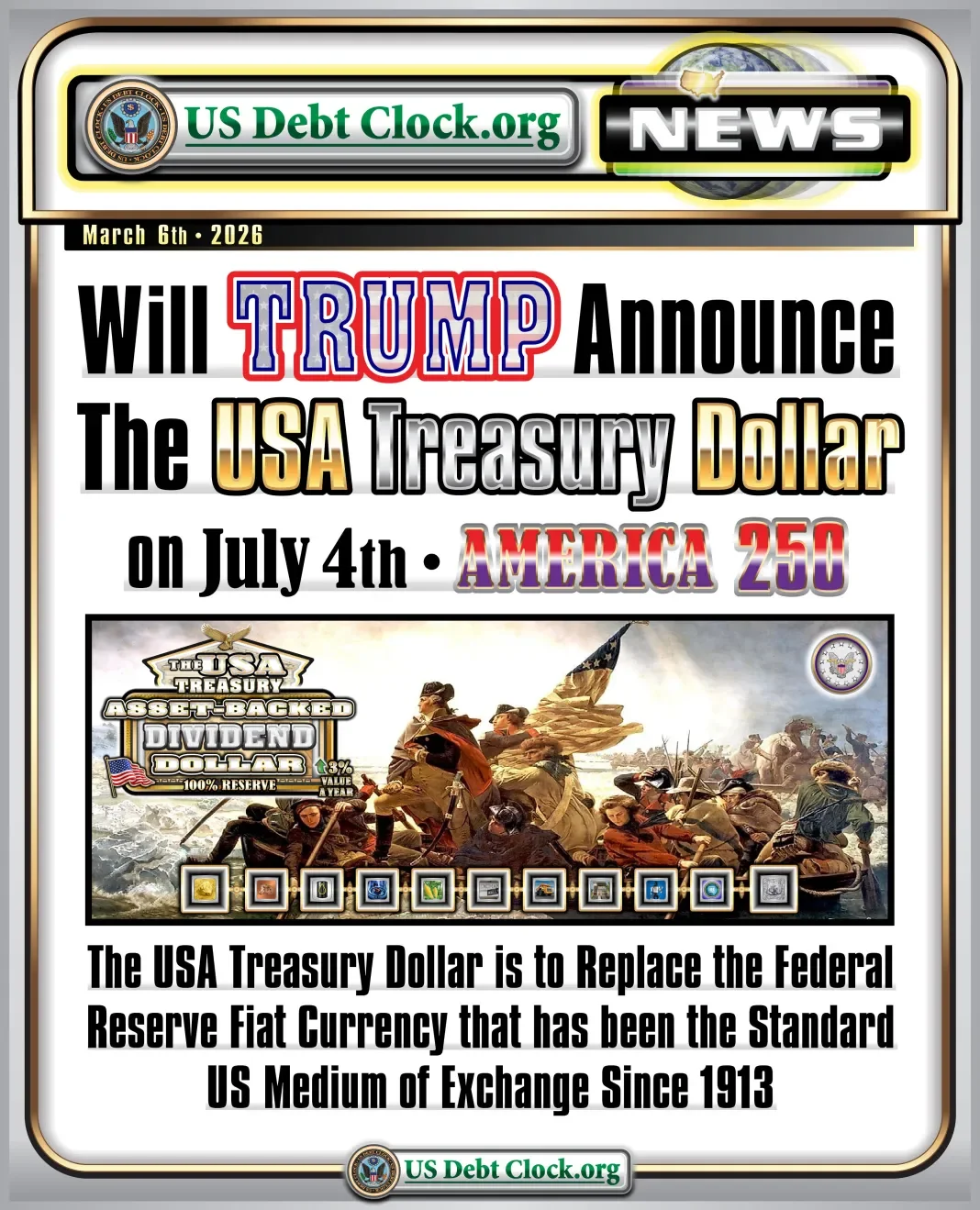
Some economists believe the next step could be a U.S. Treasury Dollar backed by real assets, designed to strengthen purchasing power and stabilize the currency rather than dilute it through debt expansion.
With America’s 250th anniversary in July of 2026, conversations about the future of money, debt, and economic sovereignty are accelerating.
The world’s financial architecture is evolving.
The only question is: who is ready?!
Does the US Debt Clock know something is in the works? We are all feeling something major is going to happen to kick off our 250th birthday, only 119 days to go.
Jon Dowling: Crypto and Great Wealth Transfer Updates with Zester, March 2026
Jon Dowling: Crypto and Great Wealth Transfer Updates with Zester, March 2026
3-7-2026
The world of cryptocurrency and blockchain is rapidly evolving, with significant legislative and geopolitical developments poised to reshape the global financial landscape.
In a recent episode of the Jon Dowling podcast, Mr. Zester, a seasoned expert in blockchain and cryptocurrency with over a decade of experience, shared his insights on the Clarity Act, the impact of geopolitical tensions, and the future of digital currencies.
Jon Dowling: Crypto and Great Wealth Transfer Updates with Zester, March 2026
3-7-2026
The world of cryptocurrency and blockchain is rapidly evolving, with significant legislative and geopolitical developments poised to reshape the global financial landscape.
In a recent episode of the Jon Dowling podcast, Mr. Zester, a seasoned expert in blockchain and cryptocurrency with over a decade of experience, shared his insights on the Clarity Act, the impact of geopolitical tensions, and the future of digital currencies.
The conversation began with a discussion on the current state of geopolitical tensions, particularly surrounding Iran and the implications of regime changes. This led to a deeper dive into the pivotal legislative developments affecting cryptocurrencies, with a focus on the Clarity Act.
This landmark bill is expected to regulate stablecoins, tokenized assets, and ultimately shape the future of the U.S. dollar and global financial systems.
Mr. Zester explained that the Clarity Act is currently stalled due to resistance from banking lobbies, primarily over the issue of interest-bearing stablecoins. Banks fear that these stablecoins could trigger a massive bank run by pulling liquidity away from them.
The likely compromise will favor institutional investors over retail participants, restricting average users’ ability to earn yield on stablecoins while allowing large financial entities to benefit.
Despite these challenges, the passage of the Clarity Act is seen as inevitable and critical for establishing the U.S. dollar-backed stablecoin as the new “digital petro dollar,” sustaining U.S. economic dominance.
This development is expected to have far-reaching implications for the global financial system.
The discussion also highlighted the anticipated massive gains for blockchains like XRP, Ethereum, and Solana due to their tokenization capabilities.
XRP, in particular, is expected to lead in real-world asset tokenization, including gold and silver. This digital transformation of precious metals is presented as a game-changer, elevating their value from mere wealth preservation tools to active mediums of exchange and offense in financial growth.
The tokenization of assets is seen as a significant development in the evolution of the financial ecosystem, enabling the creation of new asset classes and changing the way we think about wealth management.
The podcast also touched on the risks posed by Tether, the largest stablecoin backed heavily by U.S. Treasury bonds and intricately tied into geopolitical and financial power dynamics. The association of Brock Pierce, co-founder of Tether, with the [E] files raises concerns about the stability and influence of Tether in the crypto ecosystem.
A collapse of Tether, whether intentional or accidental, could destabilize the crypto market and the broader U.S. financial system, acting as a form of economic mutually assured destruction. This highlights the need for vigilance and awareness of the potential risks and challenges associated with the rapidly evolving cryptocurrency landscape.
The conversation concluded with a discussion on the future vision of the financial ecosystem, emphasizing a shift from traditional Keynesian economics to a new digital, tokenized, and transparent system.
This new system is expected to be characterized by increased transparency, accountability, and efficiency.
The importance of public awareness and engagement with these developments was also highlighted, as they are currently being decided largely behind closed doors. The role of predictive programming and the need for vigilance in understanding the unfolding crypto revolution were also underscored.
In conclusion, the insights shared by Mr. Zester on the Jon Dowling podcast provide a fascinating glimpse into the rapidly evolving world of cryptocurrency and blockchain.
As the Clarity Act and other legislative developments continue to unfold, it is clear that the future of global finance is being reshaped in profound ways.
For further insights and information, watch the full video from Jon Dowling. As the cryptocurrency landscape continues to evolve, it is essential to stay informed and engaged with the latest developments.
The Precipice
The Precipice
Notes From the Field By James Hickman (Simon Black) March 2, 2026
“OK, so now I just want a bunker,” a close friend of mine texted over the weekend. And I get it. Fear, apprehension, unease… these are completely normal feelings right now.
Google Trends shows that searches for “WW3” and “nuclear war” spiked over the weekend. Similar hashtags on social media (#WW3, etc.) also surged.
It doesn’t help that much of the legacy media has been stoking these fears, as they almost always do.
The Precipice
Notes From the Field By James Hickman (Simon Black) March 2, 2026
“OK, so now I just want a bunker,” a close friend of mine texted over the weekend. And I get it. Fear, apprehension, unease… these are completely normal feelings right now.
Google Trends shows that searches for “WW3” and “nuclear war” spiked over the weekend. Similar hashtags on social media (#WW3, etc.) also surged.
It doesn’t help that much of the legacy media has been stoking these fears, as they almost always do.
Now, I suspect most people already have very strong opinions on the conflict. I certainly do. So there’s no sense in spending time today trying to litigate whether the military action was a good idea; we’ll all find out soon enough.
Instead, I want to focus on two key points:
The first is that—regardless of how someone feels about this conflict— World War III is LESS LIKELY today than it was on Friday. And it’s not hard to understand why.
US military capabilities have been on full display this year— first in Venezuela, where special operations forces managed to extract one of the world’s most tightly protected dictators… and it was over in a matter of hours.
Only weeks later we see total dominance of Iran’s air defense systems— most of which are Russian or Chinese technology.
In other words, China and Russia saw their military technology completely embarrassed by the United States. And this unmitigated defeat makes them both less interested in taking on America’s military.
More importantly, Russia is completely depleted after four years of war in Ukraine. China’s military has almost no combat experience and has never had to project power beyond the South China Sea.
So while they’ll certainly phone in their condemnations and strongly worded tweets, these countries have neither the capacity nor the inclination for war.
It’s also noteworthy that the US rolled out a new weapon against Iran— a ‘kamikaze drone’ which was first pioneered by the Iranians themselves.
Over the past several years the Iranian military developed its low-cost Shahed-136 drone— and sold vast quantities of them to Russia for use in Ukraine.
Well, an Arizona-based defense startup reverse engineered the Shahed-136… and made major improvements with respect to range, firepower, networking, cybersecurity, and more.
It’s also dramatically more cost effective and can be manufactured in America at less than half the price as the Iranian variant.
This shows how valuable the US private economy can be in war— managing to best the Iranians at their own game in less than a year. Foreign adversaries cannot ignore this.
Look, nothing is impossible. But in terms of probabilities— at this moment, the specter of world war, nuclear war, etc. is actually lower… and adversary nations’ appetite for direct military conflict is diminishing by the day.
The second point is what’s really at stake.
Military action of this scale brings almost infinite permutations. And, yes, there are many possibilities which result in the US subduing Iran’s military and a new, America-friendly regime takes control of the country.
China has already lost access to Venezuelan oil. Now they stand to lose access to Iranian oil. This is bad news for China’s domestic economy.
More importantly, by exerting de-facto control (or at least significant influence) over most of the largest oil supplies on the planet—Iran, Venezuela, the US, most of the Gulf states— America would be able to re-establish the US dollar’s dominance.
Every country that wants to buy oil— which is pretty much everyone— would need to own and hold US dollars to pay for it. This means that foreign countries must continue buying vast quantities of Treasury bonds—helping to finance America’s deficit and keep interest rates down.
But there are other outcomes as well.
If the remaining military campaign does not go well— if the Iranian regime manages to suppress the protestors, survive the bombings, and maintain their grip on power— then the US could be in trouble.
US casualties at that point will be mounting. Munitions will be depleting rapidly. And most media attention and political opposition will pounce on the President.
Frankly I’d expect to see more well-funded protests and professional agitators making a stink across American cities, i.e. the Left will fall back on its Minneapolis/ICE playbook to force a military withdrawal.
China and Russia would likely take advantage, capitalizing on US weakness and the fact that America’s relations with Europe are heavily strained.
Between the tariff chaos, domestic social divisions, Congressional intransigence, constant government shutdown threats, etc., adding in a humiliating military defeat in Iran might just be the final straw.
Led by China, other nations could come together and say, ‘enough is enough’, then force a new Bretton Woods style convention to formally establish a new order that strips the US of its power.
Again, there are nearly infinite ways in which this could play out. But regardless of where someone stands on this weekend’s airstrikes, it’s important to acknowledge the stakes.
A successful outcome could provide major benefit to the dollar for decades to come. Defeat could trigger the end of US geopolitical dominance.
America might just be on a precipice. And we’ll find out which way it goes over the coming weeks.
To your freedom, James Hickman Co-Founder, Schiff Sovereign LLC
"Money Dysmorphia"
"Money Dysmorphia" Could Be Seriously Hurting Your Finances. Here's How To Tell If You Have It.
Caroline Bologna Tue, October 1, 2024 BuzzFeed
Loud budgeting. Slow shopping. Girl math. These days, there are endless quippy terms to describe the trends and phenomena in the realm of personal finance.
One of the more insidious realities impacting people’s financial health has a name as well: money dysmorphia.
To help keep the negative impacts at bay, HuffPost asked experts to break down this phenomenon and share their advice for dealing with it.
"Money Dysmorphia" Could Be Seriously Hurting Your Finances. Here's How To Tell If You Have It.
Caroline Bologna Tue, October 1, 2024 BuzzFeed
Loud budgeting. Slow shopping. Girl math. These days, there are endless quippy terms to describe the trends and phenomena in the realm of personal finance.
One of the more insidious realities impacting people’s financial health has a name as well: money dysmorphia.
To help keep the negative impacts at bay, HuffPost asked experts to break down this phenomenon and share their advice for dealing with it.
What Is ‘Money Dysmorphia’?
“Money dysmorphia is when you have a warped or distorted view of your finances,” said Danielle Desir Corbett, a personal finance expert and host of “The Thought Card” podcast. “You see your financial situation much differently from your reality. Money dysmorphia can be caused by a variety of reasons, including past money trauma, societal pressures, economic crisis, or could be deeply rooted in childhood upbringing.”
A recent Credit Karma survey found that 29% of Americans experience money dysmorphia.
“Money dysmorphia is a play on keeping up with the Joneses, except the inability to ‘keep up’ is causing some people to experience feelings of inadequacy,” said Courtney Alev, a consumer financial advocate at Credit Karma.
The survey data reveals that the issue is particularly prevalent in younger generations, as 43% of Gen Zers and 41% of millennials reported experiencing money dysmorphia, compared to 25% of Gen Xers and 14% of those aged 59 or above.
“While the term is new, the feelings aren’t,” said Dasha Kennedy, the creator of The Broke Black Girl and a financial wellness board member at National Debt Relief. “Many people have felt financially insecure for a long time without having a specific name for it. Now, by giving it a name, it’s easier to understand and address these feelings.”
People have long worried about money and felt that they don’t have enough ― even when they do. The problem seems to have worsened, however, in the online age.
Elizabeth Ayoola, a personal finance expert and writer at NerdWallet, told HuffPost she believes people’s skewed view of their finances is “often shaped by comparisons to others they see on social media or by soaking up economic news that creates worry.”
“When people have money dysmorphia, they’re likely looking at their finances more subjectively than objectively,” she added.
What Are The Signs Of Money Dysmorphia?
TO READ MORE: https://finance.yahoo.com/news/money-dysmorphia-could-seriously-hurting-031602305.html
Willem Middelkoop: Why $500 Silver is Possible as Comex Inventory Drops 30%
Willem Middelkoop: Why $500 Silver is Possible as Comex Inventory Drops 30%
Kitco News: 3-6-2026
Willem Middelkoop says the monetary reset is no longer a forecast. It is unfolding now.
Speaking with Kitco News at PDAC 2026, the Founder and CEO of Commodity Discovery Fund reiterated his aggressive silver outlook. “It was 2021 when I called for $100 silver,” he said. “Now I'm calling for $500 silver.”
Middelkoop argues that historical benchmarks still matter, noting the gold-silver ratio “traditionally has been one in 10 for over 2000 years,” while physical supply continues to tighten.
Willem Middelkoop: Why $500 Silver is Possible as Comex Inventory Drops 30%
Kitco News: 3-6-2026
Willem Middelkoop says the monetary reset is no longer a forecast. It is unfolding now.
Speaking with Kitco News at PDAC 2026, the Founder and CEO of Commodity Discovery Fund reiterated his aggressive silver outlook. “It was 2021 when I called for $100 silver,” he said. “Now I'm calling for $500 silver.”
Middelkoop argues that historical benchmarks still matter, noting the gold-silver ratio “traditionally has been one in 10 for over 2000 years,” while physical supply continues to tighten.
He added, “If you look at the silver production in Peru, it's down 40% over the last five years.” Beyond price targets, Middelkoop believes the global financial order is shifting east.
“The price discovery mechanism for gold and silver is moving from Chicago to Shanghai,” he said, adding, “I think this is Bretton Woods 3.0.”
He warned that “the next crisis could be a sovereign debt crisis,” but maintains that despite volatility and geopolitical tension, “We are just starting.”
01:06 - Silver Squeeze Setup
02:47 - Comex Credibility Cracks
04:18 - Shanghai Takes Over
07:36 - Mexico Mining Risk
08:50 - Fed No Longer Matters
09:53 - Bretton Woods 3.0
11:32 - Sovereign Debt Reckoning
13:39 - Middle East Political Fallout
17:20 - What It Means for Miners
19:01 - M&A and Copper Deals
23:06 - Portfolio Positioning
25:44 - Black Swan and Stacking
“Tidbits From TNT” Saturday 3-7-2026
TNT:
Tishwash: Foreign oil companies evacuate their employees from Iraq
Reuters reported on Saturday that several foreign oil companies have begun evacuating their foreign staff from oil fields in Iraq to Kuwait.
This comes amid fears of an escalating conflict in the region, as the US military in recent days abruptly canceled a major military exercise planned for an elite paratrooper unit, a move that has sparked speculation within the US Department of Defense about the possibility of sending ground troops to the Middle East as the confrontation with Iran widens.
TNT:
Tishwash: Foreign oil companies evacuate their employees from Iraq
Reuters reported on Saturday that several foreign oil companies have begun evacuating their foreign staff from oil fields in Iraq to Kuwait.
This comes amid fears of an escalating conflict in the region, as the US military in recent days abruptly canceled a major military exercise planned for an elite paratrooper unit, a move that has sparked speculation within the US Department of Defense about the possibility of sending ground troops to the Middle East as the confrontation with Iran widens.
Financial and consulting institutions have warned of potential repercussions on global oil supplies if the war with Iran continues, pointing to the possibility of a large part of production being halted due to the closure of the Strait of Hormuz.
Approximately 20% of the world's daily oil demand passes through the Strait of Hormuz. With the strait effectively closed for seven days, this meant that roughly 140 million barrels of oil, equivalent to about 1.4 days of global demand, were unable to reach the market. link
Tishwash: Iraq tells US Envoy it seeks to stay out of regional war
Iraqi Foreign Minister Fuad Hussein told the US chargé d’affaires Joshua Harris on Thursday that Iraq is working to avoid being drawn into the widening regional war, according to Iraq’s Foreign Ministry.
He warned that the fighting threatens broader regional stability and said Baghdad is trying to keep the conflict from spilling into Iraq.
Hussein also outlined the war’s potential economic impact on the country and reiterated that Iraq will protect diplomatic missions operating on its territory.
facebook post
Fuad Hussein, during his meeting with the US Chargé d'Affaires, affirmed Iraq's commitment to shielding itself from the repercussions of the war.
Arabic | English
On Thursday, March 5, 2026, Deputy Prime Minister and Minister of Foreign Affairs, Mr. Fuad Hussein, received the Chargé d'Affaires of the Embassy of the United States of America in Iraq, Mr. Joshua Harris.
During the meeting, they discussed developments in the war in the region and its repercussions on the regional situation. Mr. Fuad Hussein emphasized the seriousness of the continued war and its consequences for the security and stability of the entire region.
The minister stressed that the Iraqi government is making continuous efforts to keep the repercussions of the war away from Iraq, and to prevent it from slipping into the cycle of conflict, in order to preserve its security and stability.
The Minister also gave an explanation of the financial and economic effects of the war and its repercussions on Iraqi society, in light of the challenges facing the region.
In a related context, Mr. Fuad Hussein affirmed the Iraqi government’s commitment to protecting diplomatic missions operating in Iraq and ensuring their security in accordance with international agreements and norms.
He also reiterated that Iraqi territory would not be used as a launching pad for any hostile acts against neighboring countries. In this context, he referred to the Kurdistan Region leadership's declaration that the regional authorities would not allow any party to exploit its territory to organize acts of violence against neighboring countries, including the Islamic Republic of Iran.
Fuad Hussein Affirms Iraq's Determination to Keep the Country Away from the Repercussions of War During Meeting with the US Charge d'Affairs
Deputy Prime Minister and Minister of Foreign Affairs of the Republic of Iraq, HE Mr. Fuad Hussein, received on Thursday, 5 March 2026, the Chargé d’Affairs of the Embassy of the United States of America to the Republic of Iraq, Mr. Joshua Harris.
During the meeting, the two sides discussed the developments of the war in the region and its repercussions on the regional situation. HE Mr. Fuad Hussein stressed the seriousness of the continued war and its consequences for the security and stability of the entire region.
HE the Minister emphasized that the Iraqi government is making continuous efforts to keep Iraq away from the repercussions of the war and to prevent the country from being drawn into the circle of conflict, in order to preserve its security and stability.
HE the Minister also provided an explanation of the financial and economic impacts of the war and their repercussions on Iraqi society, particularly in light of the challenges currently facing the region.
In this context, HE Mr. Fuad Hussein reaffirmed the Iraqi government's commitment to protecting diplomatic missions operating in Iraq and ensuring their security in accordance with international agreements and diplomatic norms.
HE also reiterated that Iraqi territory will not be allowed to be used as a launching point for any hostile acts against neighboring countries. In this regard, HE referred to statements by the leadership of the Kurdistan Region affirming that the authorities of the Region do not permit any party to exploit its territory to organize acts of violence against neighboring states, including the Islamic Republic of Iran.
more of the article:
He added that Iraqi land will not be used to launch attacks against neighboring states.
The minister also referred to statements from Kurdistan Region authorities that the region will not allow its territory to be used for attacks against neighboring countries, including Iran.
The meeting comes as the United States and Israel continue strikes inside Iran, which Tehran has answered with attacks on Israeli targets and US interests across the region. link
************
Tishwash: A government advisor identifies four paths to achieving economic diversification in Iraq.
The financial advisor to the Prime Minister, Mazhar Muhammad Saleh, confirmed on Friday that achieving sustainable economic stability in Iraq requires expanding the productive base and activating four main policy paths to reduce dependence on oil revenues.
Saleh told Al-Furat News Agency: “The first path is based on manufacturing natural resources and maximizing their added value, indicating that Iraq possesses strategic resources such as silicon, sulfur and phosphate, and that moving from exporting raw materials to processing them industrially allows for the establishment of integrated production chains that contribute to increasing returns and generating job opportunities.
He added that the second track relates to revitalizing the micro, small and medium enterprises sector, as it is capable of absorbing about 60% of the workforce if the appropriate financial and regulatory environment is available, stressing the need to link these projects to a broader industrial strategy that focuses on infrastructure.
Saleh added that the third path includes developing the agricultural sector and enhancing food security through adopting digital transformation and developing logistics services, noting that expanding agricultural manufacturing doubles the economic value of products and creates productive links between agriculture and industry.
Regarding the fourth track, Saleh called for restructuring the tourism sector through partnership with the private sector and developing tourism infrastructure, stressing that Iraq represents a historical, archaeological and religious treasure trove that can be transformed into an important source of national income.
Saleh concluded by pointing out that achieving economic diversification requires the integration of policies that link industry, agriculture, services and tourism within a comprehensive development vision to build a more sustainable economy. link
Mot: Remember When?
News, Rumors and Opinions Saturday 3-7-2026
KTFA:
Paulette: IMO..... After listening to the CC, Frank stated in answer to a question that a HCL has never been passed. The question alleged that Maliki's COM passed an HCL in 2007 and sent it to Parliament. The questioner also asked if a COM has never passed a HCL, how can Parliament discuss a HCL much less pass one.
Upon further research this morning, it is reported that Maliki's HCL did pass a HCL in February of 2007 and sent it to Parliament in May of 2007. This was the culmination of a push by the Bush administration that started in 2004 after they hired the consulting firm Bering Point to help write the law.
The Bush administration considered this passage of the law as a Benchmark for the Maliki administration.
KTFA:
Paulette: IMO..... After listening to the CC, Frank stated in answer to a question that a HCL has never been passed. The question alleged that Maliki's COM passed an HCL in 2007 and sent it to Parliament. The questioner also asked if a COM has never passed a HCL, how can Parliament discuss a HCL much less pass one.
Upon further research this morning, it is reported that Maliki's HCL did pass a HCL in February of 2007 and sent it to Parliament in May of 2007. This was the culmination of a push by the Bush administration that started in 2004 after they hired the consulting firm Bering Point to help write the law.
The Bush administration considered this passage of the law as a Benchmark for the Maliki administration. Although it was sent to parliament, due to its contentious nature, it was never even brought for a First Reading in Iraq's Parliament. At least that is what my research revealed.
I know Frank continues to say Parliament is going to discuss and/or pass the HCL to give money to the citizens. I am confused as I don't understand from where this money will magically appear.
90% of Iraq's revenues come from oil sales in USD. Even an RI will not affect the value of the oil sales. In fact, each dollar will buy less IQD after the RI that we expect.
Additionally, Iraq is and has been functioning with a deficit over the last few years. We have seen many articles regarding this fact It was always my understanding that money remitted directly to the people can only be from a surplus.
I would really appreciate some clarification as to what HCL can be passed by Parliament much less even discussed as Frank himself even said that there has never been an HCL passed. Wouldn't a COM have to have had to pass it and send it to Parliament and it have a First Reading, a Second Reading, possibly a Third Reading and a vote???
I really think it would be helpful for Frank and his Teams to weigh in on this as to how Parliament can be in a position to discuss and pass a HCL possibly as early as Saturday and also as to where funds will come from to remit to the citizens......
If we have to wait until the HCL is passed prior to the RI, I think many of us would want to understand what to watch for and how soon this can occur. It just doesn't seem to me to be possible anytime soon.
Even the Oil and Gas Law between Baghdad and Kurdistan cannot be finalized and agreed as the non-oil revenues remain a contentious issue. How can a full HCL be ready for a vote? I am just trying to be a good student and I continue to have more questions than answers.
~~~~~~~~~~~~
Mike: IMO.. I dont know any more than most others about this 'Revalue process and HCL', but I have some long standing beliefs. One of those is that we will see the HCL (Article 140) prior to or at the same time as a new rate.
Im not sure of the exact numbers but I believe that oil sales are in USD and are around 3.5 to 4 mil bbls/day? As production increases, depending on the agreements with OPEC, that may increase.
Iraq has paid Kuwait and has paid for the oil infrastructure which needed to be built, so there should be more money for other modernization projects in the budget. Also, they are starting to use natural gas for their energy needs.
The HCL was never supposed to give citizens money as much as setting aside a portion of the oil sales for future generations- much like Kuwait.
It also sets the agreements between the Kurdish region and the Central govt. They have been discussing this for years. They have an idea where these numbers lie. As they find new oil or mineral deposits, the numbers may change slightly to account for this, but they know.
For them to make a final agreement on anything, they need a gentle push, or maybe a shove. They need to 'Save Face' in regards to their agreements. It's not something which we really understand.
The Reval, on the other hand, increases purchasing power. If the rate goes 1-1 with the dollar, and they remove the 3 zero notes, then they have gained a small amount of purchasing power. If their rate goes to $2.00, they now can buy twice as much as before, especially with imported goods and services.
This should also apply to contracts w outside contractors as they are paid with a revalued dinar.
We have seen for years that the banks in Iraq needed to increase their reserves. I really dont understand the 'financial system of this world', but if the CBI holds a billion dinar which is currently 1 million dollars, then after a reval at 1-1, its instantly a billion dollars.
I assume this is how we can afford to be paid.
They used the dollars we paid to survive the lean times to get their oil infrastructure going. The world took money out of the financial system when they devalued the dinar. Now they will be adding it back in.
My opinion- for what its worth- which aint much! As the Canadian bank story guy said, Be generous.
************
Clare: Exiled Crown Prince of Iran Reza Pahlavi Says He Has Accepted the Role as Iran’s Transitional Leader
Crown Prince Reza Pahlavi from Iran

by Jim Hoft Mar. 6, 2026 12:30 pm
Crown Prince of Iran Reza Pahlavi says he has agreed to accept the role of Iran’s transitional leader.
Reza Pahlavi is the son of the Shah of Iran who fled the country when Ayatollah Khomeneini took control of the Islamic nation.
Reza Pahlavi released this statement earlier today.
The Islamic Republic has launched missiles at the United Arab Emirates, Bahrain, Qatar, Kuwait, Oman, Jordan, Iraq, and Saudi Arabia. It is targeting our Arab neighbors. These violations of their sovereignty are unacceptable, and we condemn them. But this is nothing new. This is who the Islamic Republic has always been, and this is why it must end.
For nearly five decades, this terrorist regime has sown chaos and bloodshed across our region. It propped up Assad, turning Syria into a graveyard. It planted Hezbollah as a state within a state in Lebanon. It armed the Houthis to destabilize the Arabian Peninsula. It empowered militias in Iraq to undermine Iraqi sovereignty. It attacked the economic hubs of the Kingdom of Saudi Arabia and the United Arab Emirates.
None of this has ever been the desire of the Iranian people, but rather that of a regime occupying our country. Now, however, the landscape has fundamentally shifted.
Assad is gone. Hezbollah has been decimated. The regime’s military nuclear program has been set back. Its economy is in a freefall. The pillars of this regime’s aggression are crumbling. The Iranian people have paid the price in blood to reach this moment. The regime massacred tens of thousands of my compatriots in just two days, but it didn’t break the people.
Instead, the regime itself is breaking. Today, his History reminds us of our future potential. Before the revolution, Iran worked closely with Arab leaders, from King Faisal to Sheik Zahid to King Hussein to President Sadat. In Oman, my father helped Sultan Qabuz defend his country against insurgency. We were true partners then. We will be true partners again. LINK
Courtesy of Dinar Guru: https://www.dinarguru.com/
Militia Man Here is what was to be expected. They are making a move to withdraw Maliki's nomination officially. An official statement will likely be forthcoming very soon. If they do Al-Sudani is highly likely to get the nod for PM. He is the most qualified, has the largest bloc and global support. To me at this stage Maliki's nomination is effectively over. The outcome is looking to be a cleaner and more stable government, as the outcome.
Mnt Goat there is WOW! WOW! WOW! news to tell regarding the RV as we may be getting the new Iraqi government in place very shortly. Maliki still persisted in not dropping out, however...the Coordination Framework was forced to withdraw Maliki’s nomination. Article: "THE SHIITE FRAMEWORK DECIDES TO WITHDRAW AL-MALIKI’S CANDIDACY – ARAB MEDIA" A stormy meeting in Baghdad ends with a preliminary agreement within the Shiite framework to exclude Maliki from the race. Quote: "...the members of the framework reached a preliminary agreement in their meeting today to withdraw the nomination of Nouri al-Maliki for the presidency of the next Iraqi government and to choose an alternative to be determined later.” [Post 1 of 2....stay tuned]
Mnt Goat Can the Coordination Framework still be able to pick their candidate or is this now not allowed since they already pasted all the constitutional deadlines? Parliament turned this over to the Judiicary to decide what to do next. If it is to be enforced, we can be assured that al-Sudani will be the candidate, since his party has the largest winner in the elections, as the ruling states....according to this ruling, al-Sudani is already now the candidate. If this ruling holds true the Coordination Framework no longer gets to choose the nominee... WOW! WOW! WOW! again… [Post 2 of 2]
*************
Can Iraq Revalue At $3 Like Kuwait ?
Dinar for Dummies: 3-6-2026
In this video I compare the 2 countries of Iraq and Kuwait and the values of their currencies.
Seeds of Wisdom RV and Economics Updates Saturday Morning 3-7-26
Good Morning Dinar Recaps,
U.S. Signals Possible Russian Oil Sanctions Relief as Global Energy Markets Tighten
Energy shock from the Strait of Hormuz disruption forces Washington to reconsider supply restrictions.
Overview
• Treasury Secretary Scott Bessent signaled the U.S. could ease sanctions on additional Russian oil to stabilize global energy markets.
Good Morning Dinar Recaps,
U.S. Signals Possible Russian Oil Sanctions Relief as Global Energy Markets Tighten
Energy shock from the Strait of Hormuz disruption forces Washington to reconsider supply restrictions.
Overview
• Treasury Secretary Scott Bessent signaled the U.S. could ease sanctions on additional Russian oil to stabilize global energy markets.
• The move comes after Iran shut down shipping through the Strait of Hormuz, triggering supply disruptions.
• India received a 30-day waiver to purchase stranded Russian oil to help offset shortages.
• Brent crude surged to around $92 per barrel, reflecting tightening global supply conditions.
Key Developments
1. U.S. Considers Loosening Russian Oil Sanctions
During an interview with FOX Business host Larry Kudlow, U.S. Treasury Secretary Scott Bessent revealed that Washington may “unsanction” additional Russian crude to increase global supply. The administration is evaluating ways to release hundreds of millions of sanctioned barrels currently stranded at sea.
Bessent described the move as part of a temporary strategy to stabilize markets during the Middle East crisis, emphasizing that the Treasury could effectively increase supply simply by lifting restrictions on certain shipments.
2. Strait of Hormuz Closure Triggers Global Energy Shock
Energy markets were rattled after Iran closed the Strait of Hormuz, one of the world’s most critical oil shipping lanes, following U.S.-Israeli strikes that killed Iranian Supreme Leader Ayatollah Ali Khamenei.
The chokepoint normally carries roughly one-fifth of the world’s oil supply, meaning even temporary disruption creates immediate pressure on global markets. Tankers carrying millions of barrels of crude are now stranded, while nations dependent on Hormuz shipments scramble for alternatives.
3. India Granted Temporary Waiver for Russian Oil
India had previously agreed to reduce purchases of Russian crude under pressure from Western sanctions. However, the current crisis has forced a recalibration.
Washington granted India a 30-day waiver allowing it to accept Russian oil cargoes already stranded at sea. According to Bessent, India had been cooperating with Western sanctions and planned to replace Russian imports with U.S. energy exports, but the Hormuz disruption created a temporary supply gap.
Nearly half of India’s crude imports normally pass through the Strait of Hormuz, making the closure especially disruptive for the world’s third-largest oil consumer.
4. Oil Prices Surge as Supply Tightens
The disruption has pushed Brent crude prices to around $92 per barrel, with analysts warning that further escalation could drive prices significantly higher.
President Donald Trump addressed concerns about rising gasoline costs, stating bluntly: “If they rise, they rise.” The administration appears focused on ensuring physical supply remains available, even if that requires temporarily relaxing sanctions on Russian exports.
Why It Matters
This development reflects how quickly geopolitical conflicts can reshape global energy policy. Sanctions designed to isolate Russia are now being reconsidered because global supply stability is taking priority.
Key implications include:
• Sanctions flexibility: The U.S. may temporarily relax restrictions when markets face supply shocks.
• Russia’s continued relevance in global energy markets, even under sanctions.
• Growing energy vulnerability tied to key maritime chokepoints like the Strait of Hormuz.
Why It Matters to Foreign Currency Holders
For those watching global financial shifts, energy disruptions often trigger currency volatility and geopolitical realignments.
• Oil pricing influences the strength of petrocurrencies and trade balances worldwide.
• Sanction adjustments highlight how political tools are being used to control commodity flows.
• Energy crises often accelerate discussions around alternative trade systems and commodity-backed settlement models.
This environment reinforces a broader trend: global energy markets are increasingly tied to geopolitical power shifts and evolving financial alliances.
Implications for the Global Reset
Pillar 1 – Energy Control as Financial Leverage
Energy supply disruptions reveal how control over oil flows directly affects global monetary stability. Nations capable of redirecting supply quickly gain leverage in both trade negotiations and currency influence.Pillar 2 – Fragmentation of Sanctions and Trade Systems
If Russian oil begins flowing more freely again—even temporarily—it underscores the limits of sanctions in a multipolar energy market. Countries like India are increasingly navigating between Western systems and alternative energy partnerships.
The result is a more fragmented global trade structure, one of the key signals many analysts associate with the gradual restructuring of the international financial order.
This is not just politics — it’s global finance restructuring before our eyes.
Seeds of Wisdom Team
Newshounds News™ Exclusive
Sources
Newsweek — “Scott Bessent Says U.S. Could Lift Sanctions on More Russian Oil”
BBC — “Strait of Hormuz: Why the world’s most important oil chokepoint matters”
~~~~~~~~~~
China’s 2027 BRICS Chairmanship: A Quiet Strategic Shift With Major Global Financial Implications
Back-to-back leadership from Brazil, India, and China could accelerate the bloc’s push for financial reform and de-dollarization.
Overview
• China will assume the BRICS chairmanship in 2027, following Brazil (2025) and India (2026).
• Analysts see this three-year leadership sequence as potentially the most consequential period in BRICS history.
• The bloc now includes 11 full member nations and represents over 40% of the world’s population.
• Alternative payment systems and financial infrastructure reforms are expected to move from planning to action during China’s term.
Key Developments
1. Strategic Back-to-Back Leadership Cycle
Diplomatic groundwork for China’s BRICS chairmanship in 2027 is already underway, even before India’s 2026 term formally began. China’s top diplomat visited New Delhi just days before India assumed leadership, and both governments agreed to support each other’s chairmanship agendas.
This sequence—Brazil in 2025, India in 2026, and China in 2027—creates a rare opportunity for multi-year policy continuity within the bloc, allowing long-term initiatives such as financial reform and payment system development to gain traction.
The coordinated approach suggests BRICS leaders are attempting to move beyond symbolic cooperation toward structural economic initiatives.
2. A Much Larger and More Influential BRICS
The BRICS organization China will lead in 2027 is significantly larger than when Beijing last held the chairmanship in 2017.
Key changes include:
• 11 full member countries, including the addition of Indonesia in 2025
• Multiple partner nations exploring deeper alignment
• Representation of over 40% of the global population
The expanded membership has transformed BRICS from a loose political coalition into a growing economic bloc with increasing influence across the Global South.
Trade pressures and tariff disputes with Western economies have also pushed member states to explore alternative financial infrastructure, including payment networks independent of traditional Western systems.
3. De-Dollarization Returns to the Center Stage
One of the most closely watched issues ahead of China’s 2027 leadership term is the bloc’s evolving approach to reducing reliance on the U.S. dollar.
During the 2024 BRICS summit in Kazan, Chinese President Xi Jinping emphasized the need for structural reform of global financial governance.
Xi stated that BRICS nations must “deepen financial cooperation, promote the interconnection of financial infrastructure, and expand the role of the New Development Bank.”
Under China’s chairmanship, several initiatives are expected to re-emerge prominently:
• A BRICS cross-border payment system designed to facilitate trade outside traditional SWIFT networks
• Expansion of the New Development Bank’s role in development financing
• Calls for International Monetary Fund voting reforms to reflect the economic rise of emerging markets
If implemented, these measures could incrementally shift how global trade settlements occur.
4. India’s Role Remains Essential to BRICS Unity
Despite China’s growing influence within the bloc, analysts say India’s participation remains critical to BRICS credibility and stability.
Former Indian diplomat Vidya Bhushan Soni noted that Beijing now recognizes that BRICS initiatives cannot succeed without active Indian involvement.
As a result, China’s leadership approach in 2027 is expected to be more consensus-driven, emphasizing collective Global South leadership rather than purely Chinese direction.
Maintaining unity among diverse members—including India, Brazil, Russia, and several Middle Eastern economies—will be essential if the bloc hopes to implement meaningful reforms.
Why It Matters
The upcoming leadership cycle represents a rare moment of coordinated agenda-setting across multiple BRICS chairmanships.
Key potential outcomes include:
• Expanded financial cooperation among emerging economies
• Development of alternative payment networks
• Greater influence for the Global South in global financial governance
While these initiatives may develop gradually, the groundwork being laid today suggests BRICS is increasingly focused on structural economic influence rather than symbolic diplomacy.
Why It Matters to Foreign Currency Holders
For observers tracking potential global financial realignments, BRICS policy shifts remain an important indicator.
• Alternative payment systems could reshape international trade settlement flows.
• Expanded development financing could strengthen emerging-market currency ecosystems.
• Efforts to reduce dollar dependency may diversify global reserve and trade practices over time.
Even incremental progress could change the balance of financial influence between Western institutions and emerging economies.
Implications for the Global Reset
Pillar 1 – Multipolar Financial Infrastructure
If BRICS successfully builds cross-border payment systems and expands development financing mechanisms, the global financial landscape could gradually evolve toward multiple parallel financial networks rather than a single dominant system.Pillar 2 – Institutional Reform Pressure
Growing economic weight among emerging economies is increasing pressure for reforms within global financial institutions such as the IMF and World Bank.
China’s 2027 chairmanship may act as a catalyst for accelerating those conversations, particularly if the bloc presents unified proposals.
These developments suggest that the global economic order is slowly transitioning toward a more multipolar structure.
This is not just diplomacy — it’s the architecture of the next financial era being negotiated in real time.
Seeds of Wisdom Team
Newshounds News™ Exclusive
Sources
Watcher Guru — “BRICS Chairmanship for 2027: A Quiet Move With Huge Global Impact”
Reuters — “BRICS expansion and financial cooperation efforts gain momentum”
~~~~~~~~~~
🌱 A Message to Our Currency Holders🌱
If you’ve been holding foreign currency for many years, you were not foolish.
You were not wrong to believe the global financial system would change.
What failed was not your patience — it was the information you were given.
For years, dates, rumors, and personalities replaced facts, structure, and proof. “This week” predictions created cycles of hope and disappointment that were never based on how currencies actually change.
That is not your failure.
Our mission here is different: • No dates • No rates • No hype • No gurus
Instead, we focus on:
• Verifiable developments • Institutional evidence
• Global financial structure • Where countries actually sit in the process
Currency value changes only come after sovereignty, trade, banking, settlement systems, and fiscal coordination are in place. History and institutions confirm this sequence.
You will see silence. You will see denials. That is not delay — that is discipline.
Protect your identity. Organize your documents. Verify everything.
Never hand your discernment to anyone who cannot show proof.
You deserve truth — not timelines.
Seeds of Wisdom Team
Newshounds News
~~~~~~~~~~
Seeds of Wisdom Team RV Currency Facts Youtube and Rumble
Newshound's News Telegram Room Link
RV Facts with Proof Links Link
RV Updates Proof links - Facts Link
Follow the Gold/Silver Rate COMEX
Follow Fast Facts
Seeds of Wisdom Team™ Website
Thank you Dinar Recaps