
News, Rumors and Opinions Friday 9-19-2025
Note: All intel should be considered as "Rumors" until we receive official announcements ...and “Rates and Dates” could change anytime until we get to the banks/redemption centers.
RV Excerpts from the Restored Republic via a GCR: Update as of Fri. 19 September 2025
Compiled Fri. 19 September 2025 12:01 am EST by Judy Byington
Summary:
Today, September 19, 2025, marks not just another Friday, but a pivotal moment in the unfolding narrative of a world reborn.
Based on the latest intel compiled by Judy Byington, a seismic shift is not just coming; it’s here, and its effects are already rippling across the globe.
Note: All intel should be considered as "Rumors" until we receive official announcements ...and “Rates and Dates” could change anytime until we get to the banks/redemption centers.
RV Excerpts from the Restored Republic via a GCR: Update as of Fri. 19 September 2025
Compiled Fri. 19 September 2025 12:01 am EST by Judy Byington
Summary:
Today, September 19, 2025, marks not just another Friday, but a pivotal moment in the unfolding narrative of a world reborn.
Based on the latest intel compiled by Judy Byington, a seismic shift is not just coming; it’s here, and its effects are already rippling across the globe.
Judy Byington suggests that the moment we hear the Emergency Broadcast System (EBS) activate with the iconic sound of Seven Trumpets, our personal notification system will begin.
Expect a flurry of messages on your cell phones,(allegedly) directly from the advanced Starlink Satellite System.
For those holding foreign currencies like the Iraqi Dinar or Vietnamese Dong, or Zim Bonds, these appointments are where you will conduct your exchanges.
For those without, this is your opportunity to set up new Quantum Financial System (QFS) banking accounts and access the benefits of this new era.
For “us” – Tier 4b, the Internet Group – the wait is almost over! Notification to book your currency exchange, Zim Bond redemption, and Med Bed appointments is imminent. Remember, these will (allegedly) be booked through the highly secure Starlink Satellite System via a national/global number linked to a Military secure website, not via traditional texts or emails.
A Word of Caution on Exchange Rates: While some banks (Chase, Wells Fargo, HSBC) (allegedly) opened on Monday, September 15, 2025, for general public Dinar/Dong exchanges, these rates are significantly lower than what will be offered through official Redemption Centers. Patience is key for optimal results!
The Quantum Financial System is the heart of this new era. Described as a secure, instant, and transparent alternative to traditional banking, it leverages quantum computing, resists fraud, and records transfers on a distributed ledger.
Julian Assange on Telegram confirmed as of September 12, 2025, the QFS is running at full speed! Globalists(allegedly) cannot stop it. Tier 3 humanitarian operators, military retirees, and early adopters are already (allegedly) seeing SHI transactions!
President Trump (allegedly) continues to sign daily executive orders to push the QFS rollout forward, with military teams enforcing GESARA compliance worldwide. Quantum nodes are reconciling transactions 24/7.
This is not a drill. The reset is here. The Fed is collapsing, the elites are losing control
The time for speculation is over. The great shift is upon us. Prepare for the EBS, listen for the Seven Trumpets, and get ready for your Starlink notifications. This new era, (allegedly) gold-backed, secured by your DNA, and protected by the military alliance, awaits.
Step into the new era!
~~~~~~~~~~~~
Global Currency Reset:
Mon. 15 Sept. 2025 IMF Releases Dong To RV: https://www.imf.org/en/News/Articles/2025/09/15/pr-25296-vietnam-imf-executive-board-concludes-2025-article-iv-consultation
Thurs. 18 Sept. Wolverine: “I can’t say much, but it’s looking very good to get our appointments. Bond Holders are having their appointments right now.”
Wed. 17 Sept. 2025 FULL-SCALE ASSAULT: TRUMP’S EXECUTIVE ORDERS TAKE AIM AT THE FED AND SHAKE THE GLOBAL BANKING CARTEL! – amg-news.com – American Media Group
Wed. 17 Sept. 2025: GLOBAL CURRENCY RESET: THE OLD SYSTEM DIES HERE — GOLD AS TIER-1, RV, BASEL III & QFS TRIGGER THE FINAL RESET – amg-news.com – American Media Group
Read full post here: https://dinarchronicles.com/2025/09/19/restored-republic-via-a-gcr-update-as-of-september-19-2025/
Courtesy of Dinar Guru: https://www.dinarguru.com/
Nader From The Mid East The currency given to Alaq in England...It is a currency, it's one dinar but it's not currency you can use in the street. That currency represent the digital currency...In Arabic says in the bottom, it's a digital currency which is very exciting for me. Why? Because the zeros are going to be deleted from Forex. And that's it.
Frank26 [Iraq boots-on-the-ground report] FRANK: You know that note that is on that plaque? We established that it's a 1931 [Iraqi dinar note] FIREFLY: Yes it is a symbol...It's also a digital note. That's what they've been talking about. We can prove it to you...it's on the bottom of it. You can see it. FRANK: Holy sh**! So that's what they were talking about when they said digital currency. So it's within the lower notes.
*************
The $7 Trillion Sideline Asset Soon Heading For Gold & Silver - Mike Maloney
9-18-2025
What do $7.5 trillion, money markets, and your future purchasing power all have in common?
They’re connected — and the implications could be huge.
In this episode of The Gold & Silver Show, Mike and Alan reveal how an unprecedented amount of cash that’s supposed to be “safe” is actually anything but.
With warning signs flashing, this massive pool of money could soon surge into real safe havens: gold and silver.
What you’ll learn:
Why money market funds may look safe — and yet carry hidden risks
How past crises saw similar buildup of cash, followed by collapses and flight to hard assets
The real effects on wealth distribution and what the “bottom 50%” are facing
How central bank policies and massive debt could amplify the next downturn
If you’re thinking about protecting your wealth — whether through precious metals, diversifying assets, or simply staying informed — this video is a must-watch.
What We Lose When We Retire
What We Lose When We Retire
Jonathan Clements | Aug 26, 2023
WHEN WE RETIRE, we win back control over our daily life. Gone is the boss, the expectation that we’ll be at work at a certain hour, the worry about what the next office email will bring. We have a degree of freedom that, in many cases, we last knew when we were students contemplating a long summer vacation.
But even as we gain that freedom, there’s also much that we lose. If we’re to be happy retirees, we need to think hard about how we’ll cope with these losses. For some, what’s lost won’t seem all that bad. But for me—someone for whom work has been so central to my life—the seven losses below loom large.
What We Lose When We Retire
Jonathan Clements | Aug 26, 2023
WHEN WE RETIRE, we win back control over our daily life. Gone is the boss, the expectation that we’ll be at work at a certain hour, the worry about what the next office email will bring. We have a degree of freedom that, in many cases, we last knew when we were students contemplating a long summer vacation.
But even as we gain that freedom, there’s also much that we lose. If we’re to be happy retirees, we need to think hard about how we’ll cope with these losses. For some, what’s lost won’t seem all that bad. But for me—someone for whom work has been so central to my life—the seven losses below loom large.
1. Income. This is the most obvious loss, we all know it’s coming—and yet many folks are left anxious by the disappearance of their paycheck, even if they have ample savings. Moreover, with that paycheck gone, not only do we lose the ability to save, but also our financial life goes into reverse, with savings coming out of our nest egg instead of going in.
Given that, it’s hardly surprising that studies suggest retirees tend to be happier when they have ample predictable income, such as from a pension. Don’t have a pension? To ease the anxiety of retirement, consider delaying Social Security to get a larger monthly check and perhaps also purchasing immediate fixed annuities. I plan to do both.
2. Identity. When we meet folks for the first time, one of the questions is almost always, “So, what do you do?” Instead of “engineer” or “lawyer,” you’ll be saying, “I’m retired.”
How does that answer sit with you? For some, it’ll be just fine. But others will hunger for an answer that lets them reclaim the pride they felt when they described their old profession. Even now, I tell people, “I used to work for The Wall Street Journal,” resting on those old laurels, even though my last Journal byline was more than eight years ago.
3. Purpose. Our new identity will be tied to the meaningful things we choose to do with our retirement years. It might be volunteering, helping family or a “hobby.” I put hobby in quotation marks because the word can suggest something that’s little more than a way to while away the hours.
But to give us a sense of purpose, a retirement hobby has to be more than that. It needs to be something we feel we’re good at, find challenging and fulfilling, and which strikes us as important. As I scale back my work in the years ahead, HumbleDollar will be the “hobby” that provides that sense of purpose, and I know that’s also the case for many of the site’s writers.
4. Structure. I’ve worked for myself for the past nine years, and I regularly worked from home for more than a dozen years prior to that. I lack many talents, but self-discipline isn’t one of them.
For others, however, saying goodbye to the workweek’s predictable rhythm could leave them feeling lost and unsure how to allocate their time, even if there’s plenty they want to do. I suspect the vast majority of retirees soon settle into a new routine that feels not unlike their old workweek. Indeed, many retirees tell me that weekends continue to feel distinctly different from weekdays. But until you find your daily rhythm, don’t be surprised if there are some uncomfortable weeks or months.
TO READ MORE: https://humbledollar.com/2023/08/what-we-lose/
Seeds of Wisdom RV and Economics Updates Friday Morning 9-19-25
Good Morning Dinar Recaps,
US, UK to Collaborate on AI, Quantum Computing, Nuclear Energy Development
Washington and London strike a landmark tech pact, signaling a shift in global power competition.
A Strategic Memorandum with Global Implications
US President Donald Trump and UK Prime Minister Keir Starmer signed a memorandum of understanding (MOU) on Thursday during Trump’s state visit to the United Kingdom.
Good Morning Dinar Recaps,
US, UK to Collaborate on AI, Quantum Computing, Nuclear Energy Development
Washington and London strike a landmark tech pact, signaling a shift in global power competition.
A Strategic Memorandum with Global Implications
US President Donald Trump and UK Prime Minister Keir Starmer signed a memorandum of understanding (MOU) on Thursday during Trump’s state visit to the United Kingdom.
The agreement outlines joint development in artificial intelligence, nuclear energy, telecommunications, and quantum computing—all critical sectors shaping the next generation of global infrastructure.
While the MOU is not legally binding, its scope shows intent: joint research initiatives, interoperability standards, and even 6G development. At its core, this deal reinforces something larger—the restructuring of global finance and power through technology.
This is not just politics — it’s global finance restructuring before our eyes.
Quantum Computing and the Crypto Connection
One of the most significant elements is quantum computing. The US-UK task force will develop hardware, software, and algorithms with interoperability standards.
In the crypto world, this development is pivotal. Sufficiently powerful quantum computers could disrupt existing encryption models that safeguard digital assets. The fact that Washington and London are leading this race suggests they see control over quantum systems not just as a military or commercial advantage, but also as a tool to steer the future of money and security.
Here, technology and finance converge—innovation becomes a weapon in the struggle for financial dominance.
AI, 6G, and the Economic Power Play
Trump stressed the investment impact:
“This trip has galvanized $350 billion in deals across many sectors… We are committed to ensuring that the UK is a secure and reliable supply of the best AI hardware and software on Earth.”
With Trump also citing $17 trillion invested in the US over the last year, it’s clear that these technological pushes are part of a broader financial realignment strategy. AI and 6G networks will drive future trade, intelligence, and digital commerce—every piece reinforcing the dollar-led order in competition with BRICS and other rising blocs.
What looks like tech cooperation is, in fact, economic positioning in a financial restructuring already underway.
A Golden Nuclear Age
The announcement also highlighted collaboration on nuclear fusion—hailed as the potential future of limitless clean energy. By investing in advanced reactors, both the US and UK aim to secure energy independence, strengthening their supply chains and removing reliance on adversarial sources.
Energy security has always been tied to financial dominance. Control over nuclear and fusion tech means control over the backbone of industrial power, and ultimately, monetary leverage in a de-dollarizing world.
This is not simply about energy—it is about ensuring financial supremacy in the decades ahead.
Why This Matters
This memorandum may not yet change laws, but it maps out the architecture of tomorrow’s world order:
AI, quantum, and 6G as control points for commerce and finance.
Nuclear fusion as leverage over global energy pricing and reserves.
Anglo-American coordination ensuring Western dominance in the technology-driven economy.
The deal is less about research labs and more about shaping financial and energy flows in the decades ahead.
Key Takeaway: Washington and London are aligning to secure the technologies that underpin global finance and security. What looks like a science partnership is actually an economic and monetary power play.
This is not just politics — it’s global finance restructuring before our eyes.
@ Newshounds News™
Source: CoinTelegraph
~~~~~~~~~
White House Eyes Other Candidates for CFTC Chair as Quintenz Confirmation Stalls
Crypto regulation takes center stage as Trump weighs new leadership at the CFTC.
A Search for Leadership in Uncertain Times
The Trump administration is actively considering backup candidates for the Commodity Futures Trading Commission (CFTC) as Brian Quintenz’s confirmation remains stalled. Bloomberg reports that potential contenders include officials with cryptocurrency regulation expertise, reflecting how central digital assets have become in U.S. financial policy.
This is not a simple personnel shuffle. It reveals that the administration views the CFTC chairmanship as a critical post in shaping the regulatory and financial framework of the digital economy.
The CFTC’s Expanding Role in Digital Assets
Congress is currently developing legislation to expand the CFTC’s powers over crypto markets, cementing its place as one of the most influential agencies in digital asset oversight. Unlike the SEC, which has leaned heavily on enforcement, the CFTC is being positioned to act as the market’s stabilizer—regulating derivatives, spot markets, and systemic risks.
This is where the financial restructuring angle emerges: whoever leads the CFTC will effectively steer how crypto integrates into the broader financial system. Decisions on derivatives approvals, stablecoin oversight, and futures markets all tie back into how money flows globally.
Political Drama Meets Financial Power
Quintenz, Trump’s nominee, has faced resistance both in the Senate and within the crypto industry itself. Notably, the Winklevoss twins—staunch Trump supporters and key crypto financiers—have openly opposed him, arguing that his approach is out of alignment with the administration’s policy.
The dispute intensified when Quintenz alleged that the twins lobbied against his nomination after he declined to pursue Gemini’s complaint against the CFTC staff. This clash isn’t just personal; it highlights the tug-of-war between regulators, industry players, and political powerbrokers over who gets to shape the rules of the new financial order.
Why This Matters
The CFTC chair isn’t just another Washington appointment. In 2025, the position will define:
How crypto assets are classified and traded in U.S. markets.
Whether derivatives and futures tied to tokens like XRP, Bitcoin, and stablecoins expand liquidity globally.
How America positions itself in the race against BRICS nations building parallel financial systems.
The chair’s decision-making will ripple far beyond U.S. borders, influencing whether digital assets strengthen or weaken dollar dominance in the global economy.
Key Takeaway: The stalled nomination underscores how crypto regulation has become inseparable from the contest over financial power. Choosing the right CFTC leader is less about politics and more about setting the foundation of tomorrow’s monetary system.
This is not just politics — it’s global finance restructuring before our eyes.
@ Newshounds News™
Source: The Block
~~~~~~~~~
Seeds of Wisdom Team RV Currency Facts Youtube and Rumble
Newshound's News Telegram Room Link
Follow the Gold/Silver Rate COMEX
Follow Fast Facts
Seeds of Wisdom Team™ Website
Thank you Dinar Recaps
“Tidbits From TNT” Friday Morning 9-19-2025
TNT:
Tishwash: Iraq remains America's darling...the Supreme Court dismisses a lawsuit against Baghdad for hundreds of millions.
The Supreme Court in Washington ruled on Wednesday (September 17, 2025) to prevent an American military affairs company from fining the Iraqi government $121 million in a lawsuit related to breach of contract to rehabilitate Iraqi army weapons.
According to a Bloomberg report translated by Baghdad Today, Wy Oak Technology, a military-related company, filed a lawsuit against the Iraqi government, seeking $121 million in damages for the contract's suspension.
TNT:
Tishwash: Iraq remains America's darling...the Supreme Court dismisses a lawsuit against Baghdad for hundreds of millions.
The Supreme Court in Washington ruled on Wednesday (September 17, 2025) to prevent an American military affairs company from fining the Iraqi government $121 million in a lawsuit related to breach of contract to rehabilitate Iraqi army weapons.
According to a Bloomberg report translated by Baghdad Today, Wy Oak Technology, a military-related company, filed a lawsuit against the Iraqi government, seeking $121 million in damages for the contract's suspension.
The Supreme Court affirmed that "Iraq is protected under the U.S. Foreign Immunity Act," noting that this law protects foreign governments from prosecution in such cases, even in the presence of formally signed contracts.
The report added that the court's decision means Iraq retains "immunity," which prevents companies and commercial entities from being sued within the United States, whether for breaches of contract or damages resulting from operating in Iraq.
The roots of this immunity date back to the aftermath of the 2003 invasion of Iraq, when the US Congress passed a special law signed by former President George W. Bush, known as the "Iraq Freedom from Judicial Attachment Act," which granted Iraq exceptional protection from lawsuits and seizures. Experts interpreted this move as maintaining Iraq's status as a "spoiled child" in US politics, amid subsequent presidential successions that ensured this privilege would continue for two full decades. link
***************
Tishwash: The Oil Minister affirms the government's support for the Iraq Investment Forum to attract foreign capital.
Deputy Prime Minister and Minister of Oil, Hayan Abdul-Ghani, reviewed today, Thursday, the preparations for the Iraq Investment Forum, stressing the government's support for the Iraq Investment Forum to attract foreign capital.
A statement by the Ministry of Oil stated: "Abdul Ghani met with a delegation from the Preparatory Committee for the Iraq Investment Forum, headed by Ibrahim Al-Masoudi Al-Baghdadi, Chairman of the Iraqi Economic Council and member of the Preparatory Committee."
The statement added that "the Chairman of the Council provided a detailed explanation of the dialogue session for the Ministry of Oil, which is scheduled to be chaired by the Minister of Oil on September 27. During the meeting, investment opportunities presented by the Ministry of Oil were discussed, which aim to attract investments in the oil and gas sector and petroleum industries.
" It continued, "The meeting discussed logistical preparations and preparations related to sending invitations to the relevant ministers, including the Turkish and Lebanese Ministers of Oil."
The Minister stressed "his keenness to support the forum, which reflects the government's direction towards revitalizing the national economy and attracting foreign capital."
The statement indicated that "the meeting was attended by the Executive Director of the Economic Council, Thabet Kazim Al-Safi, and the Assistant Director General of the Economic Department at the National Investment Commission, Hussein Ali Kanbar, in addition to Hazem Al-Shammari from the Media and Relations Department." link
************
Tishwash: Abu Raghif inaugurates the e-signature conference in Baghdad to promote digital payments and secure transformation.
The "Activating Electronic Signatures to Support E-Payment" conference kicked off in Baghdad today, Thursday, under the title "Towards a Trusted Digital Environment." The conference, held under the patronage of the Prime Minister and under the supervision of the Central Bank and the Communications and Media Commission, brought together ministries, government institutions, and local and international technology companies.
In his speech during the opening session, which was followed by {Euphrates News}, the Chairman of the Communications and Media Commission, Nofal Abu Ragheef, said: “The conference represents a fundamental step in building a secure digital environment that supports the national economy, under the sponsorship and essential partnership of the Communications and Media Commission as the regulatory body for this vast sector, confirming its tireless pursuit of real partnerships with financial technology (FinTech) companies to develop innovative financial services that respond to the needs of citizens in the digital age.”
Abu Raghif added, "The success of this project requires responsible institutional strengthening of information security, which is the cornerstone of data protection and ensuring digital trust, as well as developing the infrastructure and encouraging informed investment in this field." He emphasized the authority's commitment to implementing applicable legislation, most notably the Electronic Signature and Electronic Transactions Law, in line with international standards and regulations of the International Telecommunication Union.
The Commission Chairman concluded his speech by emphasizing that "digital transformation is no longer just a regulatory option, but rather a national economic necessity," calling for "integrating the efforts of the state, the private sector, and international partners to build a sustainable digital economy that meets the demands of the times and serves the Iraqi citizen." link
Mot: Uh Oh !!!!!

Mot: As You Can See!! -- I Am Now Committed !!!

FRANK26…9-18-25……NO TOILET PAPER
KTFA
Thursday Night Video
FRANK26…9-18-25……NO TOILET PAPER
This video is in Frank’s and his team’s opinion only
Frank’s team is Walkingstick, Eddie in Iraq and guests
Playback Number: 605-313-5163 PIN: 156996#
KTFA
Thursday Night Video
FRANK26…9-18-25……NO TOILET PAPER
This video is in Frank’s and his team’s opinion only
Frank’s team is Walkingstick, Eddie in Iraq and guests
Playback Number: 605-313-5163 PIN: 156996#
Iraq Economic News and Points To Ponder Thursday Evening 9-18-25
Central Bank: 6.8 Trillion Dinars In Electronic Collections In 2025
Banks Economy News – Baghdad The Central Bank of Iraq revealed that the total government electronic collections through points of sale (POS) during the first eight months of 2025 exceeded six trillion dinars, while the number of employee payroll cards exceeded five million.
Central Bank: 6.8 Trillion Dinars In Electronic Collections In 2025
Banks Economy News – Baghdad The Central Bank of Iraq revealed that the total government electronic collections through points of sale (POS) during the first eight months of 2025 exceeded six trillion dinars, while the number of employee payroll cards exceeded five million.
The Director General of the Information Technology and Payments Department at the Central Bank of Iraq, Adnan Asaad, said in an interview with Al-Sabah, followed by Al-Eqtisad News:
“The volume of government electronic collections through points of sale so far has reached more than 6.8 trillion dinars in the first eight months of this year,” expecting that “it will exceed 10 trillion dinars by the end of this year, while last year it amounted to about 9 trillion dinars, while collections from gas stations exceeded 750 billion dinars, after it was 465 billion dinars last year.”
He added, "Total government e-collection through various payment instruments has reached approximately 2.1 trillion dinars, while last year it reached approximately 322 billion dinars," noting that "49 ministries and agencies have approved the deployment of e-payment instruments in more than 6,600 formations."
Asaad continued, "The number of domiciled employee cards has reached approximately 5.6 million, while the value of the use of electronic payment systems for real-time settlement has exceeded 200 trillion dinars. Automated clearing has exceeded 35 trillion dinars, and the national switchboard has recorded approximately 20 trillion dinars."
The bank's Director General of Information Technology and Payments explained that "these figures for 2025 reflect the continued expansion in the adoption of electronic payment channels and the development of its infrastructure, in line with the Central Bank's strategic directions and the government's national plans to enhance financial inclusion and digital transformation in Iraq." 09/17/2025 - https://economy-news.net/content.php?id=60147
Trade Bank Of Iraq Launches Direct Delivery Service For Electronic Cards
Banks Economy News – Baghdad The Trade Bank of Iraq announced today, Thursday, the launch of a direct delivery service for electronic cards.
A statement from the bank, received by Al-Eqtisad News, stated that "to facilitate customers, it has been decided to activate the direct delivery service for electronic cards."
The bank added, "We announce the activation of the electronic card delivery service in Baghdad and all governorates to ensure their safe and timely arrival." https://economy-news.net/content.php?id=60184
Electronic Payment In Iraq: Major Strides, Challenges Ahead
Banks Iraq is witnessing rapid transformations in the structure of its financial systems, with increasing reliance on electronic payment methods instead of direct cash transactions. This transition is not merely a technical update; it represents a fundamental step toward building a more transparent economy capable of keeping pace with changes in regional and global markets.
From Cash To Card
The Central Bank of Iraq's recent announcement that the number of domiciled employee cards has reached 5.6 million clearly indicates the depth of the ongoing transformation. After years of near-total reliance on cash, large segments of Iraqis—employees and retirees alike—now rely on electronic cards as their primary means of receiving their salaries and conducting transactions.
This step represents a qualitative shift in a country that has long been a prisoner of cash liquidity, with large salaries paid in cash, straining the banking system and increasing security and economic risks.
Leadership And The Role Of Local Companies
Among the companies that pioneered this transformation, Qi Card emerged as the first electronic payments company in Iraq, laying the foundation for a national experience in financial technology. The company launched with a basic service, payroll localization, but has gradually transformed into a major player providing multiple payment and financing services.
Despite the challenges it faced operating in a challenging environment, K-Card's presence helped boost users' confidence in digital services and provided access to groups in villages and rural areas, making electronic payments a part of daily life for a growing segment of Iraqis.
Expansion Of Services
The development did not stop at issuing cards, but included the introduction of services such as:
Biometric update to ensure accuracy of user data.
Electronic advance systems that provide urgent liquidity.
Installment services in universities, hospitals and retail stores.
Point of sale (POS) devices are widespread in markets and shops.
These services have enhanced the added value of the electronic payment sector and connected consumers more deeply to the formal financial system.
User Experience...The Most Important Indicator
The decisive factor in the success of electronic payments was not the number of cards but rather user satisfaction. Employees or retirees who once had to wait hours in bank lines are now able to receive their salary via card quickly and securely.
This user experience has directly impacted the service's popularity. The smoother the process, the higher the uptake. However, challenges still exist in some areas due to poor communications infrastructure or a lack of financial awareness.
Private Sector And Government Orientation
The widespread adoption of electronic payment is not limited to government employees. The government has adopted a clear policy to deploy point-of-sale (POS) devices in various markets, including the private sector, to expand the user base and reduce cash transactions.
Payment companies have responded to this policy by offering cards and services that operate both inside and outside Iraq, giving consumers greater flexibility and putting Iraq on the path to integration into the global financial system.
Figures And Facts
The number of electronic payment cards in Iraq has exceeded 12 million cards.
Thousands of POS devices are now widespread in the market.
A large segment of universities and institutions now rely on digital installment systems.
These figures reflect the magnitude of the change, but they also indicate the extent of the work required to secure infrastructure and update legislation.
New Technology And Applications
With the growing demand for digital solutions, applications like SuperKey have emerged, combining payments, transfers, and government services into a single platform.
These applications not only facilitate financial transactions, but also offer a practical model for integration between the public and private sectors, through services such as paying water and electricity bills or paying government fees electronically.
Challenges That Cannot Be Ignored
Despite these successes, the sector faces a number of challenges, most notably:
Lack of financial awareness among some users, which hinders full access to services.
Internet services are intermittent in some areas, limiting operational stability.
The need for more flexible legislation to keep pace with the development of financial technology.
Competing with traditional banks that still maintain a portion of their cash share.
Towards An Integrated Digital Economy
The success of electronic payment goes beyond facilitating transactions; it also serves as a tool for combating corruption, reducing tax evasion, and promoting financial inclusion. The data generated from millions of transactions represents a wealth of information that can help decision-makers formulate more accurate economic policies.
Iraq's e-payment experience is a growing success story, but it still requires strengthening its infrastructure, developing legislative frameworks, and intensifying financial literacy programs. Between the regulatory role of the Central Bank, investments by local companies like Qi Card, and government efforts to expand the sector, a clear path is taking shape toward a digital economy that could be one of the most prominent features of Iraq's economic development over the next decade. https://economy-news.net/content.php?id=60186
New Drop In Gold Prices In Baghdad
Stock Exchange Economy News – Baghdad Iraqi and foreign gold prices fell slightly on Thursday in local markets in the capital, Baghdad.
Gold prices in the wholesale markets on Al-Nahr Street in the capital, Baghdad, this morning recorded a selling price of one mithqal of 21 karat Gulf, Turkish and European gold at 736 thousand dinars, and a purchase price of 732 thousand dinars, while yesterday, Wednesday, it recorded 738 thousand dinars.
The selling price of one mithqal of 21-karat Iraqi gold reached 706,000 dinars, and the buying price was 702,000 dinars.
As for gold prices in jewelers' shops, the selling price of a mithqal of 21-karat Gulf gold ranges between 740,000 and 750,000 dinars, while the selling price of a mithqal of Iraqi gold ranges between 710,000 and 720,000 dinars. https://economy-news.net/content.php?id=60185
For current and reliable Iraqi news please visit: https://www.bondladyscorner.com
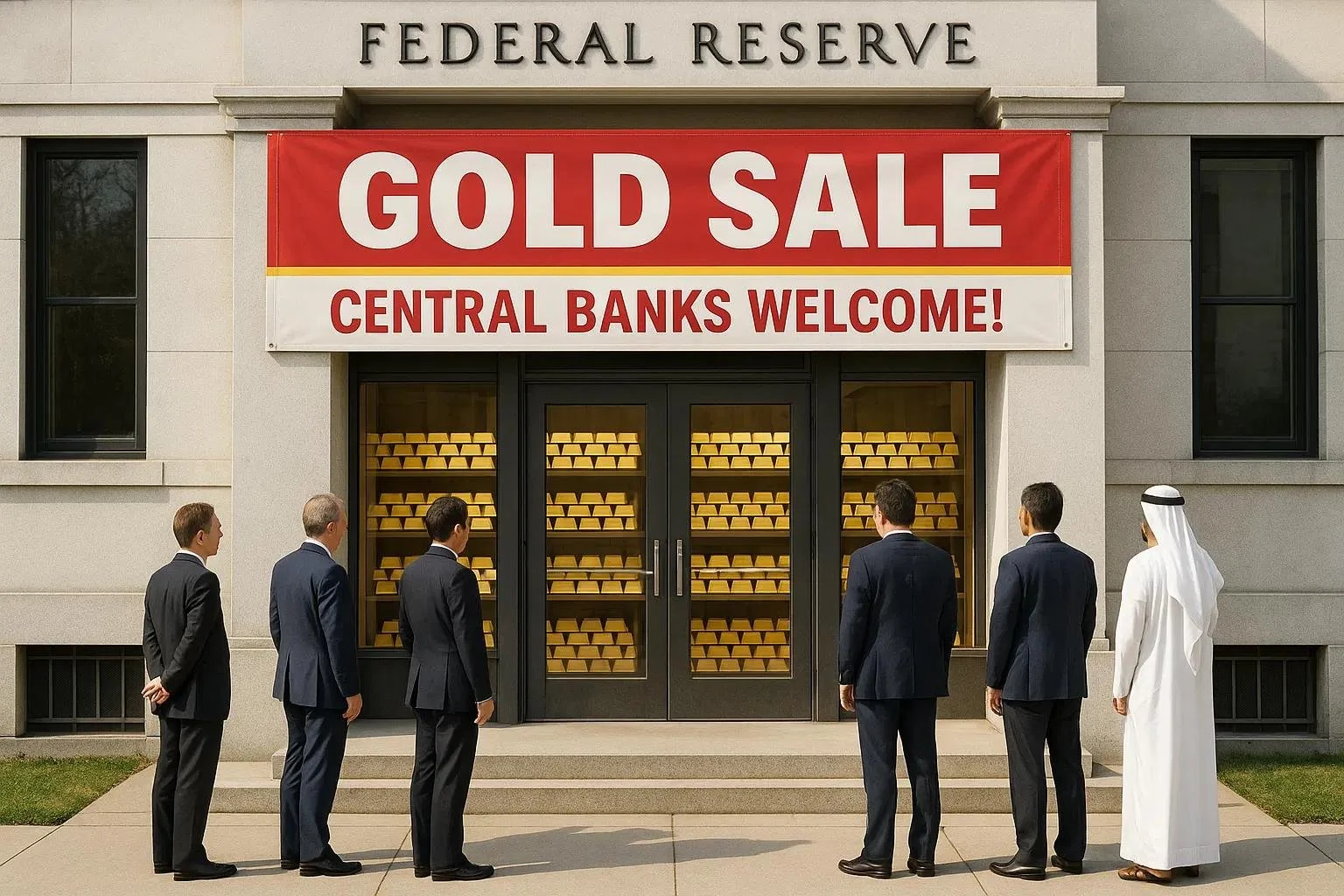
The Fed Just Became the World’s #1 Gold Salesman..
The Fed Just Became the World’s #1 Gold Salesman...
Notes From the Field By James Hickman (Simon Black) September 18, 2025
To the surprise of absolutely no one, the Federal Reserve announced its decision yesterday to cut interest rates… and kept the door open to further rate cuts in the future.
The funny thing is that we’ll never truly know why.
Sure, it’s possible that Fed officials honestly felt that the economy needs lower rates (despite obviously persistent inflation risks).
The Fed Just Became the World’s #1 Gold Salesman...
Notes From the Field By James Hickman (Simon Black) September 18, 2025
To the surprise of absolutely no one, the Federal Reserve announced its decision yesterday to cut interest rates… and kept the door open to further rate cuts in the future.
The funny thing is that we’ll never truly know why.
Sure, it’s possible that Fed officials honestly felt that the economy needs lower rates (despite obviously persistent inflation risks).
Of course, it’s also possible that Fed Chairman Jerome Powell finally caved to all the insults and pressure from the President.
Or that the rest of the FOMC members looked at what’s happening with Lisa Cook and submitted to inevitability, fearing that they too would be investigated for mortgage fraud (or some other criminal matter) if they didn’t cut rates.
Again, we may never know their real motivations. But it’s clear that the White House has gotten its way.
The President and Treasury Secretary believe that lower rates will stimulate the economy, raise wages, raise asset prices, improve housing affordability, and broadly create conditions for economic prosperity… and they’ve been pushing hard for rate cuts.
Lower rates will also help bail out the US government— whose national debt is so gargantuan that the Treasury is set to spend $1.2 trillion this Fiscal Year (which ends on September 30) just to pay interest.
The Trump administration sees lower rates as the key to slashing that annual interest bill.
Of course, a better solution would be to cut spending, bring the budget closer into balance, and reduce America’s debt-to-GDP ratio.
Putting America’s fiscal house in order would also attract investment in US government bonds the old-fashioned way— by restoring confidence that the US Treasury can pay back its debts through growth, strength, and prestige.
But making such cuts is politically difficult. Even the party that claims to be fiscally conservative isn’t really that interested in meaningful spending cuts.
So, they’re going with Plan B-- push the Fed to lower interest rates.
But as we’ve argued before, they’re setting themselves up for disappointment.
Remember what happened last year— between September and December 2024, the Fed cut rates three times for a total of 1%. Yet over that same period, US government bond yields actually INCREASED by 1%.
This proves that the Fed can’t just snap its fingers and force interest rates lower simply by having a committee meeting.
Interest rates are ultimately determined by supply and demand for money. So if they Fed really wants to see lower rates, they’re going to have to intervene directly in the bond market.
They’ve done this many times before-- this is when the Fed ‘prints’ money, i.e. what they call “quantitative easing”. And the most recent example was during the pandemic when the Fed created about $5 trillion of new money.
They used that money to buy government bonds-- essentially creating artificial demand for Treasurys that pushed yields down to record lows.
And life felt pretty good for a while-- people were able to buy homes and finance mortgages at rates lower than 3%. The government was able to sell 10-year debt for less than 0.5%.
But all those trillions of dollars of new money from the Fed came at a consequence: inflation soared to 9%— the highest in decades.
This is the major tradeoff that the Fed is facing right now: the White House wants lower interest rates. And the Fed seems to be capitulating to the pressure.
But for interest rates to get really low (and remain there), the Fed will almost certainly have to engage in more Quantitative Easing… and that means more inflation.
That alone is going to push a lot more capital into the gold market.
For the past few years, foreign governments and central banks have been selling off their US dollar reserves and funneling that money into gold; this has been the primary reason why gold has soared to all-time highs.
And with the Fed’s capitulation on rates, this trend will continue.
It’s also very likely that pension funds, insurance funds, and other long-term institutional investors will seek refuge in gold as well, driving the price even higher.
To be clear, this isn’t a prediction that gold is going to go up every day, or every month, or even every year.
But if you take a longer-term view—say, 8 to 10 years when the US national debt hits $60 trillion and Social Security runs out of funds— the case for owning gold becomes even more compelling.
I don’t hold this view because I’m a “gold bug”. I’m not fanatical about a hunk of metal. But I do understand these long-term trends, and in my view, we’re still in the early innings.
Another option is to buy gold-related companies, which can offer powerful leverage to the metal itself.
Central banks buy physical gold. They do not buy shares of gold companies. That’s why, even as gold surged, many of the companies we researched traded at dirt-cheap valuations—as low as 2-3x earnings in some cases.
But investors are starting to catch on and pay attention to these deeply undervalued businesses; in fact, we’ve seen several companies in our portfolio gain up to 4x, some even just over the last few months.
Given that Q3 earnings are coming up just around the corner, we believe that some of these gold (and related silver and platinum) companies are about to post record earnings and could see their share prices soar even more.
If you’re interested, we publish all of this investment research, including detailed analysis of deeply undervalued gold companies, in our premium service.
To your freedom, James Hickman Co-Founder, Schiff Sovereign LLC
30-50% Market Crash Incoming, Trillions will be Erased
30-50% Market Crash Incoming, Trillions will be Erased
Commodity Culture: 9-17-2025
Are you feeling the squeeze? The rising cost of living, the persistent worry about the future – you’re not alone. And according to one financial expert, things could be set for a much bigger shift than many realize.
In a recent, highly illuminating discussion on Commodity Culture, financial analyst Michael Pento joined host Jesse Day to deliver a sobering message.
30-50% Market Crash Incoming, Trillions will be Erased
Commodity Culture: 9-17-2025
Are you feeling the squeeze? The rising cost of living, the persistent worry about the future – you’re not alone. And according to one financial expert, things could be set for a much bigger shift than many realize.
In a recent, highly illuminating discussion on Commodity Culture, financial analyst Michael Pento joined host Jesse Day to deliver a sobering message.
Pento isn’t just seeing a few frayed threads in the economic fabric; he’s sounding the alarm on a “multitude of epic bubbles” that he believes are poised for a catastrophic burst.
Perhaps the most chilling aspect of Pento’s warning concerns the backbone of our society: the middle class. Already grappling with persistent inflation eroding purchasing power and wage growth that stubbornly refuses to keep pace, the middle class, Pento argues, is being “completely crushed into poverty.”
This economic pressure cooker has a direct and dangerous link to the credit markets. As everyday families struggle to make ends meet, their ability to service debt diminishes, creating a critical vulnerability in the entire system.
According to Pento, the real danger isn’t merely a slow leak; it’s a catastrophic rupture, beginning with a collapse in the credit markets. This isn’t just about banks; it’s about the lifeblood of commerce and personal finance.
Once credit seizes up, the dominoes fall swiftly, leading to an estimated 30 to 50% crash in the stock market.
And here’s where Pento’s forecast becomes truly grim: he estimates that this kind of market correction could take decades to fully recover. This isn’t a quick dip and rebound; it’s a long, arduous journey back to financial stability, profoundly impacting retirement plans, investments, and overall economic well-being for generations.
Pento’s insights on Commodity Culture paint a picture of significant economic upheaval. While such predictions can be unsettling, understanding the potential landscape is the first step toward navigating it. In times of economic uncertainty, knowledge truly is power.
For a deeper dive into Michael Pento’s detailed analysis, the driving forces behind these bubbles, and what it all means for your financial future, we highly recommend watching the full discussion from Commodity Culture.
Arm yourself with information, understand the risks, and prepare for what could be a very different economic horizon.
Silver Shorts: Blood In The Water | Bill Holter
Silver Shorts: Blood In The Water | Bill Holter
Liberty and Finance: 9-17-2025
Bill Holter explains why recent gold and silver price action points to a looming short squeeze and possible failure to deliver in the metals markets.
He argues that central banks worldwide are shifting from U.S. treasuries to gold and silver as the dollar weakens and global financial war intensifies between East and West.
Silver Shorts: Blood In The Water | Bill Holter
Liberty and Finance: 9-17-2025
Bill Holter explains why recent gold and silver price action points to a looming short squeeze and possible failure to deliver in the metals markets.
He argues that central banks worldwide are shifting from U.S. treasuries to gold and silver as the dollar weakens and global financial war intensifies between East and West.
Domestically, Holter warns that Americans are living "behind enemy lines" in a divided, manipulated system where self-sufficiency is essential. He stresses preparedness—physically, mentally, spiritually, and through community networks—while noting that urban dependence is a major vulnerability.
Ultimately, he believes that gold will re-emerge as the core collateral for settlement worldwide as the U.S. financial system deteriorates.
INTERVIEW TIMELINE:
0:00 Intro
1:30 Silver short squeeze
6:00 Financial war
12:21 US debt and stablecoins
14:00 Stock market euphoria
20:00 Relocation
24:51 Family breakdown
Iraq Economic News and Points To Ponder Thursday Afternoon 9-18-25
Prime Minister: The Government Attaches Great Importance To The Work Of Major Oil Companies In Iraq, Especially American Ones
Thursday, September 18, 2025, | Politics Number of readings: 154 Baghdad / NINA / Prime Minister Mohammed Shia al-Sudani stressed: "The government attaches great importance to the work of major oil companies, especially American ones, in Iraq.
A statement by his media office said: "Al-Sudani received, today, Wednesday, the Chairman of the Board of Directors and CEO of the American company Halliburton, specialized in the oil sector and energy technology, Jeff Miller, and his accompanying delegation."
Prime Minister: The Government Attaches Great Importance To The Work Of Major Oil Companies In Iraq, Especially American Ones
Thursday, September 18, 2025, | Politics Number of readings: 154 Baghdad / NINA / Prime Minister Mohammed Shia al-Sudani stressed: "The government attaches great importance to the work of major oil companies, especially American ones, in Iraq.
A statement by his media office said: "Al-Sudani received, today, Wednesday, the Chairman of the Board of Directors and CEO of the American company Halliburton, specialized in the oil sector and energy technology, Jeff Miller, and his accompanying delegation."
Al-Sudani stressed during the meeting: "The government attaches great importance to the work of major oil companies, especially American ones, in Iraq, to develop the energy sector, raise the efficiency of production operations, and achieve the desired aspirations."
He urged Halliburton to expand service centers in Iraq for various engineering specialties, and establish research centers to support technological development for drilling and reclamation operations, as well as open training centers to develop human capabilities and localize some industries, including the production of chemicals for drilling and production and the manufacture of oil equipment for drilling purposes and submersible pumps.
For his part, Jeff Miller expressed his thanks to the Prime Minister for the continuous support to complete the work, and expressed the company's readiness and desire to reach an agreement with the Ministry of Oil to sign a development contract Bin Omar and Sinbad fields in Basra Governorate, with the aim of producing gas, employing Iraqi cadres, and localizing the oil industry. /End https://ninanews.com/Website/News/Details?key=1252603
The Minister Of Oil Affirms The Government's Support For The Iraq Investment Forum
Buratha News Agency1832025-09-18 Deputy Prime Minister and Minister of Oil, Hayan Abdul-Ghani, reviewed preparations for the Iraq Investment Forum on Thursday, stressing the government's support for the forum to attract foreign capital.
A ministry statement said, "Deputy Prime Minister and Minister of Oil, Hayan Abdul-Ghani, met with a delegation from the preparatory committee for the Iraq Investment Forum, headed by Ibrahim Al-Masoudi Al-Baghdadi, Chairman of the Iraqi Economic Council and member of the preparatory committee."
The statement added, "The Council Chairman provided a detailed explanation of the dialogue session on the Ministry of Oil, which is scheduled to be chaired by the Minister of Oil on September 27. During the meeting, investment opportunities presented by the Ministry of Oil were discussed, aiming to attract investment in the oil and gas sector and petroleum industries."
The statement continued, "During the meeting, logistical preparations and preparations related to sending invitations to the relevant ministers, including the Turkish and Lebanese oil ministers, were discussed."
The Minister also affirmed his "keenness to support the forum, which reflects the government's drive to stimulate the national economy and attract foreign capital."
The statement also noted that "the meeting was attended by the Executive Director of the Economic Council, Thabet Kazim Al-Safi, the Assistant Director General of the Economic Department at the National Investment Commission, Hussein Ali Kanbar, and Hazem Al-Shammari from the Media and Public Relations Department." https://burathanews.com/arabic/economic/465323
Government Advisor: The Iraqi Economy Urgently Needs To Diversify And Move Away From Its Oil Dominance.
Time: 2025/09/18 19:22:03 Reading: 210 times {Economic: Al Furat News} The Prime Minister's economic advisor, Mazhar Mohammed Salih, confirmed that the Iraqi economy faces fundamental challenges due to its overreliance on crude oil exports.
Saleh told Al Furat News Agency, "The Iraqi economy is one of the most rentier economies in the world, with oil revenues accounting for more than 90% of public revenues and nearly 60% of the gross domestic product."
He explained that "this fragile structure makes the economy highly vulnerable to fluctuations in global oil prices, which hinders the achievement of comprehensive and sustainable development."
Saleh called for "the necessity of adopting serious and effective policies to diversify sources of revenue and reduce dependence on oil," noting that "diversification opportunities require continuous, long-term planning."
The economic advisor highlighted promising sectors as drivers of non-oil growth, foremost among them the agricultural sector, where Iraq boasts fertile lands and water resources. He noted that "this sector can play a pivotal role in achieving food security and reducing imports, particularly so-called virtual water, which is the import of food from countries that source our country's water resources."
Saleh emphasized the importance of manufacturing industries, particularly food, textiles, petrochemicals, and pharmaceuticals, which have the potential for rapid growth, in addition to infrastructure-related industries.
He pointed out that there are "significant opportunities to revive stalled industrial cities, and that effective implementation of the Development Road Project strategy will represent a strategic focus for comprehensive development, including the revival of major industrial cities."
He pointed out that "Iraq's geographical location gives it a pivotal regional role in global trade connectivity," stressing that "the Grand Faw Port project represents the beginning of a major strategic opportunity to diversify the national economy."
Saleh concluded his remarks by noting that Iraq is "an undisputed destination for religious and cultural tourism," emphasizing the importance of the country entering the digital age and capitalizing on the tremendous opportunities available in digital technology, such as electronic payments and e-commerce. LINK
For current and reliable Iraqi news please visit: https://www.bondladyscorner.com
Seeds of Wisdom RV and Economics Updates Thursday Afternoon 9-18-25
Good Afternoon Dinar Recaps,
BRICS Expansion in 2025 Shapes Future of World Order, US on Edge
The rapid growth of BRICS membership signals a seismic realignment in global governance and finance, challenging U.S. dominance.
Membership Numbers Reach Historic Levels
The BRICS expansion map has now engineered inclusion of eleven full members after Saudi Arabia completed its membership in July 2025, integrating Egypt, Ethiopia, Iran, UAE, and Indonesia across several key strategic partnerships.
Good Afternoon Dinar Recaps,
BRICS Expansion in 2025 Shapes Future of World Order, US on Edge
The rapid growth of BRICS membership signals a seismic realignment in global governance and finance, challenging U.S. dominance.
Membership Numbers Reach Historic Levels
The BRICS expansion map has now engineered inclusion of eleven full members after Saudi Arabia completed its membership in July 2025, integrating Egypt, Ethiopia, Iran, UAE, and Indonesia across several key strategic partnerships.
Over 23 nations have formally applied for membership while another 28 have expressed interest, spanning every continent through major diplomatic initiatives.
The alliance has also established nine partner countries including Belarus, Malaysia, Nigeria, and Thailand. Vietnam joined as a strategic partner while Colombia announced accession intentions, demonstrating continued momentum in BRICS expansion.
Trump Threatens Future Relations
President Trump has escalated tensions by threatening 100% tariffs on BRICS members over what he calls “anti-American policies.” The administration also added 10% tariff threats in July 2025, creating diplomatic friction across multiple channels.
Brazilian President Lula da Silva responded firmly during the 2025 BRICS Summit in Rio de Janeiro:
“We are witnessing an unprecedented collapse of multilateralism.”
He also warned that the world “does not want an emperor,” criticizing increased military spending and decreased development assistance.
Global Reach Expands Rapidly
The BRICS expansion map has reshaped geographical diversity. European applicants include Turkey, Serbia, and Belarus, despite Western pressure. Asian and African hopefuls include Azerbaijan, Bangladesh, Cambodia, Morocco, Pakistan, and Zimbabwe.
Looking ahead, BRICS expansion 2026 is expected to include clearer membership criteria and optimized partner-state frameworks, creating a pathway for gradual integration.
India’s Strategic Position Strengthens
India is leveraging its unique position between Western democracies and emerging economies. The country has secured access to major energy suppliers and new trade partnerships with Egypt and Ethiopia, boosting energy security and export markets.
According to the U.S. Institute of Peace, India views BRICS as a platform to promote global leadership, strategic autonomy, and a multipolar world order.
Financial Cooperation Advances
At the July 2025 Rio Summit, BRICS nations issued three finance-related declarations:
Support for IMF quota reforms
Backing of the UN Framework Convention on International Tax Cooperation
Launch of a new multilateral guarantee mechanism via the New Development Bank (NDB)
The NDB continues financing infrastructure projects across BRICS nations, while pilot programs for the new mechanism are expected in 2026.
Global Impact Reshapes Order
BRICS expansion has catalyzed a turning point in international relations. Member countries are demanding greater IMF quotas, representation for emerging economies, and reform of Western-dominated institutions.
The bloc has positioned itself as the voice of developing nations, accelerating a multipolar global system.
Implications for Global Finance
BRICS expansion accelerates the move away from Western-centric financial systems. With new members including major energy exporters and large consumer markets, the bloc is building the foundation for settlement systems that bypass the U.S. dollar.
Tokenization, de-dollarization, and the New Development Bank’s new multilateral guarantee mechanism together set the stage for alternative financing models that challenge the IMF and World Bank.
Impact on the U.S. Dollar System
Trump’s tariff threats underscore Washington’s fear that BRICS could undermine the dollar’s dominance. As more nations apply for membership, the bloc’s combined economic power grows, making dollar alternatives — including gold-backed trade settlements and regional currency swaps — more viable.
If BRICS expands its financial frameworks effectively, U.S. sanctions and tariffs may lose potency in global trade enforcement.
Strategic Outlook
Short Term (2025–2026): Membership grows, partner-state models expand, and BRICS finance declarations begin implementation.
Medium Term (2027–2029): BRICS-led institutions rival IMF/World Bank in development lending, with tokenized settlement systems gaining traction.
Long Term (2030 and beyond): The bloc’s structural reforms could mark the end of unilateral Western dominance in global governance.
Why This Matters
BRICS expansion in 2025 is not only a diplomatic milestone but a financial restructuring event that challenges the U.S.-led order. The implications span global trade, capital markets, and monetary systems.
This is not just politics — it’s global finance restructuring before our eyes.
@ Newshounds News™
Source: Watcher.Guru
~~~~~~~~~
Seeds of Wisdom Team RV Currency Facts Youtube and Rumble
Newshound's News Telegram Room Link
Follow the Gold/Silver Rate COMEX
Follow Fast Facts
Seeds of Wisdom Team™ Website
Thank you Dinar Recaps