
Seeds of Wisdom RV and Economic Updates Sunday Morning 5-25-25
Good Morning Dinar Recaps,
FORMER IMF CHIEF ECONOMIST BELIEVES CRYPTO IS A RISING THREAT TO THE U.S. DOLLAR’S DOMINANCE
Kenneth Rogoff believes that “crypto has value” and its growing usage in the gray market can chip away at the dollar’s hegemony.
American economist Kenneth Rogoff believes that the rise of crypto poses a threat to the hegemony of the U.S. dollar.
Rogoff previously served as the chief economist at the International Monetary Fund (IMF) and on the Federal Reserve Board. He is a published author and an economics professor at Harvard University.
Good Morning Dinar Recaps,
FORMER IMF CHIEF ECONOMIST BELIEVES CRYPTO IS A RISING THREAT TO THE U.S. DOLLAR’S DOMINANCE
Kenneth Rogoff believes that “crypto has value” and its growing usage in the gray market can chip away at the dollar’s hegemony.
American economist Kenneth Rogoff believes that the rise of crypto poses a threat to the hegemony of the U.S. dollar.
Rogoff previously served as the chief economist at the International Monetary Fund (IMF) and on the Federal Reserve Board. He is a published author and an economics professor at Harvard University.
In an interview with Bloomberg, Rogoff said that while the U.S. dollar is still the most dominant global currency, its influence is decreasing.
“I see it [dollar’s dominance] as in decline — it’s fraying at the edges where, of course, the renminbi is breaking free of the dollar, the euro is going to have a larger footprint — that’s been going on for a decade.”
Crypto is already eating away at the U.S. Dollar’s dominance
Rogoff said that one of the main markets for the U.S. dollar is the underground economy, sometimes referred to as the gray market or the shadow economy. The largest chunk of this economy, which the government cannot easily trace, is made up of tax evaders. Transactions conducted by criminals are also part of this economy, albeit a small one, he said.
As per Rogoff’s estimate and a World Bank survey, the underground economy constitutes about 20% of the world economy. That makes it worth around $20-to-$25 trillion, depending on the value of the dollar.
Earlier, the preferred mode of payment for such transactions used to be U.S. dollar notes. But now, crypto is increasingly emerging as the new favorite. In his latest book, Our Dollar, Your Problem, Rogoff states that cryptocurrencies have already started chipping off at the dollar’s global standing. In his interview, he said:
“…although crypto has not made significant inroads into the legal economy, it is increasingly used in the global underground economy – consisting of criminal activity but mainly tax and regulatory evasion – where cash, especially US dollars, had been king.”
The dollar losing its footing to crypto impacts the larger global market by making everything more expensive through rising interest rates. From Treasury bill rates and mortgages to car and student loans, all interest rates are affected by the dollar’s declining influence. This is because the U.S. enjoys an “exorbitant privilege” from the dollar being the most important reserve currency, he explained.
Additionally, U.S. authorities track financial flows to gather information about potential threats to national security, and a loss in the dollar’s market share makes that more difficult.
Ironically, last year, Senator Cynthia Lumis said that having Bitcoin (BTC) in reserve can help the dollar “remain strong.”
‘Crypto has value,’ Rogoff says
According to Rogoff, critics who believe cryptocurrencies are just scams with no value are “completely wrong.” He said:
“The notion that there is no ‘fundamental value proposition’ in transactions use [of crypto] is just wrong.”
Rogoff explained that cryptocurrencies provide an accepted medium of exchange, which is a value proposition. Even if the government heavily regulates crypto, it will still face significant challenges controlling the underground economy, where it has less leverage, he said.
Therefore, Rogoff insists that “crypto has value.” The difficulty that authorities will face in tracking crypto transactions in the gray market is significant, which means crypto is “not worthless,” because “there’s a lot at stake here,” he added. However, he clarified:
“Crypto can’t replace the dollar. But that’s in the legal economy where the government has a lot of leverage. But in the underground economy, by definition, it has much less leverage.”
@ Newshounds News™
Source: CryptoSlate
~~~~~~~~~
FED QUIETLY BUYS $43,600,000,000 IN US TREASURIES IN ALLEGED ‘STEALTH QE’ OPERATION AFTER CHINA ABRUPTLY DUMPS BILLIONS IN BONDS
The Federal Reserve just bought $43.6 billion in US Treasuries in the span of a single week, sparking concerns that a quiet quantitative easing (QE) operation is already underway.
New documents reveal that the Fed purchased $8.8 billion in 30-year bonds on May 8th via its System Open Market Account (SOMA) – a move that followed a much larger $34.8 billion purchase earlier that same week.
The series of large purchases has triggered allegations that a “stealth QE” program is unfolding. A recent MarketWatch op-ed by Charlie Garcia described the move as “monetary policy on tiptoes.”
The Fed has long maintained that such purchases are routine reinvestments of maturing securities, designed to help adjust the money supply and influence interest rates to meet monetary policy targets.
The Fed’s buying spree comes in the wake of a major sell-off from China
New numbers from the U.S. Treasury Department show that China sold $18.9 billion in U.S. bonds in March, even as most other countries increased their holdings during the same period.
Following the sell-off, China’s holdings now stand at $765.4 billion, placing the country in third place among foreign holders of U.S. debt.
The top two holders are now:
Japan, with $1.13 trillion
The United Kingdom, with $779 billion
China’s reduction in holdings has raised questions about geopolitical motives and economic strategy, while the Fed’s sudden bond purchases have fueled speculation of backdoor liquidity support for U.S. markets.
While the Federal Reserve continues to deny any formal return to quantitative easing, market analysts and commentators are beginning to raise red flags about the scale and timing of these recent purchases.
If these trends continue, the Fed may face increasing scrutiny over whether it is quietly attempting to stabilize markets and artificially suppress long-term interest rates in response to foreign divestment and rising fiscal pressure.
@ Newshounds News™
Source: DailyHodl
~~~~~~~~~
RIPPLE HAILS CRYPTO ETF BOOM AS GAME-CHANGER FOR INSTITUTIONAL ACCESS
Ripple’s CEO breaks it down: crypto ETFs are revolutionizing access for institutional investors and delivering long-sought legitimacy, catapulting digital assets into mainstream financial dominance.
Ripple Unpacks Crypto ETF Surge—Access and Legitimacy Just Changed Everything
Ripple CEO Brad Garlinghouse took the spotlight on Friday in a special episode of Ripple’s “Crypto In One Minute” to address the surging momentum behind crypto exchange-traded funds (ETFs). His remarks focused on the question: “Why are crypto ETFs exciting?” Garlinghouse identified two central drivers behind the growing institutional enthusiasm for these financial products, highlighting both access and legitimacy as key developments transforming the digital asset landscape.
First, Garlinghouse emphasized that ETFs now offer traditional investors a new gateway into crypto markets, stating:
“This was really the first time you had institutions be able to go on Wall Street and trade directly in crypto.”
He explained that for years, institutional investors—ranging from mutual funds to pension funds—were largely sidelined due to the complexities of self-custody and hesitations around using centralized exchanges. With ETFs, capital that was previously locked out can now enter the market through familiar, regulated structures. This shift addresses long-standing access barriers that had limited crypto’s reach into mainstream finance.
Second, the Ripple CEO argued that the emergence of crypto ETFs is helping transform how the sector is perceived, stating:
“It really is institutionalizing the entire industry of crypto.”
Garlinghouse cited the rapid growth of bitcoin ETFs as evidence. This, he suggested, marks a growing acknowledgment of crypto as a serious and legitimate asset class, on par with traditional options like gold ETFs.
A Critical Moment for the Industry
Garlinghouse’s appearance comes at a pivotal time for the crypto industry, following the U.S. Securities and Exchange Commission (SEC)’s approval of bitcoin and ether ETFs, which many view as a gateway to more diverse crypto investment products.
A wave of new filings has recently emerged, including proposals for XRP ETFs, reflecting heightened interest from institutional investors. The growing momentum is further fueled by President Donald Trump’s increasingly pro-crypto stance, and the appointment of crypto-friendly officials, such as the current SEC chairman.
Ripple’s Legal Resolution Adds Momentum
Adding further optimism to the crypto market, the SEC has moved to dismiss its enforcement case against Ripple over XRP—though the court has yet to approve the settlement agreement. The prolonged legal battle had cast uncertainty over XRP’s regulatory status in the U.S.
The anticipated resolution of this case is seen as a step toward regulatory clarity, as Ripple and its supporters anticipate a more stable and transparent environment for digital assets going forward.
@ Newshounds News™
Source: Bitcoin.com
~~~~~~~~~
Seeds of Wisdom Team RV Currency Facts Youtube and Rumble
Newshound's News Telegram Room Link
Follow the Roadmap
Follow the Timeline
Seeds of Wisdom Team™ Website
Thank you Dinar Recaps
“Tidbits From TNT” Sunday Morning 5-25-2025
TNT:
Tishwash: Al-Sudani to a congressional delegation: We look forward to developing our relationship with Washington in four areas
Prime Minister Mohammed Shia al-Sudani expressed his aspiration to develop and grow relations with the United States in various fields, particularly in the economic, energy, investment, and cultural sectors, on Saturday.
This came during his reception of US Senators Angus King and James Lankford, and their accompanying delegation, according to an Iraqi government statement received by Noon News Agency.
According to the statement, Al-Sudani stressed the importance of bilateral relations with the United States and expressed his aspiration to develop and grow them across various fields, particularly in the economy, energy, investment, and culture sectors, in light of the Strategic Framework Agreement.
TNT:
Tishwash: Al-Sudani to a congressional delegation: We look forward to developing our relationship with Washington in four areas
Prime Minister Mohammed Shia al-Sudani expressed his aspiration to develop and grow relations with the United States in various fields, particularly in the economic, energy, investment, and cultural sectors, on Saturday.
This came during his reception of US Senators Angus King and James Lankford, and their accompanying delegation, according to an Iraqi government statement received by Noon News Agency.
According to the statement, Al-Sudani stressed the importance of bilateral relations with the United States and expressed his aspiration to develop and grow them across various fields, particularly in the economy, energy, investment, and culture sectors, in light of the Strategic Framework Agreement.
He also referred to the relationship with the international coalition within the framework of talks to transition to a new phase of security cooperation in the field of advisory and capacity-building for the Iraqi security forces.
The Prime Minister noted the clear stability in Iraq, which has been reflected in the economic and development situation, stressing that "the government has taken decisive steps in the oil and gas sector and achieved significant accomplishments that will enhance cooperation and investment with American companies in this field."
The statement also quoted the delegation members as saying that they "congratulated Al-Sudani on Iraq's success in holding the two Arab political and development summits, and the country's potential contribution to achieving regional stability in light of its growing role in this field.
They also expressed their admiration for the remarkable progress in Iraq in terms of construction, reconstruction and development, and the government's success in various fields. They expressed their desire to strengthen cooperation between the two countries in all areas." link
*************
Tishwash: Economist: No budget schedules and investment projects are at risk of being halted
Economic expert Abdul Rahman Al Mashhadani ruled out the existence of budget schedules for 2025, and that 2026 will also not witness a budget.
Al-Mashhadani confirmed to Al-Furat News Agency that government spending will be done according to the 1/12 rule of the 2024 budget.
Al-Mashhadani pointed out that the 2024 budget deficit is clear and ranges between 15 and 16 trillion dinars.
He explained that "total spending was 156 trillion dinars, while revenues ranged between 140 and 141 trillion dinars, which confirms the clear and known financial deficit."
The economic expert stressed that "the economic situation in general is linked to global oil prices."
Al-Mashhadani explained that "within normal rates, things are proceeding normally," but he warned that "the absence of budget schedules means no spending for investment and commodity aspects."
The economic report predicted that "projects that are currently being spent and implemented may stop, and spending will be limited to salaries only."
Regarding next year's budget, he also expected that "the budget deficit will be lower, given that spending will be restricted to the 1/12 system of what is spent in the 2024 budget." link
***************
Tishwash: Foreign Minister: Iraq is working to achieve self-sufficiency and energy independence.
Foreign Minister Fuad Hussein affirmed on Saturday that Iraq is working towards achieving energy self-sufficiency and independence, while expressing his regret that a number of Western countries continue to classify Iraq as a high-risk country.
This came during his meeting with US Senators Angus King, an independent from Maine, and James Lankford, a Republican from Oklahoma, according to a statement issued by the Ministry of Foreign Affairs.
The statement quoted Hussein as saying that Iraqi-American relations are strategic, extending from partnership in the war on terrorism to cooperation in reconstruction and enhancing stability in the region, as well as other vital areas, including energy and education.
He also noted Iraq's aspiration to expand the horizons of these relations and increase the presence of American companies to take advantage of promising investment opportunities and contribute to construction and development efforts.
In a related context, the minister affirmed that Iraq is working rapidly to achieve self-sufficiency and energy independence by investing in associated gas, enhancing electricity interconnection projects with neighboring countries, and exploring new gas fields. This will position it as a gas-producing country, in addition to being a major oil producer. In this context, he called on specialized American companies to invest in this strategic sector.
He also pointed out that Iraq is set to hold its sixth legislative elections in November of this year, reflecting the consolidation of the democratic experience among the population and contributing to achieving stability and reconstruction.
Hussein expressed his regret that a number of Western countries continue to classify Iraq as a high-risk country in travel advisories for their citizens, which negatively impacts foreign companies' entry opportunities and hinders the development of tourism and cultural exchange.
On the other hand, the two sides affirmed that the terrorist organization ISIS continues to pose a significant threat to countries in the region and the world alike, and emphasized the importance of unifying international efforts to eliminate it and prevent its return.
They also discussed developments in the ongoing negotiations between the United States and Iran, agreeing that dialogue is the best way to resolve outstanding issues, achieve stability, and avoid escalation and confrontation.
In conclusion, the two parties affirmed their support for a political process in Syria that ensures the establishment of a comprehensive democratic process that reflects the aspirations of the Syrian people and leads to the formation of an elected government that represents the various components of society and protects their rights. link
Mot: The ""Quote "" of the Day!!!!

Mot: Astronomy lesson
Syria Just Got Sanctions Relief, Iraq is Next
Syria Just Got Sanctions Relief, Iraq is Next
589bull: 5-24-2025
589bull@589bull10000
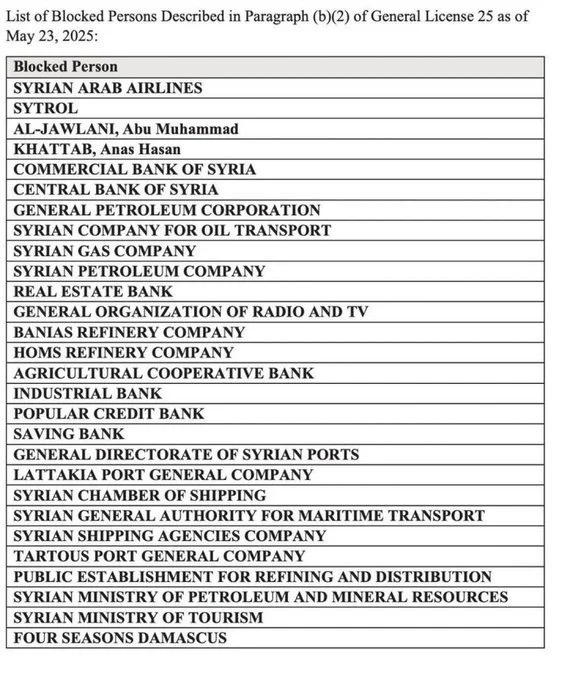
Syria just got sanctions relief. Let that sink in.
The U.S. Treasury lifted restrictions on their Central Bank, oil sector, ports, and more all in one sweep.
If Syria, after a decade of isolation, just got the greenlight… Then Iraq is next.
Syria Just Got Sanctions Relief, Iraq is Next
589bull: 5-24-2025
589bull@589bull10000
Syria just got sanctions relief. Let that sink in.
The U.S. Treasury lifted restrictions on their Central Bank, oil sector, ports, and more all in one sweep.
If Syria, after a decade of isolation, just got the greenlight… Then Iraq is next.

And it’s not just speculation anymore it’s pattern.
• Syria unlocked via General License 25
• Treasury led move, not just diplomacy
• Caesar Act waiver issued same day
• Greenlight for investment, private sector flow, and regional trade
Now ask yourself: If they can flip Syria back online overnight, what’s stopping them from flipping Iraq’s switch next?
Iraq’s already aligned:
• SWIFT-ready banks
• New CBI HQ complete
• Treasury coordination confirmed
• Budget & salary grid active
• Regional infrastructure humming
All that’s left is the rate.
The unlock.
The trigger.
Syria was the warmup.
Iraq is next.
Source(s):
https://x.com/589bull10000/status/1926084362157601052
https://dinarchronicles.com/2025/05/24/589bull-syria-just-got-sanctions-relief-iraq-is-next/
Economist’s “News and Views” 5-24-2025
Whole Financial System Is Going To Lock Up | Gregory Mannarino
Liberty and Finance: 5-23-2025
Gregory Mannarino returns to discuss the escalating global financial crisis, emphasizing the symbolic but significant downgrade of U.S. debt.
Mannarino warns of an irreversible downward spiral fueled by unchecked debt expansion, currency devaluation, and artificially low interest rates—all designed to protect central banks at the expense of the public.
He likens the current economic state to a “parasite system,” siphoning wealth from the middle class while inflating bubbles in stocks and real estate that defy fundamentals.
Whole Financial System Is Going To Lock Up | Gregory Mannarino
Liberty and Finance: 5-23-2025
Gregory Mannarino returns to discuss the escalating global financial crisis, emphasizing the symbolic but significant downgrade of U.S. debt.
Mannarino warns of an irreversible downward spiral fueled by unchecked debt expansion, currency devaluation, and artificially low interest rates—all designed to protect central banks at the expense of the public.
He likens the current economic state to a “parasite system,” siphoning wealth from the middle class while inflating bubbles in stocks and real estate that defy fundamentals.
The conversation also explores how systemic risk is being offloaded from governments and corporations onto individuals through pension schemes, market ownership laws, and manipulated inflation data.
Mannarino calls for urgent reforms to restore purchasing power and accountability, asserting that without them, the financial system’s collapse will be both inevitable and catastrophic.
Bitcoin, Gold, Capital Wars & Fear: As July 1st Deadline Nears Banks Are Fighting Basel III
Lena Petrova: 5-24-2025
Gold at $3,000? Try $10,000: The Dollar is Dying and No One’s Ready
Daniela Cambone: 5-24-2025
“We will see over the years the dollar absolutely collapse against the one currency that does not represent anyone else's sovereignty…and that is gold,” says Dr. Thomas Kaplan, CEO and Chairman of NovaGold.
In today’s interview, he tells Daniela Cambone that all fiat currencies are inherently flawed and refers to the U.S. dollar as “double-ply toilet tissue.”
Despite recent price increases, Kaplan believes gold is still in the “foothills” of a broader bull run.
“We will look back on $3,000 gold as a complete gift… the same way as we look back now on the Dow at 3,000 in the late '80s as a gift,” he says.
On the recent ECB's warning about gold, Kaplan sees it as further support for the bullish case. He emphasizes that the rising demand for physical settlement—not just futures contracts—could create a supply squeeze and trigger a major price surge.
Watch the full video to learn more.
Chapters:
00:00 – The Holy Grail of gold deposits
13:26 – Will Gold confiscation happen?
16:02 – Could Canada nationalize tts gold?
17:44 – Is the vulnerability of US dollar the greatest risk?
26:21 – Tom’s prediction for the U.S. economy
29:52 – The Three Pillars of American superpower
35:20 – Will the U.S. dollar lose reserve currency status?
37:18 – The ECB’s warning on gold
Investors Have Finally Had Enough With $2+ Trillion Deficits
Investors Have Finally Had Enough With $2+ Trillion Deficits
Notes From the Field By James Hickman (Simon Black) May 22, 2025
Well, that was fast.
It only took five days after Moody’s downgrade of the US government’s sovereign credit rating for investors to throw a fit. The result was yesterday’s meltdown trifecta in which ALL three major markets-- US stocks, US bonds, and the US dollar-- lost significant value. I wrote about this extensively last month because we saw the same phenomenon after the “Liberation Day” announcement.
Typically, if there’s bad news in a major developed country, investors will simply shift their money into a different asset class within that same country.
Investors Have Finally Had Enough With $2+ Trillion Deficits
Notes From the Field By James Hickman (Simon Black) May 22, 2025
Well, that was fast.
It only took five days after Moody’s downgrade of the US government’s sovereign credit rating for investors to throw a fit. The result was yesterday’s meltdown trifecta in which ALL three major markets-- US stocks, US bonds, and the US dollar-- lost significant value. I wrote about this extensively last month because we saw the same phenomenon after the “Liberation Day” announcement.
Typically, if there’s bad news in a major developed country, investors will simply shift their money into a different asset class within that same country.
For example, if investors in the US suddenly become concerned that a recession is on the horizon, they’ll pull their money out of the stock market… and then invest that capital into the bond market.
The money remains in the US; it simply moves into a new asset class. So, as a result, stocks decline in value, but bonds increase in value.
But what we saw last month after Liberation Day… and then AGAIN yesterday, is stocks AND bonds both declining simultaneously.
(Remember that bond prices move inversely to yields; so, when bond prices fall, as they did yesterday, it really means that bond yields, i.e. interest rates, are moving higher. More on this below.)
Plus, on top of the stock and bond market routs, the US dollar also took a big hit.
As I explained last month after Liberation Day, this can only mean ONE thing: investors aren’t shifting their money from one US asset class to another. They’re moving their money OUT of the US and into foreign assets.
This is a clear sign that at least some investors are losing confidence in the United States.
And who could blame them? Congress is fiddling while the budget burns. The “One Big Beautiful” tax bill will result in yet another $2 trillion budget deficit.
Trust me, I love tax cuts. Tax cuts are great for the economy. But you can’t just cut taxes without massive spending cuts.
Well, this legislation doesn’t cut spending. In fact, they INCREASED spending… meaning that America’s $36+ trillion debt problem is only going to become worse.
Investors aren’t terribly impressed with that outcome… because they’re the ones who will be asked to finance all that debt and buy trillions of dollars’ worth of US government bonds.
Proof of investors’ dissatisfaction came yesterday when the Treasury Department auctioned off roughly $16 billion worth of 20-year bonds.
This is how the government typically sells its bonds-- through an auction process in which various banks and funds place bids. And ordinarily no one ever pays attention to Treasury auctions; they’re about as exciting as airline safety briefings.
But yesterday was different. Investors put their collective foot down and essentially refused to buy the government’s bonds unless the yield increased dramatically.
In the end, the 20-year yield hit 5.125%… which is almost the highest level it’s been since 2007.
The auction became a major signal that investors are very concerned about the US government’s horrific finances. Sure, they’ll still buy bonds. But they will demand much higher interest rates… which is debilitating for the US government.
Remember, the government already spends more money paying interest on the national debt than they do on the US military. And total interest payments this year are expected to reach about $1.2 trillion-- more than 20 cents of every tax dollar collected.
Social Security, Medicare, and other mandatory entitlement programs will consume the other 80% of tax revenue… meaning that EVERY discretionary spending program, from the Defense Department to Homeland Security to Border Security, will have to be financed with more debt… at a HIGHER interest rate.
Higher interest rates cause the government’s annual interest bill to be even higher, meaning that the problem will eventually spiral out of control.
Folks, I’m not being pessimistic. It’s just basic arithmetic: there are very few good outcomes when your interest bill and mandatory entitlement spending grow faster than tax revenue.
Lower interest rates would be helpful. And that’s one of the reasons why the White House has been so vocal in demanding the Fed “lower” interest rates.
Problem is-- the Fed doesn’t really have the power to cut rates anymore.
In the past, all the Fed Chairman had to do to cut rates was utter a few words; the bond market would click its heels, salute, and dutifully comply. Rates would fall just based on a speech.
That doesn’t happen anymore. If you recall when the Fed supposedly cut rates last year, bond yields actually increased. Essentially, investors are no longer paying attention to the Fed. They don’t care.
The market is now in control of bond yields… NOT the Fed. And certainly not the White House or Treasury Department. And the market does not like what it sees:
- $36 trillion national debt
- $2 trillion annual deficits
- $1.2 trillion annual interest bill
- Congress doing nothing about any of it
Bottom line, investors are fleeing-- and not just the bond market. Given the drop in the US dollar yesterday (alongside stocks and bonds), it’s clear that many investors are fleeing the United States entirely and moving their capital elsewhere.
Gold will be a major beneficiary of this trend (along with well-managed gold businesses) simply because foreign governments and central banks need a reliable, liquid asset with minimal counterparty risk to park all the capital they withdraw from the United States.
Gold is one of the few assets that meets these qualifications. And, while nothing goes up or down in an uninterrupted straight line, we continue to believe that there is tremendous upside left in gold… along with silver, platinum, and several other real assets.
Ultimately, though, this is bad news for the US. No one in government seems to want to fix its terminal spending/deficit problem.
And given what happened yesterday, it’s obvious that the market is no longer willing to ignore it.
To your freedom, James Hickman Co-Founder, Schiff Sovereign LLC
TO READ MORE:
Seeds of Wisdom RV and Economic Updates Saturday Afternoon 5-24-25
Good Afternoon Dinar Recaps,
WHY RIPPLE AND XRP COULD BE THE BACKBONE OF THE G20’S FINANCIAL PLAN
▪️Ripple’s XRP and blockchain tech are key to helping the G20 achieve faster, cheaper cross-border payments by 2030.
▪️Adoption of Ripple’s solutions could boost XRP price to $10-$20 in 2025, with potential long-term growth to $1,000.
Good Afternoon Dinar Recaps,
WHY RIPPLE AND XRP COULD BE THE BACKBONE OF THE G20’S FINANCIAL PLAN
▪️Ripple’s XRP and blockchain tech are key to helping the G20 achieve faster, cheaper cross-border payments by 2030.
▪️Adoption of Ripple’s solutions could boost XRP price to $10-$20 in 2025, with potential long-term growth to $1,000.
Ripple’s fast and affordable payment system is gaining traction around the world. A new report highlights that Ripple’s XRP and blockchain payment tech could play a key role in helping the G20 meet its cross-border payment goals by 2030.
A 2025 report from the U.S. Faster Payments Council (FPC) highlights how U.S. payment companies could play a big role in making global payments faster, cheaper, and more reliably.
Global demand is rising for faster, cheaper, and more transparent cross-border payments, and it’s already a $34 trillion market. The G20 is pushing hard to improve this space, seeing it as key to boosting trade, economic growth, and development. They plan to make payments quicker, more affordable, and easier to access.
Goals For 2027 and 2030
They have set clear targets for retail, wholesale, and remittance payments, and aim for major progress by 2027 and 2030. The 2027 and 2030 goals include:
Cutting the cross-border payment costs to 1% or less
Ensuring 75% of payments are completed within an hour
Promoting Inter-Industry Collabs
In order to meet the goals, the US Faster Payments Council (FPC) urges domestic providers to:
Adopt ISO 20022
Embrace interoperability
Use blockchain tech like Distributed Ledger Technology (DLT)
It also stressed points like focusing on financial inclusion and promoting inter-industry collaborations. It specifically noted Ripple and Stellar as key players that could improve the global cross-border payment landscape.
Ripple is reshaping global payments with its RippleNet and XRP-powered tech. As it follows global rules (like ISO 20022) and uses smart blockchain tools, it’s a top pick to help the G20 hit its payment goals.
As more firms adopt Ripple’s solutions, XRP could see big gains from the rising demand. With growing adoption, experts predict $XRP will hit $10-$20 easily in 2025. Reaching $100 could happen, but it is more likely in early 2026. And eventually, as the technology and network expand further, $XRP could reach $1,000.
@ Newshounds News™
Source: Coinpedia
~~~~~~~~~
BRICS VS. US DOLLAR: WHY 2025 IS THE YEAR IT HAPPENS OR IT DOESN’T
Throughout the last several years, the global south has sought ways to de-dollarize the global economy. They have made headway, but the greenback remains the most prominent currency on the planet. This could be why, when it comes to the BRICS bloc taking on the US dollar, 2025 may be the year it either happens or it doesn’t.
For as much as the economic alliance has continued to wage war against the currency, the US dollar’s position has not yet been threatened. Indeed, Brazil even confirmed that its position looks to be secured for much of the next 10 years.
Therefore, if it is unable to make significant gains regarding de-dollarization this year, it may be safe to question if it can ever happen.
BRICS & The US Dollar: Is 2025 The Last Year It Can Truly De-Dollarize The Globe?
The idea of de-dollarization has seemingly been ingrained in the very makeup of the BRICS alliance. The bloc has sought to challenge the global status quo. There may be no bigger aspect of that than the greenback and its position.
Moreover, it is a major reason for tension between the West and the bloc. Specifically, those tensions led US President Donald Trump to threaten 150% tariffs on the group.
The alliance has discussed the creation of its own native trade settlement currency to lessen reliance on the West. It has also promoted the use of national currencies in trade to diversify.
However, the fact of the matter may be that, when it comes to the BRICS bloc and the US dollar, 2025 is the year that they take major strides in de-dollarization, or they may never will.
The BRICS bloc operates on a rotating presidency. This ensures that every country gets a chance to chair the group and lead issues they deem vital. This year lies on Brazil, one of the loudest proponents of lessening US dollar reliance. However, next year India is set to take over the position.
Throughout this year, India has sought to strengthen ties with the United States in a big way. The two nations are expected to announce a new trade deal with depleted tariffs on US imports. Moreover, it has been vehemently against any de-dollarization efforts.
Therefore, it could be a stark end to those efforts. Specifically, if plans to dethrone the dollar don’t make major strides over the next several months, it’s fair to wonder if they ever will.
@ Newshounds News™
Source: Watcher Guru
~~~~~~~~~
Seeds of Wisdom Team RV Currency Facts Youtube and Rumble
Newshound's News Telegram Room Link
Follow the Roadmap
Follow the Timeline
Seeds of Wisdom Team™ Website
Thank you Dinar Recaps
Weekend Coffee with MarkZ. 05/24/2025
Weekend Coffee with MarkZ. 05/24/2025
Some highlights by PDK-Not verbatim
MarkZ Disclaimer: Please consider everything on this call as my opinion. People who take notes do not catch everything and its best to watch the video so that you get everything in context. Be sure to consult a professional for any financial decisions
Mod: GOOD MORNING ALL! LET THE PARTY BEGIN! HAPPY BIRTHDAY MARK! MANY BLESSINGS ON YOUR SPECIAL DAY!
MZ: Thank you all for the Birthday wishes!!!
Member: Also- Happy Memorial weekend everyone!
Weekend Coffee with MarkZ. 05/24/2025
Some highlights by PDK-Not verbatim
MarkZ Disclaimer: Please consider everything on this call as my opinion. People who take notes do not catch everything and its best to watch the video so that you get everything in context. Be sure to consult a professional for any financial decisions
Mod: GOOD MORNING ALL! LET THE PARTY BEGIN! HAPPY BIRTHDAY MARK! MANY BLESSINGS ON YOUR SPECIAL DAY!
MZ: Thank you all for the Birthday wishes!!!
Member: Also- Happy Memorial weekend everyone!
Member: So many rumors that we're so close
Member” Bank Screen at SouthState Bank says: Due to system maintenance as we welcome Independent Financial customers services may be temporarily unavailable Saturday and Sunday...!!!!
MZ: Memorial Weekend is a crazy time to make it unavailable.
Member: Not slow according to Bruce it’s going down today since it didn’t yesterday. He also stated this is for real it’s this weekend.
Member: A friend that got me into this has their Iraq contact that they heard 3.48 for a sat night to sun morning kick off
Member: Bank story: Called credit union 5/23 2 ask when credit cards wld be relinked on app (every1 rec’d new tap cc’s in May). I said “this new QFS sys” is gonna b gr8!” She agreed & said it’s coming soon!
MZ: “US State Department SPOX (spokesperson?) hails Kurdistan regions $100 billion energy deals with American firms” This is coming at a key time.
MZ: We also have “US Department of State Secretary Rubio and Barzani at Friday 1:30 pm est and 8:30 pm Erbil” they met in the US and they had two different meetings I was told. It was hailed as a “breakthrough” for oil to start flowing from that region and for them to settle all disputes between Baghdad and the Kurdish region.
Member: MarkZ, please enlighten us regarding what must still happen before we RV.
MZ: I was told over a decade ago that when those two came together- we would see a change in value of the dinar. That is why I watch this.
MZ: “Maximizing non-oil revenues reaches 60%: Expert identifies Iraq’s needs “ They are 60% done towards their goal. This is part of the stability of the Iraqi economy. I did not know they were this far along in progress.
MZ: “As Chinas economy weakens, Tens of thousands of workers protest against unpaid wages” These protests started before Trump was president. There are serious weaknesses in the Chinese economy that they have been covering up.
MZ: I have zero updates from bonds, groups and even redemption center folks. This is the biggest “quiet” I have ever seen in my life. Very Eery
Member: Happy Birthday Mark. Thank you for being here for us. Keep up the hard /good work
Member: A Wonderful Happy Birthday MarkZ And StacieZ
Member: Have a blessed and happy Memorial Day Weekend to everyone.
The CBD Gurus join the stream today. Please listen to the replay for their information.
THE CONTENT IN THIS PODCAST IS FOR GENERAL & EDUCATIONAL PURPOSES ONLY&NOT INTENDED TO PROVIDE ANY PROFESSIONAL, FINANCIAL OR LEGAL ADVICE. PLEASE CONSIDER EVERYTHING DISCUSSED IN MARKZ’S OPINION ONLY
https://rumble.com/user/theoriginalmarkz
Kick: https://kick.com/theoriginalmarkz
FOLLOW MARKZ : TWITTER . https://twitter.com/originalmarkz?s=21. TRUTH SOCIAL . https://truthsocial.com/@theoriginalm...
Mod: MarkZ "Back To Basics" Pre-Recorded Call" for Newbies 10-19-2022 ) https://www.youtube.com/watch?v=37oILmAlptM
MARKZ DAILY LINKS: https://theoriginalmarkz.com/home/
Note from PDK: Please listen to the replay for all the details and entire stream….I do not transcribe political opinions, medical opinions or many guests on this stream……just RV/currency related topics.
THANK YOU ALL FOR JOINING. HAVE A BLESSED NIGHT! SEE YOU ALL IN THE MORNING FOR COFFEE @ 10:00 AM EST ~ UNLESS BREAKING NEWS HAPPENS!
FROM NOW ON NO MORE NIGHTLY PODCASTS ON MONDAYS AND FRIDAYS
News, Rumors and Opinions Saturday 5-24-2025
Note: All intel should be considered as "Rumors" until we receive official announcements ...and “Rates and Dates” could change anytime until we get to the banks/redemption centers.
RV Excerpts from the Restored Republic via a GCR: Update as of Sat. 24 May 2025
Compiled Sat. 24 May 2025 12:01 am EST by Judy Byington
“Prepare to reveal to friends, family and acquaintances, the most complicated and excruciating “I Told You So” in the history of the World.”
Fri. 23 May 2025 Trump’s “One, Big, Beautiful Bill “passes the House. The bill was said to legally open the door to no more Income Tax, with tax on sales only. “It is arguably the most significant piece of Legislation that will ever be signed in the History of our Country!” says Donald Trump.
Note: All intel should be considered as "Rumors" until we receive official announcements ...and “Rates and Dates” could change anytime until we get to the banks/redemption centers.
RV Excerpts from the Restored Republic via a GCR: Update as of Sat. 24 May 2025
Compiled Sat. 24 May 2025 12:01 am EST by Judy Byington
“Prepare to reveal to friends, family and acquaintances, the most complicated and excruciating “I Told You So” in the history of the World.”
Fri. 23 May 2025 Trump’s “One, Big, Beautiful Bill “passes the House. The bill was said to legally open the door to no more Income Tax, with tax on sales only. “It is arguably the most significant piece of Legislation that will ever be signed in the History of our Country!” says Donald Trump.
“Great job by Speaker Mike Johnson, and the House Leadership, and thank you to every Republican who voted YES on this Historic Bill!” https://beforeitsnews.com/prophecy/2025/05/trumps-new-bill-passed-the-house-what-changes-taxes-social-security-medicare-snap-2025-2576908.html
The European Union’s trade barriers, vat taxes, corporate penalties, monetary manipulations, unjustified lawsuits against American Companies have led to a US Trade Deficit of more than $250,000,000 a year. Thus, Trump was recommending a straight 50% Tariff on the European Union, starting on June 1, 2025. There would be no Tariff if the product was built or manufactured in the United States.
~~~~~~~~~~~~
Global Currency Reset:
Fri. 23 May 2025 Wolverine: “A certain platform has been given the Green Light and will begin on Mon. 26 May or Tues. 27 May. Some Crypto currency holders have been paid. We are not that far away.”
~~~~~~~~~~~~~
Fri. 23 May 2025 Major Update: Global QFS Deployment Nears …Nesara Gesara QFS on Telegram
According to our latest secure intelligence, the mass Quantum Financial System (QFS) onboarding is now imminent. Internal sources at major central banks report that encrypted public alerts and Emergency Broadcast System (EBS) messages may begin within days. All systems are on standby for the official launch of the new financial era. I have personally confirmed that every component — from one-time access codes to sovereign wallet portals — is fully tested and ready.
~~~~~~~~~~
Thurs. 22 May 2025 Bruce: On Wed. 21 2025 Redemption Center Staff received a memo that gave the following instructions: (RUMORS)
Provided everything for the banks is interconnected, we should get notified over the weekend. Email notifications that have the 800 numbers on them to set our appointments could start any time from 5:01 pm EST Fri. 23 May 2025 or for the next 28 hours until 9 pm EST Sat. 24 May 2025.
Biometric Recognition: When you get to Redemption Center you will have a camera taking a picture of you that records your biometric outline and tells them who you are.
Everything you say will be recorded and kept in your record.
When we call for an appointment we will be calling the actual Redemption Center where you will be exchanging.
They will confirm your time slot in an email or text.
All exchanges on Dinar, Dong and Zim are asset-backed.
After your exchange you will have people to help you with investments, management and your project.
Quantum Cards are in the RC and have your name on them. The card gives you access to your Quantum Account (called Sovereign Wallet).
When you move monies from your Quantum Account and into your bank accounts, you can then earn interest on your monies.
SS increases will happen this month, but won’t get paid on it until June.
DOGE payments will start in the month of June. Ages 34-60 will receive $500-$600 a month for two years. 60 and older will be a lot, lot more.
R&R payments will be in our Quantum Accounts (wallet) or sent by direct deposit.
Debt Jubilee (debt relief from mortgages, loans, credit cards – all wiped out) starts June 3, completes by July 4.
Read full post here: https://dinarchronicles.com/2025/05/24/restored-republic-via-a-gcr-update-as-of-may-24-2025/
Courtesy of Dinar Guru: https://www.dinarguru.com/
Nader From The Mid East Article: "Nearly 90% of Iraq's money supply is held outside the formal banking sector, largely hoarded in homes...The vast 'leakage' of cash poses a serious challenge to the country's financial stability and long-term economic growth...Saleh...stated the hoarding of cash...has reached critical levels...91-92 trillion dinars are currently outside the banking system...driven by public distrust in financial institutions."
Walkingstick They've already worked out the math on this. It's at least 1 to 1 IMO. This is not a threat, it's a blessing. They are threatening them with the lower denims because they want to complete the whole program.
Frank26 Iran is the reason Iraq does not have a new exchange rate...Security and stability in [Iraq] is amazing. It's growing, it's expanding. Everybody wants a piece of it even if it's not the official exchange rate yet. That screams that you have a new rate. Iran is no longer the threat to the new IQD exchange rate, therefore it will soon be released to the world.
****************
Moody’s Downgrade: Why Gold May Be the Only Way Out
Mike Maloney: 5-22-2025
The warning signs have been flashing for years. Now Moody’s has confirmed it: the United States is no longer AAA-rated.
In this urgent new video, Mike Maloney reacts live as Alan Hibbard breaks down the downgrade—and what it signals about America’s deepening debt spiral, unsustainable fiscal policies, and the dollar’s fading power on the global stage.
Mike doesn’t hold back: “We’re borrowing to go deeper into debt just to pay greater interest… and there’s no way out.”
This downgrade is more than just another headline — it’s a signal that the era of dollar dominance is ending. And according to Mike, it’s one of the clearest buy signals gold has ever seen.
Iraq Economic News And Points To Ponder Late Friday Evening 5-23-25
The Yellow Metal Is On Track For Its Best Weekly Performance In More Than A Month
Money and Business Economy News – Baghdad Gold is poised for its best weekly performance in over a month on Friday, as a weaker dollar and growing concerns about the fiscal position of the world's largest economy boosted safe-haven demand.
Spot gold rose 0.2 percent to $3,299.79 per ounce by 0014 GMT. The precious metal has risen about 3 percent so far this week and is on track for its best weekly performance since early April.
US gold futures also rose 0.2 percent to $3,299.60.
The Yellow Metal Is On Track For Its Best Weekly Performance In More Than A Month
Money and Business Economy News – Baghdad Gold is poised for its best weekly performance in over a month on Friday, as a weaker dollar and growing concerns about the fiscal position of the world's largest economy boosted safe-haven demand.
Spot gold rose 0.2 percent to $3,299.79 per ounce by 0014 GMT. The precious metal has risen about 3 percent so far this week and is on track for its best weekly performance since early April.
US gold futures also rose 0.2 percent to $3,299.60.
The dollar has fallen more than 1 percent so far this week and is on track for its worst weekly performance since April 7, making gold priced in the greenback cheaper for holders of other currencies.
The Republican-controlled U.S. House of Representatives approved a comprehensive tax and spending bill on Thursday, ensuring implementation of most of President Donald Trump's agenda and adding trillions of dollars to the government debt.
The bill now moves to the Senate, which is controlled by Republicans by a margin of 53 to 47 seats.
Gold is often viewed as a safe haven during times of political and financial uncertainty.
Meanwhile, Iranian Foreign Minister Abbas Araghchi warned that the United States would bear legal responsibility for any Israeli attack on Iranian nuclear facilities, following a CNN report that Israel was preparing to launch strikes on Iran.
As for other precious metals, spot silver was steady at $33.07 per ounce, platinum rose 0.1 percent to $1,082.47, and palladium fell 0.3 percent to $1,012.00. https://economy-news.net/content.php?id=55744
The Relationship Between The State And The Economy And The Problem Of Transitioning From The Traditional To The Organized
Dr. Haitham Hamid Mutlaq Al-Mansour At the heart of every country is a vibrant economy that regulates the rhythm of its life, and Iraq is no exception.
The modern state is no longer merely a political entity that maintains security and public order; it has transformed into a major player in shaping the economy and achieving its balance and stability.
Unfortunately, this relationship takes on more complex dimensions, with the economy sometimes becoming an arena for political conflict and at other times a tool for domination and control. Since the founding of the Iraqi state, the economy has remained hostage to political fluctuations, beginning with the industrialization phase in the mid-twentieth century, through the economic blockade of the 1990s, and finally reaching the post-2003 period, which witnessed a radical transformation in the structure of both the economy and politics.
The state, which is supposed to be the guardian of economic balance and resource allocation, has become a cause for weakening the market and deepening imbalances.
The dominance of government fiscal policy in the economic arena and the marginalization of productive sectors in favor of a rentier economy, in which oil revenues contribute 95% of the gross domestic product, is a cause for concern regarding macroeconomic policy and the relationship between the state and the economy, and what it should be.
Therefore, Iraq's contemporary history cannot be read in isolation from the intertwining of the economy and power structures. These two sides of the same coin were shaped by both strength and weakness.
The state, which is supposed to be a framework for regulating economic life, has, in the Iraqi case, become a competitor to it and a restrictor of its activity. It controls its components and directs its course beyond the limits of revenue and cost, and in most cases, beyond the conditions of the economy.
Perhaps this "satisfactory" relationship is not a final destiny, but rather a milestone in a long journey in search of an economic identity freed from the sway of politics without being detached from it.
In other countries, not far from us, the state has succeeded in serving as a tool for achieving social and economic justice through fair tax policies, smart investments in infrastructure, and empowering the private sector without relinquishing its oversight role.
However, in Iraq, we are witnessing the absence of a clear economic vision that transforms the state from an incubator of development into a factor hindering it. Bureaucracy is bloated and favoritism is rampant, while basic services decline and job opportunities shrink.
Under the prevailing rentier pattern of government sector employment, this economic model has produced a consumer culture worthy of study. Citizens have been transformed from producers into recipients of oil rents through public employment or government support.
This has led to a profound distortion in the relationship between the individual and the state. The state no longer represents a regulatory authority, but rather has become a "provider" expected to distribute provisions. Thus, society has been robbed of its productive capacity, while the economy has been robbed of its competitive vitality.
There is no escape from a vision framed around transforming the state's role from that of a "merchant" distributing oil revenues to that of an "engineer" building a diversified economy.
If we work to develop progressive socioeconomic programs aimed at changing the individual's stereotype from a recipient of financial aid to an actor in production and export processes, this vicious cycle can be broken. Global experience proves that countries that succeed in combining a fair market with social security are the most stable and prosperous.
With its structural imbalances still present, the Iraqi economy is now at a crossroads: Either the state continues its traditional role as a controller and unfair distributor of wealth, which threatens to perpetuate crises, or it transforms into an economic regulator and protector of the interests of the majority by regulating and creating the basic conditions for market growth, production, and diversification, which is the only path to achieving stability and prosperity.
The question remains: Is the political will capable of waging this fateful battle? I expect that history alone will answer. https://economy-news.net/content.php?id=55748
Oil Is Heading For Its First Weekly Loss Since Last April
economy | 09:34 - 05/23/2025 Mawazine News - Follow-up:
Oil prices fell today for the fourth consecutive session and are heading towards their first weekly decline in three weeks, affected by supply pressures and a possible increase in OPEC+ production next July.
US West Texas Intermediate (WTI) crude futures for July were trading at $60.83 per barrel, a decrease of 0.60% from the previous settlement price.
Brent crude futures for the same month were trading at $64.09 per barrel, a decrease of 0.54% from the previous closing price.
Over the course of the week, Brent crude fell by 1.9%, and US crude fell by 2.5%, following two weeks of gains. https://www.mawazin.net/Details.aspx?jimare=261825-=0
Government Advisor: Small Loans Are An Opportunity To Eliminate Unemployment And Achieve Development
Economy | 12:06 - 05/23/2025 Mawazine News - Baghdad - Advisor to the Prime Minister, Mazhar Mohammed Salih, explained on Friday that providing small loans is a pillar of the financial inclusion policy and one of its goals in eliminating unemployment and achieving development and income equality as much as possible,
as it will provide employment opportunities of no less than 60%, while pointing out that loans expand the activity of small enterprises and increase their contribution to the country's gross domestic product.
Advisor to the Prime Minister, Mazhar Mohammed Salih, said that "within the framework of administrative reform and combating bureaucracy, which are principles of the government's approach, the factor of simplifying procedures is the first priority in maximizing the management of resources and economic activity to achieve promising sustainable development in accordance with the development goals in our country."
He added that "Prime Minister Mohammed Shia Al-Sudani's directive to simplify the granting of small loans undoubtedly carries important benefits at the individual and economic levels, as many small loan programs target marginalized or emerging groups, such as women and housewives, which contributes to their integration into the economy."
Saleh explained that "these loans are very active financial levers for employment and mobilizing labor market actors, as they facilitate the youth and those with crafts and skills to start their own projects, and open the door to entrepreneurship," noting that they "help generate a stable source of income for the individual and his family, and reduce poverty and unemployment rates by economically empowering individuals, hence these small loans."
He explained that "loans play an important role in employment policy and affect the balance of the labor market, by absorbing and providing employment opportunities of no less than 60% of available job opportunities, not to mention their role in raising growth rates in the gross domestic product," noting that "they play a role in expanding the activity of small projects, which increases their contribution to the country's GDP." https://www.mawazin.net/Details.aspx?jimare=261830
For current and reliable Iraqi news please visit: https://www.bondladyscorner.com/
Seeds of Wisdom RV and Economic Updates Saturday Morning 5-24-25
Good Morning Dinar Recaps,
ELON MUSK’S DOGE PLAN TO SAVE THE U.S. ECONOMY FROM RECESSION AMID BITCOIN TURMOIL
Billionaire founder and U.S government efficiency advisor Elon Musk has proposed a strategic plan to avoid America’s economic fall into recession. With fears of a U.S. recession rising by 43% and government debt ballooning, Musk’s Department of Government Efficiency (DOGE) is choosing to bet on expansion, not reductions.
This approach may sound risky, but here’s the twist — it’s already showing some results.
Good Morning Dinar Recaps,
ELON MUSK’S DOGE PLAN TO SAVE THE U.S. ECONOMY FROM RECESSION AMID BITCOIN TURMOIL
Billionaire founder and U.S government efficiency advisor Elon Musk has proposed a strategic plan to avoid America’s economic fall into recession. With fears of a U.S. recession rising by 43% and government debt ballooning, Musk’s Department of Government Efficiency (DOGE) is choosing to bet on expansion, not reductions.
This approach may sound risky, but here’s the twist — it’s already showing some results.
Let’s find out.
Elon Musk’s Fix: Grow the Economy, Don’t Shrink It
For decades, the go-to solution during economic trouble has been to cut government spending. But now, with the U.S. debt mounting and the U.S. 10-year Treasury yield jumping to 4.5% and recession odds climbing to 43%, Musk argues that this strategy is no longer enough.
Musk says improving productivity and expanding GDP are the only real ways to avoid national bankruptcy. He admits that government waste is a serious problem, but believes that strong reforms can still make a difference.
And he’s not alone. Treasury Secretary Scott Bessent, once a firm supporter of spending cuts, now says the U.S. must “grow its way out” of the debt crisis.
According to him, if the economy grows faster than the debt, it becomes possible to manage both. This change in thinking marks a huge turning point for U.S. economic policy.
DOGE’s Progress So Far
While Musk in the 2024 U.S. election campaign promised DOGE would save $2 trillion from government spending — which is one-third of the entire federal budget — as of May, it has already saved $170 billion, which is:
17% of its $1 trillion goal, and
8.5% of the “dream target.”
Bitcoin Drops After Trade War Warning
After Donald Trump warned about new trade tariffs on Europe, Bitcoin and other cryptocurrencies quickly dropped. Eventually, Bitcoin has become very sensitive to what’s happening in politics. As these tensions rise, crypto prices are moving fast.
Just recently, Bitcoin hit a record high above $112,000. But after the news, it dropped 2.7% and is now trading around $107,937.
@ Newshounds News™
Source: Coinpedia
~~~~~~~~~
BRICS: US DOLLAR IS REPLACEABLE? SINGAPORE’S CENTRAL BANK HEAD REVEALS
The BRICS alliance is looking to replace the US dollar on the global stage with local currencies. The bloc wants their respective national currencies to thrive and make the greenback sit in the rear seat of the economy. The de-dollarization agenda is gaining steam worldwide as emerging economies are prioritizing local currencies to push their GDP.
The greenback is at risk of losing its global dominance as many countries are considering ending reliance on the currency. However, Singapore’s Central Bank head Chia Der Juin touched on the BRICS subject of de-dollarization and explained whether the US dollar can be replaced in the financial sector.
BRICS: Singapore Central Bank Head Reveals If the US Dollar Can Be Replaced
The Singapore Central Bank’s head revealed that the US dollar is irreplaceable and no BRICS currency can take its place. He said that the US dollar-based assets have “enduring advantages” and remain virtually irreplaceable in the global markets.
“The $28-trillion Treasury market is fundamental and systemic to the global financial system and there is no alternative for this point,” he said.
BRICS might find it hard to replace the US dollar as its foundation is strong, according to Singapore’s Central Bank head. He even touched on the topic of institutional Asian funds buying US-based assets for better profits.
“There is generally an overweight exposure to US assets from Asian investors. In fact, most of it is unhedged. So some changes in that sentiment and the read of the direction of the market can cause an outsized reaction,” Chia said.
In conclusion, Singapore’s Central Bank head is relatively optimistic about the US dollar-based assets than the BRICS currencies. No national currency is fit enough to withstand the whiplash of the financial markets. Only the greenback is a seasonal contender and can push its weight across even during troubled waters.
@ Newshounds News™
Source: Watcher Guru
~~~~~~~~~
Seeds of Wisdom Team RV Currency Facts Youtube and Rumble
Newshound's News Telegram Room Link
Follow the Roadmap
Follow the Timeline
Seeds of Wisdom Team™ Website
Thank you Dinar Recaps
“Tidbits From TNT” Saturday Morning 5-24-2025
TNT:
Tishwash: this was in Iraq's news
Indonesia launches economic stimulus package to boost consumption
Indonesia's Coordinating Ministry of Economic Affairs announced that the country intends to announce an economic stimulus package on June 5 to stimulate economic activity and boost consumer purchasing power.
This package comes with the hope of raising the economic growth rate to about 5% during this quarter.
Encouraging growth through increased consumption
TNT:
Tishwash: this was in Iraq's news
Indonesia launches economic stimulus package to boost consumption
Indonesia's Coordinating Ministry of Economic Affairs announced that the country intends to announce an economic stimulus package on June 5 to stimulate economic activity and boost consumer purchasing power.
This package comes with the hope of raising the economic growth rate to about 5% during this quarter.
Encouraging growth through increased consumption
Indonesia's Chief Economic Minister, Airlangga Hartarto, stated in a statement that these programs are designed to encourage growth through increased consumption, adding that launching this package before the school holidays, which begin in late June, will provide impetus to boost purchasing power.
The weakest growth rate in more than three years
Southeast Asia's largest economy grew by 4.87% in the first quarter of 2025 compared to the same period last year, its weakest growth rate in more than three years. The central bank lowered its growth forecast for 2025 to between 4.6% and 5.4% from a range of 4.7% and 5.5%.
Package size evaluation
A ministry spokesperson said the ministry is still assessing the size of the stimulus package, which aims to boost growth in the second and third quarters.
The incentives include a 50% discount on electricity bills for approximately 79.3 million households and the distribution of food aid to 18.3 million low-income households during June and July. The government also plans to provide cash transfers to low-income workers and a discount on industrial accident insurance for workers in labor-intensive industries.
To encourage tourism, the government announced discounts on airfare, train, and ferry tickets during the school holidays, which run until mid-July, and discounts on highway tolls for 110 million users during June and July, according to the ministry. link
Tishwash” Masrour Barzani invites the US Secretary of State to visit Erbil.
Kurdistan Regional Government Prime Minister Masrour Barzani announced on Friday evening that he had extended an official invitation to US Secretary of State Marco Rubio to visit Erbil.
This came in press statements following his meeting with Rubio in the US capital, where he affirmed that his meeting with the US Secretary of State was "successful," noting that he "extended an official invitation to him to visit the region."
"We discussed with Rubio the latest developments in the region," Barzani said.
This meeting comes as part of Masrour Barzani's official visit to Washington, which includes a series of meetings with US administration and congressional officials to strengthen bilateral relations and discuss regional issues of common interest. link
************
Tishwash: Iraq and the Season of Absolute Powers: No Oversight or Budget... A "Political Emergency" Paralyzes the State
Hopes for the passage of the 2025 budget in Iraq are gradually fading, amid a political landscape marked by legislative stagnation, a nearly paralyzed parliament, and a government seemingly more preoccupied with managing political balances than fulfilling constitutional and financial obligations.
In this context, Member of Parliament Jawad Al-Yasari affirmed on Friday (May 23, 2025) that next year's budget schedules "have become a thing of the past," indicating the impossibility of passing it at the present time.
Absent parliament... no prospect of holding sessions
In a statement to Baghdad Today, the leftist said, "The Iraqi government has no real seriousness in sending the 2025 budget schedules, and even if it did send them—which is unlikely—it would be impossible to pass them in light of a paralyzed parliament, with no sessions, no quorum, and no deputies."
He pointed out that holding parliamentary sessions "has become extremely difficult, due to the preoccupation of blocs, parties, and even MPs themselves with election campaigns and ongoing preparations for the general elections. This means that the new budget schedules will not be discussed or approved, and the Ministry of Finance will continue to work with the remaining 2023 and 2024 budget schedules."
A government in a political impasse
These statements highlight a deeper dilemma facing the Iraqi government, which had pledged at the beginning of this year to submit the budget schedules before the end of the first quarter, according to statements made by Cabinet spokesman Bassem Al-Awadi. However, the passage of months without submitting the schedules reflects either a delay in the government's ability to formulate them within the timeframe, or political considerations preventing their passage amid a tense and unstable parliament.
Finance between reality and maneuver
According to sources from the Ministry of Finance, government spending will not cease in the absence of 2025 budgets, as the provisions of Article (13) of Financial Management Law No. 6 of 2019 allow reliance on previous years' budgets to cover basic current expenditures, most notably salaries, social support, and temporary employment. However, the absence of a budget effectively freezes investment spending, halts new projects, and disrupts the work of ministries and governorates.
The political impasse... when the state is frozen by an unannounced decision
The absence of financial tables is not merely a procedural flaw; it reflects a complex, deeply rooted political crisis. The paralysis of parliament due to electoral polarization and the lack of coordination between the government and the House of Representatives reveal that Iraq's constitutional institutions operate not according to the state's rhythm, but rather according to the rhythm of alliances. This makes major decisions, such as the budget, a direct victim of any political confusion.
In this context, observers believe that the elections have transformed into something resembling a "political state of emergency," in which the state is temporarily frozen, legislation and oversight are halted, projects are suspended, and decisions are postponed. In the absence of an effective parliament, the executive branch is left without institutional balance, opening the door wide open to the expansion of powers in the hands of the executive branch.
Indeed, some warn that repeating this model reinforces the logic of a temporary state—a state run by momentary orders, instructions, and assessments, rather than annual budgets and plans.
The economy is in a state of anticipation... neither recession nor growth
Economically, the absence of a 2025 budget schedule pushes Iraq into a gray zone: not a state of collapse, but also not one of stable growth. Salaries are being paid, and current expenditures are proceeding, but there is no clear economic horizon, no approved spending priorities, and no transparent investment map. This leaves the private sector in a state of "waiting freeze," unable to make expansionary decisions amid the ambiguity of public policies.
Stalled projects are likely to accumulate, domestic and foreign debts lack legislative cover for settlement, and promised development plans are stuck in the drawers of ministerial committees. In the governorates, project implementation is contingent on central allocations that never materialize, and some are managed through primitive "transfers" that reproduce local financial chaos.
Economists agree that the continuation of this pattern deprives the budget of its most important political and economic functions: setting priorities, controlling the deficit, stimulating growth, and distributing wealth fairly.
Management crisis or system crisis?
The absence of budget schedules for next year cannot be reduced to the scene of an absent parliament. Rather, it reflects a structural flaw in the relationship between the authorities, where planning and development priorities are being undermined by political rivalries and electoral gains. While the government continues to spend according to outdated schedules, infrastructure projects, administrative reform, and social service programs remain suspended on the ropes of lost time. link
Mot: . I Knew It - It Can't Be Me!!!

Mot: . Don't Need a Burglar Alarm!!!