
FRANK26…10-16-26….BUDGET NEXT
KTFA
Friday Night Video
FRANK26…10-16-26….BUDGET NEXT
This video is in Frank’s and his team’s opinion only
Frank’s team is Walkingstick, Eddie and Omar in Iraq and guests
Playback Number: 605-313-5163 PIN: 156996#
KTFA
Friday Night Video
FRANK26…10-16-26….BUDGET NEXT
This video is in Frank’s and his team’s opinion only
Frank’s team is Walkingstick, Eddie and Omar in Iraq and guests
Playback Number: 605-313-5163 PIN: 156996#
Ariel: Iraq’s Final Legal Trigger, Three-Zero Deletion, and the Real Rate Architecture
Ariel: Iraq’s Final Legal Trigger, Three-Zero Deletion, and the Real Rate Architecture
10-16-2026
Your Life Is About To Change: Crossing Over Into Another Reality (The Cabinet Is Complete) 555
THE CABINET SEAL — IRAQ’S FINAL LEGAL TRIGGER, THE THREE-ZERO DELETION, AND THE REAL RATE ARCHITECTURE
Here’s what the talking heads miss: Iraq doesn’t run on vibes. It runs on bylaws codified under the 2005 constitution, layered with IMF Article IV consultation commitments, and backstopped by the Central Bank of Iraq Law No. 56 of 2004.
Ariel: Iraq’s Final Legal Trigger, Three-Zero Deletion, and the Real Rate Architecture
10-16-2026
Your Life Is About To Change: Crossing Over Into Another Reality (The Cabinet Is Complete) 555
THE CABINET SEAL — IRAQ’S FINAL LEGAL TRIGGER, THE THREE-ZERO DELETION, AND THE REAL RATE ARCHITECTURE
Here’s what the talking heads miss: Iraq doesn’t run on vibes. It runs on bylaws codified under the 2005 constitution, layered with IMF Article IV consultation commitments, and backstopped by the Central Bank of Iraq Law No. 56 of 2004.
Every major monetary action including a re-denomination or revaluation requires a seated, approved, and empowered Council of Ministers. Not a caretaker government. Not an acting cabinet. A fully constituted executive with the legal authority to sign the deletion of the three zeros and countersign the CBI’s new exchange rate regime into binding regulation.
A three-zero deletion is a re-denomination. It removes three zeros from the nominal value of the currency. If the current exchange rate is 1,310 IQD to 1 USD, removing three zeros turns 1,310 into 1.31. That would give you a revalued rate of 1 IQD = approximately 0.76 USD, or roughly 1.31 USD per 1 IQD.
Here’s how the next 30 to 60 days are structured, based on the legal milestones now unlocked:
Week 1-2: The Council of Ministers formally ratifies the banking reform program and authorizes the Minister of Finance to proceed with the revaluation directive in coordination with the CBI.
Week 2-4: The CBI Board issues the official re-denomination resolution the deletion of the three zeros and files it with the Ministry of Finance for countersignature. This is the administrative step that legally changes the currency’s nominal structure.
Week 4-6: The new exchange rate is announced. Initial peg at or near 1:1. The CBI issues guidance on the managed float mechanism and the timeline for international convertibility.
Week 6-8: Iraqi banks complete SWIFT integration upgrades and correspondent banking relationships with Western institutions go live. International currency exchanges begin accepting IQD at the new rate. The float mechanism activates, and market forces begin pulling the rate toward its asset-backed equilibrium 3.22 and potentially beyond.
Read Full Article:
https://www.patreon.com/Prolotario1/posts/your-life-is-to-172481199
Rob Cunningham: Oil, Gold, XRP, 2026 and Beyond
Rob Cunningham: Oil, Gold, XRP, 2026 and Beyond
10-16-2026
Oil • Gold • XRP | 2026 + Beyond
Observable actions.
Common economic interests. Technological convergence.
Logically discernible outcomes. Decisions implemented in plain sight.
There is strong, evidence-based infrastructure in place showing the convergence of energy, stores of wealth and interoperable digital liquidity is a natural and increasingly deliberate direction of global financial modernization.
Rob Cunningham: Oil, Gold, XRP, 2026 and Beyond
10-16-2026
Oil • Gold • XRP | 2026 + Beyond
Observable actions.
Common economic interests. Technological convergence.
Logically discernible outcomes. Decisions implemented in plain sight.
There is strong, evidence-based infrastructure in place showing the convergence of energy, stores of wealth and interoperable digital liquidity is a natural and increasingly deliberate direction of global financial modernization.
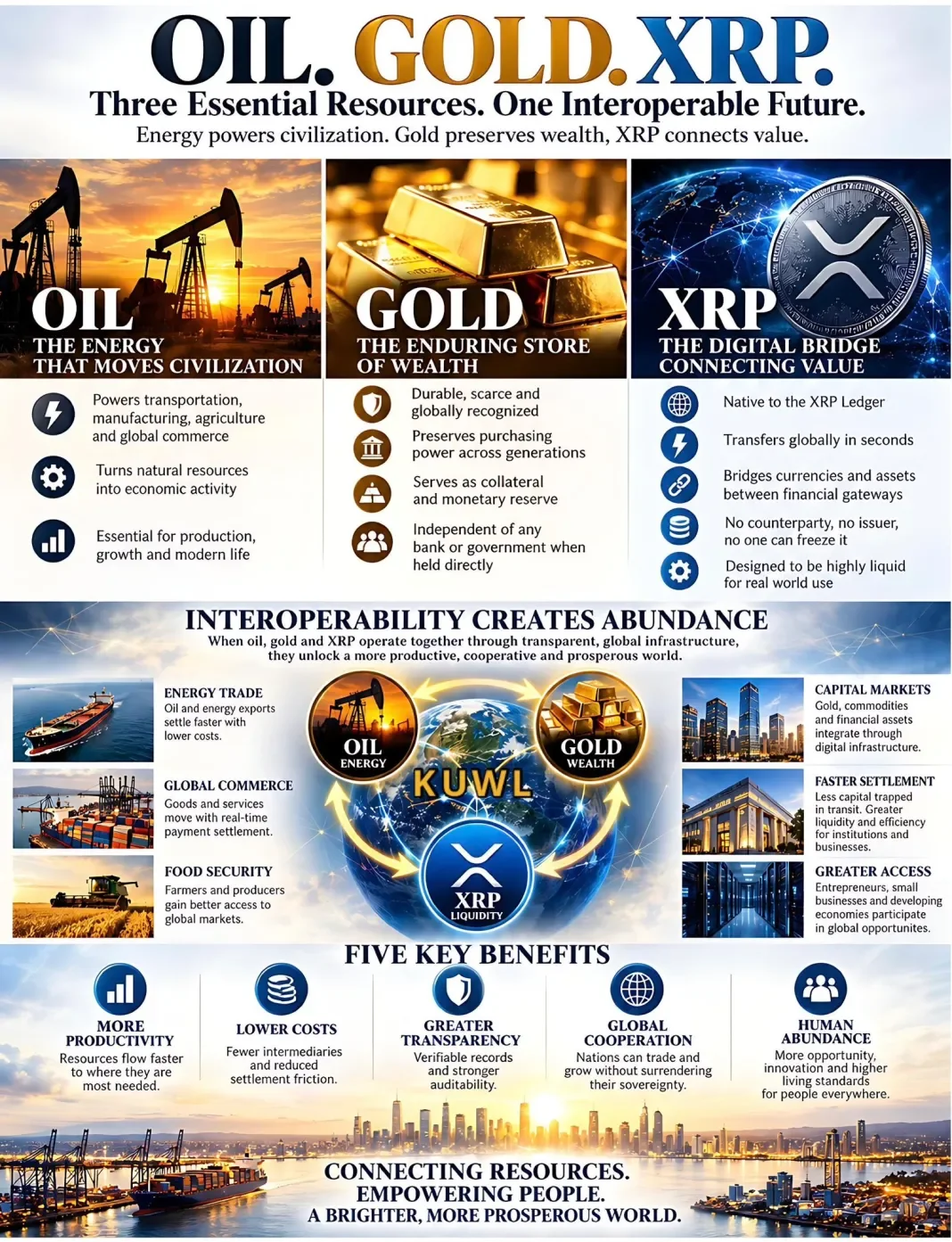
Consider the observable progression:
1. Energy remains foundational to economic production. Nations require reliable energy to manufacture, transport, cultivate, construct and operate modern civilization.
2. Gold remains a globally recognized, Tier 1 reserve asset. Central banks, governments and private institutions continue to hold gold, while digital tokenization creates new methods for representing and mobilizing ownership and utility.
3. Financial institutions are actively modernizing settlement infrastructure. The BIS, Swift, US Treasury, central banks, commercial banks and private financial technology companies are investing in tokenization, interoperability, programmable transactions and improved collateral mobility.
4. Ripple, XRP and ILP provide a vast existing technical pathway. XRP can function as a native bridge asset connecting different currencies, commodities and markets, while the XRPL supports tokenized representations of real-world value.
5. These developments address complementary economic requirements.
• Energy enables production;
• Reserves and collateral support financial confidence;
• Digital liquidity facilitates exchange.
6. Their integration creates reinforcing benefits. Faster settlement can reduce idle capital, more mobile collateral can improve financing efficiency, and interoperable markets can broaden participation in international commerce.
None of those propositions requires an assumption about concealed intentions.
They arise from documented capabilities, institutional investments and recognizable economic incentives.
The Critical Distinction: Convergence Does Not Require Uniformity
Oil, Gold and XRP need not be formally designated as a monetary trilogy to become economically interconnected.
They need only participate in an increasingly interoperable global marketplace. And they do.
The Logical Deduction
As the world’s financial infrastructure becomes capable of representing, collateralizing, exchanging and settling virtually every legitimate form of value, the connections between energy (oil), reserve wealth (gold) and digital liquidity (XRP) become increasingly practical and economically attractive.
That does not mean every transaction must use XRP. It means XRP has a uniquely identifiable opportunity to serve as the key liquidity instrument within that interconnected system.
The 3 “How” Questions
1 How much of this new world opportunity XRP captures
2 How deeply institutions integrate it, and
3 How much economic value those uses generate
The Larger Human Outcome
This central thesis extends beyond technology and finance.
A world with greater interoperability replaces a large amount of unnecessary financial friction with productive economic cooperation.
Greater transparency absolutely strengthens accountability.
Greater collateral mobility releases massive amounts of capital for productive investment.
Greater access to markets can expand entrepreneurship.
And more efficient exchanges of energy, commodities, financial assets and human labor support rising prosperity.
The conclusion is not that the entire outcome is predetermined. It is that the underlying architecture, economic incentives and technological capabilities are visibly converging toward an extraordinary opportunity.
The foundation of our new monetary infrastructure maximizes global trust through transparency, accountability, sovereignty and the verification of honest weights and measures.
Nothing can stop the emergence of our new monetary system designed to unlock abundance.
Source(s):
• https://x.com/KuwlShow/status/2110716030892822673
https://dinarchronicles.com/2026/10/15/rob-cunningham-oil-gold-xrp-2026-and-beyond/
Bruce’s Big Call Dinar Intel Thursday Night 10-15-26
Bruce’s Big Call Dinar Intel Thursday Night 10-15-26
Transcribed By WiserNow Emailed To Recaps (INTEL ONLY)
Welcome everybody to the big call tonight. It is Thursday, October 15, and you're listening to the big call. Thanks everybody for tuning in again, wherever you're located, all around this globe, glad to have you back, and looking forward to a very nice call tonight. Good call,
All right. Well, that's excellent. Thank you, Bob. I appreciate that. Excellent. Let's do a little bit of intel and see what we have and where we are right now.
You know, we talked Tuesday night about Iraq, and this does come back to Iraq in the sense that they were to seat four governors in the Board of Governors. I believe they're calling it now.
Bruce’s Big Call Dinar Intel Thursday Night 10-15-26
Transcribed By WiserNow Emailed To Recaps (INTEL ONLY)
Welcome everybody to the big call tonight. It is Thursday, October 15, and you're listening to the big call. Thanks everybody for tuning in again, wherever you're located, all around this globe, glad to have you back, and looking forward to a very nice call tonight. Good call,
All right. Well, that's excellent. Thank you, Bob. I appreciate that. Excellent. Let's do a little bit of intel and see what we have and where we are right now.
You know, we talked Tuesday night about Iraq, and this does come back to Iraq in the sense that they were to seat four governors in the Board of Governors. I believe they're calling it now.
That's what we're getting from Iraq, from our boots on the ground in Iraq, is telling us that they have seated those four members, and what we're which completes the seating of the government.
Now, in conjunction with that, is the concept of a new rate for the Iraqi dinar. Inserting that new rate in their budget for 2027, and also putting that rate out on the forex, which is the foreign exchange board for foreign currencies that are exchanging, and at some point that budget with the new rate in it would appear in their official newspaper, the Gazette, in printed form.
Now the Gazette comes out printed on Saturday and Wednesday, we didn't get a copy that happened yesterday, so we don't think any change was made there.
But there's a lot of things moving behind the scenes right now. The other thing is, what we're hearing, the preponderance of information, is saying that we're going to get started this weekend. Now I think that means notifications, and then the exchange should start.
I think either very early next week, which I'll call Monday or Tuesday. That's what two of our sources are bringing? One source is saying tomorrow is in play for us to get notified, and I think it's looking good.
I think it's a possibility that we say the weekend would start tomorrow, Friday. It's Friday, Saturday, Sunday. Maybe we do get notified and can get started over the weekend, or maybe we're just setting appointments.
We're not really sure, but we are that close to this going, and I'm excited for it for us and for everybody in Big Call Universe to move into our next phase, we know that there are certain what they're calling batches that have been paid and are done, and I think that's tier one, maybe tier two.
I know that there's people that are saying they're in process of being paid, and there's another group which would include us in tier 4b, and I would say also tier four A. which we're calling the Admirals Group, that are the rest and ready to get started.
Now, speaking of the Admirals Group, we did hear today that they're looking to get notified in about 48 hours. Now remember, the members of the Admirals Group have to go to Reno to get everything activated in their account and go one-on-one and have a three-day time in Reno.
To activate their their quantum cards, their accounts, to get their debit credit card like we will at the Redemption Center, and also to be trained on the new banking system, and also a time with at least attorney or attorneys to make sure that they have trust documents lined up.
That's a three-day time frame that we understand that everybody that is part of the admirals group would need to go to Reno to have that done. And I don't know what arrangements they're making for transportation and lodging and all that yet?
I don't know that, so don't ask. But that is something that I've been told today, as of this afternoon, that they would have that they're about 48 hours away from being notified, so let's see what happens. That would put it at Thursday afternoon, Thursday sometime.
Maybe I mean Saturday. Today's Thursday, sometime Saturday. So we'll see if that pans out. But the rest of us in 4B are looking to get our notifications.
We think we'll be notified by email and possibly by text, and then anybody that they don't have an up-to-date email for, you know, that's kind of my role in this thing was to be able to put the 800 number up on our landing page of the website, and also to send emails out from bigcalluniverse.com to. to people that wanted to get the toll-free number by email in case they didn't already have it from Wells Fargo.
Now, my understanding as of yesterday is that everything is connected in banking to the Starlink satellite system, and that even the emails that we're looking to receive may be triggered by Starlink, which is interesting.
Okay, otherwise, I think it's really important that we look for emails over the weekend to see if, in fact, they have been sent out, and then we can call, like Sue said, to set appointments and get in the flow.
And we should get in the flow now of seeing yourself responding calmly, taking the make sure you've written down or you have the toll-free number correct, and then of course read the instructions. If there are any instructions with a text or any instructions with an email, make sure you read it and read it twice before you dial. Make sure that you know what it is you have.
And like like Sue mentioned, it is going to be a series of easy questions. You know, these will be simple questions that the AI may ask us when we call in, and then of course we'll hopefully we still will be connected to a live speaking person, a human being, at the Redemption Center that's indicated by our zip code.
So make sure you know what zip code you want to use to enter in, whether it's where you live, which is most likely, possibly where you work, or possibly another place altogether, which some people do want to exchange outside of their immediate small town area for various reasons.
And so, give that some thought. Make sure you already know the zip code for the town or area that you're interested in entering in on the dial pad. Okay, we're assuming without any instructions about this, but just over the years, information we've accumulated that this is some.
This is close to how it's going to go down. This is how we believe it's going to go down by the information that we've received, and I think we're we're in a good position to get this started. And we have good sources that are bringing this, and we know that certain things are complete, and certain things are yet to be done.
Now, as far as the EBS and disclosure of various various things, various events, the emergency broadcast system will be incorporated, and it might. Be that we get the start to that triggered on Saturday the 17th. We don't know that for sure, but it could be that we learn something about that.
Now we don't know how long the disclosure, let's call it, on on the emergency broadcast system would go. We have heard eight hours a day for God knows how long, but it's going to be the kind of thing where we want to to tune in and watch it.
A lot of the stuff we know, and they may televise. We understand tribunals. You know, I don't believe they're going to televise any, you know, anything else that would be, you know, the removal of people from the planet.
But I think we're going to learn a lot, and some of us know a lot of this stuff already, and some of us don't. But want you guys to be awake. You've been listening to the Big Call for 15 years. You're pretty much awake. Not a whole lot that's going to shake you.
Not a whole lot that you're not already comfortable with or familiar with.
But there's a lot of people out there beyond Big Call universe that really have no idea what's really happening behind the scenes. We know because we have sources in high places, and we know what to expect.
And I've told you guys pretty much over the last 15 years what I am finding is going on. What I'm hearing, I'm giving over to you, and I'm hoping that we do get everything that we're looking forward to starting this weekend, which could start as early as tomorrow, Friday.
So we'll see how that goes, and we'll be in touch. And I really appreciate Sue going into the concept of robotics and 3d printing of homes. You know that is something I'm looking into for Rebuild America, especially new builds.
And I mentioned, I think at least three or four calls ago about that. So we're going to be pursuing that, and that is also some technology that we'll probably buy and get to where we could build commercial type buildings with as well, not just residential homes, but also other commercial buildings.
So we're going to be on that. No, don't worry. But I do still want involvement of Big Call Universe for Rebuild America, and I'm looking. Initially, I said 5,000 people that are listeners to the Big Call that would help me see that project through, and we'll just let you know how you can help and how that can be part of it.
That's part of building out our websites and getting that ready for interactive communication with you guys. In the meantime, which is where we are, we'll do a big call on Tuesday. Who knows? Maybe it'll be a celebration call. I hope.
But what we'll do is we will email you the people that we have emails for. We'll email you on upcoming get-togethers regionally, and also how you can help participate in Rebuild America or Rebuild International, and we'll work with the veterans on.
And Bob has some great ideas through his contacts on that, and I'll explain that program as I see it to them, and then we'll see how that comes together for the Veterans Retreat Network, and then of course the Pastoral Retreat Network.
I have some new ideas. Very, very, very, very, very, and I'm looking forward to playing golf with with Bob and playing tennis with Sue, and we'll see how that goes. Okay, and I'll take it easy. No, I'm not going to take it easy on her. She's not going to take it easy on me. She says she thinks she can wipe me off the court. Well, we'll see. I don't know.
But Anyway, this is where I want to stop for now. You have what I have. Let's let's go ahead and thank Sue for a wonderful job tonight, as always, and great teaching of the segment. Thank you for all your help, praise everything, and thank you, Bob, for both of you tonight as well as your segment on health and wellness and nutrition. And thank you, everybody that's listening in Big Call Universe for tuning in yet again,
and also thank you to the administration, for moving this forward and bringing this blessing into fruition. We've spoken it into existence. I have for the last 22 years, and it looks like the manifestation of it is about to show up, which is fantastic.
What else? Thank you, Jeannie, for your continued support. Love the teaching that you bring and the prayer that you bring every Tuesday and Thursday night.
And thank you, everybody in Big Call Universe and the satellite team. Thank you, SAT team, for getting the Big Call out all over the globe.
So let's pray right now. All right, everybody, let's have a great weekend. Let's keep an eye out for emails, and we'll talk to you on Tuesday night. God bless you all. God bless you.
Bruce’s Big Call Dinar Intel Thursday Night 10-15-26 REPLAY LINK Intel Begins 1:05:20
Bruce’s Big Call Dinar Intel Tuesday Night 10-13-26 REPLAY LINK Intel Begins 1:17:00
Bruce’s Big Call Dinar Intel Thursday Night 10-8-26 REPLAY LINK Intel Begins 1:04:44
Bruce’s Big Call Dinar Intel Tuesday Night 10-6-26 REPLAY LINK Intel Begins 1:31:31
Bruce’s Big Call Dinar Intel Thursday Night 10-1-26 REPLAY LINK Intel Begins 1:09:19
Bruce’s Big Call Dinar Intel Tuesday Night 9-29-26 REPLAY LINK Intel Begins 59:00
Bruce’s Big Call Dinar Intel Thursday Night 9-24-26 REPLAY LINK Intel Begins 1:09:09
Bruce’s Big Call Dinar Intel Tuesday Night 9-22-26 REPLAY LINK Intel Begins 1:07:07
Bruce’s Big Call Dinar Intel Thursday Night 9-17-26 REPLAY LINK Intel Begins 1:04:00
Bruce’s Big Call Dinar Intel Tuesday Night 9-15-26 REPLAY LINK Intel Begins 1:22:40
Bruce’s Big Call Dinar Intel Thursday Night 9-10-26 REPLAY LINK Intel Begins 1:04:00
Seeds of Wisdom RV and Economics Updates Friday Afternoon 10-16-26
Good Afternoon Dinar Recaps,
GLOBAL TRADE RESET WATCH: WTO REPORTS SURGE IN SUPPLY-CHAIN FINANCING FOR DEVELOPING ECONOMIES
New figures from the World Trade Organization show that supply-chain financing for developing economies has expanded sharply, helping smaller businesses access the working capital needed to participate in global trade.
Good Afternoon Dinar Recaps,
GLOBAL TRADE RESET WATCH: WTO REPORTS SURGE IN SUPPLY-CHAIN FINANCING FOR DEVELOPING ECONOMIES
New figures from the World Trade Organization show that supply-chain financing for developing economies has expanded sharply, helping smaller businesses access the working capital needed to participate in global trade.
OVERVIEW
Supply-chain finance in developing economies reached about $10 billion in 2026, representing a two- to threefold increase from 2024.
Multilateral development banks provided approximately $65 billion in direct financing annually in 2026, up from about $35 billion annually before the COVID-19 pandemic.
The WTO and its partners are working to expand access to financing, strengthen financial infrastructure and attract more private investment, particularly for small and medium-sized businesses.
KEY DEVELOPMENTS
1. Supply-Chain Financing Expands Rapidly
On October 16, the World Trade Organization and the International Finance Corporation reviewed progress in expanding supply-chain financing for developing economies during a meeting held alongside the 2026 World Bank and International Monetary Fund Annual Meetings in Bangkok, Thailand.
The WTO reported that multilateral development banks' direct financing had grown to approximately $65 billion in 2026, compared with about $35 billion annually before the pandemic. Of that financing, approximately $10 billion supports supply-chain finance in developing economies—two to three times the 2024 level.
Supply-chain financing helps businesses access money tied up in unpaid invoices, orders and transactions. Instead of waiting weeks or months for customers to pay, suppliers may use eligible invoices or other arrangements to obtain working capital sooner.
For smaller businesses, that access can mean being able to purchase materials, pay workers, fulfill orders and accept new contracts without exhausting their cash reserves.
The significance is practical: financing can help businesses participate in international trade rather than being excluded because they cannot afford the gap between producing goods and receiving payment.
2. Development Banks Seek to Bring More Private Capital Into Trade
The WTO and its development-bank partners are now looking beyond direct lending. Their broader objective is to encourage more private-sector investment and improve the financial systems that allow trade financing to reach businesses.
The initiative includes efforts to strengthen legal and regulatory frameworks, improve market infrastructure, build institutional capacity and expand the range of financing products available to smaller companies.
These foundations matter because lenders must be able to assess risk, verify transactions and enforce agreements across different countries and legal systems. Where those systems are weak, financing can become more expensive or difficult to obtain.
The partners are continuing their work through the WTO's Supply Chain Finance Task Force, which coordinates efforts among multilateral development banks and other institutions.
The long-term objective is to make trade finance more accessible and sustainable, so that public development funding can help mobilize additional private investment rather than carrying the entire burden itself.
3. Local-Currency Financing Could Help Close Trade Gaps
One priority discussed by the WTO and its partners is expanding local-currency financing and developing products that better serve businesses in underserved markets.
This matters because companies in developing economies can face additional costs when borrowing in foreign currencies. Exchange-rate movements may increase repayment costs, while limited access to local financial services can prevent otherwise viable businesses from obtaining credit.
Improving local financing options, digital platforms and financial infrastructure could help more businesses participate in regional and international supply chains.
However, access remains uneven. Research published jointly by the WTO and the International Finance Corporation in September 2026 found that volatile global financial conditions can reduce the availability of trade finance, with emerging and developing economies particularly exposed. Stronger local financial markets can help improve access, but they do not eliminate risk.
The challenge now is to turn the growth in financing into broader, dependable access for businesses that have historically struggled to secure it.
WHY IT MATTERS
Global trade depends on more than ships, ports and products. It also depends on the flow of money that allows businesses to produce, transport, sell and pay for goods across borders.
When a supplier cannot obtain financing, an order may be delayed or lost. When smaller companies cannot afford the gap between shipping goods and receiving payment, they may be unable to expand—even when demand exists.
Expanding supply-chain finance can help address these bottlenecks. It may support business growth, create opportunities for smaller exporters and strengthen connections between developing economies and international markets.
The development also highlights a broader shift in global finance: international institutions are seeking ways to combine public development funding, private investment, improved financial infrastructure and digital tools to reach businesses that traditional financing has often left behind.
This is an important development, but more financing does not automatically mean that all businesses will gain access or that international trade will become risk-free. The results will depend on implementation, affordability and the strength of the systems supporting these transactions.
WHY IT MATTERS TO FOREIGN CURRENCY HOLDERS
For readers following the evolution of the global financial system, this is a concrete development worth watching.
Trade and currency demand are connected. When businesses expand international trade, they may need more cross-border payments and access to different currencies. The effect on any particular currency depends on the scale and nature of those transactions.
Developing economies may gain greater financial participation. Better access to working capital can help smaller businesses enter international supply chains and support broader economic activity.
Financial infrastructure is becoming increasingly important. Local-currency financing, digital platforms and cooperation among development banks can influence how money moves through international commerce.
This development does not establish that a particular currency will revalue or that the U.S. dollar is about to be replaced. It shows that institutions are working to address real financing gaps that affect the ability of businesses to participate in the global economy.
For currency holders, the most useful approach is to watch measurable changes in trade, payment systems, financing arrangements and currency use—not assume that greater financing automatically produces higher exchange rates.
IMPLICATIONS FOR THE GLOBAL RESET
Pillar 1: Debt
Supply-chain finance provides businesses with access to working capital and credit. The challenge is to expand financing without creating unsustainable debt burdens.
Pillar 2: Trade
This is the central pillar of the story. Better financing can help smaller businesses fulfill orders, reach new markets and participate more fully in international trade.
Pillar 3: Assets
Invoices, receivables and other trade-related claims can support financing arrangements, helping businesses turn expected payments into usable working capital.
Pillar 4: Technology
Digital platforms and stronger financial infrastructure can make trade-finance transactions easier to process, verify and manage across borders.
Pillar 5: Energy
Businesses involved in energy, agriculture, manufacturing and transportation all need financing to keep supply chains operating. Improved access to trade finance can support these essential sectors, although this initiative is broader than energy alone.
THE BOTTOM LINE
The WTO's latest figures show meaningful growth in supply-chain financing for developing economies, alongside renewed efforts to mobilize private investment and improve access for smaller businesses. The next test will be whether this progress reaches more companies and produces lasting improvements in their ability to trade.
For the global financial reset conversation, the important signal is not a promise of sudden currency gains. It is the steady development of financial channels that may allow more countries and businesses to participate in international commerce.
The global financial system evolves when access to capital expands, the movement of money becomes more effective, and more participants can take part in the trade that connects the world.
Seeds of Wisdom Team
SOURCES
~~~~~~~~~~
RV Facts with Proof - Step 1🌱 Link
RV Intel Highlights - Step 2🔥 Link
Start Here room with over 110 RV Topics Link
Ask Your ❓Questions❓ in the Q & A Room Link
Seeds of Wisdom Team Rooms Directory Link
Follow the Gold/Silver Rate COMEX
Follow Fast Facts
Seeds of Wisdom Team™ Website
Seeds of Wisdom Team™ Rumble
Thank you Dinar Recaps
Reset Intelligence: Iraq Completes its Government
Reset Intelligence: Iraq Completes its Government
Iraq Completes Its Government
By Reset Intelligence | @EXIT_FIAT
Iraq’s parliament filled the last empty seats in Prime Minister Ali al-Zaidi’s government on Thursday, Interior and Defence among them.
For 5 months the ministries that run the police and the army had no one in charge.
Reset Intelligence: Iraq Completes its Government
Iraq Completes Its Government
By Reset Intelligence | @EXIT_FIAT
Iraq’s parliament filled the last empty seats in Prime Minister Ali al-Zaidi’s government on Thursday, Interior and Defence among them.
For 5 months the ministries that run the police and the army had no one in charge.
The vote
261 members sat. Parliament approved 11 ministers and three deputy prime ministers, and every one of them took the oath before the session closed. Only the Ministry of Migration was left open. Al-Zaidi said his deputies will draw no salary, and that the government is entering a phase of faster work on the economy.
What moved this week
• The Iraqi bank – the US Treasury sanctioned an Iraqi bank it says was set up by Iranian companies to supply Iran with US dollars. Iraq’s Central Bank had already restricted its dollar dealings back in 2023.
• Travellers’ dollars – from Sunday, the Central Bank sells travellers $2,000 at the official rate every 2 months, up to 6 times a year. Since September it was twice a year.
• The street – Baghdad closed Thursday at 166,550 IQD for $100, against the bank’s 152,000. The government’s target for the street is 155,000.
• The budget – the legal date for the 2027 budget to reach parliament passed on Thursday, with no report that it arrived.
The question
Iraq’s government is complete. What has to happen before the new notes, and what does that order mean for the dinar you hold?
That is the short version. Who got which ministry, the bank that sent dollars to Iran, and why one dollar price comes before the new notes – that is the daily read.
Read the full daily briefing free for 5 days. Sign up here: the daily Iraqi dinar briefing
Want it straight from the horse’s mouth? The CBI Rate Alert pings you the moment the Central Bank of Iraq moves the official rate. The number itself, not a rumour about it. It comes with our free resource library and the daily breakdown of what is actually moving in Iraq. Sign up free: The CBI Rate Alert
Got a dinar question? Reset Intelligence runs an on-call research assistant: ask it anything they have published. It answers in seconds and will conduct deep research to find you the answer. Try it: the Iraqi dinar research assistant
Common questions, answered straight: When will the Iraqi dinar revalue? and Is the Iraqi dinar revaluation real?
The design behind all of it is mapped in Head of the Snake, and the free guides live in the Iraqi dinar resource library.
Follow the daily intel free: Telegram · Facebook · Spotify · Odysee
https://dinarchronicles.com/2026/10/16/reset-intelligence-iraq-completes-its-government/
Coffee with MarkZ, joined by Mr. Cottrell. 10/16/2026
Coffee with MarkZ, joined by Mr. Cottrell. 10/16/2026
Some highlights by PDK-Not verbatim
MarkZ Disclaimer: Please consider everything on this call as my opinion. People who take notes do not catch everything and its best to watch the video so that you get everything in context. Be sure to consult a professional for any financial decisions
MZ: Iraq completes its cabinet, fraud arrests, Iranian quagmire, and is Europe falling? We touch on all these before Mr. Cottrell joins us to take your questions. Lucas joins at the end as well
MZ: I have group leaders and bond people that are through the roof excited. I expecting something by today …that has not occurred yet. I am hoping its going to be a good weekend.
Coffee with MarkZ, joined by Mr. Cottrell. 10/16/2026
Some highlights by PDK-Not verbatim
MarkZ Disclaimer: Please consider everything on this call as my opinion. People who take notes do not catch everything and its best to watch the video so that you get everything in context. Be sure to consult a professional for any financial decisions
MZ: Iraq completes its cabinet, fraud arrests, Iranian quagmire, and is Europe falling? We touch on all these before Mr. Cottrell joins us to take your questions. Lucas joins at the end as well
MZ: I have group leaders and bond people that are through the roof excited. I expecting something by today …that has not occurred yet. I am hoping its going to be a good weekend.
MZ: There is a crazed amount of optimism that must be based on something. I have one CMKX source that says Sunday deliveries are highly possible. Not saying it will happen but they are being told to expect them and also farm claims to happen on Sunday.
MZ: Cross your fingers guys. We know its coming
MZ: In Iraq they have completed the cabinet with 11 new ministers. This is your big news today. Along with expectations to move forward. My Iraqi contacts are extremely upbeat. They feel like this is their month. I hope they are correct.
MZ: Next comes HCL and the budget.
MZ: I believe this could be a very big weekend. I hear bond people talking…banking people are talking…..settlement people are talking….and Iraqi people are talking. I’m hoping this is it and its tied together.
MZ: The expectation is it all will go at the same time.
THE CONTENT IN THIS PODCAST IS FOR GENERAL & EDUCATIONAL PURPOSES ONLY&NOT INTENDED TO PROVIDE ANY PROFESSIONAL, FINANCIAL OR LEGAL ADVICE. PLEASE CONSIDER EVERYTHING DISCUSSED IN MARKZ’S OPINION ONLY
https://rumble.com/user/theoriginalmarkz
Kick: https://kick.com/theoriginalmarkz
Markz's linktree https://linktr.ee/theMarkZshow
FOLLOW MARKZ : TWITTER . https://twitter.com/originalmarkz?s=21. TRUTH SOCIAL . https://truthsocial.com/@theoriginalm...
Mod: MarkZ "Back To Basics" Pre-Recorded Call" for Newbies 10-19-2022 ) https://www.youtube.com/watch?v=37oILmAlptM
MARKZ DAILY LINKS: https://theoriginalmarkz.com/home/
Note from PDK: Please listen to the replay for all the details and entire stream….I do not transcribe political opinions, medical opinions or many guests on this stream……just RV/currency related topics.
THANK YOU FOR JOINING. FOR UPDATES ON MARK’S PODCAST GO TO: https://t.me/+b3hYhYlhKM1hYzcx
Is the US Returning to a Gold Standard? Heresy Financial
Is the US Returning to a Gold Standard?
Heresy Financial: 10-15-2026
The landscape of American fiscal policy is witnessing a significant shift with the appointment of Judy Shelton as an advisor to the U.S. Treasury.
This move has sparked intense discussion among economists and investors alike, as Shelton is widely recognized as one of the most prominent advocates for sound money principles.
Is the US Returning to a Gold Standard?
Heresy Financial: 10-15-2026
The landscape of American fiscal policy is witnessing a significant shift with the appointment of Judy Shelton as an advisor to the U.S. Treasury.
This move has sparked intense discussion among economists and investors alike, as Shelton is widely recognized as one of the most prominent advocates for sound money principles.
Having authored the influential book Good as Gold, her arrival at the Treasury signals a potential pivot toward a more disciplined monetary framework. While her primary focus involves advising on currency policy—with a specific lens on the financial conditions within China—her long-standing support for gold-backed systems suggests that the conversation regarding the gold standard is far from over.
Shelton’s appointment comes at a time when the United States is closely monitoring the economic stability of global partners and competitors. Her role involves assessing the financial risks emerging from China’s economy, which some analysts compare to the structural vulnerabilities seen during the final years of the Soviet Union.
Although Shelton is not traditionally categorized as a China specialist, her expertise in monetary stability provides a unique perspective on how international currency fluctuations and debt levels could impact the broader global market. Her presence at the Treasury represents a desire to explore alternative fiscal strategies that prioritize long-term stability over short-term expansion.
To understand the weight of this appointment, one must look at the historical significance of the gold standard itself.
For thousands of years, gold emerged as the premier monetary medium because of its natural durability and limited supply. It acted as a self-regulating mechanism for the global economy, naturally curbing inflation and preventing the rapid devaluation of wealth.
During the era of the classical gold standard, nations could not simply print money to resolve fiscal deficits; every unit of currency in circulation was tied to a physical asset, ensuring that the purchasing power of the citizenry remained relatively stable over decades.
As global trade became more complex, the financial system evolved from physical gold coins to paper currency and sophisticated banking. Initially, these paper notes were essentially receipts, representing a specific amount of gold held in a vault.
While this transition allowed for greater economic flexibility and growth, it also introduced the risk of institutional manipulation. Over time, central banking systems began to issue more paper notes than they had gold to back them, a practice that eventually led to systemic vulnerabilities. This disconnect between physical assets and paper representations culminated in 1971, when the Nixon administration officially ended the direct convertibility of the U.S. dollar into gold, ushering in the era of pure fiat currency.
The transition to a fiat system has granted the government unprecedented ability to borrow and spend, leading to a national debt that now exceeds $40 trillion.
Without the physical constraint of a metal standard, the money supply has expanded rapidly, resulting in significant interest obligations and persistent inflationary pressure. Many proponents of sound money argue that this unchecked spending is unsustainable and that the current path leads to a diminished standard of living for the average taxpayer.
It is within this context of record-breaking debt that Judy Shelton’s theories on fiscal restraint and gold-backed instruments have gained renewed attention.
Rather than advocating for an overnight return to a 19th-century gold standard, Shelton has proposed more modern, hybrid solutions to restore fiscal trust. One of her most discussed concepts is the implementation of Treasury trust bonds that are redeemable in gold.
This mechanism would serve as a bridge between the current fiat system and a more disciplined monetary future. By offering instruments backed by a tangible asset, the government could theoretically lower its borrowing costs while providing investors with a guarantee of value. Such a move would impose a much-needed level of accountability on federal spending, as the threat of gold redemption would prevent the endless printing of new currency.
Despite the logical appeal of sound money, the practical and political hurdles to implementing such a system remain immense. Shifting away from a fiat-based economy would require a level of political will and fiscal sacrifice that is rarely seen in modern governance.
Most experts agree that a full-scale return to the gold standard is unlikely in the immediate future, given how deeply the current debt-based model is integrated into global trade. However, the fact that Shelton is now in a position to influence Treasury policy suggests that these ideas are moving from the fringes of economic theory into the mainstream of policy discussion.
For the individual investor, the ongoing debate highlights the importance of maintaining a diversified portfolio that includes hard assets. While governmental policies may fluctuate, gold has historically maintained its purchasing power over centuries, regardless of changes in leadership or shifts in monetary regimes.
Regardless of whether the United States formally adopts a gold-backed bond, many seasoned investors continue to treat gold as a vital reserve asset. For those concerned about the stability of the dollar and the rising national debt, staying informed through expert analysis and exploring risk management tools remains the best way to safeguard one’s financial future.
TIMECODES
00:00 Judy Shelton Joins the U.S. Treasury
01:32 Why Gold Became Money
03:27 How Gold-Backed Paper Money Began
04:03 Free Portfolio Stress Test (Promo)
05:38 Paper Money, Bank Runs and Central Banks
07:03 FDR’s Gold Restrictions 07:34 Nixon Ends the Gold Standard (1971)
08:19 Fiat Money and the U.S. Debt Problem
10:26 Judy Shelton’s Gold-Backed Bond Proposal
12:08 Judy Shelton’s China Role Explained
14:02 Would Gold Bonds Fix Government Spending?
15:19 Why I Hold 20% of My Net Worth in Gold
15:45 Portfolio Stress Test: How to Access It
News, Rumors and Opinions Friday 10-16-2026
Ariel: Iraqi Dinar, Forex Re-entry, Bessent Doctrine, Final Sequencing
10-15-2026
The Baghdad–Washington chokepoint is now completely cleared: the Finance Minister’s IMF/World Bank sit-down was never about loans, it was the ‘final sign-off’ for re-linking Iraq’s correspondent banking rails to the global FOREX grid, meaning the Central Bank of Iraq is now positioned to execute the long-telegraphed RV/RI the moment the White Hats trigger the currency swap.
The freshly printed lower-denomination notes are already warehoused, the 2027 Budget and the Cabinet slate locked into a Thursday finish, so the domestic legal chassis is fully welded shut;
Ariel: Iraqi Dinar, Forex Re-entry, Bessent Doctrine, Final Sequencing
10-15-2026
The Baghdad–Washington chokepoint is now completely cleared: the Finance Minister’s IMF/World Bank sit-down was never about loans, it was the ‘final sign-off’ for re-linking Iraq’s correspondent banking rails to the global FOREX grid, meaning the Central Bank of Iraq is now positioned to execute the long-telegraphed RV/RI the moment the White Hats trigger the currency swap.
The freshly printed lower-denomination notes are already warehoused, the 2027 Budget and the Cabinet slate locked into a Thursday finish, so the domestic legal chassis is fully welded shut;
Judy Shelton’s signal-repeating of Treasury Secretary Scott Bessent’s IMF statement is not an intellectual exercise, it is the “public notice of the dollar’s deliberate controlled devaluation”
When Bessent says the IMF “must exercise its voice” on “non-market policies and exchange rates that skew competition,” he is openly codifying a managed revaluation environment where the fiat USD is permitted to fall ‘by design’ so that asset-backed currencies like the Iraqi dinar, which will re-enter the market anywhere from a low-float $0.10 to the full $3.22 parity depending on the final peg, can trade on a genuinely level field without wrecking the U.S. export machine
POTUS already has the liquidity staged and the Treasury’s re-denomination playbook ready, and what you are about to witness is not an Iraqi currency event but the “first live shift in the broader resource-backed currency reset.”
The dollar descends from its synthetic throne, the dinar emerges as the liquid bridge between the petrodollar and the new commodity-collateralized system.
Every counterparty already holding physical gold, silver, and oil leases quietly accumulates while the media screams “instability,” and by the time the mainstream narrative catches up, the revaluation will be a completed transaction with Iraq holding full IMF Article VIII convertibility status a sovereign nation re-anchored to real assets while the Cabal’s fiat leverage evaporates in real time.
Read Full Article:
https://www.patreon.com/Prolotario1/posts/volodymyr-useful-172386713
*************
Courtesy of Dinar Guru: https://www.dinarguru.com/
Walkingstick The IMF is demanding tight banks on the new exchange rate they're about to come out with. 1550 is the parallel rate versus 1520 [1510?] the official rate. This is closing the gap as close as they can right now to a 1 to 1 rate. At that moment they will raise the three zeros...1550 to 1510 is within the 2%...the IMF is requiring...This is a well thought out process. There are no mistakes.
Stephen The amount of [Iraqi] currency outside of the country of Iraq, the currency you and me hold as investors, is roughly 1% to 4% [of the supply]. I don't think the Central Bank of Iraq really cares about that number. It is so minuscule and small I don't think it plays into their studies of making any exchange rate changes.
Jeff Deleting the three zeros has nothing to do with the exchange rate...What has all the zeros? The currency we have, the investment notes we have. What they're going to do is take those out of circulation and replace them with smaller currency notes. That's what deleting zeros is. The rate will be based on what the dinar is against the US dollar. That's what determines the rate. If it's 1 dinar equals $3, that that's your rate. It's 3:1 ratio. Very simple. Deleting the zeros has nothing to do with what the value is going to be.
My First 24 Hours After The Dinar Revalues
The Dinar Den: 10-15-2026
Seeds of Wisdom RV and Economics Updates Friday Morning 10-16-26
Good Morning Dinar Recaps,
GLOBAL DEBT RESET WATCH: IMF WARNS AI INVESTMENT AND RISING BOND YIELDS COULD TEST FINANCIAL STABILITY
The International Monetary Fund warns that an AI investment correction, rising government borrowing costs and cyber threats could expose vulnerabilities in global markets and increase pressure on the financial system.
Good Morning Dinar Recaps,
GLOBAL DEBT RESET WATCH: IMF WARNS AI INVESTMENT AND RISING BOND YIELDS COULD TEST FINANCIAL STABILITY
The International Monetary Fund warns that an AI investment correction, rising government borrowing costs and cyber threats could expose vulnerabilities in global markets and increase pressure on the financial system.
OVERVIEW
AI investment is a growing financial risk. If expected profits fail to match optimistic forecasts, a sharp market correction could affect investors, lenders and the broader economy.
Rising bond yields are increasing pressure. Governments are borrowing heavily while inflation concerns and fiscal deficits can push financing costs higher.
The system remains resilient, but vulnerabilities persist. The IMF identifies risks among weaker banks, nonbank financial institutions and highly leveraged borrowers.
KEY DEVELOPMENTS
1. The IMF Identifies Three Potential Triggers for Market Turmoil
In its October 2026 Global Financial Stability Report, the IMF identifies three major risks that could disrupt financial markets:
An AI-related market correction: Investors may reassess whether expected AI profits and investment returns justify current valuations.
A sharp increase in government bond yields: Inflation, large fiscal deficits and heavy debt issuance could raise borrowing costs and tighten financial conditions.
Cyber incidents: Attacks that disrupt financial services could weaken confidence and create broader financial instability.
The IMF emphasizes that markets have remained resilient amid economic and geopolitical uncertainty. However, strong earnings and enthusiasm about AI should not be mistaken for a guarantee of safety. Existing vulnerabilities could magnify a shock if one of these risks materializes.
2. AI Is Becoming a Major Force in Global Debt Markets
Artificial intelligence is not only a technology story. It is increasingly a financing story.
Technology companies are investing heavily in data centers, computing capacity and supporting infrastructure. Some of that expansion is being funded through borrowing, placing additional demands on bond markets.
Reuters reported that hyperscale technology companies accounted for approximately 10% of global investment-grade corporate bond issuance, compared with less than 1% in 2024.
That change matters because technology companies and governments are competing for investment capital at the same time. If AI revenues disappoint or investment plans are scaled back, highly leveraged businesses could face financial pressure, potentially affecting lenders, investors and related markets.
The concern is not that AI investment must fail. It is that the financial consequences could be substantial if market expectations move sharply away from reality.
3. Government Debt and Rising Yields Could Amplify Financial Stress
Governments worldwide need to finance public services, infrastructure, energy security and other obligations. When borrowing costs rise, refinancing existing debt and funding new spending become more expensive.
Higher bond yields can also affect the value of existing bonds, influence mortgage and business lending rates, and change how investors allocate capital between government debt and other assets.
The IMF warns that a sudden increase in sovereign yields could interact with other vulnerabilities, including leverage in private credit and liquidity pressures affecting insurers and pension funds.
Although the IMF's stress testing indicates that the banking sector remains broadly resilient, it also identifies weaker institutions that could be more vulnerable under severe conditions.
The central concern is how several pressures might reinforce one another: expensive government borrowing, concentrated AI investments, high leverage and fragile pockets of the financial system.
WHY IT MATTERS
The global financial system is built on interconnected markets for government debt, corporate bonds, bank lending, investment assets and international payments. Stress in one area can spread to others.
When governments pay more to borrow, they may face difficult choices about spending and investment. When investors become less confident in high-growth sectors, capital can move quickly between assets. When leveraged institutions face losses or funding demands, they may sell assets to raise cash, potentially intensifying market movements.
These connections make the IMF's warning important beyond Wall Street. Financial conditions influence international trade, infrastructure investment, energy projects and the availability of funding for developing economies.
The report does not predict an inevitable financial crisis. It argues that policymakers and market participants should strengthen resilience before a shock occurs.
For the global financial system, preparation matters because a market that appears calm can still contain vulnerabilities.
WHY IT MATTERS TO FOREIGN CURRENCY HOLDERS
For people following the possibility of a global financial reset, this development offers an important signal about the pressures shaping the international monetary system.
Debt sustainability matters. A country's debt burden, interest costs and ability to maintain investor confidence can affect its financial flexibility and currency outlook.
Capital flows can change quickly. When bond yields rise or investors reassess risk, money may move between countries, currencies and asset classes.
Financial-system reform may gain urgency. Governments and institutions facing repeated funding pressures may have stronger incentives to improve debt management, market oversight and cross-border financial cooperation.
However, these developments do not establish that a currency will revalue, that the U.S. dollar will lose its leading role, or that a coordinated global reset has been scheduled.
Currency values depend on many factors, including monetary policy, inflation, economic growth, foreign-exchange liquidity, political stability and investor confidence.
The practical lesson is to watch measurable changes in financial policy and market behavior—not treat warnings about risk as promises of future currency gains.
IMPLICATIONS FOR THE GLOBAL RESET
Pillar 1: Debt
Government borrowing, fiscal deficits and refinancing costs are central to the IMF's warning. Debt management will remain a key influence on financial stability.
Pillar 2: Trade
Tighter financial conditions can make trade financing more expensive and complicate investment decisions across international supply chains.
Pillar 3: Assets
Bond prices, technology valuations and other financial assets may respond sharply if investors reassess risk, expected profits or interest rates.
Pillar 4: Technology
AI investment is reshaping corporate financing needs and investor expectations. Its long-term economic benefits may be significant, but the financing risks deserve attention.
Pillar 5: Energy
Energy-price increases can contribute to inflation and put upward pressure on bond yields, adding to the challenges facing heavily indebted governments.
THE BOTTOM LINE
The IMF's warning highlights the links between AI investment, government debt, bond yields and financial stability. These pressures deserve attention because they can influence the cost of capital, the movement of international investment and the ability of governments and businesses to finance future growth.
For foreign currency holders, the appropriate response is informed observation rather than speculation. A changing financial system creates developments worth watching, but it does not guarantee a particular currency outcome.
The evolution of the global financial system will be shaped not by one dramatic prediction, but by how nations manage debt, technology and confidence in the markets that connect them.
Seeds of Wisdom Team
SOURCES
2. Reuters — “IMF cites AI slowdown, spiking yields as looming global market risks”
~~~~~~~~~~
🌱 A Message to Our Currency Holders🌱
If you’ve been holding foreign currency for many years, you were not foolish.
You were not wrong to believe the global financial system would change.
What failed was not your patience — it was the information you were given.
For years, dates, rumors, and personalities replaced facts, structure, and proof. “This week” predictions created cycles of hope and disappointment that were never based on how currencies actually change.
That is not your failure.
Our mission here is different: • No dates • No rates • No hype • No gurus
Instead, we focus on:
• Verifiable developments • Institutional evidence
• Global financial structure • Where countries actually sit in the process
Currency value changes only come after sovereignty, trade, banking, settlement systems, and fiscal coordination are in place. History and institutions confirm this sequence.
You will see silence. You will see denials. That is not delay — that is discipline.
Protect your identity. Organize your documents. Verify everything.
Never hand your discernment to anyone who cannot show proof.
You deserve truth — not timelines.
Seeds of Wisdom Team
~~~~~~~~~~
RV Facts with Proof - Step 1🌱 Link
RV Intel Highlights - Step 2🔥 Link
Start Here room with over 110 RV Topics Link
Ask Your ❓Questions❓ in the Q & A Room Link
Seeds of Wisdom Team Rooms Directory Link
Follow the Gold/Silver Rate COMEX
Follow Fast Facts
Seeds of Wisdom Team™ Website
Seeds of Wisdom Team™ Rumble
Thank you Dinar Recaps
Iraq Economic News and Points To Ponder Late Thursday Evening 10-15-26
The Central Bank Of Iraq Announces A New Mechanism For Granting Dollars To Travelers
2026-10-15 The Central Bank of Iraq announced on Thursday the implementation of a new regulatory mechanism to grant travelers the amount allocated to them, which is (2000) US dollars every two months, and at a maximum of (6) times per year.
The Central Bank Of Iraq Announces A New Mechanism For Granting Dollars To Travelers
2026-10-15 The Central Bank of Iraq announced on Thursday the implementation of a new regulatory mechanism to grant travelers the amount allocated to them, which is (2000) US dollars every two months, and at a maximum of (6) times per year.
The bank confirmed in a statement received by Shafaq News Agency that the implementation of this decision will officially begin on Sunday, October 18, 2026, noting that the step aims to regulate the process of obtaining foreign currency and ensure that it reaches those entitled to it in accordance with the announced regulations.
https://www.shafaq.com/ar/اقتصـاد/المركزي-العراقي-يعلن-عن-لية-جديدة-لمنح-الدولار-للمسافرين
CF Hails Completion Of Iraq's Government
2026-10-15 / 14:30 Shafaq News- Baghdad The Coordination Framework (CF), an alliance of predominantly Shiite political parties, welcomed the completion of Iraq's cabinet on Thursday.
In a statement, the CF said the completed cabinet represents an important step toward strengthening political stability, improving the functioning of state institutions, and implementing the government's program.
On October 15, Prime Minister Ali Al-Zaidi said the appointment of three deputy prime ministers and approval of 11 cabinet nominees would strengthen his government's ability to address economic and security challenges and fulfill its commitments.
The parliamentary vote took place during a session chaired by Speaker Haibet Al-Halbousi and attended by 261 lawmakers.
https://www.shafaq.com/en/Iraq/CF-hails-completion-of-Iraq-s-government
"Five Months After The Formation Of The Government... The Cabinet Is Complete And The Implementation Phase Begins." Al-Zidi Pledges To Accelerate The Implementation Of The Government Program, Combat Corruption, Strengthen Sovereignty, And Translate.
Baghdad - One News - 10/15/2026 Prime Minister Ali Faleh al-Zaidi announced the completion of the cabinet formation, filling the remaining vacant portfolios and appointing deputy prime ministers, five months after the government was formed, stressing the transition to a new phase of accelerated government work to implement the priorities and commitments outlined in the ministerial program.
In a statement marking the completion of the government formation, Al-Zaydi said that his government is now beginning rapid steps of diligent work, pledging to proceed with the implementation of the government program and respond to the aspirations of Iraqis, and to turn plans and decisions into tangible results that are reflected in the daily lives of citizens.
He explained that the government has been working during the past months under extremely complex internal and external circumstances, noting that the war in the region has imposed and continues to impose exceptional economic challenges on Iraq, in addition to security challenges that require the highest levels of responsibility and vigilance.
Al-Zaydi stressed that his government continued to implement its ministerial program despite those circumstances, and worked to address complex issues and confront corruption, as well as taking what he described as historic steps to strengthen Iraq’s sovereignty and independence of decision, leading to the end of the international coalition’s military presence in the country.
He pointed out that the completion of the cabinet formation and the appointment of deputies to the Prime Minister represent support for the government’s ability to manage national issues, and give executive work additional momentum to coordinate efforts and accelerate the implementation of government programs and commitments.
The Prime Minister stressed that the next stage requires redoubling efforts to address the large and complex issues, emphasizing that the aspirations of Iraqis require the government to move from the stage of setting plans and making decisions to achieving actual results that the citizen can feel the impact of.
Al-Zaydi expressed his gratitude to the House of Representatives and the political forces for their contribution to completing the formation of the government, calling on the Deputy Prime Ministers and the ministers who gained the confidence of Parliament to bear their responsibilities with the highest degrees of commitment, efficiency and integrity.
Al-Zaydi concluded his statement by emphasizing the need to harness government resources to serve citizens and to work as a unified team to implement priorities and achieve national goals, thereby enhancing Iraq's security, stability, and prosperity.
#OneNews #The_First_News_Platform_in_Iraq https://1news-iq.net/بعد-خمسة-أشهر-من-تشكيل-الحكومة-الكابي
Statement Of The Secretary-General Loyalists After The Cabinet Was Completed: We Want A Government That Is Courageous In Its Decision-Making And Puts Iraq First
2026-10-15 Baghdad - 964 Media The Secretary-General of the Loyal Ansar Allah Movement, Haider Al-Gharawi, affirmed today, Thursday (October 15, 2026), that completing the cabinet represents an opportunity to correct the course, indicating that he looks forward to a courageous and strong government in making decisions in which Iraq comes first, in every position and action.
Al-Gharawi stated in a post, which was followed by Network 964 : https://964media.com/725936/
The Minister Of Finance, In His Remarks Before The IMF And World Bank Group Meetings:
https://x.com/MofIraq/status/2110379863605452907
Ministry of Finance Iraq @MofIraq
Translated from Arabic
The Minister of Finance, in his remarks before the IMF and World Bank Group meetings: We are working to modernize the banking system, strengthen governance and controls for combating money laundering and terrorist financing, expand electronic payments, and support the return of our banks to the international banking correspondent network.
Rate this translation: https://x.com/MofIraq/status/2110379863605452907
Iraqi Talks With The IMF On Financial Reforms
Finance Minister Faleh Sari continues his series of meetings in the Thai capital, Bangkok, on the sidelines of the annual meetings of the International Monetary Fund and the World Bank Group, to strengthen the partnership with international financial institutions in support of the reform process in Iraq.
In this context, the Minister held a meeting today, Wednesday, with the Director of the Middle East and Central Asia Department at the International Monetary Fund, Mr. Jihad Azour, in the presence of the Governor of the Central Bank of Iraq, to discuss the most prominent financial and monetary policy paths in the country.
The Minister reviewed the financial pressures facing Iraq, stressing the importance of strengthening cooperation with the IMF and benefiting from its expertise in dealing with economic changes.
For his part, Mr. Jihad Azour expressed the Fund’s readiness to support Iraq in facing its financial crisis resulting from tensions in the Middle East, stressing the importance of adopting solutions that are commensurate with the size of the challenges facing the country.
Ministry of Finance Government Media and Communication October 14, 2026
https://www.mof.gov.iq/pageN0015
translation of graphic: Ministry of Finance
The Minister of Finance, in his address to the meetings of the IMF and the World Bank Group
We are working to modernize the banking system, strengthen governance and anti-money laundering and counter-terrorism financing controls, expand electronic payments, and support the return of our banks to the international correspondent banking network www.mof.gov.iq