
A Good Week To Be On A Government Payroll
A Good Week To Be On A Government Payroll
Notes From the Field By James Hickman (Simon Black / Sovereign Man) October 16, 2026
It was a good week to be on a government payroll and a bad one to be paying for it. Here are a few of the most absurd stories from the last several days in case you missed them.
Too tired to go to work? The Australian government has your back!
Michele Duffy, 63, advises students at Victoria University in Melbourne. She asked to work from home two days a week to cut the “physical fatigue” of commuting. She has no medical condition precluding her from going to work in person; she just doesn’t feel like it.
Her employer, the university, disagreed. Her job is dealing with students face to face, and somebody has to be at the desk when they walk in.
Finally Ms. Duffy’s manager offered that she could work from home one day per week, on Fridays, the quietest day.
That wasn’t good enough for Duffy. So she took the university to the Fair Work Commission, Australia’s workplace tribunal. Since 2023, the tribunal can overrule employers who turn down such flexible-work requests.
The tribunal agreed the university was within its rights to refuse Duffy’s request... but then ordered them to comply regardless.
“I do not consider that it was necessary for Ms. Duffy to establish that there was a medical reason [for her to stay home],” the commissioner of the tribunal wrote.
The next logical step in this slippery slope is employees who can demand to be paid when they don’t feel like working at all!
One man, five government salaries, and nobody noticed for three years
Speaking of shamming at work, Kashim Chowdhury, 55, went on trial in London this week, accused of holding five full-time government jobs at once.
Over three years, prosecutors say, he worked his way through eight employers in a chain of overlapping government jobs, among them an east London council, the Home Office, the environment department, the UK Health Security Agency and the Department of Health.
All of these were work-from-home jobs; the man claimed he needed to work from home to look after his sick mother.
At the peak, in 2023, he was drawing five full-time salaries at the same time.
His managers rated his work “largely ineffective” and “exceptionally poor”. Yet he was never fired and the paychecks kept coming.
Apparently it’s perfectly acceptable to be exceptionally poor at your job if you work for the British government.
The only reason he finally got caught is because a government data-matching exercise called the National Fraud Initiative flagged his name... not because any of his managers did the obviously right thing and fired him.
Clearly if one man could hold five of those jobs at once, do all of them badly, and go three years without anyone noticing, then none of those jobs needed doing in the first place.
Update: California’s bullet train money went to a tiki bar
If Britain looks bad for paying the same guy to do multiple jobs, California really raises the bar of incompetence and largess.
I recently went through where the first $15 billion of money for California’s non-existent bullet train went. What I couldn’t work out was why nobody had audited any of it. The inspector general, whose job that is, said his office was half-staffed. Now he has found the time to read the consultants’ expense claims.
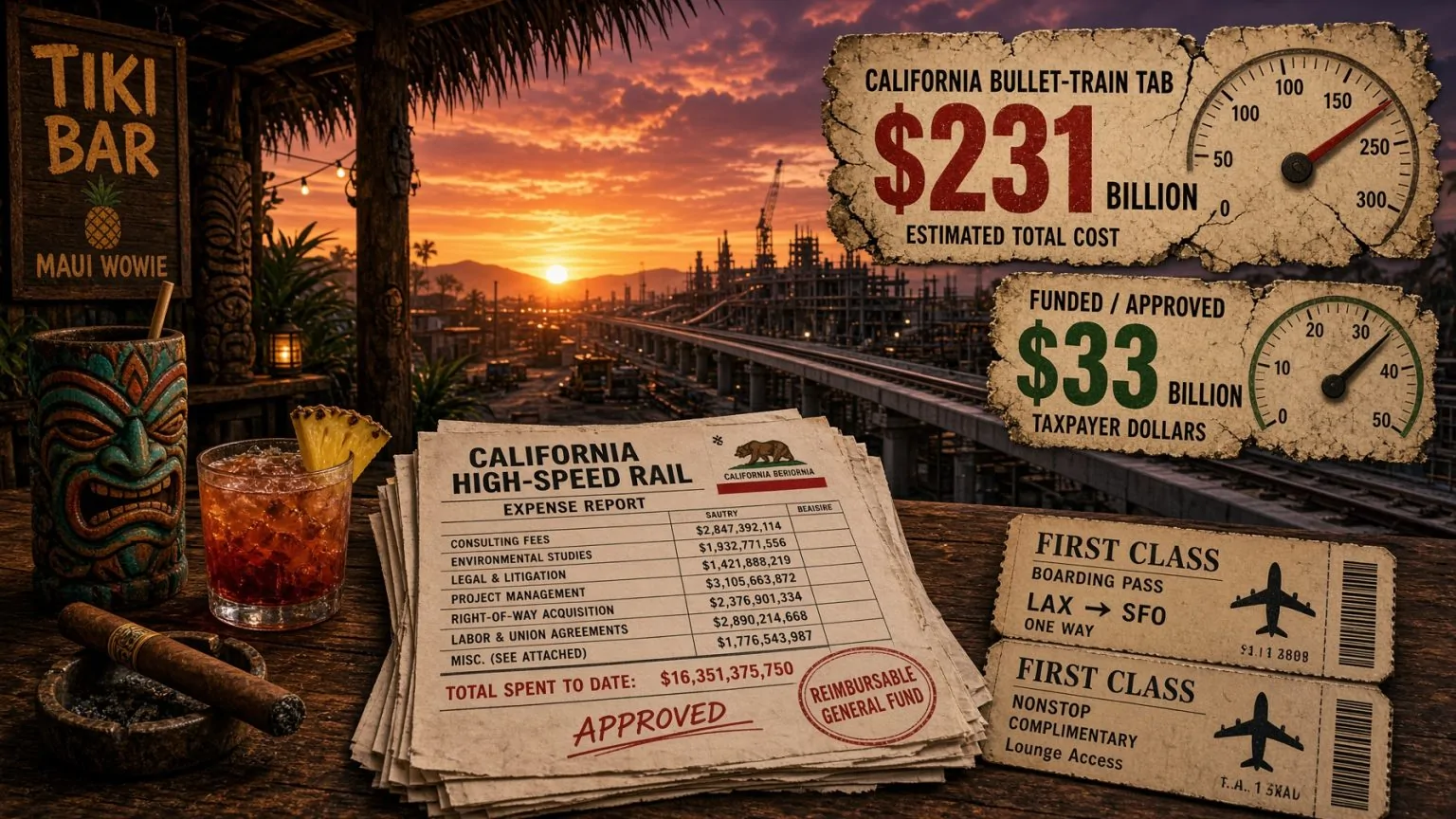
On September 15 he reported that four consulting firms, the accounting firm KPMG among them, had billed about $600,000 in travel that state rules or their own contracts didn’t allow. That was more than half of everything he looked at. The claims included first-class flights and car rides to a night club until 2:30 in the morning, a cigar lounge in Washington, DC, a tiki bar and an escape room.
One legal consultant billed for about 30 trips between Denver and Sacramento in a year: $40,800 in travel costs, plus $86,500 in billable hours for the time he spent getting there. That is roughly $4,000 a trip before he did any legal work.
Voters approved this train in 2008 for $33 billion, with service by 2020. The current estimate is that it will cost up to $231 billion and be finished by 2040.
$26,450 per student, and 62% of them still can’t do math
And while we’re talking about California, the state released its annual test results on Thursday under the headline “New Statewide Data Shows Continued Progress for California Students.”
Progress??? Their own report shows only 49% of students met the state’s basic English standard, and just 38% met the math standard. Both are still below 2019. Among low-income students, 61% fell short in English and 73% in math.
Governor Gavin Newsom’s statement called the results “important evidence that our sustained investments are making a difference.”
Here are the investments, according to the Legislative Analyst’s Office, the legislature’s nonpartisan budget staff: about $143 billion on K-12 schools in the year these tests were taken, roughly $26,450 per student.
The state’s answer is to spend 7% more this year, about $28,250 per student.
It’s a great plan! When has spending more money ever failed to produce solid results in California?
To your freedom, James Hickman Co-Founder, Schiff Sovereign LLC
https://www.schiffsovereign.com/trends/a-good-week-to-be-on-a-government-payroll-156125/
Iraq Economic News and Points To Ponder Late Saturday Evening 10-17-26
Source: Over $11M Missing From Iraqi State Bank
2026-10-17 Shafaq News- Baghdad
More than 17 billion Iraqi dinars ($11.18 million) in collected revenues and funds held in electronic accounts have reportedly gone missing from a state-owned bank, a source familiar with the matter told Shafaq News on Saturday.
The Federal Commission of Integrity (CoI) and the Federal Board of Supreme Audit should investigate the missing funds, review financial records and related electronic accounts, and examine collection and transfer procedures, according to the source, who said the inquiry should identify any administrative or financial failures, determine who was responsible, and take legal action against anyone found to be involved or negligent, while strengthening oversight to prevent similar incidents.
The bank’s identity, the timing of the disappearance, and whether an official investigation has begun remain unclear. Read more: Iraq's Dawn Crackdown moves from raids to rulings
https://shafaq.com/en/Economy/Over-11M-reportedly-missing-from-Iraqi-state-bank
IMF Pledges “Firm” Support For Iraq
2026-10-17 Shafaq News- Bangkok The International Monetary Fund (IMF) intends to support Iraq “very firmly,” Managing Director Kristalina Georgieva said on Saturday.
“We will get to Iraq both money and policy support,” Georgieva said at a closing news conference during the IMF and World Bank annual meetings in Bangkok, citing significant progress toward the program. “We still have a bit more work to do together, and I’m confident we will be successful,” she added.
LIVE NOW: IMF Managing Director Kristalina Georgieva and IMFC Chair, Saudi Finance Minister Mohammed Al-Jadaan, will brief the press on the outcomes of the International Monetary and Financial Committee meeting.
The IMF and World Bank Group held their annual meetings in Thailand from October 12 to 18, bringing together finance ministers, central bank governors, and other officials to discuss global economic issues.
Among the attendees was Iraqi Finance Minister Faleh al-Sari, who outlined Iraq’s Vision 2050, which aims to reduce reliance on oil, strengthen the private sector, and promote inclusive, sustainable growth through stronger institutions.
Al-Sari also expressed confidence that Iraq could complete its financial reforms within the next two years, underscoring the importance of cooperation with the Fund in supporting those efforts.
In its October 13 World Economic Outlook, the IMF projected that Iraq’s economy would contract by 16% in 2026 before growing by 19% in 2027. The Fund also forecast a current account deficit of 10.8% of gross domestic product this year.
Iraq has been seeking to diversify its economy and increase non-oil revenues, as oil accounts for around 85% of government revenue. According to IMF data, the Fund last approved a $5.34 billion Stand-By Arrangement for Iraq in July 2016, of which the country drew approximately $2.1 billion.
Read more: The rentier trap: Iraq’s existential reform race
https://shafaq.com/en/Economy/IMF-pledges-firm-support-for-Iraq
ECO Iraq: Iraqi Crude Production Reaches 830M+ Barrels
2026-10-17 Shafaq News- Baghdad Iraq produced approximately 834.7 million barrels of crude oil during the first nine months of 2026, with average daily production reaching its highest level in September at 4.399 million barrels, ECO Iraq Observatory said on Saturday.
According to the observatory, production averaged 4.097 million barrels per day in January and 4.140 million in February before falling sharply amid the regional war to 1.906 million in March and 1.633 million in April. Output reached its lowest level in May at 1.406 million barrels per day before recovering to 1.525 million in June, 2.901 million in July, and 3.746 million in August.
Read more: No exit but Hormuz: Iraq's economic vulnerability exposed
https://shafaq.com/en/Economy/ECO-Iraq-Iraqi-crude-production-reaches-830M-barrels
Iraq Imports 95% Of Market Needs, PM Adviser Says
2026-10-17 Shafaq News- Baghdad aIraq relies on imports for about 95% of its market needs, excluding grains supplied through the food ration system, Prime Minister's financial adviser Mudher Saleh said on Saturday.
Speaking at a trade, economy, and social responsibility forum in Baghdad, Saleh estimated annual private-sector imports of goods and services at $50 billion, rising to $70 billion when government imports are included. He warned against continued dependence on oil revenues to finance imports, particularly consumer goods.
He also called for closer links between trade, agriculture, and handicraft industries to create jobs and proposed establishing a dedicated body to support small and medium-sized producers and integrate local products into food supply chains, cooperatives, and markets through commercial contracts.
Deputy Trade Minister Sattar Al-Jabri told Shafaq News that “the ministry's responsibilities extended beyond securing food supplies to easing financial pressure on households, regulating commercial activity, and maintaining stable markets and fair prices.”
Ibtihal Hashem Al-Rubaie, director-general of the ministry's Administrative and Financial Department, called for greater support for productive businesses, training opportunities for young people and women, and a transparent, stable investment environment.
She argued that companies should be judged not only by profits but also by their contributions to employment, education, environmental protection, and good governance. Social responsibility, she added, should become a lasting institutional practice rather than a collection of isolated initiatives, with public and private institutions working together to direct resources toward sectors most in need.
Read more: Classroom to street corner: Degree holders stranded in Iraq's job drought
https://shafaq.com/en/Economy/Iraq-imports-95-of-market-needs-PM-adviser-says
Iraqis Buy 166 Homes In Turkiye In September
2026-10-17 Shafaq News- Ankara Iraqis ranked second among foreign homebuyers in Turkiye in September 2026, purchasing 166 homes and eight commercial properties, the Turkish Statistical Institute (TURKSTAT) said on Saturday.
Figures showed that Russian nationals topped the list with 388 homes, while Germans ranked third with 162. Iranian nationals purchased 159 homes, followed by Ukrainians with 158 and Chinese buyers with 124.
Home sales to foreigners in Turkiye rose 9.9% year on year in September to 2,167 units, accounting for 1.5% of total home sales nationwide.
Between January and August 2026, Iraqi citizens purchased 831 properties in Turkiye, including 801 homes and 30 commercial properties, according to TURKSTAT.
https://shafaq.com/en/Economy/Iraqis-buy-166-homes-in-Turkiye-in-September
Ariel: What is Not Feasible for Iraq (and More)
Ariel: What is Not Feasible for Iraq
10-17-2026
In My Opinion- What Is Not Feasible For Iraq
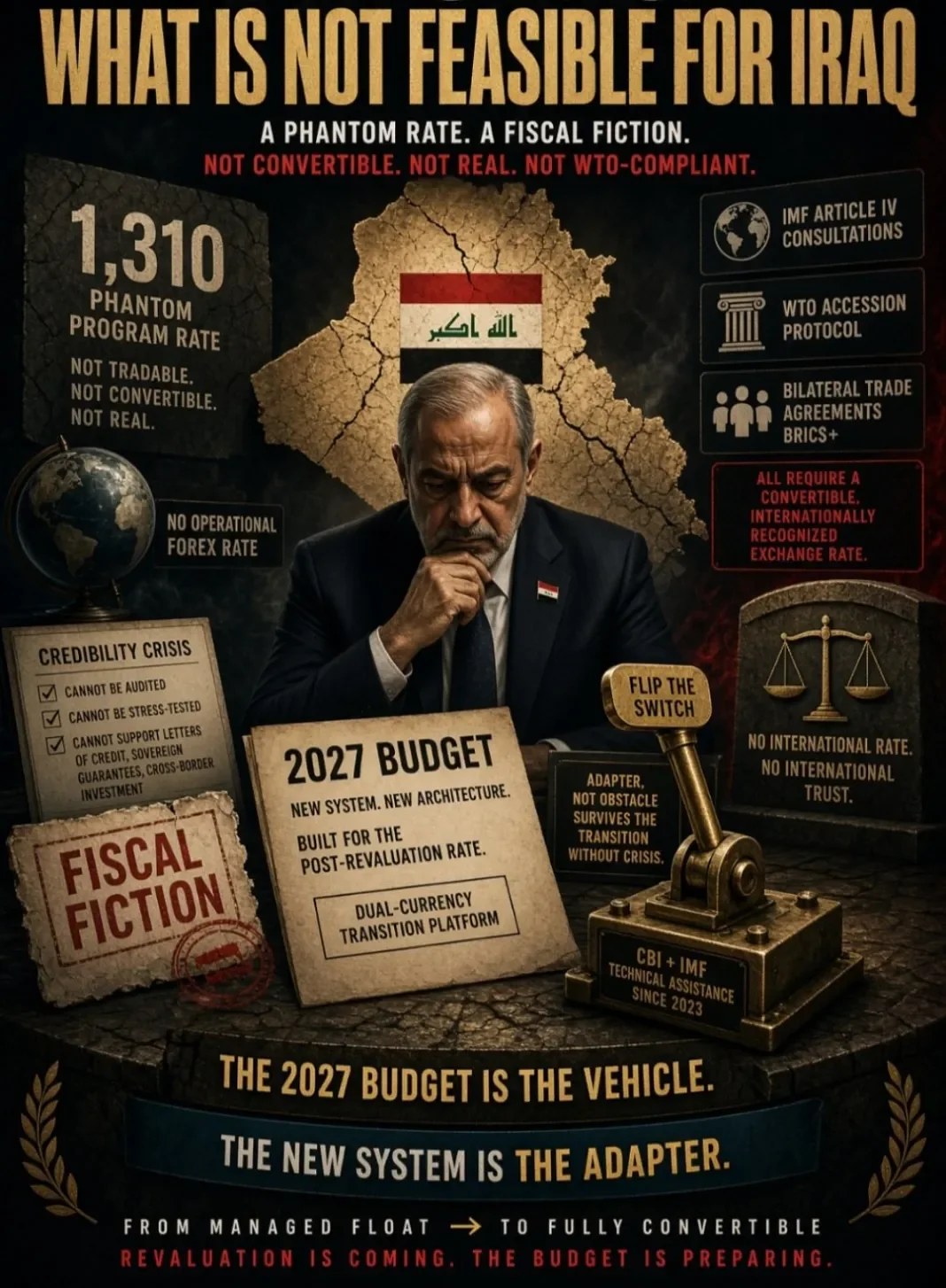
Iraq cannot formally submit a credible, WTO-compliant 2027 budget using a phantom program rate (1,310) that nobody not the IMF, not the World Bank, not their own central bank governors believes reflects economic reality.
A budget denominated in a currency that has no operational international Forex rate is a fiscal fiction. It cannot be audited. It cannot be stress-tested.
It cannot support the letters of credit, sovereign guarantees, and cross-border investment instruments that a functioning state requires.
The IMF’s Article IV consultations, the WTO accession protocol, the bilateral trade agreements with BRICS+ nations all of them require a convertible, internationally recognized exchange rate.
Iraq currently has none. The 1,310 program rate is a managed float maintained for domestic transactions. It is not tradable. It is not convertible. It is not real.
The Rudaw report I referenced Iraq preparing its 2027 budget using a “new system” is the signal that Baghdad is not planning to submit a budget under the phantom rate.
They are building the budget architecture to accommodate the post-revaluation rate.
The “new system” is likely a dual-currency or transition-capable platform that can denominate line items in the current program rate for domestic continuity but instantly convert to the new international rate the moment the Central Bank of Iraq flips the switch.
This is not speculation.
This is standard IMF technical assistance protocol for countries transitioning from managed-floating to fully convertible currencies.
The CBI has received IMF technical guidance on exactly this process since at least 2023. The 2027 budget is being prepared on a framework that anticipates the revaluation during the fiscal year.
The budget is the vehicle, not the obstacle. The new system is the adapter that allows the budget to survive the transition without triggering a fiscal crisis the moment the zeros drop.
Final Assessment
Iraq can submit a provisional 2027 budget with a placeholder exchange rate to satisfy the parliamentary calendar, then amend it within 60-90 days when the international rate goes operational. This is standard procedure for countries undergoing currency reform during a fiscal cycle.
The Real Exchange Rate
More likely, however, Baghdad will delay formal submission until the rate is public because submitting under the phantom 1,310 locks in domestic obligations at an artificially devalued rate that would create chaos if the revaluation occurs mid-year.
The Logistics Are Locked
The “new system” Rudaw references is designed to prevent exactly that. It allows the budget to be finalized with the phantom rate for continuity, but all international-facing obligations (debt service, trade credits, investment guarantees) are denominated in the future rate as “contingent line items” that activate automatically when the CBI announces the new exchange rate.
This Is Key
Iraq doesn’t need the rate to be public to submit the budget. Iraq needs the rate to be public to execute the budget. The submission is the starting gun. The execution requires the Forex rate. And the rate requires Vought’s trigger. The sequence holds.
Source(s):
• https://x.com/Prolotario1/status/2111231289923604641
https://dinarchronicles.com/2026/10/17/prolotario-what-is-not-feasible-for-iraq/
************
Who is Russ Vought?
Russell Thurlow Vought is an American political advisor who has served as the director of the Office of Management and Budget since February 2025 and is a primary architect of the Heritage Foundation's Project 2025 blueprint. Vought has additionally served as the acting director of the Consumer Financial Protection Bureau from February 2025 to August 2026 and as the acting administrator of the United States Agency for International Development from August to November 2025. He served as the Office of Management and Budget's director from 2020 to 2021 and as its deputy director, as well as its acting director, from 2018 to 2020.
https://en.wikipedia.org/wiki/Russell_Vought
Vought’s title is director of the Office of Management and Budget. The OMB directorship is one of the most powerful jobs in Washington, and Vought has used his position to wage a quiet war to change the shape of the entire U.S. government. In Vought’s hands, OMB has acted as a choke point for the funding that Congress approves and agencies rely on to run the government. While he tends to operate behind the scenes as much as possible, his influence in Trump’s second administration is so pronounced that people have described him as akin to a shadow president.
https://www.propublica.org/article/about-russell-vought-trump-shadow-president
Ariel: The Russ Vought Connection to Iraq’s Revaluation
10-17-2026
Russ Vought: A Powerful Date With Destiny (Budget & Rate)
The silence around Russ Vought is the loudest signal in Washington right now. When Vought makes his “tremendous announcement” and the RV initials are not accidental, they’re a branding signature he will unveil the complete dismantlement of the administrative state’s independent funding mechanisms.
WTO REFORM REQUIREMENTS AND THE IRAQ CONNECTION
The State Department’s pronouncement on WTO accession reforms is the signal the currency markets have been waiting for. Iraq cannot join the WTO with a currency that has three extra zeros on its face value.
The WTO accession protocol requires a nation’s currency to be convertible, stable, and reflective of actual economic fundamentals.
Iraq’s foreign reserves now exceeding $130 billion in hard currency and gold combined with their hydrocarbon export capacity and the massive foreign investment flowing into their reconstruction zones, make the current 1,310 IQD/USD exchange rate an absurdity.
It is a deliberate suppression mechanism maintained by the very same globalist banking cartel that Vought is about to dismantle. The “dropping three zeros” process is technically a redenomination removing the inflationary artifact of the Saddam-era sanctions and the subsequent occupation-era currency printing followed by a “revaluation” that sets the dinar to a rate reflecting Iraq’s actual purchasing power parity.
The State Department’s public acknowledgment of WTO accession requirements is the green light. They wouldn’t be speaking about it openly if the revaluation weren’t already sequenced and approved at levels most analysts don’t have clearance to see.
THE RV CASCADE: WHY VOUGHT’S ANNOUNCEMENT TRIGGERS IT
Here’s the piece no one is connecting. Vought’s dismantlement of the administrative state’s independent funding mechanisms directly eliminates the Treasury and Federal Reserve’s ability to maintain the artificial suppression of multiple foreign currencies that the United States has manipulated for decades through dollar weaponization.
When the Fed’s off-budget authorities get stripped, the swap lines, the currency intervention protocols, the special drawing rights manipulations all of it collapses within days.
Iraq is first in the queue because their revaluation package is already prepared, already approved by the IMF under conditions that the U.S. can no longer veto, and already integrated into the bilateral trade agreements with China, Russia, and the BRICS+ nations that have been waiting for exactly this moment.
The dinar RV is not an isolated event it is the first domino in a global currency reset that revalues multiple asset-backed currencies simultaneously. Vietnam, Indonesia, Zimbabwe, Venezuela every nation with a resource-backed currency that has been artificially suppressed to maintain dollar hegemony gets unlocked in sequence. Vought announces the dismantlement. The dollar’s artificial dominance cracks. The revaluation cascade begins. Iraq leads.
THE RV IMPLICATIONS FOR YOU All
When the dinar revalues and the State Department’s WTO announcement confirms it’s not a matter of if but when the exchange rate will land somewhere between $3.22 and $4.10, corresponding to Iraq’s actual reserve-to-currency ratio and purchasing power parity.
The redenomination removes the zeros; the revaluation sets the real rate. Your holdings convert at the new rate. The banking system processes it through the new digital currency infrastructure that the Treasury has been quietly building since 2023. And the entire transaction occurs in a financial environment where Vought has already dismantled the mechanisms that the old Fed would have used to freeze, seize, delay, or otherwise obstruct the payout.
This is the sequence: Vought announces administrative state dismantlement, the dollar’s artificial dominance cracks, the WTO accession window opens, Iraq’s revaluation goes live, the cascade triggers across Vietnam and Indonesia and Zimbabwe, and holders of physical and digital dinar positions become liquid at rates that reflect decades of artificial suppression finally corrected.
The wealth transfer is not just a currency event it is a structural defeat of the Cabal’s financial control architecture. (IMO)
Read Full Article:
https://www.patreon.com/Prolotario1/posts/russ-vought-date-172570202
https://dinarchronicles.com/2026/10/17/prolotario-the-russ-vought-connection-to-iraqs-revaluation/
Saturday Iraq News Posted by Tishwash at TNT 10-17-2026
TNT:
Tishwash: President Al-Zaydi: The cabinet formation is complete and we have filled the vacant portfolios.
Prime Minister Ali Faleh al-Zaidi confirmed on Thursday that the cabinet formation is complete five months after the government was formed, stressing the commitment to implementing the government program's priorities and responding to the aspirations of Iraqis.
Al-Zaydi said in a statement received by Iraq Observer that the government has worked diligently and persistently over the past months under extremely complex internal and external circumstances, explaining that the war in the region has imposed, and continues to impose, exceptional economic challenges on Iraq, in addition to security challenges that require the highest levels of responsibility and vigilance.
He added that the government continued to implement its ministerial program approved by the House of Representatives, worked to address complex issues and confront corruption, and took steps to strengthen the country’s sovereignty and independence of decision, leading to the end of the international coalition’s military presence in Iraq.
He explained that the completion of the cabinet formation and the appointment of deputies to the Prime Minister represent support for the government’s ability to manage national issues, and enhance coordination to implement the commitments and programs that citizens are waiting for.
He pointed out that the next stage requires doubling efforts and turning plans and decisions into tangible results that are reflected in the daily lives of citizens.
Al-Zaydi thanked the House of Representatives and the political forces for their contribution to completing the formation of the government, calling on the Deputy Prime Ministers and the ministers who gained the confidence of the Council to bear their responsibilities with the highest degrees of commitment, efficiency and integrity, and to harness their capabilities to serve the citizens and work in the spirit of one team to achieve the government’s goals link
************
Tishwash: US State Department: The Iraqi market offers promising investment opportunities for American companies.
The US State Department affirmed that the Iraqi market offers promising trade and investment opportunities for American companies and exporters, noting that strengthening economic cooperation between the two countries requires improving the business environment and addressing regulatory challenges, in addition to implementing reforms that support Iraq’s path to joining the World Trade Organization.
The ministry stated that government contracts, particularly in the energy sector, provide opportunities for commercial and investment expansion, as Iraq seeks to attract foreign investment and strengthen local industries.
In a related context, data from the Office of the US Trade Representative showed that the volume of trade between Iraq and the United States declined to about $10.4 billion during 2025, compared to 2024, which recorded a higher level of about $1.6 billion.
Trade in goods between the two countries amounted to about $7.9 billion, distributed between US exports to Iraq worth $1.7 billion, and US imports of Iraqi goods worth about $6.3 billion.
U.S. imports of Iraqi goods fell by 16.8% year-on-year, while U.S. exports to Iraq declined by 1.2%, shrinking the U.S. trade deficit in goods with Iraq to $4.6 billion, a decrease of 21.2%.
As for trade in services, its volume reached about $2.4 billion, with US service exports to Iraq declining by 15.5% to reach $1.9 billion, compared to an increase in US imports of Iraqi services by 2.1% to $541 million.
The United States' surplus in services trade with Iraq also decreased by 21%, to about $1.4 billion during 2025.
The US State Department stressed that Iraq’s accession to the World Trade Organization requires fundamental regulatory reforms that would create a business environment and expand the integration of the Iraqi economy into the global trading system link
************
Tishwash: Al-Mashhadani: The Iraqi economy cannot be fixed by changing the exchange rate alone.
Economic expert Abdul Rahman Al-Mashhadani affirmed on Saturday that raising the dollar exchange rate might provide quick and temporary liquidity to the state treasury, but it does not constitute financial reform in itself without comprehensive strategic plans.
Al-Mashhadani told the Information Agency, "True financial reform in Iraq lies in building a genuine, diversified revenue system, working to recover smuggled funds and assets, and reducing wasteful spending within the state apparatus."
He added, "Improving the economic situation requires shifting from total dependence on oil and the dollar's pricing to a modern financial management approach that measures tangible results and generates sustainable, non-oil revenues."
He pointed out that "relying on temporary solutions by manipulating the currency harms citizens' purchasing power and is ineffective. The optimal alternative lies in revitalizing productive sectors such as industry and agriculture to strengthen the stability of the national currency." link
Tishwash: The International Monetary Fund announces its support for Iraq through a loan program.
The head of the International Monetary Fund, Kristalina Georgieva, announced on Saturday that the Fund intends to strongly support Iraq through a much-needed loan program, stressing that the support will include both financial and policy aspects, while noting that intensive discussions are underway with the Lebanese authorities regarding a support program.
Speaking at a press conference concluding the annual meetings of the International Monetary Fund and the World Bank in Bangkok, Georgieva said the Fund would provide Iraq with financial and policy support, adding that talks with Lebanese authorities were making significant progress toward approving a loan program.
She added that the talks on the program had made great progress, with some issues remaining that required joint work, expressing her confidence that an agreement could be reached.
In another context, Georgieva stressed the need for regulators and supervisors to be fully aware of the risks posed by non-bank financial institutions, cyberattacks, and fraud.
She explained that the annual meetings of the International Monetary Fund and the World Bank, which were hosted by Bangkok in recent days, were characterized by a mixture of optimism and concern.
She stressed the importance of central banks focusing on maintaining price stability, noting that IMF members discussed weaknesses in economic resilience, given the depletion of energy reserves and financial resources link
************
Tishwash: Security stability is the key to economic recovery: A member of parliament reveals to Iraq Observer the gateway to attracting investments to Iraq
Iraq's ability to balance consolidating security and enhancing economic performance is crucial, given the interconnectedness and mutual influence of national issues. Sustainable security is a fundamental pillar for creating an attractive investment environment capable of drawing in companies and capital and driving development. Meanwhile, economic reforms require a stable political and security climate to ensure tangible results.
MP Taha al-Difai emphasized that security, political, and economic issues are closely intertwined, and a genuine economic revival cannot be achieved without political and security stability. He pointed out that providing a safe and stable environment would encourage local and foreign companies to enter the Iraqi market and invest their capital in projects that contribute to revitalizing the national economy.
Al-Difai told Iraq Observer, "The government has succeeded in working simultaneously to strengthen security and monopolize weapons in the hands of the state, alongside taking practical steps to stimulate the economy and attract investments, particularly in the energy sector, by providing suitable investment opportunities and offering the necessary facilities to companies wishing to operate in Iraq."
He added that “ensuring a stable business environment is a crucial factor in boosting investor confidence, paving the way for project implementation, job creation, and more effective economic activity,” emphasizing the importance of coordination between security and economic tracks to guarantee the achievement of development goals.
Given the challenges facing the Iraqi economy, there is a pressing need for a comprehensive government vision that links security stability with economic reform, translates the measures taken into tangible investment opportunities that positively impact citizens' lives, contributes to diversifying income sources, and reduces dependence on oil revenues, thereby enhancing the national economy's capacity for growth and sustainability. link
Why Are Central Banks Buying So Much Gold in 2026?
Why Are Central Banks Buying So Much Gold in 2026?
Published: 10-05-2026 De-dollarization is the gradual shift by central banks away from holding the US dollar as their dominant reserve asset. In practice, that usually means adding gold and other currencies instead. In 2026, this shift stopped being a theory investors had to take on faith.
Specifically, it is now a documented pattern, visible in the World Gold Council’s own survey data and in the IMF’s own reserve statistics.
Central banks bought a reported 289 tonnes of gold in the second quarter of 2026. That is the World Gold Council’s largest quarterly figure on record. Meanwhile, the dollar’s share of global reserves fell to 56.7%, per IMF data. A record 45% of reserve managers surveyed by the WGC in 2026 said they plan to add more gold. They expect to do so within the next year.
Key Takeaways:
Central banks bought a record 289 tonnes of gold in Q2 2026 (World Gold Council), keeping up a four-year run near 1,000 tonnes a year, though the WGC’s own 2026 forecast is a more moderate 850 tonnes.
The dollar’s share of global reserves fell to 56.7% in Q2 2026 (IMF COFER data), down from a peak above 72% in 2001.
A record 45% of central banks plan to add gold in the next 12 months (WGC 2026 survey); 89% expect global holdings to keep climbing.
The mechanism is specific: the 2022 freezing of $300 billion in Russian reserves put a line item on every reserve manager’s risk model that used to be theoretical.
Most reserve managers target a 15-20% gold allocation, not open-ended accumulation. This is a diversification program with a destination, not a flight from the dollar.
Why Does This Matter Right Now?
GoldSilver has covered the basics before: is the dollar losing its reserve currency status and what de-dollarization actually means. This piece instead focuses on what’s new in the 2026 data.
For individual investors, the useful signal here is less about any single number. It is more about who is buying. This is not retail money chasing a price move. Instead, it is sovereign balance sheets executing a multi-year plan. That plan has nothing to do with what gold did last Tuesday.
As of early October 2026, gold trades in the mid-$4,100s, down roughly 5% from its September record, per GoldSilver’s own live price charts. Silver sits in the low $60s, down about 9% from its own September peak. That said, it would be easy to read that pullback as evidence the de-dollarization story has cooled off.
The institutional data says the opposite: official-sector buying did not slow when prices did. That gap, between what price charts show and what central bank balance sheets show, is the actual story worth understanding.
Why Are Central Banks Buying Gold Right Now?
The short answer is reserve diversification driven by geopolitical risk, not a bet on next quarter’s gold price. As of mid-2026, central banks had averaged roughly 1,000 tonnes of gold purchases a year for four consecutive years. That is a pace the market had not seen since the era of fixed exchange rates.
The World Gold Council fielded its 2026 Central Bank Gold Reserves Survey between February and May, with a record 76 central banks responding. The survey found that 93% of reserve managers now hold some gold, up from 81% a few years earlier, and that 84% expect gold to make up a larger share of their reserves five years from now.
The Council’s own head of central banks described demand as remaining on an upward trajectory. Separately, 68% of central banks said in March 2026 they planned to increase gold holdings that year, up from 62% the year before.
Individual countries tell the same story at different scales. For example, Poland added 82 tonnes in 2026, working toward a stated 700-tonne target. Similarly, Turkey added 45 tonnes in January alone, pushing its reserves to 565 tonnes.
China’s central bank, meanwhile, reported a 20-tonne addition in July. That was its largest monthly rise since late 2023, a pattern GoldSilver covered in our analysis of China’s gold imports versus its official buying.
It was also its 21st straight month of reported buying, taking disclosed holdings to roughly 2,366 tonnes, or about 8% of its foreign exchange reserves. None of these are retail-sized moves. None are reversible in a weekend the way a trading position is.
Is the Dollar Really Losing Its Reserve Currency Status?
Not in the way that phrase usually implies. The dollar remains the dominant reserve and trade-settlement currency by a wide margin. Nothing in the 2026 data shows an abrupt handoff to a rival currency. Instead, what the data shows is narrower and more precise: a multi-decade decline in concentration. Specifically, the IMF’s own reserve data puts the dollar’s share of allocated reserves at 56.7% at the end of Q2 2026. That is down from 57.2% in Q1, and down from a peak above 72% back in 2001. The World Gold Council’s own central bank survey confirms the same pattern from the buying side.
The euro, by comparison, has held roughly steady near one-fifth of reserves over the same stretch. Meanwhile, the gains have mostly gone to a broader group of currencies, and to gold itself. In fact, gold’s share of global reserves has nearly doubled over the past quarter-century.
Notably, conflating “losing reserve share” with “losing reserve status” is the most common error in this topic. The difference is worth being precise about: a household that moves a third of its savings into a mix of assets has not declared bankruptcy. It has simply diversified.
What Does the 2022 Russian Reserve Freeze Have to Do With Gold?
This is the mechanism that gets skipped in most coverage of this topic. Naming it precisely matters more than simply repeating the word “geopolitics.” After the invasion of Ukraine, Western governments froze roughly $300 billion of Russia’s central bank assets.
In doing so, they demonstrated something specific: a sovereign dollar or euro reserve is not unconditionally safe. Instead, it is safe only on the condition of that country’s relationship with the government whose banking system holds the asset.
For the United States itself, a reserve of US Treasuries carries no such risk. However, for every other country, the freeze changed the calculation. It converted an abstract tail risk into a specific, dated, quantified event.
Reserve committees now model that risk explicitly, rather than assume it away. Gold held in a country’s own vault, by contrast, is simply a claim on a physical object and a domestic legal system. It does not depend on another government’s goodwill.
How Much Gold Are Central Banks Actually Buying, and Is It Slowing Down?
As of early October 2026, the most recent full-quarter figure is Q2 2026’s reported 289 tonnes. That is a record for a single quarter, according to World Gold Council data. Zoom out to the annual picture, though, and the pattern is even clearer (Chart 1). Per World Gold Council data, central banks averaged just 473 tonnes a year between 2010 and 2021.
Every year since 2022 has run two to three times that average. The Council’s own full-year forecast for 2026 continues the trend.
The World Gold Council’s Q3 2026 report is expected in early November. It will be the next real test of whether the Q2 pace held through the autumn price correction.
Even so, one thing is already clear from the survey data: reserve managers are not treating the recent pullback as a reason to pause.
TO READ MORE: https://goldsilver.com/industry-news/article/why-central-banks-buying-gold-2026/
Seeds of Wisdom RV and Economics Updates Saturday Afternoon 10-17-26
Good Afternoon Dinar Recaps,
GLOBAL DEBT RESET WATCH: DEVELOPING NATIONS FACE RECORD DEBT AS NEW FINANCING MODELS EMERGE
Record external debt, shrinking foreign aid and rising financing costs are pushing developing nations to seek new ways to fund growth and reshape their relationships with global financial institutions.
OVERVIEW
Developing countries’ external debt reached a record $12.3 trillion in 2025, increasing pressure on governments to meet repayment obligations while funding essential services and economic development.
International development assistance fell sharply, prompting countries and financial institutions to explore private investment, new partnerships and alternative financing models.
The global financial system is under pressure to adapt, as developing economies seek more sustainable access to capital, greater financial resilience and stronger opportunities for growth.
KEY DEVELOPMENTS
1. Developing Nations Face Record External Debt
According to the United Nations, developing countries’ combined external debt stock reached $12.3 trillion in 2025, approximately $508 billion higher than in 2024.
Although the pace of new borrowing has slowed, debt remains a major burden. Interest costs on long-term external debt rose by nearly 14% in 2025, according to the UN’s analysis of external debt sustainability.
For many countries, the challenge is not simply how much they owe, but how much of their available revenue must go toward servicing that debt instead of supporting infrastructure, healthcare, education, energy systems and job creation.
The pressure is especially severe for the poorest economies. Countries with limited export earnings and restricted access to affordable financing have fewer resources to absorb economic shocks.
Why it matters: When debt payments consume a growing share of national income, governments have less room to invest in development. This can weaken growth, increase financial vulnerability and make future borrowing more expensive.
2. Falling Foreign Aid Is Forcing a Search for New Financing
A Reuters report published October 17, 2026, highlighted the growing challenge facing developing countries as traditional development assistance declines.
Official development assistance from donor countries in the Organisation for Economic Co-operation and Development’s Development Assistance Committee fell by 23% in real terms in 2025, marking the largest annual decline in the history of the measure, according to the report.
In response, governments and international institutions are exploring ways to combine public funding, private investment, philanthropy and technology to finance development projects.
These approaches can help mobilize capital for infrastructure, energy, climate resilience and employment. However, private investors generally expect a financial return, meaning that not every essential project will attract investment without public support or risk-sharing arrangements.
Why it matters: A change in the sources of development financing can alter how money moves across borders, which institutions influence investment and how countries negotiate access to capital. The transition also raises questions about affordability, transparency and the conditions attached to financing.
3. New Partnerships Could Change International Development Finance
Developing nations are also exploring new bilateral relationships, regional partnerships and financing arrangements beyond traditional channels.
The World Bank, International Monetary Fund and other multilateral institutions remain important participants in global development finance. However, concerns about debt burdens, climate challenges, inequality and limited access to affordable funding have increased calls for new approaches.
Potential solutions include blended finance, debt restructuring, stronger domestic revenue collection, improved debt transparency and better use of existing international financial resources.
Debt restructuring can modify repayment terms when a country cannot manage its obligations under existing arrangements. Blended finance combines public or development funding with private capital to help projects attract investment that might otherwise be considered too risky.
These methods are not automatic solutions. Their effectiveness depends on the terms of the financing, the quality of projects, the ability to repay obligations and the economic conditions in each country.
Why it matters: The development-finance landscape may become more diversified, with governments, private investors, regional institutions and multilateral lenders sharing different roles. That could create new opportunities, but it also requires careful oversight to prevent new financing from becoming another source of unsustainable debt.
WHY IT MATTERS
This development reflects a significant challenge in the evolution of the global financial system: how to finance economic growth when traditional sources of funding are becoming more constrained.
Developing countries need capital to build infrastructure, expand energy supplies, create jobs and strengthen domestic economies. Yet high debt payments and declining assistance can limit their ability to make those investments.
The resulting search for new financing models may influence international capital flows, lending practices, development partnerships and the role of established financial institutions.
Three changes deserve attention:
More diverse sources of capital: Governments may increasingly combine multilateral loans, private investment, domestic funding and regional partnerships.
Greater focus on debt sustainability: Creditors and borrowers face pressure to assess whether financing supports productive growth or creates repayment obligations that are difficult to manage.
Changing international financial relationships: Countries may seek a wider range of partners as they negotiate funding, investment and trade arrangements.
These are meaningful developments, but they do not establish that a new global monetary system has been formally adopted. Nor do they prove that a coordinated currency revaluation is approaching.
The evidence points to pressure for reform and diversification in development finance, rather than confirmation of a predetermined financial reset.
WHY IT MATTERS TO FOREIGN CURRENCY HOLDERS
For people following international currencies and the possibility of a broader global financial reset, this story provides useful context about the economic foundations that can influence currency performance over time.
A country's debt burden, export earnings, foreign investment, access to financing and ability to sustain economic growth can all affect confidence in its currency.
If new financing supports productive investment, improves infrastructure and strengthens economic stability, it may contribute to better long-term conditions. If financing instead adds debt without generating sufficient growth or export income, the country may remain vulnerable.
A new loan, investment agreement or development partnership does not automatically increase a currency’s value. Currency performance also depends on inflation, interest rates, central-bank policy, political stability, market liquidity and other factors.
For holders of developing-country currencies, the practical lesson is to distinguish between a country's potential and measurable improvements in its economic fundamentals.
This story offers evidence that international financing arrangements are under pressure to change. It does not announce a currency revaluation, guarantee higher exchange rates or establish a timeline for a global reset.
Hope is reasonable when reforms create stronger economic foundations; financial decisions should still rest on verified information rather than predictions.
THE FIVE PILLARS CONNECTION
Pillar 1: Debt
Record external debt and rising interest costs are central to the story. Countries need financing that supports development without creating repayment obligations that overwhelm future budgets.
Pillar 2: Trade
Exports provide many developing countries with the foreign currency needed to pay for imports and service external debt. Stronger trade relationships and more reliable access to markets can help improve their financial resilience.
Pillar 3: Assets
Infrastructure, productive industries, natural resources and other economic assets can attract investment. The key question is whether financing helps these assets generate sustainable economic value.
Pillar 4: Technology
Technology can improve financial access, productivity, public services and the efficiency of development projects. Its benefits depend on reliable infrastructure, appropriate safeguards and affordable access.
Pillar 5: Energy
Energy infrastructure is essential to industrial development, transportation and economic growth. Financing reliable and affordable energy can strengthen an economy, while expensive fuel imports can worsen external financing pressures.
THE BOTTOM LINE
Developing nations are facing a difficult combination of record external debt, higher interest costs and declining official assistance. In response, governments and international institutions are looking for new ways to mobilize capital and finance development.
The shift could encourage more diversified partnerships and changes in how international investment is organized. Its success, however, will depend on whether new financing creates lasting economic value rather than simply replacing old debt with new obligations.
For those watching the global financial reset, the important signal is the growing demand for a more adaptable, inclusive and sustainable approach to international finance—not proof of an imminent currency revaluation or a guaranteed monetary reset.
As nations seek new ways to finance their futures, the global financial system will evolve through the partnerships, rules and economic foundations built to make growth more sustainable.
Seeds of Wisdom Team
SOURCES
Reuters — "High Debt, Growing Strains Put Focus on Need for New Development Approaches"
UN Trade and Development (UNCTAD) — "External Debt Sustainability and Development 2026"
~~~~~~~~~~
RV Facts with Proof - Step 1🌱 Link
RV Intel Highlights - Step 2🔥 Link
Start Here room with over 110 RV Topics Link
Ask Your ❓Questions❓ in the Q & A Room Link
Seeds of Wisdom Team Rooms Directory Link
Follow the Gold/Silver Rate COMEX
Follow Fast Facts
Seeds of Wisdom Team™ Website
Seeds of Wisdom Team™ Rumble
Thank you Dinar Recaps
You Could Earn 6% On Your ‘Plan B’ Home Abroad
You Could Earn 6% On Your ‘Plan B’ Home Abroad
Note From the Field By James Hickman (Simon Black / Sovereign Man) October 15, 2026
For a lot of Americans, the beachfront condo has become unattainable. In Naples, Florida, the median beachfront condo on the market is listed at about $2 million. And that’s before factoring in condo fees and skyrocketing insurance costs.
Now compare that to an apartment we found during research for members of our flagship service, Plan B Confidential, in João Pessoa, a midsize beach city on Brazil's northeast coast.
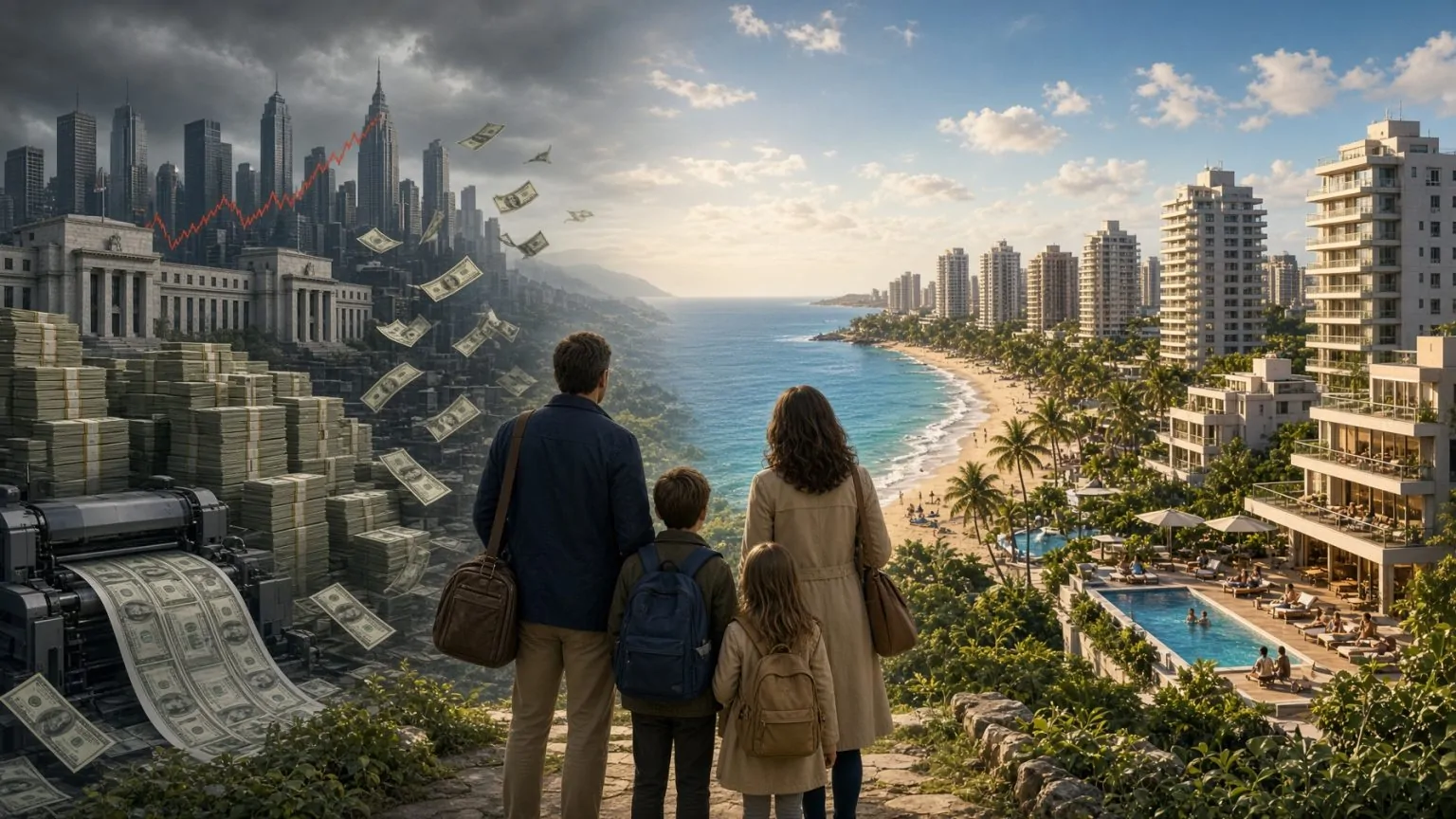
The apartment has four bedrooms, nearly 2,000 square feet, and three parking spaces. It's in Cabo Branco, the prime beach address in town, a hundred meters from the water… and the building has a pool, a sauna, and only two apartments per floor.
The asking price was about $230,000. That's less than $120 a square foot, plus condo fees of less than $300 per month.
The beachfront condos in Naples cost about FIFTEEN times as much per square foot.
And the Brazilian apartment comes with something no Florida condo can offer: buying it qualifies you for a backup residency, i.e., the legal right to live in Brazil if you ever need to.
Brazil lets foreigners apply for residency by buying property. In most of the country the property has to be worth at least $200,000 or so.
But Brazil's government wants investment in the poorer north and northeast, so the minimum there drops to about $140,000. João Pessoa is in the northeast, which means that four-bedroom qualifies with room to spare.
The residency permit runs for four years, and after that you can apply to make it permanent. To keep the residency, you hold onto the apartment and spend two weeks in Brazil every two years.
And while you hold it, you can rent it out, potentially paying for your own backup residency and vacation home abroad. Average rental yields in Brazil are around 6%, and in an upcoming report on Brazilian real estate, we break that down further by region.
Argentina and Mexico offer the same kind of value. Our Argentina report found a two-bedroom in Caballito, a central, residential neighborhood of Buenos Aires, listed at $169,000, or about $165 a square foot.
In Mexico, our report highlighted Playacar, a quiet neighborhood on a golf course next to the center of Playa del Carmen. The two-bedroom condo we found there is on the ground floor and comes fully furnished, with a big terrace beside the pool.
The asking price works out to about $220,000 at today’s exchange rate, or roughly $170 a square foot. That’s more than Buenos Aires, but cheap next to anything on an American beach.
(Listings come and go, so treat these as examples of what the money buys.)
While things are good, foreign real estate could simply be a vacation home you visit once a year that generates rental income while you’re away.
Two-bedrooms in Playacar rent long-term for about $1,100 to $1,400 a month. Over a year, that’s a gross yield of maybe 5 to 7% of what you paid, before expenses.
In Argentina, renting out an apartment makes sense again. For years the law forced landlords into three-year contracts and restricted how much they could raise the rent.
Then President Javier Milei scrapped those rules at the end of 2023, and within six months rental listings in Buenos Aires rose more than 170%.
Residency in Argentina and Mexico is even easier than in Brazil, because you don’t need the apartment at all.
In Mexico, you only need to prove that your income or savings meets a modest threshold; right now about $75,000.
Argentina gives residency to foreigners who can show steady passive income from outside the country— dividends, interest, rent, etc. Lawyers there tell clients to show about $2,000 a month for best chances of approval.
Bear in mind that neither government takes the money. You show it and you keep it… and you could hold either residency without owning a thing in the country.
But for the value, owning real estate there might be part of your Plan B anyway.
So in all three countries you end up with a legal right to live there and a cheap place to go that pays rent until you need it.
The logic is simple. If you live, work, invest, and have everything you hold dear in one jurisdiction (which happens to be the most indebted government in the history of the world), that’s a significant risk.
The US government is $40 trillion in debt, Congress won’t cut anything, and the difference gets covered by printing money, which drains the value of your savings. Moving some savings into stronger jurisdictions, establishing a second residency, and taking every legal step to cut your tax bill all mean that no single government’s incompetence has total claim over your life.
That’s what a Plan B is.
And the thing that finally gets you to go might be nothing more dramatic than a cheaper life. When our team went through João Pessoa earlier this year, a 25-minute Uber ride cost about $5, and a steak dinner at a decent restaurant ran about $25.
None of this is radical. It’s not about fleeing. It’s about having the option to go somewhere you actually enjoy— somewhere you might already vacation— and having the legal right to stay there indefinitely if you ever need to.
To your freedom, James Hickman Co-Founder, Schiff Sovereign LLC
P.S. The Brazil, Argentina, and Mexico apartments in this article came out of country reports we published this year in Plan B Confidential. We regularly publish these types of reports that go neighborhood by neighborhood with listings, rents and agents, and they spell out what each residency requires, step by step.
https://www.schiffsovereign.com/lifestyle-design/you-could-earn-6-on-your-plan-b-home-abroad-156114/
Part 2: A Secret Global Monetary Reset Has Started (Watch Before This Video Is Banned)
Part 2: A Secret Global Monetary Reset Has Started (Watch Before This Video Is Banned)
George Gammon: 10-17-2026
Chapter 4: Bank creation of money
I'm going to show you how these banks create the dollars, create the money supply, and how that in and of itself creates a tremendous amount of demand for dollars and treasuries.
What we have is a debt based monetary system. I'm sure you guys have heard that term before. And essentially what that means, whether we like it or not, is money or currency, whichever term you want to use, is really debt.
In other words, for every $1 that exists, there has to be at least $1 of debt. And usually, it's a multiple of that.
Now, for the sake of this example, we're going to go ahead and set aside currency in circulation and some technical parts of the Fed's balance sheet because 95% of the dollars, especially outside of the United States, came into existence this way.
Let me show you what I'm referring to. So, let's go ahead and use a scenario that everyone can easily understand. We've got the average Joe here and he's going to take out a mortgage from the bank to buy a home from the average Jane, So, the average Joe goes to the bank. and he says, "Hey, I need a loan for we'll just call it $100,000 because I need to buy this house from the average Jane."
Now, the key here is the bank, this is the balance sheet for the bank, assets on the left, liabilities on the right, has no money to begin with in this example. They don't need it. So what a lot of people think of is a bank is just an intermediary where they take dollars from over here that already exist because I don't know the government created it or something like that and then they take those dollars and they give it to someone else.
That is not how the banking system works. Just if you have that idea in your head, just forget about it right now. It's not how the system works. the system could function with no dollars, with no bank reserves to begin with. Here's how.
You've got that bank, assets on the left, liabilities on the right. They go ahead and create those dollars out of thin air. And they deposit them into the average Joe's bank account. Let's say that average Joe has an account with this bank.
And how do they do that? Well, it's just an electronic number. They just go over to the computer and type in $100,000 in his account and then he has $100,000.
Now, there has to be an offsetting asset because that's a liability on the bank's balance sheet, which there is. It's the loan they just created. Now, what does this loan represent? This is another key you've got to get your head around. It represents future demand for those dollars that were just created.
Let me show you what I'm referring to. So Joe wants to purchase that house from the average Jane. He wants that to go onto his balance sheet, but he has to give Jane the dollars. So let's say she banks with another bank. So those dollars will go over here. And editor, you can help me out with that one. Let's go ahead and delete the dollars there and let's make them appear on the asset side of her balance sheet. We almost put them on the liability side. Okay.
But now Joe's balance sheet has the house as an asset, but the liability again is that loan, the money, the $100,000 plus interest that he owes the bank. And now let's go ahead and take it a step further.
Assume that Jane takes that money asset side of the balance sheet and spends it into the real economy because she wants to buy whatever $100,000 car or something like that. So now we have those dollars that were created by the bank by lending them into existence. Those dollars are circulating.
They're circulating in the economy. But every single month, Joe has got to come up with, let's say, $2,000.Let's say that's his mortgage payment. So Joe represents demand for dollars because every single month he's got to go out to the economy. He's got to do something to get those dollars to go ahead and pay back the bank. So hopefully you guys can see now how thisb debt based monetary system actually creates future demand for the dollars that are created by the debt to begin with.
And unfortunately, this is just the start. It gets a lot worse, if you want to look at that way.
Chapter 5: The role of derivatives
it's not just the debt, it's also the derivatives.So, let's think about this in terms of an FX swap. It's actually sounds complicated, but it's not.
Let's say we've got corporation ABC and XYZ, and ABC needs yen and XYZ needs dollars. Sothey go agree to go ahead and take let's say a billion dollars and a billion dollars worth of yen and go ahead and swap them for let's just say three months at a predetermined exchange rate.
So you see what happens here. If XYZ gets those dollars, they're likely going to use them to spend out into the global economy, but in three months they're going to need to somehow get those billion dollars. Is that the number we said? We'll go with it. a billion dollars from somewhere by selling cars or selling widgets or whatever it is. So that in and of itself creates another $1 billion of future demand for dollars.
Now those of you who are really paying attention might be saying, "Yeah, George, okay, but that also creates future demand for yen." And it absolutely does. But let's just look at these FX swaps as far as the overall derivatives picture. And I'd like to remind you that 90% plus of the FX swaps globally, which is basically a hundred trillion market in and of itself, 90% of those transactions have the USD on one side.
So just in this super oversimplified example, we have demand coming from the banks lending the dollars into existence, we have even more demand on top of that from the shadow banks lending them to other entities. And then on top of that, we could have those dollars that were created by this bank that went to ABC and let's just say a loan. Those are going to XYZ.
They go ahead and spend those out to the real economy which creates even further future demand for those original dollars that were lent into existence in this debt based monetary system.
So now let's go back to the visual capitalist because of course the next question is okay George how much globaldebt is there which could represent demand for these dollars? Well, I'm glad you asked.
We showed you the visual representation of how big it was compared to the broad money supply or the Fed's balance sheet, but I didn't give you a specific number. So, remember this goes back to 2020 when the size of the global debt would be much smaller than it is today. And even back then there was $253 trillion which at the time represented $322% of global GDP.
But now let's get to the elephant in the room which is [laughter] obviously derivatives. We showed you the size of everything else. So let's just look at the derivatives in those exact same terms. Now for this one editor, help me out. We're going to have to start scrolling. But we're going to have
But we still have to keep scrolling and scrolling and scrolling and scrolling and scrolling. Why? Because the high-end estimate for the amount of derivatives that are out there, because no one really knows, notional value would be over one quadrillion dollars.
One quadrillion dollars. Now, it is true, this is notional, and it is true that not all of this would be denominated in dollars, but the vast majority of it would. So we have one quadrillion dollar where a significant portion of that represents future demand for dollars. And on top of that we have a measly 253 trillion of debt or the vast majority of that represents future demand for dollars.
So then the question becomes taking it back to the petro dollar and the sideeshow.
How big is that market? How big is the oil market? In other words, well, I'm glad you asked. We go over to another page from the visual capitalist and we can see the crude oil market is a whopping 2.1 trillion.
So let's assume for a moment that we lose the entire petro dollar system that because Saudi Arabia is mad at us or because of what's going on in the Middle East, they no longer sell their oil for dollars. They start selling them for euros or yuan or gold or whatever it is.
Okay? So we lose $2.1 trillion of demand, but we have one quadrillion.
But assuming the one quadrillion in derivatives and 253 trillion in actual debt represents, I don't know, we'll just throw it out there and say $500 trillion of future demand for dollars.
You see what I'm saying? We've got $500 trillion of demand over here.
We got 2.1 right here in terms of the oil market or possibly the petro dollar. But we're not done. Editor, let's go back to the previous page and look at that visual representation of the 253 trillion in global debt.
Because I know a lot of you right about now are saying, "Whoa, whoa, whoa, whoa, George. Okay, this explains the demand for dollars. What about the demand for treasuries?" Well, let's think about this. This $253 trillion of debt came from banks and other entities, shadow banks, let's say.
But a lot of this debt needed something called collateral, right? Going back to the example that we just gave, the collateral there for the bank was the average Jane's, which became the average Joe's house. That was the collateral. That's why they did the loan to begin with.
So a significant percentage of this $253 trillion in debt is backed up by a collateral called US treasuries. So you can see very clearly why even if there is demand for dollars and treasuries that is created by pricing oil and dollars, it is absolutely insignificant compared to how the monetary system itself has evolved because that is the reset that nobody is talking about.
Chapter 6: The banking trick
So a significant percentage of this trillion in debt is backed up by a collateral called US treasuries. So you can see very clearly why even if there is demand for dollars and treasuries that is created by pricing oil and dollars, it is absolutely insignificant compared to how the monetary system itself has evolved because that is the reset that nobody is talking about because nobody really knows that it happened because it happened in secret.It happened in the shadows.
And this paradigm shift was started by the banks long before 1971 and long before the petro dollar was established in 1974.
So when you think about the monetary system, the way it really works, not what you hear on CNBC, definitely not what you hear about on YouTube, where the banks are at the center of it all.
It reminds me of that quote from The Usual Suspects. I'll go ahead and read it to you. The greatest trick the devil ever pulled was convincing the world he didn't exist.
And I think the greatest trick the banks ever pulled is convincing you that the Federal Reserve, the Treasury, or the petro dollar actually control the dollar itself.
A Secret Global Monetary Reset Has Started (Watch Before This Video Is Banned) Part 1
A Secret Global Monetary Reset Has Started (Watch Before This Video Is Banned) Part 1
George Gammon: 10-17-2026
Chapter 1: The global monetary reset
A global monetary reset is happening right now. And I can assure you it is nothing like what you've been told. You think it's about oil and the petro dollar, but it's not. It's about debt.
It's about trillions and possibly quadrillions of dollars in debt. This is the biggest monetary reset in the history of the world. It might even be the biggest event the world has ever seen. And it's happening in secret.
It's happening in the shadows. It's happening without anybody knowing. And I can assure you this has huge ramifications for your portfolio, for gold, for Bitcoin, the global economy, and potentially the entire world order as we know it.
This is not something that you're going to hear in the mainstream media, and it's definitely not something that you're going to hear on YouTube.
But today, in this video, I'm going to reveal everything to you. so you can be better prepared.
Chapter 2: The petrodollar system petro dollar system actually works and the possible changes that's going to happen to this system as a result of what's happening in the Middle East right now as we speak.
But as we go through this video, you'll see dollar system is just a sideshow and what we really need to focus on is the main event.
(Using white board illustrations)
This is the petro dollar system. It's actually quite simple. But before we get there, let's go back in time to 1971. This is when Bretton Woods basically collapsed. Nixon took us off the gold standard.
So according to history books and economists, we needed to create some sort of demand for dollars. We needed to create a new system where there was also additional demand for US treasuries.
So, we went to Saudi Arabia in 1974 and said, "Hey, let's do this deal and we'll call it the petro dollar." And the deal basically goes like this. Saudi Arabia sells all of their oil for dollars.
The way the story goes is this creates demand for those dollars and then they take those dollars that they get for selling the oil andTop of Form then they go ahead and recycle them back into US treasuries so they can have a dollar asset where they're getting paid a little bit of interest.
So they sell the oil for dollars. Then they take those dollars. They give them to this guy, your drunk, insolvent Uncle Sam right here. And then he takes those treasuries and gives them back to Saudi Arabia. And that becomes the asset on their balance sheet that replaces the dollars that they received for selling the oil.
But of course, there's another part of the deal. So Saudi Arabia agrees to this, but the United States agrees to back them from a military standpoint. So if they have any conflict, if anyone, I don't know, like bombs one of their airports, then we promise to come in onbour white horse and save the day.
So let's go over a quick visual of how this works, just so everyone is on the same page. We've got the United States here.
We have Saudi Arabia.So, we have all this oil that's being produced in Saudi Arabia. They're shipping this down to whoever is below them. I don't know, let's say Africa. They're shipping this over to the east, to the northeast, that's probably Asia, and they're sending it straight up to Europe or over to the west kind of.
And in return, the Asians, let's say Japan, are sending them dollars. Now, this is very interesting because obviously the dollar is not the currency that they use in Japan. It's yen. So, what the Japanese have to do is they actually have to sell their yen to get the dollars they need to go ahead and send to Saudi Arabia to get that oil that they absolutely have to have.
And it's the same thing in Europe where the Europeans are having to take those euros, turn them into dollars. And it would be the same thing here. whatever currency they're using that is south of Saudi Arabia, they got to exchange that currency for the green back and send that to Saudi.
And like we said right here, Saudi sends that to your drunk insolvent Uncle Sam. That would be the US Treasury. Then your drunk insolvent Uncle Sam sends in all of this US debt, which is basically an IOU that promises to pay them a little bit of interest.
So, like I said, the petrod dollar system itself pretty straightforward. It's not rocket science. What's important to understand are the results or the ramifications of this system. At least the ones that you're told by all the people on YouTube, the economists, and the mainstream media.
See, what you're told is because we have this petro dollar monetary system, this creates demand for dollars that otherwise wouldn't be there, giving it more value relative to other currencies. And it also creates more demand for treasuries than otherwise would be there. So, it keeps our interest rates low.
So it allows your drunk, insolvent Uncle Sam to run up all of this debt, $40 trillion dollars of debt, and run these giant, massive, epic, biblicalsized deficits. But there's a problem and it's a really, really big problem. The problem is none of this actually matters.
Chapter 3: The debt-based dollar
Why? because we have transitioned secretly in the shadows. Like I said earlier, no one really even knows about this, but we've been transitioning from this petro dollar system to a new system, a new global monetary system.
And for the sake of this video, we'll call it the D and D dollar. Now, what does that stand for? It's not the pro dollar. It's the debt and derivatives based dollar. That's the monetary system that we are living in right now.
And this paradigm shift, this reset, if you will, changes absolutely everything. It should change the way you look at your portfolio. It should change the way you look at money. And it should change the way you look at the world.
Earlier, what I talked about is what everyone focuses on in the mainstream media especially here on YouTube, is just a sideshow. It's really irrelevant. And what you have to focus on is the main event. And that's what we're going to talk about right now.
So to start, let's go to the visual capitalist and look at the Fed's balance sheet. And I love this because it gives you a visual representation of the actual size of the balance sheet compared to other things that are vastly more important.
Again, what we want to do is we want to focus on the main event. We don't want to focus on the slideshow. So here you can see the size of the Fed's balance sheet represented by these little colored squares. And this is as of I think the end of 2020. But believe it or not, the Fed's balance sheet is a similar size right now in 2026.
So you've got the visual size there.
Let's go ahead and scroll down to the actual money supply. And here they say the global money supply, broad money, is right around 95 trillion. Now today it's going to be a lot higher than that. And I would argue even back then it was much larger than the 95 trillion.
The base money is very very difficult to measure because you would have to have access to the information for every single bank all around the world. So this is a rough guesstimate and I would say they're undershooting it. But even back then, again, 2020, we're looking at almost $100 trillion.
And remember, the vast majority of that is going to be denominated in dollars. And then we need to ask ourselves, who really controls the dollar? Is it the US government? Is it the Federal Reserve? or is it the banking system? Because they're the ones that created the almost $100 trillion dollar that you see represented on this screen.
So if the banks are creating the vast majority of the money supply, the vast majority of dollars, and it's not the FederalReserve, it's not the US government, how on earth do the banks do this? I mean, do they have a printing press? And the answer is kind of. editor, go ahead and throw up the size of the global debt versus the size of the money supply versus the size of the Fed's balance sheet. So, we go from tiny to large to massive. [laughter] You can see right there on the screen.
And the punchline is the banks lend the currency, the banks lend the dollars into existence. So the global monetary system and demand for dollars or demand for treasuries for that matter has absolutely nothing to do with oil and it has everything to do with debt and derivatives. That's the part that we haven't got to yet. And that's the part where you definitely have to be sitting down.
That's when we get to the derivatives. We're going to do that at the end of the video, but before we do, let's go right back to the whiteboard.
MilitiaMan & Crew: The Bank File They Don't Want You To See
MilitiaMan & Crew: The Bank File They Don't Want You To See
10-1702926
The Crew: Samson, PompeyPeter, Petra, Daytrader, Sunkissed, GIGI and Militia Man
No drama. No intrigue. No songs and dances. Just straight, factual news that I read and interpret to the best of my ability after being an avid Dinar investor and insanely obsessed Dinarian for over 15 years.
Follow MM on X == https://x.com/Slashn
Be sure to listen to full video for all the news……..
Iraq Economic News and Points To Ponder Saturday Morning 10-17-26
The International Monetary Fund pledges financial and economic support to Iraq; a forthcoming loan program opens the door to reforms.
Last updated: October 17, 2026 The Independent / Baghdad – The Managing Director of the International Monetary Fund, Kristalina Georgieva, announced on Saturday, October 17, 2026, the Fund’s intention to provide strong support to Iraq through a loan program requested by the Iraqi authorities, in addition to supporting economic and financial policies, in a move that may represent a new phase of cooperation between Baghdad and international financial institutions.
Speaking at a press conference at the conclusion of the annual meetings of the International Monetary Fund and the World Bank Group, held in the Thai capital Bangkok, Georgieva said that the Fund intends to provide financial support to Iraq, in parallel with providing advice and assistance in the field of economic policies.
She affirmed that the Fund would deal with Iraq’s request seriously, stressing the international institution’s readiness to provide the necessary financial and policy support to address the economic challenges.
This announcement comes at a time when the Iraqi economy is facing challenges related to managing public revenues, stabilizing the exchange rate of the dinar, enhancing the efficiency of the banking sector, and the need to diversify sources of income and reduce dependence on oil revenues in financing the general budget.
Iraqi Finance Minister Faleh al-Sari participated in the annual meetings of the International Monetary Fund and the World Bank Group, as part of an Iraqi economic delegation seeking to strengthen cooperation with global financial institutions and open new horizons for technical and financial support.
According to information regarding the participation of the Iraqi delegation, Al-Sari held a series of meetings with officials at the International Monetary Fund, including the Executive Director for Iraq and the region, Mohamed Maait, and the incoming Executive Director, Ali Al-Hosni, in the presence of the Governor of the Central Bank of Iraq, Nizar Nasser Hussein.
The meetings addressed the economic and financial situation of Iraq, the priorities of economic reform, and ways to develop cooperation with international institutions, in order to support financial stability and enhance the ability of the Iraqi economy to deal with local and external changes.
The IMF announcement raises questions about the nature of the anticipated loan program, the amount of funding Iraq may receive, as well as the conditions and reforms that may accompany any new financial agreement.
The IMF programs are usually linked to a comprehensive assessment of the economic and financial situation of the beneficiary countries, with an agreement on a set of policies and procedures aimed at addressing economic imbalances and promoting financial and monetary stability.
From an economic standpoint, a financing program with the International Monetary Fund, if approved and implemented, could contribute to strengthening Iraq's ability to cope with financial pressures and improving international confidence in the management of the economy, as well as supporting efforts to reform public finances and develop the banking sector.
However, these potential benefits remain linked to the nature of the program, the size and conditions of the funding, and the extent to which the Iraqi government is able to implement the required reforms without imposing additional economic burdens on citizens.
In this context, the issue of the Iraqi dinar exchange rate is of particular importance, with the continued discrepancy between the official dollar rate and its prices in the parallel market. This makes monetary stability, improving the efficiency of foreign transfers, and banking compliance issues worthy of follow-up during any future economic discussions.
The Fund’s announcement of its readiness to support Iraq does not mean that a final loan agreement has already been reached, as the announced statements did not include specifying the value of the financing, its duration, or the details of its conditions, nor was a final timetable for approving the program announced.
In a related development, Georgieva confirmed that the International Monetary Fund is conducting intensive discussions with the Lebanese authorities regarding a loan program, noting that tangible progress has been made in the discussions, while work continues to finalize a number of files before reaching a final agreement.
The annual meetings of the International Monetary Fund and the World Bank Group will be held in Bangkok from October 12 to 18, 2026, with the participation of financial officials, central bank governors and representatives of international economic institutions, to discuss the challenges of the global economy, financial stability and growth.
Georgieva’s announcement puts the Iraqi government at an important stage of economic talks, particularly with regard to revealing the details of the required financial program, and the extent of its connection to plans to reform the banking sector, manage public spending, and control the financial deficit.
The most prominent question in the coming period remains: Is Iraq heading towards a broad financing agreement with the International Monetary Fund, and what is the nature of the economic obligations that may result from it?
The answer will become clear when the details of the negotiations, the expected amount of support, and the mechanism for its implementation are officially announced. https://mustaqila.com/صندوق-النقد-الدولي-يتعهد-بدعم-العراق-م/
The International Monetary Fund Pledges Strong Support For Iraq Through A Forthcoming Loan Program.
All News Economy economy sharing Clock Network Published on: October 17, 2026 |
The head of the International Monetary Fund, Kristalina Georgieva, announced on Saturday that the Fund intends to provide strong support to Iraq through a much-needed loan program, stressing the institution's readiness to provide financial support and advice on economic policies.
"The IMF will provide Iraq with financial and policy support," Georgieva said during a press conference concluding the annual meetings of the International Monetary Fund and the World Bank Group in Bangkok.
Regarding Lebanon, Georgieva confirmed that "the Fund is conducting intensive discussions with the Lebanese authorities," noting "significant progress towards the approval of a loan program."
She continued: "We have made great progress in the program, and we still have some joint work ahead of us, but I am confident that we will succeed in this."
In this context, Iraqi Finance Minister Faleh al-Sari participated in the annual meetings of the International Monetary Fund and the World Bank Group, held in the Thai capital, Bangkok, to discuss ways to enhance cooperation with international financial institutions and support economic and financial reform in Iraq.
Al-Sari held a series of meetings with officials of the International Monetary Fund, beginning with a meeting with the Fund’s Executive Director for Iraq and the region, Mohamed Maait, and the incoming Executive Director, Ali Al-Hosni, in the presence of the Governor of the Central Bank of Iraq, Nizar Nasser Hussein.
The meetings discussed the economic and financial situation in Iraq, reform priorities, and ways to enhance joint cooperation with international financial institutions. https://alssaa.com/post/show/64891-صندوق-النقد-الدولي-يتعهد-بدعم-العراق-بقوة-عبر-برنامج-قروض-مرتقب
*********************
An Economist Warns Of The Repercussions Of Iraq Borrowing From The International Monetary Fund.
economy sharing Clock Network Published on: October 17, 2026 |
Economic expert Ziad al-Hashemi confirmed on Saturday that Iraq has begun negotiations with the International Monetary Fund to obtain loans, warning of the potential repercussions of borrowing on government spending and support provided to a number of sectors, in light of the recent devaluation of the Iraqi dinar.
Al-Hashemi said in a Facebook post that “sources in the IMF reported that negotiations with Iraq have begun, and that the Fund is moving towards supporting the country’s access to financing,” considering that “this step raises questions about the justifications for reducing the exchange rate of the dinar, after the government based its justification on avoiding resorting to external borrowing and more painful economic measures.”
Al-Hashemi criticized the trend towards borrowing, considering it an indication of "the continuation of what he described as financial mismanagement," calling on the government to "be honest with citizens about the reasons for requesting loans and to clarify the motives behind this trend, especially after the reduction in the value of the dinar a few weeks ago."
He warned of the "possibility of linking the financing to conditions related to controlling public spending and increasing revenues, and perhaps reducing government support for vital sectors, including fuel and electricity," noting that "the cost of borrowing may become clear gradually after receiving the first installment, and that the Fund's previous recommendations may turn into binding commitments if an agreement is reached."
For her part, the head of the International Monetary Fund, Kristalina Georgieva, announced on Saturday that the Fund will "strongly" support Iraq through the loan program it requested, stressing the institution's readiness to provide financial support and advice on economic policies. https://alssaa.com/post/show/64918-خبير-اقتصادي-يحذر-من-تداعيات-اقتراض-العراق-من-صندوق-النقد-الدولي