
Bond Market Collapse, Debt Trap, Dollar Crisis, Massive Economic Crash Incoming
Bond Market Collapse, Debt Trap, Dollar Crisis, Massive Economic Crash Incoming
Lena Petrova: 9-25-2026
In a recent and deeply insightful discussion hosted by Lena Petrova, renowned economist Peter Schiff provided a comprehensive overview of the looming financial hurdles facing the global economy today.
The conversation shed light on critical issues such as a predicted bond market correction, soaring national debt servicing costs, potential currency shifts, and persistent inflationary pressures that continue to be influenced by global energy dynamics.
Bond Market Collapse, Debt Trap, Dollar Crisis, Massive Economic Crash Incoming
Lena Petrova: 9-25-2026
In a recent and deeply insightful discussion hosted by Lena Petrova, renowned economist Peter Schiff provided a comprehensive overview of the looming financial hurdles facing the global economy today.
The conversation shed light on critical issues such as a predicted bond market correction, soaring national debt servicing costs, potential currency shifts, and persistent inflationary pressures that continue to be influenced by global energy dynamics.
Schiff elaborated extensively on the deteriorating state of public finances, pointing to the unprecedented rise in Treasury yields reaching multi-decade highs. With national debt figures continuing to expand and requiring financing at increasingly higher interest rates, experts and observers alike are paying close attention to the sustainability of current fiscal paths and the broader implications for financial markets worldwide.
During the interview, Schiff addressed the difficult position facing monetary authorities as they attempt to balance the necessity of controlling price increases with the desire to maintain market stability.
This delicate balancing act takes place against a backdrop of tightening credit conditions and changing consumer behavior, where financial strain is becoming increasingly visible across various sectors.
Furthermore, the discussion highlighted ongoing vulnerabilities within the global energy sector, noting how fluctuations in fuel and oil costs continue to place upward pressure on operational expenses for businesses and households alike. These combined pressures underscore the complex nature of managing modern economic systems during periods of transition.
The dialogue also ventured into the realm of modern technology, specifically evaluating the rapid expansion of artificial intelligence and its associated market dynamics. While acknowledging the transformative long-term potential of advanced computing and automation, Schiff cautioned against the formation of speculative excesses fueled by aggressive corporate investments and elevated valuations reminiscent of previous technological shifts.
The heavy demand for capital from both private technology enterprises and public sector borrowers creates a competitive environment that can push yields higher, feeding into broader financial trends.
As market participants evaluate these diverse risks, many are also observing a gradual diversification into traditional safe-haven assets like gold, reflecting a cautious outlook on fiat currencies and long-term monetary stability.
Seeds of Wisdom RV and Economics Updates Friday Afternoon 9-25-26
Good Afternoon Dinar Recaps,
DIGITAL DOLLAR RESET WATCH: FED PROPOSES NEW STABLECOIN RULES UNDER GENIUS ACT
The Federal Reserve is moving to establish the regulatory framework for payment stablecoins, bringing digital dollar infrastructure closer to the regulated banking system.
Good Afternoon Dinar Recaps,
DIGITAL DOLLAR RESET WATCH: FED PROPOSES NEW STABLECOIN RULES UNDER GENIUS ACT
The Federal Reserve is moving to establish the regulatory framework for payment stablecoins, bringing digital dollar infrastructure closer to the regulated banking system.
OVERVIEW
New Fed proposals: The Federal Reserve has requested public comment on two proposals establishing a regulatory framework for Board-supervised payment stablecoin issuers under the GENIUS Act.
Treasury-backed reserves: The framework would require covered stablecoins to be fully backed by permitted reserve assets, including short-term Treasury bills and other high-quality liquid assets.
Digital money moves closer to banking: The proposals would establish rules for stablecoin issuance, reserve custody, capital and risk management, and bank applications to issue payment stablecoins.
KEY DEVELOPMENTS
1. The Federal Reserve Begins Building the Stablecoin Rulebook
On September 24, the Federal Reserve requested public comment on two proposals designed to implement its responsibilities under the GENIUS Act.
The first proposal would establish requirements for payment stablecoin issuers supervised by the Federal Reserve. It includes standards for permissible reserve assets, capital, risk management and custody of reserve assets.
The comment period will remain open for 60 days after publication in the Federal Register, giving banks, financial institutions, technology companies and other interested parties an opportunity to respond.
2. Stablecoins Would Be Tied to High-Quality Financial Assets
Under the proposed framework, covered payment stablecoins would have to be fully backed by permitted reserve assets.
Those assets could include short-term U.S. Treasury bills and other high-quality, liquid assets. The purpose is to provide the reserves needed to support stablecoin redemption and maintain confidence in the digital payment instrument.
This creates an important connection between digital dollars and traditional financial assets.
As stablecoins become more integrated into payments, the assets supporting those digital tokens become part of the infrastructure connecting digital finance with conventional markets.
3. Banks Could Receive a Formal Path to Issue Payment Stablecoins
The second Federal Reserve proposal would establish a process for Board-supervised banks seeking approval to issue payment stablecoins.
Applicants would have to provide information including a business plan and financial information. The proposal also establishes procedures for applications, appeals, hearings and final determinations.
That is significant because it moves stablecoins beyond their earlier association primarily with cryptocurrency markets and toward a potential role within regulated banking and payment infrastructure.
WHY IT MATTERS
The Federal Reserve's proposals represent another step in the broader transformation of how money can be issued, transferred and settled.
Stablecoins are designed to maintain a stable value relative to a currency, most commonly the U.S. dollar. A regulated framework could make them more usable for payments, settlement and movement of money across digital financial networks.
The Fed is also emphasizing safeguards. Governor Michael Barr said the framework needs strong protections so that stablecoins can be reliably redeemed at par, including during periods of financial stress.
This highlights the central challenge facing regulators: how to encourage faster and more innovative digital payments while maintaining confidence and stability in the monetary system.
WHY IT MATTERS TO FOREIGN CURRENCY HOLDERS
For foreign currency holders watching the Global Financial Reset, the important development is the continued movement toward digitizing the infrastructure through which currencies move.
The Federal Reserve proposal does not announce a new digital dollar or a currency revaluation. Instead, it establishes rules for a private-sector form of digital dollar—the payment stablecoin—within a regulated framework.
The connection to Treasury bills is particularly important because it links digital payment instruments with the traditional U.S. financial system.
Over time, the expansion of regulated digital-dollar infrastructure could influence how international payments, cross-border settlement and currency transactions are conducted.
IMPLICATIONS FOR THE GLOBAL RESET
Pillar 3: Assets
The proposed reserve framework connects stablecoins directly to traditional financial assets, including short-term U.S. Treasury bills. This could strengthen the relationship between digital money and established financial markets.
Pillar 4: Technology
Stablecoins represent a technological change in how money can move between people, businesses and financial institutions. A formal regulatory framework could accelerate the integration of digital assets, blockchain-based settlement and programmable payment infrastructure.
Pillar 2: Trade
More widely adopted digital payment systems could eventually make cross-border transactions faster and more automated. If stablecoins become increasingly useful for international settlement, they could become another component of the infrastructure supporting global commerce.
THE BOTTOM LINE
The Federal Reserve's new proposals do not represent the arrival of a new U.S. currency or a currency revaluation. They represent something more foundational: the beginning of a detailed regulatory framework for digital dollar payment instruments operating within the U.S. financial system.
The proposed rules also demonstrate how policymakers are attempting to connect digital innovation, traditional banking, Treasury markets and payment systems rather than allowing these developments to evolve entirely separately.
The bigger story is that the future of global finance may be shaped not only by what currencies are worth, but by how money itself is redesigned to move through the next generation of the financial system.
Seeds of Wisdom Team
Newshounds News™ Exclusive
SOURCES
~~~~~~~~~~
Seeds of Wisdom Team RV Currency Facts Youtube and Rumble
Newshound's News Telegram Room Link
RV Facts with Proof Links Link
RV Updates Proof links - Facts Link
Start Here room with Most Asked Questions Link
Follow the Gold/Silver Rate COMEX
Follow Fast Facts
Seeds of Wisdom Team™ Website
Thank you Dinar Recaps
Iraq Economic News and Points To Ponder Friday Morning 9-25-26
How Did Swift Become A Bargaining Chip In Washington's Hands?
Information/Baghdad... Expert and strategic analyst Qasim Qasir confirmed on Thursday that the US administration continues its policy of economic blackmail and systematic financial piracy against countries and peoples who reject its policies of hegemony and arrogance. He pointed out that Washington has transformed the global financial system, the SWIFT system, and the dollar into tools of war and pressure to punish anyone who opposes its dictates and dubious agendas.
How Did Swift Become A Bargaining Chip In Washington's Hands?
Information/Baghdad... Expert and strategic analyst Qasim Qasir confirmed on Thursday that the US administration continues its policy of economic blackmail and systematic financial piracy against countries and peoples who reject its policies of hegemony and arrogance. He pointed out that Washington has transformed the global financial system, the SWIFT system, and the dollar into tools of war and pressure to punish anyone who opposes its dictates and dubious agendas.
Qasir told Al-Maalouma, “The United States is exploiting its influence and historical control over monetary institutions and international banking systems to impose an unjust and coercive blockade outside the framework of international law and Security Council resolutions.”
He explained that "the use of the US dollar as a tool of political and economic punishment reflects the bankruptcy of the Western system and its decline to impose its conditions through traditional means ability."
He added that "the arbitrary decisions recently taken by Washington to impose a no-fly zone on Iranian civilian aircraft and attempt to force countries in the region to comply with it represent a blatant and flagrant violation of international laws and conventions, particularly the Chicago Convention regulating the safety and freedom of civil aviation."
He stressed that "targeting civilian and humanitarian flights is a dangerous precedent that exposes the falsity of American slogans regarding human rights, freedom of trade, and freedom of movement."
The strategic expert pointed out that "the American escalation in militarizing the economy and politicalizing international financial transactions has become a primary incentive for countries in the region and the axis of resistance to expedite the dismantling of the dollar's dominance and to build banking alliances and trade exchanges in local currencies to liberate themselves from the unjust restrictions and blackmail that threaten the stability and regions of free nations."
Earlier, Fadi Abu Dayyeh, a specialist in international affairs and regional politics, affirmed that the American aggression targeting a number of Iranian cities and provinces constitutes a flagrant violation of the state's autonomy and territorial integrity, holding Washington fully responsible for breaching the agreements signed between the two sides. End/25z
"Kurdistan's Share Before The Budget Is Approved"... Baghdad And Erbil Open Early Negotiations For 2027 To Secure The Region's Entitlements In The Draft Law
Baghdad - One News - 9/24/2026 Technical talks have begun in Baghdad between a delegation from the Ministry of Finance and Economy of the Kurdistan Regional Government and officials from the Federal Ministry of Finance, to discuss the draft of the Federal General Budget Law for 2027.
he discussions focus on determining the Kurdistan Region’s share and clearly establishing its financial entitlements within the draft budget, before officially submitting it to the Council of Ministers and then referring it to the House of Representatives for ratification.
The technical delegation of the Kurdistan Regional Government had arrived in Baghdad to begin coordination meetings. It includes the directors of the Budget and Accounting Departments and an advisor to the Ministry of Finance, along with a number of experts and specialists in financial and budget matters.
The meetings will discuss Erbil's observations and demands regarding the region's share and financial entitlements, in an early move to finalize the financial details and include them in the 2027 draft budget before it moves to the stages of government approval and parliamentary legislation. https://1news-iq.net/حصة-كوردستان-قبل-إقرار-الموازنة-بغد/
America Hands Over To Iraq Its “Diplomatic Support” Site At Baghdad International Airport
latest news Friday, September 25, 2026 Baghdad - One News - The Iraqi Ministry of Foreign Affairs announced the signing of an agreement to hand over the diplomatic support site at Baghdad International Airport with the United States, as part of the Iraqi government’s efforts to complete the procedures related to ending the mission of the international coalition and the foreign military presence in Iraq, according to the timetable set for the thirtieth of September.
The Undersecretary for Bilateral Relations stressed the importance of this step in strengthening Iraqi-American relations and moving them to a new stage of cooperation and partnership in a number of areas of common interest, especially the economic, development, energy and other sectors.
Meanwhile, the American Chargé d'Affaires, Steven Fagin, expressed his country’s government’s support for the Iraqi government’s efforts to develop relations between Baghdad and Washington, based on the agreements and understandings concluded between the two countries, in a way that respects their sovereignty and opens new horizons for joint cooperation during the next stage. https://1news-iq.net/أميركا-تسلم-العراق-موقع-الدعم-الدبلوم/
Diplomatic Official: Al-Zaidi And Trump Meeting Made Disarming The Factions A "Priority"
Baghdad - One News - 9/24/2026 A diplomatic official confirmed that the meeting between Prime Minister Ali Faleh al-Zaidi and US President Donald Trump reflected the importance of the next phase in relations between Baghdad and Washington, given the existence of security and economic issues that require clear understandings between the two sides.
The official said that the United States places the issue of armed groups and the state's monopoly on weapons among its priorities in the relationship with Iraq, while Baghdad seeks not to reduce its relationship with Washington to the security aspect, and to work on expanding it to include energy, investment and development.
He added that the high-level presence of American officials alongside Trump during the meeting reflects the importance of the issues raised for discussion, foremost among them the future of cooperation between the two countries and the arms issue.
https://1news-iq.net/مسؤول-دبلوماسي-لقاء-الزيدي-وترامب-جعل
The Central Bank Of Iraq Mandates New Procedures For Import Transfers From Banks.
Last updated: September 24, 2026 Al-Mustaqilla - Al-Mustaqilla obtained a document issued by the Central Bank of Iraq, which includes a new executive mechanism to regulate foreign financial transfers for import purposes, and link them to customs declaration procedures and the prior payment of fees and tax deposits.
According to the document, issued by the Banking Supervision Department on September 24, 2026 and addressed to all licensed banks, the procedures come in implementation of paragraph four of Cabinet Resolution No. 413 of 2026, and with reference to the letter from the Ministry of Finance/General Authority of Customs.
The mechanism requires banks to ensure that all financial transfers allocated for imports are subject, before the transfer process is completed, to declaration or "pre-statement" and the pre-payment of customs duties and tax deposits through the ASYCUDA system.
The Central Bank also mandated that banks continue to include the pre-statement number in the data of external financial transfers, and link it electronically to the banking transfer system, in order to allow for matching the transfer with the pre-statement and accurately monitoring the import process.
The document reveals that the pre-clearance procedures will include all external transfers, whether financed from the banks’ own balances or from the balances reinforced by the Central Bank of Iraq, while the Central Bank is responsible for providing the General Authority of Customs with data on those transfers.
The instructions also included standardizing the coding of foreign transfers, which allows differentiation between transfers for importing goods and merchandise and transfers for shipping, insurance and services related to imported goods.
Under the mechanism, banks will follow up on financial transfers related to goods to be imported, as well as deal in accordance with applicable decisions and instructions with mporters whose goods have not entered or whose import process has not been completed.
One of the important measures included in the document is obligating banks to obtain SWIFT verification of transfers before the initial approval of the preliminary statement, which enhances the matching process between the financial transfer and the import transaction.
The mechanism also stipulated the adoption of an electronic system for refunding customs duties and tax deposits previously collected in the event of a transfer being rejected or the import not being carried out in whole or in part, in coordination between the General Authority of Customs, the General Authority of Taxes and the Accounting Department in the Ministry of Finance.
However, the document stipulated that in cases of total or partial non-import, the funds that were transferred must be returned first, and confirmation must be provided from the bank that executed the financial transfer.
The Central Bank called on the Ministry of Finance, the General Authority of Customs, the General Authority of Taxes, and all banks to organize an explanatory media campaign before the date of implementation of the new procedures.
These instructions refer to tightening the linking of funds allocated for imports with customs and tax data, with the aim of raising the level of conformity and tracking between external transfer and the actual import of goods.
IMG_8594.jpeg Screenshot IMG_8595.jpeg
https://mustaqila.com/البنك-المركزي-العراقي-يُلزم-المصارف-ب/
Ariel: Do you Know What was Just Announced?
Ariel: Do you Know What was Just Announced?
9-25-2026
Do You Know What Was Just Announced?
Translation: This is Iraq’s official invite to American banks to plug directly into its financial system, which ends the isolation that kept the dinar suppressed and unlocks foreign capital inflows that can only settle at a market-reflective rate.
Ariel: Do you Know What was Just Announced?
9-25-2026
Do You Know What Was Just Announced?
Translation: This is Iraq’s official invite to American banks to plug directly into its financial system, which ends the isolation that kept the dinar suppressed and unlocks foreign capital inflows that can only settle at a market-reflective rate.
American bank entry forces correspondent banking upgrades, SWIFT normalization, and institutional creditworthiness that the program rate was never designed to support, meaning the rate must adjust to sustain those relationships.
For dinar holders, this is the infrastructure guarantee that your physical IQD will have a direct, bankable path into the global financial system at whatever the revalued rate publishes because no American bank is wiring dollars into Baghdad to trade at 1,310.
Do you not understand what they are telling you indirectly?
You will get to walk into these American banks with your Iraqi Dinar and exchange at any given rate.
They are now preparing for your attendance.
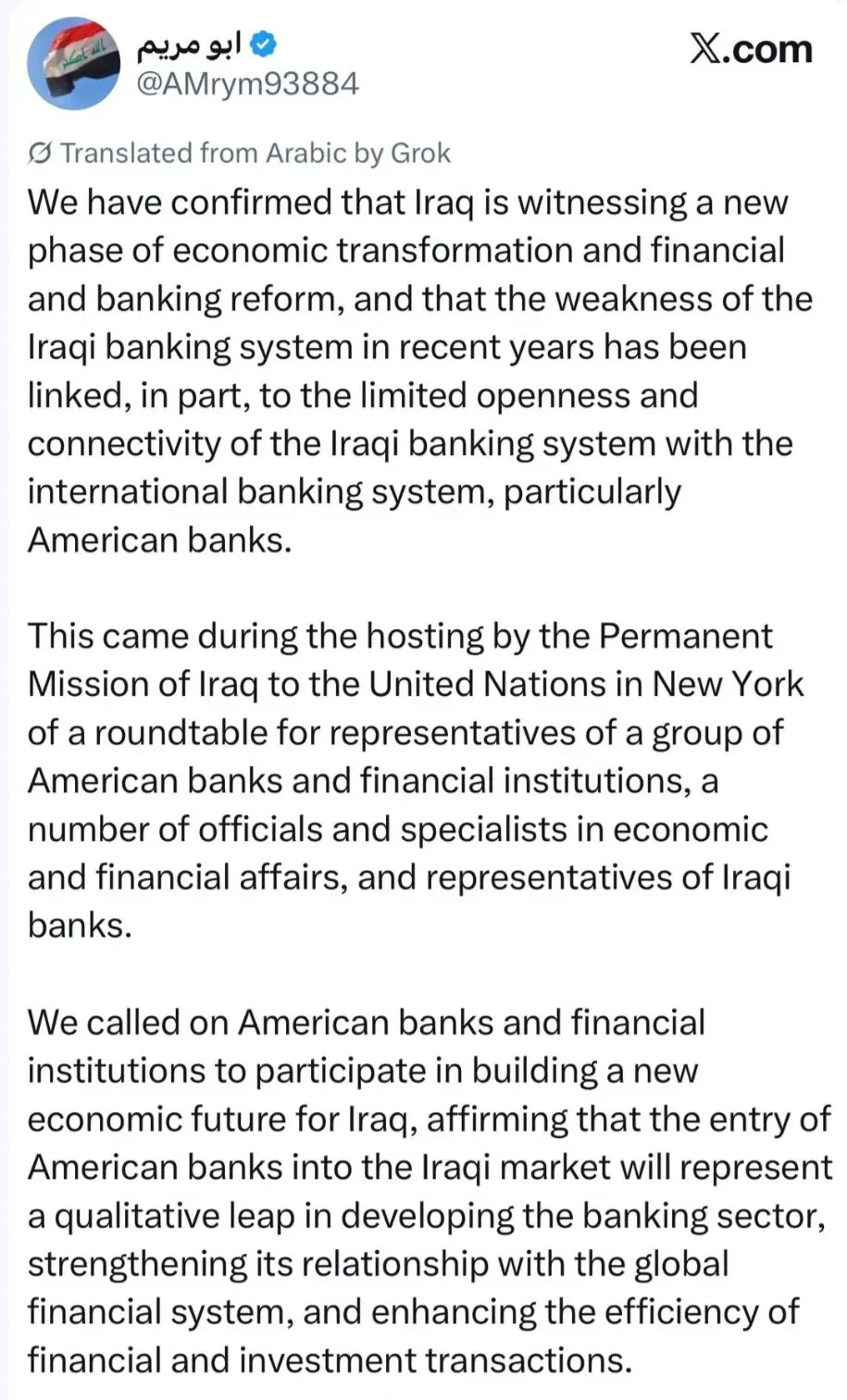
The recent news by Iraq isn’t a press release about future hopes it’s a documented diplomatic action hosted by Iraq’s Permanent Mission to the UN in New York, which means it carries the full institutional weight of the Iraqi government, not some ministry spokesman floating a trial balloon.
American banks don’t send representatives to UN-hosted roundtables for countries they consider financial pariahs; they show up when they’ve already seen the regulatory road map and want first-mover advantage on integration deals.
If the dinar were staying at program rate indefinitely, no U.S. financial institution would waste a Tuesday afternoon discussing correspondent relationships with Rafidain and TBI because the spreads wouldn’t justify the compliance overhead.
The fact that they did show up tells you the rate adjustment is baked into the timeline, and the banks are positioning for the settlement corridor, not the press conference.
Source(s):
• https://x.com/Prolotario1/status/2103271400211685558
• https://x.com/Prolotario1/status/2103285362596474886
https://dinarchronicles.com/2026/09/25/prolotario-do-you-know-what-was-just-announced/
Reset Intelligence: Iraq Invites America's Banks.
Emailed to Recaps~Thank you David
Reset Intelligence: Iraq Invites America's Banks.
By Reset Intelligence | @EXIT_FIAT
Iraq's Prime Minister told a table of American banks why Iraq's banks have been weak: too little connection to the world's banks, American banks above all. Then he asked them in.
The same day, the US handed Iraq its diplomatic post at Baghdad's airport. Soldiers out, bankers invited.
Emailed to Recaps~Thank you David
Reset Intelligence: Iraq Invites America's Banks.
By Reset Intelligence | @EXIT_FIAT
Iraq's Prime Minister told a table of American banks why Iraq's banks have been weak: too little connection to the world's banks, American banks above all. Then he asked them in.
The same day, the US handed Iraq its diplomatic post at Baghdad's airport. Soldiers out, bankers invited.
The invitation
At Iraq's mission to the United Nations in New York, Prime Minister Ali al-Zaidi hosted a group of American banks and financial institutions. His office's readout tied the weakness of Iraq's banks, in part, to limited links with the international banking system, especially American banks, and called their entry into the Iraqi market a qualitative leap for the sector. He put numbers beside the pitch: about 4.5 million barrels a day now, a policy to lift output toward 10 million, and a full reform plan for the state banks underway. No bank names were published.
Everything else that moved
The airport - US Chargé d'Affaires Steven Fagin and Deputy Foreign Minister Mohammed Hussein Bahr al-Uloom signed the US Embassy's Diplomatic Support Center at Baghdad airport over to Iraq on Thursday, ahead of the coalition mission's September 30 end.
The customs link - the CBI told every bank that import transfers now need a preliminary customs declaration, duties prepaid through ASYCUDA, and SWIFT verification codes. Prepaid duties start October 1.
The street - a currency network in Baghdad's Rusafa district was dismantled, 5 arrested and $240,000 seized, and $100 eased to 156,750 dinars against the official 131,000.
The budget - a single source says Baghdad and Erbil have reached an understanding on the 2027 budget, with the final signature waiting on the Finance Minister. The draft is due in parliament October 15.
Tehran - Mohsen Rezaei gave Washington 4 to 5 days to accept Iran's conditions in full, and President Pezeshkian said Iran wants a deal before the US midterms.
The rails and the narrative
In Washington, the Federal Reserve proposed two stablecoin rules under the GENIUS Act, and the 10-year Treasury yield hit 5.11%, its highest since 2007. Paramount's antitrust settlement cleared the way for it to own CNN alongside CBS, with Elon Musk discussed as an equity investor, and a federal judge restored three outlets' White House access.
That is the short version. Why an invitation to America's banks matters for the IQD, and how the week's moves fit together - that is the daily read.
Read the full daily briefing free for 5 days. Sign up here: the daily Iraqi dinar briefing
Want it straight from the horse's mouth? The CBI Rate Alert pings you the moment the Central Bank of Iraq moves the official rate. The number itself, not a rumour about it. It comes with our free resource library and the daily breakdown of what is actually moving in Iraq. Sign up free: The CBI Rate Alert
Got a dinar question? Reset Intelligence runs an on-call research assistant: ask it anything they have published. It answers in seconds and will conduct deep research to find you the answer. Try it: the Iraqi dinar research assistant
Common questions, answered straight: When will the Iraqi dinar revalue? and Is the Iraqi dinar revaluation real?
The design behind all of it is mapped in Head of the Snake, and the free guides live in the Iraqi dinar resource library.
Follow the daily intel free: Telegram · Facebook · Spotify · Odysee
Seeds of Wisdom RV and Economics Updates Friday Morning 9-25-26
Good Morning Dinar Recaps,
IRAN RESET WATCH: TEHRAN OFFERS 7-DAY PATH TO REOPEN HORMUZ AND RESTART PEACE TALKS
Iran’s proposed seven-day roadmap could reopen the Strait of Hormuz and restart broader negotiations, creating a potential pathway toward lower energy and trade pressures across the global economy.
Good Morning Dinar Recaps,
IRAN RESET WATCH: TEHRAN OFFERS 7-DAY PATH TO REOPEN HORMUZ AND RESTART PEACE TALKS
Iran’s proposed seven-day roadmap could reopen the Strait of Hormuz and restart broader negotiations, creating a potential pathway toward lower energy and trade pressures across the global economy.
OVERVIEW
Iran has proposed a seven-day process that would end hostilities, with the Strait of Hormuz reopening on the seventh day if specified conditions are met.
The proposal links diplomacy directly to economic relief, including the lifting of U.S. pressure on Iranian oil and the naval blockade of Iranian ports.
A successful reopening of Hormuz could have global financial consequences, potentially easing pressure on energy prices, shipping, inflation and international trade.
KEY DEVELOPMENTS
1. Iran Puts a Seven-Day Timeline on the Table
Iranian Foreign Minister Abbas Araghchi said Tehran has presented the United States, through intermediaries, with a plan under which hostilities would end during the seven-day period and the Strait of Hormuz would reopen at the end of the seventh day, provided specified conditions are met.
The proposal also calls for negotiations to restart, including broader discussions concerning Iran’s nuclear program.
2. Hormuz Has Become a Central Part of the Negotiations
The Strait of Hormuz has become one of the most important economic pressure points in the conflict because it is a major route for global oil and energy shipments.
Reuters reported that U.S. and Iranian negotiators are exploring a phased path out of the war in which Tehran would reopen the strait while Washington would lift its economic blockade of Iran. The discussions remain difficult because neither side wants to give up negotiating leverage first.
3. Energy Markets Are Watching the Diplomatic Signals
Any credible progress toward reopening Hormuz could influence global energy markets because uncertainty surrounding the waterway has contributed to higher oil prices and increased concerns about shipping and supply disruptions.
A sustained reduction in that uncertainty could eventually ease some of the energy-related inflation pressure affecting households, businesses and governments.
WHY IT MATTERS
The significance of the seven-day proposal extends well beyond the Middle East.
The global economy depends on secure energy supplies and reliable transportation routes. When a strategic waterway becomes restricted or threatened, the effects can spread through oil prices, shipping costs, insurance, inflation, manufacturing and consumer prices.
A negotiated reopening of Hormuz would therefore represent more than a diplomatic development. It could begin reducing one of the major disruptions affecting the global economy and international trade.
At the same time, the proposal should be viewed carefully. Iran has made an offer, but the United States has not accepted the seven-day framework, and major differences remain between the two sides.
WHY IT MATTERS TO FOREIGN CURRENCY HOLDERS
For foreign currency holders watching the Global Financial Reset, the important issue is the connection between geopolitics, energy, trade and currency values.
Oil is priced and traded internationally, and major changes in energy costs can influence inflation, interest-rate expectations, capital flows and the relative strength of currencies.
If diplomacy eventually produces a durable reopening of Hormuz, the resulting reduction in energy and shipping uncertainty could influence financial markets well beyond the region.
This is not evidence of an imminent currency revaluation or a specific Global Reset date. Instead, it is another example of how changes in the underlying conditions of global commerce can gradually reshape the international financial system.
IMPLICATIONS FOR THE GLOBAL RESET
Pillar 2: Trade
A reopening of the Strait of Hormuz could restore greater reliability to one of the world's most important energy shipping routes. More predictable transportation could reduce some of the costs and uncertainty currently affecting international commerce.
Pillar 3: Assets
Energy prices, government bonds, currencies and other financial assets can respond to changes in geopolitical risk. A reduction in the risk surrounding Hormuz could therefore influence how investors assess global assets and capital flows.
Pillar 5: Energy
Energy security remains a fundamental component of the global financial system. Any durable agreement that restores commercial shipping through Hormuz could reduce one source of global energy-market stress and potentially alter the economic outlook for oil-importing and oil-exporting countries.
THE BOTTOM LINE
Iran’s seven-day proposal does not mean the war is over or that a final agreement has been reached. It does, however, place a concrete diplomatic framework on the table that connects an end to hostilities with the reopening of one of the world's most important energy corridors.
If diplomacy succeeds, the effects could reach far beyond Iran and the United States, influencing energy prices, shipping, inflation, trade and international capital flows.
The bigger story is not simply whether the Strait of Hormuz reopens—it is how diplomacy, energy security and global trade are increasingly becoming part of the transformation of the financial system itself.
Seeds of Wisdom Team
Newshounds News™ Exclusive
SOURCES
Reuters — "US and Iran discuss phased deal to reopen Hormuz and end US blockade, sources say"
The Indian Express — "Iran proposes 7-day plan to end war with US-Israel: The key takeaways"
~~~~~~~~~~
🌱 A Message to Our Currency Holders🌱
If you’ve been holding foreign currency for many years, you were not foolish.
You were not wrong to believe the global financial system would change.
What failed was not your patience — it was the information you were given.
For years, dates, rumors, and personalities replaced facts, structure, and proof. “This week” predictions created cycles of hope and disappointment that were never based on how currencies actually change.
That is not your failure.
Our mission here is different: • No dates • No rates • No hype • No gurus
Instead, we focus on:
• Verifiable developments • Institutional evidence
• Global financial structure • Where countries actually sit in the process
Currency value changes only come after sovereignty, trade, banking, settlement systems, and fiscal coordination are in place. History and institutions confirm this sequence.
You will see silence. You will see denials. That is not delay — that is discipline.
Protect your identity. Organize your documents. Verify everything.
Never hand your discernment to anyone who cannot show proof.
You deserve truth — not timelines.
Seeds of Wisdom Team
Newshounds News
~~~~~~~~~~
Seeds of Wisdom Team RV Currency Facts Youtube and Rumble
Newshound's News Telegram Room Link
RV Facts with Proof Links Link
RV Updates Proof links - Facts Link
Start Here room with Most Asked Questions Link
Follow the Gold/Silver Rate COMEX
Follow Fast Facts
Seeds of Wisdom Team™ Website
Thank you Dinar Recaps
Who Decides What Gold Is Worth? How Gold Prices Are Determined
Who Decides What Gold Is Worth? How Gold Prices Are Determined
Catherine Brock Yahoo Personal Finance
The price of gold can be quoted in multiple forms because the precious metal is traded in different ways. The two main gold prices that investors should know about are spot prices and gold futures prices.
The Spot Price
The spot price of gold is the current market price per ounce for physical gold as a raw material, sometimes called spot gold. Gold ETFs that are backed by physical gold assets generally track the gold spot price.
Who Decides What Gold Is Worth? How Gold Prices Are Determined
Catherine Brock Yahoo Personal Finance
The price of gold can be quoted in multiple forms because the precious metal is traded in different ways. The two main gold prices that investors should know about are spot prices and gold futures prices.
The Spot Price
The spot price of gold is the current market price per ounce for physical gold as a raw material, sometimes called spot gold. Gold ETFs that are backed by physical gold assets generally track the gold spot price.
The spot price is lower than what you'd pay to buy gold coins, bullion, or jewelry, since your total price will include a markup called the gold premium that covers refining, marketing, dealer overhead, and profits. The spot price is more like a wholesale price, and the spot price plus the gold premium is the retail price.
Gold Futures
Gold futures are contracts that mandate a gold transaction at a specific price on a future date. These contracts are exchange-traded and more liquid than physical gold. They settle on the contract expiration date or earlier, either financially or via delivery. A cash settlement involves paying the contract's profit or loss in cash. Delivery means the seller sends physical gold to the buyer for the contracted price.
Factors That Affect Gold Prices
Supply and demand determine gold spot prices and gold futures prices. Factors that influence gold supply and demand include:
Geopolitical events: Gold is considered a safe-haven asset, meaning it can hold its value — and sometimes appreciate — when stocks and other assets are volatile or in decline. Geopolitical events, such as military conflicts and trade disputes, can prompt stock price volatility and, in turn, stoke higher demand for gold.
Central bank buying trends: Central banks own gold to hedge against inflation and support economic stability. Unlike traditional currency, the price of gold is not tied to a banking system that is subject to manipulation or collapse. Central banks influence the global gold supply because they buy and sell in large quantities.
Inflation: Many investors consider gold an effective hedge against inflation. Rising prices, therefore, can stimulate gold demand and push gold prices higher.
Interest rates: When interest rates rise, gold prices can decline. When interest rates fall, gold prices can rise. This happens in part because gold does not pay interest. Cash and fixed-income assets are preferred in higher-rate environments because they can produce higher yields.
Mining production: Mining activity affects the global gold supply, while production costs influence gold prices.
Historic Price Of Gold
Historically, the gold futures price has been volatile, particularly when adjusted for inflation. Significant trends include:
April 1934 to July 1970: Gold declined more than 65% in an extended downturn.
July 1970 to January 1980: Gold rose nearly 850% in a sharp spike upward.
January 1980 to February 2001: Gold fell 82%.
February 2001 to September 2025: Gold gained by 591%.
Owning gold potentially exposes you to similar extended trends, which is why it's important to set your allocation carefully.
In the lackluster years, your gold position will negatively impact your overall investment returns. If that feels problematic, a lower allocation percentage is more appropriate. On the other hand, you may be willing to accept gold's underperforming years so you can benefit more in the good years. In this case, you would target a higher percentage.
If you are interested in learning more about gold's historical value, Yahoo Finance has been tracking the historical price of gold since 2000.
Current Gold Dynamic
In 2025, the gold futures price rose more than 65%. It was the precious metal's strongest calendar year performance since 1979.
Thomas Winmill, portfolio manager at Midas Funds, said the historic run-up into 2026 has been driven by investors seeking a hedge against a "potential negative reaction in the general stock and bond markets to the current news cycle." Headlines about evolving U.S. tariff policies and U.S. military involvement in Venezuela, Iran, Greenland, and domestic cities can be unnerving for investors.
Additionally, rising national debt erodes confidence in the U.S. dollar. A continuation of that trend would negatively affect financial assets such as stocks and bonds and benefit gold.
While the specific factors driving gold's strength today may be historically distinct, gold's recent performance is not out of character. "Gold's behavior, like that of any hard asset, can be extremely volatile," Winmill said. As an example, gold rose more than 100% in 1979 and nearly 30% in 1980 before falling about 33% in 1981.
Seeds of Wisdom RV and Economics Updates Thursday Afternoon 9-24-26
Good Afternoon Dinar Recaps,
GLOBAL BOND RESET WATCH: U.S. 30-YEAR YIELD HITS 22-YEAR HIGH AS GLOBAL DEBT MARKETS COME UNDER PRESSURE
Rising long-term borrowing costs in the United States and other major economies are putting renewed pressure on government debt, inflation expectations and the financial system built around global bonds.
Good Afternoon Dinar Recaps,
GLOBAL BOND RESET WATCH: U.S. 30-YEAR YIELD HITS 22-YEAR HIGH AS GLOBAL DEBT MARKETS COME UNDER PRESSURE
Rising long-term borrowing costs in the United States and other major economies are putting renewed pressure on government debt, inflation expectations and the financial system built around global bonds.
OVERVIEW
The U.S. 30-year Treasury yield climbed to about 5.44%, its highest level since 2004, as a broad government-bond selloff intensified.
The pressure is spreading internationally, with Japan's 10-year government-bond yield reaching 3.075%, its highest since 1996, while other major bond markets are also experiencing elevated yields.
Higher yields increase government borrowing costs and can feed into mortgages, corporate financing, asset valuations and currency markets, making government debt a central part of the evolving global financial landscape.
KEY DEVELOPMENTS
1. The U.S. 30-year yield reaches a multi-decade high
The yield on the U.S. 30-year Treasury bond climbed above 5.44% on Thursday, reaching its highest level since 2004 as investors continued selling longer-dated government debt.
Bond prices and yields move in opposite directions, so the rise in yields reflects a decline in bond prices and a higher return demanded by investors to hold long-term government debt.
The move is significant because the 30-year Treasury represents the market's assessment of the cost and risk of financing the U.S. government over several decades.
2. The 10-year Treasury is also at elevated levels
The benchmark 10-year Treasury yield reached approximately 5.15%, its highest level since 2007, before easing somewhat. The 10-year Treasury is closely watched because it influences borrowing costs throughout the economy.
Higher Treasury yields can affect mortgages, corporate bonds, investment decisions and the valuation of financial assets.
This makes the Treasury market an important transmission mechanism between government borrowing conditions and the wider financial system.
3. Japan's bond market is moving higher as well
Japan's 10-year government-bond yield jumped to approximately 3.075%, its highest level since August 1996. Japan's five-year yield also reached a record high, while yields on longer maturities climbed across the curve.
The move followed the Bank of Japan's recent increase in its policy rate to 1.25% and signals that Japan's exceptionally low-rate environment is continuing to change.
Because Japanese investors are major participants in global capital markets, changes in Japanese bond yields can influence decisions about where capital is invested around the world.
4. Inflation and energy costs are adding pressure
Reuters reports that stronger-than-expected U.S. economic activity and renewed inflation concerns have contributed to the bond selloff. Elevated energy prices are also increasing concerns that inflation could remain persistent.
That combination creates a difficult environment for central banks.
If inflation remains elevated, central banks may have less room to reduce interest rates even when higher borrowing costs begin putting pressure on economic activity.
5. Government debt becomes more expensive to finance
Long-term bond yields matter directly to governments because new borrowing and refinancing become more expensive as market interest rates rise.
Reuters notes that the higher 30-year yield increases the government's long-term debt-service burden.
The issue extends beyond the United States. Germany, Japan, France, the United Kingdom and other major economies are also dealing with higher borrowing costs.
This creates a global environment in which governments must increasingly balance debt issuance, interest expense, economic growth and inflation.
6. Higher yields can reach consumers and businesses
The effects of the bond-market move are already reaching the private sector.
Reuters reports that U.S. 30-year mortgage rates have risen to around 7%, approximately one percentage point above their level before the current conflict.
Higher long-term yields can also increase the cost of corporate borrowing and change the relative attractiveness of stocks, bonds and other financial assets.
The bond market therefore does not operate in isolation. Changes in government borrowing costs can move through the entire financial system.
7. Global capital flows are being reassessed
As government bond yields rise in major economies, investors have more incentive to reconsider where capital is allocated.
Higher Japanese yields, for example, can alter the relative attractiveness of holding Japanese government debt versus overseas assets.
At the same time, elevated U.S. Treasury yields can support demand for dollar-denominated assets and influence exchange rates and international capital flows.
This creates another important connection between bonds, currencies and global liquidity.
WHY IT MATTERS
Government bonds form one of the foundational layers of the global financial system.
They provide collateral for financial institutions, establish reference rates for other borrowing and serve as major reserve assets for central banks and investors.
When yields rise sharply across several major economies, the implications extend beyond bond investors.
The financial system must adjust to a world in which money is no longer priced at the unusually low interest rates that characterized much of the previous decade.
The current move does not mean the global bond system is collapsing. Reuters notes that investors have so far absorbed the higher yields while economic growth remains resilient.
But it does mean the cost of financing governments, businesses and households is changing.
WHY IT MATTERS TO FOREIGN CURRENCY HOLDERS
For foreign currency holders following the Global Reset, the bond market is important because currencies do not operate independently of interest rates and capital flows.
Higher yields can attract capital toward certain markets while increasing borrowing costs in others. Changes in bond yields can therefore influence currency demand, exchange rates and the movement of international investment.
This is not an announcement of a currency revaluation or global reset.
Instead, it is another example of the financial foundation shifting through debt, interest rates, bonds and capital flows before any potential changes in currency relationships.
IMPLICATIONS FOR THE GLOBAL RESET
Pillar 1 — Debt
Higher long-term yields increase the cost of refinancing government debt and make debt sustainability a more important issue for major economies.
Pillar 2 — Bonds
Government bond markets remain one of the central foundations of global finance. Large moves in Treasury, Japanese and European yields can affect financial conditions worldwide.
Pillar 3 — Interest Rates
Higher market yields can tighten financial conditions even beyond the direct decisions of central banks.
Pillar 4 — Currencies
Interest-rate differences influence international capital flows and can change the relative demand for major currencies.
Pillar 5 — Capital Flows
Investors continually reassess where to place capital as yields, inflation expectations, currency values and economic growth change.
The Global Reset Connection
Government Debt → Bond Yields → Borrowing Costs → Central Banks → Capital Flows → Currency Demand → Global Financial Conditions
RUMOR SAFETY REMINDER
This development is not an announcement of a global financial reset, dollar collapse, currency revaluation or specific reset date.
The 30-year Treasury yield reaching its highest level since 2004 is a documented market development, but its future direction remains uncertain.
Higher bond yields can create financial pressure, but they can also reflect stronger economic growth and changing expectations about inflation and interest rates.
Hope, not hype. Follow the evidence.
THE BOTTOM LINE
The significance of today's bond-market move is bigger than the number attached to the 30-year Treasury yield. It shows how debt costs, inflation, interest rates and capital flows are interacting across major economies at the same time.
As the world adjusts to a higher-cost era of government borrowing, the bond markets are becoming another place where the architecture of the global financial system is being rewritten.
Seeds of Wisdom Team
Newshounds News™ Exclusive
SOURCES
Reuters — "Global bond rout rolls on, pushing U.S. 30-year yield to highest since 2004"
Reuters — "Bond market sell-off rumbles on ahead of Trump and Xi talks"
~~~~~~~~~~
Seeds of Wisdom Team RV Currency Facts Youtube and Rumble
Newshound's News Telegram Room Link
RV Facts with Proof Links Link
RV Updates Proof links - Facts Link
Start Here room with Most Asked Questions Link
Follow the Gold/Silver Rate COMEX
Follow Fast Facts
Seeds of Wisdom Team™ Website
Thank you Dinar Recaps
House Passes Common Cents Bill
House Passes Common Cents Bill
Lynne Marek Lead Editor Published Sept. 16, 2026 Dive Brief
The bill officially ends minting of pennies and allows merchants to round to the nearest nickel, though the coins are already out of production.
The penny, which has been in circulation since 1793, will officially be discontinued for general circulation under the proposed Common Cents Act.
House Passes Common Cents Bill
Lynne Marek Lead Editor Published Sept. 16, 2026 Dive Brief
The bill officially ends minting of pennies and allows merchants to round to the nearest nickel, though the coins are already out of production.
The penny, which has been in circulation since 1793, will officially be discontinued for general circulation under the proposed Common Cents Act.
Dive Brief:
The House of Representatives on Monday passed the Common Cents Act, eliminating U.S. production of the penny and giving merchants leeway to round to the nearest nickel on transactions when they don’t have exact change. It was the second time the chamber had passed such legislation.
The bipartisan bill that passed by the House is aimed at saving the federal government money by eliminating the money-losing act of minting the penny, but it would still allow for use of the one cent coin as legal tender.
“If the federal government is spending nearly four cents to make a penny worth one cent, something is broken,” Rep. Lisa McClain (R-MI), a sponsor of the bill, said in a Monday press release. “House Republicans are proving that common sense still has a place in government by cutting waste and protecting taxpayer dollars.”
Dive Insight:
The House bill was cosponsored by California Democratic Rep. Robert Garcia and was almost identical to a bill that the chamber passed in July, but it had to be voted on again after the Senate added an amendment when it considered the legislation in August.
The bill passed by the Senate included an amendment by Massachusetts Sen. Elizabeth Warren that requires the Treasury Department to notify Congress of any future currency discontinuation, along with a transition plan, according to two retail industry trade associations.
When the House received that revamped legislation back from the other chamber, it decided to give it a new bill number to claim its own version. Now, the legislation is expected to be voted on again by the Senate next week, according to one retail trade group, NACS, that has been following the legislation.
Given the legislation mirrors the earlier Senate version that was passed, the legislation would be expected to move to President Donald Trump for his signature soon.
Trump will likely sign the bill, given the U.S. Mint already stopped producing the penny. The final batch of pennies was struck last November, nine months after Trump directed the U.S. Treasury to stop making pennies, citing their cost inefficiency. The department estimated $56 million in savings by ending penny production. Under the bill, pennies will still be produced as collectible coins.
In the Senate, where the legislation was sponsored by Sens. Senator Cynthia M. Lummis (R-WY) and Kirsten Gillibrand (D-NY), an amendment helped win passage.
The legislation is an aid to merchants who have been increasingly frustrated by a decline in the circulation of pennies. The National Grocers Association, which represents independent supermarkets, cheered passage of the bill, saying it provides legal authority for rounding in transactions.
“This legislation gives businesses the consistency they need to handle cash transactions fairly and efficiently while minimizing disruption for consumers,” the association said in a Tuesday press release.
TO READ MORE: https://www.paymentsdive.com/news/house-passes-common-cents-bill/830533/
Penny’s End Poses Rounding Challenge
Penny’s End Poses Rounding Challenge
Published July 16, 2026 Justin Bachman Senior Reporter
Merchants press for passage of a bill to enact rounding standards as cash-handling businesses grapple with the cent’s gradual demise. Businesses would gain new guidelines for rounding transactions if the government gradually phases out the U.S. penny under legislation Congress is considering.
The Common Cents Act, which passed the House of Representatives on Tuesday, enacts formal guidelines for businesses to round tabs to the nearest 5 cents as the U.S. gradually retires the penny.
Penny’s End Poses Rounding Challenge
Published July 16, 2026 Justin Bachman Senior Reporter
Merchants press for passage of a bill to enact rounding standards as cash-handling businesses grapple with the cent’s gradual demise. Businesses would gain new guidelines for rounding transactions if the government gradually phases out the U.S. penny under legislation Congress is considering.
The Common Cents Act, which passed the House of Representatives on Tuesday, enacts formal guidelines for businesses to round tabs to the nearest 5 cents as the U.S. gradually retires the penny.
A Senate version of the bill remains in the Committee on Banking, Housing and Urban Affairs, according to Congress’ legislative website.
The bills also officially end production of the penny, although the U.S. Mint manufactured its final batch of pennies in November. The bills’ sponsors say that penny production wastes about $85 million of taxpayer money each year because each 1 cent coin costs 3.69 cents to make.
About 15 states have passed laws to govern cash rounding, causing a “confusing” patchwork of rules, a coalition of 16 business trade associations said Monday in a letter to House leaders.
“We need a clear standard from Congress allowing businesses to round cash transaction amounts and a safe harbor from liability in doing so fairly,” wrote the groups, which included the National Restaurant Association and the National Association of Convenience Stores.
The American Bankers Association and America’s Credit Unions also supported the bill in separate letters to House leaders.
The bipartisan legislation dates to last year, when bills were introduced in both houses by a group of lawmakers that included Rep. Lisa McClain, a Michigan Republican; California Democratic Rep. Robert Garcia; Sen. Cynthia Lummis, a Wyoming Republican; and Sen. Kirsten Gillibrand, a New York Democrat.
“Republicans and Democrats don’t agree on much in this town but we do agree on this: We should not be wasting $85 million a year to keep minting pennies,” McClain said Tuesday on the House floor before the vote.
About 114 billion pennies circulate, according to the Treasury, although the production halt has led to shortages. Some businesses impose their own rounding on tabs, or ask customers to pay with exact change.
The National Retail Federation has made the rounding legislation one of its most important policy priorities for 2026, given what it calls consumers’ confusion over retailers’ inability to make exact change and the potential for “unnecessary legal risk.”
The Retail Industry Leaders Association urged the Senate in a Tuesday press release to pass its companion bill to “resolve an issue that has been negatively impacting millions of businesses nationwide.”
The penny’s end “created serious operational challenges and legal uncertainty for retailers of all sizes,” Stephanie Johnson, head of government affairs for the National Grocers Association, said in a Tuesday press release. “The Common Cents Act provides the clarity businesses need to continue conducting cash transactions fairly, consistently, and without disruption for consumers.”
Under the legislation, transactions that end with 1, 2, 6 or 7 cents would be rounded down to the nearest amount divisible by five; those ending with 3, 4, 8 or 9 cents in the sum are rounded up. Electronic payments are excluded.
The Treasury Department said rounding should not affect overall prices that consumers pay, as transaction totals will move both higher and lower. However, the Federal Reserve Bank of Richmond estimated in a briefing paper last year that this “rounding tax” would cost Americans about $6 million annually.
In phasing out the penny, the Treasury Department said last year that penny fabrication isn’t “fiscally responsible or necessary” for commerce, citing the “increasing number of non-cash transactions and the very low purchasing power of a single penny.”
The department estimated $56 million in savings from stopping the production of pennies, but noted that the coin would continue circulating “for as long as possible.”
In February 2025, President Donald Trump directed the U.S. Treasury to stop making pennies, citing the cost inefficiency. The penny dates to 1793, with the latest version bearing President Abraham Lincoln in circulation since 1909, according to the U.S. Mint.
Separately, Treasury Secretary Scott Bessent said Wednesday on his X social media account that the U.S. Mint will start striking a $1 dollar gold coin, to circulate, with Trump’s image. The administration touts the coin as a commemorative collectible given that federal law requires U.S. currency to bear only the portrait of “a deceased individual.”
TO READ MORE: https://www.paymentsdive.com/news/pennys-end-poses-rounding-challenge/825398/
The Currency Reset is imminent: “This Will Be Very Serious”: Alasdair Macleod
The Currency Reset is imminent: “This Will Be Very Serious”: Alasdair Macleod
Liberty and Finance: 9-23-2026
Alasdair Macleod warns that escalating Middle East tensions could trigger a far broader economic shock through fuel, shipping, food, and global logistics disruptions. He argues that shortages of diesel, kerosene, and ship fuel could drive essential prices sharply higher while simultaneously pushing economies toward recession.
Macleod also warns that foreign demand for U.S. Treasuries could weaken just as Washington faces massive refinancing needs, potentially creating a debt trap and higher bond yields.
The Currency Reset is imminent: “This Will Be Very Serious”: Alasdair Macleod
Liberty and Finance: 9-23-2026
Alasdair Macleod warns that escalating Middle East tensions could trigger a far broader economic shock through fuel, shipping, food, and global logistics disruptions. He argues that shortages of diesel, kerosene, and ship fuel could drive essential prices sharply higher while simultaneously pushing economies toward recession.
Macleod also warns that foreign demand for U.S. Treasuries could weaken just as Washington faces massive refinancing needs, potentially creating a debt trap and higher bond yields.
Against this backdrop, he says major investors are accumulating gold as concerns over currency and counterparty risk intensify. He ultimately argues that markets may be underestimating the risks building across energy, debt, currencies, equities, and precious metals.
INTERVIEW TIMELINE:
0:00 Intro
1:30 Geopolitical conflict
23:06 US debt crisis
35:30 Macleod Finance