
Iraq Economic News And Points To Ponder Friday Morning 4-23-26
Oil Futures Rise As Iran Tensions And Strikes Fuel Market Fears
2026-04-23 Shafaq News Crude oil futures spiked $5 a barrel on Thursday after reports that air defenses were engaging targetsover Tehran and of a power struggle between Iran's hardliners and moderates.
After spiking, the benchmarks pared gains. Brent crude futures settled at $105.07 a barrel, gaining $3.16 or 3.1%. West Texas Intermediate futures finished at $95.85 a barrel, up $2.89, or 3.11%.
Oil Futures Rise As Iran Tensions And Strikes Fuel Market Fears
2026-04-23 Shafaq News Crude oil futures spiked $5 a barrel on Thursday after reports that air defenses were engaging targetsover Tehran and of a power struggle between Iran's hardliners and moderates.
After spiking, the benchmarks pared gains. Brent crude futures settled at $105.07 a barrel, gaining $3.16 or 3.1%. West Texas Intermediate futures finished at $95.85 a barrel, up $2.89, or 3.11%.
IRAN NEGOTIATOR QUITS
Israeli radio reported the resignation of Iran's top negotiator, Mohammad Baqer Qalibaf, from the team speaking to the U.S. through Pakistani intermediaries about ending the war.
Qalibaf's resignation was seen as a victory for hard line elements within the Iranian government.
Iranian news services said air defenses in Tehran were engaging targets over the city. That followed reports of drone attacks on Iranian Kurdish opponents of the Tehran government at a base in Iraq.
Iran flaunted its tightened grip over the Strait of Hormuz with video of its commandos storming a huge cargo ship, after the collapse of peace talks that Washington had hoped would open the important shipping corridor.
U.S. President Donald Trump said in a social media post that he had ordered the U.S. Navy "to shoot and kill any boat" mining the strait.
John Kilduff, partner with Again Capital, said the market was being buffeted by alternating news reports of Trump extending the ceasefire this week and threatening to sink Iranian mine-laying ships.
"Some people call it headline bingo, I call it headline roulette," Kilduff said. "I fear we're going to wake up one day and realize we're in a much worse (supply) position and prices are going to reset to a much higher level."
STRAIT OF HORMUZ TRANSIT STILL RESTRICTED
While Trump extended a ceasefire between the countries after a request by Pakistani mediators, Iran and the U.S. are still restricting transit of ships through the strait, which carried about 20% of daily global oil supplies until the start of the war on February 28.
Trump, without providing evidence, said on Thursday the U.S. had "total control" over the strait, and that it was "sealed up tight" until Iran made a deal.
Iran seized two ships in the waterway on Wednesday. Trump has maintained a U.S. Navy blockade of Iran's trade by sea.
However, about 10.7 million barrels of Iranian crudeexports crossed through the strait and left the area blockaded by the U.S. Navy between April 13 and 21, data analytics company Vortexa said.
The U.S. military has intercepted at least three Iranian-flagged tankers in Asian waters and is redirecting them away from positions near India, Malaysia and Sri Lanka, shipping and security sources said on Wednesday.
Trump has not set an end date for the extended ceasefire, White House press secretary Karoline Leavitt told reporters.
Phil Flynn, senior analyst with Price Futures Group, said prices were constrained by confidence in the crude market.
"The market continues to believe we're going to find a way through this," Flynn said.
The Federal Reserve Bank of Dallas on Thursday said a survey of 120 oil and natural gas company executives this month found 39% expect traffic through the strait to return to normal by August and 26% expect normal traffic through the waterway by November.
Twenty percent of the executives surveyed between April 15 and 20 believe traffic will be normal by May, according to the Dallas Fed. (Reuters) https://www.shafaq.com/en/Economy/Oil-futures-rise-as-Iran-tensions-and-strikes-fuel-market-fears
Oil Spikes 17% In A Week As Iran Tensions Shake Global Supply
2026-04-24 Shafaq News Oil prices rose on Friday due to fears of a renewed military escalation in the Middle East after Iran released footage of commandos boarding a cargo ship in the Strait of Hormuz and on reports Tehran's air defenses had engaged “hostile targets.”
Brent crude futures rose 99 cents, or 0.94%, to $106.06 a barrel at 0410 GMT, while West Texas Intermediate futures were up 71 cents, or 0.73%, at $96.56.
Brent rose 17.13% throughout the course of the week while WTI rose 15.13%, the second-largest weekly gain since the war began.
The resulting closure of the Strait of Hormuz after the beginning of the U.S.-Israeli war on Iran cut around 20% of the world’s supply of oil and liquefied natural gas.
Both benchmark contracts settled up more than 3% on Thursday and jumped $5 a barrel after reports that air defenses were engaging targets over Tehran and of a power struggle between Iran's hardliners and moderates.
U.S. President Donald Trump said that Iran may have loaded up its weaponry "a little bit" during the two-week ceasefire, but added that the U.S. military could eliminate it in just a single day.
The ceasefire phase is increasingly looking like a preparatory phase for war, Haitong Futures said in a report. If U.S.-Iran talks fail to make key progress by the end of April and fighting resumes, oil prices could climb to new highs for the year, it added.
Iran on Thursday posted video of commandos in a speed boat storming a huge cargo ship after the collapse of peace talks, underlining its grip over the Strait of Hormuz through which 20% of global oil and gas usually flows.
As investors and governments around the world look for an enduring peace, Trump said he would not set a "timetable" for ending the conflict with Iran and that he wanted to make "a great deal."
"Don't rush me," he said when asked how long he was willing to wait for a long-term peace deal with Iran.
Prolonged disruptions in the Strait of Hormuz could push global crude and refined-product inventories below five-year seasonal lows by late May or early June, adding a supply-risk premium back into oil prices, said Mingyu Gao, chief researcher for energy and chemicals at China Futures.
Trump also announced in a social media post on Thursday that Israel and Lebanon had agreed to extend their ceasefire by three weeks after a high-level meeting between representatives of both countries in the White House Oval Office.
(Reuters) https://www.shafaq.com/en/Economy/Oil-spikes-17-in-a-week-as-Iran-tensions-shake-global-supply
Gold Falls 3.5% Weekly On Higher-For-Longer Rate Fears
2026-04-24Shafaq News Gold prices fell on Friday and were on track for a weekly drop, as elevated oil prices fuelled fears of inflation and higher-for-longer interest rates amid stalled U.S.-Iran peace talks.
Spot gold was down 0.7% at $4,661.33 per ounce, as of 0426 GMT. The metal is down 3.5% so far this week after a four-week winning run.
U.S. gold futures for June delivery fell 1% to $4,676.50.
Brent crude prices have risen over 17% so far this week to hover above $105 a barrel, as the key Strait of Hormuz remained largely closed despite an extension of the Iran ceasefire.
"Gold is still being trapped in this sideways range, between the 50-day moving average at around $4,900 and at the bottom, the 20-day moving average at $4,645 level," Wong said, adding that "everything now boils down to what's going on in the Middle East."
Iran flaunted its tightened grip over the strait on Thursday with a video of commandos in a speedboat storming a huge cargo ship, after the collapse of peace talks that Washington had hoped would open one of the world's most important shipping corridors.
Trump told reporters that he believed Tehran wanted to make a deal but that its leadership was in turmoil. He said he was in no hurry for a deal, but if Iran did not want one, "I'll finish it up militarily."
The U.S. dollar is up 0.8% so far this week, making greenback-priced bullion more expensive for other currency holders.
The benchmark 10-year U.S. Treasury yields have gained over 2% this week, increasing the opportunity cost of holding non-yielding bullion.
Spot silver fell 1% to $74.69 per ounce, platinum lost 1.1% to $1,984.60, while palladium was down 0.3% at $1,464.02.
(Reuters) https://www.shafaq.com/en/Economy/Gold-falls-3-5-weekly-on-higher-for-longer-rate-fears
Dollar Rises 0.6% As Iran Tensions Shake Markets
2026-04-24 Shafaq News The dollar was on track for its first weekly gain in three weeks on Friday, as stalled peace negotiations between the U.S. and Iran dampened hopes for an immediate easing of Middle East tensions.
While Lebanon and Israel extended their ceasefire for three weeks ahead of its expiration on Sunday, Iran showed off its control over the Strait of Hormuz by releasing footage of its commandos storming a huge cargo ship, leaving the timing of the reopening of the world's most important shipping corridor uncertain and keeping oil prices elevated.
The dollar index, which measures the greenback against a basket of currencies including the yen and the euro, ticked 0.01% higher to 98.84 and remained on track for a weekly gain of 0.62%. The euro dipped 0.01% to $1.1682, while sterling edged down 0.02% to $1.3464.
"Oil and the dollar are still moving pretty closely together, and with crude creeping back up ... I'd say the dollar is still staying fairly firm," said Sho Suzuki, a market analyst at Matsui Securities.
Brent crude futures rose 45 cents, or 0.43%, to $105.52 a barrel at 0525 GMT, while West Texas Intermediate futures were up 14 cents, or 0.15%, at $95.99.
The dollar has drawn safe-haven demand amid the uncertainty. It gained ground in March as concerns over the conflict deepened, but gave back some of those gains this month as optimism over a potential resolution grew.
Meanwhile, the yen was on track for a fifth straight day of losses against the dollar, weakening 0.03% to 159.77 per dollar.
Japanese Finance Minister Satsuki Katayama reiterated her verbal warning on intervention on Friday that authorities can take "decisive" action against speculative moves in the foreign exchange market, a day after saying Japan has a "free hand" to intervene and that past interventions had been effective.
With Japanese authorities continuing to push back against yen weakness, "it is difficult to expect a scenario in which the yen weakens sharply beyond 160 per dollar in the near term," said Akihiko Yokoo, senior analyst at Mitsubishi UFJ Bank, in a note.
Japan's core consumer inflation slowed below the central bank's 2% target for a second straight month in March. Analysts, though, expect inflation to accelerate back above the Bank of Japan's target in coming months, as companies begin to pass on higher fuel costs from the Middle East conflict.
The BOJ is set to hold its two-day policy meeting ending on Tuesday. Reuters reported the bank is likely to hold off raising interest rates next week as fading prospects of a near-term end to the Middle East war keep the country's economic and price outlook highly uncertain. The BOJ is still expected to signal its readiness to hike to counter mounting price pressures.
Matsui Securities' Suzuki said an intervention is more likely only if the dollar-yen pair breaks above its July 2024 high of 161.95.
"So even if yen weakness accelerates after next week's BOJ meeting, they'd probably start with jawboning and if that doesn't work, then move to actual intervention," he said.
In a similar vein, the European Central Bank will hold its deposit rate on April 30 but hike it in June, according to just over half of economists polled by Reuters, in a bid to protect a war-induced energy shock from knocking the euro zone economy off balance.
The Australian dollar weakened 0.03% versus the greenback to $0.7126. New Zealand's kiwi weakened 0.03% versus the greenback to $0.585. The dollar also held firm against emerging Asian currencies, with the Philippine peso falling 0.3% to 60.699 per dollar after touching 60.755, the lowest since late March. The Malaysian ringgit weakened 0.1% to 3.9660 and the Indian rupee slipped 0.2% to 94.2950.
In cryptocurrencies, bitcoin fell 0.23% to $77,740.57. Ethereum declined 0.73% to $2,309.52. (Reuters)
https://www.shafaq.com/en/Economy/Dollar-rises-0-6-as-Iran-tensions-shake-markets
MilitiaMan and Crew: IRAQ DINAR UPDATE-Steady Progress All Fronts-Development-Investment Coordination-Regional-Global
MilitiaMan and Crew: IRAQ DINAR UPDATE-Steady Progress All Fronts-Development-Investment Coordination-Regional-Global
4-23-2026
The Crew: Samson, PompeyPeter, Petra, Daytrader, Sunkissed, GIGI and Militia Man
No drama. No intrigue. No songs and dances. Just straight, factual news that I read and interpret to the best of my ability after being an avid Dinar investor and insanely obsessed Dinarian for over 15 years.
Follow MM on X == https://x.com/Slashn
MilitiaMan and Crew: IRAQ DINAR UPDATE-Steady Progress All Fronts-Development-Investment Coordination-Regional-Global
4-23-2026
The Crew: Samson, PompeyPeter, Petra, Daytrader, Sunkissed, GIGI and Militia Man
No drama. No intrigue. No songs and dances. Just straight, factual news that I read and interpret to the best of my ability after being an avid Dinar investor and insanely obsessed Dinarian for over 15 years.
Follow MM on X == https://x.com/Slashn
Be sure to listen to full video for all the news……..
Iraq Economic News And Points To Ponder Thursday Evening 4-23-26
Iraq Extends Parliamentary Term To Allow Government Formation
2026-04-23 Shafaq News- Baghdad Iraq’s parliament is set to extend its current legislative term, which was due to end in the coming days, until the end of next month following an agreement between the Speaker Haibet Al-Halbousi and leaders of political blocs, a lawmaker said on Thursday.
MP Ibtisam Al-Hilali of the State of Law Coalition (SLC) told Shafaq News that the extension aims to facilitate the formation of the next government following the nomination of a candidate by the Shiite Coordination Framework, the largest bloc in the 329-seat parliament, in line with Article 76 of the constitution, which requires the designated prime minister to present a cabinet within 30 days.
Iraq Extends Parliamentary Term To Allow Government Formation
2026-04-23 Shafaq News- Baghdad Iraq’s parliament is set to extend its current legislative term, which was due to end in the coming days, until the end of next month following an agreement between the Speaker Haibet Al-Halbousi and leaders of political blocs, a lawmaker said on Thursday.
MP Ibtisam Al-Hilali of the State of Law Coalition (SLC) told Shafaq News that the extension aims to facilitate the formation of the next government following the nomination of a candidate by the Shiite Coordination Framework, the largest bloc in the 329-seat parliament, in line with Article 76 of the constitution, which requires the designated prime minister to present a cabinet within 30 days.
Al-Hilali added that several draft laws remain under review in parliamentary committees and are expected to be addressed in upcoming sessions.
Under Iraq’s constitutional system, parliament holds two legislative terms each year, separated by recess periods, though the leadership may extend sessions or convene extraordinary meetings to address urgent political and legislative matters, particularly during government formation or when delayed laws require passage.
Read more: Coordination Framework: Can govern Iraq, but cannot agree on a MP
https://shafaq.com/en/Iraq/Iraq-extends-parliamentary-term-to-allow-government-formation
The Shiite Coordination Framework: Can Govern Iraq, But Cannot Agree On A Prime Minister
2026-04-22 / Shafaq News Four days before a constitutional deadline that could tip Iraq's government formation into legal crisis, the Shiite Coordination Framework —the largest bloc in the country's 329-seat parliament— has failed repeatedly to agree on a candidate for prime minister. The meetings were derailed by numbers that look decisive on paper and are paralyzed in practice.
The Framework holds 162 seats, nearly half of parliament, enough to claim the premiership designation under Iraq's post-2003 power-sharing system. Under that system, the prime minister is not elected by parliament but designated by whichever coalition can credibly claim the status of largest bloc, making the CF's internal selection process the real decision, and the subsequent parliamentary confidence vote its ratification.
In practice, those 162 seats are distributed across two internally competing power centers whose interests diverge sharply enough that no combination of arguments, incentives, or face-saving formulas has yet produced a majority willing to commit to a single name.
That ratification, however, is not guaranteed. A designated prime minister still requires the support of Sunni and Kurdish blocs to secure a parliamentary confidence vote. A candidate who arrives at that threshold without cross-community backing, regardless of how he was designated, cannot form a government. The internal CF contest and the broader parliamentary landscape are therefore inseparable, and the numbers across both arenas matter.
Under Article 76 of the Iraqi constitution, the Framework has until April 26 to formally present its nominee to President Nizar Amedi, who was elected by parliament on April 11. The nominee then has 30 days to form a government and secure parliamentary confidence.
Each day the Framework spends in a failed session is a day subtracted from that window, and a signal to Iraq's partners, creditors, and regional neighbors that the caretaker government of Mohammed Shia al-Sudani may be managing the country's affairs for considerably longer than anyone formally acknowledges.
The 162-Seat Fiction
The Framework declared itself the largest parliamentary bloc following the November 2025 elections and claimed the premiership designation on that basis. The declaration was procedurally correct.
What it obscured is that the 162 seats it claimed are not a unified political force, but an institutional label applied to two categories of parties whose common ground begins and ends with Shiite identity.
The first category, parties with active armed wings inside the Popular Mobilization Forces, accounts for 59 of those seats. Asaib Ahl al-Haq, the Iran-aligned paramilitary force that has since entered formal politics through its Sadiqoon movement, holds 27. The Badr Organization of Hadi al-Amiri holds 21.
Kataib Hezbollah's political wing, Hoqooq, and Kataib Imam Ali's Khadamat movement add six and five, respectively. These blocs operate under a dual logic —parliamentary presence and armed capability— that gives them leverage inside the CF disproportionate to their seat count alone.
The second category, CF members without armed wings, holds the Framework's numerical majority at 103 seats. Caretaker Prime Minister Mohammed Shia al-Sudani's Reconstruction and Development coalition, the election's largest single winner with 46 seats, anchors this group.
Nouri al-Maliki's State of Law coalition, which holds 29 seats and carries the Framework's formal nomination for the premiership, sits alongside Ammar al-Hakim's Al-Hikma Alliance with 18, and two smaller parties —Tasmeem and Abshir Ya Iraq— with six and four seats respectively.
The distinction between these two categories matters more than the CF's aggregate figure suggests. The “civilian majority” within the Framework is theoretically dominant. It is also the most fractured half, because civilian parties calculate in terms of governance costs, international legitimacy, and cabinet portfolios, while the armed-wing blocs calculate in terms of PMF autonomy and institutional control of the security sector. Read more: Iraq’s next Prime Minister held hostage by US-Iran standoff
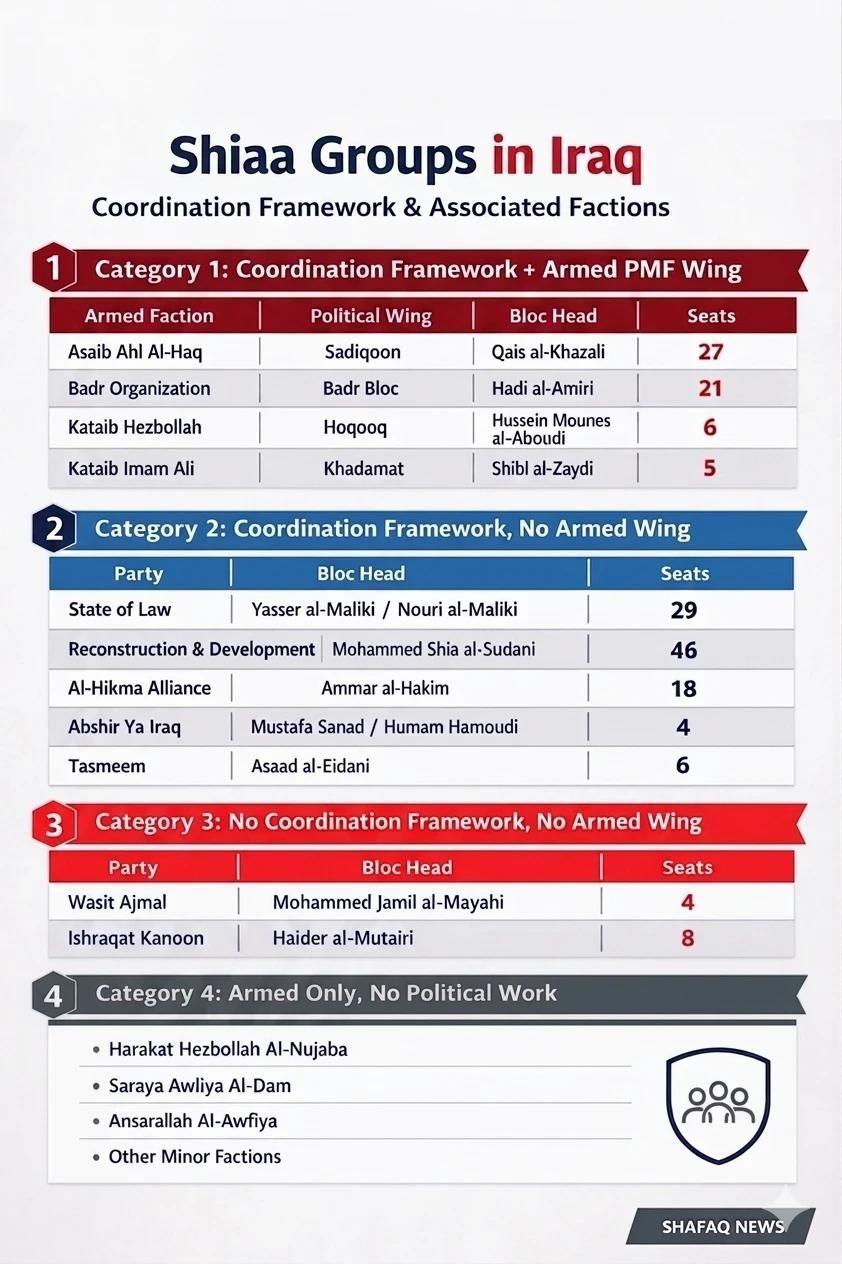
The Calculus Of Deadlock
The Framework formally nominated al-Maliki on January 24 by majority vote, not by the consensus that had governed previous nomination rounds. That procedural fracture signaled from the outset that his bid lacked the internal cohesion a confidence vote would eventually require.
Four days later, US President Donald Trump publicly rejected the nomination, threatening to cut Washington's support for Baghdad if al-Maliki returned to power. The American position hardened further when US Envoy Tom Barrack visited Baghdad and conveyed the objection through diplomatic channels directly to Iraqi political leaders.
Al-Maliki did not withdraw. His camp argued that the nomination was a collective CF decision rather than a personal ambition, and that any change of course must come from within the Framework itself. That framing —institutional loyalty as a shield against external pressure — has held his position in place even as the internal balance has shifted steadily against him.
The seat count tells the story with unusual clarity. Al-Maliki's committed coalition spans three communities but remains numerically modest: his own State of Law with 29 seats, Al-Azm alliance leader Muthanna al-Samarrai's Sunni bloc with 15, and the Kurdistan Democratic Party of Masoud Barzani with 26.
The KDP welcomed his nomination publicly and concluded a reciprocal arrangement, even if not publicly, under which al-Maliki's forces would back the KDP's presidential candidate, Foreign Minister Fouad Hussein.
That arrangement collapsed on April 11 when parliament elected the Patriotic Union of Kurdistan's candidate Nizar Amedi as president, leaving the KDP without its side of the bargain and al-Maliki without his most significant non-Shiite backer.
The forces aligned against al-Maliki's personal bid command significantly greater parliamentary weight, even if they do not always agree on an alternative. Al-Sudani's Reconstruction and Development coalition holds 46 seats. The Sadiqoon movement of Qais al-Khazali and the Al-Hikma Alliance of Ammar al-Hakim, whose positions have converged around resistance to al-Maliki specifically, together contribute 45.
Mohammed al-Halbousi's Taqadum party, the largest Sunni force with 33 seats, had already rejected al-Maliki's nomination before Trump's statement, grounding its opposition in domestic political rivalry rather than American pressure.
The PUK's 15 seats, anchored by its April 11 presidential victory, sit firmly in the anti-al-Maliki camp.
Badr Organization leader Hadi al-Amiri's 21 seats remain formally neutral —the most consequential undeclared position in the entire negotiation.
The combined weight of forces either opposed to al-Maliki or uncommitted to him exceeds 160 seats across all communities. His committed base sits at roughly 70. The gap between those two figures is a structural verdict.
What has kept al-Maliki's position alive is not numbers but leverage: his ability to deny the CF the internal consensus it needs to formally displace him, and the absence of a challenger whom all opposing factions can agree to support.
That absence has produced the current impasse. The Framework scheduled a decisive meeting for last Saturday, postponed it to Monday, and watched Monday's session end without resolution. Wednesday's attempt was similarly postponed to Friday, and April 26 is now four days away. Read more: Iraq Government Formation: The Constitution that cannot enforce its own deadlines
The Mechanism Debate
Inside the failed sessions, two voting proposals have emerged as the Framework's attempt to break its own impasse, according to sources who spoke to Shafaq News.
The first would require any nominee to secure an absolute majority of CF members —a threshold of roughly 82 of 162 seats. Neither al-Maliki nor al-Sudani reaches that figure from his own bloc alone, making the outcome dependent on which man can pull Badr, Hoqooq, Khadamat, and the smaller parties into his column.
The second proposal links the selection to the parliamentary weight of blocs backing each contender, with the winning candidate required to surpass a two-thirds threshold within the Framework's leadership structure, equivalent to approximately 10 leadership votes. This shifts the contest from seat counts to institutional seniority, a terrain where al-Maliki's longer roots inside the CF machinery could offset his numerical disadvantage.
Both leaders have reportedly agreed that one of these mechanisms should govern the outcome. The agreement on process, however, masks a disagreement on proxy candidates that may prove equally difficult to resolve.
Al-Maliki's camp has advanced Bassem al-Badri, chair of the Accountability and Justice Commission, as a compromise figure. Al-Sudani's coalition has put forward Ihsan al-Awadi, director of the caretaker prime minister's office.
Thirty lawmakers from al-Sudani's own bloc have threatened to withdraw their support if al-Awadi is nominated —a signal of the factional tension running even within what should be the Framework's dominant force.
Sources within the Framework told Shafaq News that if divisions persist, discussions may shift toward a third figure with political and administrative experience capable of addressing security, economic, and governance challenges while maintaining international acceptance. Caretaker Health Minister Saleh al-Hasnawi has been floated as one such name.
The PMF's institutional status has emerged as a parallel sticking point in the cabinet portfolio negotiations. Armed-wing blocs are demanding that the PMF's designation as an independent body be preserved in any government formation agreement, a condition that directly shapes Washington's assessment of the next prime minister's willingness to constrain Iranian-aligned forces.
The External Ceiling
What the internal CF sessions have not fully absorbed is that the room where the designation is nominally being made is not the only room where it is actually being decided.
The commander of Iran's Quds Force, Esmail Qaani, completed a covert multi-day visit to Baghdad —his presence, as is customary, unannounced until after the fact. He departed, leaving his deputy behind to monitor two parallel files: the status of Iraqi armed groups in the event of an Iran-US agreement, and the government formation process itself.
The dual mandate of that deputy's presence reflects Tehran's consistent position: the PM selection and the broader regional negotiation are not separate files.
In a message issued after his departure, Qaani stated that forming a government is "a purely Iraqi right," adding that "Iraq is too great for others to interfere in its affairs" —a formulation that pointedly referenced what he described as "perpetrators of crimes against humanity," understood as a reference to the United States.
The statement publicly disavowed the very influence his presence was understood to be exercising. Most political observers in Baghdad read the visit itself as the signal, and the departing words as its diplomatic cover.
The consequences of that visit became visible shortly after. The CF was on the verge of naming al-Badri on Friday evening, with a Saturday session expected to confirm the choice. Subsequent developments —never formally identified by any party— unraveled an agreement that had appeared settled, sending the nine-candidate contest back to its starting point.
Washington's move is expected next. US Envoy Tom Barrack is anticipated to visit Baghdad imminently. The two visits —Qaani's concluded and Barrack's forthcoming— are the decisive external inputs that will shape Iraq's next political phase.
What The Numbers Cannot Resolve
The trajectory of the current negotiation points toward one of four outcomes, each carrying distinct consequences for Iraq's political architecture.
The first is an al-Maliki premiership. It remains constitutionally possible since he holds the CF's formal nomination, commands a committed cross-community coalition of roughly 70 seats, and has not withdrawn despite sustained internal and external pressure. His camp's strategy is not to win the internal CF numbers —he cannot— but to outlast the opposition's ability to coalesce around a single alternative.
Behind that strategy sits an implicit endorsement from Tehran, whose preference for al-Maliki as a known and institutionally reliable quantity has been visible throughout the formation process. However, what al-Maliki cannot overcome is the American, and the parliamentary confidence vote that follows any CF designation would require cross-community support that his current coalition cannot deliver.
His 70-seat committed base falls critically short of the majority he would need, particularly given the public distance maintained by Sunni and Kurdish blocs that have either explicitly rejected his return or quietly withheld their backing.
The second is a second term for Al-Sudani, secured through the internal CF voting mechanism once al-Maliki's bid is formally exhausted. This is the outcome the seat distribution most clearly supports.
Al-Sudani commands the largest single bloc, enjoys tacit backing from al-Hakim and al-Khazali, faces no American veto, and demonstrated through his caretaker tenure a capacity to manage the competing pressures of Washington and Tehran without forcing either into open confrontation.
He also carries the cross-community support that a confidence vote requires —the April 11 presidential session demonstrated that the coalition holds under pressure. A second Al-Sudani term would represent continuity dressed as resolution, the CF's nominal nominee displaced by its numerical reality.
The third is a compromise figure —al-Badri, al-Awadi, al-Hasnawi, or another name whose primary qualification is the absence of committed enemies. This outcome would resolve the immediate impasse while deferring its underlying causes. A prime minister without a political base of his own would govern through negotiated dependency on the blocs that installed him, meaning the CF's internal fracture would be managed rather than resolved.
External pressure shapes this scenario as directly as it does the others. Any compromise figure must clear two external thresholds simultaneously: Washington's acceptance, which rules out anyone perceived as an Iranian instrument, and Tehran's tolerance, which rules out anyone perceived as a reformist threat to PMF institutional autonomy.
The fourth, and constitutionally most precarious, outcome is a failure to meet the April 26 limit, forcing a legal and political reckoning over what happens when Iraq's largest bloc cannot exercise the designation it claims. The Federal Supreme Court's 2010 ruling on the largest bloc created the legal ground within which this contest is being fought.
Whether that architecture contains a mechanism for resolving a CF impasse that crosses the constitutional threshold is a matter Iraqi legal scholars have not been required to address until now.
A bloc that cannot agree on a candidate across multiple failed sessions is not simply experiencing political friction. It is revealing, in real time, the limits of a power-sharing system designed to distribute influence rather than concentrate it, and that has never developed a mechanism for resolving the conflicts that distribution inevitably produces.
Read more: Iraq's Presidential vote:a rehearsal for premiership
Written and edited by Shafaq News staff.
Seeds of Wisdom RV and Economics Updates Thursday Evening 4-23-26
Good Evening Dinar Recaps,
Commodity Shift Accelerates: Energy Crisis Reshapes Currency Power
Rising geopolitical tensions and supply disruptions are driving a shift toward commodity-backed strength, altering the global currency landscape
Good Evening Dinar Recaps,
Commodity Shift Accelerates: Energy Crisis Reshapes Currency Power
Rising geopolitical tensions and supply disruptions are driving a shift toward commodity-backed strength, altering the global currency landscape
OVERVIEW (KEY POINTS)
Global markets are undergoing a significant shift as energy disruptions and geopolitical tensions reshape currency performance. Commodity-linked currencies—particularly those tied to oil and natural resources—are gaining strength while traditional currencies face increased pressure.
This is happening now due to the ongoing Middle East conflict, which has triggered one of the largest energy disruptions in recent history, forcing countries to prioritize energy security and resource access.
Key players include commodity-exporting nations like Norway, Canada, and Australia, alongside investors reallocating capital in response to changing global dynamics. These shifts are influencing currency demand and reserve strategies.
The broader implication is clear: currencies tied to real assets are gaining importance, signaling a gradual transition toward a more resource-driven global financial system.
KEY DEVELOPMENTS
1. Commodity Currencies Outperform Major Rivals
Currencies linked to natural resources are gaining strength.
Norwegian krone and Australian dollar up over 7% against the U.S. dollar in 2026
Reflects growing demand for energy and commodity-backed economies
2. Energy Crisis Drives Global Realignment
Supply disruptions are reshaping financial flows.
Middle East conflict creating historic energy market instability
Countries prioritizing secure access to oil and critical materials
3. Investment Strategies Shift Toward Resources
Capital is moving into commodity-driven markets.
Investors reducing exposure to euro and traditional currencies
Increasing allocations to commodity-linked assets and currencies
4. Dollar Holds Short-Term Strength
Despite shifts, the dollar remains dominant in crisis periods.
Rising energy prices increase demand for dollar-based transactions
Reinforces its role as a global liquidity anchor
WHY IT MATTERS
This development highlights a structural shift in global finance, where real assets like energy and commodities are increasingly influencing currency strength.
Markets are responding to supply uncertainty, creating volatility across currencies, commodities, and equities. This environment favors economies with resource control and export capacity.
For policymakers, the shift introduces new challenges. Managing inflation and growth becomes more complex when external commodity shocks drive financial conditions.
At the system level, this signals a transition toward a more fragmented and resource-dependent global financial structure.
WHY IT MATTERS TO FOREIGN CURRENCY HOLDERS
Commodity-linked currencies may strengthen relative to others
Purchasing power shifts depending on energy exposure
Capital flows favor resource-rich economies
Exchange rate volatility increases across markets
IMPLICATIONS FOR THE GLOBAL RESET
Pillar 1: Resource-Backed Currency Influence
Currencies tied to tangible assets like oil and commodities are gaining importance, reinforcing a shift toward value anchored in physical resources.
Pillar 2: Fragmentation of Monetary Power
Global finance is moving toward a multi-polar currency system, where influence is distributed among resource-rich nations rather than centralized.
CONCLUSION
The rise of commodity-linked currencies reflects a deeper transformation in the global financial system. As energy disruptions continue, the importance of resource control is becoming more evident.
While the U.S. dollar remains dominant in the short term, underlying shifts suggest a gradual rebalancing of currency power driven by real-world assets.
This is not a temporary adjustment—it is part of a broader evolution shaped by geopolitics, energy, and resource security.
When commodities drive currency strength, the foundation of global finance begins to realign.
Seeds of Wisdom Team
Newshounds News™ Exclusive
Sources
Reuters — "Commodities reshape geopolitics as currency order shifts"
Asia Times — "Is the US dollar really winning the Iran war?"
~~~~~~~~~~
Seeds of Wisdom Team RV Currency Facts Youtube and Rumble
Newshound's News Telegram Room Link
RV Facts with Proof Links Link
RV Updates Proof links - Facts Link
Follow the Gold/Silver Rate COMEX
Follow Fast Facts
Seeds of Wisdom Team™Website
Thank you Dinar Recaps
$3.5 Trillion Private Credit Bubble will Trigger the Next Financial Crisis
$3.5 Trillion Private Credit Bubble will Trigger the Next Financial Crisis
Daniela Cambone: 4-23-2026
In a world rife with economic headlines, from inflation woes to tech stock volatility, it’s easy to feel overwhelmed. But what if the biggest threat isn’t being discussed widely enough? What if a seasoned veteran, with nearly five decades of market insight, is sounding an urgent alarm about a sector you might not even be familiar with?
That’s precisely the message from Bert Dohmen, founder of Dohmen Capital and a long-time market strategist known for his contrarian views. In a recent appearance on Daniela Cambone’s show via the ITM Trading YouTube channel, Dohmen laid out a stark warning: the private credit market is a dangerous bubble, poised to trigger the next global financial crisis.
$3.5 Trillion Private Credit Bubble will Trigger the Next Financial Crisis
Daniela Cambone: 4-23-2026
In a world rife with economic headlines, from inflation woes to tech stock volatility, it’s easy to feel overwhelmed. But what if the biggest threat isn’t being discussed widely enough? What if a seasoned veteran, with nearly five decades of market insight, is sounding an urgent alarm about a sector you might not even be familiar with?
That’s precisely the message from Bert Dohmen, founder of Dohmen Capital and a long-time market strategist known for his contrarian views. In a recent appearance on Daniela Cambone’s show via the ITM Trading YouTube channel, Dohmen laid out a stark warning: the private credit market is a dangerous bubble, poised to trigger the next global financial crisis.
Dohmen, drawing on his deep understanding of liquidity and credit cycles, argues that the rapid expansion of private credit – a sector heavily promoted by Wall Street – is showing alarming signs of stress. He points to evident liquidity shortages and recent instances of large firms halting redemptions as clear signals of serious trouble brewing beneath the surface.
Think of it this way: private credit involves direct lending by non-bank financial institutions to companies, often those that can’t access traditional bank loans or public markets. While it offers flexibility, its rapid, largely unregulated growth, coupled with widespread illiquidity, creates a precarious system. When investors want their money back, and the underlying assets can’t be quickly sold, the system grinds to a halt – a classic recipe for a financial crisis.
In this environment, he critiques popular investment trends like technology stocks and cryptocurrencies, which he believes lack intrinsic value and are highly speculative. Instead, he vehemently advocates for precious metals like gold and silver, emphasizing their historical role as safe havens and their inherent, tangible value during economic downturns.
Dohmen doesn’t shy away from critiquing conventional economic policies, especially those of the Federal Reserve. He argues that the Fed’s primary tool to combat inflation – raising interest rates – is counterproductive, actually fueling inflation by increasing business costs, which are then passed on to consumers.
He predicts ongoing inflation and economic pain, doubting that policymakers will have the fortitude to genuinely shrink the money supply due to fears of triggering a deep recession and facing severe political backlash. For investors, this means that traditional diversification strategies, often lauded in calmer times, might not offer adequate protection during the impending crisis.
Interestingly, Dohmen also notes a rising political movement in some U.S. states advocating for the reintroduction of gold and silver as currency alternatives. This reflects a growing distrust of fiat currencies and central banking policies, mirroring Dohmen’s own concerns.
Beyond finance, he stresses the critical importance of diplomacy over conflict in resolving geopolitical tensions, urging for professional diplomatic training to avoid costly and destructive wars that further destabilize the global economy.
Bert Dohmen’s message is a potent blend of caution and actionable advice. The financial system, he warns, is precarious, and the next crisis is not just impending but already showing its early signs. Understanding these risks and safeguarding your wealth with stable, intrinsically valuable assets may be your best defense against the coming storm.
Seeds of Wisdom RV and Economics Updates Thursday Afternoon 4-23-26
Good Afternoon Dinar Recaps,
Currency Pressure Builds: BRICS Units Slide as Dollar Strengthens
Rising oil prices and market stress are pushing emerging market currencies lower, reinforcing short-term U.S. dollar dominance
Good Afternoon Dinar Recaps,
Currency Pressure Builds: BRICS Units Slide as Dollar Strengthens
Rising oil prices and market stress are pushing emerging market currencies lower, reinforcing short-term U.S. dollar dominance
OVERVIEW (KEY POINTS)
Two major BRICS-linked currencies—the Indian rupee and Indonesian rupiah—have dropped to near or record lows against the U.S. dollar, reflecting growing pressure across emerging markets. The rupee has weakened toward 94 per dollar, while the rupiah has fallen sharply to around 17,315.
This is happening now as higher oil prices, capital outflows, and global uncertainty weigh heavily on import-dependent economies. Despite intervention efforts by central banks, currency weakness is re-emerging as market forces overpower short-term controls.
Key players include the Reserve Bank of India and Bank of Indonesia, along with global currency markets reacting to energy costs, liquidity conditions, and investor sentiment.
The broader implication is clear: currency volatility is rising across emerging markets, reinforcing the U.S. dollar’s strength even as longer-term de-dollarization trends continue.
KEY DEVELOPMENTS
1. Indian Rupee Nears Record Low
The rupee is approaching its weakest levels on record.
Fell to around 94.08 per dollar
Near previous low of 95.10 reached earlier this month
2. Indonesian Rupiah Hits Sharp Decline
The rupiah has weakened significantly in forex markets.
Dropped to approximately 17,315 per dollar
Prompted central bank warnings of further intervention
3. Central Banks Attempt Currency Defense
Authorities are taking steps to stabilize markets.
India imposed limits on currency speculation by banks
Forced liquidation of U.S. dollar holdings to support the rupee
4. Oil Prices Drive Currency Weakness
Energy costs are adding pressure on import-heavy economies.
Higher oil prices increasing trade deficits and inflation risk
Weakening demand for local currencies in global markets
5. Regional Currencies Also Under Pressure
The trend extends beyond BRICS nations.
Philippine peso and Thai baht also declining against the dollar
Reflects broader ASEAN currency stress
WHY IT MATTERS
This development highlights the fragility of emerging market currencies during periods of global stress. When external pressures rise, capital often flows toward stronger, more liquid assets like the U.S. dollar.
Markets are reacting to rising energy costs and uncertainty, increasing volatility in foreign exchange markets and global capital flows. This can impact trade balances and investment decisions.
For policymakers, defending currencies becomes more difficult as interventions provide only temporary relief. Sustained pressure can lead to tighter monetary policy or reduced growth.
At the system level, this reinforces the current reality: the dollar remains dominant in times of crisis, even as alternative systems are being developed.
WHY IT MATTERS TO FOREIGN CURRENCY HOLDERS
Local currencies may lose value against the U.S. dollar
Purchasing power declines in import-driven economies
Capital may flow toward stronger currencies
Exchange rate volatility increases, impacting trade and savings
IMPLICATIONS FOR THE GLOBAL RESET
Pillar 1: Short-Term Dollar Dominance
Despite ongoing de-dollarization efforts, market stress is reinforcing the U.S. dollar’s role as a global safe haven, particularly during volatility.
Pillar 2: Structural Weakness in Emerging Markets
Persistent currency pressure highlights underlying challenges in liquidity, trust, and economic resilience, driving the need for long-term financial restructuring.
CONCLUSION
The recent decline in BRICS-linked currencies underscores a growing divergence between short-term market behavior and long-term structural shifts. While alternative systems are being explored, the dollar continues to dominate during periods of stress.
Central bank interventions may slow the decline, but they are unlikely to reverse broader trends driven by energy costs, capital flows, and global uncertainty.
This moment reflects a key tension in the global financial system: emerging alternatives are rising, but the existing system remains deeply entrenched.
When market pressure intensifies, currency strength reveals where confidence still resides.
Seeds of Wisdom Team
Newshounds News™ Exclusive
Sources
Watcher.Guru — "2 BRICS Currencies Crash To Record Lows Against the US Dollar"
Reuters — "Asian currencies weaken as oil prices rise and dollar strengthens"
~~~~~~~~~~
Seeds of Wisdom Team RV Currency Facts Youtube and Rumble
Newshound's News Telegram Room Link
RV Facts with Proof Links Link
RV Updates Proof links - Facts Link
Follow the Gold/Silver Rate COMEX
Follow Fast Facts
Seeds of Wisdom Team™Website
Thank you Dinar Recaps
Iraq Economic News And Points To Ponder Thursday Afternoon 4-23-26
Basrah Crudes Lead Regional Oil Benchmarks
2026-04-23 Shafaq News- Basrah Iraq’s Basrah crudes edged lower by 0.5% on Thursday, outperforming several regional benchmarks.
Market data showed Basrah Heavy falling 56 cents, or 0.50% to $111.94 per barrel, and Basrah Medium crude declined 56 cents, or 0.49%, reaching $114.04 per barrel.
Basrah Crudes Lead Regional Oil Benchmarks
2026-04-23 Shafaq News- Basrah Iraq’s Basrah crudes edged lower by 0.5% on Thursday, outperforming several regional benchmarks.
Market data showed Basrah Heavy falling 56 cents, or 0.50% to $111.94 per barrel, and Basrah Medium crude declined 56 cents, or 0.49%, reaching $114.04 per barrel.
In contrast, several regional grades declined, with Saudi Light at $109.04 per barrel, Qatar’s Al-Shaheen at $97.63, Kuwait crude at $93.64, UAE’s Murban at $103.12, and Iran Light at $94.84.
Globally, Brent crude futures rose $1.37, or 1.3%, to $103.28 a barrel. US West Texas Intermediate (WTI) crude were also up $1.52, or 1.6%, at $94.48.
Iraq prices its crude based on export destinations, with shipments to Asia linked to the Dubai and Oman benchmarks, exports to Europe tied to Brent with premiums or discounts, and cargoes to the United States priced against WTI in line with market conditions. https://www.shafaq.com/en/Economy/Basrah-crudes-lead-regional-oil-benchmarks-6
Gold Prices Fall In Baghdad And Erbil
2026-04-23 Shafaq News- Baghdad/ Erbil On Thursday, gold prices hovered around 1.03 million IQD per mithqal in Baghdad and Erbil markets, according to a survey by Shafaq News Agency.
Gold prices on Baghdad's Al-Nahr Street recorded a selling price of 1.031 million IQD per mithqal (equivalent to five grams) for 21-carat gold, including Gulf, Turkish, and European varieties, with a buying price of 1.028 million IQD. The same gold had sold for 1.035 million IQD on Wednesday.
The selling price for 21-carat Iraqi gold stood at 1.001 million IQD, while the buying price reached 998,000 IQD.
In jewelry stores, the selling price per mithqal of 21-carat Gulf gold ranged between 1.030 million and 1.040 million IQD, while Iraqi gold sold for between 1.000 million and 1.010 million IQD.
In Erbil, 22-carat gold was sold at 1.071 million IQD per mithqal, 21-carat gold at 1.023 million IQD, and 18-carat gold at 876,000 IQD. https://www.shafaq.com/en/Economy/Gold-prices-fall-in-Baghdad-and-Erbil-6-0
Iraq Expands E-Governance With New Company Registration System
2026-04-23 Shafaq News- Baghdad Iraq launched an integrated electronic platform for company registration to streamline procedures and boost the business environment, the trade minister said on Thursday.
Atheer Al-Ghurairy told a press conference that the platform, operated by the Companies Registration Directorate, aims to automate processes and accelerate transactions for both local and foreign firms. He clarified that the project includes the digital archiving of more than 103,000 documents and 18 million records, while enabling citizens and business owners to track their transactions online.
In 2024, the government launched a national e-governance program, followed in 2025 by Prime Minister Mohammed Shia Al-Sudani’s inauguration of the Digital Transformation and Automation Center to streamline procedures and reduce bureaucracy.
Government data released in July showed digital adoption across ministries and public institutions rose from 18% in 2022 to 32% in 2025. Read more: Digital Transformation in Iraq: Combating Corruption through E-Governance
https://www.shafaq.com/en/Economy/Iraq-expands-e-governance-with-new-company-registration-system
USD/IQD exchange rates advance in Baghdad and Erbil
2026-04-23 Shafaq News- Baghdad/ Erbil The US dollar closed Thursday’s trading higher in Iraq, hovering around 156,000 dinars per 100 dollars.
According to Shafaq News market survey, the dollar traded in Baghdad's Al-Kifah and Al-Harithiya exchanges at 155,500 dinars per 100 dollars, up from the morning session’s 154,950 dinars.
In the Iraqi capital, exchange shops sold the dollar at 156,000 dinars and bought it at 154,000 dinars, while in Erbil, selling prices stood at 155,050 dinars and buying prices at 154,950 dinars.
https://www.shafaq.com/en/Economy/USD-IQD-exchange-rates-advance-in-Baghdad-and-Erbil-1
Iranian Kurdish Opposition Accuses Iran Of 700 Sovereignty Breaches In Iraq
2026-04-23 Shafaq News- Al-Sulaymaniyah Iran has violated Iraqi sovereignty more than 700 times since the escalation of regional tensions, including after the ceasefire took effect on April 8, the opposition Alliance of Iranian Kurdistan Political Parties said on Thursday, noting that Iraq’s Kurdistan Region has been “a primary target.”
The alliance stated that more than 150 direct strikes targeted camps hosting Iranian Kurdish political refugees, killing 21 people, including 10 activists and group members.
It condemned the drone and missile attacks as “an attempt to deflect from Iran’s setbacks,” and described strikes on consulates, political camps, and civilian areas as “war crimes,” urging the United Nations and concerned states to take a firm stance while reaffirming support for stability in the Region.
Since hostilities escalated between the United States, Iran, and Israel on February 28, the Kurdistan Region has faced around 650 missile and drone incidents affecting diplomatic facilities, sites linked to Iranian Kurdish opposition groups, Peshmerga positions, oil fields, communication networks, residential areas, and public infrastructure, leaving about 16 people dead and 100 injured. Read more: 650 Strikes in Iraqi Kurdistan: How deniability became a weapon
BREAKING NEWS: U S Halts $500 Million to Iraq Over Militants
BREAKING NEWS: U S Halts $500 Million to Iraq Over Militants
Edu Matrix: 4-23-2026
Breaking News coming out of Iraq — reports confirm that $500 million in US cash was blocked by the US Treasury, raising serious questions about Iraq’s financial stability, oil revenues, and the future of the Iraqi dinar.
In this video, we break down what it means when US dollars are blocked, why the US Treasury blocked Iraq’s cash shipment, and how this could impact Iraq’s economy, banking system, and investors watching the Iraqi dinar.
This Breaking News update on Iraq reveals how a cargo plane carrying nearly $500 million in US banknotes tied to Iraq’s oil revenues was stopped before reaching Baghdad.
BREAKING NEWS: U S Halts $500 Million to Iraq Over Militants
Edu Matrix: 4-23-2026
Breaking News coming out of Iraq — reports confirm that $500 million in US cash was blocked by the US Treasury, raising serious questions about Iraq’s financial stability, oil revenues, and the future of the Iraqi dinar.
In this video, we break down what it means when US dollars are blocked, why the US Treasury blocked Iraq’s cash shipment, and how this could impact Iraq’s economy, banking system, and investors watching the Iraqi dinar.
This Breaking News update on Iraq reveals how a cargo plane carrying nearly $500 million in US banknotes tied to Iraq’s oil revenues was stopped before reaching Baghdad.
These funds are typically used to support liquidity inside Iraq, stabilize the exchange rate, and maintain confidence in the financial system.
When the US blocks dollar shipments to Iraq, it sends a powerful signal — and this could have ripple effects across the region.
We also discuss how this move by the US Treasury may be connected to pressure on Iraq regarding Iran-aligned groups, and why access to US dollars is one of the most important tools in global financial control.
If you are following the Iraqi dinar, Iraq economy, oil revenues, or US-Iraq relations, this is a must-watch update. Stay informed as we continue to track this developing Breaking News story involving Iraq, US cash, and the US Treasury.
Seeds of Wisdom RV and Economics Updates Thursday Morning 4-23-26
Good Morning Dinar Recaps,
Supply Chain Shock: War Disruption Boosts Logistics Profits Amid Global Trade Shift
Rerouted shipping and rising costs are driving short-term gains for logistics firms while signaling deeper structural changes in global trade
Good Morning Dinar Recaps,
Supply Chain Shock: War Disruption Boosts Logistics Profits Amid Global Trade Shift
Rerouted shipping and rising costs are driving short-term gains for logistics firms while signaling deeper structural changes in global trade
OVERVIEW (KEY POINTS)
Ongoing conflict involving Iran, the United States, and regional tensions is disrupting major global trade routes, unexpectedly boosting profits for large European logistics firms such as DHL, DSV, and Kuehne+Nagel.
This is happening now because key shipping corridors—including the Strait of Hormuz and Red Sea routes—are facing instability, forcing companies to reroute cargo and rely more heavily on alternative transport methods like air freight.
Key players include global logistics providers, shipping companies, and multinational corporations adapting to longer routes, higher costs, and tighter capacity. These shifts are increasing demand for premium logistics services.
The broader implication is significant: global supply chains are being reshaped under pressure, creating short-term financial gains but long-term uncertainty for trade and economic stability.
KEY DEVELOPMENTS
1. Logistics Firms See Profit Surge
Major European logistics companies are benefiting from disruption.
Firms like DHL, DSV, and Kuehne+Nagel expected to report stronger earnings
Higher freight rates are driving increased profit margins
2. Shipping Routes Face Severe Disruption
Critical global trade corridors are under pressure.
Strait of Hormuz instability limiting normal vessel transit
Red Sea and Suez disruptions delaying return to standard routes
3. Cargo Rerouted Around Longer Paths
Shipping companies are adjusting routes significantly.
Firms like Maersk and Hapag-Lloyd rerouting via the Cape of Good Hope
Adds time, fuel costs, and logistical complexity
4. Air Freight Demand Surges
Businesses shift to faster alternatives.
Air cargo demand rising as companies avoid delays
Benefits firms with strong air logistics infrastructure
5. Costs Rise Across the Supply Chain
Disruptions are increasing operational expenses.
Fuel prices, freight rates, and capacity constraints all rising
Higher costs translating into short-term pricing power
WHY IT MATTERS
This development highlights how global instability directly reshapes trade economics. When supply chains are disrupted, costs rise—and those increases ripple across industries and markets.
Markets are responding to higher logistics costs, which contribute to inflation and reduced efficiency in global trade. This affects everything from manufacturing to consumer pricing.
For policymakers, the situation underscores the importance of resilient supply chains and diversified trade routes. Dependence on vulnerable corridors creates systemic risk.
At the system level, this reflects a shift toward a more complex and less predictable global trade environment, driven by geopolitical factors rather than efficiency.
WHY IT MATTERS TO FOREIGN CURRENCY HOLDERS
Currencies tied to trade-heavy economies may face pressure from rising costs
Purchasing power declines as logistics-driven inflation increases
Capital flows may shift toward more stable or diversified economies
Exchange rate volatility increases amid global uncertainty
IMPLICATIONS FOR THE GLOBAL RESET
Pillar 1: Structural Supply Chain Transformation
Persistent disruption is accelerating a shift toward longer, more diversified trade routes, reducing reliance on traditional chokepoints and reshaping global commerce.
Pillar 2: Cost-Driven Economic Realignment
Rising logistics costs are contributing to inflationary pressure and economic adjustment, influencing monetary policy and long-term growth patterns.
CONCLUSION
The current conflict has created a temporary financial advantage for logistics companies, as disruption increases demand for their services and allows for higher pricing.
However, this advantage is closely tied to instability. As costs rise and trade patterns shift, the long-term outlook becomes more uncertain, especially if economic growth slows.
This moment reflects a broader transformation: global trade is becoming more complex, more expensive, and more dependent on geopolitical stability.
When supply chains are forced to adapt under pressure, the entire global economic structure begins to evolve.
Seeds of Wisdom Team
Newshounds News™ Exclusive
Sources
Modern Diplomacy — "War Driven Disruption Lifts European Logistics Profits but Risks Lie Ahead"
Reuters — "Global shipping disruption boosts logistics demand amid conflict"
~~~~~~~~~~
A Message to Our Currency Holders
If you’ve been holding foreign currency for many years, you were not foolish.
You were not wrong to believe the global financial system would change.
What failed was not your patience — it was the information you were given.
For years, dates, rumors, and personalities replaced facts, structure, and proof. “This week” predictions created cycles of hope and disappointment that were never based on how currencies actually change.
That is not your failure.
Our mission here is different: • No dates • No rates • No hype • No gurus
Instead, we focus on:
• Verifiable developments • Institutional evidence
• Global financial structure • Where countries actually sit in the process
Currency value changes only come after sovereignty, trade, banking, settlement systems, and fiscal coordination are in place. History and institutions confirm this sequence.
You will see silence. You will see denials. That is not delay — that is discipline.
Protect your identity. Organize your documents. Verify everything.
Never hand your discernment to anyone who cannot show proof.
You deserve truth — not timelines.
Seeds of Wisdom Team
Newshounds News™
~~~~~~~~~~
Seeds of Wisdom Team RV Currency Facts Youtube and Rumble
Newshound's News Telegram Room Link
RV Facts with Proof Links Link
RV Updates Proof links - Facts Link
Follow the Gold/Silver Rate COMEX
Follow Fast Facts
Seeds of Wisdom Team™Website
Thank you Dinar Recaps
Iraq Economic News And Points To Ponder Thursday Morning 4-23-26
The Minister Of Trade Announces The Launch Of The Electronic Merchant Platform And A New Package Of Automation Projects.
Money and Business Economy News – Baghdad Minister of Trade, Atheer Dawood Al-Ghurairi, announced on Thursday a new package of automation projects to simplify the services of the Companies Registration Department, while also indicating the launch of the electronic merchant platform
The Minister Of Trade Announces The Launch Of The Electronic Merchant Platform And A New Package Of Automation Projects.
Money and Business Economy News – Baghdad Minister of Trade, Atheer Dawood Al-Ghurairi, announced on Thursday a new package of automation projects to simplify the services of the Companies Registration Department, while also indicating the launch of the electronic merchant platform
Al-Ghurairi said in a press conference, which was followed by “Al-Eqtisad News”, that “the electronic transformation is not an electronic obligation, but it has become an economic necessity and an obligation for the government to improve its services and raise the efficiency of its institutions. Believing in this principle, the Ministry of Trade has begun with important steps and real achievements, as the complete transformation of the ration card has been completed and services have been provided to citizens through an efficient electronic link that spares the citizen from having to visit the institutions of the Ministry of Trade, and with complete transparency.”
He added that "the program achieved several goals, the most important of which is providing a real service to the citizen that spares him from having to visit institutions and extort bad employees. One of its goals is also to preserve state funds, as 5 million citizens who are traveling, deceased, and duplicate names were removed from the ration card, thus saving an amount of no less than one trillion dinars," noting "the integrity of real data that was not previously achieved, which was paper-based, and today digital data is based on the unified card and easy services for the citizen."
He continued: “Today we announce the transformation of the Companies Registration Department into a nearly complete electronic transformation, as we are launching 30 services today,” explaining that “this first near-final package will be fully completed within two months, in addition to 34 additional services, which will be the culmination of work that lasted for two years. We have also archived 103,000 files and 18 million and 450 thousand papers and documents into electronic format and dispensed with paper.”
He stressed that “the electronic transformation provides simplification of procedures for the citizen and the concerned party, ease of service delivery, speed of completion and transparency through transaction monitoring,” announcing “the launch of the electronic commerce system application, which has become a large market where the percentage of electronic buying and selling transactions has reached $12 billion.”
He stated that "the Ministry of Trade achieves two important things: first, protecting the consumer from any fraud and manipulation, and second, protecting the producer and seller from fraud and manipulation of brands. Therefore, it is regulating the buying and selling process."
He explained that “a department was created in the legal department to manage the file of the electronic trade system and issue the electronic trader license. In addition to completing the certificate of origin and the invoice, any exporter to Iraq from any country needs to go to the capital or the headquarters of the commercial attaché to have his papers certified, and this is routine and an obstacle. Today it has become electronic, and the company owner can certify electronically easily, and it is not subject to manipulation and is linked to ASYCUDA and the borders.”
He pointed out that "the process is a true governance that moves Iraqi trade through the linking of its institutions with border crossings, customs, institutions affiliated with the Iraqi government and commercial attachés, and linking this chain," stressing that "the ministry is moving towards true governance and control of foreign and domestic trade in a way that serves the citizen and the merchant together."https://www.economy-news.net/content.php?id=68245
Declining Global Demand Is Putting Pressure On The Rice Market, With Iraq Among The Affected Countries.
Money and Business Economy News – Baghdad Data released by the US Department of Agriculture on Thursday indicates significant shifts in the global rice market during the 2025/2026 season, with rising supplies and stocks compared to a slight decline in consumption and trade, including in Iraq.
According to the Ministry’s report on “Rice Outlook for April 2026”, which was reviewed by “Al-Eqtisad News”, global production is expected to reach about 541.4 million tons, driven by a slight increase in production within Thailand, while production in both India and China remained at high levels that make them the largest producers globally.
In contrast, global consumption forecasts were reduced by about 400,000 tons to 540.6 million tons, as a result of declining demand in several countries, including Iraq, which recorded a decrease of about 100,000 tons, in addition to declines in Japan and other countries in the Middle East.
Despite this decline, global consumption remains close to record levels, especially in key countries such as Bangladesh, Nigeria and Vietnam, reflecting continued strong demand but with a relative slowdown.
On the supply side, projected global stockpiles rose to 192.3 million tons, driven by increases in countries such as Iran and Pakistan, while China and India hold the largest share of these stockpiles as a result of government storage policies.
As for trade, global rice exports are expected to reach a record high of 62.1 million tons in 2026, despite a slight downward revision of forecasts due to increased competition, particularly from low-price exporters such as India and Pakistan, which is putting downward pressure on global prices.
These developments reflect direct effects on importing markets, including Iraq, where declining consumption indicates changes in domestic demand or import patterns, in parallel with a decrease in imports from a number of Middle Eastern and African countries.https://www.economy-news.net/content.php?id=68244
Oil Jumps Past $100 Following Iran-US Impasse
2026-04-23 Shafaq News Oil prices extended their gains on Thursday in the wake of stalled peace talks between Iran and the United States, and as both nations maintained restrictions on the flow of trade through the Strait of Hormuz.
Brent crude futures rose $1.37, or 1.3%, to $103.28 a barrel at 0410 GMT, after settling above $100 for the first time in more than two weeks on Wednesday. West Texas Intermediate futures were also up $1.52, or 1.6%, at $94.48.
Both benchmarks closed more than $3 higher on Wednesday after larger-than-expected gasoline and distillate stock draws in the U.S., and over the lack of progress on Iran peace talks.
"The oil market is repricing expectations with little sign of progress in finding a resolution in the Persian Gulf," said ING analysts in a note, adding that hopes for a resolution are fading as peace talks stall.
"In addition, Iran's seizure of two vessels attempting to transit the Strait of Hormuz suggests disruptions to shipments are set to continue."
While U.S. President Donald Trump extended a ceasefire between the countries following a request by Pakistani mediators, Iran and the U.S. are still restricting the transit of ships through the strait, which carried about 20% of daily global oil supplies until the war began on February 28.
Iran seized two ships in the waterway on Wednesday, tightening its grip on the strategic chokepoint. Trump has also maintained a U.S. Navy blockade of Iran's trade by sea, and Iranian parliament speaker and top negotiator Mohammad Baqer Qalibaf said a full ceasefire only made sense if the blockade was lifted.
The U.S. military has intercepted at least three Iranian-flagged tankers in Asian waters and is redirecting them away from positions near India, Malaysia and Sri Lanka, shipping and security sources said on Wednesday.
With his extension of the ceasefire on Tuesday, Trump again pulled back at the last moment from warnings to bomb Iran's power plants and bridges. Trump has not set an end date for the extended ceasefire, White House press secretary Karoline Leavitt told reporters.
US Exports Set Record High
On energy trade, total exports of crude oil and petroleum products from the United States climbed by 137,000 barrels per day to a record 12.88 million bpd as Asian and European countries bought up supplies after disruptions tied to the Iran war.
U.S. crude stocks rose while gasoline and distillate inventories fell, the Energy Information Administration said on Wednesday.
Crude inventories rose by 1.9 million barrels, compared with expectations in a Reuters poll for a 1.2 million-barrel draw.
U.S. gasoline stocks fell by 4.6 million barrels, while analysts had expected a 1.5 million-barrel draw. Distillate stockpiles dropped by 3.4 million barrels versus expectations for a 2.5 million-barrel drop. (Reuters)
https://www.shafaq.com/en/Economy/Oil-jumps-past-100-following-Iran-US-impasse
Dollar Rises In Baghdad And Erbil Markets
2026-04-23 Shafaq News- Baghdad/ Erbil The US dollar opened Thursday's trading higher in Iraq, hovering around 155,000 dinars per 100 dollars.
According to a Shafaq News market survey, the dollar traded in Baghdad's Al-Kifah and Al-Harithiya exchanges at 154,950 dinars per 100 dollars, up from the previous session's 154,750 dinars.
In the Iraqi capital, exchange shops sold the dollar at 156,500 dinars and bought it at 155,500 dinars, while in Erbil, selling prices stood at 154,950 dinars and buying prices at 154,800 dinars.
https://www.shafaq.com/en/Economy/Dollar-rises-in-Baghdad-and-Erbil-markets-7
Iraq News Posted by TishWash at TNT 4-23-2026
TNT:
Tishwash: Oil revenues: Washington freezes $500 million in financial aid to Iraq
US officials revealed on Wednesday that the United States has blocked the transfer of approximately $500 million in Iraqi oil revenues to Baghdad, citing the failure of efforts to dismantle pro-Iranian factions.
The Wall Street Journal quoted the US State Department as confirming that Washington expects Iraq to take concrete steps to dismantle these groups, stressing that Baghdad's "failure" to prevent attacks targeting US interests and its allies in the region casts a negative shadow on bilateral relations between the two countries.
TNT:
Tishwash: Oil revenues: Washington freezes $500 million in financial aid to Iraq
US officials revealed on Wednesday that the United States has blocked the transfer of approximately $500 million in Iraqi oil revenues to Baghdad, citing the failure of efforts to dismantle pro-Iranian factions.
The Wall Street Journal quoted the US State Department as confirming that Washington expects Iraq to take concrete steps to dismantle these groups, stressing that Baghdad's "failure" to prevent attacks targeting US interests and its allies in the region casts a negative shadow on bilateral relations between the two countries. link
Tishwash: Wall Street Journal: Washington freezes $500 million of Iraqi funds
The Wall Street Journal revealed on Wednesday that the United States has halted the transfer of $500 million destined for Iraq, along with freezing a number of security cooperation programs with Baghdad, in a move aimed at increasing pressure on Iranian-backed groups.
The newspaper quoted informed sources as saying that the US Treasury Department had frozen the transfer of about $500 million from Iraq’s accounts at the Federal Reserve Bank of New York, funds resulting from the sale of Iraqi oil.
She explained that this shipment is the second that Washington has suspended since the start of its military operation against Iran, as part of escalating economic and security measures.
She also noted that US authorities have suspended funding for a number of training programs for Iraqi military forces and counter-terrorism units, in a move that reflects a trend to restrict security cooperation between the two countries.
According to the report, these measures are part of US efforts to pressure Baghdad and reduce its level of relations with Tehran, in light of escalating regional tensions.
The newspaper noted that Iraqi oil revenues have been deposited in accounts at the Federal Reserve Bank of New York since 2003, while the United States had previously temporarily suspended cash transfers to Iraq in 2015, due to concerns that some of those funds might reach ISIS. link
************
Tishwash: An official at the Central Bank of Iraq comments on Washington's suspension of cash shipments to Baghdad.
Reuters reported on Wednesday, citing an official at the Central Bank of Iraq, that no notification had been issued by Washington to halt any cash shipments to the country.
The Iraqi official said that "a shipment that was expected to arrive in April has not yet arrived, and the status of another shipment that was expected to arrive in May is unclear."
A source in the Iraqi Foreign Ministry said that "Washington warned Baghdad through diplomatic channels that it will no longer tolerate the government's failure to rein in the pro-Iranian militias, which have representation in parliament and the government."
The warning noted "attacks attributed to Iraqi factions against American targets, including repeated strikes on the U.S. Embassy in Baghdad and the U.S. Consulate in Iraqi Kurdistan, as well as missile and drone attacks on Saudi Arabia, the United Arab Emirates, Bahrain, Kuwait, Jordan and Syria."
The Wall Street Journal revealed earlier on Wednesday that the administration of US President Donald Trump has suspended dollar shipments to Iraq and frozen funding for security cooperation programs with the government.
The newspaper quoted officials as saying that the US Treasury Department recently blocked the transfer of an air shipment of about $500 million in banknotes,proceeds from Iraqi oil sales, from Federal Reserve Bank accounts in New York to Iraq, due to US concerns about "Iraqi factions." link
**************
Tishwash: Parliamentary Finance Committee: The proposal to borrow from the Central Bank is linked to the formation of the government!
The parliamentary finance committee expressed its position on Wednesday regarding the proposal to borrow from the central bank to finance domestic expenditures, noting that this issue is linked to the formation of the next government.
Committee member Ribwar Karim told Al-Mada that “the proposal to borrow from the Central Bank to finance internal expenditures is contingent on the formation of the government.”
He added that “there is a conviction among the political parties and blocs that there are serious attempts to appoint the next prime minister as soon as possible,” explaining that “if the government is formed, there will be no need to borrow, as a fully empowered government will begin its duties.”
He explained that “borrowing from the Central Bank is merely an opinion put forward by some members of parliament,” noting that “this proposal is mainly linked to the formation of the government, and if that happens, there will be no need for this proposal.”
In a related context, economic expert Sadiq Al-Azraki warned against expanding the policy of domestic borrowing, in light of regional turmoil and its impact on oil supply chains, and the pressures that may accompany this on the general budget.
Al-Azraki said that “these developments reinforce fears of a move towards forced austerity and the government resorting to maximizing internal borrowing to secure operational expenses, especially the salaries of employees and retirees, at the expense of investment expenses,” indicating that “the government was resorting to this approach even before the current crises.”
He explained that “the danger of domestic borrowing lies in the fact that it does not generate an economic return, as it is done for consumption purposes and not to finance productive projects or infrastructure capable of paying off the debt in the future,” noting that “the ratio of domestic public debt to GDP has begun to approach critical levels, exceeding 38% in some estimates during the years 2024 and 2025.”
He pointed out that the government relies heavily on withdrawing liquidity from government banks and the central bank by discounting treasury transfers, which “turns banks from tools for financing development into treasuries for the state’s deficit,” and causes “liquidity depletion and creates a permanent crisis in circulating cash.”
He explained that “most of the oil revenues are consumed in the salaries item, and any decline in oil prices or disruption in exports puts the treasury in front of a direct deficit,” adding that “loans are not free, but rather entail increasing annual interest that is deducted from the budgets of future years, which is what specialists describe as a financial black hole.”
He pointed out that “domestic borrowing also puts pressure on the private sector, as it drains liquidity from banks and limits the ability to finance projects, leading to economic stagnation and rising unemployment,” warning that “any expansion of monetary financing without productive cover may be reflected in prices and purchasing power.”
Despite this, Al-Azraki pointed out that “the Central Bank has good foreign reserves estimated at about $108 billion, capable of covering imports for up to 12 months,” but he warned that “the danger lies in borrowing turning from an emergency tool into a permanent practice.”
He explained that the continued high dependence on oil makes the economy vulnerable to shocks, noting that “every month of export disruption could cost Iraq between $7 and $8 billion in revenue.”
He concluded by saying that “domestic borrowing may remain a helpful tool in times of crisis, but it does not address the root causes of the problem unless it is coupled with economic reforms, diversification of income sources, and reducing dependence on oil,” stressing that “salary stability in the short term is possible, but the real challenge lies in long-term financial sustainability.” link
Tishwash: Kujer: Salaries are temporarily secured, and Iraq faces austerity or printing money.
Former MP Jamal Kojar confirmed that salaries are temporarily secured, while indicating that Iraq may resort to austerity measures or printing currency in the next phase.
During his appearance on the program “On the Ruler” broadcast by Al-Furat satellite channel, Kujer said: “The dollar issue in Iraq is linked to two aspects: technical, administrative, and political.” He explained that “the currently influential aspect is the cessation of dollar shipments due to the war conditions and the disruption of air traffic, and not because of a problem with the US Federal Reserve,” noting that “no official US announcement has been issued to stop the transfer of shipments.”
He added that "the effects of the drop in oil prices will appear after three months, but the cash reserve is still better compared to previous periods," stressing "conviction in the government's ability to secure salaries during the next six months, given that oil revenues are received three months after the sale, with options including printing money despite the risks of inflation."
He pointed out that "the United States is waging a solitary conflict that may have repercussions on the global economy," indicating that "the rise in fuel prices in the American markets reflects the magnitude of the effects," and suggesting that "it will be a limited military confrontation."
Kujer said that “Iraq may be forced to adopt an austerity policy or resort to printing money, which requires a fully empowered government to manage the phase,” criticizing the three-year budget, describing it as “a backbreaker after it turned the planned deficit into an actual deficit that exceeded $133 billion.”
He predicted that "oil prices will continue to rise even if the war stops," noting that "the 2026 budget may be presented in the form of a law with the possibility of adding a supplementary budget, or resorting to legislation similar to the food security law to cover emergency expenses and secure salaries."
Regarding the National Service Law, Kujer noted that "the law is unlikely to be passed at the present time due to the lack of political consensus and clarity in its features, despite the importance of introducing it in the long term." link