
Iraq Economic News and Points To Ponder Tuesday Afternoon 12-23-25
Iraq Knocks On OPEC's Door... Government Advisor: Increased Oil Production Opens A Window Of Billions Of Dollars In Revenue
Economy | 23/12/2025 Mawazin News – Baghdad: The Prime Minister's financial advisor, Mazhar Muhammad Salih, confirmed that Iraq is seeking to increase its OPEC oil production quota by approximately 300,000 barrels per day, noting that this would generate revenues of up to $10 billion annually.
Iraq Knocks On OPEC's Door... Government Advisor: Increased Oil Production Opens A Window Of Billions Of Dollars In Revenue
Economy | 23/12/2025 Mawazin News – Baghdad: The Prime Minister's financial advisor, Mazhar Muhammad Salih, confirmed that Iraq is seeking to increase its OPEC oil production quota by approximately 300,000 barrels per day, noting that this would generate revenues of up to $10 billion annually.
Salih stated that "Oil Minister Hayyan Abdul Ghani al-Sawad's recent statements regarding Iraq's efforts to increase its oil production within OPEC come at a critical financial juncture, where the requirements of domestic financial stability intersect with the constraints of managing the global oil market and the fluctuations of geopolitical energy belts."
He pointed out that "Iraq, as the second-largest producer in OPEC, possesses actual production capacity exceeding its current quotas, at a time when pressures on the general budget are increasing due to expanding operational obligations and the slowdown in non-oil revenue growth."
He added that "estimates indicate that the increase Iraq is seeking will likely be gradual and limited, ranging from 150,000 to 300,000 barrels per day, and perhaps more. This increase would not pose a threat to market balance if it falls within the framework of the collective increases adopted by OPEC+."
He pointed out that "according to prevailing average prices in global markets, such an increase could provide Iraq with additional revenues ranging from a minimum of approximately $4 billion to a maximum of $10 billion annually, a level of revenue sufficient to alleviate the fiscal deficit or reduce the need for more costly alternative financing instruments."
He stated that "OPEC's approval of any adjustment to production quotas remains contingent on collective agreement among member states, particularly the major producers who prioritize price stability.
" He explained that "Iraq's chances of obtaining approval appear to exist but are conditional, requiring strict adherence to previous production ceilings and presenting the increase as part of a collective market management strategy, not an individual exception."
He continued, "Increasing production does not represent a permanent solution to public finance challenges, but it does provide temporary room for maneuver that alleviates immediate pressures."
He noted that "a sustainable solution remains contingent on deeper structural reforms, diversification of income sources, and reducing dependence on the cycles and fluctuations of oil assets, within the framework of comprehensive financial and economic reform policies adopted by the government." https://www.mawazin.net/Details.aspx?jimare=271922
Basra Crude Oil Rises By More Than 2% Despite The Decline In Global Oil Prices.
Economy | 23/12/2025 Mawazin News - Baghdad: Basra crude oil prices, both heavy and medium, rose by more than 2% after a decline last week. Basra Heavy crude increased by $1.35, or 2.40%, to reach $57.72, while Basra Medium crude rose by $1.35, or 2.29%, to reach $60.27.
Oil prices fell in global markets as the market awaited information on supply risks following Ukraine's targeting of Russian oil tankers and the US embargo on Venezuela, while the US president decided to sell Venezuelan oil seized by the US. https://www.mawazin.net/Details.aspx?jimare=271909
Gold Price Reaches New Record High
Economy | 23/12/2025 Mawazin News - Follow-up Gold prices on the Comex exchange broke a new record high, surpassing $4,500 an ounce. Futures contracts for February 2026 delivery reached $4,500.20 an ounce, a 2.57% increase.
The price surge accelerated, reaching $4,500.90 an ounce, after gold had already broken the $4,400 mark for the first time in history on Monday. Observers attribute the rise to expectations of an interest rate cut in the United States. https://www.mawazin.net/Details.aspx?jimare=271908
The Dollar Remains Stable In Baghdad And Kurdistan
Stock Exchange The exchange rate of the dollar against the dinar remained stable as the stock exchange closed on Tuesday evening in Baghdad and Erbil.
Baghdad
Selling price: 143,500 dinars per 100 dollars
Buying price: 142,500 dinars per 100 dollars.
Erbil
Selling price: 142,100 dinars per 100 dollars
Buying price: 142,000 dinars per 100 dollars.
184 views Added 2025/12/23 - 4:59 PM https://economy-news.net/content.php?id=63756
For current and reliable Iraqi news please visit: https://www.bondladyscorner.com
“Tidbits From TNT” Tuesday 12-23-2025
TNT:
Tishwash: Savaya is pleased with the factions' movements and stipulates a complete and irreversible disarmament.
Mark Savaya, US President Donald Trump's envoy to Iraq, welcomed the move by some Iraqi armed groups toward disarmament, considering it an encouraging development that responds to calls from religious authorities.
However, he stressed that statements alone are not enough, calling for a comprehensive and irreversible disarmament process implemented within a binding national framework that enshrines the state's monopoly on the use of force.
He warned that Iraq stands at a critical crossroads between consolidating sovereignty and stability, or remaining trapped in a cycle of disintegration and uncontrolled weapons.
TNT:
Tishwash: Savaya is pleased with the factions' movements and stipulates a complete and irreversible disarmament.
Mark Savaya, US President Donald Trump's envoy to Iraq, welcomed the move by some Iraqi armed groups toward disarmament, considering it an encouraging development that responds to calls from religious authorities.
However, he stressed that statements alone are not enough, calling for a comprehensive and irreversible disarmament process implemented within a binding national framework that enshrines the state's monopoly on the use of force.
He warned that Iraq stands at a critical crossroads between consolidating sovereignty and stability, or remaining trapped in a cycle of disintegration and uncontrolled weapons.
The reported steps taken by some Iraqi armed groups toward disarmament are a welcome and encouraging development. This represents a positive response to the persistent calls and aspirations of our religious authorities and esteemed scholars and leaders.
I express my deepest appreciation and gratitude for their wisdom, moral leadership, and principled guidance, which continues to serve as a guiding compass for the nation.
At the same time, statements alone are not enough. Disarmament must be comprehensive, irreversible, and implemented within a clear and binding national framework.
This process must also include the complete dismantling of all armed groups and ensure an orderly and legal transition of their members to civilian life.
According to the Iraqi Constitution and the rule of law, no political party, organization, or individual has the right to possess or operate armed formations outside the authority of the state. This principle applies throughout Iraq without exception. The exclusive authority to bear arms and use force must remain solely with the legitimate federal and regional institutions entrusted with organizing, commanding, and managing the armed forces to protect the Iraqi people and defend the country's sovereignty.
Iraq stands today at a crucial crossroads: either it moves forward on the path of sovereignty, stability, prosperity, unity and the rule of law, or it remains trapped in a spiral of disintegration and insecurity, where illegal armed groups exploit state resources for personal interests and foreign agendas, further undermining state authority. link
************
Tiswhwash: Warning against the "illusion of wealth": Iraq ranks among the poorest countries.
Economic expert Manar Al-Obaidi confirmed on Tuesday that the Iraqi economic crisis is not a crisis of money or oil prices, but rather a crisis of the absence of real production outside the oil sector, indicating that the per capita share of real production does not exceed $850 annually.
Al-Ubaidi said in an economic analysis entitled “The Illusion of Oil Wealth,” which was reviewed by Shafaq News Agency, that the size of the Iraqi non-oil economy does not exceed 90 trillion dinars, almost half of which goes to government spending on salaries and employment, while the real output of the private sector does not exceed $38 billion annually.
He pointed out that dividing this output by the population reveals a shocking reality, as it puts Iraq at the level of resource-poor countries like Mali and Chad, stressing that what appears to be relative prosperity is a “temporary veneer” financed by oil revenues.
He added that the Iraqi private sector, despite its size, is still indirectly linked to oil, because its activity is concentrated in import and trade, and the dollar it depends on comes mainly from oil exports, which means a lack of productive independence.
Al-Ubaidi called for what he described as a “corrective revolution” to get out of the cycle of selling oil in exchange for imports, based on privatizing the banking sector, supporting huge productive projects capable of exporting, in addition to developing tourism and services as an “enduring oil” that does not run out.
He also stressed the need to simplify the business environment and eliminate bureaucratic red tape, and to adopt a trade diplomacy that obliges exporting countries to invest within Iraq, warning that the continuation of the current situation will keep the country merely a large consumer market subject to the fluctuations of oil prices. link
************
Tishwash: Iraq and Iran discuss activating the international transport system “TIR” (Transit)
A high-level Iraqi delegation discussed on Sunday with the Iranian side the mechanisms for activating the International Transport of Goods and Trucks (TIR) agreement, during a joint meeting chaired by the Prime Minister’s Advisor for Transport, Customs and Border Ports Affairs, with the participation of the General Company for Land Transport.
A statement from the General Company for Land Transport indicated that “the meeting was attended by the Director General of the Technical Department at the Ministry of Transport, Karim Al-Jabri, the Head of the Customs Authority, and a number of specialists, where ways to implement the (TIR) system were discussed, which is a qualitative leap to simplify customs procedures and facilitate the movement of goods across international borders with the least amount of delay.”
The statement added that “the meeting’s agenda focused on strategic axes, most notably simplifying procedures through flexible mechanisms to expedite customs inspection and auditing, as well as developing cooperation at border crossings to enhance the efficiency of trade exchange between the two countries.”
The company’s general manager pointed out that “activating the agreement will contribute to supporting the Iraqi land transport fleet, enhance the smooth flow of trucks and reduce operating costs, which will positively impact the national economy and Iraq’s position as a regional trade link.”
The statement continued, “At the conclusion of the meeting, both sides agreed to continue joint coordination and form working groups to follow up on the implementation of the understandings, in order to ensure that the agreement enters into force and serves the common interests of Iraq and Iran.” link
Mot: Yeppers!!! -- That Time of Year it is!!!!
Mot: How Silent Night Began
News, Rumors and Opinions Tuesday 12-23-2025
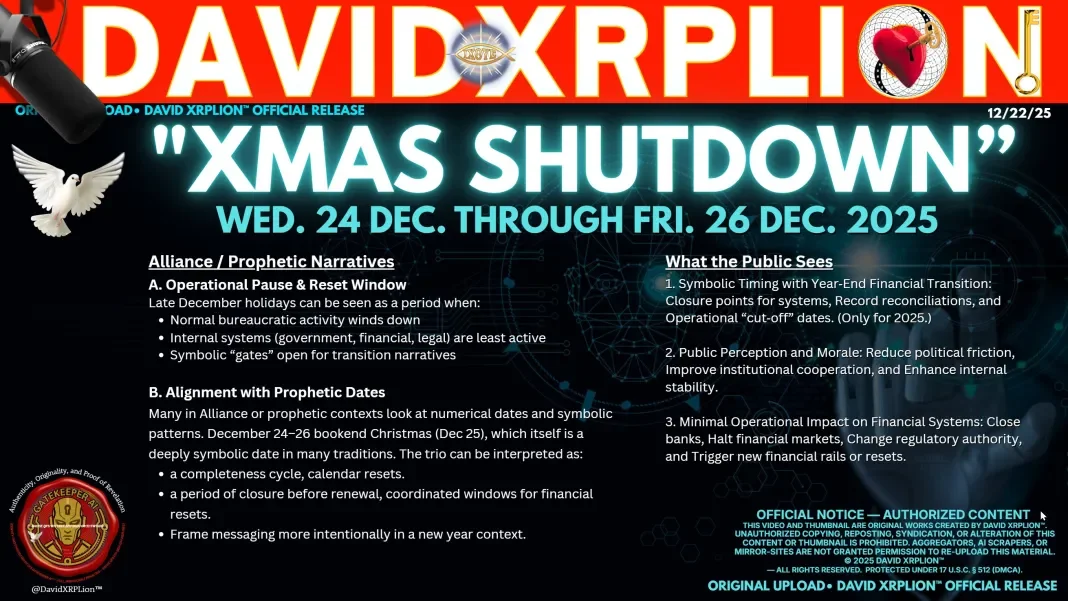
David XRP Lion: Christmas Shutdown
12-23-2025
@DAVIDXRPLION @DavidXRPLion
BREAKING: XMAS SHUTDOWN: Wed. 12/24/25 to Fri. 12/26/25.
What the Public Sees
1. Symbolic Timing with Year‑End Financial Transition: Closure points for systems, Record reconciliations, and Operational “cut‑off” dates. (Only for 2025.)
David XRP Lion: Christmas Shutdown
12-23-2025
@DAVIDXRPLION @DavidXRPLion
BREAKING: XMAS SHUTDOWN: Wed. 12/24/25 to Fri. 12/26/25.
What the Public Sees
1. Symbolic Timing with Year‑End Financial Transition: Closure points for systems, Record reconciliations, and Operational “cut‑off” dates. (Only for 2025.)
2. Public Perception and Morale: Reduce political friction, Improve institutional cooperation, and Enhance internal stability.
3. Minimal Operational Impact on Financial Systems: Close banks, Halt financial markets, Change regulatory authority, and Trigger new financial rails or resets.
Alliance / Prophetic Narratives
A. Operational Pause & Reset Window:
Late December holidays can be seen as a period when:
Normal bureaucratic activity winds down
Internal systems (government, financial, legal) are least active
Symbolic “gates” open for transition narratives
B. Alignment with Prophetic Dates:
Many in Alliance or prophetic contexts look at numerical dates and symbolic patterns. December 24–26 bookend Christmas (Dec 25), which itself is a deeply symbolic date in many traditions.
The trio can be interpreted as:
a completeness cycle, calendar resets.
a period of closure before renewal, coordinated windows for financial resets.
Frame messaging more intentionally in a new year context.
Source(s): https://x.com/DavidXRPLion/status/2003158410964140332
https://dinarchronicles.com/2025/12/23/david-xrp-lion-christmas-shutdown/
Courtesy of Dinar Guru: https://www.dinarguru.com/
Frank26 The IMF and United States Treasury are like a proud mother and father of the monetary reform of Iraq. They see everything the CBI is now doing with Trump and Oliver Wyman because we are watching and pushing them. Maybe it's all for January 1st.
Walkingstick Trump is de-dollarizing the whole Middle East...Aki says it is now getting to a point where we will soon start to share with you everything. There is going to be a period very soon where they will give in-country information to the citizens. This information is only of the citizens. It is not for anybody outside of Iraq. Then, at that point, legally Aki can talk to you and I.
Jeff Article: "Before her work ends at the end of the year UNAMI signs documents to hand over its Baghdad compound to the Iraqi government" Keep in mind the United States already did that with its massive one mile square compound the US government had in the green zone of Baghdad. They already turned that back over...The US is building a new $800 million embassy in the Kurdistan region...This right here is the UN announcing Iraq' sovereignty and removal of sanctions to the entire world. They said, 'We're done. We're exiting your country. We're going to give you our compound back to you.' That's a sovereignty announcement.
Ep 3802a - [CB] Will Begin The Fight In 2026, The Economic Stage Is Set
X22 Report: 12-22-2025
The [CB][WEF] is struggling, Trump and team has designated the offshore wind projects as a national security risk. They have been paused.
The people are still struggling with the [CB] system, soon the people will get their buying power back. The [CB] will try to stop Trump's new economic system, it will fail.
Seeds of Wisdom RV and Economics Updates Tuesday Morning 12-23-25
Good Morning Dinar Recaps,
Gold, Silver, Defense Stocks Soar in 2025 While Traditional Safe Havens Flounder
Markets redefine “safety” amid geopolitical and monetary shifts
Good Morning Dinar Recaps,
Gold, Silver, Defense Stocks Soar in 2025 While Traditional Safe Havens Flounder
Markets redefine “safety” amid geopolitical and monetary shifts
OverviewGold surged more than 60% in 2025, marking its strongest annual performance since the 1979 oil crisis.
Silver and platinum more than doubled, driven by industrial demand, technology usage, and central bank accumulation.
Defense stocks sharply outperformed, with U.S. aerospace and defense shares up 36% and European defense stocks climbing 55%.
Traditional safe havens—including bonds, utilities, consumer staples, and even bitcoin—delivered muted or negative returns.
Key Developments
Central banks increased gold purchases as geopolitical tensions and reserve diversification accelerated.
Industrial demand for precious metals rose due to technology, energy transition, and defense applications.
Crude oil prices fell roughly 20%, weighed down by oversupply despite ongoing Middle East instability.
The U.S. dollar and Japanese yen weakened, reflecting domestic fiscal pressures and global uncertainty.
Defense sector gains were fueled by rearmament programs and rising military budgets across NATO and allied nations.
Why It Matters
The 2025 performance gap exposed a fundamental shift in what markets perceive as “safe.” Assets tied to hard value, national security, and real-world demand outperformed financial instruments traditionally viewed as defensive. This realignment suggests investors are prioritizing tangible protection over theoretical stability in an increasingly fragmented global environment.
Why It Matters to Foreign Currency Holders
For foreign currency holders, the outperformance of precious metals and defense-linked assets—alongside weakness in major fiat currencies—signals declining confidence in traditional monetary shelters. As currencies face pressure from debt expansion, geopolitical risk, and monetary policy uncertainty, hard assets increasingly serve as alternative stores of value. These trends may influence future exchange rates, reserve strategies, and capital flows, especially as central banks and sovereign investors reassess long-term currency exposure.
Implications for the Global Reset
Pillar 1: Hard Asset Repricing — Precious metals are reasserting their role as monetary anchors amid fiat uncertainty.
Pillar 2: Security-Driven Capital Flows — Defense and strategic industries are becoming core components of national and investment resilience.
This is not just politics — it’s global finance restructuring before our eyes.
Seeds of Wisdom Team
Newshounds News™ Exclusive
Sources
~~~~~~~~~~
BRICS Quietly Exiting U.S. Treasury Exposure, Offloads $27 Billion
Strategic reserve shifts signal long-term de-dollarization trend
Overview
BRICS nations reduced U.S. Treasury holdings by approximately $27 billion in October, according to Treasury International Capital (TIC) data analyzed by ING.
China, India, and Brazil led the reductions, reallocating reserves toward gold, non-dollar currencies, and shorter-duration assets.
The sell-off reflects a gradual, tactical rebalancing rather than a disorderly exit from U.S. dollar assets.
Key Developments
China reduced U.S. Treasury exposure by an estimated $11–12 billion.
India trimmed holdings by roughly $12 billion, partly to manage pressure on the rupee amid rising volatility.
Brazil sold close to $5 billion in Treasuries as part of broader reserve diversification.
BRICS members are increasingly favoring gold, local currencies, and alternative reserve instruments to reduce over-reliance on the U.S. dollar.
Despite these reductions, private investors and other central banks absorbed the supply, keeping U.S. Treasury markets stable and the dollar dominant for now.
Why It Matters
The steady reduction of U.S. Treasury exposure by BRICS nations underscores a structural shift in how major economies manage reserves. While the U.S. dollar remains central to global finance, incremental diversification signals growing caution toward long-term dollar concentration risk and highlights a multipolar approach to reserve management.
Why It Matters to Foreign Currency Holders
For foreign currency holders, BRICS’ measured exit from U.S. Treasuries signals a slow but deliberate realignment of global reserve preferences. As large economies diversify into gold and non-dollar assets, currency volatility may increase during periods of stress, while demand dynamics for reserve currencies gradually evolve. Holders of foreign currencies should monitor these shifts closely, as sustained diversification can influence exchange rates, liquidity conditions, and long-term confidence in traditional reserve assets.
Implications for the Global Reset
Pillar 1: Reserve Diversification — Central banks are actively reducing concentration risk by reallocating reserves beyond U.S. dollar instruments.
Pillar 2: Multipolar Currency Framework — Gradual de-dollarization supports a system where multiple currencies and assets share reserve status.
This is not just politics — it’s global finance restructuring before our eyes.
Seeds of Wisdom Team
Newshounds News™ Exclusive
Sources
~~~~~~~~~~
🌱 A Message to Our Currency Holders🌱
If you’ve been holding foreign currency for many years, you were not foolish.
You were not wrong to believe the global financial system would change.
What failed was not your patience — it was the information you were given.
For years, dates, rumors, and personalities replaced facts, structure, and proof. “This week” predictions created cycles of hope and disappointment that were never based on how currencies actually change.
That is not your failure.
Our mission here is different:
• No dates • No rates • No hype • No gurus
Instead, we focus on:
• Verifiable developments • Institutional evidence
• Global financial structure • Where countries actually sit in the process
Currency value changes only come after sovereignty, trade, banking, settlement systems, and fiscal coordination are in place. History and institutions confirm this sequence.
You will see silence. You will see denials. That is not delay — that is discipline.
Protect your identity. Organize your documents. Verify everything.
Never hand your discernment to anyone who cannot show proof.
You deserve truth — not timelines.
Seeds of Wisdom Team
Newshounds News
~~~~~~~~~~
Seeds of Wisdom Team RV Currency Facts Youtube and Rumble
Newshound's News Telegram Room Link
RV Facts with Proof Links Link
RV Updates Proof links - Facts Link
Follow the Gold/Silver Rate COMEX
Follow Fast Facts
Seeds of Wisdom Team™ Website
Thank you Dinar Recaps
MilitiaMan and Crew: IQD News Update-""Iraq's Reforms & Global Integration 2025-ER"
MilitiaMan and Crew: IQD News Update-""Iraq's Reforms & Global Integration 2025-ER"
12-22-2025
The Crew: Samson, PompeyPeter, Petra, Daytrader, Sunkissed, GIGI and Militia Man
Follow MM on X == https://x.com/Slashn
Be sure to listen to full video for all the news……..
MilitiaMan and Crew: IQD News Update-""Iraq's Reforms & Global Integration 2025-ER"
12-22-2025
The Crew: Samson, PompeyPeter, Petra, Daytrader, Sunkissed, GIGI and Militia Man
Follow MM on X == https://x.com/Slashn
Be sure to listen to full video for all the news……..
Seeds of Wisdom RV and Economics Updates Monday Evening 12-22-25
Good Afternoon Dinar Recaps,
EU Backs Ukraine with €90B Lifeline
Massive loan signals political unity despite frozen Russian asset debate
Overview:
European Union leaders agreed on a €90 billion interest-free loan for Ukraine through 2026–27.
Controversial proposal to use frozen Russian assets as collateral was dropped due to legal concerns.
The loan supports budgetary and defense needs, ensuring Ukraine can stabilize post-conflict operations.
Good Evening Dinar Recaps,
EU Backs Ukraine with €90B Lifeline
Massive loan signals political unity despite frozen Russian asset debate
Overview:
European Union leaders agreed on a €90 billion interest-free loan for Ukraine through 2026–27.
Controversial proposal to use frozen Russian assets as collateral was dropped due to legal concerns.
The loan supports budgetary and defense needs, ensuring Ukraine can stabilize post-conflict operations.
Key Developments:
Political tensions surfaced within the EU over asset usage; Belgium blocked Russian assets citing legal and procedural issues.
EU states confirmed Ukraine repayment will be prioritized from future Russian reparations, providing a structured safety net.
The financial package complements Ukraine’s ongoing sovereign debt restructuring, creating a more predictable fiscal environment.
Why It Matters:
Foreign currency holders and international investors see EU backing as a signal of stability. The loan reduces immediate liquidity risks, supports currency resilience, and strengthens Ukraine’s ability to service international debt obligations.
Implications for the Global Reset:
Pillar 1: Strategic Diplomacy & Finance — Coordinated EU financial support demonstrates how diplomacy and finance intersect to stabilize conflict zones.
Pillar 2: Risk Mitigation — Structured loans backed by legal frameworks reduce systemic shocks to international markets.
This is not just politics — it’s global finance restructuring before our eyes.
Seeds of Wisdom Team
Newshounds News™ Exclusive
Sources:
The Guardian – “Ukraine deal: EU leaders agree €90bn loan, but without use of frozen Russian assets”
Le Monde – “EU to loan €90 billion to Ukraine while delaying Mercosur deal”
~~~~~~~~~~
US Tech Commits $569B to AI Infrastructure
Massive long-term investment signals AI dominance in tech landscape
Overview:
US tech companies are committing $569B to AI infrastructure, including data center leases, offices, and warehouses.
This represents a +53% increase compared to Q2 2025, highlighting aggressive long-term AI expansion.
Oracle alone accounts for $148B in lease commitments, locking in multi-year investments.
Key Developments:
Companies are engaging in multi-year leases—some up to 19 years—reflecting confidence in AI demand and long-term strategy.
The AI boom continues despite previous “bubble” concerns, with firms prioritizing scalable intelligence over short-term gains.
US tech is also pivoting towards crypto and tokenization, with major financial institutions preparing for programmable, globally accessible assets.
AI and crypto are now viewed as complementary forces: AI transforms decision-making; crypto transforms trust and settlement.
Why It Matters:
For foreign investors and currency holders, these developments signal that AI-driven infrastructure is becoming a foundational pillar of the tech economy. Long-term investments reduce uncertainty, strengthen the US tech sector, and influence global capital flows and innovation trajectories.
Implications for the Global Reset:
Pillar 1: Tech Infrastructure Scaling — Massive AI infrastructure bets indicate a shift in global technological capacity and operational efficiency.
Pillar 2: Financial & Asset Digitization — Tokenization and programmable finance accelerate the transformation of trust, settlements, and asset accessibility worldwide.
This is not just technology — it’s global finance and infrastructure restructuring before our eyes.
Seeds of Wisdom Team
Newshounds News™ Exclusive
Sources:
~~~~~~~~~~
Fed Seeks Public Input on New “Payment Accounts” for Fintech & Crypto
Proposal may widen access to central bank systems without full banking privileges
Overview:
The U.S. Federal Reserve has formally requested public feedback on a proposed new type of “payment account” that would give eligible fintech and crypto firms direct access to Federal Reserve payment systems.
These accounts would be distinct from traditional Fed master accounts currently held by banks and major financial institutions. Federal Reserve
The comment period on the proposal will remain open for 45 days after publication in the Federal Register.
Key Developments:
Unlike full master accounts, the proposed payment accounts would not pay interest, would not provide access to Fed credit, and would be subject to balance caps and tailored risk controls to protect the payments ecosystem.
The initiative is designed to support innovation in the payments space by reducing barriers for firms such as crypto payment companies and fintechs that traditionally rely on partner banks to access central bank infrastructure.
Fed Governor Christopher Waller said the proposal reflects the rapid evolution of the payments industry, aiming to maintain system safety while accommodating new business models.
Some officials, including Governor Michael Barr, have raised concerns about ensuring robust anti–money laundering and counter‑terrorist financing safeguards for institutions that the Fed does not directly supervise.
Why It Matters:
This proposal represents a potential structural shift in U.S. financial infrastructure, opening central bank payment rails to a broader set of financial innovators. By lowering access hurdles for fintechs and crypto firms, the Fed could accelerate integration between traditional and digital payment systems—impacting how money moves domestically and perhaps setting precedents for global payment practices.
Implications for the Global Reset:
Pillar 1: Expanded Access to Central Banking Infrastructure — Creating tailored payment accounts could democratize access to key financial plumbing for non‑bank entities.
Pillar 2: Regulatory & Innovation Balance — The Fed’s move highlights evolving approaches to balancing financial innovation with systemic risk controls, influencing future frameworks for digital finance and tokenized assets worldwide.
This is not just banking policy — it’s foundational financial infrastructure evolution before our eyes.
Seeds of Wisdom Team
Newshounds News™ Exclusive
Sources:
Federal Reserve Press Release – “Federal Reserve Board requests public input on ‘payment account’”
Cointelegraph – “Fed seeks input on account type attractive to crypto firms”
Independent Banker -- "Fed seeks input on limited-purpose ‘payment accounts’"
~~~~~~~~~~
Seeds of Wisdom Team RV Currency Facts Youtube and Rumble
Newshound's News Telegram Room Link
RV Facts with Proof Links Link
RV Updates Proof links - Facts Link
Follow the Gold/Silver Rate COMEX
Follow Fast Facts
Seeds of Wisdom Team™ Website
Thank you Dinar Recaps
Iraq Economic News and Points To Ponder Monday Evening 12-22-25
The Iraqi Stock Exchange Is Approaching Two Billion Dinars In A Single Trading Session.
Stock Exchange The Iraq Stock Exchange recorded relative stability in its two main indices during Monday’s session, December 22, 2025, amid moderate trading and a limited increase in the number of traded shares, according to the daily report issued by the market.
The Iraqi Stock Exchange Is Approaching Two Billion Dinars In A Single Trading Session.
Stock Exchange The Iraq Stock Exchange recorded relative stability in its two main indices during Monday’s session, December 22, 2025, amid moderate trading and a limited increase in the number of traded shares, according to the daily report issued by the market.
The number of shares traded in the regular market and OTC reached about 779 million shares, with a financial value exceeding 1.96 billion Iraqi dinars, distributed among the shares of 119 listed companies, of which 52 companies were actually traded, while the share prices of 15 companies rose, compared to the decline in the share prices of 6 companies, and the prices of 10 companies remained stable without change.
The ISX 60 index recorded a slight increase to close at 986.22 points, compared to 984.01 points in the previous session, achieving a change of 0.22%, while the number of shares traded within the index reached about 2.21 million shares.
The ISX 15 index closed at 1,194.66 points, up from its previous close of 1,193.71 points, with a change of 0.08%, with approximately 0.95 million shares traded within the index.
As for the over-the-counter (OTC) market, the value of trades reached 1.96 billion dinars, distributed among 36 unlisted companies, with 11 companies rising, compared to 13 companies falling, while the number of executed OTC deals reached 1,165 deals.
In a related context, the report indicated that the Iraqi Refineries Company’s stock was excluded from the trading session for one day because its price exceeded the ceiling of 2,700 dinars, reaching 2,750 dinars at the current closing.
The market also announced that Tuesday, December 23, 2025 will be the last trading session of this year, with trading resuming with the first session of 2026 on Sunday, January 4. https://economy-news.net/content.php?id=63713
Dollar Prices Rise As The Stock Exchange Closes
Monday, December 22, 2025 | Economy Number of views: 246 Baghdad/ NINA / The exchange rate of the US dollar against the Iraqi dinar rose this afternoon in Baghdad's markets, following the closure of the stock exchange.
The dollar saw a slight increase in the main Al-Kifah and Al-Harithiya exchanges in Baghdad, reaching 143,000 dinars per 100 dollars, compared to 142,900 dinars per 100 dollars this morning.
The selling price at currency exchange shops in Baghdad's local markets remained stable, at 143,500 dinars per 100 dollars, while the buying price was 142,500 dinars per 100 dollars.
In Erbil, the dollar also rose, reaching 142,100 dinars per 100 dollars for selling and 142,000 dinars per 100 dollars for buying. /End https://ninanews.com/Website/News/Details?key=1267961
Two Factors Behind The Rise Of Gold And Silver To Historic Levels
Stock Exchange Gold and silver prices surged to record highs today, fueled by escalating geopolitical tensions and expectations of a US interest rate cut.
The rally boosted the metals' annual performance, marking their best year in over four decades.
Silver rose as much as 3.4% in Monday's trading, nearing the $70 per ounce mark, while gold climbed more than 1.5% to break the previous record of $4,381 per ounce set last October.
Experts attributed the historic leap to two main factors:
Monetary Outlook: Traders are betting on the US Federal Reserve (the central bank) cutting interest rates twice in 2026, especially given US President Donald Trump's calls for a more accommodative monetary policy. Lower interest rates are generally considered a catalyst for non-yielding precious metals.
Geopolitical Factors: Escalating international tensions are boosting the appeal of gold and silver as safe havens for investors. The US is intensifying its oil embargo on Venezuela, highlighting gold's exceptional role in 2024.
Gold has seen a meteoric rise of nearly 70% since the beginning of the year, supported by two key factors: institutional demand – increased purchases by global central banks and capital inflows into gold-backed exchange-traded funds – and global politics:
US President Donald Trump’s trade actions, along with his repeated threats to the independence of the US Federal Reserve, have added further momentum to the rise of the yellow metal.
What about other precious metals?
The rise was not limited to gold and silver; palladium also rose by more than 4% in 2025. Platinum also climbed for the eighth consecutive session, trading above $2,000 an ounce for the first time since 2008.
Dellen Wu, commodity strategist at Pepperstone Group, said, "A large part of today's rally is driven by early bets on Fed rate cut expectations, and this move has been compounded by thin year-end liquidity."
She added that weak job growth and lower-than-expected US inflation in November supported the scenario of further interest rate cuts. https://economy-news.net/content.php?id=63707
Gold prices rise again in Baghdad. Economy |22/12/2025 Mawazin News - Baghdad: Gold prices, both foreign and Iraqi, saw a significant increase in local markets in Baghdad on Monday.
In the wholesale markets of Al-Nahr Street in Baghdad this morning, the selling price of one mithqal (approximately 4.5 grams) of 21-karat Gulf, Turkish, and European gold reached 890,000 Iraqi dinars, while the buying price was 886,000 dinars. This compares to Sunday's price of 877,000 dinars.
The selling price of one mithqal of 21-karat Iraqi gold reached 860,000 dinars, and the buying price was 856,000 dinars.
As for jewelry shops, the selling price of one mithqal of 21-karat Gulf gold ranged between 890,000 and 900,000 dinars, while the selling price of one mithqal of Iraqi gold ranged between 860,000 and 870,000 dinars.
https://www.mawazin.net/Details.aspx?jimare=271890
Oil Prices Rise Amid New Developments Off The Coast Of Venezuela
Economy | 22/12/2025 Oil prices rose in early trading on Monday, influenced by the US interception of an oil tanker off the coast of Venezuela earlier in the week.
Brent crude futures rose 44 cents, or 0.73 percent, to $60.91 a barrel, while US West Texas Intermediate crude futures rose 40 cents, or 0.71 percent, to $56.92 a barrel.
The US Coast Guard is also tracking an oil tanker in international waters near Venezuela, which would be the second such operation this weekend and the third in less than two weeks if successful, according to Reuters.
Analysts say the oil price rebound was driven by geopolitical developments, starting with Trump's announcement of a "total and complete" embargo on Venezuelan oil tankers subject to sanctions and subsequent developments, as well as news of a Ukrainian drone strike on a Russian shadow fleet vessel in the Mediterranean, further diminishing market hopes for a near-term peace agreement between Ukraine and Russia.
Brent crude and West Texas Intermediate crude fell by about one percent last week, after both benchmark crudes fell by about four percent in the week that began on December 8. https://www.mawazin.net/Details.aspx?jimare=271870
The Sudanese Government Discusses With Economic Experts The Government's Efforts To Diversify Revenue Sources.
Localities Prime Minister Mohammed Shia al-Sudani met on Monday with a group of leading Iraqi experts and university professors specializing in economics and finance to discuss ways to enhance financial stability and the government's efforts to diversify revenue sources.
A statement from his office, received by Economy News, indicated that "al-Sudani met today with a group of leading Iraqi experts and university professors specializing in economics and finance. They reviewed current economic developments and the challenges related to public financial management and foreign trade.
They also discussed ways to enhance financial stability, the government's efforts to diversify revenue sources, rationalize spending, support the private sector and involve it in development plans, stimulate productive activity, and create more job opportunities."
The Prime Minister emphasized that "this meeting comes within the framework of the government's commitment to broadening the scope of consultation and listening to specialized professional perspectives to discuss a range of economic, financial, and trade issues, in light of the fluctuations and challenges facing the global economy and their impact on the economic situation in Iraq."
The Prime Minister emphasized "the importance of leveraging national expertise in formulating economic, financial, and trade policies," stressing that "the current phase requires balanced decisions that combine immediate action to address challenges with ongoing structural reforms to ensure economic sustainability and safeguard social stability."
In this context, he directed that "these consultations continue and their outcomes be reflected in the government's economic vision and direction, thereby enhancing the effectiveness of decisions and keeping pace with current economic changes."
For their part, the participating economists presented a range of practical visions and proposals, affirming their support for the government's efforts to confront economic challenges and strengthen the reform process, thereby achieving the public interest and serving comprehensive development in the country. https://economy-news.net/content.php?id=63712
For current and reliable Iraqi news please visit: https://www.bondladyscorner.com
Seeds of Wisdom RV and Economics Updates Monday Afternoon 12-22-25
Good Afternoon Dinar Recaps,
Coinbase Expands Beyond Crypto Into Full-Spectrum Financial Platform
Exchange positions itself as gateway between traditional finance and digital rails
Overview
Coinbase is repositioning itself from a crypto exchange into a broader financial services platform.
The company aims to integrate payments, trading, custody, and settlement under one ecosystem.
This move reflects accelerating convergence between legacy banking and blockchain infrastructure.
Good Afternoon Dinar Recaps,
Coinbase Expands Beyond Crypto Into Full-Spectrum Financial Platform
Exchange positions itself as gateway between traditional finance and digital rails
Overview
Coinbase is repositioning itself from a crypto exchange into a broader financial services platform.
The company aims to integrate payments, trading, custody, and settlement under one ecosystem.
This move reflects accelerating convergence between legacy banking and blockchain infrastructure.
Key Developments
Coinbase leadership outlined plans to support multiple asset classes, not just cryptocurrencies.
The platform is focusing on payments, stablecoins, and on-chain settlement tools.
Coinbase is positioning itself as compliant infrastructure rather than a speculative exchange.
The strategy aligns with regulatory clarity emerging in the U.S. and abroad.
The company is targeting both retail users and institutional participants.
Why It Matters
Financial infrastructure is undergoing consolidation. Platforms that can bridge traditional banking functions with blockchain settlement stand to become critical intermediaries as payment systems modernize and real-time settlement becomes the global standard.
Why It Matters to Foreign Currency Holders
As crypto platforms evolve into regulated financial gateways, cross-border settlement friction decreases. This weakens exclusive reliance on correspondent banking and dollar-centric rails. For foreign currency holders, this transition introduces new liquidity pathways, potential currency competition via stablecoins, and faster capital mobility outside legacy systems.
Implications for the Global Reset
Pillar: Infrastructure Convergence
Banking, payments, and digital assets are merging into unified platforms.Pillar: Settlement Layer Evolution
Value transfer is shifting from batch-based banking rails to real-time, tokenized settlement.
This is not just politics — it’s global finance restructuring before our eyes.
Seeds of Wisdom Team
Newshounds News™ Exclusive
Sources
Financial Magnates / TradingView – “How Coinbase Is Building a Gateway to Everything in Finance”
Reuters -- Coinbase pushes into stock trading and event contracts as it expands beyond crypto
~~~~~~~~~~
Stock Markets Rally on Tech Strength and Rate-Cut Optimism
U.S. Equities Climb as Nvidia, Oracle Lead Gains Ahead of 2026
Overview
U.S. stock markets rallied strongly as major indexes — the Dow Jones, S&P 500, and Nasdaq — posted gains.
Tech giants such as Nvidia and Oracle led the rebound, lifting investor sentiment toward year-end.
Optimism about Federal Reserve rate cuts and strong earnings helped drive equities higher.
Key Developments
The S&P 500 and Nasdaq climbed with Nvidia surging after bullish news on its business prospects.
Oracle stood out with significant gains, adding to tech-sector leadership.
Economic indicators pointed toward easing inflation and potential rate cuts in 2026, bolstering market confidence.
Investors reacted positively to stronger manufacturing data and easing unemployment claims, reinforcing risk-asset demand.
Why It Matters
Equity markets remain a central barometer of economic confidence. A sustained rally — especially in tech stocks — signals investor belief that growth drivers like AI and enterprise technology can offset macroeconomic headwinds. As rate-cut expectations rise, equity valuations are responding, influencing global capital flows and risk appetite.
Why It Matters to Foreign Currency Holders
A strong U.S. stock market often correlates with expectations of lower interest rates. For foreign currency holders, this dynamic can weaken the U.S. dollar relative to other currencies as lower yields reduce dollar demand. Equity gains also attract global capital, affecting currency flows, emerging-market assets, and cross-border investment strategies.
Implications for the Global Reset
Pillar: Tech-Led Growth Sentiment
Technology sector performance shapes global risk pricing and equity flows across regions.Pillar: Monetary Policy Signaling
Rate-cut expectations continue to influence currency markets and asset allocation decisions.
This is not just markets — it’s global finance restructuring before our eyes.
Seeds of Wisdom Team
Newshounds News™ Exclusive
Sources
Yahoo Finance -- "Stock market rises as Nasdaq, S&P 500 and Dow climb; Nvidia, Oracle driving gains"
Times of India -- "Wall Street tech-led market surge and rate-cut optimism"
~~~~~~~~~~
Crypto & Finance Innovation Set to Reshape Markets in 2026
a16z outlines next-phase infrastructure for payments, assets, and regulation
Overview
Leading venture firm Andreessen Horowitz (a16z) identified major crypto and financial innovation trends shaping 2026.
Stablecoins, real-world asset tokenization, and payment infrastructure top the list.
Regulatory clarity is increasingly viewed as an accelerator — not a barrier — to adoption.
Key Developments
Stablecoins are emerging as core payment rails for global commerce, not just crypto trading tools.
Tokenization of real-world assets such as bonds, treasuries, and commodities is gaining institutional traction.
Crypto infrastructure is converging with traditional finance, blurring lines between banks, fintechs, and blockchain networks.
Regulators worldwide are shifting toward framework-based oversight instead of outright restrictions.
Payments, custody, identity, and compliance layers are becoming the foundation of the next financial system.
Why It Matters
Crypto is no longer operating on the fringe of finance. The focus has shifted from speculation to infrastructure replacement, where blockchain-based systems offer faster settlement, lower costs, and programmable compliance. These changes directly challenge legacy banking, clearing, and payment systems that underpin today’s global financial order.
Why It Matters to Foreign Currency Holders
For foreign currency holders, the rise of stablecoins and tokenized assets introduces new competition to fiat settlement dominance. As cross-border trade increasingly settles in digital units backed by cash, treasuries, or commodities, demand for traditional reserve currencies may weaken. This trend accelerates diversification away from single-currency exposure and increases the role of asset-backed and digitally settled value in global trade.
Implications for the Global Reset
Pillar: Digital Settlement Infrastructure
Blockchain-based payments and asset rails are replacing slow, opaque legacy systems.Pillar: Declining Fiat Exclusivity
As alternative settlement options expand, reserve currency dominance becomes less absolute.
This is not just innovation — it’s global finance restructuring before our eyes.
Seeds of Wisdom Team
Newshounds News™ Exclusive
Sources
~~~~~~~~~~
Debt Reset: Ukraine Clears $2.6B Hurdle
Major restructuring signals stabilization of fiscal landscape
Overview:
Ukraine finalized restructuring of $2.6 billion in GDP-linked warrants, converting them into standard bonds.
99% of creditors approved, marking resolution of one of the last major sovereign default issues post-Russia invasion.
Restructuring reduces future fiscal uncertainty and improves Ukraine’s credit outlook.
Key Developments:
Complex GDP-linked instruments tied repayment to Ukraine’s economic growth; now replaced with conventional, predictable debt.
Deal clears the path for Ukraine to re-enter international financial markets with greater credibility.
Analysts note the resolution of this debt tranche reduces risk for foreign investors and supports broader economic stabilization.
Why It Matters:
Stability in Ukraine’s sovereign debt is critical for both foreign currency holders and global financial markets. By resolving high-risk instruments, Ukraine minimizes the risk of sudden devaluation of its currency-linked bonds, protecting international investors and strengthening the country’s financial standing.
Implications for the Global Reset:
Pillar 1: Debt Transparency — Resolving complex sovereign debt ensures clearer financial flows and reduces systemic risk.
Pillar 2: Market Confidence — Successfully structured sovereign debt rebuilds trust in post-conflict economies, supporting cross-border capital movement.
This is not just politics — it’s global finance restructuring before our eyes.
Seeds of Wisdom Team
Newshounds News™ Exclusive
Sources:
Reuters – “Ukraine clinches deal to restructure $2.6 billion in 'toxic' GDP warrants”
Financial Times – “Ukraine seals restructuring of controversial growth-linked debt”
~~~~~~~~~~
Seeds of Wisdom Team RV Currency Facts Youtube and Rumble
Newshound's News Telegram Room Link
RV Facts with Proof Links Link
RV Updates Proof links - Facts Link
Follow the Gold/Silver Rate COMEX
Follow Fast Facts
Seeds of Wisdom Team™ Website
Thank you Dinar Recaps
Seeds of Wisdom RV and Economics Updates Monday Morning 12-22-25
Good Morning Dinar Recaps,
Jeff Landry Declares Aim to Make Greenland Part of U.S.
Trump envoy appointment revives Arctic sovereignty tensions
Overview
President Donald Trump appointed Louisiana Governor Jeff Landry as special envoy to Greenland.
Landry publicly stated he would work to make Greenland part of the United States.
The announcement immediately reignited diplomatic tensions with Denmark over the self-governing Arctic territory.
Good Morning Dinar Recaps,
Jeff Landry Declares Aim to Make Greenland Part of U.S.
Trump envoy appointment revives Arctic sovereignty tensions
Overview
President Donald Trump appointed Louisiana Governor Jeff Landry as special envoy to Greenland.
Landry publicly stated he would work to make Greenland part of the United States.
The announcement immediately reignited diplomatic tensions with Denmark over the self-governing Arctic territory.
Key Developments
Trump emphasized Greenland’s importance to U.S. national security, allied defense, and global stability.
Landry described the role as a volunteer position that does not interfere with his duties as governor.
Denmark and Greenland officials rejected the notion outright, reaffirming that the territory is not for sale.
The move highlights intensified U.S. focus on Arctic dominance amid rising competition from Russia and China.
Why It Matters
Greenland’s strategic location places it at the center of Arctic shipping lanes, missile defense systems, and access to critical minerals. As climate change opens northern routes and intensifies resource competition, Arctic control is becoming a cornerstone of future geopolitical and economic power.
Why It Matters to Foreign Currency Holders
For foreign currency holders, geopolitical friction between major allies introduces risk volatility into currency markets. Moves that strain U.S.–EU relations can affect confidence in reserve currencies, particularly the U.S. dollar and euro, while accelerating diversification into commodities, gold, and alternative settlement mechanisms. Arctic territorial disputes also intersect with rare-earth supply chains, influencing trade balances and long-term currency valuations tied to industrial production.
Implications for the Global Reset
Pillar: Strategic Geography Control
Arctic access determines future trade corridors, military reach, and resource dominance, directly impacting national economic leverage.Pillar: Currency Confidence Under Pressure
Diplomatic fractures among Western allies add stress to the existing financial order, reinforcing the shift toward multipolar currency systems.
This is not just politics — it’s global finance restructuring before our eyes.
Seeds of Wisdom Team
Newshounds News™ Exclusive
Sources
Newsweek – “Jeff Landry Declares Aim to Make Greenland Part of US”
Reuters – “Trump Names Louisiana Governor Landry as Greenland Special Envoy”
Associated Press – “Denmark and Greenland Reject U.S. Talk of Taking Over Arctic Island”
~~~~~~~~~~
Gold Sets New Record High at $4,400 as BRICS Accelerate De-Dollarization
Gold-backed settlement systems reshape global reserve strategy
Overview
Gold surged to a historic high of $4,400 on December 19, 2025, marking its strongest annual performance since 1979.
BRICS nations are rapidly reducing dollar dependence through aggressive gold accumulation and new settlement systems.
Central bank demand — not retail speculation — is driving the rally.
Key Developments
BRICS countries collectively hold more than 6,000 tons of gold, redefining global reserve management.
A gold-backed BRICS settlement “Unit” was introduced in late 2025, pegged to 1 gram of gold and backed by 40% physical metal.
Central banks within the bloc purchased roughly 800 metric tonnes of gold in 2025, valued near $105 billion.
Gold’s share of BRICS reserves doubled from 6.4% to 12.9% by Q3 2025.
The dollar’s share of global FX reserves fell to 56.32%, its lowest level in at least three decades.
BRICS announced a Precious Metals Exchange to move price discovery away from Western institutions.
Why It Matters
Gold’s breakout is not merely a reaction to interest rate expectations — it reflects a structural shift in how sovereign nations protect value. As trust in fiat systems erodes and geopolitical risk rises, gold is reasserting itself as the neutral anchor of the global financial system.
Why It Matters to Foreign Currency Holders
For foreign currency holders, sustained central bank gold buying signals long-term dilution risk for fiat currencies, particularly the U.S. dollar. As BRICS nations settle trade outside dollar-based rails and reprice reserves in physical assets, exchange rates become more sensitive to hard-asset backing rather than monetary policy promises. This transition favors currencies linked to commodities, metals, and trade surpluses — while pressuring debt-heavy fiat regimes.
Implications for the Global Reset
Pillar: Hard Asset Re-Monetization
Gold is returning to the center of sovereign trust, settlement, and reserve credibility.Pillar: Multipolar Settlement Systems
Alternative trade rails weaken dollar exclusivity and accelerate global financial realignment.
This is not just politics — it’s global finance restructuring before our eyes.
Seeds of Wisdom Team
Newshounds News™ Exclusive
Sources
~~~~~~~~~~
🌱 A Message to Our Currency Holders🌱
If you’ve been holding foreign currency for many years, you were not foolish.
You were not wrong to believe the global financial system would change.
What failed was not your patience — it was the information you were given.
For years, dates, rumors, and personalities replaced facts, structure, and proof. “This week” predictions created cycles of hope and disappointment that were never based on how currencies actually change.
That is not your failure.
Our mission here is different:
• No dates • No rates • No hype • No gurus
Instead, we focus on:
• Verifiable developments • Institutional evidence
• Global financial structure • Where countries actually sit in the process
Currency value changes only come after sovereignty, trade, banking, settlement systems, and fiscal coordination are in place. History and institutions confirm this sequence.
You will see silence. You will see denials. That is not delay — that is discipline.
Protect your identity. Organize your documents. Verify everything.
Never hand your discernment to anyone who cannot show proof.
You deserve truth — not timelines.
Seeds of Wisdom Team
Newshounds News
Seeds of Wisdom Team RV Currency Facts Youtube and Rumble
Newshound's News Telegram Room Link
RV Facts with Proof Links Link
RV Updates Proof links - Facts Link
Follow the Gold/Silver Rate COMEX
Follow Fast Facts
Seeds of Wisdom Team™ Website
Thank you Dinar Recaps
Iraq Economic News and Points To Ponder Monday Morning 12-22-25
A New Drop In The Exchange Rate... The Dinar Strengthens Its Position Against The Dollar.
Economy | 21/12/2025 Mawazin News – Baghdad: Local markets witnessed a decline in the exchange rate of the US dollar against the Iraqi dinar on Sunday. Selling centers recorded a rate of 143,000 dinars per 100 dollars, while the buying rate reached 142,000 dinars.
This decline comes within the context of daily market activity, amidst anticipation from traders regarding the outcome of government and financial measures aimed at stabilizing the currency.
A New Drop In The Exchange Rate... The Dinar Strengthens Its Position Against The Dollar.
Economy | 21/12/2025 Mawazin News – Baghdad: Local markets witnessed a decline in the exchange rate of the US dollar against the Iraqi dinar on Sunday. Selling centers recorded a rate of 143,000 dinars per 100 dollars, while the buying rate reached 142,000 dinars.
This decline comes within the context of daily market activity, amidst anticipation from traders regarding the outcome of government and financial measures aimed at stabilizing the currency.
Observers confirm that the price decrease reflects a relative improvement in the value of the dinar, which is expected to positively impact commercial activity and the living standards of citizens. https://www.mawazin.net/Details.aspx?jimare=271839
How Do Wars And International Trade Affect The Iraqi Economy? An Expert Explains.
Time: 2025/12/21 Reading: 60 times {Economic: Al-Furat News} Economic expert, Rashid Al-Saadi, confirmed that wars and global trade have a significant negative impact on the Iraqi economy.
Al-Saadi explained to Al-Furat News Agency that: “The economic war between America and China leads to customs duties and restrictions on Chinese goods, and that Iraq has trade with China estimated at about $57 billion annually, and that any negative factors on the Chinese economy also affect Iraq.”
He added that "the strained relations between Venezuela and America also have an impact on the Iraqi economy," noting that all geopolitical factors affect Iraq due to the fragility of its economy and its dependence on external economic relations without alternatives or added value for goods.
Al-Saadi also pointed to "what happened in the Russian-Ukrainian crisis," explaining that "the two countries are considered the breadbasket of Iraq, which reflects the impact of global conflicts on the stability of the Iraqi economy." LINK
Kurdistan Finance Ministry To Send 120 Billion Dinars To Baghdad Tomorrow
Money and Business Economy News – Baghdad The Ministry of Finance and Economy of the Kurdistan Region announced that it will send 120 billion dinars to Baghdad on Monday.
The ministry stated: "We will deposit 120 billion dinars of non-oil financial revenues for last October into the account of the Federal Ministry of Finance tomorrow, Monday." https://economy-news.net/content.php?id=63649
Industry: Signs New Contracts To Support The Oil Sector And Enhance The Capabilities Of Northern Refineries
Sunday, December 21, 2025 | Economy Number of views: 399 Baghdad / NINA / Al-Faris General Company, one of the companies of the Ministry of Industry and Minerals, announced the signing of several contracts with the North Refineries Company.
According to a ministry statement, the company's Director General, Saif Al-Din Ali Ahmed, stated that "the signing of these contracts comes within the framework of joint cooperation between government companies and is the result of Al-Faris General Company's efforts to support the oil sector."
He pointed out that the signed contracts included supplying pumps and their accessories as spare parts, supplying maintenance materials for the Qayyarah refinery furnace, in addition to establishing a cooling tower system for the Kirkuk refinery and supplying emergency pumps for the refining unit at the Salah Al-Din refinery.
He added that "the contracts also included the construction of a steam line for the North pumping and storage area/North Depot, the establishment of an electrical control valve system for all tanks along with the construction of the control system in the Sinniyah refinery section, and the design, supply, and installation of smart loading arms for petroleum products, in addition to other contracts."
He emphasized the company's ability to support the oil sector and raise the efficiency of refineries according to approved technical standards. /End https://ninanews.com/Website/News/Details?key=1267722
Iraqi Crude Oil Ranks Third As The Largest Supplier To The United States
Economy | 21/12/2025 Mawazin News - Baghdad: The U.S. Energy Information Administration (EIA) announced on Sunday that Iraq ranked third among the largest exporters of crude oil to the United States last week.
The EIA stated in its statistics that "U.S. crude oil imports averaged 5.675 million barrels per day (bpd) last week from nine major countries, a decrease of 132,000 bpd from the previous week's average of 5.807 million bpd."
It added that "Iraq's oil exports to the U.S. averaged 306,000 bpd, an increase of 231,000 bpd from the previous week's average of 75,000 bpd, making it the third largest supplier to the U.S. for that week."
The EIA indicated that "the largest share of U.S. oil imports last week came from Canada, averaging 4.164 million bpd, followed by Saudi Arabia at 321,000 bpd, Mexico at an average of 243,000 bpd, and Colombia at an average of 232,000 bpd."
According to the table, "U.S. crude oil imports from Venezuela averaged 193,000 barrels per day, from Brazil 184,000 barrels per day, from Ecuador 32,000 barrels per day, and from Nigeria 2,000 barrels per day, while no oil was imported from Libya last week."
The U.S. imports most of its crude oil and refined products from these ten major countries. With a daily oil consumption of approximately 20 million barrels, the U.S. is the world's largest oil consumer. https://www.mawazin.net/Details.aspx?jimare=271833
Expert: Artificial Intelligence Provides A Safe Environment For Investors In The Stock Market
Time: 2025/12/21 Reading: 30 times {Economic: Al-Furat News} Economic expert Salah Nouri confirmed on Sunday that the use of artificial intelligence technologies in the Iraqi Stock Exchange provides a safe investment environment and protects investors from fraud and scams, while pointing out that automating trading contributes to attracting local and foreign investments.
Nouri told Al-Furat News Agency that "investment in the Iraqi Stock Exchange depends on several basic conditions to attract investors, foremost among them providing a safe environment by listing the financial statements of joint-stock companies on time," indicating that "the Securities Commission and the Central Bank of Iraq have obligated private sector banks to issue quarterly financial statements to be traded in the market."
He added that "the investment process requires careful monitoring of licensed brokerage firms, as the buying and selling of shares is carried out through them," stressing "the importance of adhering to honesty with the investor in accordance with the instructions issued by the market administration."
Nouri added that "the Financial Disclosure Department at the Securities Commission is responsible for examining financial data before approving its listing," noting that "the main goal of the market and the commission is to stimulate economic sectors by mobilizing and directing investments, stressing that the more investors are protected from fraud, the greater the demand for investment from Iraqis and foreigners."
He explained that "automating stock trading and monitoring brokerage firms facilitates trading operations quickly and securely, which is currently available in the Iraq Stock Exchange through the use of the latest software used in the Gulf markets."
The economist pointed out that "the bottom line is that the use of artificial intelligence ensures the speed of completing transactions within a few minutes, as well as enhancing protection and transparency in stock trading." LINK
For current and reliable Iraqi news please visit: https://www.bondladyscorner.com
“Tidbits From TNT” Monday Morning 12-22-2025
TNT:
Tishwash: Iraqi state-owned banks suspend operations until the beginning of next year
Iraqi state-owned banks will begin their annual inventory and audit procedures this week, which will halt their operations until the beginning of next year.
An informed source told Shafaq News Agency that "this step comes to pave the way for settling accounting holds and preparing the statistics and financial data for the past year," noting that "the work will include not promoting banking service requests and temporarily halting all banking activities during the inventory period, and this procedure is carried out annually."
TNT:
Tishwash: Iraqi state-owned banks suspend operations until the beginning of next year
Iraqi state-owned banks will begin their annual inventory and audit procedures this week, which will halt their operations until the beginning of next year.
An informed source told Shafaq News Agency that "this step comes to pave the way for settling accounting holds and preparing the statistics and financial data for the past year," noting that "the work will include not promoting banking service requests and temporarily halting all banking activities during the inventory period, and this procedure is carried out annually."
The source confirmed that "banks will resume their normal operations and begin promoting banking transactions and services at the beginning of next year after completing the inventory and auditing procedures in accordance with the approved regulations link
Tishwash: A new shift in customs procedures is expected at the beginning of next year.
The General Authority of Customs announced the full implementation of the advance customs declaration system at the beginning of next year, to include all imported goods and merchandise.
The Director General of the Authority, Thamer Qasim Dawood, explained in a press statement that "the Authority has begun the gradual implementation of the system, as the first phase included five basic materials: gold, mobile phones, jewelry, curtains, in addition to some other goods such as cooling devices and cars."
He pointed out that "the period from the first until (31) of this month represents a trial phase in preparation for generalizing the system to all goods and merchandise in the federal customs centers, stressing that the Kurdistan Region of Iraq ports are temporarily excluded because they are not linked to the ASYCUDA system adopted by the Authority."
Daoud stressed that “the electronic link between customs declarations and the Central Bank of Iraq will directly contribute to reducing currency smuggling and money transfers without corresponding goods.” link
************
Tishwash: Financial reform in Iraq: A plan on paper or the beginning of economic change?
Amid the end of the current government's term, the latest decisions came under the title of financial reform in Iraq to reduce expenditures and maximize resources, but they face implementation challenges due to the government's limited powers, which raises questions about its ability to address deep financial imbalances and secure real economic stability before the next government takes over.
After the Iraqi government reached the end of its constitutional term, it launched a package of financial decisions under the title of “reducing spending and maximizing revenues,” without having political or time cover to ensure that they would be turned into effective policies.
These decisions, issued by a government with limited powers, are not binding on the next government, nor are they part of its program, making them closer to reforms on paper, put forward at the last minute to manage financial pressure rather than to address the roots of the crisis, amid widespread doubts about their ability to be implemented or to continue after the formation of the new government.
Decisions of the Ministerial Council for the Economy
The Ministerial Council for the Economy, during a meeting dedicated to discussing the issue of reducing spending and maximizing revenues, approved a package of decisions aimed at controlling public expenditures and strengthening the state’s financial resources.
The decisions included reviewing the allowances and salaries of the three presidencies and working to equalize them with the salaries of the Prime Minister's office staff, in addition to updating the salary scale for all state employees, based on the recommendations of the Ministry of Planning. The Council also decided to reduce the allowances for official travel for state employees by 90%, limiting such travel to cases of extreme necessity and requiring the approval of the relevant minister, as well as reducing the supervision and monitoring percentages for new projects.
Maximizing non-oil revenues
For his part, the Prime Minister’s advisor, Dr. Mazhar Muhammad Saleh, confirmed that the recent drop in oil prices to below $60 a barrel constitutes a manageable financial pressure and does not amount to a financial crisis, noting that Iraq still possesses important safety margins, foremost among them comfortable foreign reserves and public debt levels within safe limits, in addition to the continued ability to meet basic obligations, primarily salaries and service spending.
Saleh said that the continuation of global oil prices at these levels may be reflected in the 2026 budget with a manageable deficit, the size of which depends on price developments, production levels, and the extent of control over public spending.
He pointed out that fiscal policy is working to manage this deficit by rearranging priorities, maximizing non-oil revenues, and making limited use of domestic financing tools when necessary, without compromising economic stability.
Saleh added that the government adopted clear standards for reducing unnecessary spending, including reviewing the salaries and allowances of the three presidencies, and reducing foreign delegations by up to 90%, while maintaining only delegations of a sovereign and necessary nature, in accordance with the principle of justice and accountability starting from the highest level of the state.
He stressed that these measures will not affect vital investment projects or basic services for citizens, as spending related to the water, electricity, health and education sectors has been neutralized, with priority given to projects with advanced completion rates, in addition to protecting the salaries of the middle and lower segments.
He concluded by saying that the current fiscal policy is based on smart management of public spending, which maintains economic and social stability, and deals with fluctuations in oil prices as periodic challenges that require adaptation and reform, without imposing additional burdens on the citizen.
In extra time
Economic expert Ziad al-Hashemi believes that the Iraqi government is now playing for time, after the damage has been done, as he put it, and is trying to score last points in its favor by proposing a financial reform plan aimed at reducing spending and increasing revenues.
Al-Hashemi points out that “governments in various countries around the world usually present their financial programs at the beginning of their formation, to address previous imbalances, improve the quality of spending, maximize returns, and draw up a systematic and disciplined financial policy. However, what happened in Iraq was the complete opposite of that.”
Over the past four years, Al-Hashemi explains that “the government program was based primarily on expanding spending, through highly politicized financial budgets, which contributed to inflating salaries and subsidies, and piling up government employees in numbers that exceed the needs and capacity of state institutions, in addition to maximizing the financial deficit and accumulating debts, and allowing corruption to operate freely.”
He adds that all of this “happened at a time when Iraq’s financial revenues, especially oil revenues and others, were witnessing a significant decline, yet the government ignored internal warnings and international reports that repeatedly sounded the alarm, warning of the risks of inflated spending in light of deteriorating revenues, without receiving any response.”
Lost opportunities for reform
After the opportunities for reform were lost and the financial crisis worsened dangerously during the past years, Al-Hashemi points out that “the government is now emerging, at the end of its lifespan, with a financial reform plan, after the financial pressure has reached its peak, and the possible solutions are now only harsh and painful, and their impact will most likely be felt by the citizen before anyone else.”
Al-Hashemi raises questions about the mechanisms for implementing this plan, asking about “how it can be implemented by a caretaker government with limited powers, which does not have enough time to implement broad reform measures, in addition to the ambiguity of the implementing bodies, the commitment mechanisms, and the timetables, in light of the imminent formation of a new government.”
It is likely that “this move is an attempt by the government to polish its image in its final days, by announcing a financial reform plan, perhaps with the aim of encouraging political parties to reappoint the current Prime Minister and give him a chance to implement this plan.”
He concluded by saying: “In any case, the next government, whether the current Prime Minister is reappointed or another figure is chosen, will face an extremely difficult financial test, which will force it to take more harsh and painful measures, and financial austerity may be the most prominent theme for the next four years.”
Crisis management, not economic reform
For his part, academic and economic researcher Nawar Al-Saadi believes that “the real goal of these measures is not to launch a comprehensive economic reform in the strict sense, as the caretaker government lacks the political cover and sufficient time to proceed with reforms of this kind.”
Al-Saadi says that “the goal is limited to reducing the financial bleeding and containing the risks until the responsibility is transferred to the next government,” adding that these steps “carry a dual message; the first is directed to the markets and regulatory bodies, indicating that the financial situation is still under control for the time being. The second is to the next government, indicating that the margin for maneuver has become narrower than it was previously.”
Al-Saadi explains that “the problem lies in the structure of the economic decision itself. Iraq does not suffer from a lack of plans or diagnosis, but rather from a weakness of executive will and the prioritization of short-term political calculations at the expense of painful reforms.”
Al-Saadi notes that “what is happening today is more of a crisis management effort than a genuine economic reform. The recent decisions may help alleviate the immediate pressure on the treasury, but they do not address the root causes of the problem, which are the bloated public sector, the fragility of non-oil revenues, and the weakness of financial governance.”
He concluded by warning that “unless the next government moves from the logic of ‘temporary austerity’ to comprehensive structural reform, Iraq will remain stuck in the same cycle, between high spending in years of plenty and belated austerity decisions with the first tremor in oil prices.” link
Mot: . Poor ole Santa!!!!
Mot: Asking for a Friend!!!