
Seeds of Wisdom RV and Economic Updates Saturday Afternoon 2-22-25
Good Afternoon Dinar Recaps,
HBAR FOUNDATION INVESTS IN TOKENIZED FIDELITY USD MONEY MARKET FUND
The HBAR Foundation has announced an investment in Archax’s tokenized shares of Fidelity International’s USD Money Market Fund.
Archax, the first FCA-regulated digital asset exchange, broker, and custodian, recently tokenized the MMF on the Hedera network.
Good Afternoon Dinar Recaps,
HBAR FOUNDATION INVESTS IN TOKENIZED FIDELITY USD MONEY MARKET FUND
The HBAR Foundation has announced an investment in Archax’s tokenized shares of Fidelity International’s USD Money Market Fund.
Archax, the first FCA-regulated digital asset exchange, broker, and custodian, recently tokenized the MMF on the Hedera network.
The tokenized shares, available on the Archax platform, allow institutional investors to gain exposure to the fund through blockchain technology. These digital assets can also serve as proof-of-reserves for stablecoin treasury verification, enhancing transparency within the broader digital finance ecosystem, according to a company announcement.
The move highlights Hedera’s expanding role in institutional tokenization while advancing Fidelity International’s efforts to bring traditional financial products on-chain.
Last December, Hedera integrated Chainlink’s Data Feeds and Proof of Reserve on its mainnet to support DeFi and tokenized real-world assets. This followed a partnership between the HBAR Foundation and Chainlink, giving developers access to high-quality data and on-chain reserve verification.
Strategic investment
Gregg Bell, Senior Vice President at the HBAR Foundation, emphasized the strategic importance of the investment, stating, “Looking ahead to 2025, real-world asset tokenization will be a key catalyst for blockchain adoption. Our vision for a fully tokenized financial ecosystem aligns with Fidelity International’s commitment to innovation.”
He added that partnering with asset managers like Fidelity International is essential for accelerating institutional adoption.
The investment further strengthens Hedera’s push into institutional markets by leveraging its high-throughput infrastructure. The network’s ability to provide low-cost, fixed-fee transactions makes it an appealing option for financial institutions exploring tokenization.
The collaboration between the HBAR Foundation, Archax, and Fidelity International reflects a broader industry shift toward blockchain-powered financial products. As more institutions explore tokenization, partnerships like this could pave the way for greater adoption of digital asset infrastructure in traditional markets.
@ Newshounds News™
Source: CryptoNews
~~~~~~~~~
BRICS NEWS: BRAZIL PLANS TO REJECT BRICS CURRENCY
Brazil is considering dropping the idea of forming a new BRICS currency as it chairs the 17th summit in Rio De Janeiro in July 2025. Four government officials on the condition of anonymity revealed to Reuters that President Luiz Lula da Silva is planning to nix the idea of a common currency. The alliance is under pressure from Trump who threatened to impose tariffs if they ditch the US dollar.
The idea of developing a new BRICS currency could draw the ire of US President Donald Trump, who has vowed to crush anyone who plans to ditch the dollar for trade. Just recently, BRICS member India also denounced the formation of a new currency and embraced the US dollar for cross-border transactions.
After Rejecting BRICS Currency, Brazil Wants to End Reliance on the US Dollar
A government official revealed that Brazil wants to shelve BRICS currency but also aims to reduce dependency on the US dollar.
The source explained that Brazil will provide solutions for ending reliance on the US dollar at the upcoming summit. The 17th summit is scheduled to take place on July 6-7 with the nine member countries being in attendance.
Two out of the nine BRICS countries have rejected the idea of the formation of a new currency. Only Russia, China, and Iran are aggressively advancing the de-dollarization agenda to uplift their respective economies. Russia and Iran are reeling under pressure due to sanctions and are desperate to trade in local currencies.
On the other hand, China is looking to dominate the global finances by pushing the Chinese yuan for trade. India is distancing itself from the idea fearing that China is using BRICS as a stepping stone to advance its global agenda. The cracks in BRICS are wide open even before the alliance has made the currency a reality.
@ Newshounds News™
Source: Watcher Guru
~~~~~~~~~
WHAT IS DOGE DIVIDEND CHECK? WILL YOU GET $5,000 STIMULUS CHECK? HERE'S WHAT TO KNOW
Wondering if you should expect a $5,000 check from DOGE? And, is it a stimulus, dividend or refund? Here's what we know so far about what it is and who would potentially get it.
President Donald Trump said he's considering a plan to pay out $5,000 stimulus checks to taxpayers in the form of a 'DOGE dividend' during a speech on Wednesday. He explained it as part to take 20% of the savings identified by Elon Musk's Department of Government Efficiency (DOGE) and give it back to the American taxpayers.
This 'DOGE dividend' idea was previously floated on Tuesday by Azoria investment firm CEO James Fishback on Musk's social media platform X, suggesting President Trump and Musk "should announce a ‘DOGE Dividend’ — a tax refund check sent to every taxpayer, funded exclusively with a portion of the total savings delivered by DOGE." To which, Musk replied "Will check with the President."
“The numbers are incredible, Elon. So many millions, billions — hundreds of billions,” Trump said in his speech. “And we’re thinking about giving 20% back to the American citizens, and 20% down to pay back our debt.”
The US national debt totaled $35.5 trillion in the 2024 fiscal year, a $1.4 trillion increase from 2023, according to the Treasury Department and US debt-to-GDP ratio rose by 2 percentage points in fiscal year 2024 from 2023.
Trump didn't share any further specifics or details about the possible 'DOGE dividend' or its certainty.
Albeit, Fishback's four-page proposal of the 'DOGE dividend' described it as a refund "sent only to tax-paying householders."
Noting the difference from past stimulus checks, he added that DOGE checks would not be inflationary as they would be "exclusively funded with DOGE-driven savings, unlike COVID stimulus checks which were deficit-financed."
By definition, a dividend is a distribution of profits by a corporation to its shareholders and refund is a payment made back to a user that previously paid for something. A stimulus check on the other hand, is a direct payment to encourage spending and stimulate the economy by putting money directly into the consumers' hands.
What is DOGE?
The Department of Government Efficiency (DOGE), officially the U.S. DOGE Service Temporary Organization, is an initiative created by Trump and led by 'special government employee' Musk.
The mission of DOGE was to slash federal spending, deregulation and "modernize federal technology and software to maximize governmental efficiency and productivity."
How much has DOGE saved?
At the time it was introduced, DOGE's effort was to save as much as $2 trillion dollars a year. DOGE claims to have already saved $55 billion in government cuts so far, but the figure has not been verified.
The agency has made drastic cuts across federal agencies, including mass firings of federal workers. Some agencies that have already seen cuts include the United States Agency for International Development (USAID), the Department of Education, the National Institutes of Health, the Centers for Disease Control and Prevention, and the Consumer Financial Protection Bureau.
@ Newshounds News™
Source: USA Today
~~~~~~~~~
Seeds of Wisdom Team RV Currency Facts Youtube and Rumble
Newshound's Podcast Link
Newshound's News Telegram Room Link
Q & A Classroom Link
Follow the Roadmap
Follow the Timeline
Seeds of Wisdom Team™ Website
Subscribe to Seeds of Wisdom Team™ Newsletter
Thank you Dinar Recaps
Monetary RESET Is Inevitable | John Rubino
Monetary RESET Is Inevitable | John Rubino
Liberty and Finance: 2-22-2025
John Rubino discusses the potential for the U.S. to follow a path similar to Argentina, where government downsizing may become necessary.
He highlights that entrenched interests and military profits are significant counterforces to these cuts, and the pushback from these groups could be substantial.
Stories of government workers being laid off could also influence Congress, slowing down the downsizing process. Rubino emphasizes that the U.S. is dangerously over-leveraged, with immense debt across various sectors, making a monetary reset inevitable.
Monetary RESET Is Inevitable | John Rubino
Liberty and Finance: 2-22-2025
John Rubino discusses the potential for the U.S. to follow a path similar to Argentina, where government downsizing may become necessary.
He highlights that entrenched interests and military profits are significant counterforces to these cuts, and the pushback from these groups could be substantial.
Stories of government workers being laid off could also influence Congress, slowing down the downsizing process. Rubino emphasizes that the U.S. is dangerously over-leveraged, with immense debt across various sectors, making a monetary reset inevitable.
The U.S. economy, burdened by escalating debt and the looming threat of inflation, may be headed for a reckoning. John Rubino, a seasoned financial analyst, recently joined Liberty and Finance to discuss the possibility of the U.S. following a trajectory similar to Argentina, a nation known for its cycles of boom and bust, and where severe government downsizing has become a necessary, albeit painful, reality.
Rubino’s warnings aren’t just abstract economic theories; they’re a stark assessment of the current financial landscape. He highlights the deeply entrenched interests that hinder any attempts to rein in government spending.
The sheer size of the U.S. military-industrial complex and the profits it generates for powerful corporations make significant budget cuts a political minefield. The pushback from these groups, Rubino argues, could be immense, stalling any meaningful reform.
Beyond the powerful lobbies, Rubino also points to the human cost of downsizing. Imagine the impact of mass layoffs of government employees, the stories filling news cycles and impacting congressional decisions. The political pressure to slow down, or even reverse, austerity measures could be overwhelming.
But the core of Rubino’s argument rests on the staggering levels of debt plaguing the U.S. He paints a picture of a nation dangerously over-leveraged, with unsustainable debt levels across the government, corporate, and consumer sectors.
This massive debt, he believes, makes a monetary reset not just possible, but inevitable.
So, what can individuals do to protect themselves from this potential economic storm? Rubino’s advice is clear: invest in tangible assets, particularly gold and silver. He sees these precious metals as a vital hedge against the erosion of purchasing power caused by inflation, a likely consequence of the government’s ongoing struggle with debt.
However, Rubino’s concerns extend beyond simple financial survival. He also warns of the future transition to government-controlled monetary systems, a move that could significantly limit personal freedoms. In a world where the government controls every transaction, individual autonomy could be severely curtailed. The potential implications for privacy and personal liberty are profound.
While the comparison to Argentina might seem alarming, it underscores the urgency of addressing the U.S.’s unsustainable debt levels. Rubino’s perspective serves as a wake-up call, urging individuals to consider the potential for a significant economic shift and prepare accordingly. He champions a proactive approach: understand the risks, diversify your assets, and be aware of the potential for increased government control over your finances.
In conclusion, Rubino’s insights paint a worrying picture of the future, but they also offer a roadmap for navigating the potential challenges ahead.
By understanding the risks and taking proactive steps, individuals can better protect themselves from the potential economic storms brewing on the horizon. The time to consider these warnings is now, before the U.S. finds itself further down the path towards a potentially painful economic reckoning.
INTERVIEW TIMELINE:
0:00 Intro
1:40 Trump's first month
8:30 D.C. culture
19:00 Argentina vs U.S.
23:00 Pushback to Trump
33:30 Dollar collapse
Iraq Economic News and Points to Ponder Saturday AM 2-22-25
Washington Threatens Baghdad With Sanctions If It Does Not Resume Kurdistan Oil Exports Quickly
02/21/2025 Mawazine News – Economy The United States threatened the federal government in Iraq with sanctions on Friday if the Kurdistan Region's oil exports are not resumed quickly.
Reuters quoted sources as saying: "The administration of President Donald Trump asked Iraq to resume Kurdish oil exports quickly or face sanctions alongside Iran."
The sources added that "Washington believes that Kurdish oil sales could help reduce crude prices and compensate for the decline in Iranian supplies."
Washington Threatens Baghdad With Sanctions If It Does Not Resume Kurdistan Oil Exports Quickly
02/21/2025 Mawazine News – Economy The United States threatened the federal government in Iraq with sanctions on Friday if the Kurdistan Region's oil exports are not resumed quickly.
Reuters quoted sources as saying: "The administration of President Donald Trump asked Iraq to resume Kurdish oil exports quickly or face sanctions alongside Iran."
The sources added that "Washington believes that Kurdish oil sales could help reduce crude prices and compensate for the decline in Iranian supplies."
Oil Minister Hayan Abdul Ghani revealed last Tuesday that Iraq had sent a delegation from the ministry to the Kurdistan Region to agree on a mechanism for delivering and exporting the region's oil through the Turkish port of Ceyhan.
The oil minister said that contact had been made with the region's Minister of Natural Resources, Kamal Mohammed Salih, to negotiate with the delegation on the mechanism for receiving and exporting oil through the Turkish port of Ceyhan.
This came one day after Iraq accelerated the expected date for resuming oil exports from Kurdistan, as the federal oil minister said last Monday that oil exports from the Kurdistan Region could resume within just a week.
Iraq exports between 400,000 and 500,000 barrels per day from fields in the north of the country, in the Kurdistan Region, via the now-defunct Iraq-Turkey pipeline.
Oil Minister Hayan Abdul Ghani said earlier this month that at least 300,000 barrels per day of crude were planned to be transported once operations resumed.
In Iraqi Kurdistan, oil production is between about 280,000 and 300,000 barrels per day, and the regional government estimates its domestic consumption needs — including power generation — at around 110,000 to 120,000 barrels per day. https://www.mawazin.net/Details.aspx?jimare=259748
Iraq And The United Nations Discuss The International Cooperation Mechanism To Recover Smuggled Funds
02/21/2025 Mawazine News – Baghdad The Chairman of the Federal Integrity Commission, Mohammed Ali Al-Lami, discussed with the United Nations today, Friday, the international cooperation mechanism to recover smuggled funds.
The Integrity Commission stated in a statement received by Mawazine News, that "the Chairman of the Integrity Commission, Mohammed Ali Al-Lami, discussed with the Deputy Representative of the Secretary-General of the United Nations, Ghulam Muhammad Ishaq Zai, the international cooperation mechanism to recover smuggled funds."
According to the statement, the Chairman of the Integrity Commission, Mohammed Ali Al-Lami, said during the meeting that "corruption is a cross-border crime that requires international cooperation to reduce it."
For his part, the Deputy Representative of the Secretary-General of the United Nations, Ghulam Muhammad Ishaq Zai, expressed his readiness to "remove the obstacles that prevent Iraq from recovering its smuggled funds." https://www.mawazin.net/Details.aspx?jimare=259725
New Reform Plans For The Banking Sector In Iraq
Time: 2025/02/21 10:51:47 Read: 3,060 times {Economic: Al Furat News} The Prime Minister's Advisor for Financial Affairs, Mazhar Muhammad Salih, stressed that achieving a unified vision to study the conditions of banks in Iraq requires the integration of the national banking market within a homogeneous framework aimed at enhancing the stability of the national financial system and developing its performance in the areas of credit, digital payments, and financing economic development.
Saleh said in a special statement to {Al Furat News}, "The first vision focuses on the importance of achieving integration between national banks in a way that enhances their role in supporting the Iraqi economy, pointing out that this requires updating the financial infrastructure and adopting modern technologies to meet the requirements of the era.
The second vision, according to the financial advisor, is related to developing two comprehensive reform plans targeting the public and private banking sectors, with the aim of improving the performance of these institutions in accordance with international standards. He explained that the reform will include improving governance and financial management and enhancing transparency, which will facilitate the involvement of Iraqi banks in the global financial relations network.
Saleh added that the direct goal of banking reform is to enable Iraqi banks to deal more effectively with the outside world, ensuring economic openness and attracting foreign investments, as well as strengthening Iraq's position on the international financial scene.
This trend comes in light of the government’s ongoing efforts to develop the financial sector and enhance its role in achieving sustainable development and supporting the national economy, as banking reform is viewed as an essential step towards achieving these goals. LINK
Oil Prices Rise On Expectations Of Higher US Demand
Friday 21 February 2025 | Economic Number of readings: 298 Baghdad / NINA / Oil prices continued their gains today, Friday, in early Asian trading, and are heading for a weekly rise amid growing expectations of strong demand in the United States after data showed a decline in gasoline and distillate inventories, and prices received support from concerns about disruption to Russian supplies.
Brent crude futures rose 16 cents, or 0.2 percent, to $76.64 a barrel, and US West Texas Intermediate crude rose 17 cents, or 0.2 percent, to $72.65 a barrel, and the two crudes are heading for weekly gains of about three percent.
The US Energy Information Administration said yesterday that crude oil inventories in the United States rose while gasoline and distillate inventories fell last week after seasonal maintenance at refineries led to a decline in refining operations. / https://ninanews.com/Website/News/Details?key=1187885
Gold Retreats From Record Highs But Heads For Weekly Gains
Friday 21 February 2025 | Economic Number of readings: 329 Baghdad / NINA / Gold prices fell on Friday from the record level it recorded in the previous session, but they are still on track to achieve gains for the eighth consecutive week, supported by safe-haven demand amid concerns about former US President Donald Trump's plans to impose new tariffs, which could raise trade tensions and increase inflationary pressures.
Spot gold fell 0.4% to $2,927.89 per ounce, after hitting an all-time high of $2,954.69 on Thursday.
US gold futures also fell 0.5% to $2,942.
Among other precious metals, silver fell 0.4% to $32.79 per ounce, platinum fell 0.8% to $970.28, and palladium fell by the same percentage to $969.84. However, silver recorded a weekly increase of more than 2%, while palladium rose by 1%, while platinum fell by about 1% during the week. / End https://ninanews.com/Website/News/Details?key=1187887
Reform Committee Announces 22% Growth In Tax Revenues, With Revenues Reaching 4 Trillion Dinars
02/21/2025 Mawazine News – Economy The Higher Committee for Implementing Tax Reform announced today, Friday, a qualitative leap in tax revenues, recording a growth rate of 22%, with revenues reaching 4 trillion dinars during the past year, while indicating that Iraq is on the verge of ending the problem of similar names through an advanced digital system that puts an end to procedural errors.
Khaled Al-Jaberi, a member of the Higher Committee for Implementing Tax Reform, said in a statement to the official agency that "tax revenues for the year 2024 recorded 3.755 trillion Iraqi dinars, in a clear indication of improving tax policies, enhancing collection efficiency, and simplifying administrative procedures," explaining that "these reforms contributed to reducing corruption, accelerating the completion of transactions, in addition to issuing incentive decisions, such as exempting taxpayers from fines and interest, which prompted many of them to settle their financial dues voluntarily."
Al-Jaberi pointed out that "the coming period will witness the resolution of three major problems that have long burdened taxpayers, in addition to ending the problem of similar names.
A digital tax inquiry system will be adopted, allowing taxpayers to know their financial status electronically without the need to review the authority. Company data will also be made available electronically to government departments, which enhances transparency, facilitates inquiry processes, and supports the investment environment."
Al-Jaberi pointed out that "the tax policy in Iraq has faced major challenges, most notably tax evasion, which has led to the budget being deprived of huge revenues, in addition to bureaucracy that hinders the efficiency of collection."
He pointed out that "the new reforms seek to address these problems by adopting a modern financial system that relies on automation, which reduces human intervention in assessment and collection, and limits the violations that were hindering the tax process."
Al-Jaberi stressed that "these steps represent a qualitative shift in tax administration, as they contribute to building a more efficient and fair financial system, enhance trust between the state and taxpayers, and prepare the ground for broader reforms in the economic system."
The member of the Supreme Committee for Implementing Tax Reform pointed out that “these measures reflect the beginning of a new phase, in which taxes are transformed from a burdensome burden into an organized process based on justice and technology, which contributes to achieving sustainable development and supporting the stability of the national economy.” https://www.mawazin.net/Details.aspx?jimare=259746
Iraq Invites Japanese Companies To Invest, Confirms Readiness For New Economic Phase
02/21/2025 Mawazine News – Baghdad The Senior Undersecretary of the Ministry of Foreign Affairs, Ambassador Mohammed Bahr Al-Uloom, confirmed today, Friday, that Japan has contributed to the reconstruction of Iraq with 34 vital projects, while calling on Japanese companies to invest in Iraq.
Bahr Al-Uloom said, during the celebration of the Japanese Emperor's birthday and the National Day: "The relations between Japan and Iraq are historical and date back to 1939," praising "the development witnessed by these relations to reach the level of fruitful diplomatic partnership."
He added that "the name of Japan is associated in the Iraqi memory with the meanings of loyalty, honesty and efficient performance, in addition to the lofty human values that are consistent with our Arab and Islamic values and our ancient civilization in Mesopotamia, especially in the Sumerian and Babylonian civilizations."
He added that "the high level of civilization that Japan has achieved in the fields of economy, construction, industry and technology was not a coincidence, but rather the result of strenuous efforts made by successive generations of the Japanese people, deriving determination and strength from Japan's ancient civilization," explaining that "Japan contributed to supporting the march of freedom and democracy in Iraq after 2003, and participated with its forces in maintaining security and stability in Muthanna Governorate, an unprecedented step that left a unique humanitarian impact on the residents of the governorate."
He stated that "the two countries share in supporting each other diplomatically in international forums and UN institutions," noting that "Japan provided grants and development loans to Iraq, which contributed to the construction and rehabilitation of 34 vital projects in various Iraqi cities and regions.
he most prominent of these projects is the establishment project, which is the most recent in the Middle East and the first in Iraq to convert oil waste into high-quality derivatives, which is being implemented by the Southern Refineries Company in cooperation with the leading Japanese company "JGC", and will provide thousands of job opportunities in Basra Governorate."
He stressed that "Iraq today faces new horizons of cooperation that carry promising opportunities thanks to its stability and development in the security and economic fields, which makes it a fertile and attractive environment for investment," calling on "leading Japanese companies to be a strategic partner in this new phase of Iraq's economic renaissance, inspired by the successful Japanese experience in development and progress."
Bahr al-Uloom expressed his "admiration for the Japanese development experience," pointing to "the similarities between the two countries in geopolitical challenges."
He explained that "Iraq seeks to benefit from the distinguished Japanese model by expanding areas of cooperation and exchange of expertise," explaining that "the investments of Japanese companies in Iraq are not just a strategic choice, but rather part of the modern economic vision adopted by Iraq under the leadership of Prime Minister Mohammed Shia al-Sudani."
Bahr al-Uloom pointed to "the remarkable growth in trade cooperation between the two countries in recent years," stressing that "Iraq seeks to enhance this cooperation to include larger projects that have a greater impact on the welfare of the two peoples and the stability of the region."
He announced "Iraq's desire to expand areas of partnership," calling on "Japanese companies and institutions to intensify their presence in Iraq." https://www.mawazin.net/Details.aspx?jimare=259733
For current and reliable Iraqi news please visit: https://www.bondladyscorner.com/
Seeds of Wisdom RV and Economic Updates Saturday Morning 2-22-25
Good Morning Dinar Recaps,
CONGRESS PUSHES 5 URGENT BANKING REFORMS TO STOP DEBANKING
Lawmakers are demanding urgent FDIC action to end “debanking,” warning that unchecked regulatory power threatens financial access and could be weaponized against lawful businesses.
Lawmakers are demanding urgent FDIC action to end “debanking,” warning that unchecked regulatory power threatens financial access and could be weaponized against lawful businesses.
5 Recommendations to End ‘Debanking’: Congress Pressures FDIC to Act Now
Good Morning Dinar Recaps,
CONGRESS PUSHES 5 URGENT BANKING REFORMS TO STOP DEBANKING
Lawmakers are demanding urgent FDIC action to end “debanking,” warning that unchecked regulatory power threatens financial access and could be weaponized against lawful businesses.
Lawmakers are demanding urgent FDIC action to end “debanking,” warning that unchecked regulatory power threatens financial access and could be weaponized against lawful businesses.
5 Recommendations to End ‘Debanking’: Congress Pressures FDIC to Act Now
House Financial Services Committee Chairman French Hill, along with Representatives Dan Meuser, Andy Barr, and Bryan Steil, have urged the Federal Deposit Insurance Corporation (FDIC) to implement clearer regulations on digital assets.
In a letter addressed to FDIC Acting Chairman Travis Hill, the lawmakers expressed concerns over reports that federal regulators have pressured banks to deny services to cryptocurrency-related businesses, a practice known as “debanking.”
Emphasizing transparency and accountability in financial oversight, they warned of potential future misuse of regulatory authority, stating:
We are concerned that if we do not make the necessary changes, future Administrations will continue to operate under the Choke Point playbook using the supervisory process to debank disfavored industries.
The lawmakers proposed five key recommendations for the FDIC.
First, they urged the agency to require all banking supervisory guidance to be written and made public, preventing the use of informal verbal-only directives.
Second, they called for financial institutions to provide a clear rationale when closing customer accounts, ensuring greater accountability while adhering to the Bank Secrecy Act.
Third, they pushed for the elimination of “reputational risk” as a regulatory factor, arguing that it has been misused to justify unfair banking restrictions.
Fourth, they recommended an external review process for all supervisory guidance to weigh regulatory benefits against the impact on financial access.
Finally, they emphasized that all regulations should be applied uniformly across financial institutions to prevent selective enforcement.
The legislators acknowledged that some of these reforms might require congressional approval but urged the FDIC to take action where possible. They wrote:
While we understand that there is still a need for Congressional action to help clarify regulations surrounding digital assets, we hope that you will look at these recommendations and implement them appropriately.
They also requested clarification on which recommendations would require legislative intervention, noting: “Please let us know which recommendations you believe require an act of Congress to help better inform our legislative efforts.” The letter reflects growing concerns in Congress about ensuring fair banking access for digital asset firms and preventing regulatory overreach against specific industries.
@ Newshounds News™
Source: Bitcoin News
~~~~~~~~~
ZELENSKY SURRENDERS TO TRUMP AND 'WILL SIGN MINERAL DEAL WITHIN HOURS'
Donald Trump appears to have won his trade standoff with Volodymyr Zelensky, as the Ukrainian president is set to give in and sign a deal giving the U.S. access to deposits of critical minerals.
The deal was seen as crucial for satisfying Washington's demands for a peace settlement between Ukraine and Russia to end their three-year long war.
Zelensky told a nightly video address on Friday that teams of American and Ukrainian negotiators are working on a draft agreement, signaling an imminent deal.
'This is an agreement that can strengthen our relations, and the key is to work out the details to ensure its effectiveness,' he said. 'I look forward to the outcome - a just result.'
It's a staggering surrender by Zelensky, who just days earlier angrily lashed out at Trump saying: 'I can't sell our country.'
Trump told reporters in the Oval Office on Friday evening: 'We're signing an agreement, hopefully in the next fairly short period of time.'
A deal could be struck as soon as Saturday, people briefed on negotiations told the Wall Street Journal. The exact terms are not yet clear, however Trump had been pushing for $500 billion worth of minerals in exchange for continued military support.
It comes after Zelensky angered Trump so much during negotiations that the president threatened to completely pull US funding from Ukraine, Axios reported.
@ Newshounds News™
Source: Daily Mail
~~~~~~~~~
BRICS: VLADIMIR PUTIN CALLS FOR RUSSIA TO PARTNER WITH ELON MUSK
BRICS Member Russia’s President Vladimir Putin is calling for the country to partner with Elon Musk, according to Deputy CEO of Gazprombank Dmitry Zauers. The Russian Bank’s CEO says that Putin spoke to him about joining forces with Musk to advance the country’s technology development.
“Join forces with Musk,” Putin reportedly told Zauers. “When he is finished reforming administrative agencies in the US, he will get back go back to science. You should work with him. We are already negotiating to work together in space, we can collaborate in this sphere also,” the Russian leader added.
Zauers says he told the Russian President about domestically produced batteries used in aerospace applications and neurochips. They are “our answer to Elon Musk,” the banker said, as Musk is a giant in the tech industry himself. However, Putin wants to partner with the Tesla and SpaceX founder, not rival him.
Russia and the US: Elon Musk to Serve as the Bridge for Partnership?
Putin and Russia have explored several working relationships with the US and US representatives in the past few months since Donald Trump’s presidential nomination. Recent reports reveal that Russia is now eyeing deals with the Trump administration to save its economy from collapsing.
Indeed, the two countries discussed possible cooperation on energy projects in the Arctic during a meeting in Saudi Arabia. Kirill Dmitriev, the head of the state-owned Russian Direct Investment Fund (RDIF) confirmed that both sides negotiated some “specific areas of cooperation” and also discussed other economic policies in broad strokes.
Elon Musk has yet to comment on the reported request by Russia’s Vladimir Putin. While Donald Trump works to battle BRICS, the DOGE department leader has previously been in contact with the Russian President. It’s unclear if Musk would accept such a partnership, as he’s previously said Russia “can’t afford me.”
@ Newshounds News™
Source: Watcher Guru
~~~~~~~~~
Seeds of Wisdom Team RV Currency Facts Youtube and Rumble
Newshound's Podcast Link
Newshound's News Telegram Room Link
Q & A Classroom Link
Follow the Roadmap
Follow the Timeline
Seeds of Wisdom Team™ Website
Subscribe to Seeds of Wisdom Team™ Newsletter
Thank you Dinar Recaps
“Tidbits From TNT” Saturday Morning 2-22-2025
TNT:
Tishwash: Nechirvan Barzani talks about a historic step: Iraq will be more prosperous
Kurdistan Region President Nechirvan Barzani stressed today, Saturday, that the path of development is a historic step towards building a more prosperous Iraq.
Barzani said in his speech during the Baghdad Dialogue Conference, “We support the development path project to strengthen Iraq as an effective state in the Middle East. We in the Kurdistan Region always believe that political and economic stability for all of Iraq is a national interest, and that true development cannot be achieved without integration between Baghdad and Erbil, as well as between Iraq and its surrounding countries in the region and the world.”
TNT:
Tishwash: Nechirvan Barzani talks about a historic step: Iraq will be more prosperous
Kurdistan Region President Nechirvan Barzani stressed today, Saturday, that the path of development is a historic step towards building a more prosperous Iraq.
Barzani said in his speech during the Baghdad Dialogue Conference, “We support the development path project to strengthen Iraq as an effective state in the Middle East. We in the Kurdistan Region always believe that political and economic stability for all of Iraq is a national interest, and that true development cannot be achieved without integration between Baghdad and Erbil, as well as between Iraq and its surrounding countries in the region and the world.”
He added, "This conference emulates Iraq's vision for regional opening and integration, and the sustainability of Iraq requires cooperation and partnership, not conflict and restriction.
From this standpoint, the Development Road Project comes as an initiative and a historic step to build a more stable and prosperous Iraq on diverse economic foundations, regional openness, and integration with neighboring countries. link
***************
Clare: Iraq invites Japanese companies to invest, confirms readiness for new economic phase
The Senior Undersecretary of the Ministry of Foreign Affairs, Ambassador Mohammed Bahr Al-Uloom, confirmed today, Friday, that Japan has contributed to the reconstruction of Iraq with 34 vital projects, while calling on Japanese companies to invest in Iraq.
Bahr Al-Uloom said, during the celebration of the Japanese Emperor's birthday and the National Day: "The relations between Japan and Iraq are historical and date back to 1939," praising "the development witnessed by these relations to reach the level of fruitful diplomatic partnership."
He added that "the name of Japan is associated in the Iraqi memory with the meanings of loyalty, honesty and efficient performance, in addition to the lofty human values that are consistent with our Arab and Islamic values and our ancient civilization in Mesopotamia, especially in the Sumerian and Babylonian civilizations."
He added that "the high level of civilization that Japan has achieved in the fields of economy, construction, industry and technology was not a coincidence, but rather the result of strenuous efforts made by successive generations of the Japanese people, deriving determination and strength from Japan's ancient civilization," explaining that "Japan contributed to supporting the march of freedom and democracy in Iraq after 2003, and participated with its forces in maintaining security and stability in Muthanna Governorate, an unprecedented step that left a unique humanitarian impact on the residents of the governorate."
He stated that "the two countries share in supporting each other diplomatically in international forums and UN institutions," noting that "Japan provided grants and development loans to Iraq, which contributed to the construction and rehabilitation of 34 vital projects in various Iraqi cities and regions.
The most prominent of these projects is the establishment project, which is the most recent in the Middle East and the first in Iraq to convert oil waste into high-quality derivatives, which is being implemented by the Southern Refineries Company in cooperation with the leading Japanese company "JGC", and will provide thousands of job opportunities in Basra Governorate."
He stressed that "Iraq today faces new horizons of cooperation that carry promising opportunities thanks to its stability and development in the security and economic fields, which makes it a fertile and attractive environment for investment," calling on "leading Japanese companies to be a strategic partner in this new phase of Iraq's economic renaissance, inspired by the successful Japanese experience in development and progress."
Bahr al-Uloom expressed his "admiration for the Japanese development experience," pointing to "the similarities between the two countries in geopolitical challenges."
He explained that "Iraq seeks to benefit from the distinguished Japanese model by expanding areas of cooperation and exchange of expertise," explaining that "the investments of Japanese companies in Iraq are not just a strategic choice, but rather part of the modern economic vision adopted by Iraq under the leadership of Prime Minister Mohammed Shia al-Sudani."
Bahr al-Uloom pointed to "the remarkable growth in trade cooperation between the two countries in recent years," stressing that "Iraq seeks to enhance this cooperation to include larger projects that have a greater impact on the welfare of the two peoples and the stability of the region."
He announced "Iraq's desire to expand areas of partnership," calling on "Japanese companies and institutions to intensify their presence in Iraq." link
************
Tishwash: The United Nations announces its support for Iraq in recovering its smuggled funds and combating cross-border corruption
The Deputy Representative of the Secretary-General of the United Nations, Ghulam Mohammad Ishaqzai, expressed his readiness today, Friday, to remove the obstacles that prevent Iraq from recovering its smuggled funds.
The head of the Federal Integrity Commission (Mohammed Ali Al-Lami), according to a statement by the Integrity Commission received by (Al-Mada), stressed "the importance of cooperation with international organizations to recover Iraq's smuggled funds, indicating that corruption and the smuggling of its proceeds have become problems that cross borders and continents and require international cooperation to limit them.
During his meeting with (Ghulam Mohammad Ishaqzai), Deputy Special Representative of the Secretary-General of the United Nations for Iraq, Al-Lami praised the programs launched by the organizations affiliated with the United Nations and their assistance to Iraq in various fields after 2003; to overcome the problems and dilemmas left by the dictatorial regime and to support state institutions to advance them after the damage they suffered after the change, noting that Iraq is one of the first countries to join the United Nations and the treaties and agreements emanating from it, including the United Nations Convention against Corruption.
Al-Lami expressed his "hope that international organizations would help Iraq recover its funds that were looted before 2003, and for which binding resolutions were issued by the UN Security Council, pointing to the establishment of the Iraq Fund Recovery Fund to recover all financial rights of the Republic of Iraq that were obtained by others through illegal means; as a result of the misuse of the Oil for Food Program, the blockade, smuggling, economic sabotage, or exploitation of the sanctions imposed on Iraq; to achieve financial gains at the expense of the Iraqi people."
He stressed the need to implement international resolutions and restore Iraq's money, in order to invest it in the reconstruction process, build infrastructure and achieve development.
For his part, Ghulam Mohammad Ishaqzai, Deputy Special Representative of the Secretary-General of the United Nations, expressed his "readiness to overcome the obstacles that prevent Iraq from recovering its smuggled funds, and to continue cooperating with the Iraqi oversight agencies to hold workshops and seminars to develop their staff and increase their expertise in the field of preventing, combating, and prosecuting corruption perpetrators."
He praised "the pioneering experiences of the Iraqi Integrity Commission, stressing the importance of establishing strategic partnerships with the Commission based on the experiences gained by the organizations affiliated with the United Nations in dealing with international files in various parts of the world. link
Mot: .. Been Really Cold this Winter - But Maybe ~~~

Mot: Just aSaying!!!!

Some “Iraq News” Posted by Clare at KTFA 2-21-2025
KTFA:
Clare: Member of Parliamentary Finance: The failure of the 2025 budget tables to reach Parliament is hindering the work of spending {12/1}
2/21/2025
Member of the Parliamentary Finance Committee, Jamal Kojer, confirmed that the 2025 budget schedules have not yet reached Parliament.
Kocher told {Euphrates News} agency, "Despite the government's commitment to the requirements of Article 71 of the 2023 Budget Law, which obligates it to send the schedules on time annually."
KTFA:
Clare: Member of Parliamentary Finance: The failure of the 2025 budget tables to reach Parliament is hindering the work of spending {12/1}
2/21/2025
Member of the Parliamentary Finance Committee, Jamal Kojer, confirmed that the 2025 budget schedules have not yet reached Parliament.
Kocher told {Euphrates News} agency, "Despite the government's commitment to the requirements of Article 71 of the 2023 Budget Law, which obligates it to send the schedules on time annually."
Kocher pointed out that "the 2024 budget schedules cannot be voted on as an alternative to the 2025 budget, explaining that work is not being done according to Law (12/1) because the approved budget is not annual, but rather a three-year budget covering the years 2023, 2024 and 2025."
He explained that "disbursements during the year 2025 will be based on the share (12/1) of that year's budget within the time frame of the three-year budget."
Raghad LINK
Clare: New reform plans for the banking sector in Iraq
2/21/2025
The Prime Minister's Advisor for Financial Affairs, Mazhar Muhammad Salih, stressed that achieving a unified vision to study the conditions of banks in Iraq requires the integration of the national banking market within a homogeneous framework aimed at enhancing the stability of the national financial system and developing its performance in the areas of credit, digital payments, and financing economic development.
Saleh said in a special statement to {Al Furat News}, "The first vision focuses on the importance of achieving integration between national banks in a way that enhances their role in supporting the Iraqi economy, pointing out that this requires updating the financial infrastructure and adopting modern technologies to meet the requirements of the era.
The second vision, according to the financial advisor, is related to developing two comprehensive reform plans targeting the public and private banking sectors, with the aim of improving the performance of these institutions in accordance with international standards. He explained that the reform will include improving governance and financial management and enhancing transparency, which will facilitate the involvement of Iraqi banks in the global financial relations network.
Saleh added that the direct goal of banking reform is to enable Iraqi banks to deal more effectively with the outside world, ensuring economic openness and attracting foreign investments, as well as strengthening Iraq's position on the international financial scene.
This trend comes in light of the government’s ongoing efforts to develop the financial sector and enhance its role in achieving sustainable development and supporting the national economy, as banking reform is viewed as an essential step towards achieving these goals.
Raghad LINK
************
Clare: European Union to {Sabah}: We praise the reforms of the Sudanese government
2/20/2025
Baghdad: Hazem Mohammed Habib
The European Union commended the economic reform plans and efforts drawn up and implemented by the government of Prime Minister Mohammed Shia al-Sudani.
The Union praised the government's balanced diplomacy to bring peace and stability to the Middle East, which contributed to establishing Iraq as a "bridge for dialogue."
The European Union Ambassador to Iraq, Thomas Sailer, said in an exclusive interview with Al-Sabah: “The EU mission and the missions of the EU member states in Baghdad are working closely with the Iraqi government to push forward fundamental reforms.”
“The European Union commends the efforts of the government of Mohammed Shia al-Sudani in this area, and encourages the authorities, including the Council of Representatives and key economic stakeholders, to accelerate the pace of reforms, particularly in developing the private sector,” he added, explaining that “strengthening this sector will not only contribute to diversifying the economy, but will also increase Iraq’s attractiveness to European investors, traders and manufacturers, thus enhancing opportunities for economic cooperation between Iraq and Europe.”
Ambassador Sailer pointed out that “the European Union is also working with the Iraqi government in the areas of combating corruption, social protection, reforming the civil and military security sector, and developing the private sector, including the banking sector and corporate legislation,” stressing that “these areas are very important for Iraq to continue building a modern economy.”
“We support Iraq in joining the World Trade Organization (WTO), which is necessary, among other things, to harmonize Iraqi laws with international standards,” he added. LINK
Clare: Trade: Prices in hypermarkets are lower than those in local markets and we will reduce them by 40 percent
2/21/2025- Baghdad
The Ministry of Commerce announced today, Friday, a plan to increase the percentage of price reductions in hypermarkets to more than 40 percent, while indicating that all materials entering the hypermarket are subject to Iraqi specifications.
The Director General of the General Company for Foodstuff Trading at the Ministry of Trade, Lama Hashem Al-Moussawi, said in a statement to the official agency, which was followed by (Mawazine News):
“The hypermarket project and its locations came based on the directives of Prime Minister Mohammed Shia Al-Sudani in light of the government program based on services, as the project is primarily a service for citizens to control the prices of food and household goods,” noting that “the prices of materials are under the supervision and audit of the public sector, and also at competitive prices that serve the citizen, and whoever walks around the hypermarket will see the prices lower than their counterparts in local markets from 20% to 25%.” LINK
************
Clare: Reuters: Trump administration gives Iraq a choice between quickly resuming Kurdish oil exports or facing sanctions
2/21/2025 Baghdad Today - Follow-up
The United States of America threatened, today, Friday, February 21, 2025, the federal government in Iraq with sanctions if the Kurdistan Region's oil exports are not resumed quickly.
Reuters quoted sources as saying: “The administration of President Donald Trump asked Iraq to resume (Kurdish) oil exports quickly or face sanctions alongside Iran.”
The sources added, according to Reuters, that "Washington believes that Kurdish oil sales may help reduce crude prices and compensate for the decline in Iranian supplies."
Oil Minister Hayan Abdul Ghani revealed on Tuesday that Iraq had sent a delegation from the ministry to the Kurdistan Region to agree on a mechanism for delivering the region’s oil and exporting it through the Turkish port of Ceyhan.
The Minister of Oil explained that he had contacted the Minister of Natural Resources in the region, Kamal Mohammed Saleh, to negotiate with the delegation about the mechanism for receiving and exporting oil through the Turkish port of Ceyhan.
This came a day after Iraq accelerated the expected date for the resumption of oil exports from Kurdistan, as the federal oil minister said last Monday that oil exports from the Kurdistan region could resume within just a week.
It is noteworthy that the President of the Region, Nechirvan Barzani, announced a few days ago that the resumption of shipments will likely take place next March.
Iraq exports between 400,000 and 500,000 barrels per day from fields in the north of the country, including the Kurdistan region, via the now-defunct Iraq-Turkey pipeline.
Oil Minister Hayan Abdul Ghani said earlier this month that at least 300,000 barrels per day of crude were planned to be moved once operations resumed.
In Iraqi Kurdistan, oil production ranges between about 280,000 and 300,000 barrels per day, and the regional government estimates its needs for domestic consumption - including power generation - at about 110,000 to 120,000 barrels per day. LINK
Seeds of Wisdom RV and Economic Updates Friday Morning 2-21-25
Good Morning Dinar Recaps,
SEC ACKNOWLEDGES SLEW OF CRYPTO ETF FILINGS AS REVIEWS, APPROVALS ACCELERATE
The regulator is seeking comment on filings covering crypto staking, options and altcoin ETFs, among others.
The US Securities and Exchange Commission has acknowledged some half a dozen exchange filings related to cryptocurrency exchange-traded funds (ETFs) in the past two days, according to Feb. 19 and Feb. 20 regulatory submissions.
Good Morning Dinar Recaps,
SEC ACKNOWLEDGES SLEW OF CRYPTO ETF FILINGS AS REVIEWS, APPROVALS ACCELERATE
The regulator is seeking comment on filings covering crypto staking, options and altcoin ETFs, among others.
The US Securities and Exchange Commission has acknowledged some half a dozen exchange filings related to cryptocurrency exchange-traded funds (ETFs) in the past two days, according to Feb. 19 and Feb. 20 regulatory submissions.
The filings, submitted by securities exchanges Nasdaq ISE and Cboe BZX, address proposed rule changes for crypto ETFs concerning staking, options, in-kind redemptions and new types of altcoin funds, the documents show.
The SEC’s acknowledgments highlight how the agency has softened its stance on crypto since US President Donald Trump started his second term on Jan. 20. Consequently, two crypto index ETFs launched in February and analysts expect more ETF approvals to follow in 2025.
Flurry of filings
Nasdaq’s filing pertains to position and exercise limits on options tied to BlackRock’s iShares Bitcoin Trust (IBIT), the most popular spot crypto ETF, with nearly $57 billion in net assets, according to BlackRock’s iShares website.
Meanwhile, Cboe filed to list options on Grayscale’s and Bitwise’s Ether. The SEC has approved options on Bitcoin ETFs but has not yet greenlighted options on Ether ETFs.
Cboe has also asked for permission to list Canary and WisdomTree’s proposed XRP ETFs, support in-kind creations and redemptions for Fidelity’s Bitcoin and ETH ETFs, and allow 21Shares’ Ether ETF to stake a portion of its ETH holdings for additional yield.
The SEC is reportedly “very, very interested” in staking and has asked the industry to draft a memo reviewing the different types of staking and their potential benefits, Eleanor Terrett, a reporter for Fox Business, said in a Feb. 20 post on the X platform.
Terret said her source “expects to see some kind of agency guidance on staking in the near future as it’s a topic they’re engaging enthusiastically on.”
In-kind creations and redemptions, where an ETF swaps shares for a basket of underlying assets, are more tax efficient and, therefore, preferred by most ETF issuers and investors. The SEC has not yet permitted in-kind redemptions for spot cryptocurrency ETFs.
Expected approvals
Bloomberg Intelligence has set the odds of an XRP ETF approval in the US at 65%. Its estimates for Litecoin and Solana ETF approval odds are even higher, at 90% and 70%, respectively.
On Feb. 14, the SEC acknowledged Cboe’s request to list asset manager 21Shares’ XRP ETF, further signaling the SEC’s openness to approving an ETF for the altcoin.
On Feb. 19, cryptocurrency exchange Coinbase launched SOL futures contracts on its regulated US derivatives exchange. Robust futures markets generally support cryptocurrency ETF applications because they provide a stable benchmark for asset prices.
On Feb. 20, Franklin Templeton launched an ETF holding both spot Bitcoin and Ether. It was the second cryptocurrency index ETF to hit the market after asset manager Hashdex launched its Nasdaq Crypto Index US ETF (NCIQ) on Feb. 14.
In 2024, under former US President Joe Biden, the SEC allowed spot BTC and ETH ETFs to list in the US after years of resistance but barred other types of crypto ETFs from listing.
@ Newshounds News™
Source: CoinTelegraph
~~~~~~~~~
HONG KONG UNVEILS ROADMAP TO BECOME GLOBAL DIGITAL ASSET HUB
Hong Kong’s Securities and Futures Commission (SFC) published a 12 point ASPIRe roadmap for the territory to become a global digital asset hub.
Until October last year, it had licensed two cryptocurrency exchanges. That figure rose to ten yesterday with the licensing of Bullish, the exchange founded by Block.one and backed by Peter Thiel.
Top of the SFC’s priority list is to introduce licensing regimes for over the counter (OTC) ‘virtual asset’ marketplaces as well as virtual asset custodians. While it wants to ensure better compliance and enhance consumer protection, it is willing to lean into the more innovative aspects of web3 that are sometimes considered risky.

Currently the following activities are not allowed in Hong Kong, even for licensed exchanges: New token issuance, margin trading, derivatives, staking, and borrowing/lending. The SFC is willing to explore each of these, but some will be restricted to professional investors, such as derivatives and borrowing/lending.
“Adhering to the core principles of investor protection, sustainable liquidity and adaptive regulation, the roadmap in itself is a calibrated response to emerging VA market challenges and thus helps future-proof our ecosystem,” said Dr Eric Yip, the SFC’s Executive Director of Intermediaries.
“The roadmap is not a final destination but a living blueprint, one that invites collective efforts to advance Hong Kong’s vision as a global hub where innovation thrives within guardrails.”
@ Newshounds News™
Source: Ledger Insights
~~~~~~~~~
Seeds of Wisdom Team RV Currency Facts Youtube and Rumble
Newshound's Podcast Link
Newshound's News Telegram Room Link
Q & A Classroom Link
Follow the Roadmap
Follow the Timeline
Seeds of Wisdom Team™ Website
Subscribe to Seeds of Wisdom Team™ Newsletter
Thank you Dinar Recaps
“Tidbits From TNT” Friday Morning 2-21-2025
TNT:
Tishwash: The first of its kind in the region and Iraq as a whole.. Inauguration of an international financial and commercial center in Sulaymaniyah
On Thursday, an international financial and commercial center was inaugurated in the city of Sulaymaniyah. It is the first of its kind in the Kurdistan Region and the rest of Iraq in terms of specialization. Employees considered this a step to localize their salaries and end the crisis that has been ongoing for years .
Sulaymaniyah Governor, Haval Abu Bakr, said in a press conference attended by Shafak News Agency, during the opening ceremony of the center, "This center will provide a suitable environment for banks, financial markets and investment companies to work according to the legal frameworks approved in Iraq and the region ."
TNT:
Tishwash: The first of its kind in the region and Iraq as a whole.. Inauguration of an international financial and commercial center in Sulaymaniyah
On Thursday, an international financial and commercial center was inaugurated in the city of Sulaymaniyah. It is the first of its kind in the Kurdistan Region and the rest of Iraq in terms of specialization. Employees considered this a step to localize their salaries and end the crisis that has been ongoing for years .
Sulaymaniyah Governor, Haval Abu Bakr, said in a press conference attended by Shafak News Agency, during the opening ceremony of the center, "This center will provide a suitable environment for banks, financial markets and investment companies to work according to the legal frameworks approved in Iraq and the region ."
He added, "All banks, stock markets, financial and commercial institutions can establish branches within this center, according to the controls issued by the specialized authorities in the federal government and the region," indicating that "this step constitutes a qualitative transformation in the financial and commercial sector of Sulaymaniyah, which enhances its position as an economic hub at the level of Iraq ."
In another context, a group of protesting teachers, who had previously demanded that their salaries be transferred directly from Baghdad, welcomed the decision to open two branches of the Central Bank in the region, and considered this step a prelude to implementing the Federal Court’s decision issued on February 21, 2024, which stipulates the “localization” of the salaries of the region’s employees through the federal government .
However, this issue is still controversial among political circles, as some believe that transferring salaries to Baghdad aims to undermine the regional government and influence its authority, while others consider it a necessary solution to end the crisis of delayed salaries that has been ongoing for more than ten years .
In this context, the governor of Sulaymaniyah explained that "the mechanism for distributing salaries has not yet been decided," noting that "discussions are still ongoing about whether salaries will be distributed through the regional government as in previous years, or whether they will be transferred directly from Baghdad ."
While the opening of the financial and commercial center in Sulaymaniyah is an important step to boost economic activity, resolving the issue of salaries will remain an influential factor in financial and living stability in the region .
For more than a decade, Kurdistan cities have been suffering from a crisis of delayed salaries due to financial disputes between Baghdad and Erbil, which has prompted some groups, such as teachers and employees, to demand that their salaries be paid directly from the federal government .
On February 21, 2024, the Iraqi Federal Court issued a decision to localize the salaries of the region’s employees, but it has not been implemented yet due to administrative and political complications. The opening of the financial and commercial center in Sulaymaniyah constitutes a turning point in the economic scene, amidst the ongoing controversy over the future of financial management in the region . link
**
Tishwash: Government Advisor: No Problems in Financing the Budget for Salaries and Revenues Are Running Regularly
The Prime Minister's Advisor for Financial Affairs, Mazhar Muhammad Salih, confirmed today, Thursday, the stability of cash resources and ensuring the flow of salaries and pensions. While he pointed out that government spending positively affects 85% of the movement of total demand, he pointed out that there are no problems in financing the budget for salaries and oil and non-oil revenues.
Saleh told the Iraqi News Agency (INA): "There are priorities in the state's general budget that focus on ensuring the monthly flow of salaries for workers in the government sector and public companies, in addition to recipients of grants, wages, retirees and social care categories."
He added that "the priorities come within the current section of the general budget," stressing that "there are no problems in the flow of cash resources to the budget, whether from oil or non-oil revenues."
Saleh explained that "what is being circulated about financial difficulties are imaginary scenarios aimed at creating a state of uncertainty," noting that "about 8 million Iraqi citizens benefit from monthly payments that cover the needs of about 35 million Iraqis monthly through the family support system."
He continued, "Coordination between monetary and fiscal policy works to provide the best performance and stability for monthly government spending, which is known as the "fiscal space," which ensures speed and flexibility in financing fiscal policy in line with the "monetary space" in monetary policy."
The Prime Minister's advisor confirmed that "government spending constitutes about 50% of the country's GDP annually, positively affecting more than 85% of the movement of total demand in Iraq, which supports the sustainability of economic activity and protects it from the risks of recession."
He pointed out that "economic policy pays close attention to ensuring the timing of operational spending without interruption, as the annual inflation growth rate did not exceed 3%, which reflects precise control over the management of cash liquidity and public spending."
He pointed out that "the stability and effectiveness of monetary and financial policies contribute to enhancing economic confidence and providing the necessary protection for the Iraqi economy from future challenges." link
Tishwash: The Governor of the Central Bank, Ali Al-Alaq, confirmed that joint-stock companies constitute only 2% of the value of the gross domestic product in Iraq, while revealing the reason for the weak size of citizens' deposits in banks.
Al-Alaq said during the opening and introduction of the International Center for Finance and Trade in Sulaymaniyah Governorate, which was followed by (Al-Rabia), that "financial centers are economic levers and need modern financial infrastructure and technologies," noting "the importance of financial centers in stimulating the economy and attracting investments, which requires developing the financial infrastructure to keep pace with global changes."0
He pointed out that "these centers focus on the most important engines of the economy," stressing that "countries that have such centers have been able to achieve great achievements, as financial centers play a major role in stimulating and organizing the economy, as proven by reality, experience, numbers and data."
He stressed that "the financial aspect in Iraq needs more vitality and innovation to harness resources towards growth and construction," noting that "there is a huge amount of money inside the country, but it is not invested in the best way, as it is isolated from economic activity or hoarded without real benefit."
He stressed that "this is a fundamental issue that requires thought, initiatives and innovations to invest this money to serve growth and employment," noting that "the best way to attract and mobilize this money is to establish joint-stock companies that attract scattered capital, no matter how small its amounts are." He pointed out that "Iraq suffers from a significant shortage" in joint-stock companies, as their contribution to the GDP is only 2% of the GDP, which is the lowest percentage in the region compared to the Middle East and North Africa countries, where the percentage reaches 55%, while in developed countries it ranges between 80% and 90%, which requires new ideas and centers capable of moving this field."
The governor stressed that "Iraq has huge investment opportunities that can be exploited through partnerships between various capabilities, especially the available financial capabilities, but they do not find a clear scope for investment, which calls for a major role for financial centers in moving and establishing joint-stock companies in profitable strategic sectors."
He also pointed to the weak volume of citizens' deposits in banks, explaining that "the reason is not only due to lack of trust, but also to the availability of other investment opportunities that achieve greater returns than bank interest, as anyone can now invest their money through digital platforms and contribute to global projects without having to rely on traditional bank returns."
The governor of the Central Bank provided an example of developments in digital investment, noting that "some The platforms allow a group of people to participate in purchasing real estate in global cities such as London, where investment is based on the highest potential returns globally.
He noted that "the world is witnessing a financial revolution supported by technology and artificial intelligence, which will lead to major transformations in the nature of economic activity," noting that "the 10 largest companies in the world currently belong to the technology and communications sector, outperforming oil and traditional industry companies, as their market value ranges between 2-3 trillion dollars," stressing that "banks in the near future will transform into fully smart electronic platforms, which will radically change the way financial and investment transactions are conducted."
He stressed the "necessity of transforming financial centers into strong economic levers, so that they play a fundamental role in attracting investments, regulating financial flows, and benefiting from modern technologies," indicating that "this center has a major task ahead of it to move in these directions." The Central Bank reveals the reason for the weakness of citizens' deposits in banks: The money is huge link
************
Tishwash: King Salman approves Saudi Riyal currency symbol
The Saudi monarch, King Salman bin Abdulaziz Al Saud, approved today, Thursday, the symbol of the Saudi riyal currency in a historic step aimed at strengthening the identity of the national currency.

According to the Saudi Press Agency (SPA), the Governor of the Saudi Central Bank (SAMA), Ayman bin Mohammed Al-Sayyari, expressed his thanks and appreciation to the Custodian of the Two Holy Mosques, King Salman bin Abdulaziz Al Saud, and to the Crown Prince Mohammed bin Salman, Prime Minister, on the occasion of the launch of the Saudi riyal currency symbol.
Al-Siyari explained that the decision contributes to strengthening the Kingdom’s financial identity at the local, regional and international levels, noting that the application of the currency symbol will begin gradually, as it will be included in financial and commercial transactions and various applications in coordination with the relevant authorities.
Al-Siyari pointed out that this initiative aims to encourage pride in national identity and cultural affiliation, as well as highlight the status of the Saudi riyal and enhance confidence in it, as well as highlight the Kingdom’s prominent role among major global economies and G20 countries.
According to the agency, the national currency symbol, which was designed according to the highest technical standards, reflects the Kingdom’s culture and rich heritage. The symbol bears the name of the national currency “SAR” with a design inspired by Arabic calligraphy, and enhances the representation of the Saudi riyal in the local, regional and international context, making it suitable for use in all financial and commercial transactions. link
Mot: Don't Knows bout Yous.. but I'm ~~~

Mot: . Poor "'Piglet"" --- Are We There Yet???

Seeds of Wisdom RV and Economic Updates Thursday Evening 2-20-25
Good Evening Dinar Recaps,
HACKERS DRAIN BANK ACCOUNTS IN NEW GLOBAL ATTACK ON APPLE AND GOOGLE ANDROID DEVICES: REPORT
Hackers are reportedly draining bank accounts and stealing smartphone users’ credentials using a new and highly effective technique.
Cybersecurity researchers say criminals are now sending text messages that appear to be from banks and delivery services – with malicious PDF files attached, reports Samsung Magazine.
Good Evening Dinar Recaps,
HACKERS DRAIN BANK ACCOUNTS IN NEW GLOBAL ATTACK ON APPLE AND GOOGLE ANDROID DEVICES: REPORT
Hackers are reportedly draining bank accounts and stealing smartphone users’ credentials using a new and highly effective technique.
Cybersecurity researchers say criminals are now sending text messages that appear to be from banks and delivery services – with malicious PDF files attached, reports Samsung Magazine.
The PDFs either contain links that exploit security flaws and install malware or links that send users directly to fake bank websites, enticing people users to enter their login details.
Victims across the US, Germany, and the UK have already suffered financial losses after opening the fraudulent PDFs.
Researchers say people tend to trust PDFs more than links, and the method increases the chances of users falling for the scam.
Although SMS phishing and email-based PDF attacks have existed for years, the tactic of sending malicious PDFs directly via SMS texts is a new twist.
To stay safe, security experts recommend users avoid opening PDFs from unknown senders, verify messages with official sources, keep smartphones updated and use antivirus software to prevent malware infections.
@ Newshounds News™
Source: DailyHodl
[NOTE: Scammers and criminals are also sending text messages that appear to be from Exchanges involving your crypto assets warning of withdrawals with a phone number to call. Do not call that number. Only contact your exchange at a phone number you trust to report it. Stay safe.]
~~~~~~~~~
COINBASE REVEALS 6-POINT PLAN TO FIX US CRYPTO REGULATIONS
▪️Coinbase has outlined six key priorities for improving US crypto regulation.
▪️Coinbase argues that the CFTC is better suited than the SEC to regulate cryptocurrencies like Bitcoin and Ethereum.
▪️Coinbase emphasizes the need to protect DeFi and NFTs from over-regulation, while also calling for clear federal and state guidelines.
A day after Binance CEO Richard Teng praised the improving regulatory environment for crypto in the US, Coinbase’s Chief Policy Officer, Faryar Shirzad, stepped in with a bold take – outlining six key priorities to fix the country’s crypto framework.
His timing couldn’t be more interesting. With US President Donald Trump promising to make America the “Crypto Capital,” regulations are shifting fast. About time, right?
So, what exactly does Coinbase think needs to change? And could these proposals finally bring the clarity the industry has been waiting for?
Let’s dive into the six key priorities that could shape the future of crypto in the US.
Why US Crypto Regulations Need Urgent Reform
The US crypto regulatory landscape needs major changes. While the current administration appears supportive of the industry, regulatory efforts won’t have a real impact unless key issues are addressed.
This is where Shirzad’s insights become important. In a recent blog post, he outlined six priority areas, covering everything from defining digital assets to setting clear rules for centralized crypto firms.
Six Key Priorities for Crypto Regulation
Here are the six areas Coinbase believes need immediate attention:
1. Clear Definitions for Digital Assets
The post stresses the need to properly define digital assets. A clear definition would help Congress distinguish between securities, commodities, and other digital tokens, ensuring appropriate oversight.
2. Shifting Oversight Away from the SEC
The post suggests that the Commodity Futures Trading Commission (CFTC) is more qualified than the Securities and Exchange Commission (SEC) to regulate major cryptocurrencies like Bitcoin and Ethereum—aligning with the industry’s stance in ongoing legal battles.
3. A Smarter Approach to Token Classification
Shirzad argues that not every token should automatically be classified as a security. He calls for a clear regulatory framework that allows crypto projects to raise capital without unnecessary restrictions.
4. Stablecoin Regulations for Market Clarity
With stablecoin regulation being a hot topic, Coinbase highlights the need for a clear framework to ensure transparency and stability in this rapidly growing sector.
gible tokens (NFTs). Shirzad emphasizes the need for a balanced approach to avoid stifling growth in these areas.
6. Federal and State Guidelines for Centralized Exchanges
Finally, Coinbase calls for clear regulations at both federal and state levels to ensure accountability for centralized crypto firms.
Coinbase urges lawmakers to move quickly before the US falls behind in crypto innovation. The exchange believes a well-balanced regulatory framework can protect consumers while allowing the industry to grow.
@ Newshounds News™
Source: Coinpedia
~~~~~~~~~
Seeds of Wisdom Team RV Currency Facts Youtube and Rumble
Newshound's Podcast Link
Newshound's News Telegram Room Link
Q & A Classroom Link
Follow the Roadmap
Follow the Timeline
Seeds of Wisdom Team™ Website
Subscribe to Seeds of Wisdom Team™ Newsletter
Thank you Dinar Recaps
Seeds of Wisdom RV and Economic Updates Thursday Afternoon 2-20-25
Good Morning Dinar Recaps,
NEW SEC CYBER UNIT CLOSES CHAPTER ON AGENCY'S CRYPTO ENFORCEMENT EMPHASIS
The SEC's Republican leaders have shifted what had been a crypto-focused enforcement squad into a smaller group with a broader responsibility.
▪A new name for the U.S. Securities and Exchange Commission's former crypto enforcement unit seems to illustrate the changing approach the agency is taking toward the industry.
▪The SEC has removed "crypto" from the name of the group and backed away from the previous digital-assets-heavy focus.
Good Morning Dinar Recaps,
NEW SEC CYBER UNIT CLOSES CHAPTER ON AGENCY'S CRYPTO ENFORCEMENT EMPHASIS
The SEC's Republican leaders have shifted what had been a crypto-focused enforcement squad into a smaller group with a broader responsibility.
▪A new name for the U.S. Securities and Exchange Commission's former crypto enforcement unit seems to illustrate the changing approach the agency is taking toward the industry.
▪The SEC has removed "crypto" from the name of the group and backed away from the previous digital-assets-heavy focus.
The U.S. Securities and Exchange Commission unit tasked with chasing bad guys in the crypto space will be smaller and called something significantly different, the agency said Thursday, further cementing its trend away from an aggressive enforcement stance against the industry.
In three years, the same internal group has transitioned from the "Cyber Unit" to the "Crypto Assets and Cyber Unit" and now to the "Cyber and Emerging Technologies Unit," seemingly taking some focus off its crypto role.
In 2022, then-Chairman Gary Gensler's SEC announced the enforcement squad was almost doubling to 50 people. The latest announcement says it will include "approximately 30 fraud specialists and attorneys across multiple SEC offices."
"The unit will not only protect investors but will also facilitate capital formation and market efficiency by clearing the way for innovation to grow," Acting Chairman Mark Uyeda said in a statement, which also announced Laura D’Allaird as the head of the overhauled group."It will root out those seeking to misuse innovation to harm investors and diminish confidence in new technologies.”
That language sharply contrasts with the crypto-focused rhetoric from Gensler in 2022, when he said the unit would pursue "those seeking to take advantage of investors in crypto markets."
President Donald Trump elevated Republican Uyeda from his role as commissioner to run the agency on an interim basis while the U.S. Senate considers the nomination of former Commission Paul Atkins for the permanent job. Uyeda isn't sitting on his hands during the wait and has already been remaking the SEC, especially in relaxing its strong past distrust of crypto.
@ Newshounds News™
Source: CoinDesk
~~~~~~~~
BRICS CONTINUE TO DISCUSS ALTERNATIVE PAYMENT OPTIONS TO THE US DOLLAR
The BRICS alliance continues to discuss new and alternative payment options to challenge the US dollar on the global stage. Russian Foreign Minister Sergey Lavrov confirmed that the alliance is looking to create a trans-border payment initiative.
The idea is being discussed at the initiative of Brazil, which will host the 17th summit in Rio De Janeiro on July 6-7, 2025. Brazil will chair the upcoming summit to promote reform in global governance.
BRICS vs the US Dollar: Alternative Payments Being Discussed
Suggestions to create a trans-border payment initiative are being floated by Brazil and could discuss the prospects at the upcoming summit in July. BRICS is looking for a payment settlement other than the US dollar and usher into a new global financial infrastructure.
“This is being discussed in BRICS, at the initiative of (Brazilian President Luiz Inacio). The previous summit stated a decision on the necessity of developing a proposal on alternative payment platforms through finance ministries and central banks.
Such proposals have been made, they suggest, in particular, the creation of a so-called trans-border payment initiative, the creation of a reinsurance company, and the BRICS Clear settlement and depositary infrastructure,” said Lavrov.
The summit could face challenges as US President Donald Trump has vowed to protect the dollar from the BRICS onslaught. The alliance needs to carefully navigate threats of tariffs and cuts in aid in the upcoming summit in July. De-dollarization could no longer be easy as Trump has warned developing countries of consequences if they stray away from the US dollar.
BRICS might find it harder to create a new payment system and challenge the US dollar in 2025. Trump is watching the group and could come up with tariffs that might alter the course of the alliance.
@ Newshounds News™
Source: Watcher Guru
~~~~~~~~~
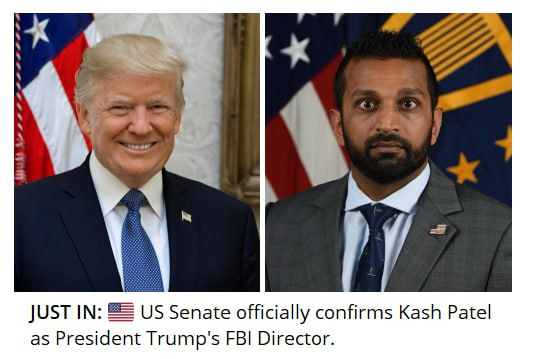
Senate vote 51-49. Kash Patel is Confirmed as Trump's FBI Director.
@ Newshounds News™
~~~~~~~~~
Seeds of Wisdom Team RV Currency Facts Youtube and Rumble
Newshound's Podcast Link
Newshound's News Telegram Room Link
Q & A Classroom Link
Follow the Roadmap
Follow the Timeline
Seeds of Wisdom Team™ Website
Subscribe to Seeds of Wisdom Team™ Newsletter
Thank you Dinar Recaps
Iraq Economic News and Points to Ponder Thursday 2-20-25
A Government Advisor Stresses The Importance Of Gold Trade To Support The Current Account Of The Balance Of Payments
The time: 2025/02/18 12:14:47 Reading: 2 ٬ 445 times {Economic: Al Furat News} A government advisor stressed the importance of gold trade to support the current account of the balance of payments.
"The adoption of advanced industrial protection policies will positively reflect on the
quality of the national gold product and the
stability of its prices."
A Government Advisor Stresses The Importance Of Gold Trade To Support The Current Account Of The Balance Of Payments
The time: 2025/02/18 12:14:47 Reading: 2 ٬ 445 times {Economic: Al Furat News} A government advisor stressed the importance of gold trade to support the current account of the balance of payments.
"The adoption of advanced industrial protection policies will positively reflect on the
quality of the national gold product and the
stability of its prices."
He pointed out that "this step will enhance the protection of one of the most important pillars of the national and family economy, with a direct and positive impact on the current account of the balance of payments." Saleh explained that
"the organization of the import of non-manufactured gold and its re-export will contribute to achieving an added value to the national economy," stressing
"the importance of careful supervision from the competent authorities to ensure the inventory of the gold movement within the framework of an economically organized trade, with high return and rational governance."
The Industrial Coordination Council had approved at its meeting the day before yesterday, Sunday, the resettlement of the precious metal industry, gold and jewelry, in addition to cosmetic products, while directing to provide all the necessary facilities for those wishing to establish their factories, and
it was decided to
monitor the quantities of gold exported abroad, through controls determining The quantities are re-manufactured,
submit documents to the central bank that provide the value of the external quantity, and
return the quantity yet
Complete its manufacturing for the country, with observation from the central bank.
https://alforatnews.iq/news/مستشار-حكومي-يشدد-على-أهمية-حوكمة-تجارة-الذهب-لدعم-الحساب-الجاري-لميزان-المدفوعات
Gold Localization
Economic 2025/02/19 Yasser Al –Mitwalli The government decision to localize the gold and precious metals industry is of great importance, as an important economic decisions, to consider gold, the pillar of the guarantee of the economy of any country of the collapses that may occur in periodic financial crises, and for causes of them naturally during periods of the economic cycle, and other political, as well as wars and others.
This decision comes consistent with what I dealt with in two previous articles published here in the "Al-Sabah" economy, as the first was titled (The forgotten wealth), in December 2024, and the second article was titled (Hedging with Gold a Safe Investment), in a month March of the same year (2024).
I was alerted to them the importance of taking advantage of global experiences in investing gold as an effective way to diversify sources of income and wealth, and as a safe alternative to the monetary reserve represented by the dollar, in order to avoid sanctions imposed by the American federalism on the countries, because it is the owner of the dollar currency, and there are many evidence and close to many of Countries.
This wealth has become forgotten and its page is folded after the world turned into a lack of evaluation of its currencies the size of its gold, and perhaps what brought back to mind the truth of the importance of this forgotten wealth (gold), the economic sanctions that some countries have been imposed by imposed by the great countries for various reasons, with the sanctions body Economic, and many examples available soon and not far from our current reality.
The nearest example that can be remembered is the embarrassing economic sanctions of Venezuela, which prevented the availability of what blocks the livelihood of its people, forcing its government to refer to the wealth of gold and act by selling it in order to confront the economic blockade that was imposed on it.
The expectations of economists also indicate that Russia may have to sell its gold reserves, as the last option in the face of US sanctions, if long.
This image became clear with the prolongation of the Russian-Ukrainian war, with the escalation of the ceiling of US-European sanctions on Russia, and Russia is also putting this possibility as the last option after the elements of confronting the siege and sanctions are exhausted. Accordingly, it seems that the
Iraqi government
is trying to benefit from these bitter experiences, and therefore it
decided to give the gold a priority to pay attention by localizing its industry and supporting workers in this sector as an optimal option.
The government's awareness of the importance of gold reserves as a guaranteed reserves in the face of emergency and critical conditions makes it offered this sector a great importance in the future. It is useful to note that
Iraq occupies an advanced rank in the cash gold reserves, as it is the fourth Arab and thirty globally, and by 152 tons of cash gold.
Perhaps the endeavor of the Central Bank of Iraq to increase the volume of Iraq's gold reserves reflects its importance in the balance and durability of the country's economy.
The new government initiative in localizing the gold industry will contribute to
encouraging citizens to invest in gold, and
restore the idea of its acquisition of decoration and saving when needed, as
this decision will achieve economic feasibility by maintaining gold from exporting it abroad, providing difficult currencies as a result of imports, and providing job opportunities For unemployed youth in this profitable profession.
The next important step is that it is necessary to adapt and amend the laws and procedures necessary to facilitate the birth of this important industry in attracting capital, whether internal or external, which has priority to attract investors to invest in a safe and profit field. https://alsabaah.iq/110413-.html
For current and reliable Iraqi news please visit: https://www.bondladyscorner.com/