
Seeds of Wisdom RV and Economic Updates Tuesday Evening 7-23-24
Good Evening Dinar Recaps,
BRICS IS MAKING PREPARATIONS FOR A US DOLLAR COLLAPSE
"According to a Russian IMF representative, BRICS is ready to offer an alternative to the US Dollar amid the currency’s collapse, and the bloc must prepare for such an instance. The alliance, consisting of Russia; India, China; Brazil; South Africa; and supporting nations, has been working to abandon the US Dollar for some time."
"The BRICS bloc is working to develop a new BRICS currency to replace the US dollar, alongside local currencies between nations. In an interview with RIA Novosti published on Friday, Russian IMF rep Alexey Mozhin noted that the shortcomings of the current financial system are becoming more apparent.
Furthermore, he points out that many publications have started to mention BRICS as a group that will offer a successful alternative to the greenback."
Good Evening Dinar Recaps,
BRICS IS MAKING PREPARATIONS FOR A US DOLLAR COLLAPSE
"According to a Russian IMF representative, BRICS is ready to offer an alternative to the US Dollar amid the currency’s collapse, and the bloc must prepare for such an instance. The alliance, consisting of Russia; India, China; Brazil; South Africa; and supporting nations, has been working to abandon the US Dollar for some time."
"The BRICS bloc is working to develop a new BRICS currency to replace the US dollar, alongside local currencies between nations. In an interview with RIA Novosti published on Friday, Russian IMF rep Alexey Mozhin noted that the shortcomings of the current financial system are becoming more apparent.
Furthermore, he points out that many publications have started to mention BRICS as a group that will offer a successful alternative to the greenback."
“Such a proposal is being discussed,” the director told RIA Novosti. “In the event of the collapse of the dollar and the international monetary system, it will be necessary to turn the said BRICS accounting unit into a real currency, backed by exchange goods.”
BRICS CURRENCY TO SERVE AS SUBSTITUTE IF US DOLLAR COLLAPSES
"The BRICS bloc has turned to blockchain technology for its brand-new payment system, according to reports. Indeed, its efforts have sought to build a competing currency built on digital assets."
"The US Dollar is still a ways away from crashing altogether, however, the path is there for BRICS to do damage. The greenback is still the global reserve, but a mounting US Debt has ensured that it won’t remain a fact forever.
"Furthermore, support around the BRICS bloc has grown over the past few years, with more countries likely to receive invites to join in 2024.
With more support in numbers and finances, BRICS could develop a strong contending currency to fight the US dollar."
@ Newshounds News™
Read more: The Republicans Voice
~~~~~~~~~
GOLD, SILVER: India's TAX CUT to Offer a Bullish Boost for the Metals?
"Today, India slashed its import tax on gold and silver, a move that could further boost demand for both precious metals in the world’s second-biggest gold market and support higher prices globally. The move will cut taxes on gold and silver imports by more than half, lowering duties from 15 percent to 6 percent."
"India will also lower the import tax on platinum to 6.4 percent."
"World Gold Council Indian operations CEO Sachin Jain told Reuters the tax cut is “a massive step in the right direction.”
“It will reduce the incentives for smuggling of gold. It will create a level playing field for honest industry stakeholders.”
"Gold was up about $14 in overseas trading after officials announced the tax cut. Even with the high import taxes, Indian gold demand has been strong. Through the first five months of 2024, gold imports into India increased by 26 percent year-on-year, with 230 tons of gold flowing into the country. This is despite record-high prices."
"Indians have historically had an affinity for gold. Indian households own an estimated 25,000 tons of gold, and that likely understates the amount given the large black market in the country. Gold is deeply interwoven into the country’s marriage ceremonies and cultural rituals. Indians have long valued the yellow metal as a store of wealth, especially in poorer rural regions."
"Gold isn't considered a luxury in India. Even poor Indians buy gold. According to a 2018 ICE 360 survey, one in every two households in India had purchased gold within the last five years. Overall, 87 percent of Indian households own some gold. Even households at the lowest income levels in India hold some of the yellow metal. According to the survey, more than 75 percent of families in the bottom 10 percent of income managed to buy some gold."
@ Newshounds News™
Read more: Investing
~~~~~~~~~
146 TRILLIONpic
@ Newshounds News™
Read more: https://x.com/SMQKEDQG/status/1780670320522747961
~~~~~~~~~

Warren Buffett Dumps $1.5 Billion Worth Bank of America Shares
Ace investor Warren Buffett’s investment arm Berkshire Hathaway has dumped $1.5 billion worth of Bank of America (BAC) shares. The recent regulatory filings show that the billionaire offloaded 33.9 million Bank of America shares. The BAC stocks were sold at an average price of $43.56 per share. After the sale from Berkshire Hathaway, BAC stocks fell to $42.30 with a decline of 1.40%.
The reduction is significant and has come as a surprise to the US stock market. Warren Buffett is known to hold stocks for the long term and not offload them mid-way. However, despite the sell-off, Warren Buffett is still the second-biggest holder of Bank of America stocks. Berkshire Hathaway holds a 10.8% stake in BAC after falling from the top position to the second due to the sell-off
@ Newshounds News™
Read more: Watcher Guru
~~~~~~~~~
IS TRUMP RIGHT TO WORRY THAT CHINA COULD TAKE OVER CRYPTO?
Does China regret banning Bitcoin mining in 2021? Could it opt back in? Can a single nation even control decentralized assets like BTC?
It’s only recently that Donald Trump has paid any attention to crypto. But now he wants to be the “crypto president,” and he’s raising digital assets as a geopolitical issue.
Asked on July 16 why he’s suddenly embracing the crypto community, he told Bloomberg:
“If we don’t do it, China is going to pick it up and China’s going to have it—or somebody else, but most likely China.”
In the interview, Trump explained how the recent experience with his “Mugshot” NFT Collection “opened my eyes” to cryptocurrencies, saying, “80% of the money [from the NFT sale] was paid in crypto. It was incredible.”
“So we have a good foundation [i.e., crypto]. It’s a baby. It’s an infant right now. But I don’t want to be responsible for allowing another country to take over this sphere,” he added.
His remarks raised several interesting questions — and not just whether China, which banned crypto trading and Bitcoin mining in 2021, is even interested in reentering the crypto trading and mining markets.
It touches on the relationship between governments and the crypto/blockchain sector generally.
To what extent can any single sovereign nation control decentralized and diversified digital assets like Bitcoin and Ethereum.
Is it even possible?
Why China?
China was once a major crypto player. The largest crypto exchanges, such as Binance, were located in China, and as much as 75% of Bitcoin mining took place on the Chinese mainland, according to estimates.
But in 2021, China cracked down on crypto trading and mining, and by July of that year, Bitcoin mining had essentially vanished on the mainland.
Recent developments, however, have raised speculation “that the Chinese government may be warming to cryptocurrency and that Hong Kong may be a testing ground for these efforts,” noted Chainalysis in October.
Indeed, in April 2024, the central government approved the launch of several Bitcoin exchange-traded funds (ETFs) in Hong Kong. Some observers think China wants to make Hong Kong a crypto hub — despite a continued trading ban on the mainland.
China’s Bitcoin ban a “strategic blunder”
“Absolutely,” Daniel Lacalle, chief economist of Tressis, told Cointelegraph.
“Beijing’s 2021 mining crackdown was a strategic blunder,” Emiliano Pagnotta, associate professor of finance at Singapore Management University, told Cointelegraph.
China wants to maintain tight control of capital outflows on the mainland, Wang, assistant professor in the economics department at the University of Essex, told Cointelegraph, which is why it banned crypto trading.
But Hong Kong, while controlled by China, has a different economy. It has always had open market policies and free capital flow, and crypto might find a natural home in the former British colony. Wang added:
“Hong Kong serves as the hub to allow some capital flow in and out of mainland China, which is important for Hong Kong and also for mainland China.”
“The digital asset ETF market in Hong Kong has indeed seen substantial growth since its launch in April 2024,” Patrick Pan, chairman and CEO of OSL — a crypto-exchange now operating in Hong Kong — told Cointelegraph.
Pan added that mainland China “has maintained a stringent stance against cryptocurrency trading and speculations.”
Pan points out, however, that China has largely accepted the importance of cryptocurrencies’ underlying blockchain technology.
“China’s development and gradual rollout of the digital yuan showcase an interest and capacity to embrace blockchain technologies, which bring long-term benefits to the country’s financial infrastructure through enhanced efficiency and security of its financial systems,” said Pan.
China may be softening its stance on crypto
Chinese government decision-making is opaque, so one may never know if China truly regrets its 2021 crypto ban. But what is clear is that “the country is reassessing its approach, especially as it sees the strategic value in digital assets,” Zennon Kapron, founder and director of consulting firm Kapronasia, told Cointelegraph, adding:
“The softening stance in Hong Kong could be a strategic move to remain competitive in the fintech and digital finance space without fully reversing its mainland policy.”
But is it too late?
“China still has advantages, such as access to cheap hardware and electricity in certain regions,” Kapron allowed. “If the government were to provide incentives or loosen restrictions, it’s conceivable that some level of dominance could be reestablished.”
It wouldn’t be easy, though. “The global mining landscape has become more diversified, making it harder for any single country to dominate,” observed Kapron.
“Bitcoin mining is not like making CPUs, but more similar to producing solar panels, building railways, etc. China has the capacity and even the comparative advantage in this type of mass production.”
Crypto trading may be a different matter, though. China is unlikely to change its trading ban on the mainland unless it first changes its capital markets policy, said Wang.
Pagnotta, by comparison, said China could still be a force within the crypto sector, particularly if it demonstrates more pragmatism and regulatory clarity.
“China now seems more open to the crypto industry and has allowed the launch of Bitcoin and ETH ETFs in Hong Kong,” said Moreno.
“Despite China’s ban on Bitcoin mining, Chinese mining pools still hold nearly 54% market share,” CryptoQuant founder Ki Young Ju posted on July 1. “While not all participants in these pools are Chinese, some mining farms might still be operating covertly in China, with authorities possibly concealing data.”
China’s central government also remains a Bitcoin “whale” as a result of its past activities — holding 190,000 BTC, or about 1% of the Bitcoin currently in existence. This is not a trivial amount.
Could China dominate crypto again?
Wang, for his part, believes that if China really sets its mind to it, it could still “play a super important, if not dominating, role” in the global crypto sector.
Not only does it have natural advantages, but there is a huge demand for using cryptocurrencies to send Chinese assets abroad, Wang added, especially given China’s tight capital market controls.
The biggest cryptocurrency exchange platform in the world in terms of trade volume is still Binance, “which is a company started in China by a Chinese but later moved abroad, and still 20% of Binance’s trade comes from China,” noted Wang.
As per Trump’s remarks, is crypto really emerging as a new theater of competition between the great powers? According to Pagnotta:
“Trump wants votes, and he understands that tens of millions of Americans hold digital assets and see it as an important electoral issue. Drawing a contrast to Biden or China in this regard is politically astute.”
“At a more profound level, Trump does not want a Chinese/BRICS [i.e, Brazil, Russia, India, China, South Africa]-led central bank digital currency [CBDC] to become dominant. Even if he did not suddenly become a genuine Bitcoiner, he surely comprehends enough game theory to realize that Bitcoin is the politically neutral global property rights system in the 21st century,” added Pagnotta
In doing so, the former US president could simply be applying the ancient wisdom that “the enemy of my enemy is my friend.”
Still, others believe the suggestion that China may once again try to gain dominance in the global crypto market is just plain wrong. Leading cryptocurrencies like Bitcoin and Ether are too diversified and decentralized now to allow control by any one sovereign state.
“China’s influence in the crypto market may grow, particularly through initiatives like the digital yuan,” said Kapron, “but achieving dominance over decentralized cryptocurrencies is a different challenge altogether.”
Trump’s recent utterances may reflect a strategic concern, continued Kapron, “but the reality is that the decentralized and diversified nature of these digital assets acts as a significant barrier to dominance by any single nation.”
Added economist Lacalle:
“There is no such thing as nationalist crypto. The beauty of the crypto market is that it is completely diversified and decentralized. The concept of government control of crypto makes no sense to anyone that understands independent currencies.”
@ Newshounds News™
Read more: COIN TELEGRAPH
~~~~~~~~~
Newshound's Daily Breakdown Podcast Link
Newshound's News Telegram Room Link
Q & A Classroom Link
Follow the Roadmap
Follow the Timeline
Seeds of Wisdom Team™ Website
Subscribe to Newsletter
Thank you Dinar Recaps
Economist’s “News and Views” Tuesday 7-23-2024
As U.S. Debt Hits Historic Levels, How Close Are We to a Complete System Failure?
Daniela Cambone: 7-23-2024
The U.S. deficit will become worrisome if tax revenue collected by the government falls far short of, or gets too close to, the debt service, claims Joel Litman, President and CEO of Valens Research.
However, he remains optimistic about the overall U.S. economy. “U.S. assets are easily 50 trillion at the lowest end, probably closer to 100 trillion.
The U.S. government is still the biggest landowner of U.S. land in the United States,” he states.
Furthermore, Litman provides a clear and informed perspective on why the U.S. remains financially resilient and what measures could ensure continued economic stability.
As U.S. Debt Hits Historic Levels, How Close Are We to a Complete System Failure?
Daniela Cambone: 7-23-2024
The U.S. deficit will become worrisome if tax revenue collected by the government falls far short of, or gets too close to, the debt service, claims Joel Litman, President and CEO of Valens Research.
However, he remains optimistic about the overall U.S. economy. “U.S. assets are easily 50 trillion at the lowest end, probably closer to 100 trillion.
The U.S. government is still the biggest landowner of U.S. land in the United States,” he states.
Furthermore, Litman provides a clear and informed perspective on why the U.S. remains financially resilient and what measures could ensure continued economic stability.
Don't miss this insightful analysis that challenges common alarmist views and offers a deeper understanding of national debt dynamics.
CHAPTERS:
00:00 US debt
5:52 The breaking point of US debt
7:53 Servicing the debt
11:04 Warren Buffet ends deficit in 5 minutes
16:01 Diminishing purchasing power
17:52 Real estate
China Sell 68% of its US Treasury: What's next?
Fastepo: 7-23-2024
The general U.S. perspective of US treasury emphasizes the security and reliability of Treasury securities. Critics, however, point to different aspects.
They often argue that the massive issuance of U.S. Treasuries is a reflection of the significant national debt, which stood at approximately $34.9 trillion as of July 2024.
They argue that this growing debt could pose long-term economic risks, including potential inflation and increased borrowing costs.
Additionally, they highlight the dependency of the U.S. on foreign investment, particularly from countries like China and Japan, which hold large amounts of U.S. debt—around $1.15 trillion and $1.1 trillion, respectively, as of early 2024.
As Washington Threatens To Shutdown China Banks, Beijing Sells Record $79.7B In US Debt & Stocks
Sean Foo: 7-23-2024
Jake Sullivan, the US NSA advisor, just warned Chinese banks. This threat is a dangerous one and risks upsetting the global economy.
Trade could be severely disrupted and supply chains broken. Meanwhile, China understands the risk and a recent report confirms they are exiting dollar assets in a big way.
They sold $79.7 Billion of US assets from January to May this year, a new record.
Timestamps & Chapters:
0:00 Sullivan Targets China Banks
2:43 China Fleeing US Assets
5:55 Feeding Into Further De-Dollarization
7:51 Sponsor: Indigo Precious Metals
9:15 Risking China Anti-USD Trade
10:27 Disastrous China Tariff Risk
13:29 China Has No Choice
“Tidbits From TNT” Tuesday 7-23-2024
TNT:
Tishwash: IMF: Iraq, Qatar increase their gold holdings
Data from the International Monetary Fund showed an increase in gold reserves in Iraq and Qatar.
According to these data, in May 2024, Iraq increased its gold reserves by 2,644 tons to 148,305 tons.
The data showed that Qatar increased its gold reserves by 3,112 tonnes to 106,423 tonnes in June 2024, according to Reuters. link
TNT:
Tishwash: IMF: Iraq, Qatar increase their gold holdings
Data from the International Monetary Fund showed an increase in gold reserves in Iraq and Qatar.
According to these data, in May 2024, Iraq increased its gold reserves by 2,644 tons to 148,305 tons.
The data showed that Qatar increased its gold reserves by 3,112 tonnes to 106,423 tonnes in June 2024, according to Reuters. link
Tishwash: Iraq eyes drawdown of US-led forces starting September, sources say
Iraq wants troops from a U.S.-led military coalition to begin withdrawing in September and to formally end the coalition's work by September 2025, four Iraqi sources said, with some U.S. forces likely to remain in a newly negotiated advisory capacity.
The Iraqi position is being discussed with U.S. officials in Washington this week at a security summit and there is no formal agreement on ending the coalition or any associated timetable yet, the Iraqi sources and U.S officials said.
U.S. State Department spokesperson Mathew Miller told a news briefing that both sides were meeting in Washington this week to determine how to transition the U.S.-led coalition's mission based on the threat posed by Islamic State, adding he had no further details.
U.S.-led forces invaded Iraq in 2003, toppled former leader Saddam Hussein and then withdrew in 2011, only to return in 2014 to fight Islamic State at the head of the coalition.
The U.S. currently has around 2,500 troops in Iraq at the head of a more than 80-member coalition that was formed in 2014 to repel Islamic State as it rampaged across Iraq and Syria.
They are housed at three main bases, one in Baghdad, one in western Anbar province and another in the northern Kurdistan region.
It is unclear how many troops would leave under a deal, with Iraqi sources saying they expected most to eventually depart but U.S. officials saying many may remain under a newly negotiated advise and assist mission.
U.S. officials are keen to have some military footprint in Iraq on a bilateral basis, in part to help support its presence across the border in Syria, where it has around 900 troops.
The issue is highly politicized, with mainly Iran-aligned Iraqi political factions looking to show that they are pushing out the country's one-time occupier again, while U.S. officials want to avoid giving Iran and its allies a win.
There are also concerns about Islamic State's ability to regroup.
The jihadist group was declared territorially defeated in Iraq in 2017 and in Syria in 2019 but still carries out attacks in both countries and is on track to double its attacks in Syria this year compared to 2023, the U.S. military said.
The group and its affiliates have also in recent months carried out attacks in Iran and Russia, as well as in Oman last week for the first time.
While the coalition's mission is to advise and assist Iraqi forces in the fight against the Islamic State, Western officials say the U.S. and its allies also see its presence in Iraq as a check on Iranian influence.
Washington and Baghdad initiated talks on the future of the coalition in January amid tit-for-tat attacks between Iran-backed Shi'ite Muslim armed groups and U.S. forces that were sparked by the Israel-Hamas war.
An agreement to draw down the coalition could be a political win for Prime Minister Mohammed Shia al-Sudani, who has been under pressure from Iran-aligned factions to push out U.S. forces but has sought to do so in a way that balances Iraq's delicate position as an ally of both Washington and Tehran. link
************
Tishwash: The Oil and Gas Law has been imprisoned in Parliament for 19 years and is threatened with deportation to the next session
The secret lies in the consensus of political forces
Political disagreements and a lack of consensus since the first session of the House of Representatives made the draft oil and gas law a victim and locked in parliament's drawers.
In each session, conflicts prevent its approval in its final form, as five parliamentary sessions have passed and the law has not been released until today.
The Parliamentary Oil, Gas and Natural Resources Committee expects that the law will be transferred to the next parliamentary session, despite the visit of the head of the Kurdistan Democratic Party, Masoud Barzani, early this month, to the capital, Baghdad, and his meeting with political leaders.
A member of the Parliamentary Oil and Gas Committee, Ali Al-Lami, said in an interview with Al-Mada, “One of the reasons for obstructing the approval of the oil and gas law is the continuing disputes between the governments of Baghdad and Erbil “
He added that his committee "sent the law at the beginning of the current parliamentary session to the government, and we met with the Prime Minister, the President of the Republic, and all the heads of blocs and parties, and we explained the importance of this law."
The member of the House of Representatives points out, “The law is unlikely to be approved during the current session, as it requires study and reading,” suggesting that “the law will be transferred to the next parliamentary session.”
The draft Iraqi oil and gas law regulates Iraq's vital sector and the management of the country's oil fields through one national company, with imports being deposited in one account.
Iraq exports an average of 3.3 million barrels of crude oil per day, and black gold constitutes more than 90 percent of the Iraqi treasure's resources.
For her part, a member of the Parliamentary Oil and Gas Committee, Zainab Al-Moussawi, said in an interview with Al-Mada, “The law is almost complete, and to a high degree, but there are some objections about some points, which are summed up in the delivery of oil imports and exploited and unexploited natural resources to Baghdad.”
Al-Mousawi adds, “The Oil and Gas Law is concerned with regulating the country’s natural resources and exploiting the largest possible amount of undiscovered oil fields.”
She points out that "the law will also contribute to achieving self-sufficiency in oil derivatives and optimal exploitation of wasted natural resources, valued at hundreds of billions of dollars, which contribute to diversifying the state's financial resources."
The draft oil and gas law in Iraq available to Parliament stipulates that responsibility for managing the country's oil fields must be entrusted to and supervised by a national oil company.
In August 2023, the Prime Minister, Muhammad Shiaa Al-Sudani, confirmed that “the draft oil and gas law is one of the basic and important laws, representing a factor of strength and unity for Iraq, and it has been stuck for years, At a time when the country today is in dire need of its legislation and to benefit from this natural wealth, in every way.” Fields and sectors, as well as the contribution of the legislation to solve many outstanding problems.”
He explained, “There are governorates that have not invested their wealth, which is considered negative for development endeavors in all their paths.”
In February 2022, the Federal Court in Baghdad ordered the region to deliver the oil produced on its lands to Baghdad, and to cancel contracts the region had signed with foreign companies.
The matter reached the point where the judiciary in Baghdad invalidated contracts with many foreign companies, especially American and Canadian companies. link
Mot: .... Why Didn't it Happen???? - Why!!!????

Mot: Beee Careful as Ya Become more Seasoned! - Slow down there, buddy!

Iraq News Highlights and Points To Ponder Tuesday AM 7-23-24
An Expert Warns Of A Return To Rising Inflation Rates Globally.. What Is The Connection To The Iraqi Markets?
Money and business Economy News – Baghdad Economist Ziad Al-Hashemi warned on Monday of the possibility of inflation rates rising again globally with the continuation of Houthi attacks on commercial shipping vessels in the Red Sea region.
Al-Hashemi said in a post on the Ax website that there are "fears of inflation rates rising again globally with the continuation of Houthi attacks on commercial shipping vessels in the Red Sea region for the sixth consecutive month, and Iraqi markets are on the list of those affected!"
He added, "The global economy has begun to feel the pressures of rising costs and prices as a result of the continued disruption of transport chains between Asia and Europe, with the Houthi attacks continuing for the sixth month and the diversion of shipping routes away from the Red Sea.
Shipping prices have quadrupled on a monthly basis from $1,890 in the first month of 2024 to more than $8,000 during the seventh month, per FEU container."
An Expert Warns Of A Return To Rising Inflation Rates Globally.. What Is The Connection To The Iraqi Markets?
Money and business Economy News – Baghdad Economist Ziad Al-Hashemi warned on Monday of the possibility of inflation rates rising again globally with the continuation of Houthi attacks on commercial shipping vessels in the Red Sea region.
Al-Hashemi said in a post on the Ax website that there are "fears of inflation rates rising again globally with the continuation of Houthi attacks on commercial shipping vessels in the Red Sea region for the sixth consecutive month, and Iraqi markets are on the list of those affected!"
He added, "The global economy has begun to feel the pressures of rising costs and prices as a result of the continued disruption of transport chains between Asia and Europe, with the Houthi attacks continuing for the sixth month and the diversion of shipping routes away from the Red Sea.
Shipping prices have quadrupled on a monthly basis from $1,890 in the first month of 2024 to more than $8,000 during the seventh month, per FEU container."
He stated that "during the past period, many international economic and financial experts have downplayed the effects of the disruption of maritime transport routes due to Houthi attacks, and their negative repercussions on the prices of goods and services in Western economies, especially the consumer price index (one of the most important indicators for assessing the path of inflation),
but with the continuation of security risks and threats in the Red Sea region, the continued rise in transport prices, and the imminent expiration of many long-term contracts with fixed freight rates, many convictions and analyses have changed."
Al-Hashemi stressed, "We have growing concern that the large increases in shipping prices will lead to significant increases in the prices of goods and products in Western markets, which will put pressure on inflation rates that have gradually begun to decline and reach the targeted levels."
He added, "These price pressures may lead to inflation rates rising again, which means that the efforts and endeavours of central banks to curb inflation in the West have faltered, and this will greatly hinder and delay the start of the process of reducing interest rates, which global markets are eagerly awaiting."
He pointed out that "concerns in the markets continue and are increasing with the continuation of military operations, the disruption of transportation routes, and the rise in transportation prices to significant levels, especially with the absence of light at the end of the tunnel of this crisis, and eyes will focus more on inflation rates, and waiting to see how things will develop."
Regarding the impact on the Iraqi markets, Al-Hashemi confirmed that they are “highly affected by changes in shipping prices coming from Asia, and increases in shipping prices can directly and quickly affect the prices of imported goods, and this may be one of the reasons for the rise in commodity prices in the Iraqi markets during the first half of 2024.”
189 views 07/22/2024 - https://economy-news.net/content.php?id=45479
Oil And Gas Law Stuck In Parliament's Drawers
Iraq 08:07 - 2024-07-23 Political differences and the absence of consensus since the first session of the House of Representatives have kept the draft oil and gas law stuck in the parliament’s drawers.
In each session, conflicts have prevented its approval in its final form. Five parliamentary sessions have passed and the law has not been released to this day.
The parliamentary Oil, Gas and Natural Resources Committee expects the law to be postponed to the next parliamentary session due to ongoing disagreements.
Ali Al-Lami, a member of the parliamentary Oil and Gas Committee, says that one of the reasons for obstructing the approval of the Oil and Gas Law is the ongoing disagreements between the governments of Baghdad and Erbil.
He adds that his committee sent the law to the government at the beginning of the current parliamentary session, but we do not expect it to be approved during the current session, as it requires study and reading, suggesting that the law will be postponed to the next parliamentary session.
For her part, Zainab Al-Moussawi, a member of the parliamentary oil and gas committee, says that the law is almost complete, and to a high degree, but there are some objections regarding some points, which are summarized in the delivery of oil revenues and exploited and unexploited natural resources to Baghdad.
Al-Moussawi adds that the oil and gas law is concerned with organizing the country's natural resources and exploiting the largest possible amount of undiscovered oil fields.
She points out that the law will also contribute to achieving self-sufficiency in oil derivatives and optimal exploitation of wasted natural resources, estimated at hundreds of billions of dollars, which contribute to diversifying the state's financial resources.
The draft of the oil and gas law in Iraq available to parliament stipulates that the responsibility for managing the country's oil fields should be entrusted to a national oil company.
Prime Minister Mohammed Shia al-Sudani had previously confirmed that the draft oil and gas law is one of the basic and important laws, and represents a factor of strength and unity for Iraq. It has been pending for years, at a time when the country is in dire need of its legislation and to benefit from this natural wealth in all fields and sectors, in addition to the contribution of the legislation of the law in solving many of the outstanding problems.
He explained that there are governorates that have not invested their wealth, which is a negative thing for development efforts in all their paths. https://kirkuktv.net/AR/Details/21690
IMF: Iraq, Qatar Increase Their Gold Holdings
Money and business Economy News – Baghdad Data from the International Monetary Fund showed an increase in gold reserves in Iraq and Qatar.
According to these data, in May 2024, Iraq increased its gold reserves by 2,644 tons to 148,305 tons.
The data showed that Qatar increased its gold reserves by 3,112 tonnes to 106,423 tonnes in June 2024, according to Reuters. 93 views 07/23/2024 - https://economy-news.net/content.php?id=45500
3 Years Without Achievement.. Iraq Wastes Its Renewable Energies And There Is No "Seriousness" In Exploiting Them
Economy News – Baghdad In 2021, the Iraqi government launched the Solar Energy and Emissions Reduction Initiative, and in 2022 confirmed its support, but it does not appear to be effective or fully completed to date.
The initiative stipulates the installation of solar energy systems on the roofs of state institutions, and the amount allocated for it is 90 billion Iraqi dinars for five years to support the national grid.
The Iraqi government sought to solve the electricity problem by contracting with major countries and companies in the field of renewable energy, including signing agreements with Arab and foreign companies to establish solar power projects in Iraq, but its efforts faltered, which keeps the wealth of solar energy under-exploited.
Energy expert Murtadha Hatem says, “Launching an initiative to support energy and reduce emissions through solar energy in Iraq is an important step towards achieving sustainable development and preserving the environment.”
He added, "Relying on solar energy contributes to reducing dependence on fossil fuels, which ensures greater sustainability of energy sources, and reduces price fluctuations associated with oil prices."
He explains that "solar energy is a clean source of energy that helps reduce greenhouse gas emissions and improve air quality, which is important in confronting climate change," indicating that "reducing dependence on energy imports from abroad and increasing local production enhances the country's energy security."
He added, "Developing solar energy projects can provide many job opportunities in the fields of design, installation, and maintenance, in addition to stimulating innovation and investment in clean technology."
Hatem confirms that “Iraq has abundant solar resources that can be exploited to provide sustainable and cheap energy, which contributes to improving the energy infrastructure.”
He explained that “launching solar energy initiatives reflects the government’s commitment to shifting towards a green and sustainable economy, which enhances Iraq’s position in the international community as an environmentally responsible country.”
Journalist and renewable energy expert Ali Naji says, “All the systems that were built in all their forms on the roofs of state institutions before this initiative were not successful and almost failed, including those installed on departments related to renewable energy.”
He added, "There are instructions from the Civil Defense that specify the hours of use of renewable energy during official working hours only, which means there are losses in operating solar systems from the moment of sunrise until the moment of the start of official working hours and connecting the system to the national grid," explaining, "Generation losses from the end of working hours until sunset, due to the national grid being cut off after the end of working hours, in addition to holidays and occasions when it is out of service."
He added, "Installing these systems on the roofs of buildings will hinder the process of roof maintenance in the event of damage," stressing that "these departments do not have sufficient personnel to manage and maintain these solar systems, and even if they are trained, partial training is not sufficient and does not cover the requirements of these systems."
Regarding the obstacles that hinder the success of the initiative, Ali Naji explains that “these systems should be placed on the outskirts of cities in the form of farms (solar energy farms) divided into five regions, for example, between the northern, central and southern regions, as is the case in Egypt, the Emirates and others,” noting that “the number of employees to maintain them will be less and easier to control, in addition to these farms being planted with trees, which will increase afforestation operations.”
He added, "The systems are connected in two ways: to the national grid, and also to charge batteries to support areas in the event of a lack of electricity or a lack of electricity supply."
Iraq, whose infrastructure is in shambles after decades of conflict and chronic corruption in public administrations, needs more than 32,000 megawatts to cover its needs, but the country's power plants produce only about 24,000 megawatts.
On March 12 of last year 2023, Oil Minister Hayan Abdul-Ghani announced that preparations were underway to launch the first solar energy project in Iraq, with a capacity of about 1,000 megawatts, which coincided with the state’s efforts to enhance its investments in the renewable energy and natural gas sector.
Despite this need, renewable energy remains underutilized, with Iraq enjoying just over 3,000 hours of sunshine out of 8,700 hours per year. Meanwhile, more than 98 percent of Iraq’s electricity is generated by fossil fuels, according to a World Bank report.
To encourage residents to install solar energy systems, the Central Bank of Iraq announced in 2022 the allocation of one trillion dinars (about $750 million) to secure subsidized loans for the private sector, including homes and private companies. But according to renewable energy specialists, this project is faltering due to the lack of cooperation from banks.
Over the past years, Iraq has relied on Iran for electricity supplies, importing 1,200 megawatts, as well as gas fuel to feed local power plants.
This year, the Iraqi News Agency quoted the authority’s advisor, Rahim al-Jaafari, as saying, “There are serious and practical steps to produce electricity from solar energy, as a plan has been developed to produce about 12,000 megawatts by the end of 2030,” adding that “it has been approved by the Council of Ministers.”
The Ministry of Environment has identified 3 types of pollution, including waste, that represent a challenge during the current stage in Iraq, calling for the adoption of modern technologies and renewable and clean energy as an alternative to fossil fuels.
85 views 07/23/2024 - https://economy-news.net/content.php?id=45489
MilitiaMan: Iraq Dinar-Prime Minister Advisors-Saleh-Al-Nusairi-Facts bringng facts-Reforms Economic & Financial
Iraq Dinar-Prime Minister Advisors-Saleh-Al-Nusairi-Facts bringng facts-Reforms Economic & Financial
MilitiaMan and Crew: 7-22-2024
The Crew: Samson, PompeyPeter, Petra, Daytrader, Sunkissed, GIGI and Militia Man Be sure to listen to full video for all the news……..
Iraq Dinar-Prime Minister Advisors-Saleh-Al-Nusairi-Facts bringng facts-Reforms Economic & Financial
MilitiaMan and Crew: 7-22-2024
The Crew: Samson, PompeyPeter, Petra, Daytrader, Sunkissed, GIGI and Militia Man
Be sure to listen to full video for all the news……..
Iraq Economic News and Points To Ponder Monday Evening 7-22-24
Is The Central Bank Leading Iraq Towards An Economic Crisis? July 22, 2024 Last updated: July 22, 2024
A Financial Report Reveals And Reality Confirms... Is The Central Bank Leading Iraq Towards An Economic Crisis? Al-Independent/- Informed sources said that the financial policy of the Central Bank of Iraq faces sharp criticism from financial experts and economic observers, amid a continuous rise in operational costs and a noticeable increase in expenditures. According to the financial situation tables as of 6/30/2024 published on the Central Bank’s website, the financial statements show that there is a clear imbalance.
Is The Central Bank Leading Iraq Towards An Economic Crisis?
July 22, 2024 Last updated: July 22, 2024
A Financial Report Reveals And Reality Confirms... Is The Central Bank Leading Iraq Towards An Economic Crisis?
Al-Independent/- Informed sources said that the financial policy of the Central Bank of Iraq faces sharp criticism from financial experts and economic observers, amid a continuous rise in operational costs and a noticeable increase in expenditures.
According to the financial situation tables as of 6/30/2024 published on the Central Bank’s website, the financial statements show that there is a clear imbalance.
The financial report revealed a slight increase in total assets, which reflects an apparent stability in the bank’s financial performance.
However, the financial statements showed some points that call for criticism and questioning the effectiveness of the financial management of the Central Bank of Iraq.
The report indicated that gold reserves rose to 14,672,164,921 thousand Iraqi dinars from 14,475,189,559 thousand Iraqi dinars.
Although this strengthens the bank's position, the question remains about the adequacy of these reserves in the face of potential economic crises.
As for the bank’s balances with banks outside Iraq, they increased to 2,011,145,122 thousand Iraqi dinars from 1,827,075,442 thousand Iraqi dinars, which reflects a diversification of assets, but the question remains about the risks associated with relying on foreign banks.
Foreign currencies witnessed a noticeable increase to 24,688,182,816 thousand Iraqi dinars from 23,838,913,348 thousand Iraqi dinars, which enhances foreign exchange reserves, but how these reserves are managed effectively must be monitored.
In terms of expenses, currency issuance expenses increased to 10,588,686 thousand Iraqi dinars from 9,897,229 thousand Iraqi dinars, raising questions about the effectiveness of managing issuance costs.
Foreign currency valuation differences also increased significantly to 188,168,707 thousand Iraqi dinars from 151,874,481 thousand Iraqi dinars, which indicates fluctuations in the value of foreign currencies that may negatively affect financial stability.
Also, general administrative expenses increased to 52,643,698 thousand Iraqi dinars from 39,692,228 thousand Iraqi dinars, which reflects an increase in operational costs that need to be carefully reviewed to ensure that resources are not wasted.
In terms of profits and losses, interest and commission income increased to 2,968,280,621 thousand Iraqi dinars from 2,495,021,601 thousand Iraqi dinars, which reflects a good performance,
but the question remains about the sustainability of these revenues in light of the economic challenges.
Total interest expenses increased to 2,684,950,171 thousand Iraqi dinars from 2,271,995,595 thousand Iraqi dinars, which indicates an increase in interest costs that need better management.
As for the final budget, the exported currency rose to 102,311,666,715 thousand Iraqi dinars from 100,791,930,154 thousand Iraqi dinars, which may indicate inflationary pressures if not properly monitored.
Bank deposits increased to 54,434,578,910 thousand Iraqi dinars from 47,851,676,798 thousand Iraqi dinars, which reflects an increase in deposits,
but the stability of these deposits in the long term must be verified.
strength point:
The report showed an increase in total assets, reflecting the central bank's apparent financial stability.
Gold reserves and external bank balances also increased, which significantly strengthens the bank's monetary position. In addition,
interest and commission income witnessed a significant increase, reflecting a good performance in the bank's financial returns.
Weaknesses and doubts:
Despite the apparent stability, outstanding outstanding debts amounting to 530,499,124 thousand Iraqi dinars did not change, indicating challenges in debt collection.
Administrative expenses also increased to 52,643,698 thousand Iraqi dinars, which may indicate poor management of operational costs.
In addition, Central Bank transfers decreased to 0 from 5,110,240,000 thousand Iraqi dinars, raising questions about the efficiency of liquidity management.
Finally, the balances of government institutions decreased to 10,750,719,726 thousand Iraqi dinars from 13,353,688,408 thousand Iraqi dinars, indicating challenges in government financing.
Recommendations:
To improve the financial position of the central bank, it is important to develop effective plans to collect outstanding debts to reduce financial risks.
Operational costs must also be reviewed and controlled to avoid any unjustified increase in expenses.
It is necessary to establish policies to monitor currency issuance to ensure that unwanted inflation does not occur.
Finally, the reasons behind the decline in the balances of government institutions must be studied and the necessary measures taken to strengthen government financing.
Based on this analysis, it is clear that the central bank needs improvements in several aspects to ensure actual financial stability and effectiveness in resource management.
To view the financial situation table, click here: Central Bank of Iraq
https://mustaqila.com/wp-content/uploads/2024/07/البنك-المركزي-العراق.pdf
https://mustaqila.com/تقرير-مالي-يكشف-والواقع-يؤكد-هل-يقود-ا/
For current and reliable Iraqi news please visit: https://www.bondladyscorner.com/
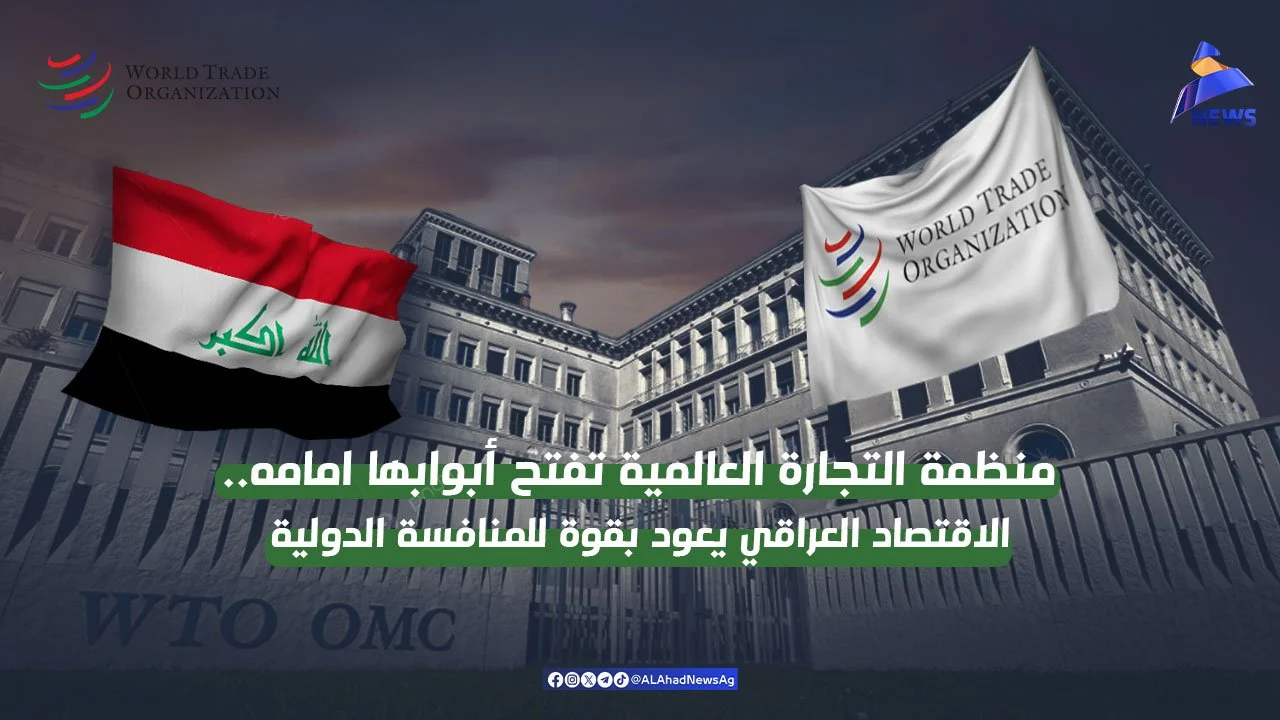
The World Trade Organization opens its doors to it.. The Iraqi economy returns strongly to international competition
Clare: The World Trade Organization opens its doors to it.. The Iraqi economy returns strongly to international competition
7/22/2024
The World Trade Organization has accelerated Iraq's steps to join it, following the resumption of negotiations that had been suspended for more than 16 years. The Iraqi delegation is preparing for the next round of negotiations that are expected to resolve this issue, which will open up global trade horizons for Iraq and return it to strong economic competition, in the region and the world, under a multilateral economic system.
According to official officials, the government of Mohammed Shia al-Sudani has only addressed all the previous obstacles that prevented Iraq from joining the international organization, as for the first time the import program was voted on, which includes setting controls for chaos and identifying real traders, in addition to other details related to customs tariffs as well as the necessary legislation for it.
KTFA:
Clare: The World Trade Organization opens its doors to it.. The Iraqi economy returns strongly to international competition
7/22/2024
The World Trade Organization has accelerated Iraq's steps to join it, following the resumption of negotiations that had been suspended for more than 16 years. The Iraqi delegation is preparing for the next round of negotiations that are expected to resolve this issue, which will open up global trade horizons for Iraq and return it to strong economic competition, in the region and the world, under a multilateral economic system.
According to official officials, the government of Mohammed Shia al-Sudani has only addressed all the previous obstacles that prevented Iraq from joining the international organization, as for the first time the import program was voted on, which includes setting controls for chaos and identifying real traders, in addition to other details related to customs tariffs as well as the necessary legislation for it.
Economic reform and exchange rate adjustment
Economic expert Naji Al-Obaidi, in an interview with Al-Ahd News, believes that Iraq’s accession to the World Trade Organization will have positive effects, attributing this to the fact that “it will increase pressure on the government to initiate the long-awaited economic reforms.”
Al-Obaidi added that "the World Trade Organization usually intervenes in the exchange rate policy when the concerned country deliberately keeps the value of its local currency low in order to improve the competitiveness of local production and encourage exports at the expense of foreign goods," indicating that "this does not apply to Iraq, where previous governments resorted to raising the exchange rate of the dinar in an artificial and arbitrary manner with the aim of gaining political and popular support."
He pointed out that joining the international organization would contribute to controlling this file.
Customs restrictions and agricultural support
In this regard, the financial advisor to the Prime Minister, Mazhar Mohammed Salih, stated in an interview with “Al-Ahd News” that Iraq has adopted broad open policies towards the world since 2003 and has sought to establish important economic and legislative rules that operate according to the mechanisms of the market system
Most of which have helped improve Iraq’s foreign trade, after an economic blockade that lasted for more than a decade and led to Iraq’s marginalization on the map of the global economic system and deprived it of investment opportunities, progress, development and technological knowledge that should have helped it confront the rapid developments and changes that international markets have witnessed and whose competitive capabilities have changed
dramatically over the past two decades at least.
Saleh pointed out that "the World Organization imposes on the new members of the developing countries group to work under conditions, the first of which is to reduce customs restrictions by 24% and cancel non-customs restrictions for a period of 6 years from the date of joining, and the second is to reduce agricultural support by 13.3% over a period of ten years from joining."
Saleh explained that "these regulatory conditions of the World Trade Organization clash with the conditions and situations of the agricultural market and the global food stock exchange itself. If we look at the agricultural monopolies in the world in light of the deterioration of agricultural development in Iraq, we find a real threat to national food security that restricts the country in the event of joining the organization unless it is preceded by starting or following an agricultural program for self-sufficiency immediately.
We will really need a green revolution similar to what Mexico and many Latin American countries have done, especially if we know that there are between 3 and 6 major monopolistic companies in the world that control 80 to 90% of agricultural crop trade and control prices and quantities such as wheat, sugar, tea, coffee, cotton and jute, at a time when ten multinational companies still dominate a third of the production and trade of seeds and pesticides in the world."
Breaking international isolation
Saleh pointed out that "despite the above, Iraq's entry and integration into the global economic space through the World Trade Organization and its dealings with international groups on terms that apply to everyone from a formal standpoint at a time when the world is still divided between the countries of the North and the South or the countries of the advanced industrial center and the developing periphery, Iraq has no choice but to leave its international isolation that it inherited since the siege and placing Iraq under the burden of Chapter Seven, the effects of which still provide a negative economic environment hostile to development and perhaps obstructing natural integration into the global market."
Accelerate joining steps
For his part, Minister of Trade Athir Dawood Al-Ghariri confirmed the resumption of negotiations for Iraq’s accession to the World Trade Organization and the acceleration of its steps, which is a qualitative event and a confirmation of what the government promised through its program to reform the economic situation, considering the private sector an essential part and the backbone of the Iraqi economy.
Al-Ghariri said in a statement followed by "Al-Ahd News" that the fourth round of negotiations will be held during the first quarter of next year, stressing that this acceleration means that the negotiations are proceeding very quickly towards Iraq's accession to the World Trade Organization, considering Iraq an important economic bloc and all countries keen for Iraq to return as an economic player in a multilateral system.
For his part, the Saudi Ambassador to the World Trade Organization, Saqr Abdullah Al-Muqbil, said that there is a positive view that we will find Iraq joining the multilateral trading system as it is one of the largest economies outside this organization, and Al-Muqbil confirmed that "the Kingdom of Saudi Arabia has a priority that Iraq's desires to join the organization be fulfilled. LINK
Seeds of Wisdom RV and Economics Updates Monday Afternoon 7-22-24
Good Afternoon Dinar Recaps,
Seven-State Coalition Opposes SEC’s Cryptocurrency Regulation
The Office of the Attorney General of Iowa announced earlier this month that Iowa Attorney General Brenna Bird led a seven-state coalition in filing an amicus brief opposing the U.S. Securities and Exchange Commission’s (SEC) attempt to regulate cryptocurrencies. The amicus brief, supported by Arkansas, Indiana, Kansas, Montana, Nebraska, and Oklahoma, was filed on July 10 to challenge the SEC’s overreach.
“SEC’s power grab may stop states from protecting their citizens from scams, and it hurts the free market,” the announcement details, adding: SEC’s policing of cryptocurrency will stifle innovation and devastate the cryptocurrency industry.
Good Afternoon Dinar Recaps,
Seven-State Coalition Opposes SEC’s Cryptocurrency Regulation
The Office of the Attorney General of Iowa announced earlier this month that Iowa Attorney General Brenna Bird led a seven-state coalition in filing an amicus brief opposing the U.S. Securities and Exchange Commission’s (SEC) attempt to regulate cryptocurrencies. The amicus brief, supported by Arkansas, Indiana, Kansas, Montana, Nebraska, and Oklahoma, was filed on July 10 to challenge the SEC’s overreach.
“SEC’s power grab may stop states from protecting their citizens from scams, and it hurts the free market,” the announcement details, adding:
SEC’s policing of cryptocurrency will stifle innovation and devastate the cryptocurrency industry.
States like Iowa, which have been at the forefront of protecting scam victims and prosecuting scammers, view the SEC’s actions as a significant overreach.
“The Biden SEC is trying to prevent states like Iowa from doing their job to hold robbers to the law and protect families from the dangers of cryptocurrency scams. This power grab will also hurt the free market and allow the SEC to take the regulatory reins over the cryptocurrency industry with no accountability,” the announcement continues.
Noting that the SEC’s “bypassing Congress to give itself new power is illegal, stifles innovation, and will let scammers off the hook,” the Iowa Attorney General’s Office noted, emphasizing:
The Biden SEC is attempting to abuse its power and put itself in charge of regulating cryptocurrency, bypassing state consumer-protection laws.
“Congress never gave the SEC power to regulate cryptocurrency, and there is no accountability to ensure the actions the SEC takes are legitimate and necessary,” the Iowa Attorney General’s Office stressed.
The amicus brief explains that the SEC is violating the Administrative Procedure Act and the Major Questions Doctrine by bypassing Congress. The states argue that typical cryptocurrencies are not investment contracts under the Securities Act of 1934, urging the court to prevent the SEC from exceeding its authority.
@ Newshounds News™
Read more: Bitcoin
~~~~~~~~~
Japan’s Fast And Early Approach To Crypto Regulation Is Paying Off
Japan was a rare exception when it came to regulating crypto. Following the catastrophic collapse of Mt.Gox in 2014 – a Japan-based company – the government moved fast and early to clamp down on what was seen as an excessively risky industry. It introduced strict rules for operators, putting them under the oversight of the country’s financial regulator.
That decision means that ten years on, Web3 in Japan is evolving quite differently compared to the startup culture that’s characterized the sector in other countries. Instead, we’re seeing a more prevalent trend of large corporations levering their way into Web3 via strategic M&A and investment activities.
To date, banking giant Softbank has been one of the
most active players, acquiring a controlling stake in crypto trading platform BITPoint in 2022 and becoming a key investor in a dedicated Web3 venture fund initially set up by Deutsche Bank.
However, the latest news, that Sony is gearing up to launch a rebranded crypto exchange called. S.BLOX, as a result of a 2023 acquisition of local platform Whalefin, has created a froth in the crypto community.
I recently spoke to Mai Fujimoto, co-founder of INTMAX, who was fresh from the Japan Blockchain Week Summit which she hosted in early July. She confirmed that, based on the lineup of this year’s event, the corporate move into Web3 is becoming a trend:
“This [Sony] is just one such example. We just hosted many speakers from large corporations [at Japan Blockchain Week], which stood out on the Web3 conference circuit. I believe this is unique to Japan. In the United States, Coinbase and Base
Chain have significantly contributed to the penetration of Web3 in the country, so we can expect similar synergies to occur in Japan as well.”
@ Newshounds News™
Read more: Forbes
~~~~~~~~~
IOTA’s Product Passport Could Be Used by Tesla, Audi, Porsche, BMW, and VW After Eviden Partnership
—IOTA’s Product Passport with Eviden enhances transparency for Tesla, Audi, Porsche, BMW, and VW, letting consumers track vehicle history and build trust.
—IOTA’s Digital Product Passports optimize production, maintenance, and recycling, improving supply chains for major automotive brands.
When it comes to cutting-edge data solutions while securing privacy to the highest level, IOTA is at the forefront as highlighted in one of our previous coverages.
According to the latest update from IOTA on the newly established partnership, the IOTA Foundation and Eviden, a subsidiary of Atos, are collaborating on the Eviden Digital Passport Solution (EDPS), which is “Powered by IOTA.”
EDPS is one of the first ready-to-use, DLT-based Digital Product Passports (DPPs) on the market and the first at this scale to utilize IOTA technology.
This upgrade provides detailed lifecycle information about products, enhancing transparency, traceability, and sustainability. Dominik Schiener, Co-Founder and Chair of the IOTA Foundation, stated:
This partnership leverages our unique joint benefits and creates a strong combination of capabilities, ready for the market to use. This is a long-term collaboration between Eviden and the IOTA Foundation, and we will work closely together to explore further use cases in domains such as construction materials, textiles, and consumer electronics, amongst others. We expect millions of passports to be registered on the IOTA network by the end of the decade.
IOTA and Eviden Enhancing Transparency and Traceability for Major Automakers
Eviden, with leading positions in computing, security, AI, and digital platforms, provides expertise across various industries in more than 47 countries. Importantly, the collaboration with the IOTA Foundation is expected to significantly impact major automakers, including Tesla, Audi, Porsche, BMW, and Volkswagen.
This partnership will enhance transparency and traceability throughout their supply chains, allowing consumers to track the origin and history of their vehicles, building trust in these brands. At the same time, manufacturers can optimize production processes, streamline maintenance, and improve recycling efforts.
At the time of writing, IOTA is trading at $0.1769, with a decrease of 0.43% and a surge of 7.48% in the past week.
@ Newshounds News™
Read more: Crypto News Flash
~~~~~~~~~
WHAT IS A CURRENCY RE-DENOMINATION?
"Redenomination is the recalibration of a country's currency, typically due to hyperinflation and currency devaluation, whereby an old currency is exchanged for a new one at a fixed rate. "
"While significant inflation is the main reason for a country to redenominate its currency, other reasons include decimalization or joining a currency union. When redenomination occurs, old banknotes and coins are typically taken out of circulation and a new currency is issued. Sometimes, the old currency continues to circulate at a fixed value against the new notes. "
"When redenomination occurs, a new value is established for the new banknotes and coins. For example, in 2006, Zimbabwe redenominated its currency at a rate of 1,000 old Zimbabwe dollars to one new Zimbabwe dollar."
"When hyperinflation is involved, redenomination becomes necessary because it requires too many old notes to facilitate commerce. Small bills essentially become useless if you need a wheel barrel of them to buy a loaf of bread. "
" Probably the most famous redenomination has been the Zimbabwean dollar, which circulated in Z$100 trillion bills—the largest denomination of currency ever issued—thanks to an annual inflation rate of more than 231 million percent.
The Zimbabwe government redenominated its currency several times starting in 2006. In that year, the country's first currency reform was launched in an effort to contain inflation. The Zimbabwean dollar was redenominated at a rate of 1,000 to one."
" In August 2008, the government launched another redenomination. Old notes could be exchanged for new ones at a rate of 10 billion to one. Inflation continued unabated, and new issues of currency with staggering face amounts continued to appear. In January 2009, Z$10 trillion, Z$20 trillion, Z$50 trillion, and Z$100 trillion notes were issued.
In February 2009, the government redenominated a third time. Old currency could be exchanged for new currency at a rate of one trillion to one. By then, most people had quit the Zimbabwe dollar in favor of the U.S. dollar and South African rand."
@ Newshounds News™
Read more: Investopedia
~~~~~~~~~
CFTC Chairman Behnam Urges Congress For Increased Crypto Regulation: We Are 'On The Front Lines' | Youtube
~~~~~~~~~
Newshound's Daily Breakdown Podcast Link
Newshound's News Telegram Room Link
Q & A Classroom Link
Follow the Roadmap
Follow the Timeline
Seeds of Wisdom Team™ Website
Subscribe to Newsletter
Thank you Dinar Recaps
Iraq Economic News and Points To Ponder Monday Afternoon 7-22-24
Al-Sudani's Advisor: Auditing Foreign Transfers Enhances Dollar Stability And Strengthens Monetary Policy
Economy |07/22/2024 Mawazine News – Baghdad The financial advisor to the Prime Minister, Mazhar Muhammad Salih, confirmed today, Monday, that the approval of an auditing company for foreign transfers is an important step to enhance the stability of the dollar and achieve the objectives of monetary policy.
Saleh explained, in a statement to the official agency, that "the accreditation of an auditing company for foreign transfers will provide additional guarantees for the integrity of compliance processes and the speed of functional performance in market transactions, especially foreign transfers."
He added that this will enhance the efficiency of the money market thanks to the clear information it provides, which contributes to the stability of transactions and raises the level of certainty in the market.
Al-Sudani's Advisor: Auditing Foreign Transfers Enhances Dollar Stability And Strengthens Monetary Policy
Economy |07/22/2024 Mawazine News – Baghdad The financial advisor to the Prime Minister, Mazhar Muhammad Salih, confirmed today, Monday, that the approval of an auditing company for foreign transfers is an important step to enhance the stability of the dollar and achieve the objectives of monetary policy.
Saleh explained, in a statement to the official agency, that "the accreditation of an auditing company for foreign transfers will provide additional guarantees for the integrity of compliance processes and the speed of functional performance in market transactions, especially foreign transfers."
He added that this will enhance the efficiency of the money market thanks to the clear information it provides, which contributes to the stability of transactions and raises the level of certainty in the market.
Saleh pointed out that this step will achieve two main objectives of monetary policy: first, improving control over local liquidity and controlling money supply growth rates; and second, stabilizing the exchange market by strengthening the role of the official market and outweighing its positive effects on the parallel market.
He added that the two objectives are linked to the role of monetary policy in stabilizing prices and containing inflationary expectations, which ensures stable real flows through the stability of the external value of money and its compatibility with the stability of the velocity of money circulation internally and the general function of the demand for money in the national economy.
https://www.mawazin.net/Details.aspx?jimare=251709
Al-Nusairi: Implementing Banking Reform Strategies Is The Main Pillar For Reforming The National Economy
Banks Economy News – Baghdad The advisor to the Iraqi Private Banks Association, Samir Al-Nusairi, confirmed today, Monday, that the banking reform and development strategy is the main pillar for reforming the comprehensive national economy.
Al-Nusairi said in a special interview with “Al-Eqtisad News” that “the strategy of banking reform and development is the basic pillar for comprehensive and radical reform of the national economy in line with what is stated in Article Twelve, Paragraph (7) of the government program, which clearly and accurately stated that (banking reform, with what it provides of a real and effective basis for the advancement of the Iraqi economy and the activation of investment through the restructuring and mechanization of government banks, reviewing their work, and stimulating and enabling private banks to be able to support investment and development in a real way).”
Al-Nusairi touched on the "importance of the banking sector, as it occupies a vital position within the financial structure of the economy in mobilizing savings and financing development through its ability to flow money between the categories of the national economy, which is the basic step for economic reform."
He pointed out "the measures currently taken by the Central Bank with the support of the government to launch its new third strategy for reforming and developing the banking sector for the years 2024-2026 according to seven main objectives, 24 sub-objectives and 75 initiatives to implement the objectives focusing on achieving monetary and financial stability, strengthening the banking sector, enhancing digital transformation, activating electronic payment, enhancing financial inclusion, maintaining a sound financial system, developing the organizational structure and human resources, strengthening the internal and external relations of the Central Bank, and the banking sector's compliance with international standards."
Al-Nusairi pointed out that "a national strategy for bank lending in Iraq for the years 2024-2029 was launched, aiming to increase credit granted to the private sector by 4% of the non-oil GDP, which is equivalent to approximately 7 trillion dinars, and the second goal is to increase credit to small and medium enterprises by 3% of the non-oil GDP, which is equivalent to approximately 5 trillion dinars."
He stressed that "the new mechanisms depend on organizing the granting of loans to develop small, medium and micro enterprises by relying on and relying on a new approach to determine the basic objectives of economic development, evaluating the current situation of private sector financing, and benefiting from international experiences in this field, as well as continuing the procedures and using monetary policy applications to control the exchange rate and reduce the gap between the official rate and the parallel rate towards reaching the targeted and balanced exchange rate."
Al-Nusairi explained that, "If it were not for the many services provided by the banking system in developed countries, these countries would not have been able to achieve the progress and economic growth they have achieved."
He explained that "the strength of the banking structure has become a necessity for building a prosperous economy that adopts modern systems and sound sustainable development. The development of banking habits and awareness of the importance of developing banking institutions in a way that ensures the building of a national savings base and develops the financial resources necessary to build the economy have become priorities for decision-makers."
The advisor to the Private Banks Association continued: “The soundness of the banking system and the mobilization of sound decisions in the field of economic policies towards developing and modernizing banking systems ensures the achievement of momentum in the world of real and financial investment, which stimulates financial and monetary markets, which leads to attracting foreign capital seeking profit.
Therefore, the decision-maker should take the necessary measures to fortify and strengthen local banking systems in a way that makes them capable of facing the challenges of transferring capital to and from abroad without causing money laundering or smuggling foreign currency, and then increasing the profitability of financial and banking institutions and strengthening the structure of the gross domestic product, which is what the government and the Central Bank are currently active in.”
254 views 07/22/2024 https://economy-news.net/content.php?id=45452
Iraq, US Discuss Future Of International Coalition Mission In Washington
July 22, 2024 Baghdad - Al-Zaman US Ambassador to Baghdad Alina Romanowski announced on Monday the start of discussions between Iraq and America regarding the future of the international coalition mission.
“Today, the US-Iraq Joint Security Dialogue begins in Washington, DC,” Romanowski wrote in a post on the X platform.
She added, "Security officials from the United States and Iraq will discuss the future of the international coalition mission and strengthening security cooperation between our two countries." LINK
Prices Have Risen 95% In The Past 16 Years.. Iraq Rethinks The “Poverty Line” Standard
Economy 2024-07-22 | 2,090 views Alsumaria News – Economy The Ministry of Planning is looking into reconsidering the poverty line in Iraq, based on the poverty line survey that began a year ago and is supposed to end at the end of this month, at a time when the prices of all types of goods, services and real estate in Iraq have differed from 2007 until now by about 95%.
The spokesman for the Ministry of Planning, Abdul Zahra Al-Hindawi, said, "The survey that the ministry began in July of last year is expected to end by the end of this month, so that we will have new results to update the poverty line annually in light of inflation indicators and the results of the ongoing annual surveys of the social and economic status of the family."
He pointed to "preparing a national map that highlights the geographical pockets of poverty at the level of the smallest administrative unit and updating it," noting that "the ministry is preparing to prepare a new five-year strategy 2024-2028, in addition to awaiting the results of the survey to be a vision based on realistic principles," according to Al-Sabah newspaper.
Data and annual reports indicate that overall prices in Iraq have increased by about 95% from 2007 to 2023, as food prices increased by about 84%, and rents by 78%, according to the Iraq Future Foundation for Strategic Studies. LINK
More Than $279 Million.. Central Bank Sales Today
Monday 22 July 2024 | Economic Number of readings: 172 Baghdad / NINA / The Central Bank of Iraq announced, on Monday, the total sales of foreign currency through the electronic window.
The window recorded the total amounts of transfers abroad (remittances, credits) of $ 266,511,934, while the total cash sales amounted to $ 13,300,000, and the total sales amounted to $ 279,811,934.
The sale was assigned to transfers and cash at a price of 1310 dinars per dollar, while the price for bond credits and international settlements for the electronic card was 1305 dinars. https://ninanews.com/Website/News/Details?key=1142838
Stock Exchange: 341 Million Shares Traded In Monday's Session0
Market Economy News – Baghdad Monday's session at the stock exchange witnessed the trading of 341.7 million shares, worth 773.3 million dinars.
The stock exchange index decreased by 0.65% after the shares of 19 traded companies decreased.
On the other hand, the shares of 5 companies rose and 647 deals were executed.
45 views 07/22/2024 -https://economy-news.net/content.php?id=45468
Al-Sudani Directs To Focus On Supporting The Iraqi Olympic Mission In The Paris Olympics
Local | 07/22/2024 Mawazine News – Baghdad Prime Minister Mohammed Shia al-Sudani directed, on Monday, to follow up on the needs of the Iraqi mission to the Paris Olympics and support the national team in the World Cup qualifiers.
His media office stated in a statement received by / Mawazine News /, that "al-Sudani followed up on the procedures related to the three sports initiatives that he launched last June, during his reception of his advisors for sports affairs, Khaled Abdul Wahid Kabyan and Iyad Binian."
He stressed "continuing to follow up on the needs of the Iraqi Olympic mission participating in the Paris Olympics, and providing all facilities and care for it, especially the Olympic football team. As well as supporting the national team in its upcoming entitlements, related to the decisive qualifiers for the World Cup."
Last June, Al-Sudani launched three foundational projects in the sports sector, in order to develop the sports reality. These are the (Olympic Champion) project, which includes preparing champion players qualified to participate in the 2028 and 2032 Olympics, to achieve the goal of obtaining Olympic medals. The second project is to support hosting the (West Asian Youth Olympics for individual games).
The third project includes allocating a budget to the Olympic federations to complete the infrastructure facilities within the current investment plan for the coming year. https://www.mawazin.net/Details.aspx?jimare=251698
For current and reliable Iraqi news please visit: https://www.bondladyscorner.com/
US Pressure on Latin America to Avoid BRICS: Lost America's Backyard?
US Pressure on Latin America to Avoid BRICS: Lost America's Backyard?
Fastepo: 7-22-2024
Despite the BRICS group's recent pause on accepting new full members, particularly emphasized by the Russian Foreign Minister, Brazil has actively advocated for the bloc's continued expansion.
Brazilian Ambassador to Russia, Rodrigo de Lima Baena Soares, revealed Brazil's proposal of Colombia as a potential new BRICS member, as reported by the Russian News Agency TASS.
This strategic recommendation was underscored by Brazilian President Luiz Inacio Lula da Silva during discussions with Colombian President Gustavo Petro, highlighting Colombia's significance in the expansion plan.
US Pressure on Latin America to Avoid BRICS: Lost America's Backyard?
Fastepo: 7-22-2024
Despite the BRICS group's recent pause on accepting new full members, particularly emphasized by the Russian Foreign Minister, Brazil has actively advocated for the bloc's continued expansion.
Brazilian Ambassador to Russia, Rodrigo de Lima Baena Soares, revealed Brazil's proposal of Colombia as a potential new BRICS member, as reported by the Russian News Agency TASS.
This strategic recommendation was underscored by Brazilian President Luiz Inacio Lula da Silva during discussions with Colombian President Gustavo Petro, highlighting Colombia's significance in the expansion plan.
In addition, Bolivia, under the leadership of President Luis Arce, has formally sought BRICS membership. Bolivia's vast lithium reserves, essential for sustainable energy solutions, make it an attractive candidate for the bloc.
Similarly, Venezuela, led by President Nicolás Maduro, has expressed a strong desire to join BRICS, emphasizing its substantial oil reserves. Venezuela's application has garnered support from China, Russia, and Brazil, underscoring its strategic importance.
The expansion of BRICS into Latin America represents a significant geopolitical shift, diminishing the influence of the United States, which has traditionally viewed the region as its geopolitical "backyard."
By incorporating more Latin American countries, BRICS aims to create a counterbalance to U.S. economic and political dominance. This move is expected to enhance regional integration, reduce dependence on U.S. markets, and promote a more diversified economic base.
In this video, we analyze the significance of Colombia, Bolivia, and Venezuela's potential inclusion in BRICS and its implications for both BRICS and the United States.
This development could potentially reshape the global order, altering economic alliances and geopolitical strategies.
We will explore how this move could challenge U.S. dominance in Latin America and enhance BRICS' influence on the world stage, thereby creating a new dynamic in international relations.
Iraq News Highlights and Points To Ponder Monday AM 7-22-24
Iraq And The US Elections... Limited Impact
Iraq 07/22/2024 The world is awaiting the results of the US elections scheduled for next November, which seem to be the most exciting in recent decades, after being dominated by personal touches and the conflict between the current president (Biden) and the previous one (Trump). Iraq is not excluded from the American spotlight, as it is a link between a number of international and regional parties.
Academic and researcher in political affairs, Dr. Abdul Aziz Al-Issawi, warned that Iraq's political situation is different from its previous situation, indicating that the Iraqi government is proceeding to zero diplomatic relations with the United States.
Al-Issawi told Al-Sabah: "We are not in 2006 or 2010 or 2014 when Iraq needed the international coalition, so the impact of the US elections is less than before." He added that "Iraq will not be affected by America and vice versa, as Iraq is no longer a major file to influence the US elections, as it has been preoccupied with the war in Gaza and Ukraine."
Iraq And The US Elections... Limited Impact
Iraq 07/22/2024 The world is awaiting the results of the US elections scheduled for next November, which seem to be the most exciting in recent decades, after being dominated by personal touches and the conflict between the current president (Biden) and the previous one (Trump). Iraq is not excluded from the American spotlight, as it is a link between a number of international and regional parties.
Academic and researcher in political affairs, Dr. Abdul Aziz Al-Issawi, warned that Iraq's political situation is different from its previous situation, indicating that the Iraqi government is proceeding to zero diplomatic relations with the United States.
Al-Issawi told Al-Sabah: "We are not in 2006 or 2010 or 2014 when Iraq needed the international coalition, so the impact of the US elections is less than before." He added that "Iraq will not be affected by America and vice versa, as Iraq is no longer a major file to influence the US elections, as it has been preoccupied with the war in Gaza and Ukraine."
He continued, "There is talk that US policy is different with the arrival of Trump, and this is not true, because it is a state of institutions." He stated that "when Trump lost the previous elections and refused to hand over power, it was legally taken from him,
" stressing that "some link the elections in Iraq to the elections in America, while there is no impact, because the current government has drawn the course of foreign relations and is proceeding to zero out relations with everyone, so that the relationship with Washington will be more diplomatic."
Al-Issawi pointed out that "the time of the expansion of American influence is over, and therefore the American elections will have less impact on Iraqi politics."
For his part, political analyst Dr. Majash' Al-Tamimi stressed the importance of the upcoming American presidential elections.
Al-Tamimi told Al-Sabah: "The United States and Iraq are allies according to a security agreement and another strategic agreement that includes non-military and security matters," adding that "the United States considers Iraq part of its national security, while Iraq considers the United States an important ally with its strength in the economy, security and other matters, as its foreign trade is in US dollars and its money is deposited in the US Federal Reserve," stressing that "Iraq is affected by what is happening in America."
Al-Tamimi continued: "Accordingly, I do not think that the Republicans' victory in the elections will greatly affect Washington's policy towards Iraq, because Iraq wants this relationship to continue."
He stressed that "the American presence is important for Iraqi national security, as American forces provide protection for the largest ISIS camp in Syrian territory, and in the absence of American support there will be negative effects on Iraqi internal security." Editing: Mohammed Al-Ansari https://alsabaah.iq/99726-.html
With A Difference Of 18 Thousand Dinars From The Official Price.. Exchange Rates Continue To Rise "Crazily"
Baghdad Today – Baghdad The dollar exchange rate continues to rise in the main stock exchanges in Baghdad, reaching nearly 150,000 dinars for every 100 dollars this morning, Monday (July 22, 2024).
Al-Kifah and Al-Harithiya stock exchanges recorded the sale of $100 at 149,250 dinars, after it recorded 148,900 dinars yesterday, against a fixed purchase price of 148,250 dinars.
While local markets and exchange shops recorded the sale of 100 dollars for 150,250 dinars, which means that the difference between the official price (132,000) and the parallel price is still more than 18,000 dinars for unknown reasons and without the slightest government action except for statements, declarations and promises that do not contribute to its decrease. LINK
Sand: The Dollar Will Rise Due To US Policies And Its Price Cannot Be Determined Accurately
Economy | 07/21/2024 Mawazine News - Baghdad Member of the Parliamentary Finance Committee, Mustafa Sand, said in an interview followed by Mawazine News, that Iraq's foreign reserves have increased due to the reduction of dollar sales in the auction. He added that the policies adopted by the US Treasury and the Federal Reserve have restricted the sale of the dollar.
Sand pointed out that the expected rise in the dollar is due to the US policies imposed on Iraq. He stressed that the dollar exchange rate cannot be determined accurately, as it changes according to fluctuations in supply and demand. https://www.mawazin.net/Details.aspx?jimare=251660
The Parallel Is 12% Higher Than The Official.. Latest Update On The Dollar Exchange Rates In Iraq
Baghdad Today - Baghdad The dollar exchange rate rose relatively in the stock exchanges, by about 150 dinars compared to the prices recorded this afternoon.
In Baghdad, the exchange rate reached 149,050 dinars per 100 dollars, after recording 148,900 dinars per 100 dollars this afternoon, while the difference between the official price and the parallel price is still 17,000 dinars per 100 dollars, which means the difference is 12%. LINK
The exchange rate list according to the latest update is as follows:
$100=149,050 Baghdad
$100=149,200 Erbil
$100=149,200 Basra
$100=149,250 Sulaymaniyah
$100=149,250 Duhok
100$=149,300 Kirkuk
$100=149,300 Halabja
$100=149,250 Connector
$100=149,250 Najaf
$100=149,300 Gray
$100=149,300 Samawah
$100=149,250 Nasiriyah
$100=149,300 Karbala
$100=149,300 Baqubah
$100=149,250 suit
$100=149,250 KWD
$100=149,300 Diwaniyah
$100=149,300 Tikrit
$100=149,300 Building
Slight Rise In Dollar Prices Against The Dinar In Iraqi Stock Exchanges
Economy 2024-07-22 | 1,515 views Alsumaria News – Economy Alsumaria News publishes the exchange rates of the dollar against the Iraqi dinar in the Iraqi local markets for Monday, July 22, 2024.
The dollar prices rose slightly with the opening of the Al-Kifah and Al-Harithiya stock exchanges, recording 149,250 dinars for every 100 dollars, while the selling prices in exchange shops in the local markets inBaghdadIt also rose, as the selling price reached 150,250 dinars, while the purchase price reached 148,250 dinars per 100 dollars.
And it was Council of Ministers On February 7, 2022, it was announced that the dollar exchange rate had been amended to 1,320 dinars per dollar.
About a year ago, specifically since the Central Bank began operating the electronic platform and the international financial transfer system,Swift(SWIFT), the dollar exchange rates did not witness Iraq Stability despite the government and the Central Bank's attempts to control the exchange rate in parallel markets. LINK
Al-Nusairi: Implementing Banking Reform Strategies Is The Main Pillar For Reforming The National Economy
Banks Economy News – Baghdad The advisor to the Iraqi Private Banks Association, Samir Al-Nusairi, confirmed today, Monday, that the banking reform and development strategy is the main pillar for reforming the comprehensive national economy.
Al-Nusairi said in a special interview with “Al-Eqtisad News” that “the strategy of banking reform and development is the basic pillar for comprehensive and radical reform of the national economy in line with what is stated in Article Twelve, Paragraph (7) of the government program,
which clearly and accurately stated that (banking reform, with what it provides of a real and effective basis for the advancement of the Iraqi economy and the activation of investment through the restructuring and mechanization of government banks, reviewing their work, and stimulating and enabling private banks to be able to support investment and development in a real way).”
Al-Nusairi touched on the "importance of the banking sector, as it occupies a vital position within the financial structure of the economy in mobilizing savings and financing development through its ability to flow money between the categories of the national economy, which is the basic step for economic reform."
He pointed out "the measures currently taken by the Central Bank with the support of the government to launch its new third strategy for reforming and developing the banking sector for the years 2024-2026 according to seven main objectives, 24 sub-objectives and 75 initiatives to implement the objectives focusing on
achieving monetary and financial stability,
strengthening the banking sector,
enhancing digital transformation,
activating electronic payment,
enhancing financial inclusion,
maintaining a sound financial system,
developing the organizational structure and human resources,
strengthening the internal and external relations of the Central Bank, and the banking sector's compliance with international standards."
Al-Nusairi pointed out that "a national strategy for bank lending in Iraq for the years 2024-2029 was launched, aiming to increase credit granted to the private sector by 4% of the non-oil GDP, which is equivalent to approximately 7 trillion dinars, and the second goal is to increase credit to small and medium enterprises by 3% of the non-oil GDP, which is equivalent to approximately 5 trillion dinars."
He stressed that "the new mechanisms depend on organizing the granting of loans to develop small, medium and micro enterprises by relying on and relying on a new approach to determine the basic objectives of economic development, evaluating the current situation of private sector financing, and benefiting from international experiences in this field, as well as continuing the procedures and using monetary policy applications to control the exchange rate and reduce the gap between the official rate and the parallel rate towards reaching the targeted and balanced exchange rate."
Al-Nusairi explained that, "If it were not for the many services provided by the banking system in developed countries, these countries would not have been able to achieve the progress and economic growth they have achieved."
He explained that "the strength of the banking structure has become a necessity for building a prosperous economy that adopts modern systems and sound sustainable development.
The development of banking habits and awareness of the importance of developing banking institutions in a way that ensures the building of a national savings base and develops the financial resources necessary to build the economy have become priorities for decision-makers."
The advisor to the Private Banks Association continued: “The soundness of the banking system and the mobilization of sound decisions in the field of economic policies towards developing and modernizing banking systems ensures the achievement of momentum in the world of real and financial investment, which stimulates financial and monetary markets, which leads to attracting foreign capital seeking profit.
Therefore, the decision-maker should take the necessary measures to fortify and strengthen local banking systems in a way that makes them capable of facing the challenges of transferring capital to and from abroad without causing money laundering or smuggling foreign currency, and then increasing the profitability of financial and banking institutions and strengthening the structure of the gross domestic product, which is what the government and the Central Bank are currently active in.” 53 views 07/22/2024 - https://economy-news.net/content.php?id=45452