
Could This Be the Biggest Gold Announcement in Decades?
Could This Be the Biggest Gold Announcement in Decades?
Andy Schectman & Michelle Makori: 6-16-2026
Michelle Makori, President & Editor-in-Chief, Miles Franklin Media, sits down with Andy Schectman, Founder & CEO, Miles Franklin Precious Metals, to discuss a theory that is gaining traction among gold investors ahead of July 4th: could the Trump administration unveil a major gold-related initiative that reshapes the global monetary system?
Schectman explains why he believes there is a growing possibility that gold-backed U.S. Treasury instruments could emerge as part of a broader strategy to address America’s debt burden, restore manufacturing competitiveness, and navigate the accelerating shift toward a multipolar financial system.
Could This Be the Biggest Gold Announcement in Decades?
Andy Schectman & Michelle Makori: 6-16-2026
Michelle Makori, President & Editor-in-Chief, Miles Franklin Media, sits down with Andy Schectman, Founder & CEO, Miles Franklin Precious Metals, to discuss a theory that is gaining traction among gold investors ahead of July 4th: could the Trump administration unveil a major gold-related initiative that reshapes the global monetary system?
Schectman explains why he believes there is a growing possibility that gold-backed U.S. Treasury instruments could emerge as part of a broader strategy to address America’s debt burden, restore manufacturing competitiveness, and navigate the accelerating shift toward a multipolar financial system.
The conversation explores the implications of Kevin Warsh’s appointment as Fed Chair, the hiring of Project 2025 contributor Paul Winfree, the passage of the GENIUS Act, China’s continued gold accumulation, the rollout of mBridge, and the growing challenge to the dollar-centric financial order.
In this episode of The Real Story with Michelle Makori:
Iran deal: peace agreement or temporary pause?
Why gold is rallying despite de-escalation
Kevin Warsh, inflation metrics and Fed policy
Gold-backed Treasuries explained
Why Andy gives a July 4 announcement a 50/50 chance
Gold, the dollar and Triffin’s dilemma
China, mBridge and the alternative financial system
Singapore’s new gold-clearing initiative
Could Western commodity pricing be losing control?
Why a Gold Backed System is the Only Option
Why a Gold Backed System is the Only Option
VRIC Media: 6-15-2026
The recent dialogue between Darrell Thomas and economic analyst Melody Wright at the Vancouver Resource Investment Conference (VRIC) offers a sobering look at the current macroeconomic climate.
As the global economy faces a complex web of challenges, Wright provides a detailed examination of why current market behavior seems disconnected from the realities faced by many households and industries.
Why a Gold Backed System is the Only Option
VRIC Media: 6-15-2026
The recent dialogue between Darrell Thomas and economic analyst Melody Wright at the Vancouver Resource Investment Conference (VRIC) offers a sobering look at the current macroeconomic climate.
As the global economy faces a complex web of challenges, Wright provides a detailed examination of why current market behavior seems disconnected from the realities faced by many households and industries.
While major stock indices remain near record levels, sectors such as mining and precious metals have faced significant headwinds, painting a picture of an economy that is struggling under the weight of uneven pressures.
A central theme of the discussion is the precarious state of the bond market and its direct impact on housing. Wright highlights how climbing 10-year Treasury yields are driving mortgage rates to levels that effectively freeze the real estate market.
This stagnation is not merely a product of high interest rates; it is fueled by a combination of overbuilding, speculative investment, and a growing skepticism regarding Federal Reserve policy. Wright argues that the market is beginning to price in the possibility of structural shifts or debt restructuring, as the burden of national debt interest costs continues to mount.
The conversation further draws uncomfortable parallels between today’s environment and the 2008 Global Financial Crisis. While current government interventions differ from the market-driven dynamics of the past, the underlying stress in credit markets and rising mortgage delinquency rates remain clear warning signs.
Wright points out that the housing market is currently sustained by a thin sliver of activity, with total sales volumes plummeting even as prices remain stubbornly high. Compounding these issues are deeper demographic shifts—the “silver tsunami” of an aging population, declining birth rates, and changing household formations—which add long-term strain to the labor supply and social safety nets.
Beyond residential real estate, Wright identifies commercial property as another potential epicenter for financial instability. With a “hard maturity wall” of loans coming due, the combination of high vacancies and default risks creates a scenario that could trigger widespread urban economic distress.
The shadow lending system, which often obscure the true level of risk in these sectors, only adds to the potential volatility of the situation.
Given these converging threats, Wright advocates for a defensive approach to personal finance. Her advice centers on the importance of debt reduction, maintaining financial resilience, and preparing for possible supply chain disruptions through increased self-sufficiency.
For those looking to protect their assets, she underscores the value of prudent investments, including precious metals like gold, as a hedge against systemic uncertainty.
To hear the full analysis and gain a deeper understanding of these critical economic indicators, we encourage you to watch the complete interview with Melody Wright on the official VRIC Media YouTube channel.
https://www.youtube.com/watch?v=lN99PekzEw8
https://dinarchronicles.com/2026/06/15/vric-media-why-a-gold-backed-system-is-the-only-option/
Gold Telegraph: Things Always Fall into Place
Gold Telegraph: Things Always Fall into Place
6-15-2026
One of the great ironies of modern history.
President Richard Nixon told Judy Shelton: “I know very little about monetary policy.”
Think about that. The same president who closed the gold window in 1971 made one of the most consequential monetary decisions in human history. A decision that ended Bretton Woods, severed the dollar’s link to gold, and reshaped the global financial system. More than 50 years later, the world is still living with the consequences.
Gold Telegraph: Things Always Fall into Place
6-15-2026
One of the great ironies of modern history.
President Richard Nixon told Judy Shelton: “I know very little about monetary policy.”
Think about that. The same president who closed the gold window in 1971 made one of the most consequential monetary decisions in human history. A decision that ended Bretton Woods, severed the dollar’s link to gold, and reshaped the global financial system. More than 50 years later, the world is still living with the consequences.
Watch the full film: https://youtube.com/watch?v=USGjSU5yXh8&t=113s
Nothing has changed. Gold is moving back into the centre of the monetary system. The majority follow the day-to-day price, which is fine. This global debt problem is a slow-moving train that needs to be addressed, and I bet that it will largely be dealt with through debasement…
The United States now carries over $39 trillion in debt, faces trillions in long-term liabilities, and depends on a monetary system that requires ever-growing debt and liquidity to function. And many are worried about gold? But what do I know… Numbers on numbers.
BREAKING NEWS: SINGAPORE BANK DBS TO OFFER TOKENIZED GOLD TO RETAIL CUSTOMERS
Starting to add up…
“Each token is backed by one gram of physical gold held by DBS in a dedicated vault in Singapore…”
Goldman has increased its forecast for the copper deficit outside the United States from 60,000 tonnes to 640,000 tonnes. Ten times larger. In a market already struggling to find enough metal. The copper crunch is no longer a future problem. Not many are watching this…
Things always fall into place when you study the patterns of history. You just have to look.
BREAKING NEWS: SINGAPORE PLANS TO LAUNCH A GOLD-CLEARING SYSTEM THIS YEAR WITH BANKS INCLUDING JPMORGAN
The gold world continues to change…
“The Singapore Exchange will establish the over-the-counter clearing mechanism…”
Source(s):
• https://x.com/GoldTelegraph_/status/2064380840809738357
https://dinarchronicles.com/2026/06/15/gold-telegraph-things-always-fall-into-place/
July 1st Your Gold Becomes Legal Money in Florida
July 1st Your Gold Becomes Legal Money in Florida
Taylor Kenny: 6-11-2026
For nearly a century, America moved away from gold. Now Florida is moving back.
CHAPTERS:
00:00 Why States Are Returning to Gold
00:51 The 1933 Gold Confiscation Lesson
01:25 DeSantis Signs Florida’s Sound Money Law
02:22 What the New Law Actually Does
04:44 Florida Joins the Sound Money Movement
05:36 The Constitutional Gold and Silver Clause
07:31 Central Banks Are Buying Gold
08:25 Gold, Silver, and Currency Resets
09:22 The Depository Red Flag
10:20 Why Physical Gold Still Matters
10:48 Protecting Yourself Before the Reset
Gold Becomes Largest Central Bank Reserve on Earth, International Monetary System Built
Gold Becomes Largest Central Bank Reserve on Earth, International Monetary System Built
And We Know: 6-6-2026
The global economic environment is currently undergoing a significant transformation, marked by shifting geopolitical dynamics and evolving monetary policies.
A recent analysis from And We Know Official delves into these complexities, offering a detailed look at how artificial intelligence, stock market trends, and a renewed focus on precious metals are shaping the future of global finance.
For investors and observers alike, understanding these interconnected threads is essential for navigating the current landscape.
Gold Becomes Largest Central Bank Reserve on Earth, International Monetary System Built
And We Know: 6-6-2026
The global economic environment is currently undergoing a significant transformation, marked by shifting geopolitical dynamics and evolving monetary policies.
A recent analysis from And We Know Official delves into these complexities, offering a detailed look at how artificial intelligence, stock market trends, and a renewed focus on precious metals are shaping the future of global finance.
For investors and observers alike, understanding these interconnected threads is essential for navigating the current landscape.
A primary concern highlighted in the discussion is the current state of the stock market, which bears a striking resemblance to the tech-heavy climate of the late 1990s. The market’s current momentum is largely driven by a narrow segment of companies involved in artificial intelligence.
While innovation is a powerful engine for growth, this hyper-concentration creates vulnerability. With high interest rates and wage stagnation, the broader economy faces risks that could lead to volatility, especially if the AI sector experiences a correction. The integration of AI into the workforce also signals a fundamental change in how labor and production function, adding another layer of uncertainty to traditional economic models.
As the international monetary system navigates challenges, there has been a notable pivot among central banks toward physical gold.
For years, the global banking system relied heavily on sovereign debt and fiat currencies as collateral. However, as concerns regarding inflation and currency devaluation persist, gold has reclaimed its status as a foundational asset.
By increasing their reserves, central banks are signaling a preference for “real money”—tangible assets that provide stability in ways that paper currency cannot. This transition reflects a broader structural adjustment aimed at mitigating the risks associated with modern fiat systems.
The landscape is further complicated by the rise of digital assets and stablecoins. With upcoming regulatory frameworks like the Clarity Act on the horizon, the intersection of blockchain technology and traditional banking is under intense scrutiny.
Concerns have been raised regarding the systemic risks posed by digital assets that lack the robust protections of traditional financial institutions. As noted by industry leaders, the integration of these technologies into the broader economy brings potential for disruption and liquidity concerns, highlighting the fragility of currently established financial infrastructures.
Amidst these global transformations, the discussion emphasizes the importance of risk management and long-term security. With systemic uncertainty on the rise, precious metals like gold and silver are presented as a strategic buffer.
Unlike many other assets, these physical commodities carry zero counterparty risk, making them a consistent choice for those looking to preserve value during periods of turbulence. By observing the deliberate actions of central banks and prioritizing tangible assets, individuals can better position themselves against the potential shocks of a changing world.
To gain a deeper understanding of these concepts and to hear the full expert analysis, we encourage you to watch the complete video from And We Know Official. Staying informed is the first step toward making sound decisions in an ever-evolving financial climate.
First They Took the Gold, Then They Changed the Rules
First They Took the Gold, Then They Changed the Rules
Zang International: 6-7-2026
Kenneth Mraz examines the events of 1933 that fundamentally changed America's monetary system.
He explains the connection between Executive Order 6102, which forced Americans to surrender their gold, and House Joint Resolution 192, which removed gold clauses from contracts and altered how debts could be settled.
He explores the difference between payment and discharge, why purchasing power continues to decline, and how today's debt-based monetary system may trace its roots back to these historic changes.
First They Took the Gold, Then They Changed the Rules
Zang International: 6-7-2026
Kenneth Mraz examines the events of 1933 that fundamentally changed America's monetary system.
He explains the connection between Executive Order 6102, which forced Americans to surrender their gold, and House Joint Resolution 192, which removed gold clauses from contracts and altered how debts could be settled.
He explores the difference between payment and discharge, why purchasing power continues to decline, and how today's debt-based monetary system may trace its roots back to these historic changes.
Chapters:
0:00 The Real Reason Purchasing Power Is Collapsing
0:29 House Joint Resolution 192 Changed Money Forever
1:00 Payment vs. Discharge: The Hidden Shift
1:34 The Endless Debt Loop Explained
2:03 Who Gets the New Money First?
2:40 Why Workers Absorb the Devalued Dollars
3:17 Savings Accounts and the “Empty Wrapper” Problem
4:02 Gold Confiscation Before the System Changed
5:01 Stablecoins, the GENIUS Act, and 1:1 Reserves
6:01 Deflation, More Money Printing, and the Reset Risk
6:33 The Choice: Hold Debt or Hold Real Wealth
The Dollar's Gold Problem Just Got Bigger
The Dollar's Gold Problem Just Got Bigger
Taylor Kenny: 6-4-2026
The safest asset in the world may no longer be the asset central banks trust most.
In this video, Taylor breaks down the dollar’s growing gold problem — and why this may be one of the clearest warnings yet that the monetary system is changing
The Dollar's Gold Problem Just Got Bigger
Taylor Kenny: 6-4-2026
The safest asset in the world may no longer be the asset central banks trust most.
In this video, Taylor breaks down the dollar’s growing gold problem — and why this may be one of the clearest warnings yet that the monetary system is changing
CHAPTERS:
0:00 The “Safest Asset” Narrative Just Cracked
0:57 Gold Overtakes U.S. Treasuries
1:27 Why Treasuries Dominated for 80 Years
2:20 The Stealth Default Hiding in Plain Sight
3:15 Central Banks Started Buying Gold at Record Levels
4:12 Russia’s Frozen Reserves Changed Everything
6:07 Why Gold Has No Counterparty Risk
9:29 Gold, Silver, and the New Monetary System
Europe Just Bragged About Losing to Gold
Europe Just Bragged About Losing to Gold
Notes From the Field By James Hickman (Simon Black / Sovereign Man) June 4, 2026
When the euro launched on January 1, 1999, it was sold as the future. It would be a single currency to knit Europe together — to wipe out the exchange-rate friction between member states, complete the continent's single market, and bind a dozen squabbling nations into one economic bloc with one money.
And in the grander ambitions of its architects, it was meant to do something more: to grow up into a true global currency, the first serious rival the US dollar had faced since World War II.
Europe Just Bragged About Losing to Gold
Notes From the Field By James Hickman (Simon Black / Sovereign Man) June 4, 2026
When the euro launched on January 1, 1999, it was sold as the future. It would be a single currency to knit Europe together — to wipe out the exchange-rate friction between member states, complete the continent's single market, and bind a dozen squabbling nations into one economic bloc with one money.
And in the grander ambitions of its architects, it was meant to do something more: to grow up into a true global currency, the first serious rival the US dollar had faced since World War II.
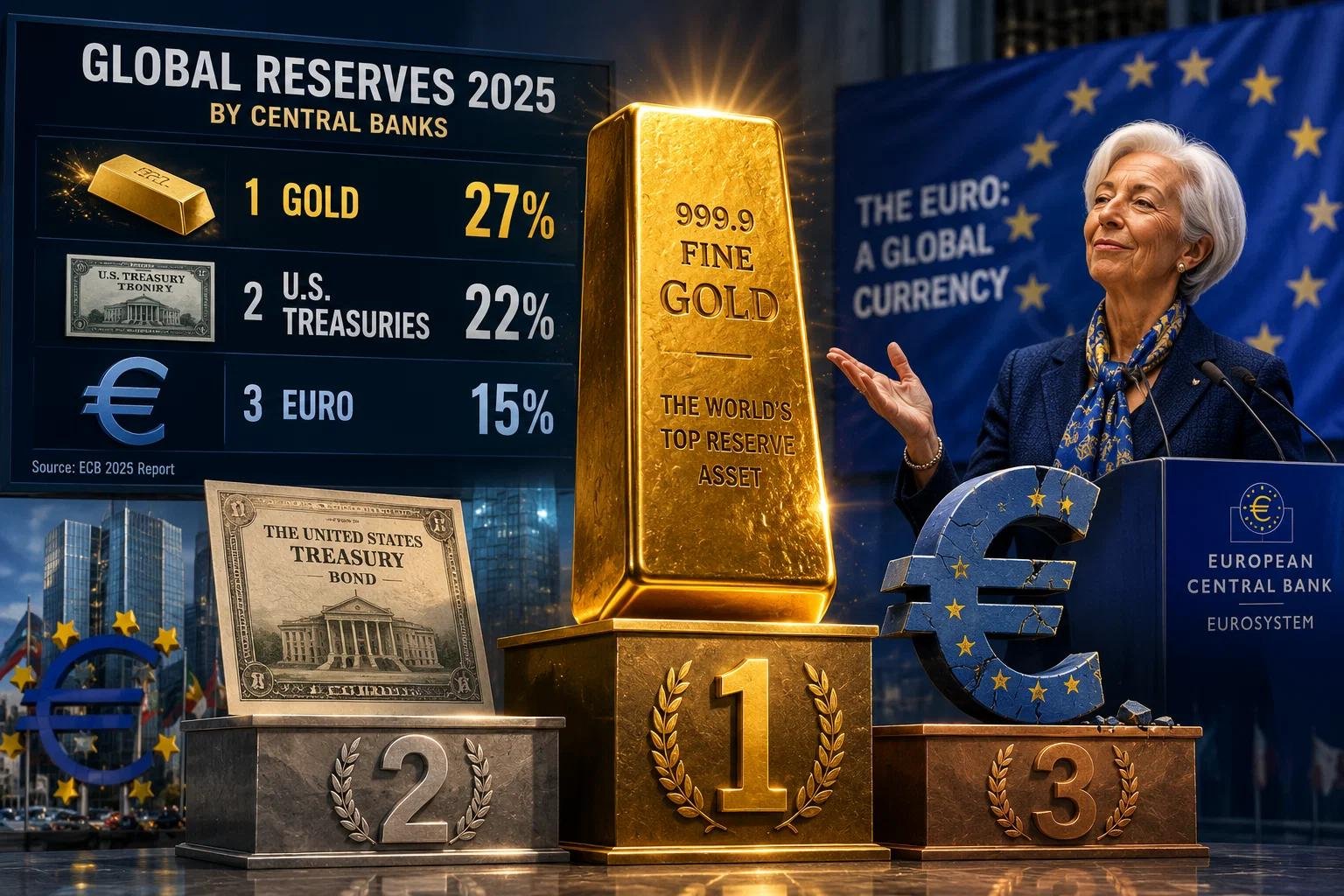
Last week, the European Central Bank published its 2025 report card, with ECB President Christine Lagarde celebrating “an opening for the euro to enhance its global appeal.”
The report bragged that the euro remains the second most used currency in the world, as well as the second most held in reserve, behind only the dollar.
The key word is “currency.”
Because in reality, 2025 was the year that gold took the top spot, making up 27% of global reserves held by governments and central banks. That pushed US Treasuries into second place with 22%, and the euro into third, making up 15% of global reserves.
A metal that pays no interest and earns no yield is now the biggest slice of global reserves, up from just 20% a year earlier.
The world is, in fact, trying to diversify away from the dollar. Central banks have spent years quietly trimming their dollar exposure, looking for somewhere safer to park their national savings.
But they are not choosing euros.
Then why, the ECB may counter, was 2025 a record year for international borrowing in euros?
Because there is more debt in everything than ever — global debt keeps smashing new highs, so a record pile of euro IOUs is less an achievement than a symptom of the times.
But to give credit where it's due, the euro is genuinely in first place in one market, according to Lagarde: "The euro became the leading currency in the green and sustainable international bond market."
That's the debt Europe sells to bankroll the very net-zero crusade that gutted its own economy. So the euro's crowning achievement of 2025 was becoming the world champion at borrowing money to make itself poorer.
If you ever needed one sentence to explain why nobody wants this currency, there it is.
Because leading the world in the things that make you poorer is the entire European model. Across the continent, governments spent two decades waging war on their own cheap energy in the name of net zero — turning their backs on nuclear power that supplied a third of Europe's electricity in 1990 and barely 15% today.
They saddled themselves with some of the highest power prices in the developed world and watched their industry pack up and leave. They threw open their borders, then aimed their police and courts at the citizens who objected.
The result is a continent so hollowed out that Mississippi, the poorest state in America, now produces more wealth per person than France or Italy.
But sure, this is the euro’s moment...
Meanwhile, central banks added roughly 850 tonnes of physical gold in 2025, a slight step down from the record-shattering pace of the prior two years, but bought at the highest prices in human history.
Poland led the gold-buying pack last year, followed by China, Turkey, and India.
But for a stretch of 2025, the single biggest gold buyer on the planet wasn't a country at all — it was Tether, the company behind the world's biggest dollar-backed stablecoin.
In the third quarter alone it bought more gold than any central bank on earth, and by the end of January it was sitting on roughly 148 tonnes — nearly 4.8 million ounces, worth about $22 billion — enough to rank among the top 30 gold holders in the world, ahead of the likes of Australia and South Korea.
This is exactly why the gold story is far from over.
The extra gold central banks have bought since 2022 laid the foundation for a price that has nearly tripled since — yet even that represents only a modest reallocation out of US dollars.
So what happens when they move even another 5% of their $10 trillion in reserves into gold?
With no single currency able to replace the dollar, and the reasons to diversify only growing, gold looks set to keep climbing as the world's largest reserve asset.
To your freedom, James Hickman Co-Founder, Schiff Sovereign LLC
P.S. Everyone from central banks to a stablecoin giant is racing into gold — which is why it's trading near record highs. We think owning the companies that produce it beats buying bullion at the top.
That's the whole idea behind Strategic Assets, Schiff Sovereign's monthly investment research. We hunt for profitable real-asset businesses with clean balance sheets, real catalysts, and a low multiple of free cash flow.
And it's working. We've seen it multiply the value of several precious metals companies, with others still in the buy range today. The same setup is now lining up well beyond the metals — in energy and other real assets — as nations around the world scramble to secure the critical resources a fragmenting world runs on.
Would $300 Silver Crush The Retail Industry? | Andy Schectman
Would $300 Silver Crush The Retail Industry? | Andy Schectman
Liberty and Finance: 6-3-2026
Andy Schectman explains that the recent silver selloff was driven by a combination of sharply higher margin requirements, ETF rebalancing, and forced selling tied to primary distributor allocations, creating a cascading liquidity event rather than a true breakdown in fundamentals.
He argues that this overlap of structural pressures led to more selling than buying in the short term, which overwhelmed bids and pushed prices lower.
Would $300 Silver Crush The Retail Industry? | Andy Schectman
Liberty and Finance: 6-3-2026
Andy Schectman explains that the recent silver selloff was driven by a combination of sharply higher margin requirements, ETF rebalancing, and forced selling tied to primary distributor allocations, creating a cascading liquidity event rather than a true breakdown in fundamentals.
He argues that this overlap of structural pressures led to more selling than buying in the short term, which overwhelmed bids and pushed prices lower.
In contrast, he notes that prior strong upside moves saw the opposite dynamic, with intense buying pressure causing premiums to surge and physical supply to tighten dramatically.
Looking forward, he says that a potential move toward $300 to $500 silver would likely bring far greater public participation and stronger hands into the market, reducing the kind of fragile selling pressure seen in earlier cycles.
In his view, that kind of environment would still strain the system but would be more fluid and balanced demand driven, rather than collapsing under forced unbalanced liquidation.
INTERVIEW TIMELINE:
0:00 Intro
2:20 Digitization of all assets
11:20 Unrealized capital gains tax
14:50 Precious metal industry
America’s Gold Problem Just Got Harder to Ignore
America’s Gold Problem Just Got Harder to Ignore
Taylor Kenny: 6-2-2026
The Fort Knox audit may be the spark—but not the real fire. America’s gold problem just got harder to ignore because the real issue may not be buried inside Fort Knox.
It may be hiding in plain sight on the U.S. Treasury balance sheet.
Why does the U.S. government still value its gold at $42.22 per ounce when the market price is thousands of dollars higher?
America’s Gold Problem Just Got Harder to Ignore
Taylor Kenny: 6-2-2026
The Fort Knox audit may be the spark—but not the real fire. America’s gold problem just got harder to ignore because the real issue may not be buried inside Fort Knox.
It may be hiding in plain sight on the U.S. Treasury balance sheet.
Why does the U.S. government still value its gold at $42.22 per ounce when the market price is thousands of dollars higher?
CHAPTERS:
00:00 Trump, Fort Knox, and the Gold Audit
00:57 The Real Question No One Is Asking
01:25 The $42.22 Gold Accounting Illusion
02:22 Why Gold Threatens the Dollar System
03:18 Central Banks Are Buying Gold for a Reason
04:44 The 1934 Gold Revaluation Warning
06:32 Nixon, Broken Promises, and Fiat Currency
07:27 Physical Gold vs. Paper Gold
08:53 Are We Near a Gold Revaluation?
News, Rumors and Opinions Tuesday 6-2-2026
KTFA:
Tishwash: Al-Zarkoushi: An extraordinary parliamentary session may be held within ten days to complete the cabinet formation.
6/1/2026 Information/Baghdad..
Member of the Coordination Framework, Abdul Samad Al-Zarkoushi, confirmed on Monday that setting a date for an extraordinary session of the House of Representatives to complete the remaining ministerial portfolios in Ali Al-Zidi's government may be decided within the next ten days.
KTFA:
Tishwash: Al-Zarkoushi: An extraordinary parliamentary session may be held within ten days to complete the cabinet formation.
6/1/2026 Information/Baghdad..
Member of the Coordination Framework, Abdul Samad Al-Zarkoushi, confirmed on Monday that setting a date for an extraordinary session of the House of Representatives to complete the remaining ministerial portfolios in Ali Al-Zidi's government may be decided within the next ten days.
Al-Zarkoushi told Al-Maalouma that “the forces of the Coordination Framework, with all their titles, realize the importance of completing the cabinet, and there is an agreement in this direction so that the government can take its course on important issues.”
He added that “a series of meetings will be held in the coming days, both within the coordination framework and with other political forces, which may lead to an extraordinary session of the House of Representatives within ten days to vote on the remaining ministerial portfolios.”
He indicated that “putting forward more than one candidate for each portfolio is possible, but the upcoming political understandings will determine the outcome,” explaining that “the question of whether or not the same names presented in the previous session will be resubmitted for the undecided portfolios will become clear in the next few days.” LINK
Clare: Between hopes and stability... the 2026 budget opens a new window for contractors in Iraq
6/1/2026 Baghdad
Economic experts believe that the anticipated measures in the 2026 budget to address the situation of contractors and daily wage workers represent an important step towards enhancing job stability, but they alone do not amount to a comprehensive reform of the labor market unless they are accompanied by long-term strategic plans.
Here, economist Ahmed Al-Tamimi confirms that the regularization of a segment of contractors and daily wage workers reflects a governmental response to continuous demands related to job security and achieving greater fairness in job opportunities, indicating that this step represents a gradual treatment of a file that has accumulated over years of reliance on temporary contracts, rather than a radical shift in the philosophy of government employment.
Al-Tamimi explained in a statement to Baghdad Today on Sunday (May 31, 2026) that the government's ability to implement large-scale stabilization operations remains directly linked to oil revenues, given the continued reliance of the general budget on oil revenues as its primary source of income. He warned that any decline or sharp fluctuations in global oil prices could place additional pressure on operational spending, particularly salaries and allowances, necessitating the diversification of income sources and the strengthening of non-oil revenues to ensure the sustainability of future financial obligations.
He pointed out that regularizing the status of contractors would positively impact the performance of government institutions by enhancing administrative stability and reducing job uncertainty, which would contribute to raising productivity levels and institutional belonging, as well as preserving accumulated expertise and competencies within state departments.
He added that these measures may also contribute to reducing the phenomenon of job attrition, especially among talents who move towards the private sector or job opportunities abroad in search of stability, stressing that the success of this policy requires, in parallel, the development of the work environment, incentive systems, promotions and training.
Al-Tamimi emphasized that transforming the regularization process from a temporary solution to a sustainable policy necessitates linking employment to the actual needs of government institutions and achieving a balance between social considerations and the requirements of financial efficiency. This will preserve the state's ability to finance investment and development projects without burdening the budget with operational expenses.
The issue of contract and daily wage workers is one of the most prominent social and administrative issues in Iraq, as tens of thousands of them have been demanding permanent employment for years to guarantee their job security and living standards.
With the 2026 budget nearing completion, expectations are rising regarding the size of the financial allocations and the government measures designated to address this issue, amidst economic challenges related to fluctuating oil prices and rising state operating expenses. LINK
************
Courtesy of Dinar Guru: https://www.dinarguru.com/
Frank26 Everybody wants this to happen now. Are you kidding me? In less than 2 months look what Trump has done. He's brought security and stability into your country [Iraq] so that you can raise the value of your currency and give your citizens purchasing power and enter the international world and pay us back. And guess what? It's happening...!
Jeff Tackling corruption is the number one thing they need to go international, revalue and so forth. It's the number one requirement by the Central Bank of Iraq. It's also the number one reason why the CBI hasn't revalued for the past 23 years.
Reset Intelligence There is one market price for gold...set by the market not by any governments wishes. The one place that price is not honored is on America's own books, where the Treasury still records the nation's gold at a number fixed back in 1970s, a small fraction of what the metal actually fetches today. That gap between the pretend price on the ledger and the real price in the market was left there on purpose. The president reached for it, asking that the gold in the vaults finally be counted. Because before a government can put a new price on something it first has to prove how much of it there is. When that number is corrected... more than a trillion dollars appears on the national balance sheet overnight ...This is what a revaluation is. [Post 1 of 2...stay tuned]
Reset Intelligence The same logic runs through Baghdad...except there, the problem was never an honest price hidden on a ledger, but a currency deliberately held below its worth, kept down for years by a political class Washington did not trust to lift it. This week the president tried again to place his own envoy over Iraq. The cabinet that will finally raise the dinar began to take shape which is why the gold and the dinar belong together. One government correcting the price of its metal while the other corrects the price of its money. A single hand guiding both inside one week. [Post 2 of 2]
SILVER ALERT! Silver Traders Leaving COMEX Exchange! Silver Supply & Demand Data Lies!
(Bix Weir) 6-2-2026
We are seeing the Death of a means of Transacting in and Controlling the Price of Silver. More and more traders are leaving the COMEX Silver Exchange knowing that the GAME IS RIGGED!
The Bullion Banks have overplayed their Silver Rigging Cards and are now STUCK without the normal flock of Suckers to unload short positions to!
This is the Death of a Century Long Silver Rig Job!