
News, Rumors and Opinions Friday 12-19-2025
KTFA:
Clare: Channel 8 English
@Channel8English
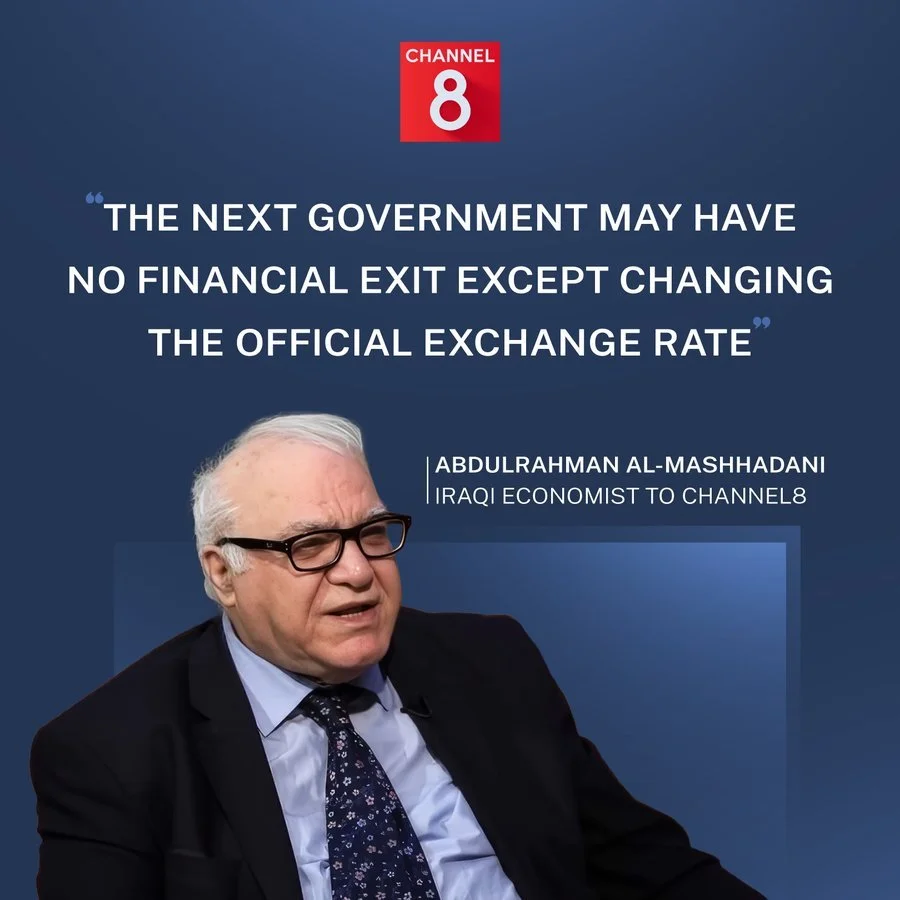
“With falling oil prices and forecasts such as JPMorgan’s outlook on future oil markets, the next government may find no financial exit except changing the exchange rate in order to pay salaries, wages, and operating expenses,” Iraqi economist Abdulrahman al-Mashhadani emphasized.
KTFA:
Clare: Channel 8 English
@Channel8English
“With falling oil prices and forecasts such as JPMorgan’s outlook on future oil markets, the next government may find no financial exit except changing the exchange rate in order to pay salaries, wages, and operating expenses,” Iraqi economist Abdulrahman al-Mashhadani emphasized.
Clare: : Trump envoy and Joe Wilson: We will make Iraq great again
12/18/2025
Mark Savaya, President Donald Trump’s envoy, wrote on the “X” platform (formerly Twitter) on Thursday that he met with US Congressman Joe Wilson and it was a “great meeting.”
"It was a great meeting with U.S. Congressman Joe Wilson and his team," Savaya said in his post, adding, "We will make Iraq great again."
For his part, Republican US Representative Joe Wilson wrote on the “X” platform that he was pleased to host Mark Savaya, the US Special Envoy to Iraq, in his office for a meeting he described as important regarding Iraq.
Wilson, who is known for raising controversial issues and making provocative statements, particularly regarding Iraq and the Middle East, added: "I look forward to working with the Special Envoy to bring prosperity to Iraq and liberate it from Iran," noting that "there is no one more qualified than him to work on this issue for President Trump."
US Representative Joe Wilson posted a picture of himself with Trump's envoy, holding the Iraqi flag, with the American flag behind them and the new Syrian flag beside it.
Joe Wilson @RepJoeWilson
Grateful to host Mark Savaya, U.S. Special Envoy for Iraq, in my office for an important meeting on Iraq. I am excited to work with the Special Envoy to Make Iraq Great Again and Free Iraq from Iran. There couldn’t be anyone better working on this issue for President Trump! LINK
**************
Clare: Article 140 and the Federal Council, along with amending the election law... A delegation from the "Party" to implement outstanding issues with Baghdad
12/18/2025
On Thursday, December 18, 2025, the Central Committee of the Kurdistan Democratic Party held an expanded meeting during which it discussed several issues, most notably the formation of the Kurdistan Regional Government, the Iraqi parliamentary elections, partnership and cooperation in Baghdad, in addition to the political situation in the region, and the implementation of outstanding issues with Baghdad.
The committee said in a statement, a copy of which was translated by Al-Jabal, that “the Kurdistan Democratic Party does not see it as right to mix the talks on forming the regional cabinet with the federal government; the issues of the region must be resolved first, and then the necessary and joint steps towards Baghdad must be taken, and our party’s delegation has begun its tasks in this regard.”
According to the statement, the meeting emphasized "the need to implement the outstanding issues with Baghdad, such as: Article 140, the establishment of the Federal Council, the formation of the Federal Court in accordance with the Constitution, and the Oil and Gas Law
." It also stressed "the serious endeavor to amend the unfair Iraqi election law, and to resolve the budget and salary issue permanently and in accordance with the federal system. A high-level delegation from the Kurdistan Democratic Party was designated for this purpose."
Below is the text of the statement:
Under the supervision of His Excellency President Masoud Barzani, and in the presence of the Vice Presidents, members of the Central Committee and branch officials, the Central Committee of our party held an expanded meeting today, Thursday, December 18, 2025.
The meeting began with a minute of silence in honor of the pure souls of Kurdistan's martyrs, foremost among them the immortal Barzani and the late Kak Idris. Following this, several important and timely issues were raised and discussed, and the necessary decisions were made.
First topic: Formation of the tenth cabinet of the Kurdistan Regional Government
This process began in conjunction with the end of last year's elections, and unfortunately, the Kurdistan Parliament has not yet been activated, the President of the Region has not been elected, and the tenth cabinet has not been formed.
Immediately after the election results were ratified, our party, through a special delegation, visited the Kurdish parties and groups to initiate dialogue aimed at forming a broad-based government. However, some parties chose to join the opposition, and we respect their decision.
Simultaneously, dialogue continued between our party and the Patriotic Union of Kurdistan (PUK). We exerted considerable effort to ensure that our agreement would not be finalized until the Iraqi parliamentary elections. Unfortunately, the PUK—due to flawed readings and preconceived notions of the parliamentary election results—unjustifiably extended the dialogue beyond the November 11, 2025 elections, despite our warnings that the pre- and post-election circumstances would be significantly different. The PUK, however, had already made its decision.
Currently, the door to dialogue remains open for reaching an agreement based on the results and entitlements of the Kurdistan Parliament elections, and the votes and trust of the people of Kurdistan must be respected.
Our party does not believe it is appropriate to conflate the discussions on forming the regional cabinet with those of the federal government; the region's issues must be resolved first, and then the necessary joint steps can be taken with Baghdad. Our party's delegation has already begun its work in this regard.
Second topic: Elections for the Iraqi Federal Parliament
The meeting discussed the November 11, 2025 elections, in which our party achieved a resounding victory, securing the votes and trust of over 1.1 million voters in Kurdistan and Iraq, and winning a significant number of provincial seats. This victory is the fruit of the struggle and sacrifices of our martyrs, the wisdom and efforts of our party's cadres, members, and supporters, the enduring legacy of Barzani, and the trust placed in our party's leadership and structures by the people of the Kurdistan Region and the Kurdish areas outside the region's administration.
Therefore, the meeting expressed its gratitude to all party and government officials, Peshmerga forces, and cadres, as well as to the families of martyrs, the loyal public, election committees and teams, and professional organizations, for their dedication to the party's success
. It also thanked the security forces for providing a calm environment for the process and congratulated the winning candidates, commending the efforts of all candidates on list (275) who worked diligently. The meeting called upon the winners to faithfully represent the hopes and aspirations of all citizens of Kurdistan and Iraq, and to work towards enacting laws that serve the people and establish good governance.
Third axis: Partnership and work in Baghdad
The meeting affirms that the people of Kurdistan have the right to negotiate in Baghdad with a unified voice and as a single entity, as a Kurdish nation, not as separate political parties. The Kurds and Kurdistan must be genuine partners in governing Iraq alongside their Shia and Sunni brothers, while respecting the rights of all other communities, just as the new Iraqi state was founded on three principles: partnership, balance, and consensus, which have become the spirit of the permanent constitution.
The meeting emphasized the necessity of implementing outstanding issues such as Article 140, establishing the Federal Council, forming the Federal Court in accordance with the Constitution, and the Oil and Gas Law.
It also stressed the importance of seriously pursuing amendments to the unfair Iraqi election law and finding a permanent solution to the budget and salary issues in a manner consistent with the federal system. To this end, a high-level delegation from our party was designated.
Fourth axis: The political situation in the region
The general political situation in the region, Iraq, and Kurdistan was discussed. The meeting noted that developments in Türkiye regarding the resolution of the Kurdish issue and the peace process are a source of hope and will have a positive impact in all areas.
Regarding the changes in Syria, the meeting welcomed the vision of the countries seeking stability in Syria, which links stability to the extent to which the distinct identities of the various components, including the Kurdish people, are respected. We hope that these changes, by learning from the mistakes of the past, will guarantee the rights and freedoms of all national, religious, and sectarian groups, and promote peaceful and civilized coexistence.
Fifth axis: Regulatory affairs
The provincial organizational offices presented an analysis of their activities and challenges. The meeting discussed proposals to strengthen ties with the public in cities and villages, enabling party organs to more effectively convey the people's demands and opinions to the leadership, so that our colleagues in the regional and central governments can play their part in addressing these issues and providing for the needs of the people.
In conclusion, the meeting made several decisions regarding topics that required legal and regulatory resolution. LINK
Courtesy of Dinar Guru: https://www.dinarguru.com/
Frank26 Everything is on course. T-minus [13] days and counting according to the Central Bank of Iraq concerning December 31, 2025 where 1310 dies and the following day on January 1, 2026 something new replaces it. All according to the CBI.
Jeff Back from December 20, 2020 when Iraq devalued their currency by 23% Article "Iraq's central bank devalues dinar by 22% amid public anger". I know it says 22% but it was actually 23%. No big deal. Anyway they devalued the currency on Sunday, December 20, 2020. I just wanted you to be aware that was a date and time frame in which they devalued or changed their exchange rate historically 5 years ago. Will they do it again on a similar time frame? Maybe, possibly.
Militia Man The Central bank is independent of the government. We're not talking about politics...They're not going to tell you the date and the exchange rate...There's no bearing whatsoever on Alaq and the gatekeepers to be able to adjust an exchange rate. Alaq can do it whenever he feels like it. But...in this digital environment he has to do it in sync...The outlook is good as far as I'm concerned...
************
4-Digit SILVER Coming as Paper Game ENDS - 'The Bankers Are Losing Control': Lynette Zang
Commodity Culture: 12-16-2025
Lynette Zang believes that once the paper manipulation game completely ends and true price discovery occurs in the silver market, the metal is headed to four digits, in a move that will shock investors who aren't paying attention.
Lynette points out that silver's rapid rise past $60 is only the beginning of a parabolic run driven by physical demand and not rigged paper promises.
00:00 Introduction
01:18 4-Digit Silver is Coming
05:24 Is Silver Manipulation Over?
06:56 Silver Import Surge in India
10:02 China Silver Export Controls
14:19 You Don't Hold It, You Don't Own It
20:36 End of Fed Independence
31:06 Chaos By Design
32:56 BRICS Versus the West
News, Rumors and Opinions Thursday 12-18-2025
Silver & Gold Explode as Dollar Tanks – Bo Polny
By Greg Hunter’s USAWatchdog.com
Biblical cycle timing expert, geopolitical and financial analyst Bo Polny has been making one correct call after another on the rise of gold and silver prices for years.
Now, he’s making one of his biggest calls yet that will start playing out before the end of 2025.
Polny says, “It’s going to happen eventually, but the US dollar is going to have a really bad day. We could see this before the New Year. We could see this before Christmas. We could see it this week.
Silver & Gold Explode as Dollar Tanks – Bo Polny
By Greg Hunter’s USAWatchdog.com
Biblical cycle timing expert, geopolitical and financial analyst Bo Polny has been making one correct call after another on the rise of gold and silver prices for years.
Now, he’s making one of his biggest calls yet that will start playing out before the end of 2025.
Polny says, “It’s going to happen eventually, but the US dollar is going to have a really bad day. We could see this before the New Year. We could see this before Christmas. We could see it this week. (Silver just hit another all-time high on Tuesday night. Gold is also up at or near record highs too!!)
So, the dollar is going to have a very bad day. When that happens, it is going to be the reverse for God’s money. . .. ‘The silver and the gold are mine says the Lord.’ We are about to witness a vertical price explosion on silver. A vertical price explosion on silver is going to be marked with a very bad day for the US dollar. . ..
Please keep in mind, the Federal Reserve Note is not federal, there are no reserves, and, actually, they are private bankers that own it. . ..
The big picture on this is we are about to witness the fall of the Federal Reserve system, which will spike silver and gold.
Silver and gold are about to embark on the greatest bull market in human history.”
Polny also predicts, “Silver is about to explode, and it will be the bank k****r. . .. Their kingdom has come to an end, and God is going to use silver to take down the Babylonian globalist agenda of a one world government.
He’s going to stop them in their tracks. This is going to be like in Joel 2:31. It will be ‘The Great and Terrible Day.’ It’s great for the church, and terrible for the enemies of God.”
In closing, Polny also says look for price targets for silver to break “$140 per ounce, $600 per ounce, $1,200 per ounce and $2,000 per ounce.”
Polny says above all, “Pray and thank God, for he saved America and the world.”
There is much more in the 70-minute interview.
https://usawatchdog.com/silver-gold-explode-as-dollar-tanks-bo-polny/
*************
Courtesy of Dinar Guru: https://www.dinarguru.com/
Frank26 [Iraq boots-on-the-ground report] FIREFLY: We now have Saleh on television. He just said how the government is stable and secure with 1320. They keep sending different people to tell us they don't want to change anything. FRANK: Why do a digital transformation if you're staying at 1310? If 1310 is so stable you're not going to transfer anything at that stupid rate...1310 dies on December 31st and something new is born.
Jeff When the UN met with Iraq that was a 'stability graduation' ceremony. Because they have achieved critical core stability required by both the UN and the US, the UN is now done with Iraq. They will be able to exit out of the country at the end of this year so that Iraq can go international in 2026.
Mnt Goat ...we must look at the FACTS. We can clearly see that an attempt to reinstate the dinar according to Dr Shabibi’s plan is underway. What we don’t know of course is when. Will it happen in 2026 or 2027? There is much more evidence that everything is pointing to early 2026 for them to normalize the dinar and place it back on FOREX for trading.
A New Silver System? What, How and When - Mike Maloney w/Alan Hibbard
12-18-2025
In this episode of The GoldSilver Show, Mike Maloney and Allan Stevo break down a viral macro thread that claims we’re witnessing “the most important monetary shift of the 21st century”—a silent reset where silver becomes the new reserve asset.
You’ll discover:
How India–Russia oil trade, AED and CNY settlements, and Russian silver purchases may be reshaping the global monetary map
Why Mike agrees with the facts but challenges the narrative, especially claims that silver has detached from COMEX or that one currency pair is “driving” the silver price
How silver is shifting from “industrial metal” to strategic reserve asset, joining gold at the sovereign level
The multi-year structural deficit in silver supply and why mines can’t ramp quickly enough to meet exploding demand from EVs, solar, data centers, and AI
Why Mike is personally accumulating silver and expecting the gold/silver ratio to compress to 20:1—maybe even 10:1
If you’re trying to decide whether to own more gold or more silver, understanding the gold–silver ratio, central bank flows, and industrial demand is critical.
Historically, extreme ratios have often preceded powerful phases of silver outperformance, especially when both metals are supported by macro forces like inflation fears, de-dollarization, and central bank buying.
Topics covered:
De-dollarization and the “triangle” of India, Russia, China & the UAE Silver as a strategic metal for technology, warfare, and AI
Why silver has been in structural deficit for years—and may stay that way into the 2030s
The mechanics of mine supply, high-grading, and why higher prices are needed
Mike’s target of a 20:1 (or 10:1) gold/silver ratio and what that could mean for investors
If you care about protecting your purchasing power, understanding this evolving gold–silver dynamic is not optional.
Gold Warning Issued as New Monetary System Takes Hold
Gold Warning Issued as New Monetary System Takes Hold
Taylor Kenny: 12-17-2025
The global monetary system is undergoing a profound transformation, and it’s happening beneath the surface.
The rising significance of gold is at the forefront of this change, driven by ongoing global political and economic disruptions.
As the world becomes increasingly uncertain, gold is emerging as the ultimate safe-haven asset, poised to replace the US dollar’s historical role as the global reserve currency.
Gold Warning Issued as New Monetary System Takes Hold
Taylor Kenny: 12-17-2025
The global monetary system is undergoing a profound transformation, and it’s happening beneath the surface.
The rising significance of gold is at the forefront of this change, driven by ongoing global political and economic disruptions.
As the world becomes increasingly uncertain, gold is emerging as the ultimate safe-haven asset, poised to replace the US dollar’s historical role as the global reserve currency.
The current fiat monetary system is designed to create inflation, effectively transferring wealth from the masses to the currency issuers.
By printing currencies endlessly, governments can maintain a semblance of economic growth, but at the cost of eroding the purchasing power of their citizens.
In contrast, gold has served as a reliable store of value for thousands of years, its value rooted in its scarcity and tangible worth.
Central banks worldwide are aggressively purchasing physical gold, not just as a diversification strategy, but as a deliberate move to position themselves for a new monetary paradigm.
This shift is driven by the erosion of confidence in the US dollar, fueled by unsustainable debt and inflationary policies.
As foreign nations and central banks reduce their reliance on the dollar, a parallel gold-backed monetary system is emerging. This signals the approaching end of the dollar’s dominance and the inevitable rise in gold’s value.
The 1933 gold confiscation by President Roosevelt and the 1971 Nixon shock, which ended the gold standard, are stark reminders of government attempts to control wealth and enable unrestricted money printing.
These events demonstrate the inherent tension between the desire for monetary freedom and the need for government control.
As the global monetary system undergoes this transformation, individuals must prepare for the consequences. Acquiring physical gold and silver is a prudent step in protecting wealth against the rapid devaluation of fiat assets like dollars, bonds, retirement accounts, and even stocks or real estate.
The speed and inevitability of a currency reset mean that the time to act is now, before a crisis unfolds.
In the face of this monumental shift, it’s essential to educate yourself and develop a personalized wealth protection strategy centered on physical precious metals. By doing so, you can safeguard your financial future and thrive in a world where the rules of the monetary system are being rewritten.
For further insights and information on this critical topic, watch the full video from ITM Trading. Their expert analysis and guidance can help you navigate the complexities of the emerging gold-backed monetary system and make informed decisions about your financial future.
In conclusion, the rise of gold as a safe-haven asset is a clarion call for individuals to reassess their financial strategies and prepare for a new monetary paradigm.
By understanding the transformation underway and taking proactive steps to protect your wealth, you can ensure a secure financial future in a rapidly changing world.
Flashback: $2,000 Gold Is Just The Beginning Here’s What Might Happen Next–
Flashback: $2,000 Gold Is Just The Beginning Here’s What Might Happen Next–
Notes From the Field By James Hickman (Simon Black) December 17, 2025
Today we’ll continue to look back at past articles that have become especially relevant, as many of the trends we warned about are now playing out in real time.
Yesterday we talked about how, back in 2022, we encouraged readers to move into real assets at a time when the dollar was irrationally strong. Gold was cheap, interest rates were near zero, and most people were still drinking the Kool-Aid.
It was one of those rare moments when the writing was on the wall, but the price tags hadn’t caught up yet.
Then in November 2023, gold crossed $2,000 for the first time. And we said: this is just the beginning.
Flashback: $2,000 Gold Is Just The Beginning Here’s What Might Happen Next–
Notes From the Field By James Hickman (Simon Black) December 17, 2025
Today we’ll continue to look back at past articles that have become especially relevant, as many of the trends we warned about are now playing out in real time.
Yesterday we talked about how, back in 2022, we encouraged readers to move into real assets at a time when the dollar was irrationally strong. Gold was cheap, interest rates were near zero, and most people were still drinking the Kool-Aid.
It was one of those rare moments when the writing was on the wall, but the price tags hadn’t caught up yet.
Then in November 2023, gold crossed $2,000 for the first time. And we said: this is just the beginning.
Not because we’re gold bugs or speculators—but because we saw the early signs of the US dollar's 80 year reign of global dominance starting to shift. We were pointing to the long-term, systemic forces driving it. Out-of-control debt, eroding trust in institutions, and the creeping de-dollarization of global finance.
We said, “we could easily see central banks around the world ditching their US dollars and loading up on gold as part of a new, de-dollarized global financial system.”
“This could potentially trigger trillions of dollars worth of capital inflows into the gold market, causing a surge in gold prices.”
We said $2,000 was the beginning. Now with gold trading over $4,300, we’re not going to say this is the beginning. But it’s certainly not the end.
Public Law 93-373 was supposed to be so boring that Congress didn’t even bother to give it a name.
You know how most laws passed by Congress have some fancy name-- like the “Inflation Reduction Act” or the “USA PATRIOT Act” or some such nonsense?
Well, on November 7, 1973, US Senator James Fulbright introduced a very short bill-- it was only ONE page-- that didn’t even have a name. But Fulbright’s unnamed bill ended up being one of the most important pieces of legislation in US history.
By the time Fulbright introduced his bill, it had been two years since the legendary “Nixon Shock” of 1971. That was when US President Richard Nixon implemented wage and price controls, and canceled the US dollar’s convertibility into gold.
Nixon famously promised the American public that there wouldn’t be any negative consequences from his actions. Yet inflation hit 3% the following year, in 1972. Then 4.7% in 1973. Then 11.2% in 1974.
Simultaneously, gold prices around the world were surging… from $35/ounce before the Nixon Shock, to more than $170 in 1974.
But individual Americans weren’t allowed to benefit from those gains thanks to a forty year old executive order that had been signed in 1933 by then President Franklin Roosevelt.
Roosevelt’s Executive Order 6102 criminalized the private ownership of more than $100 worth of gold in the United States. Roosevelt also gave Americans just 25 days to turn over their gold to the Federal Reserve… or else face up to ten years in prison.
Naturally, plenty of Americans were outraged, and a number of lawsuits were filed claiming that Roosevelt’s order was unconstitutional.
Roosevelt was rightfully worried that the Supreme Court would overturn his order. And at a certain point he considered packing the court, i.e. appointing several sympathetic judges to the Supreme Court to ensure his victory. He also considered issuing another order which would make it illegal to sue the federal government.
Fortunately for Roosevelt, however, he didn’t have to implement any of those actions; the Supreme Court very narrowly ruled in his favor, and his Executive Order stood as law of the land for four decades… until Senator Fulbright’s no-name law was finally passed on August 14, 1974.
It went into effect the following year, and Americans were suddenly free once again to exchange their rapidly-depreciating US dollars for gold.
Unsurprisingly, gold prices started rising dramatically in the second half of the decade... from about $180 in 1975, to a whopping $850 in January 1980.
And the declining dollar was just one reason for gold’s popularity; remember, the United States suffered a deluge of troubles during the 1970s and early 1980s.
The world found out that the US President was a criminal during the Watergate scandal of 1974. Then there was the humiliating US withdrawal from Vietnam in 1975, complete with a helicopter evacuation of the American embassy in Saigon.
Iran seized 52 US citizens in 1979 and held them hostage for more than a year.
Inflation raged, peaking at 13.6%. The economy stagnated and fell into recession. Troubles in the Middle East (including conflict with Israel) led to energy shortages and rising fuel prices.
Civil unrest and ‘mostly peaceful’ protests were a constant problem in the 70s and 80s. Meanwhile, criminals rampaged across American cities, and the murder rate soared. Major cities like New York, LA, and Chicago became synonymous with violent crime.
The world stopped making sense. And gold became a safe haven from that chaos.
There’s an old saying (originally a Danish proverb) suggesting that if history doesn’t repeat, it certainly rhymes. And I think it’s obvious that we’re facing many of the same challenges today.
There are major problems in the Middle East. Energy is becoming scarce (especially in Europe). The US military suffered a humiliating withdrawal from Afghanistan. Civil unrest and crime rates are totally unacceptable. Inflation continues to rage. And the President, a.k.a. “the Big Guy” appears suspicious A.F.
Just like in the 1970s, gold represents a safe haven from this chaos. And even though it’s hovering at a near-record around $2,000, I think that there is still a long way for gold to rise.
The US national debt is now $33.7 trillion; that’s up more than HALF A TRILLION just in the month of October.
The people in charge have absolutely zero fiscal restraint. Zero responsibility.
Zero sense of how destructive their actions are. They spend money and go deeper into debt as if there will never be any consequences, ever, until the end of time. They’re disgustingly ignorant, and dangerous.
The truth is that there are serious consequences to all of this debt. And we don’t have to guess what they are.
The Congressional Budget Office is already projecting that, by 2031, the US government will spend 100% of its tax revenue just on mandatory entitlements (like Social Security) and interest on the debt.
This means that, after 2031, the funding for literally everything else in government-- from the US military to the light bill at the White House-- will have to be funded by more debt.
That’s only 7 years away.
Then, two years later in 2033, Social Security’s primary trust fund will run out of money; this will cost the government an additional $1 trillion in additional spending each year to keep the program running. Naturally they’ll have to borrow that money too.
Eventually the national debt will become so large that simply paying interest each year will consume more than 100% of tax revenue.
The Federal Reserve will most likely attempt to bail out government by creating trillions upon trillions of dollars. But just as we saw over the past few years, such actions will most likely result in much higher inflation.
Disgusted with their financial circumstance, voters across America will likely turn to Socialist politicians who blame all the problems on the evils of capitalism, rather than their own incompetence. And with a majority of leftists running the country, they’ll only make things worse.
I also anticipate more conflict in the world, thanks in large part to the continued decline of America’s stature and reputation for strength.
It’s also quite likely that the US dollar could lose its royal status as the world’s dominant reserve currency by the end of the decade.
I don’t necessarily believe that the dollar will simply vanish from global trade.
But it won’t be “King” dollar anymore. Perhaps more like “Earl” or “Viscount” dollar, alongside other currencies and exchange mechanisms-- including gold.
In fact we could easily see central banks around the world ditching their US dollars and loading up on gold as part of a new, de-dollarized global financial system.
This could potentially trigger trillions of dollars worth of capital inflows into the gold market, causing a surge in gold prices.
And these are just some of the reasons why gold could still have a long, long way to rise from here.
Bear in mind that I’m not thinking about the gold price next month, or even next year. I think long-term, and my views on gold are based on trends that will likely continue to unfold over the next decade.
I’m not a ‘gold bug’. I don’t have a fanatical view about anything other than my own children. I’m not a gold speculator either.
But it’s obvious to me that in an upside down world where there are such obvious long-term threats to the US dollar, it makes sense to look for real stores of value.
And that’s why $2,000 gold could just be the beginning of a much bigger story.
To your freedom, James Hickman Co-Founder, Schiff Sovereign LLC
TO READ MORE: LINK
Flashback: The US Dollar Is Irrationally Strong Right Now
Flashback: The US Dollar Is Irrationally Strong Right Now
Notes From the Field By James Hickman (Simon Black) December 16, 2025
As we wind down 2025, we’ve been reflecting on some of the biggest long-term shifts that defined the year.
Last week, we highlighted three: First, Charlie Kirk’s assassination —
Second, 2025 marked the start gun for the US debt crisis—with the refusal to cut the deficit, central banks rushing to dump US Treasurys for gold, and signs of stagflation.
Flashback: The US Dollar Is Irrationally Strong Right Now
Notes From the Field By James Hickman (Simon Black) December 16, 2025
As we wind down 2025, we’ve been reflecting on some of the biggest long-term shifts that defined the year.
Last week, we highlighted three: First, Charlie Kirk’s assassination —
Second, 2025 marked the start gun for the US debt crisis—with the refusal to cut the deficit, central banks rushing to dump US Treasurys for gold, and signs of stagflation.
And third, a bright spot: a competent, strategic approach to nuclear power from the Trump administration, finally laying the groundwork for a productivity boom fueled by cheap energy.
As we head into the holidays, we’re revisiting some of our earlier work that speaks directly to these themes—articles that warned about the direction things were heading, long before the headlines caught up.
I wrote this article in October of 2022 during a time when the US dollar was irrationally strong, interest rates were still near zero, and gold was cheap— less than $1,700 per ounce.
I suggested that readers, “think about turning at least a portion of your irrationally strong dollars into another asset that can stand the test of time.”
The message was that reserve currency status breeds arrogance. The dollar’s dominance allows Washington to behave recklessly—binge on debt, stoke inflation, and still count on foreign demand for its bonds.
But, as history shows, no reserve currency lasts forever. The Spanish real, the British pound… they all had their day. This article reminds us: so will the dollar.
By the summer of 1497, Ferdinand and Isabella of Spain were presiding over a rapidly growing empire.
Christopher Columbus had already claimed most of the Caribbean islands on their behalf. Plus Pope Julius II had awarded virtually all of the western hemisphere to Spain in the infamous Treaty of Tordesillas.
Spain was quickly on its way to becoming a global superpower. Ferdinand and Isabella knew it, and they realized that they needed a strong currency to match their strong empire.
So on June 13, 1497, they announced a major monetary reform called the Medina del Campo, named for the site of a popular medieval banking conference at the time.
The monetary reform was sweeping; they abolished most other coins in their domain, and re-established the real as the primary currency across Spanish lands.
The real was a silver coin, weighing about 0.1 troy ounces or roughly 3.2 grams. And coins were minted in denominations of ½, 1, 2, 4, and 8 real.
Over time, the 8-real coin (real de ocho) became the most popular; it was known as a “Piece of 8”, and eventually the “Spanish dollar”.
By the mid-1500s under King Charles I of Spain, the Spanish dollar had become the world’s primary reserve currency. From the Americas to Europe to Asia, global trade and commerce were quoted and often settled in Spanish dollars.
Dutch and Portuguese traders visiting Macau in the 1600s, for example, would frequently buy goods from Chinese merchants using Spanish dollars.
In 1704, Queen Anne of Great Britain decreed that the Spanish dollar would be legal tender in the American colonies. And in 1792, the newly independent United States passed the Coinage Act which defined the US dollar as equivalent to the Spanish dollar.
The Spanish dollar’s dominance in global finance was unparalleled. But like all reserve currencies that came before, it too lost its luster.
Eventually the Spanish Empire’s strength faded. The government defaulted on its debts, confiscated private wealth, and suffered embarrassing military defeats.
The Dutch guilder then began to displace the Spanish dollar in commerce and trade. And by the late 1800s, the British pound had become the world’s dominant reserve currency — matching the British Empire’s unparalleled size and economic power.
This lasted until the mid-20th century when, after World War II, the United States dollar became the world’s primary reserve currency — a status the dollar has enjoyed for decades.
Having the world’s reserve currency is an extraordinary privilege. It means that the rest of the world literally HAS to stockpile your currency.
For example, whenever a company in Peru does business with a supplier in Malaysia, that transaction is quoted and settled in US dollars. This means that the banking systems in both Peru and Malaysia HAVE to maintain substantial holdings of US dollars in order to facilitate these transactions.
This is the biggest reason why foreigners own trillions and trillions of dollars of US government bonds; bonds are the largest and most liquid financial instrument available for foreign investors who need to hold dollars.
And because of this need for foreigners to own US dollar assets, foreigners own a whopping $7.5 trillion worth of US government bonds, roughly 25% of the national debt.
This is really an enormous benefit for the US. And for an easy example, we need look no further than to the United Kingdom.
The British pound was the world’s dominant reserve currency more than a century ago. Today the UK is still a significant economy. But they no longer have the unique reserve currency advantage.
Now, you may be aware that, a few weeks ago, the British pound and British government bonds (known as gilts) began plummeting after the British government announced a series of tax cuts and economic reforms.
It turned out that the bond market wasn’t thrilled with the plan, so investors began dumping their British gilts and pounds.
It was a full blown panic. And soon, the central bank had to step in to bail out the bond market. The Chancellor was sacked. And the Prime Minister canceled her planned tax cut.
Essentially the British government had to capitulate to the demands of investors.
This is actually normal in countries that don’t enjoy reserve currency status. If a government wants to borrow money from the bond market, politicians have to appease investors and lay out a plan that will give everyone confidence.
But not in the United States.
Because the US issues the global reserve currency, the government can engage every ridiculous antic imaginable.
They can fail to pass a budget (multiple times) resulting in a government shutdown. They can lock down the entire economy and pay people to stay home.
They can pass a multi-trillion dollar spending package and insist it “costs nothing”. They can slash interest rates to zero or engineer record high inflation.
And yet foreign investors will STILL buy US government bonds. And the dollar actually becomes STRONGER.
It’s totally insane. None of that would be possible if the US dollar weren’t the world’s reserve currency.
The curse of the reserve currency, however, is that policymakers usually believe their status will last forever. Spanish, Dutch, and British leadership never envisioned that their currencies would falter and be displaced by a rising power. And yet it happened.
The same fate awaits the US dollar.
Reserve currencies are usually displaced when economic power is in decline. Given the mountain of debt owed by the US government, the stagflation surging across the US economy, and the complete ineptitude to do anything about it, it certainly looks like that decline is taking place right now.
In general it would be foolish to think that the dollar will remain the dominant global reserve currency forever. And its displacement may take place sooner rather than later.
Once that happens, things will become a LOT more difficult for the US government. They’ll most certainly have to raise taxes. The central bank will have to print more money, sparking more inflation.
And we’ll likely see revolts of the bond market, just like what happened in the UK; just imagine the US government forced to capitulate its sovereignty to the demands of foreign lenders.
But that’s the future. For now, the dollar is still the top dog, only because it hasn’t been displaced (yet).
In fact, at the moment, the US dollar is irrationally strong.
Despite inflation that has reached multi-decade highs, and the growing national debt, the dollar is near an all-time high against the British pound. It’s at a 20+ year high against the euro. It’s strong against many major currencies. It’s even been strong against other asset classes including precious metals, crypto, and more.
So this may be a good time to consider the future and think about turning at least a portion of your irrationally strong dollars into another asset that can stand the test of time.
To your freedom, James Hickman Co-Founder, Schiff Sovereign LLC
This may Take Down the Paper System: Andy Schectman
This may Take Down the Paper System: Andy Schectman
Liberty and Finance: 12-8-2025
The world of precious metals is undergoing a significant transformation, driven by advancements in blockchain technology, shifting geopolitical landscapes, and changes in supply and demand dynamics.
In a recent in-depth discussion between Kaiser Johnson and Andy Schectman, CEO of Miles Franklin, the intricacies of the current precious metals market were explored, shedding light on the potential disruption of traditional paper gold systems by tokenized gold and the implications of emerging geopolitical and economic trends.
This may Take Down the Paper System: Andy Schectman
Liberty and Finance: 12-8-2025
The world of precious metals is undergoing a significant transformation, driven by advancements in blockchain technology, shifting geopolitical landscapes, and changes in supply and demand dynamics.
In a recent in-depth discussion between Kaiser Johnson and Andy Schectman, CEO of Miles Franklin, the intricacies of the current precious metals market were explored, shedding light on the potential disruption of traditional paper gold systems by tokenized gold and the implications of emerging geopolitical and economic trends.
The conversation began with an examination of current precious metals specials, before delving into the role of blockchain technology in revolutionizing the gold market.
Schectman explained how tokenized gold could offer a transparent, fully allocated, and instantly transferable alternative to the existing paper gold system, which has long been plagued by rehypothecation and fractional backing.
This new paradigm has the potential to collapse the traditional paper gold market, as investors increasingly seek greater reliability and the ability to take physical delivery of their assets.
The importance of transparency, auditability, and deliverability in any blockchain-based gold solution was emphasized as crucial for gaining investor confidence.
As the COMEX and LBMA systems face declining trust and fragility, exacerbated by central banks repatriating gold and a surge in physical delivery demands, the need for a more robust and trustworthy system becomes increasingly evident.
The discussion then turned to the broader geopolitical landscape, where the emergence of the BRICS+ nations’ gold-backed unit (“the unit”) is set to challenge the U.S. dollar’s global dominance.
This new system, currently in beta testing, leverages cross-border payment technologies to bypass Western sanctions and aims to internationalize the digital yuan through a network of vaults across the Belt and Road Initiative countries.
Schectman highlighted the significant accumulation of physical silver and gold by sovereign entities, as well as the structural supply-demand imbalances caused by increased industrial use—particularly in AI data centers—and strategic stockpiling by governments.
The recent addition of silver to the U.S. critical minerals list underscores the growing importance of these metals in the global economy.
As the precious metals market continues to evolve, Schectman emphasized the need for a hybrid strategy that combines physical holdings with tokenized assets to mitigate risks from technological or systemic failures. The fragility of complex supply chains and infrastructure highlights the importance of diversification and a cautious approach to investment.
Schectman encouraged investors to take note that the smartest market participants—central banks, commercial banks, and sovereign wealth funds—are actively accumulating physical metals, signaling a major price and supply shift that will eventually reach retail investors.
He stressed that holding physical metals remains the most reliable wealth preservation strategy amid fiat currency debasement.
The precious metals market is on the cusp of a significant transformation, driven by technological innovation and shifting geopolitical and economic trends.
As the conversation between Kaiser Johnson and Andy Schectman highlights, tokenized gold and the emergence of BRICS+ are set to play a major role in shaping the future of gold and silver investments. Investors would do well to take note of these developments and consider a hybrid strategy that combines physical holdings with tokenized assets.
‘One-in-400-Year Currency Crisis’ Ahead: How Gold & Silver Signal the Final Phase
‘One-in-400-Year Currency Crisis’ Ahead: How Gold & Silver Signal the Final Phase | Morgan & Makori
Miles Franklin Media: 12-7-2025
Michelle Makori, President & Editor-in-Chief of Miles Franklin Media, speaks with David Morgan, Founder of The Morgan Report, Author of 'The Silver Manifesto' and producer of the Silver Sunrise documentary.
Morgan warns: the world is entering what he calls a “one-in-400-year currency crisis” and fear will be the catalyst that triggers the final, explosive revaluation of gold and silver.
‘One-in-400-Year Currency Crisis’ Ahead: How Gold & Silver Signal the Final Phase | Morgan & Makori
Miles Franklin Media: 12-7-2025
Michelle Makori, President & Editor-in-Chief of Miles Franklin Media, speaks with David Morgan, Founder of The Morgan Report, Author of 'The Silver Manifesto' and producer of the Silver Sunrise documentary.
Morgan warns: the world is entering what he calls a “one-in-400-year currency crisis” and fear will be the catalyst that triggers the final, explosive revaluation of gold and silver.
Morgan explains why industrial and monetary demand for silver are converging at unprecedented levels, why the structural supply deficit is accelerating, and why 90% of the metals’ bull market move tends to occur in the last 10% of time.
He argues that the precious metals market began its secular run in 2000 and the final 2.5-year acceleration window could now be opening.
He also breaks down the shock CME outage, the migration of metals trading from West to East, the growing role of India, Russia, and sovereign entities buying silver, and how a global monetary reset could unfold faster than most expect.
In this interview, Morgan reveals what gold and silver are signaling about the next phase of the crisis and why it will be remembered for generations.
In this episode of The Real Story:
Why fear is now the dominant force behind gold and silver demand
The “one-in-400-year currency crisis” Morgan believes is already underway
Why industrial and monetary silver demand are colliding at the worst possible time
Structural silver deficit: how long it can continue before supply breaks
The 2.5-year “acceleration window” where 90% of the move historically occurs
CME halt: what it may signal about stress inside the system
How a monetary reset could unfold
00:00 Coming Up
01:31 Silver's Surge
03:53 Understanding the Silver Market Dynamics
07:43 Industrial & Monetary Demand for Silver
13:27 Speculations & Market Manipulations
29:11 Global Monetary Reset & Future Predictions
34:57 Market Factors Influencing Silver
40:48 Gold & Silver Investment Insights
42:05 Silver's Market Dynamics & Historical Context
46:30 Potential Substitutes for Silver
50:07 Recession Impact on Silver Demand
51:33 Currency Crisis & Financial System Reset
58:33 Future Outlook for Silver and Gold
01:06:19 Conclusion & Final Thoughts
Some Thoughts on Silver’s All Time High
Some Thoughts on Silver’s All Time High
Notes From the Field By James Hickman (Simon Black) December 3, 2025
The ancient people of Uruk— who lived in modern-day southern Iraq more than 5,000 years ago— didn’t seem terribly interested in bequeathing colorful stories of their civilization to history.
Rather than memorialize abundant tales of their immense works, or chisel countless tablets embellishing stories of their military victories, the main artifacts they left behind to modern historians are rather mundane market accounts and grain prices.
Some Thoughts on Silver’s All Time High
Notes From the Field By James Hickman (Simon Black) December 3, 2025
The ancient people of Uruk— who lived in modern-day southern Iraq more than 5,000 years ago— didn’t seem terribly interested in bequeathing colorful stories of their civilization to history.
Rather than memorialize abundant tales of their immense works, or chisel countless tablets embellishing stories of their military victories, the main artifacts they left behind to modern historians are rather mundane market accounts and grain prices.
It would be as if the only thing to be locked into a time capsule from our own era were the stock section of the Wall Street Journal. It would hardly be a reasonable description of our time.
Nevertheless, the ancient scribes of Uruk went to great lengths to record financial and commercial transactions. And one of the things we can see from their civilization is that they used silver (and NOT gold) as the primary medium of exchange.
It’s interesting to note that they did not bother minting coins. Rather, silver was weighed in bulk— the unit of measurement eventually becoming the shekel, around 8.3 grams— and then traded for grain.
(Just imagine paying for your groceries by piling a bunch of scrap and raw silver onto a scale.)
Gold was obviously a well-known commodity and considered extremely valuable... but far too rare to be used as everyday money. So silver remained the dominant financial standard for thousands of years.
Even by the time of the ancient Greeks, and then subsequently the Roman Republic, silver coins (the Greek drachma and Roman denarius) were the primary currencies of those civilizations.
But by then there was a bi-metallic system... a fixed ‘exchange rate’ that governments set between gold and silver.
In ancient Babylon during the reign of Nebuchadnezzar II, for example, cuneiform tablets show silver being exchanged for gold at a ratio of 10 to 1.
A few decades later, in the 6th century BC, King Croesus of Lydia minted the first standardized gold and silver coins, setting an official exchange rate—again, roughly 10 to 1.
The Persians under Darius the Great fixed it at 13 to 1. The Romans under Julius Caesar set it at 12 to 1.
Even as recently as 1792, the newly formed United States established a silver-to-gold ratio of 15 to 1 in the very first Coinage Act.
It wasn’t until the late 20th century—when postwar Bretton Woods gold standard was fully abandoned—that this ratio between gold and silver was finally left to the market. Since then it’s ranged from about 25:1… all the way up to 120:1.
Right now it’s somewhere in the middle of that modern range— around 73:1... and the ratio has been falling fast, primarily because silver has been on an absolute tear.
This is pretty crazy when you think about it; gold has skyrocketed this year. But silver is up even more.
And there are a lot of people who focus very heavily on this silver-to-gold ratio and believe that it will inevitably fall to its historic average of roughly 50:1. Still others think that the ratio will fall even further to 15:1, where it was originally set by Congress in 1792.
This would mean $85+ silver, or even $250+ silver.
But here’s the problem: the gold/silver ratio is meaningless. There’s no law or financial regulation requiring the ratio to be at a certain level. Just because it has historically hovered around 50:1 doesn’t mean it can’t go to 5,000:1.
Instead, in order to understand either metal’s trajectory, we should look at supply and demand.
This is why we’ve been so bullish on gold; for the past three years, central bank demand for gold has been soaring, primarily because foreign countries have been rapidly and aggressively diversifying their US dollar holdings.
And for a sovereign government, gold makes a lot of sense. It’s portable. Universally recognized. It’s a traditional strategic reserve asset.
And most importantly, unlike US government bonds or even IMF “Strategic Drawing Rights”, gold isn’t controlled by anyone... no other government, central bank, or supranational institution.
So there’s zero counterparty risk, i.e. no country has to be worried about being sanctioned or frozen out of its own gold bullion holdings.
This trend of foreign governments and central banks buying massive quantities of gold has sent the metal to its all-time high. And that extra demand has been more than enough to offset weakening gold demand in the jewelry sector.
Moreover, as we regularly argue, this trend is not going away anytime soon. As long as the US fiscal situation remains dismal, foreign countries will continue diversifying out of the dollar.
Silver, on the other hand, does not have such a strong long-term catalyst.
Central banks aren’t buying it; the market is far too small, and silver far too cheap. Foreign countries can much more easily buy $100 billion worth of gold. They just can’t do that with silver.
We’ve predicted in the past that silver would likely follow gold’s run-up— NOT because it shares the same monetary fundamentals, but because investor psychology.
Obviously there’s no telling how far this speculation can go; investors could potentially push silver prices much, much higher from here.
But without that same long-term institutional demand from central banks, silver's trajectory is much harder to predict... and to justify.
It’s also noteworthy that more than half of silver demand comes from industrial applications such as solar panels, electric vehicles, 5G infrastructure, semiconductors, and medical technologies.
According to the Silver Institute, industrial demand for silver hit an all-time high of 680.5 million ounces in 2024, the fourth straight year of growth in that category.
Importantly, total silver demand has consistently outpaced supply. The global silver market ran a structural deficit in both 2023 and 2024, meaning more silver was consumed than produced.
This created an obvious catalyst for higher silver prices.
But it’s important to understand that industrial demand is not the same as central bank demand.
When central banks buy gold, they aren’t trying to time the market or flip it for a profit. They’re diversifying reserves. It’s a long-term, strategic shift—motivated by growing mistrust in the US dollar.
In short, central banks buy gold irrespective of price.
But silver doesn’t have that kind of anchor. Industrial demand is highly cyclical. It depends on global manufacturing activity, tech infrastructure, energy-sector spending, and overall economic health.
In an economic slowdown, much of that industrial demand could dry up quickly.
If the AI bubble bursts and data centers downsize, silver demand slows. If the “green energy” push implodes, and people decide they don’t want—or can’t afford—electric vehicles and solar panels, silver demand drops.
Jewelry demand, though smaller than industrial, faces the same problem. It’s sensitive to consumer spending.
To be clear, I’m not suggesting that the silver price is going to fall. I’m saying that it’s important to understand the differences.
With gold, foreign central banks are a clear and obvious long-term driver of demand. Silver demand, on the other hand, is being driven by speculation and highly volatile (and unpredictable) global economic factors.
And I think it’s important to be clear-eyed about the differences.
To your freedom, James Hickman Co-Founder, Schiff Sovereign LLC
What Most People Don’t Know About Selling Gold For Cash
What Most People Don’t Know About Selling Gold For Cash
The more you know, the better your gold payout — and the less likely you’ll fall for lowball offers or hidden fees.
Wealthy Single Mommy Wed, October 29, 2025
Gold price keep hitting record highs — could not be a better time to sell.
Selling gold sounds simple: take your jewelry or coins to a buyer and walk out with cash. But like most “easy money” situations, there’s more to it than meets the eye. Gold buying is one of those industries where small bits of knowledge can make a big difference. The more you know, the better your payout — and the less likely you’ll fall for lowball offers or hidden fees.
What Most People Don’t Know About Selling Gold For Cash
The more you know, the better your gold payout — and the less likely you’ll fall for lowball offers or hidden fees.
Wealthy Single Mommy Wed, October 29, 2025
Gold price keep hitting record highs — could not be a better time to sell.
Selling gold sounds simple: take your jewelry or coins to a buyer and walk out with cash. But like most “easy money” situations, there’s more to it than meets the eye. Gold buying is one of those industries where small bits of knowledge can make a big difference. The more you know, the better your payout — and the less likely you’ll fall for lowball offers or hidden fees.
1. The price is negotiable
Don’t accept the first offer you hear. Most gold buyers start low — often 20–40% under what they’re willing to pay. Ask, “Is that your best price?” and mention you’re getting multiple quotes. Just like in any negotiation, confidence pays — literally. Be prepared to walk away.
2. The “spot price” isn’t what you’ll get
The gold price you see on financial websites — known as the spot price — is for pure 24K gold in bulk. Most jewelry is 10K to 18K, meaning it’s mixed with other metals. You’ll only be paid for the percentage of gold in your piece.
3. Weight and purity determine your payout
Reputable buyers test your items using acid or X-ray equipment. Always watch the test and ask for the results in writing. Some unscrupulous buyers will “downgrade” purity to pay less.
If you’re unsure about what you have, get a quick appraisal from a local jeweler before you sell.
4. Gold teeth and dental crowns have real value
Yes — dental gold is typically 16K to 22K and can be sold for scrap. Refiners or specialized buyers will pay by weight, though they may deduct a small amount for extraction. A tooth can fetch $300 and a bridge $1,200.
5. Electronics contain gold, too
Old circuit boards, phones, and CPUs have trace amounts of gold. It’s not worth much in small batches, but if you have bulk electronics — especially old computer parts — you may have hidden cash sitting in storage.
6. What you’ll get from gold changes every day
Before heading out, check the live gold price per gram at trusted sites like Kitco or JM Bullion. Knowing the market rate keeps you from being shortchanged.
7. Gold in your ring is probably worth more than the diamond
Most gold and jewelry buyers are only interested in diamond of .3 carat weight or more and even larger diamonds have dramatically decreased in value in recent years. Sometimes even smaller diamonds of very high quality can bring in less than $50.
Many people are surprised to learn that while resale value of lab-grown diamonds or cubic zirconia is $0 or close, the gold setting is always valuable — especially now.
8. Gold in jewelry is probably worth more than the gemstone
Unless your ring or necklace has an unusually large and high-quality ruby, sapphire, emerald or other gemstone, it probably worthless — no matter how much you paid for it, or how much you love it. However, the gold setting is absolutely worth its weight in gold.
TO READ MORE: https://www.yahoo.com/creators/lifestyle/story/what-most-people-dont-know-about-selling-gold-for-cash-162602378.html
Iraq Economic News and Points To Ponder Tuesday Morning 12-2-25
Silver Jumps To An All-Time High, Supported By Tight Supplies
Money and Business Economy News - Follow-up Silver prices jumped more than 2% on Monday morning, hitting a new record high, benefiting from a continued decline in global supply and rising expectations of an interest rate cut in the United States this month.
Silver traded at $57.86 an ounce, its highest level ever, extending its gains for the sixth consecutive day after rising 6% in Friday's session.
Silver Jumps To An All-Time High, Supported By Tight Supplies
Money and Business Economy News - Follow-up Silver prices jumped more than 2% on Monday morning, hitting a new record high, benefiting from a continued decline in global supply and rising expectations of an interest rate cut in the United States this month.
Silver traded at $57.86 an ounce, its highest level ever, extending its gains for the sixth consecutive day after rising 6% in Friday's session.
On the stock market, shares of silver mining companies also rose on Monday, with Sun Silver shares climbing 20% and Silver Mines shares rising 12% in Australia, while shares of China Silver Group, listed in Hong Kong, jumped 14%.
Silver prices have more than doubled since the start of the year, supported by limited supplies in physical markets.
In 2025, silver stole the spotlight from gold after recording unprecedented record levels, confirming that its controversial title of "the devil's metal" is not without reason, as it is known for its sharp fluctuations that confuse markets and surprise investors.
Silver, which usually moves in the shadow of gold, made a historic leap this year, after its price exceeded $54.47 an ounce in mid-October, an increase of 71% year-on-year, before retreating slightly only to rise again amid a supply shortage crisis.
Market experts believe that this wave is not temporary, but rather carries new dynamics that may push prices even higher. https://economy-news.net/content.php?id=62914
Silver Prices Are Set To Shine In 2025
Stock Exchange Silver prices reached record highs in 2025, placing it in the spotlight and attracting the attention of global investors, despite challenges related to limited supply.
The metal, sometimes called "the devil's metal" due to its extreme volatility, achieved exceptional gains this year, coinciding with the rise in gold prices, which surpassed $4,000 per ounce.
Silver prices reached a record high of $54.47 per ounce in mid-October 2025, marking a 71% increase compared to the previous year, before declining slightly and then rising again.
This surge in silver prices is attributed to data indicating continued high demand relative to limited supply. A significant portion of the price increase is attributed to the growing demand from India, the world's largest consumer of silver.
The metal is used in the manufacture of jewelry, household items, and decorative objects, and the country's annual consumption is approximately 4,000 metric tons.
Prices in India rose to a record high of 170,415 rupees per kilogram on October 17, an increase of 85% since the beginning of the year, while the Indian market relies on imports that account for about 80% of its supply.
The industrial and technological dimension of silver demand is no longer limited to investment or traditional use. It has expanded to include growing industrial needs, particularly with the increasing production of electric vehicles, artificial intelligence applications, and solar energy.
Silver is used in standard electric vehicle batteries at a rate of approximately 25 to 50 grams per vehicle, and this could reach one kilogram in future vehicles with solid-state batteries. Silver is also utilized for its high electrical and thermal properties, making it a key component in modern clean energy industries.
Experts explained that the current supply and demand cycle, coupled with the scarcity of mine production in Central and South America over the past decade, makes silver one of the rare metals that combines investment value with industrial applications, reinforcing expectations that its prices will remain high in the near future.
October 2025 marks the third time in 50 years that silver prices have peaked, following January 1980 when the Hunt brothers attempted to control the market, and again in 2011 after the US debt ceiling crisis, when investors turned to gold and silver as safe havens. https://economy-news.net/content.php?id=62888
Gold Prices Remained Stable In Baghdad But Rose In Erbil
Monday, December 1, 2025 | Economy Number of views: 233 Baghdad ( NINA ) – Gold prices in Baghdad remained stable on Monday, while rising in Erbil.
The selling price of one mithqal (approximately 4.5 grams) of 21-karat gold from the Gulf, Turkey, and Europe in Baghdad's wholesale markets on Al-Nahr Street was 850,000 Iraqi dinars, with a buying price of 846,000 dinars.
The selling price of one mithqal of 21-karat Iraqi gold was 820,000 dinars, with a buying price of 816,000 dinars. In jewelry shops, the selling price of one mithqal of 21-karat Gulf gold ranged between 850,000 and 860,000 dinars, while the selling price of one mithqal of Iraqi gold ranged between 820,000 and 830,000 dinars.
Gold prices in Erbil have risen, with the selling price of 22-karat gold reaching 888,000 dinars, 21-karat gold 848,000 dinars, and 18-karat gold 727,000 dinars. /End https://ninanews.com/Website/News/Details?key=1264630
The Dollar Continues To Rise In Baghdad And Erbil
Stock Exchange The exchange rate of the US dollar against the Iraqi dinar rose on Monday afternoon in the markets of Baghdad and Erbil, coinciding with the closing of the stock exchange.
The dollar prices rose in the Al-Kifah and Al-Harithiya exchanges to record 142,900 dinars for 100 dollars, while the prices this morning were 142,650 dinars for 100 dollars.
Selling prices rose in exchange shops and local markets in Baghdad, with the selling price reaching 144,000 dinars for 100 dollars, while the buying price reached 142,000 dinars for 100 dollars.
In Erbil, the dollar also recorded an increase, with the selling price reaching 142,300 dinars per 100 dollars, and the buying price reaching 142,100 dinars per 100 dollars. https://economy-news.net/content.php?id=62936
Oil Prices Rose, Supported By OPEC+ Production Plan And Concerns Over Venezuela.
Economy |01/12/2025 Oil prices rose by as much as 1.5% after OPEC+ countries confirmed their plan to halt production increases during the first quarter of next year, in addition to concerns about potential US action against Venezuela, an oil-producing nation, which caused market volatility.
By 00:52 GMT, Brent crude had pared its gains to settle at $62.99 a barrel, up 0.98%. US West Texas Intermediate crude also rose 0.99% to $59.12 a barrel.
OPEC+ had agreed in early November to halt production increases, a move aimed at slowing efforts to regain market share amid concerns about oversupply.
Following Sunday's meeting, OPEC+ stated that it reaffirms the importance of a cautious approach, while maintaining full flexibility to halt or reverse any further voluntary production adjustments. https://www.mawazin.net/Details.aspx?jimare=271009
Oil Companies Extend Invitations To US Firms To Manage The West Qurna/2 Oil Field
Economy | 01/12/2025 Mawazin News – Baghdad The Ministry of Oil announced that it has taken the necessary steps to transfer the management of the West Qurna/2 oil field to a major American oil company, emphasizing that this move aims to sustain production and enhance the stability of global markets.
In a statement, the Ministry said, "The procedures included direct and exclusive invitations to a number of major American companies, entering into direct negotiations with them, and receiving their bids. The transfer process will be conducted through transparent competition and according to the established criteria for awarding oil field development contracts."
The Ministry added that "transferring the management of the West Qurna/2 field to an American oil company will serve mutual interests, enhance the stability of global markets, and ensure the continuity of Iraqi oil production operations, market share, and the sustainability of the country's resources."
It affirmed that this step strengthens the joint economic relations between Iraq and the United States and contributes to the transfer of modern technology, benefiting both countries. The Ministry noted that "the participation of more major American companies in developing the Iraqi oil sector underscores Iraq's strategic importance in this sector and contributes to diversifying the international expertise operating within it, thus achieving Iraq's economic interests and ensuring their sustainability." https://www.mawazin.net/Details.aspx?jimare=271035
For current and reliable Iraqi news please visit: https://www.bondladyscorner.com
Designing the Perfect Money | Hidden Secrets of Value Ep. 5 | Alan Hibbard
Designing the Perfect Money | Hidden Secrets of Value Ep. 5 | Alan Hibbard
GoldSilver: 12-1-20205
Ever wonder why gold coins appear in nearly every movie, video game, and myth — from Lord of the Rings to Super Mario Bros.?
Deep down, humanity knows gold represents real value.
In this episode of Hidden Secrets of Value, Alan Hibbard unpacks why that instinct is correct — and why our modern monetary system is collapsing without it.
Designing the Perfect Money | Hidden Secrets of Value Ep. 5 | Alan Hibbard
GoldSilver: 12-1-20205
Ever wonder why gold coins appear in nearly every movie, video game, and myth — from Lord of the Rings to Super Mario Bros.?
Deep down, humanity knows gold represents real value.
In this episode of Hidden Secrets of Value, Alan Hibbard unpacks why that instinct is correct — and why our modern monetary system is collapsing without it.
He explores the layers of money, revealing how the entire financial system rests on promises built atop a missing foundation: gold, silver, and bitcoin.
👉 In this video, you’ll discover:
The difference between decentralized and distributed systems — and why most crypto projects (and central banks) are not truly decentralized.
The Monetary Layer Pyramid, from Layer 1 (gold) to Layer 4 (credit cards).
Why fiat currencies like the U.S. dollar leak value — and why your energy and time are slipping away with them.
How the 1971 end of the gold standard removed the base layer, triggering decades of financial decay.
Why gold, silver, and bitcoin must return as the “Layer 1” foundation for personal and economic stability.
💡 Questions this episode explores:
Can any cryptocurrency truly be decentralized?
What’s the difference between security, scalability, and decentralization — and can all three exist together?
Why does everything in the economy feel unstable — and what can you do to fix it in your own life?
How do gold, silver, and bitcoin function as the true base layer of value?
Alan connects it all: physics, finance, and freedom.
If you’ve ever felt trapped on the financial treadmill, this episode shows how to step off — by rebuilding your foundation on honest money.
Watch the full series here: https://goldsilver.com/hsov
If the foundation of money is broken, everything built on top will fall.