
Seeds of Wisdom RV and Economics Updates Monday Morning 10-5-26
Good Morning Dinar Recaps,
EURO RESET WATCH: EURO SLIDES TO 17-MONTH LOW AS FRENCH DEBT FEARS SHAKE MARKETS
The euro’s sharp decline reflects growing investor concern over France’s debt, political uncertainty, and the broader challenge of maintaining confidence in Europe’s financial system.
Good Morning Dinar Recaps,
EURO RESET WATCH: EURO SLIDES TO 17-MONTH LOW AS FRENCH DEBT FEARS SHAKE MARKETS
The euro’s sharp decline reflects growing investor concern over France’s debt, political uncertainty, and the broader challenge of maintaining confidence in Europe’s financial system.
OVERVIEW
The euro fell to a 17-month low, reaching about $1.1160 against the U.S. dollar as investors became increasingly concerned about France’s fiscal position.
French government bonds came under renewed pressure, with the spread between French and German 10-year yields briefly exceeding 150 basis points—the widest level since the euro-area sovereign debt crisis of 2011.
The market reaction highlights a larger financial-system issue: government debt, political stability, interest rates, and currency strength are becoming increasingly interconnected across major economies.
KEY DEVELOPMENTS
1. Euro Falls as France Becomes the Focus of Market Concern
The euro dropped to approximately $1.1160, its lowest level in 17 months, as investors reassessed the financial risks surrounding France.
The currency later recovered some ground, but the move underscored how quickly concerns about one of the eurozone’s largest economies can affect the value of the common currency.
The euro has already experienced several weeks of weakness against the dollar, and France’s fiscal difficulties have added another source of pressure.
2. French Bond Spreads Signal Rising Risk
One of the clearest warning signs is the widening gap between French and German government bond yields.
The premium investors demanded to hold French 10-year debt over German Bunds moved above 150 basis points on Friday, reaching levels not seen since the eurozone sovereign debt crisis in 2011. The spread subsequently narrowed but remained elevated at roughly 145 basis points.
French 10-year government bond yields also remained close to 5%, while German 10-year yields were considerably lower.
That difference matters because Germany is generally viewed by investors as one of Europe's safer sovereign borrowers. When investors demand a significantly higher return to hold French debt, it signals that they perceive greater fiscal and political risk.
3. France Faces a Difficult Fiscal and Political Road
France is attempting to reduce its budget deficit while dealing with a politically divided parliament and growing public opposition to spending reductions.
The country also faces a presidential election in 2027, adding another layer of uncertainty to the government's ability to push through unpopular fiscal reforms.
Markets are therefore watching not only the size of France’s debt, but also whether the government has the political ability to implement measures needed to stabilize public finances.
This creates a difficult cycle: higher borrowing costs can make debt more expensive to manage, while political resistance can make deficit reduction harder to achieve.
WHY IT MATTERS
The euro’s decline is more than a currency-market story.
It reflects the growing importance of sovereign debt sustainability in determining how investors value national currencies and financial assets.
When investors become concerned about a government's ability to control deficits and debt, they can demand higher bond yields. Higher yields increase government financing costs, potentially creating additional pressure on the budget.
If those concerns spread, the effects can move from the bond market into equities, banking, currencies, and broader financial markets.
France is particularly important because it is one of the eurozone’s largest economies. A sustained loss of investor confidence would therefore have implications beyond France itself.
At the same time, Germany's Bund market is benefiting from demand for relative safety, illustrating how capital can move within Europe rather than simply leaving Europe altogether.
WHY IT MATTERS TO FOREIGN CURRENCY HOLDERS
For people holding foreign currencies and watching the evolution of the Global Financial Reset, the euro's weakness provides an important lesson.
Currency values do not move independently of the financial systems behind them. Debt levels, government credibility, interest rates, political stability, trade flows, and investor confidence all influence currency valuations.
The current situation does not mean that the euro is being permanently weakened or that a future currency revaluation is guaranteed.
Instead, it demonstrates why the restructuring of the international financial system is likely to involve more than simply changing exchange rates. The strength of a currency ultimately depends on the economic and financial foundation supporting it.
For currency holders, this is another reminder to distinguish between actual market developments and speculation about future revaluations.
IMPLICATIONS FOR THE GLOBAL RESET
Pillar 1: Debt
France's experience demonstrates how rapidly government debt can become a currency and financial-market issue.
When investors demand higher yields, governments face increased borrowing costs. Across the world's major economies, elevated debt burdens are making the cost of financing government spending an increasingly important factor in financial markets.
Pillar 2: Currencies
The euro's decline against the dollar shows how currency values can respond immediately to changing perceptions of fiscal and political risk.
A major currency does not need to experience a formal policy change to move significantly. Investor confidence itself can become a powerful force in currency valuation.
Pillar 3: Financial Stability
The widening French-German bond spread also demonstrates why sovereign debt markets remain central to financial stability.
Government bonds serve as foundational assets for banks, investment funds, insurers, and other financial institutions. Significant changes in bond valuations can therefore ripple through the broader financial system.
Pillar 4: Trade
A weaker euro can affect European exporters by making their goods more competitive abroad, but it can also raise the cost of imports.
If energy and other imported commodities remain expensive, currency weakness can add to inflationary pressure and complicate monetary policy decisions.
*********************
THE BOTTOM LINE
The euro's slide to a 17-month low is a visible warning that currency strength, sovereign debt, political stability, and investor confidence are increasingly tied together.
France's bond-market problems do not represent a repeat of the eurozone debt crisis by themselves, but the market is clearly watching for signs that fiscal pressures could become broader financial risks.
For those following the Global Financial Reset, the important development is not simply whether the euro rises or falls next.
The bigger story is that major economies are being forced to confront debt sustainability, borrowing costs, currency confidence, and financial stability at the same time.
The evolution of the global financial system will be shaped not only by new currencies and payment technologies, but by how successfully nations rebuild the financial foundations that give those currencies their value.
Seeds of Wisdom Team
Newshounds News™ Exclusive
SOURCES
Reuters — “Euro slides on France worries; Fed pause hopes support stocks”
Financial Times — “Quant hedge funds win big from global bond sell-off”
~~~~~~~~~~
🌱 A Message to Our Currency Holders🌱
If you’ve been holding foreign currency for many years, you were not foolish.
You were not wrong to believe the global financial system would change.
What failed was not your patience — it was the information you were given.
For years, dates, rumors, and personalities replaced facts, structure, and proof. “This week” predictions created cycles of hope and disappointment that were never based on how currencies actually change.
That is not your failure.
Our mission here is different: • No dates • No rates • No hype • No gurus
Instead, we focus on:
• Verifiable developments • Institutional evidence
• Global financial structure • Where countries actually sit in the process
Currency value changes only come after sovereignty, trade, banking, settlement systems, and fiscal coordination are in place. History and institutions confirm this sequence.
You will see silence. You will see denials. That is not delay — that is discipline.
Protect your identity. Organize your documents. Verify everything.
Never hand your discernment to anyone who cannot show proof.
You deserve truth — not timelines.
Seeds of Wisdom Team
Newshounds News
~~~~~~~~~~
Seeds of Wisdom Team RV Currency Facts Youtube and Rumble
Newshound's News Telegram Room Link
RV Facts with Proof Links Link
RV Updates Proof links - Facts Link
Start Here room with Most Asked Questions Link
Follow the Gold/Silver Rate COMEX
Follow Fast Facts
Seeds of Wisdom Team™ Website
Thank you Dinar Recaps
The Real Story Behind The Bond Market Selloff
The Real Story Behind The Bond Market Selloff
Kana Norimoto , Managing Director of Asset Allocation Research , Fidelity Investments
Rising yields may be signaling a new regime for markets.
Treasury bond yields of all maturities have been climbing higher in recent months. As an example, the 30-year Treasury reached a yield of 5.3% in August, a level not seen since 2006.
What investors are seeing in Treasury markets is less about a single concern or a looming crisis, and more about a confluence of factors that are reshaping global markets.
The Real Story Behind The Bond Market Selloff
Kana Norimoto , Managing Director of Asset Allocation Research , Fidelity Investments
Rising yields may be signaling a new regime for markets.
Treasury bond yields of all maturities have been climbing higher in recent months. As an example, the 30-year Treasury reached a yield of 5.3% in August, a level not seen since 2006.
What investors are seeing in Treasury markets is less about a single concern or a looming crisis, and more about a confluence of factors that are reshaping global markets.
Taken together, these factors are forcing markets to wrestle with a complex question: What is the appropriate cost of capital in this new regime, when easy money is a thing of the past and many demands are being placed on the world’s savings at the same time?
What’s been driving rising Treasury yields
I believe there have been several overlapping factors at play in the recent volatility in Treasury rates:
1. Higher economic growth expectations
One factor is higher expected economic growth. Stronger growth drives up the neutral rate of interest for an economy. This rate, known as R* (pronounced "R-star"), is the economy's natural equilibrium rate.
The AI capital expenditure boom, which started in earnest earlier this year, is proving a tailwind to the overall US economy and does not appear to be waning anytime soon. In the near term, the capex boom is helping stimulate the economy by increasing aggregate demand for equipment and goods related to this buildout.
Longer term, the market is hopeful that the technology ultimately proves transformational for growth—boosting productivity the way railroads did in an earlier era.
The timing of any eventual sustained uptick in productivity-led economic growth is highly uncertain, but research by Fidelity’s Asset Allocation Research Team (AART) shows that productivity gains can be realized over a 10- or 15-year time horizon. The bond market is trying to price in that future growth today, which helps partially explain the recent rise in yields.
2. Elevated and volatile inflation
Another important factor is inflation.
Inflation has moderated from the extreme levels experienced earlier this decade, but it remains elevated and has proven more persistent than many investors expected. Geopolitical events, generally tight labor markets, supply-chain and energy-market disruptions, and strong investment spending have all contributed to an environment in which inflation risks remain higher than they were during much of the post-Global Financial Crisis era.
For bond investors, inflation matters because it erodes the future purchasing power of a bond's fixed payments. As such, when inflation is elevated, investors typically demand higher yields as compensation. The uncertainty of the path of inflation, coupled with questions about the AI investment boom and potential future productivity, has contributed to an ongoing reassessment of where long-term interest rates should settle.
In the near term, AI-related capital spending is increasing demand for chips, energy, and other resources, potentially adding to inflationary pressures. Over the longer term, however, the technology could prove productivity-enhancing and ultimately disinflationary.
Finally, investors are grappling with uncertainty over how the Federal Reserve will respond to those competing forces.
3. Competition from private-sector borrowing
It’s no secret that the US runs a substantial fiscal deficit, currently at 6% of gross domestic product (GDP). The federal government’s borrowing needs aren’t new, and the market has readily absorbed Treasury issuance for many years. But one thing that’s changed is that this borrowing must now compete with a historic wave of private-sector debt issuance.
For years, many of the large technology companies driving today's AI revolution were cash-flow positive—generating vastly more cash than they could reasonably deploy.
Today, many of those same companies have become borrowers, and are now issuing large amounts of debt to finance their investments in data centers and related infrastructure. The pace of new borrowing has become particularly heavy since late spring. Bond issuance by companies in the tens of billions of dollars is now relatively commonplace.
That issuance has drawn investor attention away from Treasury markets. For the first time in many years, the US government is competing with some of the world’s largest companies—which typically offer a spread on top of Treasury yields (meaning, slightly higher interest rates)—for the same pool of capital.
4. Major shifts in global dynamics
The US does not save enough domestically to finance all its investment and borrowing needs. It remains reliant on foreign capital. This means that geopolitics and economic conditions abroad can influence interest rates on US Treasurys.
Many geopolitical developments have been accumulating in the last decade without much fanfare in the market, but their effects may now be starting to surface. As tensions have risen among major global powers and some nations have sought to assert their independence from US influence, certain global investors have taken a step back from the Treasury market.
Meanwhile, aging populations and the demands they place on public safety-net spending are pressuring government finances across the developed world. Finally—after the experiences of COVID, the Ukraine War, heightened geopolitical instability, and recent energy-market disruptions—many countries are spending more on their militaries, reshoring supply chains, and investing in greater energy independence.
The global pool of savings is finite, but the demands on that capital are growing.
One surprisingly important piece of the global puzzle is Japan. For decades, Japan held interest rates at an ultra-low level as the country battled deflation—resulting in Japanese investors seeking higher returns abroad. Over time, Japan became one of the most significant buyers of overseas assets—supporting demand for US Treasurys and other global bonds—and acting almost as an anchor on yields around the globe.
In recent years, Japan has begun to normalize interest rates, meaning more of its investors’ capital may have a reason to stay closer to home. This could mean less support for Treasurys and other global bond markets.
5. US policy uncertainty
Another factor may be the uncertainty surrounding how US policymakers will respond to these developments.
Long-term bond investors are not simply focused on today's economic conditions. They are also trying to assess the future path of fiscal policy, debt management, inflation, and interest rates. When the outlook becomes less predictable, investors often demand additional compensation for holding long-term bonds.
In recent months, markets have had to digest a wide range of signals related to Treasury financing, monetary policy, and government borrowing. Higher rates do not necessarily imply that markets expect a negative outcome. But when investors have less confidence in the range of potential outcomes, they often demand a higher premium to lend money for long periods of time.
Rising rates are not necessarily cause for alarm
Headlines about rising deficits might make investors fear a looming crisis. I believe the actual picture is less sensational and more mechanical. Yields are changing in order to match the supply of bonds with investor demand for bonds, and there is nothing unnatural about this.
The composition of global Treasury investors has shifted over the years from reserve managers at central banks, who were price-agnostic buyers of Treasurys, to private institutions, which are price-sensitive buyers. In other words, typical Treasury investors today are not automatic buyers of Treasurys, as they have been in the recent past.
The marginal buyer of debt today might be a pension manager in Australia or an insurance company in Japan. These investors want to make sure they are getting a competitive rate of return on their investments, all things considered, and have many investments to compare Treasurys against.
Right now, these investors are asking what return they should be demanding on US Treasurys—given all the forces at play.
The economy continues to show resilience
The broader economic backdrop remains constructive. I continue to view the economy as being firmly in a mid-cycle expansion. The labor market remains healthy, consumer spending has proven resilient, and corporate profit growth has continued to defy expectations, in no small part thanks to the tailwind from AI-related investment spending.
This is not to say the economy is perfectly balanced or is benefiting all consumers equally. It has become very dependent on wealthier consumers, reflecting the uneven nature of today’s so-called K-shaped economy. But it means I'm seeing few warning signs of recession risk.
The real risk posed by rising Treasury yields
In my view, the risk to watch is not that investors suddenly lose faith in the US government's ability to meet its obligations. It’s that higher bond yields begin to compete more directly with stocks for investor capital.
The higher bond yields go, the more attractive they begin to look relative to stocks. In recent years, many investors have reduced their bond allocations during the low-rate regime. Going forward, if bond yields continue to rise, this may incentivize investors to shift some of their historically elevated stock allocations back toward fixed income. Therefore, Treasury rates may put pressure on stocks as bonds become increasingly attractive.
Currently, investors are optimistic about the AI trade, which gives them an additional reason to choose stocks over bonds. But if cracks in that optimism eventually emerge, higher yields could lead investors to reallocate some money from stocks to bonds.
Treasury volatility may remain a theme
The bond market is not simply reacting to deficits. It is trying to price a world of larger investment needs, shifting global capital flows, changing growth and inflation expectations, and intense competition for a limited supply of savings.
Some of these forces may ebb and flow—for example, greater clarity on Japanese interest rate policy could ease one source of volatility—but they are unlikely to disappear anytime soon.
Yet investors should remember that changes in interest rates are a normal by-product of the market’s role in matching supply and demand. Higher interest rates may feel abnormal compared with the low-rate, easy-money conditions of recent decades, but this is the new regime we’re in.
TO READ MORE: https://www.fidelity.com/learning-center/trading-investing/market-commentary
Rob Cunningham: Do we Actually Own What we Paid for?
Rob Cunningham: Do we Actually Own What we Paid for?
10-4-2026
DO WE ACTUALLY OWN WHAT WE PAID FOR?
That is what modern tokenization can help answer more clearly.
In plain English, tokenization means creating a digital representation of a real asset or legal right on a shared, neutral, transparent, electronic ledger. The asset could be a share of stock, a bond, real estate, gold, intellectual property, or another recognized property interest.
Rob Cunningham: Do we Actually Own What we Paid for?
10-4-2026
DO WE ACTUALLY OWN WHAT WE PAID FOR?
That is what modern tokenization can help answer more clearly.
In plain English, tokenization means creating a digital representation of a real asset or legal right on a shared, neutral, transparent, electronic ledger. The asset could be a share of stock, a bond, real estate, gold, intellectual property, or another recognized property interest.
The important part isn’t the token. The important part is what the token lawfully represents.
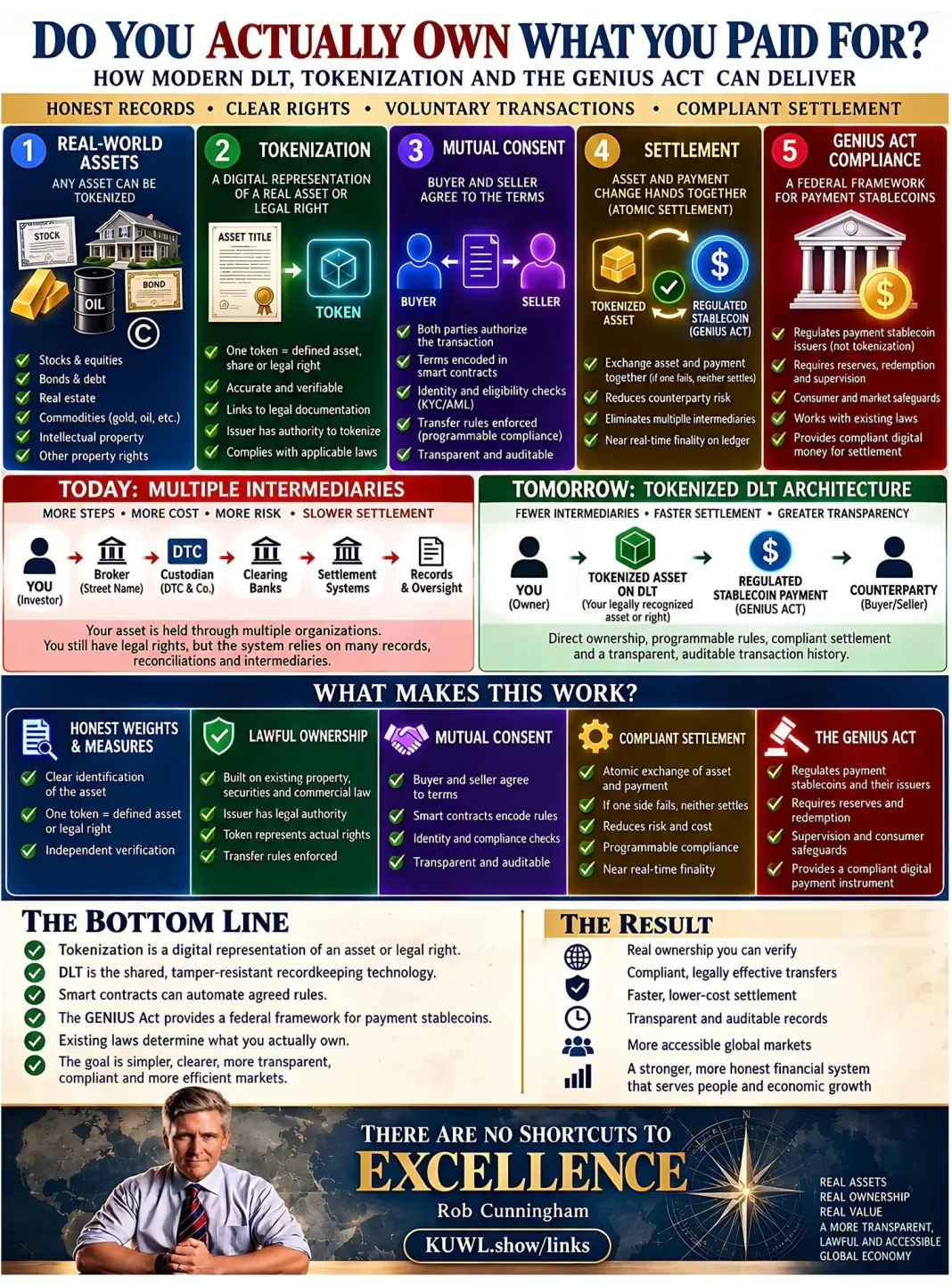
An honest system should make five things easy to establish:
1 – WHAT is it? The asset must be clearly identified. One token should correspond to a defined asset, quantity, share, or legal right – not something vague or duplicated.
2 – WHO owns it? The records should clearly establish who holds the relevant legal or beneficial rights. The blockchain record alone does not automatically create legal title to every kind of real-world asset; applicable property, securities, commercial, and other laws still matter.
3 – DID both sides agree? A transaction should occur according to disclosed terms accepted by the parties, with whatever identity, authorization, transfer, and compliance requirements the law requires.
4 – DID the trade actually settle? Ideally, the asset and payment change hands together—often called atomic settlement. That can reduce the risk that one side delivers while the other side doesn’t.
5 – CAN everyone verify what happened? A well-designed DLT (Distributed Ledger Technology) system can provide a durable, auditable transaction history, while permissions and privacy controls determine who can see what.
Where the GENIUS Act fits:
The GENIUS Act establishes a federal framework for payment stablecoins and their issuers, including requirements involving reserves, redemption, supervision, and related safeguards.
Tokenized asset + regulated payment instrument + legally effective transfer rules = the potential for faster, more transparent digital settlement.
The law governing the underlying asset still determines whether the buyer actually acquired ownership, a security entitlement, a contractual claim, beneficial ownership, or some other right.
Traditional system vs. tokenized system
Today’s financial system frequently uses intermediaries – brokers, custodians, clearing organizations, depositories and banks. For example, U.S. securities are held through intermediaries governed by an established legal framework defining customer and intermediary rights.
What DLT (Distributed ledger Technology) changes is the number of records, reconciliations and intermediaries lurking, holding, leveraging, collateralizing and extracting value from our assets.
Instead of:
Person → broker → custodian/depository → clearing → settlement → records
properly designed markets will increasingly move toward:
Owner → digitally represented legal right → buyer
with payment and transfer occurring together on interoperable infrastructure
That means fewer reconciliation steps, faster settlement, greater auditability, programmable compliance and lower counterparty risk.
The Whole Concept
Imagine selling your house.
Today, proving ownership, transferring title and transferring money involve multiple organizations, databases, documents and reconciliations.
Now imagine a legally recognized digital instrument that says:
1 This specific asset exists
2 These are the rights attached to it
3 This person currently holds those rights
4 These are the conditions under which they may transfer
5 Both parties authorize the transaction
6 Payment and transfer occurred together
7 Here is the permanent record
That is The Promise
• DLT is the recordkeeping technology
• Tokenization is the digital representation of the asset or right
• Smart contracts can automate mutual consenting rules
• Stablecoins can provide one form of digital payment
• Law determines what the parties actually own and whether the transfer is legally effective
Technology makes it easier to know what exists, who owns what, what was agreed to.
Source(s):
• https://x.com/KuwlShow/status/2106496313307119823
https://dinarchronicles.com/2026/10/03/rob-cunningham-do-we-actually-own-what-we-paid-for/
The Ultimate Anchor for the Financial System
The Ultimate Anchor for the Financial System
Gold Telegraph: 10-4-2026
For decades, U.S. Treasuries were treated like money.
Now they are starting to trade like debt.
Gold has always just been money.
The founding fathers understand that money is good as gold.
The Ultimate Anchor for the Financial System
Gold Telegraph: 10-4-2026
For decades, U.S. Treasuries were treated like money.
Now they are starting to trade like debt.
Gold has always just been money.
The founding fathers understand that money is good as gold.
Sound money…
Gold Telegraph: BREAKING NEWS: JUDY SHELTON HAS JOINED THE U.S. TREASURY DEPARTMENT AS COUNSELOR TO THE SECRETARY. Judy has spent decades thinking deeply about monetary policy, sound money, gold, and the architecture of the global financial system. To now see her bringing those ideas and that experience into discussions at the highest levels of the U.S. Treasury is incredibly exciting. My conversation with Judy on The Gold Telegraph will always be one of the highlights of my career. Beyond her extraordinary intellect, she is thoughtful, gracious, and deeply committed to the ideas she believes in. Full documentary: youtu.be/USGjSU5yXh8?si… Congratulations, my friend. Very well deserved. @judyshel

America has $40 trillion in national debt.
The President recently suggested that a certain level of inflation could reduce that burden faster.
Of course it can.
Inflation reduces the real value of debt.
But it also reduces the real value of your money.
This is exactly why gold remains the ultimate anchor of the financial system.
Source(s):
• https://x.com/GoldTelegraph/status/2106106115138478393
• https://x.com/GoldTelegraph/status/2106118311251767572
https://dinarchronicles.com/2026/10/03/gold-telegraph-the-ultimate-anchor-for-the-financial-system/
Iraq Economic News and Points To Ponder Sunday Afternoon 10-4-26
Algerian President Violates IMF Expectations
Money and business Economy News - Follow-up Algerian President Abdelmadjid Tebboune has broken with the expectations of the International Monetary Fund (IMF) regarding some economic indicators for his country, which he stressed that it is looking to collect at least $ 50 billion annually.
Algerian President Violates IMF Expectations
Money and business Economy News - Follow-up Algerian President Abdelmadjid Tebboune has broken with the expectations of the International Monetary Fund (IMF) regarding some economic indicators for his country, which he stressed that it is looking to collect at least $ 50 billion annually.
In a statement of Article IV consultations with Algeria, the International Monetary Fund (IMF) predicted that the country’s official foreign exchange reserves will decline from $ 46.5 billion this year to $ 19.8 billion by 2031, and a growth rate of 3.8% in 2026.
But Tebboune, in a video interview with local media, confirmed that the growth rate for 2026 will exceed 3.8% to reach 4.01% or 4.02%, according to the German news agency DPA.
“The report of the International Monetary Fund is just a prediction, but what is important is that even if things are taken seriously, we will have a high reserve in 2031, and we are working to raise non-oil revenues, and even oil revenues will not be erased, we are still working in the field of exploration with very strong companies. The industry will also be a tributary of the economy.”
But Tebboune pointed out that the report of the International Monetary Fund is in line with the prospects set by his country, pointing out that the report “previously talked about reaching a GDP of $ 400 billion, based on data we know in our economy, and we are almost looking similarly at the Algerian economy built on a solid ground.”
“We will reach a GDP of about $400 billion in late 2026 or during the first quarter of 2027, and this figure can be exceeded, given the current movement of investment, in addition to the exploitation of national energies, especially in the field of mines,” he said.
He said that Algeria is working to achieve a sustainable income of at least $ 50 billion annually from hard currency, and the automotive industry, the mining sector, and the localization of the iron and chip industry in local production, will be essential tributaries to strengthen the national economy and support foreign exchange reserves
https://www.economy-news.net/content.php?id=74595
Iraq. Completion Of The Procedures For The Payment Of End-Of-Service Compensation To Retirees
Money and business Economy News – Baghdad The National Retirement Authority announced on Sunday the completion of the procedures for the payment of end-of-service compensation to retirees.
The deputy head of the National Retirement Authority, Hossam Abdul Sattar, said that "within the plan of the National Retirement Authority, which includes simplifying procedures and providing the best services to the retiree segment and disbursing the end-of-service bonus, the procedures for the payment of end-of-service bonus have been completed and sent to banks for retirees referred to retirement from the military and civilians within the month of October 2026."
He added that "the number of restrictions amounted to (8111) restrictions," calling on "those who receive text messages to review the outlets to receive their reward https://www.economy-news.net/content.php?id=74600
Sweden To Reopen Embassy In Baghdad, Strengthen Cooperation With Iraq
Money and business Economy News - Baghdad
The security adviser to the Prime Minister, Qassim al-Araji, on Sunday, with the Chargé d'affaires of the Swedish Embassy in Iraq, Jürgen Lindström, discussed the bilateral relations between the two countries and ways to develop them and enhance joint cooperation, while the Swedish Chargé d'affaires announced the direction of his country's government to reopen its embassy in Baghdad.
The Information Office of the Security Adviser to the Prime Minister said that "the Security Adviser to the Prime Minister, Qassim al-Araji, received on Sunday, the Chargé d'Affaires of the Swedish Embassy in Iraq, Jürgen Lindström," noting that "during the meeting discussed the bilateral relations between Iraq and Sweden, and ways to develop them and enhance joint cooperation."
He added that "during the meeting also discussed aspects of cooperation between the Iraqi and Swedish ministries of interior, as well as cooperation in the judicial field, and coordination between the competent authorities and centers in the two countries, which contributes to enhancing the exchange of experiences and information and supporting areas of joint cooperation."
Al-Araji stressed, according to the statement, "Iraq's keenness to establish balanced relations with various countries of the world, including the Kingdom of Sweden," pointing to "the acceptance and appreciation of the Prime Minister, Ali Al-Zaidi, at the international level, and reflected in the keenness to strengthen cooperation with Iraq and develop its foreign relations."
For his part, the Swedish Chargé d'affaires "congratulations on the occasion of the Iraqi National Day," stressing "his country's keenness to develop relations with Iraq."
He pointed to "the Swedish government's move towards reopening its embassy in Baghdad
Parliamentary Finance Announces The Dispensation Of The Borrowing Law
Money and business Economy News – Baghdad The Parliamentary Finance Committee announced on Sunday the dispensation of the borrowing law, while pointing to the existence of treatments for some banks that deal in dollars.
The head of the committee, Uday Awad, said that "the problem of banking reform is a necessity in light of the current situation, and private and government banks did not live up to the solution of the financial crisis and did not have any contributions to the solution of the financial crisis," noting that "civil banks have the potential as they have correspondence and global cooperation."
He added that "the private banks have provided a set of reforms that will be discussed with the Central Bank, including why our banks are not like Gulf banks provide loans, facilities and deposit guarantee to be there is trust between the citizen and banks," noting that "there will be a periodic meeting with banks."
“There will be clear remedies and results in the coming days.”
On the borrowing law, Awad stressed that "the law has been dispensed with and is not needed at the moment, considering that the 2027 budget, coming from the government and will guarantee the law within the budget
https://www.economy-news.net/content.php?id=74602
More Than 40 Years Later... German Flights Return To Baghdad With Four Flights A Week
Money and business Economy News – Baghdad The Ministry of Transport announced the return of German airlines to Baghdad International Airport after a break of more than 40 years, through the operation of four flights a week from the cities of Berlin and Düsseldorf.
According to the ministry, the German company Eurowings, a subsidiary of the Lufthansa Group, will start operating four direct flights per week to the capital Baghdad from December 10, 2026, with two flights from Berlin and two flights from Düsseldorf.
She added that the move comes within the efforts to develop the air transport sector and promote compliance with the requirements and international standards of Iraqi airports and the national carrier.
She pointed out that during the past three months, Baghdad International Airport received a number of delegations and specialized technical and operational committees, which conducted field detection and auditing of the procedures and systems adopted at the airport, to verify their compatibility with international security, safety and operating requirements.
The ministry pointed out that the entry of a company belonging to the Lufthansa Group to the Iraqi market represents an important step to strengthen the presence of European airlines and open the way for the operation of additional direct lines with the capital Baghdad.
She pointed out that direct trips will support trade, investment and tourism exchange, facilitate the movement of businessmen and travelers, as well as enhance economic and technical cooperation between Iraq, Germany and Europe.
The ministry stressed that attracting new European and international airlines is part of its vision to develop airports, raise the level of services, operational and security efficiency and expand the network of direct international destinations.
According to the ministry, the German passenger transport companies will conduct their last flights between Iraq and Germany in the early 1980s, while more than 10 German companies have submitted requests to operate flights to Iraq in the coming period https://www.economy-news.net/content.php?id=74599
Seeds of Wisdom RV and Economics Updates Sunday Afternoon 10-4-26
Good Afternoon Dinar Recaps,
GLOBAL DEBT RESET WATCH: CAN BOND MARKETS RECOVER AS OIL AND INFLATION PRESSURE PERSIST?
Investors are searching for signs of relief after a sharp bond-market sell-off, but elevated energy prices, inflation concerns and government deficits continue to threaten borrowing-cost stability.
Good Afternoon Dinar Recaps,
GLOBAL DEBT RESET WATCH: CAN BOND MARKETS RECOVER AS OIL AND INFLATION PRESSURE PERSIST?
Investors are searching for signs of relief after a sharp bond-market sell-off, but elevated energy prices, inflation concerns and government deficits continue to threaten borrowing-cost stability.
OVERVIEW
Bond markets are seeking a recovery: Investors are watching oil prices and new economic data for evidence that pressure on government borrowing costs may ease.
Oil remains a key factor: Brent crude hovered around $102 a barrel on Friday, keeping energy-driven inflation concerns in focus.
Rate expectations are shifting: Weaker-than-expected U.S. job growth reduced market expectations of another immediate Federal Reserve rate increase.
KEY DEVELOPMENTS
1. Bond Investors Look for Signs of Relief
The Financial Times reported on October 4 that investors were watching for developments that could help revive government bond markets after weeks of selling and rising yields.
A major focus is energy. Higher oil prices can increase transportation and production costs, adding to inflation concerns and potentially keeping interest rates elevated for longer.
Investors are also watching political and fiscal developments in Europe, particularly concerns about France’s public finances. Friday’s partial market recovery offered some relief, but it has not established that the broader sell-off is over.
2. Weaker U.S. Jobs Data Changes the Rate Outlook
Reuters reported Sunday that Gulf stock markets gained as investors responded to firmer oil prices and reduced expectations of another U.S. rate increase.
The U.S. economy added 29,000 jobs in September, well below the 90,000 economists had expected. The weaker report reduced market expectations that the Federal Reserve would raise rates again in October.
This creates a difficult balance for policymakers: slower employment growth can support the case for holding rates steady, while persistent inflation can limit the scope for easing monetary policy.
3. Government Debt Remains a Longer-Term Challenge
Even if oil prices fall or interest-rate expectations improve, governments still face substantial borrowing needs.
When investors demand higher yields to hold government bonds, new borrowing and refinancing can become more expensive. Countries with large deficits may face additional pressure to balance public spending, debt servicing and economic growth.
The International Monetary Fund said on October 1 that global bond markets were still functioning in an orderly manner. That is an important distinction: high yields and market volatility deserve attention, but they do not automatically signal a financial crisis.
WHY IT MATTERS
Government bond yields influence borrowing costs across the economy, including mortgages, business loans and government refinancing.
A sustained decline in yields could provide relief to borrowers and support investment. However, if oil prices remain elevated and inflation proves persistent, borrowing costs may stay high even as economic growth slows.
The central question is whether inflation pressures ease enough to allow financial conditions to stabilize—or whether governments, businesses and households must adjust to a prolonged period of expensive credit.
WHY IT MATTERS TO FOREIGN CURRENCY HOLDERS
For readers following the Global Financial Reset, bond yields offer a measurable indicator of changing financial conditions.
Interest-rate expectations, government debt and investor confidence can influence exchange rates and cross-border capital flows. However, the effect varies by currency and depends on each country’s economic outlook and policy decisions.
A bond-market recovery would not, by itself, prove that a global reset or currency revaluation is underway. It would indicate that investors are reassessing risk, inflation and the cost of financing debt.
IMPLICATIONS FOR THE GLOBAL RESET
Pillar 1: Debt
Higher yields can increase government interest expenses as existing debt is refinanced. This can intensify debates over fiscal discipline, public spending and long-term debt sustainability.
Pillar 2: Energy
Oil prices remain a key influence on inflation expectations. More stable energy supplies and lower prices could help ease pressure on bond markets, while renewed disruptions could reverse that relief.
Pillar 3: Currencies
Changing expectations for U.S. interest rates can affect the dollar and other currencies. Yet exchange rates also reflect inflation, growth, trade balances and confidence in national economic policies.
Pillar 4: Financial Stability
Rapid changes in bond yields can affect existing bond values and expose vulnerabilities among borrowers and financial institutions. A sustained recovery would depend on more than a few days of improved market sentiment.
THE BOTTOM LINE
Bond markets are looking for relief, but the outlook remains tied to oil prices, inflation, interest-rate expectations and government borrowing needs. The next important test is whether easing price pressures and new economic data can support a sustained decline in yields rather than a temporary rebound.
For Global Financial Reset watchers, the lesson is to follow measurable changes in debt costs and financial policy: the evolution of the global financial system is being shaped not by promises of a reset, but by how nations finance, manage and restructure their debt.
Seeds of Wisdom Team
Newshounds News™ Exclusive
SOURCES
Financial Times — “What Can Revive the Battered Government Bond Market?”
Reuters — “Most Gulf Shares End Higher on Firmer Oil, US Rate Bets”
~~~~~~~~~~
Seeds of Wisdom Team RV Currency Facts Youtube and Rumble
Newshound's News Telegram Room Link
RV Facts with Proof Links Link
RV Updates Proof links - Facts Link
Start Here room with Most Asked Questions Link
Follow the Gold/Silver Rate COMEX
Follow Fast Facts
Seeds of Wisdom Team™ Website
Thank you Dinar Recaps
The Surprising Risk Of Having Too Much Cash
The Surprising Risk Of Having Too Much Cash
September 17, 2026 Fidelity
Investing in stocks and bonds may reduce some types of risk and enhance return potential.
There are many wonderful attributes of cash and short-term investments. Money held in a bank account or in a short-term investment like a money market fund is generally easy to access. The risk of volatility or loss is extremely low—or even nonexistent. Many short-term options, like money-market funds or short-term CDs or Treasurys, even pay interest.
The Surprising Risk Of Having Too Much Cash
September 17, 2026 Fidelity
Investing in stocks and bonds may reduce some types of risk and enhance return potential.
There are many wonderful attributes of cash and short-term investments. Money held in a bank account or in a short-term investment like a money market fund is generally easy to access. The risk of volatility or loss is extremely low—or even nonexistent. Many short-term options, like money-market funds or short-term CDs or Treasurys, even pay interest.
However, holding too much in cash or short-term investments can introduce a different set of risks: the risk that inflation eats away at your money's purchasing power over time, and the risk that your portfolio doesn't grow enough to meet your goals. That's why it's important to understand the role of cash in your portfolio, and check in periodically that the amount you hold is suitable for your goals.
The role of cash and short-term investments in your portfolio
Stocks, bonds, and short-term investments (which some investors may refer to as "cash" or "cash equivalents") are the 3 primary building blocks of a diversified portfolio and each has a role to play in helping you achieve your investing goals.
That’s why it’s good to make sure your portfolio holds enough of all 3 of those types of assets to help you make progress toward your goals—but not too much or too little of any one of them. With that in mind, you may want to consider whether you have more cash and short-term investments than necessary to meet your short-term needs.
The risk of inflation
Keeping your money in cash and short-term investments may seem like a great way to avoid losing it in a stock market downturn. However, holding cash raises your risk of losing money in another way.
Over time, inflation can gradually eat away at the value of your portfolio unless it’s invested in assets that can earn enough to keep up with rising prices. Although inflation is rising more slowly than it did over the past several years, consumer prices are likely to continue to go higher.
Besides cash, what?
Fortunately, you have a variety of ways to seek higher returns, depending on your investing goals, how soon you may need access to your money, and how comfortable you are with the up and down movements of financial markets.
Stocks
Do you want to invest for the future but are still in cash because you're worried that this is not a good time to invest in stocks? Fidelity has researched what a hypothetical investment of $5,000 per year would have returned if it was invested under various stock market conditions.
The study found that even if the money was invested at the "worst" possible time each year—that is, when the market was at its peak—it would have still significantly outperformed the same amount left in cash over the long run.
Chart: LINK
While the difference between investing at the “best” and “worst” time is significant, it's extremely difficult to know when markets have hit their peak or their bottom, except in retrospect. Rather than trying to do the nearly impossible, consider simply investing in stocks on a regular basis. As the chart shows, doing just that with a hypothetical $5,000 from 1990 to 2025 would have delivered a far greater return than keeping it in cash would have.
If you’re ready to stop worrying and start investing, you’ll likely want to learn more about individual stocks, mutual funds, and exchange-traded funds. We can help you decide which approach to investingLog In Required is right for you.
Bonds
If you’ve stayed in cash and short-term investments because you like how your money market fund makes regular interest payments, you may want to learn more about opportunities in bonds. Like money market funds, bonds pay regular interest. However, they may also give you opportunities for capital appreciation and offer higher interest rates than what you could earn on short-term investments.
Depending on your goals and how much you want to invest, you can buy individual bonds, bond mutual funds, or ETFs. All of these can help you reduce the risks posed by holding too much cash.
If bonds sound like what you’re looking for, you’ll likely want to learn more about them before investing.
Keeping your balance
To be sure, adding stocks and bonds to your portfolio doesn’t mean cash has no role to play in your investment strategy. Over time, stocks, bonds, and cash have all taken turns as the best- and worst-performing investments. Because financial markets and the business cycle are always in motion, it’s good to make sure your portfolio holds enough of all 3 of those types of assets to help you make progress toward your goals.
Fidelity offers a wide variety of research tools to help you reduce the risks posed by holding too much cash. We also can help you create a plan to manage risk in your portfolio and can even help manage that portfolio by looking at your timeline, goals, and feelings about risk to create a mix of investments that’s right for you.
TO READ MORE: https://www.fidelity.com/learning-center/trading-investing/how-much-cash-should-you-hold
Gold and the Fed, Judy Shelton Appointment in Treasury, Six Banks
Gold and the Fed, Judy Shelton Appointment in Treasury, Six Banks
And We Know: 10-4-2026
The modern financial landscape is undergoing a massive transformation, driven by technological innovation and shifting economic philosophies. As traditional banking systems evolve, individuals and investors are being forced to reevaluate how money works, how transactions are processed, and what the future holds for personal financial autonomy.
Recent discussions from prominent financial commentators highlight a growing tension between centralized digital currency initiatives and timeless principles of sound money, offering a fascinating glimpse into the crossroads where technology meets liberty.
Gold and the Fed, Judy Shelton Appointment in Treasury, Six Banks
And We Know: 10-4-2026
The modern financial landscape is undergoing a massive transformation, driven by technological innovation and shifting economic philosophies. As traditional banking systems evolve, individuals and investors are being forced to reevaluate how money works, how transactions are processed, and what the future holds for personal financial autonomy.
Recent discussions from prominent financial commentators highlight a growing tension between centralized digital currency initiatives and timeless principles of sound money, offering a fascinating glimpse into the crossroads where technology meets liberty.
At the forefront of these technological changes is the emergence of programmable digital payments, particularly initiatives being explored by Canadian financial institutions. Proponents of these digital systems champion them for their incredible speed, efficiency, and the promise of cost-free transactions that could streamline commerce.
However, this technological leap forward is not without its critics. A closer look at programmable currency reveals significant concerns regarding individual privacy, personal freedom, and institutional control. Because programmable money can be coded with specific restrictions or conditions on how, when, and where it is spent, many analysts worry it paves the way for unprecedented oversight.
This apprehension has even led some commentators to draw symbolic comparisons to historical and biblical warnings regarding absolute control, underscoring the deep-seated mistrust many citizens hold toward top-down monetary policies.
Contrasting sharply with the trend toward centralized digital control are differing visions for broader economic recovery and monetary stabilization. On one side of the debate, figures like Judy Shelton have emerged as voices of hope for those advocating a return to stability.
Shelton has famously championed the idea of a gold-backed bond that could be convertible into either gold or traditional fiat currency, a move designed to instill confidence and anchor the currency in tangible value.
Supporters believe that reintroducing elements of a gold standard could curb reckless spending and protect the purchasing power of everyday citizens against the erosive effects of inflation.
This hopeful outlook on asset-backed currency stands in stark opposition to other economic proposals currently circulating among policymakers and influencers. For instance, strategies suggested by figures like Anthony Scaramucci—which often lean toward higher taxation and fiscal austerity—face heavy criticism from market traditionalists.
Opponents argue that increasing the tax burden and tightening austerity measures can severely stifle economic growth, hurt small businesses, and place an unfair weight on the middle class during already uncertain times. Instead of relying on government-mandated belt-tightening, many financial experts suggest that true economic health comes from fostering production, encouraging investment, and preserving the value of the currency.
As these debates unfold, a common theme continues to resonate among those seeking financial security: the enduring value of precious metals. Gold and silver are increasingly viewed not just as traditional investments, but as essential safeguards against persistent inflation and the potential loss of financial freedom.
In an era where digital currencies can be monitored, restricted, or altered by central authorities, holding physical assets provides a reliable fallback that remains entirely outside the banking system.
This renewed interest highlights a broader excitement within certain financial circles about the potential revival of sound money principles, reminding the market of the fundamental importance of intrinsic value.
Sunday Iraq News Posted by Tishwash at TNT 10-4-2026
TNT:
Tishwash: The House of Representatives will resume its sessions on Sunday and Monday to vote on and discuss a package of laws and international
The House of Representatives will resume its sessions tomorrow, Sunday, and the day after tomorrow, Monday, with two agendas that include voting and discussing a number of draft laws and proposals.
According to the two agendas, the council will vote in its twenty-third session on a proposal to amend the Landlords Law.
TNT:
Tishwash: The House of Representatives will resume its sessions on Sunday and Monday to vote on and discuss a package of laws and international
The House of Representatives will resume its sessions tomorrow, Sunday, and the day after tomorrow, Monday, with two agendas that include voting and discussing a number of draft laws and proposals.
According to the two agendas, the council will vote in its twenty-third session on a proposal to amend the Landlords Law.
The first reading of the draft intellectual property law will be completed, along with the first reading of the draft law ratifying the agreement on security cooperation and combating crime.
Between Iraq and Spain.
The twenty-fourth session includes voting on amending the Notaries Public Law, and reading draft laws on juvenile care, securities, and commodities.
In addition to my projects for Iraq to join the International Maritime Aid Organization and the International Solar Alliance. link
Tishwash: Congratulating Iraq on its National Day, the US Secretary of State said: "I affirmed to President al-Zaidi the strength of the friendship between our two countries and our commitment to a strong and prosperous future."
US Secretary of State Marco Rubio congratulated the Iraqi people on their National Day on Saturday, emphasizing the strength of the friendship between the United States and Iraq and the commitment to a strong and prosperous future for both countries.
The US Secretary of State said, “On behalf of the United States, I congratulate the Iraqi people on their National Day on October 3.”
He added that he “affirmed to Prime Minister Ali al-Zaidi the strength of the friendship between our two countries and our commitment to a strong and prosperous future.”
He noted that “the economic partnerships announced during Al-Zaidi’s visit to Washington reflect broad opportunities for cooperation between American and Iraqi companies.”
The US Secretary of State welcomed “Iraq’s efforts to strengthen its sovereignty and contribute to achieving security and stability throughout the region,” emphasizing the celebration of the Iraqi people’s history, resilience and achievements, and looking forward to strengthening the partnership and relations between the two countries. link
US Secretary of State Marco Rubio extended his congratulations to the Iraqi people on their National Day on Saturday, emphasizing that Prime Minister Ali Faleh al-Zaidi's visit to Washington underscored the strength of the friendship between Iraq and the United States.
In a statement received by the Iraqi News Agency (INA), Rubio said, "On behalf of the United States of America, I congratulate the Iraqi people on their National Day, October 3rd."
He added, "Prime Minister Ali al-Zaidi's visit to Washington last July, and his meeting with PresidentTrump at the White House, reaffirmed the strength of the friendship between our two countries and our shared commitment to a strong and prosperous future."
He noted that "the historic economic partnerships announced during the visit demonstrate once again the great potential for cooperation between American and Iraqi companies." He added,
"We welcome Iraq's efforts to strengthen its sovereignty and contribute to achieving security and stability throughout the region."
He explained, "On this National Day, we celebrate the history, resilience, and achievements of the Iraqi people, and we look forward to the continued growth of the partnership and relations between our two countries. We extend our warmest congratulations and best wishes to the Iraqi people on this important occasion."
************
TishwashL Parliament is moving towards voting on the deputy prime ministers.
The House of Representatives is expected to vote on the deputy prime ministers this week, according to informed sources.
Sources told Baghdad Today that the names being considered for the positions include Mohsen Al-Mandalawi, Laith Al-Khazali, and Mohammed Tamim, noting that the mechanism for deciding on the names and the date of the final vote have not yet been officially announced.
She added that the matter is still under arrangement and consultation, pending an official position regarding the date and voting mechanism link
Tishwash: MP: The 2027 budget will be sent this month and approved before the end of the year
Member of Parliament Mohammed Al-Moussawi revealed on Saturday the expected date for sending the proposed federal general budget law for 2027 to Parliament, stressing that there is a governmental and parliamentary trend to reduce expenditures and activate the productive sectors.
Al-Moussawi told Al-Maalouma News Agency that “the Council of Ministers will send the proposed 2027 budget law to the House of Representatives during this month,” explaining that “the Parliamentary Finance Committee will immediately begin studying the budget and reviewing all its items upon its arrival so that it can be submitted for discussion and voting at the beginning of the tenth month.”
He added that “next year’s budget will be significantly different from its predecessors, as it will focus primarily on development programs and activating the productive sectors in the country, as well as reducing many unnecessary government spending items,” predicting that “the House of Representatives will pass the budget and vote on it definitively before the start of the new year.”
It is worth noting that the parliamentary finance committee hosted Finance Minister Faleh al-Sari last week to discuss key amendments to the draft budget law, including a detailed discussion of changing the current operating mechanism and transitioning to a "program-based budget." link
************
Tishwash: The government is taking steps to revitalize markets and stimulate commercial and productive activity.
A government source revealed on Wednesday that the government is seeking to revitalize markets, mitigate the effects of regional challenges, and advocate for the adoption of official information, stressing that the government is discussing initiatives to stimulate commercial and productive activity .
The source told the official news agency, as reported by Al-Sa’a Network, that “the government is aware of the slowdown in buying and selling in the markets, and the impact this has on citizens, traders, and business owners, and attaches importance to discussing practical solutions that help stimulate economic activity, protect purchasing power, and enhance confidence in the market .”
He added that "these challenges are not limited to Iraq, but most countries in the region face them to varying degrees in light of regional tension and the closure of the Strait of Hormuz, and the resulting disruption to trade and supplies, and the rise in transportation, shipping and insurance costs. These conditions have affected investment and consumption decisions, and have contributed to an increased state of anticipation and a slowdown in economic activity ."
He explained that “the government, while aware of the impact of these circumstances, seeks to address the internal obstacles that affect market activity, discuss initiatives to stimulate commercial and productive activity, and explore ways to facilitate financing for productive projects and support the private sector,” indicating that “the goal is to develop applicable measures that contribute to the continuity of business and the provision of job opportunities, taking into account the available financial capabilities and maintaining financial and monetary stability .”
The source clarified that "putting forward any proposal for study or discussion does not mean approving it or starting to implement it immediately, and the expectations circulating cannot be treated as binding decisions or specific dates for implementation ."
He pointed out that "any action in this regard requires careful study, technical and organizational preparations, and clear mechanisms that preserve the rights of citizens, and it must be officially announced with an explanation of its details before implementation if it is approved accordingly link
News, Rumors and Opinions Sunday 10-4-2026
GP Q: “Are we there yet?” Iraq Update as of 3rd October 2026
ARE WE THERE YET?
IRAQ
The map is being redrawn.
The dinar’s official price is not.
GP Q: “Are we there yet?” Iraq Update as of 3rd October 2026
ARE WE THERE YET?
IRAQ
The map is being redrawn.
The dinar’s official price is not.
3 October 2026 — Iraq desk
Baghdad’s central bank is still running the bank cleanup it set in motion under its minimum-requirements program.
Every Iraqi bank has already filed the paperwork and picked one of three doors: stay independent, merge, or leave the market.
What remains is gap-closing and full compliance, not a finished overhaul.
Eligible private banks can also be cleared again for cross-border trade and letters of credit in euro, UAE dirham, yuan, Jordanian dinar and other currencies.
On the dinar itself, the CBI’s stated line is still exchange-rate stability.
No new official rate has been published and nothing on the record is a revaluation.
THE PLUMBING:
Offshore, the payment pipes are the part that is actually moving. Swift’s shared ledger is live for early use. Seventeen (yes 17) banks across six continents are lined up to run tokenised bank deposits on it so money can move overnight and on weekends, with final settlement still going through existing systems. That is regulated bank money on new rails. It is not a currency reset.
Status:
• Bank reform: underway
• Rate policy: stability, unchanged
• Revaluation or QFS: not on the record
The infrastructure is being modernised. The documents describe compliance pathways and tokenised deposits. They do not announce an IQD revaluation.
Sources:
https://cbi.iq/news/print_news/3144
https://cbi.iq/news/print_news/3231
Source(s):
• https://x.com/argosaki/status/2106233314642460975
https://dinarchronicles.com/2026/10/03/gp-q-are-we-there-yet-iraq-update-as-of-3rd-october-2026/
Courtesy of Dinar Guru: https://www.dinarguru.com/
Militia Man Taking zeros off a currency would take a law. Have they done that? Not yet...There is a public discussion of a new series of notes...If and when the bank moves on a design, we will read what the bank itself says...They can change the paper. They cannot rewrite the zeros without legislature...They can change the effective exchange rate of the currency <snap> like that, like back in 2023...Physical note count, adjustment of the rate, two different things.
Mnt Goat ...There is always a target, a plan and interconnections to what the CBI is thinking or does that will give away their final plan. I believe the CBI will launch once again the 25, 50 and 100 dinar bills JUST BEFORE the project to delete the zeros occurs. I do think it will come out at around 1.00 but at whatever the program rate dictates... Remember also the CBI told us the larger older 3 zero bills will coincide with the newer lower denomination bills for up to 10 years., then be phased out.
Stephen Never expect the Central Bank of Iraq to come out and straight up say, 'Hey guys, we're going to revalue the currency.' It would create turmoil within the country of Iraq. It would collapse the country because you would have all these speculators buying up the currency. It would create total chaos. They will never do that.
***************
THE BOND MARKET IS BREAKING — Here's What Happens Next
Lena Petrova: 10-4-2026
Iraq Economic News and Points To Ponder Sunday Morning 10-4-26
An Economist Accuses "Influential Parties" Of Fabricating The Dollar Crisis And Calls On The Central Bank To Intervene Urgently
Information / Baghdad... On Saturday, economist Abdul Rahman Al-Mashhadani accused influential parties of fabricating the current rise in dollar exchange rates in local markets, explaining that the goal of this rise is to achieve exorbitant profits for specific banks that are not subject to sanctions.
An Economist Accuses "Influential Parties" Of Fabricating The Dollar Crisis And Calls On The Central Bank To Intervene Urgently
Information / Baghdad... On Saturday, economist Abdul Rahman Al-Mashhadani accused influential parties of fabricating the current rise in dollar exchange rates in local markets, explaining that the goal of this rise is to achieve exorbitant profits for specific banks that are not subject to sanctions.
Al-Mashhadani told Al-Maalouma that "the local market is witnessing clear confusion due to the unjustified rise in exchange rates," calling on the Central Bank of Iraq to "conduct a real and urgent review of the monetary policy mechanisms currently in place."
He added that "it has become necessary for the Central Bank to intervene immediately and inject sufficient quantities of foreign currency (dollars) to save the market and curb speculators," while warning of "the continued rise in exchange rates and the worsening of the crisis if the situation remains as it is without radical solutions."
Economist Dirgham Muhammad Ali had previously confirmed to Al-Maalomah that the main reason behind the rise in the dollar exchange rate was related to the withdrawal of Al-Taif Bank, which is a major official gateway for dollars entering the country through the Western Union network. End/25
After Months Of Deadlock, A Breakthrough Appears On The Horizon For The Cabinet
The issue of completing the cabinet remains unresolved in the halls of parliament, with political disagreements persisting over several ministerial portfolios. This has delayed the finalization of this crucial matter, which continues to pose a significant challenge for the government. In this regard, Maysar al-
Shammari, a leader in the Hikma Movement, confirmed to Al-Maalomah that “an agreement has been reached between the Coordination Framework and the State Administration Coalition to complete the cabinet.
This agreement also addresses the reservations held by some political forces within the Framework, which had previously prevented their participation in the government. These reservations have now been resolved.”
He added that "the previous reservations concerned certain individuals and names nominated for ministerial positions, and these have been overcome through understandings reached within the Coordination Framework."
Al-Shammari indicated that "the cabinet will be completed in the near future, and amendments will be made to the voting mechanism for the cabinet to facilitate its formation."
He pointed out that "the Iraqi public is watching and awaiting the completion of the cabinet, coinciding with steps to strengthen national autonomy, particularly with the withdrawal of US forces, as well as the completion of the political and governmental process, which will contribute to enhancing reassurance and stability among citizens."
For his part, MP Faleh al-Khazali confirmed to Al-Maalomah that “the political forces have finalized their choices regarding the names that will be submitted to Parliament for a vote next week, thus ending the cabinet formation crisis and allowing ministries to perform their duties and provide services to citizens.”
He added that "completing the cabinet is essential to achieving integration between the legislative and executive branches and to address the stalled service-related issues that citizens are waiting for," noting that "the completion of the government formation will contribute to strengthening the institutions' ability to implement their programs."
Al-Khazali explained that “completing the cabinet will help the government complete its work, allowing for a clearer evaluation of the performance of government institutions, highlighting strengths and weaknesses and addressing them,” emphasizing that “resolving the cabinet issue represents an important step in stabilizing government operations.”
All eyes remain on the parliament and political forces to see whether recent developments will contribute to resolving the cabinet formation issue and ending the delays,or whether disagreements will continue to hinder the completion of the government. (End of report 25)
The Dollar In Iraq... Al-Marsoumi Expects The Dinar To Remain Within A Narrow Range Until The Budget Is Finalized
October 2, 2026Last updated: October 2, 2026
Independent/- Economic expert Nabil Al-Marsoumi said that the exchange rate of the Iraqi dinar against the dollar in the parallel market may remain within a limited range of fluctuation during the next stage, in the absence of major financial or economic variables capable of reducing the gap with the official rate or pushing it to further widen.
Al-Marsoumi wrote on his Facebook account under the title “The Dinar in the Tunnel”, that the exchange rate in the black market seems likely to remain at levels he described as “sticky”, expecting that the fluctuation movement will not exceed about 2% up or down.
Al-Marsoumi links the continuation of this situation to the course of the upcoming budget, considering that the market may remain in a state of waiting until the trends in spending and fiscal policy become clear, or an exceptional development appears that changes the calculations of supply and demand for the dollar.
This reading reflects a state of relative stability in the parallel market, but it does not necessarily mean the end of the pressures that caused the widening gap between the official dollar price and the price traded by exchange companies and unofficial markets.
The movement of the dollar in Iraq is affected by several factors, including commercial demand for foreign currency, the volume of liquidity in dinars, import financing mechanisms and foreign transfers, in addition to the measures taken by the Central Bank to regulate access to dollars through official banking channels.
Conversely, increased public spending or changes in foreign trade and remittances could put renewed pressure on the parallel market, while improved access to dollars through the banking system could narrow the gap with the official rate.
The description of the price as “sticky” indicates the possibility that the market will remain within a relatively stable price range for a period, without a clear trend towards a sharp rise or fall, unless a strong economic or financial factor emerges that breaks the current state of equilibrium.
The Iraqi markets are watching closely in the coming period the course of the budget and the financial and monetary policies associated with it, as they are among the most prominent factors capable of affecting the volume of liquidity and demand for the dollar.
According to Al-Marsoumi’s reading, the next phase may remain governed by limited fluctuations, but any major development in fiscal policy, dollar flows, or foreign trade mechanisms could quickly move the market into a new price range.
The most prominent question facing the market remains: Will the next phase succeed in narrowing the gap between the official and parallel prices, or will the dinar continue inside what Al-Marsoumi described as the “tunnel”?
https://mustaqila.com/الدولار-في-العراق-المرسومي-يتوقع-بقاء/
Al-Zubaidi On American Dominance Over The Financial File: “It Preoccupies Political Forces And The Iraqi Public.”
The spokesperson for the Victory Coalition, Salam al-Zubaidi, confirmed on Saturday that the issue of American influence in Iraq's financial and oil sectors, particularly concerning the US Federal Reserve, has become a major concern for political forces, the government, and the Iraqi public. He called for diversifying revenue sources and reducing reliance on a single financial channel.
Al-Zubaidi told Al-Maalomah that “American dominance over Iraqi oil and the economy is a major concern for the Iraqi public and political forces, as the Iraqi economy has become heavily tied to the US Federal Reserve, which has caused numerous crises and economic contraction.”
He added that "linking Iraq's resources to a single entity, especially the US Federal Reserve, is unsound, particularly since Iraq relies primarily on oil. The funds sent to the Federal Reserve and then returned to Iraq undermine the Iraqi economy and place the government under significant pressure."
Al-Zubaidi explained that “American pressure regarding the transfer of dollars is linked to American interests and could significantly hinder the state’s general budget,” calling for the exploration of economic and financial alternatives to mitigate the impact of this pressure.
He stated that "Iraq needs to rid itself of American hegemony and seek new revenue streams and diversify its sources by building partnerships with other countries," noting funds that this path requires strategic steps and well-considered actions. (End 25)