
Iraq Economic News and Points To Ponder Wednesday Morning 9-2-26
Between External Borrowing And Removing Zeros... The Government Faces Difficult Choices To Address The Financial Crisis
31 Aug 13:51 Information/Report... As pressure mounts on Iraq's public finances, a range of options for addressing the liquidity crisis are resurfacing. These include resorting to external borrowing and restructuring the local currency.
Parliamentary sources confirm that the project to remove zeros from the currency has not yet entered the implementation phase, while economists discuss the possibility of securing a substantial external loan to provide liquidity and bolster reserves.
Between External Borrowing And Removing Zeros... The Government Faces Difficult Choices To Address The Financial Crisis
31 Aug 13:51 Information/Report... As pressure mounts on Iraq's public finances, a range of options for addressing the liquidity crisis are resurfacing. These include resorting to external borrowing and restructuring the local currency.
Parliamentary sources confirm that the project to remove zeros from the currency has not yet entered the implementation phase, while economists discuss the possibility of securing a substantial external loan to provide liquidity and bolster reserves.
This comes amidst ongoing challenges related to public spending and the heavy reliance on oil revenues, meaning any decline in oil prices or revenues quickly impacts the state's ability to finance its expenditures and obligations.
External borrowing: The fastest solution?
Economic expert Abdul Rahman Al-Mashhadani believes that the government's move towards external borrowing from international banks represents one of the quickest available solutions to address the liquidity shortage and overcome current financial pressures.
Al-Mashhadani told Al-Maalouma that external loans offer Iraq grace periods of several years before repayments of installments and interest begin. This provides the government with time to secure repayment resources without creating immediate pressure on public spending.
He also believes that resorting to borrowing can contribute to replenishing the central bank's reserves, especially given the depletion of some of them due to market financing requirements and government spending.
Al-Mashhadani suggests that Iraq could request a loan of up to $20 billion, arguing that the current debt level, compared to the size of the economy and oil revenues, gives the country room to maneuver in international borrowing markets.
But does borrowing address the root of the problem?
While borrowing may provide a quick fix for the liquidity problem, resorting to it does not represent a final solution to the structural imbalances in the Iraqi economy, as loans remain financial obligations that the state will need to repay in the future.
This means that the success of borrowing in alleviating the crisis depends on how the funds are used and whether they are directed towards supporting financial stability, financing productive projects, and reducing imbalances, rather than being used to cover recurring expenses without addressing the sources of the deficit.
Furthermore, continued reliance on oil as the primary source of revenue leaves Iraqi finances vulnerable to the fluctuations of global markets, making fiscal reform and diversification of income sources essential alongside any temporary financing solutions.
Removing zeros... an old project resurfaces
. The project to remove zeros from the Iraqi dinar has resurfaced following reports about the possibility of issuing a new currency in early 2027.
However, MP Murtadha Afwin confirmed to Al-Maalomah that the project has not yet moved to the implementation phase, stressing that removing zeros does not in itself represent a solution to the economic crises plaguing Iraq.
This stance highlights the need to distinguish between restructuring currency denominations and raising the real value of the currency. Removing zeros, if implemented, primarily aims to simplify monetary transactions and reduce the volume of circulating currency.
It does not automatically increase the purchasing power of the dinar or address inflation and the budget deficit.
The project to remove zeros has been under discussion in Iraq for years, and the Central Bank has previously addressed it as part of plans to restructure the currency and facilitate monetary transactions.
Official positions vary, and an important point emerges here: discussing the removal of zeros or external borrowing does not necessarily imply a final government decision on these matters. The Iraqi government has recently confirmed that there are no official plans to change the currency or remove three zeros, and it has denied any intention to borrow externally.
It described the financial situation as a temporary liquidity crisis, not a structural financial crisis.
Conversely, political and economic statements continue to raise the issues of borrowing and removing zeros within the public debate on how to address financial pressures, reflecting the extent of the debate surrounding the options the state might adopt in the coming period.
The liquidity crisis requires broader solutions.
Between the option of external borrowing and the project to remove zeros from the currency, a genuine solution to the financial crisis seems linked to reforms that go beyond monetary measures alone. These reforms include controlling public spending, boosting non-oil revenues, revitalizing the private sector, reviewing government expenditures, and addressing areas of waste and corruption. End/25m
Living Costs Squeeze Savings For Iraqi Households
2026-09-01 Shafaq News- Baghdad For many salaried Iraqis and retirees, a month's pay is largely spent the moment it arrives, leaving little room for savings or investment as rent, utilities, food and transportation take a growing share of household income.
Abu Ahmed, a Baghdad resident, said his salary is "gone as soon as I receive it," with rent, bills, food and transportation taking priority before any money can be set aside. What remains, he said, is too little to save in any meaningful way.
The timing of salary payments adds to the strain. Hassan Hadi, another Baghdad resident, said household expenses continue regardless of whether salaries arrive on schedule, with school fees, clothing, private generators, food and transportation consuming much of his income.
What The Essentials Cost
The pressure is reflected in the cost of basic goods and services. Regular gasoline is priced nationally at 450 dinars per liter, about $0.35, under decisions issued by the Council of Ministers.
Many Baghdad households also rely on neighborhood generators during outages in the national grid. The Baghdad Provincial Council sets monthly generator rates; in June 2026, it priced an ampere at 12,000 dinars ($9) for round-the-clock service, 8,000 dinars ($6) for night-only supply and 6,000 dinars ($4.60) in privatized areas linked to the national grid.
Against those costs, Iraq's statutory minimum wage has remained at 350,000 dinars a month, about $269, since a 2017 cabinet decision. That is about 30% below the roughly 500,000 dinars ($385) that labor unions cite as an estimated monthly poverty line.
Education can add substantially to household expenses. Annual fees at Iraq's private colleges range from about 1.2 million to 8 million dinars ($920 to $6,150), rising above 10 million dinars ($7,690) for some medical and dental programs, according to government figures.
A Low Rate Of Saving
Mudhhir Mohammed Salih, financial adviser to the prime minister, told Shafaq News that Iraq's gross national savings average 12% to 15% of GDP, with the rate fluctuating according to oil prices, income, consumption and investment.
Using a measure focused on individuals rather than national savings, economist Hilal al-Taan said about 9.7% of Iraqis saved money in 2024, well below the global average. He attributed the low rate to limited incomes, high spending on food and housing, weak confidence in banks and rising living costs.
Inflation And The Shrinking Dinar
Najm Abdul-Tarish, an academic at the University of Dhi Qar, said much of a household's income goes toward housing, education and healthcare, while inflation erodes the dinar's purchasing power. In practical terms, the money in a worker's pocket buys less even when its face value remains unchanged.
"Higher inflation can therefore erode savings while raising household expenses, putting additional pressure on both saving and investment," Abdul-Tarish told Shafaq News.
Exchange-rate pressures add another dimension. While the Central Bank of Iraq sets the official rate at 1,300 dinars to the dollar, the currency has traded weaker on the parallel market. In May 2026, $100 sold for about 153,750 dinars in Baghdad, equivalent to roughly 1,538 dinars to the dollar, according to exchange-shop data.
Cash Outside The Banks
Salih said a large amount of cash circulates outside Iraq's banking system, although he cautioned that money held outside banks should not be treated entirely as savings because much of it is used for everyday purchases, trade and other transactions.
Moving a larger share through banks could strengthen their capacity to finance economic activity, he said.
"A larger share of savings moving through banks would strengthen their ability to mobilize domestic resources for lending and investment," Salih said, pointing to the need for better banking services, greater public confidence in financial institutions and wider use of electronic payments.
Central Bank figures illustrate the challenge. Total deposits at operating banks fell from 133.50 trillion dinars ($102.7 billion) in 2023 to 122.88 trillion dinars ($94.5 billion) in 2024. Over the same period, bank credit increased from 95.66 trillion dinars ($73.6 billion) to 102.24 trillion dinars ($78.6 billion), increasing the importance of attracting deposits to support lending.
Economist Dhergham Mohammed Ali linked weak savings to the limited use of banks, calling for wider adoption of electronic payments and more point-of-sale terminals and cash facilities across retail businesses and transportation.
By the CBI's latest reading, currency in circulation totaled 111.189 trillion dinars ($85.5 billion), of which 101.966 trillion dinars ($78.4 billion) circulated outside the banking system — about 91.7% of the total.
That does not mean the money represents untapped household savings; much of it finances everyday transactions. But the scale highlights the challenge facing Iraq's banking sector: drawing more economic activity into formal financial channels while many households have increasingly little income left to save.
https://www.shafaq.com/en/Economy/Living-costs-squeeze-savings-for-Iraqi-households
Seeds of Wisdom RV and Economics Updates Wednesday Morning 9-2-26
Good Morning Dinar Recaps,
U.S. DEBT TOPS $40 TRILLION: RISING TREASURY YIELDS EXPOSE A NEW FISCAL PRESSURE POINT
America's debt has crossed $40 trillion as rising long-term Treasury yields increase the cost of government borrowing and force markets to reassess the country's fiscal flexibility.
Good Morning Dinar Recaps,
U.S. DEBT TOPS $40 TRILLION: RISING TREASURY YIELDS EXPOSE A NEW FISCAL PRESSURE POINT
America's debt has crossed $40 trillion as rising long-term Treasury yields increase the cost of government borrowing and force markets to reassess the country's fiscal flexibility.
OVERVIEW
U.S. Debt: Total U.S. government debt has surpassed $40 trillion, underscoring the scale of America's long-term fiscal challenge.
Treasury Yields: Long-dated Treasury yields have climbed to their highest levels since 2007, increasing the cost of financing and refinancing federal debt.
Financial System: The combination of massive debt, heavy Treasury issuance and higher required yields is creating a new pressure point for the dollar-centered global financial system.
KEY DEVELOPMENTS
1. U.S. Debt Has Crossed the $40 Trillion Threshold
The United States has now moved beyond $40 trillion in total federal debt, a milestone that highlights how rapidly the government's borrowing burden has expanded.
The significance is not simply the size of the number. The larger issue is the relationship between the amount of debt outstanding and the cost of financing that debt.
As more debt must be refinanced, changes in interest rates can have an increasingly significant effect on federal interest expenses.
2. Long-Term Treasury Yields Are Reaching New Highs
Long-dated Treasury yields have risen to their highest levels since 2007, reflecting investor concerns about inflation, government borrowing requirements and the future path of interest rates.
The 10-year Treasury yield has moved above 4.8%, approaching levels not seen since the early 2020s.
Higher yields mean investors are demanding greater compensation to hold longer-term government debt.
3. Treasury Supply Is Adding to the Pressure
The Treasury market is facing a combination of large borrowing needs and changing demand.
The federal government must continue issuing debt to finance deficits and refinance maturing obligations. At the same time, investors are reassessing how much compensation they require to hold long-duration government bonds.
Reuters reports that intertwined supply-and-demand pressures could keep long-term Treasury yields elevated rather than allowing them to quickly return to previous lows.
4. Higher Yields Increase the Cost of America's Debt
The impact of higher yields does not occur all at once because much of the existing federal debt was issued at earlier interest rates.
However, as Treasury securities mature and are refinanced, new borrowing increasingly reflects today's higher market rates.
That creates a potentially difficult feedback mechanism:
Higher yields → higher refinancing costs → larger interest expenses → greater fiscal pressure → increased borrowing needs.
The longer elevated yields persist, the more important this cycle becomes.
5. Treasury Stress Has Global Consequences
U.S. Treasuries are not simply another bond market. They serve as a benchmark for global borrowing costs and a core reserve asset for the international financial system.
When Treasury yields rise, borrowing costs can also increase for corporations, households and governments around the world.
The current move is occurring alongside elevated borrowing costs in Japan, the United Kingdom and Europe, suggesting that the issue is becoming part of a broader reassessment of sovereign debt and the global cost of capital.
WHY IT MATTERS
The $40 trillion debt milestone becomes more significant when viewed alongside rising interest rates and higher Treasury yields.
For years, the U.S. financial system benefited from relatively low borrowing costs. That environment allowed enormous amounts of government debt to be financed at comparatively inexpensive rates.
That equation is changing.
If long-term yields remain elevated, the United States could face increasing interest costs and less fiscal flexibility, particularly as large amounts of existing debt mature and require refinancing.
The broader concern is that the world's largest economy is entering a period in which the cost of capital itself is becoming a financial constraint.
WHY IT MATTERS TO FOREIGN CURRENCY HOLDERS
Dollar: Higher Treasury yields can support demand for dollar-denominated assets, although the longer-term fiscal implications create competing pressures.
Capital Flows: Global investors must continually compare U.S. Treasury returns with opportunities in Japan, Europe and other markets.
Exchange Rates: Changes in interest-rate expectations can produce significant movements in the dollar and other major currencies.
Purchasing Power: Higher government borrowing costs can contribute to broader financial and economic pressures that ultimately affect the purchasing power of currencies.
Global Debt: Because Treasury yields influence borrowing costs worldwide, sustained U.S. yield increases can affect currencies and financial markets far beyond the United States.
IMPLICATIONS FOR THE GLOBAL RESET
Pillar 1: Debt
The $40 trillion milestone demonstrates the growing importance of sovereign debt sustainability.
The critical issue is not simply how much debt exists, but how much it costs to maintain and refinance. If interest rates remain structurally higher, governments may have less room to respond to future economic or financial shocks.
Pillar 2: Assets
Treasury securities sit at the foundation of global asset pricing.
When Treasury yields rise, investors can demand higher returns from stocks, corporate bonds, real estate and other risk assets. Capital may also shift between countries as investors reassess relative yields and risk.
This makes the Treasury market a key transmission point for a broader global repricing of financial assets.
CONCLUSION
The United States crossing $40 trillion in debt is significant on its own, but the more important development is occurring at the same time: the market is demanding higher yields to finance America's long-term borrowing.
That creates a new fiscal pressure point. The longer Treasury yields remain elevated, the more the cost of refinancing America's enormous debt stock becomes part of the government's financial equation.
And because Treasuries serve as a benchmark for the global financial system, the consequences extend beyond Washington.
The emerging question is no longer simply how much debt the United States can issue—it is how much the global financial system will require the United States to pay to keep financing it.
Seeds of Wisdom Team
Newshounds News™ Exclusive
SOURCES
~~~~~~~~~~
🌱 A Message to Our Currency Holders🌱
If you’ve been holding foreign currency for many years, you were not foolish.
You were not wrong to believe the global financial system would change.
What failed was not your patience — it was the information you were given.
For years, dates, rumors, and personalities replaced facts, structure, and proof. “This week” predictions created cycles of hope and disappointment that were never based on how currencies actually change.
That is not your failure.
Our mission here is different: • No dates • No rates • No hype • No gurus
Instead, we focus on:
• Verifiable developments • Institutional evidence
• Global financial structure • Where countries actually sit in the process
Currency value changes only come after sovereignty, trade, banking, settlement systems, and fiscal coordination are in place. History and institutions confirm this sequence.
You will see silence. You will see denials. That is not delay — that is discipline.
Protect your identity. Organize your documents. Verify everything.
Never hand your discernment to anyone who cannot show proof.
You deserve truth — not timelines.
Seeds of Wisdom Team
Newshounds News
~~~~~~~~~~
Seeds of Wisdom Team RV Currency Facts Youtube and Rumble
Newshound's News Telegram Room Link
RV Facts with Proof Links Link
RV Updates Proof links - Facts Link
Start Here room with Most Asked Questions Link
Follow the Gold/Silver Rate COMEX
Follow Fast Facts
Seeds of Wisdom Team™Website
Thank you Dinar Recaps
Monetary RESET Has Begun, But “Performance Gold” Could Be the Biggest Opportunity | Ronald Stöeferle
Monetary RESET Has Begun, But “Performance Gold” Could Be the Biggest Opportunity | Ronald Stöeferle
Miles Franklin Media: 9-1-2026
Michelle Makori, President & Editor-in-Chief of Miles Franklin Media, interviews Ronald-Peter Stöferle, Managing Partner and Fund Manager at Incrementum and co-author of the annual In Gold We Trust report.
Stöferle explains why gold is undergoing a “creeping remonetization,” driven by central-bank accumulation, geopolitical fragmentation and growing concerns over the global monetary system. He argues that gold’s bull market is not yet in a bubble and reveals why $8,900 gold is now his new base case after his previous $4,800 target was reached ahead of schedule.
Monetary RESET Has Begun, But “Performance Gold” Could Be the Biggest Opportunity | Ronald Stöeferle
Miles Franklin Media: 9-1-2026
Michelle Makori, President & Editor-in-Chief of Miles Franklin Media, interviews Ronald-Peter Stöferle, Managing Partner and Fund Manager at Incrementum and co-author of the annual In Gold We Trust report.
Stöferle explains why gold is undergoing a “creeping remonetization,” driven by central-bank accumulation, geopolitical fragmentation and growing concerns over the global monetary system. He argues that gold’s bull market is not yet in a bubble and reveals why $8,900 gold is now his new base case after his previous $4,800 target was reached ahead of schedule.
The conversation also examines sovereign debt, inflation, de-dollarization and the changing role of gold as a neutral global reserve asset. Stöferle explains why Western institutional investors remain significantly underallocated to gold and why a shift in institutional capital could become an important driver of the next phase of the bull market.
He also discusses silver and mining equities as higher-beta opportunities, the potential role of Bitcoin and commodities in a diversified portfolio, and why the global monetary system could undergo a major reorganization in the years ahead. In this episode of The Real Story:
Why $8,900 gold is now Stöferle’s base case
Gold’s “creeping remonetization”
Central banks and the new gold-buying cycle
Sovereign debt, inflation and de-dollarization
Why institutions remain underallocated to gold
Silver and miners as higher-beta gold plays
Gold, Bitcoin and commodities in a changing portfolio
00:00 Coming Up
01:38 Introduction
03:34 Why Gold Remonetizes
05:59 History Rhymes Again
08:18 Six Vectors Overview
09:04 Central Banks Shift 2022
16:02 Sanctions and Dollar Weaponization
23:21 Bessent Soundbite Breakdown
28:30 Reanchoring With Gold Bonds
33:51 Sponsor Break and Return
38:03 Institutional Demand Gap
43:45 How Allocations Could Rise
48:58 Gold Allocation Framework
50:54 Gold and Bitcoin Allocation
51:14 New 60/40 Outperformance
52:34 Dow Theory Bull Phases
56:14 Why This Bull Isn’t Over
59:16 Gold Targets Reset Higher
01:03:29 Revaluation and Remonetization
01:07:18 Tokenized Gold Reality Check
01:11:07 Miners Catching Up
01:15:07 Why Own Physical Gold
01:17:31 Corporate Gold Standard Idea
01:21:12 What Brings Generalists Back
01:24:29 What Could Break the Thesis
01:28:48 Long View on Gold’s Future
01:33:03 Where to Follow and Closing
Iraq Economic News and Points To Ponder Tuesday Evening 9-1-26
The Rising Dollar Is Testing Banking Reforms; The Central Bank Is Changing Rules, But The Parallel Market Is Resisting.
Last updated: August 30, 2026 Al-Mustaqilla/Baghdad/- The dollar is still being sold in the Iraqi parallel market at a significant difference from the price announced by the Central Bank, despite a series of banking and regulatory measures implemented by the authorities during the past months in an attempt to restructure the financial sector and expand official channels for obtaining foreign currency.
The Rising Dollar Is Testing Banking Reforms; The Central Bank Is Changing Rules, But The Parallel Market Is Resisting.
Last updated: August 30, 2026 Al-Mustaqilla/Baghdad/- The dollar is still being sold in the Iraqi parallel market at a significant difference from the price announced by the Central Bank, despite a series of banking and regulatory measures implemented by the authorities during the past months in an attempt to restructure the financial sector and expand official channels for obtaining foreign currency.
The selling price of $100 at Baghdad exchange bureaus reached approximately 154,500 dinars at the close of trading on Saturday, August 29, the same price as at the Al-Kifah and Al-Harithiya exchanges.
Meanwhile, the Central Bank offers the dollar at 1,310 dinars, equivalent to 131,000 dinars per $100. This leaves a difference of approximately 23,500 dinars, or about 18 percent, between the Central Bank's rate and the cash selling price in the market.
The figures do not reflect a steady upward trend for the dollar. The selling price in Baghdad reached about 156,000 dinars in some sessions in June before it declined, but at the end of August it remained higher than its level at the end of January when it was selling for about 151,000 dinars per 100 dollars.
This means that the new measures have not yet led to a permanent narrowing of the gap between the two prices to limited levels, despite a major change in the way Iraq manages trade finance and access to foreign currency.
Since the beginning of 2025, Iraq has moved from an electronic platform through which the Central Bank oversaw foreign transfers to a system in which commercial banks rely on their accounts and relationships with correspondent banks abroad, while the Central Bank finances those accounts and oversees compliance.
The International Monetary Fund said last year that the transition to the new system had succeeded in reducing the gap between the official and parallel exchange rates at that stage, but it also said that further narrowing the gap required facilitating access to foreign currency, tightening customs controls to curb smuggling and informal trade, and promoting the use of the dinar in local transactions.
But the widening gap again in 2026 indicates that reforming the transfer mechanism alone was not enough to eliminate demand outside the formal system.
The central bank said in June that it was committed to meeting legitimate demand for dollars and maintaining exchange rate stability, and that its reform program included reintegrating Iraqi banks into foreign transfers, expanding their relationships with correspondent banks, improving electronic payments, and complying with anti-money laundering and counter-terrorism financing standards.
In July, Central Bank Governor Nizar Nasser Hussein announced that, following discussions with the US Treasury Department, an understanding had been reached allowing restricted Iraqi banks to return to foreign correspondent banking channels in currencies other than the dollar after they met compliance and governance requirements.
The bank said that seven banks have become eligible for this stage, and that they can regain eligibility to deal in dollars later after passing additional requirements.
In the same month, the Central Bank withdrew the licenses of three companies that mediated the buying and selling of foreign currencies, namely Al-Rawajeb, Saba and Al-Nitaq, due to their violation of the sector's regulatory controls. Then, it held meetings with exchange companies to discuss reorganizing their operations and raising compliance and governance levels.
The policy towards cash dollars also witnessed another change. In July, Iraqi media published a directive from the Central Bank allowing banks to deliver some foreign remittances and incoming dollar deposits to their owners in the same currency, according to specific controls, in a move that would increase the banking system's ability to meet the legitimate demand for foreign currency.
However, the parallel market did not disappear.
This is partly due to the nature of demand, which does not all pass through the banking system. The IMF stated in its report on Iraq that the remaining difference between the two exchange rates reflects, among other factors, informal trade, demand for dollars for activities that cannot access regulated channels, and speculation.
The central bank itself had previously stated in clarifications that part of the parallel demand comes from traders who do not use official import methods, or from trade that does not pass through regular customs ports, or from prohibited activities, which makes providing dollars for legitimate transactions insufficient on its own to eliminate the informal market.
Iraq's financial relationship with the United States and its trade with Iran add another layer of complexity.
Reuters reported last week that Iraq's reliance on the dollar-based financial system gives Washington significant leverage over its financial sector, at a time when Iraq maintains extensive economic ties with Iran. According to figures cited by the agency, Iraqi-Iranian trade exceeded $10 billion in 2025.
In recent years, the United States has also imposed restrictions and sanctions on Iraqi banks that it said were involved in transactions linked to Iran, prompting the central bank to tighten compliance requirements and restructure the relationship of Iraqi banks with the international financial system.
This reveals a paradox facing Iraqi monetary policy: stricter compliance reduces the risks of sanctions and money laundering and brings banks closer to the international financial system, but at the same time it may leave a portion of demand that is unable or unwilling to go through official procedures heading to the parallel market.
Therefore, the market rate alone does not provide a complete measure of the success of banking reform. Restructuring banks, improving governance, expanding their international relationships, and subjecting remittances to scrutiny are objectives that extend beyond the daily exchange rate.
However, a persistent gap approaching 18 percent is at the same time an indicator that is difficult to ignore when measuring the ability of reforms to reach the real economy.
For a trader who cannot finance all of his needs through a correspondent bank, or a citizen who needs cash dollars for purposes other than those specified, the parallel market rate remains the actual rate he faces.
Herein lies the most difficult test for the Central Bank and the government of Ali al-Zaidi.
After changing the rules for foreign exchange, reopening banking channels, regulating exchange companies, and expanding dollar transactions through banks, the challenge is no longer limited to building a more compliant financial system, but has become making this system capable of competing with the parallel market in speed, access, and cost.
The experience of the first eight months of 2026 suggests that the parallel market has not yet given up.
The dollar, which was selling for about 151,000 dinars per 100 dollars at the end of January, reached 154,500 dinars at the end of August, although it fell back from the peaks it recorded in June.
Thus, what has been achieved so far seems closer to a reform of the banking structure and channels than to a complete transformation of the exchange market.
Narrowing the gap between the two prices, rather than just the number of instructions or banks that have been rehabilitated, will be one of the clearest tests of the new policy’s ability to transfer reform from the banks to the market.
https://mustaqila.com/ارتفاع-الدولار-يختبر-الإصلاح-المصرفي/
USD/IQD Flat In Baghdad, Rises In Erbil
2026-09-01 Shafaq News- Baghdad/ Erbil The US dollar closed Tuesday’s trading steady in Baghdad but higher in Erbil, with exchange rates hovering above 154,100 dinars per 100 dollars.
According to a Shafaq News market survey, the dollar traded in Baghdad's Al-Kifah and Al-Harithiya exchanges at 154,250 dinars per 100 dollars, unchanged from the morning session.
In the Iraqi capital, exchange shops sold the dollar at 154,750 dinars per 100 dollars and bought it at 153,750 dinars, while in Erbil, selling prices stood at 154,200 dinars and buying prices at 154,150 dinars.
https://www.shafaq.com/en/Economy/USD-IQD-flat-in-Baghdad-rises-in-Erbil
Your Mortgage Is Now Competing With Google and the Pentagon
Your Mortgage Is Now Competing With Google and the Pentagon
Notes From the Field by James Hickman (Simon Black / Sovereign Man) September 1, 2026
Hardly a week goes by without another data center announcement, and the projects have gotten so big that they're now measured in gigawatts.
A gigawatt is a billion watts of electricity. Running around the clock, one gigawatt is enough to supply about 800,000 average American homes— and a single large data center is now built at that scale.
Your Mortgage Is Now Competing With Google and the Pentagon
Notes From the Field by James Hickman (Simon Black / Sovereign Man) September 1, 2026
Hardly a week goes by without another data center announcement, and the projects have gotten so big that they're now measured in gigawatts.
A gigawatt is a billion watts of electricity. Running around the clock, one gigawatt is enough to supply about 800,000 average American homes— and a single large data center is now built at that scale.
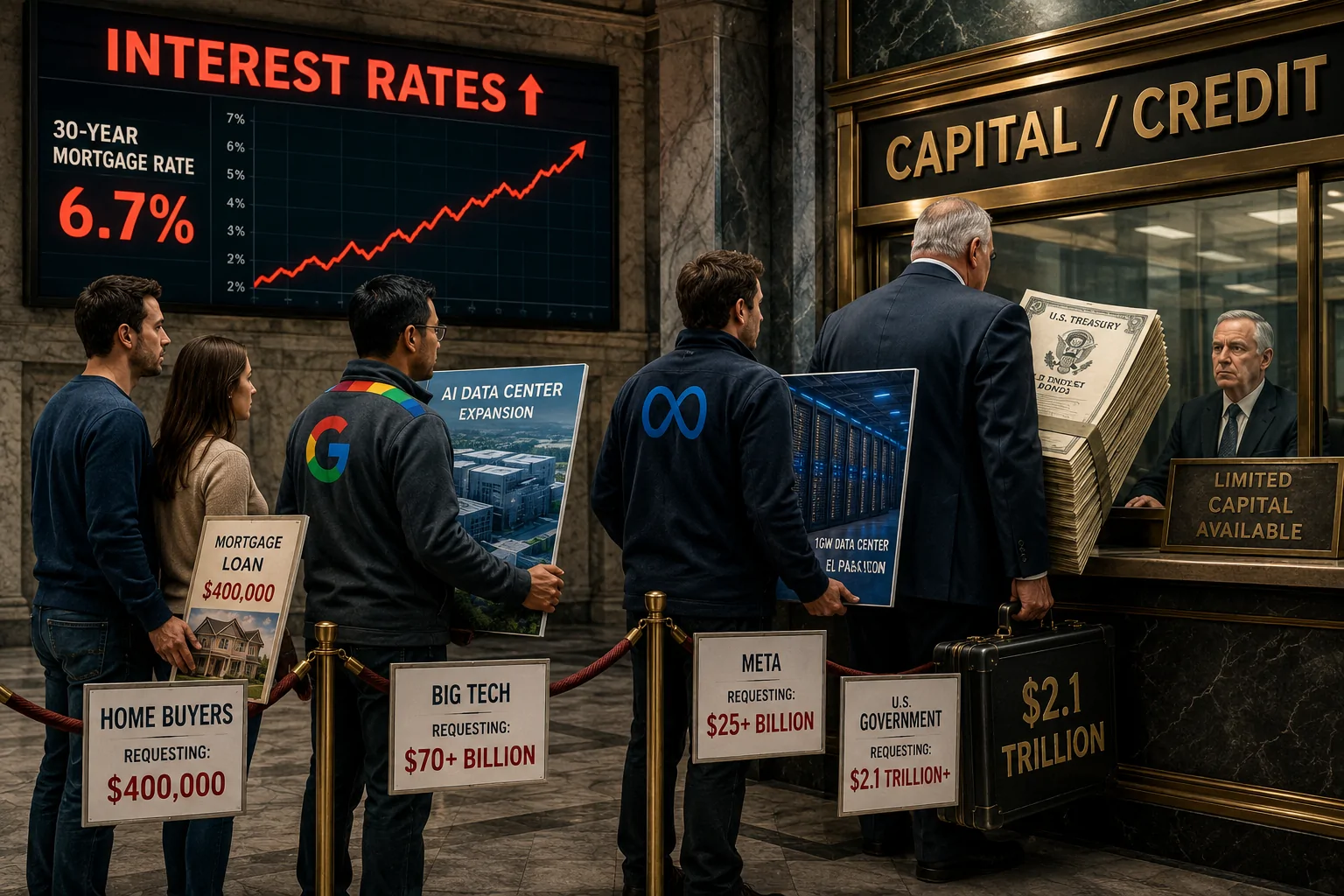
The data center that Meta is building near El Paso is designed for a full gigawatt and comes online in 2028.
Plus Meta just announced plans to grow its campus in Louisiana to 5GW. And OpenAI's Stargate program, spread across sites in several states, is planned for 10GW.
These projects are also spectacularly expensive, and even the richest companies on earth have stopped paying for them out of pocket.
Earlier this month Google borrowed $25 billion from the bond market. It was the company's third major bond sale this year, which brings its 2026 borrowing to more than $70 billion.
Google needs the money because its capital expenditures budget this year is about $200 billion, and in Q2 they spent more cash than they brought in for the first time in more than two decades.
Meta is doing the same thing. In late July, a BlackRock-led group raised $12.5 billion of debt for that El Paso site, where Meta will be the sole tenant for twenty years.
The group had to pay about 7.5% to get the deal done, one of the highest yields on any blue-chip data center bond to date. That comes on top of the $25 billion in bonds that Meta sold in May, and another $30 billion borrowed for the Louisiana campus.
And that's just two borrowers. The total borrowings right now related to AI and data centers is truly staggering.
But it’s not just tech spending that’s driving the bond market. Let’s not forget about the US federal government, which is on track for a $2.1 trillion deficit this fiscal year.
That's just the NEW amount of debt they have to borrow this year just to keep the lights on and pay all the Somalis.
The White House is asking Congress for a $1.5 trillion Pentagon budget next year, more than 40% above this year's and the largest defense request (as a percentage of GDP) since World War II.
So between tech spending and the federal deficit, that’s already several trillion dollars in capital that needs to be borrowed from the bond market... THIS YEAR.
Here’s the problem: America’s “net private savings”, i.e. the sum of ALL undistributed corporate profits, plus total household net income, is only about $2.2 trillion.
In short, the federal government already requires nearly ALL of the net private savings from literally every household and every company across America... just to make ends meet.
Meanwhile the biggest foreign lenders are backing away.
Japan, the UK, and China— the three largest foreign lenders to the US government— all cut their Treasury holdings in June. China now has their lowest Treasury holdings since 2008, down more than 13% from last year.
In short, foreigners are not coming to the rescue. So there is very little capital left over to lend for data centers and AI expansion.
And that says nothing about the tens of millions of other borrowers— small businesses, home buyers, etc. who need to borrow money.
This is why interest rates are rising— it’s simple supply and demand: demand for capital is at an all-time high. Yet supply of capital (at the moment) is fixed. And when the supply/demand fundamentals of capital get out of whack, interest rates rise.
Families who need to buy a home now are standing in the same line as Google, Meta, and the Treasury Department, competing for the same money.
That’s why the average 30-year mortgage rate is 6.7%, and will likely go MUCH higher from here...
... unless the Fed starts printing money again.
Technically the Fed doesn’t physically ‘print’ anything, it’s all electronic. And they don’t call it ‘money printing’, because that would be too embarrassing. They refer to it as ‘quantitative easing’. But it has the same effect— increasing the supply of capital to meet the demand, thus causing interest rates to fall.
Mortgage rates fall. Treasury yields fall. Everyone is able to borrow for less.
Which sounds great... except that conjuring money out of thin air invariably triggers more inflation. So if you can borrow more cheaply but have to pay more for everything, are you really any better off?
It’s obvious the White House wants the Fed to cut rates... which means firing up a fresh round of Quantitative Easing. And Congress certainly won’t mind being able to borrow more.
Pretty much all politicians, regardless of party affiliation, want lower interest rates. Given the choice between high mortgage rates and higher inflation, politicians will pick higher inflation every time.
And that's exactly why it makes sense to have a Plan B.
To your freedom, James Hickman Co-Founder, Schiff Sovereign LLC
Is Scott Bessent turning off Iran is then the QFS turned on
Is Scott Bessent turning off Iran is then the QFS turned on
Dr. Scott Young:9-1-2026
A fundamental restructuring of global economic power is quietly under way, marking a dramatic departure from decades of traditional central banking control.
In a compelling analysis, Dr. Scott Young explores how recent shifts in U.S. financial strategy under the Trump administration signal a new era of monetary enforcement and sovereign economic realignment.
Is Scott Bessent turning off Iran is then the QFS turned on
Dr. Scott Young:9-1-2026
A fundamental restructuring of global economic power is quietly under way, marking a dramatic departure from decades of traditional central banking control.
In a compelling analysis, Dr. Scott Young explores how recent shifts in U.S. financial strategy under the Trump administration signal a new era of monetary enforcement and sovereign economic realignment.
At the center of this transformation is an unprecedented campaign led by the U.S. Treasury rather than the Federal Reserve, utilizing modern distributed ledger technologies and alternative financial tracking mechanisms to reshape international trade and enforce global compliance.
Historically, foreign policy and monetary sanctions relied heavily on traditional banking channels managed through central banking networks. However, current strategic movements illustrate a deliberate transfer of authority toward the U.S. Treasury, which is spearheading a coordinated initiative known as Operation Economic Outcast.
By bypassing standard Federal Reserve mechanisms, the Treasury leverages modern infrastructure, often associated with advanced blockchain applications and emerging Quantum Financial System frameworks, to pinpoint and sever specific financial nodes sustaining non-compliant regimes such as Iran.
This technological shift allows authorities to map complex global transactions in real time, effectively isolating illicit actors from the international marketplace.
The scope of this modern financial campaign extends far beyond traditional bank account freezes, directly targeting the foundational pillars of foreign commerce.
Comprehensive sanctions now encompass digital assets, precious metals, commercial aviation, and maritime shipping channels to completely dismantle illegal trade networks. By identifying key transactional nodes across multiple sectors, the U.S. Treasury can enforce economic isolation with precision, neutralizing workarounds that historically allowed target nations to bypass standard currency restrictions.
Beyond immediate geopolitical maneuvers, this evolving strategy reflects a broader international movement toward sovereign independence and away from centralized banking monopolies. For decades, international finance was largely dictated by centralized entities whose policies frequently prioritized debt expansion over tangible assets.
The shift highlighted in Dr. Young’s presentation suggests a growing movement among sovereign nations to reclaim monetary independence, effectively dismantling corrupt financial structures in favor of localized, asset-backed policies that prioritize national stability and transparency.
This transformation also directly addresses the long-standing vulnerabilities of the global reserve currency model. The reliance on unbacked fiat systems is increasingly viewed as an economic liability, comparable to relying on obsolete energy resources of the past.
As the structural limitations of debt-based fiat currencies become undeniable, the global monetary landscape is reorienting toward intrinsic value. Central banks and national treasuries around the world are incrementally rebalancing their reserves toward physical gold and precious metals, preparing for a system where currency stability is directly linked to tangible assets.
For individual investors and observers of international markets, this strategic pivot highlights the critical importance of financial diversification into hard assets. As the global financial architecture transitions toward transparent ledger systems backed by precious metals, securing physical wealth outside the traditional banking infrastructure becomes an essential risk management strategy.
The integration of advanced tracking technology alongside military and treasury oversight marks a decisive moment in modern history, signaling the end of unchecked central bank dominance and the beginning of a sovereign, asset-backed financial system.
To explore these concepts in greater depth and understand the full scope of these economic developments, watch the complete video from Dr. Scott Young on YouTube.
Putting US Treasury on Trial for Theft and Treason? | Rick Rule
Putting US Treasury on Trial for Theft and Treason? | Rick Rule
Liberty and Finance: 8-31-2026
Rick Rule puts the U.S. financial system on trial. In this unconventional and provocative interview,
Rick Rule takes the stand as an “expert witness” in a mock trial examining some of the most controversial questions facing American savers: Is the financial system quietly eroding purchasing power, penalizing savers, and transferring wealth through inflation and taxation?
Putting US Treasury on Trial for Theft and Treason? | Rick Rule
Liberty and Finance: 8-31-2026
Rick Rule puts the U.S. financial system on trial. In this unconventional and provocative interview,
Rick Rule takes the stand as an “expert witness” in a mock trial examining some of the most controversial questions facing American savers: Is the financial system quietly eroding purchasing power, penalizing savers, and transferring wealth through inflation and taxation?
With decades of experience analyzing banks, corporations, financial institutions, and investment portfolios, Rule brings an unusual perspective to the case:
EXPERT WITNESS — QUALIFICATIONS
• Credit analyst who has reviewed roughly 5,000 financial statements of banks and corporations
• In-depth analysis of 16 major U.S. brokerage and financial-services clearinghouses
• Banking risk expert and co-founder of EverBank and Battle Bank
• Investment analyst who says he has reviewed nearly 100,000 investor portfolios, including those of individuals, foundations, and funds
THE CHARGES — IN THIS MOCK TRIAL
• Conspiracy to defraud through misleading or inadequate inflation statistics
• Theft through monetary expansion and the erosion of savers’ purchasing power, including holders of paper cash, dollar-denominated bank and brokerage deposits, and U.S. Treasuries
• Seizing property without just compensation through the taxation of nominal capital gains, including homes, land, gold, and silver
• The constitutional controversy surrounding the fiat dollar versus gold and silver
• Weakening America’s financial position and potentially aiding foreign adversaries through unsustainable fiscal and monetary policies
Rule challenges viewers to look beyond official statistics and examine what is actually happening to their purchasing power.
He explains why he believes inflation can be significantly higher than the numbers many Americans rely on, why capital-gains taxes can capture illusory gains created by currency depreciation, and why he believes savers themselves must take greater responsibility for protecting their wealth.
The discussion also covers gold vs. silver, the risks of the banking system, what happens to gold during a liquidity crisis, and why Rule believes America's greatest financial threats may ultimately come from within.
This is a mock trial—but the questions are very real.
INTERVIEW TIMELINE:
0:00 Intro
1:05 US Treasury on trial
17:55 Inflation statistics
29:30 Dilution of currency supply
50:08 Financial future of the US
52:00 Viewers questions
58:00 Rick Rule's resources
Iraq Economic News and Points To Ponder Tuesday Afternoon 9-1-26
Oil Prices Climb Above $91 On Renewed US-Iran Strikes
2026-09-01 Shafaq News Oil prices gained around $1 on Tuesday as the resumption of fighting between the U.S. and Iran in the Middle East renewed fears of supply disruptions from the world's key crude-producing region.
Brent crude futures were up $1.05, or 1.2%, to $91.54 a barrel at 0455 GMT, while U.S. West Texas Intermediate crude was up $1.27, or 1.5%, to $87.03.
Oil Prices Climb Above $91 On Renewed US-Iran Strikes
2026-09-01 Shafaq News Oil prices gained around $1 on Tuesday as the resumption of fighting between the U.S. and Iran in the Middle East renewed fears of supply disruptions from the world's key crude-producing region.
Brent crude futures were up $1.05, or 1.2%, to $91.54 a barrel at 0455 GMT, while U.S. West Texas Intermediate crude was up $1.27, or 1.5%, to $87.03.
In the previous session, Brent closed up 2.7%, at one point reaching its highest since August 25, and WTI settled up 2.8%, touching its highest since August 21.
On Monday, U.S. President Donald Trump threatened further strikes against Iran following the first exchange of direct attacks between the countries in a month on Sunday, raising tensions in a conflict that had recently shifted into an economic standoff.
"These bring the potential for Iranian retaliation back into the equation. That in turn raises the prospect of damage to energy infrastructure around the Gulf and adds fresh uncertainty for shipping through the Strait of Hormuz. Both of those risks are being reflected in the firmer tone in crude prices," said Tim Waterer, chief market analyst at KCM.
On Monday, the number of visible commodity vessels transiting the Strait of Hormuz held at five per day, below the 10-day average of around 14, shipping data from Kpler showed. None of the five ships were liquid tankers.
Efforts by mediators including Qatar and Oman to broker a deal to reopen the Strait of Hormuz, which carried about a fifth of global oil supplies before the war erupted in late February, have so far failed to gain traction.
Iran shut the waterway after the U.S. and Israel attacked the country on February 28.
Highlighting the risks that remain to shipping and oil supply, the United Kingdom Maritime Trade Operations agency (UKMTO) said on Tuesday a tanker reported being struck by three projectiles while sailing out of the Strait of Hormuz. No casualties or environmental impacts were reported.
"Despite satellite tracking firms suggesting oil flowing through Hormuz is around 6 million barrels per day, that is well below pre-conflict levels," said ANZ analysts in a note.
"In the meantime, the buffers the global oil market has been relying on are becoming exhausted. U.S. inventories are nearing minimum levels, while China's ability to keep imports low will be tested as seasonal demand picks up."
Crude oil inventories in the U.S. Strategic Petroleum Reserve declined by about 3.1 million barrels last week, leaving stockpiles at 286.6 million barrels.
Analysts polled by Reuters in August expect oil prices to remain above $80 a barrel in 2026 as shipping disruptions continue. (REUTERS)
https://www.shafaq.com/en/Economy/Oil-prices-climb-above-91-on-renewed-US-Iran-strikes
Basrah Crude Prices Jump More Than 7%
2026-09-01 Shafaq News– Basrah Iraq’s Basrah crude prices rose on Tuesday, with Basrah Heavy gaining more than 7% alongside a recovery in global oil benchmarks.
Basrah Heavy climbed $5.91, or 7.93%, to $80.43 per barrel, while Basrah Medium gained $5.91, or 7.59%, to $83.73.
In global markets, Brent crude rose $1.05, or 1.2%, to $91.54 a barrel. U.S. West Texas Intermediate (WTI) gained 1.5% to around $87.03.
Murban crude rose to $98.45 a barrel, up $2.70, or 2.82%, while the OPEC basket stood at $89.59, up $2.28, or 2.61%.
https://www.shafaq.com/en/Economy/Basrah-crude-prices-jump-more-than-7
Dollar Climbs In Baghdad, Erbil Markets
2026-09-01 Shafaq News- Baghdad/ Erbil The US dollar opened Tuesday’s trading higher in Iraq, hovering around 154,000 dinars per 100 dollars.
According to a Shafaq News market survey, the dollar traded in Baghdad's Al-Kifah and Al-Harithiya exchanges at 154,250 dinars per 100 dollars, up from the previous session’s 154,000 dinars.
In the Iraqi capital, exchange shops sold the dollar at 154,750 dinars and bought it at 153,750 dinars, while in Erbil, selling prices stood at 154,100 dinars and buying prices at 154,000 dinars
https://www.shafaq.com/en/Economy/Dollar-climbs-in-Baghdad-Erbil-markets-7
Iraq Orders Generator Fuel Subsidy For September
2026-09-01 Shafaq News- Baghdad Iraqi Prime Minister Ali Faleh Al-Zaidi on Tuesday ordered subsidized fuel supplies for private generators throughout September, according to a statement from the PM's Media Office, hours after operators in Baghdad began shutting down their units in protest over Oil Ministry support.
Private generators will receive 40 liters of fuel per kilowatt-hour at 400 Iraqi dinars (about $0.30) per liter, while maintaining the currently approved operating schedule.
Al-Zaidi also directed that electricity be supplied for at least 20 hours a day through alternating operation between the national grid and private generators.
Prime Minister Ali Faleh Al-Zaidi Directs Provision of Fuel to Private Generators at Subsidized Price for September
•••••
Prime Minister Ali Faleh Al-Zaidi directed today, Tuesday, that private generators be supplied with fuel at a rate of 40 liters per kilowatt-hour and at a subsidized price of 400 Iraqi dinars per liter throughout the month of September.
The Prime Minister also directed adherence to the currently approved operating hours, with electricity supplied for no less than 20 hours per day through alternating operation between the national power grid and private generators, ensuring a stable and continuous electricity supply to citizens. Media Office of the Prime Minister September 1, 2026
•••••
Generator owners in Baghdad began shutting down their units at midnight on Tuesday, about two hours after the Oil Ministry told Shafaq News that it prioritizes fuel supplies to residential generator operators, with diesel allocations tied to the number of hours of electricity supplied by the national grid.
Read more: Private generator operators threaten Iraq-wide shutdown in September
https://www.shafaq.com/en/Economy/Iraq-orders-generator-fuel-subsidy-for-September
Gold Prices Fall In Baghdad, Erbil Markets
2026-09-01 Shafaq News- Baghdad/ Erbil On Tuesday, gold prices hovered around 950,000 IQD per mithqal in Baghdad and Erbil markets, according to a Shafaq News market survey.
Gold prices on Baghdad's Al-Nahr Street recorded a selling price of 960,000 IQD per mithqal (equivalent to five grams) for 21-carat gold, including Gulf, Turkish, and European varieties, with a buying price of 956,000 IQD. The same gold had sold for 965,000 IQD on Monday.
The selling price for 21-carat Iraqi gold stood at 930,000 IQD, with a buying price of 926,000 IQD.
In jewelry stores, the selling price per mithqal of 21-carat Gulf gold ranged between 960,000 and 970,000 IQD, while Iraqi gold sold for between 930,000 and 940,000 IQD.
In Erbil, 22-carat gold was sold at 984,000 IQD per mithqal, 21-carat gold at 940,000 IQD, and 18-carat gold at 807,000 IQD.
https://www.shafaq.com/en/Economy/Gold-prices-fall-in-Baghdad-Erbil-markets-5-5
Iran's Toman Plummets Past 210K Per Dollar
2026-09-01 Shafaq News- Tehran Iran's toman has lost more than half its value against the dollar in a year, with the US currency climbing above 210,000 tomans from around 95,800 tomans a year ago, according to Tejarat News, a website that tracks free-market exchange rates.
The dollar is trading at more than 211,000 tomans in Iran's free market, up from about 207,000 a week earlier. The euro stood at around 245,000 tomans, while the British pound traded at about 285,000 tomans.
"The decline has accelerated as demand for foreign currency rises and access to international payment channels remains limited, putting further pressure on the currency," Tejarat News reported, noting that a weaker currency raises the cost of imported goods, raw materials and essential products.
On Aug. 24, US Treasury Secretary Scott Bessent unveiled "Operation Economic Outcast," targeting nearly 60 Iran-linked individuals, entities and vessels and widening potential secondary sanctions across sectors including digital assets, technology, gold, aviation and shipping.
Iran is also contending with high inflation. The Statistical Center of Iran reported annual inflation of 66% in July, with prices 87.9% higher than a year earlier and food inflation at 128%.
https://www.shafaq.com/en/Economy/Iran-s-toman-plummets-past-210K-per-dollar
Seeds of Wisdom RV and Economics Updates Tuesday Afternoon 9-1-26
Good Afternoon Dinar Recaps,
Japan's 30-Year Bond Shock: Rising Yields Challenge the World's Debt System
Japan's surging long-term bond yields are testing the country's debt sustainability while creating potential ripple effects across global capital flows and government borrowing costs.
Good Afternoon Dinar Recaps,
Japan's 30-Year Bond Shock: Rising Yields Challenge the World's Debt System
Japan's surging long-term bond yields are testing the country's debt sustainability while creating potential ripple effects across global capital flows and government borrowing costs.
OVERVIEW
Japan's bond market: Rising long-term yields are forcing investors to reassess the cost of holding Japanese government debt as inflation, fiscal concerns and expectations for higher interest rates intensify.
Global capital: Japan has historically been an important source of relatively inexpensive capital, meaning a shift toward higher domestic yields could influence where Japanese and international investors allocate money.
Global debt: Japan's bond-market stress is occurring alongside rising yields in the UK, Europe and the United States, suggesting a broader repricing of sovereign debt and the cost of capital.
KEY DEVELOPMENTS
1. Japan's 10-Year Yield Breaks the 3% Barrier
Japan's 10-year government bond yield reached 3% for the first time since 1996, marking a major milestone for a country that spent decades operating with exceptionally low interest rates.
The move reflects growing concerns over inflation, government spending and the future path of Bank of Japan interest rates.
2. Long-Term Japanese Yields Are Moving Even Higher
The pressure extends beyond the 10-year bond. Japan's 30-year government bond yield was around 4.19% on September 1, continuing its upward move.
Longer-term yields are particularly important because they reflect investor expectations about future inflation, government borrowing and the long-term cost of capital.
3. Japan's Debt Burden Makes Higher Yields More Significant
Japan's government debt is more than 200% of GDP, making rising borrowing costs an important fiscal issue.
As yields rise, the government faces greater costs when existing debt matures and must be refinanced. That can eventually place pressure on government spending, taxation and fiscal policy.
4. Japan Could Affect Global Capital Flows
Japan has historically been a major source of overseas investment because domestic yields were extremely low.
If Japanese yields become increasingly attractive, investors could have greater incentive to keep capital at home or reduce exposure to foreign bonds, potentially affecting markets that have benefited from Japanese capital.
Reuters analysts noted that higher Japanese yields could curb foreign-asset purchases and contribute to a broader repricing of global fixed-income markets.
5. The Japanese Shock Is Part of a Larger Global Repricing
Japan is not moving in isolation. Government borrowing costs are rising across major economies as oil prices, inflation concerns, fiscal pressures and expectations for higher interest rates weigh on bond markets.
The UK's 30-year borrowing cost has reached approximately 5.89%, its highest level since 1998, while yields in Germany, France and the United States have also moved higher.
WHY IT MATTERS
Japan's bond market has historically been one of the foundations of the global low-interest-rate and carry-trade environment.
When Japanese yields rise substantially, investors have to reconsider whether taking additional currency and foreign-market risk is still worthwhile.
The larger issue is the simultaneous rise in borrowing costs across several major economies. If sovereign yields remain elevated, governments everywhere may have to compete for capital at higher prices.
That can affect economic growth, fiscal policy, asset valuations and central-bank decisions.
WHY IT MATTERS TO FOREIGN CURRENCY HOLDERS
Currency value: Higher Japanese yields can influence the yen by changing expectations for Bank of Japan policy and international capital flows.
Capital flows: Japanese investors may have greater incentive to keep money in domestic assets rather than seeking returns overseas.
Exchange rates: Changes in Japanese yields can affect the yen and major currency pairs, particularly if expectations for monetary tightening continue to increase.
Purchasing power: Higher global borrowing costs and energy prices can increase costs for households and businesses, putting additional pressure on currencies and purchasing power.
IMPLICATIONS FOR THE GLOBAL RESET
Pillar 1: Debt
Japan demonstrates how quickly a low-interest-rate environment can become a higher-cost debt environment.
With government debt exceeding 200% of GDP, sustained increases in long-term yields could place greater pressure on Japan's fiscal position. The same principle applies globally: the higher the cost of refinancing debt, the less fiscal flexibility governments have.
Pillar 2: Assets
Japan's rising yields could contribute to a broader reassessment of global asset allocation.
If Japanese bonds become more attractive relative to foreign assets, capital flows can change. That can affect global bonds, currencies, equities and other risk assets, particularly where valuations have depended on persistently low interest rates.
CONCLUSION
Japan's bond-market move is significant because it represents more than a change in one country's interest rates. It is a test of what happens when one of the world's largest debt markets begins transitioning away from decades of exceptionally low borrowing costs.
The combination of Japan's rising yields, elevated government debt and changing capital flows could have consequences well beyond Tokyo.
At the same time, Japan's move is occurring alongside a broader global bond repricing driven by energy costs, inflation and fiscal pressure.
The question is no longer simply how high Japanese yields can go—it is how a higher global cost of capital changes the financial system built around decades of cheap money.
Seeds of Wisdom Team
Newshounds News™ Exclusive
SOURCES
Reuters — "Japan's benchmark bond yield rises to 3% for first time in 30 years"
Reuters — "Explainer: What's behind the selloff in world bond markets?"
~~~~~~~~~~
Seeds of Wisdom Team RV Currency Facts Youtube and Rumble
Newshound's News Telegram Room Link
RV Facts with Proof Links Link
RV Updates Proof links - Facts Link
Start Here room with Most Asked Questions Link
Follow the Gold/Silver Rate COMEX
Follow Fast Facts
Seeds of Wisdom Team™Website
Thank you Dinar Recaps
Ariel: Banking Infrastructure Preparations for the Iraqi Dinar Revaluation Event (and more)
Ariel: Banking Infrastructure Preparations for the Iraqi Dinar Revaluation Event
9-1-2026
The Currency Undercurrent: Banks That Are Shifting Business Models For The Reset
Domestic Banking Infrastructure Preparations for Iraqi Dinar Revaluation Event
THE SEPTEMBER 30 CONDITIONAL
Iraq’s announcement that it will not extend the September 30 deadline for US troop withdrawal is the public-facing lever.
Ariel: Banking Infrastructure Preparations for the Iraqi Dinar Revaluation Event
9-1-2026
The Currency Undercurrent: Banks That Are Shifting Business Models For The Reset
Domestic Banking Infrastructure Preparations for Iraqi Dinar Revaluation Event
THE SEPTEMBER 30 CONDITIONAL
Iraq’s announcement that it will not extend the September 30 deadline for US troop withdrawal is the public-facing lever. The private understanding communicated off the record is that the withdrawal timeline is contingent on Iraq completing the redenomination process and settling its financial obligations to the United States for the banking system modernization program, which has cost US taxpayers approximately $4.7 billion since 2020.
OPERATIONAL ASSESSMENT:
Every major US bank with Iraqi correspondent relationships is prepared. The wealth management buildouts, the Arabic-speaking personnel transfers, the currency authentication device procurement, the RTGS connections, the amended correspondent agreements these are not coincidental infrastructure upgrades. They are the domestic receiving end of a pipe that Baghdad is about to turn on.
The search results that surface publicly BOA stating no plans to handle dinar notes, JPMorgan’s Iraq branch targeting project finance are technically accurate and deliberately misleading.
No bank is preparing to exchange paper dinar at a teller window. Every bank with exposure is preparing to onboard digital dinar holdings through wealth management divisions equipped to convert sovereign currency into diversified portfolios at scale.
The dinar holder who walks into a rebranded wealth management office in Dallas or Phoenix or Charlotte with authenticated holdings and proper documentation will not be turned away. They will be greeted by an advisor who has been waiting in a freshly carpeted office with a terminal that cost more than a car, connected to a server in Baghdad that finished booting up three weeks ago.
Read Full Article:
https://www.patreon.com/Prolotario1/posts/currency-banks-168238130
Ariel: Just Thought I’d Drop this off
9-1-2026
Just Thought I Drop This Off:
JP Morgan has been quietly reclassifying specific branch locations not all of them, targeted ones in markets with statistically insignificant foreign-currency-holding demographics.
Translation: They’re not adding Wealth Management desks in branches serving high-net-zero expat communities. They’re adding them in places like suburban Ohio, middle Tennessee, the Florida panhandle regions where the average account holder is a middle-class American who has been holding physical IQD in desk drawers for years. These aren’t wealth management additions for existing millionaires. They’re intake stations.
Which means they are not doing this for existing clients. They are preparing for “YOU”.
Reportedly this was also shared. That these sections are being staffed with personnel who have received accelerated training in exotic currency redemption procedures specifically, the documentation chain required for large-volume foreign note exchanges that exceed standard Treasury reporting thresholds. The training materials reference “anticipated high-denomination foreign currency events” without naming the IQD explicitly.
But the denomination ranges cited in the internal protocols match IQD note values exactly 25,000; 10,000; 5,000; 1,000; 500; 250.
Wells Fargo has initiated a series of what they’re calling scheduled system maintenance windows multi-hour lockdowns of specific currency exchange modules within their core banking platform.
These windows are occurring on weekends, which is standard, but the frequency has increased dramatically since Q2 2026.
The modules being updated aren’t the standard FX rails used for everyday currency exchanges. They’re the ISO 20022-compliant corridors the same messaging standard that XRP, QFS, and the post-Basel III settlement frameworks all use.
Source(s):
• https://x.com/Prolotario1/status/2094534570544644280
https://dinarchronicles.com/2026/09/01/prolotario-just-thought-id-drop-this-off/
Tuesday Iraq News Posted by Tishwash at TNT 9-1-2026
TNT:
Tishwash: Al-Zaydi, in a meeting with the framework: The file of vacant ministries will be completed this week.
Prime Minister Ali al-Zaidi confirmed that discussions regarding the vacant ministries will be completed this week, during a new meeting with the coordination framework held in the office of Badr Organization leader Hadi al-Amiri.
According to a statement published by the Coordination Framework, the meeting discussed "the latest developments at the local and international levels," while Al-Zaydi announced at the beginning of the meeting that "discussions related to completing the government formation will be completed during this week, in preparation for sending it to the House of Representatives next week for a vote."
TNT:
Tishwash: Al-Zaydi, in a meeting with the framework: The file of vacant ministries will be completed this week.
Prime Minister Ali al-Zaidi confirmed that discussions regarding the vacant ministries will be completed this week, during a new meeting with the coordination framework held in the office of Badr Organization leader Hadi al-Amiri.
According to a statement published by the Coordination Framework, the meeting discussed "the latest developments at the local and international levels," while Al-Zaydi announced at the beginning of the meeting that "discussions related to completing the government formation will be completed during this week, in preparation for sending it to the House of Representatives next week for a vote."
The coordination framework also discussed "the country's financial and economic situation, in light of the repercussions of the war in the region and the disruption of navigation in the Strait of Hormuz," and also discussed "the progress of work on important and urgent legislation, most notably the general budget law and the Popular Mobilization Forces link
Tishwash: When will the removal of zeros begin? A member of parliament sets a date for the project's implementation.
MP Murtadha Afween confirmed on Monday that the project to remove zeros from the Iraqi currency has not yet moved to the implementation phase, indicating that the project does not represent a direct solution to the crises plaguing the Iraqi economy.
Afween told the Information Agency that "the issue of removing zeros from the currency has not yet reached the implementation phase," explaining that "the project has not contributed to addressing the crises facing the Iraqi economy."
He added that "removing zeros from the currency, if it proceeds, should not be considered a sufficient measure to address the economic challenges," noting "the importance of focusing on issues directly related to the country's economic and financial reality."
Afween pointed out that "addressing the economic crises requires concrete steps and measures targeting the root causes of the problems, in addition to developing solutions for issues affecting financial and economic stability," emphasizing that "monetary measures alone are insufficient to address the accumulated economic problems."
Earlier, The Media Line network revealed in a report that the Iraqi government will begin issuing a new currency with zeros removed at the beginning of 2027. link
************
Tishwash: Following a recommendation from the US Treasury, instructions have been issued to Iraqi refineries to build a database of relatives of officials.
Iraqi banks received instructions from the government today (Monday, August 31) to begin working on "building databases that cover Iraqi politicians and their relatives up to the third degree and submitting them to it."
According to information obtained by (Baghdad Today), the new database will be used to identify any "illegal profiteering and indicators of corruption operations, and may also include private security personnel and military personnel close to political and responsible figures."
The instructions received by the banks came in the wake of recommendations issued earlier by the Economic Mobilization Task Force of the US Federal Reserve to the Iraqi government to curb corruption and currency smuggling to Iran.
It is noted that the Central Bank informed Iraqi banks to prepare the complete databases by the 29th of this month. link
************
Tishwash: Sources told Al-Mustaqilla that the plan to remove zeros from the Iraqi currency is entering advanced stages, with a plan to replace the currency in early 2027.
Informed sources revealed to Al-Mustaqilla that the file of removing zeros from the Iraqi dinar and reissuing the currency has entered advanced stages of study and discussion within government departments, noting that a plan currently circulating aims to begin the process of replacing the old currency with a new currency starting from 2027, in the event that the required governmental, legislative and technical approvals are completed.
The sources said that the currency restructuring file is no longer limited to economic and technical discussions within the Central Bank of Iraq, but has become subject to study at the level of the Prime Minister’s office, within a plan related to the mechanism for moving from the current currency to a new monetary issuance after removing the zeros.
According to information obtained by Al-Mustaqila, the discussions are currently focused on developing a clear implementation plan for the replacement process, the transitional period during which the two currencies will be traded, the mechanisms for banks and government institutions to deal with the new currency, as well as the procedures related to bringing the largest possible amount of cash outside the banking sector into the formal financial system.
The sources confirmed that 2027 is among the current proposals as a possible start date for the process of replacing the old currency with the new one, but stressed that the date will not become officially effective before the completion of the governmental and legislative process and obtaining the required approvals.
The sources expected that the file would witness developments at the Cabinet level in the coming period, followed – if the project is approved – by moving to the required legislative path before reaching the implementation stage.
Mustafa Sand's statements bring the issue back to the forefront.
The new information coincides with previous statements by Iraqi Communications Minister Mustafa Sanad, who said during August that a decision regarding the removal of zeros and the change of currency had been decided at the political level, and linked the move to bringing out hoarded funds and returning them to the economic cycle and the banking system.
Sand said that the currency change process could encourage holders of large amounts of cash to reveal their money when exchanging old banknotes, allowing some of the liquidity outside banks to be brought back into the financial system, as well as dealing with money whose owners cannot prove its sources or bring it legally into the exchange process.
Sand’s statements had sparked widespread controversy, especially after the government said on August 17 that the Cabinet had not made a final decision at that time to remove the zeros, and that implementing such a step required a legislative process that went through the House of Representatives.
The Central Bank denies printing... but outlines the course of any future project
On August 26, 2026, the Central Bank of Iraq issued a statement explicitly denying reports that it had printed quantities of new Iraqi currency with zeros removed in preparation for its release into the markets.
However, the bank’s statement did not close the door to a future currency restructuring project, as it confirmed that any such project, if an official decision is made regarding it, will be subject to multiple legal, regulatory and technical stages, and that it will be officially announced and a transition period will be determined that allows citizens, banks and institutions to exchange the currency in an organized and safe manner.
This means that the official denial issued by the Central Bank so far relates to the existence of a new currency that has been printed and is ready for circulation, and not to the cancellation of the project idea or the exclusion of discussing it in the future.
Al-Mustaqilla has been following the case since its inception.
Al-Mustaqilla had published a series of reports in recent days on the issue of removing zeros and restructuring the currency, in which it quoted sources close to decision-making circles as saying that the matter was under serious study, despite the fact that no final government announcement had been issued yet.
Information obtained by “Al-Mustaqila” today confirms that the file is still in existence and under study within the relevant institutions, and that the discussions have moved to more advanced details regarding how to implement the replacement process and not just the idea in principle.
However, the sources confirmed at the same time that the project’s transition to the actual implementation phase will remain linked to the final decision of the Council of Ministers, the legislative procedures required by the file, and the position of the Central Bank, as it is the entity responsible for managing and issuing currency and monetary policy in Iraq.
Why does the government want to change the currency?
The proposed plans suggest that the project’s objectives are not limited to reducing the number of zeros and facilitating accounting and monetary operations, but could also include reorganizing the large amount of cash that exists outside the banking system.
Iraq is one of the economies that relies heavily on cash transactions, and a large percentage of the currency in circulation is outside of banks.
The latest data circulating on monetary indicators indicates that the volume of currency circulating outside the banking sector has reached more than 100 trillion dinars, which reflects the extent of the hoarding phenomenon and reliance on direct cash.
Currency replacement – if the government adopts clear control mechanisms – would encourage hoarders to deposit their money through banks or exchange centers within a specific time period, giving financial authorities greater ability to know the movement of money and the sources of some large cash blocks.
The process can also support anti-money laundering and anti-financing measures if it is accompanied by the application of clear rules regarding deposits, large sums, and sources of funds.
Replacement, not cancellation, of the value of citizens' money
From an economic standpoint, removing zeros does not mean that citizens' money will lose its value or that the dinar will automatically become more expensive.
If it is decided – for example – to remove three zeros, then renaming the monetary unit could make every thousand dinars of the old currency equivalent to one dinar of the new currency, in parallel with repricing salaries, prices, debts, contracts and balances at the same rate.
The main objective of the process is to simplify monetary categories, accounts and transactions, not to achieve an automatic increase in the purchasing power of the dinar.
Expected transitional phase
If the project is approved, the authorities will likely adopt a transitional phase during which the old and new currencies will circulate simultaneously before the old version is gradually withdrawn.
The central bank had already confirmed that any future decision of this kind would include a transition period to ensure that citizens, banks and institutions could exchange currency in an orderly manner while preserving all financial rights and obligations.
The process will require resetting banking systems, ATMs, accounting software, pricing, contracts and government records, as well as a broad awareness campaign to prevent the transition from being exploited for fraud or speculation.
The coming days could be decisive.
According to sources from “Al-Mustaqilla”, the next stage will be important in determining the final course of the project, while the governmental, legal and technical aspects of the currency replacement plan continue to be studied.
The sources confirmed that there is a trend to push the file towards completing the necessary procedures, with the picture to become clearer after the Cabinet's position and the legislative process are decided.
Accordingly, the information available so far indicates that the project to change the currency and remove zeros is moving within Iraqi institutions, and that 2027 is being considered as a possible start date for the replacement process according to the ideas being discussed. However, this has not yet turned into an official, announced, and binding date from the Central Bank or the Council of Ministers as of the date of this report.
The Iraqi public is waiting for any official announcement in the coming days that could move one of the most sensitive financial issues in the country from the stage of studies and discussions to the stage of decision and implementation link
Tishwash: Protests in Basra, Kirkuk and Anbar: Financial and employment demands shake the energy sector
On Tuesday, three Iraqi provinces witnessed protests and sit-ins demanding action related to the energy sector, including rejecting the increase in crude oil prices supplied to refineries in Basra, objecting to the price per ampere for private generators in Anbar, as well as demands to reinstate 610 workers to their jobs at the Kirkuk refinery.
In Basra, demonstrations and sit-ins resumed inside the Shuaiba refinery, expressing categorical rejection of the government’s recent decision to increase the prices of crude oil supplied to investment and government refineries.
The protesters demanded that the concerned authorities immediately reverse this decision, warning of its negative repercussions on the refinery's operating costs, its direct impact on the stability of staff employment, and the decline in profits of companies affiliated with the oil sector, according to a Shafaq News Agency correspondent.
For their part, the owners of private generators in Anbar province organized a protest in front of the provincial council building, objecting to the low price per ampere compared to operating costs, stressing that the approved price does not correspond to the size of the expenses they bear.
Alaa Sadiq Khalaf, the owner of a private generator, told Shafaq News Agency during the protest that his generator operated for about 280 hours during the month of August, while generator owners, according to him, received 35 dinars per ampere, noting that the main problem is related to the price per hour of operation.
Khalaf added that a committee visited the generator owners and determined, according to their calculations, the cost of an hour of operation without taking into account a profit margin of about 42 dinars, while it is being calculated at prices ranging between 26, 33 and 37 dinars, considering that these prices do not correspond to the actual cost of operation.
He explained that generator owners bear additional burdens related to supplying fuel, workers and operating materials, indicating that some of these costs are paid from their own money, despite talk of providing some materials or services for free.
Khalaf stressed that generator owners "are also citizens" and bear significant financial burdens, calling for the adoption of a pricing system that takes into account the actual cost of operation and does not impose additional losses on generator owners under the guise of protecting citizens.
He pointed out that continuing to operate with the current pricing, from the perspective of generator owners, puts them in front of an increasing financial crisis, given the high operating costs and the lack of a sufficient profit margin.
In this context, the generator owners explained that the Prime Minister’s office statement regarding supplying generators with subsidized fuel and operating them for 20 hours a day pertains to the month of September, stressing that their protest today is related to the approved pricing for the month of August, and is not an objection to the directives for the month of September.
In Kirkuk, dozens of workers at the Kirkuk refinery staged a protest in front of the governorate building, demanding justice and a review of the decision to terminate their services.
One of the protesters, named Mohammed Abdullah Dali, told Shafaq News Agency that "dozens of workers employed at the Kirkuk refinery and affiliated with the North Refineries Company in Baiji organized a demonstration in front of the Kirkuk Governorate building to demand their rights and fair treatment."
He explained that "the number of workers whose employment was terminated is 610 people, and they are employees of the Kirkuk refinery, and they have provided years of service and work," indicating that "terminating their services caused them great harm and suffering, and we consider it an injustice and unfairness to us."
Dali added that "the protesters are demanding that the relevant government authorities reconsider their situation and work to reinstate them to their jobs or find a fair solution to address their issue," noting that "the main demand is to include them in the 2027 budget, which would guarantee the restoration of their rights and end their ongoing suffering."
He stressed that the protest was "peaceful, and aimed at conveying the voice of the workers to the local government and the relevant federal authorities, and urging them to intervene urgently to do them justice and listen to their demands."
The protesters demanded that the government, the Ministry of Oil, the North Refineries Company and other relevant authorities "open the file of the 610 workers, review their years of service and the circumstances of their termination, and develop a legal and administrative solution that guarantees their rights link