
IRAQ & CURRENCY UPDATE: Clarity Act, China Conflict & What Comes Next? | Mark Z & Zester
IRAQ & CURRENCY UPDATE: Clarity Act, China Conflict & What Comes Next? | Mark Z & Zester
Jon Dowling: 8-19-2026
The global financial landscape is undergoing a profound transformation, driven by technological evolution and shifting geopolitical alliances.
In a recent episode of the Jon Dowling podcast, viewers were treated to a deep dive into these systemic changes. Featuring veteran commentator MarkZ and blockchain expert Zester, the episode explores the complex dynamics of currency reforms, international trade realignments, and the integration of blockchain technology into the global monetary infrastructure
IRAQ & CURRENCY UPDATE: Clarity Act, China Conflict & What Comes Next? | Mark Z & Zester
Jon Dowling: 8-19-2026
The global financial landscape is undergoing a profound transformation, driven by technological evolution and shifting geopolitical alliances.
In a recent episode of the Jon Dowling podcast, viewers were treated to a deep dive into these systemic changes. Featuring veteran commentator MarkZ and blockchain expert Zester, the episode explores the complex dynamics of currency reforms, international trade realignments, and the integration of blockchain technology into the global monetary infrastructure
For anyone tracking the future of global finance, this episode offers a comprehensive look at how emerging economic policies and digital assets are shaping a new financial order. Here is a detailed breakdown of the key themes discussed in this compelling broadcast.
A primary focus of the discussion revolves around Iraq’s ongoing efforts to modernize its financial sector and stabilize its national currency, the dinar.
MarkZ, drawing on his extensive tracking of global currency movements, highlights that Iraq’s strategy is aimed at restoring the purchasing power of its currency rather than executing a simple “lop” or cosmetic redenomination.
According to the hosts, the Central Bank of Iraq’s roadmap includes the reintroduction of lower-denomination notes and physical coins into active circulation. This move is designed to facilitate daily transactions and build domestic confidence in the local currency.
Furthermore, the podcast highlights Iraq’s progressive stride toward digitization, specifically discussing the development of a digital dinar stablecoin. This digital integration is positioned as a critical step to streamline transactions, curb inflation, and integrate Iraq more seamlessly into the modern digital economy.
The conversation extends far beyond individual currencies, framing these monetary reforms within a broader geopolitical context. A major theme of the episode is the realignment of United States foreign policy.
The hosts discuss a strategic shift toward what is described as a “quarter sphere defense,” suggesting a gradual U.S. military pullback from traditional global trade choke points. This shift, coupled with efforts to reduce regional tensions in the Middle East, is fostering new diplomatic and trade realignments among nations like Saudi Arabia and other major players in the region.
As traditional Western-led financial frameworks adapt to these shifts, the BRICS alliance (Brazil, Russia, India, China, and South Africa) is emerging as a powerful counterweight. The podcast emphasizes how BRICS nations are championing a transition toward commodity-backed trade systems.
By anchoring trade currencies to tangible assets—such as gold, oil, and other essential resources—these nations aim to establish a more stable, inflation-resistant alternative to traditional fiat-based reserve systems.
Another key highlight of the episode is the economic outlook for Vietnam and its national currency, the dong. The hosts discuss how Vietnam’s currency has historically been kept under tight control due to regional geopolitical maneuvering and competitive trade policies. However, the underlying fundamentals of the Vietnamese economy tell a highly promising story.
Vietnam has rapidly emerged as a global manufacturing powerhouse, benefiting significantly from multinational corporations diversifying their supply chains away from China. The podcast suggests that as Vietnam continues to solidify its independence in manufacturing and technology, its currency is well-positioned to reflect this growing economic strength. The decoupling of supply chains from dominant regional neighbors serves as a powerful catalyst for Vietnam’s long-term financial sovereignty.
The final segment of the podcast shifts focus to the United States, examining how legislative frameworks are paving the way for a fully digitized financial system. Zester, lending his expertise in blockchain technology, outlines the significance of several key federal legislative efforts, including the GENIUS Act, the Clarity Act, and the Bitcoin Act.
These acts, alongside pioneering state-level initiatives like Florida’s own version of the Clarity Act, are designed to establish clear regulatory boundaries for digital assets. The hosts explain that these legal frameworks are crucial for ushering in an era of tokenized assets.
By allowing traditional financial instruments, such as U.S. Treasury bonds and physical reserves, to be legally tokenized on the blockchain, the financial sector can achieve unprecedented levels of liquidity, transparency, and transactional efficiency.
The latest episode of the Jon Dowling podcast serves as an eye-opening analysis of a world in financial transition. By connecting the dots between domestic currency reforms in nations like Iraq and Vietnam, macroeconomic shifts driven by BRICS, and the legislative paving of digital asset frameworks in the West, MarkZ and Zester provide a holistic view of the next generation of global finance.
Foreign Buying of US Treasuries Just Fell 88% in a Single Month
Foreign Buying of US Treasuries Just Fell 88% in a Single Month
Notes From the Field By James Hickman (Aimon Black / Sovereign Man) August 19, 2026
If you were to head to Bloomberg, CNBC, or Yahoo Finance this morning and see virtually all green across the board in US markets, you wouldn’t think it’s a sad day for America.
And yet, despite stocks being up and investors positively effervescent, it is indeed a sad day, because today marks the first real capitulation by the Treasury Department.
Foreign Buying of US Treasuries Just Fell 88% in a Single Month
Notes From the Field By James Hickman (Aimon Black / Sovereign Man) August 19, 2026
If you were to head to Bloomberg, CNBC, or Yahoo Finance this morning and see virtually all green across the board in US markets, you wouldn’t think it’s a sad day for America.
And yet, despite stocks being up and investors positively effervescent, it is indeed a sad day, because today marks the first real capitulation by the Treasury Department.
Stocks are up because the Treasury Department announced this morning that it will double repurchases of long-dated government bonds. If that sounds boring and mundane, it’s not.
For the past several weeks, Treasury yields have been skyrocketing. Our readers won’t be surprised by this— we’ve been predicting this and telling the story for quite some time.
In short, the bond market is rapidly losing confidence in America. And that’s especially true for foreign governments and central banks.
For most of the past eighty years, pretty much every foreign government on the planet parked their national savings in US government bonds. It was a no-brainer. US Treasury bonds paid interest. They were extremely liquid and could be sold in seconds. And they are backed by the wealthiest, most powerful, most creditworthy nation on Earth.
So the rest of the world happily lent their financial surpluses to the US government and asked few questions.
At peak (in 2011), foreigners owned nearly half of all marketable US Treasury bonds. Fifteen years later they hold less than a third, and that proportion is sliding quickly.
Earlier this week the Treasury Department reported that foreigners continue to trim their holdings of US government bonds. In fact, so far this year, foreigners have only purchased 7% of net US debt issuance. In June, their purchases of Treasury bonds and notes fell 88% in a single month, and once you add in the Treasury bills they sold, foreigners were net SELLERS of US government debt.
It’s not hard to understand why; between the political theater, rising deficits, and inability to cut even obvious fraud, foreigners are no longer as willing to risk lending money to America... especially when they have to take that risk for three decades (i.e. holding a 30-year Treasury bond).
As a result, foreigners are selling. And as they sell, the natural consequence of the bond market is that Treasury yields have been rising... especially for the least popular securities like the 30-year Treasury bond.
This morning the US government officially staged an intervention. They signaled to the bond market, and to the world, that they’re willing to step in and buy back their own debt in order to prop up the market.
Investors cheered. But, again, this is actually quite sad news. It is tantamount to the Treasury Department capitulating and acknowledging that they have lost the confidence of foreign investors.
We’ve been writing about this trend for quite some time, encouraging our readers to consider investing in gold... as well as gold producers.
In our most recent edition of Schiff Sovereign: Premium, for example, we wrote about three major gold companies that we believed were significantly undervalued. They’re all up 10% just this morning... because gold is on an absolute tear.
Why Gold?
As foreign governments and central banks have been moving out of US dollars, they’ve had to park that money into some other asset. At the moment, gold is realistically the only viable strategic reserve asset that is extremely liquid, widely accepted around the world, and carries zero counter-party risk.
Foreign countries have already been buying up gold over the past few years as their confidence in the US has waned; from 2022 through 2025 they bought a few hundred billion dollars' worth— roughly 2% of their financial reserves. And that modest purchase alone took the gold price from about $1,600 to more than $4,000.
Global central banks are back in the gold market buying again today. And since we can’t exactly hold our breath that the US government is going to get its fiscal house in order anytime soon, we can only conclude that the central bank gold-buying trend will continue... and accelerate.
This trend is bad for America. But it’s good for gold. And it’s even better for gold producers.
To your freedom, James Hickman Co-Founder, Schiff Sovereign LLC
PS: One of the other companies we've covered in Premium, a gold producer, is up a bit this week, but we still think it is wildly undervalued. So does its own CEO, who told analysts on this week's earnings call that the company is "significantly undervalued."
It has no debt, just reported the most profitable first half in its history, and trades at roughly two times its annual cash flow.
Iraq Economic News and Points To Ponder Wednesday Afternoon 8-19-26
Oil Rises For Fourth Day On Hormuz Concerns
2026-08-19 Shafaq News Oil prices climbed for a fourth straight day on Wednesday as investors weighed conflicting messages from Tehran and Washington on whether the Strait of Hormuz is open to ships.
Brent crude futures climbed 69 cents, or 0.8%, to $91.71 by 0415 GMT, while U.S. West Texas Intermediate crude futures were up 76 cents, or 0.9%, to $85.70 a barrel.
Oil Rises For Fourth Day On Hormuz Concerns
2026-08-19 Shafaq News Oil prices climbed for a fourth straight day on Wednesday as investors weighed conflicting messages from Tehran and Washington on whether the Strait of Hormuz is open to ships.
Brent crude futures climbed 69 cents, or 0.8%, to $91.71 by 0415 GMT, while U.S. West Texas Intermediate crude futures were up 76 cents, or 0.9%, to $85.70 a barrel.
Both contracts closed on Tuesday at their highest in more than three weeks as hopes of peace between the U.S. and Iran faded.
U.S. President Donald Trump said on Tuesday no talks were taking place with Iran and insisted the Strait of Hormuz was open, contradicting Iran's assertion that the critical waterway remained shut to shipping.
A temporary ceasefire agreement expired on Monday and a senior Iranian official told Reuters that his country was moving to due to the diplomatic stalemate, though there were no reports of fresh strikes by either side on Tuesday.
"The shipping risks are increasing again as attacks from Iran and Houthis remain prevalent in both key chokepoints, keeping oil prices supported in the near term," said June Goh, senior oil market analyst at Sparta Commodities, referring to the Strait of Hormuz and Bab el-Mandeb strait.
Shipping through Hormuz slowed, data showed on Wednesday, as most shipowners avoided the key waterway due to a lack of clear signalling on its reopening from a blockade.
"However, Gulf producers are finding alternative export routes to bring oil out to the Gulf of Oman," said Goh. "If sustainable, this could help increase shut-in production from these two producers."
To avoid the Strait of Hormuz, Iraq's cabinet approved mechanisms for exporting Iraqi crude through specialized international and local companies and via multiple export outlets, the government said on Tuesday.
The contracts under the new mechanism will run for three months starting September 1, according to a statement issued after the cabinet meeting.
Two Chinese shipping giants have stopped sending oil tankers through Hormuz and Bab el-Mandeb amid the conflict in the Middle East and are instead collecting oil cargoes outside the Gulf.
In the U.S., crude oil and distillate inventories fell, while gasoline stocks rose last week, market sources said, citing data from the American Petroleum Institute.
Official inventory numbers from the U.S. Energy Information Administration are due at 10:30 a.m. ET (1430 GMT), with analysts polled by Reuters expecting crude stocks fell by about 600,000 barrels in the week ended August 14. (REUTERS)
https://www.shafaq.com/en/Economy/Oil-rises-for-fourth-day-on-Hormuz-concerns
Basrah Crude Grades Gain Over Five Percent
2026-08-19 Shafaq News- Baghdad Iraq's two Basrah export grades climbed more than five percent on Wednesday, outpacing modest gains in global benchmarks.
Basrah Heavy settled at $65.04 a barrel, up $3.27 or 5.29 percent, while Basrah Medium rose to $68.34 a barrel, a gain of $3.27 or 5.03 percent.
The moves ran well ahead of the day's benchmarks. Brent crude edged up 0.69 percent to $91.65 a barrel, and West Texas Intermediate rose 0.79 percent to $85.59.
Arab Light gained 4.53 percent to $85.09 a barrel. The OPEC reference basket bucked the trend, slipping 0.50 percent to $85.43. https://www.shafaq.com/en/Economy/Basrah-crude-grades-gain-over-five-percent
Chevron Moves Ahead On Southern Iraq Oil Deals, Exits KRI
2026-08-19 Shafaq News- Baghdad Chevron is pressing forward on two of southern Iraq's major oil projects and has joined a proposed pipeline that would carry Iraqi crude across Syria to the Mediterranean, the US energy major told Shafaq News, while declining to discuss the strategy behind its shifting presence in the country.
Taken together, the moves amount to a significant shift in Chevron's Iraq footprint from the Kurdistan Region of Iraq (KRI) toward federal Iraq. Chevron withdrew entirely from the KRI in 2025, telling the US Securities and Exchange Commission in its annual filing that it had "completed exit agreements."
The retreat ended a presence dating to 2012 and centered on the Sarta and Qara Dagh blocks; a settlement and relinquishment agreement covering Sarta was signed with the Kurdistan Regional Government and partner Genel Energy in April 2025, according to Genel's financial disclosures.
Sarta had underperformed for years, and the prolonged shutdown of the KRI's export pipeline further weakened its near-term commercial prospects.
Read more: Energy war nears Iraq: Oil infrastructure faces rising threat
The company's attention has turned to the south. On West Qurna (Phase 2), one of the largest oilfields in Iraq's southern Basra province, Chevron said it had built on agreements first signed in February 2026.
Chevron Exploration Services, Inc. and the state-run Basra Oil Company "have signed an agreement which advances commercial negotiations in respect of West Qurna (Phase 2)," the company noted, adding that it "looks forward to sharing its expertise in successfully developing oil and gas projects to support Iraq in further developing its energy resources."
A parallel step came at Nasiriyah, a field in the southern province of Dhi Qar. Chevron Business Development EMEA Ltd. and the Dhi Qar Oil Company (TOC) signed an addendum to a Heads of Agreement dated August 19, 2025, a move Chevron indicated "advances commercial negotiations in respect of the Nasiriyah Field and surrounding Nasiriyah Exploration Area."
Read more: Iraq's rentier economy: Risks and reforms
The company also confirmed its involvement in a proposed cross-border pipeline that could give Iraq a westward export route, providing an alternative to Iraq's Gulf export routes.
The governments of Iraq and Syria have each signed a Heads of Agreement with Urbacon Concessions Investments WLL, TIC Infra II LLC and Chevron Business Development EMEA Ltd. "in connection with a potential cross-border oil pipeline project from Iraq through Syria to the Mediterranean Sea," Chevron said.
On each project, the company drew the same line: "Beyond this, it is not our policy to comment on specific details related to commercial matters."
Chevron did not address questions on the financial and technical shape of its pipeline role, whether it views a Mediterranean route as an alternative to exports through the Strait of Hormuz, or how its growing partnership with the federal government in Baghdad sits alongside its dealings with the KRI.
Read more: SCOOP: Iraq in talks with US-Iran over Hormuz oil shipments
https://www.shafaq.com/en/Economy/Chevron-moves-ahead-on-southern-Iraq-oil-deals-exits-KRI
Iraq’s Federal Revenues Drop 40%+ On Oil Decline
2026-08-19 Shafaq News- Baghdad Iraq’s federal revenues fell 42% year-on-year in June 2026, driven by a sharp decline in oil income, according to budget execution data.
Total revenues dropped to 35.946 trillion dinars ($27.23 billion) from 62.004 trillion dinars ($46.97 billion) in June 2025, a decline of about 26.058 trillion dinars.
Oil revenues nearly halved to 28.506 trillion dinars from 57.053 trillion dinars a year earlier, a decrease of 28.547 trillion dinars. Non-oil revenues, however, rose to 7.440 trillion dinars from 4.951 trillion dinars over the same period.
As a result, oil’s share of total federal revenues fell to 80% from 92%, while the contribution of non-oil revenues increased to 20% from 8%. The dollar figures are based on an exchange rate of 1,320 dinars per dollar.
https://www.shafaq.com/en/Economy/Iraq-s-federal-revenues-drop-40-on-oil-decline
USD/IQD Exchange Rates Dip In Baghdad, Erbil
2026-08-19 Shafaq News- Baghdad/ Erbil The US dollar hovered around 154,000 Iraqi dinars per $100 in Baghdad and Erbil on Wednesday, declining in both markets by the close.
In Baghdad, the dollar fell to 154,250 dinars per $100 at Al-Kifah and Al-Harithiya central exchanges, down from 154,600 in the morning.
Exchange shops in the capital sold the dollar at 154,750 dinars and bought it at 153,750 per $100. In Erbil, the dollar also declined, with exchange shops selling at 154,050 dinars and buying at 154,000 per $100.
https://www.shafaq.com/en/Economy/USD-IQD-exchange-rates-dip-in-Baghdad-Erbil-8-1
The Shakeout Has Begun. Will Dinar Investors Win ?
The Shakeout Has Begun. Will Dinar Investors Win ?
The Dinar Den: 8-18-2026
Navigating the complex landscape of international finance and foreign exchange requires a steady hand, a deep understanding of macroeconomic policy, and a healthy dose of patience.
This is especially true for those following the developments of the Iraqi dinar (IQD). Recently, Stephen, the seasoned host of The Dinar Den and an active investor in the dinar since 2011, released a comprehensive commentary addressing the latest wave of confusion surrounding Iraq’s potential currency reforms.
The Shakeout Has Begun. Will Dinar Investors Win ?
The Dinar Den: 8-18-2026
Navigating the complex landscape of international finance and foreign exchange requires a steady hand, a deep understanding of macroeconomic policy, and a healthy dose of patience.
This is especially true for those following the developments of the Iraqi dinar (IQD). Recently, Stephen, the seasoned host of The Dinar Den and an active investor in the dinar since 2011, released a comprehensive commentary addressing the latest wave of confusion surrounding Iraq’s potential currency reforms.
With over a decade of hands-on experience tracking Iraq’s financial trajectory, Stephen aims to cut through the surrounding market noise, offering a grounded perspective on the highly debated topic of currency redenomination—specifically, the “deletion of the three zeros.”
One of the primary sources of anxiety for observers is the steady stream of conflicting messaging originating from official Iraqi government and central bank channels.
Stephen addresses these mixed signals head-on, clarifying a major point of confusion: what the “deletion of zeros” actually entails. In financial terms, a redenomination is an administrative process that simplifies transaction accounting by removing zeros from currency notes and price tags simultaneously, which does not inherently alter the purchasing power of the currency.
However, because of translation nuances and varying political agendas within regional media, this concept is often conflated with a true currency revaluation. By breaking down these technical distinctions, Stephen helps viewers understand how official announcements can easily be misinterpreted by the public.
Rather than letting investors get swept up in daily media speculation, Stephen advocates for a analytical approach focused on tangible economic fundamentals. Citing ongoing discussions with global financial experts, he emphasizes that the true indicators of Iraq’s monetary future are found in its structural economic reforms.
Over the past few years, Iraq has made significant strides in modernizing its banking sector, integrating electronic payment systems, and aligning its financial institutions with international standards.
Furthermore, the country’s aggressive crackdown on domestic corruption and capital flight serves as a major indicator of long-term economic stabilization. According to Stephen, these foundational changes are far more critical to a currency’s potential appreciation than any single press release.
The commentary also dives into the psychology of long-term asset holding, explaining that high levels of market noise, conflicting reports, and even intentional misinformation are historically common precursors to major currency valuation events.
In the global financial arena, managing public expectations is crucial for maintaining economic stability; sudden, unannounced policy shifts are often preferred by central banks to prevent destabilizing market speculation.
Stephen reassures his audience that experiencing periods of intense confusion and contradictory news is a normal part of this unprecedented economic journey, urging investors to maintain patience and focus on verifiable data.
Ultimately, The Dinar Den presentation serves as a reassuring reminder of the value of experience and perspective. By focusing on Iraq’s broader economic restructuring and anti-corruption efforts rather than reacting emotionally to daily headlines, investors can better understand the complex mechanics of international monetary policy.
To get the complete, detailed breakdown and hear Stephen’s full analysis of these historic financial developments, watch the full video from The Dinar Den on YouTube for further insights and information.
Globalists Are Planning For Economic Reset | Alex Newman
Globalists Are Planning For Economic Reset | Alex Newman
Liberty and Finance: 8-18-2026
AI data centers are rapidly expanding across America, but Alex Newman warns the consequences could go far beyond higher electricity bills and massive energy & water consumption.
He argues that the push to hyperscale AI infrastructure could accelerate a dangerous combination of private credit, government subsidies, surveillance technology, and financial instability.
Globalists Are Planning For Economic Reset | Alex Newman
Liberty and Finance: 8-18-2026
AI data centers are rapidly expanding across America, but Alex Newman warns the consequences could go far beyond higher electricity bills and massive energy & water consumption.
He argues that the push to hyperscale AI infrastructure could accelerate a dangerous combination of private credit, government subsidies, surveillance technology, and financial instability.
He warns that multiple financial bubbles could eventually implode simultaneously, creating the conditions for what he describes as a massive economic reset and a new digital financial system.
We also discuss the U.S.-China AI race, federal land being opened to data centers, the future of privacy and freedom, and what individuals can do to prepare for turbulent times ahead.
INTERVIEW TIMELINE:
0:00 Intro
1:30 AI takeover
15:45 Climate change
28:00 Globalists preparing for crisis
34:40 Preparedness steps
Seeds of Wisdom RV and Economics Updates Tuesday Afternoon 8-19-26
Good Afternoon Dinar Recaps,
Treasury Steps In as the Bond Market Sends a Warning to Washington
The U.S. Treasury is dramatically increasing its long-term bond buybacks as yields surge, while the Federal Reserve remains divided over inflation and the possibility of future rate hikes
Good Afternoon Dinar Recaps,
Treasury Steps In as the Bond Market Sends a Warning to Washington
The U.S. Treasury is dramatically increasing its long-term bond buybacks as yields surge, while the Federal Reserve remains divided over inflation and the possibility of future rate hikes.
Overview
The Treasury is doubling its long-term bond buyback operations to $4 billion per round, a significant intervention designed to improve liquidity in the $32 trillion Treasury market.
The move comes after the 30-year Treasury yield approached a 20-year high near 5.34%, as investors demanded greater compensation for inflation, fiscal deficits and the enormous supply of government debt.
Gold surged more than 3% and the dollar weakened after the Treasury announcement, while the Fed's newly released minutes revealed continuing disagreement over whether additional rate increases may eventually be necessary.
Key Developments
The Treasury has moved more aggressively into the bond market
The Treasury announced that it will more than double the size of its purchases of longer-dated Treasury securities, increasing buyback operations to approximately $4 billion per round.
The purpose is officially to improve liquidity by purchasing older, less actively traded Treasury securities, rather than directly attempting to suppress interest rates.
But the timing is significant.
The announcement came after a powerful selloff pushed long-term government borrowing costs sharply higher. The U.S. 30-year Treasury yield had reached approximately 5.34%, its highest level in nearly two decades.
The announcement immediately changed market conditions.
Long-term Treasury yields fell, the dollar weakened and gold surged.
That is an important market reaction because it demonstrates how sensitive global markets have become to changes in the Treasury's management of the U.S. debt market.
The Fed minutes reveal a very different problem
The Treasury is attempting to improve liquidity in the bond market while the Federal Reserve is still wrestling with inflation.
Minutes from the July 28–29 FOMC meeting showed significant disagreement among policymakers.
Three Fed presidents dissented in favor of a 25-basis-point rate increase at the meeting, while other participants indicated that additional tightening could eventually be necessary if inflation remains elevated.
That creates an unusual situation:
The Treasury wants an orderly and liquid government bond market while the Federal Reserve cannot simply guarantee lower interest rates.
The bond market ultimately determines long-term borrowing costs.
That distinction is becoming increasingly important.
Gold immediately responded
Gold jumped approximately 3.6% to $4,487.91 per ounce, briefly reaching $4,499.20, its highest level since June 4.
The move came as Treasury yields fell and the dollar weakened following the Treasury announcement.
This is significant for the broader financial story because gold is increasingly being treated by investors as a hedge against monetary, fiscal and geopolitical uncertainty.
It also reinforces an important theme for foreign-currency and precious-metals holders:
Capital is responding not just to interest rates, but to confidence in the financial system behind those rates.
Why It Matters
Today's Treasury action does not mean the United States is monetizing its debt or that the Federal Reserve has restarted quantitative easing.
The distinction is important.
Treasury buybacks are being described as a liquidity-management operation, purchasing older securities to improve market functioning.
But the larger significance is that Washington is now responding directly to stress that has developed in the long end of the Treasury market.
The bond market had already been signaling concern about:
Federal deficits + enormous debt issuance + inflation risk + high long-term borrowing costs.
Now the Treasury is taking a more active role in managing the market's liquidity.
That doesn't eliminate the underlying fiscal problem.
It potentially buys time while the larger problem remains.
The Bigger Global Financial Reset Story
This is where today's development becomes particularly important for Recaps.
The global financial system is increasingly showing signs of repricing sovereign risk.
Yesterday's story was that long-term yields were rising around the world.
This morning's story was that higher yields, oil and a weaker dollar were colliding with central-bank policy.
Now we have the next development:
The U.S. Treasury is responding.
That progression matters.
The sequence is:
Debt increases → bond investors demand higher yields → borrowing costs rise → financial conditions tighten → Treasury intervenes to improve liquidity → markets reassess the dollar and gold.
That is a much more consequential story than simply saying Treasury yields moved lower today.
Why This Matters to Foreign Currency Holders
The dollar's reaction deserves particular attention.
Following the Treasury announcement, the dollar index fell approximately 0.8%, while the euro rose to its highest level since late May.
Normally, higher U.S. yields can support the dollar by making dollar assets more attractive.
But today's reaction illustrates that yield levels are only one part of the currency equation.
Investors are also evaluating:
U.S. fiscal sustainability
Inflation
Federal Reserve policy
Treasury supply
Geopolitical risk
The relative attractiveness of other currencies and assets
If this pattern continues, foreign-currency markets could become increasingly sensitive to changes in U.S. fiscal policy and Treasury-market conditions, not simply Federal Reserve rate decisions.
Implications for the Global Financial Reset
1. The Treasury market is becoming a central part of the reset story.
The Treasury market is the foundation upon which much of the global financial system is priced.
When long-term Treasury yields move sharply, the consequences extend into mortgages, corporate borrowing, equities, currencies and international capital flows.
2. Washington is managing the symptoms while the fiscal problem remains.
Today's buyback announcement can improve liquidity and calm disorderly trading.
But it does not eliminate the government's underlying need to finance enormous deficits.
That means investors will continue watching who buys U.S. debt, at what yield and with what level of confidence.
3. Gold is signaling that investors are looking beyond traditional safe-haven assets.
The sharp rise in gold following the Treasury announcement is particularly notable.
It suggests that some investors are responding to the combination of debt concerns, currency uncertainty and geopolitical risk by increasing exposure to an asset outside the sovereign-debt system.
That does not mean gold replaces Treasuries.
It means the definition of a "safe haven" is becoming more diversified.
What to Watch Next
The next developments could be especially important:
Whether Treasury buybacks remain sufficient to stabilize long-term yields.
Whether the 30-year Treasury yield moves back above 5.25% or begins a sustained decline.
Whether the dollar continues weakening despite elevated U.S. yields.
Whether gold can sustain today's sharp move toward $4,500.
How the Federal Reserve responds if inflation remains elevated while long-term borrowing costs remain high.
Whether foreign demand for U.S. Treasury securities changes as investors reassess fiscal and currency risk.
Bottom Line
This afternoon's development changes the story.
The bond market was sending Washington a warning. Now Washington is responding.
The Treasury's decision to substantially increase long-term bond buybacks shows that the stability and liquidity of the government bond market have become important enough to warrant a more aggressive response.
But the Fed minutes reveal the other side of the equation: inflation has not disappeared, and some policymakers still see the possibility of higher rates.
That leaves Washington facing a difficult financial balancing act.
The next phase of the global financial reset may not be triggered by a single currency event. It may emerge from the growing tension between sovereign debt, bond-market demand, inflation, central-bank policy and confidence in the currencies that sit at the center of the global system.
Sources
Reuters — Gold surges as U.S. Treasury announcement knocks down yields and dollar
Reuters — Dollar weakens after Treasury boosts long-dated bond repurchases
Associated Press — An alarmed bond market gets the Trump administration to act again
~~~~~~~~~~
Seeds of Wisdom Team RV Currency Facts Youtube and Rumble
Newshound's News Telegram Room Link
RV Facts with Proof Links Link
RV Updates Proof links - Facts Link
Start Here room with Most Asked Questions Link
Follow the Gold/Silver Rate COMEX
Follow Fast Facts
Seeds of Wisdom Team™Website
Thank you Dinar Recaps
Ariel: This is an Easy One for the Normies and Investors alike
Ariel: This is an Easy One for the Normies and Investors alike
8-19-2026
Renee:If millions of people are holding large amounts of dinar and suddenly every 25,000 dinar note can be exchanged for tens of thousands of U.S. dollars… Who absorbs that liability? That’s the part I want explained. WHO. PAYS. THE. MONEY? Bring numbers.
This Is An Easy One For The Normies & Investors Alike:
I Got This Answer Way Back In 2013.
Ariel: This is an Easy One for the Normies and Investors alike
8-19-2026
Renee:If millions of people are holding large amounts of dinar and suddenly every 25,000 dinar note can be exchanged for tens of thousands of U.S. dollars… Who absorbs that liability? That’s the part I want explained. WHO. PAYS. THE. MONEY? Bring numbers.
This Is An Easy One For The Normies & Investors Alike:
I Got This Answer Way Back In 2013.
Nobody “pays.” A liability is created and held across three layers. The dinar doesn’t get redeemed for existing dollars sitting in a vault somewhere. New dollars are credited against new asset valuations on Iraq’s balance sheet, and the difference is absorbed by a combination of sovereign revaluation, U.S. Treasury swap lines, and critically the Federal Reserve’s ability to denominate dollars as ledger entries against foreign sovereign reserves.
But Let Me Give You An Answer From A More Polished Player In This Field
Let’s Call This Guy Sean
LAYER ONE Iraq’s Sovereign Balance Sheet
Iraq’s proven oil reserves: 145 billion barrels.
At $80/bbl, that’s $11.6 trillion in ground value.
At the post-RV pegged rate (projected $3.71–$4.20 IQD/USD depending on which internal model you use the Treasury’s Currency Stabilization Desk has been running both), Iraq’s M2 money supply of roughly 120 trillion dinar redenominates to a valuation between $31–$50 trillion USD equivalent.
Wait that sounds insane, right? Iraq’s GDP is $250 billion. How does a country with a $250B GDP back a currency worth $30+ trillion?
It doesn’t have to back it. It has to peg it. And the peg is enforced by the asset floor oil, gold, mineral rights, reconstruction contracts, and sovereign bond issuance against future extraction.
The CBI (Central Bank of Iraq) doesn’t write you a check. The CBI issues a standing swap facility to authorized exchange banks (Tier 1 banks JPMorgan, Wells Fargo, Citi, BofA, US Bank). Those banks credit your account in USD. The CBI owes those banks dinar-denominated sovereign obligations. The U.S. Treasury backstops the swap line.
So as you can see this is why I repeatedly told you all to stop focusing on who is paying for this. Because what you have in comparison to the whales who have been exchanging for years on the private backend is peanuts. And they were doing this while Iraq is still in the old program rate era.
Source(s):
• https://x.com/Prolotario1/status/2089849547271127481
More Iraq News Posted by Tishwash at TNT 8-19-2026
TNT:
Tishwash: Two million barrels since the beginning of August... Iraq opens alternative routes for its oil exports
Anbar Alliance leader Mohammed al-Dhari al-Dulaimi revealed on Wednesday that Iraq has exported approximately two million barrels of oil since the beginning of August via the Ceyhan pipeline in Turkey and by tanker trucks to Syria and Jordan.
Al-Dulaimi told the Information Agency that “crude oil exports via the Ceyhan pipeline and by tanker trucks through the Trebil border crossing with Jordan and the al-Walid crossing in western Anbar have reached unprecedented levels, exceeding two million barrels since the beginning of August.
TNT:
Tishwash: Two million barrels since the beginning of August... Iraq opens alternative routes for its oil exports
Anbar Alliance leader Mohammed al-Dhari al-Dulaimi revealed on Wednesday that Iraq has exported approximately two million barrels of oil since the beginning of August via the Ceyhan pipeline in Turkey and by tanker trucks to Syria and Jordan.
Al-Dulaimi told the Information Agency that “crude oil exports via the Ceyhan pipeline and by tanker trucks through the Trebil border crossing with Jordan and the al-Walid crossing in western Anbar have reached unprecedented levels, exceeding two million barrels since the beginning of August.
These quantities are roughly equivalent to what Iraq previously exported through the Strait of Hormuz, and it is hoped that the pace of refined oil exports to Turkey, Jordan, and Syria will increase in the coming days.”
He added that “the central government’s plan is to find an alternative to exporting oil through the Strait of Hormuz, replacing it with the Ceyhan pipeline and tanker trucks to Jordan and Syria, to compensate for the near-complete halt of Iraq’s oil exports through the Strait of Hormuz.”
toHe affirmed that “increasing the pace of Iraqi oil exports to neighboring countries would secure salaries for employees and retirees, social welfare payments, and allow for the utilization of Iraq’s non-oil revenues in various sectors.” link
Tishwash: The Iraqi treasury is looking for a way out... Borrowing, oil bonds, and the digital dinar are on the table for discussion.
Experts favor traditional tools in the short term but warn of legislative challenges.
The pressures facing the Iraqi treasury are prompting a range of proposals to address the liquidity crisis, from diversifying revenues and borrowing to restructuring spending, and even ideas like a digital dinar and using oil as a financing tool. Experts believe that implementing these new tools requires legislation and financial and economic arrangements, making traditional solutions the most feasible in the short term.
These pressures come amidst the continued application of the 1/12 spending limit, which allows the public finances to manage spending and finance essential obligations until the budget is approved. Meanwhile, the government is discussing measures aimed at rationalizing spending, diversifying revenues, and reducing dependence on oil.
Hussain Al-Daraji, a member of the parliamentary finance committee, told Al-Mada, "The current approach should focus on diversifying revenues and capitalizing on the current crisis to create an additional resource for the state, rather than treating the liquidity problem as a temporary crisis that will end as soon as oil prices improve or exports return to their previous levels."
Al-Daraji added that “previous financial policies have caused disasters in the Iraqi economy due to continued reliance on oil and the failure to build stable resources from other sectors. Therefore, the current stage requires genuine measures to rearrange spending priorities and enhance non-oil revenues, while seeking financing tools that will not increase the state’s burdens in the future.”
In this context, the proposal to adopt a digital Iraqi dinar has resurfaced, after being presented as a means that could help reduce reliance on paper currency and facilitate salary payments through electronic wallets and accounts. However, according to experts, this proposal does not represent a solution to the deficit problem or the lack of resources, as addressing the liquidity crisis requires first securing financial sources capable of covering government spending, while digital transformation represents a tool for managing and circulating money more efficiently.
Economic expert Dirgham Muhammad told Al-Mada that “the digital dinar proposals, as well as oil bonds, are difficult to implement at present because they require time, arrangements, and legislation, especially since oil represents the primary resource of the Iraqi state, and any transaction involving it outside the traditional framework of sale requires a law that allows its use as collateral for loans or to obtain financing.”
Mohammed added that “a digital dinar also requires legislation and financial and economic arrangements that are not currently available. Therefore, the immediate solutions will remain within the traditional framework, including domestic borrowing, attempting to market oil through unconventional means and opening new markets, as well as increasing export volumes through alternative outlets, whether through regional agreements or land routes via Turkey and Syria.”
Among the proposals put forward by experts to address the liquidity crisis is the sale of a portion of future oil through bonds or financial instruments, whereby the government would receive payment in advance from citizens or banks at a fixed price, in exchange for settling these bonds later according to an agreed-upon pricing mechanism.
This proposal faces objections related to the need for clear legislation regulating the mechanism for selling oil in this way and determining the quantities that can be offered. There are also concerns about the risks of volatile crude oil prices in global markets and the potential losses that could result from fixing the selling price in advance if prices rise later. Furthermore, it is essential to identify the entity that will manage these bonds, the mechanism for their settlement, and how to guarantee the rights of the state and the parties involved.
Economists believe that the liquidity issue has shifted from a crisis related to the timing of salary payments to a broader test of the state's ability to manage its resources. Traditional tools, such as borrowing, restructuring spending, and increasing exports, appear to be the most feasible in the short term. Conversely, resorting to tools like the digital dinar and oil bonds requires more mature legislation and a more robust financial and banking infrastructure to address the repercussions of the current situation. link
************
Tishwash: Economist: Removing zeros will reduce inflation and withdraw money from corrupt officials.
Economic researcher Haitham al-Khazali believes that removing zeros from the currency will reduce inflation in the financial markets and markets. He added that it will also draw cash held by citizens, merchants, and investors into banks, and compel corrupt individuals to surrender their illicit funds.
Al-Khazali told Al-Maalouma, "The government's move to remove zeros from the currency would be a step in the right direction if it proceeds with such a transformation, as it would restore the Iraqi currency's strength and reduce the inflation rate."
He added, "Removing zeros opens the door to the reintroduction of smaller denominations, such as dirhams and fils, which were previously in circulation. Furthermore, it will force those holding cash, including merchants and investors, to deposit it in banks."
He explained that "removing zeros will reveal the size of the cash held by citizens and will also recover funds acquired by corrupt individuals, ensuring their return to the state." link
Tishwash: Removing zeros: A currency restructuring or a step to boost confidence in the dinar?
The issue of removing zeros from the Iraqi currency has resurfaced, amid economic debate about the feasibility of this step and its implications for the value of the dinar and the purchasing power of the citizen, as well as the readiness of the banking and financial sectors to implement it.
Economic experts believe that removing zeros, if implemented within a comprehensive study and a clear plan, could contribute to restructuring the currency and simplifying financial and banking transactions, while emphasizing that the measure itself does not mean an increase or decrease in the purchasing power of the dinar, as long as prices, salaries and savings are transformed at the same rate.
Strengthening the value of the dinar
Economic expert Haider Al-Sheikh told Al-Sabah newspaper: “Changing the Iraqi currency and removing zeros will enhance the value of the Iraqi dinar against foreign currencies,” explaining that “changing the currency will contribute to reviving the economy and providing cash liquidity to the government.”
The sheikh explained that the currency change process, according to the study, requires several months to print specific denominations in batches, in preparation for replacing them with the current currency. He pointed out that this process could contribute to strengthening the balances of government and private banks in Iraqi dinars and providing liquidity.
The necessary cash.
He added that another benefit of the process is “knowing the amount of currency held by the government and banks, as well as knowing the volume of currency circulating in the market.”
The sheikh pointed out that Iraq, after 2003, printed more than 100 trillion dinars, indicating that about 70 percent of the printed cash is outside the government's control and stored in homes. And it is traded on the market.
Renaming the monetary unit
For his part, economist Mustafa Faraj said that "removing zeros from the Iraqi currency, if implemented according to a comprehensive study and plan, represents a positive step towards restructuring the currency and simplifying financial and banking transactions," stressing that "the process itself does not necessarily mean an increase or decrease in value."
The purchasing power of the dinar.
Faraj explained that removing three zeros, for example, means changing prices, salaries, and balances by the same percentage, and therefore the citizen's purchasing power does not change as a result of the removal alone.
He added that the main economic benefit is “reducing the volume of circulating figures, facilitating accounting and banking operations, supporting electronic payment systems, and making dealing in dinars more efficient and transparent,” stressing that the success of the step is linked to monetary stability, price control, and broad public awareness.
He explained that removing zeros could be part of a “broader monetary and banking reform package that enhances confidence in the dinar and supports economic stability.”
It is not a single, formal procedure.
Risks of the conversion phase
In contrast, economic researcher Ahmed Eid warned that the most prominent risks that may accompany the removal of zeros are not related to the accounting removal process itself, but rather to the conversion phase and what may accompany it in terms of confusion in the markets and exploitation by some traders, especially in rounding prices upwards.
He explained that goods with small prices may be more likely to increase when converted to the new monetary unit, which, if this is repeated on a large scale, may lead to citizens feeling an actual increase in the cost of living, even though the process of removing zeros is theoretically supposed not to change purchasing power.
Eid pointed to other risks, including the weak financial literacy of some citizens, particularly with regard to converting cash savings, pricing goods and services, contracts and debts, as well as the possibility of speculation and rumors spreading about the value of the dinar.
He stressed that these risks become greater if the operation is carried out during an economic period suffering from financial pressures and problems related to liquidity and confidence.
Dual pricing and oversight
To protect the purchasing power of citizens, Eid called for the adoption of a sufficient transitional period preceding and accompanying the change process, during which dual pricing in the old and new dinars would be adopted, and precise rules would be put in place to prevent arbitrary rounding of prices, in addition to tightening control over markets and implementing a broad awareness campaign.
He stressed the need for the central bank to ensure that all bank accounts, savings, debts, salaries and contracts are converted in the same proportion, with the new currency being made available in an organized manner, and a period of simultaneous circulation of the two currencies being maintained.
He stressed that “the most important thing is that the removal of zeros should be preceded by real financial and monetary stability,” explaining that protecting purchasing power is not achieved by changing the form of the currency, but rather by controlling inflation, stabilizing the exchange rate and addressing financial and economic imbalances. link
************
Tishwash: Prime Minister's Advisor: Digital Dinar a promising project to enhance the efficiency of monetary policy
The Prime Minister's advisor, Mazhar Muhammad Salih, confirmed on Monday that the digital dinar is a promising strategic project and not an independent solution to the liquidity crisis. While he pointed out that paying salaries digitally enhances the speed of payments and reduces cash transactions, he indicated that the success of the digital dinar depends on expanding banking services and infrastructure.
Saleh told the Iraqi News Agency (INA): “The proposal to launch the digital Iraqi dinar is one of the ideas that deserves to be studied within the framework of Iraq’s move towards digital transformation and the development of the financial system. If the digital dinar is meant to be a digital currency issued by the Central Bank of Iraq and enjoys the same legal force as the paper dinar, then it could represent a modern tool to enhance the efficiency of monetary policy, improve liquidity management, and develop the government payments system, which is what most central banks in the world are working on today.”
He added that “a sovereign digital currency does not mean creating a new currency, but rather issuing a digital form of the Iraqi dinar, so that it becomes available for electronic trading through digital wallets and bank accounts, while its value remains equal to the paper dinar,” explaining that “the importance of the digital currency lies in reducing reliance on cash, lowering printing, transportation and protection costs, speeding up payment processes, enhancing financial inclusion, as well as reducing the unregulated cash economy and its associated tax evasion, money laundering and corruption.”
Saleh pointed out that “the digital dinar should not be blamed for addressing the cash liquidity crisis, as the crisis, if it exists, is primarily linked to structural economic and financial factors, including the structure of the general budget, the level of government spending, citizens’ confidence in the banking sector, the size of deposits, and monetary policy,” stressing that “the digital dinar is a means to improve the efficiency of cash management, and not an independent cure for macroeconomic imbalances.”
He continued: “The Central Bank of Iraq has made significant progress in the digital transformation process by expanding electronic payment systems, digital wallets, point-of-sale devices, and linking banks to modern settlement systems.” He pointed out that “these measures represent the foundation upon which future decisions can be made to issue a sovereign digital currency, but this requires completing the legal and legislative frameworks, strengthening cybersecurity, and providing a technological infrastructure capable of accommodating this transformation.”
He explained that “disbursing salaries to employees and retirees in digital form is technically possible, especially since a large segment of salaries are currently disbursed via bank cards linked to the localization of government salaries and pensions,” noting that “in the future, the possibility of depositing salaries directly into digital wallets or accounts linked to the digital dinar can be studied, which reduces the need for cash transactions, enhances the speed of payment execution, and limits the risks of transferring and handling money in cash.”
Saleh explained that "the success of this transformation depends on several requirements, most notably expanding the spread of banking services in all governorates, increasing the number of electronic payment devices and ATMs, improving the quality of communications and internet services, and raising the level of digital financial literacy among citizens, in order to ensure that society accepts these modern methods and uses them with confidence and security."
The Prime Minister’s advisor pointed out that “the launch of the digital Iraqi dinar represents a promising strategic project, but it is not a substitute for economic and financial reforms, rather it is part of them. Its success requires a more diversified economy, a more efficient banking sector, and disciplined financial policies, in addition to an integrated legal and technical framework.
When these elements are available, the digital dinar can contribute to enhancing financial stability, improving liquidity management, and supporting the transition towards a more efficient and transparent digital economy, in line with modern global trends in managing monetary systems link
Iraq Economic News and Points To Ponder Wednesday Morning 8-19-26
"Reform or monetary gamble?" The National: Fears that removing zeros will disrupt markets and shake confidence in the dinar
Baghdad - One News A report by The National has brought the issue of removing zeros from the Iraqi dinar back to the forefront, amid what officials described as serious discussions within the Central Bank, at a time when Iraq is facing increasing pressure on the budget and a decline in oil revenues.
"Reform or monetary gamble?" The National: Fears that removing zeros will disrupt markets and shake confidence in the dinar
Baghdad - One News A report by The National has brought the issue of removing zeros from the Iraqi dinar back to the forefront, amid what officials described as serious discussions within the Central Bank, at a time when Iraq is facing increasing pressure on the budget and a decline in oil revenues.
The website quoted Ahmed Rashid, a member of the parliamentary finance committee, as saying that the project is still in the discussion phase and has not yet turned into a draft law or reached the House of Representatives, but he stressed that the current discussions are more serious than previous phases due to the economic and financial conditions that the country is going through.
According to the report, one of the main motives of the project is to try to address the huge amount of liquidity outside the banking system, as estimates indicate that there are about 70 trillion dinars outside the control of the monetary authority, out of about 125 trillion dinars in circulation.
Supporters of the project believe that replacing the old currency with a new one may encourage people with hoarded money to take it out of their homes and safes and return it to the banking system, thus allowing for an expansion of the amount of money passing through the formal financial system.
However, the report also pointed to concerns that the process of removing zeros could become a costly and confusing step for markets if it is not preceded by broader reforms in the banking sector, addressing the heavy reliance on the dollar, corruption, and weak confidence in financial institutions.
The National also pointed out that Iraq remains a largely cash-based society, with millions of citizens keeping their savings outside banks as a result of decades of wars, sanctions, crises and banking scandals, making any large-scale currency replacement extremely sensitive.
The project comes at a time of severe financial pressure, as oil exports, which had reached about 3.4 million barrels per day after the outbreak of war and the closure of the Strait of Hormuz, have declined, before returning since the beginning of August to an average of nearly two million barrels per day.
This was reflected in oil revenues, which represent at least 90% of the federal budget, as they decreased from about $6.8 billion in February to about $2.3 billion in May and June, at a time when Iraq needs about $6.5 billion per month to cover salaries, pensions and social welfare.
The report noted a conflict in official positions regarding the stage the project has reached, as Communications Minister Mustafa Sand said that the decision to remove zeros and change the currency had been made, suggesting the possibility of starting implementation in 2027 and the replacement process continuing for three years or more.
In contrast, government spokesman Haider al-Aboudi denied that the cabinet had made a decision on this matter, stressing that the file falls within the powers of the Central Bank and needs to go through the legislative process and be approved by the House of Representatives, while no detailed position was issued by the Central Bank regarding the mechanisms of the project or its timing.
The report indicates that the experiment, if approved, may include a transitional period during which the old and new currency will circulate together before the old banknotes are gradually withdrawn, similar to the experiences of countries that have previously removed zeros from their currencies.
The National concludes that the real dispute is not about removing three zeros per se, but whether Iraq can transform the process into a broader monetary reform that returns hoarded funds to banks and strengthens confidence in the dinar, or whether it will remain a cosmetic step with high costs and risks for the market if it does not address the structural problems of the economy. https://1news-iq.net/إصلاح-أم-مغامرة-نقدية؟-ذا-ناشيونال/
The Central Bank Of Iraq Concludes A Training Course On OFAC Sanctions Compliance Requirements.
The Compliance Office at the Central Bank of Iraq concluded a specialized training course titled "Compliance Requirements for OFAC Sanctions," held from August 9 to 11, 2026.
The course aimed to enhance the knowledge of staff in compliance and anti-money laundering/counter-terrorism financing (AML/CFT) reporting departments regarding the requirements and mandate of the Office of Foreign Assets Control (OFAC), sanctions programs, and implementation mechanisms. It also covered the Specially Designated Nationals (SDN) List, name verification procedures, and protocols for screening customers and transactions.
This course reflects the Central Bank of Iraq’s commitment to raising awareness of compliance requirements and enhancing the competence of banking sector personnel, thereby contributing to the improvement of oversight procedures and adherence to standards related to combating money laundering and the financing of terrorism.
Central Bank of Iraq Media Office August 18, 2026 https://cbi.iq/news/view/3292
Iraq Revives Debate Over Removing Three Zeros From The Dinar
2026-08-18 12:21 Shafaq News- Baghdad Debate has resurfaced in Iraq over a long-discussed plan to remove three zeros from the dinar, with lawmakers considering whether to include a “currency redenomination law” in a package of economic measures.
The proposal has remained under study for years as the government faces liquidity pressures and difficulties financing public spending and salaries.
Supporters argue that redenominating the currency could simplify transactions and streamline cash circulation. Economists interviewed by Shafaq News, however, caution against treating the measure as a solution to underlying financial problems that cannot be resolved by changing the currency’s denomination.
The debate intensified after Communications Minister Mustafa Sanad announced on Saturday that the government had decided to remove zeros or change the currency, linking the move to stolen public funds. He estimated the value of those funds at about 8 trillion dinars ($6.1B) and suggested that a new currency could render them unusable after the transition.
The Central Bank of Iraq began studying the proposal in 2007. In 2024, former Central Bank Governor Ali Al-Alaq confirmed that the project was “still in place,” although no implementation date was set.
Economic researcher Ahmed Eid considers the timing “economically inappropriate,” given Iraq’s financial pressures, liquidity shortages and rising government obligations. Speaking to Shafaq News, he argued that the priority should be addressing the causes of the financial crisis rather than changing the currency’s nominal value.
“Removing zeros does not provide new liquidity, finance salaries, or reduce the deficit and public debt,” Eid explained, adding that the measure would neither increase citizens’ purchasing power nor raise the dinar’s real value.
Under a three-zero redenomination, 1,000 old dinars would become one new dinar. Salaries, prices, savings, debts and contracts would all be converted at the same rate, leaving people’s real wealth unchanged.
Eid also warned that introducing the reform at a time when Iraq relies heavily on cash transactions, while financial literacy and market oversight remain limited, could create additional risks. Price increases, speculation and confusion over contracts, savings and other transactions could follow if the transition were poorly managed.
His objection, he stressed, was not to removing zeros as a monetary tool, but to linking the measure to the current financial crisis. Changing the numbers on banknotes, he maintained, would not address the economy’s underlying imbalances.
Economic journalist Salam Zidan views the primary function of redenomination as reducing the number of digits and simplifying calculations. Government budgets currently expressed in trillions of dinars, for instance, would be stated in billions under a three-zero change.
A salary of 1 million dinars ($763) would become 1,000 new dinars if three zeros were removed, while a one-zero reduction would turn it into 100,000 new dinars, Zidan explained.
The measure would not, however, resolve economic distortions. Zidan pointed out that people holding illicit funds could convert their money into gold, silver, real estate, or US dollars before a currency exchange, limiting the ability of changing banknotes alone to uncover illicit wealth.
Any redenomination would also require new banknotes, updated banking systems, ATMs, electronic payment platforms, government and corporate accounts, and a transition period during which the old and new currencies could circulate simultaneously. Authorities would need to clarify the new values of prices, contracts and salaries to the public.
Financial and banking specialist Mustafa Hantoush explained that current spending is being managed under the 1/12 rule, based on the previous year’s actual expenditure. Using 2025 figures, this permits spending of up to about 152 trillion dinars ($116 billion), although reaching that level would be difficult under current revenue conditions.
Hantoush told Shafaq News that the government is seeking to contain expenditure by restricting outlays to essential priorities while relying on borrowing through the Central Bank and discounting treasury bills to cover a deficit estimated at 6 trillion dinars ($4.6B) a month.
The pressure has been compounded by a sharp decline in oil revenues linked to disruptions following the closure of the Strait of Hormuz. Iraq relies on oil for the majority of its budget revenues, leaving its public finances highly exposed to changes in oil exports and prices.
Against that backdrop, experts argue that spending reforms, revenue diversification and stronger productive and financial sectors would do more to support the dinar’s stability than changing its denomination.
Economic expert Karim Al-Hilu noted that the three zeros have come to be associated with periods of war and sanctions. The idea has been raised repeatedly over the years, including during Nouri Al-Maliki’s premiership, but has never been implemented.
Al-Hilu sees a new currency as potentially giving the dinar “new strength” while bringing some cash circulating outside the banking system back into circulation through formal channels.
At the same time, he acknowledged that a significant share of funds linked to people accused of theft may already be held in gold, dollars and real estate rather than Iraqi currency.
He cautioned that requiring citizens to prove the source of their funds when exchanging old banknotes could cause widespread disruption without clear procedures. An abrupt implementation, he warned, could bring parts of the market to a standstill.
Despite those risks, Al-Hilu believes the reform could eventually become necessary and, if properly implemented, could strengthen the dinar.
The discussion also coincides with proposals to bring cash held outside banks back into the financial system. One proposal estimated the total cash supply at about 113 trillion dinars ($86.3B), including roughly 106 trillion dinars ($80.9B) outside banks, and called for efforts to return about 10 trillion dinars ($7.6B) to the banking system.
In 2024 and 2025, experts warned that removing zeros would require months of preparation, tighter banking and security controls, monitoring at borders and airports, and scrutiny of the sources of funds, stressing the need for exchange-rate and political stability before undertaking the reform.
They also warned of the costs of printing new banknotes, counterfeiting, money laundering and social disruption. Calling for stronger productive sectors, they argued that the strength of a currency depends not on the number of zeros but on an economy capable of producing goods and services.
https://www.shafaq.com/en/Economy/Iraq-revives-debate-over-removing-three-zeros-from-the-dinar
Seeds of Wisdom RV and Economics Updates Wednesday Morning 8-19-26
Good Morning Dinar Recaps,
When Higher Yields No Longer Guarantee a Stronger Dollar: Global Finance Enters a New Risk Phase
U.S. Treasury yields remain near multi-decade highs while oil approaches $92 and the dollar weakens—creating a difficult new equation for central banks, governments and global investors.
Good Morning Dinar Recaps,
When Higher Yields No Longer Guarantee a Stronger Dollar: Global Finance Enters a New Risk Phase
U.S. Treasury yields remain near multi-decade highs while oil approaches $92 and the dollar weakens—creating a difficult new equation for central banks, governments and global investors.
Overview
The global bond selloff has stabilized, but long-term yields remain near multi-decade highs, reflecting concerns about government debt, persistent inflation and fiscal spending.
Oil has climbed for a fourth consecutive day, with Brent crude reaching about $91.79 as uncertainty surrounding the Strait of Hormuz and the U.S.-Iran conflict keeps a geopolitical premium in energy prices.
At the same time, the U.S. dollar is weakening even while Treasury yields remain elevated, challenging the traditional relationship between higher U.S. interest rates and dollar strength.
Key Developments
1. Treasury yields remain near a 20-year high
The U.S. 30-year Treasury yield stood around 5.28% Wednesday, after reaching approximately 5.34% on Tuesday, its highest level since 2007.
The concern extends beyond the United States. German, French and Japanese long-term yields have also moved toward multi-decade highs, demonstrating that pressure on sovereign debt markets is becoming a global phenomenon rather than an isolated U.S. development.
Long-term government bonds effectively serve as an anchor for borrowing costs throughout the financial system. When those yields rise, the impact can spread into mortgages, corporate borrowing, equities, real estate and other risk assets.
The underlying concern is increasingly straightforward: governments are issuing enormous amounts of debt at a time when investors are demanding greater compensation for inflation and fiscal risk.
2. Oil is adding another layer of inflation pressure
Brent crude reached approximately $91.79 per barrel Wednesday, its highest level in about three weeks, while WTI approached $86.
The increase comes as uncertainty surrounding the Strait of Hormuz continues.
That matters because the Strait has historically carried roughly one-fifth of global oil and LNG exports. Continued disruption or uncertainty therefore creates the possibility of a larger geopolitical risk premium in energy prices.
For central banks, higher oil prices create a difficult problem.
Energy inflation can rise even if economic growth is slowing.
That makes the traditional response to weak economic conditions—cutting interest rates—more complicated if policymakers are simultaneously concerned about inflation.
3. The dollar is weakening despite elevated Treasury yields
Perhaps the most interesting development for the global financial system is occurring in the currency market.
The dollar index fell approximately 0.29% to 99.36 Wednesday, while the euro, pound and yen all gained against the dollar.
This is important because higher U.S. Treasury yields have historically provided an incentive for international investors to hold dollar-denominated assets.
But today's market is showing that higher yields do not automatically produce a stronger dollar.
Investors are weighing several factors simultaneously, including U.S. fiscal conditions, inflation, Federal Reserve policy, geopolitical risk and the relative attractiveness of other currencies.
That creates a more complicated environment for the dollar than simply comparing U.S. interest rates with those overseas.
The Central Bank Dilemma
This is where today's developments connect the bond market, oil market and currency market.
Central banks are confronting three competing forces:
Inflation: Higher energy prices could keep price pressures elevated.
Growth: Recent U.S. economic indicators have shown signs of softness, reducing the case for continued tightening.
Debt: Governments face enormous borrowing requirements, making higher interest rates increasingly expensive to sustain.
The Federal Reserve's July meeting minutes are due today and are being watched closely for clues about the future direction of monetary policy. The July meeting left rates unchanged, and markets have been trying to determine whether recent softer economic data will eventually outweigh inflation concerns.
The problem is that there may no longer be an easy policy choice.
Cut rates too quickly and inflation could remain elevated.
Keep rates high and government borrowing costs continue rising.
Allow inflation to run hotter and bond investors may demand even higher yields.
That feedback loop is increasingly important to the global financial outlook.
Why It Matters
The significance of today's market isn't simply that the 30-year Treasury yield is above 5%.
It is that multiple parts of the financial system are beginning to reprice the same risks at the same time.
Higher government debt is putting pressure on bond markets.
Higher oil prices are increasing inflation risk.
Higher long-term yields are raising the cost of capital.
A weaker dollar changes international capital flows.
And central banks are being forced to balance inflation against economic growth while governments continue borrowing heavily.
Reuters describes the recent bond-market move as a response to concerns over swelling sovereign debt and persistent inflation, with long-term borrowing costs rising across major economies.
That is much bigger than a normal market fluctuation.
Why This Matters to Foreign Currency Holders
For foreign currency holders, the dollar's behavior deserves particular attention.
A weaker dollar does not mean the dollar is collapsing, nor does it automatically mean another currency will replace it.
But if the dollar continues to weaken while U.S. Treasury yields remain historically high, it could signal that international investors are increasingly separating their decisions about interest rates from their decisions about currency exposure.
That could create greater volatility among major currencies.
The Indian rupee is already feeling the pressure from higher oil prices. Reuters reported Wednesday that the rupee fell to a three-week low as crude approached $92, prompting the Reserve Bank of India to intervene through state-owned banks.
This illustrates how an energy shock can quickly become a currency and central-bank problem for oil-importing countries.
Implications for the Global Financial Reset
1. The financial system may be entering a broader repricing—not a single "reset" event.
The most important development may be the simultaneous repricing of sovereign debt, currencies, commodities and monetary policy.
That is a structural change worth watching.
2. The old relationships between markets are becoming less predictable.
For years, investors could generally expect higher U.S. yields to support the dollar.
Today, that relationship is being challenged.
At the same time, rising oil prices are occurring alongside weaker economic signals, creating a particularly difficult environment for central banks.
3. Sovereign debt is increasingly becoming part of the global risk equation.
The pressure isn't confined to Washington.
Germany, France and Japan are also experiencing elevated long-term borrowing costs. Japan's benchmark 10-year yield has moved toward 3%, a level not seen there in roughly three decades, highlighting how dramatically the global interest-rate environment has changed.
This could eventually influence how governments finance deficits, how central banks manage their balance sheets and how international investors allocate reserves.
What to Watch Next
The next major signals will come from:
The Federal Reserve's July meeting minutes and any indication of how officials view inflation versus economic weakness.
Brent crude and the Strait of Hormuz, particularly whether oil pushes decisively above $90–$100.
The 30-year Treasury yield, especially whether it remains above 5.25% or moves toward higher territory.
The U.S. dollar, because continued weakness alongside elevated Treasury yields would be particularly significant.
Foreign demand for U.S. debt, which will help determine how much higher yields need to rise to attract buyers.
Bottom Line
The most important story today isn't simply oil, bonds or the dollar.
It is the interaction between all three.
Higher oil threatens inflation. Higher inflation complicates rate cuts. Higher rates increase the cost of government debt. Higher debt increases pressure on bond markets. And a weaker dollar changes the equation for international investors and foreign central banks.
That creates a financial environment in which monetary policy, sovereign debt, energy security and currency markets are increasingly interconnected.
For the global financial system, the question is no longer simplywhen will interest rates fall?
The bigger question is whether governments and central banks can manage inflation, energy shocks and enormous debt loads without triggering another major repricing across bonds, currencies and global capital markets.
Sources
~~~~~~~~~~
🌱 A Message to Our Currency Holders🌱
If you’ve been holding foreign currency for many years, you were not foolish.
You were not wrong to believe the global financial system would change.
What failed was not your patience — it was the information you were given.
For years, dates, rumors, and personalities replaced facts, structure, and proof. “This week” predictions created cycles of hope and disappointment that were never based on how currencies actually change.
That is not your failure.
Our mission here is different: • No dates • No rates • No hype • No gurus
Instead, we focus on:
• Verifiable developments • Institutional evidence
• Global financial structure • Where countries actually sit in the process
Currency value changes only come after sovereignty, trade, banking, settlement systems, and fiscal coordination are in place. History and institutions confirm this sequence.
You will see silence. You will see denials. That is not delay — that is discipline.
Protect your identity. Organize your documents. Verify everything.
Never hand your discernment to anyone who cannot show proof.
You deserve truth — not timelines.
Seeds of Wisdom Team
Newshounds News
~~~~~~~~~~
Seeds of Wisdom Team RV Currency Facts Youtube and Rumble
Newshound's News Telegram Room Link
RV Facts with Proof Links Link
RV Updates Proof links - Facts Link
Start Here room with Most Asked Questions Link
Follow the Gold/Silver Rate COMEX
Follow Fast Facts
Seeds of Wisdom Team™Website
Thank you Dinar Recaps
News, Rumors and Opinions Wednesday 8-19-2026
Stephanie Starr: Big Piece of Monetary Reform for Iraq
8-18-2026
Now watch the CBI.
Redenomination restructures the currency.
Revaluation changes its value.
The question is whether Iraq intends to do BOTH.
Stephanie Starr: Big Piece of Monetary Reform for Iraq
8-18-2026
Now watch the CBI.
Redenomination restructures the currency.
Revaluation changes its value.
The question is whether Iraq intends to do BOTH.
Redenomination: simplifies the currency, reduces oversized denominations and can pull massive amounts of hoarded cash back into the regulated banking system.
Revaluation: changes the actual external value/exchange rate of the currency.
And according to the reporting, one purpose of replacing the existing notes would be to force hoarded dinars into the banking system and potentially remove trillions of dinars that are never legitimately exchanged from circulation. An Iraqi economist discussing the proposal today described it as a mechanism that could isolate illicit cash and strengthen formal banking controls.
That is a BIG piece of monetary reform.
Think about the progression:
Banking reform
AML & compliance reform
International banking integration
Bringing hoarded currency into the banking system
Reducing excess physical currency
Redenomination / deleting the zeros
Exchange-rate adjustment / potential revaluation
The final piece is still the most important: the Central Bank of Iraq must officially announce the implementation details and exchange-rate policy.
Iraqi News: Iraq has finalized its decision to redenominate the Iraqi Dinar by removing three zeros from the national currency.
➡️ The move is meant to force hoarded cash back into formal banking channels while eliminating an estimated 8 trillion IQD, about $6.1 billion, in unexchanged currency tied to illicit gains, corruption, and lost funds.
➡️ Since old banknotes that are never exchanged will permanently exit circulation, the state won't need to issue equivalent replacement notes, effectively shrinking the overall money supply.
➡️ The announcement has drawn criticism from economic monitoring group Eco Iraq Observatory, which warned that announcing sensitive currency reforms through ad hoc interviews rather than official channels risks undermining market confidence and fueling speculation.
➡️ The group has called on the Central Bank of Iraq and Ministry of Finance to issue an official clarification on the plan's details and timeline.
https://www.iraqinews.com/iraq/sanad-dinar-redenomination-delete-zeros-eco-iraq-reaction-2026/
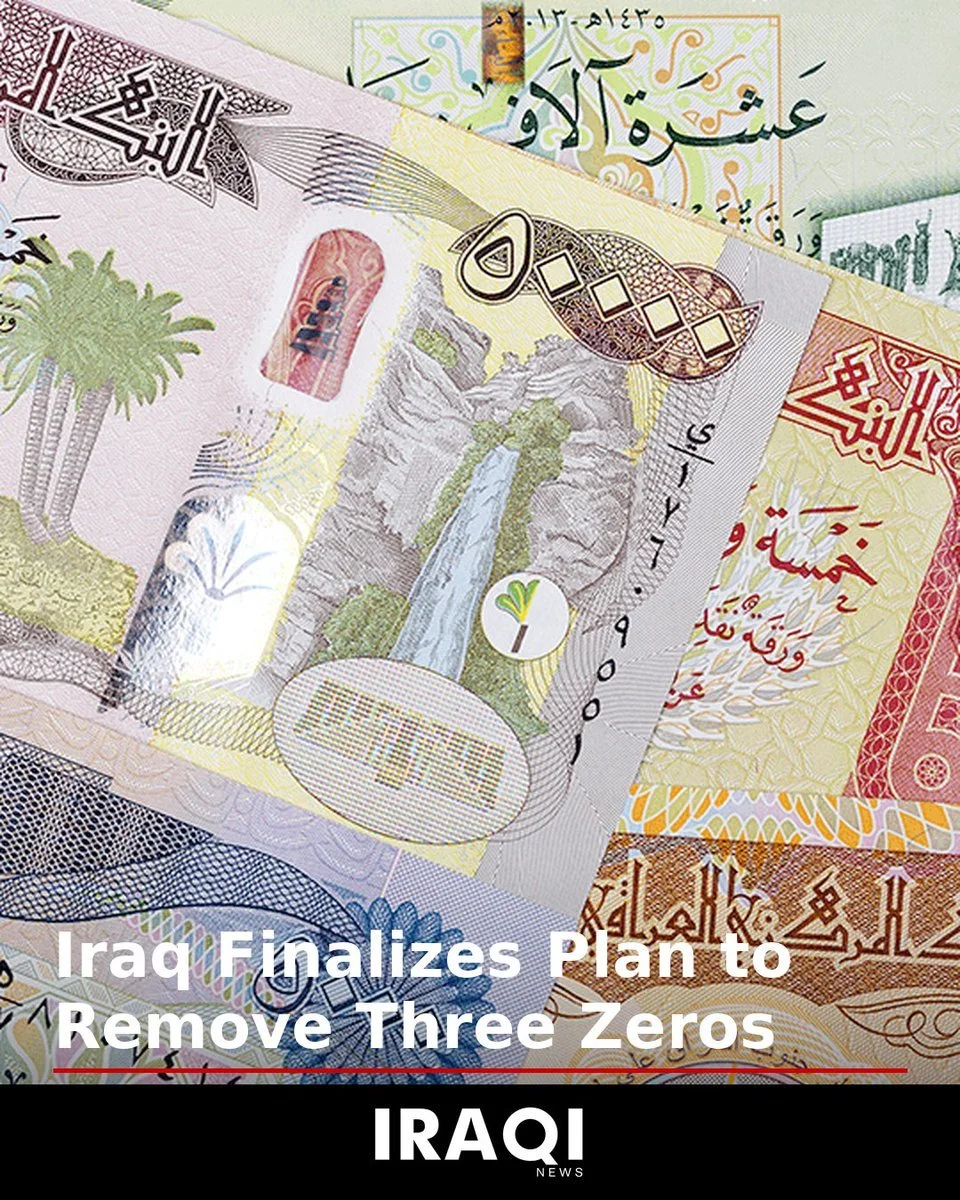
Courtesy of Dinar Guru: https://www.dinarguru.com/
Omar They're talking on the television right now about removing the zeros from the Iraqi dinar. They say it is a long awaited economic reform or a risk of inflation...The television is telling us removing the zeros is commonly referred to as a redenomination, would change the numerical denominations of Iraq's banknotes without necessarily changing the currency's real purchasing power...TV critical distinction is removing zeros would not automatically make the dinar more valuable...It's going to make daily operations much easier.
Jeff Deleting the zeros is the very next banking reform step and being implemented in the second half of the year '26. That's why they brought all those articles forward yesterday...It wasn't a coincidence.
Reset Intelligence Iraq's PM advisor publicly stated the country sits on more than 16 trillion dinars in natural resources, 5th largest proven oil reserves, 2nd largest phosphate reserves on Earth. The GDP is $265 billion. That's a resource to GDP ratio of 60 to 1. Saudi Arabia's ratio is 15 to 1. Iraq carries 4x the resource gap of Saudi Arabia at a program rate set during reconstruction 22 years ago.
***************
'Unstoppable' Market Crash To 'Break Everything' But GOLD - $10K Incoming: Edward Dowd
Commodity Culture: 8-18-2026
Edward Dowd continues to sound the alarm on the ballooning AI bubble, a major real estate crisis unfolding, and unprecedented government intervention in the stock market, and he's calling for a major collapse of the broad indices, in a move that will break everything but gold, which he sees soaring to $10,000 ahead.