
The Gold Reset Already Happened and Almost Nobody Noticed | Willem Middelkoop
The Gold Reset Already Happened and Almost Nobody Noticed | Willem Middelkoop
Kitco News: 7-27-2026
Willem Middelkoop says the monetary reset isn't coming. It's already underway, quietly, in the accounting. He also argues China is now the dominant force in the gold market, buying on every dip while the West still trades paper.
Kitco's Jeremy Szafron sits down with Willem Middelkoop, author of "The Big Reset" and founder of the Commodity Discovery Fund, for a wide-ranging hour on why both Washington and Beijing may want a cheaper gold price, the state gold buyers that don't show up in official numbers, gold overtaking US Treasuries as the world's top reserve asset, the move of price discovery to Shanghai, China's shift from paper to physical, silver's path to a possible $500, and where the gold miners go from here.
The Gold Reset Already Happened and Almost Nobody Noticed | Willem Middelkoop
Kitco News: 7-27-2026
Willem Middelkoop says the monetary reset isn't coming. It's already underway, quietly, in the accounting. He also argues China is now the dominant force in the gold market, buying on every dip while the West still trades paper.
Kitco's Jeremy Szafron sits down with Willem Middelkoop, author of "The Big Reset" and founder of the Commodity Discovery Fund, for a wide-ranging hour on why both Washington and Beijing may want a cheaper gold price, the state gold buyers that don't show up in official numbers, gold overtaking US Treasuries as the world's top reserve asset, the move of price discovery to Shanghai, China's shift from paper to physical, silver's path to a possible $500, and where the gold miners go from here.
CHAPTERS
0:00 Gold's Wild Year
0:50 Meet Willem Middelkoop
1:46 Big Reset Thesis
3:56 Central Banks Drive Gold
6:57 Hidden China Gold Hoard
9:34 Reset Through Accounting
13:21 US Gold Politics
17:13 Custody and Sanctions Risk
19:03 BRICS Parallel Rails
22:57 China Shifts to Physical
28:27 Hong Kong Clearing and mBridge
30:23 Gold for Trade Settlement
32:56 Debt Crisis Warning
33:39 Gold Bonds Speculation
34:56 Gold Replaces Treasuries
36:22 Peak Supply Metals
37:05 Silver Shortage Signals
39:48 Paper Market Breakdown
42:29 Perfect Storm Thesis
45:29 Miners Leverage Valuations
47:38 Mergers Discovery Arbitrage
54:00 China Buys in Ground
56:40 China Russia Calculus
1:00:47 Investor Takeaways
1:03:40 Closing
Iraq Economic News and Points To Ponder Monday Evening 7-27-26
Masrour Barzani renews his support for the Zaidi government in combating corruption, and demands that Baghdad assume its responsibility in protecting the Kurdistan Region from the threat of drones - 7/27/2026
Latest News Monday, July 27, 2026 Erbil - One News - The Prime Minister of the Kurdistan Region, Masrour Barzani, announced his government’s support for the steps taken by Prime Minister Ali Zaidi’s government in combating corruption, stressing the region’s readiness to provide assistance and cooperation with the federal government to address outstanding problems in a final and radical manner.
Masrour Barzani renews his support for the Zaidi government in combating corruption, and demands that Baghdad assume its responsibility in protecting the Kurdistan Region from the threat of drones - 7/27/2026
Latest News Monday, July 27, 2026 Erbil - One News - The Prime Minister of the Kurdistan Region, Masrour Barzani, announced his government’s support for the steps taken by Prime Minister Ali Zaidi’s government in combating corruption, stressing the region’s readiness to provide assistance and cooperation with the federal government to address outstanding problems in a final and radical manner.
Barzani said that the Kurdistan Region supports the federal government and seeks to strengthen cooperation with it, stressing that the region calls for resolving the crises that the region is going through peaceful means, away from escalation and wars.
On the security front, Barzani held the federal government responsible for averting the threat of drones targeting the region, stressing that Kurdistan is not a party to the war, and that his government has demanded respect for the region’s sovereignty and the prevention of the use of Iraqi territory or airspace to target it.
He added that the continued drone attacks require Baghdad to take practical measures to protect the security of the region and its citizens, reiterating the call to adopt dialogue and peaceful solutions to address the region's crises.
On the economic front, Barzani pointed out that the fuel quota allocated to the region by the federal government is not sufficient to cover local consumption, noting that the regional government has requested an increase in the quantities sent.
The regional government chief attributed the rise in fuel prices to the crises and tensions in the region, and the resulting pressure on supplies and markets.
Barzani affirmed that the regional government is committed to supporting and cooperating with the al-Zaidi government, both in combating corruption and in addressing financial and security disputes, in order to contribute to maintaining stability and reaching lasting solutions to the outstanding issues between Baghdad and Erbil.
https://1news-iq.net/مسرور-بارزاني-يجدد-دعمه-لحكومة-الزيدي/
PM Barzani: Erbil-Bound Drones Sent From Nineveh
2026-07-27 / 04:30 Shafaq News- Erbil Kurdistan Region Prime Minister Masrour Barzani on Monday said some drones targeting Erbil were launched from Nineveh province, urging the federal government to stop armed IRI groups from using Iraqi territory to “threaten” the Region.
Speaking at a press conference, Barzani stated that the Kurdistan Regional Government (KRG) had sought an air-defense system through Baghdad and several foreign governments but was not permitted to acquire one, although defensive systems alone “will not end the threat.”
On July 24, Global Coalition air defenses shot down five explosive drones over Erbil, according to the Kurdistan Region’s Counter-Terrorism Directorate, which reported that the aircraft approached from west of the province and caused no casualties, although falling debris ignited dry vegetation.
Around 20 drone and missile attacks have targeted the Kurdistan Region since July 17, including US-linked sites around Erbil and Iranian-Kurdish opposition bases in Erbil and Al-Sulaymaniyah. The strikes killed at least nine people and wounded six, all members of Iranian-Kurdish opposition groups.
Iran’s army has taken responsibility for attacks on US infrastructure and Iranian-Kurdish opposition groups, but no Iraqi IRI armed faction has claimed the strikes. (so they can't be blamed and give the GOI leverage to remove their arms) Kataib Sayyid Al-Shuhada denied (they lie outright) on July 17 that any operation had been launched from Iraqi territory, while Saraya Awliya Al-Dam rejected reports linking it to the attacks on July 25 as false and unsupported by evidence.
Read more: Two weeks of attacks on Iraqi Kurdistan, Iran claims US damage
https://www.shafaq.com/en/Kurdistan/PM-Barzani-Erbil-bound-drones-sent-from-Nineveh
Salaries Await Liquidity... Funding Crisis Delays Employee Payments
Baghdad Today - Baghdad An informed source revealed today, Monday (July 27, 2026), that the salaries of most state employees for this month have been delayed, despite the month having ended, attributing this to a lack of financial liquidity and a decline in public revenues.
The source told Baghdad Today that the delay in paying salaries is due to the repercussions of the war between the United States and Iran, and the accompanying closure of the Strait of Hormuz, which affected oil exports and contributed to a decline in financial revenues, making it difficult to provide the necessary liquidity to release employee salaries.
He added that the Ministry of Finance had announced on the 22nd of this month the release of funding for the salaries of state employees, but a large number of institutions have not yet been able to disburse the dues of their employees, due to the continued financial liquidity crisis. https://baghdadtoday.news/303975-.html
MP Miqdad Al-Khafaji Demands The Ministry Of Finance Explain The Reasons For The Delay In Salary Payments.
House of Representatives, Office of the Minister
Dr. Miqdad Al-Khafaji, Surgeon House of Representatives Najomeh Ne Nushtiran
Republic of Iraq Council of Representatives ۸۰۹ Number: Date: 26/7/2026
Greetings... To: Ministry of Finance / Minister's Office
Subject: Clarification and Follow-up on the Reasons for the Delay in Salary Disbursement
Based on the provisions of Article (61/Second) of the Constitution of the Republic of Iraq of 2005 and the provisions of Articles (15) and (27) of the Law of the House of Representatives and its Formations No. (13) of 2018, and based on the numerous appeals and complaints received by our office from employees, retirees, and social welfare beneficiaries,
We kindly request your review and explanation of the reasons for the monthly delay in releasing and distributing the salaries of employees, retirees, and beneficiaries, which has negatively and directly impacted the daily lives of citizens and their ability to meet their basic financial obligations
We also request the swift establishment of a specific and urgent regulatory mechanism, obligating all ministries, non-ministerial entities, and governorates to adhere to the specified annual and monthly deadlines for submitting payroll lists and receiving notifications, with a fixed and specific date designated each month for disbursing entitlements without any delay. as required by law.
We kindly request your response, along with detailed reasons for the delay, within the legally specified period, so that we may inform the public and take With utmost respect and appreciation
Deputy Dr. Al-Kharaj Miqdad Al-Khafaji Please be advised... With appreciation. Speaker of the House of Representatives and his deputies - O Administration - For filing
Due To A Lack Of Liquidity, The Ministry Of Finance Postpones Salary Payments, And Parliament Moves To Summon The Minister.
Today 12:35 Information / Baghdad... An informed source reported on Monday that the Ministry of Finance and the Accounting Department have decided to postpone the disbursement of salaries for employees of ministries and government departments for three days due to a temporary shortage of cash liquidity.
The source told Al-Maalomah that "this measure prompted the Parliamentary Finance Committee to take urgent action, as it intends to summon the Minister of Finance and the Directors General of the Accounting and Budget Departments in the coming hours."
The source added that "the summons will be held within the committee or in the Parliament building to provide an urgent briefing to the public and the legislative authority regarding the current cash liquidity situation and the reasons that led to this emergency halt in the salary funding process." End/25
Salary Phobia: Citizens Are Apprehensive, But The Government Reassures: It Has Been Thoroughly Reviewed Before Distribution.
Information / Special.. The financial advisor to the Prime Minister, Mazhar Muhammad Saleh, revealed today, Monday, the reasons for the delay in disbursing employee salaries during the current month and previous months, while reassuring citizens that the disbursement of salaries cannot be delayed for more than a month.
Saleh told Al-Maalomah that “the delay in salaries is due to regulatory financial procedures related to auditing and preparing the salaries of each ministry and institution government within what is known as the (trial balance), which includes each ministry’s share of salaries and disbursement units.”
He added that "there are about 1,000 disbursement units in Iraq, all of which are included in the trial balance, and then submitted to the General Accounts Department for detailed auditing in accordance with the highest standards of financial governance."
Saleh explained that "the trial balance includes the number of employees, their salary costs, promotions, bonuses, and all details related to the monthly salary," noting that "the audit process may be repeated once or twice to verify the funds before they are disbursed monthly after the procedures are completed."
He pointed out that "the state provides financial allocations to employees of companies that have been shut down since 2003, as a result of the declining economic and investment policies in the country, which have not provided solutions for these companies to return to production and benefit from them locally or through export."
Saleh pointed out that “the total amount allocated to the salaries of state employees in its various formations, in addition to the salaries of retirees, beneficiaries of the social protection network, wages, and grants, amounts to about 8 trillion Iraqi dinars.”
The Prime Minister's financial advisor emphasized that "salaries must remain a red line for the government, as they represent a source of livelihood for approximately 40 million Iraqi citizens," explaining that "the state's fiscal policy is concerned with addressing any liquidity shortfalls and securing the necessary funds through various means, whether through domestic or external borrowing." (End of page 25)
From Oil Dominance To A Diversified Economy: Al-Zidi's Government Aims To Raise Non-Oil Revenues To 46% And Expand Private Sector Contribution Over The Next Decade
latest newsMonday,July 27, 2026Baghdad - One News - The Prime Minister’s Advisor for Financial and Economic Affairs, Mazhar Muhammad Salih, revealed a long-term governmental plan to restructure public finances and the Iraqi economy over the next ten years, by diversifying revenue sources and reducing dependence on oil, in parallel with expanding the role of the private sector and increasing its contribution to the gross domestic product.
Saleh said that the government’s fiscal policy aims, during the next decade, to achieve economic stability and sustainable development, through restructuring public expenditures and revenues, and adopting the federal budget as a tool to reorganize the real economy and revitalize the productive sectors.
He explained that the financial track includes two main objectives; the first is to raise the share of non-oil revenues to about 46% of total public revenues, compared to a percentage that does not exceed 10% or less currently, in order to limit the impact of oil price fluctuations and the volatility of its revenues on public finances.
The second objective is to raise the private sector’s contribution to GDP from about 37% currently to 54% over the next ten years, by expanding the investment and production environment and promoting economic activity outside the government sector.
Saleh pointed out that revitalizing the productive sectors would provide sustainable job opportunities and reduce the unemployment rate to about 3% of the total workforce, instead of its current level of about 13%.
According to the government's proposal, these goals reflect an effort to reshape the structure of the Iraqi economy and gradually move from a model heavily reliant on oil revenues and public spending to a more diversified economy driven by broader productive and investment sectors. https://1news-iq.net/من-هيمنة-النفط-إلى-اقتصاد-متنوع-حكومة/
Seeds of Wisdom RV and Economics Updates Monday Evening 7-27-26
Good Evening Dinar Recaps,
Global Regulators Accelerate Digital Money Framework as Stablecoins Reshape Financial System
Governments and financial regulators are moving rapidly to establish common rules for digital money as stablecoins become an increasingly important part of the global financial system. New U.S. legislation, combined with guidance from international institutions, signals that digital assets are transitioning from an emerging technology into regulated financial infrastructure.
Good Evening Dinar Recaps,
Global Regulators Accelerate Digital Money Framework as Stablecoins Reshape Financial System
Governments and financial regulators are moving rapidly to establish common rules for digital money as stablecoins become an increasingly important part of the global financial system. New U.S. legislation, combined with guidance from international institutions, signals that digital assets are transitioning from an emerging technology into regulated financial infrastructure.
Overview
The United States has established its first federal framework for payment stablecoins through the GENIUS Act, while lawmakers continue advancing the CLARITY Act to define broader digital asset regulation.
The Bank for International Settlements (BIS) and the International Monetary Fund (IMF) are encouraging countries to modernize payment systems while maintaining public confidence, financial stability, and effective oversight.
Together, these developments represent another major step toward a more digital, interconnected global financial system.
Key Developments
1. GENIUS Act Creates America's First Stablecoin Framework
The GENIUS (Guiding and Establishing National Innovation for U.S. Stablecoins) Act establishes the first comprehensive federal framework governing payment stablecoins in the United States.
The legislation requires qualifying stablecoins to maintain one-to-one backing with high-quality liquid assets, such as U.S. dollars and short-term U.S. Treasury securities. Issuers must also provide regular reserve disclosures and comply with anti-money laundering and financial reporting requirements.
Supporters believe the law provides long-awaited regulatory certainty that could encourage broader adoption of compliant digital payment systems by banks, businesses, and financial institutions.
2. CLARITY Act Would Define the Digital Asset Marketplace
While the GENIUS Act focuses specifically on payment stablecoins, the CLARITY Act seeks to establish a comprehensive regulatory framework for digital assets.
The proposed legislation would define whether digital assets fall under the jurisdiction of the Securities and Exchange Commission (SEC) or the Commodity Futures Trading Commission (CFTC), reducing years of regulatory uncertainty.
Lawmakers continue negotiating ethics provisions and other amendments as bipartisan discussions move forward in the Senate. Although additional legislative steps remain, the bill represents one of the most significant efforts to modernize U.S. digital asset regulation.
3. BIS Calls for Trust as the Foundation of Digital Money
The Bank for International Settlements (BIS) has emphasized that the future of digital money depends not only on technological innovation but also on maintaining public trust, legal certainty, and financial stability.
Rather than replacing existing monetary systems, the BIS envisions digital payment innovations operating within a unified financial framework where commercial banks, central banks, and regulated private institutions remain interconnected.
The BIS has also highlighted the importance of interoperability, secure settlement systems, and internationally coordinated standards as digital finance expands across borders.
4. IMF Sees Stablecoins Transforming Cross-Border Payments
The International Monetary Fund (IMF) has continued studying how stablecoins could improve cross-border payments by reducing settlement times and lowering transaction costs.
At the same time, IMF researchers caution that rapid growth without appropriate regulation could create new risks involving monetary policy transmission, capital flows, consumer protection, and financial stability.
The IMF encourages countries to develop balanced regulatory frameworks that support innovation while preserving confidence in national monetary systems.
Why It Matters
Digital money is steadily moving from experimentation into mainstream finance. Governments are increasingly choosing regulation over prohibition, recognizing that digital payment technologies are likely to become permanent components of the international financial system.
As national frameworks become more consistent, financial institutions may gain greater confidence to expand tokenized payments, programmable finance, and regulated digital asset services.
Why It Matters to Foreign Currency Holders
For those following international monetary developments, these reforms represent foundational infrastructure rather than immediate currency revaluations.
Clearer regulatory standards, stronger payment networks, and improved cross-border settlement systems could gradually reshape how currencies move through the global economy while supporting broader financial modernization over time.
Implications for the Global Reset
Pillar 2: Trade
More efficient cross-border payment systems could reduce transaction costs, improve settlement speed, and strengthen international commerce.
Pillar 4: Technology
Digital ledgers, tokenization, regulated stablecoins, and programmable settlement are becoming increasingly important components of the next generation of global financial infrastructure.
Future Outlook
Attention now turns to continued Senate consideration of the CLARITY Act, implementation of the GENIUS Act, and ongoing international coordination among regulators, central banks, and financial institutions. As regulatory clarity expands, adoption of compliant digital payment systems is expected to accelerate across both domestic and international markets.
This is not simply about cryptocurrency—it reflects the broader modernization of the global financial system as governments, regulators, and financial institutions work to build the trusted digital infrastructure that may support the next generation of international commerce and payments.
Seeds of Wisdom Team
Newshounds News™ Exclusive
Sources
~~~~~~~~~~
Seeds of Wisdom Team RV Currency Facts Youtube and Rumble
Newshound's News Telegram Room Link
RV Facts with Proof Links Link
RV Updates Proof links - Facts Link
Start Here room with Most Asked Questions Link
Follow the Gold/Silver Rate COMEX
Follow Fast Facts
Seeds of Wisdom Team™Website
Thank you Dinar Recaps
Major Market Repricing Alert, Global Economy Changed Forever-The Reset Begins.
Major Market Repricing Alert, Global Economy Changed Forever-The Reset Begins.
David Lin: 7-27-2027
In a highly insightful interview on the David Lin Report, financial expert John Butler sat down to discuss the complex web of geopolitical risks, macroeconomic policy, and market valuations currently shaping the global economy.
As investors navigate increasingly volatile market conditions, Butler provides a sobering look at how underlying systemic issues—ranging from trade disruptions to unsustainable global debt—are building toward a major paradigm shift. This discussion serves as a crucial guide for those looking to protect their wealth in an unpredictable economic landscape
Major Market Repricing Alert, Global Economy Changed Forever-The Reset Begins.
David Lin: 7-27-2027
In a highly insightful interview on the David Lin Report, financial expert John Butler sat down to discuss the complex web of geopolitical risks, macroeconomic policy, and market valuations currently shaping the global economy.
As investors navigate increasingly volatile market conditions, Butler provides a sobering look at how underlying systemic issues—ranging from trade disruptions to unsustainable global debt—are building toward a major paradigm shift. This discussion serves as a crucial guide for those looking to protect their wealth in an unpredictable economic landscape
One of the most pressing concerns highlighted by Butler is the vulnerability of critical global trade routes. Asymmetric control over key maritime choke points, such as the Strait of Hormuz and the Bab al-Mandab, has introduced unprecedented friction into global supply chains.
By restricting the flow of vital commodities—including crude oil, fertilizers, and petrochemical products—these geopolitical tensions are actively fueling stagflationary pressures worldwide. Unlike routine market corrections, shipping disruptions of this magnitude create structural supply deficits that keep consumer prices elevated, proving that geopolitical risk is no longer just a hypothetical concern but an active driver of global inflation.
Despite these clear systemic threats, Butler argues that global markets have yet to accurately price in these risks. Equity valuations remain stubbornly elevated, buoyed largely by waves of speculative enthusiasm. Butler specifically points to the current artificial intelligence (AI) boom, characterizing much of the market excitement as an overblown hype bubble.
While AI technology holds genuine long-term promise, the extreme premium currently placed on speculative tech stocks ignores the immediate reality of rising operational costs, supply chain vulnerabilities, and tightening liquidity, leaving portfolios heavily exposed to sudden downward corrections.
Beneath the surface of market optimism lies a deeper, structural threat: the unsustainable rise of sovereign government debt across major Western economies, including the United States, the United Kingdom, and the European Union.
Butler warns of impending debt spirals and fiscal crises as governments continue to issue massive amounts of debt to fund persistent structural deficits. This fiscal strain is occurring alongside a historic shift in global power dynamics.
The world is rapidly transitioning from a unipolar system dominated by Western financial institutions to a multipolar order, forcing a recalibration of international trade alliances and foreign policies while introducing further friction into the global financial architecture.
In this environment of fiscal instability and shifting power, Butler maintains a strongly bullish outlook on precious metals over the long term. While near-term interest rate hikes by central banks may temporarily suppress the price of gold and silver, the fundamental drivers remain historically strong.
Decades of neo-Keynesian inflationary policies—characterized by persistent deficit spending and central bank intervention—have eroded the purchasing power of fiat currencies. Because these inflationary monetary policies are unlikely to be reversed by governments anytime soon, precious metals remain a vital, non-dilutable hedge against currency devaluation.
Ultimately, Butler advocates for a strategic pivot in investment philosophy. Rather than chasing momentum in overvalued and speculative sectors, he advises investors to focus on real assets that possess inherent pricing power.
This includes physical precious metals, energy resources, and basic commodities that are absolutely essential for maintaining daily societal functions. In an era marked by lower average valuations and heightened macroeconomic volatility, wealth preservation requires a historically informed approach focused on tangible utility and supply-demand fundamentals.
Rob Cunningham: The Big Ripple Infrastructure Picture
Rob Cunningham: The Big Ripple Infrastructure Picture
7-27-2027
The Big Ripple Infrastructure Picture: Context is Everything
The protocol creates the network.
The infrastructure company creates the services.
The liquidity providers help value move efficiently.
Rob Cunningham: The Big Ripple Infrastructure Picture
7-27-2027
The Big Ripple Infrastructure Picture: Context is Everything
The protocol creates the network.
The infrastructure company creates the services.
The liquidity providers help value move efficiently.
Financial institutions provide regulated access.
Applications create user experiences.
Each layer can become valuable for different reasons.
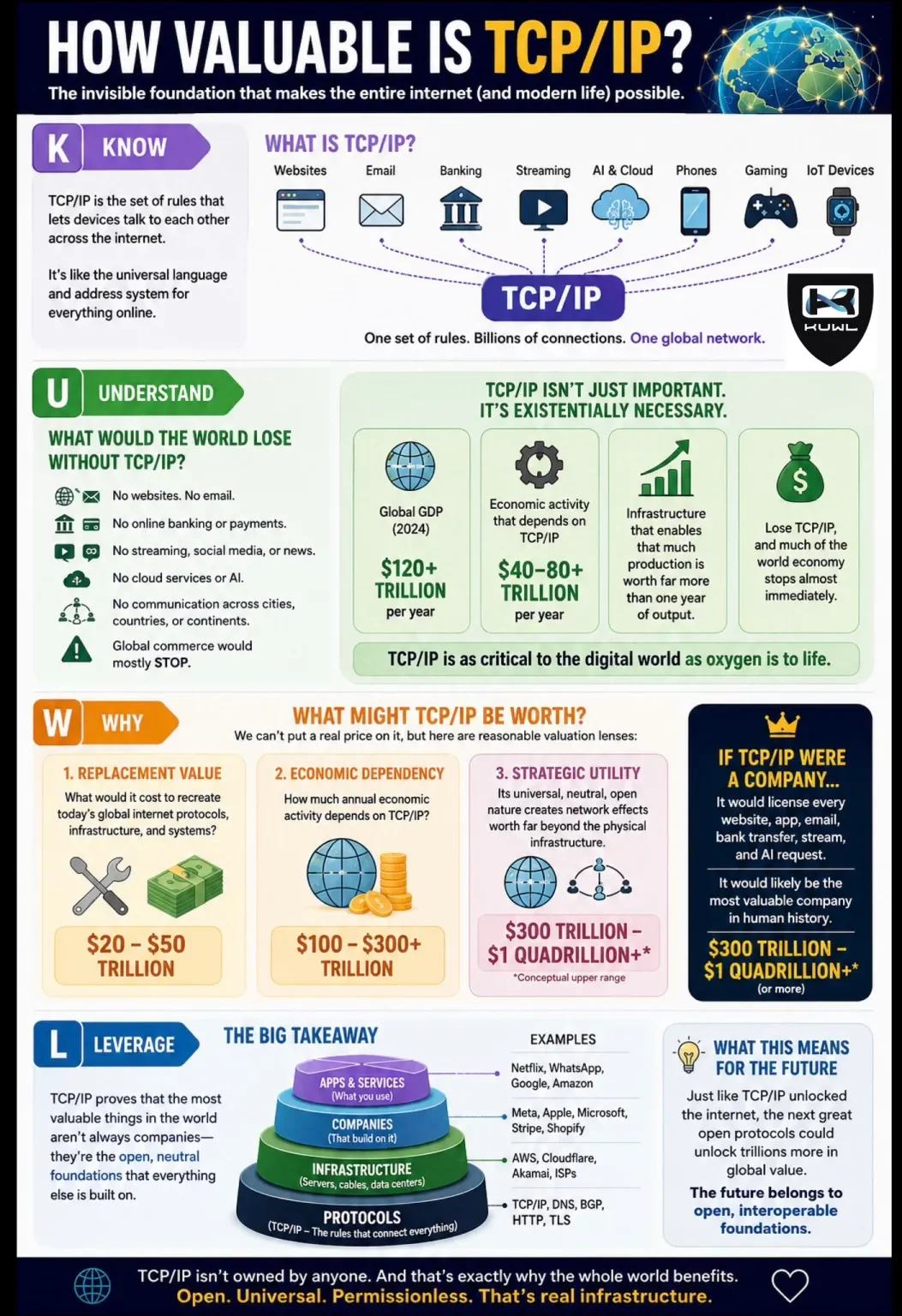
If one imagines a future where open value-transfer protocols like XRPL/ILP become as foundational to finance as TCP/IP became to the internet, then the long-term significance of companies like @Ripple that have spent 15+ years building enterprise infrastructure around those protocols could be substantial.
Notably, because the XRPL/ILP protocols are open-source, no single company can own the network itself, and multiple participants are free to build successful products and services on the same shared foundation.
KUWL Takeaway
TCP/IP didn’t become valuable because someone owned it. It became invaluable because everyone could use it.
If open-source XRPL/ILP financial protocols achieve similar global interoperability for value transfer, the greatest opportunities will lie not in owning the protocol itself, but in building trusted, regulated, high-performance infrastructure that helps the world use it.
The King of Engineering DLT benefits and invaluable protocols the world over will soon be fully recognized with an Act of Clarity.
Three reasonable valuation lenses add better context:
Replacement Value
“What would it cost to recreate?”
Replacing today’s global Internet protocols, infrastructure, standards, software, routing systems, and interoperability would likely cost tens of trillions of dollars and take decades.
Reasonable estimate: $20–50 trillion
Economic Dependency Value
“How much GDP depends upon TCP/IP?”
Nearly every modern industry now relies on TCP/IP:
Banking
Payments
Communications
Cloud computing
AI
Healthcare
Transportation
Defense
Manufacturing
Retail
Education
Global GDP today exceeds $120 trillion annually.
If TCP/IP vanished tomorrow, enormous portions of global commerce would stop almost immediately.
One could reasonably argue TCP/IP enables $40–80+ trillion of annual economic activity.
Infrastructure that enables that much production would likely be valued well above a single year’s output.
Reasonable implied value: $100–300 trillion
Strategic Utility Value
This is the interesting one.
Utilities often become more valuable than many companies built upon them.
For example:
Interstate highways
Electrical grid
GPS
Shipping lanes
Air traffic control
None generate profits proportional to their societal value.
TCP/IP belongs in this category.
Its value comes from being:
Universal
Neutral
Permissionless
Open
Interoperable
Those characteristics create enormous network effects that are difficult to replicate.
Many economists could plausibly argue TCP/IP societal value approaches several hundred trillion dollars.
Ripple, building with RippleNet, XRP and a portfolio of 900+ talented professionals, patented solutions, extraordinary compliance, prestigious customers and global legislation running atop an Open Protocol Internet of Value, should become an enterprise of value without any historical precedent.
Source(s):
• https://x.com/KuwlShow/status/2081438156411265073
https://dinarchronicles.com/2026/07/26/rob-cunningham-the-big-ripple-infrastructure-picture
Seeds of Wisdom RV and Economics Updates Monday Afternoon 7-27-26
Good Afternoon Dinar Recaps,
U.S.–Iran Diplomacy Shows Signs of Progress as Oil Markets Reprice Global Risk
Mixed diplomatic signals between Washington and Tehran eased immediate fears of a wider Middle East conflict, sending oil prices sharply lower. However, continuing warnings over the Strait of Hormuz demonstrate that geopolitical risks remain capable of quickly reshaping global energy markets and financial conditions.
Good Afternoon Dinar Recaps,
U.S.–Iran Diplomacy Shows Signs of Progress as Oil Markets Reprice Global Risk
Mixed diplomatic signals between Washington and Tehran eased immediate fears of a wider Middle East conflict, sending oil prices sharply lower. However, continuing warnings over the Strait of Hormuz demonstrate that geopolitical risks remain capable of quickly reshaping global energy markets and financial conditions.
Overview
President Trump said Iran requested a halt to military operations and indicated negotiations are underway, while warning that U.S. military action could quickly resume if talks fail.
Iran denied reports that it proposed direct negotiations with the United States, underscoring the fragile and uncertain nature of current diplomatic efforts.
Oil prices posted their largest one-day decline in two months as markets priced in reduced near-term supply risks, although maritime tensions in the Strait of Hormuz remain unresolved.
Key Developments
1. Diplomacy and Deterrence Continue Side by Side
President Donald Trump stated that Iran had reached out seeking a halt to military operations and said discussions are continuing with what he described as a reasonable opportunity to reach an agreement. At the same time, he emphasized that military operations remain ready to resume if negotiations fail.
Meanwhile, Iran's Foreign Ministry publicly rejected reports that Tehran had requested direct negotiations with Washington, maintaining that any diplomatic engagement continues through intermediaries. The differing public statements highlight the deep mistrust that still exists despite renewed diplomatic activity.
2. Oil Markets Quickly Reverse Course
Energy markets responded immediately to signs that the conflict may not escalate further in the near term.
Brent crude and West Texas Intermediate crude recorded their largest single-day declines in nearly two months, reversing part of the sharp gains that followed earlier disruptions surrounding the Strait of Hormuz.
Analysts noted that markets rapidly shifted from pricing in severe supply shortages toward expectations that additional global production could eventually create an oversupply if diplomacy continues and shipping lanes remain open.
3. Strait of Hormuz Remains the World's Financial Pressure Point
Despite improving market sentiment, Iran warned that any additional attempts to interfere with its ports or shipping would trigger further escalation.
Military officials also accused U.S. forces of threatening vessels operating near Iran's coastline, reinforcing concerns that even isolated incidents could quickly reignite broader conflict.
Roughly one-fifth of global seaborne oil trade normally passes through the Strait of Hormuz, making the waterway one of the world's most important economic chokepoints. Even without active combat, uncertainty surrounding navigation continues influencing energy prices, shipping insurance costs, and global trade expectations.
4. Financial Markets Shift Toward Lower Inflation Expectations
The decline in oil prices reduced immediate concerns that another energy shock would fuel higher inflation worldwide.
Lower energy prices could ease pressure on central banks, including the Federal Reserve, as policymakers continue balancing inflation risks with slowing economic growth.
At the same time, investors remain cautious because any breakdown in negotiations could quickly reverse recent gains across equities, cryptocurrencies, and other risk assets.
Why It Matters
Financial markets increasingly respond as much to diplomatic headlines as to military actions. Every indication of progress or deterioration between Washington and Tehran now has immediate consequences for oil prices, inflation expectations, central bank policy, shipping costs, and investor confidence.
Although markets welcomed today's easing tensions, the underlying geopolitical risks have not disappeared.
Why It Matters to Foreign Currency Holders
Currency investors continue monitoring geopolitical developments because sustained changes in energy prices often influence inflation, interest-rate decisions, and capital flows between nations.
Greater stability in global energy markets could reduce short-term volatility, while renewed conflict could once again strengthen safe-haven assets and increase pressure on currencies tied to energy imports and global trade.
Implications for the Global Reset
Pillar 1: Debt
Lower energy prices can reduce inflationary pressure, potentially giving central banks greater flexibility as governments continue managing historically high debt levels.
Pillar 2: Trade
The Strait of Hormuz remains one of the world's most important trade corridors. Continued stability supports international commerce, while renewed disruptions could rapidly increase shipping costs and slow global supply chains.
Pillar 5: Energy
Energy markets remain highly sensitive to developments in the Middle East. Diplomatic progress lowers supply concerns, but unresolved maritime tensions continue to pose significant risks to global energy security.
Future Outlook
Investors will closely watch whether indirect negotiations evolve into meaningful diplomatic progress or whether military pressure resumes. Markets are also monitoring commercial shipping activity through the Strait of Hormuz, statements from both governments, and any changes in global oil production forecasts.
This is not simply about a temporary pause in hostilities—it illustrates how diplomacy, energy security, and financial markets have become increasingly interconnected as the global financial system continues to adapt to a rapidly changing geopolitical landscape.
Sources
~~~~~~~~~~
Seeds of Wisdom Team RV Currency Facts Youtube and Rumble
Newshound's News Telegram Room Link
RV Facts with Proof Links Link
RV Updates Proof links - Facts Link
Start Here room with Most Asked Questions Link
Follow the Gold/Silver Rate COMEX
Follow Fast Facts
Seeds of Wisdom Team™Website
Thank you Dinar Recaps
Iraq Economic News and Points To Ponder Monday Afternoon 7-27-26
Brazil's Exports To Iraq Fall To $208M In Q2 2026
2026-07-26 18:34 Shafaq News- Brasilia/ Baghdad Iraq's imports from Brazil fell 37.5% in the second quarter of 2026 to $208 million, down from $333 million in the first quarter, the Brazilian Ministry of Development, Industry, Trade and Services said on Sunday.
Brazil's Exports To Iraq Fall To $208M In Q2 2026
2026-07-26 18:34 Shafaq News- Brasilia/ Baghdad Iraq's imports from Brazil fell 37.5% in the second quarter of 2026 to $208 million, down from $333 million in the first quarter, the Brazilian Ministry of Development, Industry, Trade and Services said on Sunday.
According to the ministry's data, cane or beet sugar and chemically pure sucrose topped Brazil's exports to Iraq at $70 million, followed by live cattle ($58M), soybeans ($40M), and poultry meat ($35M). Iraq also imported frozen beef ($2.8M), manufactured tobacco ($1.4M), hair care products ($608,000), prepared and preserved meat ($378,000), orthopedic and medical devices ($364,000), and appliances for spraying liquids or powders ($220,000) from Brazil.
Earlier this year, UN COMTRADE data showed that Iraq's exports to Brazil remained limited in 2025, totaling just $3.06 million, compared with the much larger value of Brazilian exports to Iraq.
https://www.shafaq.com/en/Economy/Brazil-s-exports-to-Iraq-fall-to-208M-in-Q2-2026
Oil Prices Drop 4% On US-Iran De-Escalation Signs
2026-07-27 01:17 Shafaq News Oil prices tumbled 4% on Monday after the U.S. and Iran paused strikes over the weekend after two weeks of attacks, raising hopes of a diplomatic solution that would de-escalate the conflict and allow shipping to resume in the Strait of Hormuz.
Brent crude futures fell $3.96, or 4.1%, to $92.82 by 0329 GMT after briefly slipping under the key support level of $90 earlier in the session.
U.S. West Texas Intermediate crude was at $85.29 a barrel, down $4.02, or 4.5%.
Both contracts are trading at their lowest levels in nearly a week after rising for the past three weeks.
Brent had reached $100 per barrel as the conflict, which reduced oil shipments via the Strait of Hormuz, spilled over to the Red Sea, hindering exports from the world's top exporter, Saudi Arabia, via the Bab el-Mandeb strait to Asia.
The U.S. ambassador to the United Nations, Mike Waltz, told "Fox News Sunday" and other U.S. media that President Donald Trump had decided to pause U.S. attacks to allow more time for diplomacy.
"Oil prices fell sharply in early trading as the U.S. and Iran refrained from further military action, offering the first tangible signs of a potential de-escalation in tensions," said ING analysts in a client note.
"The price action in oil this morning clearly reflects the market's desperation for positive news."
Despite the pause in attacks, fewer than 10 commodity vessels passed through the Strait of Hormuz daily during the weekend, shipping data from Kpler showed.
"Any rebound in flows through the Strait of Hormuz is likely to prove slow and partial, as many shippers remain wary and will want greater confidence in their safety before they bring more empty ships into the Strait," MST Marquee analyst Saul Kavonic said.
In addition, ship traffic through the Bab el-Mandeb strait fell on Sunday after Yemeni Houthis attacked Saudi oil installations along the Red Sea coast, although a third Chinese supertanker exited via the Bab el-Mandeb strait.
However, some analysts are still expecting markets to be supported if crude supplies stay affected by ongoing shipping risks in the Middle East and the Russia-Ukraine war.
"As the Middle East conflict widened to the Red Sea and Ukrainian drones struck Russian ships and refineries...Sustained (supply) disruption would likely keep oil prices elevated and continue to pose upside risks to global inflation," said UOB analysts in a note. (REUTERS) https://www.shafaq.com/en/Economy/Oil-prices-drop-4-on-US-Iran-de-escalation-signs
USD/IQD Exchange Rates Surge In Baghdad, Erbil
2026-07-27 04:34 Shafaq News- Baghdad/ Erbil TGFThe US dollar strengthened against the Iraqi dinar on Monday morning, hovering around 150,000 dinars per $100 in Baghdad and Erbil, according to a Shafaq News market survey.
In Baghdad, the dollar traded at 150,050 IQD per $100 at the Al-Kifah and Al-Harithiya central exchanges, up from 149,650 IQD on Sunday.
Exchange shops in the capital offered the dollar at 150,500 IQD per $100, with a buying price of 149,500 IQD.
In Erbil, the capital of the Kurdistan Region, the dollar was selling at 150,200 IQD per $100 and buying at 150,100 IQD per $100. https://www.shafaq.com/en/Economy/USD-IQD-exchange-rates-surge-in-Baghdad-Erbil-7-4
Gold Prices Climb In Baghdad, Erbil
2026-07-27 05:30 Shafaq News- Baghdad/ Erbil Gold prices rose in Baghdad and Erbil on Monday, with 21-carat gold hovering around 860,000 Iraqi dinars ($656) per mithqal (equivalent to five grams), according to a Shafaq News market survey.
On Baghdad's Al-Nahr Street, 21-carat Gulf, Turkish and European gold was selling for 858,000 IQD ($655) per mithqal and buying at 854,000 IQD ($652), up from 852,000 IQD on Sunday.
The selling price for 21-carat Iraqi gold stood at 828,000 IQD ($632) per mithqal, with a buying price of 824,000 IQD ($629).
In jewellery stores, 21-carat Gulf gold ranged between 860,000 and 870,000 IQD ($656-$664) per mithqal, while Iraqi gold sold for 830,000-840,000 IQD ($634-$641).
In Erbil, 22-carat gold sold for 905,000 IQD ($691) per mithqal, 21-carat gold for 865,000 IQD ($660), and 18-carat gold for 742,000 IQD ($566). https://www.shafaq.com/en/Economy/Gold-prices-climb-in-Baghdad-Erbil-7
Five-Part Energy Plan Targets Iraq’s Power Shortages
2026-07-27 08:29 Shafaq News- Baghdad Iraq’s Electricity Ministry on Monday outlined a five-part plan to address widespread power cuts through additional fuel supplies, the return of stalled generating units, domestic gas development, solar projects, and electricity links with neighboring countries.
Ministry spokesperson Ahmed Jiyad told Shafaq News that regional tensions had contributed to the crisis but were not its only cause, citing lower domestic and imported gas supplies, unprecedented temperatures, and rising demand on the national grid.
The ministry is now “coordinating with relevant authorities” to secure fuel, restore offline units, accelerate local gas investment, expand solar generation, and diversify electricity supplies.
Under Iraq’s latest agreement with GE Vernova, the US energy company must arrange up to 10,000 megawatts of electricity imports from neighboring countries by 2027, parliamentary Electricity and Energy Committee member Riyad Adday told Shafaq News.
The ministry previously projected peak summer generation of about 30,000 megawatts against demand of 55,000 to 60,000 megawatts, indicating that scheduled cuts would continue even if plants operated at full planned capacity.
Read more: 40-GW electricity gap forces Iraq to back private generators
https://www.shafaq.com/en/Economy/Five-part-energy-plan-targets-Iraq-s-power-shortages
Lawmakers Endorse Reforms To Ease Iraq's Power Shortages
2026-07-27 13:17 Shafaq News- Baghdad The Iraqi parliament voted on Monday to approve a package of recommendations to address the country's electricity crisis, including reopening all corruption cases related to the Electricity Ministry dating back to 2005 and strengthening oversight.
According to a statement, the measures require the ministry to submit a detailed annual plan before each summer season outlining completion rates, implementation timelines, and performance indicators, with regular reviews by parliament.
The suggestions also call for reviewing all contracts and projects awarded through exemptions or found to lack technical or economic viability, while taking legal action against those responsible for wasting public funds.
They further called for adopting a national renewable energy program by expanding the use of solar power systems for households and the agricultural and industrial sectors to ease pressure on the national grid and reduce fuel consumption.
The Central Bank of Iraq, in coordination with public and private banks, was tasked with launching a soft-loan initiative offering subsidized or interest-free financing, flexible repayment terms, and simplified guarantees for citizens wishing to install solar power systems. In addition, the Electricity Ministry was directed to establish technical and administrative mechanisms to facilitate connecting solar power systems to the national grid.
Read more: Iraq needs ≈25M solar panels to ease power crisis
A joint committee comprising the parliamentary committees on Electricity, Finance, Planning, Investment, Oil, Services, and Integrity will oversee implementation of the measures and submit periodic progress reports to parliament on achievement rates and obstacles.
Earlier today, Electricity Minister Ali Saadi Wahib reportedly told parliament that Iraq needs 60,000 MW of electricity but is generating only 20,000 MW after losing about 7,000 MW of capacity. He pledged to restore 9,000 MW within 15 days through increased Iranian gas supplies and discussions with Turkiye on electricity imports.
https://www.shafaq.com/en/Iraq/Lawmakers-endorse-reforms-to-ease-Iraq-s-power-shortages
Iraqi Dinar Sunday Update - Things Are Heating Up
Iraqi Dinar Sunday Update - Things Are Heating Up
The Dinar Den: 7-26-2026
In the world of international currency speculation, few topics generate as much discussion as the Iraqi dinar. For long-term investors like Stephen, an entrepreneur who has been following the dinar since 2011, the current economic climate in Iraq signals a potential turning point.
In a recent update from The Dinar Den, Stephen provides a balanced perspective on the anticipated revaluation of the currency, blending deep-rooted experience with a grounded, realistic outlook on the complexities of Iraqi financial reform.
Iraqi Dinar Sunday Update - Things Are Heating Up
The Dinar Den: 7-26-2026
In the world of international currency speculation, few topics generate as much discussion as the Iraqi dinar. For long-term investors like Stephen, an entrepreneur who has been following the dinar since 2011, the current economic climate in Iraq signals a potential turning point.
In a recent update from The Dinar Den, Stephen provides a balanced perspective on the anticipated revaluation of the currency, blending deep-rooted experience with a grounded, realistic outlook on the complexities of Iraqi financial reform.
Beyond the numbers and economic charts, Stephen’s recent update highlights the human element of investing. He recently shared the personal challenges his family faced with the birth of his second son, Roman. Despite a difficult stay in the NICU, Stephen reports that Roman is recovering well—a blessing that he views as a reminder of what truly matters. This vulnerability resonates with his audience, anchoring the technical discussion of “wealth transfers” in a broader context of gratitude and personal values. It serves as a reminder that while financial goals are important, they are often secondary to the health and well-being of our loved ones.
One of the most critical aspects of Stephen’s analysis is the distinction between redenomination and revaluation.
The Iraqi government has been vocal about its plans to “delete the zeros” from the currency. To the casual observer, this might seem like a simple cosmetic change. However, Stephen explains that this redenomination is a strategic move to simplify the currency and restore public confidence.
By removing the large nominal values, the government hopes to encourage citizens to move hoarded cash into the formal banking system.
The real excitement for investors, however, lies in the potential for a simultaneous revaluation (RV). While redenomination is an accounting adjustment, a revaluation increases the actual purchasing power of the currency. Stephen suggests that these two processes, when paired together, could modernize Iraq’s economy and provide significant benefits to both domestic citizens and foreign participants.
A significant indicator of Iraq’s progress is the recent modernization of its banking institutions.
Stephen points to the scheduled technical upgrades at the Iraqi Trade Bank (TBI) as a pivotal sign. These upgrades, which temporarily suspended withdrawals and deposits to implement new systems, are essential for supporting a 21st-century financial framework. A modernized banking infrastructure is a prerequisite for any major currency overhaul, as it ensures that the system can handle increased liquidity and more sophisticated digital transactions.
Furthermore, the Iraqi government’s push toward digital banking adoption is a clear attempt to move away from a cash-heavy economy. By integrating more citizens into the formal financial sector, the Central Bank of Iraq gains better control over the money supply, which is a necessary step toward stabilizing the dinar’s value on the global stage.
Investors often pore over Iraqi news articles looking for “signals” of an imminent change. However, Stephen offers an insightful correction to this approach. He notes that the primary audience for these government communications is the Iraqi public, not foreign investors. The goal of these articles is to educate the local population on how to use new denominations and how to interface with the evolving banking system.
Understanding this distinction helps investors manage their expectations. The transparency of the Iraqi government regarding its “Project to Delete the Zeros” is an educational campaign designed to prevent domestic panic and ensure a smooth transition. While these reports are encouraging, they are part of a structured internal policy rather than a countdown clock for international markets.
Despite his long-term involvement and optimism—noting that August could be a significant month for developments—Stephen remains a voice of caution. He emphasizes that the timeline for such a massive economic shift remains fluid and is known only to a few high-level officials. He urges his viewers to avoid over-speculation and to remain patient, trusting that the reforms currently underway are laying the groundwork for a more prosperous future.
Monday Iraq News posted by Tishwash at TNT 7-27-2026
TNT:
Tishwash: Iraq: Non-oil revenues hit record high
The Eco Iraq Observatory announced on Saturday that the contribution of non-oil revenues to Iraq’s total financial revenues has risen to 16%, the highest percentage recorded so far.
The observatory said in a statement received by Al-Sa’a that “this is the first time that the percentage of non-oil revenues has risen to 16% during the months of May and June, after it had remained for years not exceeding 5%.”
He explained that "non-oil revenues rose for the first time to about 10% during the government of Mustafa Al-Kadhimi, and stabilized at this level during the government of Mohammed Shia Al-Sudani, before recently recording its highest percentage."
TNT:
Tishwash: Iraq: Non-oil revenues hit record high
The Eco Iraq Observatory announced on Saturday that the contribution of non-oil revenues to Iraq’s total financial revenues has risen to 16%, the highest percentage recorded so far.
The observatory said in a statement received by Al-Sa’a that “this is the first time that the percentage of non-oil revenues has risen to 16% during the months of May and June, after it had remained for years not exceeding 5%.”
He explained that "non-oil revenues rose for the first time to about 10% during the government of Mustafa Al-Kadhimi, and stabilized at this level during the government of Mohammed Shia Al-Sudani, before recently recording its highest percentage."
The observatory explained that "non-oil revenues include commodity taxes and production fees, general fees, taxes on income and wealth, transfer revenues, as well as other revenues."
He pointed out that "the revenues of the Kurdistan Region represent about 5.5% of the total non-oil revenues, through the funds that the region delivers to the federal government." link
Tishwash: Al-Halbousi receives the US Chargé d'Affaires and emphasizes the importance of the economic partnership with Washington.
The head of the Progress Party, Mohammed al-Halbousi, discussed today, Sunday (July 26, 2026), with the US Chargé d'Affaires, Joshua Harris, the political developments and the economic partnership, and explained that the meeting addressed the results of the Prime Minister’s visit to Washington and the regional and international challenges.
The media office of the Progress Party, as reported by Network 964, stated that Al-Halbousi “received today, Sunday, the Chargé d'Affaires of the US Embassy in Iraq, Mr. Joshua Harris.”
He added that “the meeting addressed the political situation in the country, and supported the recent visit of the Prime Minister to the United States of America, which contributed to launching a comprehensive and diversified economic partnership that supports the Iraqi economy and expands investment opportunities.”
He added that “the meeting discussed developments in regional and international affairs, the challenges facing the region, and a number of topics of common interest.” link
***************
Tishwash: Parliamentary Finance Committee sets priority for new government legislation
The Parliamentary Finance Committee held a closed meeting on Saturday to discuss draft laws referred by the Iraqi government to the Council of Representatives, within its purview.
The meeting reviewed the draft laws submitted to the committee, examining their content and financial and legal implications, in preparation for further discussion and the formulation of necessary recommendations that align with current requirements and serve the public interest.
The head of the Parliamentary Finance Committee emphasized the importance of expediting the review of priority draft laws, according to a vision that ensures the strengthening of the state's financial management, supports economic reforms, and develops the legislative environment to meet the needs of government institutions and citizens.
The committee also discussed mechanisms for coordination with relevant government entities and preparations to host representatives of ministries and specialized institutions to hear their technical and legal observations, ultimately aiming to draft sound legislation that contributes to enhancing institutional performance and achieving sustainable development. link
Tishwash: What prompted the American company JPMorgan to operate in Iraq?
Political analyst Alaa al-Aqabi stated on Sunday that the agreement with JPMorgan Chase includes allocating the proceeds from the sale of 500,000 barrels of oil per day to finance projects within Iraq, denying that this constitutes a free concession of Iraqi oil .
Al-Aqabi said in a televised interview followed by Al-Sa’a Network that “the opening of JPMorgan Chase Bank in Iraq aims to finance American projects and companies operating in the country, especially after a number of European banks refrained from working in the Iraqi market .”
He added that "the agreement includes the sale of 500,000 barrels of oil per day, with the proceeds to be deposited through JPMorgan Chase to finance the agreed-upon projects, and not the transfer of oil or its revenues to the United States for free ."
He explained that "some critics described the agreement as an occupation or colonialism, but that is not true, because the money will go back to finance projects inside Iraq ."
He pointed out that "these quantities are not counted within Iraq's quota in OPEC, which gives Baghdad an opportunity to increase its oil exports without affecting its official quota, according to him ."
Al-Aqabi stressed that “Iraq needs international banking guarantees to attract investments and finance projects, given the continued reluctance of a number of European banks to enter the Iraqi market link
****************
Tishwash: The Central Bank of Iraq is restructuring its departments and creating a department to supervise non-bank financial institutions.
The Central Bank of Iraq has decided to implement extensive changes to its organizational structure, including elevating the Directorate of Supervision of Non-Bank Financial Institutions to a general department called the Department of Supervision of Non-Bank Financial Institutions, as part of efforts to improve institutional performance and enhance operational efficiency.
The decisions also included transferring the Operations and Settlements Section from the Information Technology and Payments Department to the Accounting Department, along with transferring the Policies and Regulations and Digital Financial Solutions and Services Sections to the Department of Supervision of Non-Bank Financial Institutions. The name of the Information Technology and Payments Department was also changed to the Information Technology Department.
Furthermore, the bank decided to abolish the Financial Inclusion Section and distribute its responsibilities among the Banking Supervision, Accounting, Statistics and Research, and Non-Bank Financial Institutions Supervision Departments. The Information Security Section was also abolished, and its responsibilities were transferred to the Risk Management Section in coordination with the Information Technology Department.
The measures also included abolishing the Office for Monitoring and Coordinating the Work of Central Bank Branches and linking the Basra, Mosul, and Erbil branches directly to the Deputy Governor. Finally, the Corporate Identity Division was transferred to the Total Quality Management and Institutional Development Department, which will report to the Deputy Governor instead of the Governor.
The Central Bank explained that these changes will take effect no later than July 30, 2026, with the Human Resources Department responsible for redistributing employees according to the new structure. The bank emphasized that these steps aim to enhance institutional performance and develop the organizational structure in line with its objectives and responsibilities. link
News, Rumors and Opinions Monday 7-27-2026
Ariel: What the Naysayers Severely Underestimate
7-27-2026
If you think this entire event is not being meticulously coordinated when looking at Japan and where the IQD is along with the Clarity Act you are not paying attention at all.
This is what many naysayers severely underestimate.
They are not looking at this as a global restructuring of how assets are treated and how it will be managed under the new financial system.
Ariel: What the Naysayers Severely Underestimate
7-27-2026
If you think this entire event is not being meticulously coordinated when looking at Japan and where the IQD is along with the Clarity Act you are not paying attention at all.
This is what many naysayers severely underestimate.
They are not looking at this as a global restructuring of how assets are treated and how it will be managed under the new financial system.
Iraq told you they are doing a overhaul of their monetary system.
They represent the microscopic aspect of what will occur in most countries.
The debt based system is about to be removed. And people that hold foreign currency will be there to take advantage of it.
Source(s):
• https://x.com/Prolotario1/status/2081483850023117233
https://dinarchronicles.com/2026/07/26/prolotario-what-the-naysayers-severely-underestimate/
Stephanie Starr: Iraq is Already Looking Ahead to the 2027 Federal Budget
7-27-2026
Iraq is already looking ahead to the 2027 federal budget, and that’s telling.
The Parliamentary Finance Committee is reviewing:
Fiscal plans
Spending reforms
Fee adjustments
Revenue optimization
Performance-based budgeting
This isn’t just about writing another budget, it’s about transforming Iraq into a modern, sustainable economy with stronger non-oil revenues, greater fiscal discipline, and improved government accountability.
Over the past few years Iraq has:
Modernized its banking sector
Expanded electronic payments
Increased tax and customs collection
Advanced digital transformation
Worked to reconnect its financial system with global markets!
Preparing the 2027 budget while these reforms continue signals that Baghdad is planning beyond today’s challenges and building the financial framework for long-term economic growth (that we all know will increase the value of the dinar)
The foundation is being laid. Watch the reforms not just the headlines.
Channel 8 English:The Iraqi Parliamentary Finance Committee met with the Director General of the Budget Department, where officials reviewed fiscal plans, fee adjustments, and expenditure ceilings to curb spending, maximize state revenues, and align project listings with the 2027 performance-budget framework. Read more: https://channel8.com/english/news/62091
Source(s):
• https://x.com/StephanieStarrC/status/2081440040413004002
Courtesy of Dinar Guru: https://www.dinarguru.com/
Jeff REER means Real Effective Exchange Rate. Depending on where the country's inflation is, is going to determine the direction the rate is going to go, whether it goes up or down. Iraq has...almost no inflation so the REER is going to go in a positive direction through a redenomination. There's nothing to worry about here.
Reset Intelligence Iraq's prime minister signed a rail line to carry trade into Iran, and in the same week let a US-led group begin engineering...the Kirkuk to Baniyas line out to the Mediterranean...Baghdad is turning itself into the crossroads the whole region has to run through....The dinar is the currency sitting on that ground, still priced from before any of this was signed.
GuyIt's very clear in the last week we've had roughly 10 years worth of solid news packed in one week. For those of us who've been invested for a long time...if you're a new investor, trust us, we've never seen this much movement ever, ever...it just wasn't the prime minister. He had the Governor of the Central Bank, his finance minister, an entire delegation of economic advisers and finance people...There were a lot of back channel meetings going on. We don't know what happened but why would they be having those unless something's going to move?
************
Iraqi Dinar Update: CBI Important Announcement
Edu Matrix: 7-26-2026
Learn how the Central Bank of Iraq plans to support currency exchange companies and improve their role in the national economy.
This update covers the recent meeting between Governor Nazar Hassar Hussein and executives from major currency exchange companies.
The discussion focused on practical steps to revitalize the sector, ensuring these firms can operate more effectively within the current financial landscape. By prioritizing better compliance and governance, the Central Bank of Iraq aims to create new revenue streams for these businesses.
If you follow the Iraqi economy, this summary explains the upcoming initiatives intended to expand the operational scope for currency exchange companies and strengthen their overall contribution to the financial system.
Iraq Economic News and Points To Ponder Monday Morning 7-27-26
The Iraqi Economy: From Fragility To Sustainable Reform
Economic 2026/07/26 At the heart of the economic, financial and banking field...and the suffering of the Iraqi economy from challenges, crises and fragility .
Economic and banking advisor, *Samir Al-Nassiri*, presents us with his sixteenth publication ..."
His new book (The Iraqi Economy: From Fragility to Sustainable Reform) is published by the Arab House for Science Library - Baghdad. It is a specialized diagnosis of the reality of the national economy from 2003 to 2026 .
The Iraqi Economy: From Fragility To Sustainable Reform
Economic 2026/07/26 At the heart of the economic, financial and banking field...and the suffering of the Iraqi economy from challenges, crises and fragility .
Economic and banking advisor, *Samir Al-Nassiri*, presents us with his sixteenth publication ..."
His new book (The Iraqi Economy: From Fragility to Sustainable Reform) is published by the Arab House for Science Library - Baghdad. It is a specialized diagnosis of the reality of the national economy from 2003 to 2026 .
The result of years of continuous research, analysis, study and documentation in the files of economic, financial and banking reform .
Reviewing previous economic policies up to what the new government presented in its ministerial program in the twelfth axis and the 12 paragraphs that outlined the government’s goal for economic reform for the coming years .
The book consists of 285 pages, five chapters, and sixty-one specialized sections, supported by information, data, statistics, appendices, documents, and sources that make it a comprehensive national and strategic economic reference.
Advisor Samir Al-Nassiri explains the government's new vision and methodology for restructuring the economy and consolidating its leadership of the state, not the other way around.
This involves shifting from line-item budgeting to program and performance-based budgeting, in harmony with a new economic management methodology that activates investment, energy, electricity, transportation, technology, digital transformation, banking sector reform and restructuring, and empowering the private sector to manage the economy based on facts and practical solutions for transitioning from fragility to sustainability and development .
This is not just a book... it is a practical, scientific and documented roadmap .
By shifting the economy from crisis management to opportunity management .
lt embodies the vision for a prosperous economic future for Iraq. https://alsabaah.iq/135684-.htm
Foreign Policy magazine describes al-Zaidi as "The Most Powerful Man In Iraq": Trump's Bet On His Leadership To Reshape The Iraqi Landscape May Run Into Obstacles Within The Political System
Latest News Sunday, July 26, 2026 Baghdad - One News - Foreign Policy Magazine believes that the warm welcome shown by US President Donald Trump during his reception of Iraqi Prime Minister Ali al-Zaidi at the White House was not merely a diplomatic courtesy, but rather reflects a new American approach based on supporting leaders capable of consolidating state power, reducing Iranian influence, and opening their countries’ economies to American companies.
According to the magazine's report, the Trump administration, led by its envoy to the region, Tom Barrack, is betting on a "strongman" model in Iraq, after previous US administrations focused on political compromises and power-sharing.
Washington believes that having a single leader capable of exerting control over state institutions and security services is more effective in achieving its interests than systems of governance based on balances and coalitions.
The report indicated that the search for “Washington’s man” in Baghdad began after the 2025 elections, when Trump publicly rejected the nomination of former Prime Minister Nouri al-Maliki, whom the US administration considered close to Iran, before Iraqi political forces turned to nominating Ali al-Zaidi, who at the time was a young banker with no political base or government experience.
The report argues that al-Zaidi was a consensus candidate for Iraqi political forces, while Washington considered him a figure who could be supported to implement an agenda based on strengthening state authority, restricting weapons to the government, and reducing the influence of armed factions, in parallel with launching a broad campaign to combat corruption.
He added that al-Zaidi made Washington his first foreign destination after assuming the premiership, and pledged to proceed with the project of integrating and disarming armed factions, including groups close to Iran, within an American vision that considers these steps part of a broader project to rebuild the Iraqi state.
However, the report indicates that this bet faces significant challenges, because the Iraqi political system was designed after 2003 to prevent the monopolization of power by one person, and previous attempts to integrate armed factions have not succeeded in ending their loyalties, as they have retained their leadership and organizational structures despite their members receiving salaries and positions within state institutions.
He added that some factions announced their readiness to coordinate with the government, while others, including Kataib Hezbollah and Harakat al-Nujaba, refused to engage in the weapons control project, making the implementation of this plan more complicated.
The report also argues that the recent war has strengthened the presence of the Iranian Revolutionary Guard inside Iraq and solidified the ties of some factions to Tehran, which makes it more difficult for any government attempt to impose a state monopoly on weapons within a short period of time.
The report stressed that many Iraqi officials want to strengthen state sovereignty and reduce the influence of armed groups, but desire alone is not enough given the political, military and economic influence that these factions possess, as well as the connection of some of them to Iran.
The report concludes that the Trump administration's bet on transforming Ali al-Zaidi into a central leader capable of reshaping the Iraqi landscape may face structural obstacles related to the nature of the Iraqi political system, the entanglement of power centers, and internal balances of power. It warns that the pursuit of quick results could lead to an escalation of internal conflict rather than the consolidation of stability. https://1news-iq.net/مجلة-فورين-بوليسي-الأميركية-تصف-الز/
The Judiciary Announces The Seizure Of Another 27 Billion Dinars In The Case Of Former Deputy Minister Of Oil Adnan Al-Jumaili
latest news Sunday, July 26, 2026 Baghdad - One News -On Sunday, the investigating judge of the Central Anti-Corruption Criminal Court announced the seizure of another 27 billion Iraqi dinars as part of the investigation into the case of the detained Undersecretary of the Ministry of Oil for Liquidation Affairs, Adnan al-Jumaili , and the parties involved with him.
The judge explained that the money was seized after careful monitoring to track the financial proceeds resulting from waste in projects implemented by the accused and those involved in the case, indicating that the money was hidden with a number of people. He stressed that investigations are still ongoing to reach all those involved and take legal action against them. https://1news-iq.net/القضاء-يعلن-ضبط-27-مليار-دينار-في-قضية-وك/
Adnan Al-Jumaili's Cave... 27 Billion New Dinars Hidden With A Number Of Individuals Are Now In The Hands Of The Judiciary, And Investigations Are Ongoing To Track Down The Rest Of The Funds And Reach All Those Involved
latest newsSunday,July 26, 2026 Baghdad - One News - On Sunday, the investigating judge of the Central Anti-Corruption Criminal Court announced the seizure of 27 billion Iraqi dinars as part of the ongoing investigations into the case of the Deputy Minister of Oil for Liquidation Affairs, the detained defendant Adnan Al-Jumaili, and the parties involved with him.
The judge explained that the seizure came after careful monitoring of the financial proceeds resulting from waste in the implemented projects, indicating that the money was hidden with a number of people, before the competent authorities were able to seize it.
He added that these funds represent a part of the financial proceeds under investigation, stressing that legal procedures are continuing to track down the rest of the funds, reach all those involved in the case, and take legal action against them.
He noted that investigations are still ongoing as part of efforts to uncover the entire network linked to the case, recover public funds, and hold all those involved accountable according to the law. https://1news-iq.net/مغارة-عدنان-الجميلي-27-مليار-دينار-جديد/
Oman Proposes The "Malacca" Model For Managing The Strait Of Hormuz: A Regional Proposal To Finance Shipping Services Without Imposing Transit Fees
latest news Sunday, July 26, 2026 Amman - One News - 7/26/2026 CNN has revealed a new Omani proposal aimed at reorganizing the management of navigation in the Strait of Hormuz, through the creation of a regional cooperation mechanism for providing maritime services, inspired by the model adopted in the Straits of Malacca and Singapore, in an effort to secure one of the most important maritime routes in the world and alleviate the tensions it has witnessed in recent months.
According to the report, the proposal is not based on creating a new military alliance or naval force, but rather focuses on establishing a regional framework to manage and finance navigational services, including the maintenance of buoys and lighthouses, regulating ship traffic, enhancing maritime safety procedures, and responding to emergencies and environmental pollution, similar to the mechanism that has been in place for years in the Straits of Malacca and Singapore.
The report explained that the Sultanate of Oman presented the proposal to the United States and a number of international partners, stressing that the goal is not to impose transit fees on ships, but rather to create contributions or fees related to maritime services provided, in order to ensure the continued funding of safety operations without compromising the principle of freedom of international navigation.
The report indicated that the proposal also includes a vision for regulating navigation through two maritime corridors, one in Omani waters that remains open to international navigation, and the other in Iranian waters that is subject to coordination mechanisms agreed upon by the parties, within the framework of efforts to reduce military friction and prevent a recurrence of the crises that the strait has recently witnessed.
The Omani proposal comes amid growing international concerns about the impact of security tensions in the Strait of Hormuz on global energy markets, especially since the strait is one of the most important arteries for oil and gas trade in the world, while the recent military escalation has led to higher shipping and insurance costs and raised fears of disruption to international trade.
CNN confirmed that the proposal is still in the consultation phase and has not yet reached a final agreement, as the parties are still discussing the nature of the fees, the mechanism for their administration, and the entity that will oversee the proposed system.
Diplomatic contacts continue between Oman, Iran, the United States, and several other countries concerned with maritime security in the Gulf. https://1news-iq.net/عُمان-تطرح-نموذج-ملقا-لإدارة-هرمز-م/