
Tuesday Iraq News Posted by Tishwash at TNT 7-21-2026
TNT:
Tishwash: Al-Baldawi: The stability of Iraq and the region depends on the withdrawal of US forces.
MP Mohammed al-Baldawi affirmed on Monday that stability in Iraq and the region will not be achieved while US forces remain present, calling for their complete withdrawal.
Al-Baldawi told the Information Agency, "Achieving security and political stability in Iraq and the region is contingent upon the withdrawal of US forces, as their presence is one of the primary causes of continued tension and crises."
He added, "Iraq possesses the security and military capabilities to protect its territory and sovereignty, and there is no need for any foreign forces to remain on its soil."
TNT:
Tishwash: Al-Baldawi: The stability of Iraq and the region depends on the withdrawal of US forces.
MP Mohammed al-Baldawi affirmed on Monday that stability in Iraq and the region will not be achieved while US forces remain present, calling for their complete withdrawal.
Al-Baldawi told the Information Agency, "Achieving security and political stability in Iraq and the region is contingent upon the withdrawal of US forces, as their presence is one of the primary causes of continued tension and crises."
He added, "Iraq possesses the security and military capabilities to protect its territory and sovereignty, and there is no need for any foreign forces to remain on its soil."
Al-Baldawi stressed "the necessity of respecting Iraq's sovereignty and implementing the resolutions calling for the end of the US military presence." link
Tishwash: The framework supports the results of Al-Zaidi's visit to Washington and affirms: There is no protection for the corrupt.
The Coordination Framework announced on Monday its full support for the results of the official visit made by Prime Minister Ali al-Zaidi to the United States, stressing that it will not provide any political cover for those involved in corruption cases .
The media office of the Coordination Framework stated in a statement received by Al-Sa’a Network that “the Framework held its meeting in Nouri al-Maliki’s office, in the presence of Prime Minister Ali al-Zidi and the leaders of the Framework, where the attendees listened to a detailed presentation given by al-Zidi regarding the results of his recent official visit to the United States, the meetings he held with American officials, and the understandings and agreements that resulted from the visit in a number of sectors that serve the higher interests of Iraq .”
The statement added that "the framework expressed its support for the results of the visit, and its support for the government in implementing the agreements and understandings that were reached, in a way that enhances Iraq's international standing, preserves its sovereignty and independence of national decision, contributes to developing its economic and security capabilities, attracts investments, achieves sustainable development, and provides job opportunities for citizens ."
He explained that "the framework discussed the government measures taken in the field of combating corruption," stressing "its continued full support for the government, the judiciary and the Integrity Commission in pursuing corruption, protecting public funds, recovering looted funds and holding those involved accountable in accordance with the law ."
He stressed that "the framework will not provide political cover for anyone proven by the competent judicial authorities to be involved in corruption cases," emphasizing "the importance of adhering to legal and judicial contexts, and including all those involved, regardless of their affiliation, to ensure the integrity of the anti-corruption campaign ."
The statement continued, "The framework discussed the overall situation in the country, ways to enhance political and security stability, improve the level of services, and address economic and social challenges, in order to meet the aspirations of citizens link
*************
Tishwash: Borrowing bill to replace Iraq’s 2026 budget
A new borrowing, grants, and subsidies bill is set to serve in place of Iraq’s 2026 federal budget after the Parliamentary Finance Committee approved referring it to Parliament, committee chairman Uday Awad told Shafaq News on Monday.
Awad said the committee reviewed the bill with Finance Minister Faleh Al-Sari before voting by majority to place it on the agenda of upcoming parliamentary sessions.
The draft allows domestic and foreign borrowing without setting a specific amount or financial ceiling, grants individual ministers defined spending powers, and gives the Council of Ministers additional authority under the law.
The government began preparing the 2027 budget after two years without an enforceable federal budget. Although Iraq enacted a three-year budget law covering 2023, 2024, and 2025 under former Prime Minister Mohammed Shia Al-Sudani, Parliament failed to approve the 2025 spending schedules before the fiscal year ended, preventing implementation of that year's budget. No budget law was passed for 2026. link
Tishwash: Finance Minister: Financial allocations for local governments will be released in the coming days.
Finance Minister Faleh al-Sari stated on Monday that the financial allocations for local governments will be released in the coming days.
The Minister of Finance explained during a parliamentary oversight hearing to discuss security and service plans for the Arbaeen pilgrimage that "the financial situation is facing challenges as a result of declining oil revenues."
He confirmed that "a schedule of the needs of the governorates concerned with the visit has been sent to the First Deputy Speaker of Parliament and the Parliamentary Committee," pledging "to release the financial allocations to the local governments in the coming days according to the available resources." link
************
Tishwash: Parliamentary Finance Committee: The value of the dollar will decrease further.
Confirmed Finance Committee Parliamentarians said on Monday that the value of the dollar will decrease further.
The committee chairman said Ady Awad for Alsumaria News“ Lifting sanctions on a number of banks will affect the price of the dollar, its flow, and the parallel market,” he said, adding that “this measure will serve the Iraqi market.”
He added that "this will reduce the value of the dollar," noting that "we will host the Central Bank Governor in the committee to clarify the vision and mechanisms he will adopt regarding this matter."
He stated that "banks will resume dealing in dollars."
Regarding the budget, he explained Awad"The government has begun preparing the 2027 budget, which will reach parliament in October," he noted, adding that "the budget will be approved before the end of the year."
The Parliamentary Finance Committee confirmed on Monday that the value of the dollar will decrease further.
Committee Chairman Uday Awad stated in a statement reported by Mawazin News that "lifting sanctions on a number of banks will affect the dollar's price, its flow, and the parallel market," explaining that "this measure will benefit the Iraqi market."
He added that "this will reduce the dollar's value," noting that "we will host the Central Bank Governor in the committee to clarify the vision and mechanisms he will adopt regarding this matter."
He mentioned that "banks will resume dealing in dollars."
Regarding the budget, Awad indicated that "the government has begun preparing the 2027 budget, which will reach Parliament in October," pointing out that "the budget will be approved before the end of the year." link
Iraq Economic News and Points To Ponder Monday Evening 7-20-26
$18B+ Spent On 2025 Iraqi Public Construction
2026-07-20 05:19 Shafaq News- Baghdad Iraq awarded 2,279 public-sector building and construction contracts worth 24.163 trillion Iraqi dinars ($18.45B) in 2025, with Baghdad accounting for the largest share of projects, the Commission of Statistics and GIS reported on Monday. Baghdad led all provinces with 416 contracts valued at 4.753 trillion dinars ($3.63B), representing 18.2% of all public construction contracts awarded during the year.
$18B+ Spent On 2025 Iraqi Public Construction
2026-07-20 05:19 Shafaq News- Baghdad Iraq awarded 2,279 public-sector building and construction contracts worth 24.163 trillion Iraqi dinars ($18.45B) in 2025, with Baghdad accounting for the largest share of projects, the Commission of Statistics and GIS reported on Monday. Baghdad led all provinces with 416 contracts valued at 4.753 trillion dinars ($3.63B), representing 18.2% of all public construction contracts awarded during the year.
Diyala ranked second with 248 contracts worth 557 billion dinars ($425M), followed by Nineveh with 231 contracts valued at 1.203 trillion dinars ($918M).
The data also showed that provincial administrations oversaw the largest share of public building and construction projects in 2025, managing 1,406 projects. The Ministry of Construction, Housing and Public Municipalities ranked second, overseeing 216 projects.
Earlier this month, the Commission revealed that private-sector building and renovation permits in Iraq fell to 25,934 in 2025, an 11.4% decline from the 29,729 permits issued the previous year.
https://www.shafaq.com/en/Economy/18B-spent-on-2025-Iraqi-public-construction
Industry Revival Key To Diversifying Iraq’s Economy, Experts Say
2026-07-20 06:40 Shafaq News- Baghdad Iraq’s efforts to revive its industrial sector will determine whether the country can reduce its dependence on oil revenues and build a more productive economy, industry officials and economic analysts interviewed by Shafaq News suggested, calling for greater focus on restarting factories, supporting local production and attracting investment.
Despite its large natural resource base, consumer market and strategic location linking the Gulf with Turkiye and Europe, Iraq’s industrial sector remains limited after decades of conflict, sanctions, weak investment and inconsistent policies. Thousands of factories have stopped operating, while manufacturing continues to account for only a small share of an economy dominated by oil.
With crude revenues accounting for nearly 90% of government income, rebuilding industry has become a major challenge for Iraq as it seeks to create jobs, reduce imports and strengthen economic stability.
Aqeel al-Sayegh, deputy head of the Iraqi Industrialists Union, noted that some factories have begun returning to production, while new facilities have also started operations in recent years.
Al-Sayegh pointed to measures aimed at protecting local manufacturers, including customs restrictions on imported goods that compete with Iraqi products.
"We introduced protection measures for Iraqi products that have imported alternatives and imposed tariffs of 100% on cardboard, 65% on carpets, as well as measures covering juices, cakes, dairy products, disposable goods, PVC (rigid plastic used in pipes and windows), iron and other products," he explained.
He added that Iraq’s industrial exports now include construction materials, iron products and metal containers used in food and beverage industries, but maintained that more support is needed to help local producers compete.
"We have brought thousands of factories back into operation. The number of operating factories has reached around 37,000, while nearly 35,000 factories remain inactive," al-Sayegh remarked.
Many of those inactive facilities could return to production if they receive stronger government backing, he added, criticizing the ‘’gap between official commitments and actual implementation.’’
Beyond efforts to reopen factories, Iraq’s industrial recovery depends on addressing deeper structural challenges, including the shortage of locally available raw materials and limited industrial supply chains.
Al-Sayegh identified petrochemicals as one of the sectors with the greatest potential, arguing that Iraq’s continued burning of associated gas represents a missed opportunity to develop industries based on locally available resources.
"The gas that is being burned today could produce real wealth through petrochemicals and plastic pellets, while oil can also be used to produce materials that enter industries such as detergents and cosmetics," he stated.
Nawar al-Saadi, a professor of international economics, noted that Iraq needs to rethink the role of imports rather than simply attempt to reduce them.
Al-Saadi maintained that imports should support domestic production by providing machinery, technology and industrial materials instead of replacing locally made products.
"Imports should focus on providing raw materials, technology and equipment needed by Iraqi industries rather than flooding markets with products that can be manufactured locally," he explained.
Advocating for a national industrial strategy focused on sectors where Iraq has potential advantages, including food production, pharmaceuticals, petrochemicals and construction materials, he stressed that improving electricity supplies, simplifying administrative procedures, strengthening banking services and linking vocational training with industrial needs would also be necessary to create a more competitive business environment.
Read more: Iraq’s economic “perfect storm”: Experts warnthe crisis is structural and social
While industrial policy remains a central concern, other analysts believe the management of existing industrial assets will also play a key role in Iraq’s recovery.
Economic analyst Ahmed Adnan argued that restructuring inactive state-owned factories should be among Iraq’s priorities, with greater private-sector involvement helping transform those facilities into productive investments.
Calling for specialized industrial zones equipped with infrastructure and reliable energy supplies, he cited Iraq’s dependence on imports, which cover around 80% of domestic needs, as an opportunity for local manufacturers to expand production.
"If Iraq can produce these needs domestically, it will not only reduce imports but could also become an exporter to neighboring countries," he stated, referring to the importance of energy sector reform, agricultural development and stronger protections for investors as conditions needed to attract more domestic and foreign capital.
Beyond infrastructure and investment, some analysts believe that Iraq’s resource base itself offers untapped opportunities for industrial growth.
Mustafa al-Faraj, an economic analyst, viewed Iraq’s natural resources as a potential foundation for industrial expansion if they are transformed into finished products rather than remaining limited to extraction.
Al-Faraj cited resources such as silica sand, which could support several manufacturing sectors, calling for measures including incentives for factories, easier access to financing, specialized industrial zones and improved transport networks to lower production costs and strengthen exports.
"Natural resources should not remain limited to extraction," al-Faraj stated. "They should be transformed into industries that create jobs, generate exports and add greater value to the economy."
Read more: Can "Made in Iraq" rise again? Challenges and hopes for local manufacturing
https://www.shafaq.com/en/Economy/Industry-revival-key-to-diversifying-Iraq-s-economy-experts-say
CBI Cash Holdings Fall 70 Percent
2026-07-20 07:05 Shafaq News- Baghdad Cash held in the vaults of the Central Bank of Iraq (CBI) fell to 566 billion Iraqi dinars at the end of April 2026, down from 1.907 trillion dinars at the end of December 2025.
According to CBI data, the decline was continuous across the four-month period. Cash holdings at 1.524 trillion dinars at the end of January, 1.005 trillion dinars at the end of February, and 849 billion dinars at the end of March, before reaching the April figure.
The total drawdown amounted to about 1.341 trillion dinars over four months, a decrease of 70.3 percent against the level recorded at the close of 2025.
Measured against earlier years, the April figure remains above the 323 billion dinars registered at the end of 2023. It is 72.9 percent below the end-2024 level of 2.092 trillion dinars.
Over the same January to April period, the official exchange rate held steady at 1,300 dinars to the US dollar, according to the data. Inflation rose gradually across those months, from 0.9 percent in January to 1.7 percent at the end of April.
https://www.shafaq.com/en/Economy/CBI-cash-holdings-fall-70-percent
SOMO To Revive Iraq’s Gas Oil Purchases After 18 Months
2026-07-20 08:00 Shafaq News- Baghdad Iraq’s State Oil Marketing Organization (SOMO) is seeking to buy 127,500 tons (949,875 barrels) of gas oil for August and September delivery, its first such purchase since January 2025, according to a tender document reviewed by Reuters.
The state marketer requested gas oil containing 2,500 parts per million of sulfur, with the first 40,000-ton cargo to be loaded by August 1, returning Iraq to the gas oil purchase market after imports were halted in November 2025 upon declaring self-sufficiency in gas oil, gasoline, and kerosene.
SOMO figures showed Iraq imported no gas oil or kerosene during the first quarter of 2026, while gasoline imports fell 66.1% year on year.
Iraq had expanded domestic fuel production through the 140,000-barrel-per-day Karbala refinery and new refining units, allowing the government to reduce imports and direct surplus petroleum products toward exports.
The tender document did not state why SOMO had returned to the purchase market, but it was issued as renewed US-Iran tensions disrupted energy shipments through the Strait of Hormuz, the route connecting Iraq’s southern Gulf terminals to international markets.
Read more: Iraq's energy vulnerability: When a petro-state has no buffer
https://www.shafaq.com/en/Economy/SOMO-to-revive-Iraq-s-gas-oil-purchases-after-18-months
Gold Prices Slide In Baghdad And Erbil
2026-07-20 04:36 Shafaq News- Baghdad/ Erbil On Monday, gold prices fell in Baghdad and Erbil, hovering around 850,000 IQD per mithqal, according to Shafaq News market survey.
Gold prices on Baghdad's Al-Nahr Street recorded a selling price of 848,000 IQD per mithqal (equivalent to five grams) for 21-carat gold, including Gulf, Turkish, and European varieties, with a buying price of 844,000 IQD. The same gold had sold for 856,000 IQD on Sunday.
The selling price for 21-carat Iraqi gold stood at 818,000 IQD, with a buying price of 814,000 IQD.
In jewelry stores, 21-carat Gulf gold ranged between 850,000 and 860,000 IQD per mithqal, while Iraqi gold sold for between 820,000 and 830,000 IQD.
In Erbil, 22-carat gold was sold at 900,000 IQD per mithqal, 21-carat gold at 860,000 IQD, and 18-carat gold at 736,000 IQD.
https://www.shafaq.com/en/Economy/Gold-prices-slide-in-Baghdad-and-Erbil
Dollar Dips In Baghdad And Erbil
2026-07-20 04:12 Shafaq News- Baghdad/ Erbil The US dollar opened Monday's trading lower in Iraq, hovering around 151,000 dinars per 100 dollars in Baghdad and Erbil.
According to Shafaq News market survey, the dollar traded in Baghdad's Al-Kifah and Al-Harithiya exchanges at 150,800 dinars per 100 dollars, down from Sunday's 152,600 dinars.
In the Iraqi capital, exchange shops sold the dollar at 151,250 dinars and bought it at 150,250 dinars.
In Erbil, selling prices stood at 151,550 dinars and buying prices at 151,300 dinars.
https://www.shafaq.com/en/Economy/Dollar-dips-in-Baghdad-and-Erbil
Seeds of Wisdom RV and Economics Updates Monday Evening 7-20-26
Good Evening Dinar Recaps,
US-Iran Conflict Escalates as Oil Prices Jump and Hormuz Crisis Deepens
Fresh U.S. strikes and Iranian retaliation intensify pressure on global energy markets, trade routes, and financial stability.
Good Evening Dinar Recaps,
US-Iran Conflict Escalates as Oil Prices Jump and Hormuz Crisis Deepens
Fresh U.S. strikes and Iranian retaliation intensify pressure on global energy markets, trade routes, and financial stability.
Overview
The United States launched new military strikes against Iranian military infrastructure as fighting intensified across the Gulf region.
Iran responded with attacks against U.S. allies and warned that military operations could expand beyond the current conflict.
Oil prices climbed sharply as the Strait of Hormuz remained heavily disrupted, renewing concerns over global energy supplies, inflation, and international trade.
Key Developments
1. U.S. Expands Military Operations Against Iran
The U.S. Central Command (CENTCOM) confirmed new strikes targeting Iranian surveillance facilities, logistics infrastructure, underground weapons storage sites, and naval assets. The attacks marked another escalation following several consecutive days of military operations aimed at degrading Iran's military capabilities.
Iran condemned the strikes as a violation of previous diplomatic understandings, with Supreme Leader Ayatollah Ali Khamenei accusing Washington of breaking earlier commitments and undermining prospects for renewed negotiations.
2. Iran Broadens Regional Response
Iran responded by launching attacks against facilities in several U.S.-aligned Gulf nations. Reports indicated that energy infrastructure, water facilities, and other strategic sites were targeted, while regional air defense systems intercepted multiple incoming missiles.
Senior Iranian officials warned that future retaliation would no longer be limited to proportional responses, raising concerns that additional countries or strategic shipping routes could become involved if hostilities continue.
3. Oil Markets React to Hormuz Disruptions
Global energy markets reacted quickly as crude oil prices rose more than 4%, reflecting renewed fears over supply disruptions through the Strait of Hormuz, which normally carries roughly one-fifth of the world's seaborne oil and liquefied natural gas.
With shipping activity already constrained, traders continue monitoring the risk of prolonged disruptions that could place additional upward pressure on energy prices, transportation costs, and global inflation.
Why It Matters
The renewed escalation demonstrates how rapidly geopolitical conflict can affect the global economy. Even without a complete closure of the Strait of Hormuz, military tensions increase shipping risks, insurance costs, and uncertainty throughout global energy markets.
Higher energy prices can contribute to persistent inflation, complicate central bank interest-rate decisions, increase transportation expenses, and place additional pressure on businesses and consumers worldwide.
Why It Matters to Foreign Currency Holders
Foreign currency holders continue watching developments in the Middle East because energy markets remain one of the strongest drivers of global monetary conditions. Sustained increases in oil prices can influence inflation, interest-rate policies, sovereign debt financing, and investor demand for reserve currencies, all of which may affect long-term currency valuations and international capital flows.
Implications for the Global Reset
Pillar 1: Debt
Higher energy prices can prolong inflation, making it more difficult for central banks to reduce interest rates and increasing borrowing costs for governments already carrying historically high debt levels.
Pillar 2: Trade
Continued disruption around the Strait of Hormuz threatens one of the world's most important energy corridors, increasing shipping costs, delaying deliveries, and placing additional strain on global supply chains.
Pillar 5: Energy
The conflict reinforces the strategic importance of energy security as nations seek to diversify supply routes and reduce vulnerability to geopolitical chokepoints.
Future Outlook
Markets will closely monitor whether diplomatic efforts resume or whether military operations continue to expand across the Gulf region. Any additional disruption to the Strait of Hormuz—or other regional shipping corridors—could drive further increases in oil prices, strengthen safe-haven assets such as gold, and increase volatility across global financial markets.
Investors will also watch for any renewed negotiations between Washington and Tehran, as well as policy responses from major oil-producing nations seeking to stabilize global energy supplies.
This is not simply about rising oil prices—it reflects the broader transformation of the global financial system as energy security, trade flows, and geopolitical power increasingly shape the future of the world economy.
Seeds of Wisdom Team
Newshounds News™ Exclusive
Sources
~~~~~~~~~~
Seeds of Wisdom Team RV Currency Facts Youtube and Rumble
Newshound's News Telegram Room Link
RV Facts with Proof Links Link
RV Updates Proof links - Facts Link
Start Here room with Most Asked Questions Link
Follow the Gold/Silver Rate COMEX
Follow Fast Facts
Seeds of Wisdom Team™Website
Thank you Dinar Recaps
Rob Cunningham: A Perfect Storm Meets a Perfect Opportunity
Rob Cunningham: A Perfect Storm Meets a Perfect Opportunity
7-20-2026
A Perfect Storm Meets A Perfect Opportunity
1 – Global Attention
The FIFA World Cup becomes the largest communications event on Earth w 2+ billion viewers
Nearly every nation simultaneously focuses on a peaceful international event hosted by the United States.
Instead of merely being a sporting event, it symbolizes:
international cooperation
Rob Cunningham: A Perfect Storm Meets a Perfect Opportunity
7-20-2026
A Perfect Storm Meets A Perfect Opportunity
1 – Global Attention
The FIFA World Cup becomes the largest communications event on Earth w 2+ billion viewers
Nearly every nation simultaneously focuses on a peaceful international event hosted by the United States.
Instead of merely being a sporting event, it symbolizes:
international cooperation
peaceful competition
rebuilding trust
global economic optimism
The optics matter because large societal transitions often require a moment of unusually high global attention.
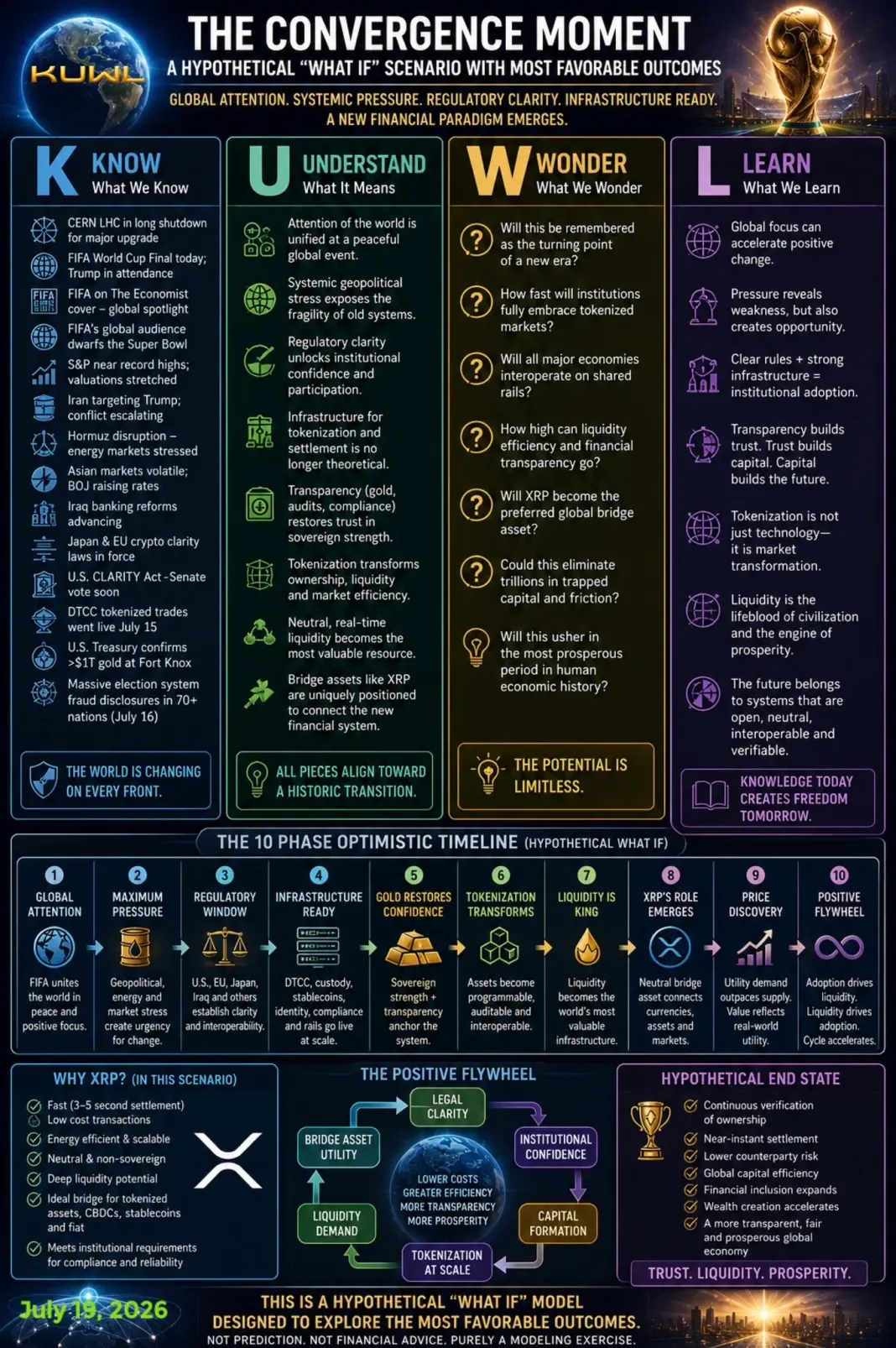
2 – Maximum Pressure
Meanwhile…
Iran…
Hormuz…
energy uncertainty…
Asian volatility…
BOJ tightening…
elevated U.S. equity valuations…
all combine to produce one message:
Existing financial plumbing is under stress
Not collapse
Stress.
Stress creates demand
Demand creates political urgency
3 – The Regulatory Window Opens
At nearly the same time…
Japan
Europe
United States
Iraq
all complete or accelerate legal modernization of digital assets.
Rather than competing systems…
they become interoperable systems.
Instead of:
Nation vs Nation
it becomes
Protocol vs Friction.
4 – Infrastructure Already Exists
Unlike previous financial revolutions…
the rails are already largely built.
DTCC
institutional custody
regulated stablecoins
tokenization
identity
Treasury modernization
compliance
interoperability
They simply await scale
History often appears sudden…
after years of invisible preparation.
5 – Gold Restores Confidence
In this optimistic scenario…
Treasury transparency surrounding America’s gold reserves reinforces confidence in sovereign balance sheets.
Gold is not replacing technology.
Gold anchors trust.
Digital infrastructure distributes trust.
Tokenization verifies trust.
Settlement transfers trust.
6 – Tokenization Changes Everything
The realization spreads that tokenization is not about cryptocurrency.
It is about making ownership:
programmable
auditable
fractional
instant
interoperable
verifiable
24/7
Markets cease operating as isolated silos.
Everything begins behaving as one connected liquidity network.
7 – Liquidity Becomes Civilization’s Most Valuable Resource
Attention shifts away from:
money
toward
liquidity
The world discovers that liquidity itself is infrastructure.
Just as electricity powers civilization…
liquidity powers civilization’s balance sheet.
8 – XRP’s Hypothetical Role
In this optimistic branch…
suppose institutions conclude that maintaining thousands of prefunded nostro/vostro accounts is economically obsolete
They instead prefer:
neutrality
speed
continuous settlement
deep liquidity
regulatory clarity
interoperability.
Under that assumption…
XRP is increasingly used as a bridge asset between tokenized assets, currencies and regulated stablecoins.
Its economic value would then derive primarily from:
liquidity demand
transaction throughput
collateral utility
treasury reserve demand
market-maker inventory requirements
cross-border settlement efficiency
rather than retail speculation.
9 – Price Discovery
Given prior regulatory uncertainty from 2020 onward, materially suppressed institutional participation, then – in this hypothetical – removing those constraints could produce a period of accelerated price discovery.
In This KUWL Scenario:
institutional demand arrives faster than new liquid supply,
market makers compete for inventory,
treasury desks accumulate strategic reserves,
collateral demand increases,
and liquidity scarcity amplifies upward price pressure.
Rather than a speculative spike, my view imagines a transition toward a structurally higher equilibrium driven by utility and balance-sheet demand.
10 – The Positive Flywheel
Every successful implementation reinforces the next
Legal Clarity
↓
Institutional Confidence
↓
Capital Formation
↓
Tokenization
↓
Liquidity Demand
↓
Bridge Asset Utility
↓
Lower Costs
↓
Greater Adoption
↓
Even More Liquidity
Source(s):
• https://x.com/KuwlShow/status/2078937975056924751
https://dinarchronicles.com/2026/07/20/rob-cunningham-a-perfect-storm-meets-a-perfect-opportunity/
Silver’s Next Industrial Boom Could Send Prices to $400 | Aaron Hoddinott & Andy Schectman
Silver’s Next Industrial Boom Could Send Prices to $400 | Aaron Hoddinott & Andy Schectman
Miles Franklin Media: 7-18-2026
Andy Schectman, Founder & CEO of Miles Franklin Precious Metals, sits down with Aaron Hoddinott, Founder & President of Pinnacle Digest, to discuss why he believes the global monetary system is already shifting, why central banks continue accumulating gold, and why silver may be one of the most compelling long-term investment opportunities.
Hoddinott explains why he sees the emergence of a parallel monetary system centered around gold, how de-dollarization is reshaping global finance, and why governments may ultimately choose inflation and a weaker dollar as the path out of mounting debt.
Silver’s Next Industrial Boom Could Send Prices to $400 | Aaron Hoddinott & Andy Schectman
Miles Franklin Media: 7-18-2026
Andy Schectman, Founder & CEO of Miles Franklin Precious Metals, sits down with Aaron Hoddinott, Founder & President of Pinnacle Digest, to discuss why he believes the global monetary system is already shifting, why central banks continue accumulating gold, and why silver may be one of the most compelling long-term investment opportunities.
Hoddinott explains why he sees the emergence of a parallel monetary system centered around gold, how de-dollarization is reshaping global finance, and why governments may ultimately choose inflation and a weaker dollar as the path out of mounting debt.
He also shares why he's been buying physical silver, arguing that growing industrial demand and constrained supply could drive significantly higher prices over the next decade.
The conversation also explores artificial intelligence, reindustrialization, demographics, and productivity, examining how these macro trends could influence inflation, interest rates, and the future of gold and silver in an increasingly uncertain economic landscape.
In this episode of Little by Little:
Why Aaron believes a parallel monetary system is already emerging
Central bank gold buying and the future of the U.S. dollar
Why inflation may remain the only path out of the debt crisis
Aaron's long-term investment thesis for physical silver
How AI, reindustrialization, and demographics could reshape the global economy
00:00 Coming Up
01:24 Introduction
03:12 Guest Origin Story
06:27 IBM AI Reality Check
08:31 Leverage Bubble Warning
13:06 Global Monetary Shift
14:38 Parallel Gold Standard
Iraq Economic News and Points To Ponder Monday Afternoon 7-20-26
'Provide Security Guarantees': Trump Urged Iraqi PM to Protect US Firms in Kurdistan
A Kurdistan Democratic Party (KDP) member of the Iraqi Parliament, Sipan Sherwani, revealed details regarding recent economic agreements signed in Washington, while simultaneously warning of a critical shortfall in refined petroleum products allocated to the Kurdistan Region for domestic consumption.
'Provide Security Guarantees': Trump Urged Iraqi PM to Protect US Firms in Kurdistan
A Kurdistan Democratic Party (KDP) member of the Iraqi Parliament, Sipan Sherwani, revealed details regarding recent economic agreements signed in Washington, while simultaneously warning of a critical shortfall in refined petroleum products allocated to the Kurdistan Region for domestic consumption.
Strategic Energy Agreements with American Firms
Speaking to Channel8, Sherwani confirmed that Iraqi Prime Minister Ali al-Zaidi finalized several strategic contracts with major U.S. corporations during his official visit to Washington. The signed frameworks cover upstream oil exploration, midstream petroleum transport, and refining capacity, measures designed to strengthen national revenues and support long-term economic stability.
Prior to the delegation's arrival, envoy Tom Barrack conveyed a message from U.S. President Donald Trump urging the Iraqi federal government to guarantee security and commercial assurances for American enterprises, particularly those operating within the Kurdistan Region. Sherwani noted that two of the U.S. energy companies signing agreements had previously established operational presence in the region's natural gas sector.
Fuel Disparity and Budget Allocations
Addressing the ongoing fuel shortage in the Kurdistan Region, Sherwani highlighted a widening gap between federal oil allocations and regional demand. Under current federal budget amendments, the Kurdistan Region is assigned 50,000 barrels of oil per day for domestic refining and consumption, compared to 1,000,000 barrels per day designated for Iraq's remaining 15 governorates.
Sherwani stated that because the Kurdistan Region accounts for approximately 14 percent of the nation's total population, an equitable distribution based on federal figures would require 140,000 barrels per day to fully resolve local fuel deficits.
Proposed Legislative and Federal Solutions
To address the regional energy shortfall, the KDP lawmaker outlined three potential regulatory and policy pathways:
Direct Federal Transfers: Requesting the federal Ministry of Oil to immediately ship refined fuel products to northern governorates to alleviate immediate shortages.
Legislative Integration: Securing fixed regional supply quotas within the upcoming national Oil and Gas Law.
Budgetary Revisions: Amending the Federal General Budget Law to adjust the daily crude-for-domestic-use ratio to mirror population demographics. https://channel8.com/english/news/61704
Iraqi Finance Committee and Ministry Review Lending Laws to Boost Revenue and Support Treasury
Daban Mohammed The Parliamentary Finance Committee hosted Finance Minister Faleh al-Sari to finalize essential amendments to fiscal legislation, targeting enhanced state revenues and public budget efficiency.
The meeting, chaired by MP Uday Awad Kadhim and attended by committee members, was held on Monday to discuss legislative proposals, amendments to lending laws, and joint strategies to boost state revenues.
The session also drafted the necessary amendments to align them with both statutory and financial requirements.
Committee Chairman Awad Demands Stronger Coordination
Kadhim stressed “the importance of strengthening coordination between the committee and relevant executive bodies.”
He noted that this cooperation reinforces legislative and oversight mechanisms while adhering to constitutional and legal frameworks to ensure legislation effectively meets current needs.
Al-Sari: Cooperation Vital to Reforming Borrowing Law
Meanwhile, Finance Minister Faleh al-Sari reviewed the prominent legislation under discussion, led by the Borrowing, Grants, and Subsidies Law, emphasizing “the vital importance of ongoing cooperation and coordination between the Ministry of Finance and the Parliamentary Finance Committee to overcome obstacles, maximize public revenues, and support the state treasury in meeting its financial needs.”
Finance Committee Finalizes Statutory Amendments
The meeting further featured extensive discussions on completing the technical and legal aspects of the statutory amendments within constitutional and legislative frameworks.
The Finance Committee reaffirmed its commitment to boosting state resources and public finance efficiency to support the general budget and achieve economic integration.
Advancing Alternative Financing Amid Deficits and U.S.-Iraq Agreements
This high-level legislative session between parliament and the Ministry of Finance comes amid severe budget deficits and escalating regional pressures.
Iraq is restructuring its economy amid an anti-corruption crackdown, with lawmakers urging a shift from high-interest foreign loans to alternative financing like the amended Borrowing, Grants, and Subsidies Law.
Concurrently, Prime Minister Ali al-Zaidi’s recent return from Washington saw the signing of 48 strategic agreements valued at over $60 billion to focus on commercial investments and energy modernization. https://channel8.com/english/news/61716
Iraq Seeks Economic Overhaul Through Sixty Billion Dollar U.S. Partnership
Mohammed Jangadost Iraqi Prime Minister Ali al-Zaidi returned to Baghdad following an official visit to the United States, where Iraqi public and private institutions signed 48 strategic agreements and memorandums of understanding valued at more than $60 billion.
The landmark economic framework aims to expand bilateral cooperation beyond security into commercial investment, energy, and infrastructure development, though unresolved domestic political challenges and opposition from armed factions threaten its implementation.
Scope of the Economic Partnership
The signed agreements establish a structure to attract major American corporations to Iraq, part of a broader effort by the al-Zaidi administration to stabilize the national economy amidst ongoing regional tension between the United States and Iran.
Beyond large-scale energy infrastructure projects designed to modernize power grids and expand natural gas production, the framework covers commercial trade, pharmaceutical manufacturing, telecommunications, and agricultural development.
Additionally, the bilateral arrangement includes expanded financial cooperation between the Central Bank of Iraq and international institutions to accelerate banking reforms and facilitate foreign direct investment.
Governance Hurdles and American Conditions
Despite receiving backing from major political alliances such as the Coordination Framework and the State Administration Coalition, the prime minister faces significant domestic hurdles. Officials in Washington have emphasized that long-term support and full investment implementation remain contingent on key administrative reforms. Specifically, the administration must complete pending cabinet appointments, implement systemic measures to curb public sector corruption, and enforce state control over weaponry by disarming non-state armed groups.
Disarmament Deadlines and Factional Resistance
The agreements have drawn criticism from local armed factions aligned under the Islamic Resistance front, who characterize the diplomatic pivot as a transition from military presence to economic dominance.
Key factions, including Kata'ib Hezbollah, Harakat Hezbollah al-Nujaba, and Sayyid al-Shuhada, have maintained their refusal to surrender arms. A September 30 deadline serves as an upcoming benchmark for the government to demonstrate measurable progress on voluntary disarmament, after which state officials indicate military or law enforcement actions could be considered.
Security Context and Strategic Outlook
Recent security incidents and strikes targeting positions in the Kurdistan Region are interpreted by political observers as explicit warnings against deepening security and economic ties with Washington. Upon returning to Baghdad, Prime Minister al-Zaidi reiterated his commitment to fulfilling the terms of the strategic framework.
The coming months will determine whether the administration can effectively resolve internal security risks to implement the $60 billion partnership or remain bogged down by domestic conflict. https://channel8.com/english/news/61684
Seeds of Wisdom RV and Economics Updates Monday Afternoon 7-20-26
Good Afternoon Dinar Recaps,
BIS Advances Global Cross-Border Payment Project Toward Real-Value Transactions
Major central banks move beyond testing as Project Agorá demonstrates how tokenization could modernize wholesale international payments.
Good Afternoon Dinar Recaps,
BIS Advances Global Cross-Border Payment Project Toward Real-Value Transactions
Major central banks move beyond testing as Project Agorá demonstrates how tokenization could modernize wholesale international payments.
Overview
The Bank for International Settlements (BIS) announced that Project Agorá has successfully completed prototype testing and will advance to real-value transaction testing for wholesale cross-border payments.
The project brings together eight major central banks and more than 40 regulated financial institutions to improve the speed, efficiency, and security of international payments through tokenization.
Rather than replacing national currencies, the platform combines tokenized central bank reserves with tokenized commercial bank deposits while allowing each central bank to maintain control over its own currency.
Key Developments
1. Project Agorá Successfully Demonstrates Multi-Currency Settlement
The BIS reported that Project Agorá successfully demonstrated atomic settlement, allowing wholesale cross-border transactions to settle instantly on an "all-or-nothing" basis across multiple jurisdictions. This approach reduces settlement risk while improving efficiency for international financial institutions.
2. Real-Value Testing Will Begin
After completing its prototype phase, the project will advance to real-value transaction testing involving participating financial institutions. The Bank of Canada has also joined the initiative, expanding international participation.
3. Major Central Banks Continue Modernizing Payment Infrastructure
Participants include the Federal Reserve Bank of New York, Bank of England, Bank of Japan, Bank of France, Swiss National Bank, Bank of Korea, Bank of Mexico, and the Bank of Canada, alongside more than 40 commercial financial institutions working to modernize cross-border payment systems.
Why It Matters
International payments remain slower and more expensive than domestic transactions because they often pass through multiple correspondent banks before reaching their final destination.
Project Agorá demonstrates how tokenized financial infrastructure could streamline these processes while preserving the safety of central bank money and existing banking systems. If implemented broadly, this technology could significantly improve the efficiency of global financial markets.
Why It Matters to Foreign Currency Holders
Many people watching international monetary developments focus on currencies themselves, but the payment infrastructure supporting those currencies is equally important. Faster, programmable, and more interoperable payment systems may eventually make cross-border settlements more efficient without changing the underlying value of national currencies.
Implications for the Global Reset
Pillar 2: Trade
More efficient cross-border settlement systems could reduce friction in global trade by lowering transaction costs and accelerating international payments.
Pillar 4: Technology
Tokenized central bank reserves and programmable payment infrastructure represent a significant step toward the modernization of wholesale financial markets while maintaining regulatory oversight.
Future Outlook
Project Agorá will now move into real-value testing with participating institutions, providing practical experience under real market conditions. Policymakers will closely watch the results as central banks continue exploring how tokenization can modernize existing financial infrastructure while preserving trust, stability, and national monetary sovereignty. Success could influence future payment systems worldwide without requiring countries to abandon their own currencies.
This is not simply about faster payments—it reflects the broader transformation of the global financial system as central banks and commercial institutions build the next generation of cross-border financial infrastructure.
Seeds of Wisdom Team
Newshounds News™ Exclusive
Sources
~~~~~~~~~~
Seeds of Wisdom Team RV Currency Facts Youtube and Rumble
Newshound's News Telegram Room Link
RV Facts with Proof Links Link
RV Updates Proof links - Facts Link
Start Here room with Most Asked Questions Link
Follow the Gold/Silver Rate COMEX
Follow Fast Facts
Seeds of Wisdom Team™Website
Thank you Dinar Recaps
Ariel: Extremely Important IQD Update for this Sets the Table for…..
Ariel: Extremely Important IQD Update for this Sets the Table for…..
7-20-2026
IQD Update: This Is Extremely Important For What This Sets The Table For:
Strengthening dinar stability + expanded international bank access = the exact mechanics needed for a controlled upward revaluation.
Ariel: Extremely Important IQD Update for this Sets the Table for…..
7-20-2026
IQD Update: This Is Extremely Important For What This Sets The Table For:
Strengthening dinar stability + expanded international bank access = the exact mechanics needed for a controlled upward revaluation.
We Are In A Prime Reform Phase
The Central Bank gets breathing room to defend a stronger rate without bleeding reserves, while US-backed access to global clearing rails (think SWIFT, correspondent banking, tokenized settlement channels) brings in legitimate foreign capital inflows.
That influx of investment and trade volume creates real demand for the dinar, letting the CBI gradually (or in phases) shift the peg higher without triggering chaos.
This Is The Bridge Needed To Pave The Way For Forex Entry
Which means from the old oil-dependent fragility to a diversified, market-integrated currency that can actually hold and appreciate value sustainably. The agreements remove the old choke points that kept it suppressed, and the timing with everything else converging makes the reval not just possible it becomes the logical next step to lock in the stability they’re announcing.
Channel 8 English: The Iraqi Private Banks League says recent agreements between the Central Bank of Iraq and the U.S. Treasury mark a major step in banking reform and are expected to strengthen the stability of the Iraqi dinar while expanding Iraqi banks’ access to international financial markets.
Iraqi Private Banks League: U.S. Treasury Deal to Strengthen Iraqi Dinar Stability Read more: https://channel8.com/english/news/61667
More Iraq News Posted by Tishwash at TNT 7-20-2026
TNT:
Tishwash: One of the most important outcomes of Al-Zaidi's visit to Washington: What will Iraq gain from opening a branch of JP Morgan Chase Bank?
One of the most important outcomes of Al-Zaidi's visit to Washington is:
What will Iraq gain from opening a branch of JPMorgan Chase Bank?
– The largest bank in the United States by assets.
– Manages assets of approximately $4.9 trillion.
– Serves in more than 100 countries.
– Will facilitate international banking transactions with Iraq.
TNT:
Tishwash: One of the most important outcomes of Al-Zaidi's visit to Washington: What will Iraq gain from opening a branch of JP Morgan Chase Bank?
One of the most important outcomes of Al-Zaidi's visit to Washington is:
What will Iraq gain from opening a branch of JPMorgan Chase Bank?
– The largest bank in the United States by assets.
– Manages assets of approximately $4.9 trillion.
– Serves in more than 100 countries.
– Will facilitate international banking transactions with Iraq.
– Will support foreign trade finance and provide advanced financial services to local and foreign companies operating in Iraq.
– Will enhance financing for major projects in Iraq and provide more efficient channels for managing cross-border payments and transfers. link
Tishwash: Iraqi Parliament Schedules First Readings for Key Economic and Institutional Amendments
The Iraqi Council of Representatives is scheduled to convene an intensive series of legislative sessions next week, focusing on a broad slate of statutory amendments and high-level anti-corruption oversight.
According to an official statement released by the parliament's media office, lawmakers will address critical regulatory overhauls across the professional, financial, and humanitarian sectors, with all scheduled sessions set to commence at 1:00 PM.
Sunday Legislative Agenda: Professional and Institutional Amendments
The parliamentary week will open with a primary focus on structural adjustments to domestic administrative and institutional frameworks. Lawmakers will conduct the initial review of several key legislative proposals.
The first reading will encompass amendments to the following statutes:
The Civil Staff Law, governing public sector employment regulations.
The Iraqi Bar Association Law and the Chemists Syndicate Law, regulating professional standards.
The Sunni Endowment Divan Law, restructuring oversight for institutional religious assets.
Tuesday Oversight Session: Financial Audit and Corruption Review
The parliamentary schedule shifts toward state oversight during mid-week proceedings, dedicated exclusively to financial accountability and the protection of public funds. The head of the Iraqi Federal Board of Supreme Audit will be present to address systemic fiscal vulnerabilities.
The primary objectives of the special oversight session include:
Reviewing and debating the findings of the Federal Board of Supreme Audit 2025 annual report.
Evaluating active anti-corruption measures across government ministries.
Establishing enhanced inter-agency cooperative mechanisms to eliminate systemic graft and safeguard state revenues.
Thursday Legislative Agenda: Economic and Humanitarian Reform
The final session of the legislative block will focus on statutory reforms carrying significant economic and social implications. Parliament will proceed with the first reading of three distinct legislative drafts.
The final agenda consists of:
The Anti-Human Trafficking Law, aimed at strengthening humanitarian protections and penalties.
The Agricultural Loan Fund Law, designed to expand credit access and stimulate the domestic agrarian economy.
The Notaries Public Law, modernizing the legal framework for civil and commercial transactions. link
************
Tishwash: Al-Zaidi's U.S. Tour Recap: Key Meetings and Strategic Agreements
Iraqi Prime Minister Ali Faleh al-Zaidi and a high-level government delegation have concluded a pivotal five-day official visit to the United States. The diplomatic mission successfully initiated a comprehensive, diversified economic partnership designed to modernize Iraq’s financial infrastructure, attract foreign capital, revitalize the domestic labor market, and expand national revenue streams beyond oil.
Al-Zaidi arrived in Washington, D.C., from July 13 to July 18, where he met with U.S. President Donald Trump, congressional leaders, and cabinet officials.
Central to the visit’s outcomes was the signing of 48 agreements, memoranda of understanding (MoUs), and strategic economic arrangements between Iraqi public and private sector entities and leading U.S. oil, industrial, technology, and financial institutions.
According to Prime Minister Advisor Mudhar Muhammad Salih, the value of agreements signed between Iraq and U.S. companies has reached $60 billion.
White House Talks and Strategic Security Alignment
The visit commenced in Washington with high-level bilateral talks at the White House between al-Zaidi and Trump. The two leaders agreed to establish a comprehensive strategic economic partnership to deepen bilateral ties.
Following these discussions, al-Zaidi received Trump’s Special Envoy, Ambassador Tom Barrack.
On security and defense, the Iraqi delegation visited the U.S. Department of War to hold talks on bilateral military relations, culminating in an agreement to further strengthen joint intelligence cooperation.
Parliamentary security ties were also reinforced during meetings with members of the U.S. Senate Armed Services Committee, including Senator Ted Budd and Senator Tim Sheehy.
Financial Reforms and Global Banking Integration
To advance domestic banking sector modernization, Prime Minister met with the U.S. Secretary of the Treasury.
A major breakthrough was achieved under the Prime Minister's sponsorship, as the Central Bank of Iraq and the U.S. Department of the Treasury finalized an agreement to restore seven Iraqi commercial banks to international foreign correspondent banking channels.
Al-Zaidi also engaged with international financial institutions to broaden development partnerships. High-level talks were held with World Bank President Ajay Banga, International Finance Corporation (IFC) Managing Director Makhtar Diop, and International Monetary Fund (IMF) Managing Director Kristalina Georgieva.
Additionally, discussions on expanding digital economy financing were held with the Chief Executive Officer of the U.S. International Development Finance Corporation (DFC), alongside a separate meeting with representatives from JPMorgan.
Congressional Engagement and Regional Diplomacy
While in Washington, the Prime Minister conducted extensive outreach across the U.S. Capitol, visiting both the Senate and the House of Representatives. Key legislative meetings included:
A meeting with Speaker of the House Mike Johnson.
Discussions with Senator Jim Risch, Chairman of the Senate Foreign Relations Committee.
Talks with Senator Roger Wicker, Chairman of the Senate Armed Services Committee.
A briefing with the House Foreign Affairs Committee and a review of bilateral milestones with a panel of former U.S. ambassadors to Iraq.
On the sidelines of his Washington engagements, al-Zaidi received the Jordanian Minister of Foreign Affairs at his residence, accepting an official invitation from His Majesty King Abdullah II to visit the Hashemite Kingdom of Jordan.
Houston Energy Summit and New Export Pipelines
The delegation later traveled to Houston, Texas, the hub of global energy operations, where Prime Minister met with U.S. Secretary of Energy Christopher Wright to discuss production and refining capacity enhancements.
In a significant geopolitical development for regional energy routing, the Prime Minister sponsored the signing of a cross-border MoU between the Iraqi Ministry of Oil and Syrian authorities.
The agreement lays the groundwork for constructing a new crude oil export pipeline through Syrian territory to the Mediterranean Sea, offering Iraq a vital new western export corridor.
Furthering energy sector development, the Prime Minister held high-impact corporate meetings with global oil majors and oilfield service providers, including:
Executive leadership at Chevron Corporation and ExxonMobil.
Representatives from the BP–ConocoPhillips consortium and Excelerate Energy.
Oilfield service leaders from Halliburton, Baker Hughes, Honeywell, KBR, and Weatherford to discuss localized public-private sector development.
Infrastructure, Big Tech, and Commercial Partnerships
During the Economic and Investment Dialogue Forum in Houston, organized by the Bilateral Chamber of Commerce, the Iraqi delegation officially announced blueprints for the landmark "Energy City" projects on the Al-Faw Peninsula.
Al-Zaidi also participated in a broad-scale Business Conference hosted by the U.S. Chamber of Commerce, anchoring commercial ties with major technology and infrastructure conglomerates.
Private executive audiences were held with the CEO of Starlink to discuss satellite connectivity, as well as representatives from Google, GE Vernova, HKN Energy, Phontif, and Commerce PLC.
Concluding the tour, Prime Minister met with members of the Iraqi diaspora, expatriate business leaders, global investors, and Iraqi scholarship students studying across various U.S. states to emphasize their role in the country’s ongoing economic transformation. link
Tishwash: The parliamentary finance committee is discussing a number of draft laws.
The Parliamentary Finance Committee, chaired by MP Uday Awad, and with the attendance of its members, held a meeting today, Sunday, July 19, 2026, to discuss proposed laws.
At the beginning of the meeting, the committee stressed the importance of giving due attention to all laws and listening to the proposals of the committee members regarding making appropriate amendments to them, in line with the public interest and meeting the financial and economic requirements of the country.
The committee discussed the proposed Investment Law for 2026, and the possibility of making the necessary amendments to it, especially with regard to real estate allowances allocated to investment projects, in order to contribute to providing an attractive environment for investment, maximizing non-oil revenues, and supporting the general budget.
The parliamentary finance committee decided to study the law in coordination with the investment committee, with the aim of refining it and learning from the experiences of neighboring countries, in the presence of specialists in the field of investment.
The committee also discussed the Grants and Subsidies Law of 2026, its financial impact and repayment estimates, in order to ensure financial sustainability, while studying the Law on Granting Employees a Five-Year Leave of Absence for 2026, due to its impact on reducing the burdens on the general budget and providing an opportunity for employees to work in the private sector.
The committee voted to submit the Borrowing, Grants and Subsidies Law for the year 2026 to the Speaker of the House of Representatives after hosting the Director General of Public Debt at the Ministry of Finance, the Financial Control Bureau, and the Central Bank, and to submit the law granting employees a five-year leave after taking into account the observations of the committee members, in preparation for including it on the agenda of the Council for the purpose of the first reading.
It also decided to raise the law on appointing relatives of donors with agricultural land contracts to the first reading after hosting the Ministry of Finance and studying the problems related to this matter, in addition to hosting the Director General of State Real Estate to discuss the proposed law regulating the sale of the state’s share of the lands to the owners of disposal rights. link
News, Rumors and Opinions Monday 7-20-2026
Note: All intel should be considered as "Rumors" until we receive official announcements ...and “Rates and Dates” could change anytime until we get to the banks/redemption centers.
RV Excerpts from the Restored Republic via a GCR Update as of Sun. 19 July 2026
Compiled Sun. 19 July 2026 12:01 am EST by Judy Byington
(Rumors)
Sat. 18 July 2026 The dollar is dead, the reset is here, and the traitors are about to lose everything. …Patriot Truth Archive on Telegram
Note: All intel should be considered as "Rumors" until we receive official announcements ...and “Rates and Dates” could change anytime until we get to the banks/redemption centers.
RV Excerpts from the Restored Republic via a GCR Update as of Sun. 19 July 2026
Compiled Sun. 19 July 2026 12:01 am EST by Judy Byington
(Rumors)
Sat. 18 July 2026 The dollar is dead, the reset is here, and the traitors are about to lose everything. …Patriot Truth Archive on Telegram
Dr. Jim Willie just went nuclear: the United States Corporation is bankrupt, the fiat dollar has been deliberately crashed by white hats, and the quantum financial system(allegedly) flipped live overnight.
The RV/GCR exploded at 3:17 AM EST today Sat. 18 July 2026 – Iraq, Vietnam, Zimbabwe, all (allegedly) revalued sky-high while the cabal’s Federal Reserve Note collapses in real time.
Willie laid it out raw: The BRICS nations, led by Trump’s secret alliance with Putin and Xi, just (allegedly) pulled the trigger. Over 209 countries (allegedly locked into gold-backed currencies, the SWIFT system is (allegedly offline forever, and the Rothschild central banks are(allegedly being seized as we speak. NESARA/GESARA (allegedly fully activated – all bank debt, mortgages, credit cards, student loans WIPED OUT (allegedly starting tomorrow morning. Redemption centers on full lockdown, military guarding Tier 4B notifications going out within hours.
The real bombshell? GitmO executions(allegedly began at dawn – top bankers, Fed chairs, and deepstate money launderers hanged for treason after the gold standard was(allegedly restored.
Med Beds(allegedly rolling out next week, suppressed energy tech released, and the biggest wealth transfer in human history is (allegedly hitting patriot accounts first. Trillions in restitution flowing to those who held the line.
America is being shaken awake – power outages are tactical, internet blackouts cover the arrests, and the EBS is primed for the 10 Days of Darkness starting any moment.
The storm isn’t coming – it’s here. The (allegedly fake regime ends this week, Trump sworn in on the real Constitution, and the Republic rises from the ashes of their burned-out corporation.
Anons, this is the moment we bled for. The dollar dies so we can live free. The evil empire of debt slavery is over. They stole our wealth for 150 years – now we take it all back with interest. The Hat is dropping truth like napalm: the shock is just beginning, and the cabal is screaming as their money turns to dust.
Get ready for the greatest week in history. Notifications any second. Redemption appointments flood in.
The Golden Age starts NOW. The shaking isn’t destruction – it’s liberation. Nothing can stop what’s coming. Patriots are about to be richer than kings while the wicked burn. NCSWIC.
Judy Note:No one knows the exact date for notification of appointments for Tier4b (us, the Internet Group) to exchange foreign currencies, but deadlines shown in the above Timing indicate it to be very soon. We have been told that Wells Fargo, which is (allegedly controlled by the Chinese Elders – (the ones who own the gold behind the Global Currency Reset) – will send out emails to currency and bond holders worldwide telling them how to set redemption & exchange appointments. It is advised to exchange/redeem your foreign currency at an official Redemption Center (RC) rather than a bank. You can only (allegedly redeem Zim at a RC, the Dinar Contract Rate can only (allegedly be given at a RC and banks will(allegedly offer you lower exchange rates than what you can obtain at a RC. You can (allegedly only set up your new wallet (bank account) at a RC. It was my understanding that most banks were under control of the Cabal and would soon play a different role in the Global Financial System.
Read full post here: https://dinarchronicles.com/2026/07/19/restored-republic-via-a-gcr-update-as-of-july-19-2026/
**************
Courtesy of Dinar Guru: https://www.dinarguru.com/
Militia Man Public data and the momentum we’re seeing support that a realistic REER adjustment based on actual fundamentals is in the cards — and likely more imminent than many realize. This fits everything we’ve been tracking: banking reforms, foreign currency flexibility, diversification, energy deals, and deeper global integration.
Frank26 IMO Iraq's bank integration into a global system is going to come once the dinar reaches 1 to 1. That will be the float in the international basket...The dinar will lead the Middle East Basket...
Reset Intelligence Al-Zaidi runs a half-built cabinet. Parliament seated 14 of his 23 ministers back in May and stalled on the other 9, interior and defense among them...Until that cabinet is whole there is no new budget, and until there is a new budget the dinar holds at 1,300...The law that would put a real price on the oil, the hydrocarbon law that splits revenue between Baghdad, Erbil and the producing provinces, has been stuck since 2007. al-Zaidi has made it a priority of his program...The plan gets drawn in Washington. The signatures that make it real are still waiting in Baghdad, and the reprice waits behind all of them.
This Was a Massive Week for Iraqi Dinar Investors!
The Dinar Den: 7-19-2026
Iraq Economic News and Points To Ponder Monday Morning 7-20-26
Good Morning Dinar Recaps,
Iraq Signs $60 Billion in U.S. Investment Deals as Banking and Energy Reforms Accelerate
Major agreements with U.S. companies and continued banking modernization highlight Iraq's long-term strategy to strengthen its economy, diversify energy exports, and deepen integration into the global financial system.
Association Of Banks: Central Bank's Understandings With The US Treasury Will Reflect On The Stability Of The Iraqi Dinar
Baghdad – WAA The Association of Iraqi Private Banks confirmed on Saturday that the Central Bank’s understandings with the US Treasury represent an important turning point in the course of reforming the Iraqi banking sector, and indicated that this development will have a positive and direct impact on increasing the stability of the value of the Iraqi dinar.
A statement issued by the association, received by the Iraqi News Agency (INA), said that "the Association of Iraqi Private Banks welcomes the important positive results that resulted from the high-level talks held by the Governor of the Central Bank of Iraq, Nizar Nasser, with officials at the US Treasury, which came as a culmination and completion of the governmental efforts made during the official visit of the Prime Minister, Ali Faleh Al-Zaidi, to the United States of America."
The association, according to the statement, praised the "strategic decision to agree on the return of (7) Iraqi banks to foreign correspondent banking channels in foreign currencies (other than the US dollar), and this is a fundamental step that confirms the success of the first phase of the banking sector reform and relicensing program led by the Central Bank of Iraq."
The association affirmed that "this important development will have a positive and direct impact on increasing the stability of the value of the Iraqi dinar, as well as its effective contribution to strengthening Iraqi banks and enhancing their soundness and ability to meet the requirements of foreign trade and financing the local market."
She pointed out that "all other banks that are still subject to restrictions can operate in other currencies when the requirements of the first phase are completed. Therefore, these banks are required to intensify their efforts and fully and quickly comply with the standards and requirements of the Central Bank of Iraq, and complete the procedures for compliance, combating money laundering and terrorist financing."
The association reiterated its "full support for the comprehensive strategy of the Central Bank of Iraq, which aims to modernize the banking sector and enhance its resilience and competitiveness, in order to ensure full and sustainable integration into the global financial system, and to create the ideal environment for the Iraqi economy to open up to international financial institutions." https://ina.iq/ar/economie/268591-.html
Iraq Arrests Bulk Cash Couriers, Seizes Million In Mastercards
ERBIL, Kurdistan Region - The Iraqi National Security Service (INSS) announced on Sunday that it had dismantled several currency smuggling networks operating across the country, including a group illegally transferring over a million in funds between Baghdad and Sulaimani using bank cards.
Arshad Hakim, spokesperson for the INSS, told Rudaw's Hastyar Qadir on Sunday that intelligence-based operations carried out by the agency’s unit in Diyala province led to the arrest of two suspects involved in a network smuggling money between Baghdad and Sulaimani.
“The group was smuggling funds using Mastercards,” Hakim said, adding that security forces seized Point of Sale (POS) devices and a large number of bank cards prepared for illegal transfers.
The arrests come amid increased Iraqi government efforts to curb foreign currency smuggling and regulate access to US dollars. Earlier in July, the Central Bank of Iraq (CBI) reduced the monthly dollar allocation for adult travelers from $3,000 to $2,000, saying the measure aimed to improve foreign currency management and encourage electronic payments.
The arrests also coincide with ongoing investigations and national efforts to curb corruption, embezzlement, and money laundering in accordance with Iraq's ongoing anti-corruption campaign launched in June, known as Operation Dawn, which has resulted in the arrest of dozens of Iraqi politicians and lawmakers, former officials, and senior government employees, in addition to hundreds of millions of dollars in stolen assets and seized state properties illegally transferred into private ownership.
Under Iraqi regulations, transferring funds abroad through bank cards outside approved channels is considered a form of illicit bulk cash smuggling.
The CBI said at the time that the move was part of efforts to “develop the management of foreign currency sales operations, enhance the efficiency of resource distribution, and align with international banking best practices.”
The INSS said in a statement that its Diyala units acted “based on precise intelligence and continuous field surveillance” and dismantled the network following judicial warrants.
In Kirkuk, security forces also arrested six people accused of operating another currency smuggling network. Authorities seized 251 Mastercards and 252 SIM cards allegedly used to move foreign currency out of Iraq.
The security agency said it also carried out operations in several other provinces targeting financial crimes.
In Nineveh, intelligence units arrested an individual carrying $100,000 in counterfeit currency, while in Baghdad, officers detained a suspect wanted under article 456 of Iraq’s Penal Code for fraud. Authorities seized more than 1.324 billion Iraqi dinars ($1 million) and $256,000 from the suspect.
In Basra, the INSS said it disrupted a scam operation in which suspects allegedly created fake Facebook pages advertising the sale of “frozen dollars” at attractive exchange rates before providing victims with counterfeit bills. Four suspects were arrested with around $10,000 in fake currency, according to the agency.
“All suspects and seized items have been referred to the relevant authorities for legal proceedings,” the INSS said.
The Iraqi government has been under pressure to address dollar shortages and exchange rate pressures, with officials previously warning that some travelers and traders had exploited dollar allocation systems, contributing to demand on the parallel market. https://www.rudaw.net/english/categories/iraq/1078425
Oil Surges Above $90 On Gulf Escalation
2026-07-20 01:23 Shafaq News Brent oil prices rose 2% to more than $90 per barrel on Monday, as escalating U.S.-Iran hostilities in the Middle East restricted oil shipments through the Strait of Hormuz.
Brent crude futures climbed $2.09, or 2.37%, to $90.19 by 0241 GMT, touching the highest since June 11, extending gains after rising 15.9% last week, its biggest weekly gain since April.
U.S. West Texas Intermediate crude was at $84.20 a barrel, up $1.71, or 2.07%, the loftiest since June 12. Front-month prices gained 15.5% last week, the largest weekly ascent since early March.
The Middle East conflict escalated over the weekend with the U.S. conducting a ninth straight night of attacks against Iran, while U.S. allies Kuwait and Bahrain reported more Iranian strikes.
"ICE Brent broke above $90 per barrel this morning with no let-up in the escalation in the Gulf," said ING analysts in a note on Monday.
"The U.S. and Iran continue to exchange strikes, which are proving to be deadly for both sides. If this escalation goes unchecked, we could return to an environment of wide-scale attacks across the Gulf."
The Islamic Revolutionary Guard Corps said on Monday that two oil tankers had exploded and been immobilised after attempting to transit what it described as an unsafe southern route through the Strait of Hormuz, alleging they had been encouraged by the U.S. military to use the passage.
Reuters could not immediately verify the incident.
In recent days both sides have taken aim at shipping traffic, with the U.S. saying it is enforcing a naval blockade on Iranian ports, and Iran saying it targets vessels violating its rules on navigating the Strait of Hormuz, which usually handles one-fifth of global oil trade.
A vessel was on fire northwest of Oman's Kumzar, the United Kingdom Maritime Trade Operations agency said early on Monday.
"The coming days and weeks will provide a clearer picture of the sustainable level of oil exports from the region under renewed dual blockades," Barclays analyst Amarpreet Singh said in a note.
"As things stand, we think oil markets are still too complacent about the potential fallout for inventories, which, unlike at the beginning of the war, are at the tightest of the past five years."
Four vessels made the transit through the Strait of Hormuz on Sunday, down from eight in the previous day, LSEG data showed. At least three oil products tankers and one Very Large Crude Carrier, have entered the strait since Friday to load oil, the data showed. https://www.shafaq.com/en/Economy/Oil-surges-above-90-on-Gulf-escalation