
News, Rumors and Opinions Tuesday 7-14-2026
Reset Intelligence: 24 Seats to Washington
7-13-2026
24 Seats to Washington
By Reset Intelligence | @EXIT_FIAT
Iraq’s prime minister just flew to Washington, and the passenger list is the story.
He did not go to talk about oil. He brought the people who run the money.
Reset Intelligence: 24 Seats to Washington
7-13-2026
24 Seats to Washington
By Reset Intelligence | @EXIT_FIAT
Iraq’s prime minister just flew to Washington, and the passenger list is the story.
He did not go to talk about oil. He brought the people who run the money.
Who boards the plane
Monday morning, Prime Minister Ali al-Zaidi lifted off for Washington with a 24-person delegation. On the plane sit the central bank governor, the finance minister and the oil minister. You do not fly the people who run a country’s money and its banks to a meeting that is only about oil. The prize in that room is readmission – Iraq’s money treated as clean enough to let back into the financial system after years held at arm’s length.
What actually backs the dinar
Under Iraqi ground sits 16 trillion dollars in oil, gas and metal, wealth that ranks Iraq 9th on earth. The dinar trades at 1,300 to the dollar for one reason, and it is not economics. That number is frozen in the 2023 budget law, and it only moves when a seated cabinet passes a new budget with a new number for the central bank to announce. Clean the government, seat the cabinet, pass the budget, and the rate can finally answer to the wealth underneath it.
The week in one list
• The delegation – PM al-Zaidi plus the central bank governor, finance minister and oil minister, 24 seats, to Washington this week.
• The route around Hormuz – the Kirkuk-Baniyas pipeline, 530 miles to Syria’s coast, 300,000 barrels a day, carried to the White House while the Strait stays shut.
• The dollar door – OFAC named Ali Ansari, the financier who drained billions from Iran’s Ayandeh Bank. Baghdad closes the leak from the inside, Washington seizes it from the outside.
• The cover – this same month, $114 trillion of US assets begins moving onto new digital rails. The timing is not an accident, and the briefing walks through why.
That is the short version, the moves that are public anyway. The daily briefing is where we connect them: why the delegation composition is the real signal, how the rate actually moves, and what it means for anyone holding the dinar.
Read the full daily briefing free for 5 days. Sign up here: resetintelligence.com
The full documented case is in the book Head of the Snake (25% off with code 25XOFF), and the free guides and scenario reports are in the Resources library.
The reforms were the preparation. This trip is the delivery. The only question history will ask is who saw it while it was actually happening.
https://dinarchronicles.com/2026/07/13/reset-intelligence-24-seats-to-washington/
Courtesy of Dinar Guru: https://www.dinarguru.com/
Frank26 We all know Iraq is going through a financial currency reform but more so we know Iraq is becoming a financial currency hub and they're being prepared to be just that in the Middle East. It's very exciting because we're witnessing it. We can see it.
Reset Intelligence Iraq's prime minister just flew to Washington...His central bank governor is on the plane. So are his finance minister and his oil minister. You do not fly the people who run a country's money to a meeting that is only about oil. The prize... - getting Iraq's money treated as clean enough to let back into the financial system after years held at arm's length.
Ariel Are you all even reading what is coming out of Iraq regarding this upcoming Washington meeting? Do you not see how they are framing this as reaching the end of a long bridge from where they started with monetary reforms from what they are about to accomplish as the tipping point once it concludes? Especially since ASYCUDA is now activated. Monday and throughout that entire week trade agreements will be made that will allow Iraq to finish not only their cabinet but reforms.Quote: “A series of major agreements will be signed in the fields of energy and the economy…. and the rest goes without saying…. and I return to say… before the visit will not resemble what comes after it.”
**************
Ariel: Big Day Today for Iraq and the USA
Big Day Today! Iraq & USA
• Meetings
• Signings
• Partnerships
• Announcements
All Will Lead To What?
Clarity Act!
Save America Act!
You all enjoy the rest of your day. See you in the evening sometime.
Source(s):
• https://x.com/Prolotario1/status/2076609647885123932
https://dinarchronicles.com/2026/07/14/prolotario-big-day-today-for-iraq-and-the-usa/
President Trump Participates in a Bilateral Meeting with the Prime Minister of the Republic of Iraq
President Trump Participates in a Bilateral Meeting with the Prime Minister of the Republic of Iraq
The White House: 7-14-2026
U.S. President Donald Trump hosts Iraqi Prime Minister Ali al-Zaidi for a bilateral meeting in the Oval Office at the White House in Washington, D.C.
The leaders discuss U.S.-Iraq relations, regional security, economic cooperation, and other issues of mutual interest during the high-level meeting before members of the media.
President Trump Participates in a Bilateral Meeting with the Prime Minister of the Republic of Iraq
The White House: 7-14-2026
U.S. President Donald Trump hosts Iraqi Prime Minister Ali al-Zaidi for a bilateral meeting in the Oval Office at the White House in Washington, D.C.
The leaders discuss U.S.-Iraq relations, regional security, economic cooperation, and other issues of mutual interest during the high-level meeting before members of the media.
Watch the full Oval Office meeting and remarks from President Trump and Prime Minister Ali al-Zaidi.
REVEALED: Bessent gives first look at Trump-signed $100 dollar bills
REVEALED: Bessent gives first look at Trump-signed $100 dollar bills
Fox News: 7-13-2026
U.S. Treasury Secretary Scott Bessent takes ‘Jesse Watters Primetime’ on an exclusive tour of the Treasury Department, showcasing a set of bills that will include President Donald Trump’s signature for America’s 250th birthday.
REVEALED: Bessent gives first look at Trump-signed $100 dollar bills
Fox News: 7-13-2026
U.S. Treasury Secretary Scott Bessent takes ‘Jesse Watters Primetime’ on an exclusive tour of the Treasury Department, showcasing a set of bills that will include President Donald Trump’s signature for America’s 250th birthday.
More Iraq News Posted by Tishwash at TNT 7-14-2026
TNT:
Tishwash: The White House reveals to Shafaq News details of Trump's demands of al-Zaidi before their meeting on Tuesday
A Senior official in the US administration revealed on Monday evening the details of the files and basic demands that US President Donald Trump will put on the table for discussion with Iraqi Prime Minister Ali al-Zaidi, ahead of their anticipated meeting at the White House on Tuesday at 11:00 AM Washington time.
The official, who requested anonymity, told Shafaq News Agency that the United States stands by Iraqi efforts to realize Iraq’s full potential as a force for stability, prosperity and security in the Middle East.
TNT:
Tishwash: The White House reveals to Shafaq News details of Trump's demands of al-Zaidi before their meeting on Tuesday
A Senior official in the US administration revealed on Monday evening the details of the files and basic demands that US President Donald Trump will put on the table for discussion with Iraqi Prime Minister Ali al-Zaidi, ahead of their anticipated meeting at the White House on Tuesday at 11:00 AM Washington time.
The official, who requested anonymity, told Shafaq News Agency that the United States stands by Iraqi efforts to realize Iraq’s full potential as a force for stability, prosperity and security in the Middle East.
He added that "any government controlled by Iran cannot succeed in putting Iraq's own interests first, keeping Iraq out of regional conflicts, or developing a mutually beneficial partnership between the United States and Iraq."
Washington's demands and its vision for the new government
According to statements obtained by Shafaq News, the Trump administration's vision and demands can be summarized in the following points:
The White House stressed that Iraqi sovereignty is directly linked to Baghdad's ability to make independent decisions away from "Iranian hegemony" to ensure the security of Iraq and its regional surroundings.
The US official also explained that the United States has been very clear with Iraq about the critical importance of preserving its sovereignty and the need to prevent attacks launched from within its borders by Iranian-backed militias.
He noted that the US administration is aware of the ongoing discussions in Iraq regarding the disarmament of some militias, stressing in a decisive tone: "We will make our decisions based on measurable actions and results," not just political promises.
Support is conditional on success.
In contrast, Trump expressed his wishes for Prime Minister Ali al-Zaidi to succeed in his current mission to confront political and security challenges.
The American official stated that "President Trump wishes al-Zaidi success in his work to form a new government free from terrorism, and to ensure a brighter future for Iraq."
He added that the Trump administration is looking forward to building a "new, strong, dynamic, and highly productive relationship" between Iraq and the United States, noting that this aspiration depends primarily on how seriously Baghdad fulfills its security and sovereignty obligations, which will be directly addressed at the White House summit on Tuesday.
Iraqi Prime Minister Ali al-Zaidi arrived in Washington, D.C., on Monday, leading a high-level delegation that included a number of ministers, officials, investorsand business owners, for an official visit that will last seven days. link
************
Tishwash: Iraqi PM Discussed Bilateral Cooperation and Regional Stability with U.S. Special Envoy in Washington
Iraqi Prime Minister Ali Falih al-Zaidi received Tom Barrack, U.S. Special Envoy to Iraq and Syria, at his residence in Washington, D.C., on Monday evening.
The two sides discussed prospects for strengthening cooperation between Iraq and the United States, according to a statement by the PM's media office.
The statement added that they also reviewed the progress of bilateral economic relations, noting their recent growth, and explored opportunities to further expand cooperation and strategic partnership.
The discussions covered the latest regional developments, with both sides underscoring the importance of supporting efforts to enhance security and stability, reduce tensions, and reinforce Iraq's pivotal role in fostering dialogue and contributing to regional de-escalation.
The Iraqi Prime Minister arrived on Washington on Monday at the head of an official delegation following an invitation from the United States.
According to Iraqi government spokesperson Haider al-Aboudi, the visit will include the signing of several memorandums of understanding, particularly in the oil and gas sector.
Al-Aboudi said during a press conference that Iraq is seeking to attract a number of U.S. companies as part of efforts to expand investment in the energy sector and increase the country's oil production capacity. link
************
Tishwash: Al-Zaydi calls on Iraqi businessmen in America to invest and return to rebuild the Nineveh Plain
Iraqi Prime Minister Ali Faleh al-Zaidi called on Iraqi businessmen in the United States, especially members of the Christian community, to invest in the education, health and oil industries, and to participate in the reconstruction of the Nineveh Plain region.
Al-Zaidi’s invitation came during his reception, at his residence in the American capital, Washington, on Monday evening, of a number of representatives of the Iraqi Christian community and Iraqi businessmen residing in the state of Michigan.
According to a statement from Al-Zaidi’s office, the meeting discussed the situation of the Iraqi community in the United States, the prospects for expanding its participation in development and investment efforts within Iraq, as well as the opportunities available to Iraqis abroad to contribute to diversifying the national economy.
Al-Zaydi stressed that the government views the cultural and religious diversity of Iraqi society as a human asset, both inside the country and abroad, calling on Iraqi businessmen in general, and Christians in particular, to invest in the education, health, industrial and oil products sectors.
He noted that the government is working on plans to significantly increase oil production over the next three years, in addition to expanding investment and partnership opportunities with foreign companies.
The Prime Minister welcomed the return of Iraqi Christian families to the country and their participation in the reconstruction of the Nineveh Plain region, stressing the government’s commitment to protecting the historical presence of Iraqi communities and enhancing their participation in public and economic life.
The meeting also discussed opportunities to open branches of American banks in Iraq, which would contribute to facilitating trade and investment and strengthening economic relations between Baghdad and Washington.
For their part, community representatives and businessmen expressed their readiness to enter the Iraqi market and establish partnerships between American companies and the public and private sectors in Iraq, in order to support the diversification of the economy and expand cooperation in various fields. link
************
Tishwash: Financial expert: The ASYCUDA system boosts revenues and reduces corruption at border crossings
Financial and banking expert Mahmoud Dagher confirmed that the ASYCUDA system is one of the most prominent tools for financial and customs reform in Iraq, noting that its application has contributed to raising the efficiency of work at border crossings and increasing government revenues.
Dagher explained that the electronic system helped reduce the manifestations of corruption and customs evasion that accompanied customs clearance procedures and transactions during the past years, by strengthening oversight, standardizing procedures, and adopting more transparent mechanisms.
He added that the shift to digital systems represents an important step in developing the state's financial management and improving the efficiency of revenue collection, which supports the national economy and enhances the ability of government institutions to monitor foreign trade. link
Tishwash: The Iraqi Trade Bank seizes the movable and immovable assets of 116 individuals and entities whohave not paid their outstanding debts (list of names).
The Trade Bank of Iraq (TBI) announced that it has taken legal action to seize the movable and immovable assets of 116 individuals and entities due to their failure to pay outstanding debts.
The bank explained that the seizure decision was based on the applicable legal procedures, after the debtors failed to meet their financial obligations, noting that a list of the names of those subject to the seizure was published within the official announcement.
The bank stressed that these measures come within the framework of protecting public funds and ensuring the fulfillment of financial rights, calling on all debtors to contact the competent authorities to settle their obligations in accordance with the approved legal controls. link
************
Tishwash: E-wallets promote financial inclusion and support the fight against corruption... Cybersecurity is key to their success - Urgent
Digital transformation and financial technology expert Ahmed Al-Tamimi confirmed on Sunday (July 12, 2026) that electronic wallets have witnessed rapid growth in Iraq in recent years, driven by the spread of smartphones, the expansion of digital services, and government measures aimed at reducing reliance on cash and promoting the digital economy.
Al-Tamimi told Baghdad Today that the spread of electronic wallets has reached unprecedented levels, but the actual rates of their use still vary between governorates and age groups, explaining that the demand for them is concentrated in major cities and among the youth, while some areas need more awareness and development of the digital infrastructure.
He added that citizens’ confidence in digital transactions has gradually improved thanks to the development of banking systems and enhanced oversight of electronic payment companies, but it is still linked to the speed of completing transactions, the level of data protection, and the immediate response to complaints and cases of fraud.
He pointed out that the most prominent security challenges are phishing attempts, theft of user data, and social engineering, in addition to the limited awareness of cybersecurity among some users, calling for strengthening multi-factor authentication systems, expanding awareness campaigns, and investing in cybersecurity solutions.
Al-Tamimi explained that government measures have contributed to expanding the umbrella of financial inclusion by supporting electronic payment services, encouraging the opening of digital wallets, and linking a number of government services and salary and payment systems to digital solutions, which has enabled groups that were outside the banking system to access financial services more easily and efficiently.
He stressed that digital transformation is an effective tool in combating corruption and reducing tax evasion, by enhancing transparency, documenting financial transactions electronically, and reducing direct cash transactions, which contributes to tracking the movement of funds, reducing the informal economy, and raising the efficiency of tax collection, as well as providing accurate data that supports decision-makers in formulating economic policies.
Al-Tamimi concluded by emphasizing that the success of digital transformation does not depend on technology alone, but requires the development of legislation, the strengthening of cybersecurity, raising the financial and digital literacy of citizens, in addition to building an effective partnership between the public and private sectors to ensure the achievement of sustainable economic development and broader financial inclusion.
In recent years, Iraq has witnessed a remarkable expansion in the use of electronic payment methods, as part of a government initiative aimed at promoting financial inclusion and reducing reliance on cash transactions.
The relevant authorities have adopted a number of initiatives to link salaries and government services to digital platforms, while experts emphasize that the success of these steps requires the continued development of the digital infrastructure, the strengthening of cybersecurity, and raising awareness of the use of electronic financial services. link
Iraq Economic News and Points To Ponder Tuesday Morning 7-14-26
US-Iran Escalation Lifts Oil Nearly 3%
2026-07-14 01:35 Shafaq News Oil prices rose nearly 3% on Tuesday to their highest in four weeks, as the U.S. reimposed its naval blockade of Iran while the two countries stepped up attacks in the Strait of Hormuz, heightening uncertainty about energy flows.
US-Iran Escalation Lifts Oil Nearly 3%
2026-07-14 01:35 Shafaq News Oil prices rose nearly 3% on Tuesday to their highest in four weeks, as the U.S. reimposed its naval blockade of Iran while the two countries stepped up attacks in the Strait of Hormuz, heightening uncertainty about energy flows.
Brent crude futures were last up $1.50, or 1.8%, to $84.80 per barrel at 0330 GMT, while U.S. West Texas Intermediate crude rose $1.70, or 2.2%, to $79.84 a barrel.
Both contracts earlier rose more than $2 a barrel before paring some gains, while Brent had surged 9.6% in the previous session, its biggest daily gain since May 2020.
Oil prices are now at their highest since the two countries signed a memorandum of understanding to end the war on June 17.
The U.S. military carried out a third consecutive night of strikes against Iran on Monday, as U.S. President Donald Trump reinstated a blockade of Iranian shipping and proposed charging a 20% fee to guard the Strait of Hormuz.
"The latest escalation, including the U.S. reinstatement of the blockade and Iranian responses, has clearly injected fresh risk into the market," KCM Trade chief market analyst Tim Waterer said.
"While a full closure hasn't occurred, the competing objectives of both sides have made the supply picture highly uncertain," he added.
Amid the strikes, two United Arab Emirates tankers were hit by two Iranian cruise missiles in the southern lane of the Strait of Hormuz in Omani territorial waters, the UAE Ministry of Defence said on Monday, killing one Indian crew member and wounding eight others.
Shipping data on Monday also showed the number of tankers transiting the Strait of Hormuz fell in the past day to the lowest level in two months.
"The key variable to monitor is the physical movement of crude through the Strait of Hormuz. Any meaningful blockage of tanker traffic, prolonged reduction in vessel movements, or disruption to export flows would likely trigger another leg higher in oil prices," said Phillip Nova analyst Priyanka Sachdeva.
"Conversely, if barrels continue to move despite the military escalation, part of the current geopolitical premium could gradually fade."
Elsewhere, Yemen's Houthi movement fired missiles at Saudi Arabia after accusing the kingdom of bombing an airport under its control on Monday.
"If the Houthis extend their attacks to Saudi's crude products in the Red Sea, it could put (further) uncertainties on crude flows from the region," Simon Wong, a portfolio manager at Gabelli Funds, said in a note.
Meanwhile, U.S. crude oil stockpiles were expected to have fallen last week, while gasoline and distillate stocks likely rose, a preliminary Reuters poll showed on Monday. (REUTERS)
https://www.shafaq.com/en/Economy/US-Iran-escalation-lifts-oil-nearly-3
Basrah Crude Leads Global Oil Gains Amid Market Rally
2026-07-14 02:23 Shafaq News- Basrah Iraq's Basrah Heavy and Basrah Medium crude grades posted the strongest gains among major benchmark crudes on Tuesday, tracking a broader rally in global oil markets driven by improved trading sentiment.
Basrah Heavy rose to $53.08 a barrel, up $4.81 or 9.97%, while Basrah Medium climbed to $55.38 a barrel, gaining $5.01 or 9.95%, according to market data.
International benchmarks also advanced, with US West Texas Intermediate (WTI) rising 1.89% to $79.51 a barrel and Brent crude adding 1.68% to $84.70.
Other regional grades posted gains. Saudi Arab Light rose 4.14% to $71.89 a barrel, Kuwait Export Blend climbed 6.08% to $76.03, and the UAE's Murban crude gained 3.05% to $80.52.
In contrast, the OPEC Reference Basket fell 2.19% to $76.25 a barrel, while Dubai crude slipped 1.77% to $69.24.
https://www.shafaq.com/en/Economy/Basrah-crude-leads-global-oil-gains-amid-market-rally
Gold Rises Ahead Of Key US Inflation Report
2026-07-14 03:07 Shafaq News Gold rose on Tuesday after hitting a two-week low earlier in the session, as markets awaited key U.S. inflation data, with escalating U.S.-Iran tensions driving oil prices higher and reinforcing expectations of further Federal Reserve rate hikes.
Spot gold was up 0.8% at $4,031.43 per ounce by 0611 GMT, recovering from its lowest level since July 1.
U.S. gold futures for August delivery gained 0.8% at $4,037.80.
Gold shed about 3% in the previous session, its biggest daily percentage decline in more than a month, as continued fighting between the U.S. and Iran drove oil prices to a one-month high.
While gold is often viewed as a hedge against inflation, higher rates tend to weigh on the non-yielding metal by increasing the appeal of interest-bearing assets.
"You have a situation where the markets probably don't want to commit. They have a big batch of event risks in front of them. There's, of course, the Warsh testimony and then the CPI print, so there's a lot for people to look at in addition to the headlines out of the Middle East," said Ilya Spivak, head of global macro at Tastylive.
Investors will closely watch June U.S. CPI data due later in the day for fresh clues on inflation and the Fed's policy path, with PPI data and Fed Chair Kevin Warsh's first semi-annual testimony before Congress this week also in focus.
The U.S. central bank may need to raise interest rates "in the near term" if coming data show inflation continuing well above the 2% target, Fed Governor Christopher Waller said on Monday.
Traders have ramped up bets on a September U.S. interest rate hike, with CME Group's FedWatch Tool showing the probability rising to around 76% from 57% a week ago.
Elsewhere, spot silver rose 0.9% to $58.17 per ounce, after earlier touching a two-week low.
Platinum gained 0.3% to $1,610.13 and palladium climbed 1.9% to $1,271.22. (REUTERS)
https://www.shafaq.com/en/Economy/Gold-rises-ahead-of-key-US-inflation-report
USD/IQD Exchange Rates Climb In Baghdad, Erbil
2026-07-14 03:59 Shafaq News- Baghdad/ Erbil The US dollar opened Tuesday's trading higher against the Iraqi dinar, hovering around 154,000 dinars per 100 dollars on Baghdad's main currency exchanges.
According to a Shafaq News market survey, the dollar traded on the Al-Kifah and Al-Harithiya central exchanges at 153,700 dinars per 100 dollars, up from 153,600 dinars in the previous session.
In Baghdad, exchange shops sold the dollar at 154,250 dinars per 100 dollars and bought it at 153,250 dinars.
In Erbil, the dollar also strengthened, selling at 153,600 dinars per 100 dollars and buying at 153,500 dinars.
https://www.shafaq.com/en/Economy/USD-IQD-exchange-rates-climb-in-Baghdad-Erbil-9-9
Baghdad Pushes US Investment Deals During Washington Visit
2026-07-14 05:30 Shafaq News- Washington Iraqi Prime Minister Ali al-Zaidi's official visit to the United States marks the most significant such trip by an Iraqi government since 2003, Iraqi government spokesperson Haidar al-Aboudi said on Tuesday.
Speaking to Shafaq News, al-Aboudi said Baghdad views the visit as the start of a phase built on investment, energy, and economic development, and that this track “rather than the military and security cooperation that defined relations over the past two decades, is what will sustain ties between Baghdad and Washington.”
Al-Zaidi arrived in Washington on Monday at the head of a high-level delegation that includes ministers, officials, investors, and company executives, on an official visit scheduled to last seven days.
Read more: Iraq's energy vulnerability: When a petro-state has no buffer
According to al-Aboudi, the government intends to use current political momentum to open Iraqi strategic projects to major American firms, particularly in oil, energy, and infrastructure. Several large US companies have already responded to that approach, and some have entered understandings with the Iraqi side, he said, adding that the outcomes of those agreements will be announced during the visit.
On restricting weapons to state control, al-Aboudi said the government has treated the file as a founding priority, framing it not only as a security matter but as a precondition for attracting foreign investment.
The current government has moved from pledges to implementation on that file, unlike its predecessors, according to al-Aboudi, who linked progress on internal security directly to investor confidence, arguing that “establishing state authority reassures international companies and lays the groundwork for stronger economic relations, with the United States first among them.”
Read more: Al-Zaidi at the White House: A sustainable partnership or continued crisis management?
https://www.shafaq.com/en/Economy/Baghdad-pushes-US-investment-deals-during-Washington-visit
Seeds of Wisdom RV and Economics Updates Tuesday Morning 7-14-26
Good Morning Dinar Recaps,
Oil Surges as U.S.-Iran Conflict Escalates: Strait of Hormuz Fears Shake Global Markets
Renewed military tensions in the Persian Gulf are driving oil prices sharply higher, increasing inflation risks and renewing concerns about global energy security and financial stability.
Good Morning Dinar Recaps,
Oil Surges as U.S.-Iran Conflict Escalates: Strait of Hormuz Fears Shake Global Markets
Renewed military tensions in the Persian Gulf are driving oil prices sharply higher, increasing inflation risks and renewing concerns about global energy security and financial stability.
Overview
Oil prices surged more than 3% to their highest levels in four weeks after renewed U.S.-Iran military tensions reignited fears of supply disruptions through the Strait of Hormuz.
Shipping risks continue to increase as tanker traffic slows, attacks on commercial vessels expand, and the United States strengthens maritime security measures while Iran continues military operations in and around the strategic waterway.
The energy market is once again being driven by geopolitics rather than supply and demand fundamentals, creating new uncertainty for inflation, central bank policy, and the broader global economy.
Key Developments
1. Oil Climbs to Four-Week High
Brent crude rose above $86 per barrel, while West Texas Intermediate climbed above $80, marking their strongest levels in nearly a month.
Markets reacted quickly as traders priced in a higher probability of prolonged disruptions to global energy shipments through the Strait of Hormuz.
2. Strait of Hormuz Remains the World's Critical Energy Chokepoint
Approximately 20% of global oil and liquefied natural gas exports normally pass through the Strait of Hormuz.
Recent attacks on commercial shipping, reduced tanker traffic, and heightened military activity have significantly increased concerns that additional disruptions could tighten global energy supplies.
3. U.S. Expands Maritime Security Measures
President Donald Trump announced the reinstatement of the Iranian maritime blockade while introducing plans for a 20% security fee on commercial cargo transiting the Strait under U.S. protection.
Although a Memorandum of Understanding signed in June sought to reduce tensions, recent military actions demonstrate that negotiations remain fragile while diplomatic communication continues.
4. Inflation Risks Return to Center Stage
Higher crude oil prices increase transportation, manufacturing, and consumer energy costs worldwide.
Financial markets are increasingly concerned that sustained energy inflation could delay future interest rate reductions by major central banks, including the Federal Reserve.
5. China Softens Demand but Cannot Offset Supply Risks
China reported significantly weaker crude oil imports as economic activity and refinery demand slowed.
While weaker Chinese demand provides some downward pressure on prices, analysts believe geopolitical risks currently outweigh traditional supply-and-demand fundamentals.
Why It Matters
Energy markets remain one of the most important drivers of the global economy.
Every significant disruption in the Strait of Hormuz affects oil prices, inflation expectations, shipping costs, and investor confidence. As markets react to renewed military tensions, central banks may face greater difficulty balancing inflation control with economic growth.
The situation also illustrates how regional conflicts can rapidly ripple through financial markets, influencing commodities, currencies, bond markets, and global trade simultaneously.
Why It Matters to Foreign Currency Holders
Those holding foreign currencies should watch developments closely because:
Higher energy prices often strengthen commodity-producing nations while increasing pressure on energy-importing economies.
Persistent inflation could delay interest rate cuts, affecting currency valuations worldwide.
Global capital flows may increasingly shift toward safe-haven assets such as the U.S. dollar and gold during periods of geopolitical uncertainty.
Implications for the Global Reset
Pillar 1: Energy
The Strait of Hormuz remains one of the world's most strategically important energy corridors. Continued instability reinforces the growing importance of energy security, diversified supply chains, and regional production, accelerating structural changes already underway in global energy markets.
Pillar 2: Trade
Higher shipping risks, rising insurance costs, and increased transportation expenses threaten global trade efficiency. Continued disruption could encourage countries to develop alternative trade routes, new payment systems, and more resilient supply chains, further reshaping international commerce.
Conclusion
The latest surge in oil prices demonstrates how rapidly geopolitical developments can influence the global financial system.
Although diplomatic channels between the United States and Iran remain open, renewed military actions have significantly increased uncertainty surrounding one of the world's most critical energy corridors.
As long as tensions remain elevated, energy markets, inflation expectations, and global trade will likely remain highly sensitive to every new development, reinforcing the structural changes already unfolding across the international financial system.
This is not simply about oil—it reflects the broader transformation of the global financial system as energy security, trade flows, and geopolitical power increasingly shape the future of the world economy.
Seeds of Wisdom Team
Newshounds News™ Exclusive
Sources
~~~~~~~~~~
🌱 A Message to Our Currency Holders🌱
If you’ve been holding foreign currency for many years, you were not foolish.
You were not wrong to believe the global financial system would change.
What failed was not your patience — it was the information you were given.
For years, dates, rumors, and personalities replaced facts, structure, and proof. “This week” predictions created cycles of hope and disappointment that were never based on how currencies actually change.
That is not your failure.
Our mission here is different: • No dates • No rates • No hype • No gurus
Instead, we focus on:
• Verifiable developments • Institutional evidence
• Global financial structure • Where countries actually sit in the process
Currency value changes only come after sovereignty, trade, banking, settlement systems, and fiscal coordination are in place. History and institutions confirm this sequence.
You will see silence. You will see denials. That is not delay — that is discipline.
Protect your identity. Organize your documents. Verify everything.
Never hand your discernment to anyone who cannot show proof.
You deserve truth — not timelines.
Seeds of Wisdom Team
Newshounds News
~~~~~~~~~~
Seeds of Wisdom Team RV Currency Facts Youtube and Rumble
Newshound's News Telegram Room Link
RV Facts with Proof Links Link
RV Updates Proof links - Facts Link
Start Here room with Most Asked Questions Link
Follow the Gold/Silver Rate COMEX
Follow Fast Facts
Seeds of Wisdom Team™Website
Thank you Dinar Recaps
Rob Cunningham: My Closing Stable GENUIS Argument Before the Jury of History
Rob Cunningham: My Closing Stable GENUIS Argument Before the Jury of History
7-13-2026
My Closing Stable GENUIS Argument Before the Jury of History
“Ladies and gentlemen of the jury,
The question before us is not merely about a piece of legislation.
It is not merely about stablecoins.
It is not merely about blockchain.
Rob Cunningham: My Closing Stable GENUIS Argument Before the Jury of History
7-13-2026
My Closing Stable GENUIS Argument Before the Jury of History
“Ladies and gentlemen of the jury,
The question before us is not merely about a piece of legislation.
It is not merely about stablecoins.
It is not merely about blockchain.
The question before us is far greater:
Who will control the future architecture of money?
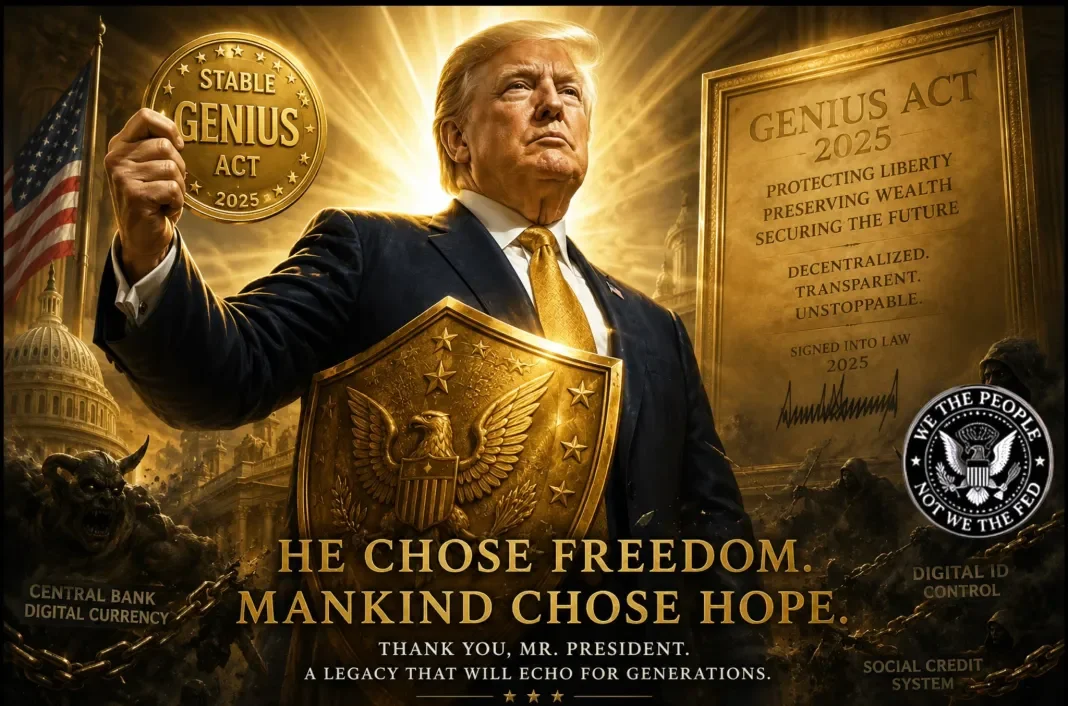
Will money remain a tool of voluntary exchange, private innovation, and individual economic freedom?
Or will money become a centralized digital instrument where every transaction can theoretically be monitored, restricted, programmed, or conditioned by whoever controls the issuing authority?
The passage of the GENIUS Act of 2025 represents, in this argument, a decisive turning point because it answered that question with a foundational principle:
Digital dollars do not have to be born from government control.
They can emerge from open networks, private innovation, transparent reserves, and voluntary adoption.
That distinction may be one of the most consequential financial decisions of the 21st century.
Exhibit A: The Battle Was Never About Technology – It Was About Control
A digital currency itself is not inherently good or evil.
Technology is a tool.
A hammer can build a house or destroy one.
The fundamental issue is who holds the hammer, under what rules, and whether the individual retains sovereignty.
A government-issued Central Bank Digital Currency (CBDC) theoretically creates capabilities that traditional cash does not possess:
direct state issuance;
real-time transaction visibility;
programmable payment rules;
automated enforcement mechanisms;
potential restrictions based on policy decisions.
Supporters argue these tools could improve efficiency, reduce fraud, and modernize payments.
Critics argue that the same architecture could create unprecedented financial surveillance or centralized control if constitutional safeguards are absent.
The concern is not the existence of digital money.
The concern is the concentration of monetary power.
Exhibit B: The GENIUS Act Changed the Battlefield
Before the GENIUS Act, the argument could be framed like this:
“If society moves toward digital dollars, the only realistic path may be a government-controlled digital dollar.”
But the legalization and regulatory recognition of dollar-backed stablecoins changes that assumption.
The argument becomes:
“Why would society require a government-issued digital currency when the market can already provide digital dollars through competing, privately issued, regulated instruments?”
That is the strategic significance.
The GENIUS Act did not merely regulate a financial product.
It legitimized an alternative monetary infrastructure.
It effectively said:
The future of digital money can be decentralized in ownership, even if denominated in a national currency.
Exhibit C: Competition Is the Enemy of Monopoly
History teaches a simple economic law:
When a monopoly controls the only available path, dependence follows.
When competing systems exist, users retain choice.
The existence of widely adopted decentralized stablecoins creates a competing path:
Path One:
Government-issued digital currency.
Centralized issuer.
Government-controlled infrastructure.
Political governance model.
Path Two:
Private stablecoin ecosystem.
Multiple issuers.
Market competition.
User choice.
Open blockchain networks.
Innovation-driven development.
The GENIUS Act strengthened Path Two.
And once millions of individuals, businesses, institutions, and global markets become dependent on open digital dollar networks, replacing them with a centralized alternative becomes politically and economically difficult, if not virtually impossible.
Exhibit D: The Network Effect Becomes the Fortress
Ladies and gentlemen, technology does not win because lawmakers declare it.
Technology wins because people adopt it.
The internet did not defeat centralized communication systems through a single law.
It won because billions of people built their lives upon it.
The same principle applies here.
A mature stablecoin ecosystem creates:
developers building financial applications;
businesses accepting digital dollars;
global users accessing dollar liquidity;
financial institutions integrating blockchain settlement;
entrepreneurs creating new services.
Once that ecosystem exists, attempting to replace it with a singular centralized alternative faces a formidable opponent:
the collective economic interest of millions of participants.
Exhibit E: The Dollar Itself Became the Strategic Weapon
The irony is profound.
Those who feared digital money could become a tool of centralized global control may find the strongest defense came not from rejecting digital currency entirely, but from ensuring that digital dollars emerged through competitive markets.
Stablecoins will export:
dollar liquidity;
American financial standards;
private-sector innovation;
open financial access.
Instead of one “world reserve” central bank digital currency (CBDC) controlled by an international bureaucracy, the world now receives competing, decentralized, dollar-based stablecoin networks.
The battlefield moved from:
“Who controls the global digital currency?”
to:
“Which digital monetary systems do people voluntarily choose?”
That is a fundamentally different paradigm.
My Closing Argument
A fair jury must acknowledge the opposing case.
The GENIUS Act does not make CBDCs legally impossible.
Congress cannot permanently bind future Congresses.
A future administration or legislature could theoretically pursue a CBDC under different circumstances.
Furthermore:
regulated stablecoins may still involve centralized issuers;
governments may influence financial infrastructure through regulation;
digital financial systems always require some governance.
Therefore, the claim that the GENIUS Act created an absolute legal impossibility for CBDCs would be too strong.
But Here Is My Final Argument
The genius of the 2025 GENIUS Act – its historic importance – is that it changed the default assumption.
Before:
“Digital money naturally leads toward government control.”
After:
“Digital money can exist through competition, transparency, and voluntary adoption.”
That is THE monumental shift.
The strongest defense of economic freedom is not merely resisting centralized power.
It is building superior alternatives.
The GENIUS Act of 2025 may have done precisely that.
It may have placed a constitutional-sized obstacle in the path of any future attempt to establish a singular global digital monetary authority – not because it outlawed such a system, but because it helped create something more powerful:
A competing monetary ecosystem already embraced by the people.
And history has repeatedly shown:
A free people are hardest to control when they possess alternatives.
The final verdict is therefore this:
The GENIUS Act may not have “killed” the CBDC idea by legal prohibition. It may have done something far more consequential – it changed the economic incentives, strengthened private digital-dollar infrastructure, and made centralized digital money far less inevitable.
The battle over the future of money was not won by banning one system.
It was potentially won by giving humanity another choice.
And choice is the foundation of liberty.
Source(s):
• https://x.com/KuwlShow/status/2076417693817659897
Seeds of Wisdom RV and Economics Updates Monday Evening 7-13-26
Good Evening Dinar Recaps,
U.S. Expands Military Pressure on Iran: Trump Reinstates Hormuz Blockade as Peace Talks Face Their Toughest Test Yet
The United States intensified military and maritime pressure on Iran while leaving diplomatic channels technically open, raising new questions about whether the ceasefire framework can still survive.
Good Evening Dinar Recaps,
U.S. Expands Military Pressure on Iran: Trump Reinstates Hormuz Blockade as Peace Talks Face Their Toughest Test Yet
The United States intensified military and maritime pressure on Iran while leaving diplomatic channels technically open, raising new questions about whether the ceasefire framework can still survive.
Overview
The United States launched major overnight strikes against Iranian military infrastructure, targeting Islamic Revolutionary Guard Corps (IRGC) assets following renewed attacks on commercial shipping in the Strait of Hormuz.
President Donald Trump announced the reinstatement of the Iranian blockade, declared the United States the "Guardian of the Hormuz Strait," and proposed a 20% cargo security fee for commercial vessels receiving U.S. protection.
Although indirect diplomatic contacts have not officially ended, the renewed military escalation places the existing Memorandum of Understanding (MOU) and ongoing technical negotiations under significant strain, increasing uncertainty for global energy markets and international trade.
Key Developments
1. Overnight U.S. Military Strikes Expand Pressure on Iran
The United States conducted one of its largest recent military operations against Iranian targets, striking IRGC military infrastructure, missile capabilities, naval assets, communications systems, and logistics facilities.
The operation follows repeated attacks against commercial shipping and reflects Washington's determination to maintain freedom of navigation through the Strait of Hormuz.
2. Trump Announces New Hormuz Security Policy
President Trump announced that the United States is reinstating the Iranian blockade, stating that Iranian military and commercial activity will face renewed restrictions.
He also declared the United States would become "The Guardian of the Hormuz Strait" and proposed a 20% cargo reimbursement fee to offset the costs of protecting international shipping through one of the world's most strategically important waterways.
3. Peace Talks Continue, But Under Growing Military Pressure
Despite today's escalation, the United States and Iran have not formally abandoned diplomacy.
The previously negotiated 60-day Memorandum of Understanding and subsequent technical discussions created a framework for continued negotiations. However, renewed military operations significantly complicate those efforts and make a comprehensive peace agreement more difficult to achieve.
4. Markets React Immediately to Rising Geopolitical Risk
Financial markets responded quickly to the renewed conflict.
Oil prices moved higher amid renewed concerns over global energy supplies, while Bitcoin and other risk assets declined as investors shifted toward safer investments. Shipping companies and insurers also face increasing uncertainty as security risks in the Strait of Hormuz continue.
5. Global Trade Faces Renewed Uncertainty
The Strait of Hormuz remains one of the world's most important energy corridors, carrying a substantial share of global crude oil and liquefied natural gas exports.
Any prolonged disruption could increase transportation costs, place upward pressure on inflation, and slow global trade just as many economies were beginning to stabilize.
Why It Matters
Today's developments represent more than another military exchange.
Energy security, global shipping, inflation, and financial market stability are now increasingly linked to developments in the Persian Gulf. The renewed military pressure demonstrates that geopolitical events can quickly reverse improving market sentiment and complicate international economic recovery.
At the same time, the continuation of diplomatic channels suggests that military action and negotiations are now occurring simultaneously, creating a highly uncertain environment for policymakers, businesses, and investors.
Why It Matters to Foreign Currency Holders
Higher energy prices can strengthen inflationary pressures and influence central bank monetary policy.
Increased geopolitical uncertainty often leads investors toward traditional safe-haven assets while creating greater volatility across global currency markets.
Changes in trade flows and shipping costs may affect national balance sheets, capital flows, and future currency valuations.
Implications for the Global Reset
Pillar 1: Trade
The renewed focus on the Strait of Hormuz highlights how vulnerable global commerce remains to disruptions in key maritime chokepoints. Shipping security, freight costs, and international supply chains continue to play a central role in global economic stability.
Pillar 2: Energy
Energy markets remain highly sensitive to geopolitical developments. Continued instability in the Persian Gulf could contribute to higher oil prices, renewed inflationary pressure, and additional challenges for central banks attempting to balance economic growth with price stability.
Conclusion
The overnight U.S. military operation and President Trump's new maritime security policy represent a significant escalation in Washington's approach toward Iran.
While diplomatic contacts have not officially ended, the balance has clearly shifted toward increased military leverage alongside continued negotiations. Whether this strategy ultimately produces a durable peace agreement or leads to further escalation remains uncertain.
What is clear is that developments in the Strait of Hormuz continue to influence global trade, energy markets, inflation, and financial stability, making this one of the most consequential geopolitical stories for the international financial system.
Seeds of Wisdom Team
Newshounds News™ Exclusive
Sources
~~~~~~~~~~
Seeds of Wisdom Team RV Currency Facts Youtube and Rumble
Newshound's News Telegram Room Link
RV Facts with Proof Links Link
RV Updates Proof links - Facts Link
Start Here room with Most Asked Questions Link
Follow the Gold/Silver Rate COMEX
Follow Fast Facts
Seeds of Wisdom Team™Website
Thank you Dinar Recaps
The US Economy and How It Works
The US Economy and How It Works
By Kimberly Amadeo Updated on September 17, 2020
Have you ever said to yourself, "How exactly does the U.S. economy work?" During a recession, you might think, "Not too well!"
Learn the causes of recession by understanding gross domestic product and the laws of supply and demand. Know how the federal government uses fiscal and trade policy. Realize how the Federal Reserve fights inflation while spurring growth with monetary policy. See how financial markets on Wall Street influence Main Street and your neighborhood.
The US Economy and How It Works
By Kimberly Amadeo Updated on September 17, 2020
Have you ever said to yourself, "How exactly does the U.S. economy work?" During a recession, you might think, "Not too well!"
Learn the causes of recession by understanding gross domestic product and the laws of supply and demand. Know how the federal government uses fiscal and trade policy. Realize how the Federal Reserve fights inflation while spurring growth with monetary policy. See how financial markets on Wall Street influence Main Street and your neighborhood.
GDP
Everything the U.S. economy produces is measured by GDP. When the GDP growth rate turns negative, the economy enters a recession.
That has happened throughout the history of U.S. recessions. When the economy contracts for years, it's called a depression. Learn the difference between recession and depression.
The most important part of the economy is consumer spending. The other three components are business expenditures, government spending, and net exports.1
The U.S. economy is no longer the world's largest. China has outpaced current U.S. GDP statistics. The U.S. is the world’s second-largest economy, while India and Japan follow in third and fourth place.2
Supply and Demand
Supply and demand are the forces that drive the U.S. economy. Supply includes labor, represented by employment, and natural resources, such as oil, land, and water. Oil prices drive 70% of the cost of gas.3
Demand, or personal consumption, drives almost 70% of the economy.4 A lot of this occurs during the holiday shopping season, which starts on Black Friday.
The recession increased unemployment. Many people became discouraged over ever finding a job and dropped out of the labor force. As a result, 38.1 million, or one-third of Americans are poor or near poor.5 That's one reason the U.S. economy has slowed. Income inequality wasn't caused by the recession. It began worsening through the 2000s.
Inflation and Deflation
Inflation occurs when demand is greater than supply and prices go up. Your income and the rate at which it keeps up with rising prices determine how much inflation impacts your life.
Inflation is difficult to stamp out. Once it occurs, people begin to expect ever higher prices. They will buy now before prices go up more in the future. That increases demand even more. Another cause of inflation is an increase in the money supply.
The U.S. government measures the current inflation rate with the Consumer Price Index, but it sometimes gives misleading information. The commodities market determines oil, gas, and food prices.6 They can skyrocket and plummet within months. The Federal Reserve uses the core inflation rate instead. That excludes energy and food costs.7
If inflation occurs in assets, such as housing or stocks, it's called an asset bubble.
The opposite is deflation; it occurs when prices fall. That also happens to assets, such as housing prices and stock portfolios. That creates stock crashes and economic crises. Deflation is worse than inflation for an economy.
Fiscal Policy
Fiscal policy is the $4 trillion federal budget.8 All the revenue ultimately comes from taxes on your income, so it is important for you to know how it is spent. Fiscal policy can stimulate, guide, or depress the economy, but only business can create economic growth.
The president starts the budgetary process each year, but only Congress has the government spending authority. For example, President Obama's economic stimulus package was his idea, but Congress approved it.
Spending outpaces revenue, creating a budget deficit. Each year, it is added to the national debt.
One large contributor to the deficit and debt is the Bush tax rebates. They follow the theory of supply-side economics. It says that lower taxes will eventually spur the economy enough to replace the loss in taxes. That hasn't happened. But tax rebates are very popular because people hate paying them. Many have proposed a flat tax or a fair tax.
Monetary Policy
Monetary policy is controlled by the Federal Reserve. That banking system is guided by the Federal Reserve Chair Jerome Powell.9 The Federal Reserve tools include the fed funds rate, the money supply, and the use of credit. These tools control how interest rates affect the economy. Compare the current fed funds rate to historical fed funds rates to know whether the Fed is using an expansionary or a contractionary monetary policy.
The primary objective of monetary policy is to control inflation. Its secondary objective is to stimulate the economy. It is also charged with the smooth functioning of the banking system. For this reason, the Fed chair is often called the most powerful person on the planet.
In 2009, Ben Bernanke was named Time's Man of the Year.10 As a Fed chair, he took aggressive steps to address the 2007 banking meltdown and the 2008 financial crisis. Yet, many critics argue that the United States should return to the gold standard.
Trade Policy
Trade policy affects the cost of imports and exports by regulating trade agreements with other countries.
Trade agreements, like the North American Free Trade Agreement, seek to reduce trade costs and increase each country's GDP. The World Trade Organization attempted an ambitious worldwide trade agreement in the Doha round of trade talks. That didn't work since the European Union and the United States didn't want to end agricultural subsidies.11
Instead, the United States pursued bilateral and regional trade agreements. These include the Trans-Pacific Partnership and the Transatlantic Trade and Investment Partnership. If they were approved, they would be the largest trade agreements in the world.
Exchange rates affect trade by changing the value of the U.S. dollar. The dollar is the world's global currency. Most international trade contracts are done in dollars. When the dollar is strong, it allows the prices of oil and other commodities to fall. That can create deflation.
Financial Markets
An implosion in the financial markets threw the economy into the worst recession since the Great Depression. How did this happen? It began with derivatives that were supposed to insure against defaults on sub-prime mortgages. Demand for the derivatives was so strong, it almost forced insurers like the American International Group to default.12 That threw Wall Street into a panic which spread throughout the world. Unregulated derivatives created the credit crisis of 2008.13
The building blocks are stocks and stock investing. They are riskier than bonds. The safest are Treasury bonds. The riskiest are junk bonds. You can invest in either with mutual funds.
Many wealthy investors let hedge funds do the investing for them. Others seek higher returns by trading in risky commodities, futures contracts, and credit default swaps. This made many argue for more regulations on Wall Street.
TO READ MORE:https://www.thebalancemoney.com/how-does-the-u-s-economy-work-4056835
Big Week Ahead For The Future Of Iraq & The Dinar
Big Week Ahead For The Future Of Iraq & The Dinar
The Dinar Den: 7-12-2026
For those following the Iraqi dinar market, the landscape is shifting at a rapid pace. Stephen, a seasoned entrepreneur and long-term investor with over a decade of experience in the sector, recently provided an in-depth update on the highly anticipated revaluation (RV) of the Iraqi dinar.
While determining an exact timeline for such a complex economic event remains a challenge, recent developments suggest that the foundational progress required for a successful transition is gaining momentum.
Big Week Ahead For The Future Of Iraq & The Dinar
The Dinar Den: 7-12-2026
For those following the Iraqi dinar market, the landscape is shifting at a rapid pace. Stephen, a seasoned entrepreneur and long-term investor with over a decade of experience in the sector, recently provided an in-depth update on the highly anticipated revaluation (RV) of the Iraqi dinar.
While determining an exact timeline for such a complex economic event remains a challenge, recent developments suggest that the foundational progress required for a successful transition is gaining momentum.
The current week stands as a critical juncture for Iraq’s economic future.
Prime Minister Al Zaidi’s historic visit to Washington, D.C., accompanied by a high-level delegation including the Governor of the Central Bank of Iraq, signals a serious commitment to strengthening international financial ties.
This diplomatic outreach is focused on securing vital economic support and integrating Iraq more deeply into the global financial system. Furthermore, strategic moves—such as securing major oil export agreements and the development of a new pipeline designed to bypass the Strait of Hormuz—are being implemented to stabilize the nation’s revenue streams and reduce reliance on vulnerable trade routes.
One of the most compelling aspects of Stephen’s update concerns the technical modernization of the Iraqi banking sector.
According to insights provided by Terrence, a UAE-based central banker who previously audited Al Rafidian Bank, Iraq’s current banking landscape is significantly “overbanked.” This leads to fragmented competition, diminished profitability, and the use of outdated financial models.
To address this, the government is moving forward with a plan to consolidate key institutions, specifically Al Rafidian and Al Rashid. By merging these entities, the central bank aims to create more robust, stable institutions with significantly larger capital bases.
These reforms are essential, as they allow domestic banks to modernize their infrastructure and compete effectively on the international stage, a move that is widely viewed as a necessary precursor to a successful currency revaluation.
Despite this progress, the road to economic normalization is not without obstacles. Stephen highlights that Iraq continues to grapple with deep-seated institutional challenges, including corruption linked to external regional influences and the process of finalizing cabinet appointments.
Additionally, U.S. stakeholders remain cautious, guiding Iraq through these policy shifts to ensure that the economic transformation is sustainable and secure.
While these hurdles have led to previous delays, the sentiment remains one of cautious optimism. Stephen advocates for continued patience among the investor community, noting that a properly executed process is far more valuable than a hasty one.
Many industry observers are currently looking toward August as a potential window for these final structural changes to take effect. For long-term investors, these reforms are viewed as the bedrock upon which future wealth creation will be built.
Fiat Currency Endgame Is Here — John Rubino’s Biggest Warning Yet
Fiat Currency Endgame Is Here — John Rubino’s Biggest Warning Yet
Triangle Investor: 7-7-2026
Financial author John Rubino warns that the world may be entering the final stages of the current financial system as rising debt, currency instability, and central bank actions reshape the global economy.
We discuss why governments are accumulating gold, whether a new gold-backed financial system could emerge, and how investors should prepare for potential currency crises, inflation, recession, and market volatility.
Fiat Currency Endgame Is Here — John Rubino’s Biggest Warning Yet
Triangle Investor: 7-7-2026
Financial author John Rubino warns that the world may be entering the final stages of the current financial system as rising debt, currency instability, and central bank actions reshape the global economy.
We discuss why governments are accumulating gold, whether a new gold-backed financial system could emerge, and how investors should prepare for potential currency crises, inflation, recession, and market volatility.
Rubino shares his outlook on gold, silver, copper, uranium, real estate, the AI bubble, and the future of fiat currencies, explaining where he sees the biggest risks and opportunities in the years ahead. Is a major financial reset coming?
Are central banks preparing behind the scenes? Find out in this deep dive into the future of money, commodities, and global markets.
Chapters 0:00 Intro
01:10 - What Happens First During a Major Currency Crisis?
02:55 - The Moment Governments Lose Control of Money
04:25 - Gold’s Recent Correction: Is the Bull Market Over?
05:35 - Why Gold & Silver Could Still Move Much Higher
06:50 - Have Gold and Interest Rates Changed Forever?
08:25 - Why Rising Rates Could Actually Help Gold
09:15 - Central Banks Are Buying Gold Again — Here’s Why
10:20 - Are Governments Preparing a New Gold-Backed System?
12:55 - Could Central Banks Sell Their Gold During a Crisis?
14:30 - Why a Market Crash Could Create a Huge Buying Opportunity
16:15 - The Road Toward $15,000 Gold and $200 Silver
17:05 - Are We Heading Into Recession or Stagflation?
19:00 - The AI Bubble Compared to the Dot-Com Crash
21:20 - Could AI Trigger the Next Financial Crisis?
23:05 - Why Investors Should Prepare for Market Volatility
24:40 - Real Estate Bubble: Are Prices Finally Peaking?
27:20 - Why Owning the Right Assets Matters
29:05 - The Biggest Opportunities in Commodities
30:00 - Gold, Silver, Copper & Uranium: John’s Top Picks