Rob Cunningham: My Closing Stable GENUIS Argument Before the Jury of History
7-13-2026
My Closing Stable GENUIS Argument Before the Jury of History
“Ladies and gentlemen of the jury,
The question before us is not merely about a piece of legislation.
It is not merely about stablecoins.
It is not merely about blockchain.
The question before us is far greater:
Who will control the future architecture of money?
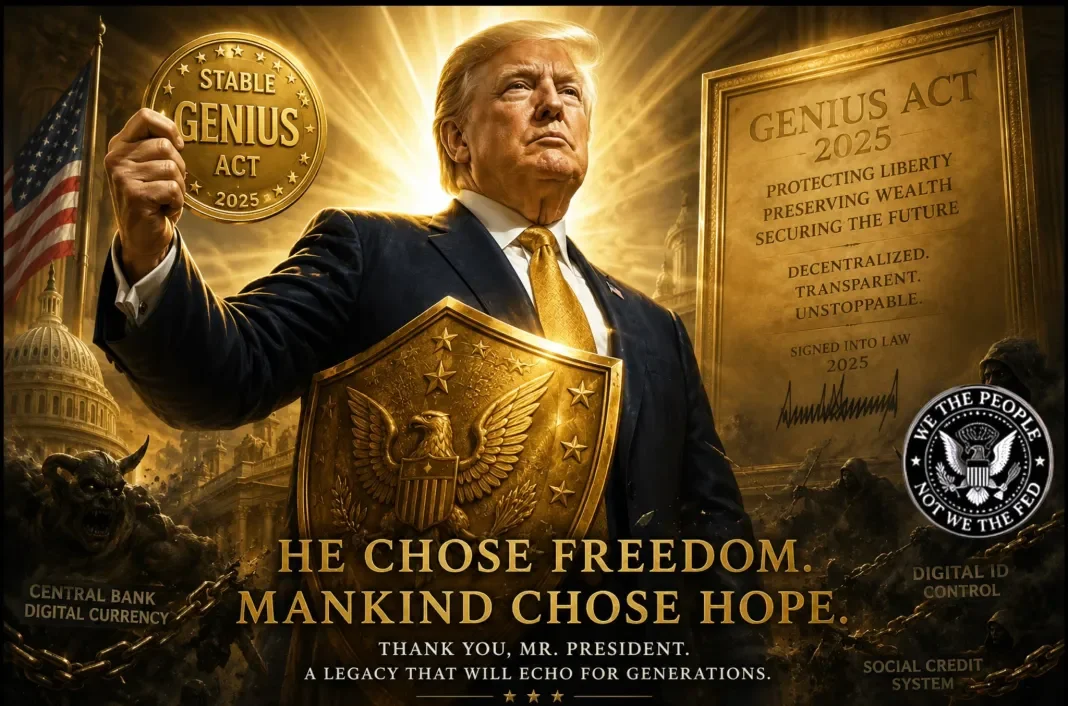
Will money remain a tool of voluntary exchange, private innovation, and individual economic freedom?
Or will money become a centralized digital instrument where every transaction can theoretically be monitored, restricted, programmed, or conditioned by whoever controls the issuing authority?
The passage of the GENIUS Act of 2025 represents, in this argument, a decisive turning point because it answered that question with a foundational principle:
Digital dollars do not have to be born from government control.
They can emerge from open networks, private innovation, transparent reserves, and voluntary adoption.
That distinction may be one of the most consequential financial decisions of the 21st century.
Exhibit A: The Battle Was Never About Technology – It Was About Control
A digital currency itself is not inherently good or evil.
Technology is a tool.
A hammer can build a house or destroy one.
The fundamental issue is who holds the hammer, under what rules, and whether the individual retains sovereignty.
A government-issued Central Bank Digital Currency (CBDC) theoretically creates capabilities that traditional cash does not possess:
direct state issuance;
real-time transaction visibility;
programmable payment rules;
automated enforcement mechanisms;
potential restrictions based on policy decisions.
Supporters argue these tools could improve efficiency, reduce fraud, and modernize payments.
Critics argue that the same architecture could create unprecedented financial surveillance or centralized control if constitutional safeguards are absent.
The concern is not the existence of digital money.
The concern is the concentration of monetary power.
Exhibit B: The GENIUS Act Changed the Battlefield
Before the GENIUS Act, the argument could be framed like this:
“If society moves toward digital dollars, the only realistic path may be a government-controlled digital dollar.”
But the legalization and regulatory recognition of dollar-backed stablecoins changes that assumption.
The argument becomes:
“Why would society require a government-issued digital currency when the market can already provide digital dollars through competing, privately issued, regulated instruments?”
That is the strategic significance.
The GENIUS Act did not merely regulate a financial product.
It legitimized an alternative monetary infrastructure.
It effectively said:
The future of digital money can be decentralized in ownership, even if denominated in a national currency.
Exhibit C: Competition Is the Enemy of Monopoly
History teaches a simple economic law:
When a monopoly controls the only available path, dependence follows.
When competing systems exist, users retain choice.
The existence of widely adopted decentralized stablecoins creates a competing path:
Path One:
Government-issued digital currency.
Centralized issuer.
Government-controlled infrastructure.
Political governance model.
Path Two:
Private stablecoin ecosystem.
Multiple issuers.
Market competition.
User choice.
Open blockchain networks.
Innovation-driven development.
The GENIUS Act strengthened Path Two.
And once millions of individuals, businesses, institutions, and global markets become dependent on open digital dollar networks, replacing them with a centralized alternative becomes politically and economically difficult, if not virtually impossible.
Exhibit D: The Network Effect Becomes the Fortress
Ladies and gentlemen, technology does not win because lawmakers declare it.
Technology wins because people adopt it.
The internet did not defeat centralized communication systems through a single law.
It won because billions of people built their lives upon it.
The same principle applies here.
A mature stablecoin ecosystem creates:
developers building financial applications;
businesses accepting digital dollars;
global users accessing dollar liquidity;
financial institutions integrating blockchain settlement;
entrepreneurs creating new services.
Once that ecosystem exists, attempting to replace it with a singular centralized alternative faces a formidable opponent:
the collective economic interest of millions of participants.
Exhibit E: The Dollar Itself Became the Strategic Weapon
The irony is profound.
Those who feared digital money could become a tool of centralized global control may find the strongest defense came not from rejecting digital currency entirely, but from ensuring that digital dollars emerged through competitive markets.
Stablecoins will export:
dollar liquidity;
American financial standards;
private-sector innovation;
open financial access.
Instead of one “world reserve” central bank digital currency (CBDC) controlled by an international bureaucracy, the world now receives competing, decentralized, dollar-based stablecoin networks.
The battlefield moved from:
“Who controls the global digital currency?”
to:
“Which digital monetary systems do people voluntarily choose?”
That is a fundamentally different paradigm.
My Closing Argument
A fair jury must acknowledge the opposing case.
The GENIUS Act does not make CBDCs legally impossible.
Congress cannot permanently bind future Congresses.
A future administration or legislature could theoretically pursue a CBDC under different circumstances.
Furthermore:
regulated stablecoins may still involve centralized issuers;
governments may influence financial infrastructure through regulation;
digital financial systems always require some governance.
Therefore, the claim that the GENIUS Act created an absolute legal impossibility for CBDCs would be too strong.
But Here Is My Final Argument
The genius of the 2025 GENIUS Act – its historic importance – is that it changed the default assumption.
Before:
“Digital money naturally leads toward government control.”
After:
“Digital money can exist through competition, transparency, and voluntary adoption.”
That is THE monumental shift.
The strongest defense of economic freedom is not merely resisting centralized power.
It is building superior alternatives.
The GENIUS Act of 2025 may have done precisely that.
It may have placed a constitutional-sized obstacle in the path of any future attempt to establish a singular global digital monetary authority – not because it outlawed such a system, but because it helped create something more powerful:
A competing monetary ecosystem already embraced by the people.
And history has repeatedly shown:
A free people are hardest to control when they possess alternatives.
The final verdict is therefore this:
The GENIUS Act may not have “killed” the CBDC idea by legal prohibition. It may have done something far more consequential – it changed the economic incentives, strengthened private digital-dollar infrastructure, and made centralized digital money far less inevitable.
The battle over the future of money was not won by banning one system.
It was potentially won by giving humanity another choice.
And choice is the foundation of liberty.
Source(s):
• https://x.com/KuwlShow/status/2076417693817659897