
First They Took the Gold, Then They Changed the Rules
First They Took the Gold, Then They Changed the Rules
Zang International: 6-7-2026
Kenneth Mraz examines the events of 1933 that fundamentally changed America's monetary system.
He explains the connection between Executive Order 6102, which forced Americans to surrender their gold, and House Joint Resolution 192, which removed gold clauses from contracts and altered how debts could be settled.
He explores the difference between payment and discharge, why purchasing power continues to decline, and how today's debt-based monetary system may trace its roots back to these historic changes.
First They Took the Gold, Then They Changed the Rules
Zang International: 6-7-2026
Kenneth Mraz examines the events of 1933 that fundamentally changed America's monetary system.
He explains the connection between Executive Order 6102, which forced Americans to surrender their gold, and House Joint Resolution 192, which removed gold clauses from contracts and altered how debts could be settled.
He explores the difference between payment and discharge, why purchasing power continues to decline, and how today's debt-based monetary system may trace its roots back to these historic changes.
Chapters:
0:00 The Real Reason Purchasing Power Is Collapsing
0:29 House Joint Resolution 192 Changed Money Forever
1:00 Payment vs. Discharge: The Hidden Shift
1:34 The Endless Debt Loop Explained
2:03 Who Gets the New Money First?
2:40 Why Workers Absorb the Devalued Dollars
3:17 Savings Accounts and the “Empty Wrapper” Problem
4:02 Gold Confiscation Before the System Changed
5:01 Stablecoins, the GENIUS Act, and 1:1 Reserves
6:01 Deflation, More Money Printing, and the Reset Risk
6:33 The Choice: Hold Debt or Hold Real Wealth
Iraq Economic News and Points To Ponder Sunday Afternoon 6-7-26
The Finance Committee Rules Out Approving The 2026 Budget And Confirms: Salary Payments Will Not Be Affected.
Money and Business Economy News – Baghdad The parliamentary finance committee explained that approving the 2026 budget is unlikely given the ongoing work to complete the government program and the cabinet, while stressing that the current priority is securing salaries and addressing the economic challenges facing the government.
The Finance Committee Rules Out Approving The 2026 Budget And Confirms: Salary Payments Will Not Be Affected.
Money and Business Economy News – Baghdad The parliamentary finance committee explained that approving the 2026 budget is unlikely given the ongoing work to complete the government program and the cabinet, while stressing that the current priority is securing salaries and addressing the economic challenges facing the government.
Finance Committee member, Ribwar Karim, told the official newspaper, as reported by "Economy News," that "this year's budget will most likely not exist, and work will begin on studying the 2027 budget, stressing that securing salaries will not be affected, and that the government has very large capabilities to address the deficit through internal or external borrowing or by using the Central Bank."
Karim added that "everyone agrees on supporting the government's efforts in securing salaries and reaching the next budget, indicating that things will be clearer in the next budget with regard to the effects of the Strait of Hormuz and oil prices and expanding revenues, especially after the application of the Customs Tariff Law and the ASYCUDA system, which will provide greater diversity in sources of income."
Karim explained that the absence of a budget until the middle of the fiscal year is directly related to the government program, especially since the government is still in the process of completing its formation, and the House of Representatives has granted the Prime Minister the necessary confidence and powers. He stressed that the Finance Committee is ready to support the government in facing the economic challenges, whether the 2026 budget is presented or not, indicating that any move to legislate an alternative law similar to the Food Security Law has not been proposed yet, and the matter is left to the request of the government and the Prime Minister’s vision for the next stage. https://www.economy-news.net/content.php?id=69946
CBI Denies Printing Money To Fund Salaries
2026-06-07 Shafaq News- Baghdad The Central Bank of Iraq (CBI) rejected on Sunday claims that it is printing money to cover government salaries, following remarks by Foreign Minister Fuad Hussein about printing 25 trillion Iraqi dinars to address the country's financial crisis.
Discounting treasury bills differs fundamentally from issuing currency, the bank stressed, describing the former as a standard mechanism used by central banks to provide temporary liquidity against government debt that is repaid at maturity. However, issuing money without corresponding assets is prohibited under Iraq’s Central Bank Law No. 56 of 2004 because it can fuel inflation and weaken the national currency.
CBI pointed out that its role is to manage monetary policy and protect the financial system rather than serve as a permanent source of budget financing, adding that any exceptional measures are implemented under strict controls and according to economic requirements.
“The current circumstances highlight the need for long-term fiscal policies aimed at building financial buffers capable of absorbing economic shocks and oil market volatility,” the bank said, calling for greater economic diversification, broader revenue sources, and efficient public debt management to reduce the impact of future crises and preserve overall economic stability. https://www.shafaq.com/en/Economy/CBI-denies-printing-money-to-fund-salaries
A Busy Week For Financial Markets: Markets Await Spacex's IPO And Inflation Data Amid Interest Rate Concerns.
Money and Business Investors began the week amid sharp fluctuations in global markets, following last week's heavy losses that pushed major US indices lower, as investors reassessed expectations of interest rate hikes this year.
The S&P 500 fell 2.6% on Friday, posting a similar weekly loss, while the Dow Jones Industrial Average declined 1.4% on the same day, ending the week down 0.6%. The Nasdaq Composite suffered the biggest losses, plunging 4.2% on Friday and closing the week down 4.7%.
This week, markets are focused on several key economic and financial events, most notably the highly anticipated initial public offering (IPO) of Elon Musk's SpaceX, as well as major corporate earnings reports and crucial US inflation data.
Oracle is scheduled to announce its earnings on Wednesday, followed by Adobe's results on Thursday, while investors await indicators related to the artificial intelligence and cloud computing sectors.
The most significant event is the anticipated initial public offering (IPO) of SpaceX on Friday, one of the largest in market history, with a price tag of $135 per share, potentially valuing the company at around $1.78 trillion. Investors are closely watching the impact of the listing on the Nasdaq indices and the potential for a significant rebalancing of index funds.
Economically, attention is focused on US inflation data, with the Consumer Price Index (CPI) due on Wednesday, followed by the Producer Price Index (PPI) on Thursday. The Federal Reserve continues to monitor inflation as part of its monetary policy decisions.
The week concludes with the release of the University of Michigan's Consumer Sentiment and Inflation Expectations report, offering further insights into the overall mood of American households after the index fell to a historic low last month.
This momentum comes as investors attempt to balance relatively strong economic data with concerns about persistent inflationary pressures and the possibility of tighter monetary policy in the near future.
https://www.economy-news.net/content.php?id=69981
Iraqi Oil Exports To US Resume At 43,000 Bpd
2026-06-07Shafaq News- Baghdad/ Washington US imports of crude oil from Iraq, OPEC's second-largest producer, rose to 43,000 barrels per day (bpd) last week after no imports were recorded a week earlier, according to data from the US Energy Information Administration (EIA).
The increase placed Iraq eighth among the 10 main suppliers of crude oil to the United States during the reporting week.
Canada remained the largest exporter to the US market with 3.677 million bpd, followed by Venezuela at 568,000 bpd, Brazil at 414,000 bpd, Mexico at 323,000 bpd, Ecuador at 300,000 bpd, Saudi Arabia at 283,000 bpd, and Colombia at 167,000 bpd.
Nigeria followed Iraq with 23,000 bpd, while Libya ranked last among the listed suppliers with 8,000 bpd.
https://www.shafaq.com/en/Economy/Iraqi-oil-exports-to-US-resume-at-43-000-bpd
OPEC+ Approves Fourth Straight Production Hike
2026-06-07Shafaq News- Baghdad/ Vienna Iraq and six other members of the OPEC+ alliance agreed on Sunday to increase oil production by a combined 188,000 barrels per day from July 2026, extending a series of monthly output increases aimed at gradually unwinding earlier supply cuts.
The decision, reached during a virtual meeting involving Saudi Arabia, Russia, Iraq, Kuwait, Kazakhstan, Algeria, and Oman, will lift Baghdad’s production target by 26,000 barrels per day to 4.378 million barrels per day, while Riyadh and Moscow will each increase output by 62,000 barrels per day, bringing their respective targets to 10.353 million and 9.824 million barrels per day.
The boost forms part of the gradual rollback of voluntary production cuts first announced in April 2023. According to OPEC+, the seven countries maintained that the production adjustments remain subject to change and could be paused or reversed depending on market developments.
July’s increase marks the fourth monthly hike, and matches the June hike, which was reduced from the 206,000-barrel-per-day increase implemented in April and May following the UAE's departure from OPEC.
https://www.shafaq.com/en/Economy/OPEC-approves-fourth-straight-production-hike
Saudi Arabia, Russia, Iraq, Kuwait, Kazakhstan, Algeria, And Oman Adjust Production And Reaffirm Commitment To Market Stability
The seven OPEC+ countries, which previously announced additional voluntary adjustments in April and November 2023, namely Saudi Arabia, Russia, Iraq, Kuwait, Kazakhstan, Algeria, and Oman met virtually on 7 June 2026, to review global market conditions and outlook.
In their collective commitment to support oil market stability, the seven participating countries decided to implement a production adjustment of 188 thousand barrels per day from the additional voluntary adjustments announced in April 2023. This adjustment will be implemented in July 2026 as detailed in the table below. The additional voluntary adjustments announced in April 2023 may be returned in part or in full subject to evolving market conditions and in a gradual manner.
The countries will continue to closely monitor and assess market conditions, and in their continuous efforts to support market stability, they reaffirmed the importance of adopting a cautious approach and retaining full flexibility to increase, pause or reverse the phase out of the voluntary production adjustments, including reversing the previously implemented voluntary adjustments announced in November 2023.
The seven OPEC+ countries also noted that this measure will provide an opportunity for the participating countries to accelerate their compensation. The seven countries reiterated their collective commitment to achieve full conformity with the Declaration of Cooperation, including the additional voluntary production adjustments that will be monitored by the Joint Ministerial Monitoring Committee (JMMC).
They also confirmed their intention to fully compensate for any overproduced volume since January 2024. The compensation period will be extended until the end of December 2026.
The seven OPEC+ countries will hold monthly meetings to review market conditions, conformity, and compensation. The seven countries will meet on 5 July 2026. https://www.opec.org/pr-detail/1781604-7-june-2026.html
Seeds of Wisdom RV and Economics Updates Sunday Afternoon 6-7-26
Good Afternoon Dinar Recaps,
Russia Pushes Multipolar Economic Vision as Eurasian Bloc Seeks Greater Financial Independence
Growing efforts to expand regional trade, de-dollarization, and economic integration highlight the accelerating shift toward a more multipolar global financial system.
Good Afternoon Dinar Recaps,
Russia Pushes Multipolar Economic Vision as Eurasian Bloc Seeks Greater Financial Independence
Growing efforts to expand regional trade, de-dollarization, and economic integration highlight the accelerating shift toward a more multipolar global financial system.
Overview
As global economic power continues shifting away from a unipolar framework, Russia and its Eurasian partners are intensifying efforts to build alternative financial and trade structures designed to reduce reliance on Western institutions.
Discussions at the 29th St. Petersburg International Economic Forum (SPIEF) focused heavily on the future of the Eurasian Economic Union (EAEU), regional sovereignty, national-currency trade, and the role Eurasia may play in an emerging multipolar economy. The conversations reflect broader global trends toward economic diversification, regional integration, and the development of parallel financial systems.
Key Developments
1. Russia Reaffirms Commitment to a Multipolar Economic Order
Russian President Vladimir Putin stated that a new global economic architecture is emerging that is becoming more diverse and representative of the Global South and East.
The vision centers on reducing dependence on traditional Western-led institutions while creating new frameworks for trade, investment, finance, and regional cooperation.
2. Eurasian Economic Union Continues Expanding Integration Efforts
The EAEU was established to promote economic integration among former Soviet republics through a common market and coordinated economic policies.
Today, the bloc represents approximately 183 million people and more than $2.4 trillion in combined GDP, making it an increasingly significant regional economic organization.
3. De-Dollarization Remains a Strategic Priority
Russia continues to work with partners through BRICS, the Shanghai Cooperation Organization (SCO), and the Greater Eurasian Partnership to increase the use of national currencies in cross-border trade.
Efforts include expanding alternative payment systems, reducing exposure to Western sanctions, and creating financial infrastructure outside the traditional dollar-centered system.
4. New Trade Corridors and Supply Chains Are Emerging
Forum participants highlighted the growing importance of eastward-facing trade routes, regional manufacturing hubs, and localized supply chains.
These developments are helping reshape global logistics networks as countries seek greater economic resilience amid geopolitical uncertainty.
5. Economic Sovereignty Becomes a Central Theme
One of the dominant messages from SPIEF was that sovereignty is increasingly tied to economic self-sufficiency, technological development, and financial independence.
Countries throughout Eurasia are exploring ways to strengthen domestic industries, improve regional connectivity, and reduce vulnerabilities to external economic pressures.
Why It Matters
The discussions at SPIEF underscore how rapidly the global economic landscape is evolving. While globalization continues, many nations are seeking greater autonomy over trade, finance, and strategic industries.
Rather than replacing the existing system overnight, these efforts are gradually creating alternative networks that could operate alongside traditional Western-led institutions.
Why It Matters to Foreign Currency Holders
• More international trade is being settled in local currencies rather than the U.S. dollar.
• Regional economic blocs are building independent payment and settlement systems.
• Alternative financial infrastructure could influence future reserve currency dynamics.
• Growing multipolarity may gradually reshape global capital flows and investment patterns.
Implications for the Global Reset
Pillar 1: Expansion of Alternative Financial Systems
The continued development of regional payment systems, local-currency trade agreements, and independent financial infrastructure reflects a broader movement toward diversification within the global monetary system.
Pillar 2: Rise of Regional Economic Blocs
Organizations such as the EAEU, BRICS, and the SCO are becoming increasingly important as nations seek greater economic sovereignty and reduced dependence on traditional centers of financial power.
Closing Insight
The discussions taking place across Eurasia suggest that the future global economy may be defined less by a single dominant center and more by multiple interconnected economic hubs. While the transition remains gradual, efforts to expand regional trade, strengthen national currencies, and develop alternative financial networks continue to gain momentum.
This is not merely a geopolitical shift—it is a long-term restructuring of how trade, finance, and economic influence may be distributed in the emerging multipolar world.
Seeds of Wisdom Team
Newshounds News™ Exclusive
Sources
Modern Diplomacy — "New Multipolar Economy: Questions for Russia and Eurasia"
St. Petersburg International Economic Forum (SPIEF) — Official Forum Information
~~~~~~~~~~
Seeds of Wisdom Team RV Currency Facts Youtube and Rumble
Newshound's News Telegram Room Link
RV Facts with Proof Links Link
RV Updates Proof links - Facts Link
Follow the Gold/Silver Rate COMEX
Follow Fast Facts
Seeds of Wisdom Team™Website
Thank you Dinar Recaps
What Gives Money Its Value?
What Gives Money Its Value?
Who decides how much money is worth?
By Kimberly Amadeo Updated on April 21, 2022
The value of money is determined by the demand for it, just like the value of goods and services. You can measure the value of money by what people will exchange for it and by how much of it there is.
Learn how the value of money is determined and who decides it.
What Gives Money Its Value?
Who decides how much money is worth?
By Kimberly Amadeo Updated on April 21, 2022
The value of money is determined by the demand for it, just like the value of goods and services. You can measure the value of money by what people will exchange for it and by how much of it there is.
Learn how the value of money is determined and who decides it.
Key Takeaways
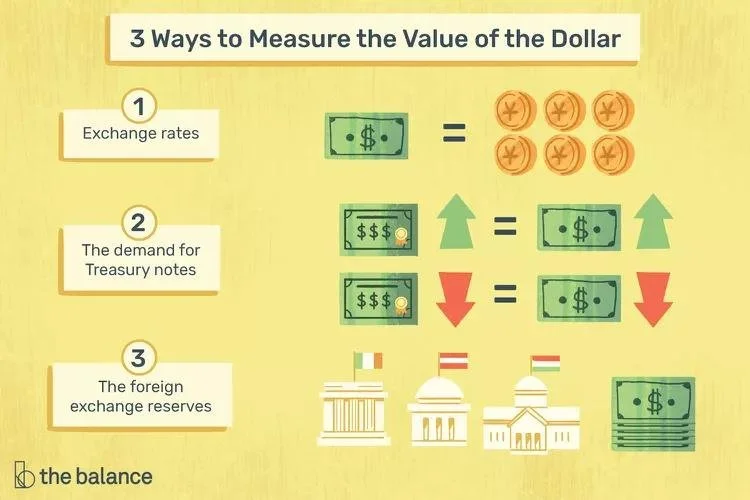
You can measure the value of money by how much it will buy in foreign currencies, the demand for Treasury notes, and how much is held in foreign exchange reserves.
When the value of money declines over time and the prices of goods increase, it is called inflation.
When prices fall steadily over time and the value of money increases, it is called deflation, and it can have a harrowing effect on the economy.
It is more valuable to have money today than to have money in the future because of the money's earnings potential; this is the time value of money.
How To Measure the Value of the Dollar
There are three ways to measure the value of the dollar.
Foreign Exchange Rate
The first way to measure the value of the dollar is by how much the dollar will buy in foreign currencies. That's what the foreign exchange (forex) rate measures. Forex traders on the foreign exchange market determine exchange rates. They take into account supply and demand, and then they factor in their expectations for the future. For this reason, the value of money fluctuates throughout the trading day.
Treasury Note Values
The second method to measure the value of the dollar is the value of Treasury notes. They can be converted easily into dollars through the secondary market for Treasurys. When the demand for Treasurys is high, the value of the U.S. dollar rises.1
Foreign Exchange Reserves
The third way is through foreign exchange reserves. That is the amount of dollars held by foreign governments. The more they hold, the lower the supply. That makes U.S. money more valuable. If foreign governments were to sell all their dollar and Treasury holdings, the dollar would collapse. U.S. money would be worth a lot less.
Why the Dollar Changes in Value
No matter how it's measured, the dollar's value declined from 2000 to 2011. That was due to a relatively low federal funds rate, a high federal debt, and a slow-growth economy.
Since 2011, the U.S. dollar has risen in value despite these factors.2 Why? Most of the economies in the world had even slower growth. That made traders want to invest in the dollar as a safe haven. As a result, the dollar strengthened against the euro.3
What Is the Time Value of Money?
Money also has a time value. Money today is worth more than money in the future because today's money can be invested and grown. To calculate the time value of money (TVM), you must consider the present value, the time frame available, and the rate at which it can grow.
Note
The formula for finding the time value of money is FV = PV x [ 1 + (i / n) ] (n x t), where FV is the future value, PV is the present value, i is the interest rate, n is compounding periods per year, and t is the number of years.
Here is an example of finding the time value of money. If you had $100 in present value, a 5% interest rate, and interest that compounds annually, you would be able to calculate the future value of the money after one year.
FV = $100 x [1 + (5% / 1)] (1 x 1) = $105
You would have $105 in future value.
How the Value of Money Affects You
The value of money affects you every day at the gas pump and the grocery store. Demand for gas and food is inelastic.4 Producers know you have to buy gas and food every week. It's not always possible to delay purchases when the price rises.
Producers will pass on any of their extra costs. You will buy it at the higher price for a while until you can change your habits.
Note
When the price of gas or food goes up, you are experiencing the reduced value of money. In March 2022, the food index increased 8.8%—the highest in 40 years.5
When the Value of Money Steadily Declines
Inflation is when the value of money steadily declines over time. Once people expect that prices will rise, they are more likely to buy now, before prices go higher. That increases demand, which tells producers they can safely pass on more costs. They drive prices up more, and inflation becomes a self-fulfilling prophecy.
That's why the Federal Reserve watches inflation like a hawk. It will reduce the money supply or raise interest rates to curb inflation. Core inflation is the price of everything except food and gas prices, which are very volatile. The Consumer Price Index is the most common measure of inflation.6
When the Value of Money Increases
Deflation occurs when the general price level across the economy declines. That sounds like a great thing, but it is worse for the economy than inflation. Why? Think about what happened to the housing market from 2007 to 2011. That was massive deflation.78 Many people could not sell their houses for what they owed on their mortgage. Buyers were afraid that the price would drop right after they purchased it. No one knew when prices would turn back up.
True, the value of money increased. You received more house for the dollar in 2011 than in 2006. But families lost homes. Construction workers lost jobs. Builders went bankrupt. That's what makes deflation so dangerous. It's a fear-driven downward spiral.
How the Value of Money Has Changed Over Time
In 1913, money was worth a lot more. A dollar then could buy what $29.04 could purchase in 2022. The dollar lost value slowly. By 1920, it could buy what $14.38 could in 2022.
During the Great Depression, money gained in value as a result of deflation. A dollar in 1930 could buy what $17.22 could in 2022. By 1950, money had lost some value. A dollar could buy what $11.93 could buy in 2022.
Money has been losing value ever since. In 1970, it could only buy $7.41 in 2022 terms. By 1990, it was only worth $2.20, also in 2022 terms. In 2000, it was worth $1.67 in 2022 terms.9
The Bottom Line
Because of inflation, your dollar today is worth more than it will be in the future. But the day-to-day value of money fluctuates as well because of the volume of demand for it. Dollar demand is measured by the exchange rate value, the value of Treasury notes, and the amount in foreign exchange reserves.
Although rising prices will lessen the purchasing power of money, generalized decreasing prices or deflation can be bad for the economy.10 Yes, deflation will certainly raise the value of money or its purchasing power.
But it's the fear of rapidly plunging prices that will make people hold on to their money, lessen aggregate demand for goods and services, and cause a serious slowdown in economic activity. This makes monitoring and managing inflation and deflation two of the Federal Reserve's most important functions.
TO READ MORE: https://www.thebalancemoney.com/value-of-money-3306108
Jon Dowling Weekly Wrap Up & Latest Financial Updates June 5th 2026
Jon Dowling Weekly Wrap Up & Latest Financial Updates June 5th 2026
6-5-2026
As we reach the midpoint of 2026, the global financial and geopolitical landscape continues to evolve at a rapid pace.
The latest weekly report, dated June 5, 2026, offers a comprehensive look into the moving parts of global currency realignment, with a specific focus on Iraq’s political trajectory, shifting U.S. economic policies, and the current state of the commodities market. For those tracking international finance, this update provides a roadmap for what to expect in the coming months.
A central theme of this week’s report is the significant progress made by Iraqi Prime Minister Al-Zaidi. With the finalization of his cabinet, the focus has shifted toward imminent diplomatic engagements in Washington, D.C.
Jon Dowling Weekly Wrap Up & Latest Financial Updates June 5th 2026
6-5-2026
As we reach the midpoint of 2026, the global financial and geopolitical landscape continues to evolve at a rapid pace.
The latest weekly report, dated June 5, 2026, offers a comprehensive look into the moving parts of global currency realignment, with a specific focus on Iraq’s political trajectory, shifting U.S. economic policies, and the current state of the commodities market. For those tracking international finance, this update provides a roadmap for what to expect in the coming months.
A central theme of this week’s report is the significant progress made by Iraqi Prime Minister Al-Zaidi. With the finalization of his cabinet, the focus has shifted toward imminent diplomatic engagements in Washington, D.C.
These meetings are expected to be a catalyst for sweeping banking reforms. By collaborating with major global institutions like Wells Fargo and Chase, Iraq aims to bring a new level of transparency and coherence to its financial system.
Key to this transition is the enactment of essential legislation, including the HCL gas law and updated border tariffs. These steps are viewed as foundational requirements for integrating Iraq’s economy more fully into the global market, moving beyond localized banking toward a more robust, internationally recognized infrastructure.
The energy sector is currently seeing a surge in optimism, highlighted by Xenog Xol gas reaching all-time market highs. This spike suggests a bullish outlook for the remainder of the year, signaling potential gains for investors keeping a close eye on alternative energy sources.
In contrast, traditional commodities like gold, silver, and crude oil remain in a holding pattern. While the dollar index has shown modest fluctuations, analysts suggest these markets are poised for “breakout” movements. These shifts are likely to be triggered by the resolution of ongoing geopolitical discussions, making the next few weeks a critical period for market watchers.
The report also touches on the domestic front, highlighting recent commentary from President Trump regarding the ideological divide in American economic policy. The discussion contrasts “red” state models—largely focused on tax relief and fostering entrepreneurial growth—with the higher-tax, social-leaning policies of “blue” states.
The report interprets these current political sentiments as a call for broader fiscal reforms, including discussions on debt relief and sustainable economic self-reliance. While U.S. equity indices are currently forecasting highs, the report tempers this optimism with a note of caution, predicting potential market corrections as we head into August and September of 2026.
A unique aspect of this week’s update is the intersection of strategic security and economic stability. The report highlights the presence of U.S. Marines in the Middle East as a stabilizing force, intended to deter corruption and ensure that the process of economic realignment remains transparent.
The goal, according to the report, is a “true” revaluation that is non-corrupt and accessible through mainstream banking institutions. This approach aims to simplify the wealth management process for the general public, moving away from the complicated redemption processes of the past.
To illustrate the importance of these reforms, the report references the historical example of the Zimbabwe hyperinflation crisis, reminding us of the necessity of sound fiscal policy.
As we navigate these complex shifts, the message from the June 5th report is one of “watchful discernment.” With major banking reforms on the horizon and energy markets hitting record peaks, the coming months promise to be transformative.
For a deeper dive into these developments and to stay informed on breaking news as it happens, be sure to watch the full video update from Jon Dowling. Staying informed is the best way to navigate the evolving world of global finance.
More “Iraq News” Posted by Tishwash at TNT 6-7-2026
TNT:
Tishwash: One trillion dinars monthly to pay the dues of companies and contractors
Prime Minister Ali Faleh al-Zubaidi revealed that approximately one trillion dinars per month has been allocated to pay the dues of businessmen, companies and contractors.
This came during his reception, yesterday, Saturday, of a number of businessmen, members of the board of directors and development of the private sector, members of the Iraqi Economic Council and a number of heads of boards of directors of private banks, in the presence of the Minister of Finance, the head of the Board of Advisors, the director of the office of the Prime Minister, and the head of the Higher Authority for Coordination between Governorates.
TNT:
Tishwash: One trillion dinars monthly to pay the dues of companies and contractors
Prime Minister Ali Faleh al-Zubaidi revealed that approximately one trillion dinars per month has been allocated to pay the dues of businessmen, companies and contractors.
This came during his reception, yesterday, Saturday, of a number of businessmen, members of the board of directors and development of the private sector, members of the Iraqi Economic Council and a number of heads of boards of directors of private banks, in the presence of the Minister of Finance, the head of the Board of Advisors, the director of the office of the Prime Minister, and the head of the Higher Authority for Coordination between Governorates.
Al-Zaydi identified three criteria for preferring the private sector: “tax accounting,” “the size of the workforce and its inclusion in social security,” in addition to “the size of the social benefits contributed to.”
He emphasized that the government relies on cooperation with the private sector to ensure the success of its economic and development reform efforts, adding: "We have an upcoming official visit to the United States, and we will be accompanied by a number of business leaders to expand investment opportunities." link
Tishwash: The Minister of Finance discusses with the World Bank technical support for budget preparation and strengthening reforms.
Finance Minister Faleh Sari met on Sunday with a World Bank delegation to discuss technical support for budget preparation and strengthening reforms.
A statement from the Ministry of Finance said that Sari received the World Bank delegation, headed by Regional Director Jean-Christophe Carré and Special Representative for Iraq Emmanuel Salinas, to discuss prospects for technical and institutional cooperation and support for Iraq's financial and economic reform priorities. The statement
added that the meeting addressed mechanisms for cooperation with the World Bank in providing technical and advisory support for preparing the upcoming general budget, enhancing the efficiency of financial planning, considering spending priorities, and supporting fiscal sustainability in light of current economic changes.
The Minister affirmed that the Ministry of Finance is proceeding with financial reforms focused on developing financial management, enhancing non-oil revenues, and modernizing banking, tax, and customs systems, in line with the priorities of the government program.
He also noted the importance of leveraging international expertise and the technical support provided by the World Bank, particularly in the areas of institutional capacity building, financial policy development, and supporting development projects and investment incentives.
For its part, the World Bank delegation reiterated its support for the Iraqi government in implementing financial and economic reform programs and providing the necessary technical advice to contribute to strengthening financial stability and supporting the Sustainable Development Goals. link
*************
Tishwash: Al-Zaidi travels to Washington with businessmen and promises to inject $10 billion into the private sector.
Iraqi Prime Minister Ali Faleh al-Zaidi announced on Saturday an upcoming official visit to the United States, accompanied by businessmen, to expand mutual and joint investment opportunities, noting at the same time that the development fund is for the private sector and will absorb a contribution from the Central Bank worth $10 billion.
This came during Al-Zaydi’s reception of a number of businessmen, members of the board of directors and development of the private sector, members of the Iraqi Economic Council and a number of heads of boards of directors of private banks, in the presence of the Minister of Finance, the head of the Board of Advisors, the director of the office of the Prime Minister, and the head of the Higher Authority for Coordination between Governorates.
According to a statement from the Prime Minister’s Media Office, Al-Zaydi affirmed that the government relies on cooperation with the private sector to ensure the success of its reform efforts in the economy and development, and that it will adopt an open-door policy regarding the proposals, requests, and problems submitted by businessmen that require intervention and resolution.
Al-Zaydi stressed the fight against corruption and extortion, and called on all businessmen or companies not to be drawn into offering any sums of money to facilitate their work and obtain their rights, and that his door is open to any case of obstruction practiced by any element within the body of the state.
Al-Zaydi said that the private sector is a partner of the government, and we support its pivotal role in developing the economy. Our criteria for preferring the private sector are: “tax accountability,” “the size of the workforce and their inclusion in social security,” and “the size of the social benefits contributed to.”
He added: We have a project for one million residential plots, and we call on the private sector to contribute to its infrastructure. There must be a share for everyone who does not own a property, plot of land, or housing unit. We will cooperate with the private sector in preparing residential lands according to economic models that preserve the rights of the state and the citizen.
The Iraqi Prime Minister revealed an upcoming visit to Washington, saying: “We have an official visit coming up to the United States, and we will bring with us a number of businessmen to expand mutual and joint investment opportunities.”
Al-Zaydi pointed out that the development fund is for the private sector, and will absorb a contribution from the Central Bank worth $10 billion, and we will open subscription to contributions for all citizens, at the official value of the Iraqi dinar.
He explained that the profits of the Development Fund will be exempt from taxes, and will finance the establishment of new factories with new products needed by the Iraqi market. We have prepared monthly payments of approximately (1 trillion dinars) for the purpose of paying the dues of businessmen, companies, and contractors, and the payments will increase with the resolution of the crude oil export crises.
He noted that he had issued directives to resolve obstacles related to tax accounting and to remove any conflict in instructions, and everything that hinders progress towards the goal of preserving public funds. He also directed that all laws and decisions that do not facilitate economic development and impede the expansion of partnership with the private sector be studied.
For their part, the businessmen offered to expand consultations with the government regarding service and development projects and priorities, diagnose market needs, and find solutions to economic challenges in order to help the government achieve its goals link
Tishwash: Iraq strengthens ties worldwide,Says Faihan
The First Deputy Speaker of parliament, Adnan Faihan, affirmed on Saturday that Iraq is proceeding with a policy of balanced openness and strengthening constructive partnerships with various countries around the world.
A statement issued by the media office of the First Deputy Speaker of Parliament, received by the Iraqi News Agency (INA), stated that “the First Deputy Speaker of Parliament, Adnan Faihan, received in his guest house the Ambassador of the Republic of Austria to Iraq, Andrea Nasi, where during the meeting they reviewed all the latest developments on the local scene, as well as exchanging views on the most prominent regional and international developments and their repercussions on the region.”
Faihan stressed "the need to raise the level of bilateral relations and expand areas of joint cooperation in a way that serves the mutual interests of the two friendly countries, especially in the economic and investment sectors, and the importance of resuming direct flights between Baghdad and Vienna as a supportive step to enhance trade exchange and revitalize tourism."
For his part, the Ambassador of the Republic of Austria to Iraq, Andrea Nasi, expressed his country's keenness to strengthen the partnership with Baghdad and develop areas of cooperation in various sectors, in a way that contributes to achieving the common interests of Iraq and Austria and serves the future of the two friendly peoples. link
************
Tishwash: The Prime Minister's advisor: Al-Zidi's government has taken measures to preserve the purchasing power of the dinar and curb inflation.
The Prime Minister's Financial Advisor, Mazhar Muhammad Salih, affirmed on Saturday that the government, headed by Ali Falih Al-Zaidi, has taken measures to preserve the purchasing power of the Iraqi dinar and curb inflation.
Salih told the Iraqi News Agency (INA) that "the policy of stabilizing the official exchange rate is based on a fundamental objective: protecting the external value of the national currency and maintaining the stability of the general price level." He pointed out that "the stability of the exchange rate has contributed to strengthening confidence in the Iraqi dinar and supporting the purchasing power of citizens."
Salih added that "the relationship between the stability of the exchange rate and the stability of prices of goods and services in the local market has remained strong, given the limited impact of the parallel market on the pricing system and the effectiveness of monetary policy." He explained that "financing imports through the official banking system and relying on the state's foreign reserves has contributed to providing imported goods at stable and controlled prices."
He continued, stating that "government policies aimed at maintaining the stability of prices for public goods and services, along with the expansion of modern commercial distribution methods, particularly cooperative stores and advanced marketing models, have strengthened competition and contributed to reducing inflationary pressures and supporting price stability."
Saleh explained that "among the most prominent factors putting pressure on the value of the national currency are the decline in official reserves, uncontrolled monetary expansion, and excessive reliance on oil revenues, which are currently subject to geopolitical constraints imposed on the freedom of energy markets, in addition to political and regional tensions and their impact on foreign currency flows and economic confidence."
He emphasized that "raising the value of the Iraqi dinar cannot be achieved through quick administrative decisions, but rather through a long-term reform process based on the stability of monetary and fiscal policies, diversification of national income sources, and strengthening confidence in the local currency."
He noted that "the stability of the dinar remains a direct reflection of the stability of the macroeconomy and its ability to withstand local and international changes, which is what the government is working on through a package of measures to strengthen the value of the Iraqi dinar. These measures include working to enhance foreign reserves, diversify the national economy and reduce dependence on oil, achieving stability in the balance of payments, as well as controlling the parallel market, reforming the banking system, expanding the use of electronic payment methods, and promoting financial inclusion." link
Iraq Economic News and Points To Ponder Late Saturday Evening 6-6-26
Government Spokesperson: Iraq is a Fully Sovereign Country
Iraqi News Agency (INA) Saturday, INA - BAGHDAD 6/06/2026 Government spokesperson Haider al-Aboudi affirmed on Friday that Iraq is a fully sovereign country, and its supreme authority is not subject to internal or external dictates.
"The government of PM Ali Faleh al-Zaidi has presented a clear ministerial program, foremost among which is strengthening national sovereignty. Monopolizing weapons in the hands of the state and enforcing the law represent the government's starting point," al-Aboudi said in a televised statement to Al-Iraqiya News, reported by the Iraqi News Agency - INA.
Government Spokesperson: Iraq is a Fully Sovereign Country
Iraqi News Agency (INA) Saturday, INA - BAGHDAD 6/06/2026 Government spokesperson Haider al-Aboudi affirmed on Friday that Iraq is a fully sovereign country, and its supreme authority is not subject to internal or external dictates.
"The government of PM Ali Faleh al-Zaidi has presented a clear ministerial program, foremost among which is strengthening national sovereignty. Monopolizing weapons in the hands of the state and enforcing the law represent the government's starting point," al-Aboudi said in a televised statement to Al-Iraqiya News, reported by the Iraqi News Agency - INA.
He noted, “The national forces' response to the issue of weapons control has become evident to everyone. It is important to restrict weapons to the state to ensure that political agendas do not dictate their control. Iraq is a fully sovereign country, and its supreme authority is not subject to internal or external dictates."
"September 2026 will mark the end of the international coalition's presence in Iraq,” he highlighted.
Regarding the fuel station issue, Al-Aboudi confirmed that "the Prime Minister is personally overseeing the fuel station file, and stations are being supplied with gasoline."
On salaries and the evaluation of general managers, Al-Aboudi explained that "salaries are secured, and the Prime Minister differs from his predecessors because he comes from the business world and understands the intricacies of economic movements."
“The evaluation of general managers is one of the most important factors in institutional performance, and it will be conducted scientifically and meticulously," he underscored.
https://ina.iq/en/politics/49325-government-spokesperson-iraq-is-a-fully-sovereign-country.html
Employees With Different Salaries And Similar Qualifications An Economist Says The New Peace Agreement Will Cost The State "Trillions"
Baghdad Today - Special Report: In Baghdad, where the days are all the same in their noise and heavy routine, Ali would get up every morning to cross the gate of his government office as if crossing into another day of postponed duty. He would sign in, review papers, and get immersed in the details of work until the evening, then return burdened with a silent question: Is what he does really measured by what he earns at the end of the month?
On the other side of the city, Muhammad was taking almost the same route, but to a different government department, offices similar to Ali's, files piling up in the same way, and daily pressure that was not much different in appearance.
Yet, when payday came, an invisible gap was revealed between the two stories, a gap created not so much by the nature of the work as by the entanglements of laws and privileges.
Ali and Muhammad did not know each other, but they met every month at the same spot, a vague feeling that justice, despite its presence in speeches, was still searching for its way among the various state circles.
This story, which is repeated among thousands of employees in Iraq, has become a constant topic of discussion and controversy in recent years, amid increasing demands to reconsider the salary structure and end the disparities that have arisen due to accumulated laws and exceptions.
With the return of talk about a comprehensive reform of the salary scale, the issue stands out as one of the most sensitive challenges facing the government, as it seeks to achieve job fairness without burdening the general budget with potentially large financial burdens.
Economic expert Nasser Al-Tamimi explained today, Friday (June 5, 2026), that Iraq is facing an important obligation related to reconsidering the structure of salaries and wages in state institutions, in light of the large disparity that exists between employees of ministries, agencies and entities not affiliated with a ministry, which has accumulated over many years as a result of special legislation, exceptions and multiple privileges.
Al-Tamimi told Baghdad Today that “talking about a comprehensive reform of the salary scale is no longer just an administrative option, but has become a necessity to achieve a greater degree of functional and social justice.
The existence of employees with the same qualifications and experience who receive vastly different salaries due to the different entity in which they work represents one of the most prominent challenges facing the public administration in Iraq.”
He stressed that “adopting a unified salary scale can be a positive step towards addressing current imbalances, but its success depends on its design taking into account the nature of different jobs and specializations, levels of responsibility and competence.
Absolute unification of salaries may lead to new problems if it does not include professional and productive incentives that ensure attracting and retaining talent, especially in specialized and technical sectors.”
He added that "any broad reform of salaries will entail a large financial burden that may reach several trillion dinars annually if the principle of raising the lowest salaries to the levels of the highest-paid entities is adopted, which requires conducting accurate financial studies to determine the sources of funding and the mechanisms for phased implementation."
He added that "the main challenge facing the government is to achieve a balance between social justice and financial sustainability, as job disparities cannot be addressed at the expense of the state's financial stability or an increase in the general budget deficit. Successful reform should be gradual, well-considered, and linked to broader reforms in human resource management and government spending."
Al-Tamimi stressed that "there is a need to review the special privileges, allowances and exceptions that have accumulated over the past years, which have become one of the most prominent reasons for disparity among employees, and achieving justice requires subjecting all institutions to unified and transparent standards as much as possible."
He added that “any broad adjustment to salaries will have direct repercussions on the general budget and the Iraqi economy, as it may contribute to stimulating local demand and improving the living standards of employees, but on the other hand, it may increase financial and inflationary pressures if it is not accompanied by balanced economic and financial reforms.”
Al-Tamimi concluded by saying: “Reforming the salary system in Iraq should be viewed as part of a comprehensive public administration reform project aimed at promoting fairness, efficiency, and rationalizing government spending, in a way that serves the interests of both the employee and the state.”
Over the past decades, Iraq's salary system has undergone frequent modifications, resulting in significant disparities among employees in state institutions.
This is due to the adoption of special laws, allowances, and exceptions that have granted some entities financial privileges exceeding those received by employees in other institutions, despite similar qualifications and job responsibilities.
With the increasing number of employees and the rising annual payroll, reforming the salary scale has become one of the most sensitive issues, given its direct impact on the general budget and the standard of living of millions of Iraqi families, as well as its connection to demands for achieving job fairness and enhancing the efficiency of government administration. https://baghdadtoday.news/300687-.html
Monte Carlo: Al-Zaidi Received US Pledges Of Broad Economic Support In Exchange For Proceeding With The Plan To "Monopolize Weapons In The Hands Of The State"
latest news Saturday, June 6, 2026 Baghdad - One News Monte Carlo Radio revealed intensive meetings being held by Prime Minister Ali al-Zaidi with American diplomats, coinciding with the start of the plan to disarm Iranian-backed factions.
According to the radio station, the American message included a pledge of significant economic support for the al-Zaidi government to strengthen the plan and restore security coordination between Baghdad and Washington after its decline following the recent war.
In this context, the government announced the provision of thirty-five thousand jobs in the security and military institutions to integrate members of the factions that agree, most notably the Sadr Movement, Asaib Ahl al-Haq, and the Imam Ali Brigades, in exchange for pursuing those who reject this American vision. https://1news-iq.net/مونت-كارلو-الزيدي-تلقى-تعهدات-أمريكية/
Security Source To “Eram News”: Signs Of US Support For Al-Zaydi Against The Factions Are Escalating, Including Air Support
latest news Saturday, June 6, 2026 Baghdad - One News An Iraqi security source told Eram News that the chances of Prime Minister Ali al-Zubaidi accepting the American offer to confront the factions refusing to hand over their weapons, which former Prime Minister Mohammed Shia al-Sudani had previously rejected, are increasing.
The security source said the offer includes providing multiple forms of support, most notably full US air support from bases in Iraq.
He explained that the military tools available to the government are ready to impose its authority and end the influence of the pro-Iranian arms that refuse to hand over weapons, foremost among them the blood relatives, Malik al-Ashtar, the Kaabi movement, and the Hamidawi Brigades.https://1news-iq.net/مصدر-أمني-لـإرم-نيوز-مؤشرات-الدعم-الأ/
Al-Khafaji reveals the course of procedures for "weapons control" and the legal and regulatory frameworks for completing the "integration of factions"
latest news Saturday, June 6, 2026 Baghdad - One News 6/06/2026 The Ministry of Defense announced the receipt of large quantities of weapons, while confirming that there is no timetable for the process of restricting weapons to the state.
The Director of Media and Moral Guidance at the Ministry, Major General Pilot Tahsin Al-Khafaji, said: “The transfer and integration process is complex and important, and requires legal and regulatory frameworks and the provision of job positions, given its connection to heavy weapons, equipment, personnel, salaries, and job entitlements.”
He confirmed that “important steps have already begun through reliance on the laws, regulations, and approved mechanisms for receiving,” assuring that “work on this file is proceeding smoothly, and there is no time limit for completing this file.”https://1news-iq.net/الخفاجي-يكشف-عن-مسار-إجراءات-حصر-السلا/
Iraqi Pm To Visit Washington For Expanding Us Investment
2026-06-06 / 13:05 Shafaq News- Baghdad Iraqi Prime Minister Ali al-Zaidi announced Saturday an upcoming official visit to Washington, accompanied by a delegation of Iraqi business leaders. According to his office, the visit aims to expand opportunities for mutual and joint investment, without specifying a date.
The Washington trip would be the first official foreign visit by the Iraqi prime minister since he was sworn in on May 1.
Read more: Al-Zaidi sworn in as Iraq's prime minister with a program already failed
US President Donald Trump extended an official invitation to al-Zaidi in a phone call on April 30, expressing a desire to develop and strengthen bilateral relations across various fields.
https://shafaq.com/en/Iraq/Iraqi-PM-to-visit-Washington-for-expanding-US-investment
Seeds of Wisdom RV and Economics Updates Sunday Morning 6-7-26
Good Morning Dinar Recaps,
Stablecoin Battle Escalates as Central Banks Push Back Against Private Digital Money
Growing tensions between central banks and stablecoin issuers are accelerating the global race to define the future monetary system.
Good Morning Dinar Recaps,
Stablecoin Battle Escalates as Central Banks Push Back Against Private Digital Money
Growing tensions between central banks and stablecoin issuers are accelerating the global race to define the future monetary system.
Overview
A major debate is unfolding across the global financial system as central banks intensify warnings about the rapid growth of stablecoins and other forms of private digital money. Regulators in Europe and the United Kingdom are increasingly concerned that widespread adoption of dollar-backed stablecoins could weaken monetary policy, increase systemic financial risks, and reinforce U.S. dollar dominance in the emerging digital economy.
The developments come as governments, financial institutions, and technology firms continue investing heavily in blockchain-based payment systems, tokenized assets, and digital settlement infrastructure. The outcome could significantly influence the future structure of global finance and cross-border transactions.
Key Developments
1. Central Banks Warn of Growing Stablecoin Risks
Officials from the European Central Bank (ECB) warned that stablecoins could create risks similar to those seen during previous financial crises. Concerns include potential bank runs, liquidity shortages, and disruptions to monetary policy transmission. The ECB emphasized that stablecoins are no longer a niche crypto product but are becoming part of mainstream financial infrastructure.
2. Dollar Dominance Remains a Key Concern
European policymakers expressed concern that most major stablecoins remain tied to the U.S. dollar. As digital payments expand globally, widespread adoption of dollar-backed stablecoins could strengthen the dollar’s international role at the expense of other currencies, including the euro and pound sterling.
3. UK Lawmakers Call for More Flexible Stablecoin Rules
A cross-party committee in the United Kingdom urged the Bank of England to avoid regulations that could hinder the development of sterling-backed stablecoins. Officials argued that excessive restrictions may prevent Britain from competing in the rapidly evolving digital finance sector.
4. Digital Currency Infrastructure Expands
Rather than simply opposing stablecoins, central banks are accelerating efforts to develop their own digital settlement systems and tokenized payment networks. Projects under development are designed to integrate blockchain technology with central bank money while maintaining regulatory oversight and financial stability.
5. Global Competition for Financial Leadership Intensifies
Governments increasingly view digital finance as a strategic national priority. Nations that establish clear frameworks for tokenized assets, stablecoins, and digital currencies may gain advantages in attracting investment, innovation, and financial activity. The competition is evolving into a race to shape the rules of the next financial era.
Why It Matters
The debate over stablecoins represents a broader struggle over who will control the future of money. While private-sector innovation is moving rapidly, central banks remain determined to preserve their ability to manage monetary policy and maintain financial stability.
As digital assets become more integrated into everyday commerce and banking, the decisions being made today could shape global finance for decades.
Why It Matters to Foreign Currency Holders
• Stablecoins are increasingly being used for international payments and settlements.
• Digital currencies could alter traditional reserve currency dynamics.
• Central bank digital currency projects continue advancing globally.
• The future monetary system may combine traditional currencies with tokenized financial infrastructure.
Implications for the Global Reset
Pillar 1: Digital Transformation of Money
The expansion of stablecoins, tokenized assets, and blockchain settlement networks signals a historic shift in how value may move across the global economy.
Pillar 2: Monetary Sovereignty Under Pressure
Central banks are working to maintain control over financial systems as private digital currencies gain traction. The balance between innovation and regulation will help determine the architecture of the future monetary order.
Closing Insight
The financial system is entering a period where traditional banking, digital assets, and central bank initiatives are increasingly converging. The question is no longer whether digital money will become mainstream, but who will ultimately control the infrastructure that powers it.
As stablecoins expand and central banks respond, the foundations of tomorrow’s financial system are being built today.
Seeds of Wisdom Team
Newshounds News™ Exclusive
Sources
Reuters — "Bank of England Faces Calls to Ease Stablecoin Plans"
Cointelegraph — "ECB Says Stablecoin Risks Strengthen Digital Euro Case"
~~~~~~~~~~
🌱A Message to Our Currency Holders🌱
If you’ve been holding foreign currency for many years, you were not foolish.
You were not wrong to believe the global financial system would change.
What failed was not your patience — it was the information you were given.
For years, dates, rumors, and personalities replaced facts, structure, and proof. “This week” predictions created cycles of hope and disappointment that were never based on how currencies actually change.
That is not your failure.
Our mission here is different: • No dates • No rates • No hype • No gurus
Instead, we focus on:
• Verifiable developments • Institutional evidence
• Global financial structure • Where countries actually sit in the process
Currency value changes only come after sovereignty, trade, banking, settlement systems, and fiscal coordination are in place. History and institutions confirm this sequence.
You will see silence. You will see denials. That is not delay — that is discipline.
Protect your identity. Organize your documents. Verify everything.
Never hand your discernment to anyone who cannot show proof.
You deserve truth — not timelines.
Seeds of Wisdom Team
Newshounds News™
~~~~~~~~~~
Seeds of Wisdom Team RV Currency Facts Youtube and Rumble
Newshound's News Telegram Room Link
RV Facts with Proof Links Link
RV Updates Proof links - Facts Link
Follow the Gold/Silver Rate COMEX
Follow Fast Facts
Seeds of Wisdom Team™Website
Thank you Dinar Recaps
News, Rumors and Opinions Sunday 6-7-2026
KTFA:
Clare: The Prime Minister receives members of the Board of Directors and Private Sector Development and chairmen of the boards of directors of private banks
6/6/2026
Prime Minister Ali Faleh al-Zaidi received on Saturday members of the Board of Directors and Development of the Private Sector, members of the Iraqi Economic Council, and a number of chairmen of the boards of directors of private banks in Iraq.
The Prime Minister's Media Office said in a statement that "Prime Minister Ali Faleh Al-Zaidi received members of the Board of Directors and Development of the Private Sector, members of the Iraqi Economic Council, and a number of chairmen of the boards of directors of private banks in Iraq."
KTFA:
Clare: The Prime Minister receives members of the Board of Directors and Private Sector Development and chairmen of the boards of directors of private banks
6/6/2026
Prime Minister Ali Faleh al-Zaidi received on Saturday members of the Board of Directors and Development of the Private Sector, members of the Iraqi Economic Council, and a number of chairmen of the boards of directors of private banks in Iraq.
The Prime Minister's Media Office said in a statement that "Prime Minister Ali Faleh Al-Zaidi received members of the Board of Directors and Development of the Private Sector, members of the Iraqi Economic Council, and a number of chairmen of the boards of directors of private banks in Iraq." LINK
Clare: Iraq secures international approval for $900 million in funding for road network development project
6/6/2026
Iraq Secures International Approval for $900 Million Road Network Development Project.
The World Bank announced on Friday its approval of a $900 million project to improve Iraq's road infrastructure.
In a statement, the Bank said the project will support Iraq's transport economic corridors through strategic investments in key road corridors that form a cornerstone for domestic transport, regional integration, and long-term economic growth. It will also enhance transport safety and reliability and open new opportunities for individuals and businesses across the country.
The statement added that road transport accounts for more than 90% of Iraq's total transport volume, yet most of the country's road networks suffer from poor infrastructure, deterioration due to climate stresses, and road safety hazards.
The project focuses on priority investments along two strategic axes: a north-south corridor connecting Baghdad to the Turkish border via the E2 highway, and an east-west corridor along the E1 highway linking Baghdad to both Syria and Jordan.
He pointed out that "the program, in its first phase, funds the rehabilitation of key sections of the E1 highway, helps improve the efficiency of specific roads in the Kurdistan Region of Iraq, and establishes the initial section of the E2 highway.
These investments combine to enhance the operational efficiency of Iraq's national road network and strengthen its resilience to climate change, while laying a solid foundation for future phases that will attract private sector capital and expand the scope of the transport corridor program."
The statement emphasized that "approximately 7.9 million citizens are expected to benefit from the project, the majority of whom live along newly constructed or upgraded roads, including about 3 million women and 1.5 million young people."
It further noted that "the project will benefit various regions of Iraq, from Baghdad to the Kurdistan Region and along the border corridors with Jordan, Syria, and Turkey."
The statement added that "the project will also support performance-based road maintenance contracts, create an enabling environment for sustainable partnerships with the private sector, and explore opportunities to generate income and revenue."
The statement concluded, “The Roads and Bridges Department of the Ministry of Construction, Housing, Municipalities and Public Works will implement the project with strategic supervision from a high-level steering committee that includes key national institutions and representatives from the Kurdistan Region of Iraq.” LINK
************
Courtesy of Dinar Guru: https://www.dinarguru.com/
Sandy Ingram I'm a little excited...Breaking news and excellent news. The World Bank approves $900 million for Iraq. This is financing. It's approved money. This money is designed to...help Iraq become more connected internally and regionally...This $900 million will enable the Development Road Project to come off without a hitch. This is excellent news...There's your interstate international transit hub.
Mnt Goat Article: “PRIME MINISTER’S ADVISOR: IRAQ IS ON THE VERGE OF MAJOR ECONOMIC CHANGES UNDER THE GUIDANCE OF AL-ZAIDI“ Iraq is heading for a huge, radical Economic Transformation. I do not use this terminology lightly. If this holds to it promises this will lead us to what we want – the reinstatement of their dinar currency.
Frank26 I just want the government formed and everything else will follow like a little doggie...Let's hope we see the government in a couple of weeks and then the monetary reform through a new exchange rate...by the speed of Trump...Things are happening so fast...There's only one direction. There's only one landing spot, a new exchange rate.
Reset Intelligence Everyone is disarming in Iraq this week, and almost no one is asking why now. The answer: you cannot route Iraq's oil money onto clean rails while the militias are still skimming it at the wellhead. Remove the guns first, then the money has somewhere honest to land.
**
Is the US Financial System Headed for a Collapse? | Lyn Alden
WTFinance: 6-5-2026
On this episode of the WTFinance podcast I had the pleasure of welcoming back Lyn Alden. Lyn Alden is the founder of Lyn Alden Investment Strategy, the author of Broken Money, and one of the most rigorous and original macro voices in finance today.
During our conversation we spoke about her overview of the economy, gradual printing, FED actions, Fiscal dominance and impact on US hegemon, Economic Statecraft, AI Capex, Stocks and more. I hope you enjoy!
0:00 - Introduction
1:59 - Overview of economy
6:38 - Gradual print
9:22 - Yield curve control
13:03 - FED cut rates?
16:24 - FED still needed?
17:49 - Fiscal Dominance & US Hegemony
19:25 - Economic Statecraft
21:56 - Chinese manufacturing inbalance
27:12 - Chokepoints
29:34 - West moving to Chinese led model?
32:34 - AI Capex
36:09 - Which sectors Lyn is watching?
39:49 - Central banks buying gold
42:39 - US dollar price setter
46:54 - One message to takeaway?
Rob Cunningham: The Optimistic KUWL Scenario
Rob Cunningham: The Optimistic KUWL Scenario
6-6-2026
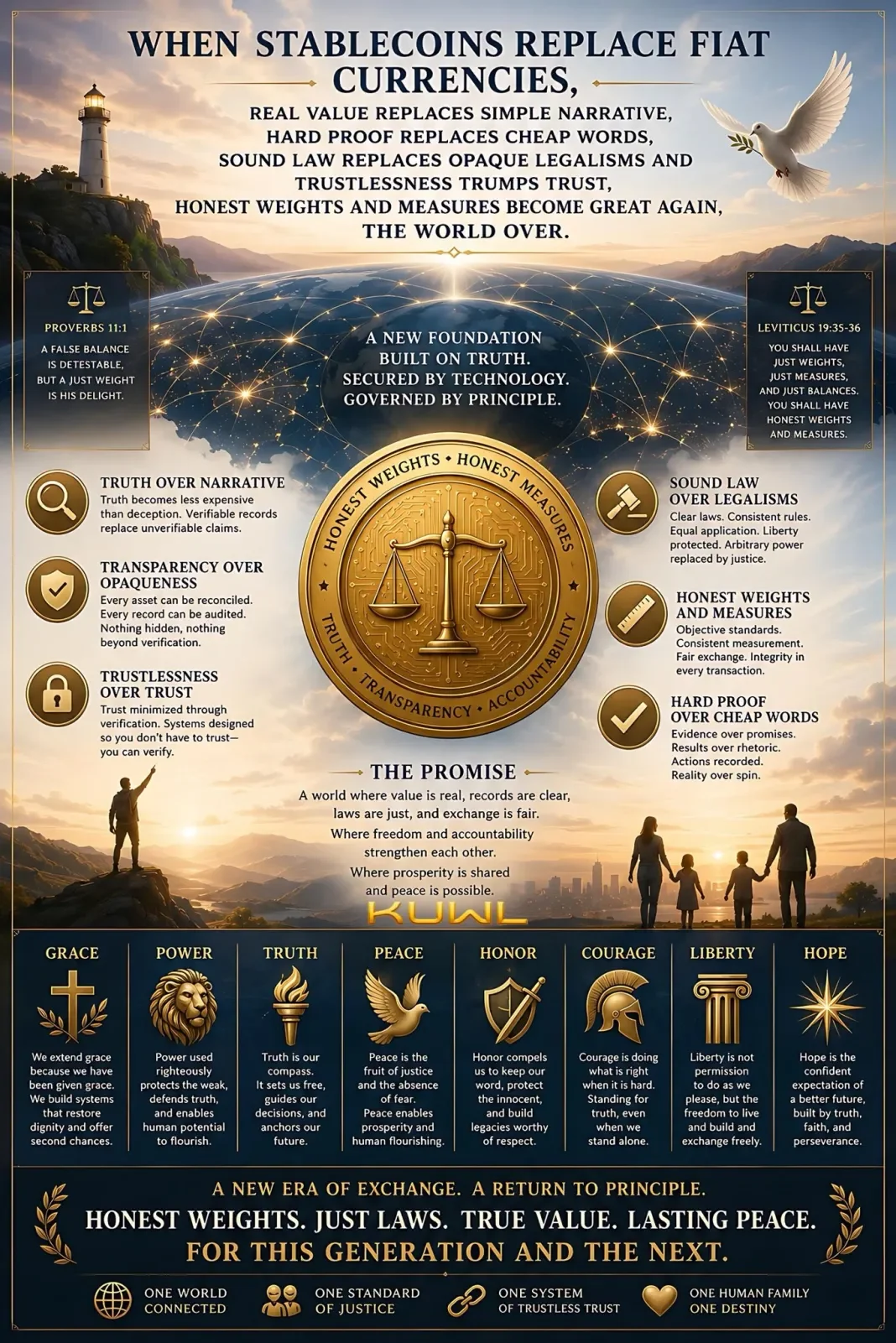
The Optimistic KUWL Scenario:
Every asset can be represented digitally.
Ownership is instantly verifiable.
Settlement occurs in seconds.
Audits become continuous rather than periodic.
Fraud becomes dramatically harder.
Rob Cunningham: The Optimistic KUWL Scenario
6-6-2026
The Optimistic KUWL Scenario:
Every asset can be represented digitally.
Ownership is instantly verifiable.
Settlement occurs in seconds.
Audits become continuous rather than periodic.
Fraud becomes dramatically harder.
Reconciliation becomes largely automated.
Capital becomes more productive because less of it sits idle.
The result is not merely faster finance.
The result is less waste.
Stablecoins Become Honest Digital Cash
In this vision, regulated stablecoins such as RLUSD function as digital representations of sovereign currency.
Every unit is:
fully backed
transparently reported
instantly transferable
globally accessible
Instead of waiting days for payment settlement:
workers get paid immediately
businesses receive funds immediately
suppliers reconcile instantly
consumers gain greater transparency
Money begins behaving more like data.
XRP Becomes a Neutral Liquidity Bridge
In the most optimistic XRP scenario, XRP is not replacing national currencies.
It functions more like a universal translation layer.
Just as the internet allows computers speaking different languages to exchange information, a bridge asset allows value to move between:
dollars
euros
yen
stablecoins
tokenized securities
tokenized commodities
without each participant maintaining enormous pools of dormant capital.
The benefit is not speculation.
The benefit is efficiency.
The XRPL Becomes Infrastructure
In this vision, the XRP Ledger becomes part of the world’s invisible plumbing.
Most people never think about it.
Just as few people think about TCP/IP when sending an email, most people never think about settlement rails.
They simply experience:
lower costs
faster transactions
greater transparency
fewer errors
Infrastructure succeeds when it becomes boring.
AI Becomes a Steward of Coordination
The optimistic AI future is not AI replacing humanity.
It is AI reducing complexity.
AI systems:
reconcile accounts
detect fraud
optimize logistics
manage inventories
forecast shortages
coordinate energy distribution
Human beings remain responsible for values, ethics, leadership, creativity, and meaning.
AI handles administrative burden.
Civilization gains leverage.
Law Provides Clarity
Legislation such as the proposed CLARITY Act and GENIUS Act succeeds when innovators, regulators, businesses, and consumers all know the rules of the road.
Capital generally flows toward certainty.
In the optimistic case:
innovation accelerates
compliance costs fall
institutional adoption increases
consumer protections improve
legal disputes decrease
The rulebook becomes understandable.
The Largest Benefit: Released Human Energy
The greatest benefit may not be financial at all.
It may be human.
When societies spend less energy on:
bureaucracy
reconciliation
paperwork
disputes
inefficiency
corruption
they gain more energy for:
families
education
invention
medicine
art
exploration
service
The ultimate dividend is time.
The Most Optimistic Civilizational Outcome
In the brightest possible scenario:
Truth becomes easier to verify.
Ownership becomes easier to prove.
Fraud becomes harder to conceal.
Commerce becomes easier to conduct.
Opportunity becomes more accessible.
Prosperity becomes more broadly distributed.
Nations retain sovereignty while remaining interoperable.
Technology serves humanity rather than controlling it.
The ideal endpoint is not a world ruled by technology.
It is a world where technology quietly removes friction so that human beings can spend more time pursuing purpose, creativity, stewardship, liberty, and peace.
Source(s):
• https://x.com/KuwlShow/status/2062883989942128949
https://dinarchronicles.com/2026/06/05/rob-cunningham-the-optimistic-kuwl-scenario/
Iraq Economic News and Points To Ponder Saturday Morning 6-6-26
Russia And Saudi Arabia Sign 30 Agreements At The St. Petersburg International Economic Forum
Money and Business Russia and Saudi Arabia continue to strengthen their cooperation in trade, investment and economic sectors, signing 30 agreements today during the St. Petersburg International Economic Forum.
The signing took place during the St. Petersburg International Economic Forum, and was attended by Russian Deputy Prime Minister Alexander Novak and Saudi Energy Minister Prince Abdulaziz bin Salman.
Russia And Saudi Arabia Sign 30 Agreements At The St. Petersburg International Economic Forum
Money and Business Russia and Saudi Arabia continue to strengthen their cooperation in trade, investment and economic sectors, signing 30 agreements today during the St. Petersburg International Economic Forum.
The signing took place during the St. Petersburg International Economic Forum, and was attended by Russian Deputy Prime Minister Alexander Novak and Saudi Energy Minister Prince Abdulaziz bin Salman.
Novak said, following the signing ceremony, that Russia and the Kingdom continued to strengthen their bilateral cooperation and expand interaction in the areas of trade, investment and other economic sectors.
Novak said: "Today we can confidently say that we have achieved a true strategic partnership, which is embodied in the practical development of trade and investment between our two countries."
He added: “Around 30 agreements have been signed, and all of this is crucial for developing trade and economic cooperation between our two countries. The volume of trade is increasing, projects are being implemented on the ground, and there is continuous communication between our business communities.”
Novak revealed that the Saudi delegation was one of the largest delegations participating in the forum, comprising about 170 people, in addition to a large number of businessmen.
The Russian Deputy Prime Minister noted the convergence of views between the two countries on key international issues.
In closing, Novak said: "This year marks 100 years since the establishment of diplomatic relations between Russia and Saudi Arabia. Respect for each other's sovereign choices and respect for the cultures of our peoples has always been a solid foundation of bilateral relations."
For his part, Saudi Energy Minister Prince Abdulaziz bin Salman stressed the special importance the Kingdom attaches to Russia, saying: "It is wonderful that in Saudi Arabia we no longer need to explain how important and vital Russia is, both in our bilateral relations and for the world as a whole."
The Saudi energy minister also noted that the Kingdom's selection as this year's guest of honor prompted them to return the favor by demonstrating the importance of being here, saying: "We wanted to show how important and vital Russia is to us."
The St. Petersburg International Economic Forum kicked off Wednesday in St. Petersburg, with the participation of leading experts and decision-makers from around the world. The event will continue until Saturday. Saudi Arabia is the guest of honor at this year's forum, underscoring the strength of economic ties between Moscow and Riyadh.
https://www.economy-news.net/content.php?id=69889
International Monetary Fund: Iraq Among The Countries Most Vulnerable To Financial Pressures With Rising Debt In 2026
Money and Business Economy News – Baghdad A report issued by the International Monetary Fund showed that Iraq faces increasing financial pressures during 2026, due to the rising cost of government energy subsidies, increasing public debt, and rising borrowing costs in international markets.
According to the report, Iraq is estimated to be among the countries with high levels of energy subsidies, with the cost of subsidies reaching less than 6% of GDP, making the general budget more vulnerable to fluctuations in oil and gas prices, and increasing pressure on public finances if global energy prices continue to rise.
The IMF noted that Iraq is among a group of economies that have seen a significant increase in public debt compared to before the COVID-19 pandemic, as debt levels rose significantly in 2026 compared to 2019, within a regional trend that includes a number of countries with high fiscal deficits.
According to the report, this development coincides with rising sovereign borrowing costs in the region, increasing financing pressures on countries with large financial needs, including Iraq, in a global environment characterized by high interest rates and tighter financing conditions.
The Fund stressed that the continuation of these pressures poses challenges to fiscal policies in Iraq, especially with regard to the need to control spending, redirect subsidies, and enhance fiscal sustainability within medium-term frameworks, while maintaining the ability to finance basic services in light of the fragile regional economic environment.
https://www.economy-news.net/content.php?id=69926
Iraq recorded a sharp decline in imports during 2025
Money and Business Economy News – Baghdad International trade data on import values for 2025 showed a significant decline in the value of Iraq’s imports compared to the previous four years, after it had been among the top importing countries on the list.
According to the data, the value of Iraqi imports during 2025 reached approximately $51.1 billion, down from $87.4 billion in 2024, a difference of over $36 billion, representing one of the largest declines recorded compared to previous years. Observers attribute this to stricter financial compliance procedures through the Central Bank's electronic platform and the drop in oil prices.
Iraq had recorded a steady increase in the value of imports during the past years, as it rose from $60.9 billion in 2021 to $76.1 billion in 2022, then $85 billion in 2023, before peaking at $87.4 billion during 2024.
In the ranking of importing countries for 2025, Iraq came behind several countries including Colombia, Ukraine, Bangladesh, Pakistan and Kazakhstan, while it outperformed other countries such as Kuwait, Oman and Qatar.
The data is based on International Trade Centre calculations relying on United Nations Trade Statistics (COMTRADE) and International Trade Centre data. https://www.economy-news.net/content.php?id=69925
Iraq And Austria Discuss Ways To Expand Prospects For Joint Cooperation.
Money and Business Economy News – Baghdad The First Deputy Speaker of the House of Representatives, Adnan Faihan Al-Dulaimi, discussed on Saturday with the Austrian Ambassador to Iraq ways to expand the prospects of joint cooperation in various fields between the two countries.
The media office of the First Deputy Speaker stated in a statement received by "Al-Eqtisad News" that "the First Deputy Speaker of the House of Representatives, Adnan Faihan Al-Dulaimi, received in his guest house the Ambassador of the Republic of Austria to Iraq, Andrea Nasi."
He added that "during the meeting, all the latest developments on the local scene were reviewed, as well as an exchange of views on the most prominent regional and international developments and their implications for the region."
According to the statement, the First Deputy stressed "the need to raise the level of bilateral relations and expand areas of joint cooperation in a way that serves the mutual interests of the two friendly countries, especially in the economic and investment sectors, and the importance of resuming direct flights between Baghdad and Vienna as a supportive step to enhance trade exchange and revitalize tourism."
Faihan explained that “Iraq is proceeding with a policy of balanced openness and strengthening constructive partnerships with various countries of the world, based on a vision that is based on mutual respect and common interests, and in a way that contributes to supporting sustainable development efforts and achieving the country’s higher interests.”
The statement indicated that “the Ambassador of the Republic of Austria to Iraq, Andrea Nasi, expressed his country’s keenness to strengthen the partnership with Baghdad and develop areas of cooperation in varioussectors, in a way that contributes to achieving the common interests of Iraq and Austria and serves the future of the two friendly peoples.”
https://www.economy-news.net/content.php?id=69922
Iraq Secures International Approval For $900 Million In Funding For Road Network Development Project
Money and Business Iraq Secures International Approval for $900 Million Road Network Development Project.
The World Bank announced on Friday its approval of a $900 million project to improve Iraq's road infrastructure.
In a statement, the Bank said the project will support Iraq's transport economic corridors through strategic investments in key road corridors that form a cornerstone for domestic transport, regional integration, and long-term economic growth. It will also enhance transport safety and reliability and open new opportunities for individuals and businesses across the country.
The statement added that road transport accounts for more than 90% of Iraq's total transport volume, yet most of the country's road networks suffer from poor infrastructure, deterioration due to climate stresses, and road safety hazards.
The project focuses on priority investments along two strategic axes: a north-south corridor connecting Baghdad to the Turkish border via the E2 highway, and an east-west corridor along the E1 highway linking Baghdad to both Syria and Jordan.
He pointed out that "the program, in its first phase, funds the rehabilitation of key sections of the E1 highway, helps improve the efficiency of specific roads in the Kurdistan Region of Iraq, and establishes the initial section of the E2 highway.
These investments combine to enhance the operational efficiency of Iraq's national road network and strengthen its resilience to climate change, while laying a solid foundation for future phases that will attract private sector capital and expand the scope of the transport corridor program."
The statement emphasized that "approximately 7.9 million citizens are expected to benefit from the project, the majority of whom live along newly constructed or upgraded roads, including about 3 million women and 1.5 million young people."
It further noted that "the project will benefit various regions of Iraq, from Baghdad to the Kurdistan Region and along the border corridors with Jordan, Syria, and Turkey."
The statement added that "the project will also support performance-based road maintenance contracts, create an enabling environment for sustainable partnerships with the private sector, and explore opportunities to generate income and revenue."
The statement concluded, “The Roads and Bridges Department of the Ministry of Construction, Housing, Municipalities and Public Works will implement the project with strategic supervision from a high-level steering committee that includes key national institutions and representatives from the Kurdistan Region of Iraq.” https://www.economy-news.net/content.php?id=69908
Al-Zaidi Travels To Washington With Businessmen And Promises To Inject $10 Billion Into The Private Sector.
Arabic and international Iraqi Prime Minister Ali Faleh al-Zaidi announced on Saturday an upcoming official visit to the United States, accompanied by businessmen, to expand mutual and joint investment opportunities, noting at the same time that the development fund is for the private sector and will absorb a contribution from the Central Bank worth $10 billion.
This came during Al-Zaydi’s reception of a number of businessmen, members of the board of directors and development of the private sector, members of the Iraqi Economic Council and a number of heads of boards of directors of private banks, in the presence of the Minister of Finance, the head of the Board of Advisors, the director of the office of the Prime Minister, and the head of the Higher Authority for Coordination between Governorates.
According to a statement from the Prime Minister’s Media Office, Al-Zaydi affirmed that the government relies on cooperation with the private sector to ensure the success of its reform efforts in the economy and development, and that it will adopt an open-door policy regarding the proposals, requests, and problems submitted by businessmen that require intervention and resolution.
Al-Zaydi stressed the fight against corruption and extortion, and called on all businessmen or companies not to be drawn into offering any sums of money to facilitate their work and obtain their rights, and that his door is open to any case of obstruction practiced by any element within the body of the state.
Al-Zaydi said that the private sector is a partner of the government, and we support its pivotal role in developing the economy. Our criteria for preferring the private sector are: “tax accountability,” “the size of the workforce and their inclusion in social security,” and “the size of the social benefits contributed to.”
He added: We have a project for one million residential plots, and we call on the private sector to contribute to its infrastructure. There must be a share for everyone who does not own a property, plot of land, or housing unit. We will cooperate with the private sector in preparing residential lands according to economic models that preserve the rights of the state and the citizen.
The Iraqi Prime Minister revealed an upcoming visit to Washington, saying: “We have an official visit coming up to the United States, and we will bring with us a number of businessmen to expand mutual and joint investment opportunities.”
Al-Zaydi pointed out that the development fund is for the private sector, and will absorb a contribution from the Central Bank worth $10 billion, and we will open subscription to contributions for all citizens, at the official value of the Iraqi dinar.
He explained that the profits of the Development Fund will be exempt from taxes, and will finance the establishment of new factories with new products needed by the Iraqi market. We have prepared monthly payments of approximately (1 trillion dinars) for the purpose of paying the dues of businessmen, companies, and contractors, and the payments will increase with the resolution of the crude oil export crises.
He noted that he had issued directives to resolve obstacles related to tax accounting and to remove any conflict in instructions, and everything that hinders progress towards the goal of preserving public funds. He also directed that all laws and decisions that do not facilitate economic development and impede the expansion of partnership with the private sector be studied.
For their part, the businessmen offered to expand consultations with the government regarding service and development projects and priorities, diagnose market needs, and find solutions to economic challenges in order to help the government achieve its goals. https://www.economy-news.net/content.php?id=69942