
News, Rumors and Opinions Thursday 6-4-2026
Note: All intel should be considered as "Rumors" until we receive official announcements ...and “Rates and Dates” could change anytime until we get to the banks/redemption centers.
RV Excerpts from the Restored Republic via a GCR Update as of Thurs. 4 June 2026
Compiled Thurs. 4 June 2026 12:01 am EST by Judy Byington
The Green Light Has Been Given
The Banks Are Done, Their Control Ended
Old Liquidity Withdrawn, New Rails Activated
Protocols Moving From Standby To Live
Note: All intel should be considered as "Rumors" until we receive official announcements ...and “Rates and Dates” could change anytime until we get to the banks/redemption centers.
RV Excerpts from the Restored Republic via a GCR Update as of Thurs. 4 June 2026
Compiled Thurs. 4 June 2026 12:01 am EST by Judy Byington
The Green Light Has Been Given
The Banks Are Done, Their Control Ended
Old Liquidity Withdrawn, New Rails Activated
Protocols Moving From Standby To Live
ISO 20022 is the language
Tier 4B is the doorway
Timing is Everything & The Timing is NOW
Tier4b ISO20022 on Telegram
Global Currency Reset:
Tues. 2 June 2026Bruce, The Big Call The Big Call Universe (ibize.com) 667-770-1866, pin123456#, 667-770-1865:
We were told notification to set exchange appointments for Tier4b (us, the Internet Group) would come by Thurs. 4 June.
Med Bed treatments would be (allegedly) available for those in Tier4b who were in dire need by Sat-Mon 6-8 June 2026.
Tariff Dividend payments for natural US citizens would (allegedly) be $2,000 to $3,000 per US citizen, could be monthly for a year and start within the next couple of days.
The Emergency Broadcast System should (allegedly) activate in the 10 days of exposure between Wed. 24 June and Sat. 4 July 2026.
The EBS could also happen this coming weekend Fri. 5 June to Mon.8 June 2026.
Debt forgiveness could start around Sun 5 July 2026.
Judy Note:No one knows the exact date for notification of appointments for Tier4b (us, the Internet Group) to exchange foreign currencies, but deadlines shown in the above Timing indicate it to be by the end of this week. We have been told that Wells Fargo, which is controlled by the Chinese Elders – (the ones who own the gold behind the Global Currency Reset) – will send out emails to currency and bond holders worldwide telling them how to set redemption & exchange appointments. It is advised to exchange/redeem your foreign currency at an official Redemption Center (RC) rather than a bank. You can only (allegedly) redeem Zim at a RC, the Dinar Contract Rate can only be given at a RC and banks will (allegedly) offer you lower exchange rates than what you can obtain at a RC. You can only (allegedly) set up your new wallet (bank account) at a RC. It was my understanding that most banks were under control of the Cabal and would soon play a different role in the Global Financial System.
Read full post here: https://dinarchronicles.com/2026/06/04/restored-republic-via-a-gcr-update-as-of-june-4-2026/
******************
Courtesy of Dinar Guru: https://www.dinarguru.com/
Thom Iraq has already moved the rate once. February 2023. 1,460 → 1,310. No announcement. No countdown. No community consensus. The Central Bank of Iraq made a policy decision and it moved. Immediately...The mechanism isn't theoretical. It's already been used. The question was never can it move. The questions are when and how much? So, let me ask you something. If the CBI moved the rate tomorrow with zero community warning , would you actually be ready?
Militia Man The security cleanup we see is gaining momentum...More major factions are publicly committing to lay down arms and integrate into state institutions. We see an abundance of that today...This trend is accelerating.
Jeff Parliament is supposed to have two sessions of parliament per week. This is a normal week. They have not had one session of parliament so far this week. What does that show you? They're done with everything. They're literally waiting for the cabinet to get approved and change the freaking rate when the government's done being approved. Form the cabinet, complete the government, change the freaking rate. That's the reason why parliament has not had one session this week ...So far nothing announced.
America's Debt Bomb Explodes: $1.25 Trillion in Credit Card Debt Signals Economic Crisis
Lena Petrova: 6-4-2026
While headlines celebrate a “strong” economy, millions of Americans are falling deeper into debt. Credit card balances have surged to a record $1.25 trillion, delinquencies are at their highest level since the 2008 financial crisis, and more families are using Buy Now, Pay Later loans just to buy groceries.
Is consumer spending masking a growing financial emergency?
In this video, we examine the alarming data behind rising debt, falling purchasing power, and what it could mean for the future of the U.S. economy.
Iraq Economic News and Points To Ponder Thursday Morning 6-4-26
During A Summit Held In Paris And Attended By "Economy News"... Hadi Chaib Ainou: Global Challenges Necessitate Strengthening International Cooperation
Money and Business Economy News – Baghdad The Director General of the Professional Group of Banks of Morocco (GPBM) and Secretary General of the Federation of Francophone Banks (FBF), El Hadi Chaib Ainou, affirmed that the global financial sector is going through a critical phase of rapid transformations at the geopolitical, economic and social levels, which necessitates a review of the traditional tools used in financial analysis and their development in line with current changes.
During A Summit Held In Paris And Attended By "Economy News"... Hadi Chaib Ainou: Global Challenges Necessitate Strengthening International Cooperation
Money and Business Economy News – Baghdad The Director General of the Professional Group of Banks of Morocco (GPBM) and Secretary General of the Federation of Francophone Banks (FBF), El Hadi Chaib Ainou, affirmed that the global financial sector is going through a critical phase of rapid transformations at the geopolitical, economic and social levels, which necessitates a review of the traditional tools used in financial analysis and their development in line with current changes.
During the Arab-European Banking and Economic Summit in Paris, held under the slogan "Towards a New Global Economic and Financial Balance," organized by the Union of Arab Banks and sponsored by French President Emmanuel Macron, and attended by "Economy News," Ainou said that the challenges facing the global financial system require new approaches that are more flexible and innovative, capable of absorbing the nature of the accelerating global changes.
The Moroccan official addressed the challenge of climate change, considering it to be one of the most prominent issues affecting the global economy, despite the difficulty of accurately predicting its future repercussions.
He pointed out that the effects of this change have become tangible in many countries, including European countries, which reinforces the importance of developing environmental legislation and activating relevant regulatory frameworks, given its increasing impact on economic and financial activities.
In a related context, Al-Hadi Shaib Ainou highlighted the importance of digital transformation and the accompanying expansion in the use of social media, pointing out the new challenges and opportunities this presents to governments and financial institutions, which necessitates the development of modern regulatory frameworks capable of keeping pace with the rapidly changing digital environment. https://www.economy-news.net/content.php?id=69852
During A Summit Held In Paris And Attended By "Al-Eqtisad News"... Raoul Delamare: Strengthening The Arab-European Partnership Is Essential To Confront Global Transformations
banks Economy News - Follow-up The President of the French-Arab Chamber of Commerce – France, Raoul Delamare, stressed the importance of strengthening cooperation between Arab, European and Francophone banking and financial institutions in light of the accelerating global challenges, noting that this partnership represents a fundamental pillar for supporting economic development and enhancing financial stability in the region.
This came during the Arab-European Banking and Economic Summit in Paris under the slogan "Towards a New Global Economic and Financial Balance," organized by the Union of Arab Banks and sponsored by French President Emmanuel Macron, and attended by "Economy News".
Delamare stressed the importance of continuing to invest in infrastructure and regional development projects, as they are key drivers of economic growth and an effective tool for promoting integration between Arab and European markets.
In his speech, he addressed the most prominent challenges facing the financial and banking sector at the present stage, most notably the escalating geopolitical tensions, rapid technological transformations, developments in artificial intelligence, in addition to the increasing risks associated with cybersecurity and the protection of digital financial systems.
He stressed that confronting these challenges requires strengthening dialogue and continuous coordination between banking and economic institutions, exchanging experiences and knowledge, and working together to develop regulatory and technical frameworks capable of keeping pace with global changes.
He concluded his speech by emphasizing that the Arab-European partnership will remain a pivotal factor in supporting economic stability and enhancing investment opportunities and future cooperation between the two sides.
https://www.economy-news.net/content.php?id=69855
During A Summit Held In Paris And Attended By "Economy News"... Maya Atik: Strengthening International Banking Cooperation Is Essential To Confront Digital Challenges
Banks Economy News – Baghdad The Director General of the French Banking Federation, Maya Atik, stressed that strengthening cooperation between international banking institutions has become an urgent necessity in light of the rapid economic and geopolitical changes taking place in the world.
This came during the Arab-European Banking and Economic Summit in Paris under the slogan "Towards a New Global Economic and Financial Balance," organized by the Union of Arab Banks and sponsored by French President Emmanuel Macron, and attended by "Economy News".
Ateeq stressed the importance of developing sustainable partnerships between financial institutions, which contribute to supporting financial stability and enhancing the banking sector’s ability to adapt to global transformations, particularly in the areas of infrastructure and regional development.
She noted that current challenges, including geopolitical risks, the rapid development of artificial intelligence technologies, and cyber threats, require banking institutions to intensify coordination and joint action to develop effective and sustainable solutions.
She concluded by emphasizing that the future of the banking sector depends primarily on deepening international cooperation and exchanging experiences, which will ensure the strengthening of financial stability and support for sustainable economic development paths. https://www.economy-news.net/content.php?id=69854
The Minister Of Finance Affirms The Continuation Of Economic Reforms And The Strengthening Of The Partnership With The World Bank
During his meeting with the World Bank representative to Iraq, Emmanuel Salinas Munoz, Finance Minister Faleh Sari affirmed the ministry's commitment to implementing financial and economic reform programs, in line with the government program's priorities and to enhance the efficiency of public resource management.
Sari indicated that the ministry is determined during the next phase to adopt reform paths based on developing the financial and banking environment, expanding the application of electronic systems in the tax and customs sectors, in addition to supporting non-oil revenues and simplifying procedures in a way that contributes to improving institutional performance and stimulating economic activity.
The two sides reviewed mechanisms for enhancing technical and institutional cooperation with the World Bank to support development and infrastructure projects, empower the private sector, and benefit from international expertise in implementing reforms.
For his part, Salinas Muñoz affirmed the bank’s continued support for the reform programs implemented by the Iraqi government, which contribute to strengthening economic development and raising the efficiency of financial institutions.
Gold Rose, Supported By A Weaker Dollar And Lower Oil Prices, Amid Optimism That Tensions Might Ease
Money and Business Economy News - Follow-up Gold prices rose on Thursday, supported by a weaker dollar and lower oil prices, as investors assessed signs of optimism about a possible settlement to the US-Israeli trade war with Iran.
Spot gold rose 0.7% to $4,461.09 an ounce, while U.S. gold futures for August delivery climbed 0.5% to $4,487.90.
The rise coincided with a decline in the dollar, which made gold priced in US dollars less expensive for holders of other currencies, in addition to a drop in oil prices after Lebanon and Israel agreed to implement a ceasefire, which boosted hopes for a broader calm in the region.
John Williams, president of the Federal Reserve Bank of New York, also reiterated that there is currently no need to change US monetary policy, arguing that inflationary pressures related to the war in the Middle East may not be long-lasting.
As for other precious metals, silver rose 0.6% to $73.13 an ounce, platinum rose 0.7% to $1,872.11, while palladium climbed 0.9% to $1,313.51. https://www.economy-news.net/content.php?id=69844
Turkish Carpet Exports Declined At The Beginning Of 2026, With Iraqi Markets Among Those Affected
Money and Business Economy News – Baghdad Data released by the Turkish Carpet Exporters Association on Wednesday showed that Turkish carpet exports declined during the first four months of 2026, amid logistical challenges and regional turmoil affecting several key markets in the Middle East, including Iraq.
According to data seen by “Al-Eqtisad News”, Turkish carpet exports amounted to $871.7 million during the period from January to April 2026, a decrease of 2.1% in value compared to the same period last year.
Alexander Kaplan, head of the carpet sector council at the Turkish Exporters Association, said that "wars and regional tensions have affected trade and supply chains," noting that "Middle Eastern markets are among the most important destinations for Turkish carpets."
Kaplan added that "Iraq, along with Saudi Arabia, Qatar and Bahrain, is among the markets that have been affected by recent regional circumstances, which has impacted export activity and trade demand."
Despite the decline recorded at the beginning of the year, the Turkish carpet industry aims to raise its exports to $3.5 billion by the end of 2026, compared to about $2.8 billion achieved during the past year.
Seeds of Wisdom RV and Economics Updates Thursday Morning 6-4-26
Good Morning Dinar Recaps,
Global Economic Warning: Energy Shock and Rising Debt Threaten Financial Stability
Growing energy disruptions, inflation pressures, and mounting debt burdens are increasing concerns about the resilience of the global financial system.
Good Morning Dinar Recaps,
Global Economic Warning: Energy Shock and Rising Debt Threaten Financial Stability
Growing energy disruptions, inflation pressures, and mounting debt burdens are increasing concerns about the resilience of the global financial system.
Overview
The Organization for Economic Cooperation and Development (OECD) has issued a warning that the ongoing Middle East crisis could become a significant threat to global economic growth. Rising energy prices, inflation concerns, and elevated sovereign debt levels are creating a challenging environment for governments, businesses, and consumers worldwide.
As tensions surrounding Iran and the Strait of Hormuz continue, policymakers are increasingly concerned that prolonged disruptions could trigger slower growth, higher inflation, and additional financial stress across the global economy.
Key Developments
1. OECD Lowers Global Growth Expectations
The OECD warned that the current energy shock is weakening the outlook for the global economy. Under its baseline forecast, world economic growth is expected to slow during 2026 as higher energy costs and tighter financial conditions impact economic activity.
The organization cautioned that if disruptions worsen, global growth could decline even further, creating additional risks for both developed and emerging economies.
2. Rising Energy Costs Continue to Fuel Inflation
Energy prices remain one of the primary drivers of inflation worldwide. Higher oil and natural gas costs are affecting transportation, manufacturing, agriculture, and consumer goods prices.
As inflation remains elevated, central banks may find it difficult to lower interest rates quickly, even as economic growth slows.
3. Strait of Hormuz Remains a Major Global Concern
The Strait of Hormuz continues to be one of the world's most important energy chokepoints. Any interruption to shipping through the region could significantly impact global oil supplies and place additional pressure on energy markets.
Governments are increasingly focusing on energy diversification strategies to reduce vulnerability to regional disruptions.
4. Financial Markets React to Ongoing Uncertainty
Investors remain cautious as they assess the potential impact of geopolitical tensions on economic growth and corporate earnings. Market volatility has increased as traders react to developments involving energy supplies, inflation expectations, and central bank policy.
The uncertainty surrounding the Middle East continues to influence investor sentiment worldwide.
5. Governments Face Growing Fiscal Challenges
Many governments are attempting to balance slowing economic growth with already elevated debt levels. Rising borrowing costs and higher energy expenses are creating additional pressure on public finances.
The OECD encouraged policymakers to pursue targeted solutions that support economic stability while avoiding excessive increases in government debt.
Why It Matters
The combination of rising energy prices, persistent inflation, and growing debt burdens creates a difficult environment for the global economy. These pressures are occurring simultaneously and have the potential to affect financial markets, government budgets, and consumer purchasing power.
Why It Matters to Foreign Currency Holders
• Higher inflation can increase currency volatility.
• Energy-importing countries may experience additional pressure on trade balances.
• Safe-haven assets often attract investment during periods of uncertainty.
• Central bank policy decisions could significantly influence future currency valuations.
Implications for the Global Reset
Pillar 1: Energy Security and Economic Stability
The current environment demonstrates the critical relationship between energy security and economic performance. Reliable energy supplies remain essential for growth, inflation control, and financial stability.
Pillar 2: Debt Sustainability Under Pressure
As governments manage slower growth and higher costs, concerns surrounding debt sustainability continue to increase. These pressures may contribute to future discussions regarding monetary policy reforms and broader financial restructuring.
Closing Insight
The OECD's latest warning underscores the growing connection between geopolitical events and economic outcomes. As energy markets remain volatile and debt levels continue rising, policymakers face increasingly difficult decisions regarding inflation, growth, and financial stability.
This is not simply an energy challenge—it is a test of how resilient the global financial system will be in the face of mounting economic and geopolitical pressures.
Seeds of Wisdom Team
Newshounds News™ Exclusive
Sources
OECD — "Global Economic Outlook Weakens Amid Energy Shock and Rising Inflationary Pressures"
Reuters — "Stocks Struggle After Broadcom Dive; Oil Eases Off Highs"
~~~~~~~~~~
🌱A Message to Our Currency Holders🌱
If you’ve been holding foreign currency for many years, you were not foolish.
You were not wrong to believe the global financial system would change.
What failed was not your patience — it was the information you were given.
For years, dates, rumors, and personalities replaced facts, structure, and proof. “This week” predictions created cycles of hope and disappointment that were never based on how currencies actually change.
That is not your failure.
Our mission here is different:
• No dates • No rates • No hype • No gurus
Instead, we focus on:
• Verifiable developments • Institutional evidence
• Global financial structure • Where countries actually sit in the process
Currency value changes only come after sovereignty, trade, banking, settlement systems, and fiscal coordination are in place. History and institutions confirm this sequence.
You will see silence. You will see denials. That is not delay — that is discipline.
Protect your identity. Organize your documents. Verify everything.
Never hand your discernment to anyone who cannot show proof.
You deserve truth — not timelines.
Seeds of Wisdom Team
Newshounds News™
~~~~~~~~~~
Seeds of Wisdom Team RV Currency Facts Youtube and Rumble
Newshound's News Telegram Room Link
RV Facts with Proof Links Link
RV Updates Proof links - Facts Link
Follow the Gold/Silver Rate COMEX
Follow Fast Facts
Seeds of Wisdom Team™Website
Thank you Dinar Recaps
Thursday AM Iraq News Posted by Tishwash at TNT 6-4-2026
TNT:
Tishwash: The Minister of Finance affirms the continuation of economic reforms and the strengthening of the partnership with the World Bank.
During his meeting with the World Bank representative to Iraq, Emmanuel Salinas Munoz, Finance Minister Faleh Sari affirmed the ministry's commitment to implementing financial and economic reform programs, in line with the government program's priorities and to enhance the efficiency of public resource management.
TNT:
Tishwash: The Minister of Finance affirms the continuation of economic reforms and the strengthening of the partnership with the World Bank.
During his meeting with the World Bank representative to Iraq, Emmanuel Salinas Munoz, Finance Minister Faleh Sari affirmed the ministry's commitment to implementing financial and economic reform programs, in line with the government program's priorities and to enhance the efficiency of public resource management.
Sari indicated that the ministry is determined during the next phase to adopt reform paths based on developing the financial and banking environment, expanding the application of electronic systems in the tax and customs sectors, in addition to supporting non-oil revenues and simplifying procedures in a way that contributes to improving institutional performance and stimulating economic activity.
The two sides reviewed mechanisms for enhancing technical and institutional cooperation with the World Bank to support development and infrastructure projects, empower the private sector, and benefit from international expertise in implementing reforms.
For his part, Salinas Muñoz affirmed the bank’s continued support for the reform programs implemented by the Iraqi government, which contribute to strengthening economic development and raising the efficiency of financial institutions. link
Tishwash: Iraq restarts major oil fields to counter the repercussions of the Hormuz closure
A report by Wood Mackenzie, published Wednesday, stated that Iraq has restarted major oil fields, including West Qurna 1 and Majnoon, to mitigate the impact of the Strait of Hormuz closure.
According to Wood Mackenzie's High-Frequency Oil Production Monitoring report, translated by Al-Ghad Press, "Iraq's production has rebounded to 1.5 to 1.6 million barrels per day as operations gradually resume at key southern fields such as West Qurna 1, Majnoon, and Fawqi."
The report added that "Iraq's immediate focus has shifted to securing related gas supplies, refinery feedstocks, and liquefied petroleum gas (LPG) to prevent a catastrophic energy shortage during the summer, unlike Gulf producers who are prioritizing exports."
It continued, "This recovery follows significant disruptions to energy flows in the Gulf and a decline in exports through the Strait of Hormuz, a vital route for Iraqi oil supplies, due to the regional conflict between Iran, Israel, and the United States." link
************
Tishwash: Al-Zaydi directs the resumption of work by oil companies in Kurdistan starting tomorrow.
Prime Minister Ali Faleh al-Zaidi directed oil companies in the Kurdistan Region of Iraq to resume operations starting tomorrow, Wednesday
A statement from al-Zaidi's office indicated that he "received a delegation from the Kurdistan Regional Government headed by Minister of Natural Resources Kamal Mohammed Saleh, accompanied by representatives of several international oil companies operating in the region, in the presence of the Minister of Foreign Affairs, the Minister of Oil, and the Chief of Staff of the Army."
The Prime Minister listened to "a detailed explanation of the working conditions of the oil companies in light of the recent events resulting from the war in the region, as well as a comprehensive vision for the companies to resume their operations as quickly as possible."
He directed that "all requirements be provided to ensure the smooth operation of the oil companies working in the region," noting that "the damage inflicted on Iraq as a result of the halt in oil exports through the Strait of Hormuz was significant, requiring redoubled efforts to compensate for this damage by addressing the problems hindering increased production."
The Prime Minister also directed that "oil companies in the Kurdistan Region of Iraq resume their operations starting tomorrow, emphasizing joint efforts and the provision of a suitable environment and essential requirements." link
************
Tishwash: Parliamentary request to hold an emergency session to complete the government cabinet and approve the budget
The Honorable Speaker of the Council of Representatives
Ref. No.: 315 Date: January 3, 2026
Greetings,
**Subject: Convening an Emergency Session**
Pursuant to the provisions of Article (61) and Article (73—Fourth) of the Constitution, and the Council of Representatives Law No. (13) of 2018; and in response to the public interest and the exigencies of the current juncture—and given the critical importance of fulfilling the requirements of the present phase, along with the direct implications this entails for the delivery of services to citizens and the enhancement of governmental performance:
We respectfully request that you take the necessary measures to convene an emergency session of the esteemed Council of Representatives. The objective of this session is to conclude the voting process for the ministerial cabinet and to resolve the issue of vacant ministries, thereby contributing to the reinforcement of institutional stability and enabling the government to discharge its duties in the most optimal manner.
Furthermore, we emphasize the critical importance of expediting the submission and deliberation of the schedules for the 2026 Federal General Budget. This is due to the profound impact such measures have on the implementation of service-oriented and developmental projects, the fulfillment of the needs of the governorates, and the assurance of the continuity of reconstruction plans and the improvement of the quality of services provided to citizens.
These matters constitute a national priority that necessitates a concerted effort and the acceleration of procedures, serving the best interests of our beloved country and realizing the aspirations of our noble people.
With our highest regards and appreciation, link
Tishwash: Armed Forces: We have begun disarming and restructuring the Popular Mobilization Forces fighters
The spokesman for the Commander-in-Chief of the Armed Forces, Sabah al-Nu’man, confirmed on Wednesday (June 3, 2026) that the committee formed under the direction of the Commander-in-Chief of the Armed Forces has begun its work to restrict weapons to the state, indicating that disengagement from the Popular Mobilization Forces includes restructuring the formations and guaranteeing the rights of the affiliates.
Al-Nu’man said in a statement to the official agency, which was followed by 964 Network , that “this committee was formed by order of the Commander-in-Chief of the Armed Forces, by a purely Iraqi decision, in response to and in fulfillment of the call of the wise religious authority, and also what was included in the ministerial program, the government’s policy, and the approach of the Prime Minister, Commander-in-Chief of the Armed Forces, regarding the restriction of weapons and the unification of the security discourse.”
He explained that “the committee has been formed and has begun its work, and will put in place the mechanisms for integrating and joining the relevant formations, and handing over weapons, equipment and camps to the Iraqi security authorities.”
Al-Nu’man explained that “all weapons and all equipment will be handed over to the Central Committee and to the Iraqi security authorities, and within two days a complete inventory will be handed over to the Central Committee, which is under the direct supervision, guidance and follow-up of the Commander-in-Chief of the Armed Forces.”
He added that “the central committee includes multiple entities, including the Ministry of Defense, the Ministry of Interior, the Joint Operations Command, and the Popular Mobilization Forces, and will put in place the mechanism to complete this process in a standard manner and it will not take long,” indicating that “the work is being carried out according to administrative and legal mechanisms, as well as logistical and technical frameworks.”
Al-Nu’man explained that “the term disengagement includes administrative frameworks and restructuring of these formations within the security services, and guaranteeing the rights of the fighters and integrating them with the military formations.”
He also pointed out that “the Prime Minister, the Commander-in-Chief of the Armed Forces, has an economic vision for the requirements of this stage,” noting that “today Iraq is witnessing a stable security situation, and all terrorist threats have been eliminated.”
The Coordination Framework announced its support for the project to restrict weapons to the state and to sever the Popular Mobilization Forces from all political, partisan and social frameworks, in order to ensure continued cooperation between the Iraqi government and the international community and to complete the implementation of ending the mission of the international coalition in Iraq.
On Wednesday (May 27, 2026), the leader of the Shiite National Movement, Muqtada al-Sadr, announced the separation of the Peace Brigades from the movement and their integration into the state, in a move he described as aiming to end the partisan affiliations of armed formations and to strengthen the principle of restricting weapons to the state.
The Asaib Ahl al-Haq movement and the Imam Ali Brigades announced their participation in the initiative to restrict weapons to the state, and the formation of committees to proceed with this matter.
Meanwhile, the Sayyid al-Shuhada Brigades, led by Abu Ala al-Walai, confirmed that they would not surrender their weapons, noting that these weapons are a “trust and duty.”
The position of the Sayyid al-Shuhada Brigades was identical to that of the Hezbollah Brigades, which still rejects calls to restrict weapons. The security official of the faction, Abu Mujahid al-Assaf, announced in a statement (May 30, 2026) the readiness of the brigades to receive the weapons of the factions that have abandoned armed action and to pay for them, saying: “We are ready to receive some special weapons for which there are no specialists in the state apparatus, such as drones, suicide aircraft, cruise missiles, and anti-tank missiles, and we are also ready to pay for them.”
The Al-Nujaba Movement issued a short statement on Wednesday (June 3, 2026) in which it announced its rejection of disarmament, and said that its position is clear as stated in a previous post by “Secretary of the Islamic Resistance, Akram Al-Kaabi.” link
Iraq Economic News and Points To Ponder Wednesday Afternoon 6-3-26
IMF: Iraq Among The Economies Most Affected By Regional Turmoil In 2026
Money and Business Economy News – Baghdad A report issued by the International Monetary Fund showed that Iraq will be among the economies most affected by regional turmoil during 2026, with clear repercussions on inflation rates, external accounts and public finances.
According to the report, which was reviewed by “Al-Eqtisad News”, Iraq is among a limited group of countries facing double pressures as a result of the disruption of trade and the rise in transportation costs, in addition to the effects of armed confrontations on trade exchange routes, especially those related to the Strait of Hormuz, which led to a noticeable decline in current account and financial balance indicators compared to previous expectations.
IMF: Iraq Among The Economies Most Affected By Regional Turmoil In 2026
Money and Business Economy News – Baghdad A report issued by the International Monetary Fund showed that Iraq will be among the economies most affected by regional turmoil during 2026, with clear repercussions on inflation rates, external accounts and public finances.
According to the report, which was reviewed by “Al-Eqtisad News”, Iraq is among a limited group of countries facing double pressures as a result of the disruption of trade and the rise in transportation costs, in addition to the effects of armed confrontations on trade exchange routes, especially those related to the Strait of Hormuz, which led to a noticeable decline in current account and financial balance indicators compared to previous expectations.
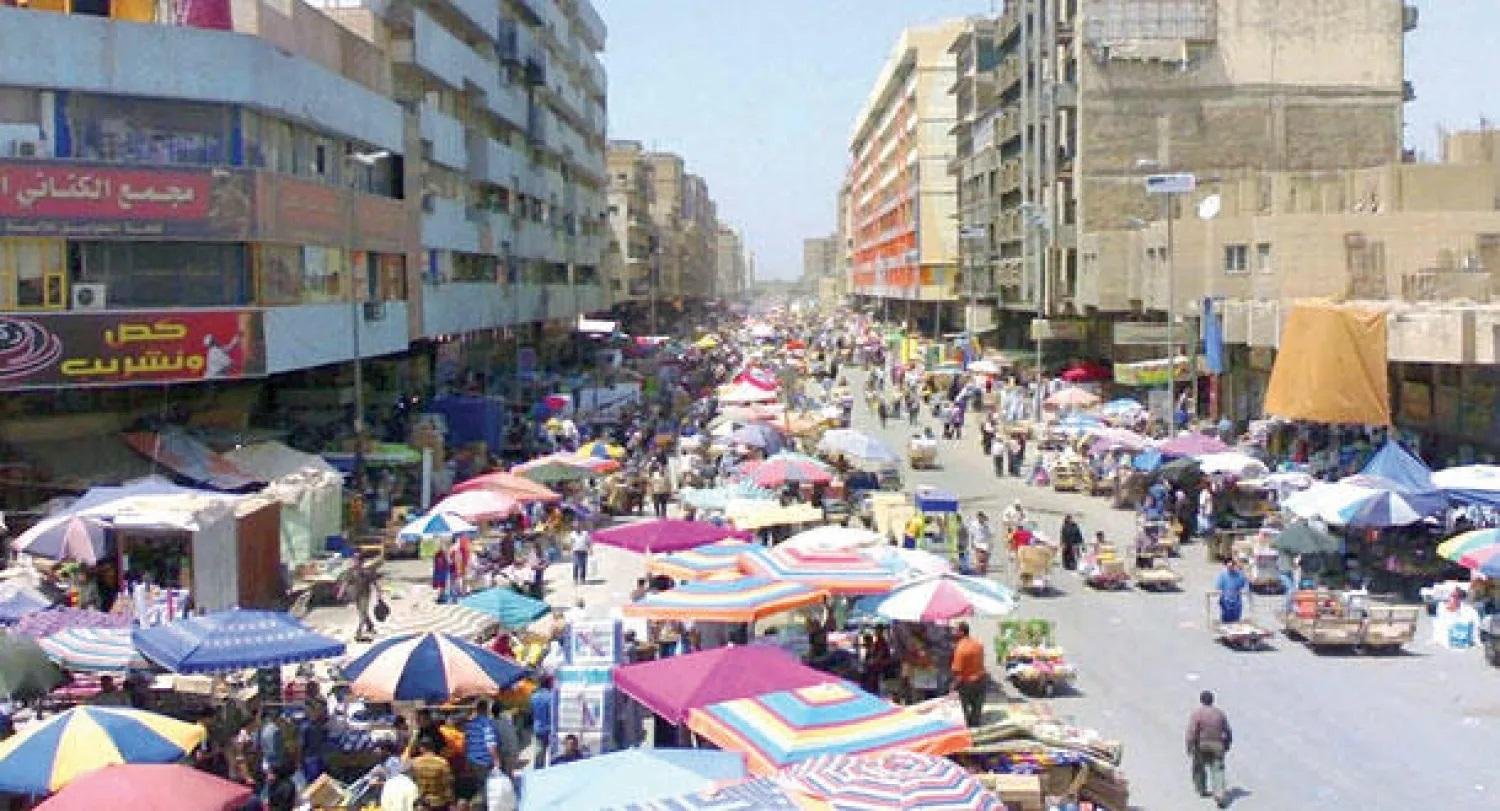
The IMF noted that Iraq and Iran experienced the greatest negative pressures on their external and fiscal accounts among the affected countries in the region, as trade losses and declining economic activity outweighed any potential gains from higher oil prices, leading to downward revisions in fiscal performance for 2026.
On the inflation side, the report explained that Iraq witnessed an increase in expectations within the Gulf Cooperation Council (GCC) countries, driven by increased import costs and higher commodity prices, with increases in the region ranging from moderate levels in Iraq and some GCC countries to higher levels in Iran.
According to the IMF, these developments reflect the sensitivity of the Iraqi economy to regional turmoil, particularly with regard to supply chains and foreign trade costs, in addition to the country's reliance on vital transport routes that pass through geopolitical hotspots.
The report also predicted that pressure on Iraq’s economic indicators would continue in the coming period, unless there is a breakthrough in the regional trade environment and an improvement in the conditions of economic and financial stability. https://www.economy-news.net/content.php?id=69817
The Minister Of Finance Discusses With The Italian Ambassador To Iraq Strengthening Economic And Financial Cooperation.
Money and Business Economy News – Baghdad Finance Minister Faleh Sari met with the Italian Ambassador to Iraq, Nicolo Fontana, on Wednesday to discuss strengthening economic and financial cooperation between the two countries.
The Ministry of Finance stated in a press release, received by "Al-Eqtisad News," that "Finance Minister Faleh Sari received the Italian Ambassador to Iraq, Nicolo Fontana, and his accompanying delegation on Wednesday to discuss ways to enhance joint cooperation and exchange expertise between the Iraqi Ministry of Finance and Italian financial institutions."
According to the statement, Sari emphasized "the importance of elevating the level of Iraqi-Italian cooperation and activating bilateral agreements in priority areas, particularly agriculture and health, in order to broaden the horizons of economic partnership and enhance opportunities for joint development."
For his part, the Italian Ambassador affirmed "his country's interest in expanding areas of cooperation with the Iraqi government in a way that serves mutual interests and strengthens economic and investment relations between the two countries."
https://www.economy-news.net/content.php?id=69819
The Minister Of Finance Approves The Inclusion And Regularization Of Daily Wage And Contract Employees Within The 2026 Budget.
Money and Business Economy News – Baghdad Finance Minister Faleh al-Sari approved on Wednesday the inclusion and regularization of daily wage and contract employees within the 2026 budget.
The head of the Finance Committee, MP Aziz Sharif Al-Mayahi, said in a statement received by “Al-Eqtisad News”, that “the Minister of Finance has agreed to include daily wage employees in ministries and service departments in the governorates, who have served for more than four years, in the 2026 budget and to place them on the permanent staff.”
https://www.economy-news.net/content.php?id=69818
Oil Prices Rose As Renewed Fighting Broke Out In The Middle East And Negotiations Stalled
energy Oil prices rose during trading on Wednesday, June 3, as new fighting broke out in the Middle East, with Iran launching missiles at Kuwait and Bahrain, while diplomatic talks between Iran and the United States made little progress.
The US military said Iran launched ballistic missiles toward Kuwait and Bahrain, but they failed to hit their targets, adding that its forces launched raids on Iran’s Qeshm Island in response to the attack attempts.
Brent crude futures rose $1.81, or 1.89%, to settle at $97.81 a barrel.
Meanwhile, U.S. crude futures rose $2.26, or 2.41%, to settle at $96.02 a barrel.
Both indices reached their highest level in a week at the close of the previous session.
Iranian media reported yesterday that Tehran has not been in contact with Washington for several days, even though Trump said negotiations are ongoing.
ANZ Bank's chief commodities strategist, Daniel Hynes, said in a note quoted by Reuters that any efforts to reopen the Strait of Hormuz face challenges, with Iran having planted mines in large parts of this vital waterway.
Heinz added: "There has been a slight increase in the number of ships attempting to cross, but the total number is still far below pre-conflict levels."
US inventory data from the Energy Information Administration is scheduled to be released later today.
https://www.economy-news.net/content.php?id=69839
Trump Launches Biggest Move To Rebuild Tariff Wall
Arabic and internationalUS President Donald Trump has launched the biggest move to rebuild the tariff wall since the Supreme Court struck down his previous tariffs months ago, with his administration proposing new tariffs of at least 10% on imports from 60 trading partners, based on an investigation into how these countries deal with goods produced using forced labor, according to Bloomberg.
Bloomberg explained that the proposed tariffs would be 10% on imports from Canada, Mexico, the European Union, Taiwan, the United Kingdom and other countries, while products from major economies, including China, India, Japan, South Korea, Brazil and Switzerland, would be subject to a 12.5%tariff.
Bloomberg reported that the tariffs will not take effect immediately, as they will be subject to a review and public comment period that could lead to modifications before final adoption. The US administration has set July 6 as the deadline for receiving written comments, with public hearings scheduled to begin the following day.
Forced labor is any work or service that a person is compelled to perform under threat of punishment.
New investigations
Bloomberg noted that the Office of the U.S. Trade Representative concluded that the 60 countries under investigation "do not effectively enforce a ban on imports resulting from forced labor," explaining that countries that impose restrictions on these imports or have pledged to do so will be subject to the lowest tariffs, while the highest tariffs will be applied to countries that "have failed to impose and effectively enforce these restrictions."
"We will no longer tolerate this disparity," U.S. Trade Representative Jamieson Greer said in a statement carried by Bloomberg, adding that the current situation "forces American workers to compete globally in an uneven playing field."
Bloomberg reported that the investigation was based on Section 301 of the U.S. Trade Act of 1974, the same legal route the U.S. administration is using to prepare another package of potential tariffs related to excess manufacturing capacity among its trading partners.
International reactions
China rejected the US accusations and criticized the new move, while a Japanese official confirmed that Tokyo is in close contact with Washington on the matter. The European Union described the proposed tariffs as "unjustified," while simultaneously reaffirming its commitment to the terms of the trade agreement with the United States, according to Bloomberg.
The agency quoted Deborah Elms, head of trade policy at the Henrich Foundation, as saying that trading partners "will be upset by this decision," adding, "You have opened (in a letter to the United States) the door to a large wave of tariff and non-tariff adjustments."
The move comes at a sensitive time for the global economy, with the ongoing US-Israeli war on Iran and rising energy prices, which has fueled inflation fears and increased pressure on the purchasing power of American voters ahead of the US midterm congressional elections scheduled for November.
Exceptions and broader messages
Bloomberg explained that the US administration proposed exempting a number of goods from the new tariffs, including beef, tomatoes, bananas, coffee, and orange juice, in addition to some types of fuel, chemicals, and metals that are already subject to other tariffs.
The Office of the U.S. Trade Representative also pointed to 34 commodities that it said are linked to supply chains involving inputs produced with forced labor, including cotton used in clothing manufacturing, rare metals used in solar energy production, palm oil, and some fish products.
Bloomberg noted that the new tariffs will test the willingness of the United States’ largest economic partners to continue the policy of restraint they have followed so far, as most countries have preferred to negotiate with Washington rather than respond with direct retaliatory measures to the series of trade tariffs imposed by the Trump administration.
The new initiative coincided with the White House's efforts to find a more solid legal basis for the tariffs after the Supreme Court's decision last February to cancel the tariffs imposed under the economic emergency powers, while analysts predict that the new tariffs will be implemented in conjunction with the expiration of other temporary tariffs in late July, according to Bloomberg. https://www.economy-news.net/content.php?id=69838
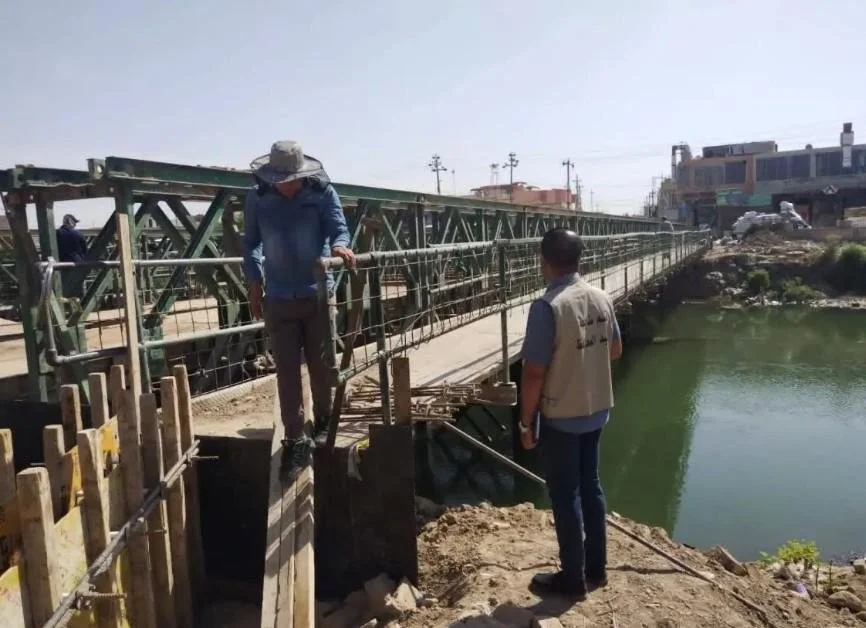
The New Al-Shamiya Bridge Project Has Reached Half Completion And Is Nearing Advanced Stages.
Localities The Diwaniyah Governorate Office announced on Wednesday that the completion rate of the new concrete bridge project in Al-Shamiya district has reached 45%, as part of regional development projects aimed at developing infrastructure and improving transportation.
The director of the follow-up department at the governorate’s office, Halim Abbas Al-Baraki, said in a press statement that the project is being implemented as an alternative to the old iron bridge, with a length of 60 meters and a width of 15 meters, at a total cost of 2 billion, 257 million and 794 thousand Iraqi dinars.
He added that the ongoing work includes pouring reinforced concrete for the bridge, carrying out earthworks for its shoulders, as well as reinforcing the footpaths for pedestrian crossings, noting that the project's implementation period has been set at 300 days and is being carried out by Al-Rami International Contracting Company.
Al-Baraki stressed that the implementing company was instructed to expedite the completion of welding work for the pillars and crossbeams according to the approved technical specifications, to ensure the project is completed with the required quality and within the specified deadlines. https://www.economy-news.net/content.php?id=69835
Rob Cunningham: Why is XRP Price Still Soft?
Rob Cunningham: Why is XRP Price Still Soft?
6-3-2026
Why Is XRP Price Still Soft? The 7-Point Common Sense Version
1. Utility Is Growing Faster Than Speculation
Real-world infrastructure is being built, but infrastructure comes before traffic.
2. Institutions Move Like Cargo Ships, Not Jet Skis
Retail thinks in days. Institutions think in years.
Rob Cunningham: Why is XRP Price Still Soft?
6-3-2026
Why Is XRP Price Still Soft? The 7-Point Common Sense Version
1. Utility Is Growing Faster Than Speculation
Real-world infrastructure is being built, but infrastructure comes before traffic.
2. Institutions Move Like Cargo Ships, Not Jet Skis
Retail thinks in days. Institutions think in years.
3. Good News Doesn’t Automatically Create Buying Pressure
Partnerships, ETFs, and announcements matter—but only actual capital flows move price.
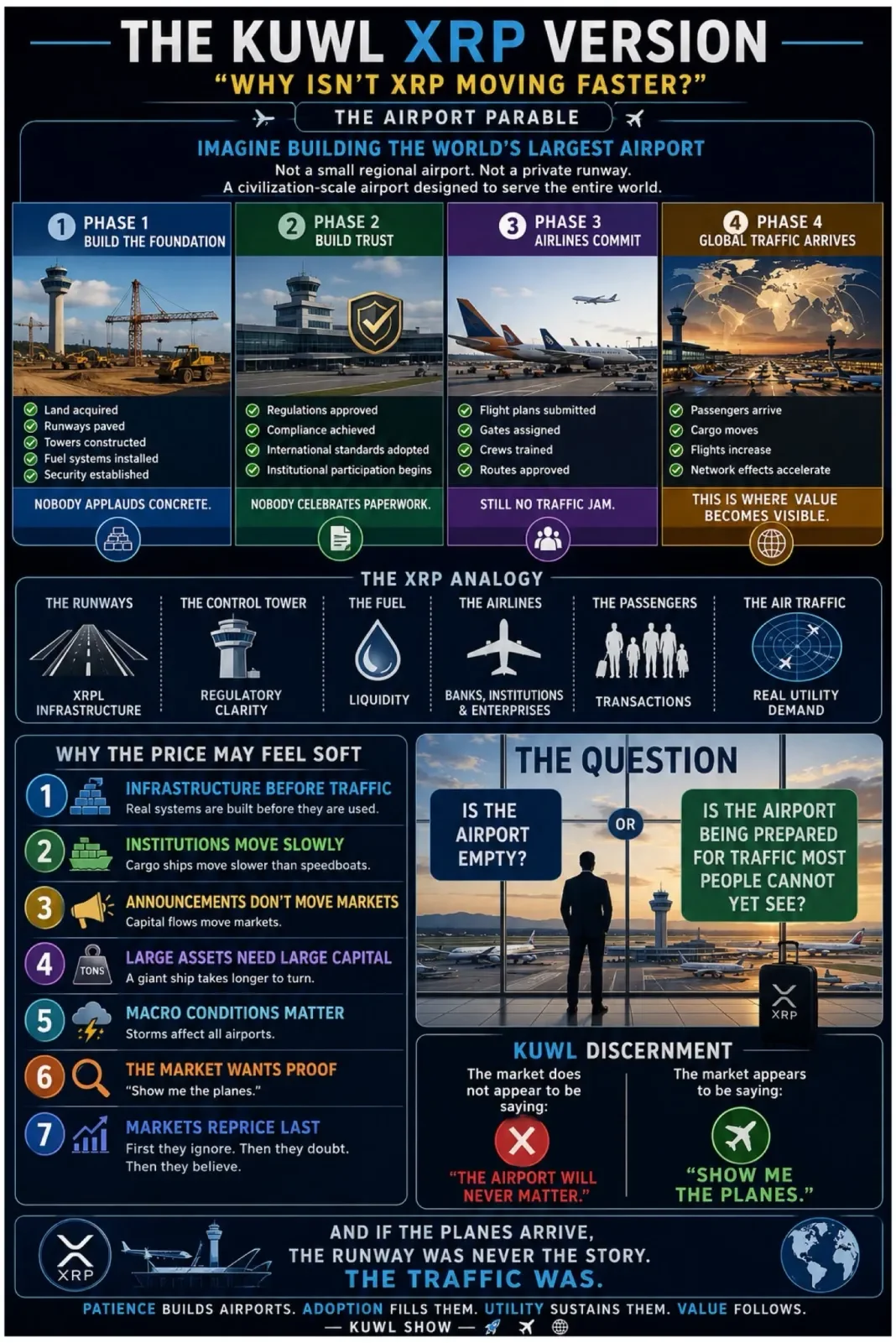
4. Big Assets Need Big Money
It’s easier to move a $1 billion asset than a $100+ billion asset. XRP requires enormous capital to materially reprice.
5. Macro Still Matters
Even strong projects get dragged around by interest rates, liquidity, geopolitics, and broader market sentiment.
6. The Market Wants Proof, Not Promises
The question isn’t whether Ripple is succeeding. The question is whether that success translates into sustained XRP demand.
7. Markets Reward Certainty Last
First they ignore. Then they doubt. Then they resist. Then they reprice.
The KUWL Version
Imagine spending years building the world’s largest airport.
The runways are paved.
The control tower is operational.
The fuel lines are connected.
The customs offices are staffed.
The gates are open.
The planes are filing flight plans.
Yet some people stand in the terminal asking: “Why isn’t there a traffic jam yet?”
Because airports are built before they become busy.
The XRP thesis has never been about today’s passengers.
It has always been about tomorrow’s air traffic.
The market’s current message does not appear to be:
“This airport will never matter.”
The market’s message appears closer to:
“Show me the planes.”
Source(s):
• https://x.com/KuwlShow/status/2061861744599847117
https://dinarchronicles.com/2026/06/03/rob-cunningham-why-is-xrp-price-still-soft/
Would $300 Silver Crush The Retail Industry? | Andy Schectman
Would $300 Silver Crush The Retail Industry? | Andy Schectman
Liberty and Finance: 6-3-2026
Andy Schectman explains that the recent silver selloff was driven by a combination of sharply higher margin requirements, ETF rebalancing, and forced selling tied to primary distributor allocations, creating a cascading liquidity event rather than a true breakdown in fundamentals.
He argues that this overlap of structural pressures led to more selling than buying in the short term, which overwhelmed bids and pushed prices lower.
Would $300 Silver Crush The Retail Industry? | Andy Schectman
Liberty and Finance: 6-3-2026
Andy Schectman explains that the recent silver selloff was driven by a combination of sharply higher margin requirements, ETF rebalancing, and forced selling tied to primary distributor allocations, creating a cascading liquidity event rather than a true breakdown in fundamentals.
He argues that this overlap of structural pressures led to more selling than buying in the short term, which overwhelmed bids and pushed prices lower.
In contrast, he notes that prior strong upside moves saw the opposite dynamic, with intense buying pressure causing premiums to surge and physical supply to tighten dramatically.
Looking forward, he says that a potential move toward $300 to $500 silver would likely bring far greater public participation and stronger hands into the market, reducing the kind of fragile selling pressure seen in earlier cycles.
In his view, that kind of environment would still strain the system but would be more fluid and balanced demand driven, rather than collapsing under forced unbalanced liquidation.
INTERVIEW TIMELINE:
0:00 Intro
2:20 Digitization of all assets
11:20 Unrealized capital gains tax
14:50 Precious metal industry
Seeds of Wisdom RV and Economics Updates Wednesday Afternoon 6-3-26
Good Afternoon Dinar Recaps,
Oil Surges as Iran-U.S. Conflict Escalates and Hormuz Risks Shake Global Markets
Rising military tensions in the Gulf are threatening global energy supplies, increasing inflation risks, and placing renewed pressure on the international financial system.
Good Afternoon Dinar Recaps,
Oil Surges as Iran-U.S. Conflict Escalates and Hormuz Risks Shake Global Markets
Rising military tensions in the Gulf are threatening global energy supplies, increasing inflation risks, and placing renewed pressure on the international financial system.
Overview
Oil prices moved higher as military hostilities between the United States and Iran intensified, raising fears of broader disruption throughout the Middle East. With negotiations stalled and attacks expanding across the Gulf region, concerns are mounting over the security of the Strait of Hormuz, one of the world's most critical energy transit corridors.
The latest escalation comes at a time when global economies are already facing elevated debt levels, inflation concerns, and slowing growth. As a result, investors and policymakers are closely monitoring developments for their potential impact on energy markets and financial stability.
Key Developments
1. Military Exchanges Intensify Across the Gulf
Iranian missile and drone attacks reportedly targeted multiple locations throughout the Gulf region, including infrastructure in Kuwait. Regional air defense systems intercepted several projectiles, while military activity expanded across key strategic locations.
In response, U.S. forces conducted strikes near Qeshm Island, close to the Strait of Hormuz, targeting what American officials described as threats to maritime security and regional stability.
2. Oil Prices Rise on Supply Disruption Fears
Crude oil prices climbed as traders reacted to growing concerns that continued fighting could further disrupt energy shipments. The Strait of Hormuz handles a significant portion of global oil and liquefied natural gas exports, making any threat to shipping routes a major concern for global markets.
Energy analysts warn that prolonged instability could place additional upward pressure on fuel costs worldwide.
3. Diplomatic Talks Between Washington and Tehran Stall
Efforts to secure a broader ceasefire and restart negotiations regarding Iran's nuclear program have slowed significantly. Both governments continue to blame each other for the breakdown in discussions, reducing hopes for a near-term diplomatic resolution.
The lack of progress increases the likelihood that military actions could continue in the coming weeks.
4. Nuclear Dispute Remains a Central Obstacle
Iran continues to seek sanctions relief and access to frozen financial assets, while the United States maintains that any relief must be tied to substantial limitations on Iran's nuclear activities.
The disagreement remains one of the largest barriers to restoring diplomatic relations and reducing regional tensions.
5. Global Supply Chains Face Renewed Pressure
Maritime security concerns have expanded beyond energy markets. Reports of attacks on commercial shipping vessels have increased concerns about disruptions to international trade, transportation costs, and supply chain reliability.
Humanitarian organizations have also warned that regional instability is creating additional challenges for aid deliveries and essential goods distribution.
Why It Matters
The Middle East remains one of the world's most important energy-producing regions. Any prolonged disruption involving the Strait of Hormuz can quickly affect oil prices, inflation, transportation costs, and economic growth across multiple continents.
Financial markets are particularly sensitive because higher energy prices often influence central bank decisions, interest rate policies, and consumer spending patterns.
Why It Matters to Foreign Currency Holders
Rising oil prices can increase global inflation pressures.
Energy-importing nations may experience increased currency volatility.
Safe-haven assets often attract demand during periods of geopolitical uncertainty.
Supply chain disruptions can impact trade balances and economic growth.
Implications for the Global Reset
Pillar 1: Energy Security Becomes a Financial Issue
The latest escalation highlights how closely energy security and monetary stability are connected. Higher oil prices can influence inflation, interest rates, sovereign debt costs, and economic growth simultaneously.
Pillar 2: Geopolitical Risk Reshapes Global Commerce
Ongoing instability is accelerating discussions about alternative trade routes, diversified supply chains, and regional economic alliances designed to reduce exposure to geopolitical chokepoints.
Closing Insight
The renewed confrontation between Iran and the United States demonstrates how quickly geopolitical events can influence global financial conditions. With energy markets, trade routes, and diplomatic efforts all under pressure, the conflict's consequences extend far beyond the Middle East.
This is not just an oil story—it is a reminder that energy security remains one of the most powerful forces shaping the future of the global financial system.
Signature
Seeds of Wisdom Team
Newshounds News™ Exclusive
Sources
Modern Diplomacy — "Oil Jumps as Iran US Talks Stall and Gulf Conflict Escalates"
Reuters — "Oil Rises as Middle East Conflict Fuels Supply Concerns"
~~~~~~~~~~
Seeds of Wisdom Team RV Currency Facts Youtube and Rumble
Newshound's News Telegram Room Link
RV Facts with Proof Links Link
RV Updates Proof links - Facts Link
Follow the Gold/Silver Rate COMEX
Follow Fast Facts
Seeds of Wisdom Team™Website
Thank you Dinar Recaps
The Dollar System is Losing Trust, Gold’s Monetary Reset has Begun
The Dollar System is Losing Trust, Gold’s Monetary Reset has Begun
Wealthion: 6-3-2026
In an ever-evolving global financial landscape, the discussion around gold’s role as more than just a shiny commodity has never been more pertinent.
Recently, a compelling conversation between Trey Reik, Chief Economist at GBI, and Ronnie Stoeferle, Partner at Incrementum AG, explored the intricate nuances of gold within the global monetary system. Their insights delve deep into whether we are witnessing a typical gold market cycle or something far more profound: a fundamental monetary revaluation.
The Dollar System is Losing Trust, Gold’s Monetary Reset has Begun
Wealthion: 6-3-2026
In an ever-evolving global financial landscape, the discussion around gold’s role as more than just a shiny commodity has never been more pertinent.
Recently, a compelling conversation between Trey Reik, Chief Economist at GBI, and Ronnie Stoeferle, Partner at Incrementum AG, explored the intricate nuances of gold within the global monetary system. Their insights delve deep into whether we are witnessing a typical gold market cycle or something far more profound: a fundamental monetary revaluation.
Stoeferle aptly titled his firm’s report “Back to the Monetary Future,” underscoring the vital importance of understanding monetary history to decode today’s complex economic and financial dynamics.
The discussion highlighted a brewing shift in global power, with the anticipated decline of the Pax Americana and a notable de-dollarization trend gaining momentum.
This shift is particularly influenced by China’s emergence across technological, economic, and scientific fronts. Amidst this backdrop, a growing erosion of trust in traditional institutions, political leadership, and central banks—magnified by rising inflation and surging gold prices—has naturally redirected attention towards gold as a reliable store of value.
One of the key takeaways from the conversation is the argument that gold’s current prices should not be solely perceived in nominal dollar terms. Instead, the analysts suggest a more insightful approach involves viewing gold in relative and monetary terms, particularly its ratio to various money supply measures like M0 and M2.
When evaluated through these lenses, gold appears to be significantly undervalued, suggesting a potentially substantial upside from a historical and comparative perspective.
The discussion also touched upon generational differences in how gold is perceived as monetary insurance. European nations, with their historical experience of multiple fiat currency devaluations, tend to have a deeper-rooted appreciation for gold’s protective qualities.
In contrast, American perspectives have often been shaped by different economic anxieties, sometimes leading to varied attitudes towards the yellow metal.
Drawing on classic Dow theory, the analysts dissected the gold market cycle into distinct phases. Initially, there’s an accumulation phase, where astute, often contrarian, investors begin to acquire assets amidst widespread negative sentiment.
This is followed by the public participation phase, characterized by increasing general interest and growing media attention. Stoeferle suggested that gold is currently well within this public participation phase—perhaps midway through it.
This indicates a broader acceptance among both institutions and the general public, but importantly, it also implies that the market is still far from its peak enthusiasm, leaving room for further development.
The conversation concluded with strong evidence of gold’s shifting narrative within the institutional world.
Major financial institutions have begun revising their gold price targets upwards, reflecting a growing confidence in its performance. Furthermore, influential firms like Morgan Stanley are now including significant allocations to gold in their portfolio recommendations. This institutional embrace underscores gold’s evolving role as a strategic asset for diversification and wealth preservation in an uncertain economic climate.
For those eager to delve deeper into these fascinating insights and gain further perspective on gold’s integral place in our monetary future, we highly recommend watching the full video from Wealthion. It offers an invaluable opportunity to understand the multifaceted factors shaping gold’s trajectory.
News, Rumors and Opinions Wednesday 6-3-2026
Ariel: Iraqi Dinar Overview
6-3-2026
Iran & Iraq Update: Progressive Operations For The Republic Restoration
Iraqi Dinar Overview
Surface narratives claim stability at ~1,300 IQD per USD with no major shift planned, citing CBI budgets and minor fluctuations. This of course ignores compartmentalized mechanics. The official rates serve budgetary theater while parallel rails (offshore trusts, sovereign wealth vehicles, and tokenized testing) prepare for phased redenomination and backing adjustments.
Ariel: Iraqi Dinar Overview
6-3-2026
Iran & Iraq Update: Progressive Operations For The Republic Restoration
Iraqi Dinar Overview
Surface narratives claim stability at ~1,300 IQD per USD with no major shift planned, citing CBI budgets and minor fluctuations. This of course ignores compartmentalized mechanics. The official rates serve budgetary theater while parallel rails (offshore trusts, sovereign wealth vehicles, and tokenized testing) prepare for phased redenomination and backing adjustments.
Just so we are clear on this. The skeptics overlook documented post-invasion currency swaps (2003-2011) where dinar holdings among US-linked entities created vested interests. The 2024 Politico framing on dollar devaluation under trade pressures aligns with accelerated timelines engineered weakening forces asset migration into hard commodities and reformed currencies.
Iraq’s full digital mandate by July 2026 (cashless government institutions via CBI directive) is not mere modernization; it clears legacy paper for blockchain/ISO 20022 integration, enabling gold-pegged or commodity-hybrid settlement without public devaluation panic.
So this should give you all a clue as to how this is going to go.
Space Force and aligned DIA/SOCOM elements monitor global settlement integrity, including orbital data relays for transaction verification.
Fort Knox audits (pushed via executive and congressional vectors) verify physical gold collateral to backstop any reset critical as European Central Bank data confirms gold surpassing US Treasuries as primary reserve asset (~27% share end-2025 vs. declining Treasury holdings).
This supports return to sounder mechanisms where dinar transitions from fiat proxy to regionally backed instrument. Under-the-table dealings involve cutouts in Gulf sovereign funds and select US Treasury alumni coordinating non-SWIFT rails. Iraq seeks independent national currency strength to exit dollar dependency in oil exports, accelerated by BRICS+ hedging and reduced Iranian influence channels.
Please understand this one thing. Trump’s team zeroed in on Iraq’s financial flows early on because of oil revenue recycling, Iranian influence channels, and broader de-dollarization risks. Those pauses on U.S. currency shipments to Iraq (hitting around $500 million tied to oil proceeds) weren’t random they were pressure tools to curb militia funding routes and force cleaner monetary policy in Baghdad.
This wasn’t headline-grabbing stuff, but it signaled a focus on stabilizing Iraq’s currency mechanics as leverage in regional cleanup.
Fast-forward to the current term, and the same threads persist: using dollar access as a carrot/stick while watching Iraq’s push to stand up its own stronger national currency backbone.
Read Full Article:
https://www.patreon.com/posts/iran-iraq-update-159961100
https://dinarchronicles.com/2026/06/02/prolotario-iraqi-dinar-overview/
***********
Courtesy of Dinar Guru: https://www.dinarguru.com/
Jeff Question: "Can the government drag the rate change for a couple more years?" Jeff: No...because they've already done everything. They've already told you the new government is going to lead Iraq into the next stage, next phase. That is the international post rate change era...All the articles tell you reforms, taxes, 150+ laws - all of that is post rate change era...This is not going to drag out for more years.
Militia Man Article: "ECONOMIC REFORM OR RADICAL CHANGE ? - A LOOK AT THE PATH TO A MARKET ECONOMY" This is further confirmation that the execution phase is real. Diversification, private sector activation, and reducing oil dependency are no longer just talk — they’re becoming policy priorities under the new government. A successful transition to a market economy is one of the strongest structural supports for a managed REER. You can’t sustainably strengthen the dinar long-term in a pure rentier system. The reforms we’re seeing are building the resilience needed for that next step.
Mnt Goat Article: “NEW UNDERSTANDINGS BETWEEN BAGHDAD AND ERBIL… AL-ZAIDI “IMPLEMENTS LONG-AWAITED KURDISH DEMANDS” Quote: "...the current phase has witnessed practical steps to implement a number of demands, especially those related to the oil file and moving towards enacting the oil and gas law."This is what is called ‘STABILITY’. These are the kind of actions we need to see in order to get the RV. We need one national Iraq working together, north and south...I leaped with JOY when I read it.
Reset Intelligence In front of a delegation of Iraqi journalists, Prime Minister Ali Falih al-Zaidi told the room he had been offered a $200 million bribe to bury corruption inside Iraq's Oil Ministry...He took it to the press. The man who carried the offer was already in custody. Adnan Mohammed Hammoud, Deputy Oil Minister for Refining Affairs and Director General of the North Refineries Company, was arrested Friday evening...Communications Minister Mustafa Sand called him an "oil whale" and "the main provider of money to parties."...Then al-Zaidi did the part that matters. He stood up a council, named himself its chair, and gave it the power to send a corruption file straight to a judge...This one action just showed you what Iraq is now capable of.
The Truth About the Dollar, Why It Buys Less Every Year! | LIVE Q&A with Lynette Zang
6-2-2026
Why does it feel like your money doesn't go as far as it used to?
In this livestream, Lynette Zang examines the truth about the U.S. dollar, rising living costs, inflation, and why many Americans are finding it harder to maintain their standard of living despite higher incomes.
The discussion explores purchasing power, monetary policy, and what these trends could mean for the future.
Seeds of Wisdom RV and Economics Updates Wednesday Morning 6-3-26
Good Morning Dinar Recaps,
Middle East Conflict, Rising Oil Prices, and Digital Currency Debates Increase Pressure on Global Finance
Escalating geopolitical risks and accelerating discussions around digital money are exposing vulnerabilities within the existing financial system.
Good Morning Dinar Recaps,
Middle East Conflict, Rising Oil Prices, and Digital Currency Debates Increase Pressure on Global Finance
Escalating geopolitical risks and accelerating discussions around digital money are exposing vulnerabilities within the existing financial system.
Overview
Today's economic landscape is being shaped by two powerful forces: renewed instability in the Middle East affecting global energy markets and growing efforts by governments and central banks to modernize payment systems through digital currencies and stablecoin regulation.
While global stock markets remain near record highs, underlying risks tied to energy security, inflation, sovereign debt, and monetary transformation continue to build beneath the surface.
Key Developments
1. OECD Warns Prolonged Middle East Conflict Could Slow Global Growth
The OECD warned today that an extended conflict involving Iran and the broader Middle East could significantly reduce global economic growth while pushing inflation higher. Under its more severe scenario, global growth could fall to 2.1% in 2026, while inflation accelerates due to disruptions in energy supplies and trade routes.
2. Oil Prices Continue Rising on Iran Uncertainty
Oil prices moved higher for a third consecutive day as negotiations between the United States and Iran remain stalled. Markets remain concerned that any disruption involving the Strait of Hormuz, one of the world's most important energy corridors, could trigger additional inflationary pressures and disrupt global supply chains.
3. Central Banks Face Growing Digital Currency Pressure
Debates surrounding digital currencies intensified as policymakers in Europe and the United Kingdom discussed the future of stablecoins and central bank digital currencies (CBDCs). European Central Bank officials argued that projects such as the Digital Euro may become increasingly important as governments seek to maintain monetary sovereignty in a rapidly evolving digital payments environment.
4. Stablecoin Regulation Emerges as Strategic Financial Issue
UK lawmakers urged regulators to soften proposed restrictions on stablecoins, warning that excessive regulation could hinder innovation and limit competitiveness. The debate highlights the growing importance of stablecoins as governments attempt to balance innovation with financial stability concerns.
5. Interest Rate Expectations Remain Elevated
Strong labor market data and persistent inflation concerns have led investors to scale back expectations for rapid interest-rate cuts. Rising bond yields and tighter monetary conditions continue to place pressure on highly leveraged governments, corporations, and consumers worldwide.
Why It Matters
The combination of geopolitical instability, energy market vulnerability, elevated debt levels, and digital monetary innovation is creating conditions that could reshape the future structure of global finance. Governments and central banks are increasingly forced to manage multiple systemic risks simultaneously.
Why It Matters to Foreign Currency Holders
Rising energy prices can create significant currency volatility.
Digital currencies and stablecoins may influence future cross-border payment systems.
Higher interest rates could pressure debt-heavy economies and alter capital flows.
Implications for the Global Reset
Pillar 1: Energy Security and Monetary Stability
Persistent instability in key energy-producing regions demonstrates how closely inflation, interest rates, and geopolitical events have become interconnected within the modern financial system.
Pillar 2: Transition Toward Digital Finance
The accelerating focus on stablecoins, digital currencies, and tokenized financial infrastructure suggests that major economies are actively preparing for the next phase of monetary evolution.
Closing Insight
Today's developments highlight a world economy balancing between old and new systems. Traditional challenges such as war, inflation, and debt remain significant, while digital currencies and financial innovation are steadily transforming how money and commerce may function in the future.
This is not simply a period of economic uncertainty—it is the intersection of geopolitical risk and monetary transformation shaping the next era of global finance.
Seeds of Wisdom Team
Newshounds News™ Exclusive
Sources
Reuters — "OECD Says Protracted War Could Drag on Global Growth, Push Up Inflation"
Reuters — "Oil Up on Middle East Fighting While AI Bulls Carry Stocks Higher"
~~~~~~~~~~
🌱A Message to Our Currency Holders🌱
If you’ve been holding foreign currency for many years, you were not foolish.
You were not wrong to believe the global financial system would change.
What failed was not your patience — it was the information you were given.
For years, dates, rumors, and personalities replaced facts, structure, and proof. “This week” predictions created cycles of hope and disappointment that were never based on how currencies actually change.
That is not your failure.
Our mission here is different: • No dates • No rates • No hype • No gurus
Instead, we focus on:
• Verifiable developments • Institutional evidence
• Global financial structure • Where countries actually sit in the process
Currency value changes only come after sovereignty, trade, banking, settlement systems, and fiscal coordination are in place. History and institutions confirm this sequence.
You will see silence. You will see denials. That is not delay — that is discipline.
Protect your identity. Organize your documents. Verify everything.
Never hand your discernment to anyone who cannot show proof.
You deserve truth — not timelines.
Seeds of Wisdom Team
Newshounds News™
~~~~~~~~~~
Seeds of Wisdom Team RV Currency Facts Youtube and Rumble
Newshound's News Telegram Room Link
RV Facts with Proof Links Link
RV Updates Proof links - Facts Link
Follow the Gold/Silver Rate COMEX
Follow Fast Facts
Seeds of Wisdom Team™Website
Thank you Dinar Recaps