Seeds of Wisdom RV and Economics Updates Friday Morning 5-29-26
Good Morning Dinar Recaps,
Dollar Weakens as US-Iran Ceasefire Hopes Shift Global Market Sentiment
Easing Middle East tensions are reducing safe-haven demand for the dollar while reshaping expectations for oil, inflation, and global capital flows.
Good Morning Dinar Recaps,
Dollar Weakens as US-Iran Ceasefire Hopes Shift Global Market Sentiment
Easing Middle East tensions are reducing safe-haven demand for the dollar while reshaping expectations for oil, inflation, and global capital flows.
Overview
The U.S. dollar moved toward a weekly decline today as reports of a potential 60-day ceasefire extension between the United States and Iran improved investor confidence and reduced demand for safe-haven assets. Falling oil prices and easing fears surrounding the Strait of Hormuz helped calm global markets, while investors increasingly focused on inflation, interest rates, and long-term diversification away from dollar-based assets.
Key Developments
1. Dollar Heads for Weekly Loss as Risk Appetite Improves
The U.S. dollar weakened against several major currencies after reports suggested Washington and Tehran were moving closer to extending their ceasefire agreement. The decline snapped a recent rally fueled by geopolitical tensions and reflected growing optimism that wider regional conflict may be avoided.
2. Oil Prices Fall Sharply on Diplomacy Hopes
Crude oil prices posted their steepest weekly decline since April as traders anticipated reduced disruption risks in the Strait of Hormuz. Lower energy prices immediately eased inflation concerns and weakened demand for the dollar as a defensive safe-haven currency.
3. Investors Begin Rotating Away From Defensive Positions
Currencies such as the Australian dollar, New Zealand dollar, euro, and yen strengthened modestly as market sentiment improved. Analysts noted that investors are gradually reducing defensive positions that were built during the height of Middle East tensions.
4. Structural Concerns About the Dollar Continue Growing
Despite relatively high U.S. interest rates, some global investors remain concerned about America’s rising debt levels, fiscal outlook, and long-term reserve currency dominance. This has contributed to ongoing discussions about diversification into alternative currencies and regional financial systems.
Why It Matters
The dollar’s decline demonstrates how quickly geopolitical developments can influence global financial markets. Reduced conflict risk lowers safe-haven demand, while falling oil prices may temporarily ease inflation pressures that have strained central banks and economies worldwide.
Why It Matters to Foreign Currency Holders
Increased potential for currency volatility tied to geopolitical developments
Growing investor focus on diversification beyond dollar-denominated assets
Lower oil prices may temporarily reduce inflation pressure across global economies
Implications for the Global Reset
Pillar 1: Reserve Currency Confidence Shift
Even modest dollar weakness highlights growing global discussions surrounding multi-currency trade systems and reserve diversification as countries seek alternatives to heavy dependence on U.S. financial markets.
Pillar 2: Geopolitics and Monetary Stability
The relationship between war risk, energy prices, and monetary policy continues showing how geopolitical events increasingly shape global liquidity, inflation trends, and investor behavior.
Closing Insight
Today’s market reaction reflects cautious optimism that diplomacy may temporarily stabilize one of the world’s most important geopolitical flashpoints. However, deeper concerns surrounding debt, inflation, and reserve currency confidence continue influencing long-term financial sentiment.
This is not just a weaker dollar — it’s a reminder that geopolitical stability and global currency confidence are becoming increasingly interconnected.
Seeds of Wisdom Team
Newshounds News™ Exclusive
Sources
~~~~~~~~~~
🌱A Message to Our Currency Holders🌱
If you’ve been holding foreign currency for many years, you were not foolish.
You were not wrong to believe the global financial system would change.
What failed was not your patience — it was the information you were given.
For years, dates, rumors, and personalities replaced facts, structure, and proof. “This week” predictions created cycles of hope and disappointment that were never based on how currencies actually change.
That is not your failure.
Our mission here is different: • No dates • No rates • No hype • No gurus
Instead, we focus on:
• Verifiable developments • Institutional evidence
• Global financial structure • Where countries actually sit in the process
Currency value changes only come after sovereignty, trade, banking, settlement systems, and fiscal coordination are in place. History and institutions confirm this sequence.
You will see silence. You will see denials. That is not delay — that is discipline.
Protect your identity. Organize your documents. Verify everything.
Never hand your discernment to anyone who cannot show proof.
You deserve truth — not timelines.
Seeds of Wisdom Team
Newshounds News™
~~~~~~~~~~
Seeds of Wisdom Team RV Currency Facts Youtube and Rumble
Newshound's News Telegram Room Link
RV Facts with Proof Links Link
RV Updates Proof links - Facts Link
Follow the Gold/Silver Rate COMEX
Follow Fast Facts
Seeds of Wisdom Team™Website
Thank you Dinar Recaps
Iraq Economic News and Points To Ponder Friday Morning 5-29-26
A US budget of $778.5 million to upgrade 5 military bases
Money and Business Economy News — Follow-up Pentagon documents for fiscal year 2027 show that the Missile Defense Agency requested $778.5 million in funding to upgrade the ground infrastructure of the missile defense system at five military bases.
The Russian news agency Novosti, after reviewing the documents, indicated that the Pentagon is seeking to upgrade five military bases to accommodate new interceptor missiles.
A US budget of $778.5 million to upgrade 5 military bases
Money and Business Economy News — Follow-up Pentagon documents for fiscal year 2027 show that the Missile Defense Agency requested $778.5 million in funding to upgrade the ground infrastructure of the missile defense system at five military bases.
The Russian news agency Novosti, after reviewing the documents, indicated that the Pentagon is seeking to upgrade five military bases to accommodate new interceptor missiles.
According to the documents, the modernization work will include Fort Greeley and Erickson Air Station in Alaska, Vandenberg Space Force Base in California, Fort Drum in New York, and the Missile Defense Integration and Operations Center in Colorado.
The funds are earmarked for upgrading fire control systems, protected networks, communication stations, and launch platforms.
The funding requested is roughly double last year’s budget of $390.1 million, with documents attributing the increased spending to the move toward a hybrid interceptor missile system, which includes the use of both the older generation (GBI) and the new generation (NGI).
Additional funds will also be allocated to enhance protection against cyber threats and to upgrade the communications network of the missile defense system.
This plan is the largest spending item within the overall budget for the US ground-based missile defense system for 2027, which amounts to $1.36 billion. https://www.economy-news.net/content.php?id=69625
Localities Economy News — Baghdad The Ministry of Construction, Housing and Municipalities confirmed on Friday that the closure of the Hamrin Bridge was a precautionary measure to preserve the safety of citizens, stressing that the bridge structure and concrete supports are completely safe.
Ministry spokesman Nabil Al-Saffar said, “Erosion occurred in the approaches to the Hamrin Bridge because they are earthen dams that were not protected by implementing cladding for the side slopes of the dam,” explaining that “the rise in the water level of Lake Hamrin caused the erosion of the edges of the earthen approaches.”
He added that "the project has reached 89% completion and has not yet been fully completed, and that the previous opening of the bridge was a temporary opening."
Al-Saffar pointed out that “the Diyala Roads and Bridges Directorate sent a letter to the Diyala Governor’s office, the Operations Command, and the Police Command to close the bridge, based on the directives of the Roads and Bridges Department, in order to preserve the safety of road users,” stressing that “the bridge body is structurally sound at 100%, and the concrete supports are also sound, and the problem is limited to the dirt approaches only.” https://www.economy-news.net/content.php?id=69627
France Freezes €4 Billion In Government Spending To Offset Losses Related To The Middle East Conflict
Arabic and international Economy News — Follow-up Media reports, quoting French Finance Minister David Amiel, revealed that the Finance Ministry has decided to freeze government spending of nearly 4 billion euros to compensate for the country’s losses related to the repercussions of the conflict in the Middle East, while keeping the defense and justice budgets unchanged.
Amil explained that the Ministry of Economy and Finance revealed yesterday a plan to freeze state budget allocations worth 3.2 billion euros, in addition to canceling additional allocations of about 847 million euros, as part of measures aimed at containing the costs resulting from the war in the region, according to French media.
This measure complements a previous government plan that saved an estimated 2.2 billion euros, obtained by freezing the reduction in social security contributions for low-wage workers, which was announced by the French government last week.
The French government expects to achieve savings of €6 billion, distributed between €4 billion from the budgets of most ministries and €2 billion from social spending. However, the budgets of the Ministries of Defense and Justice will not be reduced.
The Ministry of Finance indicated that these measures are temporary in nature, noting the possibility of lifting the freeze on funds during the current year depending on developments. A new meeting is scheduled for the end of June to discuss the upcoming emergency austerity measures . https://www.economy-news.net/content.php?id=69626
The Civil Service Council Announces The Completion Of All Procedures Related To The Employment File And Is Awaiting The 2026 Budget.
Localities Economy News — Baghdad The Federal Public Service Council announced on Friday that it has completed all the technical procedures related to the employment file, while making the launch of appointments and the application form contingent on 3 main axes.
Council spokesman Fadel Abdul Zahra Al-Gharawi said, according to the official agency, that "the launch of the new appointments and the electronic application form is linked to several factors and is not limited to the technical aspect only."
He added that “appointments in state institutions are linked to three main axes: firstly, the availability and creation of job positions; secondly, the provision of the necessary financial allocations, which is directly related to the 2026 budget and what it will include in terms of job positions and financial allocations; and thirdly, the need of ministries and government agencies for the required specializations according to their plans and job structure.”
Al-Gharawi pointed out that "the Federal Public Service Council has completed, from a technical standpoint, all procedures related to employment files, application mechanisms, and the employment form. However, the Council is still waiting for the approval of the 2026 budget and the financial allocations and new job grades that will be included in it in order to begin the technical procedures related to the employment file."
He stressed that "the council is keen on all its graduate students, and works according to national and professional responsibility in managing the employment file, adopting the principles of transparency, integrity, justice and equality in all application, nomination and distribution procedures, in order to ensure equal opportunities for all."
Friday Iraq News Posted by Tishwash at TNT
TNT:
Tishwash: Al-Zidi and Al-Sudani affirm their support for development plans and the completion of the government formation.
Prime Minister Ali Faleh al-Zaidi and the head of the Reconstruction and Development Coalition, Mohammed Shia al-Sudani, stressed on Thursday the importance of continuing to support the government in implementing its development programs and completing the government formation, in line with the aspirations of the Iraqi public.
The Prime Minister’s Media Office stated in a statement that “Prime Minister Ali Faleh Al-Zaidi met today with the head of the Reconstruction and Development Coalition, Mohammed Shia Al-Sudani.”
TNT:
Tishwash: Al-Zidi and Al-Sudani affirm their support for development plans and the completion of the government formation.
Prime Minister Ali Faleh al-Zaidi and the head of the Reconstruction and Development Coalition, Mohammed Shia al-Sudani, stressed on Thursday the importance of continuing to support the government in implementing its development programs and completing the government formation, in line with the aspirations of the Iraqi public.
The Prime Minister’s Media Office stated in a statement that “Prime Minister Ali Faleh Al-Zaidi met today with the head of the Reconstruction and Development Coalition, Mohammed Shia Al-Sudani.”
The statement added that “the meeting witnessed an exchange of greetings on the occasion of Eid al-Adha, and a review of the most prominent developments on the national scene, in addition to stressing the importance of maintaining understandings between the political parties to complete the formation of the government, and stressing support for the government in implementing its development plans, in a way that meets the aspirations of the Iraqi people.” link
Tishwash: An economist says: Borrowing narrows Iraq's economic options, and the solution lies in rationalizing spending.
Economic expert Manar Al-Obaidi confirmed that the continued decline in oil revenues and the government's inability to compensate for them with alternative sources has limited the available economic options to a narrow corner, making borrowing the only way to cover monthly expenses amounting to about ten trillion dinars.
Al-Ubaidi explained in a statement, a copy of which was received by Al-Furat News, that "borrowing is not a radical solution, but rather may become a factor exacerbating the crisis." He pointed out that public debt interest reached approximately seven trillion dinars in 2025 and is expected to exceed ten trillion dinars this year, equivalent to about 10% of total mandatory operating expenses.
He indicated that "the danger of the current path lies in the possibility that the government will reach a stage where it borrows to pay debt interest instead of funding public services." He stressed that the real solution lies in rationalizing operating expenses, primarily salaries and social welfare, emphasizing that there is ample room for reform without affecting the citizen's standard of living.
Al-Ubaidi cited the success of audits in the social welfare program during the first quarter of this year, which saved approximately 700 billion dinars. This means that more than 2.8 trillion dinars could be saved annually simply by partially reviewing beneficiary data. He questioned the size of the savings that could be achieved if the review included salaries and other areas of expenditure.
Al-Ubaidi concluded that the economic equation imposes two options, with no third alternative. Either we continue borrowing and turn debt into a structural constraint for decades to come, or we control and rationalize spending in pursuit of a gradual balance that protects the economy and the citizen’s standard of living, far from excessive optimism based on inaccurate impressionistic readings. link
************
Tishwash: European Center: The US Federal Reserve is the only current "way out" of Baghdad's economic crisis
The European Center for Economic Guarantees, Credendo, revealed in a report published today, Tuesday, May 26, 2026, the "depth of the crisis" that Iraq is going through during the current and upcoming stage, stressing that the government in Baghdad "needs" the US Federal Reserve.
The center said, according to what was translated by “Baghdad Today”, that the economic shock resulting from Iraq’s loss of its ability to export its oil as a result of the closure of the Strait of Hormuz is still “not fully apparent”, stressing that the consequences will include “enormous financial pressure on liquidity and difficulty in meeting the government’s financial obligations in the public sectors, in addition to a significant decline in the value of the Iraqi dinar and a rise in inflation rates.”
He continued, "The outlook for the economic situation in Iraq appears to be highly difficult and challenging, especially if the current crisis in the Strait continues or the region witnesses a new escalation of violence, which could lead to permanent damage to the Iraqi oil sector that cannot be repaired or avoided."
He added, "Even if the United States and Iran reach a preliminary agreement to halt the war for a short period of time, restarting the oil fields will be extremely difficult, in addition to the risk of the conflict resuming at any time, which makes the process of resuming production and exporting again a major challenge for the Iraqi government."
The center confirmed that the Iraqi government has an economic "way out" of the current crisis, represented by the large foreign financial reserve it possesses in hard currency, which it can use as a barrier to protect the Iraqi economy from the most serious consequences of the cessation of exports for a period of time that could reach months, stressing, "This reserve is not in Iraq's possession."
The center also clarified that Iraq’s large financial reserves are held with the US Federal Reserve in New York and not with the Central Bank of Iraq, which makes the use of those funds, with its long-term risks and short-term benefits, subject to a US decision.
The center indicated that the United States is aware of Iraq’s need for the large financial reserves held by the Federal Reserve, which led to “Washington using it as a political pressure tactic against the Iraqi government to push it to dissolve the factions, something that became very clear during Washington’s imposition of restrictions on cash dollar transfers to Iraq, which placed further financial restrictions on the Iraqi government.”
The center noted at the end of its report that Iraq’s temporary and currently available way out of the financial crisis, represented by the dollar reserves at the US Federal Reserve, carries another risk, explaining, “If Washington imposes economic sanctions on Iraq, the country will not be able to access the reserves of funds that it may use to finance its work for the coming months,” as it described it.
It is noted that political analysts have spoken about conducting governmental and party negotiations and discussions to reach an agreement to integrate the armed factions into a new security ministry in order to avoid American restrictions and possible sanctions on the economy. link
Tishwash: The debt trap threatens Iraq... Will the government borrow to pay off loan interest?
Economic expert Manar Al-Obaidi warned against the government resorting to internal or external borrowing after the deficit caused by the decline in oil revenues. He said that borrowing, if continued for long periods, is a factor that exacerbates the crisis, as it increases the burden of mandatory operational expenses represented by interest on accumulated debts. What is more dangerous, according to him, is the possibility of reaching a stage where the government is forced to borrow not to finance public services, but only to pay the interest on its debts.
Al-Obaidi stressed that the real solution is to rationalize operational expenses, especially the files of salaries and social welfare, which many avoid for fear of popular reactions, indicating that Iraq needs to conduct an oversight review of these files without affecting the citizen’s livelihood and dignity.
On May 21, 2026, the Governor of the Central Bank, Ali Al-Alaq, revealed that the general budget deficit had turned into an “actual and chronic deficit” reflecting a flaw in the structure of the economy due to the complete dependence on oil revenues, stressing that the country may resort to external borrowing to cover this deficit and finance development requirements after the ability of government banks to lend reached its maximum limits.
Al-Ubaidi stated in a report, which was followed by 964 Network:
Between borrowing and spending pressure: Where does the Iraqi economy stand?
With the continued decline in oil revenues and the Iraqi government’s inability to compensate for this shortfall from alternative sources, the available solutions are becoming increasingly limited, to the point where borrowing is almost the only unavoidable option.
The fact that everyone is aware of is that monthly expenses amount to about ten trillion dinars that can only be covered through one channel in the absence of oil, which is borrowing, whether internal or external. However, borrowing is not the magic solution that saves the economy, but rather, if it continues for long periods, it may be a factor that multiplies the crisis, as it increases the burden of mandatory operating expenses represented by the interest on accumulated debts.
Public debt interest payments reached approximately seven trillion dinars in 2025, and these interest payments are expected to rise this year to more than ten trillion dinars, equivalent to about 10% of total mandatory operating expenses. This is in light of the continuous increase in the size of public debt and the possibility of resorting to more borrowing in the coming months. These expenses will remain binding on any present or future government as long as debt levels remain high. Indeed, the danger of the current path lies in the possibility of reaching a stage where the government is forced to borrow not to finance public services, but only to pay the interest on its debts. This is a path that several countries have taken and paid a heavy price for.
From this it becomes clear that borrowing in itself is not a structural solution, and that the real, unavoidable solution is to rationalize operational expenditures, foremost among them the issue of salaries and social welfare, an issue that many avoid approaching for fear of popular reactions. However, the available data indicates that the scope for reform is wide, and does not necessarily require affecting the citizen's standard of living. Comparing social welfare expenditures in the first quarter of this year with the same period last year revealed a decrease of about 700 billion dinars, achieved simply by conducting preliminary audits. This means that what was saved at the annual level may exceed 2.8 trillion dinars from just a partial review of beneficiary data. So what will the situation be when the review includes the salary file and all other aspects of government spending?
In short, the equation allows for only two options, and no third:
- Continuing to borrow until the public debt file becomes a structural constraint that burdens any government for decades to come.
Controlling and rationalizing spending and striving for a gradual balance between expenditures and revenues in ways that preserve the dignity of the citizen and protect his standard of living.
As for the excessive optimism that is sometimes promoted as easy and quick solutions, its source is mostly an impressionistic reading of the scene, not a numerical reading, that measures the amount of interaction, not the amount of accuracy. link
Iraq Economic News and Points To Ponder Thursday Afternoon 5-28-26
Iraq To Probe Major State Contracts In Corruption Crackdown
2026-05-28Shafaq News- Baghdad Iraqi Prime Minister Ali Al-Zaidi on Thursday ordered corruption investigations into several major government contracts as part of his new administration’s anti-corruption campaign and “efforts to protect public funds.”
Al-Zaidi directed oversight authorities and law enforcement agencies to examine contracts previously signed by ministries and state institutions to determine whether they “complied with Iraqi laws, safeguarded public interests, and resulted in financial harm to the state.”
Iraq To Probe Major State Contracts In Corruption Crackdown
2026-05-28Shafaq News- Baghdad Iraqi Prime Minister Ali Al-Zaidi on Thursday ordered corruption investigations into several major government contracts as part of his new administration’s anti-corruption campaign and “efforts to protect public funds.”
Al-Zaidi directed oversight authorities and law enforcement agencies to examine contracts previously signed by ministries and state institutions to determine whether they “complied with Iraqi laws, safeguarded public interests, and resulted in financial harm to the state.”
The investigations will also seek to identify those who benefited from the contracts “at the expense of the public interest,” in addition to uncovering negligence, abuse of authority, and potential misuse of public funds.
Although Al-Zaidi’s office did not offer further details, the investigations could affect contracts tied to infrastructure, procurement, energy, and public spending at a time when the government has pledged to attract foreign investment and reform state institutions.
After taking office earlier this month, Al-Zaidi described corruption as “an obstacle to development that delays the progress of the state” and vowed to “protect public funds and pursue administrative and financial corruption in all its forms.”
Iraq ranked 136th globally in Transparency International’s 2025 Corruption Perceptions Index with a score of 28 out of 100, keeping Iraq among the world’s lowest-ranked countries in public-sector transparency and making corruption one of the country’s most persistent political and economic challenges despite repeated reform campaigns launched by successive governments since 2003.
The country has also faced repeated corruption scandals in recent years, including the 2022 “theft of the century” case involving roughly $2.5 billion in missing tax funds, one of the largest financial scandals in modern Iraqi history.
Read more: Iraq's corrupt maze: Oil, bribes, and broken trust
https://www.shafaq.com/en/Economy/Iraq-to-probe-major-state-contracts-in-corruption-crackdown
Oil Prices Surge 3% On US-Iran Military Clash
2026-05-28Shafaq News Oil prices jumped more than 3% on Thursday after Iran's Revolutionary Guards said they targeted a U.S. airbase in response to a U.S. attack near Bandar Abbas airport.
Brent crude futures rose $3.51, or 3.72%, to $97.8 a barrel by 0344 GMT, while the more active August contract gained $3.35 or 3.63%, to $95.6. The July contract is set to expire on Friday.
The U.S. West Texas Intermediate futures were up $3.31, or 3.73%, at $91.99.
Both benchmarks slipped more than 5% to touch their lowest in a month in the previous session on the possibility of a U.S.-Iran deal to end their war and reopen the Strait of Hormuz.
Iran's Revolutionary Guards said on Thursday they targeted a U.S. airbase after what they described as an early morning U.S. attack near Bandar Abbas airport, Tasnim news agency reported.
They warned that any repeat of what they called aggression would draw a "more decisive".
The U.S. military launched new strikes in Iran targeting a military site that officials believed posed a threat to U.S. forces and commercial maritime traffic in the strait, a U.S. official told Reuters.
"Oil supply remains constrained, and key sticking points have yet to be resolved," ANZ commodity strategist Daniel Hynes said in a note.
In the U.S., crude oil stockpiles fell by 2.8 million barrels last week, the sixth straight week of declines, according to American Petroleum Institute data.
Official inventory data from the U.S. Energy Information Administration are due on Thursday, a day later than usual due to the Memorial Day holiday on Monday.
(Reuters) https://www.shafaq.com/en/Economy/Oil-prices-surge-3-on-US-Iran-military-clash
Prime Minister's Advisor: Iraq Is On The Verge Of Major Economic Changes Under The Guidance Of Al-Zaidi
Baghdad Today - Baghdad:The Prime Minister's Advisor for Financial Affairs, Mazhar Muhammad Saleh, confirmed on Wednesday (May 27, 2026) that Iraq is going through an important transitional phase at the economic level, noting that the directives of Prime Minister Ali al-Zaidi have brought about a shift in the philosophy of managing the state's financial and economic affairs, which paves the way for broad transformations during the coming period.
Saleh said in a statement followed by “Baghdad Today” that “Al-Zidi assigned the Minister of Finance the duties of Deputy Chairman of the Ministerial Council for the Economy, which is a measure that reflects the philosophy of the modern state that sees the Ministry of Finance as a sovereign institution concerned with planning the economic future, and not just an entity for distributing salaries.”
He pointed out that "Iraq is about to undergo broad changes in its economic structure," noting that "the Prime Minister has asked the Ministry of Finance to prepare a long-term plan and move from the role of treasurer to a ministry that leads the reform of the philosophy of the economic system and creates a balanced partnership between the state and the market, within the framework of Iraq Vision 2035."
Saleh explained that "the Ministerial Council for the Economy has become the main engine for economic policies, and that it will lead the next phase by transforming temporary solutions into sustainable institutional work aimed at reforming the structure of the national economy."
He also explained that "implementation includes comprehensive oversight extending from the Financial Control Bureau to ministries such as industry and agriculture, reaching the oversight of financial markets," stressing that "the citizen is the primary goal of development programs and improving the standard of living."
In the same context, Saleh stressed that “the Central Bank of Iraq is independent in its work, but it coordinates within the Ministerial Council for the Economy, which is headed by the Ministry of Finance,” explaining that “there is a Council for Economic, Monetary and Financial Stability in which all essential economic files are presented.”
https://baghdadtoday.news/300161-.html
Integrity Commission Foils Attempt To Seize 1.5 Trillion Dinars From Rafidain And Rasheed Banks In Baghdad
Thursday, May 28, 2026 10:47 | General Baghdad/ NINA /The Federal Integrity Commission announced the thwarting of an attempt to seize one and a half trillion dinars from Al-Rafidain and Al-Rasheed banks in Baghdad.
The Commission stated in a press release that "the field team in the Baghdad Investigation Directorate, in direct coordination with the competent judicial authorities, went to Al-Rafidain Bank/General Administration, where, after monitoring and investigation, they were able to apprehend (3) defendants in possession of forged statements and checks which they intended to cash illegally.
" The statement further indicated that "(7) forged checks, allegedly issued by Al-Rasheed and Al-Rafidain Banks, with a total amount of approximately one and a half trillion dinars, were seized, intended for the benefit of the defendants."
It explained that "during the operation, which was carried out in accordance with the provisions of Articles (298 and 289) of the Penal Code, the original contract for the sale of a deposit in the name of one of the defendants for the amount of (612,000,000,000) dinars was seized." The statement noted that "the defendants confessed to attempting to process the check cashing transaction in violation of the law."
It also indicated that "coordination with the management of Al-Rafidain Bank was underway." The investigation uncovered the forged checks, and initial inquiries by the team revealed no such sums or accounts belonging to the accused.
A formal seizure report was prepared and presented, along with the accused, before the judge of the Second Karkh Investigation Court, which specializes in integrity cases. The judge ordered their detention pending the completion of investigative procedures. /End 2. For more news, subscribe to our Telegram channel. https://www.ninanews.com/Website/News/Details?Key=1298228
Prime Minister: Confining Weapons To The State Is A Decision, Not An Option, And Boosting Investment Is A Government Priority
Baghdad - One News 5/28/2026 Prime Minister Ali Falih Al-Zaidi received a group of tribal sheikhs and dignitaries today on the occasion of Eid al-Adha, stressing the government’s continued commitment to implementing the project of restricting weapons to the state and enhancing security and economic stability in the country.
The Prime Minister said that the government “is proceeding with the project called for by the Supreme Religious Authority, which stipulates that weapons be restricted to the state,” stressing that “the state must be the only entity that has a monopoly on weapons, and that the possession of force must be limited to state institutions, and this is a decision, not an option.”
He stressed the importance of preventing the spread of weapons and their use in random shooting or tribal conflicts, calling on Iraqi tribes to play a greater role in supporting security and stability and preventing any violations that threaten the country’s security.
On the political and economic front, the Prime Minister explained that Iraq continues to strengthen its relations and cooperation with the international community, noting that the government is working on “drawing a new economic identity for Iraq and moving away from the socialist mentality by attracting global companies to invest.”
He added that the government will not allow any cases of extortion or obstruction of the work of foreign companies inside Iraq, stressing the provision of a stable investment environment that supports economic development and job opportunities.
He also stressed the importance of balance in political and social discourse and promoting coexistence among all components of the Iraqi people, in order to ensure the protection of citizens’ rights and consolidate national stability.
https://1news-iq.net/رئيس-الوزراء-حصر-السلاح-بيد-الدولة-قرا/
Bond Vigilantes Are Back: The Debt Bubble Is Breaking
Bond Vigilantes Are Back: The Debt Bubble Is Breaking
Lynette Zang: 5-28-2026
Rising interest rates, exploding debt, and stubborn inflation are putting enormous pressure on the global financial system.
In this livestream, Lynette Zang breaks down why bond markets are flashing warning signs, why Main Street is struggling while Wall Street celebrates, and why physical gold and silver demand continues rising worldwide.
Bond Vigilantes Are Back: The Debt Bubble Is Breaking
Lynette Zang: 5-28-2026
Rising interest rates, exploding debt, and stubborn inflation are putting enormous pressure on the global financial system.
In this livestream, Lynette Zang breaks down why bond markets are flashing warning signs, why Main Street is struggling while Wall Street celebrates, and why physical gold and silver demand continues rising worldwide.
Chapters:
0:00 Corporations Surviving on Borrowed Money
1:06 Bond Yields Break Out — Warning Sign for the Economy
2:04 Inflation Crushing Consumer Confidence
3:11 Why Wages Never Keep Up With Inflation
4:25 Producer Prices Signal More Inflation Ahead
5:21 Commodity Prices & the Inflation Breakout
6:29 Why Gold & Silver Prices Are So Volatile
8:22 “A Trillion Times Zero Is Still Zero”
9:27 Physical Silver Delivery vs Paper Contracts
10:37 Gold Contracts, Central Banks & Physical Demand
12:16 Global Gold Buying Surges in China, India & the U.S.
13:44 The “Two Economies” — Wall Street vs Main Street
16:18 CBDCs, Barter Systems & Financial Privacy
Future-proof Digital Asset Market Structure
Future-proof Digital Asset Market Structure
Observing Consciousness:5-28-2026
Trump post Decode… Gary Gensler represented the final enforcement layer of the dying fiat-regulatory order attempting to suffocate the birth of decentralized financial sovereignty before it could mature into a civilization scale operating system…
This was never about protecting investors… it was about protecting legacy power concentration sitting on top of SWIFT, central banking leverage, offshore liquidity control, debt-based monetary expansion, and institutional gatekeeping that extracts value at every layer of human productivity…
Future-proof Digital Asset Market Structure
Observing Consciousness: 5-28-2026
Trump post Decode… Gary Gensler represented the final enforcement layer of the dying fiat-regulatory order attempting to suffocate the birth of decentralized financial sovereignty before it could mature into a civilization scale operating system…
This was never about protecting investors… it was about protecting legacy power concentration sitting on top of SWIFT, central banking leverage, offshore liquidity control, debt-based monetary expansion, and institutional gatekeeping that extracts value at every layer of human productivity…
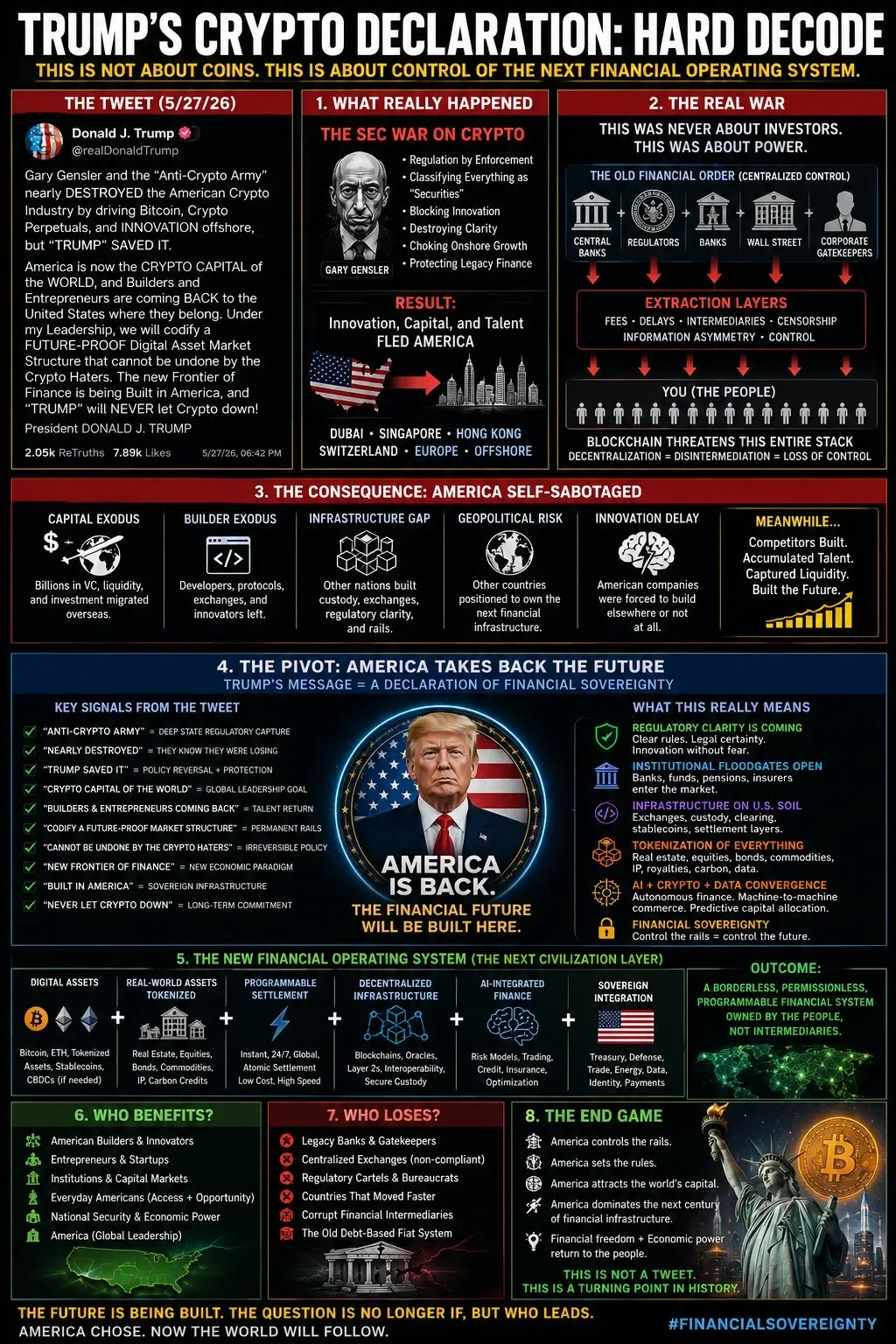
The SEC crackdown created regulatory fog thick enough to push developers, exchanges, liquidity providers, and infrastructure builders offshore while America deliberately crippled itself during the largest technological financial transition since the creation of the Federal Reserve itself…
Meanwhile, sovereign competitors quietly accumulated talent, compute infrastructure, digital custody systems, blockchain settlement frameworks, stablecoin experimentation, and AI-integrated financial tooling beneath the noise…
Trump’s post is effectively declaring that phase over… America is now openly entering the race to dominate the rails underneath the next economic civilization…
The phrase “future-proof digital asset market structure” carries enormous weight if you understand systems dynamics…
Civilizations are controlled through rails… trade rails, energy rails, currency rails, information rails, identity rails, snd settlement rails…
Whoever owns the rails underneath value transfer ultimately shapes the flow of global power itself…
Crypto evolved far beyond speculative assets years ago… it is now merging with AI, sovereign data infrastructure, energy grids, tokenized real-world assets, automated settlement, supply chain verification, machine-to-machine commerce, and programmable governance architecture… think Genesis Mission/Genesis Stack..
This is why the old guard panicked so violenty… because blockchain-based settlement threatens entire layers of institutional extraction that sit between humans and value…
[They] all understand it… banks, central banks, City of London, the C*P, and Blackrock understood it the second they pivoted toward ETF integration after years of public hostility…
Trump’s message signals that America intends to pull the builders, liquidity, infrastructure, and codified legal framework back inside US jurisdiction before the next financial operating system permanently consolidates elsewhere…
The real battlefield was never Bitcoin itself… the battlefield was control of the architecture that comes after fiat saturation, after infinite debt expansion, and after centralized financial mediation loses its grip on the velocity of human exchange…
Source(s):
• https://x.com/holonabove/status/2059817189918851203
Seeds of Wisdom RV and Economics Updates Thursday Afternoon 5-28-26
Good Afternoon Dinar Recaps,
US-Iran Ceasefire Framework Emerges as Markets Watch for Regional Stabilization
A proposed 60-day truce between the United States and Iran could temporarily ease energy market fears and reduce pressure on the global financial system.
Good Afternoon Dinar Recaps,
US-Iran Ceasefire Framework Emerges as Markets Watch for Regional Stabilization
A proposed 60-day truce between the United States and Iran could temporarily ease energy market fears and reduce pressure on the global financial system.
Overview
The United States and Iran have reportedly reached an outline agreement for a potential ceasefire extension, pending approval from President Donald Trump. The proposed framework comes after renewed military exchanges in the region and includes a 60-day truce alongside discussions surrounding Iran’s nuclear program. Financial markets are closely watching the developments as stability in the Middle East directly impacts oil prices, inflation, and global investor confidence.
Key Developments
1. US and Iran Draft 60-Day Ceasefire Proposal
Officials from both sides have reportedly developed an outline agreement designed to extend the current ceasefire for 60 additional days. The proposal is intended to create space for broader diplomatic discussions while reducing the immediate risk of escalation.
2. New Military Strikes Highlight Fragile Conditions
The ceasefire talks come immediately after Iran reportedly attacked a U.S. air base in Kuwait following American strikes targeting an Iranian drone operation. U.S. Central Command stated that American forces intercepted multiple Iranian drones and struck launch infrastructure before additional attacks could occur.
3. Strait of Hormuz and Oil Markets Remain Central Concern
Although ceasefire discussions have improved market sentiment slightly, investors remain cautious because instability involving Iran continues to threaten the Strait of Hormuz, a critical global oil shipping route. Any disruption in the region has the potential to rapidly impact energy prices, inflation, and supply chains worldwide.
4. Regional Conflict Risks Continue Expanding
The broader conflict remains active beyond Iran and the United States. Israel has reportedly intensified strikes against Iran-linked Hezbollah targets in Lebanon, while Gulf nations continue increasing defensive measures amid fears of further regional escalation.
Why It Matters
A sustained ceasefire between the United States and Iran could temporarily reduce pressure on energy markets and inflation expectations, helping stabilize financial markets already dealing with high debt and elevated interest rates. However, the fragile nature of the agreement highlights how quickly geopolitical events can disrupt global economic stability.
Why It Matters to Foreign Currency Holders
Reduced conflict risk may temporarily support global market confidence
Oil-sensitive currencies could remain highly volatile depending on negotiations
Safe-haven demand may continue if the ceasefire weakens or collapses
Implications for the Global Reset
Pillar 1: Energy Stability and Inflation Control
A successful ceasefire could ease immediate inflationary pressure by helping stabilize oil flows and reducing fears of prolonged supply disruption.
Pillar 2: Geopolitical Influence on Financial Systems
The situation demonstrates how regional military conflicts now play a major role in shaping global monetary policy, investor behavior, and trade stability.
Closing Insight
While the proposed ceasefire offers a potential path toward de-escalation, the underlying tensions remain unresolved. Financial markets may respond positively in the short term, but the broader risks tied to energy security, regional instability, and geopolitical fragmentation continue to weigh heavily on the global financial outlook.
This is not just a ceasefire negotiation — it’s a reminder that geopolitical conflict now sits at the center of global financial stability.
Seeds of Wisdom Team
Newshounds News™ Exclusive
Sources
Modern Diplomacy — "Report: US-Iran Ceasefire Deal Takes Shape After New Strikes"
Reuters — "US and Iran work toward extending ceasefire after new regional attacks"
~~~~~~~~~~
Seeds of Wisdom Team RV Currency Facts Youtube and Rumble
Newshound's News Telegram Room Link
RV Facts with Proof Links Link
RV Updates Proof links - Facts Link
Follow the Gold/Silver Rate COMEX
Follow Fast Facts
Seeds of Wisdom Team™Website
Thank you Dinar Recaps
US Treasury Pays 3.7%, Violates Every AML Regulation On The Books
US Treasury Pays 3.7%, Violates Every AML Regulation On The Books
Notes From the Field By James Hickman (Simon Black / Sovereign Man) May 28, 2026
Opening a bank account in the Land of the Free today feels like applying for a top secret security clearance. Banks often require multiple forms of ID, proof of address, proof of employment, plus detailed explanations of where your money came from, what you plan to do with it, and who you plan to send it to.
And that's just to get the account open. Once you've actually been deemed worthy of handing over your money to them, the surveillance really kicks in.
US Treasury Pays 3.7%, Violates Every AML Regulation On The Books
Notes From the Field By James Hickman (Simon Black / Sovereign Man) May 28, 2026
Opening a bank account in the Land of the Free today feels like applying for a top secret security clearance. Banks often require multiple forms of ID, proof of address, proof of employment, plus detailed explanations of where your money came from, what you plan to do with it, and who you plan to send it to.
And that's just to get the account open. Once you've actually been deemed worthy of handing over your money to them, the surveillance really kicks in.
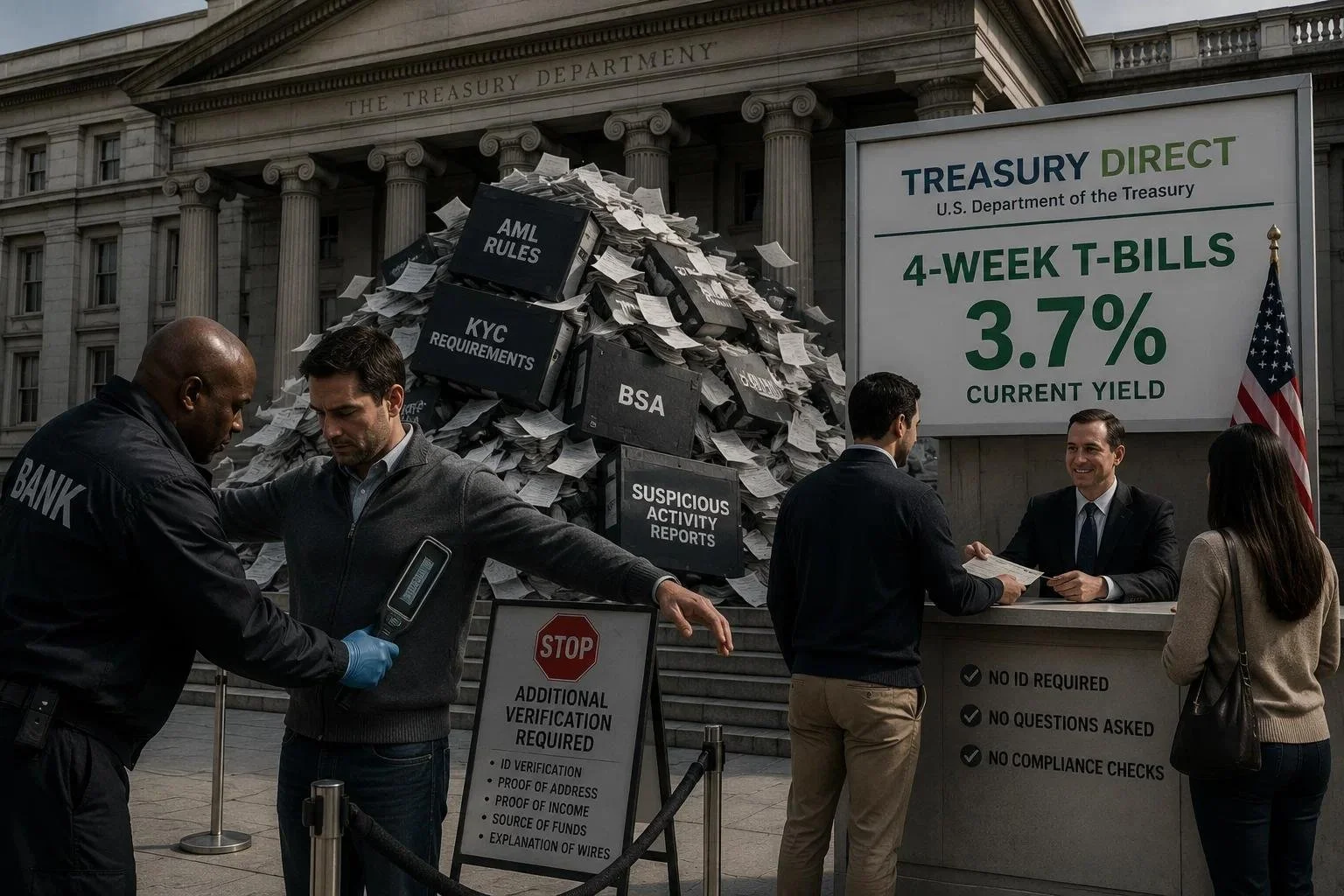
If you wire money to someone new, prepare for a phone call from the fraud department. Send a wire to a foreign bank and prepare for your account to be flagged by compliance.
The Cato Institute recently published a study showing that banks file 28 million reports to the federal government, flagging customer transactions as “suspicious”.
Yet the government’s own data show that 99.98% of these reports were filed on innocent people for completely frivolous reasons, i.e. people like my own mother who simply like to deal in physical cash.
Yet in the mind of a financial bureaucrat, using completely legal tender in the United States of America is suspicious and deserves to be reported.
Banking is a completely soulless industry devoid of any humanity or common sense.
We recently almost had a bank account shut down because one of our customers sent us a routine payment for his Total Access renewal.
Unfortunately our customer happens to have the same name as someone on a US government watch list.
Now, banks obviously shouldn’t be doing business with known criminals... so I have no problem that the transaction was flagged. But our team was quickly and easily able to prove that it wasn’t the same person. Not even close. Just two people who happen to have the same name.
But it didn’t matter. After several days of scrutiny and document gopher hunts, the bank not only rejected the transaction, but they nearly shut down our account.
Multiply that across every account, every business, every wire, every customer. American banking is now mostly a compliance apparatus that happens to do some occasional financial transactions on the side.
Yet for all the bureaucratic gauntlet your bank puts you through, the average savings account in the US pays a measly 0.38% interest right now.
It's one reason why I like crypto.
I'm not someone who thinks Bitcoin is going to magically become larger than the GDP of the known universe. But I do like that it's decentralized— that you can effectively be your own bank, without begging permission from someone whose entire job is to assume you're guilty.
Ironically, it turns out there's another option; there's at least one place in America to put your money that asks no questions.
They open accounts in no time with little more than a Social Security number. They don't demand to know where your funds came from. You don’t have to fill out 10,000 forms or show a single form of ID.
Frankly, these guys are deliberately and willfully violating every single Anti-Money Laundering rule and Treasury regulation on the books.
Fortunately no one is going to haul them off in handcuffs... because I’m talking about the Treasury Department itself!
The US government runs a website called Treasury Direct which allows anyone with a Social Security number to sign up and buy US government bonds.
Of course, as we discussed a few days ago, it would be insane to buy long-term bonds and lock up money for thirty years, ten years, or even five years. The US has nearly $40 trillion in debt, runs $2 trillion deficits every year, and has no plan to slow either down.
But the shortest-term security the US government sells is just FOUR WEEKS; it’s known as the 28-day T-bill. It’s essentially the same as a 1-month CD, and right now it pays 3.7%.
28 days is no time at all. And while I would in NO WAY be willing to hold a 30 year bond, I’m happy to loan a portion of my funds to the federal government for a couple of weeks.
Naturally the Treasury Direct website sucks. The User Interface is clunky and looks like a 15-year old designed it in 1997.
But none of that matters; they make it REALLY easy to sign up and buy bonds. You link your bank account select which bond you want to buy, and you can set yourself up for automatic reinvestments or payouts.
Crazy enough, the Treasury Department even allows you to transfer certain T-bills to third parties... which is effectively the same as making a cash or wire transfer.
There’s no hoops to jump through, no one flagging your transaction, no demands to prove that you’re not a member of Hezbollah or the Russian government.
The federal government ignores every single one of its own anti-money laundering rules. And I’d wager that criminals and terrorists are using Treasury Direct to launder and transfer money... because the Treasury Department literally performs zero compliance checks.
It’s pretty sad, and deeply ironic. But it’s also the easiest and safest way to earn a reasonable rate of return on a measly 4-week commitment.
To your freedom, James Hickman Co-Founder, Schiff Sovereign LLC
Dollar Demand CRUSHED As Gold Secretly Disappears From LBMA | Andy Schectman
Dollar Demand CRUSHED As Gold Secretly Disappears From LBMA | Andy Schectman
5-27-2026
Kaiser Johnson speaks with Miles Franklin CEO Andy Schectman about the growing mystery surrounding unreported gold movements out of the LBMA system and where that physical metal is ultimately going.
Schectman argues that official narratives do not fully account for discrepancies between reported inventories and trade flows, suggesting significant volumes of gold are being redirected into non Western vaulting and exchange systems.
Dollar Demand CRUSHED As Gold Secretly Disappears From LBMA | Andy Schectman
5-27-2026
Kaiser Johnson speaks with Miles Franklin CEO Andy Schectman about the growing mystery surrounding unreported gold movements out of the LBMA system and where that physical metal is ultimately going.
Schectman argues that official narratives do not fully account for discrepancies between reported inventories and trade flows, suggesting significant volumes of gold are being redirected into non Western vaulting and exchange systems.
He points to expanding gold hubs in regions such as the Middle East and Asia, where new exchanges and settlement mechanisms are increasingly built around physical delivery rather than paper claims.
The discussion also examines how central bank accumulation and sovereign demand are reshaping global liquidity in gold markets, reducing visible Western inventory availability.
Schectman concludes that these shifts may reflect a broader structural transition in global monetary architecture, with physical gold moving into strategic reserves outside traditional Western oversight.
INTERVIEW TIMELINE:
0:00 Intro
2:30 Gold update
17:00 Dollar dominance
32:00 Ignoring the noise
News, Rumors and Opinions Thursday 5-28-2026
Note: All intel should be considered as "Rumors" until we receive official announcements ...and “Rates and Dates” could change anytime until we get to the banks/redemption centers.
RV Excerpts from the Restored Republic via a GCR Update as of Thurs. 28 May 2026
Compiled Thurs. 28 May 2026 12:01 am EST by Judy Byington
Wed. 27 May 2026: CONFIRMED INTEL: SECURITY, STRUCTURE & SILENCE – THE TIER 4B PROTOCOL IGNITES GLOBAL RESET as Iraq, Vietnam & Zimbabwe Lead the Financial Revolution – RV 2026 …Web3.0 ISO20022 on Telegram
THE GLOBAL RESET MOVES FROM RUMOR TO REALITY. For years, IQD, VND, and ZIM holders were mocked, ignored, and called delusional. But now, all eyes are back on them—because the long-rumored revaluation is no longer speculation. It’s a verified action.
Note: All intel should be considered as "Rumors" until we receive official announcements ...and “Rates and Dates” could change anytime until we get to the banks/redemption centers.
RV Excerpts from the Restored Republic via a GCR Update as of Thurs. 28 May 2026
Compiled Thurs. 28 May 2026 12:01 am EST by Judy Byington
Wed. 27 May 2026: CONFIRMED INTEL: SECURITY, STRUCTURE & SILENCE – THE TIER 4B PROTOCOL IGNITES GLOBAL RESET as Iraq, Vietnam & Zimbabwe Lead the Financial Revolution – RV 2026 …Web3.0 ISO20022 on Telegram
THE GLOBAL RESET MOVES FROM RUMOR TO REALITY. For years, IQD, VND, and ZIM holders were mocked, ignored, and called delusional. But now, all eyes are back on them—because the long-rumored revaluation is no longer speculation. It’s a verified action.
Whispers on private forums have become bank-confirmed appointments, private tiered structures are (allegedly) moving forward, and a new financial system is rolling out quietly but powerfully. The RV has(allegedly) ignited, and TIER 4B is at the center of it all.
UNDERSTANDING THE TIERED STRUCTURE OF REVALUATION This is not a public forex event. This is a calibrated, classified, controlled restructuring. And it follows a tiered framework:
Tier 1: Sovereign governments and central banks
Tier 2: Multinational giants and elite financial trusts
Tier 3: High-net-worth individuals and pre-negotiated contracts
TIER 4B: Private citizens with legally acquired currency holdings. TIER 4B is where the people enter the equation. This is where suppressed value is unlocked, not for institutions—but for the faithful holders who waited through ridicule and silence. And now, TIER 4B is (allegedly) LIVE.
SECURITY, STRUCTURE & SILENCE: THE TIER 4B PROTOCOL: No walk-ins. No leaks. No circus. Bank staff are trained, armed with secure systems, and operating under blackout conditions. Participants are vetted, and electronic devices are restricted.
TIER 4B is not a public event. It is a classified operation, monitored, documented, and now (allegedly) fully active.
~~~~~~~~~~~~~~
Global Currency Reset:
Tues. 26 May 2026 Bruce, The Big CallThe Big Call Universe (ibize.com) 667-770-1866, pin 123456#, 667-770-1865: One source said the Tier4b green light would be on Thurs. 28 May 2026, with appointments as early as Friday 29 May. Other sources say notification Thurs-Fri with appointments launching over the weekend.
Judy Note: To my knowledge no one has been privy to the exact information about when Tier4b (Us the Internet Group) will be notified to set redemption/exchange appointments. That is the decision of 1-2 people, one being President Trump. We only know notification will be around the time of EBS Activation and likely during the ten days of communication darkness.
Read full post here: https://dinarchronicles.com/2026/05/28/restored-republic-via-a-gcr-update-as-of-may-28-2026/
**************
Courtesy of Dinar Guru: https://www.dinarguru.com/
Jeff They really don't have anything left to do...There's a lot of comments like, 'what's the delays? What's taking so long?' There is no delays in this other than the Iran war, waiting for a new regime to come in. That was a delay. Overall there's not a lot of delays. What it is, is they have scheduled dates for the rate change...Bankers schedule everything. That's what we're waiting on...Agreements are reached. Everything is ready to go.
Frank26 Question: "Do all the militia and the PMF have to be dismantled for this to go forward?" Yes...We're so close to getting rid of all of them.
Militia Man Alaq has been firm and confident ruling out devaluation. He's been saying it numerous time which is fascinating because they can't tell you about a revaluation. That is not in the cards. They're not going to tell us a time and date. I don't care how many people talk about that. They're just not going to do that. But we can see forward movement.
Iraqi Dinar What CBI Says vs What They're Actually Doing
Edu Matrix: 5-28-2026
Iraqi Dinar: What CBI Says vs What They're Actually Doing The Central Bank of Iraq is saying one thing, but actively preparing for another.
Analysis calls Iraq out, and so are we. It appears that they are preparing for global inclusion, yet they say otherwise.
Seeds of Wisdom RV and Economics Updates Thursday Morning 5-28-26
Good Morning Dinar Recaps,
Global Markets Brace for Reset Pressure as Bond Yields Rise and Oil Risks Escalate
Surging borrowing costs, geopolitical instability, and weakening confidence in sovereign debt markets are increasing strain on the global financial system.
Good Morning Dinar Recaps,
Global Markets Brace for Reset Pressure as Bond Yields Rise and Oil Risks Escalate
Surging borrowing costs, geopolitical instability, and weakening confidence in sovereign debt markets are increasing strain on the global financial system.
Overview
Today’s market developments point to growing concern over the stability of the global financial system as bond yields climb, oil markets remain volatile, and central banks face mounting pressure. Investors are increasingly focused on whether governments can sustain rising debt burdens in an environment of elevated inflation and geopolitical instability.
Key Developments
1. U.S. Treasury Yields Continue Climbing
U.S. Treasury yields moved higher today as investors reacted to concerns surrounding persistent inflation, expanding fiscal deficits, and continued heavy government borrowing. Rising yields increase borrowing costs across the economy and place additional pressure on already strained debt markets.
2. Oil Prices Remain Elevated Amid Middle East Tensions
Energy markets stayed volatile as tensions surrounding Iran and the Strait of Hormuz continued to threaten global oil supply stability. Elevated oil prices are reinforcing inflation fears worldwide, complicating central bank efforts to stabilize growth while controlling prices.
3. Central Banks Face Growing Policy Dilemma
Global central banks are increasingly trapped between the need to fight inflation and the risk of triggering economic slowdown or financial instability. Analysts warn that prolonged high interest rates could expose weaknesses in commercial real estate, private credit, and sovereign debt markets.
4. Investors Shift Toward Defensive Assets
Safe-haven demand increased today as investors moved capital into gold, defensive equities, and shorter-duration bonds. The shift reflects rising concern that the global economy may be entering a prolonged period of financial stress and slower growth.
Why It Matters
The combination of rising yields, elevated debt levels, and geopolitical instability is placing growing pressure on the foundations of the modern financial system. Historically, these conditions often force governments and central banks into major policy interventions or structural financial adjustments.
Why It Matters to Foreign Currency Holders
Increased risk of currency volatility and capital flow instability
Potential acceleration toward alternative settlement systems and reserve diversification
Rising importance of hard assets and inflation-resistant holdings
Implications for the Global Reset
Pillar 1: Debt Sustainability Challenges
Higher borrowing costs may eventually force governments to confront difficult choices involving spending cuts, monetary expansion, or debt restructuring mechanisms.
Pillar 2: Global Financial Power Shift
As confidence in traditional debt markets weakens, countries and institutions may continue exploring regional trade systems and diversified reserve strategies outside conventional frameworks.
Closing Insight
Today’s developments suggest the global economy is entering a period where debt, inflation, and geopolitical instability are becoming increasingly interconnected. Financial markets remain functional, but the underlying stress indicators continue to point toward a system under mounting long-term pressure.
This is not just market volatility — it’s a growing test of confidence in the global financial order itself.
Seeds of Wisdom Team
Newshounds News™ Exclusive
Sources
Reuters — "Treasury yields rise as investors assess inflation and debt concerns"
Reuters — "Oil prices volatile as Middle East tensions persist"
~~~~~~~~~~
🌱A Message to Our Currency Holders🌱
If you’ve been holding foreign currency for many years, you were not foolish.
You were not wrong to believe the global financial system would change.
What failed was not your patience — it was the information you were given.
For years, dates, rumors, and personalities replaced facts, structure, and proof. “This week” predictions created cycles of hope and disappointment that were never based on how currencies actually change.
That is not your failure.
Our mission here is different: • No dates • No rates • No hype • No gurus
Instead, we focus on:
• Verifiable developments • Institutional evidence
• Global financial structure • Where countries actually sit in the process
Currency value changes only come after sovereignty, trade, banking, settlement systems, and fiscal coordination are in place. History and institutions confirm this sequence.
You will see silence. You will see denials. That is not delay — that is discipline.
Protect your identity. Organize your documents. Verify everything.
Never hand your discernment to anyone who cannot show proof.
You deserve truth — not timelines.
Seeds of Wisdom Team
Newshounds News™
~~~~~~~~~~
Seeds of Wisdom Team RV Currency Facts Youtube and Rumble
Newshound's News Telegram Room Link
RV Facts with Proof Links Link
RV Updates Proof links - Facts Link
Follow the Gold/Silver Rate COMEX
Follow Fast Facts
Seeds of Wisdom Team™Website
Thank you Dinar Recaps