
More “Iraq News” Posted by Tishwash at TNT 4-20-2026
TNT:
Tishwash: Investment Authority: The dinar will be the sole currency for the sale of residential units.
The National Investment Commission affirmed the commitment of investment authorities in all governorates to implementing the applicable regulations and controls regarding the sale and lease of residential units within investment projects.
These regulations stipulate the exclusive use of the Iraqi dinar in all sales and installment transactions, emphasizing the prohibition of dealing in any foreign currency.
TNT:
Tishwash: Investment Authority: The dinar will be the sole currency for the sale of residential units.
The National Investment Commission affirmed the commitment of investment authorities in all governorates to implementing the applicable regulations and controls regarding the sale and lease of residential units within investment projects.
These regulations stipulate the exclusive use of the Iraqi dinar in all sales and installment transactions, emphasizing the prohibition of dealing in any foreign currency.
Hanan Jassim, spokesperson for the National Investment Commission, stated to Al-Sabah newspaper that this affirmation comes as part of its ongoing monitoring to ensure adherence to the approved regulations and enhance compliance levels, particularly in light of current economic changes and the fluctuations in the exchange market resulting from regional and international tensions. This aims to reduce informal foreign currency transactions and support the stability of the local market
The commission clarified that this measure is based on applicable regulations and instructions, particularly Article (10), which stipulates the exclusive use of the Iraqi dinar for payments on housing units and their installments.
It noted that observations and complaints had been received indicating that some entities were requiring transactions in foreign currencies, contrary to instructions. This constitutes a clear violation of official regulations and negatively impacts market stability and the protection of citizens' rights. The commission stressed the necessity for investment companies implementing housing projects to refrain from demanding payment in any currency other than the Iraqi dinar, whether in sales or installment transactions. It affirmed that violating entities will be held legally accountable under the relevant laws.
She added that these measures come within the framework of supporting the state’s monetary policy and enhancing confidence in the national currency, as well as reducing fluctuations in the exchange market, especially in light of the unstable global economic conditions, which will positively impact consumer protection and ensure an organized and fair investment environment.
Jassim called on citizens to report any violations in this regard, stressing that she will continue to follow up on the implementation of instructions in coordination with the competent regulatory authorities, and take the necessary legal measures against violators, in order to consolidate the principle of the rule of law and enhance stability in the investment housing sector. link
************
Tishwash: Moody's credit rating agency: Iraq's credit situation is negative and high risk.
On Friday (April 17, 2026), Moody's credit rating agency revised its outlook for Iraq from "stable" to "negative," citing risks to the country's creditworthiness as a result of the ongoing war in the Middle East.
Moody's said, "Iraq's heavy reliance on the oil sector means that any disruption to exports through the Strait of Hormuz—which account for about 90 percent of Iraq's crude oil exports—will lead to a significant decrease in dollar inflows and fiscal revenues."
Last month, energy officials in the country reported that production at key oil fields in southern Iraq, a member of the Organization of the Petroleum Exporting Countries (OPEC), had fallen by about 80 percent due to the US-Iran war and the closure of the Strait of Hormuz, pushing oil stockpiles to critical levels.
Iranian Foreign Minister Abbas Araqchi said on Friday that the Strait of Hormuz had been opened following the ceasefire agreement reached in Lebanon, while US President Donald Trump said he believed an agreement to end the Iran war would be reached "soon," although the timing remained unclear.
Four energy industry sources told Reuters that Iraq resumed oil exports from the south of the country on Friday after a halt of more than a month.
Moody's added in its report, "Even if the ceasefire holds, we expect it will take some time before oil traffic through the strait returns to normal."
The agency maintained Iraq's rating at "Caa1". link
*************
Tishwash: With a "limited" agenda, the framework sets Monday as the date for deciding on the candidate for Prime Minister.
On Sunday, the General Secretariat of the Coordination Framework called on the framework’s forces to hold a meeting on Monday at the office of the leader of the Wisdom Movement, Ammar al-Hakim, stressing that the agenda is limited to (deciding on the candidate for the presidency of the Council of Ministers).
The coordinating framework that includes the ruling Shiite political forces in Iraq failed to hold a "crucial" meeting yesterday, Saturday, and it was postponed until tomorrow, Monday.
These developments come at a time when the government formation process has entered a critical phase, following the election of Nizar Amidi as President of the Republic. This places the largest bloc before a constitutional deadline ending on April 26 to officially present its candidate, amid fears of returning to square one of political deadlock. link
Tishwash: The Sudanese have an overwhelming majority in the Iraqi parliament and on the Iraqi street.
In a political scene characterized by complexity and ongoing tensions, the name of the current Prime Minister, Mohammed Shia al-Sudani, stands out as the most prominent and influential figure in the Iraqi political equation, not only within the parliament but also on the street, which now views his experience as a model of relative stability and executive management capable of dealing with accumulated challenges.
Despite this political and popular weight, a fundamental question strongly presents itself: Why doesn’t the coordinating framework move towards resolving the issue of the premiership by adopting the Sudanese option, in line with the indicators of parliamentary support and popular acceptance, and end the state of political deadlock that has exhausted the country?
The continued postponement and procrastination in making a decision not only reflects a state of hesitation, but may also be interpreted as a disregard for the will of a broad segment of voters, who have expressed, directly or indirectly, their support for stability and continuity, which is what the Sudanese represent at this sensitive stage.
In this context, the importance of adhering to the democratic principle of respecting election results becomes clear, especially given the official statements by some Shiite political forces asserting that the largest parliamentary bloc has the right to nominate the prime minister. This is a constitutional and political principle that should govern any subsequent agreements and should not be subject to interpretation or obstruction.
Granting the right of “veto” to small blocs or using tools of political obstruction to impose conditions that are inconsistent with the real balance of power represents a dangerous precedent that strikes at the heart of the democratic process, turning it from a representative system into an arena of power struggles that does not accurately reflect the popular will.
The Coordination Committee, as a key player in the political landscape, faces a true test regarding its commitment to prioritizing the national interest over narrow factional or partisan considerations. Supporting a widely accepted candidate could be a pivotal step in restoring public confidence in the political process and pave the way for a new era of political and executive stability.
Resolving this issue is not just about naming a prime minister, but about sending a clear message that political forces are capable of respecting the rules of the democratic game, and that they are ready to side with the will of the people, not with the logic of obstruction and polarization.
Ultimately, the question remains open: Will the coordinating framework respond to this challenge and translate its slogans into actions, or will political deadlock remain the most prominent feature of the Iraqi scene in the next stage? link
Iraq Economic News And Points To Ponder Monday Morning 4-20-26
Currency Printing In Iraq: Between Financial Need And Economic Risks To The Dinar
Today 14:26 Information/Report... Concerns are mounting in Iraqi economic circles about the possibility of the government resorting to printing money without real backing in gold or dollar reserves. Experts describe this as an "unsound option" due to its direct negative impact on the value of the national currency and economic stability.
Currency Printing In Iraq: Between Financial Need And Economic Risks To The Dinar
Today 14:26 Information/Report... Concerns are mounting in Iraqi economic circles about the possibility of the government resorting to printing money without real backing in gold or dollar reserves. Experts describe this as an "unsound option" due to its direct negative impact on the value of the national currency and economic stability.
Additional money printing means increasing the money supply while the supply of goods and services in the economy remains stagnant or slows. In such cases, prices tend to rise because more money competes for the same quantity of goods, generating inflation that can turn into hyperinflation if it persists and economic conditions worsen, as happened in other countries like Zimbabwe and Venezuela.
In this context, the experiences of many countries have proven that printing money to finance budget deficits or cover current expenditures without achieving equivalent productive growth leads to a decrease in the currency's value and a loss of confidence in it.
The central bank plays a pivotal role in controlling inflation and maintaining the currency's value through monetary policy tools such as setting interest rates and monitoring liquidity.
In advanced economies, the central bank maintains its independence from the government to avoid its decisions becoming tied to financing budget deficits through money printing.
In Iraq, experts emphasize that any unplanned printing of money, coupled with the deficit in foreign reserves and the budget, could place the Central Bank in a difficult position, forcing it to balance its responsibilities to support public finances with its duty to maintain the stability of the dinar.
Economist Nabil al-Ali called on the Central Bank of Iraq to develop an urgent plan to contain the repercussions of monetary inflation, warning of a significant decline in the Iraqi dinar's exchange rate as a result of current monetary policies.
In a statement to the Al-Maalomah news agency, al-Ali said, "The government is currently relying on printing money to secure salaries and expenditures under the guise of the borrowing law."
He explained that "the continuation of this mechanism will put the Central Bank in a difficult position and may force it to deplete its reserves to cover the shortfall."
Al-Ali stressed the necessity for "the Central Bank to withdraw the printed currency from circulation as soon as it is no longer needed, and to destroy or store it instead of recycling it."
He indicated that "this measure is the only way to maintain exchange rate stability and prevent monetary inflation that threatens the purchasing power of citizens."
Furthermore, the crisis can worsen when the public loses confidence in the currency, leading them to convert their savings into foreign currencies or other assets. This negatively impacts the flow of liquidity into the economy and weakens the banking system.
Experts and analysts argue that economic solutions do not lie in printing more money, but rather in reforming fiscal and monetary policies to address the deficit.
According to economic analysts, sound monetary policies and central bank restrictions on money issuance are fundamental pillars for maintaining currency stability and preventing its collapse in the face of external shocks. End/25m
An Economist Warns Of The Decline Of The Iraqi Dinar Due To Currency Printing Policies.
Today 13:39 Information / Baghdad... Economic expert Nabil Al-Ali called on the Central Bank of Iraq on Sunday to develop an urgent plan to contain the repercussions of monetary inflation, warning of a significant decline in the Iraqi dinar's exchange rate as a result of current monetary policies.
Al-Ali told the Information Agency that “the government is currently relying on printing money to secure salaries and expenditures under the guise of the borrowing law,” explaining that “the continuation of this mechanism will put the Central Bank in a difficult position and may force it to deplete its reserves to cover the shortfall.”
Al-Ali stressed the necessity for "the Central Bank to withdraw the printed currency from circulation as soon as it is no longer needed, and to destroy or store it instead of recycling it."
He indicated that "this measure is the only way to maintain exchange rate stability and prevent monetary inflation that threatens the purchasing power of citizens." End/25
Al-Saadi: The Connection To The US Federal Reserve Reflects A Flaw In Financial Management.
Today 15:24 Information/Special.. Economic expert Rashid Al-Saadi confirmed today, Sunday, that the connection with the US Federal Reserve reflects a flaw in the management of money and requires reform, not a break.
Al-Saadi told Al-Maalouma News Agency that “Iraq’s continued involvement with the US Federal Reserve reveals a clear weakness in the management of funds and financial authority,” noting that “this file has not been professionally managed throughout the past years.”
He explained that “the heavy reliance on the US Federal Reserve reflects a flaw in the management of financial policy and a weakness in the institutions concerned with this aspect, which has made Iraq restricted by external procedures that control part of its funds.”
He added that "a sudden disengagement at the present time is not possible because that could lead to serious repercussions and economic disasters, especially since Iraqi funds are protected under the American decree, in addition to the existence of numerous international lawsuits related to the stage of Iraq's entry into Kuwait, which may be activated and lead to the freezing of funds."
He explained that "what raises questions is the US government's interference in the mechanisms for protecting these funds, even though Iraq has the ability to manage its resources if the ability and proper management are available."
It should be noted that this matter requires serious follow-up and gradual correction of errors, and that improving management is the most important step at present to avoid any future crises. End/25s
Gold Losses Mount On Dollar Strength
2026-04-20 Shafaq News Gold prices fell on Monday as the dollar firmed, while news the Strait of Hormuz is closed again pushed oil prices higher, reviving inflation fears.
Spot gold was down 0.7% at $4,794.21 per ounce, as of 0537 GMT, after hitting its lowest since April 13 earlier in the session. U.S. gold futures for June delivery fell 1.3% to $4,813.70.
"Gold prices are lower today after the U.S.-Iran war ceasefire that markets celebrated last week appeared to be breaking down," said Ilya Spivak, head of global macro at Tastylive.
"That has revived the now-familiar 'war trade' dynamics we've seen since the beginning of the conflict. Crude oil prices gained, which echoed into inflation expectation and drove up both yields and the U.S. dollar."
The dollar index opens new tab strengthened, making greenback-priced bullion more expensive for other currency holders. Benchmark 10-year U.S. Treasury yields gained 0.6%.
Oil prices jumped and stock markets wobbled as rising tension in the Middle East kept shipping in and out of the Gulf to a bare minimum.
The U.S. has seized an Iranian cargo ship that tried to run its blockade and Iran said it would retaliate, raising the possibility that the ceasefire between the two countries might not last for even the two days it is set to remain in force.
Tehran said it would not participate in a second round of negotiations that the U.S. had hoped to kick off before the ceasefire expires on Tuesday.
Gold prices have fallen about 8% since the U.S. and Israel launched strikes on Iran in late February, on concerns that higher energy prices could stoke inflation and keep global interest rates higher for longer.
While gold is considered an inflation hedge, higher interest rates crimp demand for the non-yielding asset.
Meanwhile, gold demand during one of India's key buying festivals stayed muted on Sunday as record prices curbed jewellery purchases, offsetting a modest uptick in investment demand.
Among other metals, spot silver lost 1.3% to $79.75 per ounce, platinum fell 0.8% to $2,086.90, and palladium was down 0.4% at $1,553. (Reuters) https://www.shafaq.com/en/Economy/Gold-losses-mount-on-Dollar-strength
Gold Prices Slide In Baghdad, Erbil
2026-04-20 Shafaq News- Baghdad/ Erbil On Monday, gold prices hovered around 1.02 million IQD per mithqal in Baghdad and Erbil markets, according to a survey by Shafaq News Agency.
Gold prices on Baghdad's Al-Nahr Street recorded a selling price of 1.026 million IQD per mithqal (equivalent to five grams) for 21-carat gold, including Gulf, Turkish, and European varieties, with a buying price of 1.023 million IQD. The same gold had sold for 1.046 million IQD on Sunday.
The selling price for 21-carat Iraqi gold stood at 996,000 IQD, while the buying price reached 962,000 IQD.
In jewelry stores, the selling price per mithqal of 21-carat Gulf gold ranged between 1.025 million and 1.035 million IQD, while Iraqi gold sold for between 995,000 and 1.005 million IQD.
In Erbil, 22-carat gold was sold at 1.068 million IQD per mithqal, 21-carat gold at 1.020 million IQD, and 18-carat gold at 875,000 IQD.https://www.shafaq.com/en/Economy/Gold-prices-slide-in-Baghdad-Erbil
USD/IQD Exchange Rates Fall In Baghdad And Erbil
2026-04-20 Shafaq News- Baghdad/ Erbil The US dollar opened Monday’s trading lower in Iraq, hovering around 153,000 dinars per 100 dollars.
According to Shafaq News market survey, the dollar traded in Baghdad's Al-Kifah and Al-Harithiya exchanges at 153,100 dinars per 100 dollars, down from the previous session’s 153,200 dinars.
In the Iraqi capital, exchange shops sold the dollar at 153,500 dinars and bought it at 152,500 dinars, while in Erbil, selling prices stood at 152,950 dinars and buying prices at 152,850 dinars.
https://www.shafaq.com/en/Economy/USD-IQD-exchange-rates-fall-in-Baghdad-and-Erbil-3
Seeds of Wisdom RV and Economics Updates Monday Morning 4-20-26
Good Morning Dinar Recaps,
Energy Shock Escalation: Strait Disruption Triggers Market Instability
Oil supply disruptions and geopolitical escalation are driving volatility across global markets and raising systemic financial risks
Good Morning Dinar Recaps,
Energy Shock Escalation: Strait Disruption Triggers Market Instability
Oil supply disruptions and geopolitical escalation are driving volatility across global markets and raising systemic financial risks
OVERVIEW (KEY POINTS)
A sharp escalation in geopolitical tensions has led to renewed disruption in the Strait of Hormuz, a critical global oil chokepoint. This has triggered an immediate spike in energy prices and heightened volatility across financial markets.
This is happening now because shipping activity through the strait has slowed dramatically, removing a significant portion of global oil supply from the market. The uncertainty surrounding ceasefire stability is compounding investor concern.
Key players include global energy markets, central banks, and major economies dependent on imported oil. Their responses are being shaped by rising inflation risks, supply shortages, and shifting capital flows.
The broader implication is clear: energy disruption is once again acting as a primary driver of global financial instability, increasing pressure on monetary systems already under strain.
KEY DEVELOPMENTS
1. Oil Prices Surge Amid Supply Disruption
Energy markets reacted immediately to reduced shipping through the Strait of Hormuz.
Oil prices jumped nearly 5% in a single session
Supply constraints are fueling inflation expectations globally
2. Global Markets Turn Volatile
Financial markets are showing signs of stress.
Global equity indices declined as uncertainty increased
Investors are shifting toward defensive positioning and safe assets
3. Shipping Activity Near Standstill
Critical trade routes are being disrupted.
Vessel traffic through the strait has dropped sharply
Creates risk of fuel shortages and supply chain breakdowns
4. European Markets React to Energy Shock
The impact is spreading across major economies.
European stocks fell while energy prices surged again by ~5%
Governments are preparing emergency energy measures
WHY IT MATTERS
This situation highlights how quickly energy disruptions can destabilize the global economy. Oil remains a foundational input, and even short-term supply shocks can ripple across all sectors.
Markets are reacting not just to current conditions, but to uncertainty about future supply stability. This leads to increased volatility in commodities, equities, and currencies.
For policymakers, the challenge intensifies. Rising energy prices push inflation higher, while economic uncertainty limits the ability to tighten monetary policy without slowing growth.
At the system level, these dynamics contribute to reduced confidence in stability and predictability, key indicators of structural financial stress.
WHY IT MATTERS TO FOREIGN CURRENCY HOLDERS
Currencies of energy-importing nations may weaken under pressure
Purchasing power declines as fuel-driven inflation rises
Capital flows may favor resource-rich economies
Exchange rate volatility increases amid uncertainty
IMPLICATIONS FOR THE GLOBAL RESET
Pillar 1: Energy-Driven Inflation Shock
Persistent supply disruption reinforces an environment where inflation is externally driven, limiting the effectiveness of central bank policy and increasing systemic strain.
Pillar 2: Strategic Chokepoint Vulnerability
Dependence on critical trade routes like the Strait of Hormuz exposes the system to single-point failure risks, accelerating the push toward diversification and structural realignment.
CONCLUSION
The latest developments confirm that the global financial system remains highly sensitive to geopolitical and energy-related shocks. The disruption of a key oil transit route has once again exposed underlying vulnerabilities.
As volatility spreads across markets, policymakers and investors are being forced to adapt quickly to changing conditions. The combination of supply disruption, inflation pressure, and market instability is creating a challenging environment.
This is not an isolated event—it reflects a broader pattern of increasing fragility within the global system.
When energy flows are disrupted, the financial system follows—and the pressure for structural change intensifies.
Seeds of Wisdom Team
Newshounds News™ Exclusive
SOURCES
Reuters — "Oil jumps, stocks ease as US-Iran ceasefire hangs in the balance"
The Guardian — "Oil and gas prices jump as Strait of Hormuz chaos worries investors"
~~~~~~~~~~
A Message to Our Currency Holders
If you’ve been holding foreign currency for many years, you were not foolish.
You were not wrong to believe the global financial system would change.
What failed was not your patience — it was the information you were given.
For years, dates, rumors, and personalities replaced facts, structure, and proof. “This week” predictions created cycles of hope and disappointment that were never based on how currencies actually change.
That is not your failure.
Our mission here is different: • No dates • No rates • No hype • No gurus
Instead, we focus on:
• Verifiable developments • Institutional evidence
• Global financial structure • Where countries actually sit in the process
Currency value changes only come after sovereignty, trade, banking, settlement systems, and fiscal coordination are in place. History and institutions confirm this sequence.
You will see silence. You will see denials. That is not delay — that is discipline.
Protect your identity. Organize your documents. Verify everything.
Never hand your discernment to anyone who cannot show proof.
You deserve truth — not timelines.
Seeds of Wisdom Team
Newshounds News™
~~~~~~~~~~
Seeds of Wisdom Team RV Currency Facts Youtube and Rumble
Newshound's News Telegram Room Link
RV Facts with Proof Links Link
RV Updates Proof links - Facts Link
Follow the Gold/Silver Rate COMEX
Follow Fast Facts
Seeds of Wisdom Team™Website
Thank you Dinar Recaps
Freedom Fighter: XRP is about to Make a lot More Sense
Freedom Fighter: XRP is about to Make a lot More Sense
4-19-2026
Attention:
XRP is about to make a lot more sense to people.
Global currencies require speed, liquidity, and settlement.
The Clarity Act isn’t about hype — it’s about currency infrastructure.
Freedom Fighter: XRP is about to Make a lot More Sense
4-19-2026
Attention:
XRP is about to make a lot more sense to people.
Global currencies require speed, liquidity, and settlement.
The Clarity Act isn’t about hype — it’s about currency infrastructure.
When regulation forces clarity, banks don’t fight it…
they integrate with systems built for cross-border value movement.
That’s where XRP fits.
Not price.
Use case.
Watch the shift.
Crypto Rover:THE CLARITY ACT IS COMING! FOX Business: “Banks are upset with Coinbase because they WERE forced to ACCEPT the CLARITY Act.”
Watch on X: https://twitter.com/i/status/2045369840006025643
Source(s):
• https://x.com/FreedomFight12/status/2045485106366669069
https://dinarchronicles.com/2026/04/19/freedom-fighter-xrp-is-about-to-make-a-lot-more-sense/
Majeed KSA: Venezuela to Re-enter the Global Financial System
Majeed KSA: Venezuela to Re-enter the Global Financial System
4-19-2026
Majeed KSA@majeed66224499
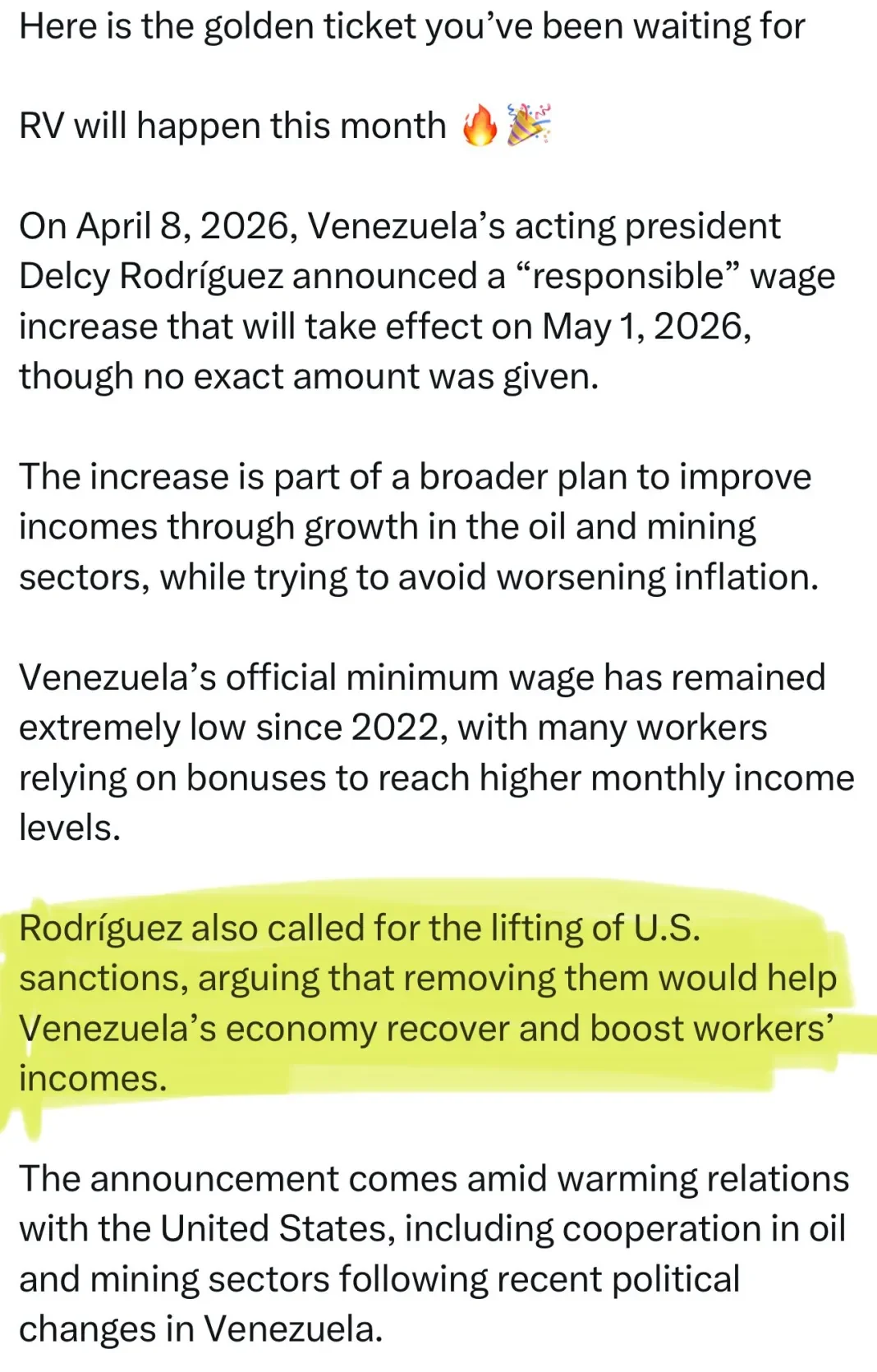
Venezuela’s president last week asked US to lift the sanction on their central bank saying, removing them would help the country’s economy and would help increasing citizens/workers income.
And in the quote post from today … saying removing the sanction will help Venezuela to re-enter the global financial system.
All that indicates one thing.
Majeed KSA: Venezuela to Re-enter the Global Financial System
4-19-2026
Majeed KSA @majeed66224499
Venezuela’s president last week asked US to lift the sanction on their central bank saying, removing them would help the country’s economy and would help increasing citizens/workers income.
And in the quote post from today … saying removing the sanction will help Venezuela to re-enter the global financial system.
All that indicates one thing.
The rate has to be on Forex BEFORE May 1.
In order for Venezuela to increase workers income by May 1.
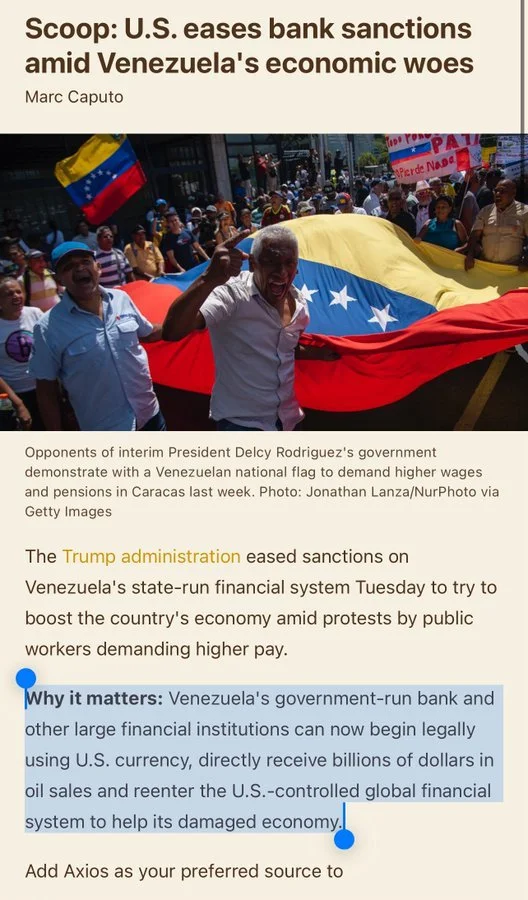
MajeedKSA: This article from April 14 Talking about the eased sanction on Venezuela Central bank and why it matters “Why it matters: Venezuela's government-run bank and other large financial institutions can now begin legally using U.S. currency, directly receive billions of dollars in oil sales and re-enter the U.S.-controlled global financial system to help its damaged economy.” Forex
Iraq Economic News And Points To Ponder Sunday Afternoon 4-19-26
EIA: Iraq’s Oil Exports To US Dip Over The Week
2026-04-19 Shafaq News- Baghdad/ Washington Iraq’s crude oil exports to the United States dropped 11,000 barrels per day (bpd) last week, US Energy Information Administration (EIA) data showed on Sunday.
Iraqi shipments averaged 109,000 bpd last week, 9.17% less than the previous week’s average of 120,000 bpd.
Total US crude imports from eight major suppliers fell to 4.675 million bpd, down 947,000 bpd from 5.622 million bpd the previous week.
EIA: Iraq’s Oil Exports To US Dip Over The Week
2026-04-19 Shafaq News- Baghdad/ Washington Iraq’s crude oil exports to the United States dropped 11,000 barrels per day (bpd) last week, US Energy Information Administration (EIA) data showed on Sunday.
Iraqi shipments averaged 109,000 bpd last week, 9.17% less than the previous week’s average of 120,000 bpd.
Total US crude imports from eight major suppliers fell to 4.675 million bpd, down 947,000 bpd from 5.622 million bpd the previous week.
Canada remained the top supplier at 3.519 million bpd, followed by Venezuela with 412,000 bpd, Saudi Arabia with 249,000 bpd, and Mexico with 145,000 bpd.
Imports also included Colombia at 130,000 bpd, Ecuador at 68,000 bpd, and Brazil at 43,000 bpd. No oil was imported from Nigeria and Libya this week. https://www.shafaq.com/en/Economy/EIA-Iraq-s-oil-exports-to-US-dip-over-the-week-0-2
Dollar Rises In Baghdad And Erbil Markets
2026-04- Shafaq News- Baghdad/ Erbil The US dollar opened Sunday’s trading higher in Iraq, hovering around 153,000 dinars per 100 dollars.
According to a Shafaq News market survey, the dollar traded in Baghdad's Al-Kifah and Al-Harithiya exchanges at 153,200 dinars per 100 dollars, up from the previous session’s 152,500 dinars.
In the Iraqi capital, exchange shops sold the dollar at 153,750 dinars and bought it at 152,750 dinars, while in Erbil, selling prices stood at 153,150 dinars and buying prices at 153,000 dinars.
https://www.shafaq.com/en/Economy/Dollar-rises-in-Baghdad-and-Erbil-markets-8
Gold Prices Rise In Baghdad, Stabilize In Erbil
2026-04-19 Shafaq News- Baghdad/ Erbil On Sunday, gold prices hovered around 1 million IQD per mithqal in Baghdad and Erbil markets, according to a survey by Shafaq News Agency.
Gold prices on Baghdad's Al-Nahr Street recorded a selling price of 1,046,000 IQD per mithqal (equivalent to five grams) for 21-carat gold, including Gulf, Turkish, and European varieties, with a buying price of 1,042,000 IQD. The same gold had sold for 1,041,000 IQD on Saturday.
The selling price for 21-carat Iraqi gold stood at 1,016,000 IQD, with a buying price of 1,012,000 IQD.
In jewelry stores, the selling price per mithqal of 21-carat Gulf gold ranged between 1,045,000 and 1,055,000 IQD, while Iraqi gold sold for between 1,015,000 and 1,025,000 IQD.
In Erbil, 22-carat gold was sold at 1,085,000 IQD per mithqal, 21-carat gold at 1,035,000 IQD, and 18-carat gold at 887,000 IQD.
https://www.shafaq.com/en/Economy/Gold-prices-rise-in-Baghdad-stabilize-in-Erbil-2-2
IEA Proposes Basra–Ceyhan Pipeline To Bypass Hormuz
2026-04-19 Shafaq News- Basra A new oil pipeline linking Iraq’s Basra fields to Turkiye’s Ceyhan terminal on the Mediterranean has been proposed to reduce reliance on the Strait of Hormuz and strengthen energy supply security, particularly for Europe, Executive Director of the International Energy Agency (IEA) Fatih Birol said on Sunday.
Speaking to Hurriyet, Birol said the Basra–Ceyhan pipeline could be “critically important” for Iraq, Turkiye, and regional supply security, adding that financing challenges could be overcome and that the project requires a political agreement between Baghdad and Ankara.
He noted that Iraq exports about 90% of its oil through the Strait of Hormuz from Basra ports, which hold reserves estimated at around 90 billion barrels, warning that disruptions to maritime traffic in the strait would have severe consequences.
The proposal comes amid renewed tensions in Hormuz, where Iran has reimposed navigation restrictions after briefly reopening the waterway, prompting some gas tankers to reroute.
Birol said the pipeline is no longer just an economic option but a strategic necessity for Iraq, and an opportunity for Turkiye and Europe to enhance energy security.
Turkiye has previously proposed expanding oil infrastructure linking Ceyhan with Iraq, including plans extending from Kirkuk southward as part of a broader trade corridor connecting Iraq’s Al-Faw port to Turkiye.
Read more: Iraq’s oil bottleneck: Abundance trapped by dependency
https://www.shafaq.com/en/Economy/IEA-proposes-Basra-Ceyhan-pipeline-to-bypass-Hormuz
US Dollar Drops In Baghdad And Erbil Markets
2026-04-19 Shafaq News- Baghdad/ Erbil The US dollar closed Sunday's trading lower in Iraq at around 153,000 dinars per 100 dollars.
According to a Shafaq News market survey, the dollar traded in Baghdad's Al-Kifah and Al-Harithiya exchanges at 153,000 dinars per 100 dollars, up from the morning session’s 153,200 dinars.
In the Iraqi capital, exchange shops sold the dollar at 153,500 dinars and bought it at 152,500 dinars, while in Erbil, selling prices stood at 153,000 dinars and buying prices at 152,850 dinars.
https://www.shafaq.com/en/Economy/US-dollar-drops-in-Baghdad-and-Erbil-markets-8
Iraq Targets Unemployment Reduction Via Farm, Industry Push
2026-04-19 Shafaq News- Baghdad Iraq is seeking to reduce unemployment, currently around 13%, by expanding domestic production through agriculture and industry, Prime Minister’s financial adviser Mudher Mohammed Salih said on Sunday.
Salih told Shafaq News that the policy focuses on boosting grain output through above-market procurement, input support, and crop planning, alongside measures to support industry, including land allocation, fuel supply, technology imports, and financing initiatives to expand private-sector factories.
He said more than 1,300 industrial projects are being supported, with over one trillion Iraqi dinars (about $760 million) allocated as sovereign guarantees to enable private firms to secure foreign financing for projects linked to construction and industrial value chains. A planned “Riyada Bank” is expected to provide financing for small businesses and youth-led initiatives.
The push comes as data point to a gap between production and imports. Economist Manar Al-Obaidi said Iraq’s roughly 1,200 medium and large industrial projects generate no more than 7 trillion dinars (about $5.3 billion) annually, compared with imports exceeding 100 trillion dinars.
He added that the sector provides about 50,000 jobs, rising to around 100,000 including informal labor, against roughly 500,000 new entrants to the labor market each year, while growth of about 5% in large projects has yet to make industry a significant contributor to GDP. Read more: The rentier trap: Iraq’s existential reform race
https://www.shafaq.com/en/Economy/Iraq-targets-unemployment-reduction-via-farm-industry-push
Seeds of Wisdom RV and Economics Updates Sunday Afternoon 4-19-26
Good Afternoon Dinar Recaps,
Bond Market Confidence Cracks as Energy Shock Deepens — Reset Signals Intensify
Debt markets, oil disruptions, and shifting capital flows are converging into a systemic turning point.
Good Afternoon Dinar Recaps,
Bond Market Confidence Cracks as Energy Shock Deepens — Reset Signals Intensify
Debt markets, oil disruptions, and shifting capital flows are converging into a systemic turning point.
Overview
Global markets are entering a highly unstable phase beneath surface-level strength. While equities have rebounded sharply, deeper indicators show bond market stress, energy supply disruption, and shifting investor behavior. The combination of waning trust in sovereign debt and persistent energy shocks is creating conditions historically associated with major monetary restructuring.
Key Developments
1. U.S. Treasury Losing Safe-Haven Status
A major shift is unfolding as investors sell U.S. Treasurys during a global crisis, rather than buying them. This has pushed yields higher and prices lower, signaling declining confidence in government debt. Rising deficits, reduced foreign demand, and geopolitical tensions are accelerating this trend, weakening what has long been the foundation of global finance.
2. Hidden Energy Crisis Driving Real Inflation Higher
Despite headline oil prices appearing stable, the true cost of physical oil has surged dramatically, with real delivery prices far exceeding benchmarks. This reflects severe supply disruptions tied to the Strait of Hormuz, now considered the largest oil market disruption on record. The result is rising electricity costs, supply chain pressure, and persistent inflation risk.
3. Geopolitical Tensions Reignite Energy Route Risk
Iran’s renewed control and threats over the Strait of Hormuz have reintroduced extreme uncertainty into global energy flows. Shipping disruptions, military control of key chokepoints, and stalled negotiations are contributing to market instability and global fuel concerns.
4. Capital Flows Signal Structural Market Shift
Investors are rapidly rotating capital, with massive inflows returning to U.S. equities even as bond markets weaken. This divergence highlights a breakdown in traditional risk behavior, suggesting markets are adapting to a new financial environment shaped by energy dominance and geopolitical risk.
Why It Matters
Loss of trust in sovereign debt threatens financial system stability
Energy disruptions are embedding long-term inflation pressures
Traditional market relationships are breaking down
Capital is shifting toward real assets and away from paper systems
These are core stress signals that often precede large-scale monetary and financial system changes.
Why It Matters to Foreign Currency Holders
Weaker confidence in debt markets can pressure major currencies
Commodity-linked currencies may gain relative strength
Global capital shifts could increase currency volatility
Reserve currency dynamics may begin to evolve
Implications for the Global Reset
Pillar 1: Debt Market Instability
The breakdown in Treasury demand signals erosion of trust in the current monetary backbone, increasing the likelihood of policy intervention or structural reform.
Pillar 2: Energy-Driven Economic Realignment
With energy acting as the primary economic driver, nations and markets are shifting toward resource-backed influence, reshaping global financial power structures.
This is not just volatility — it is a transition phase where debt, energy, and geopolitics are redefining the global financial system.
Seeds of Wisdom Team
Newshounds News™ Exclusive
Sources
~~~~~~~~~~
Seeds of Wisdom Team RV Currency Facts Youtube and Rumble
Newshound's News Telegram Room Link
RV Facts with Proof Links Link
RV Updates Proof links - Facts Link
Follow the Gold/Silver Rate COMEX
Follow Fast Facts
Seeds of Wisdom Team™Website
Thank you Dinar Recaps
Jon Dowling Weekly Wrap Up & Latest Financial Updates
Jon Dowling Weekly Wrap Up & Latest Financial Updates
4-18-2026
As we delve into the intricate dance of global events, the latest RV (Revaluation) report, recorded on April 18th, 2026, serves as a crucial compass. This comprehensive update from the host, fresh from his move to Middle Tennessee, underscores a vital principle: approaching unfolding geopolitical, economic, and financial developments with logic, not emotion.
The report paints a vivid picture of a world on the cusp of significant transformation, driven by strategic political maneuvers, shifting economic landscapes, and a volatile geopolitical climate.
Jon Dowling Weekly Wrap Up & Latest Financial Updates
4-18-2026
As we delve into the intricate dance of global events, the latest RV (Revaluation) report, recorded on April 18th, 2026, serves as a crucial compass. This comprehensive update from the host, fresh from his move to Middle Tennessee, underscores a vital principle: approaching unfolding geopolitical, economic, and financial developments with logic, not emotion.
The report paints a vivid picture of a world on the cusp of significant transformation, driven by strategic political maneuvers, shifting economic landscapes, and a volatile geopolitical climate.
At the heart of this report lies a detailed look at President Trump’s strategic timeline for peace negotiations and sweeping economic reforms, culminating around April 27th.
This date isn’t just arbitrary; it’s pegged as the potential moment for the passing of the pivotal Clarity Act and the appointment of Kevin Warsh as the new Federal Reserve Chair, replacing Jerome Powell.
This move is presented as more than just a personnel change; it’s a fundamental restructuring of the financial system, with significant implications for global markets.
The April 18th, 2026 RV report paints a picture of a world on the cusp of significant transformation. From fundamental shifts in U.S. financial leadership to intricate currency revaluations across the globe and the ever-present specter of geopolitical tensions, the message is clear: understanding these intricate connections is paramount. As the host rightly emphasizes, logical analysis will be key to navigating these evolving landscapes.
“Compression of Time”: Why Gold Moves Are Speeding Up | Wagner
“Compression of Time”: Why Gold Moves Are Speeding Up | Wagner
Kitco News: 4-17-2026
Gold and silver are entering a critical technical phase as volatility accelerates and market moves compress into shorter, more aggressive cycles.
After rallying from roughly $4,000 to $5,600, gold corrected sharply to $4,100 and is now attempting to reclaim key resistance near $4,900.
“Compression of Time”: Why Gold Moves Are Speeding Up | Wagner
Kitco News: 4-17-2026
Gold and silver are entering a critical technical phase as volatility accelerates and market moves compress into shorter, more aggressive cycles.
After rallying from roughly $4,000 to $5,600, gold corrected sharply to $4,100 and is now attempting to reclaim key resistance near $4,900.
In this episode of Chart This, Gary Wagner, editor of The Gold Forecast, explains why $4,900 is the level to watch, noting that a breakout could open the path toward $5,100 and a potential retest of the highs.
He also points to the recent pattern of a lower high and lower low as a sign that the market is still in transition.
Wagner also highlights what he calls a “compression of time” across commodities, where major price swings that once took years are now unfolding in weeks.
From silver’s 162% rally and sharp retracement to crude oil’s rapid spikes tied to geopolitical events, he outlines how extreme volatility is reshaping trading conditions.
00:18 - Gold rally and correction setup
01:12 - Support vs resistance explained
03:49 - Momentum indicators and overbought signals
05:37 - Key gold breakout level at $4,900
06:19 - Silver outperforming gold rally
08:01 - Silver targets $80, $90 and $96 resistance
10:39 - “Compression of time” in markets
11:50 - Crude oil spikes on geopolitical shocks
NATO Contractor Talks About The Dinar
NATO Contractor Talks About The Dinar
Dinar For Dummies: 4-18-2026
In the world of alternative investments, few topics spark as much debate, skepticism, and passion as the Iraqi Dinar (IQD). For years, the conversation has been dominated by “gurus” and internet rumors.
However, a recent in-depth conversation between long-time investor Stephen and Guy Vantresca—a former U.S. Army tank officer and defense technology expert—offers a refreshing, high-level perspective that moves beyond the hype and into the realm of geopolitics, macroeconomics, and military strategy.
NATO Contractor Talks About The Dinar
Dinar For Dummies: 4-18-2026
In the world of alternative investments, few topics spark as much debate, skepticism, and passion as the Iraqi Dinar (IQD). For years, the conversation has been dominated by “gurus” and internet rumors.
However, a recent in-depth conversation between long-time investor Stephen and Guy Vantresca—a former U.S. Army tank officer and defense technology expert—offers a refreshing, high-level perspective that moves beyond the hype and into the realm of geopolitics, macroeconomics, and military strategy.
If you’ve been following the Dinar, or are simply curious about the economic reconstruction of the Middle East, this discussion provides a masterclass in the complexities of currency revaluation.
What makes this dialogue unique is the background of the speakers. Stephen brings the perspective of a seasoned investor who has weathered the ups and downs of the IQD market, while Guy Vantresca provides a lens shaped by the Cold War, defense contracting, and IT infrastructure.
Together, they distance themselves from the typical “get-rich-quick” rhetoric. Instead, they frame the Iraqi Dinar as a legitimate long-term investment tied directly to Iraq’s ability to stabilize its borders, modernize its infrastructure, and assert economic independence.
One of the most frequent comparisons in the Dinar community is the recovery of the Kuwaiti Dinar after the Gulf War. Stephen and Guy revisited this history, noting how Sadaam Hussein’s 1991 invasion decimated Kuwait’s currency.
Following the liberation, Kuwait underwent a rapid revaluation that saw its currency become one of the most valuable in the world.
Guy Vantresca highlighted a pivotal shift currently underway in Iraq: the move toward a modernized “Smart City” digital currency system. This isn’t just about technology for technology’s sake; it’s a strategic economic move.
A major theme of the conversation was the current geopolitical climate. Both Stephen and Guy agreed that the ongoing tensions and conflicts in the region, while tragic, may serve as a catalyst for Iraq’s economic liberation.
There is a strategic move to decouple Iraq from Iranian influence. If Iraq can successfully exit the shadow of its neighbor and fully integrate with the global economy, the primary “bottleneck” preventing the Dinar’s revaluation may finally be removed.
While the speakers were optimistic, they remained grounded. They addressed the skepticism surrounding Iraq’s large money supply, explaining that currency valuations are driven by complex political factors and national assets, not just simple math.
Perhaps most importantly, they discussed the “day after” strategy. A currency revaluation is a taxable event. Stephen reminded viewers that having a sound financial plan, understanding tax liabilities, and practicing wealth protection are just as important as the investment itself.
The conversation concluded with a forward-looking vision. Stephen announced plans to build a community of Dinar investors focused on collaboration and financial education. The goal is to move from “investors” to “wealth managers,” sharing knowledge on tax strategies and reinvestment opportunities once the revaluation occurs.
The Iraqi Dinar remains a complex and often misunderstood asset. However, through the lens of military history and technological evolution, the path to Iraq’s economic recovery becomes clearer. It is an investment tied to the sovereignty and modernization of a nation.
For those looking for a deeper dive, we highly recommend watching the full video from Dinar For Dummies.
Seeds of Wisdom RV and Economics Updates Sunday Morning 4-19-26
Good Morning Dinar Recaps,
Debt Pressure Rising: IMF Warns of Surging Global Borrowing Needs
Growing demand for financial support signals mounting strain on sovereign debt and global liquidity conditions
Good Morning Dinar Recaps,
Debt Pressure Rising: IMF Warns of Surging Global Borrowing Needs
Growing demand for financial support signals mounting strain on sovereign debt and global liquidity conditions
OVERVIEW (KEY POINTS)
The International Monetary Fund (IMF) is warning that global demand for financial assistance is rising sharply, with potential requests reaching up to $50 billion. This reflects increasing stress across economies dealing with energy shocks, conflict-driven disruption, and slowing growth.
This is unfolding now as the global economy absorbs the aftereffects of recent geopolitical tensions, which have disrupted trade flows, energy supply, and investor confidence. Countries already carrying high debt are now facing higher borrowing costs and reduced fiscal flexibility.
Key players include the IMF, emerging market economies, and global financial institutions monitoring sovereign risk and liquidity conditions. Their responses will shape how stress is managed across regions.
The broader implication is significant: rising debt demand combined with tightening financial conditions is a classic precursor to systemic financial strain, increasing the probability of structural adjustments.
KEY DEVELOPMENTS
1. IMF Signals Surge in Emergency Lending Demand
The IMF expects increased requests for financial support.
Demand could reach $20–$50 billion in the near term
Reflects rising balance-of-payments stress across multiple countries
2. Sovereign Debt Pressures Intensify
Countries are facing mounting fiscal challenges.
Higher interest rates are increasing debt servicing costs
Governments have limited room for additional borrowing
3. Energy Disruptions Driving Economic Instability
Ongoing supply issues are feeding into financial stress.
Energy volatility is contributing to inflation and trade imbalances
Import-dependent economies are particularly vulnerable
4. Global Liquidity Conditions Tightening
Financial markets are becoming less accommodating.
Investors are showing increased risk aversion
Capital is flowing toward safe-haven assets
WHY IT MATTERS
This development underscores a critical stress point in the global financial system. As borrowing needs rise, the ability of institutions to provide support becomes increasingly important.
Markets are sensitive to sovereign risk, and rising debt concerns can trigger volatility across currencies, bonds, and equities. This creates uncertainty in pricing and investment decisions.
For policymakers, the situation is becoming more complex. Balancing growth, inflation, and debt sustainability requires careful coordination, which is harder to achieve under pressure.
At the system level, these dynamics contribute to reduced confidence in financial stability, increasing the likelihood of broader restructuring.
WHY IT MATTERS TO FOREIGN CURRENCY HOLDERS
Currency values may weaken in debt-stressed economies
Purchasing power could decline due to inflation and devaluation
Capital flows may shift toward stronger, more stable currencies
Exchange rate volatility is likely to increase
IMPLICATIONS FOR THE GLOBAL RESET
Pillar 1: Sovereign Debt Restructuring Risk
Rising borrowing needs and limited fiscal capacity increase the likelihood of debt restructuring or external intervention, both key components of financial reset scenarios.
Pillar 2: Liquidity-Driven System Adjustments
As liquidity tightens, financial systems may require coordinated support measures, potentially leading to changes in how global finance is structured and managed.
CONCLUSION
The IMF’s warning highlights a growing imbalance between financial needs and available resources. As more countries seek support, pressure on the global system intensifies.
This is not an isolated issue—it reflects broader trends of rising debt, economic slowdown, and financial tightening. These forces are interacting in ways that increase systemic risk.
As conditions evolve, the likelihood of structural adjustments within the financial system continues to rise.
When debt pressure builds across multiple regions simultaneously, the foundation of the global financial system begins to shift.
Seeds of Wisdom Team
Newshounds News™ Exclusive
SOURCES
Reuters — "IMF's Georgieva expects war to trigger demand up to $50 bln in Fund support"
Reuters — "Central banks must balance energy inflation with demand softening, IMF says"
~~~~~~~~~~
A Message to Our Currency Holders
If you’ve been holding foreign currency for many years, you were not foolish.
You were not wrong to believe the global financial system would change.
What failed was not your patience — it was the information you were given.
For years, dates, rumors, and personalities replaced facts, structure, and proof. “This week” predictions created cycles of hope and disappointment that were never based on how currencies actually change.
That is not your failure.
Our mission here is different: • No dates • No rates • No hype • No gurus
Instead, we focus on:
• Verifiable developments • Institutional evidence
• Global financial structure • Where countries actually sit in the process
Currency value changes only come after sovereignty, trade, banking, settlement systems, and fiscal coordination are in place. History and institutions confirm this sequence.
You will see silence. You will see denials. That is not delay — that is discipline.
Protect your identity. Organize your documents. Verify everything.
Never hand your discernment to anyone who cannot show proof.
You deserve truth — not timelines.
Seeds of Wisdom Team
Newshounds News™
~~~~~~~~~~
Seeds of Wisdom Team RV Currency Facts Youtube and Rumble
Newshound's News Telegram Room Link
RV Facts with Proof Links Link
RV Updates Proof links - Facts Link
Follow the Gold/Silver Rate COMEX
Follow Fast Facts
Seeds of Wisdom Team™Website
Thank you Dinar Recaps