
Seeds of Wisdom RV and Economics Updates Monday Morning 4-6-26
Good Morning Dinar Recaps,
Dollar Surges as Gold Retreats: Safe Haven Dynamics Begin to Shift
Strong U.S. Data and Rising Yields Reshape Global Capital Flows
Good Morning Dinar Recaps,
Dollar Surges as Gold Retreats: Safe Haven Dynamics Begin to Shift
Strong U.S. Data and Rising Yields Reshape Global Capital Flows
Overview
Gold pulled back sharply after recent highs, despite geopolitical tensions
U.S. dollar strengthened on solid economic data
Rising oil prices fueling inflation concerns
Investor behavior shifting toward liquidity and yield
Key Developments
1. Gold drops despite geopolitical escalation
Gold initially surged during rising tensions in the Middle East, briefly reaching elevated levels before reversing sharply.
Prices fell nearly 15% from recent highs
Dropped from around $5,400 to near $4,600
Investors rotated out of gold into cash and dollar-based assets
This suggests a shift in traditional safe-haven behavior
2. Strong U.S. jobs data boosts the dollar
A stronger-than-expected U.S. labor report changed market direction quickly:
178,000 jobs added in March (well above expectations)
Unemployment at ~4.3%
Reinforced perception of economic resilience
A stronger economy is supporting the dollar and delaying rate cuts
3. Rising yields weaken gold’s appeal
As the dollar strengthened, Treasury yields moved higher, creating pressure on gold:
Gold offers no yield, making it less attractive
Higher yields pull capital toward interest-bearing assets
Markets anticipate continued tight monetary conditions
This creates a structural disadvantage for gold in the current cycle
4. Oil-driven inflation complicates central bank policy
Energy markets are adding another layer of pressure:
Oil trading between $111–$115 per barrel
Inflation risks rising again due to energy costs
Central banks face limited flexibility to cut rates
Inflation + strong data = prolonged higher rates environment
5. Currency power takes priority over traditional hedges
A deeper shift may be unfolding in global finance:
Investors favor liquidity, speed, and dollar dominance
Gold’s role as a primary crisis hedge is being challenged
Discussions emerging حول currency competition (dollar vs yuan systems)
The system is prioritizing monetary power over static stores of value
Why It Matters
Gold failing to hold gains during crisis is a notable shift
Dollar strength reinforces U.S. financial dominance
Rising yields and inflation are reshaping asset allocation
This reflects a change in how markets respond to stress
Why It Matters to Foreign Currency Holders
Dollar strength can pressure other currencies short term
Gold’s volatility challenges traditional hedging strategies
Global capital flows increasingly favor liquidity over stability
Currency positioning is becoming more dynamic and reactive
Implications for the Global Reset
Pillar 1: Dollar Dominance Still Intact
Strong economic data and yields continue to support the dollar
Global system still leans on dollar liquidity in times of stress
Pillar 2: Changing Role of Safe-Haven Assets
Gold no longer reacting as expected in crisis scenarios
Markets shifting toward yield-bearing and liquid instruments
This suggests a transition phase—not a completed shift
Closing Perspective
Gold’s pullback during a time of heightened geopolitical tension is a signal worth watching.
The dollar’s strength, backed by economic data and yields, is currently outweighing traditional safe-haven flows.
This is not the end of gold—but it may mark a change in how and when it leads.
Seeds of Wisdom Team
Newshounds News™ Exclusive
Sources
~~~~~~~~~~
A Message to Our Currency Holders
If you’ve been holding foreign currency for many years, you were not foolish.
You were not wrong to believe the global financial system would change.
What failed was not your patience — it was the information you were given.
For years, dates, rumors, and personalities replaced facts, structure, and proof. “This week” predictions created cycles of hope and disappointment that were never based on how currencies actually change.
That is not your failure.
Our mission here is different: • No dates • No rates • No hype • No gurus
Instead, we focus on:
• Verifiable developments • Institutional evidence
• Global financial structure • Where countries actually sit in the process
Currency value changes only come after sovereignty, trade, banking, settlement systems, and fiscal coordination are in place. History and institutions confirm this sequence.
You will see silence. You will see denials. That is not delay — that is discipline.
Protect your identity. Organize your documents. Verify everything.
Never hand your discernment to anyone who cannot show proof.
You deserve truth — not timelines.
Seeds of Wisdom Team
Newshounds News™
~~~~~~~~~~
Seeds of Wisdom Team RV Currency Facts Youtube and Rumble
Newshound's News Telegram Room Link
RV Facts with Proof Links Link
RV Updates Proof links - Facts Link
Follow the Gold/Silver Rate COMEX
Follow Fast Facts
Seeds of Wisdom Team™Website
Thank you Dinar Recaps
Iraq Economic News And Points To Ponder Monday Morning 4-6-26
Iraq Will Be The Fifth Largest Arab Economy In 2026, With Expectations Of Continued Growth Until 2030.
Money and Business Economy News - Follow-up The International Monetary Fund announced on Monday that Iraq ranked fifth among Arab countries in terms of the largest economies for 2026, according to GDP data based on purchasing power parity (PPP). The Fund stated in its report that Iraq recorded a gross domestic product of $739.13 billion, ranking 44th globally.
Iraq Will Be The Fifth Largest Arab Economy In 2026, With Expectations Of Continued Growth Until 2030.
Money and Business Economy News - Follow-up The International Monetary Fund announced on Monday that Iraq ranked fifth among Arab countries in terms of the largest economies for 2026, according to GDP data based on purchasing power parity (PPP). The Fund stated in its report that Iraq recorded a gross domestic product of $739.13 billion, ranking 44th globally.
In the Arab world, Saudi Arabia topped the list, followed by Egypt in second place, then the United Arab Emirates in third, Algeria in fourth, and Iraq in fifth.
Globally, China came in first with a GDP of $43.5 trillion, followed by the United States with $31.8 trillion, and then India in third place with $19.1 trillion.
The report indicated that Iraq’s nominal GDP reached $273.91 billion, with real growth of 3.6%, while per capita GDP (PPP) reached about $15,850 annually, coinciding with the population reaching 46.64 million people.
Regarding financial indicators, the Fund explained that the annual inflation rate stabilized at 2.5%, while net government lending/borrowing recorded a rate of -7.1%, and the current account deficit reached about 1.1%.
The report concluded by emphasizing expectations that the Iraqi economy will continue to grow in the coming years, up to 2030. https://www.economy-news.net/content.php?id=67566
Global Anticipation: Inflation, Oil, And Corporate Earnings Will Shape Markets This Week.
Money and Business Investors are focused this week on US inflation and spending data, amid escalating tensions in Iran and their direct impact on oil prices.
Despite the volatility, the S&P 500 and Nasdaq Composite indices posted weekly gains, while the Dow Jones remained relatively stable.
Key data releases are expected, most notably the Consumer Price Index and personal spending figures, along with results from major companies such as Delta Air Lines, which will reflect the impact of rising fuel prices on the aviation sector.
In contrast, oil prices remain the most sensitive factor, especially with the continued tensions in the Strait of Hormuz, increasing fears of a new wave of inflation and turmoil in global markets. Https://Www.Economy-News.Net/Content.Php?Id=67553
Iraq's SOMO Urges Faster Crude Loading Schedules After Hormuz Transit Exemption
2026-04- Shafaq News- Baghdad Iraq's State Organization for Marketing of Oil (SOMO) has asked its customers to submit crude oil loading schedules within 24 hours after Iran exempted Iraq from transit restrictions through the Strait of Hormuz.
Iran's Khatam Al-Anbiya, the unified command of the country's military forces, announced the exemption on Saturday, citing the close ties between the two neighbors.
According to a document seen by Reuters, the April 5 request aims to ensure the continuity and stability of crude exports and allow the timely processing of shipping programs, including vessel nominations and contracted volumes in line with agreed terms.
SOMO confirmed in the document that all loading terminals, including Basra Oil Terminal and related facilities, are operating at full capacity, stressing Iraq's readiness to execute all contractual lifting programs without restrictions.
The move is intended to support Iraq's crude exports, which had reached approximately 99.8 million barrels, or around 3.3 million barrels per day, in February before dropping to around 800,000 barrels per day last month due to disruptions at the Strait of Hormuz caused by regional military tensions.
Separately, oil sources said on Sunday that shipments of Basra crude have begun moving to Kirkuk for export via the Kurdistan Region pipeline toward the Turkish port of Ceyhan, in a bid to increase export capacity and offset disruptions at traditional outlets. Exports through this route could reach around 340,000 barrels per day, according to a source at North Oil Company. https://www.shafaq.com/en/Economy/Iraq-s-SOMO-urges-faster-crude-loading-schedules-after-Hormuz-transit-exemption
Baghdad International Airport's US Logistics Support Center Targeted
2026-04-06 Shafaq News- Baghdad An unidentified attack targeted the US logistics support center at Baghdad International Airport on Sunday, a security source told Shafaq News.
The strike hit the perimeter of the base, according to the source, who said it remains unclear whether a missile or a drone carried out the attack.
No casualties were reported, and no group has claimed responsibility as of the time of publication.
Read more: Multiple actors, one battlefield: Iraq since the US-Israel-Iran war began
Drone crashes in Iraq’s Basra province
2026-04-06 Shafaq News- Basra A drone crashed on Monday in Al-Faw district, southern Iraq’s Basra province, without causing casualties or damage, a security source told Shafaq News.
Security forces have opened an investigation to determine the circumstances surrounding the crash.
https://www.shafaq.com/en/Security/Drone-crashes-in-Iraq-s-Basra-province
Oil Surges As US-Israeli War On Iran Pressures Supply
2026-04-06 Shafaq News Oil prices were little changed in choppy trade on Monday, as investors awaited clarity on the status of talks between the U.S. and Iran even as they remained wary about sustained supply losses due to shipping disruptions.
Brent crude futures rose 73 cents, or 0.7%, to $109.76 a barrel at 0338 GMT. U.S. West Texas Intermediate crude futures were trading 26 cents lower, or 0.2%, at $111.28 per barrel.
The pricing moves in Asia trading on Monday were dwarfed by an 11% surge for WTI and an 8% rise for Brent during the previous trading session on Thursday, the biggest absolute price increase since 2020.
On Sunday, Trump ratcheted up pressure on Tehran, threatening in an expletive-laden Easter Sunday social media post to target Iran's power plants and bridges on Tuesday if the strategic Strait of Hormuz is not reopened. Still, prices were largely unchanged on Monday.
The U.S., Iran and a group of regional mediators are discussing the terms for a potential 45-day ceasefire that could lead to a permanent end to the war, Axios reported on Sunday, citing four U.S., Israeli and regional sources.
The Strait of Hormuz, which carries oil and petroleum products from Iraq, Saudi Arabia, Qatar, Kuwait and the United Arab Emirates, remains largely closed due to Iranian attacks on shipping after the war began on February 28.
"Not being able to open the strait of Hormuz is becoming more a question of political victory," said Mukesh Sahdev, founder and CEO at consultancy XAnalysts.
Because of the Middle East supply disruptions, refiners are seeking alternative sources for crude, particularly for physical cargoes in the U.S. and Britain's North Sea.
Still, some vessels, including an Omani-operated tanker, a French-owned container ship and a Japanese-owned gas carrier, have passed through the Strait of Hormuz since Thursday, shipping data showed, reflecting Iran's policy to allow passage for vessels from countries it deems friendly.
The war threatens to linger on as Iran has officially told mediators it is not prepared to meet with U.S. officials in Islamabad in the coming days and efforts to produce a ceasefire have reached a dead end, The Wall Street Journal reported on Friday.
On Sunday, OPEC+, consisting of some members of the Organization of the Petroleum Exporting Countries and allies such as Russia, agreed to a modest rise of 206,000 barrels per day for May.
However, that decision will largely exist on paper as several of the group's key producers are unable to raise output due to the war.
Russian supply has been disrupted recently by Ukrainian drone attacks on its Baltic Sea export terminal. Media reports on Sunday said its Ust-Luga terminal resumed loadings on Saturday after days of disruptions. (REUTERS)
https://www.shafaq.com/en/Economy/Oil-surges-as-US-Israeli-war-on-Iran-pressures-supply
Iraq Ships 6.4M Crude Barrels To US In March
2026-04- Shafaq News- Baghdad/ Washington Iraq, OPEC’s second-largest oil producer, exported more than 6 million barrels of crude to the United States in March 2026, ranking fifth among top suppliers, according to data from the US Energy Information Administration (EIA).
Total exports reached 6.448 million barrels last month, down from 6.944 million barrels in February. Weekly shipments averaged 309,000 barrels per day (bpd) in the first week, 113,000 bpd in the second, 270,000 bpd in the third, and 140,000 bpd in the fourth.
Canada remained the leading exporter to the US, followed by Saudi Arabia, Mexico, and Venezuela.
Among Arab countries, Iraq ranked second after Saudi Arabia, which exported 18.424 million barrels, while Libya trailed with 28,000 barrels. https://www.shafaq.com/en/Economy/Iraq-ships-6-4M-crude-barrels-to-US-in-March
Seeds of Wisdom RV and Economics Updates Late Sunday Evening 4-5-26
Good Afternoon Dinar Recaps,
Central Banks Pause, Credit Stress Builds, and Bond Yields Climb in Fragile Global Shift
A synchronized “wait-and-watch” moment across global finance signals deeper structural pressure beneath the surface
Good Afternoon Dinar Recaps,
Central Banks Pause, Credit Stress Builds, and Bond Yields Climb in Fragile Global Shift
A synchronized “wait-and-watch” moment across global finance signals deeper structural pressure beneath the surface
Overview
In the last 24 hours, multiple developments point to a global financial system entering a holding pattern under stress. Central banks are pausing, credit markets are showing cracks, and bond yields are rising despite uncertainty.
This combination reflects a system caught between inflation that won’t fully retreat and growth that is beginning to slow—a classic late-cycle dynamic with direct implications for a global financial reset.
Key Developments
1. Central Banks Globally Shift to a “Hold” Strategy
Most central banks are pausing rate decisions, choosing caution amid geopolitical and inflation uncertainty.
Majority of major economies are holding interest rates steady
Policymakers face conflicting pressures: inflation vs. slowing growth
Limited room for independent policy as global conditions tighten
Why it matters: A synchronized pause signals that monetary policy is reaching its limits, reducing the ability to stabilize future shocks.
2. Bond Yields Rise Despite Economic Uncertainty
U.S. Treasury yields are moving higher following economic data and global instability, reflecting tightening financial conditions.
10-year yields climbing as markets price in higher-for-longer rates
Stronger jobs data colliding with inflation and geopolitical risks
Markets now expecting fewer rate cuts than previously anticipated
Why it matters: Rising yields increase borrowing costs globally, pressuring governments, corporations, and consumers simultaneously.
3. Private Credit Markets Face Growing Pressure
Concerns are building around liquidity, transparency, and loan quality in private credit markets.
Investor unease rising due to opaque lending structures
Early stress appearing in select high-risk deals
Shift back toward traditional banks seen as safer
Why it matters: Private credit has become a major pillar of global lending, and any instability here could tighten capital access quickly.
Why It Matters
These developments are interconnected and signal system-wide transition:
Monetary policy tools are becoming less effective
Debt costs are rising across the global system
Alternative credit systems are showing vulnerability
Financial conditions tightening without central bank action
This is a shift from a system driven by policy support to one increasingly shaped by market forces and structural constraints.
Why It Matters to Foreign Currency Holders
Rising yields can temporarily support the dollar, but increase long-term debt sustainability risks
Central bank hesitation signals reduced control over economic outcomes
Credit stress may trigger capital flow shifts across currencies
Fragmentation increases the likelihood of multi-currency settlement systems emerging
Implications for the Global Reset
Pillar 1: Policy Constraint & Debt Pressure
Central banks pausing while yields rise highlights a system where debt levels limit policy flexibility.
Pillar 2: Credit System Repricing
Stress in private credit signals a broader repricing of risk across global lending markets.
Closing Perspective
The system is no longer being actively steered—it is being managed cautiously under pressure.
When central banks pause, yields rise, and credit stress builds simultaneously, it signals a transition from control to containment.
This is not just policy hesitation — it’s a sign the financial system is adjusting to a new reality.
Sources
"Global central banks mostly hold as war muddies economic outlook" – Reuters
"Bond yields rise after strong March jobs report amid global uncertainty" – Wall Street Journal
~~~~~~~~~~
Seeds of Wisdom Team RV Currency Facts Youtube and Rumble
Newshound's News Telegram Room Link
RV Facts with Proof Links Link
RV Updates Proof links - Facts Link
Follow the Gold/Silver Rate COMEX
Follow Fast Facts
Seeds of Wisdom Team™Website
Thank you Dinar Recaps
Some “Iraqi News” Posted by Tishwash at TNT 4-6-2026
TNT:
Tishwash: A source reassures Baghdad residents: The sounds heard were caused by fireworks celebrating the national team's victory.
A security source reassured residents of the capital, Baghdad, on Sunday (April 5, 2026), after news circulated about explosions in a number of areas, confirming that the sounds that were heard were just fireworks launched in celebration of the Iraqi national team's victory.
The source told Baghdad Today that "the fireworks were launched from the vicinity of Mall of Iraq due to a special event to honor the national team after its recent victory," stressing that "there were no explosions or security incidents inside the capital."
TNT:
Tishwash: A source reassures Baghdad residents: The sounds heard were caused by fireworks celebrating the national team's victory.
A security source reassured residents of the capital, Baghdad, on Sunday (April 5, 2026), after news circulated about explosions in a number of areas, confirming that the sounds that were heard were just fireworks launched in celebration of the Iraqi national team's victory.
The source told Baghdad Today that "the fireworks were launched from the vicinity of Mall of Iraq due to a special event to honor the national team after its recent victory," stressing that "there were no explosions or security incidents inside the capital."
He added that "the security forces conducted routine sweeps to ascertain the situation, and it was found that there was no threat," calling on citizens "not to spread rumors and to rely on official statements." link
Tishwash: What will happen to Iraq's oil revenues in Washington? An expert responds.
The United States has effectively controlled Iraqi oil revenues in dollars since 2003, giving Washington exceptional leverage to interfere in Baghdad’s affairs through the US Federal Reserve {the US Central Bank}.
At a time when concerns are rising about the impact of tensions and war in the region on the mechanism of financial transfers, and the possibility of this affecting the flow of oil revenues to Iraq.
In this context, oil expert Hamza Al-Jawahiri explained to Al-Furat News Agency that: “Iraq’s entitlements with the US Federal Reserve are fixed,” noting that “there are no sanctions imposed on Iraq as happened with Russia or Iran.”
Al-Jawahiri added, "Iraq is a friendly country to the United States and has security agreements with it, which means there will be no interruption in the transfer of Iraqi funds." link
***************
Tishwash: Monday... the start of negotiations between the Kurdistan economic delegation and Taif Sami
On Monday (April 6, 2026), Wafa Mohammed, a member of the Kurdistan Democratic Party, revealed that an economic delegation from the Kurdistan Region had begun its official negotiations in Baghdad with Federal Finance Minister Taif Sami to resolve issues related to oil and customs between the two sides.
Wafa Mohammed told Baghdad Today that "the delegation, which arrived in Baghdad headed by Omid Sabah and including Amanj Rahim and Abdul Hakim Mustafa, will hold a series of meetings today with Finance Minister Taif Sami and the relevant customs committees, as part of efforts to close a number of outstanding financial files between the central government and the region."
Mohammed explained that "the agenda of the negotiations focuses on unifying the customs system, in addition to the files of Kurdistan's oil, its export mechanisms, and the settlement of revenues," noting that "the discussions will also address the amount of 120 billion dinars allocated to the region, which it was unable to pay in full last month, only transferring 60 billion dinars, which necessitates direct coordination with the Federal Ministry of Finance."
Wafa Mohammed confirmed that "the meetings will also address the issue of lifting restrictions and sanctions on the dollar," explaining that "the region's share of the US currency has not yet arrived, and the Kurdish team is seeking to reach practical solutions during tomorrow's meetings in order to end the financial and administrative problems between Baghdad and Erbil."
According to what was published by “Baghdad Today” earlier, an informed source stated that “a high-level delegation from the Kurdistan Regional Government is heading to the capital, Baghdad, to discuss the ASYCUDA system file with the relevant authorities in the federal government.”
Media outlets close to the Kurdistan Democratic Party, as reported by Baghdad Today, stated that "the talks will focus on the mechanism for implementing the system for managing and regulating border crossings and customs operations between the region and Baghdad."
ASYCUDA is an automated customs management system, designed by the United Nations Conference on Trade and Development (UNCTAD), that aims to automate customs procedures, data recording, duty calculation, and facilitate foreign trade through a unified database. In Iraq, its implementation has led to a reduction in manipulation and smuggling, and improved duty control. link
Tishwash: First Iraqi oil tanker makes its way through the Strait of Hormuz
Bloomberg reported on Sunday that the first Iraqi oil tanker had crossed the Strait of Hormuz, following Iran's announcement that it had granted Iraq a special exemption allowing it to use the waterway despite restrictions imposed on most countries.
According to ship tracking data, the "Ocean Thunder, a Suezmax tanker, loaded its cargo from Basra ports at the beginning of March and is currently heading to Malaysia. This type of tanker has a capacity of about one million barrels of crude oil."
The data showed that "the tanker followed a narrow northern corridor between the Iranian islands of Larak and Qeshm, a route that recent movements indicate is being carried out with the supervision and approval of Tehran."
However, Bloomberg cautioned that "tracking data may not be entirely accurate, due to the possibility of electronic jamming or the shutdown of transmitters in high-risk areas."
This development comes at a time when oil traders are closely monitoring shipping traffic in the strait, which was effectively closed following the US-Israeli strikes on Iran on February 28, causing a rise in oil and petroleum product prices, amid fears of wider economic repercussions.
Iran announced on Saturday that Iraq was exempt from the restrictions imposed on navigation in the Strait of Hormuz, stressing that the measures targeted only "hostile countries," while emphasizing respect for Iraqi sovereignty.
For his part, Iraqi Foreign Minister Fuad Hussein expressed Baghdad’s gratitude to Tehran for this step, stressing the importance of continued cooperation to ensure the smooth flow of oil exports in light of regional tensions.
Iraq is among the countries most affected by the closure of the strait, as its oil production has declined from about 3.5 million barrels per day to about 1.3 million barrels, while exports have decreased to about 800,000 barrels per day due to the disruption of shipping. link
************
Tishwash: The Foreign Minister thanks Iran for exempting Iraq from the conditions for its oil tankers to pass through the Strait of Hormuz.
Foreign Minister Fuad Hussein expressed his gratitude to Iran for allowing Iraqi oil tankers to pass through the Strait of Hormuz.
A statement from the Ministry of Foreign Affairs, a copy of which was received by Iraq Observer, said: Deputy Prime Minister and Minister of Foreign Affairs Fuad Hussein received the Iranian Ambassador to Iraq, Mohammad Kazem Al-Sadegh. During the meeting, the Minister expressed his gratitude for allowing the passage of tankers carrying Iraqi oil through the Strait of Hormuz, noting the importance of continuing this cooperation in the near future.
Mechanisms for joint cooperation between the two sides were also discussed to ensure the implementation of this commitment in a way that serves mutual interests.
For his part, the Iranian ambassador reviewed his country’s position on the latest developments related to the war, while the meeting also addressed regional conditions and their repercussions.
Hussein emphasized Iraq’s firm policy of rejecting war and the need to end it, stressing the importance of resolving conflicts through dialogue and peaceful negotiations.
He also pointed out that the region needs to adopt an approach based on open and rational dialogue, which will enhance opportunities for cooperation between regional countries and achieve common stability. link
Silver $180 & Gold $6,800 - David Hunter’s Metals Forecast 2026
Silver $180 & Gold $6,800 - David Hunter’s Metals Forecast 2026
Liberty and Finance: 4-4-2026
Elijah K. Johnson sits down with contrarian macro strategist David Hunter to break down the current markets and precious metals. Topics covered:
Why David believes the S&P, NASDAQ, and Dow could see historic rallies this quarter
Silver and gold targets: $180 silver & $6,800 gold this cycle
Silver $180 & Gold $6,800 - David Hunter’s Metals Forecast 2026
Liberty and Finance: 4-4-2026
Elijah K. Johnson sits down with contrarian macro strategist David Hunter to break down the current markets and precious metals. Topics covered:
Why David believes the S&P, NASDAQ, and Dow could see historic rallies this quarter
Silver and gold targets: $180 silver & $6,800 gold this cycle
Echo X: What if this isn’t a Theory, but a Blueprint?
Echo X: What if this isn’t a Theory, but a Blueprint?
4-4-2026
Echo 𝕏 @echodatruth
WHAT IF THIS ISN’T A THEORY… BUT A BLUEPRINT?
The @USDebtClock_org shows $619,019 per citizen in asset-backed value…
Not debt.
Not printed money.
But a digital dollar backed by real assets, gold, land, energy.
Echo X: What if this isn’t a Theory, but a Blueprint?
4-4-2026
Echo 𝕏 @echodatruth
WHAT IF THIS ISN’T A THEORY… BUT A BLUEPRINT?
The @USDebtClock_org shows $619,019 per citizen in asset-backed value…
Not debt.
Not printed money.
But a digital dollar backed by real assets, gold, land, energy.
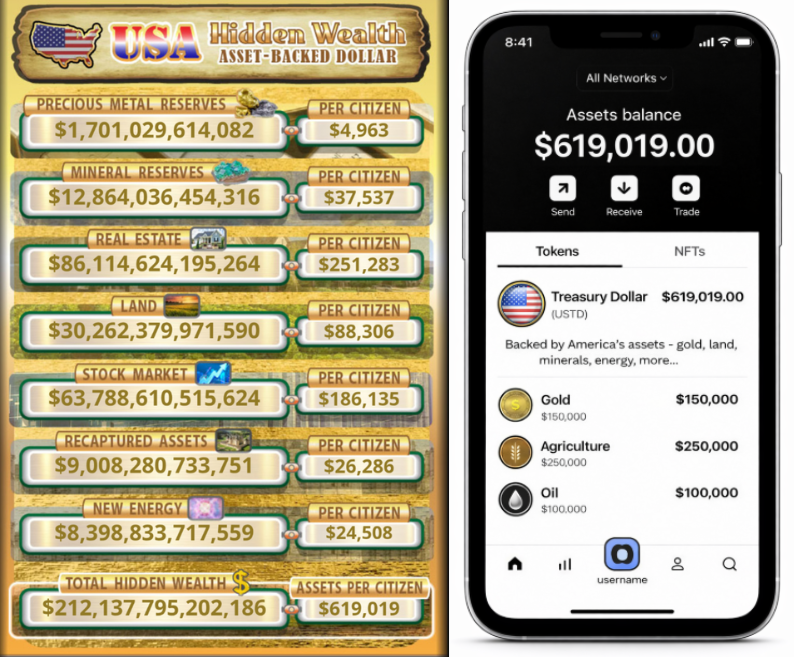
Now ask yourself…
Is there already a company building this?
Because there is.
A system where dollars are backed by real reserves,
run on-chain, and built for credit unions and banks to use.
This isn’t coming…
It’s already being built.
The shift is happening in real time.
Know What You Hold!
Source(s): • https://x.com/echodatruth/status/2040628240918728916
https://dinarchronicles.com/2026/04/04/echo-x-what-if-this-isnt-a-theory-but-a-blueprint/
Jon Dowling: Timing of the Clarity Act, Iran, Great Wealth Transfer Updates, April 2026
Jon Dowling: Timing of the Clarity Act, Iran, Great Wealth Transfer Updates, April 2026
4-4-2026
The world is on the cusp of a significant transformation, one that promises to upend the existing financial and geopolitical order.
In a recent podcast episode, Jon Dowling sat down with returning guest Rob Cunningham to discuss the impending financial reset, the role of blockchain technology, and the seismic shifts that are set to reshape the global landscape.
At the heart of this transformation is the Clarity Act, a legislative moment that will set the stage for a new, transparent, and equitable financial system.
Jon Dowling: Timing of the Clarity Act, Iran, Great Wealth Transfer Updates, April 2026
4-4-2026
The world is on the cusp of a significant transformation, one that promises to upend the existing financial and geopolitical order.
In a recent podcast episode, Jon Dowling sat down with returning guest Rob Cunningham to discuss the impending financial reset, the role of blockchain technology, and the seismic shifts that are set to reshape the global landscape.
At the heart of this transformation is the Clarity Act, a legislative moment that will set the stage for a new, transparent, and equitable financial system.
According to Rob Cunningham, this act will provide clear rules for corporations and financial institutions to transition from the old, opaque, and corrupt system to a blockchain-based system that promises atomic settlement, eliminating fraud, middlemen, and manipulative financial practices.
The existing financial system has been rigged against ordinary people, concentrating wealth in the hands of a few global elites, such as the Federal Reserve and the City of London.
The new system, on the other hand, is based on math-based, verifiable truth and accountability, marking a significant departure from the existing system of artificial debt, fraudulent bonds, and centralized control.
The deepstate’s manipulation of global finance and politics has been a hallmark of the existing system, with wars funded and populations controlled through debt slavery.
The new system promises to break free from these shackles, with cryptocurrencies like XRP positioned as a neutral bridge currency that will facilitate global transactions efficiently without perpetuating debt and control.
Japan’s involvement with Ripple is a case study in how some nations are preparing for the financial reset. As Rob Cunningham notes, Japan’s readiness for the transition is a testament to the country’s willingness to adapt to the new financial paradigm.
The conversation also touched on the geopolitical implications of the financial reset, including the ongoing regime change efforts in Iran, the role of Israel, and the broader dismantling of global military entanglements that served the interests of the deepstate’s financial empire.
Rob predicts a near-term convergence of key events, including the passage of the Clarity Act, military actions in the Middle East, and major shifts in bond markets, that will precipitate a dramatic financial reset.
As the world prepares for this new era, Rob and Jon emphasize the need for a societal and mindset shift. Rather than fear, scarcity, and compliance, listeners are encouraged to embrace abundance, wisdom, and personal responsibility.
The failures of institutions, including religion, politics, and finance, to serve the people honestly are critiqued, and awakened, courageous participation is called for in reclaiming liberty and prosperity.
So, how can you prepare for the transition? Rob Cunningham offers practical advice, including owning assets, precious metals, and utility cryptocurrencies. The future promises to be one where money serves people rather than enslaves them, and with the right mindset and preparation, individuals can thrive in this new era.
The financial reset is coming, and it’s essential to be prepared.
Watch the full video from Jon Dowling to gain further insights and information on this transformative moment. With experts like Rob Cunningham shedding light on the intricacies of the new financial system, you can stay ahead of the curve and navigate the changing landscape with confidence.
News, Rumors and Opinions Sunday 4-5-2026
KTFA
Clare: A positive appearance: Exchange rate stability reflects the strength of reserves and the flow of goods.
4/4/2026
The financial advisor to the Prime Minister, Mazhar Muhammad Saleh, confirmed on Saturday that the stability of exchange rates in the local market reflects positive indicators, while pointing out that the strength of reserves and the accumulation of commodity stock contributed to reducing the fluctuations of the parallel market.
Saleh told Al-Furat News Agency: "The stability of exchange rates in the local market reflects positive indicators that are embodied in two main directions."
KTFA
Clare: A positive appearance: Exchange rate stability reflects the strength of reserves and the flow of goods.
4/4/2026
The financial advisor to the Prime Minister, Mazhar Muhammad Saleh, confirmed on Saturday that the stability of exchange rates in the local market reflects positive indicators, while pointing out that the strength of reserves and the accumulation of commodity stock contributed to reducing the fluctuations of the parallel market.
Saleh told Al-Furat News Agency: "The stability of exchange rates in the local market reflects positive indicators that are embodied in two main directions."
He added that “the flexibility of financing foreign trade from the country’s foreign currency reserves, which are among the most efficient according to the standard of trade efficiency of reserves,” indicating that “these reserves extend to cover more than a year of imports, compared to the global standard, which is estimated at only about three months, in addition to continuing to meet the demand for foreign currency at the official rate of 1320 dinars per US dollar.”
He added that "the accumulation of diverse commodity stocks, both governmental and private, covers the country's needs for essential and durable goods for a period ranging from one to three years," noting that "this stability came as a result of adopting alternative trade methods, through the efficient and rapid use of the ports of neighboring countries, which ensures the smooth flow of goods to local markets."
He pointed out that "these factors combined have contributed to reducing exchange rate fluctuations in the parallel market, and have led to a high degree of price stability, with the exception of some seasonal fluctuations in the prices of a limited number of goods."
He stressed that "the market maintained its expectations that the conflict in the Gulf and Middle East region will remain short-term and will not extend for a long period."
From... Ragheed LINK
*************
Clare: Banking warnings: Dollar shortage threatens imports and raises the cost of living in Iraq
4/2/2026
Reports and financial sources that spoke to Al-Mustaqilla indicate a growing sense of concern within financial and economic circles in Iraq, with increasing talk about the possibility of a decline in the ability of the government and the Central Bank of Iraq to secure dollars in the coming period,
in light of rapidly evolving regional and international complexities, most notably the tension between Iran and the United States, and the tightening of control measures on financial transfer routes.
Iraq relies almost entirely on oil revenues deposited in dollars in foreign accounts. The movement of these funds, their transfer mechanisms, and auditing processes are subject to strict oversight linked to financial compliance regulations, making the dollar issue highly sensitive to any further tightening or disruption in transfer channels. Banking sources say the mounting pressure stems from concerns about dollars leaking to sanctioned entities, as well as increasing auditing requirements for transfers and foreign trade financing.
According to sources, worrying indicators have begun to emerge in the market, including the difficulty some banks are facing in obtaining dollars to meet traders' needs, and an increased reliance on the informal market for currency. There are also concerns that the gap between the official and market exchange rates will widen if the shortage persists or if transfers slow down. The sources add that any prolonged disruption to the flow of dollars could quickly impact the prices of imported goods and import costs, putting pressure on monetary stability and purchasing power, and potentially even affecting public spending if economic pressures escalate.
According to a widely circulated economic assessment, the next phase could unfold along three main paths. The first path involves continued pressure, potentially leading to a rise in the dollar's price on the parallel market, increased inflation, and disruptions to import chains.
The second path entails successful technical agreements with external regulatory bodies that ease restrictions and maintain the flow of remittances, which could result in relative stability in the exchange rate and trade financing.
The third path involves partial solutions aimed at reducing reliance on the dollar in certain transactions and expanding the use of alternative currencies or trade settlement mechanisms with neighboring countries, while the dollar remains a central pillar of the Iraqi economy.
Banking sources believe the core of the problem is not simply a "dollar shortage," but rather stems from a rentier economic structure dependent on oil, a banking system facing challenges in compliance and aligning its systems with international standards, widespread reliance on the dollar in most commercial activities, and a cumulative weakness in oversight of trade finance channels over the years. They indicate that any serious solution requires addressing the loopholes that increase risks and necessitate stricter external auditing.
Regarding solutions, financial circles say that urgent measures should focus on supporting official channels for currency transfers and trade finance, reducing the size of the informal market through more effective oversight, and ensuring that dollars reach traders through compliant banks.
In the medium term, there is a need to enhance transparency in dollar sales through approved platforms, tighten controls on entities accused of currency smuggling or invoice manipulation, and improve technical communication with external regulatory bodies to reduce complexities without compromising compliance requirements.
As for the strategic term, economic readings confirm that reducing the fragility of the dollar issue goes through diversifying sources of income, expanding local production, reducing dependence on imports, in addition to developing the banking sector and linking it more deeply to the global financial system, and opening a well-considered space for the use of other currencies in some commercial transactions in a way that reduces the pressure on the dollar, without disrupting market stability.
The sources conclude that any delay in reforms could leave the market vulnerable to sharp fluctuations, while institutional remedies could give Iraq an opportunity to reduce dollar sensitivity and lessen the impact of regional tensions on domestic financial stability. LINK
Courtesy of Dinar Guru: https://www.dinarguru.com/
Militia Man The plan they have is indeed underway. It's obvious the work is visible right in front of our face. The external environment is giving Iraq's diversification efforts more tailwind than headwind. They're not having a headwind. It's not slowing them down.
Steve There's a lot Iraq is being forced to deal with right now. I'm believing that is for a specific reason. The dinar revaluation being one of those reasons. Because if nothing changes, I don't think Iraq has that much time. Unless they get these things under control their country is going to fall apart...I don't believe that's the case... Everything we're seeing is putting the pressure on Iraq that was needed to force them to level up and stop kicking the can down the road. I think we are in very, very exciting times.
Bruce [via WiserNow] ...we heard was that there were ...group meetings of redemption center leaders...we were told from one of people that attended the meeting that this that we should get notifications this weekend...Saturday and Sunday. I'm going to say the weekend is in play for us. We also heard...Sunday, Monday, Tuesday.
************
April Could Be HUGE for Dinar Investors!
Dinar For Dummies: 4-4-2026
In this video I cover what we are looking for in the month of April.
Seeds of Wisdom RV and Economics Updates Sunday Morning 4-5-26
Happy Easter Dinar Recaps,
De-Dollarization Accelerates as BRICS Yuan Oil Trade Challenges the Petrodollar
Global energy markets begin shifting settlement power away from the U.S. dollar
Happy Easter Dinar Recaps,
De-Dollarization Accelerates as BRICS Yuan Oil Trade Challenges the Petrodollar
Global energy markets begin shifting settlement power away from the U.S. dollar
Overview (Key Points)
BRICS nations are accelerating de-dollarization through real-world oil transactions
India and Iran are leading a shift to yuan-based energy trade
Alternative payment systems are scaling rapidly, bypassing traditional dollar channels
The petrodollar system is facing tangible pressure, not just theoretical debate
Key Developments
1. India Expands Yuan-Based Oil Purchases
In March 2026, Indian refiners purchased ~60 million barrels of Russian crude
A significant portion was settled in Chinese yuan, bypassing the U.S. dollar
Indian Oil Corporation executed direct yuan payments, eliminating conversion steps
This marks one of the largest single-month moves toward non-dollar oil settlement
2. Iran Pushes Yuan Through the Strait of Hormuz
Iran is encouraging oil tankers to trade cargo in yuan through the Strait of Hormuz
The strait handles roughly 20% of global oil flow, making this move highly strategic
Tolls near $2 million per voyage are being tied to yuan-based transactions
Legislation is underway to formalize this policy, reinforcing long-term intent
3. BRICS Payment Infrastructure Gains Momentum
The mBridge CBDC platform has processed ~RMB 387.2 billion (~$55B)
95% of transactions are conducted in digital yuan, signaling strong adoption
China’s CIPS system processed ~$245 trillion in yuan transactions in 2025
Central banks continue heavy gold accumulation (1,000+ metric tons annually)
The dollar’s share of global reserves has declined from 71% to 56.3% since 2008
4. Global Sentiment Shifts Against Dollar Dependence
Russian President Vladimir Putin stated:
“The US has weaponized the dollar.”Chatham House analyst David Lubin noted:
Rising concern over dollar weaponization is driving countries to diversifyThis perception is becoming a core driver behind de-dollarization efforts globally
Why It Matters
The shift is no longer theoretical.
Real barrels of oil are now being traded outside the dollar system.
Energy markets are historically the backbone of dollar dominance
Moving oil trade into yuan and local currencies directly challenges that foundation
Payment infrastructure like CIPS and mBridge reduces reliance on Western systems
This represents a structural shift in how global trade is settled
Why It Matters to Foreign Currency Holders
A multi-currency world increases the importance of currency diversification
The U.S. dollar may remain dominant, but its monopoly is weakening
Yuan, regional currencies, and commodities (like gold) gain relevance
Currency holders should watch:
Energy trade settlement trends
Central bank reserve shifts
Expansion of BRICS financial systems
This is how value begins redistributing across currencies globally
Implications for the Global Reset
Pillar 1: Monetary System Transition
The system is evolving toward a multi-polar currency structure
The dollar, euro, and yuan may emerge as regional anchors of influence
Pillar 2: Infrastructure Before Currency Shift
Systems like mBridge and CIPS are laying the groundwork first
This confirms that payment rails change before reserve status does
The reset is not a single event—it is a phased restructuring already underway
Closing Insight
The dollar still dominates global finance—for now.
But energy trade is the front line, and that front line is shifting.
When oil moves, the system moves.
Seeds of Wisdom Team
Newshounds News™ Exclusive
Sources
~~~~~~~~~~
A Message to Our Currency Holders
If you’ve been holding foreign currency for many years, you were not foolish.
You were not wrong to believe the global financial system would change.
What failed was not your patience — it was the information you were given.
For years, dates, rumors, and personalities replaced facts, structure, and proof. “This week” predictions created cycles of hope and disappointment that were never based on how currencies actually change.
That is not your failure.
Our mission here is different: • No dates • No rates • No hype • No gurus
Instead, we focus on:
• Verifiable developments • Institutional evidence
• Global financial structure • Where countries actually sit in the process
Currency value changes only come after sovereignty, trade, banking, settlement systems, and fiscal coordination are in place. History and institutions confirm this sequence.
You will see silence. You will see denials. That is not delay — that is discipline.
Protect your identity. Organize your documents. Verify everything.
Never hand your discernment to anyone who cannot show proof.
You deserve truth — not timelines.
Seeds of Wisdom Team
Newshounds News
~~~~~~~~~~
Seeds of Wisdom Team RV Currency Facts Youtube and Rumble
Newshound's News Telegram Room Link
RV Facts with Proof Links Link
RV Updates Proof links - Facts Link
Follow the Gold/Silver Rate COMEX
Follow Fast Facts
Seeds of Wisdom Team™Website
Thank you Dinar Recaps
Iraq Economic News And Points To Ponder Sunday Morning 4-5-26
How Are The Central Bank's Foreign Reserves Distributed?
Banks Economy News – Baghdad Economic expert Nabil Al-Marsoumi revealed the distribution of foreign reserves of the Central Bank of Iraq at the end of 2025, where the total foreign reserves amounted to $97.432 billion.
According to the distribution, $24.221 billion of the reserve was allocated to gold held at the London Gold House, while the volume of US Treasury bonds amounted to $42 billion.
How Are The Central Bank's Foreign Reserves Distributed?
Banks Economy News – Baghdad Economic expert Nabil Al-Marsoumi revealed the distribution of foreign reserves of the Central Bank of Iraq at the end of 2025, where the total foreign reserves amounted to $97.432 billion.
According to the distribution, $24.221 billion of the reserve was allocated to gold held at the London Gold House, while the volume of US Treasury bonds amounted to $42 billion.
The remaining $31.211 billion of the reserve was divided among several financial entities, with $1.466 billion being held in the vaults of the Central Bank of Iraq, while the remainder was deposited in the Bank of France, the Bank of England, the US Federal Reserve, the People’s Bank of China, along with other central banks and international banks. https://www.economy-news.net/content.php?id=67529
Foreign Reserves: Between Their Sterilizing Role And Budgetary Pressures In Light Of The Halt In Oil Revenues
Economy News – Baghdad Dr. Haitham Hamid Mutlaq Al-Mansour In times of major crises, an economy is tested not only in its capacity for growth but also in its ability to survive without its primary resources. Iraq, being a country reliant on a single resource, finds itself in a vulnerable position to any shock to its oil sector.
Oil is the backbone of public finances and the cornerstone of financial and monetary stability. Therefore, a halt in oil exports, even temporarily, is not a far-fetched hypothetical scenario but a genuine test of the limits of the existing economic model.
With Iraqi oil exports remaining suspended for an extended period, the economy is not merely facing a temporary financial crisis, but rather a disruption to its export structure.
As a rentier economy, Iraq relies almost entirely on dollar inflows from oil exports, which under normal circumstances range between $90 and $100 billion annually, or approximately $7–8 billion monthly at average price and production levels. These inflows not only constitute budget revenues but also form the foundation upon which the value of the local currency and the stability of the entire monetary system are built.
With the continued cessation of this revenue stream, the Ministry of Finance found itself facing a severe funding gap.
Assuming that annual public spending is approximately 150 trillion Iraqi dinars (around $100 billion), and that at least 70–75% of this goes to salaries and pensions, the halt in oil revenues effectively means the loss of nearly 75% of funding sources. At best, the government may be unable to cover more than 20–25% of its expenditures through limited alternative sources, such as tanker exports or fees and taxes.
In this case, resorting to discounting remittances at the central bank becomes almost inevitable. If the government, for example, needs monthly financing of around 8–10 trillion dinars to cover salaries and current expenditures, this amount will be created in cash through the expansion of the central bank's liabilities.
In just six months, this financing could reach 50–60trillion dinars through new currency issuance, a figure equivalent to a significant percentage of the existing money supply.
However, this monetary expansion is not matched by any real inflow of dollars. Under normal circumstances, oil revenues would exceed $100 billion, which would be converted into foreign reserves used to cover imports and maintain exchange rate stability.
In the current situation, however, the central bank's foreign assets begin to erode. If reserves are around $100 billion and monthly demand for dollars for imports ranges between $5 and $6 billion, reserves could be depleted by $60 to $70 billion in just one year if the same demand pattern continues.
The paradox is that continuing to pay salaries, which requires injecting large amounts of dinars, will increase demand for imported goods, thus increasing pressure on the dollar. This means that every additional trillion dinars injected into the economy is very likely to be partially converted into demand for foreign currency, accelerating the depletion of reserves.
As net foreign assets decline from comfortable levels (e.g., $100 billion) to critical levels (less than $30–40 billion), confidence in the dinar begins to erode rapidly.
At this stage, the negative impact on the exchange rate becomes clearly apparent. If the official rate is around 1,320 dinars to the dollar, it could rise in the parallel market to 1,500-2,000 dinars within months, and with continued pressure, it could reach much higher levels, especially with the widening gap between supply and demand.
This increase will directly affect inflation levels, which could exceed 30-50% annually, with rising prices for imported basic commodities.
What is happening here is a transformation in the nature of the monetary system. The general budget, which was based on real dollar revenues, is now financed by issuing domestic currency backed by domestic financial assets, while the central bank's balance sheet is shifting from holding foreign assets to accumulating domestic debt owed by state-owned banks.
Within a short period, the proportion of domestic assets in the central bank's balance sheet could rise from marginal levels to more than 50% of total assets, while foreign assets decline sharply.
The ultimate result of this trajectory is that continued spending, despite its social necessity, becomes an accelerating factor for the crisis rather than a mitigating one. Every additional month of monetary financing without oil revenue corresponds to a decrease in reserves, an increase in the money supply, and a deterioration in the exchange rate.
As reserves approach critical levels insufficient to cover more than three to four months of imports, the economy enters a phase of loss of control, where the options become limited to a sharp reduction in spending, the imposition of strict controls on transfers, or accepting high levels of inflation.
It becomes clear that the problem lies not in a lack of tools, but in the limitations of the economic model itself. When an economy suddenly loses a resource that provides it with approximately $100 billion annually, it cannot compensate for this loss through issuing currency or internal instruments.
Therefore, what Iraq faces in such a scenario is not merely a liquidity crisis, but a crisis in the very foundation of monetary value generation.
Within this framework, the dinar may not represent genuine wealth but rather an expression of internal obligation, and the stability of the monetary system becomes contingent upon a limited, time-bound capacity to utilize remaining reserves.https://www.economy-news.net/content.php?id=67516
Iraq Will Be Among The Top 5 Arab Economies In 2026.
Money and Business Economy News – Baghdad Iraq ranked highly in the list of the largest Arab economies for 2026, according to the purchasing power parity criterion, based on the latest data from the International Monetary Fund (IMF).
Iraq came in fifth place in the Arab world, recording about $739.1 billion, reflecting a remarkable growth in its economic capabilities and its position among the countries of the region.
Saudi Arabia topped the list with an economy of $2.84 trillion, followed by Egypt with $2.53 trillion, then the UAE with about $1 trillion, and Algeria with $915.8 billion.
Following Iraq were Morocco with an economy of $457.5 billion, Qatar with $410.6 billion, Kuwait with $285.9 billion, Oman with $245.9 billion, and Tunisia with $193.6 billion.
Jordan recorded $138 billion, Sudan $135.9 billion, Libya $132.8 billion, Bahrain $118.1 billion, and Yemen came in last with $71.2 billion.
It is worth noting that the purchasing power parity index is a strategic measure that reflects the actual ability of the economy to purchase goods and services locally, away from the fluctuations of global exchange rates. https://www.economy-news.net/content.php?id=67534
Iraqi Oil Exports Via The Basra-Shalamcheh Railway Line Amidst The Regional War
Economy News — Baghdad By Karim Al-Araji, expert and consultant in international economicsWith the escalation of the conflict between the United States and Iran in the Persian Gulf and the Strait of Hormuz, Iraq's foreign trade has been disrupted, and the need to diversify trade routes has become even more apparent to the Iraqi people and government.
The Basra-Shalamcheh railway, being the least expensive and shortest route, could enable Iraq to export its oil to China, bypassing the volatile region of the Persian Gulf and the Strait of Hormuz.
***
Throughout history, wars have been a major impediment to international trade, and all nations have sought to avoid areas of military tension.
Indeed, wars, in addition to the destruction and insecurity they cause for the warring parties, also lead, depending on the geopolitical location of those parties, to insecurity in international trade routes. This has always been one of the most significant challenges to sustainable trade.
Last month, following the assassination of Ayatollah Khamenei, the Supreme Leader of the Islamic Revolution in Iran, by the US and Israeli regimes, Iranian officials, as previously promised, declared that their response would not be limited to Israel but would encompass the entire West Asia region (the Middle East).
Several months prior, the Iranians had warned Israel and the US that if they repeated their aggression against Iranian territory, they would target not only the occupied Palestinian territories (Israel) but also all US bases and interests in the region.
They further stated they would not allow any ships to pass through the Strait of Hormuz if their destination or purpose was linked to the interests of the US and its allies in a military attack against Iran.
Accordingly, after the commencement of the US and Israeli aggression against Iran, and in accordance with their earlier promise, the Strait of Hormuz, through which more than 20% of the world's energy supply passes and which plays a crucial role in securing global energy resources, was closed by the Iranian navy.
Only a limited number of ships were permitted to pass, and any ships or oiltankers attempting to pass without authorization were targeted by Iranian missiles.
Under these circumstances, Iraq is among the countries whose trade, exports, and imports have been severely jeopardized.
Normally, over 95% of its oil exports and a significant portion of its imports transit through the Sea of Oman and the Strait of Hormuz.
Consequently, the country's exports and imports have faced numerous challenges, and Iraq's trade with China has been significantly impacted.
This comes at a time when China is one of Iraq's most important trading partners, with bilateral trade exceeding $56 billion in 2024, and in recent years purchasing an average of 25% of Iraq's total oil. Furthermore, Iran has also declared that even if the war ends, transit through the Strait of Hormuz will not return to its previous state, posing risks to Iraqi trade.
Therefore, under these circumstances, establishing alternative land routes, particularly railways, is essential for the Iraqi government and people to break free from complete dependence on the volatile route through the Arabian Gulf and to continue exporting oil—the country's lifeline—to key partners like China.
This is an area in which several neighboring countries, such as Iran, Turkey, and even Saudi Arabia, have invested heavily in recent years.
Currently, the only way to connect Iraq by rail to China is through the Basra-Shalamcheh railway line with Iran.
This line requires only the construction of 33 kilometers of track and the completion of an 800-meter-long movable bridge over the Shatt al-Arab waterway; secondly, this line is located near Iraq's largest oil reserves.
The Basra-Shalamcheh railway project has been on the Iranian side's agenda for years, and Iranian officials are determined to complete it as soon as possible.
In this context, Iranian President Pezeshkian, during his meeting with Iraqi President Abdul Latif Rashid, considered linking the railway lines between the two countries a necessary step and deemed the completion of the Basra-Shalamcheh railway project a top priority for Iran.
However, the Iraqi government should not be content with this project or with rail links with Iran alone; it must also establish new trade routes through agreements with its other neighbors.
Given the clear importance of diversifying trade routes, the Iraqi government must complete the remaining 33 kilometers of the Basra-Shalamcheh railway line, a commitment it has made in this project, as quickly as possible, and utilize this route as an emergency trade artery, particularly for its trade with China. https://www.economy-news.net/content.php?id=67489
Some “Iraq News” Posted by Tishwash at TNT 4-5-2026
TNT:
Tishwash: The coordination framework confirms that the session to elect the President of the Republic will be held on April 11.
Coordination Framework member Mahmoud Al-Hayani confirmed on Saturday (April 4, 2026) the insistence on holding the session to elect the President of the Republic on its scheduled date of April 11, stressing that there is no intention to postpone the session under any circumstances.
Al-Hayani told Baghdad Today that “the political forces are moving towards completing the constitutional requirements, in line with the requirements of the current stage, and the session to elect the President of the Republic will be held on its scheduled date without postponement.”
TNT:
Tishwash: The coordination framework confirms that the session to elect the President of the Republic will be held on April 11.
Coordination Framework member Mahmoud Al-Hayani confirmed on Saturday (April 4, 2026) the insistence on holding the session to elect the President of the Republic on its scheduled date of April 11, stressing that there is no intention to postpone the session under any circumstances.
Al-Hayani told Baghdad Today that “the political forces are moving towards completing the constitutional requirements, in line with the requirements of the current stage, and the session to elect the President of the Republic will be held on its scheduled date without postponement.”
He added that "adherence to constitutional procedures is a national priority to ensure the stability of the political process and to move towards completing the formation of constitutional authorities, and all concerned parties are working to create the necessary conditions for the success of the session and to achieve the required consensus."
A member of the coordinating framework stated that "postponing the session is absolutely out of the question," stressing that "there is a clear determination to resolve this constitutional entitlement within the specified timeframe."
For months, Iraq has been experiencing delays in fulfilling constitutional requirements, most notably the election of the President of the Republic, due to ongoing disputes between political forces, which has led to the obstruction of the formation of the new government. link
Tishwash: The House of Representatives publishes the agenda for next Monday's session.
The Media Department of the Council of Representatives announced today, Saturday (April 4, 2026), that the Council will hold its session next Monday to complete the voting on the members of the parliamentary committees.
Agenda Session No. 15
Monday, April 6, 2026
Chamber of Deputies
Session Proceedings:
Recitation of verses from the Holy Quran
Completion of voting on the members of the Permanent Parliamentary Committees
The session begins at 11:00 a.m. link
************
Tishwash: Iran: The Strait of Hormuz is open to Iraq
The spokesman for the Khatam al-Anbiya headquarters stated that Iran respects Iraqi sovereignty in light of Baghdad's firm stances in supporting Tehran, stressing that no obstacles will be placed in the way of Iraqi trade in the Strait of Hormuz.
In a statement issued on Saturday, April 4, 2026, Ibrahim Zolfaghari, spokesman for the Khatam al-Anbiya headquarters, revealed that Iraq was exempted from all the restrictions and strict measures imposed by Iran in the strategic Strait of Hormuz.
Zulfiqari explained that these restrictions only apply to countries classified as "hostile states," noting that Iran has great respect for Iraqi national sovereignty, and describing the Iraqi people as a steadfast and strong nation in the face of American hegemony.
He added that Iraq's supportive stances toward Iran "did not go unappreciated," but rather contributed to strengthening the will to continue the struggle. The statement also emphasized that Iraq, thanks to its positions and support, can seize a historic opportunity to end the presence of American forces on its soil.
Since the outbreak of war between (America, Israel) and Iran, the Iranian Revolutionary Guard has closed the Strait of Hormuz to oil tankers, leading to a significant increase in fuel prices in global markets.
This statement comes in the wake of the air strikes launched by the United States and Israel on Iran on the morning of Saturday, February 28, 2026, which resulted in the killing of a number of the country’s leaders, while Iran responded quickly by launching missile barrages towards Israel and targeting several US military bases and headquarters in countries of the region. link
Tishwash: Warnings of a "salary shock" in May... A 5 trillion deficit puts pressure on government formation and budget approval.
On Thursday, economist Nabil Al-Marsoumi warned of a potential shortfall of up to five trillion dinars in securing employee salaries for the month of May due to the sharp decline in oil sales caused by the disruptions in the Strait of Hormuz. He urged the swift formation of the next Iraqi government with full sovereign powers to meet the needs of citizens by preparing the current year's budget.
Iraq needs more than nine trillion dinars per month, equivalent to (six billion dollars), to secure the salaries of public sector employees and workers, retirees, and to provide social welfare and food basket grants, relying on more than 90% of the financial revenues generated from oil exports, which have decreased by more than 80% after the disruption of energy supply chains in the Strait of Hormuz due to the escalating pace of military escalation in the region.
In this regard, Al-Marsoumi said in an analysis he published that although Iraq continued to export oil through the Strait of Hormuz until the eighth of March, oil revenues did not exceed $1.9 billion, which is equivalent to about 2.5 trillion dinars, indicating that according to these data, the country needs another 5 trillion dinars just to pay next month’s salaries.
He stressed that “it is necessary to expedite the formation of a fully empowered Iraqi government and prepare the 2026 budget in order to give the government the legal cover for internal and external borrowing, discounting remittances at the Central Bank of Iraq, and taking other measures to meet the basic needs of the Iraqi people, especially those related to salaries, social welfare, and the most important services such as water, electricity, and others.”
Iraq is experiencing a state of "political deadlock" as the forces and parties that won the legislative elections held in late 2015 have not been able to complete the constitutional requirements, including electing a new president of the republic and assigning a prime minister to form the next government. The steps achieved so far have been limited to electing the parliament's leadership only.
Observers warn of the repercussions of this continued delay on the political, economic and service levels in the country, especially in light of the rapidly escalating security and geopolitical tensions in the Middle East region, which necessitate the existence of a fully empowered government to manage the current crises. link
************
Tishwash: A positive appearance: Exchange rate stability reflects the strength of reserves and the flow of goods.
The financial advisor to the Prime Minister, Mazhar Muhammad Saleh, confirmed on Saturday that the stability of exchange rates in the local market reflects positive indicators, while pointing out that the strength of reserves and the accumulation of commodity stock contributed to reducing the fluctuations of the parallel market.
Saleh told Al-Furat News Agency: "The stability of exchange rates in the local market reflects positive indicators that are embodied in two main directions."
He added that “the flexibility of financing foreign trade from the country’s foreign currency reserves, which are among the most efficient according to the standard of trade efficiency of reserves,” indicating that “these reserves extend to cover more than a year of imports, compared to the global standard, which is estimated at only about three months, in addition to continuing to meet the demand for foreign currency at the official rate of 1320 dinars per US dollar.”
He added that "the accumulation of diverse commodity stocks, both governmental and private, covers the country's needs for essential and durable goods for a period ranging from one to three years," noting that "this stability came as a result of adopting alternative trade methods, through the efficient and rapid use of the ports of neighboring countries, which ensures the smooth flow of goods to local markets."
He pointed out that "these factors combined have contributed to reducing exchange rate fluctuations in the parallel market, and have led to a high degree of price stability, with the exception of some seasonal fluctuations in the prices of a limited number of goods."
He stressed that "the market maintained its expectations that the conflict in the Gulf and Middle East region will remain short-term and will not extend for a long period." link