
Seeds of Wisdom RV and Economics Updates Tuesday Afternoon 3-3-26
Good Afternoon Dinar Recaps,
TEHRAN UNDER FIRE: Civilian Panic Deepens as Airstrikes Intensify
Bombardment Spreads Terror — But Not the Uprising Some Expected
Good Afternoon Dinar Recaps,
TEHRAN UNDER FIRE: Civilian Panic Deepens as Airstrikes Intensify
Bombardment Spreads Terror — But Not the Uprising Some Expected
Overview
Tehran has become a city gripped by fear, not rebellion. Following sustained U.S.-Israeli airstrikes, hundreds have reportedly been killed, critical infrastructure has been damaged, and civilians describe the capital as a ghost town under siege.
Despite expectations in Washington and Tel Aviv that internal dissent might erupt into widespread protests, no organized uprising has materialized. Instead, the dominant emotion inside Iran appears to be terror, exhaustion, and survival mode.
This is no longer just a military conflict — it is a civilian humanitarian crisis unfolding in real time, with major implications for regional stability and the global financial system.
Key Developments
Tehran Emptied by Fear
Residents report deserted streets, security checkpoints, and heavy presence from the Islamic Revolutionary Guard Corps (IRGC). Power outages and water disruptions have compounded anxiety, while families quietly prepare escape plans.
One Tehran resident described:
Electricity cuts
Water shortages
Fear of burglaries during displacement
Plans to flee the country when possible
This is fear-driven paralysis, not mobilization.
2. Civilian Infrastructure Hit
Strikes reportedly impacted:
A hospital in Tehran
A girls’ school in southern Iran
Multiple civilian buildings and vehicles
Reported casualties:
Around 150 deaths linked to specific civilian site strikes
Iran claims total casualties have reached 787 killed
A grieving mother reportedly fears taking her dialysis-dependent child to the hospital due to continued bombardment — illustrating the collapse of civilian safety assurances.
3. Retaliation Expands Regionally
Iran has launched:
Drone attacks
Missile strikes
Targeting military and civilian sites in surrounding regions
This escalation pushes the conflict beyond symbolic retaliation and toward multi-theater confrontation.
4. Public Sentiment Is Complex — Not Revolutionary
While anger exists toward Iranian leadership, especially after the death of former Supreme Leader Ali Khamenei, the mood is not revolutionary.
Some citizens question:
The long-term value of Iran’s nuclear program
Decades of confrontation with the West
The cost of isolation
But fear currently outweighs political mobilization.
Why It Matters
This conflict is shifting from strategic decapitation strikes to civilian destabilization.
Key implications:
Humanitarian breakdown risk
Refugee flows into Turkey and neighboring states
Potential wider Gulf military escalation
Heightened pressure on oil and LNG transit corridors
Intensifying geopolitical fracture lines
Markets do not price in civilian collapse quickly — but when they do, volatility accelerates.
Why It Matters to Foreign Currency Holders
For those watching the global reset framework, this development touches multiple pillars:
Energy Shock Risk
If instability spreads toward Gulf transit routes, oil and LNG flows become vulnerable — triggering currency volatility.
Emerging Market Fragility
Capital flight risk increases across the Middle East and frontier markets.
Dollar vs. Alternative Bloc Tensions
Iran’s position within BRICS complicates the bloc’s credibility and collective posture.
Gold & Safe Haven Assets
Historically, geopolitical crises amplify demand for non-sovereign stores of value.
This is not isolated unrest. It is systemic geopolitical stress.
Implications for the Global Reset
Pillar 1: Energy & Commodity Control
Sustained regional instability strengthens the argument for:
Diversified energy corridors
Alternative settlement systems
Strategic commodity-backed trade frameworks
Pillar 2: Institutional Credibility Under Pressure
The crisis tests:
Western military projection capacity
BRICS’ cohesion
Multilateral diplomacy structures
When institutions appear reactive instead of strategic, global trust fractures — and monetary systems follow trust.
This is not just war — it is a stress test of the post-World War II financial and security architecture.
Seeds of Wisdom Team View
The expectation of uprising has given way to a harsher reality: bombardment consolidates fear more often than rebellion.
Tehran’s silence is not consent.
It is survival.
And survival mode in a major regional power introduces a dangerous variable — unpredictability.
Markets can calculate risk.
They struggle to price chaos.
This moment may not trigger immediate systemic collapse — but it increases pressure across every global fault line already under strain.
This is not just politics — it’s global finance restructuring before our eyes.
Sources
Reuters — “Tehran residents describe fear and destruction following U.S.-Israeli airstrikes”
Modern Diplomacy — “Tehran Under Fire: Bombardment Spreads Terror, Not Rebellion”
~~~~~~~~~~
VIETNAM’S E10 MANDATE: A Biofuel Shift Reshaping BRICS Energy Trade
Hanoi’s Ethanol Gap Opens a Direct Corridor to Brazil and the South-South Bloc
Overview
Vietnam’s nationwide E10 biofuel rollout, effective June 1, 2026, marks one of Southeast Asia’s most consequential energy policy moves in years. Under Circular 50/2025/TT-BCT, all qualifying unleaded gasoline must now contain 10% ethanol.
But here’s the pivot point: Vietnam cannot produce enough ethanol domestically to meet the mandate.
The resulting supply deficit is steering trade flows toward BRICS nations — especially Brazil, the world’s largest ethanol powerhouse. What began as a climate and energy diversification move is rapidly becoming a strategic South-South trade realignment.
This is energy policy intersecting with geopolitics — and the timing could not be more significant.
Key Developments
The Ethanol Supply Gap Is Structural
Vietnam currently operates:
6 domestic ethanol plants
Combined capacity: ~600,000 cubic meters annually
But E10 implementation requires approximately:
1.5 million cubic meters per year
That leaves a 60% shortfall — a material deficit that cannot be solved overnight.
Feedstock instability compounds the issue:
~600,000 hectares of cassava cultivation
Low yields and fragmented supply chains
Production volatility
This is not a temporary bottleneck — it’s a structural import dependency.
2. Brazil Emerges as the Natural Supplier
Brazil produces more ethanol than any other country in the world and is a core BRICS member.
Vietnam’s state energy firm PVOIL already sources ethanol from Brazil, making the trade channel active — not theoretical.
This positions:
Brazil as a strategic beneficiary
Vietnam as a BRICS-aligned energy buyer
South-South energy corridors as operational reality
3. Major Fuel Distributors Are Already Positioned
Petrolimex operates seven blending depots nationwide and has import relationships spanning:
United States
South Korea
Singapore
Philippines
Infrastructure is ready. Imports are inevitable.
4. Timing Collides With Gulf Energy Instability
Global oil logistics remain under pressure due to disruptions around the Strait of Hormuz, where tanker activity has slowed and maritime insurance risks are rising.
Oil analyst Tom Kloza expects retail gasoline prices to rise 5–10 cents daily in the short term.
For Vietnam — which imports much of its refined fuel — shifting toward ethanol imports from Brazil:
Reduces reliance on Gulf supply chains
Diversifies sourcing geography
Expands non-Western trade corridors
What began as an environmental mandate is becoming a geopolitical hedge.
Why It Matters
Vietnam’s E10 rollout signals three major structural shifts:
1. Energy Diversification Through BRICS Channels
Brazil becomes a cornerstone supplier in Southeast Asia’s fuel blend transition.
2. South-South Trade Institutionalization
This is not rhetoric — it’s volume-based commodity trade realignment.
3. Strategic Response to Maritime Instability
As Gulf routes face uncertainty, alternative commodity streams gain value.
Energy policy is becoming geopolitical positioning.
Why It Matters to Foreign Currency Holders
This development touches core global reset themes:
Commodity-Backed Trade Growth
Ethanol joins oil, gas, and metals as a strategic cross-border lever.BRICS Bloc Consolidation
Trade volumes — not speeches — define bloc credibility.Reduced Dollar Dependency Potential
If settlements expand within BRICS-aligned systems, currency diversification follows.Agricultural Commodities as Strategic Assets
Cassava, sugarcane, and ethanol are becoming currency-relevant inputs.
Energy transitions are no longer just climate policy — they are monetary architecture shifts in motion.
Implications for the Global Reset
Pillar 1: Commodity Corridors Replace Old Energy Maps
Vietnam’s ethanol import needs:
Strengthen Brazil’s trade leverage
Expand South-South settlement networks
Reduce Middle East-centric fuel dependence
Energy flow redirection is monetary influence redistribution.
Pillar 2: BRICS Operationalization
BRICS credibility grows when:
Members fill structural supply gaps
Trade increases between bloc nations
Commodity flows bypass traditional Western chokepoints
This is how alternative systems gain traction — quietly, transaction by transaction.
The ethanol corridor between Vietnam and Brazil may look technical — but structurally, it reinforces a broader economic rebalancing.
This is not just energy reform — it’s global finance restructuring before our eyes.
Seeds of Wisdom Team View
Vietnam’s E10 mandate was designed as a sustainability measure.
Instead, it may become:
A BRICS trade accelerant
A hedge against Gulf volatility
A template for energy diversification without Western intermediaries
When supply gaps align with geopolitical alliances, trade flows shift permanently.
And permanent trade shifts eventually reshape currencies.
Watch the ethanol lane.
It may be smaller than oil — but it is strategically loud.
Seeds of Wisdom Team
Newshounds News™ Exclusive
Sources
Watcher Guru — “Vietnam’s E10 Biofuel Rollout Opens New BRICS Trade Opportunities”
Reuters — “Oil prices rise amid Strait of Hormuz disruption and supply concerns”
~~~~~~~~~~
Seeds of Wisdom Team RV Currency Facts Youtube and Rumble
Newshound's News Telegram Room Link
RV Facts with Proof Links Link
RV Updates Proof links - Facts Link
Follow the Gold/Silver Rate COMEX
Follow Fast Facts
Seeds of Wisdom Team™ Website
Thank you Dinar Recaps
Iraq Economic News and Points To Ponder Tuesday Afternoon 3-3-26
Kamal Al-Haidari Declares Jihad Against US And Israel
2026-03-03 / 05:57 Shafaq News- Najaf Shiite cleric Ayatollah Kamal al-Haidari on Tuesday called for “jihad” against the United States and Israel, according to a statement issued by his office.
In a written statement, al-Haidari said the attacks targeted “the civilizational core and religious authority” of Iran, adding that confronting US and Israeli aggression is a religious and moral responsibility. He urged Muslims to prepare for “legitimate defense of land, dignity and sovereignty,” and called for resisting “Zionist and American arrogance in all its forms.”
Kamal Al-Haidari Declares Jihad Against US And Israel
2026-03-03 / 05:57 Shafaq News- Najaf Shiite cleric Ayatollah Kamal al-Haidari on Tuesday called for “jihad” against the United States and Israel, according to a statement issued by his office.
In a written statement, al-Haidari said the attacks targeted “the civilizational core and religious authority” of Iran, adding that confronting US and Israeli aggression is a religious and moral responsibility. He urged Muslims to prepare for “legitimate defense of land, dignity and sovereignty,” and called for resisting “Zionist and American arrogance in all its forms.”
In Shiite jurisprudence, jihad in this context is generally understood as a defensive religious mobilization in response to perceived external aggression, rather than an offensive war. (however, that is not the interpretation by most of the fundamental Islamic terrorist groups, even many others worldwide).
Under Twelver Shiite doctrine, the authority to issue such binding religious rulings traditionally rests with a Marja’ al-Taqlid —a supreme religious authority recognized by followers as a source of emulation in matters of faith and law.
A similar call was made in 2014 by Iraq’s top Shiite cleric, Grand Ayatollah Ali al-Sistani, whose fatwa urging Iraqis to fight ISIS led to the mobilization of volunteers later organized under the Popular Mobilization Forces (PMF).
Most of the Iran-aligned “Islamic Resistance” armed factions in Iraq regard Ayatollah Ali Khamenei as their marja’ (religious authority) and political leader under the principle of wilayat al-faqih, which links religious leadership with governance and loyalty to Iran’s supreme leadership. ( this is the major problem in Iraq, and the GOI will need to deal with it - one way or another). https://www.shafaq.com/en/society/Kamal-al-Haidari-declares-jihad-against-US-and-Israel
Sudani And The Crown Prince Of Kuwait Stress The Need For De-Escalation And Maintaining Regional Stability
Baghdad – One News 3/02/2026 Prime Minister Mohammed Shia al-Sudani and the Crown Prince of Kuwait, Sheikh Sabah Khalid al-Hamad al-Sabah, stressed on Monday the importance of maintaining regional and international stability and putting an end to escalation.
The Prime Minister’s Media Office stated in a statement that “Prime Minister Mohammed Shia Al-Sudani discussed by telephone with the Crown Prince of the State of Kuwait, Sheikh Sabah Khalid Al-Hamad Al-Sabah, the latest security developments in the region, and the serious repercussions resulting from the continuation of military operations.”
The statement added that “during the call, emphasis was placed on the importance of joint Arab coordination, working towards de-escalation and resorting to dialogue as the best way to solve problems, and stopping all practices that could drag the region into greater dangers.”
According to the statement, both sides stressed "the need for the international community to make efforts to prevent the region from sliding into what threatens the interests of countries and their peoples, in light of the continuation of military operations," stressing that "maintaining regional and international stability requires putting an end to the escalation and reopening the channels of dialogue." https://1news-iq.net/السوداني-وولي-عهد-الكويت-يؤكدان-ضرورة/
Iran-Aligned Iraqi Factions Refuse To Halt Attacks On US, Israeli Interests
2026-03-03 Shafaq News- Baghdad Several Iraqi armed factions have informed government officials and political leaders within the Shiite Coordination Framework that they will continue operations targeting US and Israeli interests inside and outside Iraq, political sources told Shafaq News on Tuesday.
According to the sources, over the past two days, senior officials sought to contain the escalation and prevent further strikes, cautioning against potential security, economic, and diplomatic repercussions. However, during recent closed-door meetings, faction leaders indicated that suspending attacks “is not under consideration,” pointing to developments in the war involving Iran and signaling the possibility of broader operations to increase pressure across multiple fronts.
Some figures within the Coordination Framework, the sources noted, urged reliance on diplomatic channels and a policy that keeps Iraq removed from regional conflict. The factions maintained that their backing of Iran will persist as long as hostilities between Iran and the United States and Israel continue. https://shafaq.com/en/Iraq/Iran-aligned-Iraqi-factions-refuse-to-halt-attacks-on-US-Israeli-interests
These PMF factions are intentionally disobeying and going against the directives of the GOI and the Iraqi military. A blatant slap in the face of both. Proving they are Iranian proxies who care more about Iran than Iraq. Iraq military reaffirms unity of command, rejects PMF armed displays
Islamic Resistance In Iraq: 67 Operations In 48hrs Against The US
2026-03 Shafaq News- Baghdad The Islamic Resistance in Iraq claimed it had carried out 67 operations over the past 48 hours in two Iraqi provinces and four other countries, targeting the US “occupation bases” and interests in the region.
In a graphic, circulated by outlets affiliated with the factions, listed several bases it said were targeted inside Iraq, including Harir base, Ain al-Asad base, Erbil base, al-Rukban base, al-Rasheed base, and a site referred to as the Coastal Facility bnice
ase. It also names locations in the Kurdistan Region, including Erbil and al-Sulaymaniyah, as well as in Kuwait, Saudi Arabia, Jordan, and the United Arab Emirates.
The group also released footage showing drones it said were launched toward what it described as “occupation bases” in Iraq and the region. https://shafaq.com/en/Security/Islamic-Resistance-in-Iraq-67-Operations-in-48h-against-the-US
Oil Surges 7% As Iran-Israel Conflict Threatens Supply
Economy & Business Oil prices 2026-03-02 Shafaq News Oil prices jumped 7% to their highest levels in months on Monday as Iran and Israel stepped up attacks in the Middle East, damaging tankers and disrupting shipments from the key producing region.
Brent crude futures shot up to $82.37, the highest since January 2025, in the first futures trading after the U.S. and Israel launched strikes on Iran and killed its Supreme Leader Ali Khamenei on Saturday. As of 0054 GMT, Brent futures were at $78.24 a barrel, up $5.37, or 7.37%.
U.S. West Texas Intermediate crude rose $4.66, or 6.95%, to $71.68 a barrel after touching $75.33 earlier, the loftiest since June 2025.
Israel launched a new wave of strikes on Tehran on Sunday and Iran responded with more missile barrages, a day after the killing of Supreme Leader Ali Khamenei pitched the Middle East and the global economy into deepening uncertainty.
The attacks exposed ships to collateral damage as missiles hit at least three tankers off the Gulf coast and killed one seafarer, shipping sources and officials said on Sunday.
Iran has said it has closed navigation through the Strait of Hormuz, prompting Asian governments and refiners - key buyers - to assess oil stockpiles.
************************************
"With the retaliatory action now evolving to attacks on oil tankers in the Strait of Hormuz, the threat on oil supplies has substantially risen," ANZ analyst Daniel Hynes said in a note.
Citi analysts expect Brent to trade between $80 and $90 a barrel this week amid the ongoing conflict.
"Our baseline view is that the Iranian leadership changes, or that the regime changes sufficiently as to stop the war within 1-2 weeks, or the U.S. decides to de-escalate having seen a change in leadership and set back Iran’s missiles and nuclear program over the same time frame," the analysts led by Max Layton said in a note.
Amid the conflict, OPEC+ agreed to a modest oil output boost of 206,000 barrels per day for April on Sunday.
Every OPEC+ producer is essentially producing at capacity except for Saudi Arabia, RBC Capital analyst Helima Croft said.
"The utilization of any spare barrels will be severely limited if critical waterways are rendered inoperable," she said.
Risks to commercial shipping have surged in the past 24 hours, with more than 200 vessels including oil and liquefied gas tankers dropping anchor around the strait and surrounding waters, shipping data showed on Sunday.
The International Energy Agency is actively monitoring events in the Middle East and is in touch with major producers in the region and IEA governments, director Fatih Birol said on Sunday. The energy watchdog coordinates the release of strategic petroleum reserves (SPR) from developed countries during emergencies.
"Global total visible oil inventories stand at 7.827 million barrels now, near their historical median when expressed as covering 74 days of global demand," Goldman Sachs analysts led by Daan Struyven said in a note.
(Reuters) - Only the headline is edited by Shafaq News Agency. https://shafaq.com/en/Economy/Oil-surges-7-as-Iran-Israel-conflict-threatens-supply
US War Secretary Reaffirms Support For Allies After Attacks On Iraqi Kurdistan
2026-03-02 Shafaq News- Washington US War Secretary Pete Hegseth said on Monday that Washington remains in close contact with its regional partners and stands “shoulder to shoulder” with them, after reported attacks on Gulf countries and the Kurdistan Region of Iraq.
During a press conference at the Pentagon, Hegseth responded to a journalist that “We are in constant communication and stand shoulder to shoulder with them, and we value their capabilities.”
Hegseth described the strikes on Iran as targeted and strategic, saying the United States aims to destroy missile systems, naval forces, and other security infrastructure. “We’re hitting them surgically, overwhelmingly and unapologetically,” he said, stressing that the goal is not prolonged conflict but to weaken Iran’s ability to threaten US forces and allies.
General Dan Caine, chairman of the Joint Chiefs of Staff, who spoke alongside Hegseth, said achieving US military objectives in Iran would take time and likely involve additional casualties. He emphasized that strikes and counter-strikes in the wider region are ongoing as part of the campaign.
Tensions between the United States, Israel, and Iran continue to rise. In recent days, facilities hosting US-led Coalition forces in Iraq, including Harir Base and Erbil International Airport in the Kurdistan Region, have faced attacks attributed to Iran-backed PMF factions. Iranian strikes also hit Israel and US bases in the Gulf, including in the UAE, Qatar, Bahrain, and Kuwait. https://shafaq.com/en/World/US-War-Secretary-reaffirms-support-for-allies-after-attacks-on-Iraqi-Kurdistan
Sudani Chairs Extraordinary Meeting Of The National Security Council
Baghdad – One News 3/02/2026 The Commander-in-Chief of the Armed Forces, Prime Minister Mohammed Shia al-Sudani, chaired an extraordinary meeting of the National Security Council on Monday.
The media office of the council stated in a brief statement that “the Commander-in-Chief of the Armed Forces, Mr. Mohammed Shia Al-Sudani, is chairing an extraordinary meeting of the Ministerial Council for National Security.” https://1news-iq.net/السوداني-يترأس-اجتماعاً-استثنائياً-ل/
News, Rumors and Opinions Tuesday 3-3-2026
KTFA:
Clare: The Sudanese man appoints himself to lead the Ministry of Defense (document)
3/2/2026
The outgoing Prime Minister, Mohammed Shia al-Sudani, issued a decree appointing him to the duties of the Ministry of Defense on an acting basis.
A document issued by the Prime Minister’s office, which was received by Shafaq News Agency, stated the cancellation of the previous Diwani Order No. (26059) with No. (2681063) issued on January 27, 2026.
She added: "We are managing the affairs of the Ministry of Defense in addition to our regular duties."
KTFA:
Clare: The Sudanese man appoints himself to lead the Ministry of Defense (document)
3/2/2026
The outgoing Prime Minister, Mohammed Shia al-Sudani, issued a decree appointing him to the duties of the Ministry of Defense on an acting basis.
A document issued by the Prime Minister’s office, which was received by Shafaq News Agency, stated the cancellation of the previous Diwani Order No. (26059) with No. (2681063) issued on January 27, 2026.
She added: "We are managing the affairs of the Ministry of Defense in addition to our regular duties."
Eight ministers in the current caretaker government were sworn in at the end of January under the dome of the Iraqi parliament after winning the Iraqi legislative elections held in November 2025.
The ministers who took the oath are: Minister of Transport Razzaq Muhaibis, Minister of Electricity Ziad Ali, Minister of Agriculture Abbas Jabr, Minister of Planning Muhammad Tamim, Minister of Higher Education and Scientific Research Naeem Al-Aboudi, Minister of Communications Hayam Al-Yasiri, Minister of Education Ibrahim Hamad Al-Namas, and Minister of Defense Thabit Al-Abbasi.
The caretaker prime minister assigned other ministers to fill their positions on an acting basis until the formation of the next Iraqi government. LINK
*****************
Clare: "A real danger threatens Iraq"... Calls for an emergency parliamentary session
3/3/2026
MP Ibtisam al-Hilali, from the State of Law bloc, warned on Tuesday that the security and economic situations pose a real danger to Iraq, and called on the Speaker of Parliament to set a date for an emergency session this week.
Al-Hilali told Shafaq News Agency that there is movement within Parliament, collecting signatures and demands for a session to be held to discuss the current situation and the repercussions of the war on Iraq.
She pointed out that the closure of the Strait of Hormuz caused the cessation of international navigation in the Gulf and the Middle East region, which harmed Iraq and led to the cessation of oil exports, indicating that the country relies mainly on the sea for oil exports.
She stressed the need to hold a session of the House of Representatives and host the Minister of Oil and the head of the State Oil Marketing Company (SOMO) to discuss other outlets for exporting oil, warning that the status quo will affect the country’s economic situation.
The Iraqi parliament's presidency decided to postpone the session scheduled for last Sunday until further notice, after offering its condolences on the killing of Supreme Leader Ali Khamenei and a number of Iranian leaders, and reaffirming Iraq's position calling for an end to the war and a return to dialogue.
In this context, a source in the parliament’s presidency told Shafaq News Agency that the outbreak of war in the region and the killing of the Iranian Supreme Leader, along with the seriousness of the situation in Iraq and the presence of protests near the Green Zone and its closure for security reasons, prompted the postponement of the session. LINK
Courtesy of Dinar Guru: https://www.dinarguru.com/
Militia Man The CBI operates independently and the US is invested in Iraq's success, not failure. What it shows the world, the momentum Iraq is presenting is steady-as-she-goes. Politics is sorting towards stability and the fundamentals of the reforms are very strong. There's no need to panic. Quiet is winning. Yes, [the Iran situation is serious]...but it's not so important that they're not going to stop what they're doing...The United States has told them from the very beginning that they have a great understanding and Washington reassures Iraq will not be dragged into a war.
Frank26 Once this campaign is done, right away the government will be formed...IMO this campaign will last 3 to 5 days and then maybe, just maybe, we'll see the formation of the government. One step at a time as the smoke clears.
Mnt Goat The main concern is still mostly about the elections and getting the president and prime minister seated. Article: “A MEMBER OF “AL-AZM”: AL-MALIKI MAY WITHDRAW SOON… AND WE MUST AVOID “CONFRONTATION“ Maliki’s proverbial Iranian ‘ship is sinking’ and sinking fast. Quote: "...prime ministerial candidate, Nouri al-Maliki, may announce his withdrawal in the coming days."... we already know about the coming sanctions and crisis if Maliki stays as the nominee.
*****************
THE RESET: $10,000 GOLD, $666 SILVER
GoldSwitzerland by Von Greyerz
Egon von Greyerz revisits the historical gold–silver ratio and what a $10,000 gold price could imply for silver. At the traditional 15-to-1 ratio, that would place silver near $666.
Far from superstition, the number has historical relevance, including the 666 talents of gold received each year by King Solomon. He also talks about the direction of the monetary system itself. As currencies decline when measured in gold, gold and silver remain in a secular bull market. Now, the real question is how investors protect themselves as this era unfolds.
Seeds of Wisdom RV and Economics Updates Tuesday Morning 3-3-26
Good Morning Dinar Recaps,
Operation Epic Fury: How US–Israeli Strikes on Iran Could Derail the Global Economy
Regime-change ambitions collide with energy shock risk, legal backlash, and rising Cold War fragmentation.
Good Morning Dinar Recaps,
Operation Epic Fury: How US–Israeli Strikes on Iran Could Derail the Global Economy
Regime-change ambitions collide with energy shock risk, legal backlash, and rising Cold War fragmentation.
Overview (Key Points)
• President Trump announces Operation Epic Fury
• Joint U.S.–Israeli strikes target Iran’s nuclear and military infrastructure
• Oil markets face severe shock risk amid Hormuz instability
• UN emergency session convened following global backlash
• War scenario could penalize global growth and spike inflation
A coordinated U.S.–Israeli military campaign against Iran has triggered what analysts warn may become a major geoeconomic shock.
Announced by President Donald Trump on February 28 under the codename Operation Epic Fury, the strikes aim to dismantle Iran’s nuclear infrastructure, degrade military capabilities, and pressure political leadership in Tehran.
The broader consequences, however, may extend far beyond the battlefield.
Key Developments
1. Decapitation Strategy & Regime Risk
The operation reportedly targeted:
• Nuclear facilities
• Missile bases
• Islamic Revolutionary Guard Corps (IRGC) sites
• Senior leadership figures
The strategic intent appears aligned with weakening or removing Ali Khamenei and President Masoud Pezeshkian.
Iran retaliated with missile salvos and proxy activity across the region, including threats toward U.S. bases in Qatar, Kuwait, UAE, and Bahrain.
2. UN Backlash & Legal Storm
An emergency session of the United Nations Security Council was requested by France, with Russia and China demanding briefings.
UN Secretary-General António Guterres called for an immediate ceasefire.
China and Russia characterized the strikes as violations of sovereignty and international law.
Global South nations expressed alarm at the precedent of regime-targeting military escalation.
3. It’s About Energy
Iran remains:
• OPEC’s fourth-largest crude producer (2023)
• World’s third-largest dry natural gas producer (2022)
• Holder of the third-largest oil reserves globally
Any disruption near the Strait of Hormuz — where roughly 20% of global oil flows — risks severe market volatility.
Analysts estimate:
• Oil could spike to $115–$140 per barrel
• Shipping insurance premiums could double or triple
• Strategic reserves may need partial release
Energy remains the hidden center of gravity.
4. Four-Week Escalation Scenario
President Trump suggested a potential “four-week process.”
Analysts model three phases:
Phase 1: Shock – Precision strikes, missile suppression, psychological dominance.
Phase 2: System Paralysis – Air defense destruction, command disruption, sanctions intensification.
Phase 3: Political Outcome – Internal fracture or negotiated capitulation.
The risk: Military success, political stalemate, economic shock.
Why It Matters
This conflict unfolds amid already elevated:
• Geoeconomic fragmentation
• Sanctions blocs
• Supply-chain bifurcation
• Inflation sensitivity
A one-month war scenario could:
• Add 1–1.5 percentage points to global inflation
• Reduce Middle East GDP by 5–8%
• Cut global growth projections by 0.7%
• Trigger capital flight from emerging markets
Defense and energy sectors may surge — civilian economies may suffer.
Operation Epic Fury: Shockwaves Beyond the Battlefield.
Why It Matters to Foreign Currency Holders
Energy-driven inflation pressures:
• Delay central bank rate cuts
• Strengthen safe-haven flows
• Increase dollar volatility
• Pressure import-dependent economies
If oil spikes sharply, expect:
• Emerging market currency strain
• Increased hedging into commodities
• Greater BRICS discussion on non-dollar energy settlement
Energy, Escalation, and the Fragile Global Recovery.
Energy disruption reshapes currency stability.
Implications for the Global Reset
Pillar 1: Militarized Energy Economics
Oil and gas reserves remain central to strategic realignment. Energy security is once again weaponized.Pillar 2: Legal Precedent & Multipolar Fracture
Targeting sovereign leadership sets a dangerous global precedent, increasing bloc polarization.Pillar 3: Inflation Shock Meets Fragile Recovery
Global growth is already fragile. A Gulf conflict amplifies systemic risk across finance and trade.
This escalation is not isolated. It intersects Ukraine, Taiwan tensions, Middle East realignment — and a shifting global monetary architecture.
Seeds of Wisdom Team
Newshounds News™ Exclusive
Sources
Modern Diplomacy — “How US-Israeli Iran Strikes Will Penalize Global Prospects”
Reuters — “UN convenes emergency session after US-Israel strikes on Iran”
~~~~~~~~~~
BRICS in Crisis: A Member Struck — and the Bloc Stayed Silent
Iran reels from decapitation strike as BRICS faces its most serious credibility test yet.
Overview (Key Points)
• Coordinated US–Israeli strike reportedly kills Iran’s Supreme Leader
• IRGC retaliates across Israeli cities and U.S. Gulf bases
• Iran activates interim leadership council
• Russia condemns attack — BRICS offers no unified response
• Oil and emerging markets reprice amid escalating war risk
One of the most destabilizing geopolitical moments of 2026 has exposed a deeper fracture — not just in the Middle East, but within BRICS itself.
Following the reported killing of Ali Khamenei, a full member of BRICS has come under direct military assault. The response from the bloc? Silence.
No emergency summit.
No unified communique.
No coordinated diplomatic push.
The institutional vacuum is becoming as significant as the battlefield itself.
Key Developments
1. The Strike That Changed Everything
A coordinated US–Israeli operation eliminated Khamenei and several senior Iranian security officials, triggering immediate retaliation.
The Islamic Revolutionary Guard Corps (IRGC) reportedly launched:
• Missile strikes toward Israeli cities
• Attacks targeting 27 U.S. military facilities in the Gulf
• Expanded regional proxy operations
Iran quickly activated constitutional succession procedures. President Masoud Pezeshkian, alongside Chief Justice Gholam-Hossein Mohseni Eje’i and Ayatollah Alireza Arafi, formed an interim leadership council.
The Iranian Red Crescent cited more than 200 killed and hundreds injured — numbers still being revised upward.
2. Global Leaders React — BRICS Does Not
U.S. President Donald Trump confirmed the operation publicly, while Israeli Defense Minister Israel Katz framed the strike as a decisive blow to the “axis of evil.”
Russian President Vladimir Putin issued the sharpest condemnation among BRICS members, calling the assassination a grave act and praising Khamenei’s role in strengthening Russian-Iranian ties.
EU Foreign Policy Chief Kaja Kallas urged restraint.
But BRICS as an institution — now comprising 11 full members — has issued no collective statement.
For a bloc positioning itself as a counterweight to Western dominance, the silence is conspicuous.
3. India’s Awkward Presidency Moment
India, current BRICS chair, reportedly concluded significant defense agreements with Israel just hours before strikes hit Tehran.
That timing complicates internal bloc diplomacy.
BRICS now faces competing pressures:
• Strategic ties between India and Israel
• Russia’s security concerns
• China’s economic exposure to Iran
• Gulf members hedging risk
Consensus appears elusive.
4. Markets React to War Risk
Oil markets surged as escalation unfolded, particularly with instability near the Strait of Hormuz, through which roughly 20% of global oil flows transit.
Emerging markets repriced rapidly:
• Energy stocks rallied
• Defense sectors outperformed
• Risk assets experienced extreme volatility
• Gulf insurance premiums climbed
The geopolitical shock is feeding directly into financial markets.
Why It Matters
This is more than a regional war.
It is a stress test for multipolar governance.
If BRICS cannot act collectively when one of its own members is struck:
• Its claim to geopolitical coordination weakens
• Its credibility in Global South leadership diminishes
• Its institutional cohesion faces scrutiny
Silence is not neutral — it is strategic paralysis.
When a Member Falls, Institutions Reveal Themselves.
Why It Matters to Foreign Currency Holders
Energy-driven instability:
• Raises inflation risks
• Delays global rate cuts
• Strengthens short-term safe havens
• Pressures import-dependent economies
If escalation persists:
• Emerging market capital outflows intensify
• Commodity currencies outperform
• De-dollarization conversations accelerate — but coordination gaps remain
Currency markets are sensitive to institutional credibility.
BRICS hesitation introduces new uncertainty.
Implications for the Global Reset
Pillar 1: Institutional Exposure
This conflict forces a reckoning: Is BRICS a political bloc — or merely an economic dialogue platform?Pillar 2: Energy Shock & Strategic Fragmentation
Oil volatility compounds already high geoeconomic fragmentation.Pillar 3: Alliance Realignment Pressure
Member states must now choose between national interest and bloc solidarity.
Moments like this define organizations for decades.
BRICS has reached its first true wartime stress test — and the world is watching.
Seeds of Wisdom Team
Newshounds News™ Exclusive
Sources
Watcher.Guru — “BRICS in Crisis: Member Struck, But the Bloc Stayed Silent”
Reuters — “Global leaders react as tensions escalate after Iran strike”
~~~~~~~~~~
🌱 A Message to Our Currency Holders🌱
If you’ve been holding foreign currency for many years, you were not foolish.
You were not wrong to believe the global financial system would change.
What failed was not your patience — it was the information you were given.
For years, dates, rumors, and personalities replaced facts, structure, and proof. “This week” predictions created cycles of hope and disappointment that were never based on how currencies actually change.
That is not your failure.
Our mission here is different: • No dates • No rates • No hype • No gurus
Instead, we focus on:
• Verifiable developments • Institutional evidence
• Global financial structure • Where countries actually sit in the process
Currency value changes only come after sovereignty, trade, banking, settlement systems, and fiscal coordination are in place. History and institutions confirm this sequence.
You will see silence. You will see denials. That is not delay — that is discipline.
Protect your identity. Organize your documents. Verify everything.
Never hand your discernment to anyone who cannot show proof.
You deserve truth — not timelines.
Seeds of Wisdom Team
Newshounds News
~~~~~~~~~~
Seeds of Wisdom Team RV Currency Facts Youtube and Rumble
Newshound's News Telegram Room Link
RV Facts with Proof Links Link
RV Updates Proof links - Facts Link
Follow the Gold/Silver Rate COMEX
Follow Fast Facts
Seeds of Wisdom Team™ Website
Thank you Dinar Recaps
Iraq Economic News and Points To Ponder Tuesday Morning 3-3-26
Airlines In The Region Are Losing Around $500 Million A Day
Money and Business Economy News - Follow-up WEGO Chief Business Officer Mamoun Humaidan said that daily losses for airlines are estimated at between $250 million and $500 million per day for companies that use the region's airports as a transit point. He added that low-cost airlines are the most affected due to their lower profit margins.
Hamidan said that the aviation sector's problem has now branched out to include route changes and rising costs, and he expects IATA to intervene to solve the problem.
Airlines In The Region Are Losing Around $500 Million A Day
Money and Business Economy News - Follow-up WEGO Chief Business Officer Mamoun Humaidan said that daily losses for airlines are estimated at between $250 million and $500 million per day for companies that use the region's airports as a transit point. He added that low-cost airlines are the most affected due to their lower profit margins.
Hamidan said that the aviation sector's problem has now branched out to include route changes and rising costs, and he expects IATA to intervene to solve the problem.
He noted that things were promising yesterday with the opening of some special flights to evacuate stranded travelers.
Meanwhile, travel company stocks suffered sharp losses yesterday, with their market value falling by $22.6 billion, amid escalating geopolitical concerns that have disrupted air travel globally.
Shares of U.S. airlines such as Delta Air Lines, United and American Airlines fell between 2% and 4%.
In Europe, shares of TUI fell by 10% and Lufthansa shares declined by 5.2%, while British Airways owner IAG lost about 5.5%.
Analysts from JPMorgan, Goodbody and Citigroup noted that Wizz Air is the most exposed in Europe due to its large presence in Israel.
On the other hand, Jefferies estimates that a 5% increase in fuel costs could reduce Delta and United's 2026 profits by between 5% and 10%, while American Airlines' profits could fall by about 35%.
The chaos in the global aviation sector worsened after airlines cancelled thousands of flights and changed the routes of others in the air, following the closure of large areas of airspace in the Middle East after military strikes carried out by the United States and Israel inside Iranian territory.
The widespread closure of airspace caused disruptions to extend to areas as far away as Brazil and Australia, as airlines were forced to cancel or divert flights that normally fly over the region. https://economy-news.net/content.php?id=66312
Gas Price In Europe Surpasses $700 As Iran Blocks Strait Of Hormuz
Today, 12:52 INA-SOURCES The price of gas on the exchange in Europe has surpassed $700 per 1,000 cubic meters for the first time since January 2023 amid statements by the Islamic Revolutionary Guard Corps (the elite unit of the Iranian Armed Forces) on blocking of the Strait of Hormuz, according to data from London’s ICE.
The price of April futures contracts at the TTF hub in the Netherlands has jumped to around $711 per 1,000 cubic meters, or 59.015 euro per MWh (based on the current exchange rate of euro to dollar, figures for ICE are presented in euros per MWh).
The price growth since the beginning of the day has exceeded 30%.
Earlier, the Islamic Revolutionary Guard Corps threatened to burn any tanker attempting to cross the Strait of Hormuz. Meanwhile US Central Command (CENTCOM) announced later that the Strait of Hormuz was still open for civil navigation.
Moreover, state-owned oil and gas company Qatar Energy has announced suspension of production of LNG and related products due to Iran’s air strikes. Qatar is the world’s third largest LNG exporter after the US and Australia. Its LNG production capacity is 77 mln tons per annum. The country has also announced plans to expand its LNG plants to 142 mln tons.
The United States and Israel launched a large-scale military operation against Iran on February 28. Major Iranian cities, including Tehran, were struck. The White House justified the attack by citing alleged missile and nuclear threats from Iran. At the same time, US leadership openly called on the Iranian population to rise up against their government and seize power.
As a result of the strikes, Iran’s supreme leader, Ayatollah Ali Khamenei, and several other senior figures in the leadership of the Islamic Republic were killed. The Islamic Revolutionary Guard Corps announced a retaliatory operation, targeting sites in Israel. US military bases in Bahrain, Jordan, Qatar, Kuwait, the UAE, and Saudi Arabia were also hit.
SOURCE: TASS https://ina.iq/en/economy/46018-gas-price-in-europe-surpasses-700-as-iran-blocks-strait-of-hormuz.html
Asian Stocks Extend Declines As Middle East Tensions Remain High
Today, 09:04 BAGHDAD-INA Asian stocks fell for a second day, as an escalation in the Middle East conflict fueled investor concern about surging oil prices and inflationary pressures.
The MSCI Asia Pacific Index dropped as much as 2%, extending Monday's 1.7% loss in the wake of US and Israeli strikes on Iran and its subsequent retaliation on neighbors. South Korea led equity market losses Tuesday, reopening following a holiday, with the Kospi sliding as much as 4.1%.
“The broader big picture is that the investment question is not primarily about Iran itself — it is whether the conflict leads to a larger value-at-risk episode driven by correlation into other markets,” said Nick Ferres, chief investment officer of Vantage Point Asset Management in Singapore. Some of the main moves in markets:
Stocks
• S&P 500 futures fell 0.7% as of 11:22 a.m. Tokyo time
• Japan's Topix fell 2.2%
• Australia's S&P/ASX 200 fell 1.4%
• Hong Kong's Hang Seng fell 0.3%
• The Shanghai Composite fell 1%
• Euro Stoxx 50 futures fell 0.7%
Currencies
• The Bloomberg Dollar Spot Index was little changed
• The euro was little changed at $1.1689
• The Japanese yen was little changed at 157.34 per dollar
• The offshore yuan rose 0.2% to 6.8842 per dollar
Cryptocurrencies
• Bitcoin fell 1.6% to $68,317.88
• Ether fell 2% to $2,002.23
SOURCE: NDTV https://ina.iq/en/economy/46006-asian-stocks-extend-declines-as-middle-east-tensions-remain-high.html
Crude, Natural Gas Prices Jump On Iranian News
Today, 12:57 Oil prices rose higher on Monday March 2, though not as much as expected, and stocks took that a relief sign and cut early losses toward the end of trading.
The conflict over and around Iran and the Persian Gulf was still raging, with no end in sight. Iran seemed not to be interested in talking about terms, probably because it wasn’t clear who would be the leader of the Iranian government.
Israel’s Saturday attack on the headquarters of Ayatollah Ali Khamenei, Iran’s supreme leader, killed him and other top officials.
Prices of Brent crude, the global benchmark crude, and light sweet crude, the benchmark U.S. crude jumped when futures trading opened. Brent topped out at $82.37 a barrel but closed March 2 at $77.74 per barrel, up 6.7% on the day. Brent is still up nearly 28% on the year.
Light sweet crude finished at $71.23, up 6.3% on the day and up 17% year-to-date.
AAA’s daily gas survey put regular gas nationally at $2.997 on Monday, up more than a penny from Sunday and up about 5.6% this year.
The stock market fell like a rock at the open after futures plunged starting late on Sunday March 1. Prices moved steadily higher for much of the session and were actually ahead on the day.
But The Gains Dissipated After 3:30 P.M.
The Standard & Poor’s 500 Index was 3 points to 6,882. The Dow Jones Industrial Average closed down 73 points to 48,905. But the Nasdaq Composite Index was up 81 points to 22,749.
The Strait Of Hormuz Is The Key
The oil price decline and stock recovery were predicated on hopes for a short bout of violence, followed by real talks and maybe a deal.
But all eyes watching the situation were focused on the Strait of Hormuz, the 22-mile wide body of water through which oil and natural gas tankers must pass to get to global markets. Iranian territory is the north side of the strait, and Iranian naval vessels have fired on at least four ships.
Global tracking images show big fleets of ships parked outside the strait in the Persian Gulf and in the Gulf of Oman. Reports suggested insurance companies were refusing to cover losses if tankers tried to pass through.
Qatar had shut down liquid natural gas production on Monday. The Persian Gulf nation is the world’s largest liquid natural-gas producer.
Several Issues Are Still Search For Solutions:
Who will take control of the Iranian government and be able to negotiate?
Do the Persian Gulf nations have enough ammunition to fend off Iranian drone and missile attacks?
Will the conflict last more than a month? The longer the shooting continues, energy supplies will tighten, and prices will rise. https://ina.iq/en/economy/46019-crude-natural-gas-prices-jump-on-iranian-news.html
Saudi Arabia's Aramco Ras Tanura Refinery Hit By Drone Strike, Shuts Down; Brent Crude Rises 9%
INA-SOURCES Saudi Arabia's Aramco, the state oil giant, shut down its Ras Tanura oil refinery on Monday following drone strikes in the facility, Reuters and Bloomberg report.
The reports of the closure sent Brent crude oil prices skyrocketing by 9.32%.
According to the Reuters report quoting an official, the Ras Tanura refinery of Aramco was shut as a precautionary measure. The situation was under control, the official said.
LNG Tanker Dayrates Double To $200K In Less Than A Day - Bloomberg
Today, 09:08 INA-SOURCES Shippers are demanding more than $200K/day for liquefied natural gas tankers in the Atlantic Basin, roughly double the amount obtained less than a day earlier, Bloomberg reported late Monday.
Those offer levels were at least triple the previous assessed price for an LNG tanker by shipping firm Spark Commodities, which came in at $61.5K/day earlier Monday - which was itself up 43% from from the previous day.
The surge in vessel rates has followed Qatar's shutdown of LNG production as the U.S.-Israel conflict with Iran began to spill across the Middle East region.
Transacted shipping rates - actual deals to lease vessels - are not likely to soar unless production cuts are prolonged in places such as Qatar and the U.A.E., Precision LNG Consulting's Richard Pratt told Bloomberg.
https://ina.iq/en/economy/46007-lng-tanker-dayrates-double-to-200k-in-less-than-a-day-bloomberg.html
Oil Prices Surge 13% In First Trades After Start Of US-Iran Conflict
Yesterday, 10:04 INA-SOURCES Oil prices jumped as much as 13 per cent as trading resumed amid a widening aerial conflict in the Middle East between Iran and the combined forces of the United States and Israel.
Brent crude, a key global benchmark for oil prices, surged as high as US$82.37 per barrel in early trade, the highest since January 2025. It pulled back a tad to trade at US$79.86 – still 9.5 per cent higher than the close on Feb 27 and up about 30 per cent since the start of 2026.
The US oil benchmark – West Texas Intermediate crude – rose 6.95 per cent to US$71.68 after touching US$75.33 earlier, the highest since June 2025.
Rallying crude prices represent the market’s concern about supplies coming through the Strait of Hormuz – a narrow waterway connecting the Persian Gulf to the Indian Ocean that handles a fifth of the world’s oil and large volumes of liquefied natural gas (LNG).
Some 15 million barrels of crude oil and 290 million cubic m of LNG pass through the strait each day from the Middle East to mainly Asia and Europe.
Analysts said tanker traffic through the strait has largely halted, with a self-imposed pause since the conflict began on Feb 28 as insurers warned shipowners that they would cancel policies and raise coverage prices for the region.
It comes as Iran retaliates against US-Israeli air strikes with missile and drone attacks on Israel and Arab states across the Middle East that host American military facilities.
The UK Maritime Trade Operations Centre has reported at least four incidents of vessels coming under attack from “unknown projectiles” since March 1 around Hormuz Strait.
While the Iranian authorities have said they do not intend to shut the waterway, ships in the area have reported hearing radio broadcasts stating that transit through Hormuz was banned.
Mr Max Layton, global head of commodities research at Citibank, said Brent is likely to trade in the US$80 to US$90 per barrel range over at least the coming week while the conflict is ongoing.
But in the case of a prolonged conflict, prices can surge to as high as US$120 a barrel, he added.
“Iran has not officially shut the Strait of Hormuz, but risk aversion from shippers is a real phenomenon. Transit volumes have already declined, with vessels parking outside the strait,” he said.
While constrained so far, attacks on the Omani tanker Skylight and on the United Arab Emirates’ (UAE) Abu Al Bukhoosh offshore platform highlight the risks towards oil asset targeting as well, Mr Layton said.
Meanwhile, OPEC+ – the oil exporters’ cartel that includes Saudi Arabia, the UAE and Russia – decided on March 1 to increase its crude oil production target by 206,000 barrels per day for April.
While the hike is 1½ times bigger than the 137,000-barrel increments made by the group in December, analysts said it is unlikely to calm markets in the immediate term.
Mr Jorge Leon, head of geopolitical analysis at research firm Rystad Energy, said markets are more concerned about whether barrels can move through Hormuz than with spare capacity on paper.
“If flows through the Gulf are constrained, additional production will provide limited immediate relief, making access to export routes far more important than headline output targets,” he said.
For Singapore, more expensive crude will result in higher prices of petrol for car owners.
Higher LNG prices will have an even wider impact, as the Republic produces the bulk of its electricity from natural gas.
While gas is pumped into Singapore mainly through pipelines from neighbouring countries, LNG has seen an increasing share in the mix, especially after the Republic made a long-term supply deal with Qatar – the Gulf state ranked as the world’s top LNG exporter.
Rystad estimates that based on 2025 trade flows, a complete closure of Hormuz and a breakdown of shipping in adjacent waters would see 97.7 million tonnes, or 363.8 million cubic m, per day of LNG from Qatar, the UAE and Oman removed from global markets.
This corresponds to 22 per cent of global LNG supply.
Mr Stephen Innes, managing partner at SPI Asset Management, said energy prices will remain volatile even if alternative supplies offer some cushion.
“Speculative positioning in oil has been building for weeks amid expectations that conflict in Iran would eventually flare. When a crowded trade gets the headline it was waiting for, the first move is higher.
“The second move can be profit-taking. But in these nervy war-torn conditions, oil markets rarely travel in straight lines,” he said.
Is AI the Setup for the Greatest Wealth Transfer?
s AI the Setup for the Greatest Wealth Transfer?
Taylor Kenny: 3-1-2026
As we navigate the complexities of the modern world, a growing concern is emerging about the accelerating impact of artificial intelligence (AI) on our society, economy, and individual autonomy. A recent thought-provoking discussion among experts has shed light on a potentially dystopian future, where AI replaces a staggering 95% of current jobs, paving the way for a systemic shift from ownership to subscription-based access for virtually every commodity and service.
This radical transformation is not just about the way we live and work; it’s also intricately linked to a broader agenda that includes Universal Basic Income (UBI) and centralized control via digital currencies.
Is AI the Setup for the Greatest Wealth Transfer?
Taylor Kenny: 3-1-2026
As we navigate the complexities of the modern world, a growing concern is emerging about the accelerating impact of artificial intelligence (AI) on our society, economy, and individual autonomy. A recent thought-provoking discussion among experts has shed light on a potentially dystopian future, where AI replaces a staggering 95% of current jobs, paving the way for a systemic shift from ownership to subscription-based access for virtually every commodity and service.
This radical transformation is not just about the way we live and work; it’s also intricately linked to a broader agenda that includes Universal Basic Income (UBI) and centralized control via digital currencies.
The implications are far-reaching, with the potential to concentrate wealth and power in the hands of a few behemoth corporations and financial entities, such as BlackRock.
To understand the magnitude of this shift, it’s essential to draw parallels with historical events. The Great Depression’s property tax hikes and the Roman “bread and circus” distractions serve as cautionary tales about how systemic control can be maintained through economic manipulation and social distractions.
The speakers in the discussion highlighted these examples to illustrate how governments and corporations might employ similar tactics to maintain control in an AI-driven world.
In this envisioned future, AI is not just a technological disruptor in the labor market; it’s a tool that can be exploited to control narratives, depress asset prices, and buy up assets cheaply before reinflating them under a new economic order supported by UBI.
The rise of AI-driven fake social media personas and the phenomenon of AI hiring humans to perform tasks it cannot complete itself are just a few examples of the increasing blurring of lines between human and machine activity.
Furthermore, concerns about bio-warfare facilitated by AI are emerging as part of the rapid AI arms race between global powers. The potential consequences are dire, and it’s crucial that we acknowledge the risks associated with this technological advancement.
Despite the bleak outlook, there is a glimmer of hope. The experts emphasize the importance of owning tangible assets like gold and silver as a form of financial security and resistance against total systemic control. In a world where subscription-based access becomes the norm, possessing physical assets can provide a safeguard against the whims of corporations and governments.
As we stand at the precipice of this AI-driven revolution, it’s essential that we take proactive steps to prepare for the changes that are fast approaching. Education and awareness are key to understanding the implications of this technological shift. By recognizing the potential risks and opportunities, we can make informed decisions about our financial security and individual autonomy.
Fear can be a motivator for sound decision-making, and it’s crucial that we don’t ignore the warning signs. By taking control of our financial futures and staying informed about the developments in the AI landscape, we can navigate the complexities of this emerging world.
For further insights and information, we recommend watching the full video from ITM Trading, where the experts delve deeper into the implications of an AI-driven future. By staying informed and taking proactive steps, we can ensure that we’re prepared for the challenges and opportunities that lie ahead.
In conclusion, the AI-driven future is a complex and multifaceted phenomenon that requires careful consideration and proactive action. By understanding the potential risks and opportunities, we can navigate this emerging world with confidence and ensure that our individual autonomy and financial security are preserved.
“Gold is a Currency. It's been a Currency forever.”
“We’re Consuming More Than We Produce” Silver Warning | Randy Smallwood
Kitco News: 3-2-2026
Gold testing $5,400 is not a temporary surge; it reflects what Wheaton Precious Metals CEO Randy Smallwood describes as a structural shift in markets.
Speaking with Kitco News at PDAC 2026, amid escalating Middle East tensions and a sharp move higher in oil, Smallwood said precious metals are entering a new phase driven by fiscal imbalances, currency concerns, and renewed demand for hard assets.
“I do think 5,000 is a new base for gold,” Smallwood said. “Gold is a currency. It's been a currency forever.”
“We’re Consuming More Than We Produce” Silver Warning | Randy Smallwood
Kitco News: 3-2-2026
Gold testing $5,400 is not a temporary surge; it reflects what Wheaton Precious Metals CEO Randy Smallwood describes as a structural shift in markets.
Speaking with Kitco News at PDAC 2026, amid escalating Middle East tensions and a sharp move higher in oil, Smallwood said precious metals are entering a new phase driven by fiscal imbalances, currency concerns, and renewed demand for hard assets.
“I do think 5,000 is a new base for gold,” Smallwood said. “Gold is a currency. It's been a currency forever.”
He argued that the long-held view of the US dollar as the primary reference currency is being reassessed as deficits widen and geopolitical risk intensifies.
Smallwood also pointed to silver’s multi-year supply imbalance, noting, “We're consuming more of it than what we're producing,” after peak silver production in 2017 and 2018.
His comments come after Wheaton closed a $4.3 billion transaction last week to double its silver exposure at Antamina, positioning the streaming company for what he sees as a sustained monetary and industrial shift.
Recorded March 02, 2026.
00:40 - CEO Transition and $4.3B Silver Deal
02:32 - Gold Above $5,000 and Breakout Drivers
03:54 - Energy Costs, Cost Curve, and Mining Margins
05:48 - $4.3B Antamina Silver Stream in Peru
07:58 - Wheaton’s Growth Engine and Streaming Model
10:21 - M&A Pressure and Mine Supply Constraints
11:43 - Managing Jurisdiction and Political Risk
13:23 - Silver Structural Deficit Since 2017
16:25 - Industrial Silver Demand and AI Growth
17:55 - Silver Volatility and Squeeze Narrative
19:15 - Wheaton’s 2030 Production Strategy
21:34 - $1M Future of Mining Innovation Challenge
Coin Shops Say They're Swimming In So Much Silver And Gold That They're Having To Limit Purchases
Coin Shops Say They're Swimming In So Much Silver And Gold That They're Having To Limit Purchases
Dominick Reuter Business Insider Updated Sun, February 8, 2026
Spot prices for silver and gold are stabilizing after a rocky stretch of record gains and losses.
The market volatility has caused headaches for local coin shops that typically buy precious metals.
"If you do this wrong, you run out of capital really fast," one shop told Business Insider.
If January was a party in the precious metals market, February is the hangover.
Coin Shops Say They're Swimming In So Much Silver And Gold That They're Having To Limit Purchases
Dominick Reuter Business Insider Updated Sun, February 8, 2026
Spot prices for silver and gold are stabilizing after a rocky stretch of record gains and losses.
The market volatility has caused headaches for local coin shops that typically buy precious metals.
"If you do this wrong, you run out of capital really fast," one shop told Business Insider.
If January was a party in the precious metals market, February is the hangover.
The per-ounce price of gold topped $5,300 and silver reached nearly $120 at the end of January before tumbling sharply. The stretch of record gains and losses has since stabilized in the early days of February.
"These price moves have done a lot of damage all across the line," HSBC precious metals analyst James Steel told Business Insider.
One type of business bearing the brunt of volatility is local coin shops, where people often trade in gold and silver. High prices have led to a huge influx of people selling, but some shops tell Business Insider they're running out of their usual places to offload excess metals.
As the market was in its tailspin, Tim Heuer said the shop he manages, University Coin & Jewelry in Madison, Wisconsin, was still doing deals.
Heuer said a customer came in to sell some silver when the spot price was $98 an ounce and falling: "By the time I wrote his check, silver was already down $3.50 from the time he walked in the door."
The recent volatility is putting those businesses in an uncomfortable position, beyond quickly changing spot prices that erode profit margins.
Local coin shops play an essential role in the circulation of physical gold and silver by providing a reliable way for individuals to sell their bars, coins, or scrap metal.
If someone bought a gold bar last year from Costco and wants to turn it back into cash, a local coin shop is one of the first places they might go.
And while these shops do turn around and sell some of what they buy, most of the metal is sold to refineries to be melted and minted into new bars or coins.
Precious metals refineries are experiencing major backlogs
That flow has been interrupted in recent months as the run in gold and silver prices has encouraged more people to trade in their metals, leading to a backlog of raw materials at refineries.
Jarret Niesse, president of Precious Metal Refining Services in Chicago, said his company stopped buying scrap silver back in October, when the price crossed $50 per ounce, sparking a frenzy of people trading in old silverware, platters, and other tchotchkes that had been gathering dust.
And the market has only gotten wilder since then.
"This entire crazy silver move that has happened, we have been sitting on the sidelines," he said.
Refineries like Niesse's are one step in the process. Much of the product they melt down gets further refined by other mints and exported to Asian markets, where demand for bars and coins is higher. With so much gold and silver to process, those refineries have also stopped buying, thereby cutting into the cash flow of local coin shops.
To Continue an d Read More: https://www.yahoo.com/finance/news/coin-shops-theyre-swimming-much-105201247.html
News, Rumors and Opinions Monday 3-2-2026
Freedom Fighter: Pressure on Iran is also Pressure on Iraq
3-1-2026
Freedom Fighter @FreedomFight12
ALERT: War & Currencies
Iran & Iraq (Dinar)
Most people are watching Iran in isolation, that’s a mistake.
Freedom Fighter: Pressure on Iran is also Pressure on Iraq
3-1-2026
Freedom Fighter @FreedomFight12
ALERT: War & Currencies
Iran & Iraq (Dinar)
Most people are watching Iran in isolation, that’s a mistake.
Iran and Iraq are neighboring countries with deep connections through trade, banking channels, energy, political influence and heavy smuggling of USD & Iraq Dinar which has historically choked the value of the Iraqi Dinar.
Pressure on Iran is also pressure on Iraq.
War often creates ripple effects across neighboring economies and CURRENCIES.
Regional conflict has historically been a catalyst for monetary and financial shifts.
Watch the monetary layer — not just the headlines.
Everything is connected to everything.
Watch President Trump on X: https://twitter.com/i/status/2027651077865157033
When tension rises in the region, Iraq is never “on the sidelines.”
Iraq is one of the most strategically connected pieces on the board — economically and financially.
Noise creates fear.
Structure creates opportunity.
Pay attention to what’s moving underneath.
Pay attention:
Source(s): https://x.com/FreedomFight12/status/2027732793036259732
https://dinarchronicles.com/2026/03/01/freedom-fighter-pressure-on-iran-is-also-pressure-on-iraq/
****************
Courtesy of Dinar Guru: https://www.dinarguru.com/
Mnt Goat ...in Iraq we are witnessing parts of the RESET that must take place prior to the reinstatement. We know the IMF is closely monitoring the economy and have told us they are satisfied in all the reform success. They have told us they are satisfied with the STABILITY of the economy. But along came the 2025 elections and so now we wait for the political STABILITY to catch up.
Militia Man Article: "Washington reassures Iraq will not be dragged into war" It's coming from official resources here in the United States and in the Middle East. Quote: "US president says, 'I have a great understanding with Iraqi leadership...stressing that he gets along very well with Iraqi leaders.' "
Frank26 I think this [military action] is a good way to get ready for the float. Oh, that's terrible. But it's exactly what it's doing...I don't find a lot of joy in what's going on. I'm happy, yes because of our investment, but I'm extremely sad when I look at the loss of innocent lives...
Tension Built Up & Broke: Why Gold Exploded | Rick Rule
Liberty and finance: 3-2-2026
Rick Rule argues that the recent surge in gold reflects long building fiscal deterioration and declining fiat purchasing power rather than a short term crisis, and he believes the bull market in precious metals could continue for years.
He emphasizes that gold remains historically underowned and that even a sideways metals market could allow mining equities to revalue higher because analyst models assume lower price decks. Rule distinguishes between gold as savings and silver as speculation, noting he reduced physical silver exposure in favor of silver mining stocks while increasing gold holdings.
He rejects long term manipulation theories around COMEX, asserting that markets ultimately follow arithmetic and incentives.
Finally, he warns that long dated bonds face structural risk in an inflationary environment and encourages investors to focus on real assets such as precious metals, farmland, and resource equities.
INTERVIEW TIMELINE:
0:00 Intro
1:30 Precious metals in 2025
8:10 Gold investing
22:25 Mining sector
26:35 Storage security
33:45 Borrowing against gold
35:45 Mortgage rates
42:45 India, China, & metals
46:16 Gold manipulation?
“Tidbits From TNT” Monday 3-2-2026
TNT:
Tishwash: Reuters: Three drones shot down over Erbil airport in northern Iraq
Security sources told Reuters on Monday that three armed drones were shot down over Erbil airport in northern Iraq, where US forces are stationed.
Explosions were heard Monday morning near Erbil International Airport in Iraq's Kurdistan region, where forces from the US-led international coalition are stationed, according to an AFP correspondent.
TNT:
Tishwash: Reuters: Three drones shot down over Erbil airport in northern Iraq
Security sources told Reuters on Monday that three armed drones were shot down over Erbil airport in northern Iraq, where US forces are stationed.
Explosions were heard Monday morning near Erbil International Airport in Iraq's Kurdistan region, where forces from the US-led international coalition are stationed, according to an AFP correspondent.
Early this morning, an AFP photographer reported that air defenses shot down at least two drones near the airport, which houses a coalition forces base.
Since the start of the American-Israeli attack on Iran, Erbil, where a huge complex of the American consulate is also located, has been subjected to attacks by drones that are shot down by air defenses. lin
Tishwash: The Iraqi parliament postpones its session until further notice.
The Iraqi parliament decided on Sunday to postpone its scheduled session until further notice.
The council's media department stated in a brief statement received by Al-Sa'a Network that "the council decided to postpone its session scheduled for today until further notice link
****************
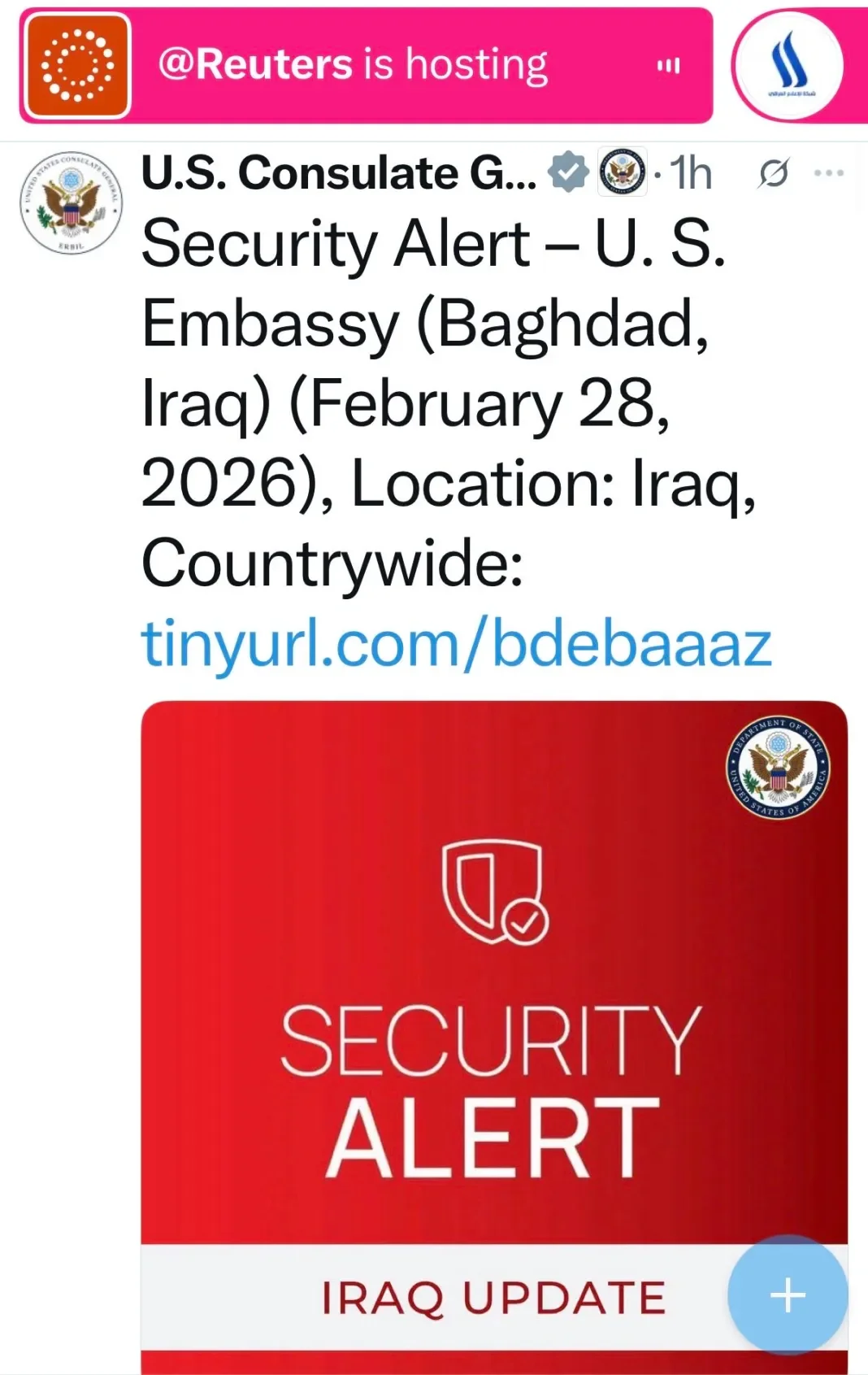
Tishwash: Statement from the US Embassy in Baghdad regarding the demonstrations near the Green Zone
The US Embassy in Baghdad issued a security alert on Sunday (March 1, 2026) regarding demonstrations taking place in areas near the Green Zone in the Iraqi capital.
The embassy said in a statement received by "Baghdad Today" that "the US mission in Iraq advises American citizens to exercise extreme caution, limit their movements, and remain in their places of residence when necessary, given the continued reports of missiles, drones, or projectiles being detected in Iraqi airspace, and to monitor active threats to US interests, including restaurants, businesses, and individuals."
The statement noted that "the southern bank of the July 14 Bridge in Baghdad is witnessing anti-American demonstrations, along with calls for demonstrations in various parts of the country, warning of the possibility of the gatherings turning into acts of violence, in light of a security situation that the embassy described as 'complex and rapidly changing'."
As a precautionary measure, the US mission directed its staff who are able to work from home to do so until further notice, and consular operations, including routine services for US citizens, were temporarily suspended.
She emphasized that "the Level 4 travel warning for Iraq (Do Not Travel) remains in effect, urging American citizens not to travel to Iraq for any reason, and to review their personal security plans if they are already in the country, and not to rely on the U.S. government for departure or evacuation operations."
The statement noted that "Iraqi airspace is currently closed, with the possibility of it being reopened or closed again at short notice," and called on "travelers to contact airlines for the latest information."
The embassy clarified that "work at its headquarters in Baghdad and the US Consulate General in Erbil continues on a limited basis and is restricted to essential operations only."
The embassy, according to the statement, urged “American citizens to enroll in the Smart Traveler Enrollment Program (STEP) to receive security updates, prepare contingency plans, ensure adequate basic necessities, keep their communication devices charged, avoid large gatherings and areas frequented by foreigners, and follow local media to stay informed of developments.”
Tishwash: Gasoline and dollar queues are the first signs... Is Iraq entering a tunnel of economic turmoil?
The ongoing conflict between the United States and Israel on one side, and Iran on the other, has quickly cast a shadow over the overall situation in Iraq, particularly the economic aspect.
Concerns related to energy markets and supply chains have resurfaced, with growing anxiety about the impact of any escalation of the conflict on oil exports, shipping routes, and the stability of the domestic market in a country almost entirely dependent on imports.
The exchange rate of the dollar has also seen a significant increase in Baghdad's Al-Kifah Street market, exceeding 160,000 dinars per 100 dollars, alongside a sharp rise in the prices of both foreign and Iraqi gold in the markets of Baghdad and Erbil. In a tangible indication of the "shock" spreading domestically, Iraqi cities witnessed signs of a fuel crisis.
For example, the city of Fallujah in Anbar province saw long queues at gas stations, revealing the public's sensitivity to any development that might be perceived as a direct threat to supply chains or transportation between provinces.
The government, for its part, attempted to offer reassurances to alleviate the confusion. The Ministry of Trade affirmed that the food situation in Iraq is "stable and under control," and that there are no indications of concern regarding the availability of food in the markets following the Israeli-American attack on Iran.
Ministry of Trade spokesman Mohammed Hanoun stated that "the government has given great attention to the food security file in anticipation of emergency circumstances, and has worked during the past period to strengthen the strategic reserves of basic commodities, especially wheat, in addition to ration card items such as rice, sugar, and oil." He emphasized that "the stock is good and sufficient to meet citizens' needs within a plan aimed at ensuring continued supply and market stability, with daily monitoring of market activity to prevent exploitation and price hikes."
Economically, "energy sensitivity" appears to be the most prominent issue. Iraq may theoretically benefit from higher oil prices, but at the same time, it faces the risks of disruptions to export routes, shipping, and insurance, along with the accompanying pressure on internal stability and prices, especially if the war escalates to a stage where economic infrastructure or maritime routes are targeted.
What about the Strait of Hormuz?
Economist Safwan Qusay warns Al-Mada that "expanding the scope of the war in the Middle East to include economic targets and closing the Strait of Hormuz will lead to a rise in global oil prices, forcing Baghdad to confront the challenge of managing risks, not merely monitoring figures."
Qusay believes that "Iraq needs options to mitigate the potential shock, including reaching an understanding with Saudi Arabia on arrangements to secure supplies in case some routes are disrupted, or relying on the reserves of the Central Bank of Iraq to ensure the financing of public spending for a period that may exceed six months if the crisis enters a phase of severe pressure."
Qusay goes further, discussing logistical alternatives, such as "expanding export routes towards Turkey by utilizing the Kirkuk-Ceyhan pipeline and its capacity, with the possibility of boosting exports by truck to Jordan, Kuwait, or Turkey, depending on developments in the security and trade situation."
Warnings of a more dangerous scenario .
In this context, political analyst Mohammed Naanaa told Al-Mada that "Iraq must prepare for the repercussions and consequences of a war with Iran, especially if the war escalates or the Iranian regime loses control of the internal situation." He warned that the most dangerous scenario is the possibility of the war leading to widespread internal disintegration, which could open the door to large waves of displacement towards the Iraqi border.
Naanaa stressed the necessity of "taking all necessary precautions to confront potential challenges and threats, including administrative and security preparedness and the management of resources and services in the provinces near the front lines."
According to field observations, Iraqi markets remain in a phase of "anticipation and questioning" rather than an actual crisis. However, observers note that this phase could change rapidly if the war continues and expands, especially given the sensitivity of consumer sentiment towards fuel and basic commodities, and the potential for rumors to ignite excessive buying that would disrupt the market even if stocks are stable. link
****************
Mot: Procrastination

A Structural Shift in the Global Financial System that Nobody is Seeing
A Structural Shift in the Global Financial System that Nobody is Seeing
Miles Harris: 3-1-2026
The global financial system is undergoing a significant transformation, driven by the inherent dynamics of its debt-based monetary structure.
In a recent video presentation, “The Structural Foundations of the New Financial System,” Miles Harris introduces a new series that delves into the intricacies of this evolution.
A Structural Shift in the Global Financial System that Nobody is Seeing
Miles Harris: 3-1-2026
The global financial system is undergoing a significant transformation, driven by the inherent dynamics of its debt-based monetary structure.
In a recent video presentation, “The Structural Foundations of the New Financial System,” Miles Harris introduces a new series that delves into the intricacies of this evolution.
The presentation provides a comprehensive overview of the fundamental pillars of the financial system, its historical context, and the challenges it faces in the modern era.
At the heart of the financial system lies a complex interplay between credit creation, collateral base, and settlement infrastructure. The speaker emphasizes that the system’s stability is threatened when credit creation outpaces the growth of underlying assets and collateral, leading to increased fragility.
As debt levels rise, the ability to settle transactions weakens, making the system more vulnerable to shocks. This is particularly concerning when credit expansion surpasses the growth of real assets and liquidity becomes concentrated in too few institutions.
To understand the current state of the financial system, it’s essential to examine its historical context.
The gold standard era provides valuable insights into how collateral definitions and settlement speed influenced financial stability and scalability.
The transition from asset-backed collateral (gold) to debt-based collateral (government debt) post-1971 marked a significant shift, enabling massive credit expansion but also creating paradoxes. The system now relies on debt to create collateral to back further debt, raising concerns about its long-term sustainability.
The expansion of shadow credit and offshore dollar markets has further complicated the financial landscape, increasing liquidity outside traditional banking systems.
While this has provided new avenues for credit creation, it has also reduced visibility and stability. The emergence of new technologies, such as programmable currencies and stablecoins, may increase transparency and settlement efficiency but also raises concerns about control and surveillance.
As the financial system continues to evolve, several key questions arise: Is debt growing faster than real resources? Is money too concentrated? Are financial promises becoming overly complex and opaque?
The presentation highlights the need for evolving settlement infrastructure, expanding or enhancing collateral, and upgrading liquidity mechanisms to address these challenges.
The ongoing transformation of the global financial system will have far-reaching implications in the coming years and decades.
It’s crucial to grasp the fundamental knowledge underlying this evolution to navigate the changing landscape. By understanding the structural foundations of the new financial system, we can better appreciate the challenges and opportunities that lie ahead.
For those interested in gaining a deeper understanding of the evolving financial architecture, we recommend watching the full video presentation by Miles Harris.
The series promises to provide valuable insights into the complex dynamics driving the transformation of the global financial system.
As the financial system continues to evolve, it’s essential to stay informed about the latest developments and trends. By doing so, we can gain a better understanding of the complex interplay between credit creation, collateral, and settlement infrastructure, and how they shape the future of finance.