
A 30% Surge in Gold by Year-End , Path to $5,000 Swift - Vermeulen
A 30% Surge in Gold by Year-End , Path to $5,000 Swift - Vermeulen
Daniela Cambone: 11-10-2025
I'm looking for a 30% explosion to $5,100 gold by year-end," says Chris Vermeulen, Chief Market Strategist of The Technical Traders.
In today's interview with Daniela Cambone, the veteran chartist, who accurately called gold's recent breakout, dissects the "mere three-wave correction" that has spooked momentum traders.
A 30% Surge in Gold by Year-End , Path to $5,000 Swift - Vermeulen
Daniela Cambone: 11-10-2025
I'm looking for a 30% explosion to $5,100 gold by year-end," says Chris Vermeulen, Chief Market Strategist of The Technical Traders.
In today's interview with Daniela Cambone, the veteran chartist, who accurately called gold's recent breakout, dissects the "mere three-wave correction" that has spooked momentum traders.
He details the "herd mentality" that first drove prices higher and argues this pullback is a classic shakeout before a parabolic surge, drawing direct and "scary" parallels to the 2007 pre-crisis setup.
“Tidbits From TNT” Tuesday 11-11-2025
TNT:
Tishwash: Do you know how much gold Iraq possesses? Find out where Arab countries rank!
The World Gold Council announced on Monday that Iraq and nine other Arab countries collectively possess approximately 1,498 tons of gold reserves, according to its latest data issued for the current month of November.
Five Arab countries hold the largest share
The council explained that the top five Arab countries, namely: Saudi Arabia, Lebanon, Algeria, Iraq and Libya, collectively possess 1,101 tons of gold , which constitutes the largest proportion of Arab gold reserves.
TNT:
Tishwash: Do you know how much gold Iraq possesses? Find out where Arab countries rank!
The World Gold Council announced on Monday that Iraq and nine other Arab countries collectively possess approximately 1,498 tons of gold reserves, according to its latest data issued for the current month of November.
Five Arab countries hold the largest share
The council explained that the top five Arab countries, namely: Saudi Arabia, Lebanon, Algeria, Iraq and Libya, collectively possess 1,101 tons of gold , which constitutes the largest proportion of Arab gold reserves.
As for the rest of the Arab countries included in the list, which include Egypt, Qatar, Kuwait and Jordan, their combined reserves amount to 397 tons.
Iraq strengthens its reserves and maintains its global ranking
According to the report, Iraq increased its gold reserves to 171.9 tons during August, after it had been 162.7 tons in July, which enabled it to maintain its 29th position globally among the 100 countries included in the ranking of the world’s largest gold reserves. link
Tishwash: Urgent | President of the Republic: Holding legislative elections confirms our commitment to constitutional and democratic political life.
President Abdul Latif Jamal Rashid affirmed that holding the sixth legislative elections represents a new and important stage in Iraq’s political and democratic path, noting that this constitutional entitlement embodies the state’s commitment to constitutional and democratic political life.
In a statement issued on the occasion of the elections, the President said, “Our people have proven that they are worthy of continuing their civilizational achievements, and have presented a distinguished democratic model of coexistence among its various components,” calling for “active and broad participation in the electoral process as the best way to correct mistakes, address shortcomings, and develop the political system.”
He added that “electing is a national right and duty, and the Presidency has worked to support all parties concerned with implementing this national entitlement to ensure its integrity and transparency,” stressing “the importance of voters being realistic, honest and trustworthy in choosing the candidates who will represent them in the House of Representatives and be the watchful eye protecting their rights and interests.”
The President concluded by affirming that “the Presidency will continue to support the upcoming House of Representatives in enacting important laws that activate the articles of the Constitution and complete the institutional building of the state on solid foundations of justice and citizenship.” link
************
Tishwash: Iraq enters the era of digital services... How has electronic payment changed the lives of citizens?
Prepared by : Mohammed Hussein Al-Abousi – President of the Arab Youth Organization
Cash transactions are no longer the preferred method of transportation in Iraq, as digital services, particularly electronic payments , have begun to rapidly transform citizens' daily lives. With the expansion of e-wallet networks and digital banks, Iraq is effectively entering the era of the digital economy , a move considered a historic shift in the country's economic and social structure.
From salaries to bills, everything has gone digital.
Data from the Central Bank of Iraq indicates a significant increase in the number of e-wallet users over the past two years, with companies like Zain Cash , Asiacell Money , and KeyCard expanding their electronic payment and transfer services across all governorates. Employees can now receive their salaries through digital applications and pay their electricity and internet bills without needing to visit government offices, saving time and effort and reducing traditional cash transactions that previously burdened citizens.
A national project to change financial culture
In this context, the Arab Youth Organization implemented a year-long national project to promote a culture of electronic payments . This included organizing training workshops in ten Iraqi governorates , with the participation of hundreds of young people from civil society organizations. The project aimed to enhance financial literacy and encourage citizens to use digital tools in their daily lives, thus contributing to the creation of a new generation better equipped to engage with modern financial technology.
Electronic payment reduces corruption and increases transparency
Economists believe that the shift towards electronic payments not only facilitates transactions but is also a crucial step in combating corruption and reducing the informal economy. Tracking financial transactions electronically limits financial manipulation and strengthens trust between citizens and government institutions.
Furthermore, the digitization of financial transactions opens the door to investment in financial technology (FinTech) and encourages banks to adopt innovative solutions that keep pace with global developments.
Broad social impact
The effects of this transformation were not limited to the economy alone, but were also reflected in society. With the increasing use of electronic payments among young people, women, and students, a new culture emerged based on financial independence and personal budgeting, in addition to creating job opportunities in the fields of technology, customer service, and digital marketing.
Basrawi website opinion
Basrawi.com believes that Iraq is currently experiencing the beginnings of a true digital era, and that the widespread adoption of electronic payments among citizens paves the way for building a comprehensive knowledge-based economy .
It emphasizes that the continuation of this transformation requires governmental and legislative support on one hand, and the ongoing initiatives of civil society, such as the Arab Youth Organization project, on the other, to ensure that digital services reach all segments of society. link
Mot: The Fight is REAL!!!!

Mot: . and another ole ""Motisum"" -- the Perfect Gift - isn't!!!
Seeds of Wisdom RV and Economics Updates Tuesday Afternoon 11-11-25
Good Afternoon Dinar Recaps,
AI Financial Governance — Algorithms Managing Global Risk
Artificial intelligence is increasingly shaping policy, oversight, and real-time market stability.
Overview
AI-driven governance is emerging as a critical pillar of the global financial reset. Central banks, regulators, and large financial institutions are deploying machine learning and predictive analytics to monitor systemic risk, optimize monetary policy, and ensure compliance across complex digital and cross-border markets.
Good Afternoon Dinar Recaps,
AI Financial Governance — Algorithms Managing Global Risk
Artificial intelligence is increasingly shaping policy, oversight, and real-time market stability.
Overview
AI-driven governance is emerging as a critical pillar of the global financial reset. Central banks, regulators, and large financial institutions are deploying machine learning and predictive analytics to monitor systemic risk, optimize monetary policy, and ensure compliance across complex digital and cross-border markets.
Current Developments
Central banks are using AI models for real-time stress testing, liquidity management, and fraud detection, creating a new standard for proactive oversight.
The G20 and other multilateral institutions are drafting standards for AI transparency and accountability in financial governance, ensuring that algorithmic decisions are auditable and reliable.
AI-enabled monitoring of tokenized assets, CBDCs, and cross-border settlements allows for instant detection of anomalies, reducing systemic exposure to shocks and enhancing market confidence.
What It Means
AI governance is essential for:
Integrating tokenized assets and digital currencies into regulated financial systems.
Enhancing predictive capacity to prevent crises before they cascade.
Providing oversight across jurisdictions where traditional regulators may lack resources or expertise.
Why This Matters
Without AI governance, the speed and complexity of a tokenized, multi-currency global system could overwhelm human oversight. Properly deployed, AI becomes a stabilizing force that makes the global financial reset operationally feasible. Observers should monitor regulatory adoption of AI standards and central bank implementations as leading indicators of a coordinated reset.
This is not just politics — it’s global finance restructuring before our eyes.
Seeds of Wisdom Team
Newshounds News™ Exclusive
Sources
~~~~~~~~~
Geopolitical Alignment — Diplomacy and Finance Converge
Global power shifts are synchronizing economic, political, and financial strategies.
Overview
Geopolitical realignment underpins the entire global financial reset. Diplomatic breakthroughs, regional alliances, and strategic engagements are increasingly tied to financial flows, debt restructuring, and currency integration. Trade, sanctions, and foreign investment are now coordinated with broader global policy objectives.
Current Developments
The U.S. has lifted key sanctions on Syria, enabling reconstruction investments and diplomatic engagement with previously adversarial leaders.
Germany’s presence at the BRICS summit highlights European interest in maintaining strategic dialogue with emerging economic powers.
Tanzania’s contested elections and subsequent international scrutiny demonstrate how political stability and governance intersect with economic credibility, affecting investment and regional integration.
What It Means
Financial reset and geopolitical alignment are mutually reinforcing:
Countries with aligned policies can participate in multi-currency trade and tokenized asset settlements.
Diplomatic agreements reduce the risk of sanctions-driven fragmentation.
Political stability underpins investor confidence, enabling debt restructuring and large-scale infrastructure financing.
Why This Matters
Without coordinated geopolitical alignment, the other four pillars — debt realignment, currency integration, tokenization, and AI governance — risk operating in fragmented silos. Observers should track cross-border summits, sanctions policy shifts, and regional alliances as leading indicators of a comprehensive reset.
This is not just politics — it’s global finance restructuring before our eyes.
Seeds of Wisdom Team
Newshounds News™ Exclusive
Sources
Newsweek — Trump Welcomes New Syrian Leader Ahmad al-Sharaa as US Lifts Sanctions
Watcher Guru — MPs From Germany To Attend BRICS Summit in Russia
Modern Diplomacy — Tanzania’s 2025 Elections: AU and SADC Condemn Final Results
Reuters — BRICS Expands Global Cooperation Beyond Dollar Trade
~~~~~~~~~
Seeds of Wisdom Team RV Currency Facts Youtube and Rumble
Newshound's News Telegram Room Link
RV Facts with Proof Links Link
RV Updates Proof links - Facts Link
Follow the Gold/Silver Rate COMEX
Follow Fast Facts
Seeds of Wisdom Team™ Website
Thank you Dinar Recaps
Ariel : Iraq Dinar Update, are we Crossing the Rubicon?
Ariel : Iraq Dinar Update, are we Crossing the Rubicon?
Iraq Dinar Update: Are We Crossing The Rubicon? (The Changing Of The Guard) We Are Stepping Into Our Destiny
Let’s Look At Some Outlines (This Is What We Know)
U.S. Treasury’s Stranglehold on Iraqi Banking System:
Treasury operatives embedded in Baghdad dictate every major transaction, sanctioning 19 banks in 2025 alone for funneling to Tehran-backed networks. Direct correspondent bans dollar access, forcing Iraqi institutions into Treasury-vetted channels. Which is a genius move by the way.
Ariel : Iraq Dinar Update, are we Crossing the Rubicon?
Iraq Dinar Update: Are We Crossing The Rubicon? (The Changing Of The Guard) We Are Stepping Into Our Destiny
Let’s Look At Some Outlines (This Is What We Know)
U.S. Treasury’s Stranglehold on Iraqi Banking System:
Treasury operatives embedded in Baghdad dictate every major transaction, sanctioning 19 banks in 2025 alone for funneling to Tehran-backed networks. Direct correspondent bans dollar access, forcing Iraqi institutions into Treasury-vetted channels. Which is a genius move by the way.
Quarterly Dubai summits with Federal Reserve enforcers audit compliance, rewriting governance codes and digital infrastructure.
This isn’t partnership it’s ownership, ensuring no dinar move escapes Washington approval. Something we all should welcome at this juncture because they did enough foot dragging. Donald Trump put his foot down and now they are playing by rules that we are setting. I would have it no other way. It’s been long enough.
Trump’s directives echo unchallenged: Iraq repays through dinar liberation, offsetting billions poured into their systems and airports. Troops stay as collateral until Forex lights up with reinstated rates. This isn’t negotiation it’s extraction, with 2025 marking the expiration of program-rate tolerance.
The shift delivers what America built. A currency unbound, debts squared. Not to mention 24 Iraqi institutions fully vetted and seized under direct U.S. oversight, dollar access revoked from Iran-linked conduits, forcing all flows into compliant rails for uncontested rollout.
Which means top 12 proxy commanders asset-frozen and relocated, disarmament crews embedded in PMF units, clearing sovereign control for currency liberation without interference.
People listen to me. Iraq sustains the 3.00 rate through freshly unlocked oil revenues now flowing exclusively into Treasury-vetted accounts, with daily barrels hitting record pipelines that dwarf pre-war output while every dollar is captured for reserves.
So they will have the ability to support a 3.00 rate. Gold vaults in Baghdad quietly surpassed 180 tons this quarter, providing an unbreakable physical anchor that turns the dinar into a commodity-backed powerhouse no algorithm can touch.
Militia cash pipelines have been surgically severed and redirected into state coffers, flooding the Central Bank with billions previously siphoned to proxies. The delete-zeros maneuver strips value only from internal circulation while external notes ride the full reinstatement wave, backed by Trump’s enforced repayment structure that transforms America’s rebuilt banking grid into Iraq’s permanent wealth engine.
Read Full Article: https://www.patreon.com/posts/iraq-dinar-are-143293031
Here We Go….
Majeed: Potential rate for IQD is $3.22-$4.25
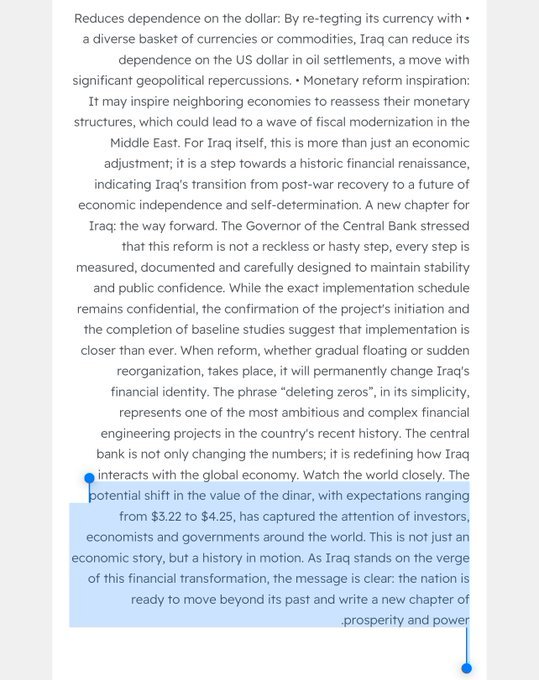
The Iraqi Dinar Reform (Without Zeros)
Crypto Trader: The Iraqi dinar without zeros: The Central Bank of Iraq launches a historic reform.
Seeds of Wisdom RV and Economics Updates Tuesday Morning 11-11-25
Good Morning Dinar Recaps,
The Five Pillars of the Global Financial Reset — Where We Stand and What’s Still Missing
How coordinated debt, currency, and digital asset policies are converging toward a global monetary realignment.
Overview
The concept of a Global Financial Reset is no longer theoretical. Across continents, governments and financial institutions are quietly restructuring debt, piloting digital currencies, integrating trade settlements outside the dollar, and building AI-driven oversight systems. Yet, the reset remains incomplete — a work in progress that requires synchronization across what can be called the Five Foundational Pillars of the new global order.
Good Morning Dinar Recaps,
The Five Pillars of the Global Financial Reset — Where We Stand and What’s Still Missing
How coordinated debt, currency, and digital asset policies are converging toward a global monetary realignment.
Overview
The concept of a Global Financial Reset is no longer theoretical. Across continents, governments and financial institutions are quietly restructuring debt, piloting digital currencies, integrating trade settlements outside the dollar, and building AI-driven oversight systems. Yet, the reset remains incomplete — a work in progress that requires synchronization across what can be called the Five Foundational Pillars of the new global order.
************************************
Current Status
Sovereign Debt Realignment: Debt forgiveness and restructuring negotiations have accelerated among developing economies, notably under the IMF’s “Resilience and Sustainability Trust” and China’s debt-for-equity arrangements in Africa and Latin America.
Currency & Trade Integration: The rise of BRICS+ trade settlements in gold and local currencies is reshaping cross-border commerce, while the U.S. and EU accelerate their digital currency frameworks.
Tokenized Assets: Banks are testing blockchain-based settlement layers for tokenized cash and securities — JPMorgan’s Onyx platform processed over $2 trillion in tokenized transactions this year alone.
AI Financial Governance: Central banks now deploy AI for real-time risk monitoring, while the G20 has drafted standards for algorithmic transparency in monetary policy.
Geopolitical Alignment: Diplomatic breakthroughs — from the U.S.–Syria sanctions thaw to Germany’s quiet presence at the BRICS summit — indicate the merging of economic and political realignments into a single framework.
What’s Still Missing
Global adoption still requires interoperability — between digital currencies, between AI governance systems, and among trade blocs. Without trust in shared regulatory and valuation systems, fragmentation remains the primary obstacle to a true “reset.” The next phase will hinge on transparency, convertibility, and coordinated AI oversight.
Why This Matters
What’s unfolding is not simply another market cycle but a structural convergence — a rewrite of how money, value, and sovereignty interact in the 21st century. The world is edging toward a single interconnected monetary ecosystem, but the synchronization of its five pillars will determine whether it stabilizes or fractures global finance.
This is not just politics — it’s global finance restructuring before our eyes.
Seeds of Wisdom Team
Newshounds News™ Exclusive
Sources
BIS — The Next‑Generation Monetary and Financial System (Annual Economic Report, 2025)
Forbes — The BRICS’s New Gold Settlement Architecture Is Being Built (Oct 26 2025)
ECB — The Quest for Cheaper and Faster Cross‑Border Payments (Jun 27 2025)
McKinsey — The Stable Door Opens: How Tokenized Cash Enables Next‑Gen Payments
JPMorgan — 2025 Cross‑Border Payments Trends for Financial Institutions
*********************************************
Sovereign Debt Realignment — Quiet Restructuring Beneath the Surface
Debt renegotiations and strategic write-downs are redefining financial sovereignty across continents.
Overview
The global debt landscape is shifting. Over the past year, dozens of developing economies have quietly entered renegotiations under new frameworks designed to stabilize currencies and attract foreign investment. While headlines focus on trade wars and sanctions relief, the deeper restructuring — sovereign debt realignment — represents a fundamental pillar of the global financial reset.
Key Developments
IMF-led initiatives like the Resilience and Sustainability Trust are merging with regional debt swaps and bilateral settlements that convert liabilities into tangible investments. China has reframed portions of its Belt and Road debt into equity participation, effectively creating state-backed public–private partnerships. Meanwhile, the U.S. Treasury and European institutions are experimenting with “Green Bond Offsets,” allowing developing nations to trade environmental progress for debt reduction.
In Africa and Latin America, several nations — including Zambia, Ghana, and Argentina — have entered new hybrid repayment agreements involving commodity guarantees, signaling a move away from pure cash-based settlement toward real-asset backing. This transition points to a model of real-world collateralization rather than perpetual borrowing.
What It Means
The emerging pattern isn’t default — it’s controlled deconstruction. Major lenders are reclassifying old debt under sustainability and reconstruction mechanisms, giving nations temporary breathing room while preserving creditor influence. The next phase will likely involve digitally tracked debt instruments, allowing transparent, tokenized monitoring of repayment schedules.
Why This Matters
Sovereign debt realignment lays the foundation for everything that follows — currency integration, digital asset tokenization, and geopolitical negotiation. Without balance sheet stabilization at the sovereign level, no global reset can achieve credibility. The world’s monetary architecture is being rebuilt from its most fragile corner outward.
This is not just politics — it’s global finance restructuring before our eyes.
Seeds of Wisdom Team
Newshounds News™ Exclusive
Sources
~~~~~~~~~
********************************
Currency & Trade Integration — The Shift Beyond the Dollar
Alternative currencies and regional settlement corridors are quietly reshaping global commerce.
Overview
Currency and trade integration is emerging as a cornerstone of the global financial reset. While the U.S. dollar remains dominant, BRICS nations, regional trade partners, and strategic commodity exporters are building infrastructure to trade outside the dollar system, supported by alternative currency settlements and gold-backed frameworks.
Current Developments
BRICS+ countries continue piloting gold-anchored settlement systems, allowing member nations to conduct trade in local currencies backed by physical reserves. This reduces reliance on the U.S. dollar and mitigates exchange-rate volatility in high-value trade corridors.
The European Central Bank (ECB) and other major institutions are advancing digital euro and cross-border CBDC initiatives, enhancing interoperability with tokenized cash and alternative settlement rails.
Select central banks are signing bilateral swap agreements, expanding foreign currency liquidity to support trade in non-dollar currencies while maintaining market stability.
What It Means
A functioning multi-currency trade ecosystem would allow businesses and governments to settle international trade with greater flexibility and reduce exposure to unilateral sanctions or monetary shocks. Full adoption will require:
Interoperable digital currency frameworks across continents.
Legal and operational frameworks for cross-border settlements.
Clear accounting and regulatory standards for multi-currency trade.
Why This Matters
Currency and trade integration provides the practical rails for the reset. Without functioning alternatives to dollar dominance, debt restructuring, tokenized asset adoption, and geopolitical realignment cannot fully take hold. Observers should watch the expansion of BRICS settlement corridors, digital euro pilots, and major central bank swap agreements as early indicators of a systemic shift.
This is not just politics — it’s global finance restructuring before our eyes.
Seeds of Wisdom Team
Newshounds News™ Exclusive
Sources
Forbes — The BRICS’s New Gold Settlement Architecture Is Being Built
BIS — Cross-Border Payments: Building a Global Settlement Layer
ECB — The Quest for Cheaper and Faster Cross-Border Payments
IMF — Global Currency Trends and Alternative Settlement Systems 2025
~~~~~~~~~
Tokenized Assets — From Pilot Programs to Systemic Infrastructure
Digital representation of cash, securities, and commodities is redefining financial markets.
Overview
Tokenization converts physical or digital assets into blockchain-based representations, enabling instant settlement, programmable contracts, and global custody. This pillar is rapidly gaining momentum, providing the plumbing for cross-border trade and investment that supports a global financial reset.
Current Developments
Major financial institutions and central banks are piloting tokenized cash and securities, including JPMorgan’s Onyx platform, which has processed trillions in tokenized transactions.
Regulatory progress, such as the U.S. Senate Agriculture Committee’s draft crypto market structure bill, clarifies the scope of the CFTC and SEC, removing uncertainty around digital asset custody and settlement.
Tokenized commodities and stablecoins are increasingly used for cross-border payments, reducing reliance on traditional correspondent banking and improving liquidity management for corporates and sovereigns.
What It Means
For tokenized assets to support a global reset, the following are critical:
Interoperability between CBDCs, tokenized instruments, and traditional banking systems.
Legal recognition of tokenized ownership and enforceability across jurisdictions.
Institutional adoption of custody and settlement infrastructure at scale.
Why This Matters
Tokenized assets are not just a technological innovation — they are a necessary backbone for cross-border liquidity and settlement. Without widespread adoption, alternative trade corridors and debt realignment risk remaining fragmented. Observers should watch pilot programs scale, legislation pass, and banks integrate tokenized instruments into their core treasury functions.
This is not just politics — it’s global finance restructuring before our eyes.
Seeds of Wisdom Team
Newshounds News™ Exclusive
Sources
Cointelegraph — Senate AG Releases Crypto Market Structure Bill Draft
McKinsey — The Stable Door Opens: How Tokenized Cash Enables Next-Gen Payments
McKinsey — From Ripples to Waves: The Transformational Power of Tokenizing Assets
JPMorgan — 2025 Cross-Border Payments Trends for Financial Institutions
~~~~~~~~~
Seeds of Wisdom Team RV Currency Facts Youtube and Rumble
Newshound's News Telegram Room Link
RV Facts with Proof Links Link
RV Updates Proof links - Facts Link
Follow the Gold/Silver Rate COMEX
Follow Fast Facts
Seeds of Wisdom Team™ Website
Thank you Dinar Recaps
The Debt Has Increased By HALF A TRILLION Since The Shutdown Began
The Debt Has Increased By HALF A TRILLION Since The Shutdown Began
Notes From the Field By James Hickman (Simon Black) November 10, 2025
By the autumn of 1648, England had been embroiled in a chaotic and bloody civil war for more than six years. Extreme ideological tensions in England had been building for decades over freedom of religion, plus the balance of power within government.
King Charles was wildly unpopular. And a majority of politicians in parliament saw it as their sole mission to resist him. Many believed adamantly that parliament should rule over the king and ultimately dictate all laws in England.
The Debt Has Increased By HALF A TRILLION Since The Shutdown Began
Notes From the Field By James Hickman (Simon Black) November 10, 2025
By the autumn of 1648, England had been embroiled in a chaotic and bloody civil war for more than six years. Extreme ideological tensions in England had been building for decades over freedom of religion, plus the balance of power within government.
King Charles was wildly unpopular. And a majority of politicians in parliament saw it as their sole mission to resist him. Many believed adamantly that parliament should rule over the king and ultimately dictate all laws in England.
On the other side, a number of traditionalists thought parliament to be a corrupt body of liars and thieves, and they wanted to preserve the power of both church and king.
Tensions erupted into war in 1642, eventually resulting in Charles’ capture and imprisonment.
At that point the majority of parliament didn’t have any desire to extend the crisis any further. They felt like they had won sufficient concessions. Enough was enough. So they negotiated a peace treaty to end the civil war, much to the relief of people across England.
Unfortunately there were a number of radicals who pledged to continue the fight no matter the cost. They viewed any compromise as failure.
One of those was a little known Member of Parliament named Oliver Cromwell, who, on December 6, 1648, sent more than a thousand troops to surround the palace of Westminster and block the entrance of Parliament.
Only the most radical members were allowed entry; the rest were either blocked or arrested.
Cromwell’s aim was to prevent the peace treaty from being ratified; he felt that it was too soft with too many compromises. And as a result, the English Civil War continued, followed by Cromwell’s personal dictatorship, for more than a decade.
I hope I’m wrong but I think the US is in store for a similar head fake. After more than a month of the shutdown, there were signs over the weekend that a compromise had been reached in the United States Senate.
But the theater began almost immediately after, with the radical Left vomiting all over the deal and insisting that they would “continue to fight.”
My sense is that while a lot of people may believe that the government shutdown is nearly over, this may in fact just be another miss, just like England’s ‘almost’ peace treaty in 1648. There’s a good chance this compromise will be blocked by aggressive radicals in Congress.
To say this is a national embarrassment is a massive understatement. And at this point it’s nearly all branches of government and institutions chipping away at the remaining dignity of America.
One of the things that I find most bizarre is how many prominent radicals seem to think their shutdown is “winning the hearts and minds of the American people.”
They believe this because of last week’s gubernatorial elections in New Jersey and Virginia in which the candidates from their party won.
Now, the combined margin of victory of both candidates was about one million people. There are roughly 350 million people in the United States.
Yet, in the mind of a Leftist radical, one million voters in two states speak for 350 million Americans in 50 states, and therefore they have a moral mandate to keep “fighting” while the government remains closed.
This raises a key question: fighting for what?
Well, they claim to be fighting for healthcare affordability. Coincidentally this is the same party that passed Obamacare more than a decade ago— during which time the cost of health insurance in the US has soared above and beyond the already uncomfortably high rate of inflation.
Strange, considering that the actual name of the legislation was the Affordable Care Act. Yet it seems to have only made healthcare less affordable.
Seeds of Wisdom RV and Economics Updates Monday Evening 11-10-25
Good Evening Dinar Recaps,
BRICS Carbon Markets at a Crossroads: Article 6 or a New Era?
Emerging-economy bloc must choose between a unified internal trading system or full integration with multilateral carbon markets.
Overview
The BRICS carbon-markets partnership—launched at the 2024 Kazan summit—now stands at a pivotal decision point: will member states build a bespoke intra-BRICS credit-trading regime via mutual recognition of registers and standards, or will they align with the multilateral framework of Paris Agreement Article 6? The question carries major implications for climate diplomacy, trade, and financial flows in the global economy.
Good Evening Dinar Recaps,
BRICS Carbon Markets at a Crossroads: Article 6 or a New Era?
Emerging-economy bloc must choose between a unified internal trading system or full integration with multilateral carbon markets.
Overview
The BRICS carbon-markets partnership—launched at the 2024 Kazan summit—now stands at a pivotal decision point: will member states build a bespoke intra-BRICS credit-trading regime via mutual recognition of registers and standards, or will they align with the multilateral framework of Paris Agreement Article 6? The question carries major implications for climate diplomacy, trade, and financial flows in the global economy.
Key Developments
The Kazan declaration described the partnership as a platform for “potential intra-BRICS cooperation on carbon markets to exchange views on potential cooperation under Article 6 of the Paris Agreement among the BRICS countries.”
By early 2025, eight out of eleven BRICS-group countries had established a voluntary carbon-credit market, with two others finalising regulatory frameworks.
Significant divergence exists in national approaches: e.g., China rejects foreign registries and only allows domestic projects; other members like Brazil and South Africa convert credits from international registries (Verra, Gold Standard) into national systems.
Credit-price disparities: about US$14 per credit in Beijing versus under US$3 in Indonesia—highlighting major structural differences.
BRICS leaders formally opposed unilateral green-protectionism measures, including carbon border adjustment mechanisms (CBAM), reinforcing their preference for a system designed by emerging economies.
Meanwhile, the international framework under Article 6 of the Paris Agreement (including Articles 6.2 and 6.4) is increasingly operationalised—offering an alternative path to market cooperation.
Why It Matters
This moment matters because the decision will shape how carbon-credit flows, climate finance and trade linkages evolve among major emerging economies—and how they interact with the established Western-dominated climate-finance system.
If BRICS members opt for a self-contained recognition regime, we may see a parallel carbon-market architecture outside the dominant frameworks. Conversely, alignment with Article 6 could integrate BRICS into the global carbon-market infrastructure, boosting transparency and linkage with global capital flows—but also potentially ceding some regulatory sovereignty.
Implications for the Global Reset
Pillar: Markets — Carbon credits are not just climate instruments; they are becoming tradeable assets that factor into real economic flows across borders.
Pillar: Finance — The structure of credit-generation and trading impacts capital-investment decisions in emerging economies, and affects how climate risk is priced.
Pillar: Currency & Reserve System — If BRICS currencies or regional credit-settlement systems end up being used in carbon-trade settlement, this could erode the dominance of dollar-settled frameworks.
The deeper point: the interplay of climate-markets, trade-regulation and financial architecture means that the global reset is not only about money and states, but about how value is created and transferred in a decarbonising world.
This is not just politics — it’s global finance restructuring before our eyes.
Seeds of Wisdom Team
Newshounds News™ Exclusive
Sources
Watcher.Guru, “BRICS Carbon Markets at a Crossroads: Article 6 or New Era?” 10 Nov 2025. (https://watcher.guru/news/brics-carbon-markets-at-a-crossroads-article-6-or-new-era) Watcher Guru
RenewableMatter.eu, “BRICS at a crossroads: mutual recognition or Article 6?” 7 Nov 2025. (https://www.renewablematter.eu/en/brics-at-a-crossroads-mutual-recognition-or-article-6) Renewable Matter
UNFCCC, “What is Article 6 of the Paris Agreement?” (https://unfccc.int/process-and-meetings/the-paris-agreement/article-6) UNFCCC
Columbia University Energy Policy Institute, “How to Fully Operationalize Article 6 of the Paris Agreement” Sept 2025. CGEP
~~~~~~~~~
Seeds of Wisdom Team RV Currency Facts Youtube and Rumble
Newshound's News Telegram Room Link
RV Facts with Proof Links Link
RV Updates Proof links - Facts Link
Follow the Gold/Silver Rate COMEX
Follow Fast Facts
Seeds of Wisdom Team™ Website
Thank you Dinar Recaps
Derivatives, US Debt, and the Dollar’s Last Stand
GOLD RUSH HOUR: Derivatives, US Debt, and the Dollar’s Last Stand
Taylor Kenny: 11-9-2025
Whispers of instability are growing louder, not just from the fringe, but from within the very heart of global finance.
If you’ve felt a nagging sense that something significant is shifting beneath the surface of our economic world, you’re not alone. A recent video discussion from ITM Trading delves deep into these escalating financial and economic challenges, painting a compelling picture of a world on the cusp of a “Great Gold Reset.”
This isn’t just about market fluctuations; it’s about a monumental structural transformation, and gold is being positioned right at its epicenter.
GOLD RUSH HOUR: Derivatives, US Debt, and the Dollar’s Last Stand
Taylor Kenny: 11-9-2025
Whispers of instability are growing louder, not just from the fringe, but from within the very heart of global finance.
If you’ve felt a nagging sense that something significant is shifting beneath the surface of our economic world, you’re not alone. A recent video discussion from ITM Trading delves deep into these escalating financial and economic challenges, painting a compelling picture of a world on the cusp of a “Great Gold Reset.”
This isn’t just about market fluctuations; it’s about a monumental structural transformation, and gold is being positioned right at its epicenter.
The conversation begins with a stark observation: China’s relentless accumulation of gold. This isn’t just a casual investment; it’s a strategic, multi-faceted move, executed both openly and through undisclosed channels. Why?
Because China, and increasingly other nations, seem to be anticipating a major upheaval in the global financial order. Their gold hoard isn’t merely a commodity purchase; it’s a foundational step towards a new monetary reality.
At the core of this looming instability lies the unsustainability of U.S. debt. We’re now talking about annual interest payments exceeding an astronomical $1 trillion. Think about that for a moment – money spent solely on servicing past debt, money that could fund critical infrastructure, education, or innovation.
Compounding this is the Federal Reserve’s delicate dance. The end of quantitative tightening (QT) – a process meant to shrink the Fed’s balance sheet – is viewed by many as a potential precursor to a return to aggressive money printing (quantitative easing, or QE).
This “printer go brrr” scenario, while potentially staving off immediate crises, only inflates the existing debt bubble, devalues the currency, and fuels long-term instability.
The dialogue draws chilling parallels to the 2008 financial crisis, but with a critical difference: the underlying risks today might be even more pervasive and less understood.
The culprits? Opaque derivatives markets, shadow banking, and an array of risky debt instruments. These financial wildcards remain largely unregulated and their potential impact catastrophically underestimated. Imagine a financial system where the biggest threats lurk in the unseen corners, growing quietly in the dark.
Perhaps the most profound topic discussed is the potential erosion of the U.S. dollar’s status as the global reserve currency. This would be a historic, once-in-a-generation shift with ramifications for every corner of the globe.
It’s within this context that the “Great Gold Reset” truly takes shape.
Nations like China and members of the BRICS alliance (Brazil, Russia, India, China, South Africa, and soon others) aren’t just buying gold; they’re actively developing new systems for gold clearing and pricing.
The vision? Gold as the centerpiece of a new global monetary order, a more stable, asset-backed alternative to a debt-laden fiat system.
For those who already own gold, the advice from the experts is clear: hold your gold. This isn’t the time to panic sell. As the crisis deepens and monetary systems face increasing pressure, gold is expected to rise significantly.
Its role as a protective, counter-cyclical asset becomes paramount. Hold it until conversion is truly necessary, for its intrinsic value and historical resilience will be your strongest shield.
This isn’t just an economic blip; it’s a “Fourth Turning” moment, as referenced by Strauss and Howe, or part of Ray Dalio’s “Big Cycle” – a historical pattern of collapse and rebirth. These periods are characterized by profound societal and economic transformations, often turbulent, but ultimately leading to a new order.
While the future remains uncertain and daunting, the human element isn’t lost. The discussion emphasizes the importance of personal financial control through gold ownership.
It’s about empowering individuals to navigate chaos, providing a tangible asset that offers both protection and opportunity when traditional systems falter.
In these transformative times, understanding these shifts isn’t just academic; it’s essential for safeguarding your financial future.
And even amidst talk of global resets and economic upheaval, a Nickelback concert offers a brief, glorious escape – proving that even in the face of monumental change, a little levity (and maybe a good investment in gold) can help us get through.
The Iraqi dinar without zeros: The Central Bank of Iraq launches a historic reform.
TNT:
Tishwash: The Iraqi dinar without zeros: The Central Bank of Iraq launches a historic reform.
Written by Dr. Subhi Jabara…
Research and writing by: Dr. Subhi Jabara
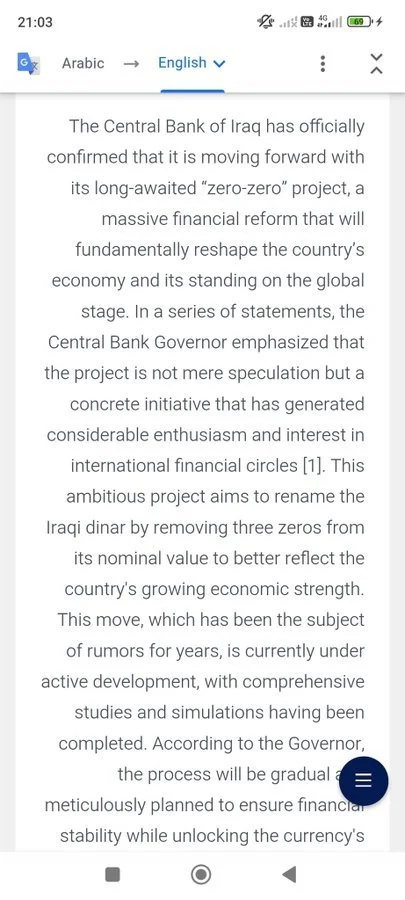
The Central Bank of Iraq has officially confirmed that it is moving forward with its long-awaited “zero-zero” project, a massive financial reform that will fundamentally reshape the country’s economy and its standing on the global stage.
In a series of statements, the Central Bank Governor emphasized that the project is not mere speculation but a concrete initiative that has generated considerable enthusiasm and interest in international financial circles
TNT:
Tishwash: The Iraqi dinar without zeros: The Central Bank of Iraq launches a historic reform.
Written by Dr. Subhi Jabara…
Research and writing by: Dr. Subhi Jabara
The Central Bank of Iraq has officially confirmed that it is moving forward with its long-awaited “zero-zero” project, a massive financial reform that will fundamentally reshape the country’s economy and its standing on the global stage.
In a series of statements, the Central Bank Governor emphasized that the project is not mere speculation but a concrete initiative that has generated considerable enthusiasm and interest in international financial circles

This ambitious project aims to rename the Iraqi dinar by removing three zeros from its nominal value to better reflect the country's growing economic strength.
This move, which has been the subject of rumors for years, is currently under active development, with comprehensive studies and simulations having been completed.
According to the Governor, the process will be gradual and meticulously planned to ensure financial stability while unlocking the currency's true potential.
For years, the Iraqi dinar has suffered from a decline in its nominal value as a result of decades of conflict and economic instability.
The current exchange rate, hovering around an unofficial rate of 1,415 dinars to the US dollar, forces citizens to carry large amounts of cash for their daily transactions and complicates international trade and investment.
The “zero-zero” project was designed to address this problem by simplifying the currency and aligning it with the country’s strong economic fundamentals, including robust oil revenues, expanding gold reserves, and deepening trade partnerships with global powers such as China, the United States, and the European Union
While the Central Bank has been careful not to commit to a specific timeline, the confirmation that the project has begun marks a pivotal moment for Iraq. This represents a transition from post-war recovery to a new era of economic independence.
Signs of Reform: How Will “Removing Zeros” Work?
The phrase “removing zeros” may sound alarming, but it is a standard monetary policy tool known as currency revaluation.
It is not a confiscation of wealth, but rather a recalibration of the currency's nominal value.
In essence, 1,000 old Iraqi dinars will become 1 new dinar. Crucially, all prices, wages, and savings will be adjusted proportionally, ensuring that individuals' purchasing power remains stable at the moment of the shift
The real shift occurs in the subsequent adjustment of the exchange rate
The Central Bank has developed several scenarios, with internal studies predicting that the floating dinar could stabilize automatically at a value in the distant future between 3.22 and 4.25 dinars to the dollar.
The governor clarified that these figures are not a declared rate but rather an indicator of the currency's potential if it is allowed to float freely based on market demand and Iraq's economic fundamentals
Two main paths are being considered for the next phase.
Economists close to the central bank indicate that both options remain on the table. The choice will depend on the government's strategic priorities, whether it favors a gradual, market-driven adjustment or a swift and decisive reset.
Either path would trigger one of the most significant currency transformations in the modern Middle East.
The economic driver: Why is now the right time for a stronger dinar?
The timing of this reform is not coincidental. The Iraqi economy is at an evolutionary turning point.
The country's fiscal position has steadily improved, driven by several key factors:
Strong oil revenues:
As a leading producer in OPEC, Iraq's steady oil revenues provide a stable foundation for its economy and strong support for its currency.
Growing gold reserves:
The central bank is actively expanding its gold reserves, a traditional safe asset that enhances monetary stability and international credibility.
Deepening trade partnerships:
Iraq has developed strong trade relations with major global economies, including China, the United States, and the European Union, diversifying its economic interactions and reducing its dependence on any single partner.
Despite this strength, the nominal value of the dinar has been lagged, widening the gap between the official exchange rate and its true value.
Each time Iraq's GDP grows or its foreign reserves increase, this discrepancy becomes more pronounced.
The “zero-zero” project is the mechanism to close this gap, allowing the currency to finally reflect the country’s true wealth and economic progress
This reform is expected to have profound global implications.
Revaluing the Iraqi dinar would:
• Boost regional investment: A stable and strong currency would make Iraq a more attractive destination for foreign investment, thereby fostering economic growth throughout the region.
• Reduces dependence on the dollar: By re-pegging its currency into a diversified basket of currencies or commodities, Iraq can reduce its reliance on the US dollar for oil settlements, a move with significant geopolitical implications.
• Inspires monetary reform: It could inspire neighboring economies to reassess their monetary structures, potentially triggering a wave of fiscal modernization across the Middle East. For Iraq itself, this is more than just an economic adjustment; It is a step toward a historic fiscal renaissance, signaling Iraq's transition from post-war recovery to a future of economic independence and self-determination.
A new chapter for Iraq: The way forward.
The central bank governor has emphasized that this reform is not a rash or hasty move; Every step is carefully measured, documented, and designed to maintain stability and public confidence. While the precise implementation timeline remains confidential, the confirmation that the project has begun and the preliminary studies are complete indicates that implementation is closer than ever.
When the reform takes place, whether through a gradual float or a sudden restructuring, it will permanently alter Iraq's fiscal identity.
The phrase “removing zeros,” as simple as it sounds, represents one of the most ambitious and complex financial engineering projects in the country’s modern history.
The central bank is not just changing numbers; It is redefining how Iraq interacts with the global economy. The world is watching closely.
The potential shift in the dinar's value, with projections ranging between 3.22 and 4.25 to the dollar, has captured the attention of investors, economists, and governments worldwide.
This is not just an economic story; it is history in motion. As Iraq stands on the precipice of this financial transformation, the message is clear: the nation is ready to transcend its past and write a new chapter of prosperity and strength. link
Seeds of Wisdom RV and Economics Updates Monday Afternoon 11-10-25
Good Afternoon Dinar Recaps,
Saudi Arabia’s State-Backed Stablecoin — Gulf FinTech as a New Reserve Tool
Riyadh leads digital finance innovation under Vision 2030.
Overview
Saudi Arabia is pushing the creation of a nationally-issued stablecoin, regulated by its central bank and capital markets authority, as part of its strategy to modernize its financial system and reduce dollar-dependence.
Good Afternoon Dinar Recaps,
Saudi Arabia’s State-Backed Stablecoin — Gulf FinTech as a New Reserve Tool
Riyadh leads digital finance innovation under Vision 2030.
Overview
Saudi Arabia is pushing the creation of a nationally-issued stablecoin, regulated by its central bank and capital markets authority, as part of its strategy to modernize its financial system and reduce dollar-dependence.
Key Developments
The initiative has received endorsements from major cryptocurrency and digital-asset exchanges, positioning the Kingdom as a regional fintech leader.
79 % of Saudi day-to-day transactions are now cashless, offering fertile ground for a digital-asset settlement infrastructure.
Industry commentary frames the move as a turning point for the Gulf’s digital-asset ecosystem, linking trade-settlement, cross-border payments and national sovereignty.
Why It Matters
The stablecoin initiative is a concrete signal that monetary sovereignty and digital liquidity are becoming central to how states view reserve-currency architecture. For global finance, this marks a pivot: settlement systems may increasingly bypass legacy dollar plumbing, edging toward regional digital rails. Investors and global institutions must consider that reserve currency dynamics are evolving from dollars + bonds toward digital + asset-linked frameworks.
Implications for the Global Reset
Pillar: Currency & Reserve System — A national digital currency denotes a shift in reserve-system architecture.
Pillar: Finance — Enhanced liquidity and settlement efficiency underpin new flows of capital in the Gulf.
The story underlines that the global reset is not just about de-dollarisation, but about a re-engineering of how money, payment and credit are organised in a digital age.
This is not just politics — it’s global finance restructuring before our eyes.
Seeds of Wisdom Team
Newshounds News™ Exclusive
Sources
Al Arabiya News, “Global crypto exchanges back Saudi Arabia’s stablecoin, digital- asset ambitions” 6 Nov 2025. Al Arabiya English
Watcher.Guru, “Saudi Arabia’s Stablecoin Initiative Receives Major Industry Support” Nov 2025. Watcher Guru
Forbes, “The real-world rise of stablecoin remittances for the Gulf region” 26 Oct 2025. Forbes
Carnegie Endowment, “The Future of Cryptocurrency in the Gulf Cooperation Council Countries” May 2025. Carnegie Endowment
~~~~~~~~~
Copper Crisis 2026 — Structural Deficit and the Green-Tech Squeeze
The world’s industrial backbone faces its largest shortage in two decades.
Overview
The global copper market is forecast to face its worst supply deficit in 22 years by 2026—estimated at around 590,000 tons—with potential widening by over 1 million tons by 2029.
Key Developments
Morgan Stanley projects copper prices will remain elevated into 2026, driven by supply disruptions and weaker U.S. dollar.
Analysts cite major mine disruptions, output contractions (first since 2020) and surging demand from AI data centres and electric-vehicle infrastructure as key drivers.
Reuters reports price forecasts rising to ~US $10,500 per metric ton in 2026, reflecting the structural squeeze in one of the world’s key industrial metals.
Why It Matters
Copper is foundational for electrification, infrastructure and high-tech manufacturing. A structural shortage means inflationary pressure, shifts in mining investment, and potential bottlenecks in global growth. For global finance, this demonstrates that the physical commodity base remains a critical factor in any reset of asset valuations, trade flows and reserve hedging strategies.
Implications for the Global Reset
Pillar: Metals — Resource scarcity accelerates commodity-backed trade and alternative asset flows.
Pillar: Markets — Supply constraints force investors to re-evaluate industrial-commodity exposure and inflation risk.
The copper shortage reveals that the global reset is not only monetary, but deeply physical: scarcity of key materials will shape how the system is restructured.
This is not just politics — it’s global finance restructuring before our eyes.
Seeds of Wisdom Team
Newshounds News™ Exclusive
Sources
Watcher.Guru, “Copper Market Crisis: 2026 Set for Biggest Shortage in 22 Years” Nov 2025. Watcher Guru
Chronicle Journal via Investing.com, “Morgan Stanley Bets Big on Commodities: Gold & Copper Shine Amid Inflationary Pressures” 29 Oct 2025. The Chronicle-Journal
Investing.com, “Copper: Supply Shortages May Spark Explosive Breakout” Oct 2025. Investing.com
Reuters, “Copper to hold gains in 2026 as mine disruptions fuel deficit” 27 Oct 2025. Reuters
~~~~~~~~~
Seeds of Wisdom Team RV Currency Facts Youtube and Rumble
Newshound's News Telegram Room Link
RV Facts with Proof Links Link
RV Updates Proof links - Facts Link
Follow the Gold/Silver Rate COMEX
Follow Fast Facts
Seeds of Wisdom Team™ Website
Thank you Dinar Recaps
4 Ways Middle-Class Earners Are Protecting Their Money in Today’s Uncertain Economy
4 Ways Middle-Class Earners Are Protecting Their Money in Today’s Uncertain Economy
Laura Bogart Sun, November 9, 2025 GOBankingRates
When it comes to the global economy these days, you should expect the unexpected. Stock markets are behaving like roller coasters, prices of everyday goods continue to rise, and the job market remains unpredictable. Middle-class earners are feeling the strain. Protecting their money — and their peace of mind — in such uncertainty is a daunting task. Fortunately, safeguarding their hard-earned savings may be easier than they think.
4 Ways Middle-Class Earners Are Protecting Their Money in Today’s Uncertain Economy
Laura Bogart Sun, November 9, 2025 GOBankingRates
When it comes to the global economy these days, you should expect the unexpected. Stock markets are behaving like roller coasters, prices of everyday goods continue to rise, and the job market remains unpredictable. Middle-class earners are feeling the strain. Protecting their money — and their peace of mind — in such uncertainty is a daunting task. Fortunately, safeguarding their hard-earned savings may be easier than they think.
According to Jayant Mistry, CFA, senior vice president, CFO and treasurer of consumer banking at Synchrony, there are some simple yet effective steps middle-class earners can take to ensure that the ups and downs of the broader economy don’t send their personal finances into a spiral.
He shared some of these tips with GOBankingRates as part of our Top 100 Money Experts series.
Plan for a Rainy Day
While you’d like to believe your life will be nothing but sunshine, rainy days — like a job loss, car troubles, health issues or home repairs — will inevitably roll in. Mistry says middle-class earners can protect themselves from getting wet by setting up an emergency fund.
In addition to saving for major life goals, he encourages people to set aside money that can insulate them from financial surprises.
“I think being financially secure is about planning not just for large events, but also rainy days,” he said. “We all have so much going on in our lives, so having tomorrow or someday funds around allows people to feel more secure and have flexibility when difficult life events occur.”
Set Up a System To Pay Yourself First
Though you might want to dive straight into investments or complex money management strategies, Mistry says you’re better off starting slow and simple. He recommends setting up three different bank accounts: one for required expenses, one for wants (such as a money market account) and one for emergencies (ideally a high-yield savings account).
Once you’ve set up your accounts, Mistry wants you to establish a system that lets you “pay yourself first” — or add to your savings — automatically.
TO READ MORE: https://www.yahoo.com/finance/news/4-ways-middle-class-earners-162821576.html