
Seeds of Wisdom RV and Economic Updates Thursday Evening 5-1-25
Good Evening Dinar Recaps,
HOUSE REPUBLICANS TO UNVEIL LANDMARK DRAFT DIGITAL ASSET BILL AHEAD OF KEY CRYPTO HEARING NEXT WEEK
▪️Top Republicans of the House Financial Services Committee alongside their counterparts in the House Agriculture Committee will be releasing a draft ahead of a May 6 hearing on the future of digital assets, sources told The Block
.
▪️The incoming version is set to be similar to one that passed out of the House last year called the Financial Innovation and Technology for the 21st Century Act
Good Evening Dinar Recaps,
HOUSE REPUBLICANS TO UNVEIL LANDMARK DRAFT DIGITAL ASSET BILL AHEAD OF KEY CRYPTO HEARING NEXT WEEK
▪️Top Republicans of the House Financial Services Committee alongside their counterparts in the House Agriculture Committee will be releasing a draft ahead of a May 6 hearing on the future of digital assets, sources told The Block
.
▪️The incoming version is set to be similar to one that passed out of the House last year called the Financial Innovation and Technology for the 21st Century Act
Key lawmakers are set to release a new discussion draft in the coming days that outlines a significant regulatory framework for digital assets, ahead of a major congressional hearing next week.
Top Republicans on the House Financial Services Committee — Reps. French Hill and Bryan Steil — along with their counterparts on the House Agriculture Committee — Reps. Glenn "GT" Thompson and Libertarian Dusty Johnson — will release the draft before a May 6 joint hearing on digital assets, a source familiar with the matter confirmed to The Block.
The hearing, titled “American Innovation and the Future of Digital Assets: A Blueprint for the 21st Century,” will be held at 10 a.m. ET and is expected to focus on long-awaited legislation to define crypto market structure in the United States.
The draft is expected to resemble last year’s Financial Innovation and Technology for the 21st Century Act (FIT 21), which passed the House. A staffer for the House Agriculture Committee also confirmed that the text would be released prior to the hearing.
Committees in the House and Senate have advanced bills focused on stablecoins, and legislation to regulate the crypto industry as a whole has been viewed as the next step. President Donald Trump has said that he wants to see a stablecoin bill on his desk by August, but some say the bills could be linked.
Republicans have been mostly leading efforts on both bills and would need Democratic support to pass. Some Democrats, including crypto critic Rep. Brad Sherman of California, have said that "good crypto regulation" is needed, but Trump-backed crypto ventures could threaten any hope of bipartisanship.
Moving Onwards
The process for a market structure bill is moving quickly, said Ron Hammond, senior director of government relations at the Blockchain Association, as lawmakers could decide to hold another hearing or could go straight away to a markup — the process where lawmakers openly debate, amend, and vote on a bill.
Hammond said he had not seen a version of the discussion draft, but said he had been told it was 90% similar to FIT 21.
"Overall, it's still kind of a black box until we see the text of what actually got changed and what they intend to change after the discussion draft," Hammond said in an interview.
FIT 21 sets out to clarify when a digital asset would be regulated by the Securities and Exchange Commission, the Commodity Futures Trading Commission, or both. It would have ultimately granted more power and funding to the CFTC to oversee crypto spot markets and "digital commodities," particularly bitcoin, and set parameters for the Securities and Exchange Commission.
Meanwhile, the Senate is working on its version of a crypto market structure bill, Hammond said.
Stablecoins - market structure
Combining the two bills has been floated, but there are concerns of partisan divides as the midterms near in November 2026, Hammond said, while others say they should be separated and get stablecoin legislation signed into law first. Work on a stablecoin bill is seen as less complicated than trying to regulate the industry as a whole.
Hill told reporters in March that he views the bills as "linked," and Steil said he viewed the two as peanut butter and jelly.
However, Trump's foray into crypto could complicate crypto legislative efforts. Hill was asked in March about the Trump family's involvement in crypto, which includes a DeFi protocol under development as well as live and tradable memecoins and NFTs. World Liberty Financial, backed by Trump, also recently launched its own stablecoin.
Hill had said that Trump's memecoin and stablecoin involvement has complicated their work.
During congressional hearings over the past several weeks, Democrats have raised alarm bells over Trump's involvement. Top Democrat of the House Financial Services Committee, Maxine Waters of California, accused Trump of making himself richer through his crypto ventures during a hearing last month.
"The more the Trump family gets involved in the crypto realm, and World Liberty Financial gets involved, it just presents another angle of attack for Democrats to attack Trump," Hammond said. "So there is a concern that this will only worsen over time and sour a potential good bipartisan vote in the Senate."
@ Newshounds News™
Source: The Block
~~~~~~~~~
AUSTRALIAN ELECTION WILL BRING PRO-CRYPTO LAWS EITHER WAY
No matter who wins Saturday's election in Australia, crypto legislation developed with the industry is set to finally happen this year.
Despite reports in February suggesting that 2 million pro-crypto voters could decide the outcome of this week’s Australian Federal Election, crypto has barely rated a mention during the campaign.
“I think it’s a missed opportunity,” Independent Reserve founder Adrian Przelozny told Cointelegraph. “Neither side has made crypto a headline issue because they’re wary of polarizing voters or sounding too niche.”
But the good news is that after more than a decade of inaction, both the ruling Australian Labor Party (ALP) and the opposition Liberal Party are promising to enact crypto regulations developed in consultation with the industry.
In April, Shadow Treasurer Angus Taylor promised to release draft crypto regulations within the first 100 days after taking office, while the Treasury itself has draft bills on “regulating digital asset platforms” and “payments system modernization” scheduled for release this quarter.
Amy-Rose Goodey, CEO of the Digital Economy Council of Australia, said that both parties “are equally invested in getting this draft legislation across the line.”
“Irrespective of who gets in, we’re in a better position than we were about a year ago.” Pro-crypto voters have choices in the Senate, too, with the Libertarian Party issuing a 23-page Bitcoin policy in March — calling for the creation of a national Bitcoin Reserve and the acceptance of Bitcoin as legal tender.
The minor party is fielding five Senate candidates in different states, including former Liberal MP Craig Kelly, but doesn’t currently have anyone in the Senate.
The progressive left-wing Greens party has not outlined a position on crypto, while the conservative right-wing One Nation party has campaigned against debanking and CBDCs.
More Than A Decade Of Inaction On Crypto
Australia’s first parliamentary inquiry into digital assets was held back in 2014, but there’s been more than a decade of regulatory inaction since. The industry says this has led to stagnation and a brain drain of talent to jurisdictions like Singapore and the UAE.
The former Liberal Government was considering the landmark Digital Services Act, based on the 2021 Senate Committee’s crypto recommendations, when it lost office in 2022. Despite ongoing consultations since, the ALP government, led by Prime Minister Anthony Albanese, hasn’t put forward any legislation to parliament.
But there has definitely been a vibe shift from the ALP recently, with Treasurer Jim Chalmers telling Cointelegraph that digital assets “represent big opportunities for our economy.”
”We want to seize these opportunities and encourage innovation at the same time as making sure Australians can use and invest in digital assets safely and securely with appropriate regulation.”
His office said exposure draft legislation would be released “in 2025” for consultation, introduced into Parliament “once that feedback has been considered” with the subsequent reforms “phased in over time to minimize disruptions to existing businesses.”
The shadow assistant treasurer, Luke Howarth, said the ALP has been slow to act because it didn’t have a blockchain policy when it was elected.
“It wasn’t until the FTX collapse that they acknowledged the need for regulation,” he told Cointelegraph. “The Albanese government initially promised it would put in place regulation by 2023 but have failed to draft legislation or give a clear time-frame for action. After three years, all that was offered to industry was a six-page placeholder document.”
He’s referring to Treasury’s March statement “on developing an innovative Australian digital asset industry.” It provides for the licensing of Digital Asset Platforms (DAPS), a framework for payment stablecoins and a review of Australia’s Enhanced Regulatory Sandbox.
While short on detail, those aims are broadly similar to the crypto regulation priorities that Howarth outlines to Cointelegraph — the big difference being that the opposition has committed to a faster time frame.
Przelozny praised the 100-day promise as “exactly the kind of urgency we need.”
If elected, the Liberal Party’s legislation is expected to take some of its cues from Senator Andrew Bragg’s private members bill in 2023 and some from the more recent work done by the Treasury.
The government steps up efforts
The Treasury has been quietly drafting legislation this year, which Goodey understands is “almost complete.”
“There’s been prioritization within Treasury, and I know that their team has almost doubled — the digital asset team — for writing that draft legislation. So, there has been an investment in that over the past six months.”
Przelozny characterizes the ALP’s approach as “cautious and methodical, but it’s been slow,” prioritizing consumer protection and risk management.
BTC Markets CEO Caroline Bowler said the election of a pro-crypto Trump administration and the UK’s draft regulations (released this week) likely forced both sides of politics to finally get serious.
”Australia has ground to make up, and I would anticipate this also being a factor in the savvy move by both parties,” she said.
Stand With Crypto campaign and ASIC
The Stand With Crypto campaign is active in Australia but has been fairly low-key during the campaign, with a focus on debanking.
Coinbase managing director for APAC John O’Loghlen called on whoever wins the election to launch a “Crypto-Asset Taskforce (CATF) within the first 100 days.” This would include industry and consumer representatives to finally get crypto regulations over the line.
“If Australia doesn’t move now, we risk falling even further behind,” he told Cointelegraph.
“The next government must move beyond consultation and into legislation.”
The Australian Securities and Investments Commission (ASIC) is the local equivalent of the US Securities Exchange Commission (SEC). It released its own crypto regulatory proposals in December.
Joy Lam, Binance’s head of global regulatory and APAC legal, told Cointelegraph she doesn’t expect ASIC to suddenly change direction if a new government comes in, as the SEC did.
“ASIC doesn’t make the law,” she said. “I don’t expect a complete kind of 180 because ASIC, it is independent, and it does have its own mandate, but it obviously operates within the legislative framework that the government is going to be setting.”
Who should single-issue crypto voters back?
In February, a poll by YouGov and Swyftx found that 59% of crypto users would vote for a pro-crypto candidate in the federal election above all other issues. That equates to around 2 million Australians and would be enough to determine the outcome of the election one way.
But the similarities between the major parties on crypto regulation are much greater than the differences. Goodey said both sides of politics have genuinely engaged with the industry about its concerns and priorities.
“You can see in some of the language with their media releases that they both released in March, April this year, that they are in agreement on what the industry issues are,” she said.
Owing to Senator Bragg’s campaigning on crypto, the industry sees the Liberal Party as more enthusiastic about digital assets, but after three years in government, the ALP looks to have arrived at roughly the same place.
Recent YouGov and Resolve polls suggest the government is likely to be reelected.
While internal Liberal polling suggests an ALP minority government is a genuine possibility, the major parties would have enough votes between them to pass bipartisan crypto legislation.
Whatever happens, 2025 looks like the year Australia will finally provide the crypto industry with the certainty it needs.
“For industry, the timing is really quite critical now because obviously it’s something that has been discussed and kicked around for quite a few years,” Lam said.
“I would say that we are cautiously optimistic.”
@ Newshounds News™
Source: CoinTelegraph
~~~~~~~~~
Seeds of Wisdom Team RV Currency Facts Youtube and Rumble
Newshound's News Telegram Room Link
Q & A Classroom Link
Follow the Roadmap
Follow the Timeline
Seeds of Wisdom Team™ Website
Thank you Dinar Recaps
BREAKING: Vietnam China Russia Loas Cambodia Vietnam's End of War Celebration w/U.S.
BREAKING: Vietnam China Russia Loas Cambodia Vietnam's End of War Celebration w/U.S.
Edu Matrix: 5-1-2025
BREAKING: Vietnam, China, Russia, Laos, Cambodia in Vietnam's End of War Celebration with U.S. VND Rate - It’s been 50 years since the Vietnam War ended, and Vietnam is commemorating this historic milestone with massive celebrations in Ho Chi Minh City.
This video takes a closer look at the country’s evolution since the war, from reunification to rapid economic reform, and what it means for today’s VND (Vietnamese đồng) investors.
BREAKING: Vietnam China Russia Loas Cambodia Vietnam's End of War Celebration w/U.S.
Edu Matrix: 5-1-2025
BREAKING: Vietnam, China, Russia, Laos, Cambodia in Vietnam's End of War Celebration with U.S. VND Rate - It’s been 50 years since the Vietnam War ended, and Vietnam is commemorating this historic milestone with massive celebrations in Ho Chi Minh City.
This video takes a closer look at the country’s evolution since the war, from reunification to rapid economic reform, and what it means for today’s VND (Vietnamese đồng) investors.
Explore how the VND has depreciated from under 1 per USD in 1983 to over 23,000 in 2023, and what experts say about its outlook in 2025.
With analysts forecasting a potential slide to 26,000 VND per USD, many still see opportunity in holding the VND, especially as Vietnam attracts major foreign manufacturers fleeing China.
Seeds of Wisdom RV and Economic Updates Thursday Afternoon 5-1-25
Good Afternoon Dinar Recaps,
US BLOCKCHAIN FIRMS URGE SEC TO CLARIFY CRYPTO STAKING RULES
The Council warns that overly strict staking rules could stymie innovation and impede market growth.
A coalition of US blockchain firms has urged the Securities and Exchange Commission (SEC) to provide clear regulatory guidance on crypto staking.
The coalition, led by the Crypto Council for Innovation, requested in an April 30 open letter that the agency treat staking with the same clarity it recently applied to proof-of-work mining.
Good Afternoon Dinar Recaps,
US BLOCKCHAIN FIRMS URGE SEC TO CLARIFY CRYPTO STAKING RULES
The Council warns that overly strict staking rules could stymie innovation and impede market growth.
A coalition of US blockchain firms has urged the Securities and Exchange Commission (SEC) to provide clear regulatory guidance on crypto staking.
The coalition, led by the Crypto Council for Innovation, requested in an April 30 open letter that the agency treat staking with the same clarity it recently applied to proof-of-work mining.
Staked tokens are not a security
The Council argued that staking is a core technical process for maintaining blockchain networks, not an investment contract.
It stated:
“The benefits of staking to a PoS network and its participants are clear: base layer actors are incentivized to contribute to the security of the network, minimize the risk of manipulative activity, ensure data integrity, and bolster community trust in the network.”
It stressed that staking allows users to validate transactions, secure the network, and help produce new blocks. In return, participants receive token-based rewards. These rewards are determined by each network’s protocol, not by a centralized authority or profit-sharing agreement.
The Council also pointed to the SEC Division of Corporation Finance’s March 2025 statement on PoW mining. In that statement, the SEC clarified that mining on decentralized networks is not a securities transaction.
The Council asserted that this reasoning should also apply to staking, as miners and stakers engage in administrative functions to support blockchain infrastructure and receive protocol-defined rewards.
Meanwhile, the letter acknowledged that some risks exist, such as the possibility of slashing, where stakers lose tokens for violating protocol rules.
However, it noted that slashing is uncommon and not a defining feature of staking’s economic model. Therefore, the Council maintains that staking should not be classified under securities laws.
Why is clarity needed?
The Crypto Council believes that formal guidance from the SEC would benefit many stakeholders, including developers, service providers, and end-users.
They argued that such clarity would remove uncertainties for platforms that offer staking, especially those connected to crypto exchange-traded funds (ETFs).
The Council further stressed that regulatory clarity would help the US stay competitive with other global jurisdictions, which are moving faster to support innovation in the digital asset space.
However, they cautioned against overly rigid rules that could limit innovation or reinforce outdated market practices.
@ Newshounds News™
Read more: CryptoSlate
~~~~~~~~~
BRICS DRIVING A NEW US DOLLAR DOWN CYCLE OR PUSHING IT TO COLLAPSE?
The United States’ global relations have been at the forefront of geopolitical affairs throughout this month. Amid an influx of America-first trade policies, several global collectives have warned over the protectionist approach. Now, the BRICS bloc is positioning itself, alongside US policy, to either drive a new dollar down cycle or push the currency closer to collapse.
At the start of his return to the White House, US President Donald Trump had assured the importance of the greenback’s global status. Indeed, he said that the dollar’s loss of status as a global reserve currency would be akin to “losing a war.” Now, his administration is being confronted with a weakening currency and an influx of global policies to help facilitate its struggle.
US Dollar in Concerning Predicament as BRICS & United States Policy Drive It Down
Just one week ago, Goldman Sachs gave a gloomy prediction for the future of the US dollar. Indeed, the bank aligned with the prevailing belief that the global reserve asset could be on its way toward a concerning position. Not only has it faced pressure from growing de-dollarization efforts, but it has now felt the ire of nations challenged by US tariff plans.
That has provided a key question for both the Western nation and its global south opposition. Is BRICS driving the US dollar to a notable down cycle or pushing it closer to collapse? The economic alliance has, for the last several years, remained at the forefront of alternative currency promotion and development. That could only fast-track this year.
The US dollar DXY Index has recently fallen to a three-year low. Moreover, the greenback has struggled amid a concerning first 100 days for US President Trump. Additionally, a report from The Hill notes that “foreign investors appear to be reappraising the role of US Treasury securities as a global haven asset” amid the administration’s actions in recent months.
So What’s Next?
With US fiscal net interest payments on its debt reaching $949 billion and surpassing its defense spending, there is even more reason to worry. Historian Barry Eichenberg told the publication that Trump “should be promoting financial stability, limiting the use of tariffs, and strengthening America’s geopolitical alliances.”
That has not taken place. In fact, the opposite has. Subsequently, there is reason to believe the BRICS bloc is playing a key role in helping the US decimate the value of its dollar. Since 2024, it has sought to limit its exposure to the currency. A key reason has been its weaponization.
Moreover, it shifted its attention to gold. Indeed, many nations in the alliance have ramped up their purchasing of the metal with eye on a continued de-dollarization approach. With gold surging, there should be a reason for the United States to emphasize a shift in philosophy. That is, before a US dollar downcycle becomes a full-blown collapse.
@ Newshounds News™
Source: Watcher Guru
~~~~~~~~~
Seeds of Wisdom Team RV Currency Facts Youtube and Rumble
Newshound's Podcast Link
Newshound's News Telegram Room Link
Q & A Classroom Link
Follow the Roadmap
Follow the Timeline
Seeds of Wisdom Team™ Website
Subscribe to Seeds of Wisdom Team™ Newsletter
Thank you Dinar Recaps
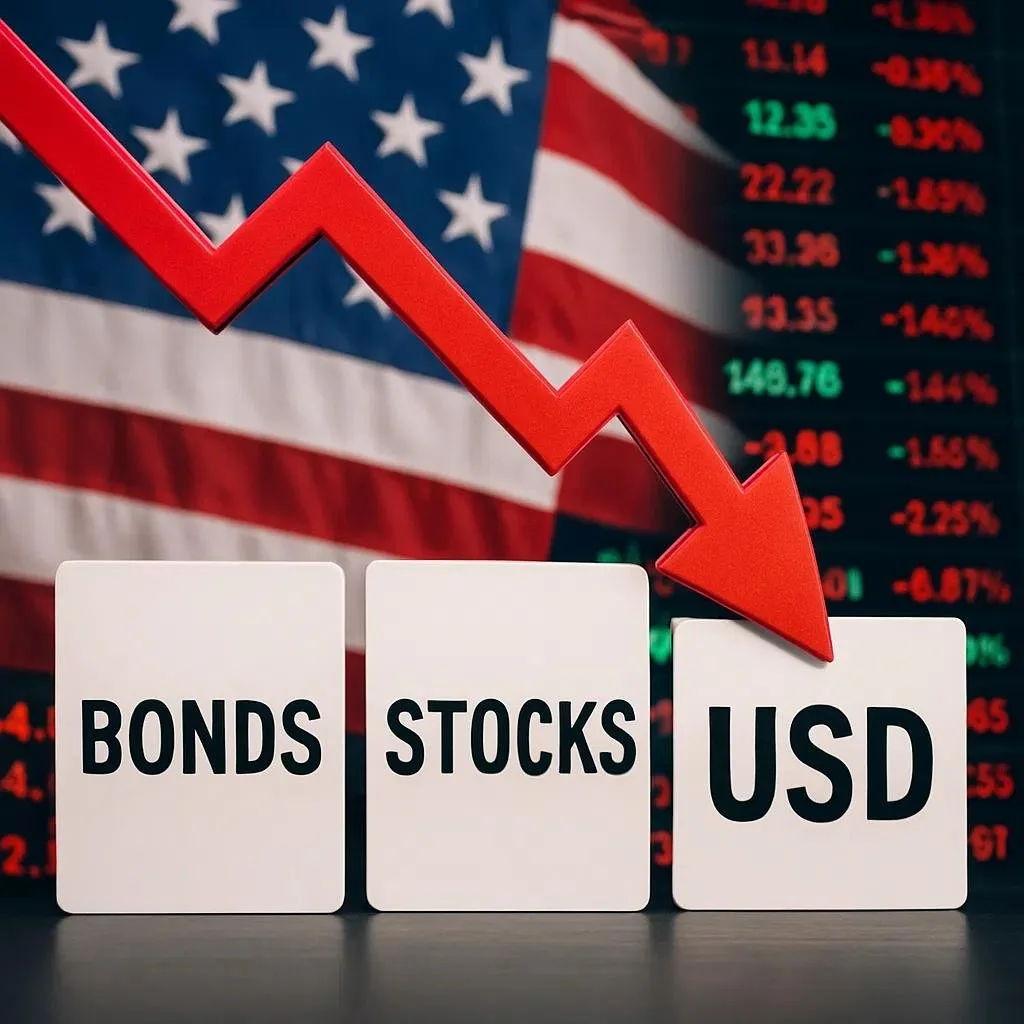
This Trifecta of Market Declines is Rare… And Not Good
This Trifecta of Market Declines is Rare… And Not Good
Notes From the Field By James Hickman (Simon Black) April 30, 2025
In today’s podcast, we explore the rare phenomenon of simultaneous declines in the stock market, bond market, and currency market—a powerful signal of capital flight out of the US.
We talk about when and where this has happened before, and why the Federal Reserve’s diminishing control over interest rates won’t fix it.
This Trifecta of Market Declines is Rare… And Not Good
Notes From the Field By James Hickman (Simon Black) April 30, 2025
In today’s podcast, we explore the rare phenomenon of simultaneous declines in the stock market, bond market, and currency market—a powerful signal of capital flight out of the US.
We talk about when and where this has happened before, and why the Federal Reserve’s diminishing control over interest rates won’t fix it.
We also discuss what higher rates mean for the commercial real estate market, and how that reverberates through the banking system.
And we answer the question: is gold overbought, and inching towards a correction?
The podcast also covers:
Why gold, not Bitcoin, remains the ultimate safe haven for central banks.
Why the US dollar's dominance is fading—and what comes next.
The case for gold stocks over physical gold in today’s environment.
Give it a listen here.
CLICK HERE to listen to today’s podcast.
(For the audio-only version, check out our online post here.)
To your freedom, James Hickman Co-Founder, Schiff Sovereign LLC
News, Rumors and Opinions Thursday 5-1-2025
IQD Flips First, XRP Follows
589bull: 5-1-2025
Iraq just passed Resolution No. 294 — authorizing the Ministry of Finance to pull over 3 trillion IQD from dormant tax accounts and inject it into the Central Bank of Iraq to cover salaries.
Old funds.
New movement.
Right before the budget flips.
IQD Flips First, XRP Follows
589bull: 5-1-2025
Iraq just passed Resolution No. 294 — authorizing the Ministry of Finance to pull over 3 trillion IQD from dormant tax accounts and inject it into the Central Bank of Iraq to cover salaries.
Old funds.
New movement.
Right before the budget flips.
This isn’t routine. They’re not just covering payroll — they’re positioning liquidity inside the CBI. You don’t unlock trillions in dormant escrow just to patch a gap. You do it to prime the system before something big resets.
Abu snwe: At the time of the Sudanese preparation for the Arab summit The Iraqi government announces its bankruptcy and authorizes the Minister of Finance, a Sami spectrum to withdraw the tax trusts of more than 3 trillion to pay the salaries of the month of April.
Everyone keeps asking: What moves first — IQD or XRP?
Answer: IQD flips first. XRP follows. Fast.
Iraq’s revaluation is the event — the trigger. It resets regional liquidity, realigns trade, and floods the system with pressure.
That pressure needs rails. Fast, neutral, compliant rails. That’s when XRP ignites.
IQD is the fuse.
XRP is the ignition.
Classic damage control.
If everything was “normal,” they wouldn’t need to say it. You don’t withdraw 3+ trillion IQD from dormant tax accounts unless you’re prepping for something outside the norm — like a rate shift or system switch.
The fact that the Parliamentary Finance Committee had to come out and calm people down tells you one thing:
This wasn’t routine.
This was strategic liquidity repositioning.
They’re staging cash where it needs to be before the public feels the shift — likely to smooth salary transitions and avoid panic right before the flip.
Source(s):
https://x.com/589bull10000/status/1917586572301721638
https://x.com/589bull10000/status/1917621269450707386
https://x.com/589bull10000/status/1917622313908068612
https://dinarchronicles.com/2025/05/01/589bull-iqd-flips-first-xrp-follows/
************
Courtesy of Dinar Guru: https://www.dinarguru.com/
Mnt Goat ...Iraq is excited and so should we be... the dinar situation can change very suddenly once the right policies are effective. This process is not going to take months or years more.
Militia Man What we have seen so far in the news is...all positive, nothing that's considered to be worrisome as far as I can see. The tone from Washington has been positive. They've been talking about support...for Iraq's monetary reforms by the largest financial institutions in the world - United States Treasury, Federal Reserve, International Monetary Fund, World Bank, IFC. The focus has been about security, stability, sustainability, partnerships with the public and private sectors, investment opportunities...
Planned Demolition Of The Banking System | David Morgan
Liberty and Finance: 4-30-2025
David Morgan outlines the global banking hierarchy and highlights how real power resides not with governments but with elite financial institutions, steering the world toward a centralized digital monetary system diminishing national financial sovereignty.
Two key points he emphasizes are that the destruction of the current banking system is a planned demolition, not a natural failure, and that this collapse is designed to usher in a new, more authoritarian financial regime rooted in AI-driven control and digital currencies.
Morgan warns that such a system will eliminate human discretion and embed surveillance into every transaction, reducing people to programmable nodes in a technocratic grid. He concludes that unless more people resist, we risk entering a future where convenience masks total economic and personal subjugation.
INTERVIEW TIMELINE:
0:00 Intro
1:30 Who's running the show?
8:23 Globalism
13:50 The Fed's real purpose
18:00 Banking system planned demolition
33:40 Rules, laws, and accountability
Seeds of Wisdom RV and Economic Updates Thursday Morning 5-1-25
Good Morning Dinar Recaps,
COULD THE SEC SETTLE WITH RIPPLE LAWSUIT USING XRP?
▪️John Squire suggests SEC might settle Ripple case by accepting XRP instead of cash.
▪️Delaying XRP ETF approval could help SEC avoid rising prices before settlement deal.
▪️June 17 ETF delay might be part of SEC’s calculated move, says Squire.
Good Morning Dinar Recaps,
COULD THE SEC SETTLE WITH RIPPLE LAWSUIT USING XRP?
▪️John Squire suggests SEC might settle Ripple case by accepting XRP instead of cash.
▪️Delaying XRP ETF approval could help SEC avoid rising prices before settlement deal.
▪️June 17 ETF delay might be part of SEC’s calculated move, says Squire.
A surprising idea is gaining attention in the crypto world as social media influencer John Squire suggests that the U.S. Securities and Exchange Commission (SEC) could be planning to settle its lawsuit with Ripple by accepting XRP tokens instead of cash.
Will the SEC truly accept XRP as a payment? Let’s find out!
Delaying ETF Could Be a Strategic Move
In a recent tweet that’s now widely shared, John Squire suggests that the SEC could be delaying the approval of XRP spot ETFs on purpose. Because if they plan to settle the Ripple lawsuit using XRP, they wouldn’t want the price of XRP to shoot up too early.
And that’s exactly what could happen if a spot ETF is approved right now. Unlike a futures ETF, a spot ETF buys XRP directly. That demand would send the price soaring, possibly making XRP too expensive for a favorable government settlement.
Therefore, to keep XRP’s price lower, there has been a delay in the settlement process.
If XRP Is Used as Payment
The theory comes after journalist Eleanor Terrett confirmed that the SEC had delayed its decision on Franklin Templeton’s XRP spot ETF until June 17. Squire argues that this delay is not a coincidence but part of a broader strategy.
Squire says that if the SEC accepts XRP as payment, it would show they no longer see it as illegal. He also points out it wouldn’t make sense for the U.S. government to take payment in something they say is not allowed.
Such a settlement could also lead to regulatory clarity for XRP, encourage institutional investment, and possibly mark the beginning of a new bull run for the token.
XRP Price Outlook
As of now, XRP is trading around $2.20, reflecting a drop of 0.63%, with a market cap hitting $129.13 billion. However, the 1-day chart suggests that if XRP goes above $2.40, it could start a strong upward trend toward $2.60 or even $2.90. But if it falls below $2, it might trigger more big sell-offs.
@ Newshounds News™
Source: Coinpedia
~~~~~~~~~
NORTH CAROLINA HOUSE PASSES STATE CRYPTO INVESTMENT BILL
North Carolina’s House passed a bill to allow the state treasurer to invest government funds in approved cryptocurrencies with a 71 to 44 vote.
North Carolina’s House of Representatives has passed a bill allowing the state’s treasurer to invest public funds in approved cryptocurrencies, which will now head to the Senate.
The House passed the Digital Assets Investment Act, or House Bill 92, on its third reading on April 30 by a vote of 71 to 44.
Republican House Speaker Destin Hall introduced the bill in February, which would allow the treasurer to allocate 5% of the state’s investments into designated digital assets.
The investments can only be made after obtaining an independent third-party assessment confirming that the crypto holdings are maintained with a secure custody solution and risk oversight and regulatory compliance standards are met.
New amendments allow the treasurer to examine the feasibility of allowing members of retirement and deferred compensation plans to elect to invest in digital assets held as exchange-traded products (ETPs).
The House also passed a related bill, the State Investment Modernization Act, or HB 506, with little discussion on April 30, in a 110 to 3 vote.
The bill aims to create the North Carolina Investment Authority (NCIA) to take over investment management from the treasurer.
If passed into law, the authority to invest in digital assets would transfer from the treasurer to NICA, and approval would be required from its board of directors based on third-party assessments to make crypto investments.
Local news outlet NC Newsline reported that Treasurer Brad Briner supports both bills.
Arizona leads the crypto bill race
North Carolina is second to Arizona in the state-level race to approve legislation allowing local governments to invest in cryptocurrencies.
On April 28, Arizona’s House approved two bills, SB 1025 and SB 1373, proposing different methods for the state to establish a crypto reserve.
Arizona is the only state whose House and Senate have passed crypto-related bills, which are both awaiting Governor Katie Hobbs’ decision.
@ Newshounds News™
Source: CoinTelegraph
~~~~~~~~~
Seeds of Wisdom Team RV Currency Facts Youtube and Rumble
Newshound's News Telegram Room Link
Q & A Classroom Link
Follow the Roadmap
Follow the Timeline
Seeds of Wisdom Team™ Website
Thank you Dinar Recaps
“Bits and Pieces” in Dinarland Thursday AM 5-1-2025
SWIFT Just Said the Quiet Part out Loud
589bull: 5-1-2025
SWIFT just said the quiet part out loud:
“Tokens allow messaging and settlement to be collapsed into one.”
Translation? The old financial system just admitted it’s cooked.
SWIFT Just Said the Quiet Part out Loud
589bull: 5-1-2025
SWIFT just said the quiet part out loud:
“Tokens allow messaging and settlement to be collapsed into one.”
Translation? The old financial system just admitted it’s cooked.
For decades, banks played a game.
First they’d send a message (SWIFT). Then — hours or even days later — they’d move the money. Two separate layers. Two sets of fees. Two opportunities to stall, skim, and manipulate.
That game’s over.
With tokenized value? There’s no delay, no middleman, no second layer.
When the message is sent — the value moves with it. No waiting. No clearing house. No FX trap.
It’s one move. One strike. Final.
This is exactly what XRP was designed for. Same with XDC and QNT.
Real-time settlement. Frictionless. Immutable. And now SWIFT’s basically admitting they’re switching to that model — after fighting it for years.
Funny how that works.
Now Iraq.
They’ve got a locked-up budget, a brand new CBI headquarters, and a digital banking system syncing up as we speak.
You think they’re doing all that for another decade of 1,300-to-1 rates?
Come on.
This isn’t just about payments. It’s about control.
Once settlement and messaging collapse into one, the middlemen collapse too. That means real money moves start happening without IMF approval, without central bank delays, and without SWIFT’s gatekeeping.
This is how the reset happens.
Not with an announcement.
Not with a press release.
It happens when the plumbing flips behind the scenes… And they start talking like the new system is already live.
SWIFT just did.
Watch liquidity.
Watch corridors.
Watch Iraq.
Because when they say “collapsed into one”, what they’re really saying is:
The storm’s not coming. You’re standing in it.
Source(s):
https://x.com/589bull10000/status/1917533399968866435
https://dinarchronicles.com/2025/05/01/589bull-swift-just-said-the-quiet-part-out-loud/
************
Courtesy of Dinar Guru: https://www.dinarguru.com/
Sandy Ingram As you know the Iraqi Foreign Minister Fuad Hussein left for Washington D.C. to meet with Secretary of State Marco Rubio on Thursday. But what you many not know is the huge request the Iraqi Foreign Minister had for the United States...The visit signals a deepening partnership between the two nations, which is a good thing for IQD investors. But the interesting factor that was finally revealed about the meetings was Iraq's request. Iraq asked the US to reconsider travel warnings ...A move that could make it easier for investors to travel freely to the country... [Post 1 of 2...stay tuned]
Sandy Ingram Hussein stressed that the current "Level 4 - Do Not Travel" advisory is hurting Iraq's chances of attracting American businesses and investment. He explained Iraq's situation has improved significantly and continuing to label Iraq as highly dangerous just doesn't reflect the new reality on the ground anymore...Hussein pointed out some European countries have already updated their travel advisories for Iraq...As of now, it's unclear whether the Untied States will agree to remove or lower the travel warning...If Washington does choose to reconsider it would mark a major step toward opening Iraq's doors wider to American investors and businesses. Guys this is major! [Post 2 of 2]
Mike Bara: Special Non-Florida Live News/Discussion with Special Guest Wolverine!
4-30-2025
“Tidbits From TNT” Thursday Morning 5-1-2025
TNT:
Tishwash: Fuad Hussein arrives in Oman to exchange views on "current challenges"
Fuad Hussein arrives in Oman to exchange views on "current challenges"
The Iraqi Ministry of Foreign Affairs announced the arrival of its Minister, Fuad Hussein, to the Omani capital, Muscat, on an official visit aimed at strengthening bilateral cooperation between the two countries.
The ministry said in a statement that "Deputy Prime Minister and Minister of Foreign Affairs Fuad Hussein is scheduled to hold meetings during the visit with a number of Omani officials, most notably the Omani Minister of Foreign Affairs, Badr bin Hamad Al Busaidi, to exchange views on regional and international developments and current challenges."
The statement indicated that the Iraqi Ambassador to Muscat, Qais Al Ameri, and embassy staff attended the reception ceremony.
TNT:
Tishwash: Fuad Hussein arrives in Oman to exchange views on "current challenges"
Fuad Hussein arrives in Oman to exchange views on "current challenges"
The Iraqi Ministry of Foreign Affairs announced the arrival of its Minister, Fuad Hussein, to the Omani capital, Muscat, on an official visit aimed at strengthening bilateral cooperation between the two countries.
The ministry said in a statement that "Deputy Prime Minister and Minister of Foreign Affairs Fuad Hussein is scheduled to hold meetings during the visit with a number of Omani officials, most notably the Omani Minister of Foreign Affairs, Badr bin Hamad Al Busaidi, to exchange views on regional and international developments and current challenges."
The statement indicated that the Iraqi Ambassador to Muscat, Qais Al Ameri, and embassy staff attended the reception ceremony. link
Tishwash: The majority of Iraq's financial assets are in US dollars. Al-Sudani's advisor discusses linking Iraqi banks to US banks.
On Wednesday, April 30, 2025, Mazhar Mohammed Salih, advisor to the Prime Minister for Financial Affairs, spoke about the repercussions of linking Iraqi banks to American banks.
As long as Iraq is within the dollar zone like other OPEC countries, with the US dollar constituting the majority of its financial assets from oil revenues, it is in our country’s interest to deal equally with the US commercial banking system as a global correspondent power for national banks, especially when dealing with more than one US bank operating globally (Global Bank) that has major global branches and arms, ” Saleh said in a press statement followed by Al-Jabal.
He pointed out that "the Central Bank of Iraq's efforts to link national banks with major banks and financial institutions in the United States, with more than one bank that enjoys international standing, is an important means of providing economic stability and improving the investment, trade, and development climate in our country through integration with the dollar trade, banking, and investment zone, which remains one of the strongest and most important monetary zones in the world."
He stressed that "reducing the costs of foreign banking transactions requires direct banking cooperation with more than one American (Global) bank, and that the Central Bank of Iraq is moving in the right, open, and rapid direction in assessing its priorities to serve the stability of the national economy at the level of foreign banking transactions and implementing them with the required speed and high guarantees ."
He pointed out that "the second American bank is responsible for providing opportunities for Iraqi banks as a global correspondent bank with multiple branches and operations to quickly implement banking operations, whether in transfers or financing foreign trade for our country's markets, without obstacles and with transparency and high governance. In addition, it provides financing and credit lines for trade and investment in Iraq, as well as benefiting from digital banking services and highly advanced international standards, which will bring our national banks to the required global level.
These are factors that encourage the investment and business climate in our country at the same time, in the midst of integration and cooperation with the international banking system." link
************
Tishwash: KRG official publicly criticizes Iraq’s Trade Bank over delays to ATM rollout and bank cards
A senior official in the Kurdistan Regional Government publicly criticized Iraq’s Trade Bank on Wednesday, citing significant delays and insufficient cooperation in the rollout of a high-profile digital banking initiative intended to modernize public salary payments.
The initiative, known as My Account, launched in September 2023, aiming to allow government employees in the Kurdistan Region to receive salaries digitally via bank-issued cards, reducing dependency on cash and increasing financial transparency. TBI was among several banks selected for participation.
“We are pleased to announce that the Trade Bank of Iraq is now part of the My Account project to digitize salary payments in the Kurdistan Region,” the ministry had said in a statement last year. Although welcomed in May 2024 by the Kurdistan Ministry of Finance, TBI’s participation has become a source of concern.
Nearly a year later, officials say the bank has fallen short of its commitments.
Aziz Ahmed, deputy chief of staff to KRG Prime Minister Masrour Barzani and the official leading the My Account team, spoke candidly to 964media. “It’s true, this is the first time we are publicly expressing our concerns about one of the banks in the My Account project, which is TBI,” he said. “But the scale of the issues with this bank can no longer be overlooked.”
Ahmed explained that the KRG has been waiting for over a year for TBI to fulfill a pledge to install 100 ATMs. “Despite over 40,000 requests from public employees in the Kurdistan Region to open accounts with the bank, the ATM installation process hasn’t moved forward, and the issuance of My Account cards has also been delayed,” he said.
The delay, according to Ahmed, is not just administrative but has practical consequences. “The delay in delivering ATMs and distributing bank cards has affected the speed of the banking rollout and has harmed public employees in the region,” he said.
Other banks participating in the program have also experienced occasional technical setbacks, but those were typically resolved without long-term disruption. “The level of difficulty we’ve had with TBI is different and ongoing,” Ahmed said. “Issues faced by other banks, such as temporary ATM outages, were addressed and solved. That has not been the case with TBI.”
According to the latest data obtained by 964media from the My Account project, there are approximately 650 ATMs available across the Kurdistan Region—many newly installed as part of the initiative. The project aims to expand this network to over 1,200 ATMs, reaching beyond major cities to include towns and remote areas.
This expansion is intended to ease salary access for the Kurdistan Regional Government’s 1.2 million public sector employees—roughly one ATM for every 1000 workers.
Eight banks are currently participating: BBAC, Cihan Bank, RT Bank, Bank of Baghdad, Iraqi Islamic Bank, National Bank of Iraq, Trade Bank of Iraq, and the International Development Bank.
964media has learned that the project has registered around 750,000 employees so far, with more than 450,000 having received their bank cards, enabling them to withdraw salaries from ATMs after being paid directly to their individual bank accounts.
The project has vowed to register all public sector employees for digital banking accounts by the end of this year.
Ahmed said the KRG has formally raised the issue with both the Central Bank of Iraq and the office of Iraqi Prime Minister Mohammed Shia al-Sudani. “Despite our repeated official communications and efforts to resolve the problems with the bank at the highest levels, the response and cooperation have not met expectations.”
Frustrated by the lack of progress, the KRG has opted to go public. “The lack of a satisfactory outcome from those efforts has left us no choice but to make our concerns public in the spirit of transparency,” Ahmed said.
My Account functions as an alternative to Baghdad’s Tawtin (localization) program. In February 2024, Iraq’s Federal Supreme Court ruled that salaries for public employees in the Kurdistan Region must be paid directly by the federal government, rather than through the KRG’s allocated share of the national budget.
In September 2024, public sector workers in Erbil and Sulaymaniyah expressed growing frustration as some ATMs ran out of cash, leaving many unable to access their delayed wages. However, officials overseeing the My Account project say those problems have since been addressed and that the system is now operating more smoothly. There have been no reports of widespread issues since. link
Mot: 'Footloose' - Dancing In The Movies https://www.youtube.com/watch?v=0rLhJZTHYo4
Mot: 40 FINGERS - Sound Of Silence & The Last Of The Mohicans
Seeds of Wisdom RV and Economic Updates Wednesday Evening 4-30-25
Good Evening Dinar Recaps,
UK DECIDES TO ALIGN WITH US RATHER THAN EU OVER CRYPTO REGULATION: INTRODUCES NEW RULES
Amidst fear of losing ground to global fintech hubs, the UK has announced new draft regulations for the crypto sector.
On 29 April 2025, Finance Minister Rachel Reeves said, “Through our Plan for Change, we are making Britain the best place in the world to innovate – and the safest place for consumers. Robust rules around crypto will boost investor confidence, support the growth of Fintech and protect people across the UK.”
Good Evening Dinar Recaps,
UK DECIDES TO ALIGN WITH US RATHER THAN EU OVER CRYPTO REGULATION: INTRODUCES NEW RULES
Amidst fear of losing ground to global fintech hubs, the UK has announced new draft regulations for the crypto sector.
On 29 April 2025, Finance Minister Rachel Reeves said, “Through our Plan for Change, we are making Britain the best place in the world to innovate – and the safest place for consumers. Robust rules around crypto will boost investor confidence, support the growth of Fintech and protect people across the UK.”
The UK government is now introducing compulsory regulation for crypto exchanges, dealers, and agents.
Importantly, the UK has decided to align with the US, treating crypto assets as securities. This marks a departure from the EU’s Markets in Crypto-Assets (MiCA) framework, which took effect in December 2024.
“The Chancellor also revealed that the UK and US will use the upcoming UK – US Financial Regulatory Working Group to continue engagement to support the use and responsible growth of digital assets,” the UK government website said.
The government aims to finalize the legislation by the end of 2025.
UK’s Clear New Rules To Boost Investor Confidence
Furthermore, the Chancellor also revealed that discussions with the US about supporting the use and responsible growth of digital assets are underway, as the government works in national interest to drive growth through Plan for Change.
The Chancellor also announced that the government will publish the first-ever Financial Services Growth and Competitiveness Strategy on 15 July, alongside her Mansion House speech. This will support the financial services sector’s long term growth, with Fintech identified as a priority sector, and help it finance investment and growth across the UK.
Around 12% of UK adults now own or have owned crypto, up from just 4% in 2021.
Industry Leaders Urge UK To Address Urgent Concerns Around Regulation, Funding, Innovation
Despite the government’s efforts, several fintech and crypto executives have expressed concern that the UK is losing its competitive edge.
“I think the UK will get it right — but there is a risk if you get it wrong that you drive innovation to other markets,” Keith Grose, Coinbase’s UK head, revealed CNBC on 30 April 2025.
Meanwhile, Jaidev Janardana, CEO of digital bank Zopa, weighed in too. “If I consider the pace of innovation, I believe the US is currently ahead – despite its own set of challenges. Yet, when you look at places like Singapore and Hong Kong, there is significantly faster innovation,” he said.
Tim Levene, CEO of venture capital firm Augmentum Fintech, said, “We’re scrambling around looking for pots of capital in the UK, where currently it would be more fruitful to go to the Gulf, to go to the US, to go to Australia, or elsewhere in Asia, and that that doesn’t feel right.”
@ Newshounds News™
Source: 99Bitcoins
~~~~~~~~~
BRICS MAY PUSH GOLD PRICE TO $6,000 AS US TRADE WAR TALKS PERSIST
With continued geopolitical unrest, the rush to haven assets has been an undeniable reality. That could benefit one economic alliance that has sought out a US dollar alternative for much of the last year. Indeed, the BRICS alliance may push the gold price to heights of $6,000 as talks of an impending US trade war persist.
Since its unveiling of sweeping global tariffs in early April, tension between the US and China has reached a fever pitch. Moreover, that has created increased conflict within the alliance itself, as the group has recently failed to deliver a joint statement. Yet, all eyes are on gold, as the developments could only fuel the asset that BRICS nations have purchased rampantly throughout the last year.
BRICS May Push Gold to New Heights Amid US Tensions
Since he emerged victorious in the 2025 US presidential election, Donald Trump has expressed his issues with the BRICS alliance. He threatened 150% tariffs on the bloc for their role in global de-dollarization efforts. Although that didn’t come to fruition, China is facing import duty increases of up to 245% amid its recent roll-out of America-first trade policies.
These could only strengthen the Global South collective, however, as the policy reshapes the international economy. Indeed, the BRICS bloc may push the gold price to $6,000 as talks of a US trade war persist.
US Global Investors CEO and executive chairman of Hive Digital Technologies, Frank Holmes, recently discussed gold’s potential. “I think the goal should be going to $6,000 over the term for President Trump,” Holmes said. “If the tariffs go up 25%, then the dollar has to go down 25%,” Holmes added.
The expert was articulating the reality that the ongoing economic policy and the greenback have an adverse relationship. Since he entered office, the US dollar has plummeted 10% over the first 100 days of Trump. Moreover, BRICS, and China specifically, have ramped up gold buying.
The People’s Bank of China has been the largest covering buyer of gold for more than five straight months. Moreover, in Q1 alone, it added 27 tonnes to its reserves, making it the largest holder in modern history. Trading at the $3,300 level, there is room for the asset to skyrocket, especially if the Trump tariff plan is resumed in the coming month.
@ Newshounds News™
Source: Watcher Guru
~~~~~~~~~
Seeds of Wisdom Team RV Currency Facts Youtube and Rumble
Newshound's News Telegram Room Link
Q & A Classroom Link
Follow the Roadmap
Follow the Timeline
Seeds of Wisdom Team™ Website
Thank you Dinar Recaps
More News, Rumors and Opinions Wed. PM 4-30-2025
KTFA:
Henig: LNG, aircraft, agriculture contracts with US must be done in May: PM
April 29, 2025 - 17:00
Việt Nam is also working closely with ASEAN and regional partners to conduct negotiations in a manner that ensures harmonised interests and a sustainable, balanced trade relationship, in line with the ASEAN–US Comprehensive Strategic Partnership. HÀ NỘI —
Prime Minister Phạm Minh Chính on Tuesday chaired a meeting in Hà Nội with ministries and relevant agencies to review preparations for bilateral trade negotiations with the United States.
KTFA:
Henig: LNG, aircraft, agriculture contracts with US must be done in May: PM
April 29, 2025 - 17:00
Việt Nam is also working closely with ASEAN and regional partners to conduct negotiations in a manner that ensures harmonised interests and a sustainable, balanced trade relationship, in line with the ASEAN–US Comprehensive Strategic Partnership. HÀ NỘI —
Prime Minister Phạm Minh Chính on Tuesday chaired a meeting in Hà Nội with ministries and relevant agencies to review preparations for bilateral trade negotiations with the United States.
This was the sixth cabinet meeting regarding the implementation of conclusions and directives issued by the Party Central Committee, the Politburo, and General Secretary Tô Lâm on adapting to the US’ new tariff policies, in which Việt Nam is subject to a 46 per cent rate.
PM Chính stated that Việt Nam had recently implemented a wide range of active and coordinated measures. Ministries and sectors have engaged with the highest sense of responsibility. The results so far are heading in a positive direction, yet the situation remains complex, requiring agencies to closely monitor developments, respond promptly and effectively, and address issues within their jurisdiction in a proactive, practical, and feasible manner.
Vietnamese agencies have been making great efforts to address issues related to the origin of goods, non-tariff barriers, intellectual property, copyright, and administrative procedure reduction.
PM Chính has instructed ministries and sectors to be proactive in working with the US, clearly explaining the issues of US concern that Việt Nam has been addressing.
He urged the swift negotiation and signing, by May 2025, of contracts for the purchase and import of goods from the United States, such as LNG, aircraft, pharmaceuticals, medical equipment, and agricultural products, to ensure a sustainable trade balance.
PM Chính emphasised that negotiations must be conducted with calmness, determination, and great flexibility – avoiding either perfectionism or haste – while safeguarding national sovereignty, security, and interests.
The negotiations must also honour Việt Nam’s international commitments, ensuring no one objective is pursued at the expense of another party or country, and adhering to the principle of “harmonised interests, shared risks”.
He requested Vietnamese agencies to engage in dialogue with the US so that both sides could reduce tariffs on each other’s goods to mutually appropriate levels. He also called on the US to soon recognise Việt Nam as a market economy and lift restrictions on the export of high-tech goods.
These measures would contribute to trade balance and technology transfer, while reflecting US’s support for a strong, independent, self-reliant, and prosperous Việt Nam. Việt Nam will continue to revise its legal framework to address US’ concerns, while ensuring sovereignty, fulfilling international commitments, and maintaining compatibility with the legal systems of both countries.
The Government leader noted that Việt Nam had recently focused on amending numerous laws. At the upcoming ninth session of the National Assembly, the Government will submit proposals to amend laws related to intellectual property, copyright protection, and administrative procedure reform to better reflect the current context.
Việt Nam is also working closely with ASEAN and regional partners to conduct negotiations in a manner that ensures harmonised interests and a sustainable, balanced trade relationship, in line with the ASEAN–US Comprehensive Strategic Partnership. PM Chính instructed each relevant ministry and agency to develop specific negotiation plans, and tasked the Ministry of Industry and Trade with consolidating and finalising these plans by April 30. — VNS LINK
************
Courtesy of Dinar Guru: https://www.dinarguru.com/
Militia Man Article: ..."the country's massive financial reserves are one of the main reasons behind the improvement in the value of the Iraqi dinar against the dollar. We expect the dinar's value to continue to improve in the coming period." That' kind of a heads up without saying, 'Hey, we're revaluing our currency!' But they did say we expect the dinar's value to continue to improve in the coming period...
Boots-On-The-Ground Guru Maxis I am in Baghdad (Green Zone). A few of my guys [Iraqi employees] have [bank] accounts but they have not deposited their large notes until they are sure about the new lower notes and a revaluation. There are no consequences if they don’t [make a deposit]. The GOI has offered bonds but they are weary of these. They do expect a revaluation but all it will mean to them is cheaper prices on goods and services. Yes they are [excited about purchasing power] but they are getting frustrated about the delays.
When Trump is Finished, Federal Reserve will be Insignificant, Long Live Gold and Bitcoin
X22 Report (with Bob Kudla): 4-29-2025
Bob begins the conversation talking about how Germany is going to block out the sun, which means solar power will not work they way they said it will to power the country.
Gold and Bitcoin are making moves as the fiat currency implodes on itself.
Oil is going to come down to counter the tariff temp price increase, but when the temp price increase is gone because companies are paying for it people are going to see prices come down.
In the end the Federal Reserve will be insignificant.
************
The Quiet Coup: BIS Just Rewrote The Global Monetary Rules With One Gold Ruling | Andy Schectman
Two dollars investing: 4-30-2025
In a move that went unnoticed by nearly everyone, the Bank for International Settlements (BIS) quietly reclassified gold—forever altering the structure of the global financial system.
Andy Schectman breaks down how this one ruling reshaped the balance of monetary power, signaled a silent collapse of confidence in fiat, and exposed the coming gold-backed shift few are prepared for.
Discover why central banks are hoarding gold, what this means for the U.S. dollar, and how the BIS may have just staged the greatest monetary coup of our lifetime.
Seeds of Wisdom RV and Economic Updates Wednesday Afternoon 4-30-25
Good Morning Dinar Recaps,
COINBASE URGES SUPREME COURT TO WEIGH IN OVER IRS'S ACCESS TO CUSTOMER DATA
▪️Coinbase said the Supreme Court should clarify the third-party doctrine, which says that people who give information to third parties, such as banks, should not have an expectation of privacy.
▪️Others have filed amicus briefs, including billionaire Elon Musk, the Cato Institute, and the DeFi Education Fund.
Good Morning Dinar Recaps,
COINBASE URGES SUPREME COURT TO WEIGH IN OVER IRS'S ACCESS TO CUSTOMER DATA
▪️Coinbase said the Supreme Court should clarify the third-party doctrine, which says that people who give information to third parties, such as banks, should not have an expectation of privacy.
▪️Others have filed amicus briefs, including billionaire Elon Musk, the Cato Institute, and the DeFi Education Fund.
Coinbase urged the U.S. Supreme Court to consider a case involving the Internal Revenue Service that it says "sets a dangerous precedent" surrounding customers' personal data.
The crypto exchange said the Supreme Court should clarify the third-party doctrine, which says that people who give information to third parties, such as banks, should not have an expectation of privacy.
"This Court’s guidance is especially important here because this case involves a new technology—blockchain— that is particularly susceptible to surveillance abuse," the firm said in an amicus brief filed on Wednesday with the Supreme Court.
The IRS demanded records from Coinbase almost a decade ago from thousands of its customers, including information involving security settings, transactions, and correspondence. The company pushed back, but a district court later said Coinbase had to comply, but narrowed the IRS's search according to the filing.
In 2020, petitioner James Harper, a Coinbase customer, filed a suit against the IRS for its role in the alleged unlawful seizure of information that identified him as a crypto holder.
Now it's up to the Supreme Court to decide if it wants to take Harper's case up. Others have filed amicus briefs, including billionaire Elon Musk, the Cato Institute, and the DeFi Education Fund.
Coinbase Chief Legal Officer Paul Grewal said the company supports complying with tax rules, but said the IRS went too far.
"We believe in tax compliance, but this goes far beyond a narrow and tailored request and far beyond crypto," Grewal said Wednesday in a post on X. "This applies to banks, phone companies, ISPs, email, you name it. As we explain here, you should have the same right to privacy for your inbox or account as you have for a letter in your mailbox."
@ Newshounds News™
Source: The Block
~~~~~~~~~
ZIMBABWE REINTRODUCES GOLD COINS SALE TO STRENGTHEN CURRENCY RESERVES
https://goldseek.com/article/zimbabwe-reintroduces-gold-coins-sale-strengthen-currency-reserves
As gold prices skyrocket, the Reserve Bank of Zimbabwe (RBZ) has resumed issuing gold coins.
The central bank introduced the coins in June 2022. The program was touted as a way for investors to store value in the face of rampant inflation. At the time, a Zimbabwean brokerage firm analyst told Al Jazeera that the coin was a “welcome development.”
“For a long time, the market did not have many investment options, and this is a new asset class. The thinking was inspired by the need to come up with an instrument that addresses the inflation problems in the economy, where purchasing power has been eroded. From what we are gathering, this is going to be a store value.”
He went on to say that the fundamentals of gold help it hedge against inflation and geopolitical risk, and that the gold coins would open the gold market to “ordinary investors.”
The RBZ suspended the sale of the coins 10 months ago, but they are now being reintroduced through local banks.
Fidelity Gold Refineries (Private) Limited mints the 22-carat "Mosi-Oa-Tunya" coin. It is available in various sizes, ranging from 1/10 ounce to 1 ounce.
The Zimbabwe central bank owns Fidelity Gold Refineries (Private) Limited, and it operates as the only gold-buying and refining entity in the country.
RBZ monetary policy committee member Persistence Gwanyanya told Bloomberg that the reintroduction of the gold coins comes at a time when “gold is more attractive to the market,” and that the move “supports our value preservation efforts.”
“We are taking advantage of firm gold prices and re-injecting the gold coins into the market.”
According to the Bloomberg article, the hope is that resuming gold coin sales will “ramp up the bullion stockpile used to back up the local currency, the ZiG.”
You might be wondering how selling gold increases a bullion stockpile.
The answer is it doesn't. Bloomberg seems to be oversimplifying a monetary policy scheme that will increase the reserves backing the ZiG, but won't increase the country's gold reserves specifically.
@ Newshounds News™
Source: GoldSeek
~~~~~~~~~
Seeds of Wisdom Team RV Currency Facts Youtube and Rumble
Newshound's Podcast Link
Newshound's News Telegram Room Link
Q & A Classroom Link
Follow the Roadmap
Follow the Timeline
Seeds of Wisdom Team™ Website
Subscribe to Seeds of Wisdom Team™ Newsletter
Thank you Dinar Recaps