Iraq Hardest Hit By Hormuz Strait Disruptions
2026-04-02 Shafaq News- Baghdad Iraq recorded the sharpest increase in borrowing costs among regional countries due to disruptions in the Strait of Hormuz, with yields rising by 0.64 percentage points to 7.1%, according to the United Nations Conference on Trade and Development (UNCTAD).
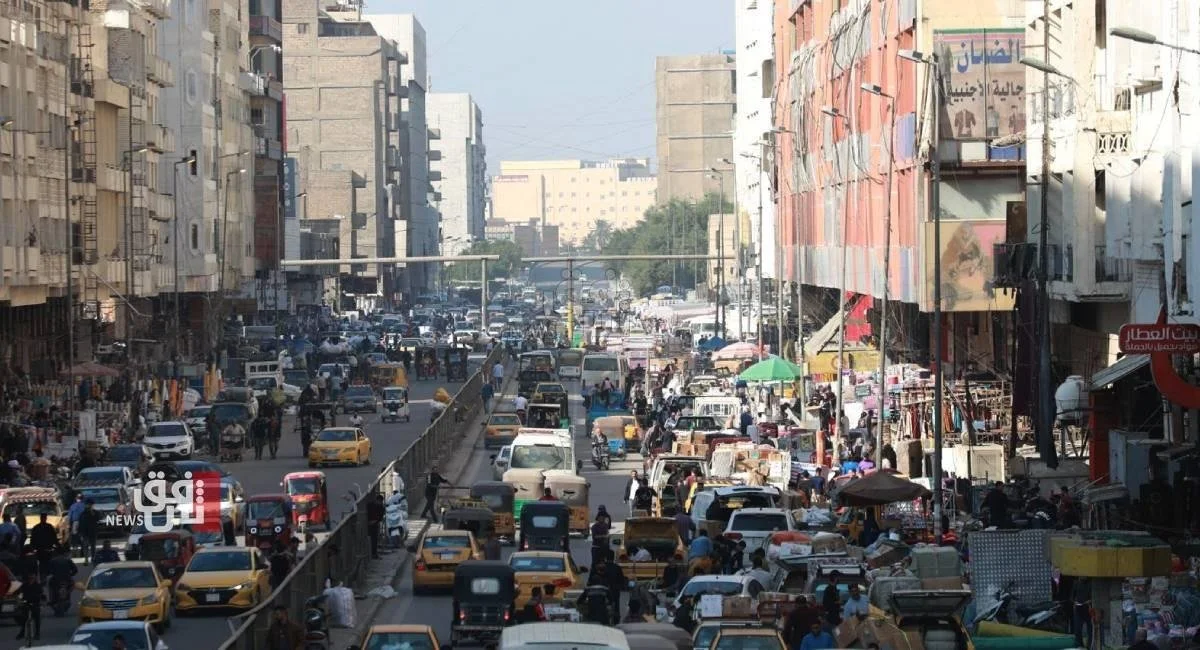
Data showed varying increases across the region, with Bahrain rising by 0.41 percentage points to 7%, Saudi Arabia and Oman each up by 0.26 points, and Jordan by 0.24 points. The UAE, Qatar, and Kuwait saw smaller increases ranging between 0.27 and 0.28 points, while Kuwait remained the lowest overall at 4.4%.
The organization noted that rising borrowing costs have added economic pressure amid escalating tensions in the Strait of Hormuz, where disruptions to energy and fertilizer flows have led to a near halt in shipping since late February 2026. Transport and maritime insurance costs have surged by more than 90%, driving sharp increases in oil, gas, and fertilizer prices and directly impacting food production and prices in Iraq and other import-dependent countries.
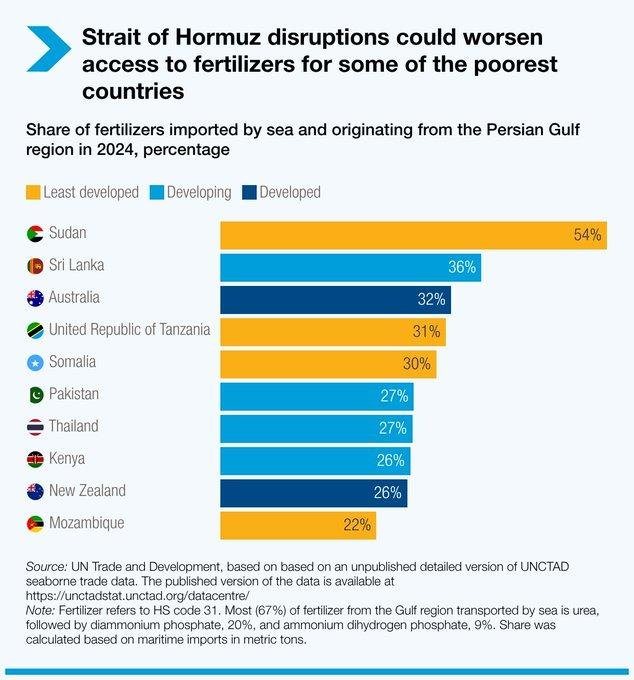
The Strait of Hormuz carries about one-third of global seaborne fertilizer. With trade highly concentrated, disruption risks grow. Many countries rely on Gulf-region supplies for staple crops, including #LDCs like Sudan, Tanzania & Somalia. Read more: https://ow.ly/q9ZI50YBhby
https://www.shafaq.com/en/Economy/Iraq-hardest-hit-by-Hormuz-strait-disruptions
Iraqi Analyst Warns Of March Oil Revenue Shortfall Amid Oil Field Closures
2026-04-02 Shafaq News- Baghdad Seven major oil fields in Basra remain closed as of the end of March 2026, while four producing fields generated a combined daily output of 659,000 barrels per day through three state oil companies, according to Nabil Al-Marsoumi, a political analyst and professor at Al-Maqal University in Basra.
Al-Marsoumi reported that despite Iraq continuing oil exports through the Strait of Hormuz until March 8, March oil revenues did not exceed 1.9 billion dollars, equivalent to approximately 2.5 trillion Iraqi dinars. He warned that Iraq requires an additional 5 trillion dinars to cover salaries for May alone.
The analyst called for the urgent formation of a full-authority Iraqi government and preparation of a 2026 budget to provide legal cover for domestic and foreign borrowing, discounting transfers at the Central Bank of Iraq, and other measures to meet basic needs, including salaries, social welfare, water, and electricity services.
The State Organization for Marketing of Oil (SOMO) did not officially release figures for March. However, February data showed that total crude oil exports reached approximately 99.9 million barrels, generating revenues exceeding $6.8 billion. Exports from central and southern Iraqi fields totaled 93.3 million barrels, while the Kurdistan Region exported 5.6 million barrels via the Turkish port of Ceyhan. The Qayyarah field contributed 971,130 barrels.
Read more: Iraq's energy vulnerability: When a petro-state hasno buffer
Read more: Energy war nears Iraq: Oil infrastructure faces rising threat
Strait Of Hormuz Closure Stifles Iraqi E-Commerce
2026-04 Shafaq News The closure of the Strait of Hormuz has slowed e-commerce across Iraq, prolonging delivery times, raising costs, and forcing a growing number of customers to cancel online orders.
Shadha Abdul Karim, who operates an online store through social media, described mounting shipping setbacks affecting orders routed via the Strait, leading to widespread cancellations.
“Customers are entitled to cancel and receive full refunds if orders are not delivered on time,” she informed Shafaq News, adding that higher shipping costs under current conditions are likely to erode profits, while noting that she had kept prices low to attract buyers.
“I regret that not all customers received their orders on time, but this was beyond my control. I contacted affected clients to explain the hold-ups caused by the exceptional situation,” she explained.
Similar concerns are being reported by other sellers. Hala Hamid, another online retailer, pointed to the broader impact on supply chains, particularly imports from global platforms such as China’s Shein.
“The closure has led to noticeable delays in shipments due to disruptions in some sea and air routes, as well as higher transport costs, which in turn affected delivery schedules,” she noted.
Economists indicate that the fallout extends beyond logistics. The Strait of Hormuz, a key passage for global energy flows, plays a central role in shaping shipping costs, inflation, and trade patterns worldwide.
Economic expert Mustafa Al-Faraj noted that e-commerce depends heavily on speed and affordability, making it particularly sensitive to disruptions in major shipping routes.
“Higher oil prices immediately increase shipping and transport costs, whether by sea or air, which raises the prices of goods sold online and reduces consumers’ purchasing power,” he relayed to Shafaq News, adding that disruptions in supply chains from Asia, especially China and India, are likely to slow delivery times, weakening a key advantage of online shopping.
Al-Faraj also pointed out that major e-commerce companies may scale back promotions or transfer higher costs to consumers, with emerging markets like Iraq feeling the effects more sharply due to heavy reliance on imports.
In parallel, economic expert Ali Dadoush pointed to a wider chain reaction tied to currency stability and financial flows. “Any disruption in maritime traffic through the strait will increase shipping costs and prolong delivery timelines, which directly affects online markets through higher prices, reduced product variety, and longer delivery times,” he explained to Shafaq News.
He added that declining oil revenues could pressure exchange rates and limit dollar liquidity, increasing import costs and weakening purchasing power. Stricter controls on foreign transfers could also disrupt digital payments, potentially reducing online transactions and pushing some consumers back toward cash.
“The overall impact points to stagflation, with a contraction in e-commerce volumes alongside rising prices and declining consumer confidence,” he concluded, noting that while limited opportunities may emerge for local e-commerce growth, they are unlikely to offset short-term pressures without broader policy support.
Written and edited by Shafaq News staff.
https://www.shafaq.com/en/Report/Strait-of-Hormuz-closure-stifles-Iraqi-e-commerce
Read more: Hormuz lockdown: Iraq’s economic lifeline under threat
Read more: Iraq's energy vulnerability: When a petro-state has no buffer
Dollar Slips In Baghdad And Erbil Markets
2026-04-02 Shafaq News- Baghdad/ Erbil The US dollar opened Thursday’s trading lower in Iraq, hovering around 154,000 dinars per 100 dollars, according to a survey by Shafaq News Agency.
The dollar traded in Baghdad's Al-Kifah and Al-Harithiya exchanges at 154,400 dinars per 100 dollars, down from 154,750 dinars recorded on Wednesday.
In the Iraqi capital, exchange shops sold the dollar at 155,000 dinars and bought it at 154,000 dinars, while in Erbil, selling prices stood at 154,300 dinars and buying prices at 154,150 dinars.
https://www.shafaq.com/en/Economy/Dollar-slips-in-Baghdad-and-Erbil-markets
Dollar Rises In Baghdad And Erbil Markets
2026-04-02 Shafaq News- Baghdad/ Erbil The US dollar closed Thursday’s trading higher in Iraq, hovering around 154,000 dinars per 100 dollars
According to a Shafaq News market survey, the dollar traded in Baghdad's Al-Kifah and Al-Harithiya exchanges at 154,500 dinars per 100 dollars, up from the morning session’s 154,400 dinars.
In the Iraqi capital, exchange shops sold the dollar at 155,000 dinars and bought it at 154,000 dinars, while in Erbil, selling prices stood at 154,750 dinars and buying prices at 154,600 dinars.
https://www.shafaq.com/en/Economy/Dollar-rises-in-Baghdad-and-Erbil-markets-4-0
Gold Prices Fall In Baghdad And Erbil
2026-04-02 Shafaq News- Baghdad/ Erbil On Thursday, gold prices hovered around 1 million IQD per mithqal in Baghdad and Erbil markets, according to a survey by Shafaq News Agency.
Gold prices on Baghdad's Al-Nahr Street recorded a selling price of 1,005,000 IQD per mithqal (equivalent to five grams) for 21-carat gold, including Gulf, Turkish, and European varieties, with a buying price of 1,001,000 IQD. The same gold had sold for 1,026,000 IQD on Wednesday.
The selling price for 21-carat Iraqi gold stood at 975,000 IQD, while the buying price reached 971,000 IQD.
In jewelry stores, the selling price per mithqal of 21-carat Gulf gold ranged between 1,005,000 and 1,015,000 IQD, while Iraqi gold sold for between 975,000 and 985,000 IQD.
In Erbil, 22-carat gold was sold at 1,063,000 IQD per mithqal, 21-carat gold at 1,014,000 IQD, and 18-carat gold at 869,000 IQD. https://www.shafaq.com/en/Economy/Gold-prices-fall-in-Baghdad-and-Erbil-9