Iraq Economic News and Points To Ponder Saturday Morning 2-7-26
S&P Affirms Iraq's Credit Rating With A Stable Outlook
Money and Business Economy News – Baghdad Standard & Poor's (S&P) credit rating agency has affirmed Iraq's credit rating at B-/B with a stable outlook.
According to a previous World Bank report, Iraq remains committed to pursuing stability and sustainable growth, despite the significant challenges it has faced in recent years, including the war against terrorism and economic fluctuations.
The government has focused on rebuilding infrastructure, improving public services, and pushing forward economic reforms, supported by international partnerships aimed at promoting sustainable development and human capital development.
The World Bank noted that Iraq’s oil-based growth model has been a major source of economic instability, limiting its ability to achieve stable growth and sustainable development. Continued reliance on oil revenues makes the Iraqi economy more vulnerable to risks amid the accelerating global shift towards reducing carbon emissions.
The bank explained that Iraq is among the countries most exposed to the effects and shocks of climate change, both in terms of physical risks, such as rising temperatures, water scarcity and extreme weather events, and in terms of financial vulnerabilities that exacerbate these challenges. https://economy-news.net/content.php?id=65424
More Than 1.2 Million Tons... Remarkable Growth In Non-Oil Trade Between Iran And The Kurdistan Region
Money and Business Economy News – Baghdad The border crossings in the Kurdistan Region recorded a remarkable increase in non-oil trade with Iran, with exports coming from the Iranian Kurdistan province through these crossings reaching about 1.27 million tons, with a total value of $643 million.
Customs data indicated that the volume of goods imported through border crossings linked to the Kurdistan Region of Iraq reached approximately 217,000 tons, with an estimated value of $650 million, reflecting the growing land trade between the two sides.
The Kurdistan Region has several official border crossings with Iran, most notably the Haji Omran crossing located northeast of Erbil Governorate, opposite the Iranian Tamarjin (Piranshahr) crossing, and the Bashmakh crossing in Penjwen District of Sulaymaniyah Governorate, which is adjacent to Kurdistan Governorate in Iran.
The Bashmakh border crossing is one of the most prominent crossings linking Iraq, via the Kurdistan Region, with Iran, and it plays an important role in supporting trade and the flow of non-oil goods between the two countries. https://economy-news.net/content.php?id=65423
Iraq Faces A Crucial Economic Test: Customs Tariffs Caught Between The Flames Of Protests And The Option Of Reform.
Economy News – Baghdad Amid a volatile economic climate and increasing pressure on the local market, Iraq has entered a new phase of trade and economic tension with the General Authority of Customs announcing the implementation of the new customs tariff starting from the beginning of 2026, at a rate of 15% on luxury goods.
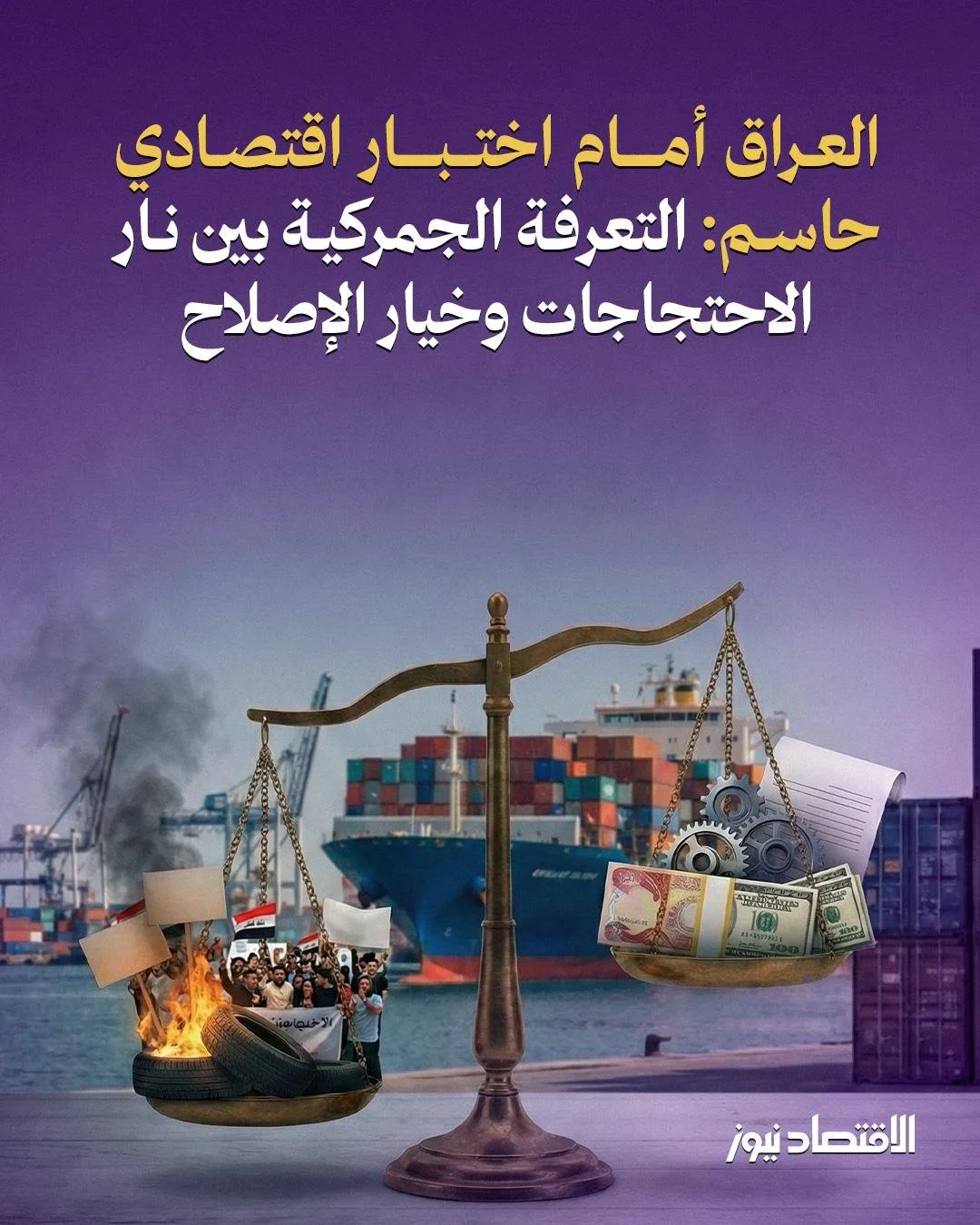
This move, which came under the slogan of "regulating trade and supporting the national product," sparked mixed reactions, which quickly turned into field protests and calls for a general strike, amid warnings of its repercussions on the Iraqi economy, traders, and consumers alike.
Earlier, the Director General of the Authority, Thamer Qasim Dawood, explained that the decision excludes basic and essential goods that affect the lives of citizens, noting that new fees were imposed that also included the automotive sector, through the mandatory application of Iraqi specifications to imported goods, and the imposition of fees on hybrid cars for the first time.
The amendments also included unifying the rates of fees on medicines and medical supplies at 5%, imposing a new tax at a similar rate on gold, in addition to adopting the electronic “ASYCUDA” system as a tool for collecting tax deposits and regulating import operations.
In contrast, the Prime Minister's financial advisor, Mazhar Muhammad Salih, believes that these measures—despite their difficulty—fall within the realm of financial and economic reform. He argues that they represent an attempt to reduce trade distortions, combat fraud and manipulation, protect external transfer channels from financial corruption, and support local production.
Saleh added during his interview with “Al-Eqtisad News” that these steps also contribute to maintaining the integrity of external transfer routes and reducing financial corruption phenomena, adding that the customs tariff came based on an economic policy reading of the country’s financial reality, and on orientations aimed at supporting the national product and regulating foreign trade, and that this option falls within the sovereign discretionary powers of economic policy.
He explained that imposing this tariff aims to achieve a delicate balance between maximizing public revenues on the one hand and maintaining economic stability and preventing market imbalances on the other, stressing that the success of these measures remains linked to the ability of the market and economic actors to gradually adapt to them.
The debate didn't stop at the government's explanation; it extended to the voices of experts and market players. Economist Nabil Al-Marsoumi warned that implementing the ASYCUDA system in conjunction with increased customs duties led to a sharp decline in trade volume and a drop in state customs revenues equivalent to 71 billion dinars in just one month.
He also pointed to the direct impact of these measures on more than one million traders and about 350,000 commercial establishments, which are now suffering from a slowdown in the movement of goods and the accumulation of containers in the country’s ports, especially in the port of Umm Qasr.
The crisis reached its peak with the Baghdad Chamber of Commerce announcing a complete closure of markets starting Sunday, February 2, 2026, in protest against what it described as the "excessive customs burden," demanding urgent government intervention to mitigate economic damage and expedite customs clearance procedures.
A few days ago, the General Authority of Customs in the Ministry of Finance issued a directive to adopt a reduction rate of 25% on the average import values recorded in the ASYCUDA system.
Over the past month, Iraq has witnessed angry demonstrations in several provinces, protesting the decision to impose new taxes and fees, and to apply customs tariffs to imported goods. https://economy-news.net/content.php?id=65418
Customs Denies "Unprecedented Increase": Current Tariff Conforms To International Standards; Traders Threaten Strike
Money and Business Economy News – Baghdad The director of the Iraqi Customs Authority, Thamer Qasim, confirmed on Saturday that the customs tariff currently in place is based on international standards, and there is no such thing as an "unprecedented increase" in the tariff.
Qasim said, "The General Authority of Customs is an executive body to implement the decisions issued by the government, and it has completed all procedures and implemented the ASYCUDA system and applied the Customs Tariff Law and the classification of goods based on type."
He explained that "some traders see an increase because the trader used to rely on a fixed fee, and this is not internationally acceptable. Today, we have adopted international standards, procedures, and demarcation as is the case in neighboring countries."
Qassem pointed out that there is no such thing as an "unprecedented increase in customs tariffs," but rather it is a departure from the fixed fee and the adoption of a system of tariffs on goods and merchandise.
He explained that "the customs tariff on cars exists, and the exemption was only on hybrid cars, and customs duties were imposed on the import of hybrids, and this exists and is approved in neighboring countries and regional countries."
Traders, who called for a general strike at all customs outlets, described the increase in tariffs and additional fees as an outrageous rise that will negatively affect trade and local markets. https://economy-news.net/content.php?id=65425
Iraq Ranks Seventeenth Globally On The List Of Countries With The Cheapest Gasoline Prices.
Economy News – Baghdad The Eco Iraq Observatory announced that Iraq ranks seventeenth globally on the list of countries with the cheapest gasoline prices. While revealing a government trend to increase the prices of oil derivatives in order to maximize state revenues, it warned of the repercussions of this step due to the direct economic damage it may cause to citizens and market activity.
The observatory said in a statement received by "Al-Eqtisad News" that "cars in Iraq consume about one billion liters of gasoline of various types every month, as well as similar quantities of gas oil."
He pointed out that “Iraq ranks seventeenth globally in terms of the cheapest fuel prices, with the price of a liter of gasoline being about $0.649, while the global average is $1.30 per liter,” indicating that “the government’s direction is towards raising prices under the pretext of the high cost of local production, as well as seeking to maximize the revenues of the state, which is suffering from a deficit.”
The observatory added that "the potential increase will include all products, including gasoline, gas oil, kerosene, jet fuel, and fuel oil."
The observatory strongly criticized this move, considering that it “will lead to higher transportation, production and service costs, and its direct impact on the prices of basic commodities, as well as putting pressure on citizens’ purchasing power and slowing down market activity.”
The observatory also warned that "raising fuel prices could exacerbate inflation rates and negatively affect commercial and industrial activity," calling on the government to carefully study financial alternatives and not impose additional burdens on citizens in light of the current economic conditions. https://economy-news.net/content.php?id=65417