Parliamentary Confirmation Of The Need To Postpone Economic Decisions Until The Formation Of The Next Government.
Money and Business Economy News – Baghdad Amid escalating controversy over recent decisions regarding financial deductions or tax additions, several members of the House of Representatives affirmed that the current government, as a caretaker government, is constitutionally restricted and does not have the authority to make decisions with a direct economic impact on citizens' livelihoods. While they stressed that the economic reform file and the approval of the 2026 budget are among the priorities of the next government, they indicated that there is no real financial crisis.
In this context, MP Ghaith Al-Kalabi, from the Al-Asas bloc, said that “the decisions issued by the Economic Ministerial Council are not within the powers of a caretaker government, which is a government that must be bound by the laws and legislation in force, with the need to take into account the living conditions of citizens,” considering that some of these decisions are a constitutional violation, according to the MP.
Al-Kalabi explained that the current government is constitutionally restricted and unable to take financial measures or make significant economic changes, and does not have the legal authority to infringe upon citizens' living or educational rights. He indicated that the House of Representatives represents the constitution and will not allow the powers or acquired rights of citizens to be taken away, stressing full solidarity with the people's demands.
The MP rejected the notion of using citizens as a means to address economic shortcomings, stating that Parliament categorically rejects these decisions and calls for waiting until the new government is formed to assess the economic situation, particularly regarding the approval of the 2026 budget.
He emphasized that there is no genuine financial crisis. Al-Kalabi further explained that a large segment of the population faces real financial obligations, including loans, the need for treatment for chronic illnesses, and reliance on private hospitals. This makes these decisions unacceptable under the current circumstances, and he called for postponing any economic measures until the new government officially assumes its duties.
For his part, MP Haider Ali, representing the Faili Kurds, affirmed that “the selection of the President of the Republic in today’s session will contribute to accelerating the formation of the new government,” indicating that “the next government will begin its work and implement its government program, which will focus primarily on economic reforms and addressing financial issues, foremost among them the 2026 budget.”
For his part, MP Hussein Al-Batat said that this session will see a clear focus on a number of important aspects, most notably adherence to the timelines for forming parliamentary committees and selecting their chairpersons, as the formation of committees represents the actual launch of the work of the House of Representatives.
Al-Batat added that a proposal has been submitted stipulating that an MP should be a member of only one committee, in accordance with their area of expertise, noting that this measure would serve the public interest and focus efforts on a specific area.
He explained that one of the important issues that should be placed on the agenda of the sixth session of the House of Representatives is the issue of recording the attendance and absence of representatives, especially during the sessions in which laws are voted on, and the necessity of their remaining until the end of the session, as their absence leads to the lack of a quorum and the postponement of the approval of laws, stressing the need to address this problem during the current session. https://economy-news.net/content.php?id=65201
The Central Bank Of Iran Is Distributing The 500,000 Toman Note Through The Banking Network, Featuring 11 Security Features.
Banks Economy News — Follow-up The Central Bank of Iran announced that the distribution of the 500,000 toman note (equivalent to 5 million rials), which was printed in advance, will begin in the banking network starting from February 1, 2026.
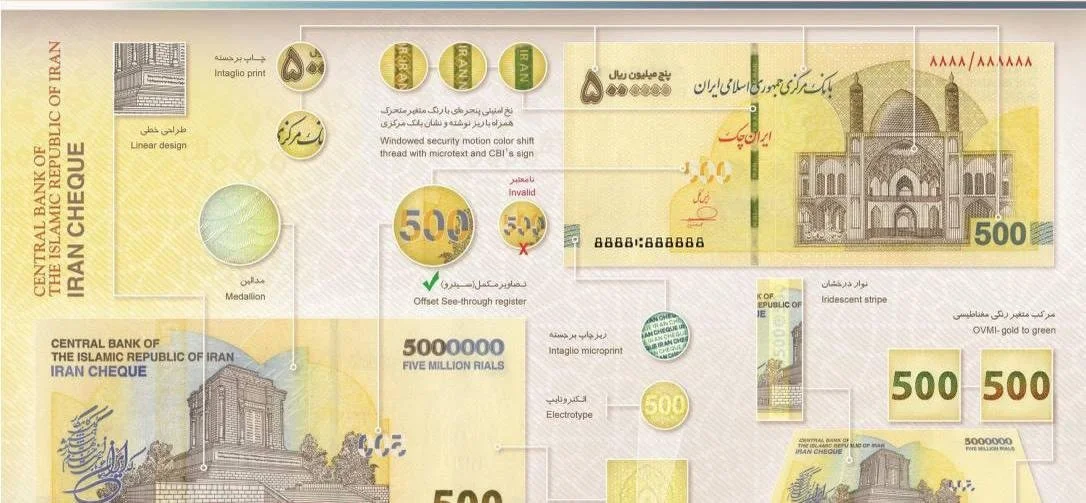
This step comes within the framework of managing and regulating cash transactions and facilitating financial transactions, with the aim of speeding up the completion of cash transactions, as the Central Bank has begun distributing this new category in banks within the banking network in the country. https://economy-news.net/content.php?id=65213
German Central Bank Warns Of Risks To The Dollar’s Global Status
The German central bank has warned that the US dollar’s position as the world’s reserve currency could come under question as early as this year.
According to the annual report of Germany’s Federal Financial Supervisory Authority (BaFin), the dollar may face funding pressures, geopolitical shocks, and the growing politicization of institutions. The report expressed concern about the risk of liquidity shortages stemming from geopolitical tensions, describing this as a particularly serious threat.
BaFin Chairman Mark Branson stated, “There remains a risk that markets may begin to question the US dollar’s role as the world’s reserve currency.”
He warned that radical attempts to politicize institutions could undermine the effectiveness of international cooperation, especially during economic or financial crises.
This warning follows the dollar’s worst single-day decline in nearly a year. The dollar index, which measures the currency’s performance against a basket of major peers, recorded its sharpest drop since last April on Tuesday.
The decline came after US President Donald Trump announced a sweeping global tariff agenda https://ina.iq/en/economy/45158-german-central-bank-warns-of-risks-to-the-dollars-global-status.html
Dollar Faces Weekly Loss As Geopolitical Tensions Weigh On Markets
The dollar is headed for its second consecutive weekly loss on Friday as global tensions escalate and pressure on U.S. assets increases.
Tariff threats on countries that trade oil with Cuba have heightened international uncertainty, weakening demand for U.S. assets and contributing to downward pressure on the dollar. The White House announced that President Donald Trump signed an executive order to impose tariffs on nations supplying oil to Cuba, adding to recent geopolitical strains involving Iran, Venezuela, Greenland, and Europe.
Reports that Trump is considering potential strikes against Iran have driven up oil prices, adding further pressure on the dollar index (DXY).
Meanwhile, a bipartisan Senate agreement has offered some hope of averting a partial U.S. government shutdown, and Japanese data showed that inflation in Tokyo slowed but remained within the central bank’s target range.
The dollar index, which measures the U.S. currency against a basket of other major currencies, rose 0.2% to 96.35, trimming its weekly decline to about 1.1%.
In currency markets, the euro fell 0.2% to $1.194, the yen weakened 0.17% to 153.39 against the dollar, and the pound sterling slipped 0.1% to $1.3791. https://ina.iq/en/economy/45153-dollar-faces-weekly-loss-as-geopolitical-tensions-weigh-on-markets.html
Gold And Silver Plunge Sharply In Global Markets
Precious metal prices declined sharply in global markets during spot trading on Friday, with gold falling by more than 8% to drop below $5,000 an ounce.
Silver also recorded a steep decline, plunging by more than 20% in spot trading to below $90 an ounce, marking one of its largest single-day drops in recent years.
The sell-off comes amid heightened volatility in global markets, driven by shifts in investor demand and broader financial market movements. https://ina.iq/en/economy/45159-gold-and-silver-plunge-sharply-in-global-markets.html
Oil Prices Fall More Than 1%
Oil prices fell by more than 1% on Friday, retreating from multi-month highs, although they remained on track for their strongest gains in years as risk premiums rose on concerns that a potential U.S. attack on Iran could disrupt supplies.
Brent crude futures fell 91 cents to $69.80 a barrel, after settling up 3.4% in the previous session at their highest level since July 31. The March contract expires later on Friday, while the more actively traded April contract slipped $1.07 to $68.52 a barrel. Source: Al Arabiya https://ina.iq/en/economy/45150-oil-prices-fall-more-than-1.html
Weekly Crude Prices Edge 5% Higher Amid Geopolitical Risks, US Supply Disruptions
Oil prices are on track for a weekly gain on Friday, supported by escalating geopolitical tensions, severe weather-related supply disruptions in the US and heightened uncertainty surrounding sanctions and trade policy, although the rally lost momentum toward the end of the week as fresh supply prospects capped further upside.
International benchmark Brent crude traded at $68.53 per barrel at 2.46 p.m. local time (1146 GMT), up 4.8% from last Friday's close of $65.40.
US benchmark West Texas Intermediate (WTI) rose 5.1% to $64.33 per barrel, compared with $61.20 a week earlier.
The main driver of the rise was the sharp escalation in geopolitical risks centered on the Middle East. Tensions between the US and Iran significantly lifted risk premiums, as Washington's increasingly aggressive rhetoric and the deployment of US naval assets raised fears of potential supply disruptions.
Iran's pledge to respond forcefully to any attack, combined with its role as the Organization of Petroleum Exporting Countries' (OPEC) fourth-largest producer, kept markets focused on the risk of disruptions to regional oil flows throughout the week.
Ongoing coordination between US and Israeli military officials further reinforced perceptions of rising regional instability.
Prices also found strong support from supply disruptions in the US, where extreme cold weather severely curtailed crude production, refinery operations and exports, particularly along the Gulf Coast.
The National Weather Service reported snow depths exceeding 50 centimeters in parts of the country, while wind chill temperatures plunged to as low as minus 31 degrees Celsius, highlighting the severity of the cold wave. Adverse weather conditions brought crude oil exports from the US Gulf Coast close to a standstill, tightening near-term supply.
Market estimates indicated that around 2 million barrels per day of oil supply were temporarily taken offline over the weekend.
Officials warned that the cold wave, affecting roughly two-thirds of the US, could persist in the coming days, raising concerns that supply disruptions may last longer than initially anticipated.
These outages were reflected in falling inventories, with data from the US Energy Information Administration showing that commercial crude oil stocks declined by about 2.3 million barrels last week, reinforcing expectations of a tighter market in the world's largest oil-consuming country.
Monetary policy developments further supported the market. Comments suggesting that progress in the US fight against inflation has been uneven kept expectations for policy easing alive.
The Federal Reserve held its benchmark interest rate steady at 3.5%-3.75% at its first Federal Open Market Committee meeting of the year, in a decision approved by a 10-2 vote.
Expectations that lower interest rates later in the year could stimulate economic activity continued to underpin oil demand.
Geopolitical risks were also influenced by Washington's latest sanctions move targeting Cuba. US President Donald Trump signed an executive order declaring a national emergency and authorizing tariffs on countries supplying oil to the island, a step intended to protect US national security and foreign policy interests by restricting energy flows to Havana, which has already faced critical shortages due to halted Venezuelan shipments and a suspension of Mexican deliveries.
This escalation lifted geopolitical risk premiums and added upward support to prices.
However, markets also weighed the potential impact of these tariffs on global economic activity, with analysts warning that heightened trade barriers could dampen growth and weaken oil demand, exerting downward pressure on prices.
China's public rejection of the tariffs and its support for Cuba further underscored broader geopolitical and trade frictions, creating mixed signals for oil markets.
Gains were also capped by mounting expectations of rising supply, particularly from Venezuela.
Venezuelan lawmakers enacted sweeping reforms to the country's hydrocarbon laws, significantly reducing the state's oil monopoly and opening the sector to greater private and foreign participation. The reform lowers taxes and royalties, grants private producers operational autonomy and allows disputes to be settled in international or US courts.
On the same day the law was signed, the US Treasury Department issued a general license easing several sanctions on Venezuelan crude, allowing US companies to lift, transport and refine Venezuelan-origin oil. These developments reinforced expectations of increased Venezuelan output over time, easing near-term supply concerns.
Additional pressure came from progress toward restarting production at Kazakhstan's Tengiz field and the normalization of export capacity through the Caspian Pipeline Consortium. Strong non-OPEC supply growth continued to weigh on the medium-term outlook, fueling concerns that global oil markets could slip into surplus later in the year.
Lingering uncertainty over US trade policy and the absence of any expected changes to production levels at the upcoming OPEC+ meeting also limited upside momentum, prompting some profit-taking toward the end of the week despite sustained geopolitical risks.
SOURCE: Anadolu Agency https://ina.iq/en/economy/45168-weekly-crude-prices-edge-5-higher-amid-geopolitical-risks-us-supply-disruptions.html