
Thank you to all the subscribers to our Early Access program…we thank you for your continued support.
We are excited to offer this new service to keep you informed and up-to-date on the latest Dinar and currency news.
Seeds of Wisdom RV and Economics Updates Monday Morning 8-3-26
Good Morning Dinar Recaps,
Iran–Oman Shipping Agreement Raises Hope for Lower Energy Costs and a New Era in Global Trade
Diplomatic progress between Iran and Oman, combined with renewed U.S.–Iran negotiations, is easing pressure on global energy markets while highlighting how trade routes and payment systems may be evolving as part of the next generation of the international financial system.
Good Morning Dinar Recaps,
Iran–Oman Shipping Agreement Raises Hope for Lower Energy Costs and a New Era in Global Trade
Diplomatic progress between Iran and Oman, combined with renewed U.S.–Iran negotiations, is easing pressure on global energy markets while highlighting how trade routes and payment systems may be evolving as part of the next generation of the international financial system.
Overview
Iran and Oman are reportedly nearing an agreement to jointly manage commercial shipping through the Strait of Hormuz, one of the world's most important energy corridors.
President Donald Trump confirmed that U.S.–Iran negotiations are scheduled to begin Monday, helping calm markets and contributing to a sharp decline in oil prices.
The combination of diplomatic progress and improved maritime security could reduce inflationary pressures while supporting more stable global trade and energy markets.
Key Developments
1. Strait of Hormuz Agreement Moves Closer
Iranian officials reported that negotiations with Oman are in the final stages of establishing a cooperative framework for managing commercial shipping through the Strait of Hormuz, which carries approximately 20% of the world's daily oil supply. While details are still being finalized, the agreement is intended to improve navigation and reduce tensions in one of the world's most strategically important maritime corridors.
2. Diplomacy Replaces Immediate Military Escalation
President Donald Trump confirmed that formal negotiations with Iran are expected to begin Monday, emphasizing that he would prefer reaching an agreement rather than expanding military operations. According to Trump's public remarks, discussions are expected to address both the future of the Strait of Hormuz and broader issues surrounding Iran's nuclear program.
Although reports have circulated suggesting possible military contingency plans remain available if diplomacy fails, today's developments indicate that negotiations—not military action—are currently the primary focus.
3. Oil Prices Fall as Markets Respond
Financial markets reacted quickly to the diplomatic developments. Oil prices fell more than 6%, dropping below $80 per barrel, while U.S. stock futures advanced as investors reduced expectations of a prolonged disruption to Middle East energy supplies.
Lower oil prices have the potential to ease inflation pressures throughout the global economy by reducing transportation, manufacturing, and energy costs.
4. Alternative Payment Systems Remain Under Discussion
Earlier drafts of the Iran–Oman shipping proposal reportedly included provisions that could allow digital assets or yuan-denominated payment mechanisms for certain shipping-related transactions. Although no final agreement has confirmed these payment methods, the discussions reflect a broader global trend toward exploring alternatives to traditional dollar-based settlement for international commerce.
Why It Matters
The Strait of Hormuz remains one of the world's most important gateways for global energy supplies. Progress toward greater stability not only supports energy security but may also reduce inflation pressures that affect families, businesses, corporations, and governments worldwide.
For consumers, sustained lower oil prices can gradually reduce gasoline prices, transportation expenses, and some supply-chain costs. While grocery prices and many household expenses typically adjust more slowly, continued stability in energy markets often helps ease inflation over time.
Why It Matters to Foreign Currency Holders
Foreign currency holders continue watching developments that strengthen international trade and financial stability. Although the U.S. dollar remains the world's primary reserve currency, discussions surrounding alternative payment mechanisms demonstrate that countries continue exploring more diversified methods of settling cross-border trade.
Implications for the Global Reset
Pillar 2: Trade
Greater stability in the Strait of Hormuz would improve the flow of global commerce, reduce shipping risks, and support more efficient international trade.
Pillar 3: Assets
Ongoing discussions surrounding digital asset and alternative payment mechanisms illustrate the continued modernization of international financial infrastructure, even though no final payment framework has yet been adopted.
This is about far more than easing Middle East tensions—it reflects how diplomacy, secure trade routes, and evolving payment systems can work together to strengthen the global economy while gradually reshaping the future of international finance.
Seeds of Wisdom Team
Newshounds News™ Exclusive
Sources
~~~~~~~~~~
🌱 A Message to Our Currency Holders🌱
If you’ve been holding foreign currency for many years, you were not foolish.
You were not wrong to believe the global financial system would change.
What failed was not your patience — it was the information you were given.
For years, dates, rumors, and personalities replaced facts, structure, and proof. “This week” predictions created cycles of hope and disappointment that were never based on how currencies actually change.
That is not your failure.
Our mission here is different: • No dates • No rates • No hype • No gurus
Instead, we focus on:
• Verifiable developments • Institutional evidence
• Global financial structure • Where countries actually sit in the process
Currency value changes only come after sovereignty, trade, banking, settlement systems, and fiscal coordination are in place. History and institutions confirm this sequence.
You will see silence. You will see denials. That is not delay — that is discipline.
Protect your identity. Organize your documents. Verify everything.
Never hand your discernment to anyone who cannot show proof.
You deserve truth — not timelines.
Seeds of Wisdom Team
Newshounds News
~~~~~~~~~~
Seeds of Wisdom Team RV Currency Facts Youtube and Rumble
Newshound's News Telegram Room Link
RV Facts with Proof Links Link
RV Updates Proof links - Facts Link
Start Here room with Most Asked Questions Link
Follow the Gold/Silver Rate COMEX
Follow Fast Facts
Seeds of Wisdom Team™ Website
Thank you Dinar Recaps
FRANK26….8-2-26…..THE 3rd
KTFA
Sunday Night Video
FRANK26….8-2-26…..THE 3rd
This video is in Frank’s and his team’s opinion only
Frank’s team is Walkingstick, Eddie and Omar in Iraq and guests
Playback Number: 605-313-5163 PIN: 156996#
KTFA
Sunday Night Video
FRANK26….8-2-26…..THE 3rd
This video is in Frank’s and his team’s opinion only
Frank’s team is Walkingstick, Eddie and Omar in Iraq and guests
Playback Number: 605-313-5163 PIN: 156996#
Rob Cunningham: The 2026 Cambrian Explosion Awaits
Rob Cunningham: The 2026 Cambrian Explosion Awaits
8-1-2026
The 2026 Cambrian Explosion Awaits – Understanding Chris Larsen’s Profound Vision
Before the 1950s…
The world already had ships.
It already had ports.
Rob Cunningham: The 2026 Cambrian Explosion Awaits
8-1-2026
The 2026 Cambrian Explosion Awaits – Understanding Chris Larsen’s Profound Vision
Before the 1950s…
The world already had ships.
It already had ports.
It already had railroads.
It already had trucks.
So why did global commerce reportedly explode after one deceptively simple invention?
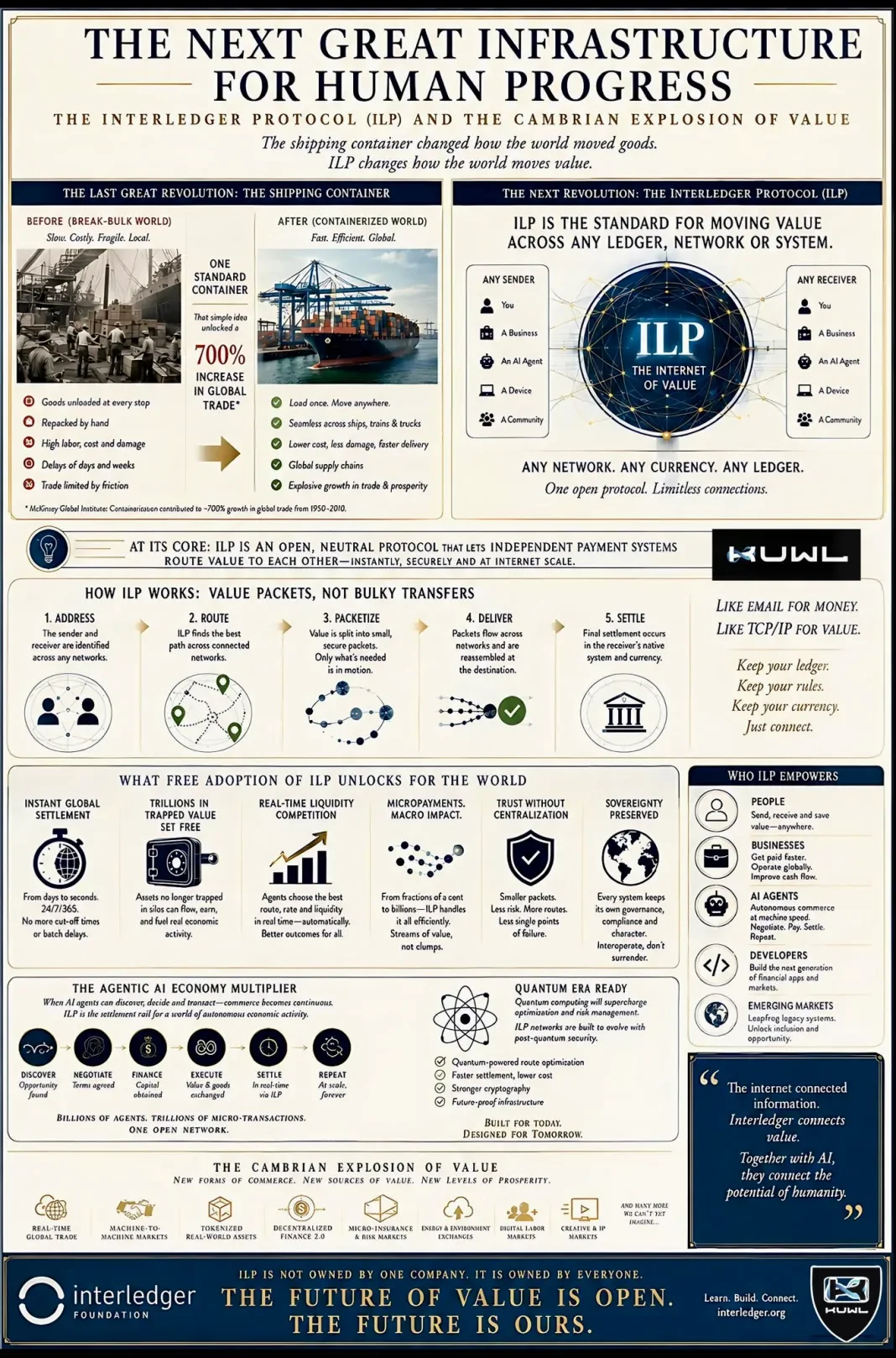
It wasn’t because humanity suddenly built more cargo.
It was because humanity finally agreed on one standard way to move it.
That single steel container quietly removed billions of points of friction from global trade.
Now ask yourself…
What if the world’s greatest bottleneck today isn’t moving goods…
…but moving value?
Every nation has payment systems.
Every bank has ledgers.
Every blockchain has its own rules.
Every business has accounting software.
Every wallet speaks a slightly different language.
The result?
The digital equivalent of unloading every shipping container by hand at every border.
Now imagine something different.
Not one global bank.
Not one global blockchain.
Not one global currency.
One open protocol allowing all of them to communicate while remaining completely independent.
Sound familiar?
It should.
It’s exactly what standardized shipping containers did for physical commerce.
The Interledger Protocol (ILP) aims to do something remarkably similar for value.
Not by replacing financial systems…
But by connecting them.
Now take one more step.
What happens when billions of AI agents begin buying, selling, negotiating, investing, financing, insuring and settling transactions every second?
Will they wait until Monday morning?
Will they tolerate three-day settlement?
Will they navigate thousands of disconnected payment networks one integration at a time?
Or will they naturally gravitate toward the simplest, fastest and most interoperable path available?
History suggests the answer.
Technology almost always flows toward lower friction.
This raises a fascinating question almost nobody is asking…
If standardized shipping containers helped unlock an extraordinary expansion in global trade…
What might a freely adopted global interoperability protocol unlock for global value?
Not just larger transactions.
Millions…
Billions…
Eventually trillions of entirely new economic relationships that simply weren’t practical before.
Machine-to-machine commerce.
Streaming payments.
Tokenized real-world assets.
Autonomous supply chains.
Real-time global liquidity.
A true Internet of Value.
Perhaps the biggest story isn’t which blockchain wins.
Perhaps it’s the emergence of the protocol that allows all of them to work together.
That’s a very different conversation.
And one that could prove far more important than most investors realize.
I spent considerable time connecting the historical dots—from standardized shipping containers… to TCP/IP… to ILP… to tokenized real-world assets… to the coming age of agentic AI.
If you’ve ever wondered why some technologists call this the next Cambrian Explosion of Value, I think you’ll find the answer surprisingly elegant.
Goodbye SDR. Hello XRP.
The Positive ILP Network Flywheel
More tokenized assets
↓
More blockchain networks
↓
More ILP connectivity
↓
More AI agents
↓
More autonomous commerce
↓
More cross-network settlement
↓
Greater demand for efficient bridge liquidity
↓
Deeper liquidity
↓
Lower transaction costs
↓
Even greater adoption
This is a classic positive network effect.
Why Liquidity Becomes Increasingly Valuable
Historically, wealth has flowed toward scarce infrastructure.
Examples include:
railroads
shipping lanes
ports
telecommunications
Internet backbone providers
cloud infrastructure
In the new ILP World, liquidity itself becomes infrastructure.
Not money.
Not banks.
Liquidity.
The scarcer, deeper, and more globally connected that liquidity is, the more valuable it becomes to users seeking efficient cross-network settlement.
An Analogy to SDRs
Today’s IMF SDR is a synthetic reserve asset derived from a basket of major currencies.
Under ILP, XRP would not function as an IMF-issued SDR. Rather, it will resemble a market-discovered global bridge asset that participants voluntarily use because it minimizes friction between otherwise separate financial systems.
Its role will be closer to:
“The shortest path through the graph.”
rather than
“The world’s official reserve currency.”
That distinction matters. A lot.
Welcome to our New @Interledger Era where XRP will be voluntarily crowned Liquidity King of the World by mutual consent of sovereigns, not by force or mandates from centralized, godless control freaks.
Source(s):
• https://x.com/KuwlShow/status/2083544895004799262
• https://x.com/KuwlShow/status/2083562692762034199
https://dinarchronicles.com/2026/08/01/rob-cunningham-the-2026-cambrian-explosion-awaits/
Andy Schectman: Every Signal Is Screaming Buy Gold
Andy Schectman: Every Signal Is Screaming Buy Gold
VRIC Media: 8-2-2026
Andy Schectman argues that rising bond yields, persistent inflation, and declining confidence in U.S. debt are creating a powerful long-term case for precious metals.
He explains why central banks and major buyers continue accumulating physical gold despite recent price weakness, how China is building the vaults, exchanges, and payment systems needed to challenge Western paper markets, and why the shift toward physical settlement could reshape global price discovery.
Andy also compares the outlook for gold, silver, and platinum, with gold remaining his preferred asset for a changing monetary system.
Andy Schectman: Every Signal Is Screaming Buy Gold
VRIC Media: 8-2-2026
Andy Schectman argues that rising bond yields, persistent inflation, and declining confidence in U.S. debt are creating a powerful long-term case for precious metals.
He explains why central banks and major buyers continue accumulating physical gold despite recent price weakness, how China is building the vaults, exchanges, and payment systems needed to challenge Western paper markets, and why the shift toward physical settlement could reshape global price discovery.
Andy also compares the outlook for gold, silver, and platinum, with gold remaining his preferred asset for a changing monetary system.
0:00 Is gold preparing for another major move?
1:49 Interest rates, bond yields, and America’s debt trap
8:38 The real inflation rate and gold’s performance
11:30 Central banks and major buyers accumulate physical gold
13:32 Stablecoins, Treasuries, and the future of interest rates
18:10 When will gold respond to money creation?
20:18 Who is taking delivery from COMEX?
23:38 Could higher gold prices weaken the dollar?
24:00 The Global South builds a new gold settlement system
28:15 Hong Kong’s vault expansion and China’s long strategy
32:33 How much gold is China really buying?
36:01 Falling mine supply and rising physical demand
40:01 Gold revaluation and the July 4 prediction
45:04 Paper markets versus physical price discovery
49:15 Gold, silver, or platinum?
Seeds of Wisdom RV and Economics Updates Sunday Afternoon 8-2-26
Good Afternoon Dinar Recaps,
Iran Pursues Strait of Hormuz Shipping Deal as Red Sea Tensions Keep Global Trade on Edge
New negotiations over the Strait of Hormuz and continued military tensions in the Red Sea highlight how energy security, shipping routes, and alternative payment systems are becoming increasingly important to the future of the global financial system.
Good Afternoon Dinar Recaps,
Iran Pursues Strait of Hormuz Shipping Deal as Red Sea Tensions Keep Global Trade on Edge
New negotiations over the Strait of Hormuz and continued military tensions in the Red Sea highlight how energy security, shipping routes, and alternative payment systems are becoming increasingly important to the future of the global financial system.
Overview
Iran and Oman are negotiating a new framework to manage commercial shipping through the Strait of Hormuz, one of the world's most critical energy corridors.
An earlier draft proposal reportedly included the possibility of crypto- or yuan-based toll payments, signaling continued efforts to reduce reliance on the U.S. dollar in international trade.
Meanwhile, rising U.S.–Iran tensions in the Red Sea continue to threaten maritime security, keeping global energy markets and supply chains on alert.
Key Developments
1. Iran Nears Shipping Management Agreement with Oman
Iran announced it is close to reaching an agreement with Oman on managing commercial shipping through the Strait of Hormuz, the narrow waterway that carries approximately 20% of the world's oil supply. Negotiations remain focused on how shipping lanes would be administered while balancing regional security concerns and maintaining the flow of international commerce.
2. Digital Payments Could Enter Global Maritime Trade
One of the most closely watched aspects of earlier negotiations is a reported proposal allowing crypto assets or yuan-based payment systems to be used for transit tolls. While no final agreement has been announced, such a framework would represent one of the first instances of digital assets being integrated into the operation of a major global trade corridor.
3. Red Sea Becomes the Latest Strategic Flashpoint
At the same time, U.S.–Iran tensions continue to shift toward the Red Sea, where Iran-backed Houthi activity has increased risks to commercial shipping. Continued instability near both the Bab el-Mandeb Strait and the Strait of Hormuz has reinforced concerns over the security of global maritime trade routes.
4. Markets Continue Watching Oil and Shipping Risks
Prediction markets continue to reflect uncertainty regarding when normal shipping traffic may fully resume through the Strait of Hormuz. Investors remain focused on the possibility that renewed military escalation—or successful diplomacy—could quickly influence oil prices, freight costs, and global inflation.
Why It Matters
The Strait of Hormuz is one of the world's most strategically important maritime chokepoints. Any changes to how shipping is managed—or how transit fees are paid—could influence global energy markets, international trade, payment systems, and geopolitical alliances well beyond the Middle East.
The reported discussion of digital asset or yuan-based toll payments also reflects the broader global trend toward exploring alternatives to traditional dollar-denominated settlement for cross-border commerce.
Why It Matters to Foreign Currency Holders
Foreign currency holders continue monitoring developments that could gradually reshape international payment systems. While the U.S. dollar remains the dominant global reserve currency, growing experimentation with alternative settlement mechanisms demonstrates how geopolitical events are increasingly influencing the evolution of global finance.
Implications for the Global Reset
Pillar 2: Trade
The Strait of Hormuz remains one of the world's most important trade corridors. Any changes to shipping management or maritime security could significantly affect global commerce, transportation costs, and supply chain resilience.
Pillar 3: Assets
The reported consideration of digital assets and alternative payment mechanisms highlights the continuing evolution of financial infrastructure and the growing role that tokenized and digital settlement systems may play in future international trade.
This is not simply another Middle East geopolitical story—it illustrates how global trade routes, energy security, and evolving payment systems are becoming increasingly interconnected as the international financial system continues to modernize.
Seeds of Wisdom Team
Newshounds News™ Exclusive
Sources
~~~~~~~~~~
Seeds of Wisdom Team RV Currency Facts Youtube and Rumble
Newshound's News Telegram Room Link
RV Facts with Proof Links Link
RV Updates Proof links - Facts Link
Start Here room with Most Asked Questions Link
Follow the Gold/Silver Rate COMEX
Follow Fast Facts
Seeds of Wisdom Team™ Website
Thank you Dinar Recaps
Iraq Economic News and Points To Ponder Sunday Afternoon 8-2-26
Iraq Faces ‘Cash-Flow’ Strain, Not Bankruptcy
2026-08-02 Shafaq News- Baghdad Iraq’s financial situation reflects difficulties managing cash flows under exceptional uncertainty, rather than a lack of resources or risk of bankruptcy, Prime Minister Ali Al-Zaidi’s financial and economic adviser Mudher Mohammed Saleh told Shafaq News on Saturday.
Saleh stated that the government could continue paying salaries and meeting essential obligations if it managed its fiscal and monetary tools efficiently, but if the war continues into early next year and further affects oil exports, Baghdad may rely on domestic and external borrowing alongside reordered spending priorities.
Iraq’s foreign reserves are a “safeguard” for stable financial flows, he said, arguing that effective crisis management and faster economic reforms could preserve budget financing despite regional disruption.
The country relies heavily on crude exports to finance public spending, earning over $18 billion from the sale of 268.09 million barrels during the first half of 2026, according to the State Organization for Marketing of Oil (SOMO), less than the revenue reported for only four months of the same period last year. Shipping disruptions through the Strait of Hormuz sharply reduced exports from Iraq’s southern terminals, tightening government liquidity while salaries and other recurrent obligations continued to fall due.
Finance Minister Faleh Al-Sari said monthly payments to public employees, pensioners, and social-welfare recipients total about 7.8 trillion dinars ($5.95B). The ministry had disbursed around 3 trillion dinars ($2.29B) and held about 1.5 trillion dinars ($1.15B) in available liquidity, leaving an estimated funding gap of 3.3 trillion dinars ($2.52B).
The shortage has also affected essential services, with Health Minister Abdul Hussein Al-Mousawi saying salaries had become the government’s priority.
Read more: No exit but Hormuz: Iraq's economic vulnerability exposed
https://www.shafaq.com/en/Economy/Iraq-faces-cash-flow-strain-not-bankruptcy
US Extends Streak Of Zero Iraqi Oil Imports
2026-08-02 Shafaq News- Baghdad/ Washington The United States imported no crude oil from Iraq for the fifth consecutive week, according to data released by the US Energy Information Administration (EIA).
Canada remained the largest foreign supplier of crude to the United States during the week, exporting 3.62 million barrels per day (bpd), followed by Venezuela (673,000 bpd), Brazil (269,000 bpd), and Ecuador (230,000 bpd). The EIA data showed no crude imports from either Iraq or Saudi Arabia during the reporting period.
Iraq last exported crude to the United States during the week ending June 19, when shipments averaged 71,000 bpd.
The country lost an estimated 302.8 million barrels of oil production during the first half of 2026 as the US-Iran war disrupted extraction and exports through the Strait of Hormuz. As OPEC’s second-largest producer, Iraq relies on crude sales for about 90% of state revenue, leaving its economy highly vulnerable to disruptions in the Strait, which carries roughly one-fifth of global oil supplies.
Read more: No exit but Hormuz: Iraq's economic vulnerability exposed
https://www.shafaq.com/en/Economy/US-extends-streak-of-zero-Iraqi-oil-imports
USD/IQD Exchange Rates Climb In Baghdad, Erbil
2026-08-02 Shafaq News- Baghdad/ Erbil The US dollar strengthened against the Iraqi dinar in Baghdad and Erbil on Sunday, hovering around 152,000 dinars per $100 across local currency markets.
According to Shafaq News market survey, the dollar traded at 151,800 Iraqi dinars per $100 on Baghdad’s al-Kifah and al-Harithiya central exchanges, up from 150,850 dinars on Saturday.
In Baghdad’s retail market, exchange offices sold dollars at 152,250 dinars per $100 and bought them at 151,250 dinars.
In Erbil, the dollar sold at 152,200 dinars per $100 and was bought at 152,100 dinars.
https://www.shafaq.com/en/Economy/USD-IQD-exchange-rates-climb-in-Baghdad-Erbil-5-3
OPEC Eyes 185K+ Bpd Output Boost Before Year-End Freeze
2026-08-02 Shafaq News- Vienna OPEC will raise its oil production targets by about 188,000 barrels per day (bpd) in September before pausing further output increases for the rest of the year, Reuters reported on Sunday.
Citing sources familiar with the matter, the outlet noted that the alliance is tying the adjustment to its plan to gradually return more supply to the market after years of production cuts designed to support oil prices.
At its meeting on Sunday, OPEC will also assess market conditions and discuss production quotas for 2027.
OPEC output climbed to 19.34 million bpd in June, rising by 3.3 million bpd from the previous month, as Gulf producers restored supplies following disruptions linked to the effective closure of the Strait of Hormuz.
The strategic maritime gateway, which carries about 20% of global oil supplies, has remained largely closed since Feb. 28 after Iran restricted maritime traffic in response to the conflict involving Washington and Tehran.
Read more: No exit but Hormuz: Iraq's economic vulnerability exposed
https://www.shafaq.com/en/Economy/OPEC-eyes-185K-bpd-output-boost-before-year-end-freeze
Gold Prices Inch Higher In Baghdad, Erbil
2026-08-02 Shafaq News- Baghdad/ Erbil Gold prices rose in Baghdad and Erbil on Sunday, with 21-carat gold hovering around 870,000 Iraqi dinars per mithqal (about five grams) in local markets, according to Shafaq News survey.
In Baghdad’s wholesale market on Al-Nahr Street, imported 21-carat gold from the Gulf, Turkiye and Europe sold for 870,000 dinars per mithqal and was bought at 866,000 dinars, up from 866,000 dinars on Saturday.
Iraqi 21-carat gold sold for 842,000 dinars per mithqal and was bought at 836,000 dinars.
In jewellery shops, imported 21-carat gold ranged from 870,000 to 880,000 dinars per mithqal, while Iraqi gold traded between 840,000 and 850,000 dinars per mithqal.
In Erbil, 22-carat gold sold for 905,000 dinars per mithqal, 21-carat gold for 865,000 dinars, and 18-carat gold for 740,000 dinars. https://www.shafaq.com/en/Economy/Gold-prices-inch-higher-in-Baghdad-Erbil-3-1
Weekly Trading Value On Iraq Bourse Plunges 63%
2026-08-02 Shafaq News- Baghdad Trading activity on the Iraq Stock Exchange (ISX) slowed sharply, with the value of transactions falling more than 63% from the previous week to 17.46 billion Iraqi dinars ($13.3M).
According to the exchange's weekly report, trading took place over five sessions involving 69 listed companies. Shares of 26 companies were not trade because buy and sell orders failed to match, while eight companies remained suspended for failing to meet disclosure requirements.
The ISX15 index closed at 1,267.67 points, down 0.17% from the previous week, while the broader ISX60 index slipped 0.30% to 1,041.07 points.
Weekly trading volume dropped 67.90% from the previous week, and the total value of trades declined 63.62%. By contrast, the number of executed transactions rose 3.41%.
Foreign investors bought 65.596 million shares worth 55.461 million Iraqi dinars ($42.3K) in 102 transactions and sold 32.742 million shares valued at 282.051 million Iraqi dinars ($215.3K) through 150 transactions.
The Iraq Stock Exchange holds five trading sessions each week, from Sunday to Thursday, and includes 104 listed Iraqi joint-stock companies representing the banking, telecommunications, industry, agriculture, insurance, financial investment, tourism, hotel, and service sectors. https://www.shafaq.com/en/Economy/Weekly-trading-value-on-Iraq-bourse-plunges-63
Sunday Iraq News Posted by Tishwash at TNT 8-2-2026
TNT:
Tishwash: US forces begin withdrawal from military compound in Erbil
The Monitor website revealed that the US military has begun withdrawing its remaining forces from the military complex near Erbil International Airport in the Kurdistan Region of Iraq.
Al-Monitor, citing informed sources, reported that "the US military has begun withdrawing its remaining forces from the military complex near Erbil International Airport in the Kurdistan Region, after dismantling and redeploying Patriot air defense systems."
TNT:
Tishwash: US forces begin withdrawal from military compound in Erbil
The Monitor website revealed that the US military has begun withdrawing its remaining forces from the military complex near Erbil International Airport in the Kurdistan Region of Iraq.
Al-Monitor, citing informed sources, reported that "the US military has begun withdrawing its remaining forces from the military complex near Erbil International Airport in the Kurdistan Region, after dismantling and redeploying Patriot air defense systems."
According to the sources, "the troop reduction process began last week, and the process is continuing in line with the United States' commitment to complete its withdrawal from Iraq by the agreed deadline with Baghdad on September 30." link
************
Tishwash: Al-Zaydi chairs a meeting dedicated to approving the final version of the government program.
Prime Minister Ali al-Zubaidi chaired a meeting on Saturday dedicated to reviewing and approving the final draft of the government program.
The Prime Minister's Media Office stated in a press release received by Al-Ghad Press that "the Prime Minister chaired a meeting on Saturday dedicated to reviewing and approving the final draft of the government program, in the presence of the Secretary-General of the Council of Ministers and a number of relevant advisors."
The statement added that "the meeting included a comprehensive review of the program's axes and priorities, and a discussion of final observations to ensure the integration of visions and objectives, in preparation for its final approval and submission to the Council of Representatives, reflecting the government's commitment to implementing its program, achieving reforms, accelerating the pace of development, and improving the level of services provided to citizens." link
************
Tishwash: Al-Fahdawi: All blocs agree on finalizing the cabinet formation.
Member of the United Anbar Alliance, Muhammad al-Fahdawi, confirmed that there is an agreement between the political blocs to expedite the resolution of al-Zidi’s ministerial cabinet during this month, noting that everyone agrees to pass the cabinet and the remaining positions despite the existence of some disagreements between the political blocs.
Al-Fahdawi told Al-Maalouma, “The data on the ground and what resulted from the meeting of the coordination framework have given the green light to hold a parliamentary session at the beginning of August in order to decide on the ministerial cabinet.”
He added that "everyone is still in agreement on what was agreed upon in previous meetings regarding the government cabinet, despite some disagreements, but it is possible to ease the atmosphere and resolve the disagreements to ensure the passage of the remainder of Al-Zaidi's cabinet."
He explained that "Prime Minister Ali al-Zaidi is pressing and emphasizing the importance of finalizing and completing the cabinet in order for his government to succeed by securing votes on the remaining positions so that there can be a fully empowered and legitimate government." link
************
Tishwash: An economic expert says: Iraq has entered a phase of financial hardship, and radical reforms have become an urgent necessity.
Economic expert Ziad Al-Hashemi confirmed that Iraq has officially entered a phase of "financial hardship," noting that the government is facing complex financial challenges at a time when citizens and employees are waiting for their financial entitlements to be disbursed.
Al-Hashemi explained that the essence of the crisis is not related to the size of the available dollar reserves, but rather to the way public revenues and government spending are managed, indicating that a large part of the oil revenues is depleted before reaching the state treasury as a result of corruption and various financial obligations, while the priority of meeting the needs of employees and basic services is declining.
He added that the current crisis is not just a result of the drop in oil prices, but rather the result of accumulated problems that have lasted for years due to uncontrolled spending and mismanagement of financial resources.
He called for the adoption of a comprehensive reform package that includes reducing waste in public spending, controlling the payroll, combating cases of fictitious employment, recovering looted funds, dismantling economic offices, as well as developing non-oil revenues and strengthening alternative state resources.
Al-Hashemi stressed that financial reserves, despite their importance, will not be able to protect the Iraqi economy in the long term unless genuine financial and administrative reforms are implemented that address the structural causes of the crisis and establish the sustainability of public resources. link
************
Tishwash: The Iraqi market is attracting the attention of the American private sector.
The visit of Prime Minister Ali Faleh al-Zaidi and his accompanying delegation to Washington confirmed that there is a clear shift in the nature of the relationship between the two countries. After the previous security and military cooperation between Baghdad and Washington, the recent visit led to a shift in that relationship from focusing on security and military files to building a long-term economic and investment partnership based on common interests and promoting sustainable development.
Experts who accompanied the Iraqi delegation during the Washington visit confirm that American companies view the Iraqi market as a promising market and are eager to invest in various productive sectors.
Major American companies
Kamil Abdullah Al-Hamdani, a member of the Iraqi delegation participating in the Washington meetings and representative of the private sector, stated that the official visit to the United States achieved important results in terms of strengthening bilateral economic partnerships and opening direct communication channels with major American and international companies, noting that the delegation held a series of intensive meetings in Boston and other American cities.
Others were included in the visit.
Government will Al-Hamdani told Al-Sabah newspaper that the meetings were characterized by clarity and transparency, and witnessed intensive dialogues with representatives of companies and economic institutions. This contributed to presenting a realistic picture of the investment environment in Iraq and the economic reforms being implemented by the government. He emphasized that the delegation sensed a genuine desire among many American companies to enter the Iraqi market and invest in various sectors, a desire reinforced by the government's will, led by the Prime Minister, to provide An attractive environment for investment.
He explained that the agreements and memoranda of understanding signed during the visit were not merely protocol-based, but were formulated on practical foundations that make them implementable and establish long-term partnerships, and that the American Chamber of Commerce expressed a clear conviction in the feasibility of working in Iraq in light of the stability and economic reforms it is witnessing.
Transfer of global expertise
Al-Hamdani stated that the delegation did not limit itself to holding economic meetings, but also reviewed the latest experiences in the fields of technology, industry, innovation and business management, with the aim of transferring global expertise to Iraq and benefiting from it in supporting the private sector and enhancing the economic development process, stressing that the next stage requires translating the outcomes of the visit into projects and investments that contribute to diversifying the economy and creating new job opportunities.
Project financing programs
The head of the Iraqi Economic Council, Ibrahim al-Baghdadi, said: On the economic and financial side, the Prime Minister held a meeting with the Executive Director of the US International Development Finance Corporation (DFC), and also met with the President of the World Bank Group, Ajay Banga, and the President of the International Finance Corporation, Mukhtar Diop, in the presence of the Minister of Finance, the Governor of the Central Bank, and a number of senior Iraqi officials, where they discussed project financing programs, financial and banking reform, developing the investment environment, and strengthening cooperation with international financial institutions.
He added that the most important part of the visit was the meeting with the CEOs of major American companies, as part of the work of the American Chamber of Commerce conference in Washington, including GE Vernova, Google, HKN, Vantive and others, where the Iraqi side presented promising investment opportunities in the energy, electricity, industry and technology sectors, stressing the government’s readiness to provide the appropriate environment for investors.
Encouraging joint investments
In support of the private sector, Al-Baghdadi noted that the Iraqi delegation participated in the ceremony announcing the establishment of the American-Iraqi Chamber of Commerce, headed by businessman Ammar Shaker Al-Khafaji, which represents a new platform to enhance relations between businessmen in the two countries and encourage joint investments. He pointed out that the Prime Minister met with a number of Iraqi businessmen and the Iraqi community in the United States and the importance of this meeting, and listened to their opinions and suggestions regarding enhancing the contribution of Iraqi talents to development projects within Iraq.
Providing financial cover
For his part, the head of the Association of Iraqi Private Banks, Wadih Al-Hanzal, explained that the strategic memorandum of understanding signed in the American capital, Washington, with the Association of Energy Engineers (AEE), on the sidelines of the visit of the Prime Minister, Mr. Ali Al-Zaidi, aims primarily to provide the necessary financial and technical cover to solve the electricity crisis in Iraq through the gateway of sustainable development.
He stated that the core objective of this partnership is to provide the necessary funding to support the construction of advanced power plants that rely entirely on solar energy, as well as to provide financial facilities for converting homes to operate on clean energy systems.
He explained that “directing bank financing towards these projects will contribute directly and effectively to finding radical solutions to the problem of electricity shortages, and relieving the great pressure on the national grid, which will positively impact the lives of citizens and sectors.” All economic sectors.
American companies and investors
For his part, Dr. Abdul Aziz Al-Khudairi, Chairman of the Board of Directors of the Al-Khudairi Group and an expatriate economist in the United States, who participated in the Washington meetings, said: The visit achieved positive results in terms of communication with the American business community, and the presence of the Prime Minister and the Iraqi delegation contributed to attracting the attention of American companies and investors, especially with the broad participation of major companies and economic institutions.
Al-Khudairi said that the visit could be described as successful because it presented a different image of Iraq as a promising market for investment, and that the meetings held with representatives of American companies revealed an increasing interest in entering the Iraqi market, especially in the energy, infrastructure and services sectors.
joint projects
He noted that the Houston station, known globally as the “Energy City,” was one of the most prominent stops on the visit, as it witnessed intensive meetings with companies specializing in oil, gas and energy, which sent positive messages about the availability of real job opportunities and great potential for implementing joint projects within Iraq.
Al-Khudairi explained that the Al-Khudairi Group participated in all the meetings held with American companies, during which a number of memoranda of understanding were signed, which he described as good, stressing that these memoranda represent a first step towards turning them into investment and implementation contracts during the next stage, after completing the technical and legal aspects.
American Chamber of Commerce
Al-Khudairi stated that he participated in the expanded business conference organized by the American Chamber of Commerce in Washington, D.C., in the presence of the Prime Minister and a number of Iraqi ministers and officials, including the Ministers of Oil, Electricity, Finance and Foreign Affairs, along with the Chairman of the Iraqi Trade Bank, the Director of Baghdad Bank, the Director General of Basra Oil Company, as well as representatives of major American companies, financial and investment institutions and industrial and technological sectors.
Economic reform programs
The conference witnessed extensive discussions that addressed ways to enhance the economic partnership between Iraq and the United States, reviewing available investment opportunities, supporting economic, financial and banking reform programs, in addition to developing the business environment in line with the requirements of international investors and enhancing Iraq’s ability to attract capital.
Al-Khudairi emphasized that the next phase requires following up on the outcomes of the meetings and translating the understandings into practical agreements. He stressed that the success of any economic visit is measured by the resulting projects, job opportunities, and technology transfer, which is what the Iraqi government, in cooperation with the national private sector and international partners, is striving for. The visit yielded tangible results, including the signing of a large number of agreements and memoranda of understanding. The most prominent of these were agreements in the oil and electricity sectors, with projects exceeding 30,000 megawatts, most notably the agreement with GE Vernova, in addition to strategic projects for developing the energy sector.
The agreements also included the rehabilitation and operation of the Basra-Haditha-Banias pipeline with a capacity of one million barrels per day, and the Basra-Haditha-Ceyhan pipeline with a capacity of 750,000 barrels per day, which contributes to raising Iraq’s export capacity to more than two million additional barrels per day, as well as diversifying oil export outlets and reducing dependence on a single outlet, which enhances Iraq’s economic security in light of the geopolitical challenges facing the region. link
News, Rumors and Opinions Sunday 8-2-2026
Ariel: Iraq is Telling you What they are About to do
8-1-2026
Iraq Is Telling You What They Are About To Do:
Currency Overhaul
Monetary Reformation
Gold Revaluation
Ariel: Iraq is Telling you What they are About to do
8-1-2026
Iraq Is Telling You What They Are About To Do:
Currency Overhaul
Monetary Reformation
Gold Revaluation
Financial Stability
Do You See The Timing?
Do You See The Agenda?
Do You See The Progress?
Redenomination + Revaluation = ?
Payday!
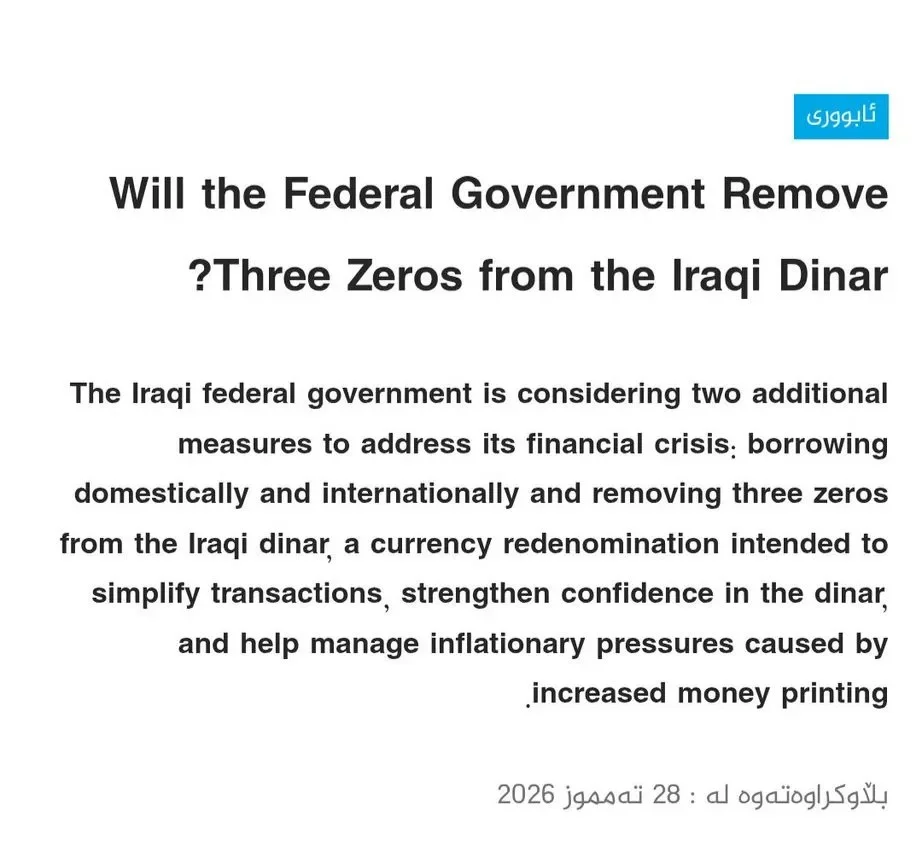
The 3 Zero Project Are In-Country Only
Source(s):
• https://x.com/Prolotario1/status/2083278112557559854
https://dinarchronicles.com/2026/08/01/prolotario-iraq-is-telling-you-what-they-are-about-to-do/
************
Courtesy of Dinar Guru: https://www.dinarguru.com/
Reset Intelligence Baghdad keeps doing quiet, boring, specific things to its money that only make sense in one direction.
Jeff What brought the value of the dinar down? It was Iraq getting placed under US sanctions. US OFAC sanctions very simply brought the value down.What happens when you take the sanctions off? It reinstates back to where it was. In ‘03 sanctions devalued it from $3.22 so when you take the sanctions off it should put it right back up again…
Frank26 The three zeros are going to be removed from two different areas. 1. From the decimal representation of the value of the Iraqi dinar, which is $0.00076. When they lift the three zeros take the decimal point and move it over to the right…You got $0.76…At the blink of an eye, at the flip of a switch, 76 cents will become $1.00… 2. Take that 25k note that you got in your hand. Go to the bank. Trade it in for an American currency. They just lifted the three zeros physically from you and the market.
Ariel Iraq’s Currency Reset As The Gateway: Iraq’s Central Bank…has been executing the Deletion of Three Zeros project in coordination with the International Monetary Fund’s Middle East Technical Assistance Center. The mechanics are straightforward on paper. The current 25,000 dinar note gets replaced by a 25 new dinar note with equivalent purchasing power. The exchange rate adjusts from approximately 1,310 IQD per USD to a projected range between 1.00 and 3.22 new IQD per USD depending on which internal CBI projection you access.
************
IQD Update: What Happens if the IQD Follows the ZiG?
Edu Matrix: 8-2-2026
Understand Zimbabwe's economic history from 1980 to 2024. What happens if the IQD follows the ZiG? This analysis provides U.S. investors with context on hyperinflation and new monetary systems.
This breakdown covers the evolution of the Zimbabwe currency, tracking the path from post-independence to the recent introduction of a gold-backed currency. We examine specific periods of volatility to help you grasp the structural challenges that have defined the nation's financial landscape over the last four decades.
For those monitoring emerging markets, this summary explains how hyperinflation impacted previous fiscal policy and what the current monetary system aims to stabilize.
By reviewing these historical shifts, you will gain a clearer perspective on the risks and mechanisms currently at play within the Zimbabwean economy.
0:00 Analyzing the Zimbabwe Currency Revaluation
0:53 Tracing the History of the Zimbabwe Dollar
3:50 The Gold-Backed Zig Currency Explained
6:17 The Reality of Iraqi Currency Exchange Risks
https://www.youtube.com/watch?v=VWhGSbEJb_4
Iraq Economic News and Points To Ponder Late Saturday Evening 8-1-26
Concerns About Passing The Borrowing Law... Hamdoun: It Will Raise The Debt To $150 Billion
Information/Special.. Former Member of Parliament, Mahasin Hamdoun, warned on Saturday against passing the 2026 External Borrowing and Grants Law to ensure the payment of salaries for employees in Parliament, stressing that passing this law will raise Iraq's external debts to more than one hundred and fifty billion dollars.
Concerns About Passing The Borrowing Law... Hamdoun: It Will Raise The Debt To $150 Billion
Information/Special.. Former Member of Parliament, Mahasin Hamdoun, warned on Saturday against passing the 2026 External Borrowing and Grants Law to ensure the payment of salaries for employees in Parliament, stressing that passing this law will raise Iraq's external debts to more than one hundred and fifty billion dollars.
Hamdoun told Al-Maalouma Agency that “the volume of internal and external debts has reached more than one hundred billion dollars at the present time,” adding that “passing the external borrowing law within the House of Representatives requires more than a month, as it requires study and review by the Finance Committee and the competent authorities before voting on it.”
She added that "continuing with the current borrowing mechanism at this pace will raise the debt to more than $150 billion," noting that "new mechanisms must be explored to support the budget, moving away from borrowing which burdens the state, such as combating corruption, collecting outstanding debts owed by companies, and finding new outlets for oil exports." (End of 25 words)
In Preparation For Sending It To Parliament, Al-Zaydi Chairs A Meeting To Approve The Final Version Of The Government Program
latest news Saturday, August 1, 2026 Baghdad - One News - 8/01/2026 Prime Minister Ali Faleh al-Zaidi chaired a meeting on Saturday dedicated to reviewing and approving the final version of the government program, in the presence of the Secretary-General of the Cabinet and a number of relevant advisors.
The Prime Minister’s Media Office stated in a statement that the meeting witnessed a comprehensive review of the axes of the government program and its priorities, as well as a discussion of the final observations related to its objectives and implementation mechanisms.
The statement added that the meeting focused on ensuring the integration of government visions and the unification of priorities, in line with the government’s commitments to implement reforms, accelerate the pace of development, and improve the level of services provided to citizens.
He indicated that the government program will be submitted to the House of Representatives, after its final approval, to complete the constitutional and legal procedures related to it, in preparation for starting to implement its provisions according to the approved schedules and plans.
The approval of the government program comes as the executive framework that the government will adopt in managing its files during the next stage, and in determining its priorities in the service, economic and reform fields, in addition to establishing clear mechanisms to monitor progress rates and evaluate the performance of government institutions. https://1news-iq.net/تمهيداً-لإرساله-إلى-البرلمان-الزيدي-ي/
Escalating Tensions Between Saudi Arabia And The Factions Threaten Rapprochement Between Baghdad And Riyadh. The Washington Institute Warns That Failure To Contain The Factions' Activities Could Push The United States To Target Their Top Leadership
Baghdad - One News - 8/01/2026 A report issued by the Washington Institute for Near East Policy warned that the recent escalation between Saudi Arabia and Iranian-backed armed factions inside Iraq threatens the rapprochement between Baghdad and Riyadh, and puts the government of Iraqi Prime Minister Ali al-Zubaidi before a very complex security and political test, at a time when it seeks to implement its pledge to restrict weapons to the state before the end of next September.
The report explained that the strikes carried out by the United States and Saudi Arabia against sites in Iraq, which the US Central Command (CENTCOM) described as “logistical sites and weapons depots used by Iranian-backed factions,” came in response to repeated drone attacks launched from Iraqi territory targeting Saudi Arabia, including the attack on the Abqaiq oil facility, the world’s largest oil processing facility.
The report indicated that the exchange of blows led to the postponement of the visit that al-Zaidi was scheduled to make to Saudi Arabia, considering that this development serves the interests of Tehran, which, according to it, seeks to weaken the Iraqi-Gulf rapprochement and isolate Baghdad from its Arab surroundings by using armed factions to put pressure on Saudi Arabia and the Gulf states.
He explained that the Iranian-backed Iraqi factions had previously targeted oil facilities and infrastructure in Saudi Arabia and the UAE in recent years, and had intensified their attacks in recent months against US bases and sites in the Gulf, noting that Riyadh responded, in coordination with Washington, by carrying out strikes inside Iraq, after official warnings confirmed that it would not leave those attacks unanswered.
According to the report, the strikes targeted locations in the Nineveh Plain, Amerli, and Dibis in northern Iraq, as well as Camp Ashraf in Diyala, and sites in Karbala, south of Baghdad, and north of Basra.
While the Popular Mobilization Forces announced the deaths of 20 members and injuries to 32 others, the report suggested that members of the Iranian Revolutionary Guard were among the dead, following the appearance of coffins draped in Iranian flags in Iranian media.
The report linked these developments to a broader regional escalation, which included attacks carried out by the Yemeni group against Saudi facilities, ports and oil tankers, as well as Iranian attacks targeting ships in the Strait of Hormuz and an American base in Jordan, considering that what is known as the “axis of resistance” has transferred part of its pressure to the Saudi arena with the aim of pushing the United States to ease its pressure on Iran.
The report stressed that the administration of US President Donald Trump finds itself facing a complex equation of maintaining its partnership with the new Iraqi government, while at the same time continuing to provide a security umbrella for its Gulf allies, noting that US officials warmly received al-Zaidi during his recent visit to Washington, but his government is now facing the repercussions of the return of US strikes to Iraqi territory.
The report suggested that Iran would likely continue to use Iraqi factions to target Saudi Arabia and the Gulf states in order to undermine the Arab support that the al-Zaidi government needs to complete its project of restricting weapons to the state by September 30, the same date expected for the completion of the withdrawal of US combat forces from Iraq.
The report called on the US administration to work on arranging an Iraqi-Saudi summit in the coming months, in parallel with launching a permanent security dialogue between the intelligence agencies in Baghdad and Riyadh, to prevent further escalation, stressing that the success of the relationship between the two countries is in the interest of regional stability and limits the opportunities for the expansion of Iranian influence.
He also recommended supporting the Iraqi government in carrying out precise operations targeting the storage, assembly, and maintenance sites of armed factions’ drones, based on US intelligence information, and taking advantage of the existing cooperation between Prime Minister Ali al-Zaidi and the head of the Supreme Judicial Council, Faiq Zaidan, with the aim of cutting off the supply chains for these drones.
He added that Baghdad’s failure to contain the activities of the factions may push Washington to target their top leaders, considering that past experiences have shown that targeting leaders is more effective in reducing attacks against American interests than targeting field operatives or weapons depots.
On the economic and security front, the report called for accelerating the provision of anti-drone defense systems to Western companies operating in Iraq, and facilitating their import to protect oil facilities and their workers, as well as giving the Iraqi government priority in obtaining these systems if it demonstrates actual cooperation in reducing the activity of armed factions.
The report concluded that the success of al-Zaidi's government in implementing its security program requires continued Arab and international support, warning that continued attacks could complicate Baghdad's efforts to impose state authority and give Iran a greater opportunity to derail the rapprochement between Iraq and the Gulf states.
Seeds of Wisdom RV and Economics Updates Sunday Morning 8-2-26
Good Afternoon Dinar Recaps,
Federal Reserve Holds Rates Steady, but Americans Still Face High Borrowing Costs as Inflation Fight Continues
While financial markets welcomed signs of stability, the Federal Reserve's decision to keep interest rates unchanged means the effects of higher borrowing costs will continue to ripple through households, businesses, and the global economy.
Good Afternoon Dinar Recaps,
Federal Reserve Holds Rates Steady, but Americans Still Face High Borrowing Costs as Inflation Fight Continues
While financial markets welcomed signs of stability, the Federal Reserve's decision to keep interest rates unchanged means the effects of higher borrowing costs will continue to ripple through households, businesses, and the global economy.
Overview
The Federal Reserve left its benchmark interest rate unchanged, signaling that inflation remains a concern despite recent progress.
Higher interest rates continue to affect mortgages, auto loans, credit cards, and business financing, placing ongoing pressure on consumers and employers.
Markets are increasingly focused on when meaningful rate cuts might begin, as future Fed decisions will influence global capital flows, the U.S. dollar, and economic growth.
Key Developments
1. The Cost of Borrowing Remains Elevated
Although the Fed chose not to raise rates, borrowing costs remain near multi-year highs. Families looking to purchase homes or vehicles, refinance debt, or carry credit card balances are still facing significantly higher monthly payments than they did just a few years ago.
2. Businesses Continue to Feel Financial Pressure
Higher financing costs are making expansion projects, equipment purchases, hiring, and commercial real estate investments more expensive. Many companies remain cautious about new investments until borrowing conditions improve.
3. Inflation Is Easing—but Not Fast Enough
Inflation has moderated from its peak, but it remains above the Federal Reserve's long-term 2% target. Policymakers continue balancing the need to reduce inflation without pushing the economy into recession.
4. Relief for Families May Come Gradually
Consumers hoping for immediate reductions in grocery prices, housing costs, insurance premiums, and everyday expenses may need to remain patient. Even after inflation slows, prices generally stabilize rather than return to previous levels, meaning households typically experience slower price increases rather than widespread price declines.
5. Global Markets Remain Focused on Future Fed Decisions
Because the U.S. dollar remains the world's primary reserve currency, Federal Reserve policy influences global borrowing costs, government debt servicing, international investment flows, commodity prices, and currency values. Every future rate decision will continue to shape financial conditions well beyond the United States.
Why It Matters
Federal Reserve policy affects nearly every sector of the economy. Higher interest rates influence household budgets, corporate investment decisions, government borrowing costs, and global capital markets. Even without additional rate increases, today's elevated borrowing costs continue to slow economic activity while the Fed works toward restoring price stability.
Why It Matters to Foreign Currency Holders
For those following the evolution of the international monetary system, Federal Reserve policy remains one of the most influential drivers of global liquidity. Interest rate decisions affect the strength of the U.S. dollar, international capital flows, sovereign debt markets, and the pace at which alternative payment systems and reserve assets continue to develop.
Implications for the Global Reset
Pillar 1: Debt
Higher interest rates increase borrowing costs for households, businesses, and governments, placing additional pressure on debt sustainability and long-term fiscal stability.
Pillar 3: Assets
Federal Reserve policy directly influences the value of stocks, bonds, real estate, gold, and other investment assets as investors continually adjust portfolios based on expectations for future interest rates.
Looking Ahead
Many economists now expect the Federal Reserve to keep monitoring inflation, employment, consumer spending, and energy prices before making its next move. If inflation continues to cool, borrowing costs could begin easing in the coming months, providing gradual relief for families and businesses. Until then, higher interest rates are likely to remain one of the defining forces shaping both the U.S. economy and the broader global financial system.
This is not simply about interest rates—it reflects the ongoing transformation of the global financial system as central banks balance inflation, debt, and economic growth while markets adapt to a new era of higher capital costs.
Seeds of Wisdom Team
Newshounds News™ Exclusive
Sources
Reuters — Federal Reserve holds interest rates steady as policymakers weigh inflation and growth
Federal Reserve — FOMC Statement and Monetary Policy Decisions
~~~~~~~~~~
🌱 A Message to Our Currency Holders🌱
If you’ve been holding foreign currency for many years, you were not foolish.
You were not wrong to believe the global financial system would change.
What failed was not your patience — it was the information you were given.
For years, dates, rumors, and personalities replaced facts, structure, and proof. “This week” predictions created cycles of hope and disappointment that were never based on how currencies actually change.
That is not your failure.
Our mission here is different: • No dates • No rates • No hype • No gurus
Instead, we focus on:
• Verifiable developments • Institutional evidence
• Global financial structure • Where countries actually sit in the process
Currency value changes only come after sovereignty, trade, banking, settlement systems, and fiscal coordination are in place. History and institutions confirm this sequence.
You will see silence. You will see denials. That is not delay — that is discipline.
Protect your identity. Organize your documents. Verify everything.
Never hand your discernment to anyone who cannot show proof.
You deserve truth — not timelines.
Seeds of Wisdom Team
Newshounds News
~~~~~~~~~~
Seeds of Wisdom Team RV Currency Facts Youtube and Rumble
Newshound's News Telegram Room Link
RV Facts with Proof Links Link
RV Updates Proof links - Facts Link
Start Here room with Most Asked Questions Link
Follow the Gold/Silver Rate COMEX
Follow Fast Facts
Seeds of Wisdom Team™ Website
Thank you Dinar Recaps
Iraq Dinar Update, Liquidity Crisis, Clarity Act, and the Road Ahead: Jon Dowling:
Iraq Dinar Update, Liquidity Crisis, Clarity Act, and the Road Ahead: Jon Dowling:
8-1-2026
The global financial landscape is experiencing a profound period of transformation. From liquidity challenges in foreign economies to sweeping regulatory changes surrounding digital assets in the United States, multiple economic indicators point toward a broader structural shift.
Recent reporting by market analyst Jon Dowling highlights how international monetary pressures, asset tokenization, and geopolitical developments are converging to create a new paradigm for global finance and community stewardship.
Iraq Dinar Update, Liquidity Crisis, Clarity Act, and the Road Ahead: Jon Dowling:
8-1-2026
The global financial landscape is experiencing a profound period of transformation. From liquidity challenges in foreign economies to sweeping regulatory changes surrounding digital assets in the United States, multiple economic indicators point toward a broader structural shift.
Recent reporting by market analyst Jon Dowling highlights how international monetary pressures, asset tokenization, and geopolitical developments are converging to create a new paradigm for global finance and community stewardship.
Below is an in-depth analysis of these major developments, exploring how domestic policy shifts, international monetary revaluations, and modern financial technologies are reshaping the global economic outlook.
At the center of Middle Eastern economic discussions is Iraq’s ongoing fiscal challenge. Reports indicate that Iraq is confronting a substantial 70% liquidity crisis, creating intense pressure on its government to enact long-overdue economic and political reforms.
To address these structural deficiencies, leadership is under increasing obligation to finalize key legislative frameworks, including the Hydrocarbon Law (HCL gas law) and Article 140.
Many financial observers believe these legislative steps are crucial prerequisites for stabilizing the nation’s financial system and potential discussions surrounding the long-term revaluation of the Iraqi dinar.
Signs of fiscal stress are already visible in daily banking operations. Iraqi state banks have taken the unusual step of adjusting protocol to remain open through weekends to clear public salary payments. While this reflects acute operational strain within the banking sector, it also highlights dedicated governmental efforts to stabilize income flows to citizens, curb systemic corruption, and facilitate a fairer distribution of national resource revenue.
While foreign economies work through fiat liquidity challenges, the United States is rapidly progressing toward digital asset regulation. The proposed Clarity Act is gaining noticeable bipartisan traction, attracting support from major institutional powerhouses such as BlackRock.
This legislative drive aims to provide much-needed regulatory boundaries for digital currencies, encouraging traditional financial markets to transition toward tokenized assets on the blockchain.
Combined with administrative efforts from regulatory bodies like the SEC and operational migrations planned by the Depository Trust & Clearing Corporation (DTCC), the legislation marks a pivotal watershed moment.
Providing clear rules for digital assets paves the way for institutional capital to enter utility-driven blockchain networks, precious metals tokenization, and modern foreign currency exchanges.
As regulatory frameworks solidify, analysts anticipate significant momentum behind utility-focused cryptocurrencies. As traditional fiat currency models face ongoing inflationary pressures, decentralized finance solutions and digital ledger systems—particularly those associated with enterprise protocols like XRP—are positioned as efficient alternatives for cross-border settlements.
Key public speeches and political announcements are expected to further catalyze interest in digital asset infrastructure, signaling a gradual departure from total reliance on traditional paper monetary systems.
International markets are already adapting to this digital evolution. In response to paper market volatility and recent price fluctuations, China has adjusted its gold trading policies, shifting away from speculative paper proxies toward blockchain-backed tokenization.
By integrating precious metals directly onto distributed ledgers, international markets can improve liquidity, enhance asset tracking, and reduce reliance on intermediary financial proxies.
In broader commodities markets, subtle adjustments in gold and silver prices—coupled with market expectations of potential interest rate cuts by the Federal Reserve—suggest that central banks are preparing for a changing macroeconomic environment. Lower interest rates typically ease financial pressure on the public and provide liquidity ahead of major political and economic cycles.
Economic realignments rarely happen in isolation; they are deeply interconnected with international diplomacy. Recent reports highlight momentum toward historic peace initiatives and regional diplomatic agreements in the Middle East, including framework discussions regarding regional security and economic stabilization.
Achieving long-term geopolitical stability in energy-rich regions is vital for establishing transparent trade routes, stabilizing currency values, and facilitating global investment flows.
In times of broad economic and technological transformation, taking a broader perspective on community values and stewardship is essential. In his analysis, Jon Dowling incorporates timeless principles from Scripture, emphasizing values such as humility, collective discernment, and mutual support as society navigates shifting economic structures.
Rather than viewing financial shifts purely through an individualistic lens, these perspectives encourage viewing economic stewardship as an opportunity to uplift communities, promote fairness, and support long-term social stability.
The convergence of foreign liquidity pressures, U.S. regulatory clarity, digital asset adoption, and geopolitical negotiations signals a unique period in global finance. As traditional structures evolve, tracking legislative and technological updates remains essential for navigating the future of money and investment.
The Bust Has Already Begun – Most Investors Just Don’t See It | Mark Thornton & Andy Schectman
The Bust Has Already Begun – Most Investors Just Don’t See It | Mark Thornton & Andy Schectman
Miles Franklin Media: 8-1-2026
Andy Schectman, Founder & CEO of Miles Franklin Precious Metals, interviews Mark Thornton, Senior Fellow at the Mises Institute, to discuss why he believes the global economy is approaching a critical turning point driven by mounting debt, declining trust, and years of monetary distortion.
Thornton explains why the bond market may be sending a warning investors shouldn't ignore, how decades of easy money have distorted markets, and why private credit could become the next major financial risk.
The Bust Has Already Begun – Most Investors Just Don’t See It | Mark Thornton & Andy Schectman
Miles Franklin Media: 8-1-2026
Andy Schectman, Founder & CEO of Miles Franklin Precious Metals, interviews Mark Thornton, Senior Fellow at the Mises Institute, to discuss why he believes the global economy is approaching a critical turning point driven by mounting debt, declining trust, and years of monetary distortion.
Thornton explains why the bond market may be sending a warning investors shouldn't ignore, how decades of easy money have distorted markets, and why private credit could become the next major financial risk.
He also shares why central banks continue accumulating gold while reducing their reliance on government debt.
The discussion also explores the growing role of gold and silver in wealth preservation, the risks facing the global financial system, and why Austrian economics offers a different perspective on today's macroeconomic challenges.
In this episode of Little by Little:
Warning signs from the bond market
The risks building in private credit
How easy money fueled today's debt bubble
Why central banks keep buying gold
Gold and silver for wealth preservation
Austrian economics and today's markets
00:00 Coming Up
01:21 Introduction
03:01 Boom or Bust Now
03:40 War Oil and China
06:43 Hidden Inflation Pain
08:58 Balance Sheets Near Break
11:05 Bond Market Distrust
16:59 Real Inflation Debate
18:41 Private Credit Black Swan
25:29 Central Banks Buy Gold
32:49 AI Bubble and Surveillance
39:23 Advice for Young People
44:35 Mises Resources and Metals
46:09 Closing Thanks and Outro
Bond Market Rejects The Fed: Why The Rules Just Changed For Gold
Bond Market Rejects The Fed: Why The Rules Just Changed For Gold
Kitco News: 7-31-2026
The bond market just delivered a sharp rejection to the Federal Reserve’s latest rate decision, pushing 30-year Treasury yields to 19-year highs as inflation fears persist.
Meanwhile, three top macro strategists—Gareth Soloway, Willem Middelkoop, and Mike McGlone—issue three completely conflicting calls on where gold, bonds, and energy go from here.
Bond Market Rejects The Fed: Why The Rules Just Changed For Gold
Kitco News: 7-31-2026
The bond market just delivered a sharp rejection to the Federal Reserve’s latest rate decision, pushing 30-year Treasury yields to 19-year highs as inflation fears persist.
Meanwhile, three top macro strategists—Gareth Soloway, Willem Middelkoop, and Mike McGlone—issue three completely conflicting calls on where gold, bonds, and energy go from here.
In this episode of "This Week in Focus," Senior Anchor Jeremy Szafron breaks down the breakdown in traditional market correlations.
From the World Gold Council's latest Q2 demand report showing central bank buying surging 62% year-over-year to Big Tech's massive earnings divergence and breaking developments in currency markets, we analyze what this means for your portfolio.
00:00 - Cold Open: The Old Market Rules Stopped Working
01:10 - Fed Rate Hold & The 30-Year Treasury Yield Surge
03:30 - Gareth Soloway on Bond Market Signals
06:15 - Willem Middelkoop: The Quiet Monetary Reset & China's Gold
09:45 - Gareth Soloway: The $13,000 Gold Model Target
13:20 - Mike McGlone: Is Gold's Cycle High Already In?
16:50 - WGC Q2 Report: Central Banks Buy 289 Tonnes vs. ETF Outflows
20:15 - Credit Market Stress, KOSPI & Big Tech Earnings Split
23:40 - Soloway's S&P 500 Technical Level Tested 26:15 - Physical Gold & Silver Positioning Strategy
28:10 - Market Scoreboard & What to Watch Next Week