
Thank you to all the subscribers to our Early Access program…we thank you for your continued support.
We are excited to offer this new service to keep you informed and up-to-date on the latest Dinar and currency news.
Iraq Economic News and Points To Ponder Saturday Afternoon 8-1-26
CBI Reserves Slide $7B+ In H1 2026
2026-08-01 Shafaq News- Baghdad Iraq’s foreign reserves fell by $7.4 billion during the first five months of 2026, while the country’s gold holdings increased by 5.7% from their level at the end of last year, according to data from the Central Bank of Iraq (CBI).
Foreign reserves stood at $93.673 billion at the end of May 2026, down from $101.082 billion in January, marking a decline of $7.409 billion, or 7.3%, over the five-month period.
CBI Reserves Slide $7B+ In H1 2026
2026-08-01 Shafaq News- Baghdad Iraq’s foreign reserves fell by $7.4 billion during the first five months of 2026, while the country’s gold holdings increased by 5.7% from their level at the end of last year, according to data from the Central Bank of Iraq (CBI).
Foreign reserves stood at $93.673 billion at the end of May 2026, down from $101.082 billion in January, marking a decline of $7.409 billion, or 7.3%, over the five-month period.
In Iraqi dinar terms, foreign reserves totaled 121.775 trillion dinars ($93.673B) at the end of May, compared with 131.407 trillion dinars ($101.082B) in January. The difference amounted to 9.632 trillion dinars ($7.409B).
Meanwhile, Iraq’s gold holdings increased in value compared with the end of 2025, reaching 33.295 trillion dinars ($25.612B) at the end of May, up from 31.488 trillion dinars ($24.221B) at the close of last year.
The rise amounted to 1.807 trillion dinars ($1.391B), or 5.7%, although the value of Iraq’s gold reserves remained below the record level reached in March 2026, when they climbed to 38.386 trillion dinars ($29.532B).
The CBI’s total assets also declined to 88.114 trillion dinars ($67.780B) at the end of May, compared with 94.380 trillion dinars ($72.600B) in January. The decrease totaled 6.266 trillion dinars ($4.820B), or 6.6%. https://www.shafaq.com/en/Economy/CBI-reserves-slide-7B-in-H1-2026
Oil Minister to Turkiye to expand Iraq's export routes
2026-08-01 Shafaq News- Baghdad Iraq's Oil Minister Basim Mohammed Khudair al-Abbadi travelled to Turkiye on Saturday at the head of a senior delegation to finalise talks and sign an agreement on the transport and loading of Iraqi crude oil through the Iraq-Turkiye pipeline to the port of Ceyhan, according to an official statement.
Al-Abbadi said the visit aims to expand Iraqi crude export outlets and maximise financial revenues from exports to support the state budget, coinciding with disruptions at the Strait of Hormuz that have strained global energy supply chains.
The visit falls within broader ministerial efforts to strengthen cooperation with Turkiye on the export agreement, increase export capacity, and reduce dependence on traditional transit routes by securing alternative options, the statement added.
The two sides are also set to discuss joint project development and expanded cooperation in oil, gas, and infrastructure, to advance shared interests and enhance economic stability for both countries.
The trip follows the expiry of the previous pipeline agreement on July 27, and comes as both governments work to ensure continued crude flow and deepen energy sector ties.
Al-Abbadi had discussed the agreement with Turkish Energy and Natural Resources Minister Alparslan Bayraktar in Baghdad on July 9. Prime Minister Ali al-Zaidi visited Turkiye last week at the head of a senior government delegation and met with President Recep Tayyip Erdogan, with talks covering security, economic, and investment cooperation, as well as oil, energy, and trade.
A senior official at the state-owned North Oil Company disclosed to Shafaq News on June 24 that the Iraq-Turkiye pipeline running from Kirkuk to Ceyhan had been fully prepared, with a test pumping phase set to begin within two weeks ahead of a stable resumption of exports.
https://www.shafaq.com/en/Economy/Oil-Minister-to-Turkiye-to-expand-Iraq-s-export-routes
Iraq, Turkiye To Begin Ceyhan Oil Exports Under New Deal
2026-08-01 Shafaq News- Baghdad Iraqi and Turkish companies will begin operations under a new agreement to transport crude oil exports through the Iraq-Turkiye pipeline to the Port of Ceyhan, Prime Minister Ali Al-Zaidi announced on Saturday.
Al-Zaidi called the deal a “strategic milestone” for restoring Iraqi crude flows through the pipeline and expanding economic cooperation with Turkiye. Baghdad and Ankara, he added, are finalizing a broader framework covering oil, electricity, water resources, and other areas of mutual interest.
Earlier today, Oil Minister Bassem Mohammed Khudair Al-Abadi signed the one-year agreement with the Turkish side to transport Iraqi crude through the pipeline at a minimum rate of 750,000 barrels per day pending the completion of the wider framework.
https://www.shafaq.com/en/Economy/Iraq-Turkiye-to-begin-Ceyhan-oil-exports-under-new-deal
Basrah Crude Posts Sharp Weekly Losses
2026-08-01 Shafaq News- Basrah BasraH Heavy and Medium crude posted steep weekly losses even as global oil prices rose at the close of the week, following a stretch of volatility across markets in recent days.
BasraH Heavy fell $1.89 a barrel, or 3.25%, in the final trading session to settle at $56.21, marking a weekly loss of $9.61, or 14.60%, from its level at the start of the week.
BasraH Medium also slipped $1.89 a barrel, or 3.13%, to close at $58.51, posting a weekly loss of $9.61, or 14.11%, compared with the start of the week.
Global oil futures, by contrast, ended the week higher. Brent rose $0.98, or 1.10%, to $90.01 a barrel, while West Texas Intermediate climbed $1.22, or 1.46%, to $84.81 a barrel.
https://www.shafaq.com/en/Economy/BasraH-crude-posts-sharp-weekly-losses
Baghdad And Ankara Pursue 750K Bpd Deal
2026-08-01 Shafaq News- Ankara Iraq and Turkiye on Saturday discussed a one-year agreement setting a minimum Iraqi crude export volume of 750,000 barrels per day through the Iraq-Turkiye pipeline to Ceyhan.
The Ankara talks were led by Iraqi Oil Minister Basim Al-Abbadi and Turkish Energy and Natural Resources Minister Alparslan Bayraktar. Iraq’s Oil Ministry stated that the temporary deal would remain in force while both sides develop a broader framework covering oil, electricity, and water resources
The previous bilateral pipeline framework expired on July 27. The route, Iraq’s only active crude export outlet outside its southern terminals, reopened in September 2025 after a two-and-a-half-year shutdown linked to an international arbitration dispute over Kurdistan Region crude exports.
Read more: Iraq–Turkiye pipeline restart reshapes energy balance
https://www.shafaq.com/en/Economy/Baghdad-and-Ankara-pursue-750K-bpd-deal
Dollar Edges Higher In Baghdad And Erbil
2026-08-01 Shafaq News- Baghdad/ Erbil The US dollar closed Saturday’s trading higher in Iraq, hovering around 150,000 dinars per 100 dollars.
According to Shafaq News market survey, the dollar traded in Baghdad's Al-Kifah and Al-Harithiya exchanges at 152,000 dinars per 100 dollars, up from the morning session’s 150,850 dinars.
In the Iraqi capital, exchange shops sold the dollar at 152,500 dinars and bought it at 151,500 dinars, while in Erbil, selling prices stood at 152,100 dinars and buying prices at 152,000 dinars.
https://www.shafaq.com/en/Economy/Dollar-edges-higher-in-Baghdad-and-Erbil-8-7
Seeds of Wisdom RV and Economics Updates Saturday Afternoon 8-1-26
Good Afternoon Dinar Recaps,
Global Digital Money Framework Accelerates as Stablecoin Rules and Financial Oversight Advance
Governments and international financial institutions are accelerating efforts to modernize the global monetary system through digital asset regulation, stablecoin oversight, and next-generation payment infrastructure. While individual countries are moving at different speeds, the overall direction points toward a more regulated, technology-driven financial system with significant implications for global commerce and cross-border payments.
Good Afternoon Dinar Recaps,
Global Digital Money Framework Accelerates as Stablecoin Rules and Financial Oversight Advance
Governments and international financial institutions are accelerating efforts to modernize the global monetary system through digital asset regulation, stablecoin oversight, and next-generation payment infrastructure. While individual countries are moving at different speeds, the overall direction points toward a more regulated, technology-driven financial system with significant implications for global commerce and cross-border payments.
Overview
Digital asset regulation continues advancing as governments seek clearer rules for stablecoins, tokenized assets, and cryptocurrency markets.
International financial institutions are emphasizing the need to preserve confidence in money while embracing financial innovation.
The modernization of payment systems is increasingly viewed as a key component of the future international monetary system.
Key Developments
1. Stablecoin Regulation Continues to Gain Momentum
Momentum continues behind legislation and regulatory initiatives designed to establish clearer rules for stablecoins and digital assets. Policymakers increasingly view regulatory certainty as essential for encouraging innovation while protecting investors and maintaining financial stability.
Several jurisdictions are moving toward comprehensive frameworks that define issuer responsibilities, reserve requirements, and market oversight.
2. BIS Calls for Trust to Remain the Foundation of Digital Money
The Bank for International Settlements (BIS) recently emphasized that innovation alone is not enough. According to the BIS, future payment systems must continue to preserve trust in money, financial integrity, and interoperability as digital finance expands.
The BIS acknowledged the efficiency benefits of tokenization and programmable payments but warned that current stablecoin structures still present risks if widely adopted without appropriate safeguards.
3. IMF Highlights Stablecoins' Growing Global Influence
Recent International Monetary Fund (IMF) research shows that stablecoins are becoming increasingly important in cross-border payments and international capital flows.
The IMF notes that while stablecoins can improve payment efficiency, they may also affect exchange rates, monetary policy transmission, and financial stability—particularly in emerging economies where dollar-denominated digital assets are growing rapidly.
4. Financial Infrastructure Continues Modernizing
Banks, payment providers, and financial regulators are steadily moving toward tokenized financial infrastructure, programmable settlement systems, and faster cross-border payment networks.
Although implementation will likely occur over several years, these initiatives reflect a broader transition toward a more digital and interconnected global financial architecture.
Why It Matters
The global financial system is evolving beyond traditional banking infrastructure. Digital assets, tokenized payments, and regulated stablecoins are becoming increasingly integrated into mainstream finance, with governments working to balance innovation against financial stability.
For businesses and consumers, these developments could eventually improve payment speed, reduce settlement costs, and expand access to digital financial services while operating within clearer regulatory frameworks.
Why It Matters to Foreign Currency Holders
Those monitoring international monetary developments continue to watch digital payment infrastructure because changes in cross-border settlement, reserve management, and regulated digital assets may influence the long-term evolution of the global financial system. While these initiatives do not signal an immediate currency revaluation, they represent structural changes that could reshape international finance over time.
Implications for the Global Reset
Pillar 2: Trade
Modernized digital payment systems and regulated stablecoins have the potential to improve cross-border settlement, increase efficiency, and reduce friction in international commerce.
Pillar 4: Technology
Tokenization, programmable money, and digital payment infrastructure continue to reshape financial markets as governments and central banks prepare for the next generation of monetary systems.
Closing Thought
This is not simply about cryptocurrency—it reflects the continuing modernization of global finance as regulators, central banks, and financial institutions work to build a more digital, interoperable, and resilient international monetary system.
Sources
~~~~~~~~~~
Seeds of Wisdom Team RV Currency Facts Youtube and Rumble
Newshound's News Telegram Room Link
RV Facts with Proof Links Link
RV Updates Proof links - Facts Link
Start Here room with Most Asked Questions Link
Follow the Gold/Silver Rate COMEX
Follow Fast Facts
Seeds of Wisdom Team™Website
Thank you Dinar Recaps
Weekend Coffee with MarkZ 08/01/2026
Weekend Coffee with MarkZ 08/01/2026
Some highlights by PDK-Not verbatim
MarkZ Disclaimer: Please consider everything on this call as my opinion. People who take notes do not catch everything and its best to watch the video so that you get everything in context. Be sure to consult a professional for any financial decisions
MZ: A special weekend podcast brought to you by Lucas and the (CBD) Gurus. I will cover the news of the day and latest updates before Lucas takes health related questions. Iraq openly talking about zeros, US drawing down troops
Weekend Coffee with MarkZ 08/01/2026
Some highlights by PDK-Not verbatim
MarkZ Disclaimer: Please consider everything on this call as my opinion. People who take notes do not catch everything and its best to watch the video so that you get everything in context. Be sure to consult a professional for any financial decisions
MZ: A special weekend podcast brought to you by Lucas and the (CBD) Gurus. I will cover the news of the day and latest updates before Lucas takes health related questions. Iraq openly talking about zeros, US drawing down troops
MZ: There are rumors that some Whales have started processing in Reno but I cannot confirm them. But there are so many rumors running around right now…..now we need them to come true.
MZ: Bond contacts still believe that this weekend is going to be fruitful with Congress passing the Clarity Act and that their bond money will be spendable the first of this week. The rumors are great…..now we need them to be real.
Member: Iraqi researcher Ziad al-Hashemi said on Friday that Iraq has officially entered a state of the gvnt is going through its worst period, and the ppl are waiting to receive their financial entitlements.
MZ: In Iraq – yes…they are having liquidity problems …it may be forcing them to move. They are keeping the banks open both Friday and Saturday to make payments on salaries for this month..
MZ: “Will the Iraqi Government remove three zeros from the Iraqi dinar?” They are talking about it again in the news. It is clear that because of the war and closing the Strait of Hormuz that something needs to happen.
MZ: In the past Dr. Shabibi did a great breakdown. Their “White Papers” did a great breakdown on how they will restore the dinar value and issue lower denomination notes into the market.
MZ: They told us over and over again that they will not just drop the 3 zeros and our 25,000 notes just become 25. This will not be a lop….they have told us the purchasing power of the dinar increases and will be more than the dollar again and they will issue new LD notes. They will increase its value and restore it to its former glory.
MZ: As a worst case in this article they allude to the dinar being roughly the value of a buck (1$)
THE CONTENT IN THIS PODCAST IS FOR GENERAL & EDUCATIONAL PURPOSES ONLY&NOT INTENDED TO PROVIDE ANY PROFESSIONAL, FINANCIAL OR LEGAL ADVICE. PLEASE CONSIDER EVERYTHING DISCUSSED IN MARKZ’S OPINION ONLY
https://rumble.com/user/theoriginalmarkz
Kick: https://kick.com/theoriginalmarkz
Markz's linktree https://linktr.ee/theMarkZshow
FOLLOW MARKZ : TWITTER . https://twitter.com/originalmarkz?s=21. TRUTH SOCIAL . https://truthsocial.com/@theoriginalm...
Mod: MarkZ "Back To Basics" Pre-Recorded Call" for Newbies 10-19-2022 )https://www.youtube.com/watch?v=37oILmAlptM
MARKZ DAILY LINKS: https://theoriginalmarkz.com/home/
Note from PDK: Please listen to the replay for all the details and entire stream….I do not transcribe political opinions, medical opinions or many guests on this stream……just RV/currency related topics.
THANK YOU FOR JOINING. HAVE A BLESSED DAY. FOR UPDATES ON MARK’S PODCAST GO TO: https://t.me/+b3hYhYlhKM1hYzcx
Saturday Iraq News Posted by Tishwash at TNT 8-1-2026
TNT:
Tishwash: Al-Sarraj: Current circumstances necessitate creating a conducive environment and expediting the formation of the cabinet.
Political analyst Ibrahim al-Sarraj believes that current circumstances necessitate creating a conducive environment and expediting the formation of the cabinet, particularly the security ministries.
Speaking to Mawazin News, al-Sarraj stated, "The lack of political momentum toward finalizing the cabinet is not related to the anti-corruption campaign targeting several officials and members of parliament, as disagreements among political parties regarding the cabinet predate the campaign."
TNT:
Tishwash: Al-Sarraj: Current circumstances necessitate creating a conducive environment and expediting the formation of the cabinet.
Political analyst Ibrahim al-Sarraj believes that current circumstances necessitate creating a conducive environment and expediting the formation of the cabinet, particularly the security ministries.
Speaking to Mawazin News, al-Sarraj stated, "The lack of political momentum toward finalizing the cabinet is not related to the anti-corruption campaign targeting several officials and members of parliament, as disagreements among political parties regarding the cabinet predate the campaign."
He added, "The disagreements among political blocs manifested in objections to certain nominees," noting that "these objections were not based on objective grounds but rather aimed at marginalizing certain blocs due to existing disputes."
He further explained that "Prime Minister Ali Mohsen al-Ahmad has an opportunity to create a conducive atmosphere by working to bridge the differences between the various political blocs, especially given the current regional situation, which demands the completion of the cabinet, particularly the security ministries." link
************
Tishwash: Liquidity shortages threaten Iraqi private banks and push towards mergers to settle obligations.
A banking source revealed a shortage of liquidity in a number of private banks in Iraq, attributing this to the limited deposits and the decline in citizens’ confidence in private banks, which has weakened their ability to meet some local and international obligations and the requirements of the Central Bank of Iraq.
The source said that this situation may push towards the merger of a number of banks, noting that mergers also come within the requirements of reforming the banking sector and trends related to international standards.
He added that banks are required to have financial assets and insurance with the Central Bank of Iraq, explaining that a bank that suffers from weak assets or is unable to meet its obligations towards citizens may be subject to closure, provided that the rights of depositors are dealt with in accordance with the approved principles and controls.
The source explained that merging struggling or liquidity-deficient banks does not necessarily mean the loss of citizens’ money, as financial obligations and rights remain in place, but the recovery of funds may not be as quick and easy as depositors expect.
He pointed out that addressing the liquidity shortage problem requires restructuring the banking sector and strengthening confidence in local banks, in addition to increasing their ability to comply with regulatory and financial requirements, which contributes to reducing the risks of default and protecting depositors' funds. link
*************
Tishwash: “No money” is a clear message that the crisis needs management, not excuses.
August 1, 2026
The Iraqi government acknowledged on Friday that the country is going through a real financial crisis that has led to a change in the mechanism for disbursing employee salaries and delaying them until the Ministry of Finance has sufficient liquidity, amid the continued repercussions of the disruption to revenue exports through the Strait of Hormuz.
Government spokesman Haider al-Aboudi stated in a press conference that Iraq faces enormous monthly expenses, emphasizing that spending cannot continue using the same mechanisms as before. This admission came shortly after a striking statement by Health Minister Abdul-Hussein al-Moussawi, who succinctly summarized the crisis by saying, “There’s no money,” referring to the severe funding shortage plaguing the health sector.
These developments put al-Zaydi’s government to a critical test; economic experts believe that the crisis, despite its roots extending back to the era of former Prime Minister Muhammad al-Sudani, who successfully managed it cautiously, now requires decisive alternatives and an immediate halt to costly promises.
Observers criticized the continuation of additional government pledges, such as the proposal to distribute one million serviced residential plots and amend the retirement of security forces, in parallel with the inflation of special grade privileges, uncontrolled expenditures in ministries, and the salary of the Rafha detainees.
Social media platforms witnessed a widespread wave of anger, as one activist wrote on the “X” platform: “Delaying salaries means starving millions of families, while the privileges and operational budgets of officials have not been touched by any rationalization.”
On Facebook, another citizen commented: “The real crisis is not just in Hormuz, but in continuing to make fanciful promises and neglecting to manage liquidity scientifically.”
Experts emphasize that a safe financial transition requires immediately controlling side spending and rationalizing government consumption, in order to avoid exacerbating the liquidity crisis and securing the basic entitlements of citizens. link
************
Tishwash: Iraq enters a state of "financial hardship"... and a warning of a more severe crisis.
Researcher and economic consultant Ziad Al-Hashemi warned on Friday (July 31, 2026) that Iraq has officially entered a state of "financial hardship," noting that the government is going through its worst period while citizens are waiting to receive their financial entitlements.
Al-Hashemi said in a statement received by "Baghdad Today" that: "The government's recent admission of the shortage of liquidity in its treasury is no longer surprising, after long months of stubbornness, denial and obstinacy, and after the continuous deterioration in revenues forced it to admit the bitter truth to the people."
He added that "what is truly surprising is that there were those who were reassured that everything was going well, and that there was nothing to worry about, as long as Iraq had dollar reserves that allowed it to pay salaries normally."
He stressed that “it is Iraq’s misfortune that its oil revenues are considered depleted revenues even before they reach the government treasury,” explaining that “the corrupt are waiting for their share, the party’s economic offices are waiting for their share, the armed groups are waiting for their share, the creditors are waiting for their share, and the ghost employees are waiting for their share, so that the real Iraqi employee comes last on the list.”
Al-Yassiri pointed out that "the problem under such a lax and undisciplined financial model does not lie in the decline in oil prices or the decline in exports alone, but rather in governments that have spent recklessly for years as if revenues would remain high forever."
Al-Hashemi stressed that "Iraq does not suffer from a lack of resources, but rather from their mismanagement," calling on the government to "reduce waste, control the payroll, stop fictitious employment, suppress corruption and recover looted funds, dismantle economic offices, and develop non-oil revenues."
He explained that "any further rise in oil prices will only be a temporary respite before another, more severe financial crisis, unless these measures are taken."
He concluded by saying: "The truth that must be stated clearly is that a state that is unable to protect its revenues and regulate its spending will not be saved by reserves forever, and the employee and the citizen will not be able to continue paying the price for corruption and mismanagement indefinitely." link
************
Tishwash: “I will leave if I remain shackled”... Al-Zaydi’s resignation shakes the coordination framework, and the weapons issue ignites the confrontation.
In a remarkable political development, sources within the coordination framework, as reported by Al-Araby TV and followed by Al-Mustaqilla, revealed an escalating, undeclared crisis between Iraqi Prime Minister Ali Faleh al-Zaidi and the political forces supporting his government, reaching the point of hinting at the option of resignation.
According to the sources, Al-Zaydi expressed his dissatisfaction with the lack of response to his vision on a number of crucial issues, stressing that the continued obstruction of his government’s decisions may push him to take a decisive political stance.
These developments put the Al-Zaidi government in front of one of its most difficult crises since its formation, as the dispute is no longer about administrative details or differences in viewpoints, but rather about the nature of the security and sovereign decision and who has the final say in state matters.
The weapons issue: the flashpoint between al-Zaydi and the factions
According to the information circulating, the issue of restricting weapons to the state has become one of the most prominent causes of tension, after some factions did not respond to the Prime Minister’s directives regarding reorganizing the status of weapons and armed forces under the official state framework.
Observers believe that this issue represents the biggest test for al-Zaydi, as any attempt to redefine the relationship between the state and the factions will clash with complex political and security balances that have formed over the past years.
The unity government faces a moment of truth
The current escalation points to a deeper crisis within the Iraqi political equation, where the Prime Minister finds himself facing a difficult dilemma: either to proceed with implementing his program and strengthening the powers of the state, or to confront the pressures of the forces that contributed to his coming to power.
The al-Zaidi crisis raises a major question about the ability of Iraqi governments to make independent decisions on sovereign matters, especially when those decisions conflict with the interests of influential forces within the political and security landscape.
A political resignation or a warning message?
Politicians believe that al-Zaydi's threat to resign may be a pressure tactic to rearrange the rules of the relationship with his partners, but at the same time it reveals the extent of the tension within the coalition that leads the government.
If the crisis turns into an open confrontation, Iraq may be facing a new phase of political conflict, the title of which is: Who has the final say… the government or the forces behind it?
The coming days will be crucial in determining whether al-Zaidi's threat is merely a bargaining chip, or the beginning of a political crisis that could redraw the map of power in Baghdad link
News, Rumors and Opinions Saturday 8-1-2026
KTFA:
Clare: Will the Federal Government Remove Three Zeros from the Iraqi Dinar?
The Iraqi federal government is considering two additional measures to address its financial crisis: borrowing domestically and internationally and removing three zeros from the Iraqi dinar, a currency redenomination intended to simplify transactions, strengthen confidence in the dinar, and help manage inflationary pressures caused by increased money printing.
KTFA:
Clare: Will the Federal Government Remove Three Zeros from the Iraqi Dinar?
The Iraqi federal government is considering two additional measures to address its financial crisis: borrowing domestically and internationally and removing three zeros from the Iraqi dinar, a currency redenomination intended to simplify transactions, strengthen confidence in the dinar, and help manage inflationary pressures caused by increased money printing.
By: Hawre Tofiq
It is clear that, due to the war, the Strait of Hormuz has been closed, significantly restricting oil exports and causing a sharp decline in public revenues. As a result, the federal government is facing a crisis in financing its operational budget, particularly the payment of public sector salaries. To address this situation, it has taken the following steps:
1. Printing More Iraqi Dinars
During Prime Minister Mohammed Shia' Al-Sudani's government, additional Iraqi dinars have been printed to pay salaries. While this measure has helped solve the immediate problem of salary payments, it could lead to long-term inflation because of the increased money supply.
2. Two Additional Plans Under Consideration
The government is now considering two further options:
First: Domestic and foreign borrowing.
Second: Removing three zeros from the Iraqi dinar.
The Iraqi government is reportedly considering deleting three zeros from the national currency. For example:
25,000 Iraqi dinars would become 25 dinars after removing three zeros.
Likewise, all other currency denominations would be adjusted accordingly.
Instead of expressing figures in billions, they would be expressed in millions.
The objective of this move is to preserve the value of the Iraqi dinar. Since a large amount of currency has already been printed, the government fears inflationary pressure. It also intends to revalue the exchange rate against the U.S. dollar. For example, after removing the three zeros, US$100 could be exchanged for 150 Iraqi dinars instead of the current denomination. The government also believes this measure could help reduce the apparent size of operational budget expenditures, including salaries.
3. Legal and Constitutional Requirements
Monetary and financial policy requires legal backing. The proposal to remove three zeros from the Iraqi dinar would normally require legislation, making it a politically sensitive issue that may be difficult to pass in Parliament.
To address this, the government has explored another legal route. The Prime Minister requested that the Federal Supreme Court of Iraq issue an interpretive ruling regarding the powers of the Council of Ministers under Article 80, Paragraph Third of the Iraqi Constitution, which authorizes the Council to issue decisions, regulations, and instructions.
The Prime Minister asked whether the Council of Ministers could issue regulations and instructions even if Parliament had not explicitly delegated that authority in a specific law.
The Federal Supreme Court ruled that, regardless of whether a law expressly grants such authority, the Council of Ministers possesses an inherent constitutional power to issue regulations, instructions, and decisions.
This ruling opens the door for the government to proceed with removing the three zeros from the Iraqi dinar through a governmental regulation, without first obtaining parliamentary approval. That this is a highly technical monetary and financial issue that deserves careful analysis and discussion by financial and economic experts. LINK
************
Clare: Without delay, Al-Rafidain Bank directs work on Friday and Saturday to complete salaries.
7/30/2026
On Thursday evening, Rafidain Bank directed that official working hours continue in a number of its branches and departments responsible for settling salaries during Friday and Saturday, in order to complete the procedures for raising and disbursing salaries without delay.
According to a statement issued by the bank and received by Shafaq News Agency, this directive comes as a confirmation of its approach to harnessing its human and technical capabilities to ensure the speed of salary disbursement operations, and to enhance the readiness of its branches to accommodate the volume of work, in order to ensure the smooth provision of banking services, reduce pressure on branches, and provide the best level of service to citizens.
The bank confirmed that its staff will continue working during the two official holidays to complete all procedures related to raising and disbursing salaries according to the highest standards of efficiency, speed and accuracy, which embodies its commitment to providing reliable banking services, and consolidating its role in supporting the stability of the financial system and serving citizens.
Earlier today, Iraqi Finance Minister Faleh al-Sari revealed that there is a real financial deficit that is hindering the completion of salary payments for employees, retirees, and social welfare beneficiaries.
For his part, Iraqi Health Minister Abdul Hussein al-Moussawi acknowledged on Thursday that the government is facing a liquidity crisis that has made securing salaries its priority.
An informed source confirmed to Shafaq News Agency that the process of distributing state employees’ salaries for this month is expected to begin at the start of next August, given the continued financial challenges facing the public treasury. LINK
*************
Courtesy of Dinar Guru: https://www.dinarguru.com/
Jeff Iraq has been stalling and delaying the cabinet all the way since May with making no efforts to try to resolve the cabinet. That's because the cabinet isn't an issue. They know who they want to put in there. Everything is scheduled to the rate change. The rate change itself is scheduled. That's the critical component to this. Everything has to happen around what is the rate change date. They're timing the cabinet completion with what is the rate change date.
Frank26 [California bank story] I got a call yesterday ...he wanted to meet with me one on one...I've already done business with them through investments but this was a higher up VP. I went to his office in downtown...The question he asked first was, you've been a customer with us for a long time...along with owning all of these dinars? I was like, yeah, but you already know that...what's the reason for the meeting?...He said, from our conversation you know we're getting pretty close. He said, the main reason why I brought you here today is to show you. He turned his PC screen around and showed me a list of numbers and a list of names and codes. He said, do you know the code for the Iraq dinar? I said, yeah...the color of IQD was in red. The numbers did not start with a decimal point and there were no zeros on that screen for the IQD. [Post 1 of 2....stay tuned]
Frank26 I picked my jaw from the ground and said, what does this mean? He says, we're close...those numbers keep changing and it's been for a little over a week and that's why he decided to reach out and ask me meet with him.Those numbers were higher than I thought they would be and the number also changed while I was there. So he was telling the truth, the numbers are changing all the time. I was not at a local bank so please do not start bothering the banks about this conversation. Let it happen. Let it flow. We're close...He said we would be talking very soon and we have a lot to do...there are no delays. There are no red flags. There are no red lights. He said this is on and popping and that was the end of the conversation. We're there. [Post 2 of 2]
************
Something BIG Is Happening Inside Iraq's Banks
The Dinar Den: 7-31-2026
Iraq Economic News and Points To Ponder Late Friday Evening 7-31-26
How Long Can Iraq Rely On The Central Bank's Reserves, Money-Printing Scheme To Survive?
Mahmood Baban 30-07-2026 For four months, despite an 83 percent decrease in its revenue, Iraq has still been able to cover its monthly expenses; above all, seven trillion Iraqi dinars (about $5.3 billion) for wage earners, including the Kurdistan Region.
It is true that the delayed return of oil revenue through the national marketer's mechanism, the State Organization for Marketing of Oil (SOMO), resolved some of the imbalance between revenue and spending during the ongoing war, but what has sustained the Iraqi government financially is the Central Bank of Iraq (CBI) by introducing 43 trillion dinars (about $32.6 billion).
How Long Can Iraq Rely On The Central Bank's Reserves, Money-Printing Scheme To Survive?
Mahmood Baban 30-07-2026 For four months, despite an 83 percent decrease in its revenue, Iraq has still been able to cover its monthly expenses; above all, seven trillion Iraqi dinars (about $5.3 billion) for wage earners, including the Kurdistan Region.
It is true that the delayed return of oil revenue through the national marketer's mechanism, the State Organization for Marketing of Oil (SOMO), resolved some of the imbalance between revenue and spending during the ongoing war, but what has sustained the Iraqi government financially is the Central Bank of Iraq (CBI) by introducing 43 trillion dinars (about $32.6 billion).
This was done by injecting newly printed money and reducing the reserves it had accumulated over two decades.
According to data from the federal oil ministry and SOMO, the combined oil revenues of Iraq and the Kurdistan Region over the past two months still do not reach one-third of a single pre-war month's revenue.
Data shared by SOMO show that in May and June 2026 (61 days), total revenue stood at $2.33 billion, whereas in just the 28 days of February, it was $6.8 billion. This is despite the fact that 17 to 24 percent of the revenue reported by SOMO goes to foreign companies operating in Iraq.
In other words, over the past two months, Iraq had approximately 2.5 trillion dinars (about $1.9 billion) in oil revenue, but its monthly expenditure was seven times that amount.
Since the beginning of the Iran war in late February, the question that constantly arose was whether the Iraqi government would be unable to cover its expenses, particularly salary expenses, due to the decrease in oil exports and revenue, but now the government is distributing salaries for July 2026. How did this happen, and where did the money originate from?
While many questions linger, four stand out: How can Iraq sustain expenses where 90 percent goes toward operational costs and salaries without sufficient revenue?
Why has the dinar appreciated against the US dollar despite increased liquidity injection? Can Iraq live off its foreign reserves, and for how long? To what extent can it continue printing dinar currency (from 50,000 to 250 dinar notes) for the market?
Expenditure Amid Appreciation
In the first half of this year, Iraq's monthly expenditure roughly mirrored that of last year. Finance ministry data puts total expenditure for the first five months at 46.69 trillion dinars (about $35.35 billion), projected to reach approximately 55.56 trillion dinars (about $42.07 billion) over six months - on par with the 56.7 trillion dinars (about $42.92 billion) spent in the first half of last year.
In contrast, total revenue for the first six months of last year stood at 62 trillion dinars (about $46.94 billion) - 57 trillion oil (about $43.15 billion), five trillion non-oil (about $3.79 billion) - whereas in the first half of this year, it barely reached approximately 35.56 trillion dinars (about $26.92 billion) - roughly half of last year's figure.
Iraq sustained these expenses by utilizing reserves, issuing new currency into circulation, cutting operational and investment spending, and attempting to recover billions of dinars and millions of dollars hidden in barrels, cans, walls, and pits - as seen in Operation Dawn and the case of Adnan Al-Jumaili, former deputy oil minister for refining affairs, who was awarded “Best Manager of the Year" by the former Iraqi prime minister and oil minister just last year.
The answer to the second question - why the dinar has appreciated against the US dollar despite increased liquidity injection - is simple: the Iraqi dinar does not maintain a standard direct relationship with the US dollar, nor does Iraq's currency market react rapidly to bank interest rates and market shifts like Turkey or Iran. Instead, the CBI directly sets and maintains the exchange rate.
By standard economic metrics, injecting excess dinars without backing from production and GDP growth should weaken the currency. However, as observed recently, the dinar's value against the dollar appreciated rather than depreciated.
Statistics show that at the end of last year, total currency printed by the CBI was 99.79 trillion dinars (about$76.14 billion) - 92.56 trillion held in banks, 7.24 trillion outside. By May end, total printed currency reached 113.56 trillion dinars (about $86.66 billion) - 6.75 trillion in banks, 106.8 trillion in circulation outside. Over the first five months of this year, the CBI injected an extra 2.75 trillion dinars (about $2.1 billion) per month. Consequently, the exchange rate dropped from above 157,000 dinars to 149,500 dinars per $100.
Moreover, CBI figures through July 2 show that the US had not sent any cash dollars to Iraq this year, causing foreign cash reserves at the Bank to drop to $84 million before rebounding to over $500 million. By July 16, cash reserves stood at $319 million - meaning the US sent only a single shipment of $500 million in physical cash to Iraq up to mid-July 2026.
Ultimately, what moves the dollar-dinar market is big merchants and capitalists holding massive reserves of both currencies accumulated over the past two decades, rather than basic supply-and-demand laws or CBI monetary policy alone.
Monetary Expansion Risks
Iraq's foreign currency reserves have experienced major ups and downs over the past two decades, continuously rising and accumulating until late 2022. At the beginning of 2014, it reached 90 trillion dinars (about $68.49 billion), later dropping to 50 trillion (about $38.05 billion) due to the war on the Islamic State (ISIS), rising to 80 trillion (about $60.88 billion) before COVID, and dropping to 64 trillion (about $48.70 billion) during the COVID era.
At the beginning of 2023, it reached 150 trillion dinars (about $114.14 billion), and now (July 16, 2026) it has dropped to 102.5 trillion dinars (about $78 billion).
Over the past six months or so, since late January through July 16, reserves have dropped by 29.4 trillion dinars (about $22.37 billion) -falling from 131.89 trillion (about $100.36 billion) to 102.5 trillion. If Iraq receives very low income, it can rely on its reserves for at most six more months. Reserves cannot be drawn down to zero; dropping below half of their current level signals national insolvency.
Furthermore, 29 trillion dinars (about $22.07 billion) of these reserves consist of gold - whose value keeps fluctuating with world market prices (losing 6.4 trillion dinars, or about $4.87 billion, in value this year) - while the rest is tied up in financial bonds, which have decreased by 20 trillion dinars (about $15.22 billion) since the start of the year as funds were drawn down.
The CBI’s financial system requires money printing to be backed by labor, production and services - areas where Iraq faces severe structural deficits. Over the past six months, the CBI expanded the currency supply by approximately 13.7 trillion dinars (about $10.43 billion).
The only dangerous consequence of printing money without domestic product (GDP) growth is rising inflation; on April 1 of last year the rate was 0.4 percent and on April 1 of this year it reached 4.7 percent, while last month it reached 3 percent.
If currency printing continues without output-backed revenue, inflation will enter double digits. Commodity price controls will collapse, pushing poverty, unemployment, and financial hardship higher while further undermining real GDP growth.
Iraq's revenues and expenditures in the first half of this year were severely unbalanced. However, the CBI bailed out the government and prevented a liquidity crisis by injecting 43 trillion dinars (about $32.56 billion) into circulation - raising printed currency from 99.79 trillion (about $75.56 billion) to 113.56 trillion dinars (about $85.98 billion) while depleting reserves from 131.89 trillion (about $99.86 billion) to 102.5 trillion dinars (about $77.61 billion).
The budget deficit was covered by printing money and eroding reserves - not through structural reform, revenue diversification, operational cost cuts, productive sector activation, or recovering the trillions lost to corruption. Iraq can likely limp along to the end of this year, however, what it will do next year remains to be seen.
Seeds of Wisdom RV and Economics Updates Saturday Morning 8-1-26
Good Morning Dinar Recaps,
Infrastructure, Nuclear Program, and Shipping Lanes Become New Flashpoints
Military planning, nuclear developments, and threats to global energy routes are increasing pressure on financial markets as the Middle East conflict moves beyond battlefield operations into areas that could reshape international trade and energy security.
Good Morning Dinar Recaps,
Infrastructure, Nuclear Program, and Shipping Lanes Become New Flashpoints
Military planning, nuclear developments, and threats to global energy routes are increasing pressure on financial markets as the Middle East conflict moves beyond battlefield operations into areas that could reshape international trade and energy security.
Overview
Reports indicate the United States and Israel are preparing potential strikes on Iran's energy infrastructure, signaling another possible escalation in the conflict.
Iran has reportedly transferred advanced nuclear centrifuges to a deeper underground facility, further complicating diplomatic efforts surrounding its nuclear program.
Tehran continues to warn that additional military pressure could lead to disruptions in the Strait of Hormuz, one of the world's most important energy shipping corridors.
Key Developments
1. Energy Infrastructure Becomes a Strategic Target
According to multiple reports, U.S. and Israeli planners are preparing possible operations against Iran's critical energy infrastructure, including facilities tied to oil and natural gas production. Such actions would represent another significant escalation because they directly threaten Iran's economic lifeline while increasing risks to global energy supplies.
2. Iran Strengthens Protection of Its Nuclear Program
Iran has reportedly moved advanced centrifuges to the underground Mountain Pick facility, reducing international visibility into portions of its nuclear program after previous strikes on nuclear-related sites. Analysts believe this move could make future negotiations considerably more difficult while increasing uncertainty surrounding any long-term diplomatic agreement.
3. Strait of Hormuz Remains a Major Global Risk
Iran's leadership warned that continued military pressure could lead to actions affecting strategic waterways, particularly the Strait of Hormuz. Because roughly one-fifth of globally traded oil moves through this corridor, even the threat of disruption continues to influence energy markets, shipping costs, and inflation expectations.
4. Maritime Pressure Continues
The U.S. Navy has continued enforcing maritime operations around Iranian shipping routes, redirecting commercial vessels while allowing humanitarian traffic. Although no full closure has occurred, the continued military presence demonstrates that tensions remain elevated despite ongoing diplomatic discussions.
Why It Matters
The conflict is increasingly shifting beyond military exchanges toward energy production, nuclear capabilities, and international shipping routes. These three areas directly influence global inflation, commodity prices, transportation costs, and investor confidence.
Any disruption involving the Strait of Hormuz or major energy facilities could quickly ripple through global markets, affecting everything from fuel prices to manufacturing costs and international trade.
Why It Matters to Foreign Currency Holders
Foreign currency holders continue watching these developments because sustained geopolitical instability often influences capital flows, reserve currencies, commodity prices, and central bank policy. While military conflict alone does not trigger currency revaluations, prolonged pressure on global trade and energy markets can accelerate broader changes within the international monetary system.
Implications for the Global Reset
Pillar 2: Trade
The continued risk to the Strait of Hormuz highlights the vulnerability of global shipping networks and reinforces efforts by many nations to diversify trade routes, payment systems, and supply chains.
Pillar 5: Energy
Energy remains one of the primary drivers of global inflation and economic stability. Any disruption to oil production or shipping could influence monetary policy, commodity markets, and long-term investment decisions worldwide.
This is not simply another Middle East military update—it reflects how energy security, global trade routes, and strategic infrastructure have become central components of the broader restructuring taking place within the international financial system.
Seeds of Wisdom Team
Newshounds News™ Exclusive
Sources
~~~~~~~~~~
🌱 A Message to Our Currency Holders🌱
If you’ve been holding foreign currency for many years, you were not foolish.
You were not wrong to believe the global financial system would change.
What failed was not your patience — it was the information you were given.
For years, dates, rumors, and personalities replaced facts, structure, and proof. “This week” predictions created cycles of hope and disappointment that were never based on how currencies actually change.
That is not your failure.
Our mission here is different: • No dates • No rates • No hype • No gurus
Instead, we focus on:
• Verifiable developments • Institutional evidence
• Global financial structure • Where countries actually sit in the process
Currency value changes only come after sovereignty, trade, banking, settlement systems, and fiscal coordination are in place. History and institutions confirm this sequence.
You will see silence. You will see denials. That is not delay — that is discipline.
Protect your identity. Organize your documents. Verify everything.
Never hand your discernment to anyone who cannot show proof.
You deserve truth — not timelines.
Seeds of Wisdom Team
Newshounds News
~~~~~~~~~~
Seeds of Wisdom Team RV Currency Facts Youtube and Rumble
Newshound's News Telegram Room Link
RV Facts with Proof Links Link
RV Updates Proof links - Facts Link
Start Here room with Most Asked Questions Link
Follow the Gold/Silver Rate COMEX
Follow Fast Facts
Seeds of Wisdom Team™ Website
Thank you Dinar Recaps
FRANK26….7-31-26…..DISCUSSION IS OVER
KTFA
Friday Night Video
FRANK26….7-31-26…..DISCUSSION IS OVER
This video is in Frank’s and his team’s opinion only
Frank’s team is Walkingstick, Eddie and Omar in Iraq and guests
Playback Number: 605-313-5163 PIN: 156996#
KTFA
Friday Night Video
FRANK26….7-31-26…..DISCUSSION IS OVER
This video is in Frank’s and his team’s opinion only
Frank’s team is Walkingstick, Eddie and Omar in Iraq and guests
Playback Number: 605-313-5163 PIN: 156996#
Will Iraqi Citizens become Rich After the IQD Revalues?
Will Iraqi Citizens become Rich After the IQD Revalues?
The Dinar Den: 7-31-2026
For years, the global financial community and currency enthusiasts have closely monitored the developments surrounding the Iraqi dinar. Discussions regarding a potential revaluation (RV) of the currency frequently spark intense debate and speculation.
In a recent video from the popular YouTube channel The Dinar Den, Stephen—an experienced entrepreneur and long-time investor in the Iraqi dinar—provides a grounded, analytical perspective on this complex topic.
Will Iraqi Citizens become Rich After the IQD Revalues?
The Dinar Den: 7-31-2026
For years, the global financial community and currency enthusiasts have closely monitored the developments surrounding the Iraqi dinar. Discussions regarding a potential revaluation (RV) of the currency frequently spark intense debate and speculation.
In a recent video from the popular YouTube channel The Dinar Den, Stephen—an experienced entrepreneur and long-time investor in the Iraqi dinar—provides a grounded, analytical perspective on this complex topic. He addresses one of the most common misconceptions in the space: the belief that a currency revaluation would instantly transform every citizen within Iraq into an overnight millionaire.
To understand the true dynamics of a potential revaluation, Stephen highlights a crucial distinction between the experiences of foreign currency holders and domestic citizens living in Iraq.
For foreign investors, a positive shift in the exchange rate represents a direct arbitrage or conversion opportunity. If the dinar strengthens against foreign currencies like the U.S. dollar, those holding physical dinars outside of Iraq could potentially realize significant returns upon exchange.
However, this external investment dynamic does not translate into a sudden, magical multiplication of personal wealth for the local population living and working within Iraq’s borders.
The core of this distinction lies in the difference between nominal wealth and real wealth. Stephen explains that while a currency’s face value or exchange rate may shift, domestic economies operate on a system of balanced variables.
If a currency undergoes a revaluation, local economic factors—such as wages, consumer prices, utility costs, and outstanding contracts—gradually adjust to reflect the new monetary landscape. These inflationary and structural market adjustments prevent local citizens from experiencing a sudden, disproportionate spike in their nominal bank balances, ensuring the domestic economy remains balanced rather than chaotic.
Instead of creating instant millionaires, the real benefit of an Iraqi dinar revaluation for the people of Iraq lies in the stabilization of the country’s macroeconomic environment.
A stronger domestic currency fundamentally enhances local purchasing power, particularly regarding imported goods. Because Iraq relies heavily on foreign imports for various commodities and everyday products, a higher-valued dinar means these goods become significantly cheaper to acquire.
This shift helps curb domestic inflation, lowers the overall cost of living, and provides a more predictable, stable environment for local businesses and everyday consumers.
Ultimately, Stephen emphasizes that sustainable, long-term wealth—both for individuals and nations—is shaped by tangible economic foundations rather than currency valuation alone. True economic prosperity is driven by productivity, industrial output, infrastructure development, asset ownership, and manageable living costs.
A currency’s exchange rate is merely a reflection of these underlying realities, not a magic wand for wealth creation.
Something BIG Just TERRIFIED The Fed | Bill Holter & David Morgan
Something BIG Just TERRIFIED The Fed | Bill Holter & David Morgan
Capital Cosm: 7-30-2026
CHAPTERS:
00:00 – Introduction and Guest Welcome
01:20 – Fed Interest Rate Decision and Market Reaction
02:17 – Bill Holter on the Looming Credit Market "Crackup"
Something BIG Just TERRIFIED The Fed | Bill Holter & David Morgan
Capital Cosm: 7-30-2026
CHAPTERS:
00:00 – Introduction and Guest Welcome
01:20 – Fed Interest Rate Decision and Market Reaction
02:17 – Bill Holter on the Looming Credit Market "Crackup"
05:43 – Global Market Contagion: South Korea's KOSPI Crash
09:29 – Analysis of the Fed's Economic Stance and Inflation Goals
10:33 – Market Index Volatility: NASDAQ vs. Dow Jones
12:01 – Precious Metals: Gold and Silver as Safe Havens
13:09 – The "Rotation" into Gold: Central Banks and Institutions
15:34 – The Math of Debt: GDP vs. Debt Creation
17:30 – Oil Prices and Their Impact on Gold and Mining
20:11 – Sponsor Break: Capitalist Exploits Insider
21:28 – The Inevitable Loss of Fiat Purchasing Power
22:49 – Inflation Predictions and Real Asset Value
24:14 – Correction: Clarifying the KOSPI Market Drop
25:49 – Sentiment Analysis: The Case for Gold in Today's Market
27:30 – Strategic Allocations: Cash, Metals, and Miners
31:10 – Inflation vs. Deflation: Preparing for Both
33:07 – The US Dollar Index (DXY) and Global Liquidity
35:30 – Analyzing M2 Money Supply and Debt Servicing
37:41 – Final Thoughts: Accountability and Systemic Trust
40:10 – Closing Remarks and Outro
Bruce’s Big Call Dinar Intel Thursday Night 7-30-26
Bruce’s Big Call Dinar Intel Thursday Night 7-30-26
Transcribed By WiserNow Emailed To Recaps (INTEL ONLY)
Welcome everybody to the big call tonight. It is Thursday, July 30th, and you're listening to the big call. Thanks everybody for tuning in again.
We're back, and I want to welcome everybody. Anybody that might be new, go to have some new people on the big call. You never know, but I know there's people that have been here for 15 years, like me. So I'm glad to say that's the case for some people. All right.
Med Beds are going to be great – they are going to be super – they will change a lot of lives – Its been hidden – don’t get me started – you don’t want to know what I think - All I can tell you is – the Med Beds are real – they are there – they are ready – we know about them – I could write a book about them - I could – they are there they are ready - but we’ve got to get in the redemption center first
Bruce’s Big Call Dinar Intel Thursday Night 7-30-26
Transcribed By WiserNow Emailed To Recaps (INTEL ONLY)
Welcome everybody to the big call tonight. It is Thursday, July 30th, and you're listening to the big call. Thanks everybody for tuning in again.
We're back, and I want to welcome everybody. Anybody that might be new, go to have some new people on the big call. You never know, but I know there's people that have been here for 15 years, like me. So I'm glad to say that's the case for some people. All right.
Med Beds are going to be great – they are going to be super – they will change a lot of lives – Its been hidden – don’t get me started – you don’t want to know what I think - All I can tell you is – the Med Beds are real – they are there – they are ready – we know about them – I could write a book about them - I could – they are there they are ready - but we’ve got to get in the redemption center first
But I am looking forward to us and everybody that needs to get into that med bed and get restored. All right. That's a little med bed commercial. I wasn't going to do. It's a holographic medical bed. Is how it's termed. All right. So let's talk about where we are on the Intel segment right now.
I was told yesterday that tonight would be my last call, my last big call, my last public big call. Have I heard that before?? Yes maybe a half dozen times -
And look, I want it to be.
Other than the fact that we don't have numbers yet, other than the fact that we don't have a celebration call yet, which I'd like to do, even if it's only recorded and we have it as a recorded link for you. I'd like to do that.
If we had had numbers today, I would have been able to put them out on tonight's call, which would have been great for everybody.
Well, here's the number. Okay, Bruce sent it on the call. He's got it on the website on BigCallUniverse.com. You know, whatever, right? In the email that big call universe sending out.
I'm looking forward to that. So I'm hoping that this is the last public big call.
I can't say that it is, but I can tell you where we where they say we are in terms of this timing. I told you guys I get real antsy when we get toward the end of the month, thinking, "Well, you know what? They might just started august 1.
And what I'm hearing tonight is that we should, we could have been notified today or tomorrow, and started exchanges Friday or Saturday. Now we've got to take the today out. Thursday's gone, and we have to look at Friday. Is Friday in play?
Yes. Is Friday in play for notifications with exchanges to start Saturday? Yes,
The weekend is definitely in play. The weekend we're hearing from several sources is going to be the kickoff, the beginning, and I believe they're thinking in terms of Saturday, now if we do start Saturday, they'll stay open Sunday. Redemption centers will be open.
If we start Saturday, we'll go right through Saturday, Sunday, Monday, Tuesday. And my my latest information is, it will go for 21 days or three weeks when we start, when we start. So let's say we start on august 1, which is Saturday. If that was the day of our start, we could go three months, (WEEKS) all the way to August 20/20 or 21st.
And my theory that came to us.What I guess it was Tuesday was that the banks would start somewhere in the vicinity of August 20th or 21st.
I can't confirm that that's the case. Can't confirm it for tonight's call.
It may be or it may not be. But I can tell you, it makes some sense. If anything in this whole thing makes some sense, what makes sense is that the redemption centers would go first. Number one, they're the only way to redeem your Zim is through redemption centers.
Number two, it's the highest available rates.
I mean, especially on the dinar, as you guys know, there's no contract rate on the dinar except at the redemption center, and you know, it you'd be foolish not to call an 800 number to set an appointment to do it. Now, certain people have pushed banks. They've pushed it. Banks, no banks, only banks, banks, banks, banks. Forget that.
And I know I've talked about redemption centers because that's what we're being told by Wells Fargo and some of the other major banks.
Wells Fargo is in charge of the redemption centers in the United States.
HSBC and RBC, which is Scotia Bank that owns RBC Bank, are the main banks in Canada, but we they do have redemption centers in Canada.
They do. They don't have anywhere near as many as we do, but they don't have as many people as we do either.
The population of Canada, most of the population is within 100 miles of our northern border. It's Canada, most, and it equals-it's approximately equal to the population of California.
So, you know, Canada's cool. They just need to kind of get their act together.
They've done some things that are a little bit nutsy right now. Hopefully, those wildfires up there are being handled and are going out. Hopefully, it's got rain, put all those wildfires out.
So, let's see what else.
So that puts us in play for the weekend, and we'll define that as numbers, possibly Friday, if not Saturday, and exchanges starting most likely. If it's Friday, we'd start on the first, which is Saturday for lunch, and then we go right through that.
Now, today, from what we've heard, redemption centers. There were only three currencies on the screens. That's as that's of 51 currencies that will be on the redemption center screens. 51 today. Three of those currencies were up with solid rates, Iraqi Dinar, Vietnamese Dong, and Indonesian rupiah.
Those were the three. Cool. I don't have the rates. I don't need no stinking rates. You know why?
Because we know that the Dinar for us that go to the redemption centers will be offered as a contract rate, which is very high, very high.
The ZIM, which is being redeemed like a bearer bond, is one to one to the U.S. dollar, and our U.S.N. dollar, our new dollar, U.S.N. You think of U.S.N. is new, new dollar. Our new U.S.N. will be available for us when we go in on day one for our exchanges and redemption of Zim, so we should have that. It should be out. It's in the banks already. It's just not on the in the teller drawers.
That's an easy switch. That's an easy fix. We're hearing that our current fiat dollar, backed by only the full faith and credit of the United States, that fiat dollar that we have now will be available to use in the United States until about November 15, plus or minus about November 15.
But the new dollar, our U.S. N, will be introduced to from the banks and at the redemption centers for us. I told you it's already strapped, probably in either 500 or $1,000 increments, and they want us to take no more than about three grand, 3500, in the new USTN United States Treasury notes, because remember, there's no more Federal Reserve note on the new money, Treasury, U.S. Treasury notes.
So we'll have that as cash, which we can take or not take.
Now it's not free; it comes off your exchange total, but it's only got about three grand that we are. They don't want us to take a ton of cash, so that in case something happened and we could get jacked up, you know, on the way home, something like that. So just a little bit, or take none, none of it. I'm going to take a couple of grand, two or three grand probably.
So there's that.
Trying to think if there's anything. See, this is a real short Intel segment because that's really what we want to get out there.
I think that we will get numbers and call and set appointments for like the next day, and it makes sense that they want everybody to use the 800 number and call and set appointments because they want to see who we are when we show up.
Are we on the good side or are we on the bad side?
Let's see. They want to tell you know, make sure that we're doing the right thing, that we're doing good things with the money, that all of that. One other thing, NDAs.
Here's the latest I've got on NDAs at the Redemption Center.
If you have 10 or more notes.
Let's say you've got a 25,000 dinar note, and you have 10 of those. That would be what 250,000 dinar at whatever rate. Okay, which I already know what the rate is. And or let's say you've got 5 25k notes and you've got five 200,000 dong notes. Okay, so let's say you had 10 notes or more, and a lot of us have a lot more.
10 or more puts you into where you're signing an NDA. 10 or more notes, if you Have Zim because of the amount of the denominations of Zim-50 billion, you know, 10 trillion, 50 trillion, 100 trillion, whatever you've got in Zim-that's a lot of Gitas right there, and that turns into an NDA automatically, okay.
But if you're a ZIM holder and you have dire need, you go to the head of the phone to the company.
You let them know that you have dire need and tell them what it is. They'll enter it in on their on their laptop. So get a few key services, and you'll be able to get an appointment a little sooner than a lot of people because we are considered sovereigns -- They want us to be around a long time to see these projects through. 100 200 300 years - We can easily live that long - easily.
How old was Methuselah, 972 years or something like that. I don't know that we want to live that long, right? But you know, I don't think we want to live that long or not. But it's out there. Noah live 930 years.
Um, so I just think we can we can live these new lives, and we can enjoy them and do the right thing with this money. All right, one other thing about money: a lot of people are thinking, well, when I get all this money, I'm going to invest in this and that and the other and buy gold mines and do this well. You know what? Okay, if that's what you want to do, I don't plan to do that.
I know that the banks are going to offer us over 8% interest per year.
You realize what 8% is on $10 billion?
800,000. 800 million. Hello, $800 million a year.
If you take it quarterly, that's 200 million a quarter.
That's a pretty big nut to get rid of.
200 mil a quarter to sell to to invest into people's lives, to give to certain causes, to build out projects. I mean, I'm not saying that's you know it's not chump change.
That's only based on 10 billion with a B.
What about trillion? What about quadrillion?
You know, or even higher, and this is where you're going to move money from your quantum account into your primary bank account or secondary or tertiary banks. You'd have like three banks connected to your quantum card.
So far, that's what I've heard. Three banks, and I'm going to start with one. Start with one, and then see what happens after that.
And even if it's over eight, like eight and a quarter, eight and a half, 875, 8.75% I'm going to stick with 8% They offer me that, I'll go with 88888. is good.
Eight is good. 2% a quarter. Boom, on whatever money's in your primary and secondary bank accounts, you know, and then that way you got you've got a goal. Basically, you have a goal to try to spend. I'm saying you should try to spend or set or invest it in people's lives in projects.
I'm looking forward to this. I'm really kind of jacked up about rebuild America and sports venues and music venues, art and art music, and how that's going to work and helping. You know, kids don't get art and music in school, right? They dropped all that. They stopped all that sometimes.
They don't even get PE. They don't even get recess for PE anymore.
No, we we got to get people like Sue. We got to get them fit. We got to get them walking. We got to get them dancing. We got to get them enjoying music, live venues, live music, all of that. There's so much we're going to do, and we'll do it all throughout the U.S. and maybe in other parts of the world too.
We'll see what happens. But I'm excited about that. I'm excited about using my creativity, your creativity, our creativity, to create something new, something different, omnivorous.
Yeah, man, that's it. That's what we're looking to do, and we'll make some definite improvements. We'll make some changes.
I'm not saying it's going to be a perfect world, you guys. I don't believe that's going to happen. However, can we do? Can we help people that that have been less fortunate? Sure.
That's why we're. That's why we, that's why we're doing this call. That's why we got the zim. That's why we're doing this to uplevel the the humanity, to uplevel the playing field, level it out, and it's going to be terrific.
And I'm looking forward to a new start, and I'm looking forward to playing Sue and beating her on the tennis court.
She's still not going to happen.
Oh, listen to you, or as they say, oh, listen at you, oh, listen at you, Sue. Sue might be a she might be a real force. I know she can move pretty quickly, but I don't know if she's going to be able to beat the broom man. I don't know.
We'll see. Yeah, it'd be fun. It'd be fun too. It'd really be fun. Bob and I teeing it up, playing a little golf.
I tell you what, you guys. I hope everybody's ready. If you're not ready, you need to get ready.
Otherwise, I think this tomorrow is questionable.
Will we get notified tomorrow, or is the first of August August already August Saturday?
Both appear to be in play right now, as of now.
From the people that we're talking to, we'll see.
Keep an eye out for your emails, and we'll send them out. We'll send our own email out from Big Call Universe. We'll send that out, and we'll have it on the website, BigCallUniverse.com. And we will be emailing you. But in the future, with Rebuild America And rebuild international and veterans retreat network and pastoral retreats. You know what we're doing with that. We'll let you know in an email to you, and probably with a podcast link in the email.
Might have a little copy, maybe a little copy, then plus the link. Click on, so you can hear my voice again, as if you're not tired of hearing it for 15 years.
But you know we're going to have a good time, you guys. I hope I hope I can get 5,000 or more volunteers to help me with rebuild America, basically finding the areas that used to help, that maybe had an industry that went out, maybe they used to manufacture something and now it's dead. There's nothing in the town. Even the video stores close. All they've got is a bank, maybe a drugstore, and maybe they've got a restaurant.
You know we want to revitalize America too, to revitalize this country and give everybody a purpose wherever they live.
So that's my segment for tonight. Sue, Bob, thank you, Bob, so much for everything that you're doing to keep us healthy.
Sue, thank you for everything that you're doing. Keep us informed on metacognition, meta sciences, and everything else that you're doing.
Metanoia, and I just appreciate everybody. Big call universe, 15 years with you, thank you.
Remember, I plan to do some regional get-togethers for some people that want to help on Rebuild America, and maybe a regional get-together where it makes sense for Rebuild International.
Yeah, especially if you're a Spanish speaker or you speak a few languages, it's going to be helpful for Rebuild International.
And oh gosh, you guys realize how bad shape Venezuela is in from the from the earthquakes down there.
They're in sad shape, and and maybe it's just money we can send, but we've got to do it right. We've got to do it right. I mean, I don't plan on going down there and pulling out, you know, stacking rubble and everything around and move that. But you know, we can help them.
And maybe they just need some heavy equipment. Maybe they need money. You know they need money, but you know we'll try to do it the right way.
We're not just going to throw money at a problem and look the other way. We want to try to help.
Cuba evidently is coming along nicely, from what I understand. Iran is pretty much done, from what I understand. President Trump did send them a message saying to the citizens of Iran, "We have your back. We're going to help you rebuild.
I think the whole Middle East is actually going to pitch in and help rebuild Iran, and hopefully, we can create or get a new form of government created down there. I really hope so. So anyway, I'm going on and on.
Thank you guys, everybody. Big call universe for listening. Thank you, Sue and Bob, everybody, GCK, GD, Pastor Scott, be healed in Jesus' name.
Everybody, hang in there, and let's see what happens. You know, we'll see if we have a call Tuesday or not.
If we get these numbers, I may do a call. I may not. We'll see. I may do a recorded call and just make sure everybody has the numbers.
Okay. So everybody have a great weekend. Let's look for the numbers either tomorrow or Saturday. What we're hearing. So let's see what happens. All right. So God bless you. Let's let's pray the call out.
Well, good night, everybody. Let's see what happens over this weekend
Bruce’s Big Call Dinar Intel Thursday Night 7-23-26 REPLAY LINK Intel Begins 1:08:45
Bruce’s Big Call Dinar Intel Tuesday Night 7-28-26 REPLAY LINK Intel Begins 1:34:24
Bruce’s Big Call Dinar Intel Thursday Night 7-23-26 REPLAY LINK Intel Begins 1:27:10
Bruce’s Big Call Dinar Intel Tuesday Night 7-21-26 REPLAY LINK Intel Begins 1:30:35
Bruce’s Big Call Dinar Intel Thursday Night 7-16-26 REPLAY LINK Intel Begins 1:14:00
Bruce’s Big Call Dinar Intel Tuesday Night 7-7-26 REPLAY LINK Intel Begins 1:03:15
https://www.freeconferencecallhd.com/wall/recorded_audio?audioRecordingUrl=https%3A%2F%2Frs0002.freeconferencecall.com%2Fstorage%2FsgetHD%2FHsCgW%2FO7eM
Bruce’s Big Call Dinar Intel Thursday Night 7-9-26 REPLAY LINK Intel Begins 1:10:20
Bruce’s Big Call Dinar Intel Tuesday Night 7-7-26 REPLAY LINK Intel Begins 1:19:00
https://www.freeconferencecallhd.com/wall/recorded_audio?audioRecordingUrl=https%3A%2F%2Frs0002.freeconferencecall.com%2Fstorage%2FsgetHD%2FHsCgW%2FO79O
Bruce’s Big Call Dinar Intel Thursday Night 7-2-26 REPLAY LINK Intel Begins 1:14:14
Bruce’s Big Call Dinar Intel Tuesday Night 6-30-26 REPLAY LINK Intel Begins 1:13:15
Seeds of Wisdom RV and Economics Updates Friday Afternoon 7-31-26
Good Afternoon Dinar Recaps,
Federal Reserve Divided as Inflation Concerns Keep Rate Hikes on the Table
Persistent inflation, rising Treasury yields, and growing divisions within the Federal Reserve are increasing uncertainty over the direction of U.S. monetary policy. While interest rates were left unchanged, several Fed officials are openly calling for tighter policy, signaling that future rate hikes remain a real possibility with significant implications for global markets.
Good Afternoon Dinar Recaps,
Federal Reserve Divided as Inflation Concerns Keep Rate Hikes on the Table
Persistent inflation, rising Treasury yields, and growing divisions within the Federal Reserve are increasing uncertainty over the direction of U.S. monetary policy. While interest rates were left unchanged, several Fed officials are openly calling for tighter policy, signaling that future rate hikes remain a real possibility with significant implications for global markets.
Overview
Federal Reserve officials remain divided over whether inflation has been sufficiently contained, despite leaving interest rates unchanged at the latest meeting.
Treasury yields have climbed as investors increasingly price in the possibility of another rate hike later this year.
Higher borrowing costs could ripple through mortgages, consumer loans, business investment, global capital flows, and debt markets.
Key Developments
1. Fed Holds Rates but Internal Division Becomes More Visible
The Federal Reserve maintained its benchmark interest rate at 3.50%–3.75%, but the decision revealed an unusually public disagreement among policymakers. Several officials argued that inflation remains too persistent and that additional tightening may still be necessary to restore price stability.
Rather than signaling a clear path forward, the meeting left investors with greater uncertainty regarding the timing of future policy decisions.
2. Multiple Officials Continue Pressing for a Rate Hike
Three Federal Open Market Committee members reportedly favored an immediate 25-basis-point increase, arguing that inflation remains above the Fed's long-term 2% target.
Although the majority preferred to wait for additional economic data, the growing number of dissenting voices suggests that the debate inside the Federal Reserve is shifting toward maintaining a restrictive policy stance longer than many markets previously expected.
3. Treasury Yields Rise as Markets Reprice Interest Rate Expectations
Following the Fed meeting and comments from several policymakers, U.S. Treasury yields moved higher, particularly on shorter-term securities that are more sensitive to monetary policy.
Higher Treasury yields generally translate into increased borrowing costs throughout the economy, affecting:
Mortgage rates
Auto loans
Credit card interest
Business financing
Government borrowing costs
The movement also tends to strengthen the U.S. dollar while placing pressure on interest-sensitive assets such as gold, cryptocurrencies, and portions of the stock market.
4. Investors Now Focus on Upcoming Inflation and Employment Data
Markets are now closely watching future inflation reports, employment data, consumer spending, and energy prices to determine whether additional rate hikes become necessary.
While current expectations still lean toward rates remaining unchanged at the next meeting, analysts acknowledge that persistent inflation or stronger-than-expected economic growth could quickly shift expectations toward renewed tightening later this year.
Why It Matters
Monetary policy remains one of the most powerful forces shaping the global financial system. Every interest rate decision influences borrowing costs, investment flows, government debt servicing, currency values, and international capital markets.
For households, prolonged higher rates can make buying homes, financing vehicles, carrying credit card balances, and obtaining business loans significantly more expensive. For investors, uncertainty over future Fed policy often creates heightened volatility across financial markets.
Why It Matters to Foreign Currency Holders
Those following potential currency revaluations continue to watch Federal Reserve policy closely because U.S. interest rates influence global liquidity, dollar demand, sovereign debt costs, and international capital flows. While interest rate decisions alone do not trigger currency revaluations, they remain an important component of the broader global monetary landscape.
Implications for the Global Reset
Pillar 1: Debt
Higher interest rates increase borrowing costs for governments, businesses, and consumers while making it more expensive to refinance existing debt. Rising debt-service costs continue to pressure highly leveraged economies worldwide.
Pillar 3: Assets
Interest rate expectations directly influence capital flows into the U.S. dollar, Treasury securities, gold, equities, and digital assets. Continued policy uncertainty may contribute to greater volatility across global financial markets.
Closing Thought
This is not simply about one Federal Reserve meeting—it reflects the broader rebalancing of the global financial system as central banks navigate inflation, debt burdens, and the future cost of money in an increasingly uncertain world.
Sources
CryptoBriefing — "Fed Chair Warsh Faces Criticism for Inaction on Inflation Rates"
CryptoBriefing — "Fed Dissenters Push for Rate Hike Amid Inflation Concerns: MarketWatch"
~~~~~~~~~~
Seeds of Wisdom Team RV Currency Facts Youtube and Rumble
Newshound's News Telegram Room Link
RV Facts with Proof Links Link
RV Updates Proof links - Facts Link
Start Here room with Most Asked Questions Link
Follow the Gold/Silver Rate COMEX
Follow Fast Facts
Seeds of Wisdom Team™ Website
Thank you Dinar Recaps
Rob Cunningham: Why Care about the Clarity Act?
Rob Cunningham: Why Care about the Clarity Act?
7-31-2026
“Why should we care about the Clarity Act?”
Fair question.
• Most Americans don’t own a crypto company.
• Most don’t trade digital assets.
• Most are simply trying to build a life, raise a family, save for retirement, and leave something better for their children.
Rob Cunningham: Why Care about the Clarity Act?
7-31-2026
“Why should we care about the Clarity Act?”
Fair question.
• Most Americans don’t own a crypto company.
• Most don’t trade digital assets.
• Most are simply trying to build a life, raise a family, save for retirement, and leave something better for their children.
So… what’s in it for us?
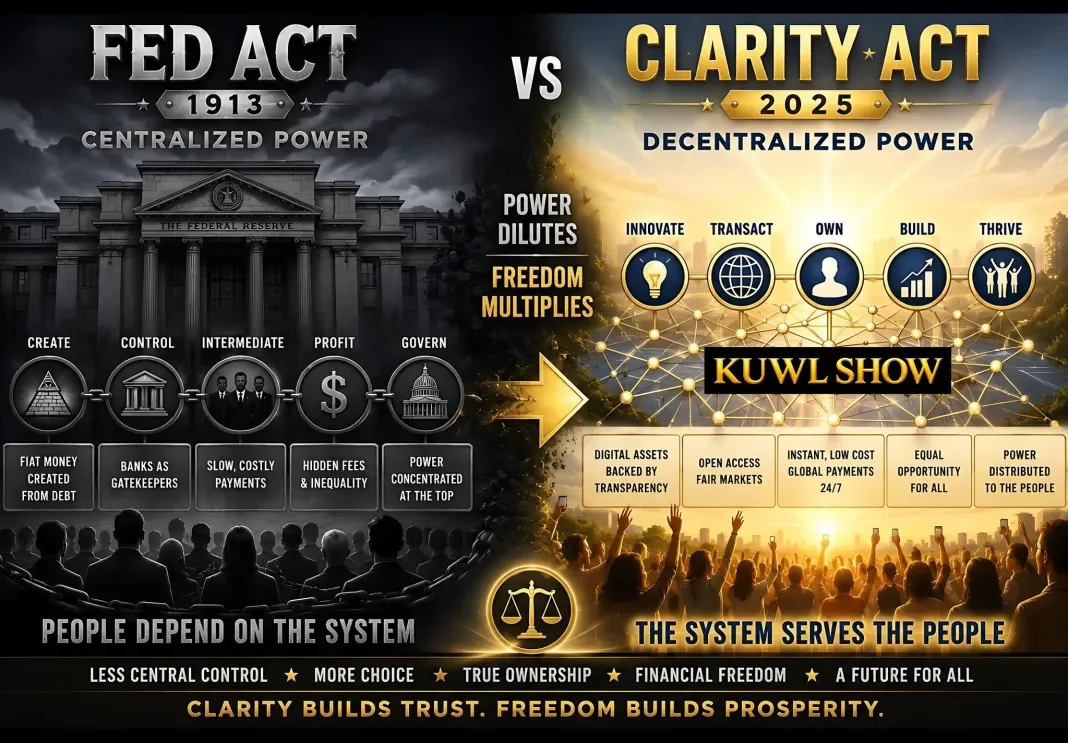
What if this legislation isn’t primarily about crypto at all?
What if it’s about something FAR bigger, like:
• Who controls the system of money?
• Who owns our digital property?
• Whether financial opportunity becomes more open – or remains centralized?
• Whether the next generation inherits a system built on banker permissions … or one built on transparent rules?
Every generation experiences legislation that reshapes its’ future. We choose or others choose for us.
The 1913 Federal Reserve Act defiled the U.S. monetary architecture of the last century.
The 2026 Clarity Act can free us all from bank tyranny.
I’m not asking you to agree.
I’m inviting you to ask a better question.
“What changes when financial infrastructure becomes as open and interoperable as the Internet itself?”
If you’ve wondered why so many institutions, banks, technology companies, and policymakers are focused on this legislation, I wrote a plain-English explanation free for all to review and share.
No jargon.
No tribal politics.
Just one question:
“What’s in it for me and my family?”
Source(s):
• https://x.com/KuwlShow/status/2082941681905602785
https://dinarchronicles.com/2026/07/31/rob-cunningham-why-care-about-the-clarity-act/