
Thank you to all the subscribers to our Early Access program…we thank you for your continued support.
We are excited to offer this new service to keep you informed and up-to-date on the latest Dinar and currency news.
News, Rumors and Opinions Friday 7-24-2026
Stephanie Starr: Pivotal Moment Not Just for Iraq, but for the Entire Middle East
7-24-2026
Iraq’s Prime Minister is heading to Iran at a pivotal moment not just for Iraq, but for the entire Middle East.
Iraq is uniquely positioned to maintain relationships with both the United States and Iran, making it one of the few nations capable of helping reduce regional tensions through diplomacy.
Peace creates opportunity. Opportunity creates investment. Investment creates prosperity.
The timing is difficult to ignore:
Stephanie Starr: Pivotal Moment Not Just for Iraq, but for the Entire Middle East
7-24-2026
Iraq’s Prime Minister is heading to Iran at a pivotal moment not just for Iraq, but for the entire Middle East.
Iraq is uniquely positioned to maintain relationships with both the United States and Iran, making it one of the few nations capable of helping reduce regional tensions through diplomacy.
Peace creates opportunity. Opportunity creates investment. Investment creates prosperity.
The timing is difficult to ignore:
The U.S. is advancing the CLARITY Act to establish a regulatory framework for digital assets. It’s no coincidence that other countries have passed their own crypto laws. Here are the ones just in the last 30 days.
Japan has already passed landmark legislation reclassifying cryptocurrencies as financial products, paving the way for lower taxes, institutional adoption, and future crypto ETFs.
Russia has approved a sweeping cryptocurrency law creating a regulated market for digital assets, licensed exchanges, and digital repositories while expanding legal use in cross-border trade.
Taiwan recently passed its Virtual Asset Service Act, establishing a comprehensive legal framework for crypto exchanges and stablecoin issuers.
Nigeria also signed a new Executive Order coordinating virtual asset regulation across government agencies and accelerating its digital asset framework.
Around the world, governments are no longer debating whether to regulate digital assets they’re racing to define the rules. Whether this reflects a broader global shift or parallel responses to the growth of digital finance, the pace of legislative activity has accelerated significantly over the past month.
Iraq continues modernizing its banking sector, expanding electronic payments, reconnecting banks to the global financial system, and diversifying beyond oil.
The U.S.-Iraq strategic partnership continues to deepen through financial reforms, investment, and security cooperation. Historically, Iraq (ancient Mesopotamia) is widely regarded as the cradle of civilization, and many religious traditions associate the region around the Tigris and Euphrates with the Garden of Eden.
If lasting peace gains traction, Iraq’s strategic location, natural resources, and financial modernization could position it as one of the Middle East’s most important economic hubs.
Some investors believe these developments could eventually contribute to a broader restructuring of the global monetary and financial system. While the idea of a “global currency reset” remains speculative, there is no question that major changes are occurring across digital assets, payment infrastructure, and international finance.
Peace through prosperity has always been the stronger path.
Watch Iraq. It’s going to be BIBLICAL
The next chapter may be far bigger than most people realize.
Source(s):
• https://x.com/StephanieStarrC/status/2080257560716673097
*************
Courtesy of Dinar Guru: https://www.dinarguru.com/
Reset Intelligence The rate is not the thing trapped behind the WTO. It waits on a budget parliament has to write and a cabinet it has to seat, and those are the pieces with a real date on them.
Mnt Goat Can the news get any better than this other than getting news of the reinstatement is done. Folks, this visit by al-Zaidi to Washington is beginning to pay off for Iraq... President Trump has his eyes on Iraq and a plan to revolutionize their economy...this is not only for Iraq but the entire middle east. Iraq is going to play a MAJOR role in the plan.
StephenIraq's GDP - right now they are the fastest growing Middle Eastern nation...surpassing Kuwait, Saudi Arabia, Dubai...And when you look at all the deals they just signed, it's like gosh, their progress and their potential [is off the charts]. I don't see a dinar hater or someone who used to be against this investment or thought it was foolish before and look at everything happening right now and just say, wow, I want to be part of this transition or I want to be invested, maybe not in the dinar, but in some part of this country of Iraq to be able to get returns on the upside...
*************
HUGE Event Monday Could SHAKE Silver Market | Andy Schectman
Liberty and Finance: 7-23-2026
Andy Schectman returns to Liberty & Finance with a sweeping macroeconomic update, warning that multiple financial risks are converging at once—from overvalued stocks and housing to Social Security funding, Treasury demand, and hidden inflation pressures.
He explains why central banks continue accumulating physical gold while reducing reliance on U.S. debt, and why China's July 24 move to end retail paper gold trading could mark a major shift toward physical price discovery.
The discussion also explores practical challenges investors face when reallocating wealth into precious metals during periods of market stress.
Could the "everything bubble" finally be approaching its breaking point, and what does it mean for gold and silver investors?
Seeds of Wisdom RV and Economics Updates Friday Morning 7-24-26
Good Morning Dinar Recaps,
U.S.–Iran Conflict Deepens as War Funding Grows, Energy Risks Persist, and Diplomacy Stalls
Escalating military spending, stalled diplomacy, continued threats to global shipping lanes, and persistent regional instability are reinforcing concerns that the Middle East conflict could have lasting consequences for global energy markets, international trade, and the evolving financial system.
Good Morning Dinar Recaps,
U.S.–Iran Conflict Deepens as War Funding Grows, Energy Risks Persist, and Diplomacy Stalls
Escalating military spending, stalled diplomacy, continued threats to global shipping lanes, and persistent regional instability are reinforcing concerns that the Middle East conflict could have lasting consequences for global energy markets, international trade, and the evolving financial system.
Overview
The Pentagon is seeking an additional $67 billion from Congress after reportedly spending more than $37.5 billion on the ongoing Iran conflict, signaling expectations of a prolonged military campaign.
Iranian officials continue rejecting direct negotiations with the United States until Washington changes its policies, reducing expectations for a near-term diplomatic breakthrough.
Oil markets remain highly sensitive as Red Sea shipping disruptions continue, even as Brent crude eased below $100 per barrel, providing temporary relief from inflation concerns.
Key Developments
1. U.S. Seeks Additional $67 Billion for Iran Operations
The Pentagon has requested $67 billion in additional defense funding, citing continued operational requirements, munitions replenishment, intelligence activities, and classified defense programs tied to the conflict with Iran.
The request is expected to face significant debate in Congress, where lawmakers from both parties have expressed concerns about expanding military expenditures. If approved, the funding would signal that Washington expects the conflict to continue for an extended period rather than transition quickly toward a negotiated settlement.
2. Diplomatic Progress Remains Limited
A senior Iranian cleric publicly declared that Iran will not negotiate with the United States until American behavior changes, reinforcing Tehran's longstanding position on sanctions, military pressure, and nuclear issues.
Although indirect discussions through regional mediators continue, public statements from both sides suggest that meaningful negotiations remain difficult, increasing uncertainty over the prospects for any comprehensive agreement.
3. Energy Markets Continue to Balance Risk and Supply
Brent crude briefly traded below $100 per barrel, easing immediate inflation concerns after recent price spikes. Markets interpreted the decline as a sign that global supplies have not yet suffered major interruptions despite continuing geopolitical risks.
However, analysts caution that oil prices remain extremely sensitive to any escalation involving the Strait of Hormuz or additional disruptions to regional exports.
4. Red Sea Shipping Remains Under Pressure
Iran-backed Houthi forces continue targeting shipping associated with Saudi Arabia and its allies in the Red Sea. While the Bab el-Mandeb Strait remains open, attacks have disrupted shipping schedules, increased insurance costs, and forced some vessels to alter routes.
Although global oil exports continue moving, the situation demonstrates how multiple maritime chokepoints can simultaneously threaten international supply chains.
5. Regional Security Risks Continue to Expand
Iraqi Kurdish authorities intercepted five bomb-laden drones near Erbil, highlighting the continuing risk of regional spillover beyond the immediate U.S.–Iran confrontation.
The incident illustrates that military tensions now extend across several countries, requiring governments and financial markets to monitor security developments throughout the broader Middle East.
Why It Matters
Military conflict is increasingly influencing financial markets alongside traditional economic indicators. Defense spending, energy prices, shipping security, inflation expectations, and geopolitical risk are becoming closely interconnected as investors evaluate the potential duration of the conflict.
Even without a complete interruption of oil supplies, persistent uncertainty raises transportation costs, insurance premiums, and investment risk, contributing to greater volatility throughout the global economy.
Why It Matters to Foreign Currency Holders
Foreign currency investors continue monitoring developments because prolonged geopolitical instability can influence energy prices, inflation, central bank policy, and cross-border capital flows.
While the conflict does not directly trigger currency revaluations, it affects many of the macroeconomic conditions that shape long-term monetary policy and international financial stability.
Implications for the Global Reset
Pillar 1: Debt
Higher military expenditures and expanding defense budgets increase government borrowing needs while adding pressure to already elevated sovereign debt levels.
Pillar 2: Trade
Continued disruptions around the Red Sea and the Bab el-Mandeb Strait demonstrate how geopolitical conflicts can reshape global shipping routes, increase logistics costs, and affect international commerce.
Pillar 5: Energy
Oil markets remain highly dependent on Middle East stability. Even temporary disruptions to major maritime chokepoints can influence global inflation, monetary policy, and long-term energy security planning.
Future Outlook
Attention now turns to Congress's debate over additional defense funding, the possibility of renewed diplomatic initiatives, and whether military activity expands further across the region.
Markets will also closely monitor shipping activity through the Strait of Hormuz and the Bab el-Mandeb Strait, as well as oil price movements, since these remain among the most important indicators of whether geopolitical tensions begin easing or continue escalating.
This is not simply about military conflict—it reflects the broader transformation of the global financial system as geopolitical risk, energy security, government spending, and international trade increasingly shape the future of the world economy.
Seeds of Wisdom Team
Newshounds News™ Exclusive
Sources
CryptoBriefing — US Seeks $67B More for Iran Conflict Amid Congressional Resistance
CryptoBriefing — Houthi Actions Disrupt Red Sea Oil Shipments, Bab el-Mandeb Strait Remains Open
~~~~~~~~~~
🌱 A Message to Our Currency Holders🌱
If you’ve been holding foreign currency for many years, you were not foolish.
You were not wrong to believe the global financial system would change.
What failed was not your patience — it was the information you were given.
For years, dates, rumors, and personalities replaced facts, structure, and proof. “This week” predictions created cycles of hope and disappointment that were never based on how currencies actually change.
That is not your failure.
Our mission here is different: • No dates • No rates • No hype • No gurus
Instead, we focus on:
• Verifiable developments • Institutional evidence
• Global financial structure • Where countries actually sit in the process
Currency value changes only come after sovereignty, trade, banking, settlement systems, and fiscal coordination are in place. History and institutions confirm this sequence.
You will see silence. You will see denials. That is not delay — that is discipline.
Protect your identity. Organize your documents. Verify everything.
Never hand your discernment to anyone who cannot show proof.
You deserve truth — not timelines.
Seeds of Wisdom Team
Newshounds News
~~~~~~~~~~
Seeds of Wisdom Team RV Currency Facts Youtube and Rumble
Newshound's News Telegram Room Link
RV Facts with Proof Links Link
RV Updates Proof links - Facts Link
Start Here room with Most Asked Questions Link
Follow the Gold/Silver Rate COMEX
Follow Fast Facts
Seeds of Wisdom Team™ Website
Thank you Dinar Recaps
Iraq Economic News and Points To Ponder Friday Morning7-24-26
Iran Seeks Access To $11B In Energy Funds In Iraq
2026-07-23 / 13:35 Shafaq News- Tehran/ Baghdad Iran has between $10 billion and $11 billion in funds and energy receivables held or owed in Iraq, Central Bank of Iran Governor Abd Al-Naser Hemmati announced on Thursday.
Hemmati said he discussed the funds with Iraqi Central Bank Governor Nizar Nasser Hussein during Prime Minister Ali Al-Zaidi’s visit to Tehran, with both sides seeking mechanisms to allow Iran to finance imports or complete permitted financial transfers.
Part of the money has already been used to purchase essential goods, but transfer restrictions continue to “limit [Tehran’s] access” to the remainder.
Iraq deposits payments for Iranian gas and electricity into restricted accounts because US sanctions limit direct dollar and euro transfers to Iranian institutions.
Iraq pays Iran $4 billion to $5 billion annually for gas, according to Iraqi energy officials cited by Reuters in March 2025. Then-Electricity Minister Ziyad Ali Fadel estimated that losing Iranian gas would cut about one-third of Iraq’s 27,000 MW electricity output. Read more: $24 billion frozen asset dispute blocks final US-Iran agreement
https://www.shafaq.com/en/World/Iran-seeks-access-to-11B-in-energy-funds-in-Iraq
Attacks On Oil Fields And Companies In Basra Were Carried Out By Iraqi Armed Factions. The Guardian Reports That Iraq Has Failed To Invest Its Oil Wealth
latest news Thursday, July 23, 2026 Baghdad - One News - 7/23/2026 The British newspaper The Guardian revealed in a lengthy report that Iraq is facing one of its most dangerous security, political and economic tests since 2003, after it turned into an arena of indirect confrontation between the United States and Iran, amid escalating attacks on oil facilities and widening division over the weapons of the factions and their influence within state institutions.
According to the report, the series of attacks began after the outbreak of the regional war, with drones targeting oil fields, service facilities, and the headquarters of foreign companies in Basra, including sites linked to American and international companies operating in the energy sector.
The strikes caused widespread fires, forced hundreds of foreign workers to leave the country, and left thousands of Iraqi workers without work, significantly reducing oil production.
The newspaper quoted Iraqi officials as saying that most of the attacks were not launched from outside the borders, but rather originated from within Iraq and were carried out by Iraqi armed factions linked to Iran, in an attempt to disrupt the oil sector, raise global prices, and increase pressure on the US administration to halt its military operations against Tehran.
The report indicated that the perpetrators of the attacks possessed accurate information about the locations of the targeted warehouses, equipment and facilities, raising suspicions of leaks from within state institutions or companies operating in the oil sector.
Officials who spoke to the newspaper believe that foreign companies will not bear the losses alone, as the costs of the destroyed equipment will be borne by the Iraqi government, making the national economy, Iraq’s investment reputation, and its ability to attract international companies the biggest losers.
The Guardian confirmed that the war revealed the fragility of the Iraqi state and its inability to protect its airspace and vital facilities, despite the security leaders' knowledge of the parties behind the missile and drone launches, the chain of command, and the areas from which the attacks originate.
The report also linked the weak security response to the spread of corruption within military institutions, explaining that some leadership positions are bought with millions of dollars, which pushes leaders to protect their financial interests and avoid confrontation instead of enforcing the law and protecting state institutions.
In this context, the report indicated that Prime Minister Ali al-Zaidi escalated his stance against the armed factions, giving them until September 30 to hand over their weapons and integrate their combat formations into the official security forces, as part of a project to restrict weapons to the state and reduce Iranian influence.
While some of the older factions accepted the idea of merging into the state, the ideological factions under the umbrella of the “Islamic Resistance in Iraq” refused to hand over their weapons, considering that the confrontation with the United States and Israel represents an existential battle and a religious duty, and that their weapons will not be surrendered as long as the American presence exists.
The report indicated that the American pressure was not limited to the political and security aspects, but also included influential economic tools, as Washington halted cash dollar shipments sent to Baghdad in April, before resuming them in July after the government announced practical steps towards disarming the factions.
According to the report, these pressures coincided with a severe oil crisis, after the closure of the Strait of Hormuz and attacks on Basra facilities led to a decline in production and exports and the appearance of long queues in front of gas stations, in scenes that brought back memories of the chaos that Iraq witnessed after 2003.
The newspaper pointed out that Iraq’s reliance on oil revenues to fund the salaries of about four million government employees made it highly vulnerable to any halt in production or exports, and prompted it to look for alternative routes, including restarting the Iraqi-Saudi pipeline to bypass the Strait of Hormuz.
The report also addressed the reasons for Iraq’s failure to invest its oil wealth since 2003, despite the entry of major companies such as BP, ExxonMobil and Shell, explaining that corruption, bureaucracy, contractual disputes and delays in financial dues prompted international companies to reduce their operations or withdraw from their projects.
The Guardian added that the oil contract system in Basra is subject to the influence of parties, tribes, and sometimes armed factions, which profit from government contracts, making the oil sector for many Iraqis a symbol of corruption and mismanagement rather than a source of national pride.
In parallel with the arms crisis, the government expanded its anti-corruption campaign, which included senior officials in the Ministry of Oil, including Deputy Oil Minister Adnan al-Jumaili, after millions of dollars, billions of dinars, quantities of gold and weapons were seized, before the investigations expanded to include dozens of deputies and officials.
The report considered that the Iraqi political scene is embodied in two contradictory images; the first being Prime Minister Ali al-Zubaidi’s participation in the funeral ceremonies of Iranian Supreme Leader Ali Khamenei in Najaf, and the second being his sitting a few days later next to US President Donald Trump in the White House, renewing his pledge to restrict weapons to the state, combat corruption, and attract American investments.
The Guardian concluded that Iraq faces a highly complex equation: it is financially and economically dependent on the United States, while simultaneously confronting deeply entrenched Iranian influence within its political and security institutions, leaving it caught between two competing powers at one of the most sensitive junctures in its modern history.
https://1news-iq.net/الهجمات-على-الحقول-والشركات-النفطية-ف/
Al-Zaidi Urges Iran To Seize Iraq Dialogue Opportunity
2026-07-23 / 11:36 Shafaq News- Tehran Iraq has long served as a platform for dialogue and resolving regional disputes, Iraqi Prime Minister Ali Al-Zaidi said on Thursday, urging Iran to seize the current opportunity to advance "de-escalation dialogue."
During a meeting in Tehran with Iran's Judiciary Chief Gholam-Hossein Mohseni Ejei, Al-Zaidi reaffirmed Iraq's commitment to building strong relations with Iran and expressed his government's readiness to deepen cooperation, especially in the economic sector, in a way that serves the interests of both countries, according to a statement from the Iraqi prime minister's media office.
The two sides discussed ways to strengthen bilateral relations and expand cooperation across multiple sectors, particularly in the judicial field, emphasizing the judiciary's role in supporting stability. Iraqi Prime Minister Media Office
tnepoSdsorm8gia2lal4a4lufl0u2hm26h1m7g79uh3606hfm3u61ftic94h ·
Prime Minister Ali Faleh Al-Zaidi Meets with the Head of Iran’s Judiciary in Tehran
Prime Minister Ali Faleh Al-Zaidi met in the Iranian capital, Tehran, with the Head of Iran’s Judiciary, Gholam-Hossein Mohseni Ejei.
The meeting discussed ways to further strengthen relations between the two countries and enhance bilateral cooperation across various fields, particularly in the judicial sector. The two sides also emphasized the role of the judiciary in supporting and consolidating stability.
During the meeting, Prime Minister Al-Zaidi reaffirmed Iraq’s commitment to building the strongest possible relations with the Islamic Republic of Iran and expressed the government’s readiness to expand joint cooperation across various sectors, particularly in the economic field, in a manner that serves the interests of both countries and promotes the prosperity of their peoples.
The Prime Minister also stressed that Iraq has long served, and continues to serve, as a platform for dialogue and the resolution of disputes across the region, underscoring the importance of seizing the current opportunity to advance dialogue and de-escalation efforts.
For his part, Mr. Ejei highlighted the religious, historical, and social bonds between Iraq and Iran. He commended the Iraqi government’s measures and efforts to combat corruption, noting that Iran has experience in combating corruption and stands ready to cooperate with Iraq in this field. He also expressed his appreciation to the Iraqi people for their noble gesture in participating in the funeral procession of Grand Ayatollah Ali Khamenei.
•••••
Media Office of the Prime Minister July 23, 2026 Ejei highlighted the religious, historical, and social ties between Iraq and Iran, praising the Iraqi government's anti-corruption efforts.
“Iran has an experience in combating corruption and stands ready to cooperate with Iraq in this field,” he offered, appreciating the Iraqi people for “their noble gesture in participating in the funeral procession of Grand Ayatollah, Ali Khamenei.”
https://www.shafaq.com/en/Iraq/Al-Zaidi-urges-Iran-to-seize-Iraq-dialogue-opportunity
What’s Really Happening in Iraq? | Jon Dowling & Larry Ballard
What’s Really Happening in Iraq? | Jon Dowling & Larry Ballard
7-23-2026
The global financial system is standing at a pivotal crossroads. As national debts soar and traditional fiat monetary structures face unprecedented stress, economists and geopolitical analysts are increasingly turning their attention toward systemic monetary reforms.
In a recent podcast hosted by Jon Dowling, guest speaker Larry Ballard—a Christian believer and author of Restoring the Republic—shared a comprehensive breakdown of the ongoing global financial reset.
What’s Really Happening in Iraq? | Jon Dowling & Larry Ballard
7-23-2026
The global financial system is standing at a pivotal crossroads. As national debts soar and traditional fiat monetary structures face unprecedented stress, economists and geopolitical analysts are increasingly turning their attention toward systemic monetary reforms.
In a recent podcast hosted by Jon Dowling, guest speaker Larry Ballard—a Christian believer and author of Restoring the Republic—shared a comprehensive breakdown of the ongoing global financial reset.
Rather than focusing on speculative timelines, Ballard provides a high-level macroeconomic analysis of how world economies are shifting away from fiat systems toward commodity-backed currencies.
From the strategic positioning of currencies like the Vietnamese Dong and Iraqi Dinar to major shifts in U.S. tax policy and blockchain infrastructure like XRP, this analysis explores how strategic global shifts are shaping a new era of economic parity and international stability.
At its core, the proposed global financial reset represents a foundational transition in how money derives its value. For decades, the global economy has operated primarily on fiat currencies—money backed by government decree rather than physical assets. The current structural shift aims to anchor monetary systems back to tangible wealth, such as precious metals, energy reserves, and commodities.
Ballard emphasizes that key international leadership forces and strategic allies are fostering this transition to establish global economic parity. By balancing the purchasing power and economic foundations of developing and developed nations, this systemic reset serves as a prerequisite for long-term international peace and trade equilibrium.
When national currencies reflect genuine economic productivity and tangible asset reserves, the potential for speculative market manipulation and currency wars is significantly reduced.
A central topic of discussion in the podcast is the unique economic positioning of Vietnam and its currency, the Vietnamese Dong (VND). On paper, the Dong appears heavily devalued, with exchange rates offering hundreds of thousands of Dong for a modest amount of foreign capital. However, this low valuation is far from an economic accident; it is a calculated monetary strategy.
Vietnam’s economic engine relies heavily on export manufacturing and a growing tourism industry. A weaker national currency makes Vietnamese goods exceptionally competitive in global markets and makes the country an attractive, affordable destination for international travelers.
Consequently, adjusting Vietnam’s currency value requires careful synchronization with global reset timelines. Rapid revaluation without proper macroeconomic balancing could disrupt Vietnam’s competitive edge in manufacturing. Understanding these national economic nuances reveals why global monetary transitions require deliberate, phased implementations rather than sudden market shifts.
Iraq represents one of the most significant focal points in the global economic realignment. Historically constrained by geopolitical instability and an over-reliance on crude oil exports, Iraq is undergoing a major structural revitalization. Forecasts, including projections from the World Bank, highlight Iraq as one of the fastest-growing economies in the region in the coming years.
This surge in economic potential is driven by a strategic pivot away from single-resource dependency toward broader natural resource management, modernized domestic banking systems, and sweeping infrastructure upgrades.
Crucially, major American corporations—including industrial giants like General Electric, technology leaders like Google, and energy conglomerates like ExxonMobil—are playing active roles in reconstructing Iraq’s foundational systems.
By integrating heavy industry, advanced digital infrastructure, and modern global banking standards, Iraq is laying the groundwork for full reintegration into the international financial ecosystem, positioning its national currency for long-term stability and growth.
The discussion also turns to U.S. domestic economic reform, examining how international monetary changes intersect with domestic fiscal policy. A central proposal discussed by Ballard is the potential shift away from federal income taxation in favor of a robust tariff-based revenue model.
Historically, the United States operated without a permanent federal income tax during one of its most rapid periods of industrial and economic expansion (1850–1913), relying primarily on consumption taxes and import tariffs to fund federal operations.
Energy markets remain the backbone of international finance, heavily influencing currency values and trade balance sheets. Historically, global commerce has been vulnerable to geographic chokepoints, most notably the Strait of Hormuz, where geopolitical friction could instantly destabilize global oil supplies and trigger inflation.
The ongoing reset framework highlights a structural shift in global energy distribution. New supply corridors, expanded pipeline networks, and diversified production methods are reducing global dependence on vulnerable maritime bottlenecks. As energy transit becomes safer and more decentralized, energy price volatility decreases. Stabilizing the cost of primary commodities directly stabilizes national currencies, neutralizing a primary catalyst for resource-driven geopolitical conflicts.
For a commodity-backed global financial ecosystem to function efficiently, it requires a modernized, secure, and rapid settlement layer. Traditional legacy banking networks, such as legacy wire systems, are often slow, costly, and lack real-time transparency.
In the podcast, asset-backed digital technologies—specifically enterprise-grade blockchain platforms like XRP—are identified as critical components of the modern financial architecture. Designed specifically for cross-border liquidity and institutional settlements, digital payment rails offer several clear advantages.
By bridging physical assets with cryptographic verification, enterprise digital assets provide the foundational infrastructure necessary to execute high-volume international trade in a commodity-backed economic era.
The insights shared by Larry Ballard emphasize that the global financial reset is not merely a sudden market event, but a deliberate, multi-faceted structural evolution. From the deliberate currency management of export-heavy nations like Vietnam to the rapid modernized rebirth of Iraq and the integration of blockchain payment rails like XRP, the global monetary architecture is steadily returning to asset-backed realism and fiscal accountability.
As these macroeconomic realignments continue to unfold, understanding the underlying mechanics of international trade, energy security, and monetary policy is essential for navigating the future economic landscape.
FRANK26…7-23-26….BANKS WANT US !!!
KTFA
Thursday Night Video
FRANK26…7-23-26….BANKS WANT US !!!
This video is in Frank’s and his team’s opinion only
Frank’s team is Walkingstick, Eddie and Omar in Iraq and guests
Playback Number: 605-313-5163 PIN: 156996#
KTFA
Thursday Night Video
FRANK26…7-23-26….BANKS WANT US !!!
This video is in Frank’s and his team’s opinion only
Frank’s team is Walkingstick, Eddie and Omar in Iraq and guests
Playback Number: 605-313-5163 PIN: 156996#
Seeds of Wisdom RV and Economics Updates Thursday Evening 7-23-26
Good Evening Dinar Recaps,
U.S.-Iran Conflict Begins Reshaping Global Finance as Markets Brace for Wider Economic Impact
Escalating military tensions between the United States and Iran are no longer affecting only the battlefield. Rising energy risks, disrupted shipping, and growing financial uncertainty are increasingly influencing global markets, trade flows, and investor expectations as governments prepare for the possibility of a prolonged regional conflict.
Good Evening Dinar Recaps,
U.S.-Iran Conflict Begins Reshaping Global Finance as Markets Brace for Wider Economic Impact
Escalating military tensions between the United States and Iran are no longer affecting only the battlefield. Rising energy risks, disrupted shipping, and growing financial uncertainty are increasingly influencing global markets, trade flows, and investor expectations as governments prepare for the possibility of a prolonged regional conflict.
Overview
President Donald Trump indicated that he is weighing additional military options against Iran as tensions remain elevated.
Reports of continued military activity and threats to key maritime routes are keeping oil markets and investors on edge.
Financial markets are increasingly pricing in geopolitical risk as higher energy costs could influence inflation, trade, and central bank policy.
Key Developments
1. Conflict Expands Beyond Military Headlines
While military operations continue to dominate the headlines, the broader economic consequences are becoming increasingly important. Reports of additional U.S. military activity, combined with Iran's continued warnings regarding strategic shipping lanes, have reinforced concerns that the conflict could evolve into a prolonged disruption affecting international commerce.
Although some reports remain unconfirmed by U.S. officials, markets are reacting to the possibility of further escalation rather than waiting for formal announcements.
2. Energy Markets Continue Pricing in Risk
Oil traders remain focused on the security of the Persian Gulf and surrounding maritime routes. Even without a complete interruption of exports, uncertainty surrounding the Strait of Hormuz and nearby shipping corridors has increased transportation costs, insurance premiums, and volatility throughout global energy markets.
Analysts note that geopolitical risk premiums are once again becoming a significant component of crude oil pricing as traders prepare for potential supply disruptions.
3. Financial Markets Watch Inflation and Interest Rates
Higher energy prices could complicate monetary policy for central banks. Rising fuel costs have the potential to slow progress on inflation, which could influence future interest-rate decisions by the Federal Reserve and other major central banks.
Investors are closely monitoring whether sustained energy inflation could delay expected monetary easing while increasing volatility across equities, bonds, and digital assets.
4. Global Trade Faces Additional Pressure
Businesses dependent on international shipping continue evaluating alternative supply routes as geopolitical uncertainty grows. Even limited disruptions in key maritime chokepoints can affect delivery schedules, freight costs, and commodity prices far beyond the Middle East.
The situation highlights how regional conflicts can rapidly influence global trade networks and financial markets.
Why It Matters
Financial markets increasingly respond to geopolitical events alongside traditional economic indicators. Rising energy costs, disrupted shipping, and uncertainty surrounding central bank policy can influence inflation, investment decisions, and international capital flows. Even if military operations remain geographically limited, their economic effects can extend worldwide.
Why It Matters to Foreign Currency Holders
Currency markets often react quickly during periods of geopolitical uncertainty. Prolonged energy disruptions and inflationary pressures could influence interest-rate expectations, reserve management strategies, and capital flows between major currencies. Those following long-term international monetary developments will likely continue monitoring how these events affect global financial stability.
Implications for the Global Reset
Pillar 1: Debt
Higher energy costs can contribute to inflation, making it more difficult for governments and central banks to reduce interest rates while increasing borrowing costs across the global economy.
Pillar 2: Trade
Continued uncertainty surrounding critical shipping routes reinforces the importance of resilient supply chains and may accelerate efforts to diversify trade corridors and reduce dependence on vulnerable maritime chokepoints.
Future Outlook
Markets will closely watch whether diplomatic efforts can reduce tensions or whether additional military actions lead to broader disruptions across energy markets and international trade. Investors are also monitoring how prolonged geopolitical uncertainty may influence inflation, monetary policy, and global economic growth during the second half of the year.
This is not simply about a regional military conflict—it reflects how geopolitical events increasingly influence energy security, global trade, inflation, and the evolving structure of the international financial system.
Seeds of Wisdom Team
Newshounds News™ Exclusive
Sources
Axios — Trump Says He Is Considering Restarting Major Military Operations Against Iran
Reuters — Middle East Conflict, Oil Markets and Global Energy Coverage
~~~~~~~~~~
Seeds of Wisdom Team RV Currency Facts Youtube and Rumble
Newshound's News Telegram Room Link
RV Facts with Proof Links Link
RV Updates Proof links - Facts Link
Start Here room with Most Asked Questions Link
Follow the Gold/Silver Rate COMEX
Follow Fast Facts
Seeds of Wisdom Team™Website
Thank you Dinar Recaps
Iraq Economic News and Points To Ponder Thursday Afternoon 7-23-26
Oil Climbs Above 1.5% On Gulf Shipping Risks
2026-07-23 01:30 Shafaq News Oil prices rose more than 1.5% in Asian trade on Thursday to stand at their highest in more than six weeks, as Yemen's Houthis targeted oil tankers in the Red Sea and the United States launched a new round of strikes on Iran.
Brent crude futures rose $2.2 or 2.3%, to $96.27 by 0327 GMT, the highest since June 8, having settled up more than $3 at $94.07 in the previous session, just shy of a six-week high.
Oil Climbs Above 1.5% On Gulf Shipping Risks
2026-07-23 01:30 Shafaq News Oil prices rose more than 1.5% in Asian trade on Thursday to stand at their highest in more than six weeks, as Yemen's Houthis targeted oil tankers in the Red Sea and the United States launched a new round of strikes on Iran.
Brent crude futures rose $2.2 or 2.3%, to $96.27 by 0327 GMT, the highest since June 8, having settled up more than $3 at $94.07 in the previous session, just shy of a six-week high.
U.S. West Texas Intermediate crude climbed $1.65, or 1.9%, to $88.48, after Wednesday's rise of 3%.
Iran's Revolutionary Guards said an oil tanker caught fire after an explosion while attempting to follow a route they described as mined, south of the Strait of Hormuz, while two others had turned back.
In a statement the Guards said the strait was under their control and "completely closed" while U.S. actions continued in the region, warning that no tanker would be allowed to enter or leave without coordination with Iran.
Besides the renewed conflict over control of the key waterway, the Iran-aligned Houthis have opened a new front by threatening to target vessels carrying Saudi oil in the Bab el-Mandeb strait and unveiling a naval blockade of Saudi Arabia.
Oil prices are facing a rare risk from simultaneous disruptions at both the Bab el-Mandeb and the Strait of Hormuz, said Priyanka Sachdeva, senior market analyst at Phillip Nova.
"Geopolitical premiums have returned, but a sustained (price) rally will require evidence of prolonged shipping disruptions or meaningful supply outages."
The Houthis said they had carried out a military operation targeting two Saudi oil tankers, and maritime security reports said one of the vessels identified by the group, the Saudi-flagged tanker Encelia, had been hit in the Red Sea.
The Houthis said they had forced about 10 ships to retreat and return after warning vessels against sailing to Saudi ports.
Reuters could not immediately verify this account.
The Houthis' naval blockade of Saudi Arabia in the Red Sea threatens to disrupt global energy supplies beyond the Gulf, while Iran's Revolutionary Guards' spokesperson also warned shipping companies that the Strait of Hormuz southern route is mined in a post on X.
The new threat to Red Sea passage could interrupt up to 5 million barrels per day of oil supply, and the main route for Gulf oil that bypasses the Strait of Hormuz, said Saul Kavonic, the head of energy research at MST Marquee.
The U.S. military said it completed its 12th consecutive night of attacks on Iran hours after President Donald Trump vowed to destroy an Iranian bridge or power plant every time Iran shoots at a ship in the Strait of Hormuz, raising the stakes in the war with Iran. (REUTERS) https://www.shafaq.com/en/Economy/Oil-climbs-above-1-5-on-Gulf-shipping-risks7
Basrah Crudes Surge As Global Oil Rallies
2026-07-23 02:54 Shafaq News- Basrah Iraq’s Basrah crude jumped more than 7% on Thursday, amid gains in global oil markets.
Basrah Heavy crude climbed to $61.86 per barrel, up $4.43, or 7.71%, while Basrah Medium crude rose to $64.16 per barrel, gaining $4.43, or 7.42%.
Brent crude advanced to $96.05 per barrel, up $1.98, or 2.10%, while US West Texas Intermediate crude gained $1.42, or 1.64%, to $88.25 per barrel. OPEC's basket also climbed to $88.50 per barrel, up $2.40, or 2.79%.
Saudi Arabia’s Arab Light crude rose 6.84% to $82.92 per barrel, while UAE Das crude climbed 8.81% to $88.07 per barrel. Qatar Land crude also advanced 8.84% to $87.77 per barrel.
https://www.shafaq.com/en/Economy/Basrah-crudes-surge-as-global-oil-rallies
Iraq’s Iran Imports Drop 55% In Q1 2026
2026-07-23 06:34 Shafaq News- Baghdad Iraq’s imports from Iran fell nearly 55% in the first quarter of 2026 to $2.3 billion, down from $5.1 billion during the same period last year, according to the Islamic Republic of Iran Customs Administration’s (IRICA) data.
Petroleum gases and other gaseous hydrocarbons remained the largest import category at $351 million, followed by iron and non-alloy steel bars and wire ($159M), fresh apples, pears, and quinces ($78M), ceramic tiles ($77M), plastic household and kitchenware ($60M), and polyethylene polymers ($59M), alongside primary iron and steel products and other industrial and food commodities. https://www.shafaq.com/en/Economy/Iraq-s-Iran-imports-drop-55-in-Q1-2026
Dollar Climbs In Baghdad, Stabilizes In Erbil
2026-07-23 09:37 Shafaq News- Baghdad/ Erbil The US dollar closed Thursday’s trading mixed in Iraq, hovering around 151,000 dinars per 100 dollars.
According to Shafaq News market survey, the dollar traded in Baghdad's Al-Kifah and Al-Harithiya exchanges at 150,500 dinars per 100 dollars, up from the morning session’s 150,450 dinars.
In the Iraqi capital, exchange shops sold the dollar at 151,000 dinars and bought it at 150,000 dinars, while in Erbil, selling prices stood at 150,800 dinars and buying prices at 150,700 dinars.
https://www.shafaq.com/en/Economy/Dollar-climbs-in-Baghdad-stabilizes-in-Erbil
Oil Hits Two-Month High After Houthi Tanker Attacks
2026-07-23 09:42 Shafaq News Oil prices hit their highest in nearly two months on Thursday, rising for a fifth day after Yemen's Houthis said they struck two Saudi oil tankers, widening disruption to global oil shipping through both the Red Sea and the Strait of Hormuz.
Brent crude futures were up by $5.83, or 6.2%, at $99.90 a barrel by 1310 GMT after reaching $100 a barrel for the first time since late May.
U.S. West Texas Intermediate crude rose $4.41, or 5.08%, to $91.24, exceeding $90 a barrel for the first time since June 11.
"The immediate outlook for crude oil remains supportive as markets price a worrying probability of supply interruptions in a second chokepoint," said Pepperstone research strategist Ahmad Assiri.
Besides the renewed conflict over control of the Strait of Hormuz, Yemen's Houthis have opened a new front by targeting vessels carrying Saudi oil in the Bab el-Mandeb strait after stating they would impose a naval blockade on shipments from Saudi Arabia.
Houthi militia attacked two Saudi Arabian oil tankers in a military operation, the group said on Thursday, with a Saudi news agency later confirming one of the two vessels was ablaze after an assault while sailing in the Red Sea.
Goldman Sachs said Brent might exceed $120 a barrel in the fourth quarter and average $100 next year if the Strait of Hormuz remains disrupted through 2027, with further upside if the Bab el-Mandeb strait and Suez Canal also suffer persistent disruption.
Iran's Revolutionary Guards said an oil tanker caught fire after an explosion while attempting to follow a mined route in the southern area of the Strait of Hormuz near the coast of Oman and that two others had turned back.
The Guards said the strait was under their control and "completely closed" while U.S. actions continued in the region, warning that no tanker would be allowed to enter or leave without coordination with Iran.
The U.S. military said it had completed a 12th consecutive night of attacks on Iran, hours after U.S. President Donald Trump vowed to destroy an Iranian bridge or power plant every time Iran shoots at a ship in the Strait of Hormuz.
Goldman expects oil prices to retain most of their recent gains through July and August as global inventories continue to decline, supported by lower Middle East production, seasonal summer travel demand and a sharp slowdown in releases of strategic petroleum reserves.
Meanwhile, European diesel margins hit a record $66.25 a barrel on July 17, supported by Russia's diesel export ban following repeated Ukrainian attacks on its refineries and concerns over further disruptions to Middle East supplies, and traded as high as $65.30 a barrel on Thursday. (REUTERS)
https://www.shafaq.com/en/Economy/Oil-hits-two-month-high-after-Houthi-tanker-attacks
Ariel: Impact of the Clarity Act on the Iraqi Dinar ( And More)
Ariel: Impact of the Clarity Act on the Iraqi Dinar
7-23-2026
The Clarity Act: Moving Into The Digital Age Of Transparent Banking
Operation Global Realignment
This moment stands as one of the most decisive inflection points in modern financial history. The impending Senate floor vote on the Crypto Clarity Act will codify regulatory certainty for digital assets in the United States, effectively dismantling the final legal barriers that have kept decentralized finance chained to the legacy fiat architecture.
Ariel: Impact of the Clarity Act on the Iraqi Dinar
7-23-2026
The Clarity Act: Moving Into The Digital Age Of Transparent Banking
Operation Global Realignment
This moment stands as one of the most decisive inflection points in modern financial history. The impending Senate floor vote on the Crypto Clarity Act will codify regulatory certainty for digital assets in the United States, effectively dismantling the final legal barriers that have kept decentralized finance chained to the legacy fiat architecture.
By removing regulatory ambiguity, the Act accelerates the migration of capital away from the parasitic Rothschild-controlled debt-based monetary system that has dominated global finance for over a century.
This shift will starve the old central-bank debt engine of its endless liquidity imbalances and force a painful but necessary reconfiguration of value storage worldwide. The Japanese reverse carry trade, now entering its terminal phase, serves as the critical detonator.
With the Bank of Japan openly committing to more frequent rate hikes beyond the previous six-month cadence, the yen carry trade that fueled cheap global borrowing for decades is being deliberately unwound. BoJ insider warnings from figures such as Yuto have proven accurate. This constitutes an orchestrated collapse designed to trigger the broader Great Financial Reset. The dominoes are falling in sequence.
Impact On The Iraqi Dinar and Parallel Digital Transformation
– The Crypto Clarity Act will create a parallel, regulated on-ramp for sovereign digital currencies and tokenized assets, directly benefiting Iraq’s dual-track strategy of currency redenomination and full digital migration. This is extremely important for what will come next. Because we all know what is about to occur with Japan. So the timing is perfect. And once this occurs we will see many things unraveling that will no longer have oxygen in the new system.
– Iraq’s Deletion of 3 Zeros Project, which digitally/Electronically/Physicaly removes three zeros from the dinar while simultaneously launching a digital dinar on a blockchain-compliant ledger, gains immediate legitimacy and interoperability once U.S. regulatory clarity is established. Basically removing previous skepticism around sovereign digital currencies being treated as unregistered securities.
– The ASYCUDA Agreement (Automated System for Customs Data) signed with the World Trade Organization streamlines Iraq’s customs, taxation, and cross-border settlement processes. When layered atop the Clarity Act’s framework, it enables real-time, transparent dinar-denominated trade settlements that bypass traditional SWIFT bottlenecks still tied to legacy debt structures.
– Once the Senate vote passes, institutional capital currently sidelined by regulatory fear will flow into compliant crypto infrastructure. This capital will seek yield in undervalued, resource-backed digital sovereigns such as the new Iraqi dinar, whose oil reserves, reconstruction contracts, and WTO accession provide tangible collateral absent in most fiat experiments.
Read Full Article:
https://www.patreon.com/Prolotario1/posts/clarity-act-into-164576411
https://dinarchronicles.com/2026/07/23/prolotario-impact-of-the-clarity-act-on-the-iraqi-dinar/
*****************
Ariel: Iraq is Preparing to Launch a Central Bank Digital Dinar
7-23-2026
We Are Off To The Races Boys & Girls:
Note: Iraq Is Preparing To Launch A Central Bank Digital Dinar (Cbd Dinars) In Parallel With The Physical Note Redenomination. The Clarity Act’s Framework For Stablecoins And Tokenized Assets Provides A Ready-Made Compliance Template That Iraqi Monetary Authorities Have Been Studying Through Back-Channel Consultations With U.S. Treasury Officials.
Passage Signals To Global Banks That Any Digital Dinar Issued Will Operate Inside A Recognized Regulatory Perimeter, Reducing Perceived Risk And Allowing Faster Integration With Swift, Ripple, And Other Cross-Border Rails Already Being Tested In Baghdad.
So in other words this will become standard Support for International Trade & Investment
And with Iraq’s digital Dinar set to be integrated into global trade via systems like ASYCUDA (UNCTAD’s Automated System for Customs Data), having a transparent regulatory environment in major markets like the US will facilitate cross-border transactions and investment flows.
Which is why the WTO meetings that are ongoing are crucial in this area. We are watching the final pieces come together smoothly.
Watcher.Guru: JUST IN: Coinbase CEO Brian Armstrong says the crypto Clarity Act is "ready for a full Senate floor vote."
Source(s):
• https://x.com/Prolotario1/status/2080020088913371323
MilitiaMan & Crew-IRAQ DINAR UPDATE-“72 Hours That Matter: $200B Deals, Quiet Diplomacy & the REER Path”
MilitiaMan & Crew-IRAQ DINAR UPDATE-“72 Hours That Matter: $200B Deals, Quiet Diplomacy & the REER Path”
7-23-2026
The Crew: Samson, PompeyPeter, Petra, Daytrader, Sunkissed, GIGI and Militia Man
No drama. No intrigue. No songs and dances. Just straight, factual news that I read and interpret to the best of my ability after being an avid Dinar investor and insanely obsessed Dinarian for over 15 years.
Follow MM on X == https://x.com/Slashn
MilitiaMan & Crew-IRAQ DINAR UPDATE-“72 Hours That Matter: $200B Deals, Quiet Diplomacy & the REER Path”
7-23-2026
The Crew: Samson, PompeyPeter, Petra, Daytrader, Sunkissed, GIGI and Militia Man
No drama. No intrigue. No songs and dances. Just straight, factual news that I read and interpret to the best of my ability after being an avid Dinar investor and insanely obsessed Dinarian for over 15 years.
Follow MM on X == https://x.com/Slashn
Be sure to listen to full video for all the news……..
Seeds of Wisdom RV and Economics Updates Thursday Afternoon 7-23-26
Good Afternoon Dinar Recaps,
U.S.-Iran Tensions Escalate as Trump Weighs Military Action and Markets Brace for Wider Conflict
Escalating rhetoric from Washington, reports of new military activity in the Persian Gulf, and rising concerns over global energy supplies are increasing uncertainty across financial markets as investors monitor the risk of a broader Middle East conflict.
Good Afternoon Dinar Recaps,
U.S.-Iran Tensions Escalate as Trump Weighs Military Action and Markets Brace for Wider Conflict
Escalating rhetoric from Washington, reports of new military activity in the Persian Gulf, and rising concerns over global energy supplies are increasing uncertainty across financial markets as investors monitor the risk of a broader Middle East conflict.
Overview
President Donald Trump said he is seriously considering renewed military operations against Iran, signaling that a decision could come soon.
Iranian media reported a missile strike near Suza on Qeshm Island, although official U.S. confirmation has not been issued.
Oil prices and financial markets reacted to rising geopolitical risk, highlighting the growing connection between security developments and the global economy.
Key Developments
1. Trump Signals Possible Major Military Action
President Donald Trump told Axios that he is seriously considering a large-scale military operation against Iran, describing the potential action as larger than previous U.S. operations.
Trump stated that the United States is prepared to act independently if necessary, while adding that Israel would quickly join any coordinated military response if requested.
2. Reports of Strike Near Iran's Qeshm Island
Iran's semi-official Tasnim News Agency reported that a U.S. missile struck a coastal area near Suza on Qeshm Island, prompting local authorities to begin an investigation.
As of publication, U.S. officials have not publicly confirmed the reported strike, making the incident an important but still developing story.
3. Financial Markets React
The possibility of expanded military operations added new volatility to global markets.
Oil prices rose above $100 per barrel as traders priced in additional risks to Middle East energy supplies and shipping routes. Equity markets also weakened as investors shifted toward more defensive positions amid growing geopolitical uncertainty.
4. Diplomatic Outlook Becomes More Uncertain
The latest escalation follows months of intermittent military activity and fragile diplomatic efforts between Washington and Tehran.
While no formal announcement has been made regarding renewed negotiations, the increase in military rhetoric reduces confidence that near-term diplomatic progress can be achieved without additional international mediation.
Why It Matters
The Persian Gulf remains one of the world's most strategically important energy regions.
Any expansion of military operations involving Iran could affect shipping through the Strait of Hormuz, increase transportation costs, disrupt energy exports, and place additional upward pressure on global inflation.
Why It Matters to Foreign Currency Holders
Energy markets often influence inflation, interest-rate expectations, and currency valuations.
If geopolitical tensions continue pushing oil prices higher, central banks may face renewed pressure to maintain tighter monetary policies, increasing volatility across foreign exchange and global financial markets.
Implications for the Global Reset
Pillar 1: Debt
Higher energy prices could complicate efforts by central banks to reduce interest rates, increasing borrowing costs for governments and adding pressure to already elevated global debt levels.
Pillar 2: Trade
Growing security concerns around Middle East shipping routes could disrupt international trade flows, increase transportation costs, and accelerate efforts to diversify global supply chains.
Pillar 5: Energy
Continued instability surrounding the Persian Gulf reinforces the strategic importance of energy security and alternative transportation routes for global oil and natural gas supplies.
Future Outlook
Markets will closely watch for official confirmation regarding the reported strike on Qeshm Island and any further announcements from Washington or Tehran.
Investors will also monitor whether diplomatic channels remain open or whether military escalation continues, as future developments could significantly influence energy prices, inflation expectations, and global financial market stability.
This is not simply about military tensions—it reflects the broader transformation of the global financial system as energy security, geopolitical risk, and international trade increasingly influence inflation, monetary policy, and economic stability.
Seeds of Wisdom Team
Newshounds News™ Exclusive
Sources
Axios — Trump Says He Is Seriously Considering Restarting Major Military Operations in Iran
Crypto Briefing — US Missile Strikes Iran's Qeshm Island, Escalating Tensions
~~~~~~~~~~
Seeds of Wisdom Team RV Currency Facts Youtube and Rumble
Newshound's News Telegram Room Link
RV Facts with Proof Links Link
RV Updates Proof links - Facts Link
Start Here room with Most Asked Questions Link
Follow the Gold/Silver Rate COMEX
Follow Fast Facts
Seeds of Wisdom Team™Website
Thank you Dinar Recaps
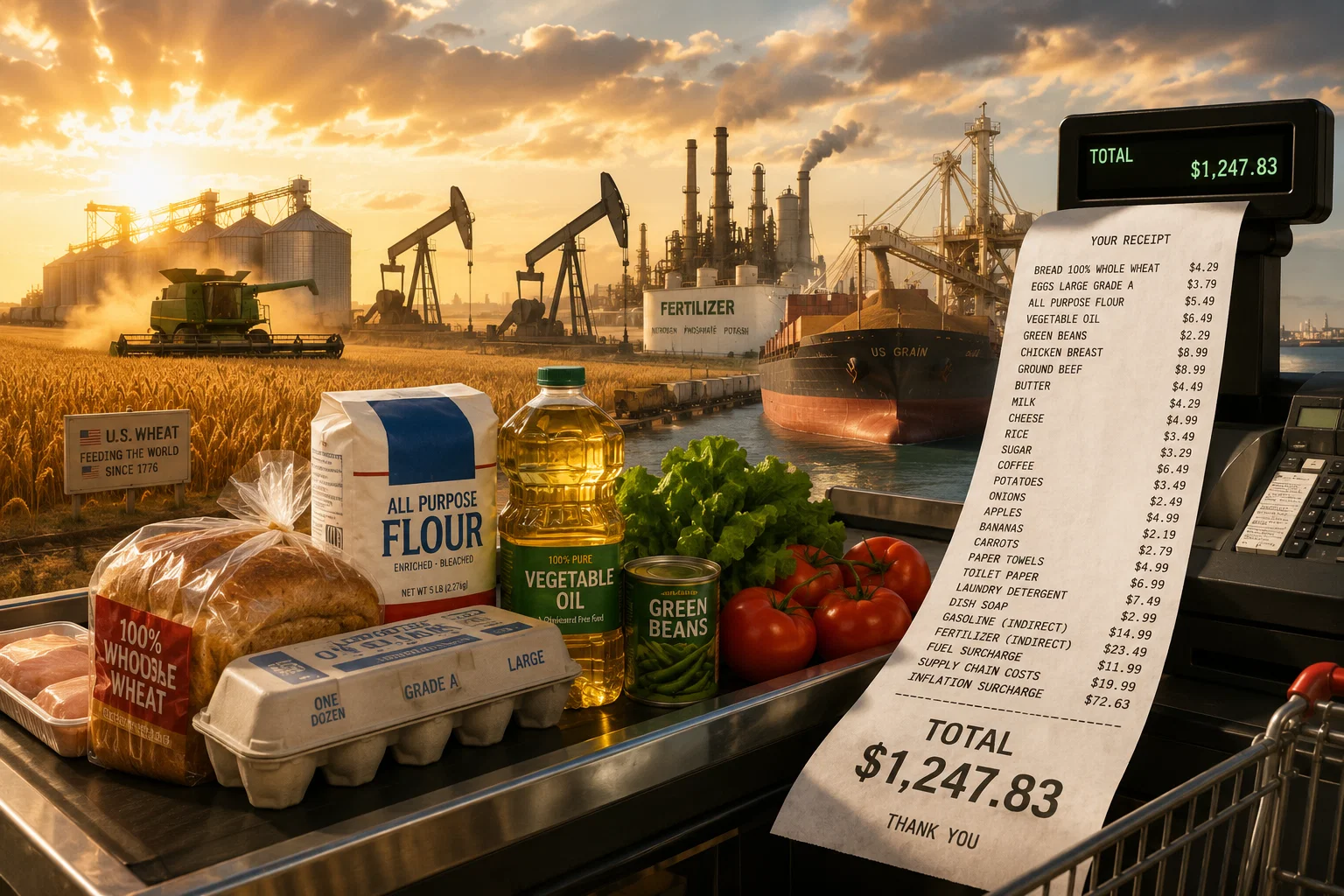
US Taxpayers Subsidized The Greatest Heist Of The Cold War. The Grocery Bill Came Later.
US Taxpayers Subsidized The Greatest Heist Of The Cold War. The Grocery Bill Came Later.
Notes From the Field By James Hickman (Simon Black / Sovereign Man) July 23, 2026
In the summer of 1972, a Soviet official named Nikolai Belousov stepped off a plane in New York City with a shopping list.
The Soviet Union had just finished its worst harvest in over a decade and was on the verge of starvation... and Belousov was tasked with the nearly impossible mission of buying enough wheat to feed an entire nation.
US Taxpayers Subsidized The Greatest Heist Of The Cold War. The Grocery Bill Came Later.
Notes From the Field By James Hickman (Simon Black / Sovereign Man) July 23, 2026
In the summer of 1972, a Soviet official named Nikolai Belousov stepped off a plane in New York City with a shopping list.
The Soviet Union had just finished its worst harvest in over a decade and was on the verge of starvation... and Belousov was tasked with the nearly impossible mission of buying enough wheat to feed an entire nation.
So he flew to America.
His first meeting was with Michel Fribourg, the head of Continental Grain. The two shook hands and closed a deal for Russia to buy millions of tons of American wheat.
Belousov's next stops were the other biggest grain traders in America: Cargill, Cook, Bunge, Louis Dreyfus, and Garnac.
He worked through every major American grain firm in a matter of weeks— each deal negotiated in complete secrecy... and each firm assumed they were the only American grain house that the Soviets were talking to.
In reality, Belousov was closing deals with all of them.
By the time word got out that the Soviets had been buying from everyone, everywhere, all at once, Belousov had already locked up roughly 440 million bushels of wheat, about a quarter of the entire American crop, for ~$700 million.
And here's the wild part: this was the peak of the Cold War... yet America's staunchest adversary didn't even pay full price for US wheat.
That’s because, for years prior, the US Department of Agriculture had been funding subsidies to make American grain cheaper abroad, covering the gap between the higher domestic price and the lower global price.
So the end result was that the Soviet Union drained American wheat inventory— and that’s when the Law of Supply and Demand kicked in. Wheat prices nearly doubled. Corn prices more than tripled by the following summer. Bread, beef, and eggs all followed.
Yet while Americans were suffering major food inflation at home, the US government was subsidizing the Soviet Union’s wheat purchases to the tune of $300 million in taxpayer funds.
The American taxpayer had financed the largest grain purchase the world had ever seen, for the benefit of its sworn enemy.
Then the second shoe dropped. The following autumn, in October 1973, the Arab oil-producing countries announced an embargo on the United States in response to America backing Israel in the Yom Kippur War.
Consequently, the price of crude oil roughly quadrupled... and it made the food inflation much worse.
Many people don’t realize just how much modern agriculture runs on oil and gas. Nitrogen fertilizer is synthesized from natural gas. Phosphate (another critical fertilizer ingredient) is mined and hauled with diesel. And everything from tractors to grain dryers burns fuel.
Because of the embargo, fertilizer prices more than doubled in 1973 and 1974, and food prices quickly followed. Inflation was eating quite aggressively into consumers’ standards of living.
All of this had a major impact on the stock market; as inflation raged throughout the 1970s, even America’s largest companies suffered. Their earnings shrank (especially when adjusted for inflation) and stock prices went nowhere.
The Dow Jones Industrial Average stock index closed at 1,000 in November 1972... and literally ten years later in November 1982, it was still at 1,000. The market went nowhere over the course of an entire decade.
And adjusted for inflation, of course, most stocks were losers.
The only real winners were REAL ASSET producers— especially gold and energy companies. Gold went from $35 an ounce in the early 1970s to a peak of $850 within a decade— though there were downturns in between.
Gold miners (and silver miners as well) were the best performers of the decade, with the Barron’s Gold Mining Index returning a phenomenal 1,247% in ten years.
Similarly, oil went from about $3 a barrel to nearly $40, and companies like Exxon completely trounced the S&P 500.
More than fifty years later, similar conditions are building again.
The Strait of Hormuz has been effectively closed since late February, except for the tankers Iran waves through from China and its other friends while everyone else waits outside.
Some oil is moving, for sure. But given that about a quarter of the world's sulfur and roughly 15% of its fertilizer exports normally move through that strait, there are significant implications for the agricultural sector.
Many consequences are already on the books.
Urea, the world's most common nitrogen fertilizer, climbed above $850 a tonne this spring, up roughly 80% since February and the highest price since 2022. Sulfur, an essential input for phosphate fertilizer, has doubled since January to record levels.
And in a recent American Farm Bureau survey, 70% of farmers said they cannot afford all the fertilizer they need this season.
Here's why that matters: spring planting is over. Farmers either paid those high fertilizer prices... or they skimped. And skimping means smaller harvests this fall.
Either way, higher food prices are already locked in. The shock has already happened. The impact just hasn’t been felt yet in the grocery stores because the harvest hasn’t taken place yet.
Meanwhile, agricultural markets are trading as if nothing has changed. Crop prices haven't come close to keeping pace with energy and fertilizer costs, and governments are already hoarding: China has temporarily banned phosphate fertilizer exports to keep supplies at home.
The last time this happened, the people who owned fertilizer production made money. Everyone else just got the grocery bill.
The featured research in Schiff Sovereign's investment newsletter, Strategic Assets, already includes a potash producer, a phosphate producer, and a palm oil grower, and we're watching a fantastic fertilizer company for the right entry point.
Our palm oil grower has nearly doubled since we published the research. The potash producer is up more than 16%... with a lot more room to grow. Our phosphate producer, which we recently featured, is still trading inside our suggested buy range.
To your freedom, James Hickman Co-Founder, Schiff Sovereign LLC
Insiders Are Betting Millions On Gold Reset By Year-End | Ed Steer
Insiders Are Betting Millions On Gold Reset By Year-End | Ed Steer
Liberty and Finance: 7-22-2026
Why are traders pouring millions into gold call options as high as $20,000? Precious metals analyst Ed Steer explains why he believes unprecedented positioning in the futures and options markets points to a potential historic shift in gold and silver pricing.
He also discusses unusual Commitment of Traders data, the role of commercial traders, and why he sees the balance of power gradually moving from Western paper markets toward Asia.
Insiders Are Betting Millions On Gold Reset By Year-End | Ed Steer
Liberty and Finance: 7-22-2026
Why are traders pouring millions into gold call options as high as $20,000? Precious metals analyst Ed Steer explains why he believes unprecedented positioning in the futures and options markets points to a potential historic shift in gold and silver pricing.
He also discusses unusual Commitment of Traders data, the role of commercial traders, and why he sees the balance of power gradually moving from Western paper markets toward Asia.
Along the way, Steer shares his interpretation of recent developments involving Chinese gold trading and what they could mean for the precious metals market.
Whether or not these forecasts come to pass, this interview explores the market signals and arguments that have many investors watching gold and silver more closely than ever.
INTERVIEW TIMELINE:
0:00 Intro
1:20 $20,000 gold call options
10:00 Short-squeeze
18:30 Gold & silver manipulation
23:25 Shanghai gold exchange
China Shuts Down Paper Gold in 24 Hours
China Shuts Down Paper Gold in 24 Hours
Taylor Kenny: 7-23-2026
China is shutting down retail paper gold trading at several major banks—and forcing investors to close positions or take physical delivery.
Is this the beginning of a major shift from paper pricing to real metal?
China Shuts Down Paper Gold in 24 Hours
Taylor Kenny: 7-23-2026
China is shutting down retail paper gold trading at several major banks—and forcing investors to close positions or take physical delivery.
Is this the beginning of a major shift from paper pricing to real metal?
CHAPTERS:
0:00 China’s Paper Gold Shutdown Begins
0:35 Why Paper Markets Control Gold and Silver Prices
1:27 How Rehypothecation Creates Multiple Claims on One Asset
2:21 Bank Spoofing and Precious Metals Price Manipulation
3:15 Why China Is Ending Retail Paper Gold Trading
3:43 China’s Bigger Physical Gold Strategy
4:41 Could Price Discovery Shift From Paper to Physical?
5:40 Physical Gold, Counterparty Risk, and Wealth Protection
6:38 East vs. West: Two Different Views of Gold
7:35 What This Means for Gold and Silver Investors