
Thank you to all the subscribers to our Early Access program…we thank you for your continued support.
We are excited to offer this new service to keep you informed and up-to-date on the latest Dinar and currency news.
Iraq Economic News and Points To Ponder Tuesday Morning 3-3-26
Airlines In The Region Are Losing Around $500 Million A Day
Money and Business Economy News - Follow-up WEGO Chief Business Officer Mamoun Humaidan said that daily losses for airlines are estimated at between $250 million and $500 million per day for companies that use the region's airports as a transit point. He added that low-cost airlines are the most affected due to their lower profit margins.
Hamidan said that the aviation sector's problem has now branched out to include route changes and rising costs, and he expects IATA to intervene to solve the problem.
Airlines In The Region Are Losing Around $500 Million A Day
Money and Business Economy News - Follow-up WEGO Chief Business Officer Mamoun Humaidan said that daily losses for airlines are estimated at between $250 million and $500 million per day for companies that use the region's airports as a transit point. He added that low-cost airlines are the most affected due to their lower profit margins.
Hamidan said that the aviation sector's problem has now branched out to include route changes and rising costs, and he expects IATA to intervene to solve the problem.
He noted that things were promising yesterday with the opening of some special flights to evacuate stranded travelers.
Meanwhile, travel company stocks suffered sharp losses yesterday, with their market value falling by $22.6 billion, amid escalating geopolitical concerns that have disrupted air travel globally.
Shares of U.S. airlines such as Delta Air Lines, United and American Airlines fell between 2% and 4%.
In Europe, shares of TUI fell by 10% and Lufthansa shares declined by 5.2%, while British Airways owner IAG lost about 5.5%.
Analysts from JPMorgan, Goodbody and Citigroup noted that Wizz Air is the most exposed in Europe due to its large presence in Israel.
On the other hand, Jefferies estimates that a 5% increase in fuel costs could reduce Delta and United's 2026 profits by between 5% and 10%, while American Airlines' profits could fall by about 35%.
The chaos in the global aviation sector worsened after airlines cancelled thousands of flights and changed the routes of others in the air, following the closure of large areas of airspace in the Middle East after military strikes carried out by the United States and Israel inside Iranian territory.
The widespread closure of airspace caused disruptions to extend to areas as far away as Brazil and Australia, as airlines were forced to cancel or divert flights that normally fly over the region. https://economy-news.net/content.php?id=66312
Gas Price In Europe Surpasses $700 As Iran Blocks Strait Of Hormuz
Today, 12:52 INA-SOURCES The price of gas on the exchange in Europe has surpassed $700 per 1,000 cubic meters for the first time since January 2023 amid statements by the Islamic Revolutionary Guard Corps (the elite unit of the Iranian Armed Forces) on blocking of the Strait of Hormuz, according to data from London’s ICE.
The price of April futures contracts at the TTF hub in the Netherlands has jumped to around $711 per 1,000 cubic meters, or 59.015 euro per MWh (based on the current exchange rate of euro to dollar, figures for ICE are presented in euros per MWh).
The price growth since the beginning of the day has exceeded 30%.
Earlier, the Islamic Revolutionary Guard Corps threatened to burn any tanker attempting to cross the Strait of Hormuz. Meanwhile US Central Command (CENTCOM) announced later that the Strait of Hormuz was still open for civil navigation.
Moreover, state-owned oil and gas company Qatar Energy has announced suspension of production of LNG and related products due to Iran’s air strikes. Qatar is the world’s third largest LNG exporter after the US and Australia. Its LNG production capacity is 77 mln tons per annum. The country has also announced plans to expand its LNG plants to 142 mln tons.
The United States and Israel launched a large-scale military operation against Iran on February 28. Major Iranian cities, including Tehran, were struck. The White House justified the attack by citing alleged missile and nuclear threats from Iran. At the same time, US leadership openly called on the Iranian population to rise up against their government and seize power.
As a result of the strikes, Iran’s supreme leader, Ayatollah Ali Khamenei, and several other senior figures in the leadership of the Islamic Republic were killed. The Islamic Revolutionary Guard Corps announced a retaliatory operation, targeting sites in Israel. US military bases in Bahrain, Jordan, Qatar, Kuwait, the UAE, and Saudi Arabia were also hit.
SOURCE: TASS https://ina.iq/en/economy/46018-gas-price-in-europe-surpasses-700-as-iran-blocks-strait-of-hormuz.html
Asian Stocks Extend Declines As Middle East Tensions Remain High
Today, 09:04 BAGHDAD-INA Asian stocks fell for a second day, as an escalation in the Middle East conflict fueled investor concern about surging oil prices and inflationary pressures.
The MSCI Asia Pacific Index dropped as much as 2%, extending Monday's 1.7% loss in the wake of US and Israeli strikes on Iran and its subsequent retaliation on neighbors. South Korea led equity market losses Tuesday, reopening following a holiday, with the Kospi sliding as much as 4.1%.
“The broader big picture is that the investment question is not primarily about Iran itself — it is whether the conflict leads to a larger value-at-risk episode driven by correlation into other markets,” said Nick Ferres, chief investment officer of Vantage Point Asset Management in Singapore. Some of the main moves in markets:
Stocks
• S&P 500 futures fell 0.7% as of 11:22 a.m. Tokyo time
• Japan's Topix fell 2.2%
• Australia's S&P/ASX 200 fell 1.4%
• Hong Kong's Hang Seng fell 0.3%
• The Shanghai Composite fell 1%
• Euro Stoxx 50 futures fell 0.7%
Currencies
• The Bloomberg Dollar Spot Index was little changed
• The euro was little changed at $1.1689
• The Japanese yen was little changed at 157.34 per dollar
• The offshore yuan rose 0.2% to 6.8842 per dollar
Cryptocurrencies
• Bitcoin fell 1.6% to $68,317.88
• Ether fell 2% to $2,002.23
SOURCE: NDTV https://ina.iq/en/economy/46006-asian-stocks-extend-declines-as-middle-east-tensions-remain-high.html
Crude, Natural Gas Prices Jump On Iranian News
Today, 12:57 Oil prices rose higher on Monday March 2, though not as much as expected, and stocks took that a relief sign and cut early losses toward the end of trading.
The conflict over and around Iran and the Persian Gulf was still raging, with no end in sight. Iran seemed not to be interested in talking about terms, probably because it wasn’t clear who would be the leader of the Iranian government.
Israel’s Saturday attack on the headquarters of Ayatollah Ali Khamenei, Iran’s supreme leader, killed him and other top officials.
Prices of Brent crude, the global benchmark crude, and light sweet crude, the benchmark U.S. crude jumped when futures trading opened. Brent topped out at $82.37 a barrel but closed March 2 at $77.74 per barrel, up 6.7% on the day. Brent is still up nearly 28% on the year.
Light sweet crude finished at $71.23, up 6.3% on the day and up 17% year-to-date.
AAA’s daily gas survey put regular gas nationally at $2.997 on Monday, up more than a penny from Sunday and up about 5.6% this year.
The stock market fell like a rock at the open after futures plunged starting late on Sunday March 1. Prices moved steadily higher for much of the session and were actually ahead on the day.
But The Gains Dissipated After 3:30 P.M.
The Standard & Poor’s 500 Index was 3 points to 6,882. The Dow Jones Industrial Average closed down 73 points to 48,905. But the Nasdaq Composite Index was up 81 points to 22,749.
The Strait Of Hormuz Is The Key
The oil price decline and stock recovery were predicated on hopes for a short bout of violence, followed by real talks and maybe a deal.
But all eyes watching the situation were focused on the Strait of Hormuz, the 22-mile wide body of water through which oil and natural gas tankers must pass to get to global markets. Iranian territory is the north side of the strait, and Iranian naval vessels have fired on at least four ships.
Global tracking images show big fleets of ships parked outside the strait in the Persian Gulf and in the Gulf of Oman. Reports suggested insurance companies were refusing to cover losses if tankers tried to pass through.
Qatar had shut down liquid natural gas production on Monday. The Persian Gulf nation is the world’s largest liquid natural-gas producer.
Several Issues Are Still Search For Solutions:
Who will take control of the Iranian government and be able to negotiate?
Do the Persian Gulf nations have enough ammunition to fend off Iranian drone and missile attacks?
Will the conflict last more than a month? The longer the shooting continues, energy supplies will tighten, and prices will rise. https://ina.iq/en/economy/46019-crude-natural-gas-prices-jump-on-iranian-news.html
Saudi Arabia's Aramco Ras Tanura Refinery Hit By Drone Strike, Shuts Down; Brent Crude Rises 9%
INA-SOURCES Saudi Arabia's Aramco, the state oil giant, shut down its Ras Tanura oil refinery on Monday following drone strikes in the facility, Reuters and Bloomberg report.
The reports of the closure sent Brent crude oil prices skyrocketing by 9.32%.
According to the Reuters report quoting an official, the Ras Tanura refinery of Aramco was shut as a precautionary measure. The situation was under control, the official said.
LNG Tanker Dayrates Double To $200K In Less Than A Day - Bloomberg
Today, 09:08 INA-SOURCES Shippers are demanding more than $200K/day for liquefied natural gas tankers in the Atlantic Basin, roughly double the amount obtained less than a day earlier, Bloomberg reported late Monday.
Those offer levels were at least triple the previous assessed price for an LNG tanker by shipping firm Spark Commodities, which came in at $61.5K/day earlier Monday - which was itself up 43% from from the previous day.
The surge in vessel rates has followed Qatar's shutdown of LNG production as the U.S.-Israel conflict with Iran began to spill across the Middle East region.
Transacted shipping rates - actual deals to lease vessels - are not likely to soar unless production cuts are prolonged in places such as Qatar and the U.A.E., Precision LNG Consulting's Richard Pratt told Bloomberg.
https://ina.iq/en/economy/46007-lng-tanker-dayrates-double-to-200k-in-less-than-a-day-bloomberg.html
Oil Prices Surge 13% In First Trades After Start Of US-Iran Conflict
Yesterday, 10:04 INA-SOURCES Oil prices jumped as much as 13 per cent as trading resumed amid a widening aerial conflict in the Middle East between Iran and the combined forces of the United States and Israel.
Brent crude, a key global benchmark for oil prices, surged as high as US$82.37 per barrel in early trade, the highest since January 2025. It pulled back a tad to trade at US$79.86 – still 9.5 per cent higher than the close on Feb 27 and up about 30 per cent since the start of 2026.
The US oil benchmark – West Texas Intermediate crude – rose 6.95 per cent to US$71.68 after touching US$75.33 earlier, the highest since June 2025.
Rallying crude prices represent the market’s concern about supplies coming through the Strait of Hormuz – a narrow waterway connecting the Persian Gulf to the Indian Ocean that handles a fifth of the world’s oil and large volumes of liquefied natural gas (LNG).
Some 15 million barrels of crude oil and 290 million cubic m of LNG pass through the strait each day from the Middle East to mainly Asia and Europe.
Analysts said tanker traffic through the strait has largely halted, with a self-imposed pause since the conflict began on Feb 28 as insurers warned shipowners that they would cancel policies and raise coverage prices for the region.
It comes as Iran retaliates against US-Israeli air strikes with missile and drone attacks on Israel and Arab states across the Middle East that host American military facilities.
The UK Maritime Trade Operations Centre has reported at least four incidents of vessels coming under attack from “unknown projectiles” since March 1 around Hormuz Strait.
While the Iranian authorities have said they do not intend to shut the waterway, ships in the area have reported hearing radio broadcasts stating that transit through Hormuz was banned.
Mr Max Layton, global head of commodities research at Citibank, said Brent is likely to trade in the US$80 to US$90 per barrel range over at least the coming week while the conflict is ongoing.
But in the case of a prolonged conflict, prices can surge to as high as US$120 a barrel, he added.
“Iran has not officially shut the Strait of Hormuz, but risk aversion from shippers is a real phenomenon. Transit volumes have already declined, with vessels parking outside the strait,” he said.
While constrained so far, attacks on the Omani tanker Skylight and on the United Arab Emirates’ (UAE) Abu Al Bukhoosh offshore platform highlight the risks towards oil asset targeting as well, Mr Layton said.
Meanwhile, OPEC+ – the oil exporters’ cartel that includes Saudi Arabia, the UAE and Russia – decided on March 1 to increase its crude oil production target by 206,000 barrels per day for April.
While the hike is 1½ times bigger than the 137,000-barrel increments made by the group in December, analysts said it is unlikely to calm markets in the immediate term.
Mr Jorge Leon, head of geopolitical analysis at research firm Rystad Energy, said markets are more concerned about whether barrels can move through Hormuz than with spare capacity on paper.
“If flows through the Gulf are constrained, additional production will provide limited immediate relief, making access to export routes far more important than headline output targets,” he said.
For Singapore, more expensive crude will result in higher prices of petrol for car owners.
Higher LNG prices will have an even wider impact, as the Republic produces the bulk of its electricity from natural gas.
While gas is pumped into Singapore mainly through pipelines from neighbouring countries, LNG has seen an increasing share in the mix, especially after the Republic made a long-term supply deal with Qatar – the Gulf state ranked as the world’s top LNG exporter.
Rystad estimates that based on 2025 trade flows, a complete closure of Hormuz and a breakdown of shipping in adjacent waters would see 97.7 million tonnes, or 363.8 million cubic m, per day of LNG from Qatar, the UAE and Oman removed from global markets.
This corresponds to 22 per cent of global LNG supply.
Mr Stephen Innes, managing partner at SPI Asset Management, said energy prices will remain volatile even if alternative supplies offer some cushion.
“Speculative positioning in oil has been building for weeks amid expectations that conflict in Iran would eventually flare. When a crowded trade gets the headline it was waiting for, the first move is higher.
“The second move can be profit-taking. But in these nervy war-torn conditions, oil markets rarely travel in straight lines,” he said.
MilitiaMan and Crew: IQD News Update-Market Economy-State Power-Self Sufficient-REER
MilitiaMan and Crew: IQD News Update-Market Economy-State Power-Self Sufficient-REER
3-2-2026
The Crew: Samson, PompeyPeter, Petra, Daytrader, Sunkissed, GIGI and Militia Man
Follow MM on X == https://x.com/Slashn
Be sure to listen to full video for all the news……..
MilitiaMan and Crew: IQD News Update-Market Economy-State Power-Self Sufficient-REER
3-2-2026
The Crew: Samson, PompeyPeter, Petra, Daytrader, Sunkissed, GIGI and Militia Man
Follow MM on X == https://x.com/Slashn
Be sure to listen to full video for all the news……..
FRANK26….3-2-26….BARTER
KTFA
Monday Night Video
FRANK26….3-2-26….BARTER
This video is in Frank’s and his team’s opinion only
Frank’s team is Walkingstick, Eddie and Omar in Iraq and guests
Playback Number: 605-313-5163 PIN: 156996#
KTFA
Monday Night Video
FRANK26….3-2-26….BARTER
This video is in Frank’s and his team’s opinion only
Frank’s team is Walkingstick, Eddie and Omar in Iraq and guests
Playback Number: 605-313-5163 PIN: 156996#
Is AI the Setup for the Greatest Wealth Transfer?
Is AI the Setup for the Greatest Wealth Transfer?
Taylor Kenny: 3-1-2026
As we navigate the complexities of the modern world, a growing concern is emerging about the accelerating impact of artificial intelligence (AI) on our society, economy, and individual autonomy. A recent thought-provoking discussion among experts has shed light on a potentially dystopian future, where AI replaces a staggering 95% of current jobs, paving the way for a systemic shift from ownership to subscription-based access for virtually every commodity and service.
This radical transformation is not just about the way we live and work; it’s also intricately linked to a broader agenda that includes Universal Basic Income (UBI) and centralized control via digital currencies.
Is AI the Setup for the Greatest Wealth Transfer?
Taylor Kenny: 3-1-2026
As we navigate the complexities of the modern world, a growing concern is emerging about the accelerating impact of artificial intelligence (AI) on our society, economy, and individual autonomy. A recent thought-provoking discussion among experts has shed light on a potentially dystopian future, where AI replaces a staggering 95% of current jobs, paving the way for a systemic shift from ownership to subscription-based access for virtually every commodity and service.
This radical transformation is not just about the way we live and work; it’s also intricately linked to a broader agenda that includes Universal Basic Income (UBI) and centralized control via digital currencies.
The implications are far-reaching, with the potential to concentrate wealth and power in the hands of a few behemoth corporations and financial entities, such as BlackRock.
To understand the magnitude of this shift, it’s essential to draw parallels with historical events. The Great Depression’s property tax hikes and the Roman “bread and circus” distractions serve as cautionary tales about how systemic control can be maintained through economic manipulation and social distractions.
The speakers in the discussion highlighted these examples to illustrate how governments and corporations might employ similar tactics to maintain control in an AI-driven world.
In this envisioned future, AI is not just a technological disruptor in the labor market; it’s a tool that can be exploited to control narratives, depress asset prices, and buy up assets cheaply before reinflating them under a new economic order supported by UBI.
The rise of AI-driven fake social media personas and the phenomenon of AI hiring humans to perform tasks it cannot complete itself are just a few examples of the increasing blurring of lines between human and machine activity.
Furthermore, concerns about bio-warfare facilitated by AI are emerging as part of the rapid AI arms race between global powers. The potential consequences are dire, and it’s crucial that we acknowledge the risks associated with this technological advancement.
Despite the bleak outlook, there is a glimmer of hope. The experts emphasize the importance of owning tangible assets like gold and silver as a form of financial security and resistance against total systemic control. In a world where subscription-based access becomes the norm, possessing physical assets can provide a safeguard against the whims of corporations and governments.
As we stand at the precipice of this AI-driven revolution, it’s essential that we take proactive steps to prepare for the changes that are fast approaching. Education and awareness are key to understanding the implications of this technological shift. By recognizing the potential risks and opportunities, we can make informed decisions about our financial security and individual autonomy.
Fear can be a motivator for sound decision-making, and it’s crucial that we don’t ignore the warning signs. By taking control of our financial futures and staying informed about the developments in the AI landscape, we can navigate the complexities of this emerging world.
For further insights and information, we recommend watching the full video from ITM Trading, where the experts delve deeper into the implications of an AI-driven future. By staying informed and taking proactive steps, we can ensure that we’re prepared for the challenges and opportunities that lie ahead.
In conclusion, the AI-driven future is a complex and multifaceted phenomenon that requires careful consideration and proactive action. By understanding the potential risks and opportunities, we can navigate this emerging world with confidence and ensure that our individual autonomy and financial security are preserved.
“Gold is a Currency. It's been a Currency forever.”
“We’re Consuming More Than We Produce” Silver Warning | Randy Smallwood
Kitco News: 3-2-2026
Gold testing $5,400 is not a temporary surge; it reflects what Wheaton Precious Metals CEO Randy Smallwood describes as a structural shift in markets.
Speaking with Kitco News at PDAC 2026, amid escalating Middle East tensions and a sharp move higher in oil, Smallwood said precious metals are entering a new phase driven by fiscal imbalances, currency concerns, and renewed demand for hard assets.
“I do think 5,000 is a new base for gold,” Smallwood said. “Gold is a currency. It's been a currency forever.”
“We’re Consuming More Than We Produce” Silver Warning | Randy Smallwood
Kitco News: 3-2-2026
Gold testing $5,400 is not a temporary surge; it reflects what Wheaton Precious Metals CEO Randy Smallwood describes as a structural shift in markets.
Speaking with Kitco News at PDAC 2026, amid escalating Middle East tensions and a sharp move higher in oil, Smallwood said precious metals are entering a new phase driven by fiscal imbalances, currency concerns, and renewed demand for hard assets.
“I do think 5,000 is a new base for gold,” Smallwood said. “Gold is a currency. It's been a currency forever.”
He argued that the long-held view of the US dollar as the primary reference currency is being reassessed as deficits widen and geopolitical risk intensifies.
Smallwood also pointed to silver’s multi-year supply imbalance, noting, “We're consuming more of it than what we're producing,” after peak silver production in 2017 and 2018.
His comments come after Wheaton closed a $4.3 billion transaction last week to double its silver exposure at Antamina, positioning the streaming company for what he sees as a sustained monetary and industrial shift.
Recorded March 02, 2026.
00:40 - CEO Transition and $4.3B Silver Deal
02:32 - Gold Above $5,000 and Breakout Drivers
03:54 - Energy Costs, Cost Curve, and Mining Margins
05:48 - $4.3B Antamina Silver Stream in Peru
07:58 - Wheaton’s Growth Engine and Streaming Model
10:21 - M&A Pressure and Mine Supply Constraints
11:43 - Managing Jurisdiction and Political Risk
13:23 - Silver Structural Deficit Since 2017
16:25 - Industrial Silver Demand and AI Growth
17:55 - Silver Volatility and Squeeze Narrative
19:15 - Wheaton’s 2030 Production Strategy
21:34 - $1M Future of Mining Innovation Challenge
Coin Shops Say They're Swimming In So Much Silver And Gold That They're Having To Limit Purchases
Coin Shops Say They're Swimming In So Much Silver And Gold That They're Having To Limit Purchases
Dominick Reuter Business Insider Updated Sun, February 8, 2026
Spot prices for silver and gold are stabilizing after a rocky stretch of record gains and losses.
The market volatility has caused headaches for local coin shops that typically buy precious metals.
"If you do this wrong, you run out of capital really fast," one shop told Business Insider.
If January was a party in the precious metals market, February is the hangover.
Coin Shops Say They're Swimming In So Much Silver And Gold That They're Having To Limit Purchases
Dominick Reuter Business Insider Updated Sun, February 8, 2026
Spot prices for silver and gold are stabilizing after a rocky stretch of record gains and losses.
The market volatility has caused headaches for local coin shops that typically buy precious metals.
"If you do this wrong, you run out of capital really fast," one shop told Business Insider.
If January was a party in the precious metals market, February is the hangover.
The per-ounce price of gold topped $5,300 and silver reached nearly $120 at the end of January before tumbling sharply. The stretch of record gains and losses has since stabilized in the early days of February.
"These price moves have done a lot of damage all across the line," HSBC precious metals analyst James Steel told Business Insider.
One type of business bearing the brunt of volatility is local coin shops, where people often trade in gold and silver. High prices have led to a huge influx of people selling, but some shops tell Business Insider they're running out of their usual places to offload excess metals.
As the market was in its tailspin, Tim Heuer said the shop he manages, University Coin & Jewelry in Madison, Wisconsin, was still doing deals.
Heuer said a customer came in to sell some silver when the spot price was $98 an ounce and falling: "By the time I wrote his check, silver was already down $3.50 from the time he walked in the door."
The recent volatility is putting those businesses in an uncomfortable position, beyond quickly changing spot prices that erode profit margins.
Local coin shops play an essential role in the circulation of physical gold and silver by providing a reliable way for individuals to sell their bars, coins, or scrap metal.
If someone bought a gold bar last year from Costco and wants to turn it back into cash, a local coin shop is one of the first places they might go.
And while these shops do turn around and sell some of what they buy, most of the metal is sold to refineries to be melted and minted into new bars or coins.
Precious metals refineries are experiencing major backlogs
That flow has been interrupted in recent months as the run in gold and silver prices has encouraged more people to trade in their metals, leading to a backlog of raw materials at refineries.
Jarret Niesse, president of Precious Metal Refining Services in Chicago, said his company stopped buying scrap silver back in October, when the price crossed $50 per ounce, sparking a frenzy of people trading in old silverware, platters, and other tchotchkes that had been gathering dust.
And the market has only gotten wilder since then.
"This entire crazy silver move that has happened, we have been sitting on the sidelines," he said.
Refineries like Niesse's are one step in the process. Much of the product they melt down gets further refined by other mints and exported to Asian markets, where demand for bars and coins is higher. With so much gold and silver to process, those refineries have also stopped buying, thereby cutting into the cash flow of local coin shops.
To Continue an d Read More: https://www.yahoo.com/finance/news/coin-shops-theyre-swimming-much-105201247.html
News, Rumors and Opinions Monday 3-2-2026
Freedom Fighter: Pressure on Iran is also Pressure on Iraq
3-1-2026
Freedom Fighter @FreedomFight12
ALERT: War & Currencies
Iran & Iraq (Dinar)
Most people are watching Iran in isolation, that’s a mistake.
Freedom Fighter: Pressure on Iran is also Pressure on Iraq
3-1-2026
Freedom Fighter @FreedomFight12
ALERT: War & Currencies
Iran & Iraq (Dinar)
Most people are watching Iran in isolation, that’s a mistake.
Iran and Iraq are neighboring countries with deep connections through trade, banking channels, energy, political influence and heavy smuggling of USD & Iraq Dinar which has historically choked the value of the Iraqi Dinar.
Pressure on Iran is also pressure on Iraq.
War often creates ripple effects across neighboring economies and CURRENCIES.
Regional conflict has historically been a catalyst for monetary and financial shifts.
Watch the monetary layer — not just the headlines.
Everything is connected to everything.
Watch President Trump on X: https://twitter.com/i/status/2027651077865157033
When tension rises in the region, Iraq is never “on the sidelines.”
Iraq is one of the most strategically connected pieces on the board — economically and financially.
Noise creates fear.
Structure creates opportunity.
Pay attention to what’s moving underneath.
Pay attention:
Source(s): https://x.com/FreedomFight12/status/2027732793036259732
https://dinarchronicles.com/2026/03/01/freedom-fighter-pressure-on-iran-is-also-pressure-on-iraq/
*****************
Courtesy of Dinar Guru: https://www.dinarguru.com/
Mnt Goat ...in Iraq we are witnessing parts of the RESET that must take place prior to the reinstatement. We know the IMF is closely monitoring the economy and have told us they are satisfied in all the reform success. They have told us they are satisfied with the STABILITY of the economy. But along came the 2025 elections and so now we wait for the political STABILITY to catch up.
Militia Man Article: "Washington reassures Iraq will not be dragged into war" It's coming from official resources here in the United States and in the Middle East. Quote: "US president says, 'I have a great understanding with Iraqi leadership...stressing that he gets along very well with Iraqi leaders.' "
Frank26 I think this [military action] is a good way to get ready for the float. Oh, that's terrible. But it's exactly what it's doing...I don't find a lot of joy in what's going on. I'm happy, yes because of our investment, but I'm extremely sad when I look at the loss of innocent lives...
****************
Tension Built Up & Broke: Why Gold Exploded | Rick Rule
Liberty and finance: 3-2-2026
Rick Rule argues that the recent surge in gold reflects long building fiscal deterioration and declining fiat purchasing power rather than a short term crisis, and he believes the bull market in precious metals could continue for years.
He emphasizes that gold remains historically underowned and that even a sideways metals market could allow mining equities to revalue higher because analyst models assume lower price decks. Rule distinguishes between gold as savings and silver as speculation, noting he reduced physical silver exposure in favor of silver mining stocks while increasing gold holdings.
He rejects long term manipulation theories around COMEX, asserting that markets ultimately follow arithmetic and incentives.
Finally, he warns that long dated bonds face structural risk in an inflationary environment and encourages investors to focus on real assets such as precious metals, farmland, and resource equities.
INTERVIEW TIMELINE:
0:00 Intro
1:30 Precious metals in 2025
8:10 Gold investing
22:25 Mining sector
26:35 Storage security
33:45 Borrowing against gold
35:45 Mortgage rates
42:45 India, China, & metals
46:16 Gold manipulation?
Monday Coffee with MarkZ. 03/02/2026
Monday Coffee with MarkZ. 03/02/2026
Some highlights by PDK-Not verbatim
MarkZ Disclaimer: Please consider everything on this call as my opinion. People who take notes do not catch everything and its best to watch the video so that you get everything in context. Be sure to consult a professional for any financial decisions
Member: Welcome to March
Member: Good Morning Mark, Mods and all! What is the word of the day?
Monday Coffee with MarkZ. 03/02/2026
Some highlights by PDK-Not verbatim
MarkZ Disclaimer: Please consider everything on this call as my opinion. People who take notes do not catch everything and its best to watch the video so that you get everything in context. Be sure to consult a professional for any financial decisions
Member: Welcome to March
Member: Good Morning Mark, Mods and all! What is the word of the day?
MZ: The rumors that I am hearing from some bond sources is they did start processing some bonds boxes that came with historic art like boxes with golden guns , falcon art pieces, gold pieces ect…..The rumor is they started doing this over the weekend and will continue processing quietly this week. That is what I was told.
MZ: One of my sources swear they know someone running around with lots of money this weekend. They supposedly got 100% full access. If that is true…its almost time to start partying.
Member: praying the war in Iran doesn’t affect the RV
Member: Is the Iran war slowing down or speeding up the RV?
MZ: I think it is speeding it up. I think that during this upheaval the RV may be released for us. That’s what I think
Member: I also think it be a good time to do it for Iraq with everything going on in the region!
Member: Last week I called Truist to see about getting appt with mgr as I have known her for a while. Teller said all bank mgrs in training.after short talk, I asked was I under NDA and he said YES.
Member: Mark is it true,,Intel Providers were being leaned on not to disclose information
MZ: That may be true but no one is leaning on me right now.
Member: Is it in the stars? 6 planets aligned on march 1st when did they start bombing … and we are about to have a blood moon total lunar eclipse on March 3rd… something big about to happen
Membr: Have a good day everyone…….stay positive and keep watching. Nothing, nothing, nothing…then Suddenly!
The Mushroom Ladies join the stream today. Please listen to the replay for their information.
THE CONTENT IN THIS PODCAST IS FOR GENERAL & EDUCATIONAL PURPOSES ONLY&NOT INTENDED TO PROVIDE ANY PROFESSIONAL, FINANCIAL OR LEGAL ADVICE. PLEASE CONSIDER EVERYTHING DISCUSSED IN MARKZ’S OPINION ONLY
https://rumble.com/user/theoriginalmarkz
Kick: https://kick.com/theoriginalmarkz
FOLLOW MARKZ : TWITTER . https://twitter.com/originalmarkz?s=21. TRUTH SOCIAL . https://truthsocial.com/@theoriginalm...
Mod: MarkZ "Back To Basics" Pre-Recorded Call" for Newbies 10-19-2022 ) https://www.youtube.com/watch?v=37oILmAlptM
MARKZ DAILY LINKS: https://theoriginalmarkz.com/home/
Note from PDK: Please listen to the replay for all the details and entire stream….I do not transcribe political opinions, medical opinions or many guests on this stream……just RV/currency related topics.
THANK YOU FOR JOINING. HAVE A BLESSED DAY. SEE YOU IN THE MORNING FOR COFFEE @ 10:00 AM EST ~ UNLESS BREAKING NEWS HAPPENS! FOR UPDATES ON MARK’S PODCAST GO TO: https://t.me/+b3hYhYlhKM1hYzcx
“Tidbits From TNT” Monday 3-2-2026
TNT:
Tishwash: Reuters: Three drones shot down over Erbil airport in northern Iraq
Security sources told Reuters on Monday that three armed drones were shot down over Erbil airport in northern Iraq, where US forces are stationed.
Explosions were heard Monday morning near Erbil International Airport in Iraq's Kurdistan region, where forces from the US-led international coalition are stationed, according to an AFP correspondent.
Early this morning, an AFP photographer reported that air defenses shot down at least two drones near the airport, which houses a coalition forces base.
TNT:
Tishwash: Reuters: Three drones shot down over Erbil airport in northern Iraq
Security sources told Reuters on Monday that three armed drones were shot down over Erbil airport in northern Iraq, where US forces are stationed.
Explosions were heard Monday morning near Erbil International Airport in Iraq's Kurdistan region, where forces from the US-led international coalition are stationed, according to an AFP correspondent.
Early this morning, an AFP photographer reported that air defenses shot down at least two drones near the airport, which houses a coalition forces base.
Since the start of the American-Israeli attack on Iran, Erbil, where a huge complex of the American consulate is also located, has been subjected to attacks by drones that are shot down by air defenses. link
************
Tishwash: The Iraqi parliament postpones its session until further notice.
The Iraqi parliament decided on Sunday to postpone its scheduled session until further notice.
The council's media department stated in a brief statement received by Al-Sa'a Network that "the council decided to postpone its session scheduled for today until further notice link
*************
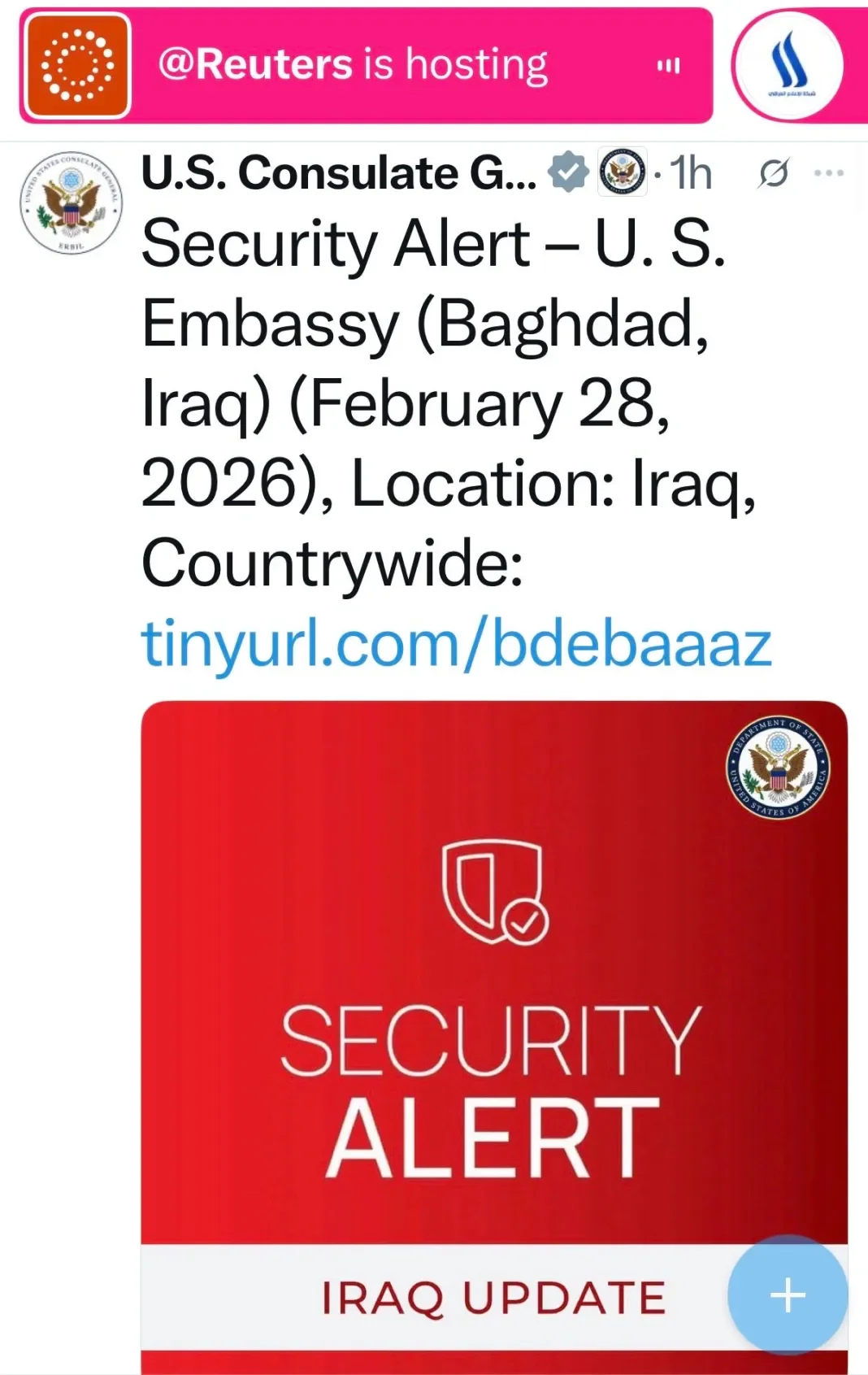
Tishwash: Statement from the US Embassy in Baghdad regarding the demonstrations near the Green Zone
The US Embassy in Baghdad issued a security alert on Sunday (March 1, 2026) regarding demonstrations taking place in areas near the Green Zone in the Iraqi capital.
The embassy said in a statement received by "Baghdad Today" that "the US mission in Iraq advises American citizens to exercise extreme caution, limit their movements, and remain in their places of residence when necessary, given the continued reports of missiles, drones, or projectiles being detected in Iraqi airspace, and to monitor active threats to US interests, including restaurants, businesses, and individuals."
The statement noted that "the southern bank of the July 14 Bridge in Baghdad is witnessing anti-American demonstrations, along with calls for demonstrations in various parts of the country, warning of the possibility of the gatherings turning into acts of violence, in light of a security situation that the embassy described as 'complex and rapidly changing'."
As a precautionary measure, the US mission directed its staff who are able to work from home to do so until further notice, and consular operations, including routine services for US citizens, were temporarily suspended.
She emphasized that "the Level 4 travel warning for Iraq (Do Not Travel) remains in effect, urging American citizens not to travel to Iraq for any reason, and to review their personal security plans if they are already in the country, and not to rely on the U.S. government for departure or evacuation operations."
The statement noted that "Iraqi airspace is currently closed, with the possibility of it being reopened or closed again at short notice," and called on "travelers to contact airlines for the latest information."
The embassy clarified that "work at its headquarters in Baghdad and the US Consulate General in Erbil continues on a limited basis and is restricted to essential operations only."
The embassy, according to the statement, urged “American citizens to enroll in the Smart Traveler Enrollment Program (STEP) to receive security updates, prepare contingency plans, ensure adequate basic necessities, keep their communication devices charged, avoid large gatherings and areas frequented by foreigners, and follow local media to stay informed of developments.”
************
Tishwash: Gasoline and dollar queues are the first signs... Is Iraq entering a tunnel of economic turmoil?
The ongoing conflict between the United States and Israel on one side, and Iran on the other, has quickly cast a shadow over the overall situation in Iraq, particularly the economic aspect.
Concerns related to energy markets and supply chains have resurfaced, with growing anxiety about the impact of any escalation of the conflict on oil exports, shipping routes, and the stability of the domestic market in a country almost entirely dependent on imports.
The exchange rate of the dollar has also seen a significant increase in Baghdad's Al-Kifah Street market, exceeding 160,000 dinars per 100 dollars, alongside a sharp rise in the prices of both foreign and Iraqi gold in the markets of Baghdad and Erbil. In a tangible indication of the "shock" spreading domestically, Iraqi cities witnessed signs of a fuel crisis.
For example, the city of Fallujah in Anbar province saw long queues at gas stations, revealing the public's sensitivity to any development that might be perceived as a direct threat to supply chains or transportation between provinces.
The government, for its part, attempted to offer reassurances to alleviate the confusion. The Ministry of Trade affirmed that the food situation in Iraq is "stable and under control," and that there are no indications of concern regarding the availability of food in the markets following the Israeli-American attack on Iran.
Ministry of Trade spokesman Mohammed Hanoun stated that "the government has given great attention to the food security file in anticipation of emergency circumstances, and has worked during the past period to strengthen the strategic reserves of basic commodities, especially wheat, in addition to ration card items such as rice, sugar, and oil." He emphasized that "the stock is good and sufficient to meet citizens' needs within a plan aimed at ensuring continued supply and market stability, with daily monitoring of market activity to prevent exploitation and price hikes."
Economically, "energy sensitivity" appears to be the most prominent issue. Iraq may theoretically benefit from higher oil prices, but at the same time, it faces the risks of disruptions to export routes, shipping, and insurance, along with the accompanying pressure on internal stability and prices, especially if the war escalates to a stage where economic infrastructure or maritime routes are targeted.
What about the Strait of Hormuz?
Economist Safwan Qusay warns Al-Mada that "expanding the scope of the war in the Middle East to include economic targets and closing the Strait of Hormuz will lead to a rise in global oil prices, forcing Baghdad to confront the challenge of managing risks, not merely monitoring figures."
Qusay believes that "Iraq needs options to mitigate the potential shock, including reaching an understanding with Saudi Arabia on arrangements to secure supplies in case some routes are disrupted, or relying on the reserves of the Central Bank of Iraq to ensure the financing of public spending for a period that may exceed six months if the crisis enters a phase of severe pressure."
Qusay goes further, discussing logistical alternatives, such as "expanding export routes towards Turkey by utilizing the Kirkuk-Ceyhan pipeline and its capacity, with the possibility of boosting exports by truck to Jordan, Kuwait, or Turkey, depending on developments in the security and trade situation."
Warnings of a more dangerous scenario .
In this context, political analyst Mohammed Naanaa told Al-Mada that "Iraq must prepare for the repercussions and consequences of a war with Iran, especially if the war escalates or the Iranian regime loses control of the internal situation." He warned that the most dangerous scenario is the possibility of the war leading to widespread internal disintegration, which could open the door to large waves of displacement towards the Iraqi border.
Naanaa stressed the necessity of "taking all necessary precautions to confront potential challenges and threats, including administrative and security preparedness and the management of resources and services in the provinces near the front lines."
According to field observations, Iraqi markets remain in a phase of "anticipation and questioning" rather than an actual crisis. However, observers note that this phase could change rapidly if the war continues and expands, especially given the sensitivity of consumer sentiment towards fuel and basic commodities, and the potential for rumors to ignite excessive buying that would disrupt the market even if stocks are stable. link
*************
Mot: Procrastination

Any Takers For The Taliban’s New Investment Visa?
Any Takers For The Taliban’s New Investment Visa?
Notes From the Field By James Hickman (Simon Black) February 23, 2026
Just imagine how tranquil your retirement could be in... sunny Afghanistan! You could wake up in the morning to the pleasant sound of celebratory gunfire... then artfully dodge landmines left behind by not one, but two different superpower invasions on your way to witness the day’s beheading.
You could cap off the afternoon spelunking through mountain caves where you might bump into actual jihadists, then end the day with a stroll through a war-torn city’s desperate poverty.
Any Takers For The Taliban’s New Investment Visa?
Notes From the Field By James Hickman (Simon Black) February 23, 2026
Just imagine how tranquil your retirement could be in... sunny Afghanistan! You could wake up in the morning to the pleasant sound of celebratory gunfire... then artfully dodge landmines left behind by not one, but two different superpower invasions on your way to witness the day’s beheading.
You could cap off the afternoon spelunking through mountain caves where you might bump into actual jihadists, then end the day with a stroll through a war-torn city’s desperate poverty.
If this sounds ideal to you, then you're in luck! The Taliban now offers an investment visa for foreigners to obtain residency in Afghanistan.
This is a real thing; earlier this month, Afghanistan's Economic Commission approved a proposal to offer foreign investors residency permits of up to ten years. Put your money into Afghan mining, construction, or energy, and you too can call Kabul home.
Sure, the banking system is cut off from the international financial network, US sanctions make it effectively illegal for Western companies to operate there, and girls aren't allowed to attend school past sixth grade. The roads, power grid, and water systems are barely functional. And the country has been at war, in some form, for over forty years.
Any takers?
Fortunately the world is a big place, and there are plenty of other options besides Afghanistan.
And while we poke fun at the Taliban, the core concept of obtaining residency in another country is one of the smartest things you can do to give yourself a Plan B.
The logic is simple. If your home country feels like an increasingly unfamiliar place— as a lot of people in the West feel right now— then it makes sense to have a backup... a place you can go, legally, on your own terms, even if borders close or things get weird.
We saw this play out during COVID. When governments around the world slammed their borders shut in 2020. Tourists were locked out— flights canceled, entry denied.
But people who had established legal residency in a foreign country still had the right to enter and stay, just like citizens.
Families who had taken that step years earlier found that they had options— another place to leave the chaos, work remotely from their second home, and wait out the insanity on their own terms.
Those who hadn't were stuck wherever they happened to be, subject to whatever restrictions their local governments decided to impose.
That distinction— tourist versus legal resident— became the difference between freedom and lockdown. Overnight. And this might matter again.
But a second residency isn’t about crises and pandemics..
A lot of people start by simply finding a place they enjoy. They visit somewhere on vacation — Costa Rica, Portugal, Malaysia, wherever— and they love it. They go back a few times. Eventually they start looking at property. Maybe they buy a place and rent it out when they're not using it.
Over time, they realize they've built something more than a vacation spot. They've got a home in a country where life is slower, the food is better, and their money goes a lot further.
And that last part matters more than most people think.
The cost of living in much of the world is a fraction of what it is in the West. A couple living on Social Security and a modest level of savings— money that barely covers the basics in most American cities — can live extremely well in dozens of countries.
We're talking beachfront property, hired help, great healthcare, and money left over at the end of the month.
There are plenty of ways to obtain residency abroad. In some countries, you can become a legal resident by purchasing property— something that you might want to do anyhow.
In Panama, you can become a legal resident by purchasing property for roughly $300,000 — and that buys you genuinely nice real estate in a country where property prices can be $100 to $200 per square foot.
In Europe, countries like Portugal and Greece have set up formal programs specifically designed to attract foreign capital in exchange for residency rights.
There are also plenty of countries that don't even require an investment— where simply demonstrating you have a pension (like Social Security) is enough to qualify.
Other places (like Australia or New Zealand) are looking strictly at skill needs, so younger people with valuable work experience can obtain residency.
Everyone's situation is different. For some people it's a beachfront villa in Central America. For others it's a flat in Lisbon. For others it's a farm in New Zealand. The world is full of options.
The point is that none of this is radical. It's not about fleeing. It's about having the option to go somewhere you actually enjoy — somewhere you might already vacation — and having the legal right to stay there indefinitely if you ever need to.
It's the same logic as any insurance policy. You don't buy fire insurance because you want your house to burn down. You buy it because you'd rather not find out the hard way that you needed it. That’s what a Plan B is about.
To your freedom, James Hickman Co-Founder, Schiff Sovereign LLC
FRANK26…3-1-26….PART 2 and BANK STORY
KTFA
Sunday Night Video
FRANK26…3-1-26….PART 2 and BANK STORY
This video is in Frank’s and his team’s opinion only
Frank’s team is Walkingstick, Eddie and Omar in Iraq and guests
Playback Number: 605-313-5163 PIN: 156996#
KTFA
Sunday Night Video
FRANK26…3-1-26….PART 2 and BANK STORY
This video is in Frank’s and his team’s opinion only
Frank’s team is Walkingstick, Eddie and Omar in Iraq and guests
Playback Number: 605-313-5163 PIN: 156996#
FRANK26….3-1-26….S & S BORN
KTFA
Sunday Night Video
FRANK26….3-1-26….S & S BORN
This video is in Frank’s and his team’s opinion only
Frank’s team is Walkingstick, Eddie and Omar in Iraq and guests
Playback Number: 605-313-5163 PIN: 156996#
KTFA
Sunday Night Video
FRANK26….3-1-26….S & S BORN
This video is in Frank’s and his team’s opinion only
Frank’s team is Walkingstick, Eddie and Omar in Iraq and guests
Playback Number: 605-313-5163 PIN: 156996#
A Structural Shift in the Global Financial System that Nobody is Seeing
A Structural Shift in the Global Financial System that Nobody is Seeing
Miles Harris: 3-1-2026
The global financial system is undergoing a significant transformation, driven by the inherent dynamics of its debt-based monetary structure.
In a recent video presentation, “The Structural Foundations of the New Financial System,” Miles Harris introduces a new series that delves into the intricacies of this evolution.
A Structural Shift in the Global Financial System that Nobody is Seeing
Miles Harris: 3-1-2026
The global financial system is undergoing a significant transformation, driven by the inherent dynamics of its debt-based monetary structure.
In a recent video presentation, “The Structural Foundations of the New Financial System,” Miles Harris introduces a new series that delves into the intricacies of this evolution.
The presentation provides a comprehensive overview of the fundamental pillars of the financial system, its historical context, and the challenges it faces in the modern era.
At the heart of the financial system lies a complex interplay between credit creation, collateral base, and settlement infrastructure. The speaker emphasizes that the system’s stability is threatened when credit creation outpaces the growth of underlying assets and collateral, leading to increased fragility.
As debt levels rise, the ability to settle transactions weakens, making the system more vulnerable to shocks. This is particularly concerning when credit expansion surpasses the growth of real assets and liquidity becomes concentrated in too few institutions.
To understand the current state of the financial system, it’s essential to examine its historical context.
The gold standard era provides valuable insights into how collateral definitions and settlement speed influenced financial stability and scalability.
The transition from asset-backed collateral (gold) to debt-based collateral (government debt) post-1971 marked a significant shift, enabling massive credit expansion but also creating paradoxes. The system now relies on debt to create collateral to back further debt, raising concerns about its long-term sustainability.
The expansion of shadow credit and offshore dollar markets has further complicated the financial landscape, increasing liquidity outside traditional banking systems.
While this has provided new avenues for credit creation, it has also reduced visibility and stability. The emergence of new technologies, such as programmable currencies and stablecoins, may increase transparency and settlement efficiency but also raises concerns about control and surveillance.
As the financial system continues to evolve, several key questions arise: Is debt growing faster than real resources? Is money too concentrated? Are financial promises becoming overly complex and opaque?
The presentation highlights the need for evolving settlement infrastructure, expanding or enhancing collateral, and upgrading liquidity mechanisms to address these challenges.
The ongoing transformation of the global financial system will have far-reaching implications in the coming years and decades.
It’s crucial to grasp the fundamental knowledge underlying this evolution to navigate the changing landscape. By understanding the structural foundations of the new financial system, we can better appreciate the challenges and opportunities that lie ahead.
For those interested in gaining a deeper understanding of the evolving financial architecture, we recommend watching the full video presentation by Miles Harris.
The series promises to provide valuable insights into the complex dynamics driving the transformation of the global financial system.
As the financial system continues to evolve, it’s essential to stay informed about the latest developments and trends. By doing so, we can gain a better understanding of the complex interplay between credit creation, collateral, and settlement infrastructure, and how they shape the future of finance.