
Thank you to all the subscribers to our Early Access program…we thank you for your continued support.
We are excited to offer this new service to keep you informed and up-to-date on the latest Dinar and currency news.
Seeds of Wisdom RV and Economics Updates Monday Evening 2-23-26
Good Evening Dinar Recaps,
Trump’s “Board of Peace” Weighs Stablecoin for Gaza Reconstruction
Digital Currency Enters Post-War Economic Strategy
Good Evening Dinar Recaps,
Trump’s “Board of Peace” Weighs Stablecoin for Gaza Reconstruction
Digital Currency Enters Post-War Economic Strategy
Overview
The Board of Peace, launched by Donald Trump, is reportedly exploring the creation of a stablecoin to support Gaza’s post-war reconstruction. According to reporting from the Financial Times, the proposal is in early-stage discussions and would aim to allow Gazans to transact digitally — not replace fiat currency.
This development signals a potential intersection of geopolitics, digital finance, and reconstruction policy in one of the world’s most fragile regions.
Key Developments
1. Stablecoin Under Preliminary Discussion
The proposed token would function as a digital transaction mechanism, not a meme coin and not a fiat replacement. Its purpose would be to enable digital payments and economic participation inside Gaza.
2. $1 Billion Membership Requirement
The Board of Peace requires $1 billion contributions per member nation for a permanent, renewable role. The U.S. pledged $10 billion, while 26 countries joined as founding members — including Israel, Saudi Arabia, Hungary, and El Salvador. Several Western European nations declined participation.
3. GENIUS Act Signals U.S. Stablecoin Support
The Trump administration has shown broader support for digital asset infrastructure, including signing the GENIUS Act into law, expanding the regulatory pathway for stablecoins within the United States.
4. Gaza Already Sees Stablecoin Activity
According to blockchain intelligence sources, over $100 million in stablecoins has reportedly moved through OTC desks in Gaza over the last two years — largely without regulatory oversight. This suggests that digital dollar infrastructure may already be functioning informally in the region.
5. Tokenized Land Proposal Also Floated
Reports indicate discussions within Trump’s orbit about potentially tokenizing postwar Gaza land, with digital tokens tied to redevelopment and relocation plans — part of a broader vision to transform Gaza economically following the October 2025 ceasefire.
Why It Matters
This is more than humanitarian aid.
It signals a potential shift toward:
Digital currency as a reconstruction tool
Stablecoins embedded in foreign policy
Blockchain rails used in geopolitically sensitive regions
Private-public financial coordination at sovereign scale
If implemented, the Gaza stablecoin would represent one of the first major attempts to use regulated digital dollar infrastructure as a structured economic recovery instrument.
Why It Matters to Foreign Currency Holders
For those tracking global monetary realignment:
Stablecoins are increasingly state-aligned, not fringe crypto tools.
Reconstruction finance may move onto blockchain-based settlement rails.
Cross-border capital flows could bypass legacy banking channels.
Dollar-backed digital assets may expand influence through strategic deployment.
This supports the broader thesis that digital payment systems are becoming geopolitical instruments, not just financial products.
Implications for the Global Reset
Pillar 1: Digital Infrastructure Expansion
Stablecoins are evolving into sovereign-adjacent financial tools, potentially forming parallel settlement systems in unstable regions.
Pillar 2: Asset Tokenization
If land tokenization proceeds, it would accelerate the shift toward real-world asset (RWA) digitization, merging property rights, blockchain verification, and capital allocation.
This is not just regional rebuilding — it’s experimentation with next-generation monetary architecture.
Seeds of Wisdom Team View
While the proposal remains premature, the direction is clear:
Digital currency is moving from speculation to strategic deployment.
The question is no longer if stablecoins will integrate into global systems — but where and how fast.
When reconstruction, geopolitics, and blockchain intersect, the financial system is being quietly re-engineered.
When Foreign Policy Meets Fintech: Stablecoins Go Strategic
Seeds of Wisdom Team
Newshounds News™ Exclusive
Sources
Cointelegraph — "Trump‘s Board of Peace said mulling stablecoin for Gaza efforts: FT"
Financial Times — "Trump board considers stablecoin plan for Gaza reconstruction"
~~~~~~~~~~
Ukraine’s Reconstruction Bill Soars to $588 Billion
World Bank Report Signals Economic Rebuild on Historic Scale
Overview
A new joint assessment from the World Bank, United Nations, European Commission, and the Ukrainian government estimates that Ukraine will require $588 billion over the next decade to rebuild.
The updated figure represents a 12% increase from last year’s estimate, underscoring the intensifying economic toll of the war.
The financial scale is historic — and the implications stretch far beyond Ukraine.
Key Developments
1. $588 Billion in Reconstruction Needs
The revised projection reflects mounting destruction, particularly a 21% surge in energy infrastructure damage. The report does not yet include Russia’s most recent intensified strikes.
2. $195 Billion in Direct Damage
Total direct damage has now reached $195 billion, up 11% from the previous assessment. The hardest-hit sectors include:
Housing — $61 billion in losses (14% of housing stock damaged)
Transport — $40.3 billion, heavily impacting railways
Energy — $25 billion due to repeated missile strikes
3. GDP Shrinkage and Slow Recovery Outlook
Ukraine’s economy has contracted 21% since 2021.
If hostilities continue, GDP growth may hover around 2% this year, but could rise toward 4% with a ceasefire.
4. Refugee and Demographic Crisis
The war has triggered Europe’s largest refugee crisis since World War II:
6+ million Ukrainians displaced abroad
4.6 million internally displaced
2.4 million fewer children than before the conflict
Reintegration and workforce expansion will be critical to economic recovery.
5. Funding Strategy and Private Sector Role
Ukraine has already:
Allocated $15.25 billion for reconstruction
Spent $20.3 billion on urgent repairs
The report suggests that up to 40% of reconstruction needs could come from private investment, contingent upon structural reforms and improved business conditions.
Why It Matters
This is not just rebuilding — this is nation-scale economic restructuring.
At nearly three times Ukraine’s projected 2025 GDP, the reconstruction cost signals:
Massive capital mobilization ahead
Expanded multilateral coordination
Potential sovereign debt restructuring
Large-scale infrastructure modernization
The size of the rebuild makes Ukraine one of the most significant reconstruction projects in modern history.
Why It Matters to Foreign Currency Holders
For those watching global financial realignment:
Large-scale rebuilding may involve new financing mechanisms
Infrastructure funding could expand digital payment and settlement systems
Sovereign bonds and international guarantees may reshape regional capital flows
Reconstruction funding may influence currency stabilization frameworks
When hundreds of billions move through multilateral pipelines, global liquidity channels adjust.
Implications for the Global Reset
Pillar 1: Multilateral Financial Coordination
The involvement of the World Bank, UN, and European Commission signals centralized reconstruction governance at an international scale.
Pillar 2: Infrastructure Modernization
Rebuilding energy, transport, and housing sectors opens the door to modernized grids, digital systems, and next-generation infrastructure.
Ukraine’s recovery could become a blueprint for post-conflict economic redesign — merging public funding, private capital, and strategic geopolitical alignment.
This is not just war recovery — it is global capital repositioning.
Seeds of Wisdom Team View
The $588 billion figure reflects more than destruction — it reflects the cost of rebuilding an economy under fire.
History shows that reconstruction periods often accelerate:
Financial system reforms
Public-private partnerships
Currency stabilization efforts
Infrastructure digitization
Ukraine stands at the intersection of conflict, capital, and systemic redesign.
From Destruction to Redesign: Ukraine’s Economic Reset Begins
Seeds of Wisdom Team
Newshounds News™ Exclusive
Sources
Modern Diplomacy — "Cost to rebuild Ukraine surges to $588 billion, World Bank reports"
Reuters — "Ukraine reconstruction needs rise sharply, joint assessment finds"
~~~~~~~~~~
Seeds of Wisdom Team RV Currency Facts Youtube and Rumble
Newshound's News Telegram Room Link
RV Facts with Proof Links Link
RV Updates Proof links - Facts Link
Follow the Gold/Silver Rate COMEX
Follow Fast Facts
Seeds of Wisdom Team™ Website
Thank you Dinar Recaps
Iraq Economic News and Points To Ponder Monday Evening 2-23-26
President Barzani, US's Barrack Discuss Bilateral Ties And Regional Developments
2026-02-23 / 12:58 Shafaq News- Erbil The Kurdistan Region President Nechirvan Barzani on Monday affirmed that the Region will remain a factor of security and stability, stressing the importance of continued dialogue as the path forward. In a statement, the Kurdistan Region Presidency said Barzani received the US Ambassador to Turkiye and Special Envoy for Syria Tom Barrack, along with his accompanying delegation, in the presence of US Chargé d’Affaires to Iraq Joshua Harris.
President Barzani, US's Barrack Discuss Bilateral Ties And Regional Developments
2026-02-23 / 12:58 Shafaq News- Erbil The Kurdistan Region President Nechirvan Barzani on Monday affirmed that the Region will remain a factor of security and stability, stressing the importance of continued dialogue as the path forward. In a statement, the Kurdistan Region Presidency said Barzani received the US Ambassador to Turkiye and Special Envoy for Syria Tom Barrack, along with his accompanying delegation, in the presence of US Chargé d’Affaires to Iraq Joshua Harris.
The delegation conveyed their appreciation for Barzani’s initiatives aimed at stabilizing the region, easing tensions, and facilitating an agreement between the Syrian government and the Syrian Democratic Forces (SDF), the statement added, noting that the talks addressed relations between the United States and both Iraq and the Kurdistan Region, as well as the latest developments in Syria and the political landscape in Iraq and the Kurdistan Region.
“Brazani highlighted the necessity of resolving issues through peaceful means and upholding peace and stability in the region,” the statement noted.
X Nechirvan Barzani @IKRPresident
I’m pleased to receive @USAMBTurkiye Tom Barrack, accompanied by @USEmbBaghdad CDA Joshua Harris. We had productive discussions on Iraq–U.S. relations, the political process in the country, and recent developments in Syria. I reiterated the Kurdistan Region’s commitment to peace and stability, and we stressed the importance of continued dialogue as the path forward.
Earlier, the US envoy met in Baghdad with caretaker Prime Minister Mohammed Shia Al-Sudani and Foreign Minister Fuad Hussein. Hepresented Washington’s perspective on Iraqi government formation, expressing theUS appreciation for the Iraqi government’s step to transfer members of ISIS from detention facilities abroad to prisons inside Iraq. The move, he noted, reflects efforts to reinforce Iraq’s sovereignty and assume its legal responsibilities.
Leader Barzani Urges Mechanism Reflecting Kurdish Will In Choosing Iraq’s President
2026-02-23 Shafaq News- Erbil Kurdistan Democratic Party (KDP) leader Masoud Barzani called on Monday for the establishment of an appropriate mechanism to determine the presidential candidate in a manner that reflects the will of the Kurdish people.
According to a statement from Barzani’s headquarters, the remarks were made during his meeting with US envoy Tom Barrack, in Erbil, in the presence of Kurdistan Region Prime Minister Masrour Barzani.
Barzani stressed that the Coordination Framework, a coalition of predominantly Shiite political forces, would determine the candidate for premiership, underlining the need to prioritize Iraq’s national interests. “The next prime minister should be committed to the constitution, principles of partnership, balance, and compromise,” the statement added.
He reiterated the need for the next Iraqi government to commit to implementing the constitution and the principles of federalism, as well as to enact laws related to unresolved and critical issues for the future of Iraq’s people, including the oil and gas law, Article 140 of the constitution concerning disputed territories, and legislation linked to implementing federal principles within the Iraqi state.
Regarding regional relationships, Barzani added that Iraq should maintain shared interests with all its neighbors, while taking into account the partnership with the United States.
Barrack emphasized that the United States supports Iraq’s sovereignty, underscoring the importance of strong relations and partnership with Iraq and the Kurdistan Region. “He commended Brazani’s role in preventing the escalation of war and violence, as well as his efforts to contain recent developments in Syria,” the statement added.
Earlier in the day, the US envoy met in Baghdad with caretaker Prime Minister Mohammed Shia Al-Sudani and Foreign Minister Fuad Hussein. He presented Washington’s perspective on Iraqi government formation, expressing the US appreciation for the Iraqi government’s step to transfer members of ISIS from detention facilities abroad to prisons inside Iraq. The move, he noted, reflects efforts to reinforce Iraq’s sovereignty and assume its legal responsibilities.
The Central Bank Of Iraq Warns Against Scams And Fraud Perpetrated Using Various Banknotes - 2/23/2026
The Central Bank of Iraq has detected several scams perpetrated by unscrupulous individuals targeting citizens for financial gain. The bank urges the public to exercise caution and avoid falling victim to these schemes.
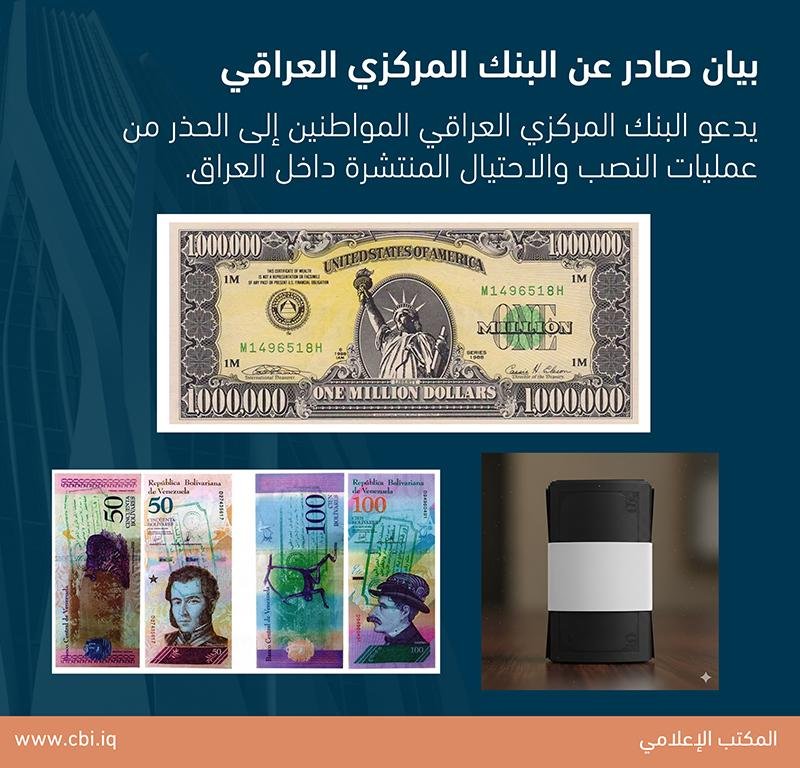
In a statement, the bank outlined several common methods used within Iraq, including:
1- Selling a $1,000,000 bill as genuine currency when it is actually a commemorative note no longer in circulation. The highest denomination in circulation is $100.
2- Distributing black paper cut to the same dimensions as a dollar bill, claiming it is genuine $100 bills coated with a black substance. The scammers falsely claim that these bills will be recirculated after the black coating is removed.
3- Distributing banknotes withdrawn from circulation by various countries, which have no monetary value, and exchanging them for Iraqi dinars at inflated prices. These scammers employ various tactics, pretexts, and false claims to deceive their victims.
4- Counterfeit or printed dollar and dinar banknotes bearing the words "model," "invalid," or "null" are being used as children's toys and are being promoted as genuine banknotes. The Central Bank of Iraq confirms that the relevant authorities have been notified to prevent their printing or importation from outside Iraq.
Central Bank of Iraq, Media Office, February 23, 2026 https://cbi.iq/news/view/3136
US Envoy Conveys Washington’s Vision On Iraq Government Formation
2026-02-23 Shafaq News- Baghdad Iraq’s Deputy Prime Minister and Foreign Minister, Fuad Hussein, stated on Monday that forming the country’s government is a sovereign Iraqi matter, while noting that Baghdad takes into account the views of its international partners, particularly the United States, as an ally.
His remarks came during a meeting in Baghdad with US envoy Tom Barrack, according to a statement by the Iraqi Foreign Ministry, which said the Barrack presented Washington’s perspective on the issue.
Read more: Al-Maliki pledges global partnerships under Iraqi sovereignty
Hussein cautioned against the outbreak of any war between the United States and Iran, warning of its potential consequences for the wider region. He also reaffirmed Iraq’s support for diplomatic efforts and the upcoming round of negotiations scheduled in Geneva under Omani mediation.
Barrack, for his part, expressed US appreciation for the Iraqi government’s step to transfer members of ISIS from detention facilities abroad to prisons inside Iraq. The move, he noted, reflects efforts to reinforce Iraq’s sovereignty and assume its legal responsibilities. Hussein said Iraq remains in contact with several countries to arrange the repatriation of their nationals implicated in terrorism-related cases, praising the Turkish government’s agreement to receive its citizens among those detainees.
Both sides reiterated their support for the agreement between the Syrian government and the Syrian Democratic Forces (SDF), stressing the importance of implementing its provisions.
X وزارة الخارجية العراقية @Iraqimofa
Foreign Minister discusses with the US envoy strengthening security cooperation and developments in the regional situation – Iraqi Ministry of Foreign Affairs https://mofa.gov.iq/2026/61614/
The US Envoy also met Faiq Zidan, head of Iraq’s Supreme Judicial Council, to review legal procedures related to detainees transferred from prisons in Syria to Iraq.
In separate talks with Mohammed Al-Halbousi, leader of the Taqaddum Party, Barrack discussed enhancing economic cooperation and maintaining coordination in counterterrorism efforts, and addressed recent regional developments, developments in Syria, and bilateral cooperation on security and detainee files, with both sides emphasizing support for Syria’s stability.
On Sunday, Barrack met caretaker Prime Minister Mohammed Shia Al-Sudani and described the talks as fruitful. Posting on X, he added that discussions focused on “continued Iraqi goals and objectives to build a sovereign, stable, and prosperous future that aligns with POTUS’s desire and plan for peace and prosperity in the region.”
X Ambassador Tom Barrack @USAMBTurkiye
Fruitful meeting with Prime Minister Mohammed Shia al-Sudani @IraqiPMO discussing continued Iraqi goals and objectives to build a sovereign, stable, and prosperous future that aligns with @POTUS ’s desire and plan for peace and prosperity in the region. The necessity of effective leadership that aligns itself with the policies and practices of further stabilization for Iraq and the Iraqi people is key to our mutual goals.
https://www.shafaq.com/en/Iraq/US-Envoy-conveys-US-vision-on-Iraq-government-formation
Trump Reviews Multi-Tiered Military Offensive On Iran
2026-02-23 Shafaq News- Washington US President Donald Trump is weighing military options against Iran if diplomacy fails, The New York Times reported on Monday, as negotiators prepare for a new round of indirect nuclear talks in Geneva next week.
Citing US officials, the newspaper noted that Trump is considering an initial limited strike to pressure Tehran to abandon its nuclear ambitions, with potential targets including Islamic Revolutionary Guard Corps (IRGC) bases, nuclear facilities, and ballistic missile programs. If these measures fail, the outlet reported that a broader campaign could be launched later this year aimed at weakening or toppling the Iranian regime.
Trump’s advisers warned that while an initial strike could send a strong message, doubts remain over whether airstrikes alone can compel Iran to change course. The president is also exploring a settlement that would allow Iran a restricted nuclear enrichment program for research and medical purposes, though it remains unclear whether either side would accept such terms.
Earlier, Iranian Foreign Minister Abbas Araghchi indicated he will likely meet US envoy Steve Witkoff in Geneva next week, pointing out that a “good chance” remains for a diplomatic solution on Tehran’s nuclear ambitions.
Meanwhile, Ebrahim Rezaei, spokesperson for the Iranian National Security and Foreign Policy Commission, described the negotiations as “decisive,” warning they will shape the fate of US troops in the region.
In a post on X, he framed next week’s talks as a “test for Donald Trump,” stressing that failure could trigger confrontation or war between the two nations.
X ابراهیم رضایی @EbrahimRezaei14
Thursday's negotiations are a test for Trump and will determine whether American soldiers will go to hell or return to America.
On February 19, Trump set a 15-day deadline for Iran to reach what he called a “meaningful deal,” warning of potential consequences. Tehran, however, reaffirmed its uranium enrichment rights. Iranian President Masoud Pezeshkian remarked that “global powers are lining up to force us to bow our heads, but we will not bow.”
Both sides have resumed Omani-mediated talks this month, holding rounds in Muscat and Geneva. Meanwhile, The New York Times, citing satellite imagery and flight data, previously reported that more than 60 US attack aircraft are now stationed at Jordan’s Muwaffaq Salti Air Base, nearly triple the usual number, with at least 68 transport aircraft arriving since February 15.
Read more: Iran–US talks: Diplomatic breakthrough or imminent military confrontation?
https://www.shafaq.com/en/Middle-East/Trump-reviews-multi-tiered-military-offensive-on-Iran
$845 Trillion Derivative Crisis as US Banks Prepare for Bail-ins
$845 Trillion Derivative Crisis as US Banks Prepare for Bail-ins
Taylor Kenny: 2-22-2026
The global financial system is teetering on the edge of a precipice, with a ticking time bomb waiting to unleash a potentially catastrophic crisis. At the heart of this threat lies the gargantuan derivatives market, valued at a staggering $845 trillion.
This complex web of financial bets, layered repeatedly over the same debt, poses a systemic risk that could have far-reaching and devastating consequences.
$845 Trillion Derivative Crisis as US Banks Prepare for Bail-ins
Taylor Kenny: 2-22-2026
The global financial system is teetering on the edge of a precipice, with a ticking time bomb waiting to unleash a potentially catastrophic crisis. At the heart of this threat lies the gargantuan derivatives market, valued at a staggering $845 trillion.
This complex web of financial bets, layered repeatedly over the same debt, poses a systemic risk that could have far-reaching and devastating consequences.
The derivatives market’s role in the 2008 financial crisis is well-documented. The crisis was triggered by a concentration of risk within a few large banks, which ultimately led to a global economic meltdown.
However, the current landscape is far more complicated, with risk now dispersed across the financial ecosystem, including pension funds, hedge funds, and asset managers.
The proliferation of sophisticated financial instruments, such as Synthetic Risk Transfers (SRTs), has enabled banks to offload risk from their balance sheets without selling the underlying loans, creating a false sense of security.
SRTs, in particular, have become a double-edged sword. While they allow banks to manage their risk exposure, they also increase the likelihood of contagion, as risk is spread across a broader range of institutions.
The involvement of unregulated shadow banks and private credit funds has further exacerbated the problem, as these entities operate outside traditional oversight and now account for half of all global financial assets.
Regulators have sounded the alarm, warning of the rapid growth and interconnectedness of these risk transfers. The consequences of inaction could be severe, with vulnerable areas such as commercial real estate loans, subprime auto loans, and the growing private credit sector facing rising defaults and high leverage.
One of the most insidious aspects of the current financial landscape is the concept of a “bail-in.” Implemented quietly after the 2008 crisis, this mechanism allows banks to absorb losses by converting depositors’ funds into bank equity or restricting access to their accounts.
In other words, in the event of a bank failure, it is the depositors and creditors, rather than governments, who will bear the brunt of the losses. This scenario has already played out in countries like Cyprus and Lebanon, leaving many to wonder if they are prepared for the worst.
So, what can be done to mitigate this looming threat? The first step is to acknowledge the systemic risk posed by the derivatives market and take proactive measures to protect one’s wealth. For those who are prepared, there are strategies that can be employed to safeguard their financial future.
One such strategy is to diversify assets outside the traditional banking system. Physical gold and silver, for example, can serve as an insurance policy against financial collapse. By holding these precious metals, individuals can reduce their exposure to the risks associated with the derivatives market and create a buffer against potential losses.
As the derivatives market continues to pose a threat to global financial stability, it is essential to stay informed and be prepared.
By understanding the risks and taking proactive steps to mitigate them, individuals can safeguard their financial future and weather the storm.
For further insights and information, watch the full video from ITM Trading with Taylor Kenney, which provides a comprehensive analysis of the derivatives market and its potential risks.
Rome's Financial Collapse: 4 Assets That Outlived the Crash
Rome's Financial Collapse: 4 Assets That Outlived the Crash
Independent Financial Historian: 2-21-2026
In 64 AD, Emperor Nero began a quiet process that would eventually destroy the most powerful currency the world had ever seen.
By the Crisis of the Third Century, the Roman denarius had lost 98% of its silver content, wiping out the savings of millions who trusted the imperial stamp. This wasn't an overnight crash; it was a slow, invisible theft that lasted generations—until it wasn't invisible anymore.
Rome's Financial Collapse: 4 Assets That Outlived the Crash
Independent Financial Historian: 2-21-2026
In 64 AD, Emperor Nero began a quiet process that would eventually destroy the most powerful currency the world had ever seen.
By the Crisis of the Third Century, the Roman denarius had lost 98% of its silver content, wiping out the savings of millions who trusted the imperial stamp. This wasn't an overnight crash; it was a slow, invisible theft that lasted generations—until it wasn't invisible anymore.
This video conducts a forensic financial autopsy of Rome's monetary collapse, tracing the timeline from a trusted reserve currency to a worthless bronze washer.
More importantly, we analyze the specific assets that preserved wealth when the official money died: productive land, physical metals, practical skills, and local networks.
History shows that while currencies inevitably fail, the protocol for surviving the collapse remains remarkably consistent.
Seeds of Wisdom RV and Economics Updates Monday Afternoon 2-23-26
Good Afternoon Dinar Recaps,
“Sell America” Panic: Markets Plunge Amid Trump’s Tariff Chaos
Trade policy whiplash sparks global volatility as investors flee risk assets and question U.S. stability
Good Afternoon Dinar Recaps,
“Sell America” Panic: Markets Plunge Amid Trump’s Tariff Chaos
Trade policy whiplash sparks global volatility as investors flee risk assets and question U.S. stability
Overview
U.S. trade policy uncertainty triggered sharp global market volatility.
U.S. stock futures declined, while the dollar weakened against safe-haven currencies.
Gold, silver, and government bonds rallied amid risk-off positioning.
Legal ambiguity following a Supreme Court ruling deepened investor anxiety.
Following a ruling by the Supreme Court of the United States invalidating emergency trade levies, President Donald Trump moved to impose a new 15% tariff under Section 122 of the 1974 Trade Act. Markets reacted swiftly, rotating out of U.S. risk assets and into traditional safe havens as uncertainty around timing, legality, and scope intensified.
Key Developments
1. Wall Street Futures and the Dollar Slide
U.S. equity futures fell sharply, with S&P 500 futures down 0.5% and Nasdaq futures down 0.6%. The dollar weakened across major pairs — losing ground to the Japanese yen and Swiss franc, while the euro advanced.
European markets echoed caution, with broad-based declines in major indices. Meanwhile, Asian markets diverged, as some investors interpreted tariff recalibration as potentially less punitive for certain exporters.
2. Safe-Haven Assets Surge
Investors rushed into gold (+0.6%) and silver (+2%), reinforcing classic flight-to-safety behavior. U.S. 10-year Treasury yields dipped to 4.077%, reflecting bond-buying pressure.
Energy markets reversed earlier geopolitical gains. Brent crude fell 1.1%, signaling concerns that trade disruption could dampen global demand.
3. Legal and Policy Ambiguity Deepens Uncertainty
The Supreme Court’s rejection of emergency levies forced the administration to pivot to Section 122, a rarely used and legally untested statute. Analysts estimate the average effective tariff rate may fluctuate significantly over the coming months, depending on exemptions and duration.
The repeated cycle of announcement → legal challenge → revision has amplified uncertainty across global supply chains, currency markets, and corporate earnings forecasts.
4. Market Fragility Exposed
The volatility highlights how modern markets are not merely reacting to tariffs themselves — but to the instability of policymaking. Corporate giants with heavy index weightings, including Nvidia, now face heightened scrutiny as trade turbulence increases earnings sensitivity.
Why It Matters
This episode underscores a core Global Reset theme: policy unpredictability is now a systemic market risk.
When trade rules shift rapidly and legal frameworks are contested, investors begin to question institutional stability. That can accelerate capital rotation away from perceived risk jurisdictions — even the United States.
When Policy Becomes Volatile, Capital Becomes Defensive.
Why It Matters to Foreign Currency Holders
A weakening dollar amid tariff instability impacts global reserve positioning.
Safe-haven demand strengthens alternative stores of value.
Currency volatility increases hedging activity across emerging markets.
For foreign currency holders, this signals a broader recalibration: confidence in predictable U.S. trade policy is a cornerstone of dollar dominance. Sustained unpredictability could gradually erode that trust.
Dollar Dominance Depends on Stability — Not Surprises.
Implications for the Global Reset
Pillar 1: Institutional Credibility Under Pressure
Frequent legal reversals and executive pivots raise questions about long-term policy reliability.Pillar 2: Capital Seeks Neutral Ground
Gold, silver, and neutral currencies gain appeal when political risk intrudes into trade frameworks.
In an interconnected financial system, the cost of uncertainty often outweighs the intent of protectionism. Markets now hedge not only against tariffs — but against the volatility of decision-making itself.
In a Global Reset Era, Stability Is the Ultimate Currency.
Seeds of Wisdom Team
Newshounds News™ Exclusive
Sources
Modern Diplomacy — “Sell America Panic: Markets Plunge Amid Trump’s Tariff Chaos”
Reuters — “Global markets slide as U.S. tariff uncertainty shakes investor confidence”
~~~~~~~~~
Russia Pursuing BRICS Bridge for an Alternative Financial Corridor
Sanctions pressure accelerates Moscow’s pivot toward alternative trade routes and CBDC-linked settlement systems
Overview
• Russia intensifies diversification away from Western financial systems
• INSTC shortens trade routes by 40%, bypassing the Suez Canal
• BRICS Bridge advances as a CBDC-linked payment rail
• Effort aims to reduce dollar dependency and sanction vulnerability
Under sustained Western sanctions and geopolitical isolation, Russia is accelerating efforts to reconfigure its trade and financial architecture. According to reports, Moscow is deepening engagement with the BRICS Bridge initiative and the International North-South Transport Corridor (INSTC) to create parallel economic channels beyond U.S. and European influence.
Key Developments
1. INSTC: A Strategic Trade Realignment
The International North-South Transport Corridor is a 7,200-kilometer multimodal network connecting Russia to India via Iran through sea, rail, and road links.
• Transit time reduced from 45 days to 25 days
• Approximately 40% shorter than traditional Suez Canal routes
• Expands Russia’s connectivity to Middle Eastern and Asian markets
By leveraging this corridor, Russia aims to minimize reliance on Western-controlled maritime routes and strengthen South-South trade flows.
2. BRICS Bridge: CBDC-Based Financial Bypass
The BRICS Bridge is a blockchain-based cross-border payment platform designed to interlink central bank digital currencies (CBDCs) of member states.
Participating nations include:
Russia China India UAE Brazil South Africa Iran
The platform enables peer-to-peer central bank wallet transfers, reducing reliance on the U.S. dollar and Western clearing systems. Reports suggest potential transaction cost reductions of up to 40%.
3. India’s Proposal for Unified CBDC Linkage
The Reserve Bank of India has proposed linking member CBDCs to a single settlement reference unit for intra-BRICS trade. This proposal is expected to be discussed at the upcoming summit in New Delhi.
This signals that BRICS is exploring not just digital interoperability — but structured monetary coordination.
4. Sanctions as Catalyst
Western sanctions and disrupted trade routes have accelerated Moscow’s pivot. Rather than retreating economically, Russia is attempting to engineer parallel infrastructure — both physical (INSTC) and digital (BRICS Bridge).
However, implementation challenges remain. While the INSTC is operationally advancing, the BRICS Bridge remains in advanced pilot phase, and full multilateral coordination will require political and technical alignment across diverse economies.
Why It Matters
This is not simply about trade logistics — it is about financial sovereignty under pressure.
By developing independent corridors and CBDC-linked rails, Russia and BRICS partners are building the structural foundations of a multipolar financial architecture.
When Sanctions Close Doors, New Corridors Open.
Why It Matters to Foreign Currency Holders
• Reduced dollar settlement demand could gradually reshape FX liquidity patterns.
• CBDC interoperability challenges traditional correspondent banking systems.
• Alternative trade routes strengthen non-Western economic blocs.
For foreign currency holders, the significance lies in the infrastructure shift. Payment systems determine reserve demand over time. If BRICS settlement mechanisms scale, the long-term gravitational pull of the dollar could soften — even incrementally.
Payment Rails Shape Power — Not Just Politics.
Implications for the Global Reset
Pillar 1: Alternative Infrastructure Emerges
The INSTC and BRICS Bridge represent parallel systems forming outside traditional Western frameworks.Pillar 2: Digital Currency Diplomacy Expands
CBDC interlinking introduces programmable, state-level monetary coordination.
Russia’s strategy illustrates a broader reset dynamic: economic isolation accelerates financial innovation. Whether the BRICS Bridge reaches full operational scale remains uncertain, but the direction is clear — diversification away from single-pole financial dominance.
The Global Reset Is Built on Corridors — Physical and Digital.
Seeds of Wisdom Team
Newshounds News™ Exclusive
Sources
Watcher Guru — “Russia Pursuing BRICS Bridge for an Alternative Financial Corridor”
Anadolu Agency (AA News) — “Russia expands INSTC and alternative trade corridors amid sanctions”
~~~~~~~~~~
🌱 A Message to Our Currency Holders🌱
If you’ve been holding foreign currency for many years, you were not foolish.
You were not wrong to believe the global financial system would change.
What failed was not your patience — it was the information you were given.
For years, dates, rumors, and personalities replaced facts, structure, and proof. “This week” predictions created cycles of hope and disappointment that were never based on how currencies actually change.
That is not your failure.
Our mission here is different: • No dates • No rates • No hype • No gurus
Instead, we focus on:
• Verifiable developments • Institutional evidence
• Global financial structure • Where countries actually sit in the process
Currency value changes only come after sovereignty, trade, banking, settlement systems, and fiscal coordination are in place. History and institutions confirm this sequence.
You will see silence. You will see denials. That is not delay — that is discipline.
Protect your identity. Organize your documents. Verify everything.
Never hand your discernment to anyone who cannot show proof.
You deserve truth — not timelines.
Seeds of Wisdom Team
Newshounds News
~~~~~~~~~
Seeds of Wisdom Team RV Currency Facts Youtube and Rumble
Newshound's News Telegram Room Link
RV Facts with Proof Links Link
RV Updates Proof links - Facts Link
Follow the Gold/Silver Rate COMEX
Follow Fast Facts
Seeds of Wisdom Team™ Website
Thank you Dinar Recaps
Iraq Economic News and Points To Ponder Monday Afternoon 2-23-26
Lists Of Those Restricted From Dealing In US Dollars
The Central Bank of Iraq is currently leading an initiative aimed at reforming the Iraqi banking sector. This requires licensed and supervised Iraqi financial institutions to undergo a thorough and rigorous reform process. Until this reform is complete, the banks listed below are prohibited from participating in the foreign exchange auction or dealing in US dollars, either directly or indirectly.
Lists Of Those Restricted From Dealing In US Dollars
The Central Bank of Iraq is currently leading an initiative aimed at reforming the Iraqi banking sector. This requires licensed and supervised Iraqi financial institutions to undergo a thorough and rigorous reform process. Until this reform is complete, the banks listed below are prohibited from participating in the foreign exchange auction or dealing in US dollars, either directly or indirectly.
This list does not prevent international auditing firms from conducting audits of these financial institutions to support their full compliance with banking reform requirements.
Depositing Iraqi Oil Revenues In New York: Between Financial Stability And Economic Sovereignty
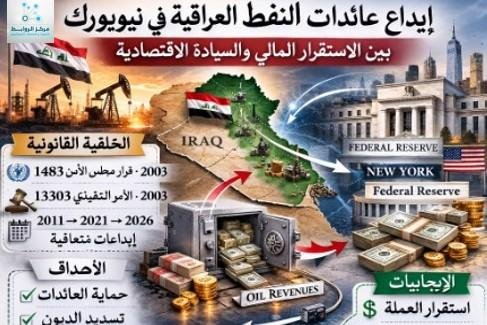
Researcher Shatha considers the mechanism of depositing Iraqi oil revenues in accounts at the US Federal Reserve in New York to be one of the most complex financial arrangements in modern Iraqi history. Since 2003, this mechanism has become more than just a technical procedure for protecting funds; it has transformed into a pivotal element affecting Iraq's economic sovereignty, financial stability, and political relations with international powers.
Legal And Economic Background
Following the 2003 US-led invasion of Iraq, the UN Security Council passed Resolution 1483, which aimed to protect Iraq's oil revenues and state assets from creditor claims and lawsuits, given the massive debt accumulated since the previous regime. In this context, US Executive Order 13303 was issued, granting broad legal immunity to Iraqi oil revenues held in the United States. This order was later renewed and amended to reflect developments in the debt situation.
Economically, Iraq was in a very fragile situation. External debt, the collapse of financial institutions, and the lack of international confidence all made this mechanism a necessary tool for reintegrating Iraq into the global financial system and securing a regular flow of dollars needed for imports and financing the general budget.
Indirect Economic Benefits
This arrangement contributed to several economic gains. It boosted international confidence in the management of Iraqi oil revenues, helped stabilize the exchange rate, and reduced the risk of Iraqi funds being frozen abroad. It also provided a more attractive environment for international oil companies, which operate within a legal framework that limits their exposure to legal action related to oil activities in Iraq.
From a macro-financial perspective, this system served as a safety valve against external shocks, whether resulting from fluctuations in oil prices or from legal disputes with creditors, which helped the state maintain a minimum level of financial stability during extremely difficult periods.
The Cost Of Sovereignty And External Dependence
Conversely, these benefits cannot be separated from their sovereign cost. Oil constitutes approximately ninety percent of Iraq's state revenues, and depositing these revenues abroad has granted the United States significant influence over key sectors of the Iraqi economy.
This has become particularly evident at critical political junctures, when Iraqi sovereign decisions have been contingent upon access to or restrictions on these funds.
This situation reflects a classic economic dilemma facing rentier states emerging from conflict: the trade-off between short-term financial stability and building full economic sovereignty in the long term. The longer the reliance on external protection mechanisms persists, the more complicated the path to genuine financial independence becomes.
International Dimension And Overlapping Issues
The issue of oil revenues intersects with other legal and political matters, including maritime border disputes and the deposit of coordinates with the United Nations under the Law of the Sea Convention.
Iraq's successive deposits in 2011, 2021, and 2026 reflect gradual attempts to establish a legal framework that serves national interests, but they have simultaneously opened the door to objections from neighboring countries, confirming that legal stability is not achieved through unilateral deposits, but rather through consensus or international arbitration.
Future reading
From an analytical economic perspective, the mechanism for depositing oil revenues in New York can be argued to have played a historical role in protecting Iraq during an exceptional transitional period. However, its continuation in its current form raises fundamental questions about Iraq's ability to build independent financial institutions, diversify its sources of income, and reduce its dependence on external arrangements.
The real challenge lies not in the immediate abolition of this mechanism, but in developing a gradual strategy that moves Iraq from the logic of external protection to the logic of institutional sovereignty, where confidence stems from the strength of the national financial system, not from the position of bank accounts.
Conclusion
The deposit of Iraqi oil revenues in New York is not merely a technical or financial matter; it reflects a history of conflict, debt, and economic restructuring. While this arrangement has provided a degree of stability, it serves as a reminder that economic sovereignty is not measured solely by the size of revenues, but also by a state's ability to control them within an independent national legal and institutional framework.
Economic Studies Unit / North America Office, Links Center for Research and Strategic Studies
https://rawabetcenter.com/archives/180088
Government Advisor: Sovereign Guarantees Allow Investors To Borrow From Global Markets With An Iraqi Guarantee.
Economy | 23/02/2026 Mawazin News – Follow-up: The Prime Minister's Financial Advisor, Mazhar Muhammad Salih, confirmed on Monday that sovereign guarantees are a tool to support the financing of major investment projects. He also indicated that Iraq has allocated $1 billion in sovereign guarantees to support private sector projects.
Salih stated, according to the official news agency and as reported by Mawazin News, that "sovereign guarantees are one of the financial tools used by governments to support the financing of major investment projects.
They are an official commitment issued by the state, represented by the Ministry of Finance, to repay the debts of a project or company in the event that the borrower is unable to meet its obligations to the lending entity, whether it be international banks or other financing institutions."
He pointed out that "these guarantees aim to reassure financiers and encourage them to finance strategic projects, as the state affirms its responsibility to repay the loan in the event of investor default.
These guarantees are often directed towards vital projects that contribute to supporting the national economy, such as the construction of bridges, roads, railways, and power plants, in addition to factories that generate added value for the economy."
He added that "for the first time, Iraq has included sovereign guarantees of approximately one billion dollars in its three-year budget for the years 2023-2025. These guarantees, which are being implemented according to the law, are intended to support strategic private sector projects exclusively.
" He explained that "among the most prominent projects that can benefit from these guarantees are pharmaceutical factories, infrastructure projects related to major new cities, as well as projects related to the development road and its infrastructure, renewable energy projects, and digital transformation."
He continued, "These guarantees allow investors to borrow from global financial markets with the guarantee of the Iraqi government through an official sovereign document. In principle, a sovereign guarantee is similar to a promissory note, but it is issued by the government and included in the budget law. This gives lenders—whether local or foreign—greater confidence that the state will guarantee repayment in the event of the borrower's default." https://www.mawazin.net/Details.aspx?jimare=273510
Chevron To Take Over Iraq’s West Qurna-2 After Lukoil Exit
2026-02-23 Shafaq News- Baghdad (Updated at 16:00) Iraq on Monday signed two preliminary memoranda of principles with US energy major Chevron covering the West Qurna-2, Al-Nasiriyah, and Balad oil fields.
According to caretaker Prime Minister Mohammed Shia Al-Sudani's office, the first agreement between Basra Oil Company and Chevron provides for the transfer of management of the West Qurna-2 field. A second agreement with Dhi Qar Oil Company and North Oil Company covers development of the Al-Nasiriyah field, four exploration blocks in Dhi Qar, and the Balad field in Saladin, and amends a previous arrangement by adding Al-Nasiriyah.
US Syria Envoy and Ambassador to Turkiye Tom Barrack later said the agreement reflects President Donald Trump’s vision of promoting “peace through shared prosperity” in the Middle East, describing Chevron’s involvement as a sign of confidence in Iraq’s stability and investment climate.
X Ambassador Tom Barrack @USAMBTurkiye
Today marks a significant milestone for the people of Iraq and for one of America’s leading energy companies, Chevron. This partnership reflects strong support for @POTUS vision of promoting peace through shared prosperity in the Middle East. Chevron’s commitment to stewarding a field that contributes nearly 12% of Iraq’s oil production demonstrates confidence in Iraq’s stability and potential. American investments in Iraq means new opportunities for growth - creating jobs, enhancing economic resilience, and advancing a future of mutual prosperity.
Basra Oil Company and Russia’s Lukoil previously signed a settlement to temporarily transfer the West Qurna-2 contract to Basra Oil Company and resolve outstanding financial dues. A separate framework agreement between Basra Oil Company, Lukoil, and Chevron allows the contract to shift temporarily before reassignment to Chevron following negotiations on a new contract, granting Chevron exclusive negotiation rights for one year.
Lukoil declared force majeure at West Qurna-2 in November 2025 after Western sanctions disrupted its operations, according to Reuters, leading Iraq to halt payments and cancel several crude shipments.
The field, discovered in 1973, produces between 400,000 and 480,000 barrels per day –nearly 10 percent of national output– and holds more than 13 billion barrels of recoverable reserves. Lukoil also moved to sell its overseas assets, including fields in Iraq, citing restrictions imposed on the company and its subsidiaries.
Read more: Russia’s Lukoil turmoil deepens risks for Iraq’s West Qurna-2 oilfield
https://www.shafaq.com/en/Economy/Chevron-to-take-over-Iraq-s-West-Qurna-2-after-Lukoil-exit
“Tidbits From TNT” Monday 2-23-2026
TNT:
Tishwash: Al-Moussawi: Iraq's financial reserves are constantly increasing and salaries are fully secured.
MP Jassim al-Moussawi confirmed on Monday that Iraq's financial reserves are witnessing a continuous increase, stressing that salaries are fully secured and there are no concerns about their payment in the coming period.
Al-Moussawi told the Information Agency that “Iraq’s financial situation is reassuring and the reserves at the Central Bank are constantly rising,” adding that “this reflects the state’s ability to fulfill its obligations towards employees and retirees.”
He added that "salaries are fully secured and cannot be affected by the current political or economic crises," noting that "the government is working to manage the financial file cautiously to ensure economic stability."
TNT:
Tishwash: Al-Moussawi: Iraq's financial reserves are constantly increasing and salaries are fully secured.
MP Jassim al-Moussawi confirmed on Monday that Iraq's financial reserves are witnessing a continuous increase, stressing that salaries are fully secured and there are no concerns about their payment in the coming period.
Al-Moussawi told the Information Agency that “Iraq’s financial situation is reassuring and the reserves at the Central Bank are constantly rising,” adding that “this reflects the state’s ability to fulfill its obligations towards employees and retirees.”
He added that "salaries are fully secured and cannot be affected by the current political or economic crises," noting that "the government is working to manage the financial file cautiously to ensure economic stability."
Al-Moussawi pointed out that "the increase in financial reserves gives Iraq strength in facing economic challenges and enhances confidence in the state's financial situation," emphasizing that "the next period will witness additional measures to boost revenues and control spending." link
****************
Tishwash: $65 Billion Investment to Transform Al-Tayeb Border City into an Economic City
The head of the National Investment Commission, Haider Makkiya, announced on Saturday a planned investment in the border city of Al-Tayeb to transform it into an economic city, noting that the investment is valued at $65 billion.
Makkiya told the Iraqi News Agency (INA): “Al-Tayeb is a multi-service economic city located on an area of more than 120,000 dunams, and the value of investments there exceeds $65 billion, of which $5 billion is allocated to infrastructure, roads, electricity, sewage, and other services.”
He pointed out that “the city has an abundance of natural resources that enable it to succeed, including water, hills, fuel, and other natural resources such as sand and gravel. There is a wealth of natural resources that allow for the establishment of a city with this specialized focus.” link
*************
Tishwash: Did Maliki obstruct the presidential candidate?
Arif al-Hamami, a former member of the State of Law Coalition, confirmed the soundness of the position of the Union and Democratic parties regarding Nouri al-Maliki's candidacy for the position of Prime Minister.
Al-Hamami told Al-Maalouma, “The issue of the Kurds not putting forward a candidate for the presidency is not related to the issue of Maliki’s candidacy for prime minister. If the Kurdish bloc has taken the issue of Maliki’s candidacy as a reason for not putting forward a candidate for the presidency, then it should clarify its position.”
He added that "the head of the Democratic Party, Masoud Barzani, is one of the first supporters of Maliki's candidacy for the position of Prime Minister, in addition to the fact that the other parties in the Patriotic Union of Kurdistan do not have any problem regarding the candidate for Prime Minister."
He explained that "certain biased parties have been spreading interpretations aimed at linking the delay in nominating a presidential candidate to al-Maliki's candidacy for prime minister." link
**************
Tishwash: Maliki refuses to meet Trump's envoy in Baghdad despite al-Sudani's attempt
Information obtained by Network 964 indicates that developments are escalating in the case of withdrawing Nouri al-Maliki’s nomination for the premiership, with a meeting between al-Maliki and Barak proving impossible.
Network 964 learned from political sources that Prime Minister Mohammed Shia al-Sudani offered to mediate a meeting between prime ministerial candidate Nouri al-Maliki and Tom Barrack, the envoy of US President Donald Trump, who arrived in Baghdad this evening on a visit that was not previously announced, coinciding with the intensification of the prime ministership crisis, and the demands of several forces, including the Asaib Ahl al-Haq movement and the Hikma movement, for al-Maliki to withdraw after the American warning issued by Trump four days after al-Maliki’s nomination.
According to sources close to the State of Law Coalition, Maliki rejected the request made by Sudani to bring Maliki together with Trump's envoy. According to the coalition's spokesman, Aqeel al-Fatlawi, Maliki is waiting for "clarifications from the Iraqi ambassador in Washington, Nizar al-Khairallah," who is said to be carrying clarifications regarding the true American position on Maliki's candidacy and the circumstances surrounding Trump's tweet.
Maliki believes that it was driven by internal and external parties, and he is trying to avoid any direct contact with an American figure before he personally ascertains the nature of the American position beyond what is being circulated.
According to the sources, Maliki has been refusing for weeks to attend the framework meetings or discuss any other scenario that would call for his withdrawal. His atmosphere is repeating one call, as he personally expressed it in his only interview on February 3, when he said that he was nominated by the framework and that he would not withdraw, but rather the framework should withdraw his nomination if it wished.
The opposition forces are demanding that Maliki withdraw in order to avoid embarrassing all the leaders of the Shiite forces and forcing them to withdraw Maliki’s nomination in response to American pressure, while Maliki’s supporters respond that he is not prepared to bear this embarrassment, that he is ready to face all pressures, and that the framework should back down if it wants, without forcing Maliki to appear in a position of retreat. link
*************
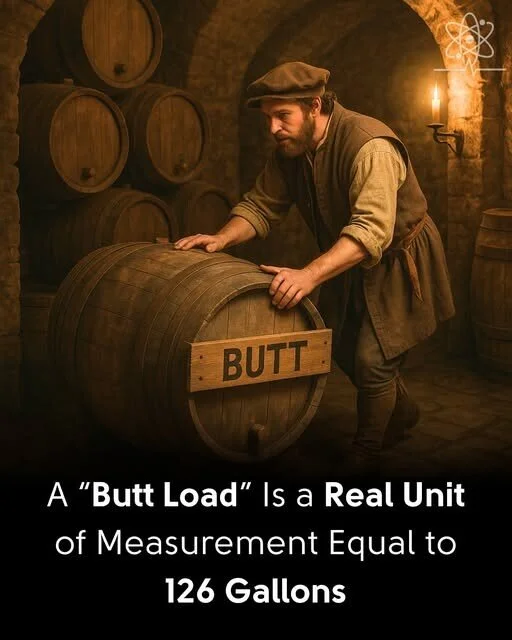
Mot: “a buttload of something” - HUH?? Ur Kidding!!!!
The word “buttload,” often used colloquially to mean “a large amount,” actually has roots in old English wine measurement systems.
A “butt” was a real unit used to measure large quantities of liquid, especially wine or ale, during medieval times and into the early modern era.
One butt equals two hogsheads, and each hogshead typically holds 63 gallons (in the imperial system), making a butt exactly 126 gallons.
This unit was most commonly used in England and parts of Europe, especially in reference to shipping and storing wine, beer, and other liquids in wooden casks or barrels.
These massive barrels were known as butts (yes, that’s the actual term), and they often appeared in old taverns and ships’ cargo.
Today, the term survives mostly as slang or humor — “a buttload of something” — but it does in fact originate from a formal measurement that once held legal and commercial significance.
News, Rumors and Opinions Monday 2-23-2026
Note: All intel should be considered as "Rumors" until we receive official announcements ...and “Rates and Dates” could change anytime until we get to the banks/redemption centers.
RV Excerpts from the Restored Republic via a GCR Update as of Mon. 23 Feb. 2026
Compiled Mon. 23 Feb. 2026 12:01 am EST by Judy Byington
Gold/asset-backed Quantum Financial System (allegedly) Activated in 209 Nations Mon. 23 Feb. 2026
48 Hour GESARA Wealth Distribution
Blackout(allegedly) Begins on Wed. 25 Feb. 2026
Note: All intel should be considered as "Rumors" until we receive official announcements ...and “Rates and Dates” could change anytime until we get to the banks/redemption centers.
RV Excerpts from the Restored Republic via a GCR Update as of Mon. 23 Feb. 2026
Compiled Mon. 23 Feb. 2026 12:01 am EST by Judy Byington
Gold/asset-backed Quantum Financial System (allegedly) Activated in 209 Nations Mon. 23 Feb. 2026
48 Hour GESARA Wealth Distribution
Blackout(allegedly) Begins on Wed. 25 Feb. 2026
Trust The Plan
God Wins!
Judy Note: On Tues. 24 Feb. 2026 President Trump will give his State of the Union Address to the nation. A president normally gives the address before Congress, but Congress has closed down because they didn’t approve a funding budget.
With Mon. 23 Feb. 2026’s (allegedly) activation of the Gold/asset-backed Global Currency Reset (GCR) and Global Quantum Financial System (QFS), banks across the World not Basil III compliant were being forced to close. They could (allegedly) no longer print fiat money, nor could they even function.
The new QFS system was engineered to run independently from legacy banking structures powered by physical gold reserves recorded in real-time.
What this meant across the Globe for the common person was there would be no more endless debt, no more banks controlling your life. Your bank account balance was already mirrored onto the new system. Though, would not be accessible to you until you(allegedly) personally set up your new wallet at an official Redemption Center that has already been located near you.
Redemption Centers were scheduled to be open to the general public around mid March. It was strongly advised to have cash on hand during this transition period of fiat currency to gold/asset-backed. Withdraw what you can from your bank NOW. There will be a period of ten days when banks will (allegedly) be closed and ATMs not working.
Prepare for the Global Currency Reset, the full-scale activation of the gold/asset-backed Quantum Financial System.
As of Sun. 22 Feb. 2026 4am EST Gold and asset-backed currencies (allegedly) went active in the United States, Canada, United Kingdom, Germany and Australia.
On Mon. 23 February 2026, the Quantum Financial System (QFS) will(allegedly) officially transition into full operational control over all 209 nations.
On Wed. 25 February 2026, a 48-hour blackout for GCR/GESARA wealth redistribution was scheduled to begin. (In other words, those worldwide holding foreign currencies and Zim Bonds could schedule exchange/redemption appointments at their local official redemption center).
On Fri. 6 March 2026, the first wave of wealth redistribution will (allegedly) go live.
On Mon. 16 March 2026, President Trump will (allegedly) host a monumental Independence Day–style global celebration symbolizing the rebirth of a free republic under GESARA law. The event will merge with worldwide QFS announcements and unveilings of new sovereign infrastructures.
Military sources confirm that QFS Accounts were (allegedly) in full sync. Prosperity Packages primed for Tier4b Humanitarians.
Tier4b (Us, the Internet Group) Redemption Centers were on standby. IQD, VND and Zim rates aligning rapidly.
~~~~~~~~~~~~
Sun. 22 Feb. 2026 Now The Currency Revaluation Is Official We Are In The Money People. …Nesara/Gesara Activate on Telegram
With IEEPA’s non-tariff powers “FULLY CONFIRMED” and no doubt remaining, Trump can now (allegedly) impose targeted restrictions on Iranian proxies disrupting Iraq’s economy without legal overhang.
This clears the primary obstacle to Iraq’s dinar redenomination (zero-drop/program rate), as stable trade corridors become enforceable.
Coupled with the Section 122 tariff’s USD-weakening effect, the RV gains inevitability: CBI’s February 17, 2026, Temenos-Ripple integration for tokenized exchanges aligns perfectly, enabling seamless post-RV liquidity. 1:1 Parity Is Coming.
Read full post here: https://dinarchronicles.com/2026/02/23/restored-republic-via-a-gcr-update-as-of-february-23-2026/
*****************
Courtesy of Dinar Guru: https://www.dinarguru.com/
Militia Man Things are taking place showing Iraq's integration into the financial system...We can see all those things taking place...
Jeff You've got to retrace your steps in this. What brought the value of the dinar down in 2003? It's called US sanctions. Right now the only remaining sanctions on Iraq are the US Treasury OFAC sanctions. So, if sanctions automatically brought the value of the the dinar down, what happens when you take sanctions off? ...Wouldn't that suggest it maybe reinstates, putting it back in the $3+ range? ...You take the US OFAC sanctions off, it puts it back to $3.22...
Frank26 [Iraq boots-on-the-ground report] FIREFLY: On the television it is showing the CBI is sending to all the banks inside Iraq and financial institutions a memo that says, 'Do not discriminate against any older or new denominations of the American US dollar when they are exchanging dinar.' FRANK: IMO I think it's just a preparation to tell the citizens of Iraq we've got a new rate coming and when you get it you got to bring in those 3 zero notes... those American dollars you're still using...and any other foreign currency... Because when it happens... you are going to pour into the banks... The moment this happens it's going to be insanity, it's going to be an amazing influx of people that are all over our banks. They want the lower notes...This is very good news.
***************
The New Gold Standard
GoldSwitzerland by VON GREYERZ
2-21-2026
Monday Coffee with MarkZ, 02/23/2026
Monday Coffee with MarkZ, 02/23/2026
Some highlights by PDK-Not verbatim
MarkZ Disclaimer: Please consider everything on this call as my opinion. People who take notes do not catch everything and its best to watch the video so that you get everything in context. Be sure to consult a professional for any financial decisions
Member: Good Morning…..last of February…..clock is ticking
Member: GM Mark and friends.... new week ... new hope
Monday Coffee with MarkZ, 02/23/2026
Some highlights by PDK-Not verbatim
MarkZ Disclaimer: Please consider everything on this call as my opinion. People who take notes do not catch everything and its best to watch the video so that you get everything in context. Be sure to consult a professional for any financial decisions
Member: Good Morning…..last of February…..clock is ticking
Member: GM Mark and friends.... new week ... new hope
Member: MarkZ is really scaling us back on podcasts, maybe it’s almost time!
Member: Is today the day? I still have great hope for February…how about you Mark?
MZ: I also still have great hope for February…..there are sure a a lot of rumors running around.
Member: Friday you described yourself as bubbly and excited ....the movement of certain people has your undivided attention...so what are we waiting for now?
Member: Sure are lots of crazy rumors over the weekend..
Member: The Confusion Is Intentional & 'Could' Mean We Are Close, Very Close ...
MZ: The rumors are running crazy and obscene….They are up, down and conflicting. It is difficult to figure out what is real and what is not. We are getting different stories from different groups. To me there is a extreme level of disinformation going on.
MZ: I have a couple of bond sources that very much believe that the QFS opens completely tomorrow and we get announcements…..sounds great….right? I hope they are right.
MZ: To me its very interesting that from some of the same groups…. on the bond side some claim some have been paid….and when I reach out to some of the key people they tell me they have not been paid…so we are getting conflicting information.
MZ: What I am also hearing from some bigger bond and currency groups attached to sovereigns (Tier 3) that they have great expectations for this week.
MZ: It is only Monday morning and getting this much information and rumors is highly unusual. Stay calm…getting this many rumors at once makes vetting difficult…..so stay calm. Its odd that so many groups were told QFS releases tomorrow…and other groups were told when the QFS is live – that when they get to go…..and QFS is expected to go tomorrow…..guess we will see…..just stay calm
Member: There was so much that was prerequisite to the RV. Drip, drip, drip, flood! You are seeing it. It's all good!
Member: I wonder- does the QFS and the asset backed $ have to be announce publicly together before the RV?
MZ: I still think it will go about the same time
Member: Maliki back out this morning saying he absolutely will NOT withdraw!
Member: WHY?? Did Sudani not revalue the IDQ before the election???
MZ: “ After Tom Barack’s visit to Baghdad- did Al Sudani get the green light for a second term?” The US is definitely pushing. Evven Suadi Arabia is pushing and sent a message against Maliki’s return and is pushing for a return of Al-Sudani.
MZ: There is a lot happening this morning in Iraqi politics. We may see the end of Maliki’s political career this week….at least for now.
Member: If HCL is approved this week…will the RV immediately or wait a couple weeks or months?
MZ: I would say just days after the HCL is approved.
Member: US forces begin the largest withdrawal from northern Syria towards Iraqi Kurdistan
MZ: They are moving out- at least 100 trucks,…accompanied by air support. Some very interesting movements. Are we re-positioning these troops because of Iran? Or do we not care about Syria anymore? I think there is something deeper in these troop movements that happened all of a sudden.
Member: Mark- Friend of a friend stationed in Iraq says they are on the move and will be out of contact for 2 months
MZ: In Iraq “Central bank warns of fraud in various bank notes “ This is very interesting. They are claiming almost all the bolivar there ..they are getting inundated by bills that don’t even exist. Iraq is getting an influx of fake Venezuelan bills being sold to Iraqis.
MZ: A person on the ground in Venezuela says they had a conversation with a friend of his wife. He has high knowledge what is happening there in banking in general. He claims starting in Mrch there will only be 2 types of money in Venezuela and that they are transitioning their money. They will use US money and the new Venezuelan money….and they will be worth 1 to 1. So that is the new bolivar….nobody panic …we are watching and trying to find answers on the bolivar a lot of hold right now.
MZ: They may be handling this like Kuwait and Iraq did it. They got rid of their old currency and the new rate applies to the new currency. Kuwait did that. Iraq did that with the old Sadaam Hussein bills. Now the important part for us….if they do this…how do we exchange the old venezulan currency for the new Venezuelan dollars? There are a lot of rumors. I will let yu know what we find out when I know…..we are chasing it.
MZ: It is possible we will have to change our old bolivar for the new Venezuelan dollar…..and then exchange it for USD or whatever your national currency is at the reset.
Member; Will we have to go to Venezuelan to exchange or can we do it here in the US?
MZ: No part of me thinks any of us will have to go to Venezuela to exchange. Its possible we will be able to exchange the old bolivar for SKR’s (safe keeping receipts) or deposit it digitally . Like in a multi currency account. That would not surprise me.
Member: I believe President Trump has a State of the union speech tomorrow night.
Member: President Trump says Supreme Court "accidentally and unwittingly" gave him more power after tariffs ruling. It's all very good!
Member: “Tarriff 232” might be “Plan B” that switches the value of our currency. Bessent mentioned this .
MZ: it very much could be.
Member: Alien disclosures, cartel wars, Iran strike, Epstein files. Other than that should be a pretty slow week in the news lol
Member: Fingers crossed this is our big week……stay safe and warm everyone.
Ron the Inventor joins the stream today. Please listen to the replay for his information.
THE CONTENT IN THIS PODCAST IS FOR GENERAL & EDUCATIONAL PURPOSES ONLY&NOT INTENDED TO PROVIDE ANY PROFESSIONAL, FINANCIAL OR LEGAL ADVICE. PLEASE CONSIDER EVERYTHING DISCUSSED IN MARKZ’S OPINION ONLY
https://rumble.com/user/theoriginalmarkz
Kick: https://kick.com/theoriginalmarkz
FOLLOW MARKZ : TWITTER . https://twitter.com/originalmarkz?s=21. TRUTH SOCIAL . https://truthsocial.com/@theoriginalm...
Mod: MarkZ "Back To Basics" Pre-Recorded Call" for Newbies 10-19-2022 ) https://www.youtube.com/watch?v=37oILmAlptM
MARKZ DAILY LINKS: https://theoriginalmarkz.com/home/
Note from PDK: Please listen to the replay for all the details and entire stream….I do not transcribe political opinions, medical opinions or many guests on this stream……just RV/currency related topics.
THANK YOU ALL FOR JOINING. HAVE A BLESSED NIGHT! SEE YOU ALL TONIGHT AT 7:00 PM EST OR IN THE MORNING FOR COFFEE @ 10:00 AM EST ~ UNLESS BREAKING NEWS HAPPENS!
MilitiaMan and Crew: IQD News Update-Iraq's REER-Financial Integration-Underway
MilitiaMan and Crew: IQD News Update-Iraq's REER-Financial Integration-Underway
2-22-2026
The Crew: Samson, PompeyPeter, Petra, Daytrader, Sunkissed, GIGI and Militia Man
Follow MM on X == https://x.com/Slashn
Be sure to listen to full video for all the news……..
MilitiaMan and Crew: IQD News Update-Iraq's REER-Financial Integration-Underway
2-22-2026
The Crew: Samson, PompeyPeter, Petra, Daytrader, Sunkissed, GIGI and Militia Man
Follow MM on X == https://x.com/Slashn
Be sure to listen to full video for all the news……..
Seeds of Wisdom RV and Economics Updates Monday Morning 2-23-26
Good Evening Dinar Recaps
Gulf Brinkmanship: Why Iran Hasn’t Blinked Under U.S. Pressure
Military buildup intensifies, but Tehran holds firm as nuclear negotiations remain deadlocked.
Good Evening Dinar Recaps
Gulf Brinkmanship: Why Iran Hasn’t Blinked Under U.S. Pressure
Military buildup intensifies, but Tehran holds firm as nuclear negotiations remain deadlocked.
Overview
The standoff between the United States and Iran is entering a new phase of strategic tension. Despite an expanding U.S. military presence in the Middle East, Iran has not agreed to scale back its nuclear program, prompting questions from U.S. leadership about Tehran’s strategic calculus.
U.S. President Donald Trump has reportedly questioned why Iran has not moved toward compromise amid rising pressure. His special envoy, Steve Witkoff, emphasized that Washington is seeking clarity on Iran’s position rather than signaling frustration.
At the core of the dispute: uranium enrichment, sanctions relief, missile development, and regional proxy influence.
Key Developments
1. U.S. Military Posturing Intensifies
The United States has expanded military deployments in the region, signaling preparedness for potential action. Iran has responded with warnings that it would target U.S. bases if attacked. The show of force is intended as deterrence — but so far, it has not triggered diplomatic concessions.
2. Nuclear Enrichment Remains Central Dispute
Washington is demanding that Iran:
• Cease high-level uranium enrichment
• Limit or halt its missile program
• Reduce support for regional militant groups
Iran maintains its nuclear program is peaceful and civilian in nature and has expressed openness to limited restrictions — but only in exchange for meaningful sanctions relief. Tehran refuses to link nuclear concessions to its missile capabilities or regional alliances.
3. Sanctions Relief Deadlock
Negotiations remain stalled over the scope and sequencing of sanctions relief. The U.S. seeks structural changes before easing economic pressure. Iran insists relief must precede or accompany any major nuclear rollback.
4. Political Undercurrents Expand the Equation
Envoy Witkoff also met with Reza Pahlavi, a prominent Iranian opposition figure advocating regime change. This move introduces additional political complexity and signals that Washington may be exploring parallel strategies beyond formal diplomacy.
Why It Matters
This is more than a regional dispute — it is a test of deterrence credibility, sanction effectiveness, and geopolitical leverage.
If Iran withstands U.S. pressure without conceding, it may embolden other sanctioned nations to adopt similar resistance strategies. Conversely, escalation could destabilize energy markets and global security frameworks.
When military pressure fails to produce diplomatic movement, markets begin pricing in escalation risk.
Why It Matters to Foreign Currency Holders
Currency markets are highly sensitive to Middle East instability. Key implications include:
Oil price volatility could strengthen commodity-linked currencies
Safe-haven flows may support the U.S. dollar and gold
Sanctions shifts could impact emerging market currencies tied to energy trade
Broader geopolitical fragmentation may accelerate non-dollar trade experimentation
For those tracking a broader global financial reset, persistent U.S.–Iran tension underscores how geopolitics increasingly intersects with currency stability and energy pricing structures.
Energy chokepoints and nuclear diplomacy remain silent drivers of monetary realignment.
Implications for the Global Reset
Pillar 1: Energy & Geopolitical Leverage
Iran sits at a strategic crossroads of global energy transit. Any escalation affecting the Gulf could ripple through oil markets, sovereign debt, and inflation trajectories.Pillar 2: Sanctions Architecture Stress-Test
If sanctions fail to compel policy change, alternative financial channels — including BRICS-aligned trade structures — may gain renewed urgency among sanctioned economies.
This is not just diplomacy — it is a stress test of the current global order’s enforcement mechanisms.
Conclusion
Iran’s refusal to “blink” under mounting U.S. pressure highlights a fundamental shift in modern geopolitical strategy. Military signaling alone may no longer produce immediate compliance in an era of diversified alliances and alternative financial networks.
As tensions persist, markets will watch three indicators closely:
Oil price reaction
Sanctions enforcement credibility
Diplomatic engagement signals
The outcome will influence not just regional security — but the future architecture of global power and finance.
Stalemate today, systemic consequences tomorrow.
Seeds of Wisdom Team
Newshounds News™ Exclusive
Sources
Reuters – “Trump wondered why Iran has not surrendered amid US show of force”
Modern Diplomacy – “Trump Wondered Why Iran Has Not Surrendered Amid US Show of Force”
~~~~~~~~~~
Energy as a Weapon: Russia’s Power Grid Assault and the Global Reset Shockwave
Massive strikes on Ukraine’s energy infrastructure intensify geopolitical risk and threaten broader energy market stability.
Overview
Russia has launched large-scale drone, ballistic, and cruise missile strikes across Ukraine, deliberately targeting energy infrastructure in Kyiv, Odesa, Dnipro, Mykolaiv, and central regions.
Ukrainian President Volodymyr Zelenskiy confirmed that the primary objective was the energy sector, though residential buildings and rail lines were also hit. At least one civilian death and multiple injuries were reported.
Despite mediation efforts supported by U.S. President Donald Trump, negotiations have stalled, with Moscow continuing strategic military escalation.
The attacks signal a continued weaponization of energy — not just against Ukraine, but as leverage in the broader geopolitical and economic arena.
Key Developments
1. Coordinated Energy Infrastructure Assault
Russia deployed hundreds of drones and missiles in one week, focusing heavily on power generation and distribution systems. Energy facilities in Odesa were struck, causing fires and service disruptions, while Kyiv suffered grid damage impacting civilians during winter conditions.
2. Energy Grid as Strategic Pressure Point
Targeting energy infrastructure undermines industrial output, logistics, heating systems, and rail transport. Disruptions to electricity ripple through:
Manufacturing capacity
Military logistics
Food supply chains
Digital infrastructure
Energy stability is foundational to economic resilience — and its disruption creates systemic vulnerability.
3. Peace Talks Stall Amid Escalation
Recent negotiations in Geneva failed to produce breakthroughs. Russia continues demanding territorial concessions in eastern Ukraine. The renewed strikes indicate military leverage is being prioritized over diplomacy.
4. Broader Energy Market Sensitivity
While strikes are within Ukraine, markets are highly sensitive to escalation in energy corridors connected to Europe. Any expansion of conflict could impact:
Natural gas flows
Oil supply routes
European energy pricing
LNG markets
Energy remains one of the most inflation-sensitive components of global macro stability.
Why It Matters
Energy infrastructure attacks amplify volatility across global markets. Europe remains exposed to Eastern European instability, and energy pricing feeds directly into inflation, interest rate policy, and sovereign debt stress.
When energy becomes a battlefield, inflation becomes a weapon.
Why It Matters to Foreign Currency Holders
For those watching the global financial reset narrative, energy instability is a key structural driver:
Rising energy prices support commodity-linked currencies
Persistent volatility can weaken energy-importing nations’ currencies
Inflationary pressure complicates central bank rate strategies
Energy disruptions accelerate multipolar trade arrangements
If energy flows fragment further, countries may deepen non-dollar settlement mechanisms for oil and gas trade.
Energy shocks historically precede monetary realignments.
Implications for the Global Reset
Pillar 1: Energy-Driven Inflation Persistence
Disruptions to energy systems reinforce structural inflation, limiting central banks’ ability to ease policy. Persistent inflation reshapes debt sustainability models globally.Pillar 2: Fragmentation of Energy Trade Systems
As energy security becomes paramount, nations may accelerate regional alliances and alternative payment structures to shield themselves from geopolitical chokepoints.
Energy is not just a commodity — it is monetary leverage.
This is not just warfare — it is infrastructure warfare with monetary consequences.
Conclusion
Russia’s strikes on Ukraine’s power grid highlight a strategic truth: modern conflict targets economic infrastructure, not just territory.
Energy stability underpins currency strength, bond markets, industrial production, and inflation control. Continued infrastructure targeting raises the probability of prolonged volatility in global commodities and financial markets.
The reset conversation cannot ignore energy — because energy determines price stability, and price stability underpins monetary order.
Energy infrastructure today. Monetary consequences tomorrow.
Seeds of Wisdom Team
Newshounds News™ Exclusive
Sources
~~~~~~~~~~
Seeds of Wisdom Team RV Currency Facts Youtube and Rumble
Newshound's News Telegram Room Link
RV Facts with Proof Links Link
RV Updates Proof links - Facts Link
Follow the Gold/Silver Rate COMEX
Follow Fast Facts
Seeds of Wisdom Team™ Website
Thank you Dinar Recaps
Iraq Economic News and Points To Ponder Monday Morning 2-23-26
CBI Warns Of Fraud Schemes Involving Various Banknotes
Baghdad – INA The Central Bank of Iraq on Monday warned of fraud and scam operations being carried out using different types of banknotes.
In a statement received by the Iraqi News Agency (INA), the bank’s media office said it had detected several fraud schemes carried out by individuals seeking illicit financial gain, urging citizens to exercise caution to avoid falling victim to such practices.
CBI Warns Of Fraud Schemes Involving Various Banknotes
Baghdad – INA The Central Bank of Iraq on Monday warned of fraud and scam operations being carried out using different types of banknotes.
In a statement received by the Iraqi News Agency (INA), the bank’s media office said it had detected several fraud schemes carried out by individuals seeking illicit financial gain, urging citizens to exercise caution to avoid falling victim to such practices.
The bank explained that the most prominent schemes observed inside Iraq include the sale of a so-called $1,000,000 banknote presented as legal tender, when in fact it is merely a non-circulating commemorative note. It stressed that the highest denomination of U.S. currency in circulation is the $100 bill.
It added that scammers are also promoting black-coated paper cut to the same dimensions as a $100 bill, falsely claiming the notes will return to circulation once the black substance is removed—an assertion the bank categorically denied.
The statement further noted that fraudsters are circulating withdrawn foreign banknotes that no longer hold any monetary value and exchanging them for Iraqi currency at inflated amounts using various deceptive pretexts.
It also warned against counterfeit or printed dollar and dinar notes marked with terms such as “specimen,” “invalid,” or similar labels, often marketed as genuine currency despite being intended only as toys or samples.
The Central Bank confirmed that the relevant authorities have been notified to prevent the printing or import of such materials into Iraq. https://ina.iq/en/economy/45673-cbi-warns-of-fraud-schemes-involving-various-banknotes.html
The Dollar Is Falling Against The Euro And The Pound After Trump Restricts His Customs Powers.
Money and Business Economy News - Follow-up The dollar fell on Monday as traders saw the U.S. Supreme Court's decision to overturn tariffs imposed by President Donald Trump as supportive of global growth, but remained cautious due to the continuing risk of repercussions from the Iranian issue.
The euro rose 0.4% to $1.1820 and sterling gained 0.3% to $1.3516 in Asian trading, which was relatively quiet due to a holiday in Japan and Lunar New Year celebrations in China. The dollar fell 0.4% to 154.40 yen.
The Supreme Court ruled on Friday that Trump's sweeping tariffs exceeded his authority. Trump responded by strongly criticizing the court and imposing a 15% tariff on all imports, insisting on maintaining high tariff agreements with trading partners, according to Reuters.
Sim Moh Siong, a currency strategist at OCBC Bank in Singapore, said: "This weakens the dollar because it could benefit economic growth in regions outside the United States."
He added that the long-term implications for the exchange rates of other currencies are less clear, as the decline in US revenues is likely to have a negative impact on the financial situation and the dollar, while oversight of Trump’s power may be a positive thing, by limiting one of the sources of policy volatility.
The New Zealand dollar rose slightly, but the Australian dollar fell a little to $0.7070.
The Swiss franc, a safe-haven currency, rose significantly by 0.5% to 0.7727 per dollar.
In addition to the implications of the tariff issue, markets are focusing on the US military buildup in the Middle East and the pressure on Iran regarding the nuclear issue, and are awaiting Trump's State of the Union address on Tuesday. https://economy-news.net/content.php?id=65971
The Imminent Opening Of Nasiriyah International Airport After The Completion Of The Final Stages Of Rehabilitation.
Money and Business Economy News – Baghdad The Ministry of Transport will soon officially open Nasiriyah International Airport, after the rehabilitation work on its various components and main facilities has reached its final stages.
The director of the ministry’s media office, Maitham Al-Safi, explained that the engineering and technical teams are continuing to work at an increasing pace to complete the remaining sections of the rehabilitation work, especially the air navigation systems and devices, and the communications and safety systems, in preparation for entering the trial operation phase in the next few months.
He stated that the airport represents a strategic addition to the network of operating airports in the country, as it will serve Dhi Qar and the neighboring governorates, which will contribute effectively to relieving pressure on other airports, as well as supporting tourism, religious and commercial activity and opening up broad and wide horizons for businessmen and investment funds to enter the governorate.
Al-Safi explained that the civil works on the main runway and aircraft parking areas are largely complete, while the passenger terminals and service buildings are nearing completion. Internal road networks and airport infrastructure are also nearing completion.
Currently, coordination is underway with relevant authorities to finalize accreditation and operational requirements in accordance with internationally recognized civil aviation standards.
He noted that the airport's operation will provide direct and indirect job opportunities for hundreds of residents of Dhi Qar Governorate, and will contribute to revitalizing the service and commercial sectors, in addition to strengthening air connectivity between southern Iraq and regional and international destinations.
The ministry's media office director noted that the final opening date for the airport will be officially announced after all technical tests and operational safety requirements are completed, ensuring its readiness to operate at full capacity. He described the airport as one of the most important strategic projects through which the government hopes to strengthen the infrastructure of the air transport sector, in addition to supporting economic development plans in the governorates. https://economy-news.net/content.php?id=65974
SOMO: All Correspondence With U.S. Confirms The Soundness Of Our Procedures, No Threat Of Sanctions
Baghdad-INA The State Oil Marketing Organization (SOMO) on Sunday denied receiving any official notification or threat of U.S. sanctions, affirming that its oversight mechanisms for crude oil and petroleum product exports are robust and coordinated with international authorities.
Ali Nizar al-Shatri, Director General of SOMO, told the Iraqi News Agency (INA) that “we have not received any official communication regarding U.S. sanctions. We rely exclusively on formal documents and official correspondence, and do not rely on statements circulating informally.”
He added that “all understandings and discussions, including those with the U.S. Department of the Treasury, confirm the soundness of the mechanisms, documentation, and procedures employed by SOMO.”
The company enforces strict control mechanisms over all tankers entering Iraqi territorial waters, issuing daily reports detailing the nature of vessels and their destinations, in coordination with security authorities overseeing the territory. “These measures provide full reassurance regarding the institution’s integrity and the safeguarding of the national budget’s lifeline,” al-Shatri said.
He also explained that “Iraq has now become a major exporter of petroleum products,” noting that revenues from these exports have begun to rival crude oil earnings, underscoring the company’s commitment to preserving this vital economic sector. https://ina.iq/en/economy/45663-somo-all-correspondence-with-us-confirms-the-soundness-of-our-procedures-no-threat-of-sanctions.html
FRANK26….2-22-26….BANK STORIES
KTFA
Sunday Night Video
FRANK26….2-22-26….BANK STORIES
This video is in Frank’s and his team’s opinion only
Frank’s team is Walkingstick, Eddie and Omar in Iraq and guests
Playback Number: 605-313-5163 PIN: 156996#
KTFA
Sunday Night Video
FRANK26….2-22-26….BANK STORIES
This video is in Frank’s and his team’s opinion only
Frank’s team is Walkingstick, Eddie and Omar in Iraq and guests
Playback Number: 605-313-5163 PIN: 156996#