
Thank you to all the subscribers to our Early Access program…we thank you for your continued support.
We are excited to offer this new service to keep you informed and up-to-date on the latest Dinar and currency news.
What We Lose When We Retire
What We Lose When We Retire
Jonathan Clements | Aug 26, 2023
WHEN WE RETIRE, we win back control over our daily life. Gone is the boss, the expectation that we’ll be at work at a certain hour, the worry about what the next office email will bring. We have a degree of freedom that, in many cases, we last knew when we were students contemplating a long summer vacation.
But even as we gain that freedom, there’s also much that we lose. If we’re to be happy retirees, we need to think hard about how we’ll cope with these losses. For some, what’s lost won’t seem all that bad. But for me—someone for whom work has been so central to my life—the seven losses below loom large.
What We Lose When We Retire
Jonathan Clements | Aug 26, 2023
WHEN WE RETIRE, we win back control over our daily life. Gone is the boss, the expectation that we’ll be at work at a certain hour, the worry about what the next office email will bring. We have a degree of freedom that, in many cases, we last knew when we were students contemplating a long summer vacation.
But even as we gain that freedom, there’s also much that we lose. If we’re to be happy retirees, we need to think hard about how we’ll cope with these losses. For some, what’s lost won’t seem all that bad. But for me—someone for whom work has been so central to my life—the seven losses below loom large.
1. Income. This is the most obvious loss, we all know it’s coming—and yet many folks are left anxious by the disappearance of their paycheck, even if they have ample savings. Moreover, with that paycheck gone, not only do we lose the ability to save, but also our financial life goes into reverse, with savings coming out of our nest egg instead of going in.
Given that, it’s hardly surprising that studies suggest retirees tend to be happier when they have ample predictable income, such as from a pension. Don’t have a pension? To ease the anxiety of retirement, consider delaying Social Security to get a larger monthly check and perhaps also purchasing immediate fixed annuities. I plan to do both.
2. Identity. When we meet folks for the first time, one of the questions is almost always, “So, what do you do?” Instead of “engineer” or “lawyer,” you’ll be saying, “I’m retired.”
How does that answer sit with you? For some, it’ll be just fine. But others will hunger for an answer that lets them reclaim the pride they felt when they described their old profession. Even now, I tell people, “I used to work for The Wall Street Journal,” resting on those old laurels, even though my last Journal byline was more than eight years ago.
3. Purpose. Our new identity will be tied to the meaningful things we choose to do with our retirement years. It might be volunteering, helping family or a “hobby.” I put hobby in quotation marks because the word can suggest something that’s little more than a way to while away the hours.
But to give us a sense of purpose, a retirement hobby has to be more than that. It needs to be something we feel we’re good at, find challenging and fulfilling, and which strikes us as important. As I scale back my work in the years ahead, HumbleDollar will be the “hobby” that provides that sense of purpose, and I know that’s also the case for many of the site’s writers.
4. Structure. I’ve worked for myself for the past nine years, and I regularly worked from home for more than a dozen years prior to that. I lack many talents, but self-discipline isn’t one of them.
For others, however, saying goodbye to the workweek’s predictable rhythm could leave them feeling lost and unsure how to allocate their time, even if there’s plenty they want to do. I suspect the vast majority of retirees soon settle into a new routine that feels not unlike their old workweek. Indeed, many retirees tell me that weekends continue to feel distinctly different from weekdays. But until you find your daily rhythm, don’t be surprised if there are some uncomfortable weeks or months.
TO READ MORE: https://humbledollar.com/2023/08/what-we-lose/
The Fed Just Became the World’s #1 Gold Salesman..
The Fed Just Became the World’s #1 Gold Salesman...
Notes From the Field By James Hickman (Simon Black) September 18, 2025
To the surprise of absolutely no one, the Federal Reserve announced its decision yesterday to cut interest rates… and kept the door open to further rate cuts in the future.
The funny thing is that we’ll never truly know why.
Sure, it’s possible that Fed officials honestly felt that the economy needs lower rates (despite obviously persistent inflation risks).
The Fed Just Became the World’s #1 Gold Salesman...
Notes From the Field By James Hickman (Simon Black) September 18, 2025
To the surprise of absolutely no one, the Federal Reserve announced its decision yesterday to cut interest rates… and kept the door open to further rate cuts in the future.
The funny thing is that we’ll never truly know why.
Sure, it’s possible that Fed officials honestly felt that the economy needs lower rates (despite obviously persistent inflation risks).
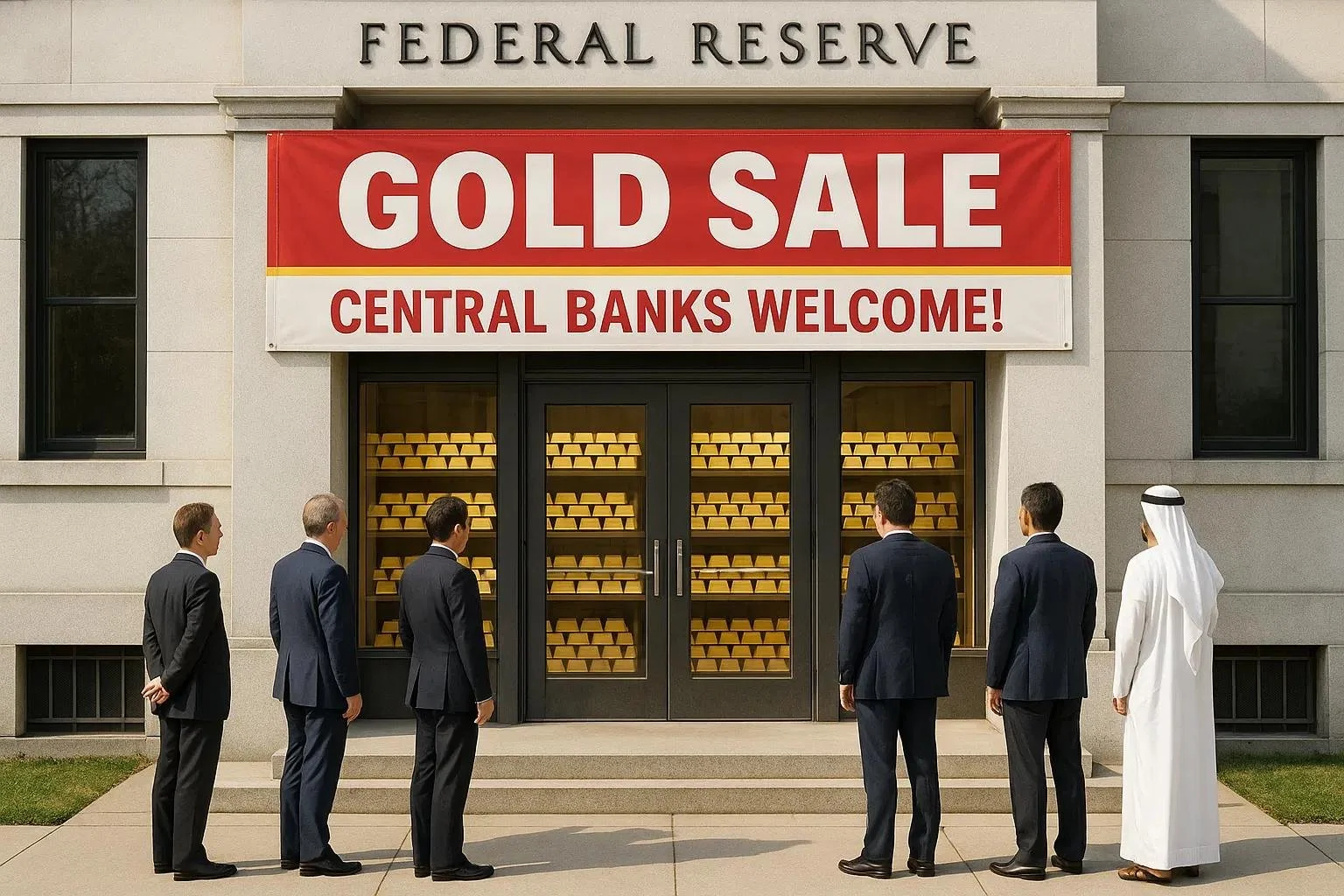
Of course, it’s also possible that Fed Chairman Jerome Powell finally caved to all the insults and pressure from the President.
Or that the rest of the FOMC members looked at what’s happening with Lisa Cook and submitted to inevitability, fearing that they too would be investigated for mortgage fraud (or some other criminal matter) if they didn’t cut rates.
Again, we may never know their real motivations. But it’s clear that the White House has gotten its way.
The President and Treasury Secretary believe that lower rates will stimulate the economy, raise wages, raise asset prices, improve housing affordability, and broadly create conditions for economic prosperity… and they’ve been pushing hard for rate cuts.
Lower rates will also help bail out the US government— whose national debt is so gargantuan that the Treasury is set to spend $1.2 trillion this Fiscal Year (which ends on September 30) just to pay interest.
The Trump administration sees lower rates as the key to slashing that annual interest bill.
Of course, a better solution would be to cut spending, bring the budget closer into balance, and reduce America’s debt-to-GDP ratio.
Putting America’s fiscal house in order would also attract investment in US government bonds the old-fashioned way— by restoring confidence that the US Treasury can pay back its debts through growth, strength, and prestige.
But making such cuts is politically difficult. Even the party that claims to be fiscally conservative isn’t really that interested in meaningful spending cuts.
So, they’re going with Plan B-- push the Fed to lower interest rates.
But as we’ve argued before, they’re setting themselves up for disappointment.
Remember what happened last year— between September and December 2024, the Fed cut rates three times for a total of 1%. Yet over that same period, US government bond yields actually INCREASED by 1%.
This proves that the Fed can’t just snap its fingers and force interest rates lower simply by having a committee meeting.
Interest rates are ultimately determined by supply and demand for money. So if they Fed really wants to see lower rates, they’re going to have to intervene directly in the bond market.
They’ve done this many times before-- this is when the Fed ‘prints’ money, i.e. what they call “quantitative easing”. And the most recent example was during the pandemic when the Fed created about $5 trillion of new money.
They used that money to buy government bonds-- essentially creating artificial demand for Treasurys that pushed yields down to record lows.
And life felt pretty good for a while-- people were able to buy homes and finance mortgages at rates lower than 3%. The government was able to sell 10-year debt for less than 0.5%.
But all those trillions of dollars of new money from the Fed came at a consequence: inflation soared to 9%— the highest in decades.
This is the major tradeoff that the Fed is facing right now: the White House wants lower interest rates. And the Fed seems to be capitulating to the pressure.
But for interest rates to get really low (and remain there), the Fed will almost certainly have to engage in more Quantitative Easing… and that means more inflation.
That alone is going to push a lot more capital into the gold market.
For the past few years, foreign governments and central banks have been selling off their US dollar reserves and funneling that money into gold; this has been the primary reason why gold has soared to all-time highs.
And with the Fed’s capitulation on rates, this trend will continue.
It’s also very likely that pension funds, insurance funds, and other long-term institutional investors will seek refuge in gold as well, driving the price even higher.
To be clear, this isn’t a prediction that gold is going to go up every day, or every month, or even every year.
But if you take a longer-term view—say, 8 to 10 years when the US national debt hits $60 trillion and Social Security runs out of funds— the case for owning gold becomes even more compelling.
I don’t hold this view because I’m a “gold bug”. I’m not fanatical about a hunk of metal. But I do understand these long-term trends, and in my view, we’re still in the early innings.
Another option is to buy gold-related companies, which can offer powerful leverage to the metal itself.
Central banks buy physical gold. They do not buy shares of gold companies. That’s why, even as gold surged, many of the companies we researched traded at dirt-cheap valuations—as low as 2-3x earnings in some cases.
But investors are starting to catch on and pay attention to these deeply undervalued businesses; in fact, we’ve seen several companies in our portfolio gain up to 4x, some even just over the last few months.
Given that Q3 earnings are coming up just around the corner, we believe that some of these gold (and related silver and platinum) companies are about to post record earnings and could see their share prices soar even more.
If you’re interested, we publish all of this investment research, including detailed analysis of deeply undervalued gold companies, in our premium service.
To your freedom, James Hickman Co-Founder, Schiff Sovereign LLC
4 Ways To Avoid Bank Fees and Keep More of Your Money
4 Ways To Avoid Bank Fees and Keep More of Your Money
Laura Bogart Wed, September 17, 2025 GOBankingRates
You work hard for your money — to quote the great Donna Summer, “so hard, honey, honey.” Your emergency and retirement funds can vouch for your saving and budgeting skills. Your financial advisor is on speed dial, and no coupon is left unused. So why does your bank statement feel like it’s working against you?
Before you spiral into spreadsheet mode to dissect every expense, Andrea Woroch — a nationally recognized consumer finance expert, writer, and regular on-air contributor — wants you to zoom in on something else: bank fees.
4 Ways To Avoid Bank Fees and Keep More of Your Money
Laura Bogart Wed, September 17, 2025 GOBankingRates
You work hard for your money — to quote the great Donna Summer, “so hard, honey, honey.” Your emergency and retirement funds can vouch for your saving and budgeting skills. Your financial advisor is on speed dial, and no coupon is left unused. So why does your bank statement feel like it’s working against you?
Before you spiral into spreadsheet mode to dissect every expense, Andrea Woroch — a nationally recognized consumer finance expert, writer, and regular on-air contributor — wants you to zoom in on something else: bank fees.
Woroch spoke with GOBankingRates as part of our Top 100 Money Experts series to about how surprise bank fees can chip away at the money you specifically put in the bank to keep it safe. Here are Woroch’s top strategies to sidestep those fees and keep more of your hard-earned cash. https://www.youtube.com/watch?v=WpEqyNeIjEw
1. Know the Most Common Fees
Whether you’re navigating a budgeting app or simply trying to stop the drip of small charges, rule number one is: Know thy enemy.
“Where you choose to bank can impact your finances as some charge high fees which can add up quickly if you aren’t paying attention,” said Woroch. “Some of the most common bank fees include checking account maintenance fees, overdraft fees and out-of-network ATM fees.”
First, Woroch advises that you find out what the minimum balance is, to avoid monthly maintenance fees. Set up an alert that will warn you when your balance drops to near that amount, then move money to the account to bring your balance back up again.
You could also shop around for a bank that offers free checking, removing the problem altogether.
Woroch also cited those irritating ATM fees.
ATM fees are easier to avoid as you can use digital wallets to make purchases these days,” she said. “If you need cash and can’t find an in-network ATM, head to a grocery or drugstore that offers cash back for no charge. You can then make a small purchase using your debit card and request money back from the cashier without paying high fees to access your cash.”
2. Say Sayonara to Overdraft Fees With Proper Planning
TO READ MORE: https://www.yahoo.com/finance/news/4-ways-avoid-bank-fees-163350701.html
Fed Rate Cut: How It Affects Your Bank Accounts, Loans, Credit Cards, And Investments
Fed Rate Cut: How It Affects Your Bank Accounts, Loans, Credit Cards, And Investments
Hal Bundrick, CFP® Yahoo Personal Finance September 17, 2025
Finally. The Federal Reserve delivered a long-awaited quarter-point rate cut on Sept. 17.
Wall Street expects two more rate cuts at both of the Fed's next meetings before the end of the year.
Here's how the long-running interest rate pause has impacted deposits, credit, and debt so far. And what a rate cut could do for — or to — your money.
Fed Rate Cut: How It Affects Your Bank Accounts, Loans, Credit Cards, And Investments
Hal Bundrick, CFP® Yahoo Personal Finance September 17, 2025
Finally. The Federal Reserve delivered a long-awaited quarter-point rate cut on Sept. 17.
Wall Street expects two more rate cuts at both of the Fed's next meetings before the end of the year.
Here's how the long-running interest rate pause has impacted deposits, credit, and debt so far. And what a rate cut could do for — or to — your money.
How a Fed rate cut affects checking and savings accounts
2025 has been a year of modest earnings on deposit accounts. A rate cut won't help.
Checking accounts
Your checking account is a money-in-motion machine. The convenience of liquidity limits your earning power.
The national average of interest paid on checking accounts has barely budged much this year and remains at 0.07%. Imagine that moving even lower. Is it possible? Yes.
Savings accounts
Interest rates on savings accounts are only marginally better and are up a fraction to 0.40%. But savings accounts are for near-term money.
High-yield savings accounts have been more effective interest payers. Rates are still barely clinging to 4%, with some financial providers slightly above or below that.
This is one category where rate shopping really pays off. Especially as interest rates move lower.
Money market accounts
If you have $10,000 or more that you want to keep on the sidelines but are ready to put in play, money market accounts have been convenient — but low-paying. National average payouts remain at 0.59%.
A better option might be a high-yield money market account, where interest rates are still near or a little better than 4%.
What a rate cut does to CDs
CD rates have crept slightly higher in the last month or so. A 12-month CD is averaging 1.70%, but you can find better deals if you're willing to take the time to hunt them down — and move your money online.
Your minimum deposit and term will affect your rate.
What a rate cut will mean for mortgages and personal loans
Home mortgages
This Single Thing Is The Biggest Warning You're Being Scammed
This Single Thing Is The Biggest Warning You're Being Scammed, And It's Information We All Need
Noah Michelson Tue, September 16, 2025 BuzzFeed
Financial scams have exploded in recent years, and it’s not just banks and corporations getting screwed out of big bucks. U.S. consumers lost more than $10 billion to fraud in 2023 — more than any previous year, and a 14% increase from 2022 — and all signs point to even larger losses in 2024.
So how do we protect ourselves from bad actors who want to steal our money and our identities?
This Single Thing Is The Biggest Warning You're Being Scammed, And It's Information We All Need
Noah Michelson Tue, September 16, 2025 BuzzFeed
Financial scams have exploded in recent years, and it’s not just banks and corporations getting screwed out of big bucks. U.S. consumers lost more than $10 billion to fraud in 2023 — more than any previous year, and a 14% increase from 2022 — and all signs point to even larger losses in 2024.
So how do we protect ourselves from bad actors who want to steal our money and our identities?
That’s what we — Raj Punjabi and Noah Michelson, the hosts of HuffPost’s Am I Doing It Wrong? podcast ― asked Jeremiah Baker, a cybersecurity specialist who has spent the last 17 years growing a firm that hacks into its clients’ networks and web applications to identify the weaknesses in their online defenses and fortify them against future attacks.
Baker told us the biggest red flag that we might be getting scammed is someone asking for personal information, especially if they’re doing so with a heightened level of emotion or urgency.
“Your bank’s never going to call you and... ask you for your username and password, or any kind of identifiable information,” he said. “It’s usually a tee-up of someone asking you for something... an impersonation scam — pretending to be an institution when they’re not, [or pretending to be] a friend, a colleague, a relative.”
There’s also usually what Baker referred to as a “sob story” involved in the ask.
It’s “highly emotional, highly urgent — ‘You have to hurry!’ And those are the things that really should raise a red flag to say, ‘Hey, wait a minute, I need to hang up this phone and reach back out to the institution and make sure that it’s really them,’” Baker told us.
That can be difficult to do in the heat of the moment — especially if someone is claiming to be a representative from an institution we work with, and they’re warning us that we might lose everything if we don’t act quickly. However, trusting our guts and taking a step back to analyze the situation can save us a lot of agony — and money.
“Most everyone I speak to said, ‘Yeah, I didn’t really feel like I should be doing it, but I did it because they had all this other information on me ― like, they knew my address, they knew my name, birth date, they knew my Social Security number,’” Baker said. “All that information — with all these huge data breaches that we’ve seen over the last several years, bad guys get ahold of that information. So they use it to set trust and context, and then they get us to do something.”
Baker tells clients to “trust [their] intuition,” and to keep in mind that banks and other institutions are never going to ask for that kind of information over the phone or via email
TO READ MORE: https://www.yahoo.com/lifestyle/articles/single-thing-biggest-warning-youre-003104659.html
Are You Smart Enough To Beat Inflation? Solve These Money Puzzles To Find Out
Are You Smart Enough To Beat Inflation? Solve These Money Puzzles To Find Out
T. Woods Sun, September 14, 2025
“Inflation” is a word any money-conscious adult hears or reads almost daily, but that doesn’t mean everyone totally understands how it can impact their finances. Truly comprehending the complexities of inflation, and how it can sway your financial stability, is a requirement for any financially responsible adult.
With that in mind, do you understand inflation? Further, are you smart enough to beat it? Take this GOBankingRates quiz to find out.
Are You Smart Enough To Beat Inflation? Solve These Money Puzzles To Find Out
T. Woods Sun, September 14, 2025
“Inflation” is a word any money-conscious adult hears or reads almost daily, but that doesn’t mean everyone totally understands how it can impact their finances. Truly comprehending the complexities of inflation, and how it can sway your financial stability, is a requirement for any financially responsible adult.
With that in mind, do you understand inflation? Further, are you smart enough to beat it? Take this GOBankingRates quiz to find out.
What Is Inflation?
The first step to beating inflation is understanding it. True or false: Inflation is the increase in prices of goods and services within an economy over a certain period of time, often caused by a destabilization between supply and demand.
A) True
B) False
Answer: What Is Inflation?
If you answered (A) True, you’re 100% correct. Inflation is, essentially, a higher cost of living. Goods and services increase in price due to such factors as crises (like the COVID-19 pandemic or a housing crisis), general supply chain problems, consumer demand and more.
Understanding Inflation Rates
Assume your weekly groceries cost $100 in 2024. Further assume that in 2025, the exact shame shopping list now costs you $108.
A) What is the inflation rate between 2024 and 2025 shopping trips?
B) If your salary went from $100,000 to $105,000 over the course of the same year, did your real income increase or decrease, and by how much?
The Answers: Understanding Inflation Rates
A) The inflation rate that impacted your groceries is 8%. Didn’t come up with the same answer? Here’s how you calculate it: Subtract the previous price from the current one ($108 – $100 = $8), divide that sum by 100 ($8/100 = 0.08) and then multiply the final result by 100 (0.08 x 100 = 8%).
Your groceries have increased by 8% due to inflation.
B) Regarding a real income change, similarly subtract your previous salary from the current one ($105,000 – $100,000 = $5,000), divide that sum by 100,000 (5,000/100,000 = 0.5, or 5%) and subtract the inflation rate from that sum (5% – 8% = -3%).
Your real income change is -3%, meaning it fell by 3%.
Investing vs. Inflation
TO READ MORE: https://finance.yahoo.com/news/smart-enough-beat-inflation-solve-131146285.html
3 Key Signs That You’re Losing Money to ‘Lifestyle Inflation’ — and How To Get Out of It
3 Key Signs That You’re Losing Money to ‘Lifestyle Inflation’ — and How To Get Out of It
Laura Bogart Mon, September 15, 2025 GOBankingRates
“Treat yourself.” This iconic line from “Parks and Recreation” has become a cultural mantra and, let’s face it, maybe even a personal motto at times. After all, you’ve just landed a raise. Not only are you bringing home a bigger paycheck, but you’re also working harder than ever to earn it. You’ve got every reason to, well, treat yourself.
But after a few splurges — maybe it’s bottomless brunches, a new bag, or just a couple of nights of takeout — you’re not feeling as flush as you expected. In fact, your bank account might still look a little too familiar.
3 Key Signs That You’re Losing Money to ‘Lifestyle Inflation’ — and How To Get Out of It
Laura Bogart Mon, September 15, 2025 GOBankingRates
“Treat yourself.” This iconic line from “Parks and Recreation” has become a cultural mantra and, let’s face it, maybe even a personal motto at times. After all, you’ve just landed a raise. Not only are you bringing home a bigger paycheck, but you’re also working harder than ever to earn it. You’ve got every reason to, well, treat yourself.
But after a few splurges — maybe it’s bottomless brunches, a new bag, or just a couple of nights of takeout — you’re not feeling as flush as you expected. In fact, your bank account might still look a little too familiar.
If your expenses have quickly risen to match your new income, you may be experiencing lifestyle inflation. Whether it’s driven by your own aspirations or a desire to keep up with friends or coworkers, lifestyle inflation can leave you feeling just as broke as before, if not more so.
Allison Baggerly understands your pain.
As a budgeting expert, author, podcaster, and founder of Inspired Budget, Baggerly has helped thousands of people bust out of the paycheck-to-paycheck cycle. She spoke to GOBankingRates as part of our Top 100 Money Experts series to share how to recognize lifestyle inflation and reclaim control of your money — without completely giving up the fun stuff.
Key Signs You’re Slipping Into Lifestyle Inflation
Baggerly says lifestyle inflation can sneak up fast. Here are some common red flags:
Upgrades become routine. Maybe you trade in your car early, replace furniture that’s still in great shape, or jump on every “limited-time” sale.
Dining out more than before. Ordering DoorDash or grabbing brunch several times a week starts to feel normal instead of special.
Savings goals stall. Despite higher income, contributions to retirement, debt payments or an emergency fund don’t budge.
Spotting these patterns is the first step to stopping them.
Understanding Lifestyle Inflation Helps You Avoid It
“It’s easy to fall into because it feels like you’re just doing what you’re ‘supposed’ to do,” Baggerly said. “You’re working hard and earning more, so you deserve the nicer couch or the spontaneous weekend trip, right? The problem is that those small upgrades pile up fast, and suddenly that raise is gone. You’re making more, but you still feel broke. That’s lifestyle inflation in action.”
This could look like ordering DoorDash three nights in a row instead of cooking, upgrading your car before it’s really necessary, or jumping on a sale ‘just because.’ Meanwhile, financial goals like paying down debt, saving for retirement, or building an emergency fund get left behind.
But here’s the good news: Being able to spot the pattern is the first step to changing it.
Planning for a Win Helps You Avoid Splurges
TO READ MORE: https://finance.yahoo.com/news/3-key-signs-losing-money-185646127.html
Billionaire Ray Dalio Warns Debt-Laden US Economy Faces 'Heart Attack,' Advises Investors To Hold 10–15% Gold
Billionaire Ray Dalio Warns Debt-Laden US Economy Faces 'Heart Attack,' Advises Investors To Hold 10–15% Gold
Kaustubh Bagalkote Fri, September 12, 2025
Bridgewater Associates founder Ray Dalio issued stark warnings about the U.S. economy’s mounting debt burden, comparing the fiscal strain to arterial blockage that could trigger a financial “heart attack.”
Debt Crisis Threatens Economic Stability
Speaking at an Abu Dhabi Finance Week launch event, Dalio warned that escalating debt service costs are “squeezing out other spending” and building up like plaque in a clogged circulatory system, reported Reuters. “A doctor would warn of a heart attack,” the billionaire investor cautioned.
Billionaire Ray Dalio Warns Debt-Laden US Economy Faces 'Heart Attack,' Advises Investors To Hold 10–15% Gold
Kaustubh Bagalkote Fri, September 12, 2025
Bridgewater Associates founder Ray Dalio issued stark warnings about the U.S. economy’s mounting debt burden, comparing the fiscal strain to arterial blockage that could trigger a financial “heart attack.”
Debt Crisis Threatens Economic Stability
Speaking at an Abu Dhabi Finance Week launch event, Dalio warned that escalating debt service costs are “squeezing out other spending” and building up like plaque in a clogged circulatory system, reported Reuters. “A doctor would warn of a heart attack,” the billionaire investor cautioned.
The U.S. national debt has surpassed $37 trillion, with Moody’s projecting the debt-to-GDP ratio to climb from nearly 100% in 2025 to approximately 130% by 2035. Moody’s downgraded the U.S. long-term credit rating from Aaa to Aa1 in May, citing concerns about fiscal sustainability.
Gold as Portfolio Insurance
Dalio recommended investors allocate “somewhere between 10% and 15%” of their portfolios to gold as protection against market instability. Gold futures recently hit record highs near $3,600.
“Gold was uncorrelated with other assets, its value tending to rise during a crisis when other assets fall,” Dalio explained. He emphasized that with the world “abundant in debt” and geopolitical tensions rising, investors should question “whose money do you own?” when building neutral portfolios.
Fed Policy and Market Valuations
The S&P 500 tracked by SPDR S&P 500 (NYSE:SPY) and the Nasdaq Composite have gained over 12.25% and 14.33% year-to-date, respectively, closing at record highs as markets anticipate Federal Reserve rate cuts.
However, Dalio’s warnings align with concerns about elevated valuations amid underlying fiscal pressures.
Dalio previously sold his remaining Bridgewater stake in July, stepping away from the hedge fund he founded in 1975 after building it into one of the world’s largest investment firms.
Building Wealth Across More Than Just the Market
Building a resilient portfolio means thinking beyond a single asset or market trend. Economic cycles shift, sectors rise and fall, and no one investment performs well in every environment. That's why many investors look to diversify with platforms that provide access to real estate, fixed-income opportunities, professional financial guidance, precious metals, and even self-directed retirement accounts.
TO READ MORE: https://www.yahoo.com/finance/news/billionaire-ray-dalio-warns-debt-233112283.html
How Do I Make The Most Of This Sudden Windfall?
How Do I Make The Most Of This Sudden Windfall?
I’m 40 and my mom just died — leaving me a $3.25M inheritance
Christy Bieber Sat, September 13, 2025 Moneywise
According to Northwestern Mutual, $90 trillion will transfer to younger generations in the coming years [1]. Rebecca, 40, says she has inherited $3 million in stocks and $250,000 in cash, and has a $100,000 mortgage and $25,000 in other debt. What should she do with such a large windfall to make sure she’s using it wisely?
How Do I Make The Most Of This Sudden Windfall?
I’m 40 and my mom just died — leaving me a $3.25M inheritance
Christy Bieber Sat, September 13, 2025 Moneywise
According to Northwestern Mutual, $90 trillion will transfer to younger generations in the coming years [1]. Rebecca, 40, says she has inherited $3 million in stocks and $250,000 in cash, and has a $100,000 mortgage and $25,000 in other debt. What should she do with such a large windfall to make sure she’s using it wisely?
Think Before Acting
When you receive a large inheritance, the first thing to consider is the tax implications. Federal estate taxes don't kick in until you inherit at least eight figures (the threshold in 2025 is $13.99 million), so you shouldn't have to worry about that. Some states also impose an inheritance or estate tax (Maryland imposes both).
If you inherit assets you plan to sell, there’s good news. The step-up basis at death resets the cost basis for the inherited assets to the fair market value at the time of death. This usually helps reduce the amount of capital gains taxes you will owe.
Beyond the tax implications, you need to make a smart plan for how to make the money last. An often cited statistic from a 20-year study by The Williams Group of 3,200 families says that 70% of the time family wealth is lost by the second generation, and this number jumps to 90% for the third generation.
If you don't want to become one of the majority who waste the funds, you should avoid jumping into spending the money or upgrading your lifestyle dramatically.
While it is probably a good idea to pay off your mortgage and other debt so you can avoid interest costs, you should refrain from doing things like immediately buying a bigger house or making other large purchases that eat away a big chunk of the money and require you to commit to higher ongoing expenses.
You should also avoid telling anyone other than your immediate family about the inheritance. If word gets out, you may find yourself targeted by people trying to get you to "invest" in their business venture, help them cope with "emergency" spending needs or any other excuse to access your funds.
What Should You Do With The Money?
The first thing you should do is pay off your debt and make sure you’ve built a sizable emergency fund, then invest every dollar, ideally in a mix of simple and safe investments.
TO READ MORE: https://www.yahoo.com/finance/news/m-40-mom-just-died-103000408.html
7 of the Top Financial Conflicts Couples Face (and How To Overcome Them)
7 of the Top Financial Conflicts Couples Face (and How To Overcome Them)
January 11, 2025
Money matters are a significant source of stress in relationships. According to a 2024 Fidelity study, 45% of partners argue about money at least occasionally, and 27% admit to being frustrated by their partner’s money habits.
Understanding and addressing money conflicts is essential for maintaining a healthy and harmonious partnership. Here are some of the top financial conflicts couples face and effective strategies to overcome them.
7 of the Top Financial Conflicts Couples Face (and How To Overcome Them)
January 11, 2025
Money matters are a significant source of stress in relationships. According to a 2024 Fidelity study, 45% of partners argue about money at least occasionally, and 27% admit to being frustrated by their partner’s money habits.
Understanding and addressing money conflicts is essential for maintaining a healthy and harmonious partnership. Here are some of the top financial conflicts couples face and effective strategies to overcome them.
Different Spending Habits
One partner may thrive on the excitement of spontaneous purchases and enjoy spending freely, while the other prefers saving and meticulously managing the budget. This difference can quickly lead to frustration and resentment.
In order to overcome this, foster open communication about financial behaviors, ensuring each partner understands the other’s perspectives without judgment. According to MyWellbeing, establishing common financial goals, such as saving for a vacation or purchasing a house, can align spending priorities.
Additionally, try to create a balanced budget that allocates funds for both saving and discretionary spending to satisfy both partners’ needs.
Saving vs. Spending Priorities
Couples often clash over financial priorities, with one partner emphasizing the importance of saving for the future and the other preferring to enjoy the present moment. This fundamental difference can create tension and disagreements about money management, leading to frustration and misunderstanding.
To address this, try allocating a portion of the income to savings and another portion for spending on shared interests and activities. Additionally, commit to regular check-ins to reassess and adjust financial priorities as needed, ensuring both partners remain aligned.
To have a productive conversation, Desert Financial Credit Union recommends creating a safe and comfortable environment, having a set cadence, and practicing active listening and empathy.
Debt and Financial Obligations
TO READ MORE: https://www.gobankingrates.com/saving-money/relationships/top-financial-conflicts-couples-face-how-overcome/
50 Habits That Will Prepare You for a Comfortable Retirement
50 Habits That Will Prepare You for a Comfortable Retirement
Lydia Kibet Wed, September 10, 2025 GOBankingRates
A comfortable retirement isn’t built overnight and it doesn’t require a six-figure salary. What makes the difference are the small habits you build over time. Whether you’re in your 20s or 50s the right habits will help you build the kind of retirement you want.
The 50 habits below will set you up for a comfortable retirement.
Saving and Investing
1. Start saving and investing early. Time is your greatest asset. The earlier you start, the more time your savings and investments have to grow.
50 Habits That Will Prepare You for a Comfortable Retirement
Lydia Kibet Wed, September 10, 2025 GOBankingRates
A comfortable retirement isn’t built overnight and it doesn’t require a six-figure salary. What makes the difference are the small habits you build over time. Whether you’re in your 20s or 50s the right habits will help you build the kind of retirement you want.
The 50 habits below will set you up for a comfortable retirement.
Saving and Investing
1. Start saving and investing early. Time is your greatest asset. The earlier you start, the more time your savings and investments have to grow.
*********************************
2. Automate your finances. Set up automatic transfers to your savings, investing and retirement accounts.
3. Build an emergency fund. Save at least three to six months’ worth of living expenses to avoid tapping into your retirement accounts during emergencies.
4. Take advantage of employer 401(k) match. This is free money. Always contribute enough to your 401(k) to get the full employer match.
5. Contribute to an IRA. Use a traditional IRA or Roth IRA to grow your retirement savings tax-efficiently.
6. Diversify your investments. Don’t invest in one asset class. Spread your money across stocks, index funds, ETFs and bonds to reduce risk.
7. Invest consistently. Use dollar cost averaging to invest consistently regardless of where the market goes.
8. Rebalance your portfolio regularly. Review your portfolio year and adjust asset classes based on your risk tolerance and goals.
9. Understand your risk tolerance. Pick investments that align with your risk appetite.
10. Avoid emotional investing. Stick to your plan despite the market swings.
11. Increase your retirement contributions annually.
12. Don’t panic during market downturns. Don’t panic sell your investments when the market is going down.
13. Stay invested long-term. Time in the market beats timing the market.
4. Shop for insurance annually. Compare rates for auto, home and health insurance to ensure that you’re getting the best rates.
15. Use catch-up contributions. Contribute more to your retirement accounts once you hit the age of 50.
16. Avoid early withdrawals. Don’t tap into your retirement accounts unless it’s an emergency that deserves the withdrawal penalty.
17. Harvest tax losses. Strategically realize losses to offset gains and reduce current tax liability
Spending and Budgeting
TO READ MORE: https://www.yahoo.com/finance/news/50-habits-prepare-comfortable-retirement-185504786.html
How Happy Couples Handle Money — Even When They Disagree
How Happy Couples Handle Money — Even When They Disagree
September 4, 2025 Top 100 Money Experts
What’s the best way to manage money with a partner?
You’re sitting at the breakfast table with your partner. Gazing into their eyes, you think about how much you love them, how much they — to quote “Jerry Maguire” — “complete you,” and how fortunate you are to have them.
Just as you’re about to fall even deeper in love, they open their mouth to tell you they might have, ahem, put a little more on the credit card than they planned. Or perhaps to chide you for not taking your employer match on your 401(k).
How Happy Couples Handle Money — Even When They Disagree
September 4, 2025 Top 100 Money Experts
What’s the best way to manage money with a partner?
You’re sitting at the breakfast table with your partner. Gazing into their eyes, you think about how much you love them, how much they — to quote “Jerry Maguire” — “complete you,” and how fortunate you are to have them.
Just as you’re about to fall even deeper in love, they open their mouth to tell you they might have, ahem, put a little more on the credit card than they planned. Or perhaps to chide you for not taking your employer match on your 401(k).
Ah, love. Ain’t it grand? It still can be — even if your money habits clash — when you learn how to balance different financial styles. That process might sound complex and uncomfortable, but according to Emma Johnson, founder of Wealthy Single Mommy and author of “The 50/50 Solution” and “The Kickass Single Mom,” it starts with something simple: listening to each other.
GOBankingRates caught up with Johnson to get her take on how happy couples can stay happy couples when it comes to managing money together.
YOU TUBE VIDEO: https://www.youtube.com/watch?v=dqyl46S4HvM&embeds_referring_euri=https%3A%2F%2Fwww.gobankingrates.com%2F&source_ve_path=OTY3MTQ
Respect Each Other’s Financial Independence
One of Johnson’s first pieces of advice is to recognize that you and your partner are, well, your own people. You each had fully formed identities and managed your own money before you got together. Acting like a parent or boss with your partner’s finances can only breed resentment.
Each partner needs some financial autonomy – money you can spend without checking in first,” Johnson said. “You’re both adults.”
Therapists back this up. Given how often couples argue over money, it’s not surprising that services like Ascencion Counseling include financial advice right on their websites. To keep your financial independence while managing joint responsibilities, you and your partner need to communicate and plan together.
One common approach is to open a joint account for major shared expenses like rent, utilities and groceries, while keeping separate accounts for personal spending. Once you agree on how much each of you will contribute — ideally based on income rather than splitting everything 50/50 — you can still maintain individual control over your own separate accounts.
This kind of setup gives each partner more confidence in their financial abilities while also minimizing potential resentment. That’s a win-win.
Love Each Other Through Your Differences
How To Protect Your Financial Windfall
How To Protect Your Financial Windfall
Mike Crisolago Updated Sep 6, 2025 Money Wise
The (PCH) Publisher’s Clearing House saga is a cautionary tale for anyone who comes into a large sum of money — whether it’s a sweepstakes giveaway, a lottery win or an inheritance. Without a plan, that money can dry up faster than you think.
Oregon man won ‘$5K a week forever’ in 2012, spent cash like he was set for life — but Publishers Clearing House went bankrupt. Now he might lose home
An old sweepstakes TV commercial once promised, “Only Publishers Clearing House can make you so rich, so fast!”
How To Protect Your Financial Windfall
Mike Crisolago Updated Sep 6, 2025 Money Wise
The (PCH) Publisher’s Clearing House saga is a cautionary tale for anyone who comes into a large sum of money — whether it’s a sweepstakes giveaway, a lottery win or an inheritance. Without a plan, that money can dry up faster than you think.
Oregon man won ‘$5K a week forever’ in 2012, spent cash like he was set for life — but Publishers Clearing House went bankrupt. Now he might lose home
An old sweepstakes TV commercial once promised, “Only Publishers Clearing House can make you so rich, so fast!”
But, as some unlucky winners discovered this year, the opposite is also true: Publishers Clearing House (PCH) can make your fortune disappear just as quickly.
That’s what happened to John Wyllie, a 61-year-old Oregon man who won $5,000 a week for life from the PCH Prize Patrol in 2012.
According to NBC affiliate KGW8 [1], Wyllie received an annual check for $260,000 every January. The money let him retire and buy a house on six acres in scenic Bellingham, Washington. But this year, the checks suddenly stopped. A few months later, Wyllie learned why: PCH had filed for bankruptcy without warning him or other winners.
Wyllie told KGW8 the turn of events “feels like a nightmare,” made worse by the fact that he hasn’t worked in more than a decade and can’t find a job now. With bills piling up, he’s sold off big-ticket items like a jet ski and trailer, but still expects to lose his home.
For anyone who’s ever daydreamed about a life-changing win, Wyllie’s story is a harsh reminder that easy money isn’t always forever. It’s a reality check that could strike anyone who finds themselves scrambling to offset the loss.
From bankable to bankruptcy
KGW8 reported that Wyllie is one of at least 10 winners still owed money they’ll likely never receive.
That’s because ARB Interactive, which paid $7.1 million to buy PCH, announced it would only honor prizes won after it took over in July. For past winners still waiting on payments, The Wall Street Journal [2] noted they’ll “have to seek payment from the bankruptcy estate.”