
Thank you to all the subscribers to our Early Access program…we thank you for your continued support.
We are excited to offer this new service to keep you informed and up-to-date on the latest Dinar and currency news.
Saturday Iraq News Posted by Tishwash at TNT
TNT:
Tishwash: Trump announces lifting of naval blockade in the Strait of Hormuz
US President Donald Trump announced on Friday the lifting of the naval blockade in the Strait of Hormuz, stressing the need to reopen it immediately to international shipping without any transit fees.
Trump said in press statements, as reported by Shafaq News Agency, that "ships stuck in the strait due to the blockade, which will now be lifted, can begin the process of returning," adding that "the Strait of Hormuz must be opened immediately without transit fees in both directions."
TNT:
Tishwash: Trump announces lifting of naval blockade in the Strait of Hormuz
US President Donald Trump announced on Friday the lifting of the naval blockade in the Strait of Hormuz, stressing the need to reopen it immediately to international shipping without any transit fees.
Trump said in press statements, as reported by Shafaq News Agency, that "ships stuck in the strait due to the blockade, which will now be lifted, can begin the process of returning," adding that "the Strait of Hormuz must be opened immediately without transit fees in both directions."
He noted that "all sea mines will be removed if found," explaining that US forces "detonated many of them," while Iran will immediately remove the remainder.
Trump asserted that "ships stuck in the Strait of Hormuz can return home," emphasizing that "Iran must agree that it will never possess a nuclear weapon or bomb."
He pointed out that "the nuclear dust buried deep underground will be extracted in coordination with Iran and the International Atomic Energy Agency."
He concluded that "no money will be exchanged with Iran until further notice," revealing that he would go to the "operations room to make the final decision on this matter." link
************
Tishwash: After the depletion of state-owned banks, the central bank faces the burden of financing.
Economist Mahmoud Dagher gave a briefing on the liquidity crisis facing government banks and its implications for the state’s ability to finance its needs through domestic borrowing, warning of continued financial pressures if the current crisis lasts for an extended period.
Dagher told Al-Jarida that “the low level of liquidity in government banks makes it difficult to resort to them to achieve internal borrowing, which prompted the Ministry of Finance to transfer remittances to the Central Bank for discounting instead of having them discounted by government banks.”
He added that “this measure leads to additional pressure on the debt-backed central bank budget,” indicating that “the continuation of the crisis for a longer period may force the government to look for alternative solutions, foremost among them being reducing public spending and rationalizing expenditures to limit the increasing financial pressures.” link
************
Tishwash: Washington removes the name of an Iraqi with 12 titles from its sanctions list.
The U.S. Treasury Department’s Office of Foreign Assets Control (OFAC) announced Thursday evening that it had lifted sanctions on 76 entities and individuals who were on old sanctions lists, including an Iraqi citizen whose name appeared in various forms in the department’s records.
This move came as part of an initiative to modernize the US sanctions system, a trend discussed by Treasury Secretary Scott Bisent during the "No Money for Terror" conference held in the French capital, Paris.
The US Treasury explained in its statement , which was reviewed by Shafaq News Agency, that the review included removing restrictions on deceased individuals, ships that were dismantled or taken out of service, as well as people who were previously classified as part of illicit financial networks that no longer exist, or others who were listed more than a decade ago without sufficient identifying data to continue scrutinizing them.
According to Treasury Department documents, the updated list included a prominent Iraqi citizen named Badran Turki Hishan al-Mazidi, who was born in Mosul, the center of Nineveh Governorate, and is known by the nicknames "Abu Ghadiya" and "Abu Abdullah".
The lifting of restrictions on him came after his name and titles appeared in 12 different forms in previous lists to avoid merging identities.
The list also included the removal of other names and companies belonging to multiple nationalities, including Colombia, Algeria, Mexico, the Philippines, Burma and Germany. link
************
Tishwash: Government advisor: The 2026 budget will be a “crisis management budget”
The financial advisor to the Iraqi Prime Minister, Mazhar Muhammad Salih, warned of the challenges that may face in preparing the general budget for 2026, in light of the escalating geopolitical tensions in the Gulf region, describing the anticipated budget as being closer to a “crisis management budget” than to a budget for economic expansion or long-term development.
Saleh said, in a statement followed by (Al-Mada), that the escalating crisis in the Strait of Hormuz puts Iraq before a double challenge, which is to ensure the continuation of internal financial stability, in conjunction with protecting its oil exports, which constitute the main source of public revenues.
He explained that the budget “is no longer just an accounting document or tables of numbers,” but has become a reflection of the nature of the rentier Iraqi economy and the extent of the state’s ability to manage its resources amid a turbulent regional environment.
He indicated that the government would most likely move towards preparing a more conservative budget based on cautious oil assumptions, focusing on reducing unnecessary spending and rearranging priorities towards protecting salaries, pensions, social welfare and basic services.
He added that any disruption to oil exports through the Gulf would put direct pressure on Iraq’s financial and monetary stability, given the country’s almost complete dependence on oil revenues to finance operational and investment spending.
In contrast, Saleh pointed out that geopolitical crises may lead to a rise in global oil prices, which may give Iraq a temporary financial reprieve that alleviates the severity of the deficit and helps to pass the budget without an immediate financial crisis, provided that revenues are managed efficiently, waste is reduced, and the efficiency of public spending is increased.
He stressed that continuing to work according to the amended Federal Financial Management Law No. 6 of 2019 remains an option if the budget is delayed due to continued regional uncertainty.
Saleh concluded by saying that the real challenge lies not in the budget legislation itself, but in the state’s ability to ensure the sustainability of funding in an economy that is almost entirely dependent on oil, calling for dealing with the 2026 budget with “economic rationality and financial realism” away from emergency spending and ill-considered policies. link
************
Tishwash: Government advisor: The 2026 budget will focus on reducing unnecessary spending.
The Prime Minister's financial advisor, Mazhar Muhammad Salih, confirmed on Friday that the 2026 budget will focus on reducing unnecessary spending and ensuring funding for vital sectors directly related to citizens' lives.
He also indicated that continuing to operate under the amended Federal Financial Management Law No. (6) of 2019 remains a constitutional and financial option should the budget's approval be delayed.
Salih stated, "In light of the escalating crisis in the Strait of Hormuz, through which the world's oil artery passes amidst anxiety and tension, Iraq finds itself facing a dual challenge: how to successfully enact its 2026 budget amidst regional turmoil that threatens its oil exports, while simultaneously maintaining internal financial stability."
He added, "The budget is no longer merely an accounting document or a set of figures; it has become a political and economic equation reflecting the nature of the Iraqi economy, which is based on oil revenues, and simultaneously revealing the state's ability to manage its financial resources prudently and efficiently in a highly volatile and fragile regional environment."
He added, "Given the escalating geopolitical conflict in the Middle East and the accompanying direct and indirect threats to maritime navigation and energy flows in the Strait of Hormuz, the possibility of enacting Iraq's 2026 budget appears constitutionally and politically viable. However, it will be one of the most sensitive and complex budgets in Iraq's modern financial history due to the intrinsic link between the Iraqi economy and global oil markets."
He pointed out that "Iraq still relies almost entirely on oil revenues to finance salaries, pensions, social welfare, general operating expenses, and investment projects. This makes any disruption to exports through the Gulf a direct pressure on the country's financial and monetary stability." He noted that "the financial authorities are expected to prepare a more conservative budget based on prudent oil assumptions, reducing unnecessary spending and reprioritizing expenditures to protect social spending related to salaries, pensions, social welfare, and basic services, as well as ensuring funding for vital sectors directly impacting citizens' lives and their economic stability."
He explained that "conversely, geopolitical crises often drive up global oil prices, which could provide Iraq with temporary financial relief, mitigating the deficit and offering an opportunity to pass the 2026 budget without a direct financial collapse, especially if the financial administration succeeds in managing oil revenues efficiently, activating export alternatives, reducing financial waste, and increasing the efficiency of public spending."
He stated that "continuing to operate under the amended Federal Financial Management Law No. (6) of 2019 remains a constitutional and financial option if the budget's approval is delayed due to continued uncertainty and tension in the regional landscape."
He pointed out that "the real challenge lies not in the debate surrounding the enactment of the 2026 federal budget law itself, but rather in the ability of public finances to ensure the sustainability of funding amidst a turbulent regional environment and an economy that relies almost exclusively on oil."
He explained that “the 2026 budget, if it is enacted under the current geopolitical climate, appears to be closer to a (crisis management budget) than to a budget for economic expansion or long-term sustainable development, which requires the legislative and executive authorities to deal with it with economic rationality and financial realism, far from containment policies, immediate reactions and ill-considered emergency spending.” link
Seeds of Wisdom RV and Economics Updates Saturday Morning 5-30-26
Good Morning Dinar Recaps,
Global Debt Concerns and Central Bank Pressures Signal Growing Financial Reset Risks
Rising borrowing costs, expanding debt burdens, and shifting global capital flows are increasing pressure on the existing financial order.
Good Morning Dinar Recaps,
Global Debt Concerns and Central Bank Pressures Signal Growing Financial Reset Risks
Rising borrowing costs, expanding debt burdens, and shifting global capital flows are increasing pressure on the existing financial order.
Overview
Today's economic developments highlight growing concerns about the sustainability of the global debt-driven financial system. Investors are increasingly focused on rising sovereign borrowing costs, mounting debt obligations, and the difficult choices facing central banks as they attempt to balance inflation control with economic growth.
Key Developments
1. Global Bond Markets Face Renewed Pressure
Government bond yields remained elevated as investors assessed the long-term implications of expanding fiscal deficits and persistent inflation. Higher yields increase financing costs for governments and place additional strain on heavily indebted economies.
2. Central Banks Confront Difficult Policy Choices
Monetary policymakers continue to face the challenge of maintaining price stability while avoiding a broader economic slowdown. Analysts warn that keeping interest rates elevated for an extended period could expose vulnerabilities across banking, commercial real estate, and private credit markets.
3. Global Debt Levels Remain Near Record Highs
Economists continue to monitor the effects of record debt accumulation across both developed and emerging economies. Rising debt-servicing costs are increasingly consuming government budgets, limiting fiscal flexibility and raising concerns about future financial stability.
4. Investors Increase Focus on Alternative Assets
Growing uncertainty surrounding traditional debt markets has contributed to continued interest in gold, commodities, and other alternative assets. This trend reflects broader concerns about preserving value in an environment characterized by inflation risk and fiscal challenges.
Why It Matters
The modern financial system is built upon confidence in sovereign debt markets, central bank credibility, and economic growth. As debt burdens rise and borrowing becomes more expensive, policymakers may face increasing pressure to implement measures that could reshape monetary and financial frameworks.
Why It Matters to Foreign Currency Holders
Potential for increased currency volatility as debt pressures mount
Growing interest in asset diversification and alternative stores of value
Increased focus on countries with stronger fiscal and monetary positions
Implications for the Global Reset
Pillar 1: Debt Sustainability Challenges
Governments worldwide are confronting rising financing costs at a time when debt levels remain historically elevated. This dynamic could eventually force difficult decisions regarding taxation, spending, monetary policy, or debt management.
Pillar 2: Shifting Global Capital Flows
Investors are increasingly evaluating alternatives to traditional sovereign debt investments. Over time, these shifts could influence reserve allocation strategies, trade settlement preferences, and global financial influence.
Closing Insight
Today's developments reinforce a broader trend: the global financial system continues to operate under significant debt-related pressure. While no immediate crisis is evident, the combination of elevated debt, higher interest rates, and changing investor behavior suggests that structural adjustments may become increasingly necessary.
This is not just a debt story — it's a test of how long the global financial system can sustain record borrowing in a higher-rate world.
Seeds of Wisdom Team
Newshounds News™ Exclusive
Sources
Reuters — "Global debt concerns persist as borrowing costs remain elevated"
International Monetary Fund (IMF) — "Global Financial Stability Report"
~~~~~~~~~~
🌱 A Message to Our Currency Holders🌱
If you’ve been holding foreign currency for many years, you were not foolish.
You were not wrong to believe the global financial system would change.
What failed was not your patience — it was the information you were given.
For years, dates, rumors, and personalities replaced facts, structure, and proof. “This week” predictions created cycles of hope and disappointment that were never based on how currencies actually change.
That is not your failure.
Our mission here is different: • No dates • No rates • No hype • No gurus
Instead, we focus on:
• Verifiable developments • Institutional evidence
• Global financial structure • Where countries actually sit in the process
Currency value changes only come after sovereignty, trade, banking, settlement systems, and fiscal coordination are in place. History and institutions confirm this sequence.
You will see silence. You will see denials. That is not delay — that is discipline.
Protect your identity. Organize your documents. Verify everything.
Never hand your discernment to anyone who cannot show proof.
You deserve truth — not timelines.
Seeds of Wisdom Team
Newshounds News™
~~~~~~~~~~
Seeds of Wisdom Team RV Currency Facts Youtube and Rumble
Newshound's News Telegram Room Link
RV Facts with Proof Links Link
RV Updates Proof links - Facts Link
Follow the Gold/Silver Rate COMEX
Follow Fast Facts
Seeds of Wisdom Team™ Website
Thank you Dinar Recaps
Iraq Economic News and Points To Ponder Late Friday Evening 5-29-26
Commander-In-Chief: The Government's Focus On Security Forces Is A Cornerstone For Stability
Iraqi News Agency, INA - BAGHDAD 5/29/2026 PM and Commander-in-Chief of the Armed Forces, Ali Faleh al-Zaidi, affirmed on Wednesday that the government's focus on security forces is a cornerstone for stability and weapon control.
Al-Zaidi received on Wednesday several military and security commanders from various branches of the security forces, in the presence of the heads of the Intelligence and National Security services, the Chief of Staff of the Army, the Deputy Commander of the Joint Operations, and the undersecretaries of the Ministry of Interior, on the occasion of Eid Al-Adha Al-Mubarak, according to a statement from the PM Media Office, received by the Iraqi News Agency - INA.
Commander-In-Chief: The Government's Focus On Security Forces Is A Cornerstone For Stability
Iraqi News Agency, INA - BAGHDAD 5/29/2026 PM and Commander-in-Chief of the Armed Forces, Ali Faleh al-Zaidi, affirmed on Wednesday that the government's focus on security forces is a cornerstone for stability and weapon control.
Al-Zaidi received on Wednesday several military and security commanders from various branches of the security forces, in the presence of the heads of the Intelligence and National Security services, the Chief of Staff of the Army, the Deputy Commander of the Joint Operations, and the undersecretaries of the Ministry of Interior, on the occasion of Eid Al-Adha Al-Mubarak, according to a statement from the PM Media Office, received by the Iraqi News Agency - INA.
The Prime Minister extended his “best wishes to the heroes of the security agencies and formations on the occasion of Eid,” commending their efforts and success in imposing security across all regions of the country and meeting various challenges.
He expressed his pride and appreciation for the significant efforts exerted by the armed forces and the distinguished level they have attained, which enables them to fulfill their national duties and assert their authority in consolidating stability.
The Commander-in-Chief of the Armed Forces stressed the government’s commitment to providing full support to the security forces, which constitute the fundamental pillar of imposing stability and restricting arms in the hands of the state.
“The prosperity Iraq enjoys today would not have been achieved without the sacrifices of the heroic martyrs and wounded, who gave everything to protect the country, preserve its gains, and fulfill the aspirations of the Iraqi people,” he added.
PM: Government Determined To Proceed With State-Controlled Weapons Project
Iraqi News Agency, Friday,29 May 2026 Baghdad - INA Prime Minister Ali al-Zaidi affirmed on Friday that the government is determined to proceed with the project to restrict weapons to the state.
The Prime Minister's Media Office stated in a press release received by the Iraqi News Agency (INA): "Prime Minister Ali Falih al-Zaidi received today a group of tribal sheikhs and dignitaries who offered their congratulations on the occasion of Eid al-Adha."
Al-Zaidi emphasized "his pride in the honorable tribes, which represent a social umbrella providing the state with the best talents and leadership and administrative personnel," noting "the government's commitment to supporting this social entity, which has been a pillar of the Iraqi state since its inception and a defender of it in the most difficult circumstances."
The Prime Minister stressed that "the government is determined to proceed with the project to restrict weapons to the state, to prevent violations of the rule of law, to combat corruption, to strengthen Iraq's power and sovereignty, and to pursue open regional and international relations for the benefit of Iraq—all principles called for by the Supreme Religious Authority."
Al-Zaidi: We Are Proceeding With The Project To Restrict Weapons To The State Control
Iraqi News Agency, Thursday, 5/28/2026 / 19:46 INA–Baghdad 28 May 2026 Prime Minister Ali Faleh al-Zaidi affirmed on Thursday the government’s commitment to proceeding with the project, which has the support of the highest religious authority and stipulates that weapons be exclusively held by the state, and emphasized that the government wants the state to remain the sole entity authorized to possess weapons.
The Prime Minister’s Media Office said in a statement received by the Iraqi News Agency (INA) that “Prime Minister Ali Faleh al-Zaidi hosted a group of tribal sheikhs and dignitaries, exchanging greetings with them on the occasion of Eid al-Adha.”
“Al-Zaidi noted that tribes are the backbone of the state and its living history. They have played a significant role in resolving issues and problems, as they are the guardians of values and protectors of civil peace. They have been the first line of defense and have contributed to ending many conflicts and calls for division,” according to the statement.
Al-Zaidi reiterated the government’s commitment to the project, which has the support of the highest religious authority and stipulates that weapons be exclusively held by the state, while he stressed that “the government wants the state to be the sole entity authorized to possess weapons.”
“Al-Zaidi listened to the interventions and opinions of those present and expressed his pleasure at meeting this group of tribal sheikhs,” the statement continued.
“The Council of Tribes is a school for learning authentic values and principles,” Al-Zaidi stressed, calling for “reliance on three pillars: economic commitment, national belonging, and belief in the state,” because “Iraq needs unified voices during this critical stage to move the country forward.”
Al-Zaidi stressed that “the state alone must possess power; this is a decision, not an option,” emphasizing “the need to prevent the proliferation of weapons and their use in arbitrary practices and tribal conflicts.”
Al-Zaidi noted that Iraq is part of the international community, and we are committed to balanced relations, pointing to “efforts to establish an effective identity for Iraq and move away from centralized economic approaches by attracting international companies to invest.”
“We will not allow any extortion or obstruction of foreign companies operating in Iraq,” Al-Zaidi added, expressing his hope that “tribal sheikhs will play a greater role in addressing violations and protecting the country and its stability.”
“Iraq needs moderation in discourse and coexistence to secure the rights of its people,” he concluded.
Muqtada Al-Sadr Launches Saraya Al-Salam Handover To State
2026-05-29 Shafaq News- Najaf A committee appointed by Patriotic Shiite Movement (PSM) leader Muqtada Al-Sadr held its first meeting on Friday to implement the formal separation of its military wing Saraya Al-Salam from the movement, reviewing the procedures required to carry out the decision within the one-week timeframe set by Al-Sadr.
facebook المكتب الخاص لسماحة السيد مقتدى الصدر
pdoerSstno56hi1hm357i4431a8igi26t39hl21tt4gl897mi039lf1ui2a8 ·
The Meeting Of The Committee Commissioned By His Eminence Commander Muqtada Al-Sadr (May Allah Be Glorified) About The Dissolution Of The Peace Secrets - Private Office / Al-Najaf Al-Ashraf
In accordance with the statement of His Eminence Commander Muqtada Al-Sadr (May Allah be glorified), which ordered the completion of the procedures of disbanding the military side of the Peace of the Shiite National Stream for a maximum of one week, the commission announced today, Friday the twelfth of the month of Dhu-Hajj 1447 corresponding to the 29th-ninth From May 2026, for the purpose of following up the completion of the procedures of dismantling the military side of the Peace Army from the National Shiite Stream and the implementation of what is stated in the statement of His Eminence Commander Muqtada Al-Sadr (May Allah be glorified), where the meeting included both the Director of the Special Office of His Eminent Mr. Haider Al-Jabri and the Military Adviser Brother Abu Dua Al-Essawi and the assistants The jihadi, brother Tahsen Al-Hamidawi, and the official of the written buildings, Mr. Sheikh Mohammed Al-Aboudy, reviewing the most important procedures related to the implementation of the decision of His Eminence Commander Muqtada Al-Sadr (May Allah be glorified).
Earlier today, Prime Minister Ali Al-Zaidi noted that the government remains committed to placing all weapons under state control, upholding the rule of law, combating corruption, and reinforcing Iraq's sovereignty and regional standing, while pursuing broader international engagement in line with the guidance of the Supreme Religious Authority.
المكتب الاعلامي لرئيس الوزراء العراقي facebook
Prime Minister Ali Falah Al-Zaidi Receives A Group Of Elders Of Clans And Faces On The Occasion Of Eid Al-Adha
••••••••••
Today, Friday, the Prime Minister of the Cabinet, Mr. Ali Falah Al-Zaidi, received a group of clan elders and congratulators on the occasion of Eid Al-Adha.
His lordship affirmed his respect for the noble tribes, which represent a social umbrella that offers the state the best of the abilities, leadership and administrative elements, pointing to the government's keenness to support this social entity, which since the beginning of the founding of the Iraqi state, has been a pillar of its existence and defender in the most difficult circumstances.
Mr. Prime Minister emphasized that the government is determined to proceed with the project of confiscation of arms by the state, not allowing the violation of the power of law, fighting corruption, strengthening the power and sovereignty of Iraq, and opening up to building regional and international relations for the betterment of Iraq, all of which are principles called for by the Supreme Reference.
•••••
Media office of the Prime Minister 29- MAY-2026 Al-Sadr’s office said earlier this week that civilian bodies affiliated with Saraya Al-Salam will be transferred to Al-Bunyan Al-Marsous without retaining any headquarters, weapons, uniforms, titles, or other military-related assets. He also called on factions within the Popular Mobilization Forces (PMF) to distance themselves from what he described as partisan and sectarian directives.
Meanwhile, a government source told Shafaq News that the move came in response to Al-Zaidi's direct messages to political groups with armed wings, urging them to dismantle those formations and integrate their members into official institutions.
The move comes amid growing debate over regulating weapons outside state control and restructuring armed factions. Iraqi officials have been discussing a phased plan, expected to begin after Eid Al-Adha holidays end on May 31, under which some groups could transition into political organizations while others may be integrated into the Popular Mobilization Forces (PMF).
Read more: Iraq’s disarmament debate: Why unity masks deep divisions
https://shafaq.com/en/Iraq/Muqtada-Al-Sadr-launches-Saraya-Al-Salam-handover-to-state
After Al-Sadr’s Saraya Al-Salam Decision, Is Iraq Closer To Restricting Weapons To The State?
2026-05-29 Shafaq News Debate over armed factions in Iraq has resurfaced after Iraq’s Patriotic Shiite Movement (PSM – formerly Sadrist) leader Muqtada al-Sadr announced the separation of Saraya al-Salam from his movement and its integration into the state, reviving questions over uncontrolled weapons and their relationship with state institutions.
Welcomed by Iraq’s newly formed government headed by Ali al-Zaidi, the move comes amid broader international pressure, particularly from the United States, which has tied its support for Baghdad to efforts aimed at controlling armed factions and limiting their military and political influence within state institutions.
Origins of the Factions
Most of Iraq’s current armed factions emerged in the aftermath of the US 2003 invasion that toppled Saddam Hussein’s regime. Their influence expanded significantly after ISIS seized large Iraqi cities in 2014.
At that stage, Saraya al-Salam was formed as a military force following al-Sadr’s call to protect Shiite holy sites, while other factions were incorporated into the Popular Mobilization Forces (PMF), which later evolved into an official umbrella organization for numerous armed groups.
Rather than ending competing centers of power, that integration produced a complex structure involving the state, armed factions, political authorities, and parties, making the issue of restricting weapons to state control one of Iraq’s most difficult challenges.
Al-Sadr and Weapons
Considered one of the central figures in this issue, al-Sadr previously established the al-Mahdi Army after 2003 before dissolving it and later reconstituting Saraya al-Salam in 2014.
In his latest announcement, al-Sadr said the separation of Saraya al-Salam “comes in the public interest and to avoid dangers surrounding the country,” while calling for all civilian bodies affiliated with the group to become unarmed civilian institutions and for all military matters to be transferred entirely to the state.
For observers interviewed by Shafaq News, the move signals a shift from rhetoric advocating state control of weapons toward practical implementation within al-Sadr’s own movement, placing other factions under direct political pressure.
Read more: Iraq’s armed factions and the disarmament debate: Why unity masks deep divisions
State Priority
Prime Minister Ali al-Zaidi described the initiative as “an important step to strengthen stability and consolidate the principle of the state’s monopoly on weapons,” calling on all factions to operate under state authority. “The state is the only entity authorized to carry weapons and enforce the law.”
Researcher and academic Alaa Najah told Shafaq News that the government’s position was longstanding, noting that the prime minister had repeatedly emphasized the importance of restricting weapons to the state to strengthen institutions, preserve internal stability, and reassure the Iraqi public.
According to Najah, building a strong state begins with consolidating the monopoly of weapons in the hands of official institutions, “as a fundamental step to protect sovereignty and enhance security and stability, away from escalation or division.”
Divisions Among Factions
Despite the official welcome, positions among armed factions remain divided. Circulating reports and statements indicate that some factions have shown preliminary willingness to engage in a process of “regulating weapons,” while others, most notably Harakat al-Nujaba and Kataib Hezbollah, reject any path leading to disarmament.
Political writer and researcher Mohammed al-Yasiri said the issue is not about surrendering weapons, but regulating and restricting them. Speaking to Shafaq News, he added that while some factions support the project of restricting weapons, “others are seeking guarantees related to responding to any potential external threat.”
Al-Yasiri also pointed to a difference between the Iraqi and American visions, noting that Washington focuses on stopping the use of drones and missiles, whereas Iraq is discussing the regulation of medium and heavy weapons.
Multiple Centers of Decision-Making
Political analyst Ramadan al-Badran noted that al-Sadr’s latest move “reflects a national orientation that supports the state,” but other factions “differ like their affiliations, as some are influenced by external powers and do not possess full independence in decision-making.”
Al-Badran told Shafaq News that factions closely linked to Iran’s Islamic Revolutionary Guard Corps (IRGC) require “solutions that go beyond Iraq” and involve broader regional coordination, stressing, “the Iraqi political system itself contributed to producing this structure during previous stages.”
Read more: Multiple actors, one battlefield: Iraq since the US-Israel-Iran war began
US Pressure
International pressure from the United States has also intensified, with Washington linking support for the Iraqi government to distancing armed factions from state institutions.
Earlier, the United States opposed the participation of armed factions in government unless they are disarmed, while also demanding an end to state funding for some groups, further complicating Iraq’s internal political landscape.
Observers concluded that Iraq now faces two options. Continuing the policy of “containment” adopted by previous governments, or moving toward a genuine restructuring of the relationship between the state and armed factions.
Written and edited by Shafaq News staff.
Green Policy is Deadlier Than Guns
Green Policy is Deadlier Than Guns
Notes From the Field By James Hickman (Simon Black / Sovereign Man May 29, 2026
Every year around this time, a silent killer sneaks its way onto European shores and slaughters people by the tens of thousands. Last year, it killed more people in just three months than the number of civilians killed in the war in Ukraine all year. It killed three times as many people as traffic accidents do. And it killed FOUR times more Europeans than gun violence killed in America. I'm not talking about COVID. Or even the legions of migrants invading the continent.
Green Policy is Deadlier Than Guns
Notes From the Field By James Hickman (Simon Black / Sovereign Man May 29, 2026
Every year around this time, a silent killer sneaks its way onto European shores and slaughters people by the tens of thousands. Last year, it killed more people in just three months than the number of civilians killed in the war in Ukraine all year. It killed three times as many people as traffic accidents do. And it killed FOUR times more Europeans than gun violence killed in America. I'm not talking about COVID. Or even the legions of migrants invading the continent.
This deadly scourge that kills tens of thousands of Europeans each year is the lack of air conditioning.
Heat killed 62,775 people across the continent in the summer of 2024, according to a study in Nature Medicine.
The World Health Organization calls it the leading "climate-related" cause of death in the region.
But in reality, these deaths are directly related to the fanatical green environmental policies of European governments, which have made the electricity to run air conditioning prohibitively expensive.
Roughly 19% of European homes have A/C, versus 90% in the US.
The simple reason is the bill: electricity in Germany costs about 2.5 times what it does in the US. Starting in 2011, Germany shut down every one of its nuclear reactors and bet its grid on wind and solar — in a country where the sun barely shines.
European media and politicians have also spent a generation making anyone who even thinks about buying A/C feel like a moral failure.
The result is a continent that has made cooling both unaffordable and shameful; then they act surprised when 60,000 people die in a heat wave.
The dead are not the only price paid. For decades, German manufacturing thrived because one machine could produce more than a thousand workers in the developing world.
But Germany's high-tech manufacturing model only worked because the electricity to run those machines was reliable and affordable. But the German government has spent twenty years making energy either too expensive or, on certain days, simply unavailable.
Germany used to have inexpensive electricity thanks to its nuclear reactors. But the green fanatics have succeeded in shutting those reactors down, resulting in higher electric prices.
The bill for that policy lands on the factory floor. The German Association of the Automotive Industry reported on May 13, 2026 that German automakers have already shed 100,000 jobs since 2019, with another 125,000 projected to disappear by 2035.
German Chancellor Friedrich Merz has called the nuclear phase-out "a mistake," and said "I regret this." Yet in the same breath he explained that "it is the way it is, and we are now concentrating on the energy policy we have."
In other words, they acknowledge that they made a huge mistake. But they also admit that they aren't going to fix it.
Perversely, the simple act of admitting a mistake (even without fixing it) is actually progress for a politician.
Just look at their immigration policy— they won’t even admit the mistake of importing legions of gang-raping foreigners who do not respect laws and have no problem committing violence.
The bill for that policy has come due in the same way the energy bill came due: in bodies.
In August 2024, Solingen's Festival of Diversity got a firsthand demonstration of what they were celebrating when a Syrian asylum seeker stabbed three people to death.
Four months later, a Saudi national drove a rented SUV through Magdeburg's Christmas market, killing six and injuring 200.
In January 2025, an Afghan asylum seeker— already under an active deportation order German authorities had failed to enforce— stabbed a two-year-old boy and a 41-year-old man to death in a public park in Aschaffenburg.
By November 2025, German cities had begun canceling their Christmas markets outright. One reopened after spending more than €250,000 on concrete barriers to keep trucks from being driven into shoppers a second time.
The state's response to imported violence is not to stop importing it. It is to cancel Christmas.
The pattern is always the same: even when governments make an enormous mistake, they lean into it. They rarely fix anything, they just continue with a destructive policy.
And anyone who actually does try to fix it gets ridiculed, canceled, or shot.
One current example from the US is the LA mayoral election.
The incumbent mayor, Karen Bass, has presided over the worst destruction the city has seen in decades. She does nothing about the homeless problem— in fact recently stated that taxpayers should pay for new teeth for homeless meth addicts so that they can have dignity.
Her only positive contribution, in her own words, is that she was “out of the country” when the Palisades wild fires started in January 2025 and that she did “not start the fires” herself. That’s a pretty low bar for success.
Her opponent, Spencer Pratt, just wants to fix the city. He presents real solutions to real problems, yet he is the one that the media paints as a fringe lunatic— not the lady who wants to give taxpayer-funded teeth to meth addicts.
Politicians do not just refuse to fix their mistakes; they save their loudest contempt for whoever is rude enough to mention them, or daring enough to fix them.
There may still be a way forward here. Maybe more responsible, more sensible people start running... and maybe voters will be responsible and sensible enough to elect them. Maybe this happens before it’s too late, and America can finally turn things around.
But there’s also a rational possibility that doesn’t happen... and that’s why it’s worth having a Plan B.
To your freedom, James Hickman Co-Founder, Schiff Sovereign
PS— Having a Plan B is not hysteria. It’s not unpatriotic. It’s a rational common-sense move to mitigate obvious risks.
The fact is that we have much more control over our circumstances than the ‘experts’ would have us believe. It is possible to get inflation’s impact on your life under control. To reduce your current and future tax bill. To reduce the risk of future social chaos. To set your family up for long-term success.
These are all sensible precautions and part of a smart Plan B strategy; we have been providing these solutions for years, and invite you to learn more about our research.
Stephanie Starr: The Clarity Act Process is Officially Moving Deeper
Stephanie Starr: The Clarity Act Process is Officially Moving Deeper
5-29-2026
The CLARITY Act process is officially moving deeper into the Senate process and honestly… this is probably the furthest we’ve seen real crypto legislation progress in a long time.
Banking Committee markup completed
Banking Committee approval passed
Agriculture Committee + Banking Committee now working to merge the final text
Final Senate version expected next
Stephanie Starr: The Clarity Act Process is Officially Moving Deeper
5-29-2026
The CLARITY Act process is officially moving deeper into the Senate process and honestly… this is probably the furthest we’ve seen real crypto legislation progress in a long time.
Banking Committee markup completed
Banking Committee approval passed
Agriculture Committee + Banking Committee now working to merge the final text
Final Senate version expected next
Senate floor scheduling after that
Senate debate & vote
Presidential signature
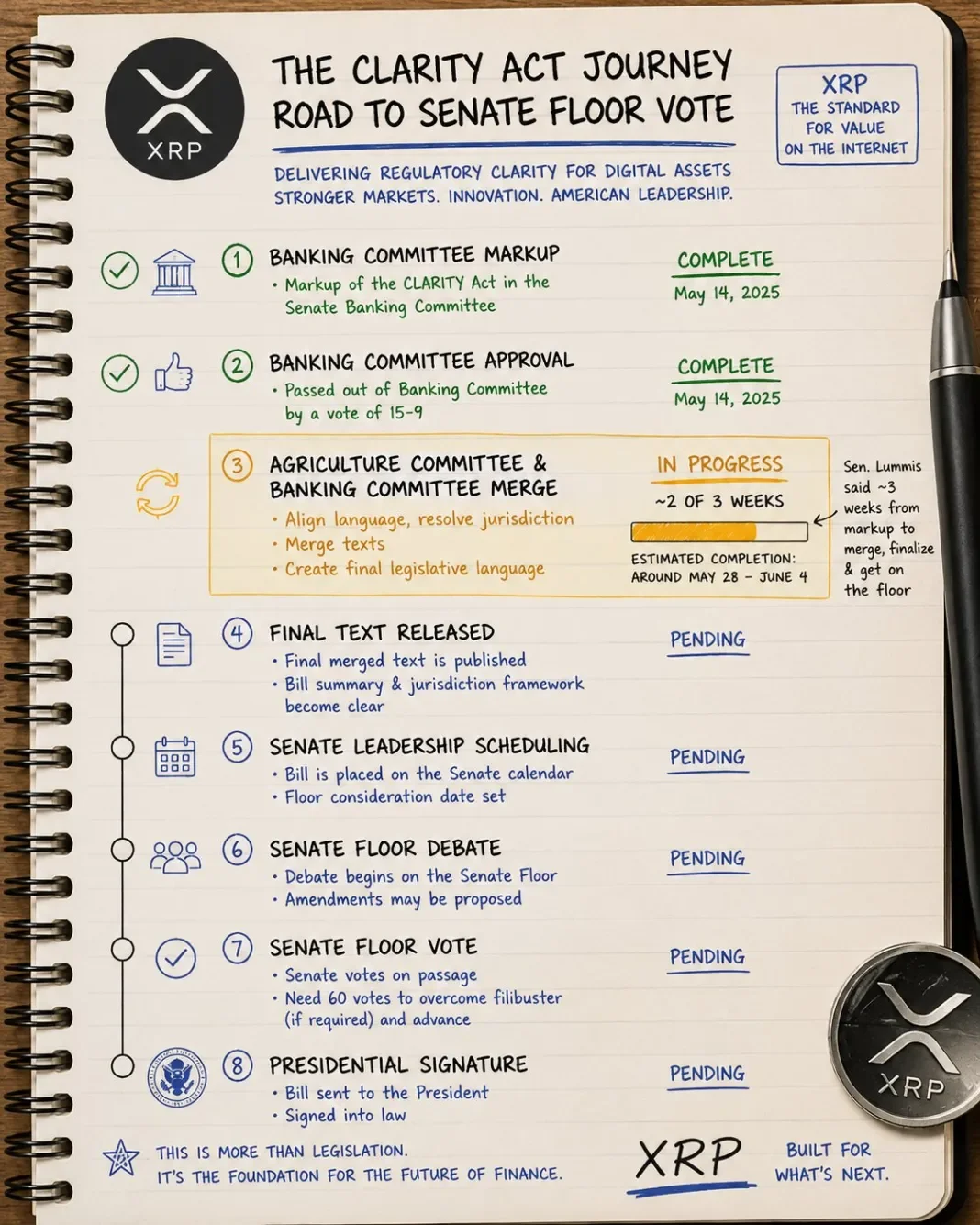
Senator Lummis said after markup that it could take around 3 weeks to:
merge the language,
finalize the text,
and attempt to get it on the Senate floor.
Today marks the 2-week point since markup… meaning we may be entering the most important stretch of the process right now. This isn’t just XRP people watching anymore:
the White House is talking crypto,
the SEC is talking crypto,
the CFTC is talking crypto,
senators are publicly engaging,
and industry leaders are openly pushing for regulatory clarity.
“When does this become a live Senate floor event?” Because once that happens… the conversation changes completely.
Time is running short.
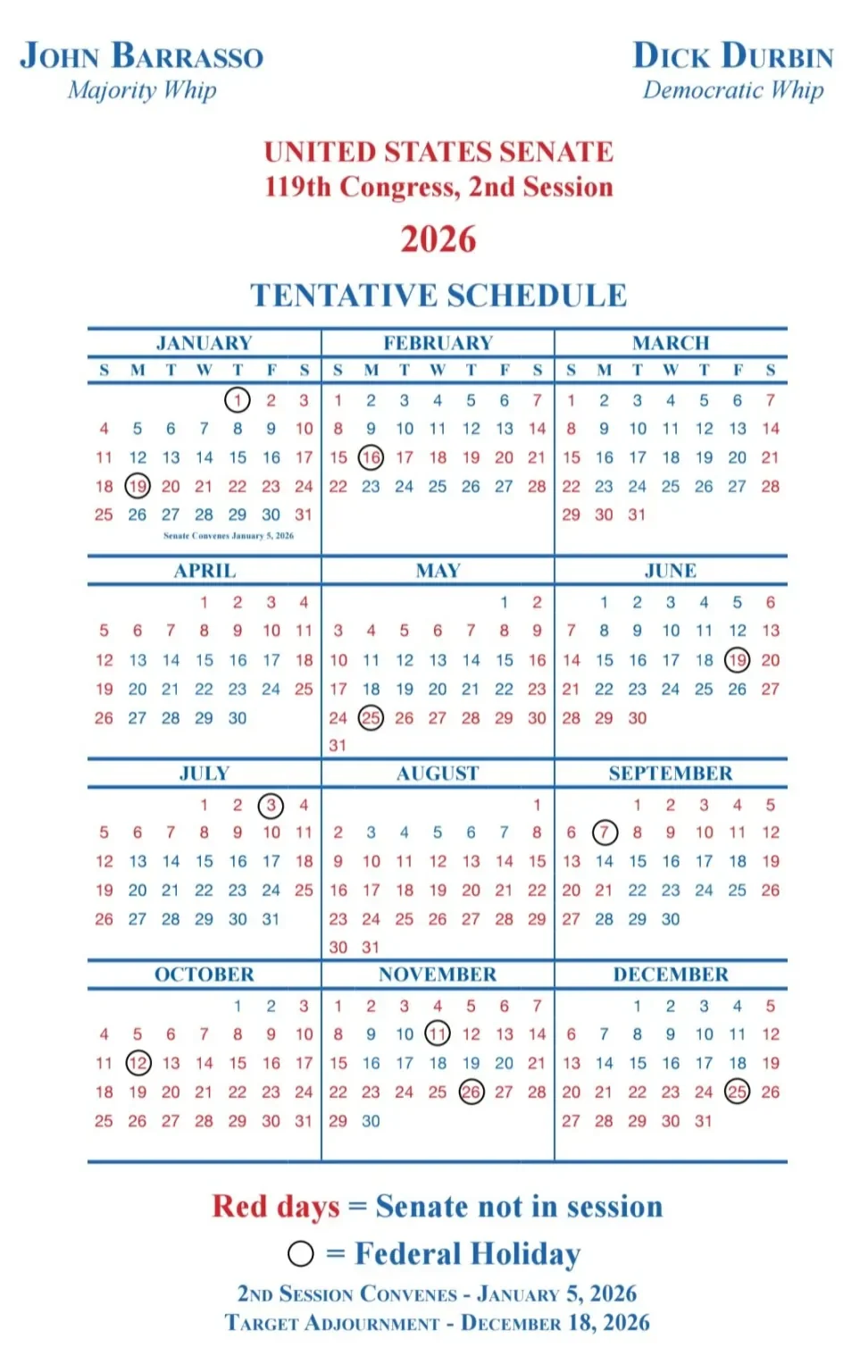
Congress is scheduled to return from the Memorial Day recess on Tuesday, June 3, 2026.
That’s one reason a lot of crypto watchers are circling the first half of June- possible merged CLARITY Act text, and potential Senate floor scheduling activity.
If leadership wants movement before the July 4th recess as President Trump wants, June becomes the key working window.
All eyes on Crypto from June 4th-June 26th.
US Senate Banking Committee: Chairman @SenatorTimScott agrees with @USTreasury@SecScottBessent: it is time to make America the crypto capital of the world. That is why he advanced the Clarity Act through a bipartisan markup to deliver clear rules of the road and bring crypto innovation onshore.
Watch on X: https://twitter.com/i/status/2060075047138603133
Source(s):
• https://x.com/StephanieStarrC/status/2060040781012881438
America Is Doing Exactly What It Did In 1970. The $100 Trillion Currency Collapse
America Is Doing Exactly What It Did In 1970. The $100 Trillion Currency Collapse
Unfolded Finance: 5-29-2026
On August 15th, 1971, Richard Nixon went on television and told the world the dollar would no longer be convertible to gold. He called it temporary. It wasn't.
What followed was the 1970s — a decade of inflation, dollar erosion, and a grinding destruction of savings that only ended when Paul Volcker raised rates to 20% and accepted a brutal recession.
America Is Doing Exactly What It Did In 1970. The $100 Trillion Currency Collapse
Unfolded Finance: 5-29-2026
On August 15th, 1971, Richard Nixon went on television and told the world the dollar would no longer be convertible to gold. He called it temporary. It wasn't.
What followed was the 1970s — a decade of inflation, dollar erosion, and a grinding destruction of savings that only ended when Paul Volcker raised rates to 20% and accepted a brutal recession.
The fix worked because federal debt was 32% of GDP. Volcker's medicine was survivable. America's federal debt today is 124% of GDP. Annual interest payments have crossed $1.1 trillion — more than the entire defense budget.
Add unfunded Social Security and Medicare obligations and the total gap between what America has promised and what its revenues can cover exceeds $100 trillion.
The structural over-commitment that forced Nixon's hand in 1971 is running again — not as a formal gold window closure, but as a continuous, gradual, almost invisible detachment of the dollar from the fiscal discipline that gives a fiat currency its long-term credibility.
The 1970s fix isn't available this time. The debt is too large to survive the interest rates that previously cured the inflation.
What You'll Learn:
▸ Why Bretton Woods worked for 25 years — and the specific mechanism that made it structurally impossible to maintain after 1968
▸ Why Nixon's gold window closure was not recklessness — and what "controlled default vs uncontrolled default" actually meant in August 1971
▸ How the 1970s affected ordinary Americans who had done everything right by the standards of the previous system
▸ Why today's structural gap — $36T debt, $1.1T interest, $80T unfunded liabilities — replicates 1971's gold gap at $100 trillion scale
▸ What "financial repression" means in practice — and why it is the mechanism that resolves the current gap without a formal announcement
▸ Why Volcker's 1982 fix is structurally unavailable at 124% debt-to-GDP — and what that means for the resolution that comes instead
▸ What the 1970s looked like from inside — and why the decade was only named in retrospect by people who lived through it without knowing
The Timeline:
1944 — Bretton Woods establishes dollar-gold convertibility at $35/oz; global reserve system built on this promise
1965-1968 — Vietnam spending and Great Society programs create structural deficit; dollar claims begin exceeding gold reserves
1969-1971 — France demands gold for dollars; Fort Knox visibly draining; gap between promise and reserves becomes unsustainable
August 15, 1971 — Nixon closes gold window; Bretton Woods ends; dollar floated 1973 — First oil shock; dollar weakness compounds inflation
1974-1979 — Stagflation decade; CPI triples; dollar loses 35% against major currencies
1979-1981 — Volcker raises rates to 20%; brutal recession; debt at 32% GDP makes medicine survivable
1982 — Inflation broken; dollar credibility restored; reconstruction complete
2008-2022 — Fed balance sheet grows
$900B to $8.9T; structural deficit becomes permanent
June 2022 — CPI peaks 9.1%; 40-year inflation high
2025 — $36.2T debt; $1.1T interest payments exceed defense budget; $9T maturing debt refinancing at high rates
America is making the same decision again. Not in a conference room on a Sunday night. In every budget resolution that doesn't close the gap.
Seeds of Wisdom RV and Economics Updates Friday Afternoon 5-29-26
Good Afternoon Dinar Recaps,
XRP Enters Mainstream Banking as SoFi Expands Crypto Access to Millions
The addition of XRP to a federally chartered U.S. bank signals growing integration between digital assets and traditional finance.
Good Afternoon Dinar Recaps,
XRP Enters Mainstream Banking as SoFi Expands Crypto Access to Millions
The addition of XRP to a federally chartered U.S. bank signals growing integration between digital assets and traditional finance.
Overview
SoFi has reportedly become the first nationally chartered U.S. bank to support XRP deposits, giving approximately 13.7 million customers access to buy, sell, and hold XRP directly through its banking platform. The move marks another step toward the integration of cryptocurrency into regulated financial infrastructure and highlights the growing convergence between traditional banking and digital assets.
Key Developments
1. SoFi Adds XRP Access for 13.7 Million Customers
SoFi confirmed that users can now deposit and manage XRP alongside cryptocurrencies such as Bitcoin, Ethereum, and Solana. Because SoFi operates as a federally regulated financial institution under oversight from the Office of the Comptroller of the Currency, the move is being viewed as a significant milestone for mainstream crypto adoption.
2. XRP Moves Closer to Traditional Financial Integration
Unlike crypto-native exchanges, SoFi provides banking, lending, savings, and investment services in one platform. Analysts say adding XRP into a familiar banking application lowers barriers for everyday users who may have avoided separate crypto exchanges or external wallets.
3. Institutional Interest in XRP Ledger Continues Growing
There is increasing institutional attention surrounding the XRP Ledger and tokenized assets. Reports from the Digital Assets Forum 2026 noted expanding use cases involving cross-border payments, tokenization, and transparent settlement systems.
4. Crypto Adoption Continues Expanding Inside Regulated Finance
SoFi’s gradual rollout of cryptocurrencies reflects a broader trend of regulated institutions slowly embracing digital assets. Industry observers believe this may encourage additional banks and financial firms to explore similar integrations as demand for digital asset services grows.
Why It Matters
The integration of XRP into a federally chartered banking institution represents another step toward the normalization of digital assets within traditional finance. As cryptocurrencies become more accessible through regulated platforms, the line between conventional banking and blockchain-based finance continues to narrow.
Why It Matters to Foreign Currency Holders
Expanding digital asset adoption could increase interest in alternative financial systems
Cross-border payment technologies may challenge portions of the traditional banking structure
Greater institutional participation may accelerate discussions surrounding tokenized finance and settlement systems
Implications for the Global Reset
Pillar 1: Digital Asset Integration Into Banking
The move suggests traditional financial institutions are becoming more willing to incorporate blockchain-based assets into everyday banking infrastructure.
Pillar 2: Evolution of Cross-Border Financial Systems
Growing use of blockchain payment networks and tokenized assets may gradually reshape how international transactions and settlements are processed in the future.
Closing Insight
While XRP’s addition to SoFi does not replace the traditional banking system, it demonstrates how digital assets are steadily moving deeper into regulated financial environments. The broader trend suggests that blockchain technology is becoming increasingly difficult for mainstream finance to ignore.
This is not just crypto adoption — it’s another step toward merging digital assets with the future of global finance.
Seeds of Wisdom Team
Newshounds News™ Exclusive
Sources
~~~~~~~~~~
Seeds of Wisdom Team RV Currency Facts Youtube and Rumble
Newshound's News Telegram Room Link
RV Facts with Proof Links Link
RV Updates Proof links - Facts Link
Follow the Gold/Silver Rate COMEX
Follow Fast Facts
Seeds of Wisdom Team™ Website
Thank you Dinar Recaps
Seeds of Wisdom RV and Economics Updates Friday Morning 5-29-26
Good Morning Dinar Recaps,
Dollar Weakens as US-Iran Ceasefire Hopes Shift Global Market Sentiment
Easing Middle East tensions are reducing safe-haven demand for the dollar while reshaping expectations for oil, inflation, and global capital flows.
Good Morning Dinar Recaps,
Dollar Weakens as US-Iran Ceasefire Hopes Shift Global Market Sentiment
Easing Middle East tensions are reducing safe-haven demand for the dollar while reshaping expectations for oil, inflation, and global capital flows.
Overview
The U.S. dollar moved toward a weekly decline today as reports of a potential 60-day ceasefire extension between the United States and Iran improved investor confidence and reduced demand for safe-haven assets. Falling oil prices and easing fears surrounding the Strait of Hormuz helped calm global markets, while investors increasingly focused on inflation, interest rates, and long-term diversification away from dollar-based assets.
Key Developments
1. Dollar Heads for Weekly Loss as Risk Appetite Improves
The U.S. dollar weakened against several major currencies after reports suggested Washington and Tehran were moving closer to extending their ceasefire agreement. The decline snapped a recent rally fueled by geopolitical tensions and reflected growing optimism that wider regional conflict may be avoided.
2. Oil Prices Fall Sharply on Diplomacy Hopes
Crude oil prices posted their steepest weekly decline since April as traders anticipated reduced disruption risks in the Strait of Hormuz. Lower energy prices immediately eased inflation concerns and weakened demand for the dollar as a defensive safe-haven currency.
3. Investors Begin Rotating Away From Defensive Positions
Currencies such as the Australian dollar, New Zealand dollar, euro, and yen strengthened modestly as market sentiment improved. Analysts noted that investors are gradually reducing defensive positions that were built during the height of Middle East tensions.
4. Structural Concerns About the Dollar Continue Growing
Despite relatively high U.S. interest rates, some global investors remain concerned about America’s rising debt levels, fiscal outlook, and long-term reserve currency dominance. This has contributed to ongoing discussions about diversification into alternative currencies and regional financial systems.
Why It Matters
The dollar’s decline demonstrates how quickly geopolitical developments can influence global financial markets. Reduced conflict risk lowers safe-haven demand, while falling oil prices may temporarily ease inflation pressures that have strained central banks and economies worldwide.
Why It Matters to Foreign Currency Holders
Increased potential for currency volatility tied to geopolitical developments
Growing investor focus on diversification beyond dollar-denominated assets
Lower oil prices may temporarily reduce inflation pressure across global economies
Implications for the Global Reset
Pillar 1: Reserve Currency Confidence Shift
Even modest dollar weakness highlights growing global discussions surrounding multi-currency trade systems and reserve diversification as countries seek alternatives to heavy dependence on U.S. financial markets.
Pillar 2: Geopolitics and Monetary Stability
The relationship between war risk, energy prices, and monetary policy continues showing how geopolitical events increasingly shape global liquidity, inflation trends, and investor behavior.
Closing Insight
Today’s market reaction reflects cautious optimism that diplomacy may temporarily stabilize one of the world’s most important geopolitical flashpoints. However, deeper concerns surrounding debt, inflation, and reserve currency confidence continue influencing long-term financial sentiment.
This is not just a weaker dollar — it’s a reminder that geopolitical stability and global currency confidence are becoming increasingly interconnected.
Seeds of Wisdom Team
Newshounds News™ Exclusive
Sources
~~~~~~~~~~
🌱 A Message to Our Currency Holders🌱
If you’ve been holding foreign currency for many years, you were not foolish.
You were not wrong to believe the global financial system would change.
What failed was not your patience — it was the information you were given.
For years, dates, rumors, and personalities replaced facts, structure, and proof. “This week” predictions created cycles of hope and disappointment that were never based on how currencies actually change.
That is not your failure.
Our mission here is different: • No dates • No rates • No hype • No gurus
Instead, we focus on:
• Verifiable developments • Institutional evidence
• Global financial structure • Where countries actually sit in the process
Currency value changes only come after sovereignty, trade, banking, settlement systems, and fiscal coordination are in place. History and institutions confirm this sequence.
You will see silence. You will see denials. That is not delay — that is discipline.
Protect your identity. Organize your documents. Verify everything.
Never hand your discernment to anyone who cannot show proof.
You deserve truth — not timelines.
Seeds of Wisdom Team
Newshounds News™
~~~~~~~~~~
Seeds of Wisdom Team RV Currency Facts Youtube and Rumble
Newshound's News Telegram Room Link
RV Facts with Proof Links Link
RV Updates Proof links - Facts Link
Follow the Gold/Silver Rate COMEX
Follow Fast Facts
Seeds of Wisdom Team™ Website
Thank you Dinar Recaps
Iraq Economic News and Points To Ponder Friday Morning 5-29-26
A US budget of $778.5 million to upgrade 5 military bases
Money and Business Economy News — Follow-up Pentagon documents for fiscal year 2027 show that the Missile Defense Agency requested $778.5 million in funding to upgrade the ground infrastructure of the missile defense system at five military bases.
The Russian news agency Novosti, after reviewing the documents, indicated that the Pentagon is seeking to upgrade five military bases to accommodate new interceptor missiles.
A US budget of $778.5 million to upgrade 5 military bases
Money and Business Economy News — Follow-up Pentagon documents for fiscal year 2027 show that the Missile Defense Agency requested $778.5 million in funding to upgrade the ground infrastructure of the missile defense system at five military bases.
The Russian news agency Novosti, after reviewing the documents, indicated that the Pentagon is seeking to upgrade five military bases to accommodate new interceptor missiles.
According to the documents, the modernization work will include Fort Greeley and Erickson Air Station in Alaska, Vandenberg Space Force Base in California, Fort Drum in New York, and the Missile Defense Integration and Operations Center in Colorado.
The funds are earmarked for upgrading fire control systems, protected networks, communication stations, and launch platforms.
The funding requested is roughly double last year’s budget of $390.1 million, with documents attributing the increased spending to the move toward a hybrid interceptor missile system, which includes the use of both the older generation (GBI) and the new generation (NGI).
Additional funds will also be allocated to enhance protection against cyber threats and to upgrade the communications network of the missile defense system.
This plan is the largest spending item within the overall budget for the US ground-based missile defense system for 2027, which amounts to $1.36 billion. https://www.economy-news.net/content.php?id=69625
Localities Economy News — Baghdad The Ministry of Construction, Housing and Municipalities confirmed on Friday that the closure of the Hamrin Bridge was a precautionary measure to preserve the safety of citizens, stressing that the bridge structure and concrete supports are completely safe.
Ministry spokesman Nabil Al-Saffar said, “Erosion occurred in the approaches to the Hamrin Bridge because they are earthen dams that were not protected by implementing cladding for the side slopes of the dam,” explaining that “the rise in the water level of Lake Hamrin caused the erosion of the edges of the earthen approaches.”
He added that "the project has reached 89% completion and has not yet been fully completed, and that the previous opening of the bridge was a temporary opening."
Al-Saffar pointed out that “the Diyala Roads and Bridges Directorate sent a letter to the Diyala Governor’s office, the Operations Command, and the Police Command to close the bridge, based on the directives of the Roads and Bridges Department, in order to preserve the safety of road users,” stressing that “the bridge body is structurally sound at 100%, and the concrete supports are also sound, and the problem is limited to the dirt approaches only.”https://www.economy-news.net/content.php?id=69627
France Freezes €4 Billion In Government Spending To Offset Losses Related To The Middle East Conflict
Arabic and international
Economy News — Follow-up Media reports, quoting French Finance Minister David Amiel, revealed that the Finance Ministry has decided to freeze government spending of nearly 4 billion euros to compensate for the country’s losses related to the repercussions of the conflict in the Middle East, while keeping the defense and justice budgets unchanged.
Amil explained that the Ministry of Economy and Finance revealed yesterday a plan to freeze state budget allocations worth 3.2 billion euros, in addition to canceling additional allocations of about 847 million euros, as part of measures aimed at containing the costs resulting from the war in the region, according to French media.
This measure complements a previous government plan that saved an estimated 2.2 billion euros, obtained by freezing the reduction in social security contributions for low-wage workers, which was announced by the French government last week.
The French government expects to achieve savings of €6 billion, distributed between €4 billion from the budgets of most ministries and €2 billion from social spending. However, the budgets of the Ministries of Defense and Justice will not be reduced.
The Ministry of Finance indicated that these measures are temporary in nature, noting the possibility of lifting the freeze on funds during the current year depending on developments. A new meeting is scheduled for the end of June to discuss the upcoming emergency austerity measures .
https://www.economy-news.net/content.php?id=69626
The Civil Service Council Announces The Completion Of All Procedures Related To The Employment File And Is Awaiting The 2026 Budget.
Localities Economy News — Baghdad The Federal Public Service Council announced on Friday that it has completed all the technical procedures related to the employment file, while making the launch of appointments and the application form contingent on 3 main axes.
Council spokesman Fadel Abdul Zahra Al-Gharawi said, according to the official agency, that "the launch of the new appointments and the electronic application form is linked to several factors and is not limited to the technical aspect only."
He added that “appointments in state institutions are linked to three main axes: firstly, the availability and creation of job positions; secondly, the provision of the necessary financial allocations, which is directly related to the 2026 budget and what it will include in terms of job positions and financial allocations; and thirdly, the need of ministries and government agencies for the required specializations according to their plans and job structure.”
Al-Gharawi pointed out that "the Federal Public Service Council has completed, from a technical standpoint, all procedures related to employment files, application mechanisms, and the employment form. However, the Council is still waiting for the approval of the 2026 budget and the financial allocations and new job grades that will be included in it in order to begin the technical procedures related to the employment file."
He stressed that "the council is keen on all its graduate students, and works according to national and professional responsibility in managing the employment file, adopting the principles of transparency, integrity, justice and equality in all application, nomination and distribution procedures, in order to ensure equal opportunities for all."
Friday Iraq News Posted by Tishwash at TNT
TNT:
Tishwash: Al-Zidi and Al-Sudani affirm their support for development plans and the completion of the government formation.
Prime Minister Ali Faleh al-Zaidi and the head of the Reconstruction and Development Coalition, Mohammed Shia al-Sudani, stressed on Thursday the importance of continuing to support the government in implementing its development programs and completing the government formation, in line with the aspirations of the Iraqi public.
The Prime Minister’s Media Office stated in a statement that “Prime Minister Ali Faleh Al-Zaidi met today with the head of the Reconstruction and Development Coalition, Mohammed Shia Al-Sudani.”
TNT:
Tishwash: Al-Zidi and Al-Sudani affirm their support for development plans and the completion of the government formation.
Prime Minister Ali Faleh al-Zaidi and the head of the Reconstruction and Development Coalition, Mohammed Shia al-Sudani, stressed on Thursday the importance of continuing to support the government in implementing its development programs and completing the government formation, in line with the aspirations of the Iraqi public.
The Prime Minister’s Media Office stated in a statement that “Prime Minister Ali Faleh Al-Zaidi met today with the head of the Reconstruction and Development Coalition, Mohammed Shia Al-Sudani.”
The statement added that “the meeting witnessed an exchange of greetings on the occasion of Eid al-Adha, and a review of the most prominent developments on the national scene, in addition to stressing the importance of maintaining understandings between the political parties to complete the formation of the government, and stressing support for the government in implementing its development plans, in a way that meets the aspirations of the Iraqi people.” link
************
Tishwash: An economist says: Borrowing narrows Iraq's economic options, and the solution lies in rationalizing spending.
Economic expert Manar Al-Obaidi confirmed that the continued decline in oil revenues and the government's inability to compensate for them with alternative sources has limited the available economic options to a narrow corner, making borrowing the only way to cover monthly expenses amounting to about ten trillion dinars.
Al-Ubaidi explained in a statement, a copy of which was received by Al-Furat News, that "borrowing is not a radical solution, but rather may become a factor exacerbating the crisis." He pointed out that public debt interest reached approximately seven trillion dinars in 2025 and is expected to exceed ten trillion dinars this year, equivalent to about 10% of total mandatory operating expenses.
He indicated that "the danger of the current path lies in the possibility that the government will reach a stage where it borrows to pay debt interest instead of funding public services." He stressed that the real solution lies in rationalizing operating expenses, primarily salaries and social welfare, emphasizing that there is ample room for reform without affecting the citizen's standard of living.
Al-Ubaidi cited the success of audits in the social welfare program during the first quarter of this year, which saved approximately 700 billion dinars. This means that more than 2.8 trillion dinars could be saved annually simply by partially reviewing beneficiary data. He questioned the size of the savings that could be achieved if the review included salaries and other areas of expenditure.
Al-Ubaidi concluded that the economic equation imposes two options, with no third alternative. Either we continue borrowing and turn debt into a structural constraint for decades to come, or we control and rationalize spending in pursuit of a gradual balance that protects the economy and the citizen’s standard of living, far from excessive optimism based on inaccurate impressionistic readings. link
************
Tishwash: European Center: The US Federal Reserve is the only current "way out" of Baghdad's economic crisis
The European Center for Economic Guarantees, Credendo, revealed in a report published today, Tuesday, May 26, 2026, the "depth of the crisis" that Iraq is going through during the current and upcoming stage, stressing that the government in Baghdad "needs" the US Federal Reserve.
The center said, according to what was translated by “Baghdad Today”, that the economic shock resulting from Iraq’s loss of its ability to export its oil as a result of the closure of the Strait of Hormuz is still “not fully apparent”, stressing that the consequences will include “enormous financial pressure on liquidity and difficulty in meeting the government’s financial obligations in the public sectors, in addition to a significant decline in the value of the Iraqi dinar and a rise in inflation rates.”
He continued, "The outlook for the economic situation in Iraq appears to be highly difficult and challenging, especially if the current crisis in the Strait continues or the region witnesses a new escalation of violence, which could lead to permanent damage to the Iraqi oil sector that cannot be repaired or avoided."
He added, "Even if the United States and Iran reach a preliminary agreement to halt the war for a short period of time, restarting the oil fields will be extremely difficult, in addition to the risk of the conflict resuming at any time, which makes the process of resuming production and exporting again a major challenge for the Iraqi government."
The center confirmed that the Iraqi government has an economic "way out" of the current crisis, represented by the large foreign financial reserve it possesses in hard currency, which it can use as a barrier to protect the Iraqi economy from the most serious consequences of the cessation of exports for a period of time that could reach months, stressing, "This reserve is not in Iraq's possession."
The center also clarified that Iraq’s large financial reserves are held with the US Federal Reserve in New York and not with the Central Bank of Iraq, which makes the use of those funds, with its long-term risks and short-term benefits, subject to a US decision.
The center indicated that the United States is aware of Iraq’s need for the large financial reserves held by the Federal Reserve, which led to “Washington using it as a political pressure tactic against the Iraqi government to push it to dissolve the factions, something that became very clear during Washington’s imposition of restrictions on cash dollar transfers to Iraq, which placed further financial restrictions on the Iraqi government.”
The center noted at the end of its report that Iraq’s temporary and currently available way out of the financial crisis, represented by the dollar reserves at the US Federal Reserve, carries another risk, explaining, “If Washington imposes economic sanctions on Iraq, the country will not be able to access the reserves of funds that it may use to finance its work for the coming months,” as it described it.
It is noted that political analysts have spoken about conducting governmental and party negotiations and discussions to reach an agreement to integrate the armed factions into a new security ministry in order to avoid American restrictions and possible sanctions on the economy. link
************
Tishwash: The debt trap threatens Iraq... Will the government borrow to pay off loan interest?
Economic expert Manar Al-Obaidi warned against the government resorting to internal or external borrowing after the deficit caused by the decline in oil revenues. He said that borrowing, if continued for long periods, is a factor that exacerbates the crisis, as it increases the burden of mandatory operational expenses represented by interest on accumulated debts. What is more dangerous, according to him, is the possibility of reaching a stage where the government is forced to borrow not to finance public services, but only to pay the interest on its debts.
Al-Obaidi stressed that the real solution is to rationalize operational expenses, especially the files of salaries and social welfare, which many avoid for fear of popular reactions, indicating that Iraq needs to conduct an oversight review of these files without affecting the citizen’s livelihood and dignity.
On May 21, 2026, the Governor of the Central Bank, Ali Al-Alaq, revealed that the general budget deficit had turned into an “actual and chronic deficit” reflecting a flaw in the structure of the economy due to the complete dependence on oil revenues, stressing that the country may resort to external borrowing to cover this deficit and finance development requirements after the ability of government banks to lend reached its maximum limits.
Al-Ubaidi stated in a report, which was followed by 964 Network:
Between borrowing and spending pressure: Where does the Iraqi economy stand?
With the continued decline in oil revenues and the Iraqi government’s inability to compensate for this shortfall from alternative sources, the available solutions are becoming increasingly limited, to the point where borrowing is almost the only unavoidable option.
The fact that everyone is aware of is that monthly expenses amount to about ten trillion dinars that can only be covered through one channel in the absence of oil, which is borrowing, whether internal or external. However, borrowing is not the magic solution that saves the economy, but rather, if it continues for long periods, it may be a factor that multiplies the crisis, as it increases the burden of mandatory operating expenses represented by the interest on accumulated debts.
Public debt interest payments reached approximately seven trillion dinars in 2025, and these interest payments are expected to rise this year to more than ten trillion dinars, equivalent to about 10% of total mandatory operating expenses. This is in light of the continuous increase in the size of public debt and the possibility of resorting to more borrowing in the coming months. These expenses will remain binding on any present or future government as long as debt levels remain high. Indeed, the danger of the current path lies in the possibility of reaching a stage where the government is forced to borrow not to finance public services, but only to pay the interest on its debts. This is a path that several countries have taken and paid a heavy price for.
From this it becomes clear that borrowing in itself is not a structural solution, and that the real, unavoidable solution is to rationalize operational expenditures, foremost among them the issue of salaries and social welfare, an issue that many avoid approaching for fear of popular reactions. However, the available data indicates that the scope for reform is wide, and does not necessarily require affecting the citizen's standard of living. Comparing social welfare expenditures in the first quarter of this year with the same period last year revealed a decrease of about 700 billion dinars, achieved simply by conducting preliminary audits. This means that what was saved at the annual level may exceed 2.8 trillion dinars from just a partial review of beneficiary data. So what will the situation be when the review includes the salary file and all other aspects of government spending?
In short, the equation allows for only two options, and no third:
- Continuing to borrow until the public debt file becomes a structural constraint that burdens any government for decades to come.
Controlling and rationalizing spending and striving for a gradual balance between expenditures and revenues in ways that preserve the dignity of the citizen and protect his standard of living.
As for the excessive optimism that is sometimes promoted as easy and quick solutions, its source is mostly an impressionistic reading of the scene, not a numerical reading, that measures the amount of interaction, not the amount of accuracy. link
Iraq Economic News and Points To Ponder Thursday Afternoon 5-28-26
Iraq To Probe Major State Contracts In Corruption Crackdown
2026-05-28 Shafaq News- Baghdad Iraqi Prime Minister Ali Al-Zaidi on Thursday ordered corruption investigations into several major government contracts as part of his new administration’s anti-corruption campaign and “efforts to protect public funds.”
Al-Zaidi directed oversight authorities and law enforcement agencies to examine contracts previously signed by ministries and state institutions to determine whether they “complied with Iraqi laws, safeguarded public interests, and resulted in financial harm to the state.”
Iraq To Probe Major State Contracts In Corruption Crackdown
2026-05-28Shafaq News- Baghdad Iraqi Prime Minister Ali Al-Zaidi on Thursday ordered corruption investigations into several major government contracts as part of his new administration’s anti-corruption campaign and “efforts to protect public funds.”
Al-Zaidi directed oversight authorities and law enforcement agencies to examine contracts previously signed by ministries and state institutions to determine whether they “complied with Iraqi laws, safeguarded public interests, and resulted in financial harm to the state.”
The investigations will also seek to identify those who benefited from the contracts “at the expense of the public interest,” in addition to uncovering negligence, abuse of authority, and potential misuse of public funds.
Although Al-Zaidi’s office did not offer further details, the investigations could affect contracts tied to infrastructure, procurement, energy, and public spending at a time when the government has pledged to attract foreign investment and reform state institutions.
After taking office earlier this month, Al-Zaidi described corruption as “an obstacle to development that delays the progress of the state” and vowed to “protect public funds and pursue administrative and financial corruption in all its forms.”
Iraq ranked 136th globally in Transparency International’s 2025 Corruption Perceptions Index with a score of 28 out of 100, keeping Iraq among the world’s lowest-ranked countries in public-sector transparency and making corruption one of the country’s most persistent political and economic challenges despite repeated reform campaigns launched by successive governments since 2003.
The country has also faced repeated corruption scandals in recent years, including the 2022 “theft of the century” case involving roughly $2.5 billion in missing tax funds, one of the largest financial scandals in modern Iraqi history.
Read more: Iraq's corrupt maze: Oil, bribes, and broken trust
https://www.shafaq.com/en/Economy/Iraq-to-probe-major-state-contracts-in-corruption-crackdown
Oil Prices Surge 3% On US-Iran Military Clash
2026-05-28Shafaq News Oil prices jumped more than 3% on Thursday after Iran's Revolutionary Guards said they targeted a U.S. airbase in response to a U.S. attack near Bandar Abbas airport.
Brent crude futures rose $3.51, or 3.72%, to $97.8 a barrel by 0344 GMT, while the more active August contract gained $3.35 or 3.63%, to $95.6. The July contract is set to expire on Friday.
The U.S. West Texas Intermediate futures were up $3.31, or 3.73%, at $91.99.
Both benchmarks slipped more than 5% to touch their lowest in a month in the previous session on the possibility of a U.S.-Iran deal to end their war and reopen the Strait of Hormuz.
Iran's Revolutionary Guards said on Thursday they targeted a U.S. airbase after what they described as an early morning U.S. attack near Bandar Abbas airport, Tasnim news agency reported.
They warned that any repeat of what they called aggression would draw a "more decisive".
The U.S. military launched new strikes in Iran targeting a military site that officials believed posed a threat to U.S. forces and commercial maritime traffic in the strait, a U.S. official told Reuters.
"Oil supply remains constrained, and key sticking points have yet to be resolved," ANZ commodity strategist Daniel Hynes said in a note.
In the U.S., crude oil stockpiles fell by 2.8 million barrels last week, the sixth straight week of declines, according to American Petroleum Institute data.
Official inventory data from the U.S. Energy Information Administration are due on Thursday, a day later than usual due to the Memorial Day holiday on Monday.
(Reuters) https://www.shafaq.com/en/Economy/Oil-prices-surge-3-on-US-Iran-military-clash
Prime Minister's Advisor: Iraq Is On The Verge Of Major Economic Changes Under The Guidance Of Al-Zaidi
Baghdad Today - Baghdad:The Prime Minister's Advisor for Financial Affairs, Mazhar Muhammad Saleh, confirmed on Wednesday (May 27, 2026) that Iraq is going through an important transitional phase at the economic level, noting that the directives of Prime Minister Ali al-Zaidi have brought about a shift in the philosophy of managing the state's financial and economic affairs, which paves the way for broad transformations during the coming period.
Saleh said in a statement followed by “Baghdad Today” that “Al-Zidi assigned the Minister of Finance the duties of Deputy Chairman of the Ministerial Council for the Economy, which is a measure that reflects the philosophy of the modern state that sees the Ministry of Finance as a sovereign institution concerned with planning the economic future, and not just an entity for distributing salaries.”
He pointed out that "Iraq is about to undergo broad changes in its economic structure," noting that "the Prime Minister has asked the Ministry of Finance to prepare a long-term plan and move from the role of treasurer to a ministry that leads the reform of the philosophy of the economic system and creates a balanced partnership between the state and the market, within the framework of Iraq Vision 2035."
Saleh explained that "the Ministerial Council for the Economy has become the main engine for economic policies, and that it will lead the next phase by transforming temporary solutions into sustainable institutional work aimed at reforming the structure of the national economy."
He also explained that "implementation includes comprehensive oversight extending from the Financial Control Bureau to ministries such as industry and agriculture, reaching the oversight of financial markets," stressing that "the citizen is the primary goal of development programs and improving the standard of living."
In the same context, Saleh stressed that “the Central Bank of Iraq is independent in its work, but it coordinates within the Ministerial Council for the Economy, which is headed by the Ministry of Finance,” explaining that “there is a Council for Economic, Monetary and Financial Stability in which all essential economic files are presented.”
https://baghdadtoday.news/300161-.html
Integrity Commission Foils Attempt To Seize 1.5 Trillion Dinars From Rafidain And Rasheed Banks In Baghdad
Thursday, May 28, 2026 10:47 | General Baghdad/ NINA /The Federal Integrity Commission announced the thwarting of an attempt to seize one and a half trillion dinars from Al-Rafidain and Al-Rasheed banks in Baghdad.
The Commission stated in a press release that "the field team in the Baghdad Investigation Directorate, in direct coordination with the competent judicial authorities, went to Al-Rafidain Bank/General Administration, where, after monitoring and investigation, they were able to apprehend (3) defendants in possession of forged statements and checks which they intended to cash illegally.
" The statement further indicated that "(7) forged checks, allegedly issued by Al-Rasheed and Al-Rafidain Banks, with a total amount of approximately one and a half trillion dinars, were seized, intended for the benefit of the defendants."
It explained that "during the operation, which was carried out in accordance with the provisions of Articles (298 and 289) of the Penal Code, the original contract for the sale of a deposit in the name of one of the defendants for the amount of (612,000,000,000) dinars was seized." The statement noted that "the defendants confessed to attempting to process the check cashing transaction in violation of the law."
It also indicated that "coordination with the management of Al-Rafidain Bank was underway." The investigation uncovered the forged checks, and initial inquiries by the team revealed no such sums or accounts belonging to the accused.
A formal seizure report was prepared and presented, along with the accused, before the judge of the Second Karkh Investigation Court, which specializes in integrity cases. The judge ordered their detention pending the completion of investigative procedures. /End 2. https://www.ninanews.com/Website/News/Details?Key=1298228
Prime Minister: Confining Weapons To The State Is A Decision, Not An Option, And Boosting Investment Is A Government Priority
Baghdad - One News 5/28/2026 Prime Minister Ali Falih Al-Zaidi received a group of tribal sheikhs and dignitaries today on the occasion of Eid al-Adha, stressing the government’s continued commitment to implementing the project of restricting weapons to the state and enhancing security and economic stability in the country.
The Prime Minister said that the government “is proceeding with the project called for by the Supreme Religious Authority, which stipulates that weapons be restricted to the state,” stressing that “the state must be the only entity that has a monopoly on weapons, and that the possession of force must be limited to state institutions, and this is a decision, not an option.”
He stressed the importance of preventing the spread of weapons and their use in random shooting or tribal conflicts, calling on Iraqi tribes to play a greater role in supporting security and stability and preventing any violations that threaten the country’s security.
On the political and economic front, the Prime Minister explained that Iraq continues to strengthen its relations and cooperation with the international community, noting that the government is working on “drawing a new economic identity for Iraq and moving away from the socialist mentality by attracting global companies to invest.”
He added that the government will not allow any cases of extortion or obstruction of the work of foreign companies inside Iraq, stressing the provision of a stable investment environment that supports economic development and job opportunities.
He also stressed the importance of balance in political and social discourse and promoting coexistence among all components of the Iraqi people, in order to ensure the protection of citizens’ rights and consolidate national stability.
https://1news-iq.net/رئيس-الوزراء-حصر-السلاح-بيد-الدولة-قرا/
Bond Vigilantes Are Back: The Debt Bubble Is Breaking
Bond Vigilantes Are Back: The Debt Bubble Is Breaking
Lynette Zang: 5-28-2026
Rising interest rates, exploding debt, and stubborn inflation are putting enormous pressure on the global financial system.
In this livestream, Lynette Zang breaks down why bond markets are flashing warning signs, why Main Street is struggling while Wall Street celebrates, and why physical gold and silver demand continues rising worldwide.
Bond Vigilantes Are Back: The Debt Bubble Is Breaking
Lynette Zang: 5-28-2026
Rising interest rates, exploding debt, and stubborn inflation are putting enormous pressure on the global financial system.
In this livestream, Lynette Zang breaks down why bond markets are flashing warning signs, why Main Street is struggling while Wall Street celebrates, and why physical gold and silver demand continues rising worldwide.
Chapters:
0:00 Corporations Surviving on Borrowed Money
1:06 Bond Yields Break Out — Warning Sign for the Economy
2:04 Inflation Crushing Consumer Confidence
3:11 Why Wages Never Keep Up With Inflation
4:25 Producer Prices Signal More Inflation Ahead
5:21 Commodity Prices & the Inflation Breakout
6:29 Why Gold & Silver Prices Are So Volatile
8:22 “A Trillion Times Zero Is Still Zero”
9:27 Physical Silver Delivery vs Paper Contracts
10:37 Gold Contracts, Central Banks & Physical Demand
12:16 Global Gold Buying Surges in China, India & the U.S.
13:44 The “Two Economies” — Wall Street vs Main Street
16:18 CBDCs, Barter Systems & Financial Privacy
Seeds of Wisdom RV and Economics Updates Thursday Afternoon 5-28-26
Good Afternoon Dinar Recaps,
US-Iran Ceasefire Framework Emerges as Markets Watch for Regional Stabilization
A proposed 60-day truce between the United States and Iran could temporarily ease energy market fears and reduce pressure on the global financial system.
Good Afternoon Dinar Recaps,
US-Iran Ceasefire Framework Emerges as Markets Watch for Regional Stabilization
A proposed 60-day truce between the United States and Iran could temporarily ease energy market fears and reduce pressure on the global financial system.
Overview
The United States and Iran have reportedly reached an outline agreement for a potential ceasefire extension, pending approval from President Donald Trump. The proposed framework comes after renewed military exchanges in the region and includes a 60-day truce alongside discussions surrounding Iran’s nuclear program. Financial markets are closely watching the developments as stability in the Middle East directly impacts oil prices, inflation, and global investor confidence.
Key Developments
1. US and Iran Draft 60-Day Ceasefire Proposal
Officials from both sides have reportedly developed an outline agreement designed to extend the current ceasefire for 60 additional days. The proposal is intended to create space for broader diplomatic discussions while reducing the immediate risk of escalation.
2. New Military Strikes Highlight Fragile Conditions
The ceasefire talks come immediately after Iran reportedly attacked a U.S. air base in Kuwait following American strikes targeting an Iranian drone operation. U.S. Central Command stated that American forces intercepted multiple Iranian drones and struck launch infrastructure before additional attacks could occur.
3. Strait of Hormuz and Oil Markets Remain Central Concern
Although ceasefire discussions have improved market sentiment slightly, investors remain cautious because instability involving Iran continues to threaten the Strait of Hormuz, a critical global oil shipping route. Any disruption in the region has the potential to rapidly impact energy prices, inflation, and supply chains worldwide.
4. Regional Conflict Risks Continue Expanding
The broader conflict remains active beyond Iran and the United States. Israel has reportedly intensified strikes against Iran-linked Hezbollah targets in Lebanon, while Gulf nations continue increasing defensive measures amid fears of further regional escalation.
Why It Matters
A sustained ceasefire between the United States and Iran could temporarily reduce pressure on energy markets and inflation expectations, helping stabilize financial markets already dealing with high debt and elevated interest rates. However, the fragile nature of the agreement highlights how quickly geopolitical events can disrupt global economic stability.
Why It Matters to Foreign Currency Holders
Reduced conflict risk may temporarily support global market confidence
Oil-sensitive currencies could remain highly volatile depending on negotiations
Safe-haven demand may continue if the ceasefire weakens or collapses
Implications for the Global Reset
Pillar 1: Energy Stability and Inflation Control
A successful ceasefire could ease immediate inflationary pressure by helping stabilize oil flows and reducing fears of prolonged supply disruption.
Pillar 2: Geopolitical Influence on Financial Systems
The situation demonstrates how regional military conflicts now play a major role in shaping global monetary policy, investor behavior, and trade stability.
Closing Insight
While the proposed ceasefire offers a potential path toward de-escalation, the underlying tensions remain unresolved. Financial markets may respond positively in the short term, but the broader risks tied to energy security, regional instability, and geopolitical fragmentation continue to weigh heavily on the global financial outlook.
This is not just a ceasefire negotiation — it’s a reminder that geopolitical conflict now sits at the center of global financial stability.
Seeds of Wisdom Team
Newshounds News™ Exclusive
Sources
Modern Diplomacy — "Report: US-Iran Ceasefire Deal Takes Shape After New Strikes"
Reuters — "US and Iran work toward extending ceasefire after new regional attacks"
~~~~~~~~~~
Seeds of Wisdom Team RV Currency Facts Youtube and Rumble
Newshound's News Telegram Room Link
RV Facts with Proof Links Link
RV Updates Proof links - Facts Link
Follow the Gold/Silver Rate COMEX
Follow Fast Facts
Seeds of Wisdom Team™ Website
Thank you Dinar Recaps