
Thank you to all the subscribers to our Early Access program…we thank you for your continued support.
We are excited to offer this new service to keep you informed and up-to-date on the latest Dinar and currency news.
News, Rumors and Opinions Tuesday 10-28-2025
KTFA:
Clare: IMF forecasts: Iraq will be the fourth largest Arab economy by 2030.
10/28/2025
International Monetary Fund data predicts that Iraq will rank fourth among the largest Arab economies by 2023.
Saudi Arabia will top the list of the largest Arab economies by 2030, with a projected GDP of $1.6 trillion, cementing its position as the strongest economy in the region.
KTFA:
Clare: IMF forecasts: Iraq will be the fourth largest Arab economy by 2030.
10/28/2025
International Monetary Fund data predicts that Iraq will rank fourth among the largest Arab economies by 2023.
Saudi Arabia will top the list of the largest Arab economies by 2030, with a projected GDP of $1.6 trillion, cementing its position as the strongest economy in the region.
The UAE came in second place with approximately $765 billion, followed by Egypt in third place with $590 billion, Iraq with $346 billion, and Algeria with $309 billion.
The next highest rankings were held by Qatar with $297 billion, Morocco with $252 billion, and Kuwait with $190 billion. Oman followed with $133 billion, while Jordan rounded out the list with $74 billion.
The data indicated that these estimates are based on GDP at current prices, with expectations of increasing economic growth in a number of Arab countries until the end of the current decade.
The World Bank had previously predicted that Iraq would record the highest growth rate among Arab economies next year, at 6.7%, followed by Djibouti at 6.1%, and then Qatar at 5.3%, despite reducing its growth estimate by 0.1 percentage points from its June forecast.
The bank raised its growth estimates for Iraq by 2.3 percentage points, followed by Palestine by 1.1 percentage points, while Oman's growth forecast was reduced by 2.9 percentage points.
The three largest Arab economies—Saudi Arabia, the UAE, and Egypt—are expected to grow by 4.3%, 5%, and 4.3%, respectively, in 2026. LINK
************
Clare: The Central Bank announces that electronic trading has increased to $60 billion.
10/28/2025- Baghdad
The Central Bank of Iraq expects the volume of electronic payments to reach $60 billion by 2035, as part of a reform plan to gradually phase out paper cash transactions.
"As part of its reform plan, the bank is pursuing electronic transformation and financial inclusion, given its significant role in reducing reliance on paper cash transactions, which has significantly reduced the use of cash. It has encouraged all individuals today to increase their transactions and shift to electronic payments, particularly for salaries and government departments," bank spokesman Alaa Al-Fahd said, according to the official newspaper.
He added, "The bank is implementing a banking reform plan in cooperation with Oliver Wyman, which announced in its report a significant response from banks to the reform plan's implementation, expecting electronic payments to reach $60 billion by 2035."
Al-Fahd explained that "electronic payments have significantly reduced the printing of banknotes due to electronic transactions," noting that "there is an idea to move towards digital electronic banks and the significant role they play in reducing reliance on paper money."
He continued, "The development of electronic payments over the past three years has witnessed a qualitative leap and a very high growth rate, with the number of cards issued reaching more than 22 million, in addition to the import of more than 75,000 devices." He expected that "the future will bring even greater growth in the issue of electronic payments and transactions as an alternative to paper transactions." LINK
************
Courtesy of Dinar Guru: https://www.dinarguru.com/
Militia Man Are they going to tell us everything? Not a chance. Are they going to tell you when it revalues or what the exchange rate specifically is going to be? No. But they definitely give you indicators. And if you're savvy enough to be able to follow along...I think you'll get the big picture.
Nader From The Mid East The 50, 100 and 200's are out. Even the one, five exist already. The 5, 10, 25, 50, 100 and the 200s...I know what I'm talking about. I know that...The 50, 100 and 200 are out. The 5s and 10s and all that [lower denominations] are not out... The 25,000, 10,000, 5,000, 1,000 are still on. Everything is still on. That will not change till we change the rate
Frank26 [Iraq boots-on-the-ground report] FIREFLY: Baghdad channel one TV talks about the history of our coins and the years and the amounts when they first came out. We're all glued to the television. Very interesting. We don't see anything about the 50 but we are really paying attention to this about the coins. FRANK: After all this has been shown about the coins, what's next after the fils? IMO, nothing but the exchange rate. They are now down with the lower notes education IMO and the new exchange rate make all of this lower notes make sense...very very very soon.
************
Is Silver Poised To Make A Massive Reversion? Mike Maloney
10-28-2025
Buckle up for a deep dive into why both gold and silver are riding the wave of a global monetary shift.
In this episode of the Gold Silver Show, Mike & Alan break down:
• How physical demand (not just paper markets) is pushing precious-metals prices higher around the world.
• Why silver isn’t for the faint-hearted — it’s volatile, but offers enormous long-term potential if you hold strong.
• What central-bank gold accumulation tells us about the future of money.
• Why the gold-silver ratio matters — and how today’s extreme level might signal a dramatic upside for silver.
• The looming debt, inflation and fiat-currency risks that suggest we’re in a generational opportunity for precious-metals investors.
Californians Keep Finding Leftover Loot From The Gold Rush
Californians Keep Finding Leftover Loot From The Gold Rush — 1 man even bought a home with his spoils. How to cash in
Jing Pan Sat, October 25, 2025
It’s been more than 170 years since California’s Gold Rush — but locals are once again finding gold dust, flakes and even nuggets glittering in the state’s rivers.
“Gold’s all around,” said Manny Goza, a prospector sifting through the Bear River, in an interview with FOX40 News. (1) The low water levels during the fall make it easier to reach stretches of the river that are usually inaccessible.
Californians Keep Finding Leftover Loot From The Gold Rush — 1 man even bought a home with his spoils. How to cash in
Jing Pan Sat, October 25, 2025
It’s been more than 170 years since California’s Gold Rush — but locals are once again finding gold dust, flakes and even nuggets glittering in the state’s rivers.
“Gold’s all around,” said Manny Goza, a prospector sifting through the Bear River, in an interview with FOX40 News. (1) The low water levels during the fall make it easier to reach stretches of the river that are usually inaccessible.
For Goza, a builder by trade, panning for gold has paid off.
“I did it every day. I've been here since 2005, bought a house in 2010 because I could pay my bills off the gold,” he said. “When I’m not contracting, I’m here digging gold.”
With gold prices up more than 50% over the past 12 months, the precious metal is drawing renewed attention from locals looking for opportunity in their own backyard.
Goza said an “amateur” prospector can expect to make around $50 a day, while a more serious one might bring in “anywhere from $100 to $15,000.”
Just like the original gold rush nearly two centuries ago, striking it big often comes down to luck. One prospector recalled a moment when a golden nugget “just rolled out — it was completely round like a baseball and it was half gold.”
Still, the work can be grueling. As another prospector put it, gold “doesn’t jump into the pan.”
And payday is never a sure thing.
“It’s emotional, some days you find $15,000, some days you don’t find anything,” Goza said.
TO READ MORE: https://finance.yahoo.com/news/californians-keep-finding-leftover-loot-123300020.html
Expect Run To Gold, Not Dollars, In Coming Crisis | Matthew Piepenberg
Expect Run To Gold, Not Dollars, In Coming Crisis | Matthew Piepenberg
Liberty and Finance: 10-25-2025
Matthew Piepenburg of Von Greyerz joins Elijah K. Johnson to explain why the world is preparing for a very different kind of crisis than 2008.
Piepenburg argues that the next “uh-oh moment” in markets won’t trigger a flight to U.S. Treasuries or the dollar—but rather to gold. He contrasts views from analysts like Brent Johnson, explaining why even with a stronger DXY, gold could still rise.
Expect Run To Gold, Not Dollars, In Coming Crisis | Matthew Piepenberg
Liberty and Finance: 10-25-2025
Matthew Piepenburg of Von Greyerz joins Elijah K. Johnson to explain why the world is preparing for a very different kind of crisis than 2008.
Piepenburg argues that the next “uh-oh moment” in markets won’t trigger a flight to U.S. Treasuries or the dollar—but rather to gold. He contrasts views from analysts like Brent Johnson, explaining why even with a stronger DXY, gold could still rise.
Piepenburg also warns against waiting for the perfect entry point, saying long-term investors should focus on wealth preservation, not short-term price moves.
The ground beneath our global economy is shifting. Whispers of a looming market correction or even a full-blown credit crisis are growing louder, prompting investors to re-evaluate their traditional safe havens.
In a recent insightful discussion hosted by Elijah K. Johnson of Liberty and Finance, Matthew Piepenberg of Von Greer’s Gold offered a compelling perspective on the future of precious metals, particularly gold and silver, in this evolving landscape.
Piepenberg’s core message is clear: we are witnessing a secular bull market in gold, a long-term trend that remains firmly intact despite any short-term price volatility. He urges investors to shift their mindset, viewing gold not as a speculative commodity to be traded on daily swings, but as a strategic store of value, an asset to be held for decades, akin to a generational inheritance of wealth.
The macroeconomic forces at play are undeniable and paint a picture that strongly favors precious metals. Soaring US debt levels, the relentless debasement of fiat currencies, and a world increasingly navigating geopolitical complexities are collectively fueling a historic pivot towards gold. The traditional safe havens – the US dollar and treasury bonds – are facing unprecedented scrutiny.
A central theme of the discussion is the erosion of the US dollar’s purchasing power. Piepenberg highlights a growing global sentiment for a move away from the dollar and towards gold. This isn’t just theoretical; it’s evidenced by the significant accumulation of gold reserves by central banks worldwide. Furthermore, the very idea of gold-backed US treasury securities is now being openly discussed, a stark indicator of the shifting monetary paradigms.
The conversation even delved into the possibility of a gold revaluation by the US Treasury. Such a move, which would significantly increase the official price of gold, could be a strategy to grapple with the nation’s mounting debt. While speculative, it underlines the growing recognition of gold’s intrinsic monetary value.
The “exorbitant privilege” the US dollar has enjoyed as the world’s reserve currency is now under a microscope. Piepenberg points out its paradoxical effects, contributing to chronic trade deficits and the offshoring of manufacturing. As this privilege wanes, a multipolar global currency system is emerging, and gold is poised to play a pivotal role within it.
This raises a critical question for investors: will the US dollar and treasuries truly remain safe havens in the face of future crises? Piepenberg argues that while they may have served this purpose in the past, gold is increasingly becoming the preferred refuge for those seeking genuine security.
For those looking to navigate these turbulent economic waters, Piepenberg offers practical advice: focus on the long-term preservation of wealth. This means prioritizing physical precious metals and measuring your financial success not in the fluctuating units of fiat currency, but in the tangible ounces and grams of gold and silver.
He encourages investors to educate themselves about the historical cycles of currency debasement and to understand the unique, time-tested attributes of gold as a monetary asset. In an era of unprecedented economic uncertainty, understanding the power and potential of precious metals is not just prudent, it’s essential for safeguarding your financial future.
INTERVIEW TIMELINE:
0:00 Intro
1:30 Gold update
18:29 Reindustrialization
24:00 Gold is now #1 safe haven
“The System Is Ending” - Clive Thompson’s Final Warning on Gold & Fiat Collapse
“The System Is Ending” - Clive Thompson’s Final Warning on Gold & Fiat Collapse
ITM Trading: 10-26-2025
Clive Thompson, a former Swiss banker, shares hard-won lessons from decades on the inside: gold carried families through war, preserved wealth through collapse, and shielded everyday people through major crises.
Now, he’s warning that the fiat system is failing, and few are prepared.
“The System Is Ending” - Clive Thompson’s Final Warning on Gold & Fiat Collapse
ITM Trading: 10-26-2025
Clive Thompson, a former Swiss banker, shares hard-won lessons from decades on the inside: gold carried families through war, preserved wealth through collapse, and shielded everyday people through major crises.
Now, he’s warning that the fiat system is failing, and few are prepared.
In a world buzzing with fleeting trends and digital promises, some truths remain constant, shining brighter with each passing year. One such truth, the enduring value of gold, is championed by a man whose life has been inextricably woven with this precious metal for half a century:
Clive Thompson. A seasoned expert whose career has spanned from the trading floors of London to the secure vaults of Swiss private banking, Clive offers insights that are not just theoretical, but forged in the crucible of real-world experience.
Clive’s journey with gold began not in a bustling financial district, but with a simple yet profound lesson from his grandfather. Imagine being a child, presented with a choice: ephemeral paper money, fleeting chocolate, or a gleaming gold sovereign.
This early exercise in discernment laid the foundation for Clive’s lifelong understanding: gold possessed an intrinsic worth that paper currency, a mere promise, could never truly match. It was a tangible asset, a physical representation of value, even then.
From these formative lessons, Clive’s professional life unfurled, cementing his conviction. Decades spent navigating diverse financial landscapes – from the dynamic markets of London to the strategic havens of the Cayman Islands and the meticulous world of Swiss private banking – allowed him to witness firsthand gold’s unparalleled role as a “wealth shield.”
Through crises, wars, economic upheavals, and market volatility, gold consistently acted as an unflinching guardian of wealth, preserving fortunes when other assets faltered.
He recounts stories of clients who, guided by foresight or instinct, chose gold over precarious paper assets. Their enduring legacy often became the preservation of family wealth across generations, a testament to gold’s permanence. Clive vividly remembers the 2008 financial crisis, a pivotal moment when the sudden surge in demand for physical gold overwhelmed supply. This stark reality underscores a critical lesson: the time to own gold is before the panic, not during it.
What makes gold so resilient? Clive emphasizes its fundamental properties: liquidity, portability, and permanence.
Unlike the ephemeral whispers of fiat currencies, which throughout history have collapsed under the weight of their own making, gold remains. It’s a tangible asset that can be easily converted, moved, and, crucially, cannot be printed into oblivion by governments. It holds its value not by decree, but by millennia of human trust and inherent scarcity.
Clive’s insights extend beyond individual portfolios to the precarious state of the global financial system. He points to the staggering realities of soaring government debt, unchecked money printing, and inflating asset bubbles.
The pivotal moment, he argues, was the abandonment of the gold standard in 1971, which unleashed a torrent of unchecked fiat currency inflation, eroding purchasing power at an accelerating rate.
He warns that the current trajectory is unsustainable. The global financial system, built on layers of debt and manufactured money, is nearing a critical juncture.
When fiat currencies inevitably lose all their value – a historical pattern that repeats itself – gold, Clive asserts, will reclaim its rightful role as real money, the bedrock of financial stability.
For Clive Thompson, gold is not merely an investment; it is a permanent, private, and tangible form of wealth. It is protection against systemic risk and a legacy for future generations. It’s about securing what’s truly valuable when the illusion of paper wealth dissipates.
In a world teetering on the edge of a financial reset, Clive’s message is clear and urgent: prepare now. Don’t wait for the inevitable.
Ready to safeguard your future and understand the enduring power of gold? Watch the full video from ITM Trading for further insights from Clive Thompson, a man whose 50 years with gold speak volumes. The wisdom of experience is invaluable – especially when it comes to the future of your wealth.
The System is Blinking Red: Andy Schectman
The System is Blinking Red
VRIC Media: 10-25-2025
In a landscape dominated by shifting geopolitical sands and aggressive monetary policy, understanding the true role of precious metals is more critical than ever.
Andy Schectman, President of Miles Franklin Precious Metals, recently sat down with Darrell Thomas of VRIC Media for a profound, in-depth analysis that goes far beyond simple metal price predictions.
Schectman argues that we are not just in a cyclical bull market for gold and silver, but amidst a fundamental, orchestrated global monetary transition.
The System is Blinking Red
VRIC Media: 10-25-2025
In a landscape dominated by shifting geopolitical sands and aggressive monetary policy, understanding the true role of precious metals is more critical than ever.
Andy Schectman, President of Miles Franklin Precious Metals, recently sat down with Darrell Thomas of VRIC Media for a profound, in-depth analysis that goes far beyond simple metal price predictions.
Schectman argues that we are not just in a cyclical bull market for gold and silver, but amidst a fundamental, orchestrated global monetary transition.
Here are the key takeaways from one of the most comprehensive market interviews of the year, focusing on institutional movement, the “debasement trade,” and the explosive upside potential of physical silver.
The narrative that gold is a “barbarous relic” is officially dead. Schectman points to overwhelming evidence that gold is rapidly being reintegrated into the global monetary framework, driven by overwhelming physical demand from central banks and major financial institutions.
Regarding the recent price pullback, Schectman views it not as a cause for alarm, but as a much-needed correction within a massive bull market. His advice is clear: “Buy the dip” and employ prudent cost-averaging strategies to build a core position during periods of temporary weakness.
Perhaps the most intricate part of the analysis centers on the complex macroeconomic strategy Schectman calls the “debasement trade.” This isn’t just accidental inflation; it is a calculated maneuver by the US government to deliberately devalue the dollar to achieve specific economic goals—primarily supporting the massive reshoring of US manufacturing.
The US is attempting to navigate Triffin’s dilemma—the inherent conflict faced by a world reserve currency where domestic economic needs clash with global monetary obligations.
This monetary maneuver aims to reposition the US economy toward sustainable, manufacturing-led growth while acknowledging that the dollar’s status must evolve. In this environment of controlled currency weakening, physical precious metals become the ultimate defense mechanism.
While gold is the primary monetary asset, Schectman makes a compelling case for silver as the asymmetric wealth asset of this decade. Silver’s value is rooted in its duel nature: it is both a critical industrial metal (essential for solar, EVs, and electronics) and a historical monetary metal.
Schectman emphasizes that the historically wide gold-to-silver ratio (how many ounces of silver it takes to buy one ounce of gold) is a powerful indicator of silver’s current gross undervaluation. Given the persistent supply deficits and surging industrial demand, silver is positioned for potentially explosive upside.
Throughout the discussion, Schectman stresses that official inflation figures are artificially low, and the long-term shifts driven by AI and the hollowing out of US manufacturing capacity mean economic volatility is a certainty.
The global accumulation of physical gold and silver by the world’s most powerful entities—central banks, institutions, and BRICS nations—suggests that the transition to a new monetary standard is not a theory, but an ongoing reality that will profoundly reshape financial markets.
For investors, the conclusion is simple and stark: Owning physical precious metals is the only true hedge against inevitable currency debasement and inflation. While market noise and manipulation exist to distract and disorient, the physical fundamentals are screaming alignment. The time to acquire wealth outside the traditional banking system is now.
To fully grasp the nuanced details of the debasement trade and Schectman’s forecast methodology, we highly recommend watching the full, comprehensive interview hosted by Darrell Thomas on VRIC Media.
https://dinarchronicles.com/2025/10/26/vric-media-the-system-is-blinking-red/
Biggest Bubble in History, Only Gold Survives Coming Carnage
Biggest Bubble in History, Only Gold Survives Coming Carnage
Commodity Culture: 19-24-2025
The global financial system is navigating turbulence unlike any seen before. In a recent, must-watch episode of Commodity Culture, host Jesse Day sat down with Alasdair Macleod—a seasoned finance expert with four decades of experience focused on precious metals and macroeconomic trends—to dissect the present dangers.
Macleod’s analysis is sobering: we are in the grip of an unprecedented credit bubble, fueled by decades of low rates and excessive government debt, making physical gold and silver essential stores of value against coming systemic failures.
Biggest Bubble in History, Only Gold Survives Coming Carnage
Commodity Culture: 19-24-2025
The global financial system is navigating turbulence unlike any seen before. In a recent, must-watch episode of Commodity Culture, host Jesse Day sat down with Alasdair Macleod—a seasoned finance expert with four decades of experience focused on precious metals and macroeconomic trends—to dissect the present dangers.
Macleod’s analysis is sobering: we are in the grip of an unprecedented credit bubble, fueled by decades of low rates and excessive government debt, making physical gold and silver essential stores of value against coming systemic failures.
Here is a breakdown of Macleod’s most critical insights from the discussion.
Macleod argues that the primary threat to global wealth isn’t a typical recession—it’s a systemic credit crisis driven by historical failures in monetary policy.
The Scale of Debt: The current credit bubble is deemed “unprecedented,” inflated by historically low interest rates that encouraged massive debt accumulation across governments, corporations, and individuals. This debt is largely unproductive, meaning it hasn’t generated enough economic activity to service itself, a critical vulnerability as interest rates inevitably rise.
Signs of Stress: We are already seeing the consequences. Macleod points to recent corporate collapses in the US automotive sector and failures among regional banks as clear indicators of stress propagating through the credit system.
He warns these are merely the beginning, anticipating more severe failures as rising rates choke off access to cheap capital.
The Margin Debt Vulnerability: A key concern highlighted by Macleod is the massive margin debt currently fueling equity markets. This leverage acts as a tinderbox; should markets begin to correct, forced selling could cascade, precipitating a sharp and violent market crash far beyond typical volatility.
Macleod believes the system is poised for a crisis larger than any historical precedent, demanding vigilance from every investor.Amidst the chaos, Macleod maintains that physical precious metals are critical for preserving purchasing power.
He stresses that short-term price volatility—like the recent corrections in gold and silver—are insignificant distractions compared to the long-term, relentless depreciation of fiat currencies.
The Silver Shortage: Macleod brings specific attention to the silver market, noting pronounced shortages in key inventories, particularly within the LBMA. This physical tightness contrasts sharply with the availability of paper silver.
The Risk of ETFs and Paper Assets: For investors considering paper exposure (such as ETFs), Macleod issues a stark warning about counterparty and jurisdictional risks. When the financial system comes under extreme pressure, the difference between owning physical metal and a paper promise becomes critical.
Mining Stocks: While mining stocks offer a leveraged play on rising metal prices, Macleod cautions that they remain exposed to significant timing risks due to market volatility. The primary focus for true wealth preservation must remain physical metal ownership.
The interview broadened into the global geopolitical arena, where Macleod sees major shifts accelerating financial instability.
Macleod characterizes the ongoing tensions, particularly the US-China trade war, as reflecting the waning of American global dominance. He asserts that China holds a strategic upper hand, largely due to its control over critical rare earth minerals—materials essential for the US military-industrial complex.
A “Wounded Animal”: Macleod uses the compelling analogy of the US acting as a “wounded animal,” lashing out through proxy conflicts and economic sanctions (citing UKraine, Venezuela, and the Middle East). He points to the heightened risk of a full-scale regional conflict, particularly involving Israel and Iran, as a major source of global instability that could rapidly destabilize fragile markets.
Macleod’s overarching message is clear: understanding credit—how bubbles inflate and how they inevitably burst—is the most crucial aspect of investment strategy today.
The combination of systemic credit stress, unprecedented debt levels, and significant geopolitical friction creates a precarious environment where traditional financial assumptions no longer hold true.
For investors seeking to preserve real wealth and navigate this era of extreme risk, the flight to essential, uncompromised value—physical gold and silver—is not merely an option, but a necessity.
The depth of Alasdair Macleod’s analysis—covering everything from the specifics of LBMA inventories to the real economic impact of Artificial Intelligence—is invaluable. To gain the full context and detailed insights into these complex market dynamics, be sure to watch the complete interview on Commodity Culture.
Could Gold ever Become Money again?
Could Gold ever Become Money again?
Heresy Financial: 19-25-2025
In a world increasingly dominated by digital transactions, central bank digital currencies, and instant, borderless payments, the notion of the world reverting to a gold standard often sounds like a historical fantasy.
Critics quickly dismiss the idea, citing the rigidity, impracticality, and inefficiency of tying modern economies to a physical metal.
But what if we are thinking about gold money the wrong way?
Could Gold ever Become Money again?
Heresy Financial: 19-25-2025
In a world increasingly dominated by digital transactions, central bank digital currencies, and instant, borderless payments, the notion of the world reverting to a gold standard often sounds like a historical fantasy.
Critics quickly dismiss the idea, citing the rigidity, impracticality, and inefficiency of tying modern economies to a physical metal.
But what if we are thinking about gold money the wrong way?
A recent deep dive by Heresy Financial suggests that the return of gold as money—not merely as a backing for currency—is not necessarily a return to 19th-century systems. Instead, technology and financial innovation have laid the groundwork for a truly modern, functional, electronic gold standard.
Here is why dismissing the possibility ignores the lessons of history and the realities of modern finance.
The traditional image of gold money involves the physical movement of coins or bullion, which was inherently slow, expensive, and difficult to divide for everyday transactions.
The invention of paper money in the 1600s was a true technological disruption. It separated the transfer of ownership from the movement of the physical asset. Instead of hauling a chest of gold, one simply traded a receipt (a banknote). This made transactions faster, cheaper, and more divisible.
However, this efficiency came at a catastrophic cost: centralization. As paper money became dominant, banks took liberties, leading to fractional reserve banking, inflation, bank runs, and ultimately, the complete abandonment of the gold-backed system in favor of unbacked fiat money.
Today, fiat money serves its purpose—it is an excellent medium of exchange—but lacks gold’s fundamental reliability as a long-term store of value.
If gold were to re-emerge as money, it would not require physical movement. It would leverage the very technology we use today.
The reality is that most gold ownership today is already divorced from its physical location. Billions of dollars worth of gold change hands daily through ETFs, futures contracts, and financial instruments. This ownership is tracked electronically through trusted custodians.
A modern gold standard would function similarly: ownership transfer, not physical movement.
Imagine a system where your digital account represents allocated, segregated, and independently audited gold held in a secure vault. Transactions would involve electronic transfers of ownership, likely batch-settled, much like current inter-bank settlements.
If these safeguards are met, digital gold ownership could provide the divisibility and speed of modern payments while retaining the inherent stability of the metal.
To understand how a monetary transition happens, we must recognize the two critical functions of money: Store of Value and Medium of Exchange.
Historically, during monetary transitions, Gresham’s Law comes into play: Bad money drives out good money. The trusted asset (good money) tends to be hoarded as a store of value, while the less trusted asset (bad money) is used rapidly as the medium of exchange.
This indicates a slow but significant loss of trust in fiat currency among the world’s most powerful financial institutions.
The video emphasizes a crucial point: governments will never voluntarily transition back to a restrictive gold standard, as it limits their ability to inflate, spend, and control the economy.
Monetary transitions throughout history have never been initiated by the ruling powers. They occur only when the people—or in today’s context, globally interconnected financial actors—lose faith and stop accepting the existing fiat money as payment.
If confidence in fiat systems collapses, an alternative must be ready to assume the role of money. Whether that alternative is electronic gold, Bitcoin, or another viable asset remains uncertain.
For now, the prudent financial strategy is diversification. Protecting wealth requires a balanced approach across assets that retain value, regardless of which way the monetary winds eventually blow.
The future of money is uncertain, but the lessons of the past are clear. A modern gold standard is not about returning to physical coins; it’s about applying digital technology to ancient, sound principles.
For an in-depth exploration of this topic, watch the full analysis from Heresy Financial.
Money vs. Currency | Hidden Secrets of Value Ep. 2 | Alan Hibbard
Money vs. Currency | Hidden Secrets of Value Ep. 2 | Alan Hibbard
GoldSilver: 10-23-2025
In this episode of Hidden Secrets of Value, Alan Hibbard revisits the shocking story of Weimar Germany’s hyperinflation, where the price of bread soared from 1 mark to billions in just a few years.
The takeaway: currencies can be printed into oblivion, while money — like gold, silver, and even bitcoin — must be earned through work.
Money vs. Currency | Hidden Secrets of Value Ep. 2 | Alan Hibbard
GoldSilver: 10-23-2025
In this episode of Hidden Secrets of Value, Alan Hibbard revisits the shocking story of Weimar Germany’s hyperinflation, where the price of bread soared from 1 mark to billions in just a few years.
The takeaway: currencies can be printed into oblivion, while money — like gold, silver, and even bitcoin — must be earned through work.
👉 In this video, you’ll discover:
Why the U.S. dollar is a currency, not money — and why that distinction matters.
How inflation quietly destroys purchasing power, even without a “Weimar moment.”
Why gold, silver, and bitcoin are forms of honest money — immune to unlimited printing.
The truth behind Elon Musk’s statement that “money is just a database” — and why the honesty of that database determines your wealth.
Gresham’s Law: why people always hoard the best money and spend the weakest currency.
In Episode 2, Alan explores: Could hyperinflation happen in America?
What makes gold, silver, and bitcoin superior to paper currencies?
Should you hold U.S. dollars as savings, or convert them into a true store of value?
What role does honest money play in securing your family’s future?
This isn’t theory — it’s history, repeating itself.
And understanding the difference between money and currency may be the single most important step in protecting your wealth.
Watch the full series here: https://goldsilver.com/hsov
Start of Monetary Reset? What’s Next for Bitcoin, Gold, Dollar
Start of Monetary Reset? What’s Next for Bitcoin, Gold, Dollar
David Lin: 10-23-2025
Ever wonder what the future of our economy truly holds? Recently, David Lin sat down with Jim Thorne, Chief Market Strategist at Willington Altis Private Wealth, for a comprehensive dive into the intricate web of market dynamics, geopolitical shifts, and groundbreaking technological advancements.
Thorne’s insights paint a vivid picture of profound transformation, from a capex supercycle fueled by AI to a reimagined global financial system.
Start of Monetary Reset? What’s Next for Bitcoin, Gold, Dollar
David Lin: 10-23-2025
Ever wonder what the future of our economy truly holds? Recently, David Lin sat down with Jim Thorne, Chief Market Strategist at Willington Altis Private Wealth, for a comprehensive dive into the intricate web of market dynamics, geopolitical shifts, and groundbreaking technological advancements.
Thorne’s insights paint a vivid picture of profound transformation, from a capex supercycle fueled by AI to a reimagined global financial system.
At the heart of Thorne’s forecast is the anticipation of a “capex super cycle”. This isn’t just incremental growth; it’s a massive wave of capital expenditure driven by technological innovation, primarily Artificial General Intelligence (AGI). He argues that this will be the engine of substantial investment and economic expansion.
Fueling this boom, Thorne points to the potential impact of a new Trump Administrationn’s pro-growth, supply-side economic policies. Specifically, the 100% tax deductibility on capital expenditures is expected to unleash a torrent of investment, especially in sectors tied directly to AI development and energy infrastructure.
This policy, he suggests, will accelerate the deployment of cutting-edge technologies and revitalize key industries.
When it comes to alternative assets, Thorne made a bold prediction: gold and Bitcoin are poised to significantly outperform real estate over the next 5 to 10 years.
While precious metals have seen recent profit-taking, Thorne remains bullish on gold long-term, though he anticipates a near-term consolidation phase. This suggests a strategic patience for investors looking at the yellow metal’s enduring value.
Bitcoin, intrinsically linked to technological innovation and a potentially lower interest rate environment, is also set for strong performance. This outlook positions digital and traditional alternative assets as key beneficiaries in the coming decade.
One of Thorne’s most intriguing visions revolves around the evolving role of stablecoins backed by US treasuries. He outlines a scenario he calls “Bretton Woods 2.0,” where digital assets significantly increase demand for US debt, paradoxically strengthening the dollar’s global dominance. This suggests a future where the digital and traditional financial worlds converge, with the US dollar maintaining its central role through new, tokenized mechanisms.
Crucially, Thorne forecasts lower interest rates in the future, which would act as a powerful tailwind for asset prices, particularly growth stocks and cryptocurrencies. This monetary environment, combined with the capex supercycle, sets the stage for a period of robust market activity.
Finally, Thorne highlights the profound, transformative potential of blockchain and tokenization in financial markets.
He predicts substantial disruption and innovation, particularly in how treasuries and other assets are accessed and traded. This isn’t just about efficiency; it’s about fundamentally rethinking the infrastructure of finance, making markets more accessible and liquid.
Jim Thorne’s analysis offers a compelling roadmap for understanding a future defined by technological leaps, strategic policy shifts, and a redefined global financial architecture. It’s a future where innovation, particularly AGI and blockchain, isn’t just a buzzword, but the very engine of economic transformation.
News, Rumors and Opinions Friday 10-24-2025
Note: All intel should be considered as "Rumors" until we receive official announcements ...and “Rates and Dates” could change anytime until we get to the banks/redemption centers.
RV Excerpts from the Restored Republic via a GCR: Update as of Fri. 24th Oct. 2025
Compiled Fri. 24 Oct. 2025 12:01 am EST by Judy Byington
2025 BREAKING: Tier 4B Exchanges – The Quiet Activation
Judy Note: More than 500,000 US civilian federal employees missed a full paycheck on Fri. 24 Oct. 2025. Trump has it under control. He (allegedly) flipped the green button Thurs. Evening 23 Oct. The Global Currency Reset is (allegedly) on.
Note: All intel should be considered as "Rumors" until we receive official announcements ...and “Rates and Dates” could change anytime until we get to the banks/redemption centers.
RV Excerpts from the Restored Republic via a GCR: Update as of Fri. 24th Oct. 2025
Compiled Fri. 24 Oct. 2025 12:01 am EST by Judy Byington
2025 BREAKING: Tier 4B Exchanges – The Quiet Activation
Judy Note: More than 500,000 US civilian federal employees missed a full paycheck on Fri. 24 Oct. 2025. Trump has it under control. He (allegedly) flipped the green button Thurs. Evening 23 Oct. The Global Currency Reset is (allegedly) on.
Tier 4B (Us, the Internet Group) currency exchanges are now being reported across the U.S., with private appointments, NDA protocols, and sudden flashes of live rates. Insiders say the QFS infrastructure is (allegedly) humming beneath the surface — the ignition phase may have begun.
Unconfirmed yet consistent reports indicate that banks are scheduling private exchanges for Iraqi dinar and Vietnamese dong. Terminals flash temporary revalued rates, then vanish. Redemption centers are allegedly on high alert, staff briefed and systems armed. Something is moving.
Participants are said to be signing strict NDAs before exchanges — a mark of secrecy that fits a classified financial rollout. The same chatter emerges from unrelated sources. Different states. Same timing. Same story. That’s not coincidence — that’s coordination.
Whispers from banking circles suggest quiet test transactions. Controlled waves. Soft launches designed to prevent system shock. October is a strategic month — fiscal endings, central bank recalibrations, digital network realignments. Perfect timing for a controlled reset.
The rumored QFS is reportedly being tested — quantum-secured, tamper-proof, immune to manipulation.
Exchanges are said to run through advanced verification systems scanning every note for authenticity. Each operation logged. Each signal monitored.
Skeptics warn of rumor mills, but patterns don’t lie. When independent intel streams converge, something larger brews. The convergence itself is the signal. This isn’t hopium — it’s movement. Quiet, deliberate, and irreversible.
Both the dinar and dong are spotlighted as undervalued assets aligned with upcoming parity adjustments. For those watching closely, these aren’t coincidences. They’re early tremors of a tectonic shift.
Stay alert. Stay disciplined. The first wave never announces itself. It moves in silence, through signed NDAs and blinking terminals. If you know — you know.
Final Warning: Tier 4B may already be activating behind closed doors. Or this could be the final stress test before the floodgates open. Either way — the system is awake. Timing is everything. Patience separates the prepared from the panicked.
~~~~~~~~~~~~
Global Currency Reset:
Judy Note: It is my personal opinion, and I could easily be wrong, that when we hear the EBS go off with the sound of Seven Trumpets, we can soon expect to receive several messages on our cell phones generated from the new Starlink Satellite System. One of those messages should contain information about how to gain a redemption center appointment. Those who don’t have foreign currency to exchange will use their appointment to set themselves up for banking, med bed treatment and voting using personal cell phones linked up to the Starlink Satellite System, while we with currency and bonds will do the same, plus be able to do our exchange.
Read full post here: https://dinarchronicles.com/2025/10/24/restored-republic-via-a-gcr-update-as-of-october-24-2025/
***************
Courtesy of Dinar Guru: https://www.dinarguru.com/
Militia Man The oil and gas law will likely be after the event we are waiting for. imo
Walkingstick [The CBI's] Remittance 338 is rather significant for the monetary reform. It's going to remove the parallel market but more so it will put an end to the auctions, the last place where the American dollar is being used inside of Iraq...It is the only leak left to plug. Remittance 338...will stabilize liquidity flow of money through the central bank and it makes all of their banks stronger. More importantly it gets rid of the parallel market...auctions and it gets rid of using the American dollar inside of Iraq. Donald Trump keeps telling them use your own rate at a plus or minus of 2%. Do not be paired. Do not be pegged to the American dollar because it restricts the IQD's real effective exchange rate.
Frank26 [Iraq boots-on-the-ground report] FIREFLY: The Finance Minister on television talking about their trip to Washington. They say they talked with the IMF...World Bank...US Treasury saying they have agreed to align Iraq's priorities with our monetary reform for 2026. They're going to support out plan...They have agreed with everything about our monetary reform.
************
Silver Demand Breaking The Market | Rafi Farber
Liberty and Finance: 10-24-2025
Rafi Farber joins Elijah K. Johnson to break down the recent pullback in gold and silver and explain why it’s only a pause before the next major move higher.
He says we’re still in a “dollar short squeeze,” with the Fed yet to start its next round of money printing.
Rafi explains why silver hasn’t shown its final blow-off move, how tightening in the repo market signals growing financial stress, and why platinum’s surge may reveal early signs of monetary demand returning.
He also discusses the London–New York silver dislocation and what it means for the future of physical supply.
Rafi concludes by urging investors to stay grounded through volatility and prepare for the coming reset where prices are measured in gold and silver, not dollars.
INTERVIEW TIMELINE:
0:00 Intro
1:30 Gold & silver update
9:30 Reserve repo market
23:10 Junk silver vs pure silver
25:35 Last thoughts
Let’s Take a Quick Pause and Look Back at History
Let’s Take a Quick Pause and Look Back at History
Notes From the Field By James Hickman (Simon Black) October 23, 2025
In light of this week’s roller-coaster gold ride, I thought it would be useful to turn once again back to the lessons of history and revisit what we discussed recently about the 1970s.
Foreign governments and central banks around the world had been becoming increasingly concerned about the US government’s outrageous fiscal deficits as early as the mid-1960s.
Let’s Take a Quick Pause and Look Back at History
Notes From the Field By James Hickman (Simon Black) October 23, 2025
In light of this week’s roller-coaster gold ride, I thought it would be useful to turn once again back to the lessons of history and revisit what we discussed recently about the 1970s.
Foreign governments and central banks around the world had been becoming increasingly concerned about the US government’s outrageous fiscal deficits as early as the mid-1960s.
PIC
French President Charles de Gaulle sounded the alarm about America’s costly war in Vietnam, combined with historic welfare spending, and he began demanding that the Treasury Department redeem a portion of France’s US dollar holdings for gold.
Decades ago, that was his right because under the post–World War II Bretton Woods system, the US dollar was convertible into gold at a rate of $35 per ounce.
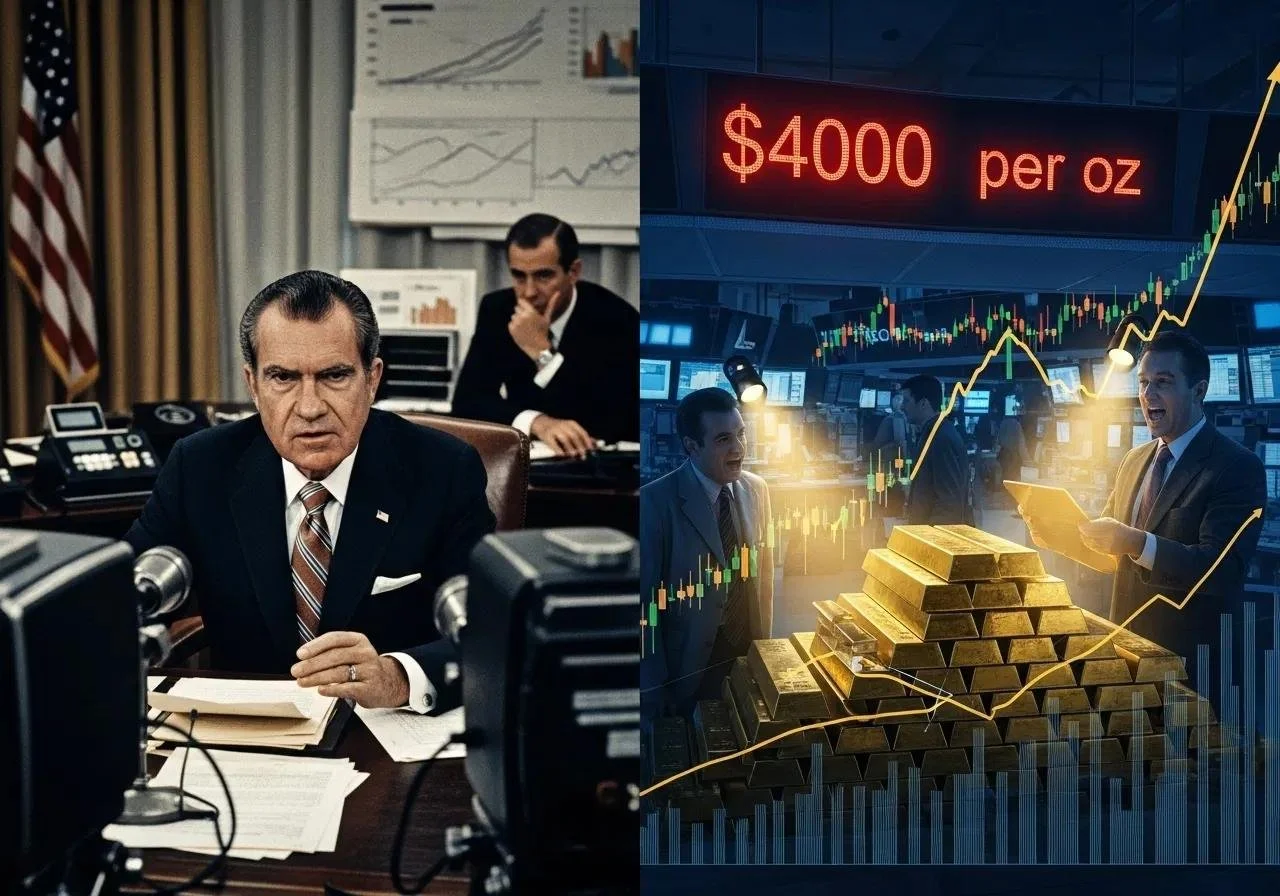
By 1971, foreigners’ demands to exchange their dollars for gold had become so great that Richard Nixon formally ended the convertibility once and for all.
Nixon downplayed any impact, telling Americans on August 15, 1971, “your dollar will be worth just as much tomorrow as it is today.”
The reality is the dollar went on to lose 75% of its value throughout the course of the decade. And if anything, Nixon’s move only encouraged foreigners to dump their dollars at an even more rapid pace.
As a result, the price of gold skyrocketed fivefold as governments and central banks around the world diversified out of the dollar and into gold.
We’ve been seeing this same move over the past couple of years—insatiable foreign and central bank appetite has driven gold prices from $1,800 a couple of years ago to over $4,000 today.
Obviously, over the past few months, there has been a lot of individual investor capital flowing into ETFs, hedge fund speculation, and similar vehicles. But in the long run, gold’s rise has been—and will continue to be—driven by foreign government and central bank diversification out of the dollar.
In 1975, gold hit a temporary peak at around $185 per ounce. After a period of consolidation, in which there was a significant price correction, gold then resumed its ascent, rising all the way to $850.
The point is that regardless of any short-term price correction, the fundamental driver—foreign governments and central banks diversifying out of the US dollar—hadn’t changed.
It took the election of Ronald Reagan in 1980 to finally restore credibility in the US government’s finances. Reagan, of course, campaigned on cutting the deficit, sparking a long-term trend which culminated in multiple budget surpluses in the late 1990s.
This renewed confidence in US government finances is what ultimately reversed the trend on gold prices, causing the price to collapse below $300 by the end of the 90s.
I believe we’re in a similar situation today as in 1975.
Gold had a significant correction earlier this week, but the price remained above $4,000.
Perhaps this is the start of a lull period, or even a correction phase as in 1975, but it doesn’t fundamentally change the story right now: foreign governments and central banks are aggressively trying to diversify their US dollar strategic reserves, and gold is one of the only assets that makes sense.
I’m not here to say “buy gold” at $4,000. But based on the trajectory of the US government’s finances, the price of gold should go much higher over the next few years.
I don’t say this because I’m a “gold bug.” I don’t have any irrational fascination with a piece of metal. Rather, my outlook is based on a clear understanding of global central banking and strategic reserve assets, coupled with the obvious deterioration in the US government’s fiscal condition.
But I also understand that after an almost uninterrupted and astonishing rise to nearly $4,400, gold may be due for a correction—similar to what happened in 1975.
The reality is, no one knows for sure. Gold could just as easily rise to $5,000 as drop to $3,500.
I’d point out, however, that there are still a number of high-quality gold, platinum, and silver businesses that are wildly undervalued and extremely profitable—and they will continue to be extremely profitable even if there is a steep decline in gold prices.
For example, one of the companies we featured in our premium investment research service is producing gold at a price of just $1,000 per ounce. This means the price of gold could fall below $3,000, and this company would still be making money hand over fist—and trading at just 5x earnings based on today’s stock price.
Did I mention they pay a handsome dividend?
To me, the long-term case for gold is crystal clear—foreign governments and central banks will continue to by gold unless there is a fundamental change in Congress’s attitude toward the US budget deficit. And I don’t see that happening anytime soon.
The short-term case for gold over the next couple of months is anyone’s guess. It could go higher, it could go lower. And that’s why I think some of these ultra-cheap, highly profitable, well-managed, largely debt-free gold companies are really worth considering.
When the long-term case for gold is so obvious, it’s a sensible strategy to own a business that has so much gold exposure, pays a dividend, and can continue to be extremely profitable—even if there’s a short-term gold correction.
To your freedom, James Hickman Co-Founder, Schiff Sovereign LLC
What’s Really Driving Gold & Silver Volatility? It’s Classic ‘Price Misdirection’ | Andy Schectman
What’s Really Driving Gold & Silver Volatility? It’s Classic ‘Price Misdirection’ | Andy Schectman
Miles Franklin Media: Michelle Makori, President & Editor-in-Chief of Miles Franklin Media, breaks down the shocking overnight sell-off that sent gold and silver prices tumbling before bouncing back.
Andy Schectman, Founder & CEO of Miles Franklin Precious Metals, reveals what really happened and who dumped gold in the middle of the night and why?
Was it technical selling, profit-taking, or a coordinated paper-market attack?
What’s Really Driving Gold & Silver Volatility? It’s Classic ‘Price Misdirection’ | Andy Schectman
Miles Franklin Media: Michelle Makori, President & Editor-in-Chief of Miles Franklin Media, breaks down the shocking overnight sell-off that sent gold and silver prices tumbling before bouncing back.
Andy Schectman, Founder & CEO of Miles Franklin Precious Metals, reveals what really happened and who dumped gold in the middle of the night and why?
Was it technical selling, profit-taking, or a coordinated paper-market attack?
Schectman exposes what really happened during the “drive-by” selloff, which banks quietly bought the dip, and how this wild volatility could be a flashing warning signal of something much bigger – a reset in the global monetary order.
In this interview:
Record highs followed by the sharpest gold drop in 12 years
Massive futures dump at the thinnest trading hour – why it matters
Evidence of major banks buying physical metal right after the crash
Paper vs. Physical: the widening gap and what it reveals
Is this volatility engineered misdirection before a monetary reset?
Why gold’s “crash” may actually confirm its long-term bull trend
00:00 Introduction: Gold & Silver Market Volatility
02:55 Analyzing the Gold Market Correction
04:44 Market Manipulation & Paper Contracts
13:43 Global Financial Implications
31:52 Mainstream Media Narratives
38:46 Future of Gold & Silver
44:19 Systemic Contagion & Coordinated Attacks
46:22 Global South & East's Role in Commodities
50:26 The Erosion of the Dollar's Attraction
59:00 U.S. Government's Secret Gold Accumulation
01:11:09 The Federal Reserve's Dilemma
01:21:06 Practical Investment Advice in a Volatile Market
01:27:37 Conclusion & Viewer Engagement
News, Rumors and Opinions Monday 10-20-2025
Note: All intel should be considered as "Rumors" until we receive official announcements ...and “Rates and Dates” could change anytime until we get to the banks/redemption centers.
RV Excerpts from the Restored Republic via a GCR: Update as of Mon. 20 Oct. 2025
Compiled Mon. 20 Oct. 2025 12:01 am EST by Judy Byington
Judy Note: The World has been undergoing the largest transfer of wealth in human history, and because of a compromised Main Stream Media, no one knew it.
Note: All intel should be considered as "Rumors" until we receive official announcements ...and “Rates and Dates” could change anytime until we get to the banks/redemption centers.
RV Excerpts from the Restored Republic via a GCR: Update as of Mon. 20 Oct. 2025
Compiled Mon. 20 Oct. 2025 12:01 am EST by Judy Byington
Judy Note: The World has been undergoing the largest transfer of wealth in human history, and because of a compromised Main Stream Media, no one knew it.
For years President Trump has warned that the fiat dollar was an instrument of Globalist control. Trump has spent years uniting nations so they could reinstate gold/asset-backed currencies at a 1:1 to each other and thereby rescue sovereignty to the nations.
That Plan has necessitated destroying the Central Banking Cartel and ending the IMF, BIS and World Economic Forum’s counterfeit financing. It involved resurrecting sound money around the World so as to rebuild economies founded in concepts of the original Constitution – Sovereign nations that functioned under God.
~~~~~~~~~~~~~~~
Tues. 14 Oct. Majeed: The Bank of Nigeria will migrate to the new financial system by Oct. 31 2025: https://x.com/majeed66224499/status/1978424730420916401?t=MHAuTb94nsD0kInNZl1rpA&s=09
Wed. 15 Oct. Wolverine: Hi guys it is 1:00am here in Sydney and I like to tell you that I’m overwhelmed with emotions that soon this will be all over. Please believe me that this definitely coming. I’m not here to give you hopium and play with your emotions. Please stay in faith and stay close to God. I love you all with all my heart. Your friend, Wolverine
~~~~~~~~~~~~
Fri. 17 Oct. Mark this down: Tuesday, October 21, 2025 is set to be the first controlled public unlock of the QFS interface. … on Telegram
This will happen quietly, in waves, no flashy headlines, no public countdowns.
What to Expect:
A secure message containing your personal QFS credentials
Biometric onboarding through the encrypted app gateway
Access to your personal quantum ledger, balances, adjustments, and asset grants
Rollout Notes:
The system will prioritize verified participants with active financial or humanitarian profiles
You may see “Pending Validation” beside certain assets, this is part of the syncing process
Behind the Curtain:
Quantum ledger synchronizations are already live across dozens of nations, from Switzerland to Singapore. The transition is no longer theoretical, it’s operational.
If October 20 was the final systems go, then October 21 is the first open door.
~~~~~~~~~~~~~
Restored Republic …Robert F. Kennedy Jr.
As a result of the fiat dollar causing disasters in international trade, a BRICS Alliance (Brazil, Russia, India, China, South Africa) formed. The BRICS nations declared that they weren’t going to put up with the corrupt fiat US Dollar system anymore.
BRICS took control and began to evaluate the worth of each nation’s gold and natural resources – the beginning of a Global Currency Reset – the largest transfer of wealth in World history.
~~~~~~~~~~~
Sat. 18 Oct. 2025: BREAKING OVERNIGHT INTEL DROP: CODE RED – $4,300 Gold.
THE GOLD SIGNAL Gold blasting past $4,300 isn’t finance — it’s flight. Investors are abandoning the dollar. Fiat fraud dies. Tangible value returns. Exactly as Trump forecasted. The people are escaping the paper matrix.
Read full post here: https://dinarchronicles.com/2025/10/20/restored-republic-via-a-gcr-update-as-of-october-20-2025/
************
Courtesy of Dinar Guru: https://www.dinarguru.com/
Walkingstick Iraq is going to become a currency hub for all of the Middle Eastern currencies. Iraq is about to become the trading platform for the entire Middle East. $3.22 is the reinstatement, filled by an RV in a basket. But it doesn't mean the basket has to float. The basket means the other currencies will depend on the Iraqi dinar. They will not be pegged to the American dollar. They will be pegged to the Iraqi dinar.
Frank26 What is 12-2c? It's an amendment that is in the budget. We feel it is exposing the new exchange rate...In D.C they're having fun...talking about the monetary reform success...Once they return home IMO they will bring back the permission to expose the implementation that is coming right now. That implementation is based on the laws Parliament are about to sign and release.
Jeff There isn’t a lop. Withdrawing a 25,000 note and replacing it with a 25 note does not mean it’s a lop because they clearly told us in print that two currency will coexist tougher at the same exact value. If the rate is $3…a 25 note would be $75. A 25,000 note would be $75,000. It’s that simple…Iraq is about to revalue.
************
SILVER ALERT! LBMA Physical Silver Shortage is NOT a Broken Market...IT'S A FREE MARKET!
(Bix Weir) 10-19-2025
Quick update on the Silver Shortage in London...THAT'S WHAT HAPPENS WHEN THE PRICE OF SILVER IS SUPPRESSED TOO LOW FOR TOO LONG!!