
Thank you to all the subscribers to our Early Access program…we thank you for your continued support.
We are excited to offer this new service to keep you informed and up-to-date on the latest Dinar and currency news.
Thursday Iraq News Posted by Tishwash at TNT 10-8-2026
TNT:
Tishwash: Al-Masoudi: Al-Zaidi gave the green light to American companies to take control of energy projects.
Former Member of Parliament Riyadh al-Masoudi asserted on Thursday that Prime Minister Ali Faleh al-Zaidi has given American companies the green light to completely control energy projects in Iraq, without any restrictions or conditions.
Al- Masoudi told the Information Agency, "Prime Minister Ali Faleh al-Zaidi is merely a listener and executor of Trump and his administration's directives. He is the weakest link in implementing Washington's policies, even though they are not in the interest of the Iraqi people. Moreover, al-Zaidi has given American companies the green light to completely control energy projects and other vital projects without any restrictions or conditions."
TNT:
Tishwash: Al-Masoudi: Al-Zaidi gave the green light to American companies to take control of energy projects.
Former Member of Parliament Riyadh al-Masoudi asserted on Thursday that Prime Minister Ali Faleh al-Zaidi has given American companies the green light to completely control energy projects in Iraq, without any restrictions or conditions.
Al- Masoudi told the Information Agency, "Prime Minister Ali Faleh al-Zaidi is merely a listener and executor of Trump and his administration's directives. He is the weakest link in implementing Washington's policies, even though they are not in the interest of the Iraqi people. Moreover, al-Zaidi has given American companies the green light to completely control energy projects and other vital projects without any restrictions or conditions."
He added, "The country's economic and security policies remain weak due to American interference in internal affairs, in addition to the weakness of the Iraqi negotiator, al-Zaidi, in dealing with issues that affect the country's sovereignty." He further stated, "Al-Zaidi has not achieved any notable accomplishments, and all the signed agreements benefit America, not the Iraqi people." link
***********
Tishwash: One day after the exchange rate adjustment decision... A source at the Central Bank of Iraq told the Iraq Observer: We are monitoring every detail of market activity, curbing speculation, and continuing to bolster banks' dollar reserves to meet their needs.
A source at the Central Bank of Iraq stated that the bank's procedures to bolster banks' reserves to meet their import financing needs are ongoing.
Speaking to Iraq Observer one day after the exchange rate adjustment, the source added that the bank is closely monitoring all market developments and is committed to curbing speculation to achieve a fair dollar exchange rate in the Iraqi market, thus protecting the rights of Iraqi citizens and strengthening the value of the Iraqi dinar.
The source concluded by reassuring all citizens, business owners, and merchants that the financial situation in the country is under control and that dollars are available in all Iraqi banks to meet the import needs of traders. link
************
Tishwash: Financial advisor: Adjusting the exchange rate is a precautionary measure to protect economic stability.
The Prime Minister's Financial Advisor, Mazhar Muhammad Salih, confirmed on Wednesday that the adjustment to the dinar's exchange rate is part of precautionary measures aimed at protecting economic, financial, and monetary stability. He noted that financing for foreign trade is proceeding regularly and stably.
Salih stated, "The exchange rate of the Iraqi dinar against the dollar and other foreign currencies represents the dinar's external value, and therefore its stability is closely linked to the availability of foreign currency and the economy's ability to finance foreign trade needs."
He added, "The potential repercussions of regional and international crises, particularly the effects of war and unrest that could impact oil exports through the Strait of Hormuz, and their impact on oil revenues, the general budget, and foreign currency inflows, necessitate a precautionary and well-considered approach."
He clarified that "the measures taken do not indicate any imbalance in the economic situation, but rather are part of proactive safeguards to protect economic, financial, and monetary stability, in anticipation of any developments that might affect the state's foreign currency reserves or its ability to finance foreign trade and public spending."
He pointed out that “monetary policy works to manage the exchange market and maintain the smooth flow of foreign currency, ensuring the continued and stable financing of foreign trade.” Meanwhile, fiscal policy works to absorb some of the potential effects of external shocks through balanced management of public spending, revenues, fees, taxes, and government subsidies.
Saleh explained that “customs and tax measures are part of the precautionary system and are used judiciously to regulate imports, enhance public revenues, and rationalize the use of foreign currency, without aiming to increase the burden on citizens or cause unjustified price hikes.”
He affirmed that “the general budget possesses important tools to protect internal stability through continued spending on food, medicine, fuel, and essential services.” He noted that government subsidies, in addition to their social function, represent an economic tool for absorbing shocks and maintaining price stability and domestic demand.
Saleh emphasized that the financial, customs, and tax measures associated with the current phase aim to strengthen the state’s ability to confront any potential decline in oil revenues or foreign currency inflows, maintain the general budget’s ability to meet its obligations, and protect the stability of the domestic market.
He explained that “these measures are not intended to cause a sudden change in the exchange rate or to burden society with the cost of the crisis. Rather, they aim to hedge against these challenges and build a financial and monetary safety net that enables the Iraqi economy to cope with exceptional circumstances, while continuing to provide essential goods and services and maintaining purchasing power and internal stability.”
He pointed out that the strength of the economy in such circumstances is not measured solely by the size of its resources, but also by its ability to manage shocks before their full effects are felt. He emphasized that the integration of monetary and fiscal policy, exchange rate procedures, customs, taxes, spending, and subsidies represents a formula for protecting the economy and citizens from the repercussions of any external disruption in oil markets or international trade link
************
Tishwash: Warnings of a third exchange rate adjustment... and the Central Bank's capitulation to the Ministry of Finance
Iraq is heading towards a new reduction in the value of the dinar against the dollar to cover the budget deficit, in a move that will be the third adjustment to the exchange rate after the December 2020 adjustment (when the dinar was reduced to 1450) and the February 2023 adjustment (when it was raised to 1310), amid political and economic warnings against the Central Bank “submitting” to the wishes of the Ministry of Finance.
Former MP Majid Shenkali said in a post seen by 964 Network that the leaks confirm the trend towards changing the exchange rate to cover the budget deficit at a time when the government continues to expand with appointments and promotions, describing this trend as “complete disconnect from reality, financially and politically” in light of rapid regional and international developments.
For his part, economist Nabil Al-Marsoumi indicated that the Central Bank may again yield and agree to a third amendment if the financial authority decides to do so, explaining that despite the bank’s absolute powers under its law, it was previously forced to abandon its opposition under pressure from the Ministry of Finance in 2020, before agreeing to the second amendment in 2023.
These moves come amid a widening gap between the official rate set at 131,000 dinars per 100 dollars and the parallel market rate, which has broken the 160,000 mark, prompting calls to amend the official rate in the budget tables to control the growing financial deficit. link
************
Tishwash: Parliament will have a say in amending the exchange rate.
MP Ibtisam Al-Hilali confirmed on Wednesday (October 7, 2026) that the House of Representatives will have an opinion on amending the exchange rate in the budget law in consultation with the government to control the dollar in the black market, following the government’s sudden decision to change the official rate, stressing her rejection of the decision and warning of its direct repercussions on prices and the livelihood of citizens.
In a statement received by 964 Network , Al-Hilali expressed her rejection of “the Cabinet’s decision to change the exchange rate of the dollar against the Iraqi dinar, noting that this decision will affect the Iraqi citizen and market.”
Al-Hilali said, “We were surprised by the Cabinet’s decision to change and raise the exchange rate of the dollar against the Iraqi dinar, which has repercussions and a direct impact on the Iraqi economy and market.”
She added, “We reject this decision. If the government wanted to address the financial crisis, it should have changed the exchange rate to 1400 dinars per dollar or less to control the market and prevent it from affecting food prices, which directly impacts citizens.”
Al-Hilali explained that “the House of Representatives will have an opinion on changing the exchange rate in the budget law, in consultation with the government, to control the dollar exchange rate in the black market.” link
Reset Intelligence: The Day the IQD Shut Baghdad's Markets
Emailed to Recaps~ Thank you David
Reset Intelligence: The Day the IQD Shut Baghdad's Markets
By Reset Intelligence | @EXIT_FIAT
The first trading day of Iraq's new dinar rate ended with two of Baghdad's main wholesale markets locked.
The dollar on the street went up, not down. Baghdad closed Wednesday at 167,000 IQD for $100, against just above 163,000 before the decision.
Emailed to Recaps~ Thank you David
Reset Intelligence: The Day the IQD Shut Baghdad's Markets
By Reset Intelligence | @EXIT_FIAT
The first trading day of Iraq's new dinar rate ended with two of Baghdad's main wholesale markets locked.
The dollar on the street went up, not down. Baghdad closed Wednesday at 167,000 IQD for $100, against just above 163,000 before the decision.
The markets
Shops and warehouses in Shorja and Jamila closed on Wednesday, and several exchange and money-transfer companies closed with them. Traders told Iraqi reporters they were caught off guard and could not price their goods at the new rate. They have suspended their dealings until they can tell whether 1,520 will stand. One Shorja owner called the wholesale trade "completely paralyzed."
Everything else that moved
Prices - a market owner in Saladin province said a sack of rice went from 45,000 IQD to 50,000 within hours. A food distributor's agent said major firms have suspended wholesale deliveries.
The street - $100 opened Wednesday at 168,500 IQD in Baghdad and closed at 167,000. The Central Bank's new public price is 152,000.
Baghdad's answer - the Central Bank promised to meet every dollar request for trade, bank cards and travelers "without any restrictions." The state trade bank began supplying foreign currency, and the customs pay-up-front rule was suspended in the same cabinet decision as the rate.
Parliament - it suspended its agenda to debate the dollar, and the Speaker directed that the Central Bank governor and the finance minister be hosted at Thursday's session. Lawmakers are collecting signatures to reverse the decision.
The cabinet - the vote on the 9 empty seats has been pushed to next week.
Tehran - American media report the US military is on alert for possible strikes on Iran. A tanker was hit north of Qatar.
The question
The bank moved its price toward the street, and the street moved further away. Why?
That is the short version. What the gap between Iraq's two dollar prices is made of, and the one number that shows whether Baghdad's answer is working - that is the daily read.
Read the full daily briefing free for 5 days. Sign up here: the daily Iraqi dinar briefing
Want it straight from the horse's mouth? The CBI Rate Alert pings you the moment the Central Bank of Iraq moves the official rate. The number itself, not a rumour about it. It comes with our free resource library and the daily breakdown of what is actually moving in Iraq. Sign up free: The CBI Rate Alert
Got a dinar question? Reset Intelligence runs an on-call research assistant: ask it anything they have published. It answers in seconds and will conduct deep research to find you the answer. Try it: the Iraqi dinar research assistant
Common questions, answered straight: When will the Iraqi dinar revalue? and Is the Iraqi dinar revaluation real?
The design behind all of it is mapped in Head of the Snake, and the free guides live in the Iraqi dinar resource library.
Follow the daily intel free: Telegram · Facebook · Spotify · Odysee
Iraq Economic News and Points To Ponder Thursday Morning 10-8-26
The Sudanese Coalition Accuses Politicians Of Hypocrisy: They Publicly Criticize The Rise Of The Dollar While Secretly Smuggling It
Baghdad - One News Khaled Walid, a member of the Reconstruction and Development Coalition, attacked politicians whom he accused of having double standards regarding the dollar exchange rate, noting that they publicly express their objection to its rise in front of the media, while, according to his accusations, they are smuggling US currency away from public view.
Walid said that some politicians “weep over the price of the dollar in the media in a miserable way while they smuggle it in secret,” accusing them of putting pressure on state institutions, which he described as having been exhausted as a result of their political and oversight performance.
The Sudanese Coalition Accuses Politicians Of Hypocrisy: They Publicly Criticize The Rise Of The Dollar While Secretly Smuggling It
Baghdad - One News Khaled Walid, a member of the Reconstruction and Development Coalition, attacked politicians whom he accused of having double standards regarding the dollar exchange rate, noting that they publicly express their objection to its rise in front of the media, while, according to his accusations, they are smuggling US currency away from public view.
Walid said that some politicians “weep over the price of the dollar in the media in a miserable way while they smuggle it in secret,” accusing them of putting pressure on state institutions, which he described as having been exhausted as a result of their political and oversight performance.
He added that these politicians are returning to demand the inclusion of hundreds of thousands of job positions in the budget, with the aim of satisfying their electoral base, at a time when the country is facing financial and economic challenges that require dealing with public spending responsibly.
Walid criticized what he described as attempts to target political opponents under the pretext of holding the previous government responsible for the current situation, stressing that the formation of governments took place according to political agreements and power-sharing, and that the forces that criticize its performance were partners in it.
He explained that the participation of those parties was not limited to ministerial portfolios, but also included special grades and other political gains, considering that holding one party responsible contradicts the nature of collective participation in running the state.
The member of the Reconstruction and Development Coalition concluded his criticism by addressing those forces, saying: "Enough with the hypocrisy," referring to what he sees as a contradiction between their media stances and their political practices. https://1news-iq.net/ائتلاف-السوداني-يتهم-سياسيين-بازدواج/
Parliament Cancels "Dollar Session" And Settles For A Meeting With The Minister Of Finance And The Governor Of The Central Bank
2026-10-08 05:13 Shafaq News - Baghdad A parliamentary source reported on Thursday that the Speaker of Parliament decided to cancel the parliamentary session scheduled for today, which was to include hosting Finance Minister Faleh Sari and Central Bank Governor Nizar Nasser Hussein to discuss the repercussions of the decision to raise the exchange rate of the dollar against the Iraqi dinar.
For his part, MP Sipan Shirwani, from the Kurdistan Democratic Party bloc, told Shafaq News Agency that the parliamentary finance committee will hold a meeting this afternoon, in the presence of the Minister of Finance and the Governor of the Central Bank, to discuss the reasons for the change in the exchange rate of the dollar against the Iraqi dinar.
Sherwani added that the meeting will be dedicated to discussing the change in the dollar exchange rate, and it is also likely to address the draft federal budget law.
It is worth noting that the Iraqi Parliament voted yesterday, Wednesday, to postpone the agenda of yesterday’s session and convert it into a general discussion session regarding the decision to raise the exchange rate of the dollar against the Iraqi dinar, while it set a special session for today, Thursday, to host the Governor of the Central Bank and the Minister of Finance to discuss the reasons for the decision and its repercussions.
The Central Bank of Iraq announced (yesterday, Wednesday) a change in the official exchange rate of the Iraqi dinar against the US dollar to be 1,520 dinars per dollar instead of 1,320 dinars per dollar, which generated angry popular reactions.
The Central Bank also described yesterday the decision to raise the exchange rate of the dinar against the US dollar as a "strategic step" to enhance financial stability, reassuring citizens and the economic sector of the adequacy and strength of its foreign reserves https://shafaq.com/ar/سیاسة/البرلمان-يلغي-جلسة-اليوم-ويكتفي-باستضافة-وزير-المالية-ومحافظ-المركزي-باللجنة-المالية
"A Hasty Decision That Harmed The Citizen," MP Walaa Al-Jizani Said: "Raising The Dollar Exchange Rate Has Had Negative Effects On The Street, And Parliament Is Moving To Discuss Its Repercussions"
Baghdad - One News - 10/07/2026 Deputy Walaa Al-Jizani, Vice President of the Badr parliamentary bloc, described the government’s decision to raise the dollar exchange rate as “hasty,” stressing that its repercussions have negatively affected the public and harmed citizens.
Al-Jizani said that the House of Representatives witnessed a parliamentary movement and stance regarding the decision to raise the exchange rate, indicating that the parliament works for all the people of Iraq and not for a specific political audience, in light of the reactions that the decision has caused in the street.
He added that the Speaker of Parliament was surprised by the decision to raise the dollar exchange rate, noting that there are several solutions that can be resorted to in order to address the repercussions of the decision, including proposals and solutions offered by financial experts.
Al-Jizani revealed that the Minister of Finance and the Governor of the Central Bank of Iraq will attend the House of Representatives tomorrow to discuss the details of the decision to raise the exchange rate and the reasons that led to taking it, stressing that the hosting will allow the representatives to see more clearly the background of the decision and its repercussions.
He indicated that the picture would become clearer after discussions with the Minister of Finance and the Governor of the Central Bank, stressing that Parliament would present its observations and recommendations regarding the decision during the discussions.
The deputy head of the Badr parliamentary bloc stressed that the House of Representatives has the right to make recommendations regarding the issue, considering that the Central Bank should deal with it in light of the repercussions of raising the exchange rate on citizens and markets.
Regarding the completion of the government formation, Al-Jizani revealed that the House of Representatives is expected to vote on completing Prime Minister Ali Falih Al-Zaidi's cabinet early next week. https://1news-iq.net/قرار-متسرع-أضر-بالمواطن-النائب-ولاء/
Seeds of Wisdom RV and Economics Updates Thursday Morning 10-8-26
Good Morning Dinar Recaps,
GLOBAL AI DEBT RESET WATCH: TECH GIANTS FLOOD BOND MARKETS WITH BILLIONS IN NEW AI BORROWING
The race to build artificial intelligence infrastructure is creating a new wave of corporate borrowing that is beginning to compete directly with governments for global investment capital.
Good Morning Dinar Recaps,
GLOBAL AI DEBT RESET WATCH: TECH GIANTS FLOOD BOND MARKETS WITH BILLIONS IN NEW AI BORROWING
The race to build artificial intelligence infrastructure is creating a new wave of corporate borrowing that is beginning to compete directly with governments for global investment capital.
OVERVIEW
Broadcom is reportedly arranging more than $50 billion in financing connected to OpenAI's custom AI-chip development, while Oracle is also seeking major financing for AI hardware.
SpaceX is reportedly pursuing $40 billion in financing, including $30 billion of investment-grade debt and $10 billion in bank loans, to purchase Nvidia chips.
The surge in AI borrowing is adding a new layer of pressure to already-elevated bond yields and raises important questions about who will control and absorb the world's available capital as governments and corporations compete for funding.
KEY DEVELOPMENTS
1. AI Infrastructure Is Becoming a Massive Borrowing Machine
The artificial intelligence boom is moving beyond a technology story and increasingly becoming a global financing story.
The Wall Street Journal reported that Broadcom is working to arrange more than $50 billion in financing for custom AI chips being developed with OpenAI. Oracle is also reportedly in discussions to finance large purchases of AI chips and infrastructure.
These are enormous sums, particularly when considered alongside the capital already being committed to data centers, computing equipment and energy infrastructure.
The scale of these projects demonstrates that the next stage of AI development will require not only technological innovation but also massive amounts of debt and investment capital.
2. SpaceX Moves Toward a $40 Billion AI Financing Package
SpaceX is reportedly seeking approximately $40 billion to purchase Nvidia chips for its expanding AI operations.
The proposed financing reportedly includes $30 billion in investment-grade debt and $10 billion in bank loans.
Reuters noted that SpaceX had already raised a record $86 billion in its June IPO and subsequently sold another $25 billion in bonds.
The new borrowing is significant because it illustrates how quickly AI-related capital requirements are growing. Companies are increasingly turning to debt markets rather than relying exclusively on equity financing.
That shift matters because debt must ultimately be serviced through future cash flows.
3. AI Borrowing Is Competing With Government Borrowing
This may be the most important financial development in the story.
Governments around the world are already borrowing heavily to finance budget deficits, defense spending, healthcare, pensions and infrastructure.
Now some of the world's largest technology companies are seeking tens of billions of dollars at the same time.
Reuters described the competition for funding as a growing problem for governments that must continue financing large fiscal needs.
The issue is not necessarily that AI companies will "crowd out" governments completely. Rather, the concern is that multiple enormous borrowers are competing for the same pool of global savings, potentially keeping borrowing costs higher than they otherwise would be.
WHY IT MATTERS
The AI boom is creating a financial cycle that deserves close attention.
More AI infrastructure requires more chips, data centers, electricity and networks. Those investments require more capital. As companies borrow more heavily to finance expansion, investors demand compensation for taking on additional credit risk.
At the same time, governments are also competing for capital.
This creates a potentially important feedback loop:
AI investment → more borrowing → greater demand for capital → higher financing costs → greater pressure on debt markets.
The risks become more significant if the future profits expected from AI fail to justify the enormous investment being made today.
Reuters also reported that credit-default protection on SpaceX widened to a record, showing that some investors are already becoming more cautious about the amount of debt associated with the AI expansion.
WHY IT MATTERS TO FOREIGN CURRENCY HOLDERS
For foreign currency holders watching the evolution of the global financial system, this development is important because capital flows influence currencies.
When investors demand higher returns from bonds and other debt instruments, money can move toward markets offering stronger yields and perceived safety.
Higher U.S. Treasury yields can support the dollar by making dollar-denominated assets more attractive. At the same time, higher borrowing costs can increase pressure on governments carrying large debt loads.
The important lesson is that currency strength is not determined by one factor.
Interest rates, government debt, corporate borrowing, trade flows, energy costs, investment opportunities and investor confidence all interact.
This is why developments in AI financing can eventually become relevant to the broader currency landscape.
IMPLICATIONS FOR THE GLOBAL RESET
Pillar 1: Debt
The financial system is entering an environment in which sovereign debt and corporate debt are competing for increasingly expensive capital.
The growth of AI-related borrowing adds another major category of borrowers to an already heavily indebted global economy.
If AI generates the extraordinary productivity and profits expected by investors, the borrowing could help finance a major technological transformation.
If returns disappoint, however, highly leveraged projects could create additional stress for lenders and investors.
Pillar 2: Technology
AI is becoming more than a technology investment.
It is becoming an infrastructure investment, requiring enormous amounts of computing power, electricity, real estate and financing.
That means technology policy and financial policy are becoming increasingly interconnected.
Pillar 3: Global Capital
The competition for capital may become one of the defining financial issues of the next several years.
Governments need funding for debt and public spending. Corporations need funding for expansion. Investors must decide which borrowers deserve their capital and what return is sufficient for the risk.
That competition could influence bond yields, currencies, investment flows and economic growth across major markets.
Pillar 4: Systemic Risk
Another issue deserves attention: the increasingly interconnected nature of the AI financing ecosystem.
Chip manufacturers, technology companies, investors, lenders and infrastructure providers can become financially connected through loans, equity stakes, equipment purchases and financing agreements.
That does not mean a crisis is inevitable.
It does mean that the financial consequences of an AI slowdown could extend beyond individual technology companies if leverage continues to increase across the ecosystem.
THE BOTTOM LINE
The AI boom is entering a new financial phase in which technological ambition is being matched by enormous borrowing requirements.
The most important question is no longer simply how powerful artificial intelligence will become, but how much debt the global financial system will use to build it.
For currency holders, this is another reminder that the financial system is changing through interconnected pressures involving debt, technology, interest rates and global capital flows.
The global financial system is evolving from a system built primarily around sovereign finance into one increasingly shaped by the competition between governments, corporations and technology for the world's capital.
Seeds of Wisdom Team
Newshounds News
SOURCES
~~~~~~~~~~
🌱 A Message to Our Currency Holders🌱
If you’ve been holding foreign currency for many years, you were not foolish.
You were not wrong to believe the global financial system would change.
What failed was not your patience — it was the information you were given.
For years, dates, rumors, and personalities replaced facts, structure, and proof. “This week” predictions created cycles of hope and disappointment that were never based on how currencies actually change.
That is not your failure.
Our mission here is different: • No dates • No rates • No hype • No gurus
Instead, we focus on:
• Verifiable developments • Institutional evidence
• Global financial structure • Where countries actually sit in the process
Currency value changes only come after sovereignty, trade, banking, settlement systems, and fiscal coordination are in place. History and institutions confirm this sequence.
You will see silence. You will see denials. That is not delay — that is discipline.
Protect your identity. Organize your documents. Verify everything.
Never hand your discernment to anyone who cannot show proof.
You deserve truth — not timelines.
Seeds of Wisdom Team
Newshounds News
~~~~~~~~~~
Seeds of Wisdom Team RV Currency Facts Youtube and Rumble
Newshound's News Telegram Room Link
RV Facts with Proof Links Link
RV Updates Proof links - Facts Link
Start Here room with Most Asked Questions Link
Follow the Gold/Silver Rate COMEX
Follow Fast Facts
Seeds of Wisdom Team™ Website
Thank you Dinar Recaps
Why Did Treasury Just Hire the Architect of the Gold-Backed Bond?
Why Did Treasury Just Hire the Architect of the Gold-Backed Bond?
by Phoenix Capital Research Tuesday, Oct 06, 2026
In late September, Treasury Secretary Scott Bessent brought Judy Shelton into his office as Counselor to the Secretary. Most of the coverage treated it as a personnel note about a longtime gold advocate. I think the more useful question is a simple one: why would Treasury want her, and why now? Start with the problem Bessent is trying to solve.
Treasury has to sell trillions of dollars in long-term debt to finance a national debt that has passed $40 trillion.
Why Did Treasury Just Hire the Architect of the Gold-Backed Bond?
by Phoenix Capital Research Tuesday, Oct 06, 2026
In late September, Treasury Secretary Scott Bessent brought Judy Shelton into his office as Counselor to the Secretary. Most of the coverage treated it as a personnel note about a longtime gold advocate. I think the more useful question is a simple one: why would Treasury want her, and why now? Start with the problem Bessent is trying to solve.
Treasury has to sell trillions of dollars in long-term debt to finance a national debt that has passed $40 trillion.
Investors are demanding more to hold it. On Monday, the 30-year Treasury yield hit 5.7%, its highest level since 2002. Treasury expanded its bond buyback program in August to bring those yields down, and it has had little lasting effect.
The traditional fixes for this problem run through the Federal Reserve: the Fed buys bonds, or it caps long-term yields directly. Both options hand the problem to the Fed, and both tend to weaken the dollar.
Judy Shelton has spent more than a decade designing a different fix. One that runs through Treasury.
In a 2012 paper for the Cato Journal, she proposed Treasury Trust Bonds: zero-coupon bonds that holders could redeem at maturity for either dollars or a fixed amount of gold. More recently, she has advocated a 50-year Treasury bond backed by U.S. gold reserves. Her argument is that investors would accept a lower interest rate in exchange for the gold option, which would reduce the government’s borrowing costs.
That is a very specific skill set. And it happens to match a very specific problem.
Now look at the order in which things have happened.
First, President Trump personally named gold a critical mineral in Executive Order 14241. Then Treasury audited Fort Knox and valued America’s gold reserves at more than $1 trillion. Then Treasury added gold to its Iran sanctions. And now the country’s leading designer of gold-convertible debt is working in the Secretary’s office
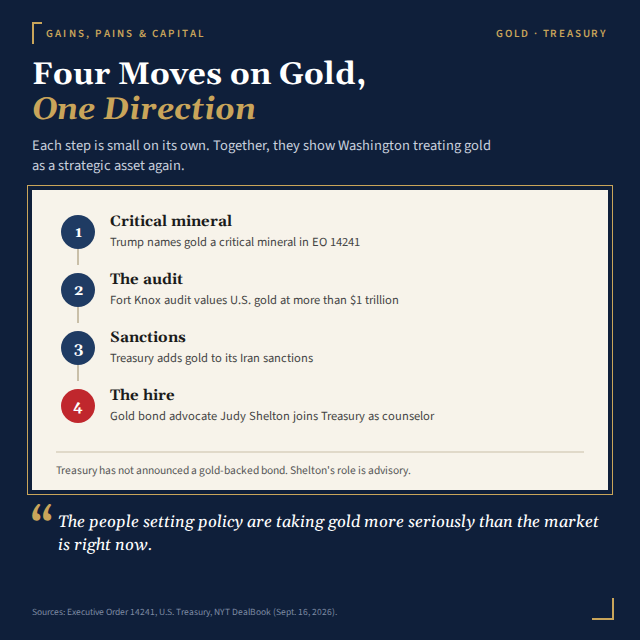
If you were preparing to use gold as part of the government’s financing toolkit, those are the steps you would take: establish its strategic importance, verify what you own, and bring in someone who knows how to structure it.
I want to be careful here. Treasury has not announced or proposed a gold-backed bond. Shelton’s role is advisory. Bessent himself said this summer that gold doesn’t determine the value of the dollar. It is entirely possible that she is there for other reasons, such as Washington’s push to reform the Fed, which she has criticized for years.
Still, investors get paid for understanding what is possible before the market prices it. So let’s look at the implications.
First, the balance sheet. he U.S. government still carries its gold at $42.22 an ounce, an official price set in 1973. At that price, America’s roughly 261 million ounces are worth about $11 billion on paper. At today’s price of around $4,170, they’re worth about $1.1 trillion. Any program that uses gold as backing for debt puts that gap to work without selling a single ounce.
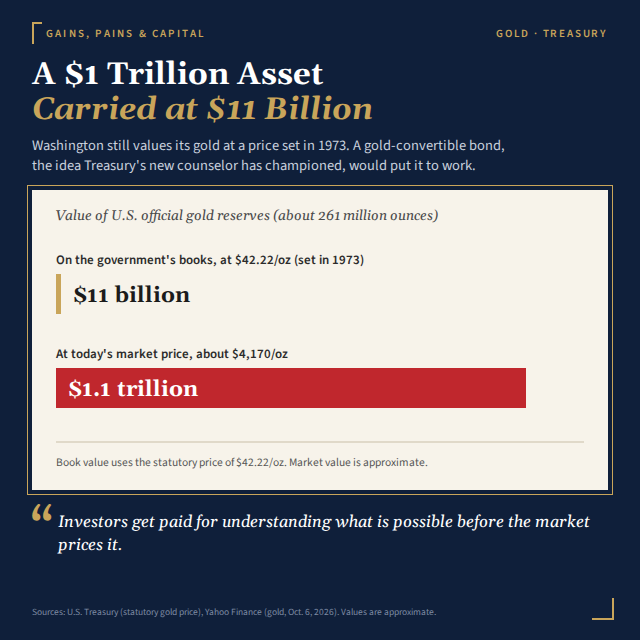
Second, the incentive. A government that uses gold to support its borrowing has a reason to want a strong gold price, because the more gold is worth, the more it can support. That would be a meaningful shift from the past 50 years, when Washington treated gold as a relic.
Third, China. Beijing is already treating gold as strategic money. China’s central bank added 20.2 tonnes in August, its largest monthly purchase since October 2023. Its gold holdings have risen for 22 consecutive months, and gold is now 9% of China’s foreign exchange reserves. Shelton has written for years about rebuilding the international monetary system with gold playing a role. If Washington wants a response to China’s gold buildup, strengthening the dollar’s link to gold is one option.
And here’s what makes this interesting for investors: the market isn’t paying attention.
Gold is down nearly 8% from a month ago, and its gain over the past year is the smallest since Yahoo Finance began tracking it daily. Back in January, gold was up more than 95% year over year. Investors are treating gold as a trade that has run its course.
TO READ MORE: https://www.zerohedge.com/news/2026-10-06/why-did-treasury-just-hire-architect-gold-backed-bond
The Final Move Before The Dinar Revalues?
The Final Move Before The Dinar Revalues?
The Dinar Den: 10-7-2026
The global financial community and foreign currency enthusiasts were recently taken by surprise by an unexpected policy shift from the Central Bank of Iraq (CBI).
In a move that blindsided many analysts who had been tracking Iraq’s economic reforms, the central monetary authority officially adjusted the exchange rate of the Iraqi dinar against the United States dollar.
The Final Move Before The Dinar Revalues?
The Dinar Den: 10-7-2026
The global financial community and foreign currency enthusiasts were recently taken by surprise by an unexpected policy shift from the Central Bank of Iraq (CBI).
In a move that blindsided many analysts who had been tracking Iraq’s economic reforms, the central monetary authority officially adjusted the exchange rate of the Iraqi dinar against the United States dollar.
Rather than continuing the previous trajectory toward strengthening the national currency, the rate was adjusted downward from 1310 dinars per dollar to a range of 1500 to 1520 dinars per dollar.
This decision represents a stark contrast to the Iraqi government’s long-standing, publicly stated goals of bolstering the dinar, enhancing domestic purchasing power, and reducing the nation’s systemic reliance on foreign currency.
Unsurprisingly, this sudden devaluation has sparked immediate economic waves and public distress within Iraq. Local citizens, already navigating a complex economic landscape, have expressed deep confusion and frustration, leading to public protests in several areas.
On the political front, the backlash has been equally intense, with various lawmakers demanding emergency parliamentary sessions to dissect the rationale behind this sudden policy reversal and to pressure the monetary authorities for a reconsideration of the rate adjustment. The friction between the government’s previous promises of currency strength and this sudden market weakening has created a highly charged domestic environment.
However, beneath the immediate political friction lies a highly significant administrative precedent that could shape the future of Iraq’s financial system.
By unilaterally executing this rate adjustment, the Central Bank of Iraq has clearly demonstrated its operational independence from the legislative branch.
This move proves that the monetary authority has the power and the willingness to make rapid, sweeping adjustments to the national currency’s value without waiting for lengthy parliamentary debates or legislative approval.
For seasoned market observers, this administrative autonomy is a critical indicator that future adjustments can be implemented swiftly and decisively when the central bank deems the timing appropriate.
In his recent video analysis, Stephen suggests that this apparent setback might actually be part of a highly coordinated, large-scale monetary strategy.
He posits that the sudden weakening of the dinar serves as a necessary stabilizing or recalibrating step that precedes a much more substantial and positive currency revaluation in the near future.
From this perspective, the current economic and political turbulence can be viewed as intentional “noise” designed to mask the final preparatory stages of a major monetary transition.
To understand where this complex situation is heading, investors and economic analysts must keep a close eye on several critical political and economic milestones on the horizon. The ongoing national budget approval process and upcoming cabinet appointments are expected to serve as major indicators of Iraq’s true long-term fiscal policy.
These developments will provide much-needed clarity regarding whether this rate adjustment is a temporary stabilization measure or the beginning of a broader economic restructuring plan designed to reintegrate Iraq more fully into the global financial system.
While the immediate news of the dinar’s depreciation may seem discouraging on the surface, the broader context offers a more nuanced and potentially optimistic outlook for patient observers. Rather than viewing the current volatility with concern, seasoned investors are encouraged to remain calm, analytical, and highly watchful.
This sudden movement in the exchange rate, combined with the central bank’s demonstration of independent authority, signals that significant momentum is building behind Iraq’s monetary system.
Iraq Economic News and Points To Ponder Wednesday Evening 10-7-26
Iraq’s Dollar Rate Increase Draws Lawmaker Backlash
2026-10-07 Shafaq News- Baghdad Iraq’s Finance Ministry said on Wednesday that it had adopted a base exchange rate of 1,500 Iraqi dinars per US dollar and suspended advance customs payments, prompting lawmakers to seek an emergency parliamentary session to reverse the currency decision.
Approved under Cabinet Resolution No. 544 on Oct. 6, 2026, the measures revised the official exchange rate and suspended Resolution No. 413 governing advance customs collection.
Iraq’s Dollar Rate Increase Draws Lawmaker Backlash
2026-10-07 Shafaq News- Baghdad Iraq’s Finance Ministry said on Wednesday that it had adopted a base exchange rate of 1,500 Iraqi dinars per US dollar and suspended advance customs payments, prompting lawmakers to seek an emergency parliamentary session to reverse the currency decision.
Approved under Cabinet Resolution No. 544 on Oct. 6, 2026, the measures revised the official exchange rate and suspended Resolution No. 413 governing advance customs collection.
Following an emergency recommendation from the finance minister and Central Bank of Iraq governor, the Cabinet established three rates: 1,500 dinars per dollar for purchases from the Finance Ministry, 1,510 for sales to banks, and 1,520 for sales by banks and non-bank financial institutions to customers.
The adjustment raises the official retail rate from 132,000 to 152,000 dinars per $100, making each $100 purchase 20,000 dinars more expensive.
Read more: Why Iraq's dinar keeps sliding despite fresh US cash
Concerned about rising consumer prices, lawmakers called for an emergency parliamentary session to reconsider the move. In a statement, MP Ibtisam Al-Hilali of the State of Law Coalition argued that, if the government sought to address the financial crisis through the exchange rate, it should be set at 1,400 dinars per dollar or lower to limit the impact on food prices. Parliament, she added, would have a say in any exchange-rate change through the budget law, in consultation with the government, to help control the parallel-market rate.
The revised rate brings the official price closer to that of the parallel market, where Baghdad exchange shops were selling $100 for 168,500 dinars on Wednesday.
Economist Ali Daadoush previously attributed the disparity largely to limited access to dollars through official banking channels rather than insufficient reserves, saying restrictions on overseas transfers, informal trade, speculation and market expectations were widening the gap and raising import costs.
Read more: Iraq overhauls import fees with advance customs payments
Customs procedures have also added pressure. The suspended mechanism, approved in August and scheduled to take effect on Oct. 1, required importers to pay estimated duties and tax deposits before banks could transfer funds abroad to cover imported goods.
Under the system, authorities calculated payments through ASYCUDA using invoices, product classifications, and declared values. Baghdad Chamber of Commerce spokesperson Rashid al-Saadi previously told Shafaq News that customs duties could reach 30%, 35% or, in some cases, 40%, in addition to a 3% tax deposit, significantly increasing upfront expenses.
Read more: Can Iraq’s economy weather a wider regional shock? Experts differ
https://shafaq.com/en/Economy/Iraq-s-dollar-rate-increase-draws-lawmaker-backlash
Economist: Iraq May Need IMF After Dinar Devaluation
2026-10-07 Shafaq News- Baghdad Iraq may need a program with the International Monetary Fund if oil revenues continue to decline and the dinar devaluation that took effect on Wednesday fails to provide enough support to public finances, Standard Chartered economist Carla Slim told Asharq Bloomberg.
Slim said any potential IMF program could involve structural reforms, particularly to Iraq’s public-sector wage bill, if oil production fails to recover, while production is currently running at about 70% of its January level.
The dinar devaluation gives the government more local currency for every dollar earned from oil exports, helping it finance salaries, Slim said, but the effectiveness of the measure would depend on how long the fiscal pressure lasts and how quickly oil production and exports recover.
Earlier today, the Central Bank of Iraq (CBI) put into effect a new exchange-rate structure, buying dollars from the Finance Ministry at 1,500 dinars per dollar, selling them to banks at 1,510, and setting the cash selling rate to the public at 1,520, compared with the previous public rate of 1,320.
The adjustment would support domestic production and industry, encourage investment in non-oil sectors, and create jobs, the CBI said. Foreign reserves are “sufficient” to meet foreign-currency demand for trade financing, overseas bank-card transactions, and cash sales to travelers.
The devaluation followed mounting pressure on Iraq’s public finances after the US-Israeli war on Iran disrupted oil exports. Reuters reported that exports fell to about 2.34 million barrels per day (bpd) in August from more than 3.6 million previously, while Iraq’s proposed 2027 budget assumes exports of around 4 million bpd.
The official-rate change did not immediately close the gap with the parallel market. A Shafaq News survey put the dollar at 168,500 dinars per $100 in Baghdad’s Al-Kifah and Al-Harithiya central exchanges, compared with the new official public rate of 152,000 dinars per $100.
Read more: Why Iraq's dinar keeps sliding despite fresh US cash
Another adjustment to the dinar’s exchange rate could also remain an option over the next six to 12 months, depending on oil revenues and foreign reserves, according to Slim. Over the longer term, she said reducing the budget’s dependence on oil from about 90% to 45% would require higher non-oil government revenues through stronger tax collection and the digitization of government services.
In June, Government spokesperson Haider Al-Aboudi said Al-Zaidi was heading a specialized committee seeking to reach the same 45% target within 10 years by increasing non-oil revenues, including receipts from border crossings, customs, and government collections.
https://shafaq.com/en/Economy/Economist-Iraq-may-need-IMF-after-dinar-devaluation
CBI Pledges Unrestricted Dollar Supply After Devaluation
2026-10-07 Shafaq News- Baghdad The Central Bank of Iraq (CBI) said on Wednesday its foreign reserves “are strong enough to meet all requests for dollars in full and without restrictions,” as its new exchange rate, weakening the dinar, took effect.
The reserves guarantee immediate coverage of all external transfer requests to finance trade, bank card settlements and cash sales to travelers, the bank said in a statement.
Under the new rate, the central bank buys dollars from the Finance Ministry at 1,500 dinars, sells them to banks at 1,510 dinars and sells cash dollars to the public at 1,520 dinars. The previous end-user rate was 1,320 dinars per dollar.
The bank described the change as a "positive adjustment" that would support Iraqi products and local industry by making domestic goods more competitive against imports. It said the move would encourage factories and national companies to expand, attract investment to non-oil sectors and create jobs, particularly for young Iraqis, by helping small and medium-sized businesses grow.
The adjustment was made in coordination with the Council of Ministers under the amended Central Bank Law No. 56 of 2004, according to the statement.
The Iraqi Contractors Union asked Prime Minister Ali Al-Zaidi on Wednesday to postpone applying the new rate, warning it would raise project costs. Lawmakers have also called for an emergency parliamentary session to reconsider the decision over concerns about consumer prices.
The new rate brings the official price closer to the parallel market, where Baghdad exchange shops were selling $100 for 168,500 dinars on Wednesday.
Read more: Banking without trust: Why Iraqis still keep their money in cash
https://shafaq.com/en/Economy/CBI-pledges-unrestricted-dollar-supply-after-devaluation
Trade Bank Of Iraq Injects Dollars To Support Dinar
2026-10-07 Shafaq News- Baghdad The state-owned Trade Bank of Iraq (TBI) began on Wednesday supplying foreign currency to the market through official banking channels to support the Iraqi dinar and ease dollar shortages.
The bank said it is injecting cash in foreign currency to meet the needs of trade and other economic activities, while monitoring the market to assess demand. The aim is to limit exchange-rate swings and strengthen the banking sector's role in stabilizing the local market, it said.
Read more: Why Iraq's dinar keeps sliding despite fresh US cash
Iraq's new official exchange rate took effect today, with the Central Bank now buying dollars from the Finance Ministry at 1,500 dinars, selling them to banks at 1,510 and selling cash dollars to the public at 1,520, up from 1,320 previously. On the parallel market, the dollar rose to about 1,680 dinars after the devaluation was announced.
Read more: Iraq’s dollar rate increase draws lawmaker backlash
https://shafaq.com/en/Economy/Trade-Bank-of-Iraq-injects-dollars-to-support-dinar-3
Cbi Official Clarifies Limits On Currency Trader Arrests
2026-10-07 Shafaq News- Baghdad The Central Bank of Iraq (CBI) has exclusive authority to regulate and oversee banking and non-banking financial institutions, a senior official told Shafaq News on Wednesday, clarifying that security forces cannot pursue or detain foreign currency traders without judicial authorization.
Security agencies may enforce laws and court rulings in coordination with relevant authorities when violations are formally reported, the official said, but cannot independently act against individuals dealing in foreign currencies without explicit judicial orders.
Earlier on Wednesday, the CBI introduced a new exchange-rate structure, setting the dollar at 1,500 dinars for purchases from the Finance Ministry, 1,510 for sales to banks, and 1,520 for sales to the public, up from the previous retail rate of 1,320. The parallel-market rate reached 1,680 dinars per dollar following the adjustment.
The bank had characterized the decision as a “strategic step” toward financial stability, assuring citizens and businesses that its foreign reserves remained strong and sufficient.
Read more: Can Iraq’s economy weather a wider regional shock? Experts differ
https://shafaq.com/en/Economy/CBI-official-clarifies-limits-on-currency-trader-arrests
What Makes The Federal Reserve Decide To Raise Or Lower Interest Rates?
What Makes The Federal Reserve Decide To Raise Or Lower Interest Rates?
Sep 28, 2026 Economic outlook Hilarey Gould Editorial staff, J.P. Morgan Wealth Management
As the United States’ central bank, the Federal Reserve (Fed) exists to promote the overall strength, stability and well-being of the U.S. economy. As part of its monetary policy function, the Fed adjusts the federal funds rate to help meet its so-called dual mandate: controlling inflation and supporting maximum employment.
Interest rate hikes by the Fed aim to cool economic activity and inflation, while interest rate cuts aim to stimulate economic growth.
What Makes The Federal Reserve Decide To Raise Or Lower Interest Rates?
Sep 28, 2026 Economic outlook Hilarey Gould Editorial staff, J.P. Morgan Wealth Management
As the United States’ central bank, the Federal Reserve (Fed) exists to promote the overall strength, stability and well-being of the U.S. economy. As part of its monetary policy function, the Fed adjusts the federal funds rate to help meet its so-called dual mandate: controlling inflation and supporting maximum employment.
Interest rate hikes by the Fed aim to cool economic activity and inflation, while interest rate cuts aim to stimulate economic growth.
When the Federal Reserve decides to raise or lower the federal funds rate, it makes headlines – and for good reason. Even small rate adjustments affect the cost and availability of credit, sending ripples through the country’s larger economy. But why does the Federal Reserve cut or hike interest rates in the first place? Read on for a full breakdown, including how the federal funds rate functions as a powerful lever in the U.S. economy.
What is the Federal Reserve?
The Federal Reserve (Fed) is the central bank of the United States. Established in 1913 through the Federal Reserve Act, it comprises 12 Federal Reserve Banks, the Federal Reserve Board of Governors and the Federal Open Market Committee (FOMC). The three arms work together to carry out the following five functions:
Conducting the nation’s monetary policy
Supervising and regulating U.S.-based financial institutions
Promoting stability within U.S. financial systems
Fostering the safety and efficiency of financial transactions at all levels of the economy
Promoting community development and consumer protection Footnote 1 Opens overlay
With regard to the Fed’s most visible function – conducting monetary policy – Congress has tasked it with a dual mandate to maintain maximum employment and stable prices in the United States.
Current Fed Chair Kevin Warsh has been vocal about his commitment to fighting inflation and ensuring the central bank “delivers price stability.” Footnote 2 Opens overlay At the same time, Fed officials closely monitor the labor market every month to understand if it’s heating up or slowing down.
On the price stability front, the Fed’s goal is an annual inflation rate of 2%. Full employment, however, isn’t as easy to gauge. Instead of relying on a single figure to inform its decisions, the Fed considers a broad set of labor market indicators to determine what qualifies as maximum employment at any given moment.
Why does the Fed change interest rates?
One of the main tools the Fed uses to achieve its dual mandate is the federal funds rate – the interest rate banks charge each other for overnight loans of reserves. (Reserves refer to both the amount of cash a bank has physically on hand and its deposits with a central bank.)
When the Fed makes changes to this rate, financial institutions follow suit, which impacts the cost of all credit products (such as mortgages, car loans, personal loans, business loans, credit cards and more).
In turn, changes to the cost of credit products affect the spending behavior of U.S. households and businesses. Knowing this, the Fed adjusts the federal funds rate to steer economic activity as needed to achieve its goals.
What leads the Fed to raise interest rates?
The Fed raises interest rates when it needs to tighten monetary policy. One of the main reasons it does so is to combat high inflation.
For example, the Consumer Price Index (CPI) surged in 2022, hitting a 40-year high of 9.1% in June of that year – far above the Fed’s 2% inflation target. Footnote 3 Opens overlay
To stop and reverse the surge, the Fed implemented 11 rate hikes between 2022 and 2023, increasing the target range to 5.25%–5.50%. Footnote 4 Opens overlay
The rate hikes worked in bringing down inflation and the Fed lowered its federal funds rate. Then when stubborn inflation returned in 2026, the Fed increased the federal funds rate for the first time in three years at its September FOMC meeting. Footnote 5 Opens overlay
The FOMC also raises rates in response to factors that signal economic vitality, including a strong labor market, wage growth and expanding economic activity.
What leads the Fed to lower interest rates?
The Fed lowers interest rates when it needs to ease monetary policy – primarily to stimulate the economy and prevent or soften a recession. Among the key factors that can lead to cuts are rising unemployment, a weak labor market and subdued inflation.
In March 2020, for example, the FOMC dropped the federal funds rate to a target range of 0% to 0.25% in response to severe economic disruption brought on by the first U.S. wave of the COVID-19 pandemic.
The rate remained at 0% to 0.25% until rate hikes were needed to calm surging inflation in 2022. Footnote 6 Opens overlay After raising the rate and keeping it at a target range of 5.25% to 5.50% through 2024, the Fed lowered rates several times, with the last cut in December 2025 in response to positive economic signals. Footnote 7 Opens overlay
The Fed’s decision-making process when it comes to raising and lowering interest rates
The FOMC is the 12-member monetary policymaking arm of the Federal Reserve. It consists of the seven members of the Federal Reserve Board of Governors, the president of the Federal Reserve Bank of New York and four other Reserve Bank presidents (who serve one-year terms).
The group meets at least eight times a year to review economic and financial data and to decide on monetary policy actions. Its primary responsibilities include setting the target federal funds rate and directing open market operations, such as the buying and selling of U.S. government securities.
After each meeting, the FOMC releases a written statement outlining its decisions, including interest rate adjustments and the purchase or sale of securities to control the U.S. money supply. This statement is often accompanied by a press conference.
Key economic indicators the Fed monitors to make rate decisions
The Fed monitors a wide range of economic indicators to determine whether it will raise, lower or hold interest rates. Here are the most notable and how they’re tracked:
Inflation
What it measures: The rate at which the cost of goods and services is increasing
Reports tracked: The personal consumption expenditures (PCE) price index, consumer price indexes, producer price indexes and the Spot Commodity Price Index
Labor market data
What it measures: The supply of and demand for labor
Reports tracked: Nonfarm payroll employment, the unemployment rate, measures of labor utilization, the nonemployment index, labor market flows, labor force participation and more
Gross domestic product (GDP)
What it measures: The total output of goods and services in the economy
Reports tracked: Real GDP and its components
Consumer spending
What it measures: U.S. household spending
Reports tracked: Retail sales, consumer spending and income, auto sales, personal savings rates and housing market activity
Business investment
What it measures: U.S. business investments
Reports tracked: Investments in nonresidential structures, equipment, intellectual property, private construction and real nonresidential fixed investments
Trade
What it measures: International trade trends
Reports tracked: Balance of international trade and exchange value of the U.S. dollar
Manufacturing
What it measures: Manufacturing trends
Reports tracked: Industrial production, capacity utilization rates for manufacturing, core capital goods and more
Monetary policy and financial markets
What it measures: The financial system itself
Reports tracked: Fed system assets, monetary policy instruments, the federal funds rate, FOMC statements, money market rates, capital market rates, Treasury yield curve, fed funds futures and economic projections for the federal funds rate
TO READ MORE: https://www.chase.com/personal/investments/learning-and-insights/article/federal-reserve-raise-lower-interest-rates
THE XRP STORY IS BECOMING MUCH BIGGER: Rob Cunningham
THE XRP STORY IS BECOMING MUCH BIGGER
“Ladies & Gentlemen, Start Your Engines!”
See what is converging?
Not rumor.
Not one announcement.
Architecture.
THE XRP STORY IS BECOMING MUCH BIGGER
“Ladies & Gentlemen, Start Your Engines!”
See what is converging?
Not rumor.
Not one announcement.
Architecture.
For years, XRP was understood primarily through one job:
MOVE VALUE. FAST. GLOBALLY.
Now add four more: OWN. CUSTODY. COLLATERALIZE. PRODUCE.

1. XRP → CREDIT
Ripple President Monica Long has described institutional credit as a major XRP use case, with credit activity targeting 2027.
That changes the economic equation.
XRP isn’t limited to moving liquidity. It can become part of the infrastructure that secures liquidity.
Payments move capital.
Credit mobilizes capital.
Collateral secures credit.
2. XRP → REGULATED CUSTODY
Now Washington is building another piece.
The SEC has proposed “Adviser and Regulated Fund Custody Rules; Crypto Custody Rules” – 234 pages addressing custody within regulated financial structures.
Here’s the critical distinction: CUSTODY ≠ OWNERSHIP.
You can own an asset while an authorized institution safeguards it under defined contractual terms.
Think of the emerging model as: PRIVATE OWNERSHIP + REGULATED CUSTODY + PRODUCTIVE UTILITY.
3. XRP → PRODUCTIVE TREASURY ASSET
Now look at Evernorth.
Its strategy isn’t simply: BUY XRP. HOLD XRP. WAIT.
Its three stated pillars are:
1 ACCUMULATE XRP
2 INTERNATIONAL EXPANSION
3 DIVERSIFIED YIELD GENERATION
The objective is to increase XRP per share and expand XRP’s utility.
That’s important.
The model isn’t merely own the asset.
It’s: OWN IT → SAFEGUARD IT → DEPLOY IT → PRODUCE WITH IT
4. NOW CONNECT THE ENGINE
This is where the architecture becomes easy to see:
OWNERSHIP → Who owns it?
CUSTODY → Who safeguards it?
PAYMENTS → How does value move?
SETTLEMENT → When is payment final?
CREDIT → How does capital get mobilized?
COLLATERAL → What secures that credit?
YIELD → How can productive deployment generate return?
These aren’t competing functions.
They are parts of the same financial engine.
And that changes the XRP question.
Stop asking only: “How many XRP does a payment use?”
Start asking: “How much XRP must be owned, accumulated, safeguarded and productively deployed to operate a global 24/7 financial system?”
That’s a fundamentally different supply-and-demand question.
An XRP briefly passing through a transaction performs one job.
An XRP held in custody, committed as collateral, deployed into authorized lending or otherwise put to productive use can perform another.
AND THE INDIVIDUAL DOESN’T DISAPPEAR.
Neither does private ownership.
Individuals can own XRP directly or through appropriate legal structures while institutional custodians safeguard assets and contractual arrangements define whether – and how – those assets can be productively deployed.
The terms matter.
The contract matters.
Ownership matters.
Custody itself doesn’t create yield.
Productive deployment does.
And the governing agreement determines who receives the economic benefit.
Now ZOOM out:
PRIVATE OWNERSHIP
↓
REGULATED CUSTODY
↓
PRODUCTIVE DEPLOYMENT
↓
CREDIT
↓
COLLATERAL
↓
GLOBAL SETTLEMENT
↓
MONETARY INFRASTRUCTURE
The timing deserves attention.
Evernorth is explicitly pursuing XRP accumulation, international expansion and diversified yield generation while the federal government is simultaneously developing proposed crypto-custody rules and Ripple is advancing institutional credit infrastructure.
OWNERSHIP → CUSTODY → PRODUCTIVITY → CREDIT → COLLATERAL → SETTLEMENT.
XRP originally answered: “How can value move?”
The next chapter asks a much bigger question: “How can value WORK?”
OWN IT
SAFEGUARD IT
PUT IT TO WORK
MOVE VALUE
SECURE VALUE
CREATE VALUE
XRP is becoming much more than a story about moving money.
It’s a story about the infrastructure underneath ownership, liquidity, credit, collateral and global capital itself.
Source(s):
• https://x.com/KuwlShow/status/2107563437895139780
https://dinarchronicles.com/2026/10/06/rob-cunningham-the-xrp-story-is-becoming-much-bigger/
China’s New Gold System Takes Aim at the Dollar
China’s New Gold System Takes Aim at the Dollar
Taylor Kenny: 10-7-2026
China is buying gold, reducing its reliance on U.S. debt, and expanding systems that could bypass the dollar. If this trend continues, the impact on inflation, retirement savings, and purchasing power could be enormous.
In a recent analysis by ITM Trading, financial experts explore how China’s persistent gold accumulation, massive infrastructure investments, and deliberate moves away from the U.S. dollar point toward preparation for a brand-new global monetary order.
China’s New Gold System Takes Aim at the Dollar
Taylor Kenny: 10-7-2026
China is buying gold, reducing its reliance on U.S. debt, and expanding systems that could bypass the dollar. If this trend continues, the impact on inflation, retirement savings, and purchasing power could be enormous.
In a recent analysis by ITM Trading, financial experts explore how China’s persistent gold accumulation, massive infrastructure investments, and deliberate moves away from the U.S. dollar point toward preparation for a brand-new global monetary order.
Rather than relying on traditional fiat currency systems, this emerging paradigm appears to be centered squarely on physical gold. Understanding these macroeconomic changes is essential for anyone looking to comprehend the future of international trade and secure their long-term financial wellbeing.
To fully grasp the significance of current events, it helps to look back at how historical shifts in monetary power typically occur. Major transitions are often driven by profound geopolitical and economic evolutions, much like the post-World War II Bretton Woods agreement.
During that pivotal era, the U.S. dollar emerged as the undisputed world reserve currency, originally backed by a fixed standard of gold. Today, however, the financial heavyweights of the East are charting a very different course. Instead of upholding the traditional Western-led framework, China is actively amassing massive reserves of physical precious metals, establishing a prominent gold exchange in Shanghai, and encouraging international trade partners to settle transactions in local currencies and gold rather than the greenback.
This multi-layered strategy involves creating a robust, physical gold-backed monetary ecosystem, complete with strategic settlement vaults located in key regions such as Saudi Arabia. Such developments directly challenge the long-standing dominance of the petrodollar and pose a serious question regarding the future reserve status of the U.S. dollar.
As more sovereign nations seek to diversify their financial reserves and move away from absolute dollar dependence, underlying risks related to U.S. national debt and domestic inflation begin to compound. Over time, these pressures could potentially degrade the purchasing power of dollar-denominated assets, making traditional savings methods increasingly vulnerable to macroeconomic instability.
Financial analysts consistently warn that as global trade dynamics evolve, the U.S. may resort to increased monetary expansion to manage its fiscal obligations, thereby exacerbating inflationary pressures. In light of these unfolding trends, holding tangible assets like physical gold is frequently highlighted as a vital safeguard against currency debasement and systemic financial volatility.
Diversifying a portfolio with precious metals allows individuals to protect their purchasing power independently of any single government’s monetary policy or banking infrastructure.
Ultimately, the transition from a purely dollar-centered global economy to a more diversified, gold-influenced financial system is expected to be gradual yet fundamentally inevitable. This monumental shift carries serious implications for international currency values, geopolitical alliances, and individual wealth preservation strategies.
CHAPTERS:
00:00 China Is Preparing for a Post-Dollar World
01:26 How Bretton Woods Made the Dollar King
03:45 Shanghai Challenges the Western Gold Market
05:10 China’s Gold Settlement Strategy for Global Trade
06:37 How Gold Could Bypass the Dollar
07:07 The Inflation Risk Facing the U.S.
08:04 Why Central Banks Want Physical Gold
10:02 What Dollar Devaluation Could Mean for Retirement
Seeds of Wisdom RV and Economics Updates Wednesday Afternoon 10-7-26
Good Afternoon Dinar Recaps,
GLOBAL DEBT RESET WATCH: IMF WARNS OF ENERGY AND DEBT SHOCK AS FED SIGNALS MORE RATE HIKES
The IMF is warning that energy costs and record public debt are threatening global growth just as new Fed minutes point toward another U.S. rate increase this year.
Good Afternoon Dinar Recaps,
GLOBAL DEBT RESET WATCH: IMF WARNS OF ENERGY AND DEBT SHOCK AS FED SIGNALS MORE RATE HIKES
The IMF is warning that energy costs and record public debt are threatening global growth just as new Fed minutes point toward another U.S. rate increase this year.
OVERVIEW
IMF Managing Director Kristalina Georgieva warned that high energy prices, record public debt and risks from the AI investment boom are threatening global growth.
New Federal Reserve minutes show that most officials expect another rate hike this year as inflation remains above the Fed’s 2% target.
Rising oil prices and government borrowing costs are creating a difficult combination: slower growth, persistent inflation and more expensive debt.
KEY DEVELOPMENTS
1. IMF Warns the Energy Shock Could Last
IMF Managing Director Kristalina Georgieva warned Wednesday that the global economy is being squeezed by a combination of high energy prices, elevated inflation and record public debt.
Brent crude remains around $100 per barrel, while disruptions to energy and LNG shipping are keeping pressure on fuel and transportation costs.
Georgieva warned that even if the conflict in the Gulf ends soon, the effects of higher energy prices could persist. The IMF's previous global growth outlook assumed that the Strait of Hormuz would gradually return toward normal conditions, making continued disruption a significant risk to that forecast.
2. Fed Minutes Signal Another Rate Hike
The afternoon release of the Federal Reserve's September meeting minutes added a new layer to the story.
The Fed raised its benchmark interest rate by 25 basis points in September, its first increase in three years. The minutes show that officials generally believed inflation remained too high and that a higher policy rate could be necessary to bring inflation back toward the central bank's 2% target.
Most officials' projections pointed toward another rate increase before the end of the year, although policymakers remain divided over how quickly additional tightening should occur.
This means the world's largest economy may be moving toward higher borrowing costs at the same time that energy prices are pushing inflation higher.
3. Record Debt Makes Higher Rates More Dangerous
The IMF says global public debt is at its highest level since World War II and is projected to exceed 100% of global GDP before 2030.
That creates a difficult environment for governments.
Higher interest rates may be necessary to contain inflation, but higher rates also increase the cost of servicing existing government debt. At the same time, higher energy costs can weaken economic growth and increase inflation.
The IMF is therefore calling for credible medium-term fiscal plans, particularly among heavily indebted advanced economies.
WHY IT MATTERS
Today's developments show how several major financial pressures are beginning to reinforce one another.
Energy prices are pushing inflation higher. Inflation is keeping interest rates higher. Higher rates increase debt-service costs. And high debt can make slower economic growth even more difficult to manage.
That combination is one of the biggest challenges facing the international financial system.
The IMF's warning is particularly important because it comes ahead of next week's IMF and World Bank meetings, where finance ministers and central bankers from 191 member countries will discuss global economic and financial stability.
WHY IT MATTERS TO FOREIGN CURRENCY HOLDERS
For foreign currency holders watching the Global Financial Reset, today's developments are a reminder that currency values are closely connected to the larger financial system.
Countries facing higher debt costs, expensive energy imports and weaker growth may need to adjust monetary, fiscal and trade policies.
That does not mean an overnight currency revaluation is guaranteed or that a specific reset date is approaching.
It does mean the financial pressures that could eventually encourage changes in international payment systems, reserves, trade relationships and currency strategies are becoming increasingly visible.
IMPLICATIONS FOR THE GLOBAL RESET
Pillar 1: Debt
Record public debt combined with higher interest rates increases the cost of maintaining existing obligations. Governments may face growing pressure to reform spending, taxation and debt-management policies.
Pillar 2: Energy
Oil around $100 per barrel creates inflationary pressure throughout the global economy. Energy-importing nations face additional pressure on trade balances and currencies.
Pillar 3: Currencies
When interest rates remain high and global investors shift capital toward higher-yielding assets, emerging-market currencies can come under pressure.
At the same time, countries may have greater incentives to diversify reserves, strengthen domestic financial markets and develop alternative settlement arrangements.
Pillar 4: Technology
The IMF also highlighted the enormous scale of the AI investment boom. AI could increase productivity and global growth, but a sharp reversal in investment or excessive valuations could create another source of financial instability.
THE BOTTOM LINE
The most important development this afternoon is that the IMF's warning about energy and debt now intersects with the Federal Reserve's signal that higher interest rates may be needed again this year.
The combination of expensive energy, rising debt-service costs, persistent inflation and tighter monetary policy creates a difficult environment for governments and central banks around the world.
For those following the Global Financial Reset, this is the kind of structural pressure worth watching—not because it guarantees an overnight reset, but because it can force countries to rethink how money, debt, trade and reserves function.
The global financial system evolves when mounting pressure makes the old ways of managing money and debt increasingly difficult to sustain.
Seeds of Wisdom Team
Newshounds News
SOURCES
Reuters — “IMF chief warns energy shock, growing debt and AI risks threaten global growth”
~~~~~~~~~~
Seeds of Wisdom Team RV Currency Facts Youtube and Rumble
Newshound's News Telegram Room Link
RV Facts with Proof Links Link
RV Updates Proof links - Facts Link
Start Here room with Most Asked Questions Link
Follow the Gold/Silver Rate COMEX
Follow Fast Facts
Seeds of Wisdom Team™ Website
Thank you Dinar Recaps
Ariel: Why you Should be Excited about this
Ariel: Why you Should be Excited about this
10-7-2026
Why You Should Be Excited About This
Eighty-five billion in foreign currency reserves is the war chest that makes a revaluation defensible instead of speculativewhen the CBI moves the rate, those reserves are the guarantee that the new value holds against any market pressure or speculative attack.
Ariel: Why you Should be Excited about this
10-7-2026
Why You Should Be Excited About This
Eighty-five billion in foreign currency reserves is the war chest that makes a revaluation defensible instead of speculativewhen the CBI moves the rate, those reserves are the guarantee that the new value holds against any market pressure or speculative attack.
Based on the full stack the $85B reserves (28th globally, 3rd in the Arab world per IMF data through mid-2025/Q2 2026), forward oil contracts, gold positioning, non-oil revenue projections, and the measured appreciation posture Washington expects the defensible rate Iraq can post on the Forex this year is 3.85 dinars per dollar.
From Another Source Who Will Remain Anonymous
Why That Particular Rate?
1. $85B against Iraq’s money supply gives real room, but a measured first move preserves the buffer. At 3.85, the Central Bank cuts the gap by roughly two-thirds from 1,310 without burning reserves defending an aggressive peg against speculative attack on day one.
2. Oil sold forward at 2027 delivery locks in dollar inflows that can be priced against a stronger dinar. But those contracts settle over time they support a trajectory, not a cliff jump. 3.85 is the rate those inflows can defend now.
3. Safaa Al-Jabri’s $110B+ projected 2027 sovereign revenue includes customs, taxes, and fees but those collection systems are still being digitized and enforced. Until that revenue is actually captured rather than projected, it argues for a conservative first posting.
4. The U.S. side prefers phased appreciation a strong enough move to kill the parallel market and Iran’s arbitrage channel, but not so violent it destabilizes regional trade or triggers panic liquidation of dinar-denominated debt. 3.85 sits in that corridor: dramatic enough to be historic, stable enough to hold.
Now Please Keep In Mind
Redenomination & Revaluation-
The Important Sequencing Note:
Iraq can do both simultaneously or in phases. Delete the zeros for cash-handling sanity (1.31 becomes the nominal face), then let the rate appreciate against that face or move the rate first. Either path, the wealth event lives entirely in the revaluation leg, not the zero deletion. Anyone telling you the zeros ARE the event is selling theater.
Important Justification:
Iraq’s Treasury is not wiring dollars to Chase and Wells Fargo when you exchange. The mechanics:
• You exchange at a U.S. bank. The bank credits you dollars and takes custody of the dinar.
• The bank offloads the dinar into the secondary market — to the U.S. Treasury’s held positions, to market makers, or back into forex liquidity pools where dinar now trades as an internationally recognized currency.
• Iraq settles against its own currency obligations over time through the CBI’s reserve position and oil-for-dinar mechanics not as a lump-sum payout.
I needed to make this clear for those who will attempt to use those reserves as an excuse as to why it is so impossible for Iraq to go back to 3.22 or 4.00. We are getting paid in secondary markets. We will not be draining Iraq’s reserves or economy.
This is precisely why the reserve figure matters so much: the $85B isn’t a payout fund, it’s the credibility backstop that lets the secondary market absorb redemptions at the new rate without Iraq’s books imploding. The reserves guarantee the currency’s floor; the market handles the flow.
Source(s):
• https://x.com/Prolotario1/status/2107584877633654938
https://dinarchronicles.com/2026/10/06/prolotario-why-you-should-be-excited-about-this/
Reset Intelligence: Devalue, Delete, Revalue
Emailed to Recaps~ Thank you David
By Reset Intelligence | @EXIT_FIAT
For about a week one theory has circulated in the dinar community: Iraq lowers the IQD first, deletes the zeros, and only then raises the rate.
This morning the first step happened. Iraq's Council of Ministers approved a new rate and the Central Bank adopted it: 1,500 IQD to the dollar buying from the Finance Ministry, 1,510 selling to the banks and 1,520 selling to the public.
Emailed to Recaps~ Thank you David
By Reset Intelligence | @EXIT_FIAT
For about a week one theory has circulated in the dinar community: Iraq lowers the IQD first, deletes the zeros, and only then raises the rate.
This morning the first step happened. Iraq's Council of Ministers approved a new rate and the Central Bank adopted it: 1,500 IQD to the dollar buying from the Finance Ministry, 1,510 selling to the banks and 1,520 selling to the public.
One statement
Safaa al-Jabiri sits on parliament's economy committee. Late on Monday he said: "There is a proposal from the finance minister to adjust the official exchange rate to 150,000 dinars for every $100, but there is no final decision so far." By the next day it was a decision. In the same statement he said that changing Iraq's currency, and possibly deleting the zeros, is under serious discussion inside the Prime Minister's office and the Central Bank.
Everything else that moved
The budget - after parliament's Finance Committee met Finance Minister Faleh al-Sari, the draft's figures came out: 217 trillion IQD in spending, a 50 trillion deficit, oil at $58 a barrel and 1,500 IQD to the dollar. A committee member said the rate "is subject to change." The cabinet approved it the same day.
The oil line - an Iraqi oil expert called the budget's 4 million barrels a day of exports "impossible" while the Strait of Hormuz is shut.
The law - the Central Bank's governor said in September that new banknotes fall under the bank's own authority, while deleting zeros needs a law passed by parliament.
The street - the dollar closed Tuesday above 163,000 IQD per $100 in Baghdad, before the decision. The bank's price to the banks moves from 131,000 to 151,000.
The weapons - Prime Minister Ali al-Zaidi told tribal sheikhs that 5 armed factions have agreed to hand over their weapons and 3 already have.
Tehran - Trump said "nobody knows" who is running Iran. A tanker was hit in the Strait of Hormuz and Oman evacuated 10 of its crew.
The question
Is the step down the first move of a bigger plan, or only a finance ministry short of cash? Nothing in the decision mentions the zeros or a higher rate to follow.
That is the short version. Why a government would lower its currency before changing it, what would have to follow, and how to tell the two stories apart - that is the daily read.
Read the full daily briefing free for 5 days. Sign up here: the daily Iraqi dinar briefing
Want it straight from the horse's mouth? The CBI Rate Alert pings you the moment the Central Bank of Iraq moves the official rate. The number itself, not a rumour about it. It comes with our free resource library and the daily breakdown of what is actually moving in Iraq. Sign up free: The CBI Rate Alert
Got a dinar question? Reset Intelligence runs an on-call research assistant: ask it anything they have published. It answers in seconds and will conduct deep research to find you the answer. Try it: the Iraqi dinar research assistant
Common questions, answered straight: When will the Iraqi dinar revalue? and Is the Iraqi dinar revaluation real?
The design behind all of it is mapped in Head of the Snake, and the free guides live in the Iraqi dinar resource library.
Follow the daily intel free: Telegram · Facebook · Spotify · Odysee