THE XRP STORY IS BECOMING MUCH BIGGER: Rob Cunningham
THE XRP STORY IS BECOMING MUCH BIGGER
“Ladies & Gentlemen, Start Your Engines!”
See what is converging?
Not rumor.
Not one announcement.
Architecture.
For years, XRP was understood primarily through one job:
MOVE VALUE. FAST. GLOBALLY.
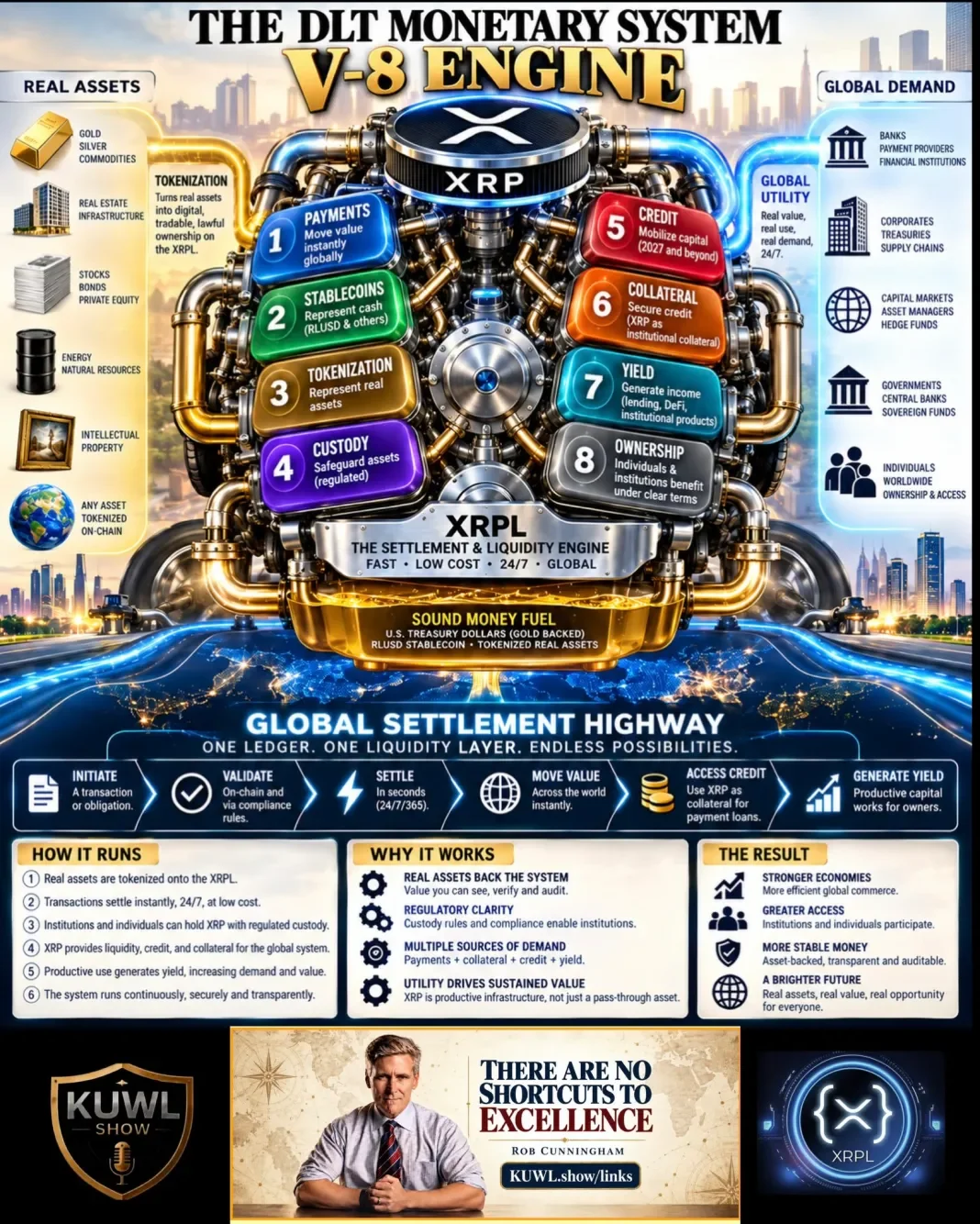
Now add four more: OWN. CUSTODY. COLLATERALIZE. PRODUCE.
1. XRP → CREDIT
Ripple President Monica Long has described institutional credit as a major XRP use case, with credit activity targeting 2027.
That changes the economic equation.
XRP isn’t limited to moving liquidity. It can become part of the infrastructure that secures liquidity.
Payments move capital.
Credit mobilizes capital.
Collateral secures credit.
2. XRP → REGULATED CUSTODY
Now Washington is building another piece.
The SEC has proposed “Adviser and Regulated Fund Custody Rules; Crypto Custody Rules” – 234 pages addressing custody within regulated financial structures.
Here’s the critical distinction: CUSTODY ≠ OWNERSHIP.
You can own an asset while an authorized institution safeguards it under defined contractual terms.
Think of the emerging model as: PRIVATE OWNERSHIP + REGULATED CUSTODY + PRODUCTIVE UTILITY.
3. XRP → PRODUCTIVE TREASURY ASSET
Now look at Evernorth.
Its strategy isn’t simply: BUY XRP. HOLD XRP. WAIT.
Its three stated pillars are:
1 ACCUMULATE XRP
2 INTERNATIONAL EXPANSION
3 DIVERSIFIED YIELD GENERATION
The objective is to increase XRP per share and expand XRP’s utility.
That’s important.
The model isn’t merely own the asset.
It’s: OWN IT → SAFEGUARD IT → DEPLOY IT → PRODUCE WITH IT
4. NOW CONNECT THE ENGINE
This is where the architecture becomes easy to see:
OWNERSHIP → Who owns it?
CUSTODY → Who safeguards it?
PAYMENTS → How does value move?
SETTLEMENT → When is payment final?
CREDIT → How does capital get mobilized?
COLLATERAL → What secures that credit?
YIELD → How can productive deployment generate return?
These aren’t competing functions.
They are parts of the same financial engine.
And that changes the XRP question.
Stop asking only: “How many XRP does a payment use?”
Start asking: “How much XRP must be owned, accumulated, safeguarded and productively deployed to operate a global 24/7 financial system?”
That’s a fundamentally different supply-and-demand question.
An XRP briefly passing through a transaction performs one job.
An XRP held in custody, committed as collateral, deployed into authorized lending or otherwise put to productive use can perform another.
AND THE INDIVIDUAL DOESN’T DISAPPEAR.
Neither does private ownership.
Individuals can own XRP directly or through appropriate legal structures while institutional custodians safeguard assets and contractual arrangements define whether – and how – those assets can be productively deployed.
The terms matter.
The contract matters.
Ownership matters.
Custody itself doesn’t create yield.
Productive deployment does.
And the governing agreement determines who receives the economic benefit.
Now ZOOM out:
PRIVATE OWNERSHIP
↓
REGULATED CUSTODY
↓
PRODUCTIVE DEPLOYMENT
↓
CREDIT
↓
COLLATERAL
↓
GLOBAL SETTLEMENT
↓
MONETARY INFRASTRUCTURE
The timing deserves attention.
Evernorth is explicitly pursuing XRP accumulation, international expansion and diversified yield generation while the federal government is simultaneously developing proposed crypto-custody rules and Ripple is advancing institutional credit infrastructure.
OWNERSHIP → CUSTODY → PRODUCTIVITY → CREDIT → COLLATERAL → SETTLEMENT.
XRP originally answered: “How can value move?”
The next chapter asks a much bigger question: “How can value WORK?”
OWN IT
SAFEGUARD IT
PUT IT TO WORK
MOVE VALUE
SECURE VALUE
CREATE VALUE
XRP is becoming much more than a story about moving money.
It’s a story about the infrastructure underneath ownership, liquidity, credit, collateral and global capital itself.
Source(s):
• https://x.com/KuwlShow/status/2107563437895139780
https://dinarchronicles.com/2026/10/06/rob-cunningham-the-xrp-story-is-becoming-much-bigger/