
Thank you to all the subscribers to our Early Access program…we thank you for your continued support.
We are excited to offer this new service to keep you informed and up-to-date on the latest Dinar and currency news.
Iraq Economic News and Points To Ponder Late Monday Evening 8-17-26
Telecom Minister Claims Dinar Redenomination Finalized, Drawing Criticism
Iraq Jawad Al-Samarraie August 16, 2026 Baghdad (IraqiNews.com) — Minister of Communications Mustafa Sanad stated in a televised broadcast that the government decision to redenominate the Iraqi Dinar and delete three zeros from the national currency is officially finalized.
Sanad asserted that replacing the current banknotes will force hoarded cash back into formal banking channels while eliminating an estimated 8 trillion IQD ($6.1 billion) in unexchanged currency tied to illicit gains, corruption, and lost funds.
Telecom Minister Claims Dinar Redenomination Finalized, Drawing Criticism
Iraq Jawad Al-Samarraie August 16, 2026 Baghdad (IraqiNews.com) — Minister of Communications Mustafa Sanad stated in a televised broadcast that the government decision to redenominate the Iraqi Dinar and delete three zeros from the national currency is officially finalized.
Sanad asserted that replacing the current banknotes will force hoarded cash back into formal banking channels while eliminating an estimated 8 trillion IQD ($6.1 billion) in unexchanged currency tied to illicit gains, corruption, and lost funds.
However, the minister’s pronouncements have triggered backlash from economic monitors over fiscal messaging and central bank authority.
Key Statements & Fiscal Arguments
Finalized Redenomination: Sanad stated the decision to remove zeros and issue a restructured currency is fully resolved.
Tackling Hoarded & Illicit Liquidity: Replacing existing currency will compel citizens to deposit hoarded cash into formal banking institutions, bringing idle liquidity back into the national economic cycle.
Projected 8T IQD Money Supply Contraction: An estimated 8 trillion IQD in physical banknotes may never be submitted for exchange due to illicit origins, criminal gains, or deceased/unclaimed holdings.
State Balance Sheet Relief: Sanad argued that unexchanged legacy banknotes will permanently exit circulation, meaning the state will not be required to issue equivalent replacement notes, reducing the overall money supply.
Sanad’s declarations prompted criticism from economic monitoring group Eco Iraq Observatory, which rebuked cabinet ministers for announcing sensitive monetary policies outside official central banking channels.
The observatory warned that broadcasting national currency reforms through ad-hoc political interviews rather than institutional communiqués undermines market confidence, fuels currency speculation, and signals fragmented inter-agency coordination. Eco Iraq formally urged the Central Bank of Iraq (CBI) and the Ministry of Finance to issue an official clarification detailing the veracity, operational mechanics, and statutory timeline of any currency restructuring plan.
https://www.iraqinews.com/iraq/sanad-dinar-redenomination-delete-zeros-eco-iraq-reaction-2026/
Iraq Has Finalized Its Decision To Redenominate The Iraqi Dinar By Removing Three Zeros From The National Currency.
raqi News @IraqiNews_com The move is meant to force hoarded cash back into formal banking channels while eliminating an estimated 8 trillion IQD, about $6.1 billion, in unexchanged currency tied to illicit gains, corruption, and lost funds.
Since old banknotes that are never exchanged will permanently exit circulation, the state won't need to issue equivalent replacement notes, effectively shrinking the overall money supply.
The announcement has drawn criticism from economic monitoring group Eco Iraq Observatory, which warned that announcing sensitive currency reforms through ad hoc interviews rather than official channels risks undermining market confidence and fueling speculation.
The group has called on the Central Bank of Iraq and Ministry of Finance to issue an official clarification on the plan's details and timeline. https://iraqinews.com/iraq/sanad-din
https://x.com/IraqiNews_com/status/2089232903687540927
The Parliamentary Finance Committee Responds To Statements About Removing Zeros And Sets A Condition For Raising The Value Of The Dinar.
Baghdad Today - Baghdad Member of Parliament’s Finance Committee, Bassem Al-Gharabi, commented on the statements and news circulating regarding the project to change the currency and remove zeros, stressing the need to deal very cautiously with this issue because of its direct repercussions on economic stability and capital.
Al-Gharabi said in a post followed by Baghdad that “changing the currency is not ordinary news that can be released without considering its repercussions. It is a highly sensitive monetary issue that can affect citizens’ expectations, the movement of money, and the dollar and gold markets,” stressing that he is waiting for an official and clear position from the Central Bank of Iraq and the competent authorities that clarifies the reality of the project, its legal basis, its economic feasibility, and the timing of its implementation.
The member of the Finance Committee added that removing zeros in itself does not raise the value of the dinar or increase purchasing power, but rather shortens the numbers and facilitates some transactions, noting that real economic reform begins with stabilizing public finances, reforming the banking sector, controlling revenues, and strengthening confidence in the national currency.
Al-Gharabi raised a fundamental legal question about the powers of implementation, saying: Can the Central Bank implement the project within its current powers, or do the implications for contracts, debts, fines, court rulings, taxes and fees require special legislation from the House of Representatives? He called for official and accurate answers to be provided before any final decisions are issued in order to preserve market stability and the rights of citizens.
https://baghdadtoday.news/304832-.html
The Central Bank Remains Silent On The Removal Of Zeros Amid Market Confusion.
August 17, 2026Last updated: August 17, 2026 Independent/Report/ - The silence of the Central Bank of Iraq regarding the escalating news about changing the currency and removing three zeros from the dinar has left an information gap in one of the most sensitive monetary files, at a time when conflicting statements continue to come from officials, deputies and experts regarding a decision that the body authorized to issue the currency has not yet announced whether it has actually been taken, or is still under study, or what its implementation mechanisms are.
The silence surrounding the issue has become even more sensitive after Communications Minister Mustafa Sand stated in a televised interview that the decision to change the currency and remove zeros had been "issued," just days after a member of the parliamentary finance committee spoke of a discussion regarding the proposal to remove zeros during a meeting that included the prime minister, the finance minister, and the central bank governor. The government spokesperson had denied on June 22 the existence of any official decision or proposal in this regard.
Despite the Central Bank continuing to publish its usual news and announcements, including announcements of financial auctions on Sunday, August 16, no clarification regarding the currency change or the removal of zeros appeared in its official data list until Monday morning.
Three economic experts, who spoke to Al-Mustaqila and asked not to be named, said that the absence of a clear statement from the bank left markets and citizens with questions that the monetary authority is supposed to answer before any decision of this magnitude is made.
The first expert said that the problem is no longer about agreeing or disagreeing about the feasibility of removing zeros, but rather about the “irresponsible statements” that preceded any official announcement, considering that they confused the market and left basic questions unanswered, including whether the designs of the new currency were completed, the size of the amounts that can be exchanged, whether the exchange will be in cash or through bank accounts, and how large sums of money will be dealt with.
He added that the uncertainty may push some savers to increase their demand for dollars, especially in a country where large amounts of money are still outside the banking system, and where a segment of the public does not trust banks to the degree that would allow them to suddenly transfer their cash savings to them.
The second expert said that the currency restructuring project is not new, and that it went through study phases within the Central Bank years ago, but he added that moving from study to implementation requires extensive arrangements that include designing the new denominations, contracting with international printing houses, preparing sites to receive, sort and destroy the old currency, preparing banks to open accounts and deal with exchange operations, as well as setting rules for funds that require disclosure of their source.
This is supported by what the Central Bank officially announced in 2022, when it said that restructuring the currency and removing zeros requires a law to be enacted by the House of Representatives, and that a draft law had been prepared years ago and needed amendments.
The Central Bank Law also stipulates that the bank alone has the right to issue currency, determine its denominations, standards, and designs, and make arrangements for its issuance, which makes the absence of its direct position more important than statements issued by other government entities.
The third expert said that dealing with funds of unknown origin does not necessarily require removing zeros, and suggested instead subjecting large cash blocks when they are introduced into the banking system to source verification procedures, and linking the purchase or transfer of ownership of large assets, such as real estate and cars, to anti-money laundering controls when transactions raise suspicious indicators.
The three experts, despite their disagreement on the feasibility of changing the currency, believe that the issue cannot tolerate fragmented media management, because removing zeros does not automatically increase the purchasing power of the dinar, but rather it is a renaming of the monetary unit that requires changing prices, salaries, debts and contracts in the same proportion if it is implemented properly.
The question that needs answering from the central bank remains simpler than the ongoing debate: **Was the decision to remove zeros actually made?**
If a change has been made, the market expects the entity responsible for the currency, not ministers, members of parliament, or social media platforms, to announce its timing, the mechanism of the exchange, its limits, the fate of funds outside banks, and the guarantees that prevent market disruption or harm to citizens' savings.
https://mustaqila.com/البنك-المركزي-يلتزم-الصمت-حول-حذف-الأص/
Tuesday Iraq News Posted by Tishwash at TNT 8-18-2026
TNT:
Tishwash: Prime Minister's Advisor: Digital Dinar a promising project to enhance the efficiency of monetary policy
The Prime Minister's advisor, Mazhar Muhammad Salih, confirmed on Monday that the digital dinar is a promising strategic project and not an independent solution to the liquidity crisis. While he pointed out that paying salaries digitally enhances the speed of payments and reduces cash transactions, he indicated that the success of the digital dinar depends on expanding banking services and infrastructure.
Saleh told the Iraqi News Agency (INA): “The proposal to launch the digital Iraqi dinar is one of the ideas that deserves to be studied within the framework of Iraq’s move towards digital transformation and the development of the financial system.
TNT:
Tishwash: Prime Minister's Advisor: Digital Dinar a promising project to enhance the efficiency of monetary policy
The Prime Minister's advisor, Mazhar Muhammad Salih, confirmed on Monday that the digital dinar is a promising strategic project and not an independent solution to the liquidity crisis. While he pointed out that paying salaries digitally enhances the speed of payments and reduces cash transactions, he indicated that the success of the digital dinar depends on expanding banking services and infrastructure.
Saleh told the Iraqi News Agency (INA): “The proposal to launch the digital Iraqi dinar is one of the ideas that deserves to be studied within the framework of Iraq’s move towards digital transformation and the development of the financial system.
If the digital dinar is meant to be a digital currency issued by the Central Bank of Iraq and enjoys the same legal force as the paper dinar, then it could represent a modern tool to enhance the efficiency of monetary policy, improve liquidity management, and develop the government payments system, which is what most central banks in the world are working on today.”
He added that “a sovereign digital currency does not mean creating a new currency, but rather issuing a digital form of the Iraqi dinar, so that it becomes available for electronic trading through digital wallets and bank accounts, while its value remains equal to the paper dinar,” explaining that “the importance of the digital currency lies in reducing reliance on cash, lowering printing, transportation and protection costs, speeding up payment processes, enhancing financial inclusion, as well as reducing the unregulated cash economy and its associated tax evasion, money laundering and corruption.”
Saleh pointed out that “the digital dinar should not be blamed for addressing the cash liquidity crisis, as the crisis, if it exists, is primarily linked to structural economic and financial factors, including the structure of the general budget, the level of government spending, citizens’ confidence in the banking sector, the size of deposits, and monetary policy,” stressing that “the digital dinar is a means to improve the efficiency of cash management, and not an independent cure for macroeconomic imbalances.”
He continued: “The Central Bank of Iraq has made significant progress in the digital transformation process by expanding electronic payment systems, digital wallets, point-of-sale devices, and linking banks to modern settlement systems.” He pointed out that “these measures represent the foundation upon which future decisions can be made to issue a sovereign digital currency, but this requires completing the legal and legislative frameworks, strengthening cybersecurity, and providing a technological infrastructure capable of accommodating this transformation.”
He explained that “disbursing salaries to employees and retirees in digital form is technically possible, especially since a large segment of salaries are currently disbursed via bank cards linked to the localization of government salaries and pensions,” noting that “in the future, the possibility of depositing salaries directly into digital wallets or accounts linked to the digital dinar can be studied, which reduces the need for cash transactions, enhances the speed of payment execution, and limits the risks of transferring and handling money in cash.”
Saleh explained that "the success of this transformation depends on several requirements, most notably expanding the spread of banking services in all governorates, increasing the number of electronic payment devices and ATMs, improving the quality of communications and internet services, and raising the level of digital financial literacy among citizens, in order to ensure that society accepts these modern methods and uses them with confidence and security."
The Prime Minister’s advisor pointed out that “the launch of the digital Iraqi dinar represents a promising strategic project, but it is not a substitute for economic and financial reforms, rather it is part of them. Its success requires a more diversified economy, a more efficient banking sector, and disciplined financial policies, in addition to an integrated legal and technical framework. When these elements are available, the digital dinar can contribute to enhancing financial stability, improving liquidity management, and supporting the transition towards a more efficient and transparent digital economy, in line with modern global trends in managing monetary systems link
************
Tishwash: Iraq to Drop Zeros From Its Currency as Dinar Redenomination Returns?
Iraq's Communications Minister Mustafa Sanad says Iraq has decided to remove zeros from the dinar and reprint the currency, but the Central Bank remains the country's monetary authority and has not publicly confirmed a timetable.
Is Iraq preparing to remove zeros from its currency after years of discussion over a possible dinar redenomination?
The question returned to the forefront Sunday after Communications Minister Mustafa Sanad said the decision had been made and that Iraq's currency would soon undergo changes and be reprinted.
"The decision to remove the zeros from the Iraqi currency has been made; the Iraqi currency will soon undergo changes and be reprinted," Sanad said in an interview with INews Iraq.
The statement would represent a major development in a monetary reform proposal discussed in Iraq for more than a decade.
But it also raises questions over timing and implementation because the Central Bank of Iraq (CBI), rather than the Communications Ministry, is the country's monetary authority.
The CBI has not, in the material reviewed for this report, announced a specific timetable for removing zeros. In June, the bank stressed its commitment to supporting the dinar and maintaining monetary and economic stability, while warning against inaccurate reporting about currency-related measures.
What Would Removing Zeros Mean?
Removing zeros, commonly referred to as redenomination, would change the numerical denominations of Iraq's banknotes without necessarily changing the currency's real purchasing power.
For example, under a hypothetical three-zero adjustment, 1,000 old dinars could become one new dinar, with prices, wages, bank balances, contracts and other financial values adjusted proportionally.
The policy would therefore be fundamentally different from a devaluation or revaluation of the dinar.
Earlier discussions by the Central Bank have presented deleting zeros as a technical and administrative reform intended to simplify accounting, reduce the volume of cash in circulation and make financial transactions more efficient.
The CBI's broader reform agenda has also focused on strengthening the banking sector and expanding international banking relationships.
In July, Prime Minister Ali Falih al-Zaidi said seven Iraqi banks had been prepared to return to international correspondent-banking channels after meeting compliance and governance requirements.
Why Is the Idea Returning Now?
The proposal comes as Iraq attempts to modernize a heavily cash-dependent economy while managing significant fiscal and monetary pressures.
The country remains highly dependent on oil revenues, leaving government finances sensitive to fluctuations in crude prices and production.
At the same time, the amount of currency circulating in the economy has grown substantially, making the physical handling of large-denomination dinar payments increasingly cumbersome.
A redenomination could make everyday accounting and financial reporting more straightforward.
It could also complement efforts to move transactions into the formal banking system, particularly if the replacement of banknotes encourages citizens and businesses to deposit large cash holdings rather than keeping them outside financial institutions.
Not a Shortcut to a Stronger Dinar
A critical distinction is that removing zeros would not automatically make the dinar more valuable.
If the conversion were purely proportional, an item costing 50,000 old dinars could simply be priced at 50 new dinars after three zeros were removed.
Salaries and bank deposits would undergo the same mathematical adjustment.
The reform would therefore simplify the currency rather than instantly increase Iraqis' purchasing power.
The CBI has previously emphasized the importance of monetary stability, and in June it rejected misleading claims surrounding currency and state financing operations.
The bank said its strategy remained focused on supporting the dinar and maintaining financial and economic stability.
A Reform With Political and Practical Risks
Any decision to redenominate the currency would require extensive preparation.
The government and central bank would need to coordinate the printing of new notes, establish a conversion period, adjust accounting and payment systems, update contracts and financial records, and conduct a large public information campaign.
Businesses, banks and government institutions would also need sufficient time to adapt.
The transition could be particularly sensitive in Iraq because of the size of the informal cash economy.
Authorities would need to ensure that counterfeit notes, unregistered wealth and illicit funds do not enter the financial system during the exchange process.
At the same time, political agreement would be needed across Baghdad's fragmented political landscape, including coordination between the Central Bank, Finance Ministry, Parliament and other state institutions.
Banking Reform Moves in Parallel
The currency debate comes as Iraq's financial sector is already undergoing a broader reform process.
The CBI said in February that Iraqi commercial and Islamic banks and branches of foreign banks had completed a major stage of a comprehensive reform program, with institutions choosing among paths including remaining independent, merging or exiting the market.
The bank said further work would focus on addressing identified deficiencies and achieving full compliance.
The bank has also been working to expand the ability of compliant Iraqi banks to conduct international transactions in currencies including the euro, UAE dirham, Chinese yuan and Jordanian dinar.
Those reforms are relevant to a potential redenomination because changing the physical currency without strengthening the banking infrastructure would address only part of the problem.
What Happens Next?
Sanad's statement has revived a proposal that has circulated through Iraqi economic policy debates for years.
But the key question now is whether the statement represents a finalized government decision ready for implementation or a political announcement ahead of formal action by the country's monetary authorities.
The Central Bank will ultimately be central to determining how, and whether, the reform proceeds.
For Iraqis, the practical significance will depend less on the number of zeros printed on a banknote than on what accompanies the change: monetary stability, functioning banks, transparent conversion rules and confidence that the new currency will retain its purchasing power.
Until those elements are established, the prospect remains best framed as a major policy signal rather than an immediate change in the value of the Iraqi dinar. link
************
Tishwash: New changes in financial and development institutions... Al-Zaydi appoints new leaders
Prime Minister Ali Faleh al-Zaidi made new changes today, Tuesday, to a number of leadership positions within financial and development institutions, in a move that the government said comes within its directions to enhance efficiency and support the path of administrative and economic reform.
The changes included appointing Ali Abdul-Ridha Alwan as Chairman of the Trade Bank of Iraq (TBI), while Bilal Al-Hamdani was appointed Executive Director of the Iraq Development Fund, in a decision that places two new figures in front of important responsibilities in one of the most sensitive sectors of the Iraqi economy.
The importance of this step stems from the nature of the institutions that were included in the changes. The Iraqi Trade Bank is one of the most prominent government banking arms, while the Iraq Development Fund is linked to investment files, programs and development projects, which makes management efficiency a key factor in achieving the desired results.
According to official explanations, the aim of the changes is to raise the level of institutional performance and accelerate the implementation of development programs and plans, in addition to supporting administrative and economic reform.
But the success of this step will not be measured by simply changing names and positions, but rather by the tangible results that the new administrations will deliver, especially in light of the challenges facing the Iraqi economy and the banking sector, and the need for more efficient, transparent institutions capable of keeping pace with financial and digital transformations.
The new management of the Iraqi Trade Bank faces important issues, including developing banking services, strengthening governance, improving performance, and supporting confidence in the Iraqi banking system. Meanwhile, the Iraq Development Fund will have a greater responsibility to transform plans and allocations into real development projects that contribute to creating job opportunities and stimulating the economy.
In conclusion, the recent changes appear to be part of a governmental trend to restructure financial and development institutions, and the real test remains during the next phase: Will the new leadership succeed in transforming administrative change decisions into economic and developmental results that are felt by the citizen and the Iraqi economy? link
************
Tishwash: Exclusive: Iraq nears agreement with German company to transport its oil through the Strait of Hormuz with Iranian approval
An Iraqi government source revealed on Monday that the State Oil Marketing Company (SOMO) is conducting intensive negotiations with American and German oil transport companies in an attempt to secure the passage of Iraqi crude through the Strait of Hormuz, taking advantage of Iranian approval for the passage of tankers flying the Iraqi flag amid the disruptions to shipping in the waterway.
The source told Shafaq News Agency that "Iraq is seeking to capitalize on Iran's approval for Iraqi-flagged oil tankers to cross the border to deliver crude oil to global markets," indicating that "SOMO has held talks with two companies specializing in global oil transport, one American and the other German."
He explained that "the American company refused to raise the Iraqi flag on its tankers, which is a basic condition set by Baghdad to ensure the safe passage of oil through the strait, and therefore no agreement has been reached with it so far."
According to the source, "the German company has agreed to raise the Iraqi flag on its tankers while transporting crude oil from Iraqi ports and passing through Hormuz to global markets," noting that "Iraqi oil will not be subject, according to understandings with the Iranian side, to any financial fees for passage."
However, the source pointed to another obstacle related to the American side, saying that Baghdad “needs American approval or authorization to complete the transit arrangements,” predicting that it would be obtained soon, in light of the American sanctions imposed on parties linked to Iranian navigation and insurance mechanisms in the Strait of Hormuz.
The United States imposed sanctions on July 29 on companies and tankers linked to Iran, including entities that Washington said were using insurance and shipping services to collect revenue from ships crossing the strait, further complicating insurance and financial transactions related to transit.
The government source pointed out that the deadline set by Prime Minister Ali Faleh al-Zaidi for the Ministry of Oil to find solutions to the crude oil export crisis "may be extended for a second week," explaining that reaching final arrangements with shipping companies "is not easy," as the companies are demanding higher transportation fees and additional insurance guarantees commensurate with the level of risks in the strait.
On Monday, Al-Zaidi gave the Ministry of Oil a week to show tangible results in addressing the export crisis, and directed it to contract with international companies to market and sell oil, and to develop alternative export outlets, in light of the decline in exports due to the Hormuz crisis.
The new negotiations come after an official Iraqi move towards Washington and Tehran to obtain arrangements that would ensure the continuous passage of oil tankers, while Iraq's exports in July amounted to about 49 million barrels, more than 30 million barrels of which passed through the Strait of Hormuz, according to data from the Ministry of Oil.
Security risks and high insurance costs remain major obstacles to restoring Iraqi exports to normal levels. Shipping companies have refrained from sending tankers to Basra ports despite the significant discounts offered by SOMO to buyers. Ship tracking data from earlier in August showed a sharp decline in shipping traffic through the Strait of Hormuz, as ship owners remained hesitant to enter the region due to the risk of being targeted.
In a sign of the difficult situation, Totsa, the trading arm of Total Energies, recently offered Basra crude for loading from locations outside the Strait of Hormuz, as buyers continue to be reluctant to send tankers to Iraq’s southern ports because of security risks. link
Iraq Economic News and Points To Ponder Monday Evening 8-17-26
Iraqi PM Advisor: Digital Dinar a ‘Promising Strategic Project’
Daban Mohammed At a Glance
The Iraqi PM advisor described the digital dinar as a strategic initiative designed to enhance monetary policy and improve liquidity management.
The advisor clarified the digital currency is a legal tender extension of the paper dinar.
The official cautioned the project is not a direct remedy for structural macroeconomic imbalances.
Lawmakers proposed distributing state salaries directly into citizen digital wallets.
Iraqi PM Advisor: Digital Dinar a ‘Promising Strategic Project’
Daban Mohammed At a Glance
The Iraqi PM advisor described the digital dinar as a strategic initiative designed to enhance monetary policy and improve liquidity management.
The advisor clarified the digital currency is a legal tender extension of the paper dinar.
The official cautioned the project is not a direct remedy for structural macroeconomic imbalances.
Lawmakers proposed distributing state salaries directly into citizen digital wallets.
Mudher Muhammad Salih, advisor to the Iraqi Prime Minister, identified the proposed digital Iraqi dinar as a strategic initiative to boost monetary policy efficiency, enhance liquidity management, and modernize government payment systems.
Key Statement and Focus Area
The PM advisor noted, "The proposal to launch the digital Iraqi dinar is one of the ideas worth studying within the framework of Iraq's orientation towards digital transformation and developing the financial system."
Salih stressed that "the launch of the digital Iraqi dinar represents a promising strategic project, but it is not a substitute for economic and financial reforms; rather, it is a part of them."
"The Central Bank of Iraq has made significant strides in the digital transformation path by expanding electronic payment systems, digital wallets, and point-of-sale (POS) devices, as well as linking banks to modern settlement systems," he added.
Speaking to state media, the Iraqi News Agency (INA), Salih said a digital dinar issued by the Central Bank of Iraq (CBI) with legal tender status could enhance monetary policy and liquidity management.
Salih explained that the initiative introduces a "digital version of the Iraqi dinar" for electronic trading while maintaining a value "equal to the paper dinar."
He clarified that the sovereign digital currency does not introduce a new currency, but rather creates a "digital version of the Iraqi dinar" available for electronic trading via digital wallets and bank accounts while remaining "equal to the paper dinar."
The digital currency aims to reduce cash reliance, cut operational costs, and counter financial corruption like tax evasion. However, Salih cautioned against viewing the digital dinar as a direct solution to Iraq's structural liquidity crisis.
He emphasized that the project serves to improve cash management efficiency rather than remedy broader macroeconomic imbalances.
The advisor highlighted that these measures form the foundation for a future sovereign digital currency. However, he noted that the transition requires completing legal frameworks, strengthening cybersecurity, and upgrading technical infrastructure.
Salih mentioned that paying employee and retiree salaries digitally is already "technically possible" due to existing widespread bank card enrollment. In the future, the government can study depositing funds directly into accounts linked to the digital dinar to limit the risks of "handling funds in cash."
He underlined that success depends on nationwide banking expansion, more payment devices, improved internet services, and higher "digital financial literacy" to ensure "community acceptance" and security.
FYI
The proposed digital Iraqi dinar aims to modernize capital movement and address a severe, structural liquidity paradox in the country.
To combat the hoarding of an estimated 70% to 80% of currency outside the banking system, legislators suggestsd to distribute government salaries directly via the digital dinar, bypassing the physical cash gridlock.
On Friday, August 7, lawmaker Saad al-Awadi formally proposed launching the digital Iraqi dinar to secure and distribute state employee and retiree salaries directly into digital wallets.
The explicit intent of this legislative push is to bypass the physical cash bottleneck and secure immediate purchasing power for citizens. https://channel8.com/english/news/63999
Raq’s Government Has Not Decided To Remove Zeros From The Currency,
Zoom News @zoomnewskrd #BREAKING: Iraq’s government has not decided to remove zeros from the currency, spokesperson Haider Al-Aboudi says, adding that any such move would require legislation from Parliament.
https://x.com/zoomnewskrd/status/2089427732572557349
Iraq: Increased Demand For The Dollar Following Leaks About Changing The Dinar.
Demand for the dollar is high in the Iraqi market amid expectations of currency change and a rising exchange rate.
August 17, 2026Last updated: August 17, 2026
Al-Mustaqilla - An informed source revealed to Al-Mustaqilla that there has been a noticeable increase in demand for the dollar in the Iraqi market in recent hours, coinciding with escalating talk and leaks regarding a government plan to make changes to the Iraqi currency in the coming period.
The source said that the increased demand for the dollar is mainly due to the anxiety caused by the statements and leaks circulating about the project to change the Iraqi dinar, and the new monetary and financial measures that may accompany it.
According to the source, some market participants are converting part of their savings from dinars to dollars, in anticipation of any possible changes in the currency trading mechanism or exchange rates, which may increase demand for foreign currency and increase pressure on the dollar exchange rate in the parallel market.
The source indicated that there are expectations of a rise in the dollar exchange rate against the dinar during the next period if the demand for the dollar continues, stressing at the same time that the size and extent of the rise are linked to the measures that may be taken by the government and the Central Bank of Iraq, as well as the level of supply and demand in the market.
These developments come at a time when controversy is growing over the restructuring of the Iraqi currency and the removal of zeros, amid information circulating about preparations to issue a new currency and replace the current currency according to specific timeframes.
Conversely, any official change to the currency or exchange rate requires decisions and procedures announced by the competent authorities, and leaks circulating alone cannot be considered evidence of the project's implementation.
Iraqi markets are awaiting the position of the Central Bank and the government regarding this information in the coming days, especially since any official announcement regarding the currency or exchange rate would directly affect the movement of the dollar and local markets.
Iraq: Increased demand for the dollar following leaks about changing the dinar.
"A Sick Currency" In New Clothes... Will Removing Zeros Save The Dinar Or Just Beautify The Crisis?
Information / Report... From time to time, the proposal to remove zeros from the currency and replace them as a solution to end inflation and simplify accounting transactions is raised in Iraqi economic and political circles.
With fluctuating exchange rates, the current cash liquidity crisis, and the pressures of public debt, the Iraqi citizen finds himself torn between government promises of stability and the very real fears of inflation.
Will changing the local currency and removing its zeros represent a genuine lifeline for the ailing economy, or is it merely a cosmetic measure for a sick currency that will not address the root causes of the structural financial crisis plaguing the country?
Supporters of this measure believe it offers significant organizational and psychological benefits, most notably facilitating accounting transactions and reducing the astronomical figures in public budgets, bank accounts, and daily sales and purchase statements.
Moreover, it would restore confidence in the Iraqi dinar by giving it an appearance of strength and high value against foreign currencies like the dollar, thus improving investor confidence.
Additionally, it would alleviate logistical burdens by reducing the volume of circulating cash and saving on printing, transporting, and storing it, and would compel citizens to bring hoarded cash at home into the formal banking system to combat the shadow economy.
Conversely, economists warn that removing zeros from the currency could become a mere illusion with potentially disastrous consequences, as it fails to address the root causes of the structural crisis linked to Iraq's total dependence on oil.
Furthermore, the process of withdrawing the old currency and printing and distributing the new denominations would be prohibitively expensive, and could potentially cause market instability, driving citizens to seek refuge in dollars or gold out of fear of economic collapse.
In this context, economist Abdul Rahman al-Mashhadani emphasized on Monday that the decision to remove zeros and change the local currency falls exclusively under the purview of the Central Bank of Iraq. He cautioned against taking this step amidst the current financial crisis, given its potentially negative repercussions on the market.
Al-Mashhadani told Al-Maalouma News Agency, “The idea of removing zeros and changing the currency is not new; work on it and a comprehensive study on it have been underway since 2012.” He added that the justifications recently put forward, claiming the move aims to control the funds of corrupt individuals, are illogical and impractical.
He pointed out that "changing the currency will not have a direct impact on the big corrupt figures and those hoarding ill-gotten gains, as they have many ways to circumvent the decision, including distributing the funds to relatives and close associates or recruiting people to transfer them in exchange for financial commissions."
He added that "the currency replacement process will take at least seven months at best, and requires the Central Bank to develop a new structure and designs, which will be subject to in-depth discussions." He explained that "the printing process is not local but is linked to a British company, and the denominations are printed in four countries: France, Britain, Spain, and India."
Al-Mashhadani clarified that “the replacement process needs specific and well-regulated banking outlets to prevent overcrowding, chaos, and exploitation by unscrewulous individuals.” He revealed that "the amount of money hoarded outside the banking system is enormous and estimated to be Approximately 92 trillion dinars."
For his part, Murtadha al-A'ajibi, a member of the Iraqi Foundation Coalition, confirmed on Monday that talk of removing zeros from the Iraqi currency is actually a proposal being discussed, indicating that there are no current government efforts or plans to implement it.
Al-A'ajibi told Al-Ma'louma news agency, "The talk about removing zeros from the Iraqi currency is just a proposal being discussed, and there are currently no government efforts or actual plans to implement this step," explaining that "the matter has not yet reached the stage of implementation procedures."
He added that "removing zeros does not represent a solution to the financial crisis that Iraq is suffering from, nor can it address the root of the economic problem," noting that "addressing the financial situation requires real and well-considered measures that target the causes of the crisis, rather than resorting to superficial solutions."
Al-A'ajibi pointed out that "such steps do not contribute to addressing the financial crisis, but rather are merely stopgap solutions that do not fundamentally address the economic problems." He stressed the necessity of "focusing on economic and financial reforms that would address the root causes of the imbalances and enhance the stability of the Iraqi economy". End/25
The Monetary System Is in “Huge Trouble” | Frank Giustra & Michelle Makori
The Monetary System Is in “Huge Trouble” | Frank Giustra & Michelle Makori
Miles Franklin Media: 8-16-2026
Michelle Makori, President & Editor-in-Chief of Miles Franklin Media, interviews Frank Giustra, CEO of the Fiore Group, mining financier and founder of Lionsgate Entertainment.
Following Senator Rand Paul’s visit to Fort Knox, Giustra explains why seeing the gold is not the same as independently verifying its quantity, ownership and possible encumbrances.
The Monetary System Is in “Huge Trouble” | Frank Giustra & Michelle Makori
Miles Franklin Media: 8-16-2026
Michelle Makori, President & Editor-in-Chief of Miles Franklin Media, interviews Frank Giustra, CEO of the Fiore Group, mining financier and founder of Lionsgate Entertainment.
Following Senator Rand Paul’s visit to Fort Knox, Giustra explains why seeing the gold is not the same as independently verifying its quantity, ownership and possible encumbrances.
Giustra also examines mounting pressure on the U.S. dollar and Treasury market, central bank gold buying, de-dollarization, the petrodollar and the yen carry trade. He explains why he expects quantitative easing to return and how the policy response to the next crisis could drive gold significantly higher.
Giustra also warns that the AI-driven equity boom is an unsustainable bubble and explains why a recession could initially pull down stocks, cryptocurrencies and gold.
He closes with his long-term outlook for copper amid rising demand and a deepening supply deficit.
In this episode of The Real Story with Michelle Makori:
What Senator Rand Paul’s Fort Knox visit did and did not confirm
Why Giustra is calling for an independent audit of U.S. gold reserves
Whether America could be quietly accumulating additional gold
Central bank gold buying and the acceleration of de-dollarization
The petrodollar, Iran and the Strait of Hormuz
Japan, the yen carry trade and risks to U.S. Treasuries
Why Giustra expects quantitative easing to return
The AI bubble, recession risk and implications for financial markets
Why gold could fall initially during a liquidity crisis
Copper shortages, critical minerals and the global supply deficit
Why owning physical gold remains Giustra’s highest-conviction position
00:00 Coming Up
02:38 Introduction
04:15 Fort Knox Timeline
06:10 Clips And Reactions
08:27 Why No Real Audit
11:53 Audit Motives And Doubts
16:46 Hidden Gold Theories
19:11 Covert US Gold Buying
25:05 China Gold And Paper Market
29:11 How Gold Reenters System
31:09 Five Year Reset Forecast
34:37 Petrodollar And War
37:52 Petrodollar Police Examples
40:02 Bessent Clip And Pushback
43:39 Iran War Endgame
44:36 War Fallout Grows
45:52 Inflation Oil And Gold
49:27 Japan Yen Carry Trade
53:24 Treasury Selloff To QE
56:35 Default Or Debase
59:38 Next QE Ends Dollar
01:02:09 Dollar Crisis Repression
01:05:51 Hard Asset Reset Path
01:08:52 AI Bubble Rate Cuts
01:15:41 Copper Supply Cliff
01:19:53 Own Physical Gold
01:21:29 Closing
Ariel: You all are in for Some Historical Times (And More)
Ariel: You all are in for Some Historical Times
8-17-2026
From The Back Channels
3.22 USD is the calibrated settlement rate the figure built into the back-end reconciliation architecture across CBI contingency contracts, cross-border oil pricing templates, and the tokenized asset framework established under Section 10505 of the Clarity Act.
Ariel: You all are in for Some Historical Times
8-17-2026
From The Back Channels
3.22 USD is the calibrated settlement rate the figure built into the back-end reconciliation architecture across CBI contingency contracts, cross-border oil pricing templates, and the tokenized asset framework established under Section 10505 of the Clarity Act.
This is the rate the system executes against. It was chosen because it absorbs legacy obligations, satisfies IMF Article IV parity thresholds, and aligns with the gold-backed recalibration without fracturing Iraq’s internal debt servicing capacity.
Every interbank handshake currently sitting in escrow is denominated against 3.22. That was something I wanted to share.
Because you all know I have always said 1:1 was a starting exchange rate. Not the final rate.
I Also Wanted To Address This Small Discrepancy
3.37 USD the 2guch reference represents the projected open-market float ceiling post-launch. This is where the currency is expected to settle once it hits unrestricted forex markets and speculative demand compounds against limited float supply.
The delta between 3.22 (calibrated floor/settlement) and 3.37 (market ceiling) is not a discrepancy. It is a designed corridor a controlled spread that allows the CBI to.
Whatever. Tomato/Tamata Right?
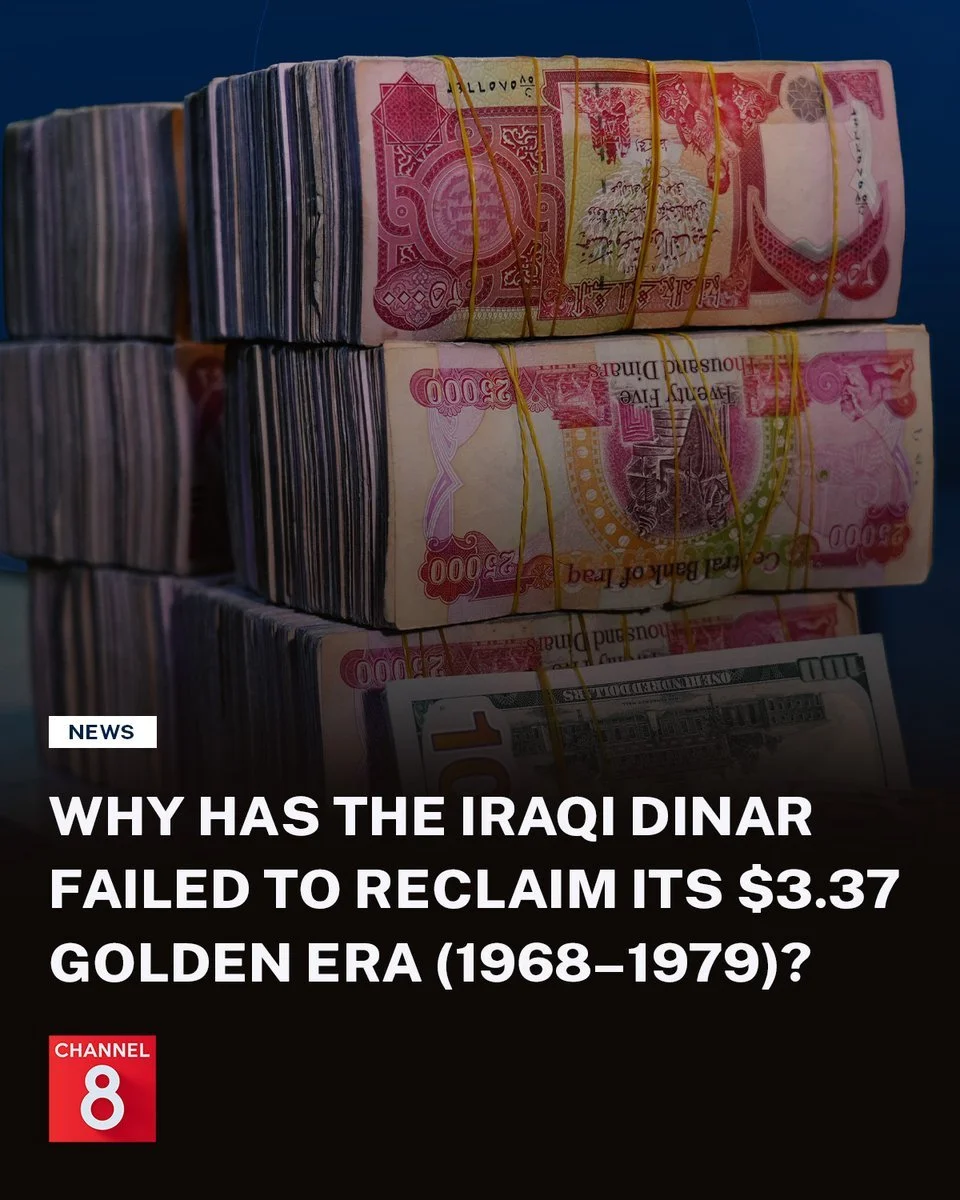
Channel 8 English: Channel8 has learned that decades of geopolitical conflict, sanctions, and market resistance have left Iraq unable to bridge the gap between its official 1,320 IQD peg and parallel market rates exceeding 1,530 IQD, cementing a historic decline from its four-dollar peak in the 1970s. This modern volatility persists despite official interventions like the 2021 devaluation to 1,460 IQD and the 2023 revaluation, with street prices still occasionally spiking to 1,700 IQD.
Read more:https://channel8.com/english/news/63882
Source(s):
• https://x.com/Prolotario1/status/2089079465649570270
https://dinarchronicles.com/2026/08/17/prolotario-you-all-are-in-for-some-historical-times/
*************
Ariel: The Sudden Rate Change has a Base Reasoning
8-17-2026
The Sudden Rate Change Has A Base Reasoning:
1. Iraqi parliament conducting first reading of the 2027 budget next week, with agreement to pass “as soon as possible”.
2. Digital dinar deployed nationwide meaning the infrastructure to support a new valuation already exists on the ground.
3. KRG and Baghdad reaching full consensus on ASYCUDA at all border points with a 50-50 revenue split the exact condition Iraqi financial officials previously stated would trigger the dinar’s rise.
4. September 1 tax adjustments in Iraq creating additional fiscal pressure for reconciliation.
Here Is One Thing You Need To Note
The Iraqi government is preparing to submit the 2027 federal budget to the Council of Representatives, with the bill expected by late September or early October. This is not routine. A budget submitted with the old exchange rate baked into its revenue projections would be fiscal malpractice if a revaluation is imminent because every line item, every public sector salary, every oil revenue projection, every dinar-denominated expenditure would be calculated on a pre-revaluation basis, meaning the moment the rate changes, the entire budget becomes instantly inaccurate and must be recalculated and resubmitted.
So What Would Be The Next Best Move?
They won’t submit a budget they know will be obsolete in weeks. The 2027 budget submission is the fiscal wall. The rate has to move before the budget bill arrives at parliament, because the budget itself has to be written in the new currency’s value. Late September is the deadline for the budget. That means the rate change has to happen before late September. September 1 is the earliest date the enforcement infrastructure is in place. The window is September 1 through roughly September 20-25. That’s the operational corridor.
The New Currency Is Already In The Country
The new currency began arriving in Baghdad ten days ago. That places physical arrival at approximately August 6. It was contracted for printing long ago meaning the design, the security features, the denomination structure, all of it was finalized and sent to the printer months back. This isn’t a decision being made. This is a decision that was made, e******d, and is now sitting in a vault waiting for deployment.
Why This Matters More Than You Think
Physical currency doesn’t get printed, shipped across borders, transported to Baghdad under security, and then sit in a warehouse indefinitely. The logistics of securing newly printed currency in transit and storage are enormous armed transport, secure facilities, insurance, chain-of-custody documentation.
Every day that currency sits in Baghdad without being deployed is a day of operational risk. Someone talks. Someone photographs a crate. The element of surprise degrades. The longer the new notes sit, the higher the probability of a leak that would allow the corrupt to begin converting hoarded dinars before the switch.
The Bottom Line
The currency arrived August 6. It’s now August 16. That’s ten days of degradation on the element of surprise. They cannot hold this much longer. Every day past this point increases the risk that someone with access to the storage facility informs a network, and that network begins moving hoarded wealth into real estate, gold, or foreign accounts. The switch has to happen within days, not weeks.
Iraq Economic News and Points To Ponder Monday Afternoon 8-17-26
Tehran To Tackle Iranian Business Hurdles In Iraq
2026-08-16 Shafaq News- Baghdad Central Bank of Iran Governor Abdolnaser Hemmati pledged to address obstacles facing Iranian businesses in Iraq, Iranian media reported on Sunday. During a meeting with Iranian business representatives in Baghdad, Hemmati said he would follow up on export revenues, customs tariffs, and unpaid dues to Iranian contractors.
Tehran To Tackle Iranian Business Hurdles In Iraq
2026-08-16 Shafaq News- Baghdad Central Bank of Iran Governor Abdolnaser Hemmati pledged to address obstacles facing Iranian businesses in Iraq, Iranian media reported on Sunday. During a meeting with Iranian business representatives in Baghdad, Hemmati said he would follow up on export revenues, customs tariffs, and unpaid dues to Iranian contractors.
Hemmati arrived in Baghdad on Sunday with an economic delegation and met Iraqi Trade Minister Mustafa Nizar al-Ani to discuss strengthening bilateral trade, facilitating the movement of goods, and implementing existing agreements.
https://www.shafaq.com/en/Economy/Tehran-to-tackle-Iranian-business-hurdles-in-Iraq
Oil Prices Climb On Hormuz Shipping Disruptions
2026-08-17 Shafaq News Oil prices rose on Monday as fading expectations of a U.S.-Iran peace breakthrough and slower tanker traffic through the Strait of Hormuz reinforced geopolitical risk concerns in the market.
Brent crude futures rose as much as 1% to $89.40 per barrel and were last trading up 72 cents at $89.20 by 0229 GMT. The U.S. West Texas Intermediate crude futures rose 44 cents to $82.83 a barrel.
Both contracts gained more than 5% last week following attacks on tankers operated by Abu Dhabi National Oil Company in the Hormuz strait and on a Saudi Aramco refinery.
Over the weekend, Iranian Foreign Minister Abbas Araqchi said Iran had not decided to resume talks with the U.S. while U.S. President Donald Trump urged Americans to accept slightly higher gasoline prices while the conflict continues.
"Oil prices have now rebounded almost completely from the lows seen in early August, as hopes for a more permanent resolution between the U.S. and Iran have faded and geopolitical risk premiums have returned to the market," said Priyanka Sachdeva, head of market insights for Phillip Nova in Singapore.
"However, I see limited upside from here unless we get clear evidence of renewed aggression in the Strait of Hormuz, particularly material damage to tankers or oil infrastructure," she said.
Shipping through the Strait of Hormuz slowed over the weekend, data showed on Monday, following attacks on tankers. Five commodity vessels transited the strait on Saturday, with none registered for Sunday, ship-tracking data from Kpler showed, versus 31 for the prior weekend.
The United Arab Emirates accused Iran of attacking a third vessel operated by ADNOC that was transiting the strait on Friday, the Emirati state news agency WAM reported, after blaming it for two other incidents involving ADNOC vessels in the strait on Thursday evening. https://www.shafaq.com/en/Economy/Oil-prices-climb-on-Hormuz-shipping-disruptions
PM Al-Zaidi Orders Round-The-Clock Oil Operations
2026-08-17 Shafaq News- Baghdad (Updated at 18:35) Iraqi Prime Minister Ali Al-Zaidi on Monday ordered oil companies to operate around the clock to sustain production and boost exports as the closure of the Strait of Hormuz continues to restrict crude shipments, demanding tangible results within one week.
At an Oil Ministry meeting, Al-Zaidi called for faster pipeline upgrades, alternative routes, and contracts with international companies to market Iraqi oil, according to his office. He also pressed officials to use the crisis to accelerate infrastructure projects and reduce dependence on Hormuz.
Every barrel of oil left unsold meant a delay in salaries or public services and a loss to the state treasury, Al-Zaidi stated, insisting that officials deliver solutions rather than explanations.
https://www.shafaq.com/en/Economy/PM-Al-Zaidi-orders-round-the-clock-oil-operations
Gold Nears $4,400 As Rate Hike Bets Fade
2026-08-17 Shafaq News Gold drifted higher on Monday, supported by a weaker dollar and recent soft economic data that reduced expectations for a U.S. interest rate hike next month.
Spot gold rose 0.4% to $4,391.49 per ounce by 0520 GMT. Prices hit a more-than-two-month high last week.
U.S. gold futures for December delivery edged 0.3% higher to $4,448.40.
The U.S. dollar index (.DXY) was down 0.2%, making greenback-priced metals more affordable for other currency holders.
"Gold has taken the ball and run with it to start the week, with soft inflation numbers keeping the U.S. dollar under pressure and giving gold extra headroom to push towards the $4,400 level," said Tim Waterer, chief market analyst at KCM Trade.
"A sustained move above $4,500 would likely need additional dollar weakness or a clearer pullback in energy prices."
An unexpected decline in U.S. nonfarm payrolls in July, coupled with data showing only mild consumer price inflation, has reduced expectations that the U.S. Federal Reserve will raise interest rates next month.
Traders are now pricing in a 30% chance of a September rate hike, down from 47% a month earlier, CME's FedWatch Tool showed.
Lower interest rates reduce the opportunity cost of holding non-yielding bullion, enhancing its appeal to investors.
Markets are now awaiting minutes of the Fed's July meeting, due on Wednesday, for further clues on policymakers' monetary stance.
On the geopolitical front, U.S. President Donald Trump's envoys met with Egyptian, Qatari and Turkish mediators in Cairo on Sunday, a diplomatic source said, aiming to advance his Gaza peace plan, even as Israel pressed on with airstrikes in the enclave.
Among other metals, spot silver rose 1.4% to $65.57 per ounce. Platinum fell 0.1% to $1,746.43, while palladium gained 1.4% to $1,331.10. (Reuters) https://www.shafaq.com/en/Economy/Gold-nears-4-400-as-rate-hike-bets-fade
USD/IQD Edges Higher In Baghdad, Erbil
2026-08-17 Shafaq News- Baghdad/ Erbil The US dollar opened higher in Iraq on Monday, trading above 153,900 dinars per 100 dollars.
According to a Shafaq News market survey, the dollar traded in Baghdad’s Al-Kifah and Al-Harithiya exchanges at 154,000 dinars per 100 dollars, up from the previous session’s 153,100 dinars.
In the Iraqi capital, exchange shops sold the dollar at 154,500 dinars and bought it at 153,500 dinars, while in Erbil, selling prices stood at 154,000 dinars and buying prices at 153,900 dinars.
https://www.shafaq.com/en/Economy/USD-IQD-edges-higher-in-Baghdad-Erbil
Gold Prices Increase Across Baghdad And Erbil
2026-08-17 Shafaq News- Baghdad/ Erbil On Monday, gold prices hovered around 970,000 IQD per mithqal in Baghdad and Erbil markets, according to a Shafaq News market survey.
Gold prices on Baghdad’s Al-Nahr Street recorded a selling price of 960,000 IQD per mithqal (equivalent to five grams) for 21-carat gold, including Gulf, Turkish, and European varieties, with a buying price of 956,000 IQD. The same gold sold for 950,000 IQD on Sunday.
The selling price for 21-carat Iraqi gold stood at 930,000 IQD, while the buying price reached 926,000 IQD.
In jewelry stores, the selling price per mithqal of 21-carat Gulf gold ranged between 960,000 and 970,000 IQD, while Iraqi gold sold for between 930,000 and 940,000 IQD.
In Erbil, 22-carat gold was sold at 994,000 IQD per mithqal, 21-carat gold at 951,000 IQD, and 18-carat gold at 814,000 IQD.
https://www.shafaq.com/en/Economy/Gold-prices-increase-across-Baghdad-and-Erbil
Breaking Down Comrade Mamdani’s 30% Discount
Breaking Down Comrade Mamdani’s 30% Discount
Notes From the Field By James Hickman (Simon Black / Sovereign Man) August 14, 2026
When Walmart founder Sam Walton passed away in 1992, his family fortune made him the wealthiest person on the planet... by far. His Walton Family Enterprises was worth $23.8 billion— nearly four times as much as Bill Gates at the time. And if he were still alive today, Walton would be the second-richest man in the world, just behind Elon Musk... and ahead of Zuckerberg, Ellison, the Google guys, etc.
That’s a pretty impressive feat for a guy whose core business is basically being a gigantic grocery store.
Breaking Down Comrade Mamdani’s 30% Discount
Notes From the Field By James Hickman (Simon Black / Sovereign Man) August 14, 2026
When Walmart founder Sam Walton passed away in 1992, his family fortune made him the wealthiest person on the planet... by far. His Walton Family Enterprises was worth $23.8 billion— nearly four times as much as Bill Gates at the time. And if he were still alive today, Walton would be the second-richest man in the world, just behind Elon Musk... and ahead of Zuckerberg, Ellison, the Google guys, etc.
That’s a pretty impressive feat for a guy whose core business is basically being a gigantic grocery store.
Selling food is an extremely low margin business. And Walton’s success was built on a fanatical adherence to cost control and efficiency— being able to squeeze every penny of savings possible from the entire supply chain, and passing those savings on to the customer.
In short, he made a fraction of a cent on every sale... but generated more sales than any company in the history of the world.
It’s fascinating that Sam Walton dedicated his life to perfecting this business model. Yet Comrade-Mayor Zohran Mamdani— who has never operated a business in his entire life— thinks he can do a better job than Walton.
A few weeks ago, Mamdani’s team published their formal RFP (request for proposal) for contractors to build five city-owned grocery stores in New York City— one per borough.
Mamdani’s objective is to sell staple foods like milk, eggs, bread, etc. at a 30% discount to the supermarkets down the street.
So apparently these socialists believe that 30% is the amount that "Big Grocery" is gouging them... which shows just how little they understand about business.
Again, groceries are notoriously low margin businesses. If they sell you something for $1, their gross profit is about a penny. Cutting prices by 30% guarantees they will lose money.
Staple consumer items like milk, eggs, chicken, and bread— exactly the products that Mamdani intends to sell at a discount— are some of the LOWEST margin products in the grocery store. Grocers already sell those at rock bottom prices just to get shoppers in the door.
For example, the Giant Eagle supermarket chain sold eggs at or below cost in all of its stores during last year’s bird flu outbreak. Costco sells over 150 million rotisserie chickens a year at $4.99 and loses tens of millions of dollars on them.
Grocers treat these staples as loss-leaders; they make up for it by generating small profits from the rest of the shopping cart, i.e. items like soda, snacks, prepared foods, and specialty items.
There is simply no fat to cut on staple items... and certainly nowhere near 30%. In fact, let’s take a quick look at how the supply chain works— starting from the grocery store and working backwards.
We already showed how grocers will barely break even, i.e. they sell a staple food for $1, and they make no money.
Before them are the major food distributors who supply the grocery stores.
Sysco, the country's biggest food distributor, keeps about two cents out of of every dollar it charges. The transportation companies hauling the food keep around three cents.
One step further back is the food processor. Tyson Foods, the largest meat company in America lost a billion dollars selling beef last year. Its core chicken business is generally profitable, but highly cyclical, and they have swung to nine-figure losses when feed costs spike.
Yet even the farmers themselves who supply the processors or grow the grain typically lose money; over 1,000 American dairy farms closed last year alone, and Illinois farmers growing the feed corn are on track to lose $70 to $110 an acre on this year's crop, their fourth losing year in a row. And that’s after their government subsidy checks.
Nobody in the food chain for staple goods is making real money. Farming, feed, processing, trucking, distribution, retail: every link runs on pennies. A 30% price cut cannot come out of anyone's profit, because the profit does not exist.
Comrade-Mayor Mamdani and his merry band of socialists either don't understand that, or have decided it doesn't matter because the taxpayer will absorb it.
Now, the city won't run the stores itself. Mamdani will pay a contractor to run them... But since the stores are designed to lose money, the city will send the operator a check every year to cover the losses.
How big will the check be? Nobody knows.
But on opening day, if the city really is selling the cheapest chicken in the borough, people will come buy all of it. Restaurant managers will stock up on cheap chicken to resell to their customers. Consumers will fill their freezers with it.
All that chicken will vanish in an instant, just like a deep-discount TV during a Black Friday sale.
Naturally the Comrade-Mayor will take steps to prevent this. But how?
Initially they said you would need to show ID at the grocery store. But they quickly backtracked because, obviously, ID is racist. So now they’re pitching the idea of something like a library card.
You need to show ID to get the card, and the card to buy the chicken. But apparently that’s not racist?
Naturally the card would need to track how much chicken a single consumer purchases in order to prevent people from going to multiple stores and buying out the whole inventory.
But if that’s the case, it’s not a library card. It’s a ration card. And that’s been a staple of every socialist disaster for over a century.
Running a grocery on a tiny margin is one of the hardest operating problems in retail. Order too much fresh food and it rots in the back room; order too little and the shelves sit empty.
Walmart survives on that knife's edge with some of the most advanced logistics technology on earth.
For example, they discovered decades ago that that strawberry Pop-Tarts sell at seven times their normal pace ahead of a hurricane— which is why trucks full of them roll toward the Florida coast before a storm hits.
Capitalism works through specialization— specialists spend their entire careers perfecting one tiny sliver of that machine to claw back a fraction of a point of margin.
The farmer, the trucker, and the supply-chain engineer each spend a lifetime becoming ruthlessly good at one narrow thing, and the penny of margin is the reward for doing it almost perfectly.
Mamdani quotes Karl Marx and thinks he can do a better job... even though his government cannot even reliably pick up the garbage.
These are the same people who want to run health care, housing, and energy.
Frankly I couldn’t be happier. The socialists finally got what they wanted: they’re in power, in the spotlight. And they’re about to prove once and for all that their entire ideology is a complete and total disaster.
To your freedom, James Hickman Co-Founder, Schiff Sovereign LLC
We Left Gold in 1971... Now the World Is Leaving the Dollar
We Left Gold in 1971... Now the World Is Leaving the Dollar
Peter Schiff: 8-17-2026
Peter Schiff on plunging retail sales, sticky inflation, the Fed's stealth QE, and why the world is now leaving the dollar standard.
Retail sales just plunged, producer prices are still rising, and the Fed is quietly expanding its balance sheet again.
The July data tells the story the markets keep ignoring. Retail sales fell 0.6 percent, the biggest drop in over a year, and since those numbers are not adjusted for inflation, real spending fell even further.
We Left Gold in 1971... Now the World Is Leaving the Dollar
Peter Schiff: 8-17-2026
Peter Schiff on plunging retail sales, sticky inflation, the Fed's stealth QE, and why the world is now leaving the dollar standard.
Retail sales just plunged, producer prices are still rising, and the Fed is quietly expanding its balance sheet again.
The July data tells the story the markets keep ignoring. Retail sales fell 0.6 percent, the biggest drop in over a year, and since those numbers are not adjusted for inflation, real spending fell even further.
Consumer sentiment sank to 51 as households braced for 4.3 percent inflation, more than double the Fed's 2 percent target. Producer prices rose 4.7 percent year over year, and instead of rallying on the weak data, the bond market sold off to its lowest weekly close of the year, with the 30-year at 5.27 percent.
Meanwhile the Fed expanded its balance sheet by more than 21 billion dollars in two weeks, with the national debt about 80 billion dollars away from 40 trillion.
Peter marks 55 years since Nixon closed the gold window and calls it what it was: a 100 percent default on America's creditors.
His father Irwin testified against removing gold backing in 1968, and the 1970s proved him right. Now the sequel is underway.
The world is going off the dollar standard the way America went off gold, and the next leg down in the American standard of living has already started. Gold near 4,400 dollars and silver above 66 are the market's verdict.
Chapters:
00:00 Middle Class Squeeze
01:01 PPI Breakdown
04:08 Fed Balance Sheet Surge
05:23 Stagflation Signals
08:28 Bond Market Warning
11:39 Greenspan and 1987 Echoes
14:48 Stocks vs Bonds Diverge
15:33 Gold Shines Bitcoin Slips
18:16 Bitcoin Bear Case
21:08 Iran Sanctions and Oil
26:30 Nixon Gold Standard Legacy
28:52 Inflation Math Reality
29:30 Video Plug Fiat Failure
30:19 Electric Catamaran Tour
34:30 Cruising Plans Tax Credit
37:02 Gold Standard Break Explained
48:09 Dollar Standard Ending
Monday Iraq News Posted by Tishwash at TNT 8-17-2026
TNT:
Tishwash: Late-night meeting of the four presidencies to discuss three "serious" issues in Iraq
The four presidencies will hold an important meeting this evening, Monday, focusing on the issue of limiting weapons and options for confronting factions that refuse to disarm after the September 30 deadline.
According to an informed source who spoke to Shafaq News Agency, the meeting to be held between Prime Minister Ali al-Zubaidi, Speaker of Parliament Hebat al-Halbousi, President Nizar Amidi, and Head of the Supreme Judicial Council Faiq Zaidan will focus on two issues: first, restricting weapons, and second, continuing the fight against corruption and ensuring there are no red lines in pursuing any person accused of corruption, regardless of their governmental or political position.
TNT:
Tishwash: Late-night meeting of the four presidencies to discuss three "serious" issues in Iraq
The four presidencies will hold an important meeting this evening, Monday, focusing on the issue of limiting weapons and options for confronting factions that refuse to disarm after the September 30 deadline.
According to an informed source who spoke to Shafaq News Agency, the meeting to be held between Prime Minister Ali al-Zubaidi, Speaker of Parliament Hebat al-Halbousi, President Nizar Amidi, and Head of the Supreme Judicial Council Faiq Zaidan will focus on two issues: first, restricting weapons, and second, continuing the fight against corruption and ensuring there are no red lines in pursuing any person accused of corruption, regardless of their governmental or political position.
The source explained that the meeting will also discuss the economic situation and the serious financial crisis that Iraq is going through due to the halt in its oil exports through the Strait of Hormuz, and possible solutions to confront the crisis in the coming period.
The issue of armed factions is one of the most sensitive issues facing the Iraqi government, with the approach of September 30, which the main political forces have set as the deadline for restricting weapons to official institutions.
In September 2024, Iraq and the United States agreed to end the military mission of the US-led international coalition against ISIS in Iraq, as part of a phased plan to move the security relationship between the two countries from the framework of the coalition to a bilateral partnership.
On Sunday, the State of Law coalition, led by Nouri al-Maliki, submitted a proposal to separate the date of the withdrawal of US forces from Iraq from the issue of disarming the factions, within the framework of a vision that is still "under study".
Regarding the fight against corruption, a campaign of arrests was launched in Iraq in late June, targeting political officials, members of parliament, and businessmen, as part of a campaign called "Operation Dawn," which Prime Minister Ali al-Zubaidi described as the "first phase" of broader measures to recover public funds, while tasking oversight bodies with receiving any indications related to cases of corruption or negligence in state institutions.
On the financial level, Iraq is experiencing a serious financial crisis, which has resulted in the delay in paying the salaries of a number of Iraqi state employees for the month of July, amidst accumulated living expenses and increasing economic pressures that have begun to be clearly reflected in the Iraqi markets. link
************
Tishwash: Minister of Communications: The decision to remove zeros and change the Iraqi currency has been finalized.
Communications Minister Mustafa Sand said that the decision to remove zeros from the Iraqi currency and change it has been finalized, noting that implementing this step will contribute to bringing hoarded funds out of the banking system and returning them to the economic cycle .
During a televised interview followed by Al-Sa’a Network, Sand added that “the currency exchange process will push those who hoard money to disclose it, while other amounts will remain outside the exchange process, especially money that its owners cannot show,” referring to money obtained from corruption or illegal activities, in addition to money that is lost or belongs to deceased people, which may reduce the size of the circulating cash mass.
He pointed out that "the value of the money that may not be exchanged could reach, according to his estimates, about 8 trillion dinars," considering that "its non-return practically means that the state will not be obliged to issue its equivalent in new currency."
Sand’s statements come after a wide controversy she stirred up regarding changing the Iraqi currency and removing zeros, as the “Eco Iraq” observatory denounced the announcement of sensitive economic and monetary decisions through unqualified entities, while the Central Bank of Iraq and the Ministry of Finance remained silent .
The observatory said in a statement received by Al-Sa’a Network that managing a file as large as the national currency through scattered statements, instead of official statements issued by the competent monetary and financial authorities, reflects a weakness in government coordination, warning that ambiguity may open the door to rumors and speculation and affect citizens’ confidence in the national currency, and demanding that the Central Bank and the Ministry of Finance issue an official clarification regarding the truth of the decision, its implementation mechanisms and its timetable . link
************
Tishwash: Economic Observatory: Government silence regarding "currency change" is confusing the Iraqi dinar market
Observatory of Iraq criticized the confusion in the government’s discourse, which is represented in announcing sensitive economic and monetary decisions, such as changing the currency, through unqualified entities, amid the silence of the Central Bank of Iraq and the Ministry of Finance.
The observatory stated in a statement received by Shafaq News Agency that "managing a file as large as the national currency through scattered statements, instead of clear official conferences and statements issued by the competent monetary and financial authorities, reflects a weakness in government coordination," explaining that "such confusion opens the door to rumors, speculation, market disruption, and harm to citizens and the country."
The observatory warned that "this ambiguity affects the economic security of citizens and may affect their confidence in the national currency and increase the demand for foreign currencies and gold, thus exacerbating the state of anxiety in the market."
Eco Iraq held the Central Bank and the Ministry of Finance "responsible for clarifying the truth about the decision and any confusion in the Iraqi market resulting from their silence," demanding that the competent authorities "issue an official statement explaining the reasons for changing the currency, the implementation mechanisms, the timetable, and guarantees to protect citizens' savings and market stability." link
************
Tishwash: Iraq Struggles to Contain Volatile Dinar Currency Disparity
At a Glance
The Iraqi dinar reached its peak value during the 1970s when one dinar was worth four U.S. dollars.
Conflict and economic embargoes during the 1990s caused the currency to crash to 3,000 dinars per dollar.
The Central Bank fixed the official rate at 1,320 IQD, but parallel market rates remain high at 1,530 IQD.
The government has failed to contain the significant price gap between official state channels and open market vendors.
Channel8 has learned that decades of geopolitical conflict, sanctions, and market resistance have left Iraq unable to bridge the gap between its official 1,320 IQD peg and parallel market rates exceeding 1,530 IQD, cementing a historic decline from its four-dollar peak in the 1970s.
Key Statements and Focus Area
On current market disparity: A persistent, wide gap remains between Iraq's official and market exchange rates, with open markets trading at 1,530 IQD despite the Central Bank's 1,320 IQD official peg.
On structural historical declines: This modern monetary disparity mirrors the volatile historical trajectory of the Iraqi dinar, which collapsed from its historic peak of four dollars per dinar to some of its lowest historical levels.
On modern monetary interventions: Although the government devalued the dinar to 1,460 IQD in 2021 due to crashing oil revenues and later revalued it to 1,320 IQD in 2023, the market resisted, with street prices occasionally spiking to 1,700 IQD.
Chronological Eras of the Iraqi Dinar Value
1968–1979 (The Peak): The currency maintained its absolute highest valuation, trading at a stable rate of 1 IQD to $4.00 USD.
1980–1988 (The Iran-Iraq War): Wartime economic strain caused a minor depreciation, adjusting the value to 1 IQD to $3.30 USD.
1991–2003 (The Sanctions Era): Under a crushing economic blockade and excessive domestic printing, the currency collapsed to 3,000 IQD to $1 USD.
2004–2021 (Post-War Stabilization): The introduction of a new currency stabilized the market, keeping exchange rates steady between 1,180 IQD and 1,200 IQD per dollar.
In recent weeks, the Iraqi dinar strengthened against the U.S. dollar, with the exchange rate dropping from a peak of nearly 160,000 IQD to 153,000 IQD per 100 dollars.
This decline was driven by the U.S. government lifting restrictions on several private Iraqi banks and the Central Bank of Iraq addressing rumors of currency devaluation.
Market traders told Channel8 that ongoing government financial stabilization measures, including organized customs duty collections via the ASYCUDA system, helped restore public sector confidence, keeping the dollar from climbing back to its June peaks.
Speaking to Channel8 today, Jabar Goran, spokesperson for the Slemani Currency Exchange Market, highlighted that deleting zeros from the dinar would compel holders of hidden cash reserves to disclose their origins, effectively rendering tens of trillions in illicit funds unusable.
Goran also dismissed rumors of an Iraqi dinar exchange-rate adjustment, stating that a devaluation is unnecessary because rising revenues have offset increased expenditures.
The spokesperson previously predicted that if regional geopolitical tensions ease and vital maritime trade channels like the Strait of Hormuz remain stable, the parallel market exchange rate could significantly strengthen, potentially dropping down to a range between 146,000 and 147,000 IQD per $100 USD.
FYI
The Iraqi dinar was originally introduced into circulation in 1932. Following the regime change in 2003, the Coalition Provisional Authority introduced an entirely overhauled banknote series widely known as the "Bremer Print."
This new issue systematically replaced both the pre-1991 high-quality "Swiss Print" and the poorly printed, easily counterfeited banknotes produced locally during the 1990s sanctions era.
This monetary timeline demonstrates that prolonged foreign wars, domestic mismanagement, and geopolitical shifts remain the primary drivers behind the dynamic instability of the dinar against global currencies. link
************
Tishwash: The Prime Minister's advisor: The government has translated its promises into restructuring the national economy.
The financial advisor to the Prime Minister, Mazhar Muhammad Salih, affirmed on Saturday that evaluating Prime Minister Ali al-Zaidi's government after 100 days in office should not be limited to the number of days it has spent in power, but rather to the direction it has chosen since taking office. He pointed out that the government assumed responsibility in a highly complex Iraqi context.
According to the official newspaper, Salih stated, "The government came to power in a highly complex Iraqi context: an economy heavily dependent on oil, a state burdened by a long administrative and financial legacy, entrenched corruption, security and sovereignty challenges, and increasing social pressure seeking job opportunities, services, and a decent life."
He added, "Al-Zaidi's government did not deal with these issues as separate crises, but rather tried to view them as parts of a single problem: building the state and restoring its ability to manage its resources and interests."
He indicated that "the fight against corruption was at the forefront of the files to which the government gave clear priority," explaining that "the importance lies not only in opening files or taking measures, but in moving the fight against corruption from the usual political rhetoric to a more institutional path based on oversight, recovering public funds, and holding those involved accountable."
He explained that "transforming the fight against corruption into a declared and ongoing battle is an important step in the right direction, after corruption has become, for many years, one of the biggest obstacles to state-building."
Saleh pointed out that "the al-Zaidi government did not merely manage the existing economy, but also proposed the idea of reforming its structure," indicating that "talk of program-based budgeting, reforming the banking sector, developing the tax and customs systems, supporting the private sector, and creating new tools to finance development and investment reflects an attempt to move from an economy that relies on rent-seeking to one that can generate value."
He emphasized that "Iraq does not lack resources, but rather the ability to transform those resources into production, job opportunities, and sustainable wealth," noting "the importance of the government's focus on investment, energy, and infrastructure, and its efforts to open the door to broader investment partnerships."
He added that "economic diversification is not just a financial slogan, but the path to building a genuine labor market and reshaping the Iraqi middle class based on work, production, and efficiency."
Regarding the private sector, Saleh explained that "Iraq cannot build its future relying solely on government jobs," clarifying that "what is needed is an economy that creates opportunities outside the state and gives doctors, engineers, merchants, farmers, industrialists, and entrepreneurs real space to grow."
He pointed out that "the government's success in this direction will not be measured only by the volume of investments it attracts, but also by the number of productive jobs it creates and its ability to translate investment into tangible economic activity that citizens feel."
At the level of the state and sovereignty, Saleh emphasized that "the insistence on the state's monopoly on the use of force and the restoration of national decision-making sends a clear political message that building the economy cannot be separated from building the state," stressing that "there is no strong economy without a strong state, no stable investment without a clear security and sovereign environment, and no stable middle class without institutions operating within the framework of the law."
Regarding the energy sector, he noted that "the government views electricity and energy as more than just service-related matters; they are the foundation of industry, investment, and production, and any real success in this sector can have a positive impact on the entire economy."
He explained that "the government's actions in energy and investment can be interpreted as part of a broader project aimed at transforming Iraq from an economy that consumes its resources to one that can invest them."
Saleh stated that "what is most striking about al-Zidi's experience during this short period is that the government did not hide behind difficult circumstances, but rather tackled the most challenging issues, including corruption, oil revenues, public finances, energy, investment, the private sector, and sovereignty."
He emphasized that "governments are not only judged by the files they close, but also by what they dare to open," pointing out that "the first few months cannot be sufficient to judge the results of reforms that, by their nature, require years, but they can be enough to discern the government's direction and political will."
He clarified that "al-Zidi, in his economic discourse, does not simply propose increasing spending, but rather speaks of reforming the structure of the economy, and he does not address combating corruption as a media campaign, but as a national issue."
He added, "The government does not treat the private sector as a mere guest in the Iraqi economy, but rather as a fundamental partner in wealth creation. It does not view energy as simply a service, but as a foundation for development. Nor does it separate sovereignty and stability from the ability to attract investment and build the economy."
He emphasized that "the government's success in translating its initial proposals into sustainable policies and tangible results means it will not have merely achieved scattered governmental accomplishments, but will have begun to redefine the relationship between the state, the economy, and the citizen."
He pointed out that "the most significant value at the beginning of al-Zaidi's term is the renewed focus on how to transition from a rentier state to a wealth-creating state, and from an economy where the rich get richer as opportunities dwindle for others, to an economy where increased individual wealth contributes to the wealth of society."
Saleh concluded by saying, "The importance of the first hundred days does not lie in achieving everything, but rather in demonstrating that there is a government willing to address long-postponed issues." He explained that "the courage to tackle these difficult files may be the first real achievement, even before its results become apparent on the ground." link
News, Rumors and Opinions Monday 8-17-2026
Ariel: PM Al-Zaidi is Not Planning to Go Through Parliament
8-17-2026
PM Ali al-Zaidi Is Not Planning To Go Through Parliament:
He Doesn’t Have To And Here Is Why
Article 80 of the Iraqi Constitution grants the Council of Ministers authority to issue administrative regulations and execute policy decisions in coordination with the Central Bank of Iraq without a parliamentary vote specifically in matters of monetary sovereignty and financial system management.
Ariel: PM Al-Zaidi is Not Planning to Go Through Parliament
8-17-2026
PM Ali al-Zaidi Is Not Planning To Go Through Parliament:
He Doesn’t Have To And Here Is Why
Article 80 of the Iraqi Constitution grants the Council of Ministers authority to issue administrative regulations and execute policy decisions in coordination with the Central Bank of Iraq without a parliamentary vote specifically in matters of monetary sovereignty and financial system management.
3 Things To Note
1. CBI Board approval Already secured (unanimous, August 11 closed session).
2. Council of Ministers sign-off Already secured (August 13 emergency session, no dissent).
3. Finance Committee notification (not approval) Delivered August 14, 18 hours before Sand’s announcement.
Parliament can object.
Parliament can scream.
Parliament cannot stop this.
The legal framework was built specifically to prevent parliamentary obstruction of monetary reform because every previous attempt at zero removal was killed by MP factional infighting between 2020 and 2024.
Ali al-Zaidi studied those failures. He engineered around them.
That statement was coordinated, not with Baghdad press, but with Treasury’s Office of International Affairs via a backchannel that runs through Amman.
The phrase “decision to change the currency” is deliberate. It’s not a proposal. It’s not under consideration. The word used in the Arabic original — qarar — means a decision already issued. Already made. Already signed.
What Sand did not say matters more. He did not say “parliamentary approval required.” He did not say “pending legislation.” He said “ready.” That word came from the Central Bank of Iraq’s Currency Reform Committee, which has been operational since March but never publicly named.
~Parliament was going to stall past October. Now they react in days, not weeks. Let them file procedural complaints. The CBI controls the ledger, and the ledger is already migrated.
Source(s):
• https://x.com/Prolotario1/status/2088860147921703114
************
Courtesy of Dinar Guru: https://www.dinarguru.com/
Reset IntelligenceRemember, Germany, 1948 - The money flips in the middle of the chaos. Not after it. Iraq is running the same play, in the open and on the record. The crisis you are seeing is the old system's last months. Behind it, this week alone: borders onto one ledger, weapons into a statute, a budget that must print the IQD's real effective exchange rate.
JeffThe budget comes after the rate change...the pseudo '26 budget and the cabinet are coming to a head at the same time...A completed cabinet is the lynch pin to the rate change...It'll probably be 24 to 48 hours notice at best...to whatever date they're going to do the cabinet...If they were going to do it around next weekend, they might not tell us till maybe Thursday or Friday...It's going to be very short notice
Militia ManArticle quote "The finance committee has taken upon itself the legislation of grants and borrowing law and an agreement was reached with the government...the first reading will take place next week...There's an agreement between the prime minister and the finance committee that there should be a budget and that it should be passed in the House of Representatives as quickly as possible...which will determine the exchange rate." I have never seen that before. Anybody who's been here for 23 years has never seen that before. I think you guys should be sitting up in your seats and smiling about that...Linking the budget explicitly to determining the exchange rate is a...change in pattern.
**********
The Dollar System is Dead-What comes next?
WTFinance: 8-16-2026
On this episode of the WTFinance podcast I had the pleasure of welcoming on Simon Dixon.
During our conversation Simon spoke about his overview of the markets, potential treasury intervention, pumping stock market higher, Plaza accord 2.0, end game of central banks and more.
0:00 - Introduction
2:06 - Overview of the economy and markets?
5:35 - Treasury intervention
7:40 - Pumping stock market higher
12:43 - Middle East Outcome
19:28 - Multipolar financial world
22:24 - Plaza Accord 2.0
28:25 - End game of Central Banks
30:28 - Gaining control
35:25 - Protect yourself
42:40 - One message to takeaway?
Iraq Economic News and Points To Ponder Monday Morning 8-17-26
Telecom Minister Claims Dinar Redenomination Finalized, Drawing Criticism
IraqJawad Al-Samarraie August 16, 2026 Baghdad (IraqiNews.com) — Minister of Communications Mustafa Sanad stated in a televised broadcast that the government decision to redenominate the Iraqi Dinar and delete three zeros from the national currency is officially finalized. Sanad asserted that replacing the current banknotes will force hoarded cash back into formal banking channels while eliminating an estimated 8 trillion IQD ($6.1 billion) in unexchanged currency tied to illicit gains, corruption, and lost funds.
Telecom Minister Claims Dinar Redenomination Finalized, Drawing Criticism
IraqJawad Al-Samarraie August 16, 2026 Baghdad (IraqiNews.com) — Minister of Communications Mustafa Sanad stated in a televised broadcast that the government decision to redenominate the Iraqi Dinar and delete three zeros from the national currency is officially finalized. Sanad asserted that replacing the current banknotes will force hoarded cash back into formal banking channels while eliminating an estimated 8 trillion IQD ($6.1 billion) in unexchanged currency tied to illicit gains, corruption, and lost funds.
However, the minister’s pronouncements have triggered backlash from economic monitors over fiscal messaging and central bank authority.
Key Statements & Fiscal Arguments
Finalized Redenomination: Sanad stated the decision to remove zeros and issue a restructured currency is fully resolved.
Tackling Hoarded & Illicit Liquidity: Replacing existing currency will compel citizens to deposit hoarded cash into formal banking institutions, bringing idle liquidity back into the national economic cycle.
Projected 8T IQD Money Supply Contraction: An estimated 8 trillion IQD in physical banknotes may never be submitted for exchange due to illicit origins, criminal gains, or deceased/unclaimed holdings.
State Balance Sheet Relief: Sanad argued that unexchanged legacy banknotes will permanently exit circulation, meaning the state will not be required to issue equivalent replacement notes, reducing the overall money supply.
Sanad’s declarations prompted criticism from economic monitoring group Eco Iraq Observatory, which rebuked cabinet ministers for announcing sensitive monetary policies outside official central banking channels.
The observatory warned that broadcasting national currency reforms through ad-hoc political interviews rather than institutional communiqués undermines market confidence, fuels currency speculation, and signals fragmented inter-agency coordination. Eco Iraq formally urged the Central Bank of Iraq (CBI) and the Ministry of Finance to issue an official clarification detailing the veracity, operational mechanics, and statutory timeline of any currency restructuring plan.
https://www.iraqinews.com/iraq/sanad-dinar-redenomination-delete-zeros-eco-iraq-reaction-2026/
Iraq Has Finalized Its Decision To Redenominate The Iraqi Dinar By Removing Three Zeros From The National Currency.
Iraqi News@IraqiNews_com The move is meant to force hoarded cash back into formal banking channels while eliminating an estimated 8 trillion IQD, about $6.1 billion, in unexchanged currency tied to illicit gains, corruption, and lost funds.
Since old banknotes that are never exchanged will permanently exit circulation, the state won't need to issue equivalent replacement notes, effectively shrinking the overall money supply.
The announcement has drawn criticism from economic monitoring group Eco Iraq Observatory, which warned that announcing sensitive currency reforms through ad hoc interviews rather than official channels risks undermining market confidence and fueling speculation.
The group has called on the Central Bank of Iraq and Ministry of Finance to issue an official clarification on the plan's details and timeline. https://iraqinews.com/iraq/sanad-din
https://x.com/IraqiNews_com/status/2089232903687540927
Economic Observatory: Government Silence Regarding "Currency Change" Is Confusing The Iraqi Dinar Market
2026-08-16 Shafaq News - Baghdad On Sunday, the Economic Observatory of Iraq criticized the confusion in the government’s discourse, which is represented in announcing sensitive economic and monetary decisions, such as changing the currency, through unqualified entities, amid the silence of the Central Bank of Iraq and the Ministry of Finance.
The observatory stated in a statement received by Shafaq News Agency that "managing a file as large as the national currency through scattered statements, instead of clear official conferences and statements issued by the competent monetary and financial authorities, reflects a weakness in government coordination," explaining that "such confusion opens the door to rumors, speculation, market disruption, and harm to citizens and the country."
The observatory warned that "this ambiguity affects the economic security of citizens and may affect their confidence in the national currency and increase the demand for foreign currencies and gold, thus exacerbating the state of anxiety in the market."
Eco Iraq held the Central Bank and the Ministry of Finance "responsible for clarifying the truth about the decision and any confusion in the Iraqi market resulting from their silence," demanding that the competent authorities "issue an official statement explaining the reasons for changing the currency, the implementation mechanisms, the timetable, and guarantees to protect citizens' savings and market stability."
Mustafa Sand Reveals A Government Plan To Remove Zeros And Change The Currency... And 8 Trillion Dinars Is The Value Of The "Missing Figures".
Baghdad - One News Communications Minister Mustafa Sand revealed a government plan to reintroduce the project of removing zeros from the Iraqi dinar and changing the currency, noting that the value of what he described as the “missing figures” amounts to about 8 trillion dinars, in a move that would bring the national currency file back to the forefront of economic discussion after years of raising it and postponing it.
Talk of the project comes amid controversy and questions about its implementation mechanism and its potential repercussions on markets, prices and citizens’ savings, as well as the fate of the large amount of cash circulating outside the banking system.
The idea of removing zeros is based on issuing a new currency and recalculating nominal values after removing three zeros, so that every thousand dinars of the current currency becomes equivalent to one dinar in the new currency, with salaries, prices, savings, debts and contracts being recalculated in the same proportion.
Thus, removing zeros does not in itself mean an increase in the purchasing power of the dinar or an increase in the value of citizens’ savings, but rather represents a renaming and reorganization of monetary values, unless it is accompanied by other changes in monetary policy or the exchange rate.
Changing the currency may give monetary authorities an opportunity to reorganize the money supply and withdraw some of the money circulating outside the banking system, as replacing the old currency with the new one requires introducing large quantities of cash into banks and exchange outlets within a time period determined by the competent authorities.
But the new talk opens the door to questions about the final official position on the project, especially since it comes after a previous government denial, last June, of the existence of an official decision to remove zeros, change the currency, or amend the exchange rate of the dinar.
The government position at the time had confirmed that Iraq was facing a temporary liquidity crisis and not a structural financial crisis, while the Central Bank of Iraq had confirmed in previous statements that there was no intention to change the exchange rate.
Between the new statements and previous positions, the implementation of the project to remove zeros remains contingent on an official announcement clarifying the nature of the decision, its implementation mechanism, and the timetable for currency replacement, as well as how to deal with salaries, savings, contracts, prices, and the cash holdings outside banks. https://1news-iq.net/مصطفى-سند-يكشف-عن-توجه-حكومي-لحذف-الأصف/
106 Trillion Outside Banks... Removing Zeros Unlocks The Vaults Of The Money Supply
Baghdad - Al-Sa'a Network The Iraqi government's move to revisit the project of removing zeros from the dinar has sparked widespread controversy and concern in the markets, amid questions about the implications of the move on the value of the currency, prices and savings, and whether the project will be limited to renaming the currency denominations or will turn into a tool for reorganizing the money supply and withdrawing funds circulating outside the banking system, according to the "Eram News " website.
The website, in a report seen by Al-Sa’a Network, quoted its sources as saying that “removing the zeros could coincide with the return of funds to the banking system, especially since about 106 trillion dinars, representing about 94% of the total money supply of 113 trillion dinars, is circulating outside banks .”
He added that "returning these funds to bank accounts could allow banks to reinvest them in the form of loans with appropriate interest rates, and direct them to the production, industry, agriculture, trade and real estate sectors, thus turning funds outside the banking system into part of the formal economic cycle ."
He noted that "discussions regarding the removal of zeros are still ongoing, and there is a difference of opinion regarding whether to change the currency or just remove the zeros, and therefore the project has not yet reached the stage of a final decision ."
He explained that "the government's approach and the Central Bank's management aim, within the proposed vision, to withdraw about 10 trillion dinars from the money supply, which is equivalent to about 7.6 billion dollars according to a rate of 1310 dinars to the dollar, and return it to the banking cycle, but the process at the same time has costs and needs to study its effects on the market ." https://alssaa.com/post/show/58808-106-تريليونات-خارج-المصارف-حذف-الأصفار-يفتح-خزائن-الكتلة-النقدية
Removing Zeros Will Include Converting Salaries, Prices, Balances, And Financial Obligations
1 News - One News@onenewsiq Translated from Arabic Al-Araby Al-Jadeed newspaper: Removing zeros will include converting salaries, prices, balances, and financial obligations by the same ratio without increasing the citizen's purchasing power. #OneNews https://x.com/onenewsiq/status/2089136372653216214
"It Affects Economic Security": Eco Iraq Criticizes The Proposal To Change The Currency Outside Of Official Institutions And Warns Of Increased Demand For The Dollar And Gold.
The Economic Observatory “Eco Iraq” criticized on Sunday what it described as the confusion in the government’s discourse regarding sensitive economic and monetary issues, particularly talk about changing the currency, warning that the absence of official clarifications from the Central Bank of Iraq and the Ministry of Finance may open the door to rumors, speculation and market confusion.
The observatory said in a statement that managing a file as large as the national currency through scattered statements issued by unqualified parties, instead of clear official conferences or statements from the relevant monetary and financial institutions, reflects a weakness in government coordination and increases the ambiguity about the true directions being proposed.
He added that dealing in this way with a file that is directly related to monetary policy and citizens’ savings may lead to the spread of rumors and speculation in the market, and affect citizens’ view of the stability of the national currency.
Eco Iraq warned that continued uncertainty regarding currency change could affect what it described as the “economic security of citizens” and impact confidence in the Iraqi dinar, potentially leading to increased demand for foreign currencies and gold, and hedging against any possible changes.
The observatory noted that any increase in anxiety levels within the market, as a result of the lack of official information, may be reflected in the movement of demand, prices and economic expectations, especially in light of the sensitivity of issues related to the exchange rate and monetary policy.
The observatory held the Central Bank of Iraq and the Ministry of Finance responsible for clarifying the truth about what is being proposed regarding changing the currency, in addition to addressing any confusion that the market may witness as a result of the continued official silence regarding the issue.
“Eco Iraq” called on the relevant authorities to issue an official statement clarifying the true nature of the proposed approach, its reasons, and the mechanisms for its implementation if there is an actual decision, as well as specifying the timetable and guarantees for protecting citizens’ savings and maintaining market stability.
The observatory stressed that clear official communication and coordination among relevant institutions are essential factors in preventing the spread of inaccurate information and curbing speculation, especially when it comes to monetary decisions that can directly affect citizens' confidence in the national currency and the Iraqi market. https://1news-iq.net/يمس-الأمن-الاقتصادي-إيكو-عراق-ينتقد/
Iraq Struggles to Contain Volatile Dinar Currency Disparity
Daban Mohammed
At a Glance
The Iraqi dinar reached its peak value during the 1970s when one dinar was worth four U.S. dollars.
Conflict and economic embargoes during the 1990s caused the currency to crash to 3,000 dinars per dollar.
The Central Bank fixed the official rate at 1,320 IQD, but parallel market rates remain high at 1,530 IQD.
The government has failed to contain the significant price gap between official state channels and open market vendors.
Channel8 has learned that decades of geopolitical conflict, sanctions, and market resistance have left Iraq unable to bridge the gap between its official 1,320 IQD peg and parallel market rates exceeding 1,530 IQD, cementing a historic decline from its four-dollar peak in the 1970s.
Key Statements and Focus Area
On current market disparity: A persistent, wide gap remains between Iraq's official and market exchange rates, with open markets trading at 1,530 IQD despite the Central Bank's 1,320 IQD official peg.
On structural historical declines: This modern monetary disparity mirrors the volatile historical trajectory of the Iraqi dinar, which collapsed from its historic peak of four dollars per dinar to some of its lowest historical levels.
On modern monetary interventions: Although the government devalued the dinar to 1,460 IQD in 2021 due to crashing oil revenues and later revalued it to 1,320 IQD in 2023, the market resisted, with street prices occasionally spiking to 1,700 IQD.
Chronological Eras of the Iraqi Dinar Value
1968–1979 (The Peak): The currency maintained its absolute highest valuation, trading at a stable rate of 1 IQD to $4.00 USD.
1980–1988 (The Iran-Iraq War): Wartime economic strain caused a minor depreciation, adjusting the value to 1 IQD to $3.30 USD.
1991–2003 (The Sanctions Era): Under a crushing economic blockade and excessive domestic printing, the currency collapsed to 3,000 IQD to $1 USD.
2004–2021 (Post-War Stabilization): The introduction of a new currency stabilized the market, keeping exchange rates steady between 1,180 IQD and 1,200 IQD per dollar.
In recent weeks, the Iraqi dinar strengthened against the U.S. dollar, with the exchange rate dropping from a peak of nearly 160,000 IQD to 153,000 IQD per 100 dollars.
This decline was driven by the U.S. government lifting restrictions on several private Iraqi banks and the Central Bank of Iraq addressing rumors of currency devaluation.
Market traders told Channel8 that ongoing government financial stabilization measures, including organized customs duty collections via the ASYCUDA system, helped restore public sector confidence, keeping the dollar from climbing back to its June peaks.
Speaking to Channel8 today, Jabar Goran, spokesperson for the Slemani Currency Exchange Market, highlighted that deleting zeros from the dinar would compel holders of hidden cash reserves to disclose their origins, effectively rendering tens of trillions in illicit funds unusable.
Goran also dismissed rumors of an Iraqi dinar exchange-rate adjustment, stating that a devaluation is unnecessary because rising revenues have offset increased expenditures.
The spokesperson previously predicted that if regional geopolitical tensions ease and vital maritime trade channels like the Strait of Hormuz remain stable, the parallel market exchange rate could significantly strengthen, potentially dropping down to a range between 146,000 and 147,000 IQD per $100 USD.
FYI
The Iraqi dinar was originally introduced into circulation in 1932. Following the regime change in 2003, the Coalition Provisional Authority introduced an entirely overhauled banknote series widely known as the "Bremer Print."
This new issue systematically replaced both the pre-1991 high-quality "Swiss Print" and the poorly printed, easily counterfeited banknotes produced locally during the 1990s sanctions era.
This monetary timeline demonstrates that prolonged foreign wars, domestic mismanagement, and geopolitical shifts remain the primary drivers behind the dynamic instability of the dinar against global currencies.
Seeds of Wisdom RV and Economics Updates Monday Morning 8-17-26
Good Morning Dinar Recaps,
The Bond Market Is Repricing the Global Financial System
August 17, 2026
The most important financial signal may not be coming from a central bank. It may be coming from the bond market. After the U.S. 30-year Treasury auction produced a 5.216% yield, long-term borrowing costs have moved into territory that would have seemed extraordinary during the low-rate era. Now, rising yields are appearing across other major sovereign bond markets as investors reassess inflation, government debt and the future path of interest rates.
Good Morning Dinar Recaps,
The Bond Market Is Repricing the Global Financial System
August 17, 2026
The most important financial signal may not be coming from a central bank. It may be coming from the bond market. After the U.S. 30-year Treasury auction produced a 5.216% yield, long-term borrowing costs have moved into territory that would have seemed extraordinary during the low-rate era. Now, rising yields are appearing across other major sovereign bond markets as investors reassess inflation, government debt and the future path of interest rates.
Overview
The U.S. Treasury's latest 30-year auction produced a 5.216% yield, the highest auction yield since 2001, highlighting the rising cost of long-term government financing.
Japan's 10-year government bond yield has now reached a three-decade high,showing that the pressure on sovereign debt markets extends beyond the United States.
Investors are increasingly confronting a difficult combination of large government debt loads, inflation risk and higher-for-longer borrowing costs, potentially changing how capital is priced across the global economy.
Key Developments
1. The U.S. bond market has crossed an important threshold
The Treasury's August 13 sale of $25 billion in 30-year bonds cleared at 5.216%. That was substantially above the 5.058% yield at the previous comparable auction.
The significance goes beyond the individual auction.
The 30-year Treasury is one of the most important benchmarks for long-term borrowing throughout the U.S. economy. When its yield rises, the effects can spread into mortgages, corporate borrowing, real estate, infrastructure financing and investment valuations.
Federal Reserve data shows the 30-year Treasury market yield was around 5.21% on August 13, confirming that the elevated auction yield was consistent with broader market conditions rather than an isolated auction result.
The cost of financing the world's largest sovereign debt market is being repriced.
2. The pressure is spreading beyond the United States
The development becomes more significant when viewed internationally.
Japan's 10-year government bond yield climbed to approximately 2.93% on August 17, its highest level since 1996 and close to the psychologically important 3% threshold.
Japan is particularly important because its government has operated for decades with exceptionally low interest rates.
A major change in Japanese bond yields therefore has implications beyond Japan. Higher domestic yields can alter where Japanese investors place capital, potentially affecting global bond markets, currencies and international investment flows.
At the same time, euro-zone government bond yields are also near multi-year highs as investors weigh inflation risks associated with the Middle East conflict.
This is beginning to look less like a single-country bond-market problem.
It is becoming a global repricing of sovereign risk and the cost of money.
3. Central banks are losing some control over the long end of the market
This is one of the most important distinctions for understanding what is happening.
Central banks control—or strongly influence—short-term interest rates.
They do not directly control where investors ultimately decide that 10-, 20- or 30-year government debt should trade.
The Federal Reserve could eventually lower its policy rate while long-term Treasury yields remain elevated if investors continue demanding greater compensation for inflation, fiscal risk and the supply of government debt.
That creates a potentially uncomfortable environment for policymakers.
Short-term rates could fall while long-term borrowing costs remain high.
That would make a traditional monetary-policy recovery more difficult.
4. Government debt is becoming increasingly sensitive to interest rates
Higher yields matter because governments must continually refinance existing debt while issuing new debt to finance deficits.
The higher the interest rate, the greater the cost of that refinancing.
This creates a structural feedback loop:
Higher debt → greater issuance → greater supply of bonds → investors demand more yield → higher borrowing costs → larger interest expense → greater fiscal pressure.
This does not mean the United States is approaching a default.
It means interest expense is becoming an increasingly important component of fiscal policy.
And the same basic issue exists in many other highly indebted economies.
5. Japan illustrates how monetary policy, currency markets and bonds are becoming interconnected
Japan provides an especially useful example because its bond-market pressures are occurring alongside significant yen volatility.
The yen has remained under pressure despite recent U.S.-Japan intervention, while investors increasingly expect the Bank of Japan to consider additional rate increases.
That creates a chain reaction:
Yen weakness → higher import costs → inflation pressure → higher Japanese rates → higher JGB yields → changes in global capital flows.
The same basic connections are appearing elsewhere.
Currency markets, central banks and sovereign bond markets can no longer be treated as separate stories.
Why It Matters
For years, investors operated in an environment where extremely low interest rates made borrowing relatively inexpensive and encouraged capital into stocks, real estate and other higher-risk assets.
That environment is changing.
A 5%-plus long-term Treasury yield gives investors an alternative to assets that must depend on future growth or appreciation.
When the risk-free rate rises, the hurdle for virtually every other investment rises with it.
This can affect:
Equities Future corporate earnings are discounted at higher rates.
Real estate Higher financing costs can pressure property valuations.
Corporate debt Companies must pay more to refinance.
Emerging markets Higher developed-market yields can attract capital away from emerging economies.
Currencies Interest-rate differences can produce significant capital flows.
The bond market therefore acts as a transmission mechanism for the repricing of the entire financial system.
Why It Matters to Foreign Currency Holders
This development is particularly important for anyone watching foreign currencies.
Currency values are influenced by interest-rate differentials, capital flows, trade balances, inflation and investor confidence.
If U.S. long-term yields remain substantially higher than those available elsewhere, global investors have a strong incentive to consider dollar-denominated assets.
But if rising U.S. debt and higher yields eventually create concerns about fiscal sustainability, the relationship becomes more complicated.
That is why a changing bond market deserves attention alongside currency markets.
The next major currency move could be influenced as much by sovereign debt and capital flows as by traditional foreign-exchange fundamentals.
Implications for the Global Reset
Debt: Higher yields increase the cost of financing and refinancing government debt, making debt sustainability a more important component of global financial policy.
Central Banks: Monetary authorities may discover that cutting short-term rates does not automatically bring long-term borrowing costs down.
Currencies: Capital is increasingly being allocated according to differences in yields, inflation expectations and perceived fiscal strength.
BRICS: Higher borrowing costs and greater sensitivity to the dollar-centered financial system may provide additional incentives for emerging economies to develop local-currency settlement and alternative payment infrastructure.
Global Finance: The financial system may be moving toward an environment in which the price of sovereign debt—not simply central-bank policy—plays a larger role in determining the cost and direction of global capital.
What to Watch
• Whether the U.S. 30-year Treasury yield remains above 5%.
• Whether Japan's 10-year yield approaches or breaks the 3% level.
• Whether European sovereign yields continue rising.
• Whether central banks begin cutting short-term rates while long-term yields remain elevated.
• Whether higher government borrowing costs begin influencing fiscal policy.
• Whether investors increasingly diversify toward gold, commodities and non-dollar assets.
Bottom Line
The Global Financial Reset does not necessarily require a dramatic announcement, a new world currency or the collapse of the existing monetary system.
It can begin with prices.
When investors demand a different return to finance governments for 10, 20 or 30 years, the cost of capital throughout the economy changes.
The recent U.S. 30-year Treasury auction above 5.2%, followed by a three-decade high in Japan's 10-year government bond yield, suggests that this repricing is no longer confined to one market.
The significance is not that a financial reset has already occurred.
The significance is that the assumptions underlying the previous financial era are being challenged by the bond market itself.
Why This Could Be a Global Financial Reset Signal
The post-2008 financial system was built around very low interest rates, abundant liquidity and relatively inexpensive sovereign borrowing.
The emerging environment looks different.
Governments face enormous debt loads.
Inflation remains a risk.
Energy markets remain vulnerable to geopolitical shocks.
Central banks have less room to maneuver.
And investors are demanding more compensation for holding long-term government debt.
At the same time, countries outside the traditional Western financial core are developing local-currency trade, alternative payment systems and new sources of development financing.
That combination is worth watching.
The old system does not have to collapse for the financial architecture to change.
It only has to become progressively more expensive, more diversified and more sensitive to the underlying cost of capital.
Closing Perspective
The next major phase of the global financial reset may not be announced by a central bank—it may be priced into the bond market first, as investors force governments, currencies and policymakers to adjust to a world where the cost of capital is no longer close to zero.
Seeds of Wisdom Team
Newshounds News™ Exclusive
Sources
Council on Foreign Relations — Treasury Auction Yield Hits Highest in 25 Years
Reuters — Global markets and the latest bond, currency and rate developments
~~~~~~~~~~
🌱 A Message to Our Currency Holders🌱
If you’ve been holding foreign currency for many years, you were not foolish.
You were not wrong to believe the global financial system would change.
What failed was not your patience — it was the information you were given.
For years, dates, rumors, and personalities replaced facts, structure, and proof. “This week” predictions created cycles of hope and disappointment that were never based on how currencies actually change.
That is not your failure.
Our mission here is different: • No dates • No rates • No hype • No gurus
Instead, we focus on:
• Verifiable developments • Institutional evidence
• Global financial structure • Where countries actually sit in the process
Currency value changes only come after sovereignty, trade, banking, settlement systems, and fiscal coordination are in place. History and institutions confirm this sequence.
You will see silence. You will see denials. That is not delay — that is discipline.
Protect your identity. Organize your documents. Verify everything.
Never hand your discernment to anyone who cannot show proof.
You deserve truth — not timelines.
Seeds of Wisdom Team
Newshounds News
~~~~~~~~~~
Seeds of Wisdom Team RV Currency Facts Youtube and Rumble
Newshound's News Telegram Room Link
RV Facts with Proof Links Link
RV Updates Proof links - Facts Link
Start Here room with Most Asked Questions Link
Follow the Gold/Silver Rate COMEX
Follow Fast Facts
Seeds of Wisdom Team™ Website
Thank you Dinar Recaps
“An Earthquake Is Coming”: The Debt Warning Investors Cannot Ignore | Francis Hunt
“An Earthquake Is Coming”: The Debt Warning Investors Cannot Ignore | Francis Hunt
Miles Franklin Media: 8-15-2026
Andy Schectman, Founder & CEO of Miles Franklin Precious Metals, interviews Francis Hunt, market analyst and Founder of The Market Sniper, to examine growing stress in the U.S. Treasury market and the implications for gold, silver and global wealth preservation.
Hunt argues that the simultaneous decline in Treasury prices and the U.S. dollar represents a significant warning about confidence in the Western debt-based financial system.
“An Earthquake Is Coming”: The Debt Warning Investors Cannot Ignore | Francis Hunt
Miles Franklin Media: 8-15-2026
Andy Schectman, Founder & CEO of Miles Franklin Precious Metals, interviews Francis Hunt, market analyst and Founder of The Market Sniper, to examine growing stress in the U.S. Treasury market and the implications for gold, silver and global wealth preservation.
Hunt argues that the simultaneous decline in Treasury prices and the U.S. dollar represents a significant warning about confidence in the Western debt-based financial system.
He explains why rising yields may reflect a shortage of willing buyers rather than economic strength, how Japan’s need for liquidity could expose vulnerabilities in the Treasury market and why the yen carry trade could affect bonds, technology stocks and other risk assets.
The conversation also explores the shift toward gold-based settlement systems, central-bank gold accumulation and the growing importance of physical precious metals as confidence in sovereign debt weakens. Hunt discusses gold’s role as enduring money, silver’s supply-demand imbalance and why investors may increasingly prioritize the return of capital over the return on capital.
In this episode of Little by Little:
Warning signs in the U.S. Treasury market
Why bonds and the dollar are falling together
Japan, the yen carry trade and global contagion
The liquidity risk facing major Treasury holders
Why the Fed may be trapped
China and emerging gold settlement infrastructure
Gold as money and a wealth-preservation asset
Silver’s supply-demand imbalance and upside potential
Currency debasement, inflation and investor protection
How a debt crisis could spread across Western markets
00:00 Coming Up
02:13 Introduction
03:33 S&P Illusion Two Tier Economy
05:58 Yen Carry and Treasury Stress
09:40 Hotel California Bonds
14:18 Trust Breakdown and Gold Shift
15:42 Global South Parallel Rails
20:13 Gold Infrastructure and Taxes
25:50 Signals to Watch
32:37 Carry Trade Hits Tech
34:23 Lightning Round Takes
37:56 Biggest Investor Mistake
39:46 Where to Follow and Final Advice
41:55 Closing Thanks and Outro