
Thank you to all the subscribers to our Early Access program…we thank you for your continued support.
We are excited to offer this new service to keep you informed and up-to-date on the latest Dinar and currency news.
Seeds of Wisdom RV and Economics Updates Tuesday Morning 6-30-26
US-Iran Peace Prospects Face Uncertainty as Qatar Diplomacy Continues
Conflicting signals from Washington and Tehran raise new questions about whether a temporary ceasefire can evolve into a lasting peace agreement.
Overview
Diplomatic uncertainty surrounds planned meetings in Qatar, with conflicting reports about whether direct U.S.-Iran negotiations will occur.
The fragile ceasefire remains under pressure following recent military exchanges despite ongoing diplomatic efforts.
Global markets continue watching developments closely because of their impact on oil supplies, the Strait of Hormuz, and regional stability.
US-Iran Peace Prospects Face Uncertainty as Qatar Diplomacy Continues
Conflicting signals from Washington and Tehran raise new questions about whether a temporary ceasefire can evolve into a lasting peace agreement.
Overview
Diplomatic uncertainty surrounds planned meetings in Qatar, with conflicting reports about whether direct U.S.-Iran negotiations will occur.
The fragile ceasefire remains under pressure following recent military exchanges despite ongoing diplomatic efforts.
Global markets continue watching developments closely because of their impact on oil supplies, the Strait of Hormuz, and regional stability.
Key Developments
1. Conflicting Diplomatic Signals
Senior U.S. officials are expected in Doha, while Iranian representatives have also traveled to Qatar. However, Iranian officials insist that no direct negotiations are scheduled, creating uncertainty over whether meaningful peace talks will actually occur.
2. Ceasefire Faces Continued Pressure
Although both governments publicly support diplomacy, recent missile and drone incidents demonstrate how quickly military tensions can threaten the interim agreement. Analysts say confidence-building measures remain limited, making the ceasefire vulnerable to future escalation.
3. Strait of Hormuz Remains a Central Issue
The Strait of Hormuz continues to dominate negotiations because it carries roughly one-fifth of the world's seaborne oil trade. Discussions continue over maritime security and navigation as shipping companies seek greater certainty after months of disruption.
4. Nuclear Negotiations Still Represent the Biggest Challenge
While reducing military tensions remains the immediate priority, Iran's nuclear program remains the largest obstacle to any comprehensive peace agreement. Future negotiations are expected to focus heavily on inspection arrangements and long-term compliance mechanisms.
5. Regional Stability Depends on Broader Agreements
The negotiations extend well beyond U.S.-Iran relations. Conflicts involving Israel, Hezbollah, and Lebanon remain closely linked, meaning progress on one front could influence stability across the broader Middle East.
6. Markets Respond Cautiously
Financial markets have welcomed reduced military activity, with oil prices easing as traders anticipate more stable Gulf energy exports. However, investors remain cautious because any breakdown in diplomacy could quickly reverse those gains.
Why It Matters
The current diplomatic effort represents an important opportunity to reduce one of the world's most significant geopolitical risks. A durable agreement would strengthen energy security, stabilize international shipping routes, and reduce volatility across global commodity and financial markets.
Why It Matters to Foreign Currency Holders
Foreign currency holders should continue monitoring these negotiations because geopolitical stability directly influences global financial markets, inflation, energy prices, and central bank policy. A sustained reduction in Middle East tensions could support greater market confidence, while renewed conflict could strengthen demand for safe-haven assets and delay broader financial reforms.
Implications for the Global Reset
Pillar 1 – Debt
Lower energy prices could help reduce inflationary pressures, easing borrowing costs for governments, businesses, and consumers while improving fiscal stability.
Pillar 2 – Trade
A secure Strait of Hormuz supports uninterrupted global shipping, strengthens international supply chains, and promotes more stable global trade flows.
Pillar 3 – Assets
Reduced geopolitical risk may shift investor demand away from traditional safe-haven assets such as gold while improving confidence across equity and currency markets.
Pillar 4 – Technology
Greater regional stability supports continued investment in digital infrastructure, AI development, cybersecurity, and cross-border financial technologies.
Pillar 5 – Energy
A lasting peace agreement would strengthen the reliability of global oil and LNG supplies while encouraging long-term investment in diversified energy infrastructure.
Future Outlook
The coming weeks will determine whether diplomatic engagement in Qatar develops into substantive negotiations or remains limited to technical discussions. Maintaining the ceasefire while addressing difficult issues—including Iran's nuclear program and long-term Gulf security—will be essential for any lasting agreement.
Even if direct negotiations remain limited in the short term, continued diplomatic engagement could reduce the risk of renewed conflict and help normalize shipping through the Strait of Hormuz. However, unresolved political differences and broader regional conflicts suggest that achieving a comprehensive peace agreement will likely remain a gradual and uncertain process.
This is not just about diplomacy—it reflects the broader restructuring of global security, energy markets, and international trade, with lasting implications for financial stability and the evolving global economic order.
Seeds of Wisdom Team
Newshounds News™ Exclusive
Sources
~~~~~~~~~~
Seeds of Wisdom Team
Newshounds News
Seeds of Wisdom Team RV Currency Facts Youtube and Rumble
Newshound's News Telegram Room Link
RV Facts with Proof Links Link
RV Updates Proof links - Facts Link
Start Here room with Most Asked Questions Link
Follow the Gold/Silver Rate COMEX
Follow Fast Facts
Seeds of Wisdom Team™ Website
Thank you Dinar Recaps
The World's Gold Is Quietly Leaving London and New York
The World's Gold Is Quietly Leaving London and New York
Notes From the Field By James Hickman (Simon Black) June 29, 2026
In December 1916, with German and Austro-Hungarian armies closing in on Bucharest, the Romanian government made a decision that must have felt entirely sensible at the time.
Romania had gambled its way into the Great War a few months earlier, sending its army across the Carpathian Mountains to grab Austro-Hungarian Transylvania, believing that Germany and Austria-Hungary were too exhausted to stop them.
The World's Gold Is Quietly Leaving London and New York
Notes From the Field By James Hickman (Simon Black) June 29, 2026
In December 1916, with German and Austro-Hungarian armies closing in on Bucharest, the Romanian government made a decision that must have felt entirely sensible at the time.
Romania had gambled its way into the Great War a few months earlier, sending its army across the Carpathian Mountains to grab Austro-Hungarian Transylvania, believing that Germany and Austria-Hungary were too exhausted to stop them.
But Romania’s gamble fell apart in weeks. German and Austro-Hungarian were exhausted. But not so exhausted to allow Romania to waltz across the border and grab territory uncontested.
The Central Powers quickly reacted, beat the Romanian army all the way back to Bucharest, and then converged on the capital. The King of Romania and his court fled the country just before it fell.
Just before surrendering, however, Romania’s Prime Minister Ion Brătianu made a bold decision to seal up the country’s gold reserves. He ordered more than 90 tonnes of gold to be loaded in over 1,700 crates onto seventeen railcars, and had it shipped to the one ally Romania was certain it could trust: Russia.
The arrangement made sense on paper. Tsar Nicholas II was Romania's wartime partner, and an overland route to ship the national gold reserves to Moscow seemed far safer than risking German submarines on the sea route to London.
Fortunately the crates arrived safely; Russian officials locked the gold securely inside the Kremlin and provided a written guarantee that the gold remained Romanian property.
But the Russian Revolution broke out only months later. The Bolsheviks seized power, arrested the Tsar, and eventually murdered him and his family. In January 1918, Leon Trotsky severed ties with Romania and declared its gold "untouchable for the Romanian oligarchy."
It’s been more than a century, and Romania is still asking for its gold back from Russia. The gold is worth about $12 billion today and has never been returned.
For most of human history, a king kept his gold where he could see it. It sat behind his own walls, in his own keep, guarded by his own men. The idea of loading your treasure onto a ship and sending it to a rival capital for safekeeping would have struck any medieval monarch as total insanity.
The King of France did not store his gold in London. You did not hand a rival your treasury to seize the moment relations soured.
What changed first was London. By the nineteenth century, Britain ruled an empire that spanned the globe. Its navy went unchallenged. And the British pound was redeemable for gold.
The City of London sat at the center of world finance and ran the deepest gold market on earth.
For foreign governments, keeping gold in the Bank of England's vaults was not a surrender but an upgrade. The metal was safer behind Britain's guns than behind its own, and given the advances of British finance, the gold could be sold, lent, or borrowed against in an afternoon.
The gravity of financial power shifted to New York a century later as Nazi forces conquered Europe. Allowing your national gold reserves to be confiscated by Hitler became a much greater risk than shipping everything to America.
So country after country scrambled to move their gold before German tanks crossed the border.
America was the safest vault on earth: a nation with an ocean on either side, an economy the war had only strengthened, and a bright future ahead of it.
After the war, the 1944 Bretton Woods agreement pinned the dollar to gold— and pegged every global currency to the US dollar. And from then on New York (and London to a lesser degree) were the obvious places for foreign governments to hold their gold reserves.
A country could settle international debts without moving a single ounce, just by having a clerk slide its bars from one stack to another within the same vault.
The arrangement held for eighty years because the US remained the most powerful, most trusted government in the world. But now that trust is vanishing quickly.
According to a recent report published by the World Gold Council, the number of foreign central banks storing gold in New York or London slipped 17% and 11% respectively. And that’s just in a single year.
And the number of central banks bringing their gold home (or at least moving it to neutral third-party vaults) nearly tripled. Gold, for the most part, is going home.
They’re also buying more of it, with central bank gold purchases running at roughly double the historic rate for the third year in a row.
To fund those purchases, central banks are selling US Treasuries... or letting them mature without reinvesting.
Over the past year, gold passed both US Treasuries and the euro to become the single largest reserve asset on earth. And for the first time since 1996, central banks now hold more gold than US Treasuries.
Central banks almost never sell gold. On the rare occasion that some country does sell, it’s usually because they’re in a genuine crisis (like Turkey selling gold to defend a collapsing currency).
Or, as was the case with the British government in the late 1990s, they’re the dumbest people alive.
Absent that kind of emergency or stupidity, governments and central banks “hodl” their gold.
Bottom line, these countries are not shipping their gold out of London and New York to sell it. Just the opposite. It is proof they intend to hold the metal for a very long time, and that they are willing to give up using it as a financial instrument.
None of this is about the gold price on any given morning.
Over the last few weeks, gold slipped below $4,000 an ounce for the first time since November.
Since last fall, as retail investors entered the market driving the price of gold sharply higher, we warned that a pullback like this was likely.
But we also said that nothing about the thesis was changing. The US was still spending far beyond its means and weaponizing the dollar. Washington was still dysfunctional— full of AOCs and Elizabeth Warrens. Therefore global central banks were continuing to diversify their reserves.
We’re not fanatical about gold. But it’s clear that the long-term catalysts to drive prices higher are not going away anytime soon.
The world is more fractured than it was even a few years ago, and dollar dominance is slipping.
So what does everyone own instead? China is pushing for international use of its yuan... and you can see a flicker of it in the payments data. But it is not a real alternative.
The one asset every central bank on earth can hold without worrying who controls it is gold. Plus they all have confidence that gold will still have strategic value 5, 10, 20+ years from now.
That’s why these central banks view $4,000 gold as a reasonable entry point to accumulate more, and they likely will not miss the chance to do so.
To your freedom, James Hickman Co-Founder, Schiff Sovereign LLC
P.S. The same opportunity is open to everyone else. As gold sold off, so did shares in the companies that dig it out of the ground. Even at gold's all-time highs, many of these producers traded at low multiples while selling their gold for far more than their projections ever assumed.
Their costs stayed roughly fixed, so margins exploded, and some have started paying dividends or raised the ones they had. At $4,000 gold they are still enormously profitable, yet fickle investors are dumping them as if the gold story is over.
It is not. Nothing has changed about why central banks buy, and so far they have moved only a small share of their reserves into gold.
If you want to learn more about these gold companies, and other real assets we research in our newsletter, Strategic Assets, click here.
Tues. AM Iraq News Posted by Tishwash at TNT 6-30-2026
TNT:
Tishwash: A politician reveals that the arrest of Al-Sudani and Al-Halbousi has been postponed until the next round of arrests.
The director of the Iraqi Media Center in Washington
Nizar Haider, revealed on Monday that the arrest warrants for the head of the Progress Alliance, Mohammed al-Halbousi, and former Prime Minister Mohammed Shia al-Sudani remain in effect and will be executed within the next few days on charges related to corruption and money laundering.
TNT:
Tishwash: A politician reveals that the arrest of Al-Sudani and Al-Halbousi has been postponed until the next round of arrests.
The director of the Iraqi Media Center in Washington
Nizar Haider, revealed on Monday that the arrest warrants for the head of the Progress Alliance, Mohammed al-Halbousi, and former Prime Minister Mohammed Shia al-Sudani remain in effect and will be executed within the next few days on charges related to corruption and money laundering.
Haider told Al-Maalomah News Agency that "the Integrity Commission will execute arrest warrants within the next few days against former Prime Minister Mohammed Shia al-Sudani and the head of the Progress Alliance, Mohammed al-Halbousi, for their involvement in stealing huge sums of money and transferring them to foreign banks, in addition to possessing a fortune equivalent to the budgets of some countries."
He added that "the US Federal Reserve has placed al-Sudani and al-Halbousi at the top of its list of most wanted individuals for their involvement in corruption cases during their tenure in leadership positions in the central government," clarifying that "the arrest of al-Sudani and al-Halbousi has been postponed until the coming days, and what has been rumored about political settlements to cancel the arrest warrants is baseless."
He added that "Prime Minister Ali al-Zaidi's office, in coordination with the Counter-Terrorism Service, will pursue those involved in stealing huge sums of money from the country's treasury in hard currency and imprison them to recover the stolen funds." link
************
Tishwash: Al-Zaydi directs the opening of a special account to collect funds "looted" from public property in Iraq
Iraqi Prime Minister Ali Faleh al- Zaidi has instructed the Minister of Finance to open a special bank account – not for savings, but to recover millions of dollars looted from public assets . This is the first practical step to recover stolen funds through legal proceedings against officials
implicated
in the “ Dawn ” campaign . The Prime Minister ’s legal advisor , Munir Haddad , told Rudaw Media Network : “ Those accused of stealing public funds and plundering the Iraqi state in recent years will be tried and punished according to the Iraqi Penal Code and other relevant laws pertaining to money laundering and crimes against public funds .
The judiciary and the government will not be satisfied with merely recovering the funds ; the government is determined to combat corruption and eradicate corrupt individuals , showing no favoritism to anyone , regardless of their position.”
The scope of arrests in the “Dawn” campaign has widened, and some of the accused officials fled before security forces arrived , but the search for them continues . Badr Alliance MP Noor Adel told Rudaw Media Network : " Unfortunately, today, the highest legislative authority , when you become an MP, makes you subject to questioning , accusation , and..."
Extortion and other such practices— let them clean up all the institutions . We agree that they should start with us first, and God willing , it will reach its end, God willing , there will be a solution, and God willing , the people will see the light.”
The Iraqi government officially announced that the operation would continue, emphasizing that no foreign forces other than Iraqi forces were participating . Operation Dawn is not just a military name ; it is a true test of the rule of law in Iraq, and Iraqis hope that these reforms will target the “ big fish” who operate behind the scenes and not just the “ small fry .” link
************
Tishwash: To combat waste and corruption: The Law for the Protection of Currency Issuance in Iraq
According to official statements issued by the Central Bank of Iraq, the total volume of Iraqi currency in circulation is 100 trillion dinars. Based on relevant statements and analyses, 70% of this currency is not circulating within the national banking sector (both public and private) and is hoarded by individuals and companies for various purposes.
The presence of cash outside the banking system has numerous negative consequences and risks for the economy. Holding cash is different from saving and hoarding money; its presence in such quantities reduces the money supply and creates an impression of illicit activity.
It also exposes its holders to various risks, including theft, assault, and damage. Furthermore, the existence of unused cash creates an incentive to convert it into other forms, some of which are detrimental. Some resort to converting dinars into foreign currencies, most notably the dollar, which puts undue pressure on demand and leads to higher exchange rates in the parallel market. Others use it for real estate purposes, such as land and buildings, creating high demand and price imbalances.
Cash can also... It is diverted to stagnant and economically unproductive uses such as gold, diamonds, and the acquisition of expensive items like watches and accessories. This encourages the illegal trade of bringing in these goods through outlets outside the authority of the state, which already exist.
The hoarding of cash is not always due to weaknesses in the banking sector. It may stem from a reluctance to disclose the source of the funds deposited. Those who hoard cash can certainly be divided into categories.
The first consists of public and private sector employees with surplus income who haven't found suitable ways to invest it. The second comprises business owners and investors across various sectors who receive high revenues and profits and prefer to keep all or part of their earnings in cash, believing it to be the safest and most flexible method of investment.
The third category is largely made up of tax evaders who don't want to disclose their wealth and are waiting for an opportunity to convert it into concealed assets. The most dangerous category consists of corrupt individuals, thieves, and those with ill-gotten gains who fear exposure due to the suspicions and questions that such figures raise.
Finally, there is a category of people who cannot publicly disclose their financial dealings because the source of their funds is unknown. Illicit trade in prohibited substances such as drugs and weapons increases the hoarding of money whenever there are pressures, restrictions, or fears to convert it into funds through investments or deposit it outside the country. It is certain that the crises that befell the banks of neighboring countries are related to the increase in hoarding of money within the country.
The issue of hoarding cash is not hidden from any official body. The Central Bank is the one that announces the decrease in the percentage of uncirculated currency issued from time to time. The case of (A.J.), which is expected to be a gateway to revealing corruption, is what stirred people's feelings about the subject, especially after showing scenes and pictures that reveal the hiding of billions in miserable ways and the burning of millions of dollars.
According to leaks and expectations, there are trillions hidden in various ways in places chosen by cash hoarders. This is a serious and important matter, especially when a percentage of the currency issued is unused or in the possession of thieves and corrupt people, with the possibility of it being damaged when the refuge is burning, burying, or other reactions. All of these things happened and are happening because the authority responsible for currency did not find the appropriate methods to attract and bring that money into local circulation.
Current instructions impose restrictions on the amount that a traveler can take out not exceeding $10,000, with the prohibition of taking out the dinar commission outside of official transfers.
We believe it has become essential for legislative and executive bodies to adopt a draft law (or amend an existing law) accompanied by regulations and instructions aimed at protecting the issuance of currency, without infringing upon personal freedoms and property rights guaranteed by the constitution and laws. This can be achieved through several means and tools.
The first of which is: setting a maximum limit for cash holdings, whereby any natural or legal person is prohibited from holding liquid cash exceeding 100 million dinars or the equivalent of 50,000 US dollars in foreign currencies outside the banking system. Any amount exceeding this must be deposited within six months of the law's enactment.
The second is: restricting transactions to banks and subjecting all sales, purchases, and transfers of goods and services exceeding 10 million dinars to payment through banking channels (check, transfer, card, electronic wallet), making cash payments a violation with penalties.
The third is: activating the "From Where Did You Get This?" law, requiring every depositor with an amount exceeding 50 million dinars to disclose the source of funds, and obligating banks to audit and report any suspected money laundering.
Fourth: Criminalizing the destruction and concealment of currency. Destroying, burning, burying, or concealing the national currency is considered a violation of sovereignty and a crime of economic sabotage, punishable by imprisonment for 5-10 years plus a fine many times the amount.
Fifth: Tax clearance for valuable goods. Purchasing, importing, and trading any commodity or possession exceeding 50 million dinars in value (real estate, car, gold, watches, precious items) requires submitting a tax clearance certificate and payment exclusively through the banking system.
Sixth: Bank transparency. The Central Bank shall require government and private banks to adopt transparent windows for transfer and deposit operations, similar to the dollar sale window, and to publish a weekly report on the volume of major deposits and withdrawals. Seventh: Granting a reward of 5% of the seized amount to anyone who reports illegal cash outside the regulations, with a guarantee of legal immunity for the informant and confidentiality of information. link
************
Tishwash: Al-Zaydi: I will not receive a salary and I will not accept a gift... and the employees' salaries are guaranteed.
Prime Minister Ali Al-Zidi confirmed on Monday that the salaries of state employees are secure and regular, while renewing his pledge not to receive a salary or accept any gift, and announced proceeding with the establishment of an energy and development fund.
Al-Zaydi said in a press statement followed by Al-Furat News that “the salaries of state employees are secured and regular, and we are very keen on this point,” indicating that “the size of the debt at the beginning of the government’s work amounted to about 208 trillion dinars, while the budget depends on oil by 93%, compared to 7% non-oil revenues.”
He added: “I will not receive a salary, nor will I accept a gift, even if it is a necktie, and my hands will not touch public money,” stressing that “the government will direct the Minister of Finance to open a special account to recover Iraq’s money from those who were involved with it, and we will take a different stance with anyone who refuses to return it.”
He pointed out that "the National Sovereignty Conference will be announced at the end of this year, and will enshrine the monopoly of power in the hands of the state and its agencies only," noting that "the government will not run for another term and will not establish a political party, nor will it allow any dictates from outside the borders, neither from the East nor from the West."
Al-Zaidi explained that "his next visits after Washington will be to Türkiye, Iran and Saudi Arabia, in addition to receiving invitations to visit France, Britain and Germany."
On the economic front, Al-Zaydi announced the establishment of the “Energy and Development Fund” with contributions from the Central Bank of Iraq, which will be offered for public subscription. He indicated that the government will extend an invitation to Saudi Arabia, the UAE, and Qatar, in addition to American and European banks, to contribute to the fund, which will focus on financing development, industry, agriculture, and other sectors. link
************
Tishwash: From markets to screens: How has e-commerce changed Iraqis' consumer habits?
E-commerce expert Mohammed Salman Al-Amiri confirmed on Monday (June 29, 2026) that Iraq is witnessing a rapid shift in consumption patterns, driven by digital developments and the spread of communication and e-commerce applications, which has changed consumer behavior and methods of purchasing and payment in recent years.
Al-Amiri told Baghdad Today that the great development in digital technologies and the emergence of dozens of electronic applications have provided unprecedented flexibility in communication and exchange of services, which has directly affected the daily lives of Iraqi families, especially in shopping methods and meeting needs.
Online shopping and delivery services are leading the way.
He explained that a large segment of citizens now rely on purchasing their needs through social media platforms and electronic applications, especially in the areas of food, clothing and household appliances, in conjunction with the continuous expansion of delivery services that have become an essential part of commercial activity inside and outside cities.
He added that "delivery" services are no longer limited to residential neighborhoods or city centers, but have expanded to include the transport of goods and orders between governorates through companies and digital platforms that connect stores with consumers directly, noting that the rates of reliance on this type of shopping are recording annual growth ranging between 10 and 25%.
Ready-made meals top consumer priorities
Al-Amiri explained that the demand is no longer focused on traditional goods only, but has increasingly extended to ready-made meals and food, which have become a daily choice for a large number of families, especially families where both spouses work or employees face time constraints.
Continued growth despite the challenges
He pointed out that the digital transformation also included payment methods, with the increasing use of bank cards and electronic financial services, compared to a relative decline in reliance on cash among a segment of citizens, despite the continuation of some concerns related to the security of electronic payments and the previous experiences of some users.
He stressed that market indicators show the continued expansion of e-commerce and digital financial services in the coming years, with expectations of an increase in the number of users who will rely on bank cards and electronic wallets as a primary means of purchasing, saving, and conducting daily transactions.
Over the past decade, Iraq has witnessed a remarkable expansion in the use of the internet and smartphones, which has contributed to the growth of e-commerce, delivery services, and digital payment.
Experts believe that this transformation is reshaping Iraqi consumer behavior and creating new economic opportunities, but it requires developing the digital infrastructure and enhancing confidence in the electronic payment system. link
Seeds of Wisdom RV and Economics Updates Monday Night 6-29-26
Supreme Court Ruling Raises New Questions About Federal Reserve Independence
Two U.S. Supreme Court decisions have preserved the Federal Reserve's independence for now, but legal experts warn that the central bank's protection from political influence now rests on a razor-thin majority that could shift with a future Court.
Overview
The Supreme Court preserved the Federal Reserve's independence in a narrow 5-4 ruling while broadly expanding presidential authority over most independent federal agencies.
Legal scholars warn that the Fed's constitutional protections now depend on a single Supreme Court vote.
The decision introduces new long-term uncertainty for monetary policy, financial markets, and investor confidence.
Supreme Court Ruling Raises New Questions About Federal Reserve Independence
Two U.S. Supreme Court decisions have preserved the Federal Reserve's independence for now, but legal experts warn that the central bank's protection from political influence now rests on a razor-thin majority that could shift with a future Court.
Overview
The Supreme Court preserved the Federal Reserve's independence in a narrow 5-4 ruling while broadly expanding presidential authority over most independent federal agencies.
Legal scholars warn that the Fed's constitutional protections now depend on a single Supreme Court vote.
The decision introduces new long-term uncertainty for monetary policy, financial markets, and investor confidence.
1. Two Supreme Court Decisions Reshape the Debate
The U.S. Supreme Court issued two significant rulings that together redefine the legal landscape for independent federal agencies.
In a 6-3 decision, the Court ruled that presidents have broader authority to remove leaders of most independent agencies without having to demonstrate cause. However, in a separate 5-4 ruling, the Court carved out an exception for the Federal Reserve, recognizing its unique role in safeguarding monetary stability and insulating it from direct political pressure.
As a result, Federal Reserve Governor Lisa Cook remains in office, and the Fed's current governance structure remains intact.
2. Why the Margin Matters
According to Harvard Law Professor Noah Feldman, the concern is not the immediate outcome but the narrow margin supporting the Fed's independence.
Because the decision was decided 5-4, a single change in the Court's composition could allow a future challenge to overturn the precedent. Feldman argues that an institution responsible for guiding the world's largest economy should not rely on such a narrow constitutional safeguard.
3. Markets May Watch Future Legal Challenges Closely
The Federal Reserve's credibility depends heavily on its ability to make monetary policy decisions free from political influence.
Although the Court reaffirmed the Fed's special status, investors now face greater uncertainty over how future administrations—or future Supreme Courts—might revisit the issue.
Financial markets generally value central bank independence because it promotes confidence in long-term inflation management, interest rate policy, and overall economic stability.
4. Broader Implications for Financial Markets
The ruling extends beyond constitutional law.
A weaker perception of Federal Reserve independence could influence bond markets, currency valuations, equity markets, and digital assets, all of which respond to expectations surrounding monetary policy.
For cryptocurrency markets, increased uncertainty surrounding Federal Reserve governance may contribute to heightened volatility as investors reassess macroeconomic risks.
Why It Matters
Central bank independence has long been viewed as a cornerstone of financial stability. Even without immediate policy changes, uncertainty surrounding the Federal Reserve's legal protections may influence investor confidence and shape expectations for future monetary policy decisions.
Why It Matters to Foreign Currency Holders
Foreign exchange markets are highly sensitive to Federal Reserve policy. Any future uncertainty regarding the Fed's independence could affect interest rate expectations, U.S. dollar strength, global capital flows, and the broader monetary environment closely watched by foreign currency holders.
Implications for the Global Reset
Pillar 1 – Debt
The Federal Reserve plays a central role in managing interest rates, inflation, and government borrowing costs. Questions surrounding its independence could influence debt markets and global monetary stability.
Pillar 2 – Assets
Investor confidence in central bank independence affects capital allocation across stocks, bonds, precious metals, and digital assets as markets respond to changing perceptions of monetary policy credibility.
Closing Thoughts
While the Supreme Court preserved the Federal Reserve's independence for now, the narrow margin of the ruling ensures the debate is far from settled. Future changes in the Court's composition—or new legal challenges—could once again test the constitutional protections surrounding one of the world's most influential financial institutions.
This is not just about one Supreme Court ruling—it reflects the ongoing balance between political authority, central bank independence, and confidence in the global financial system.
Seeds of Wisdom Team
Newshounds News™ Exclusive
Sources
~~~~~~~~~~
Seeds of Wisdom Team RV Currency Facts Youtube and Rumble
Newshound's News Telegram Room Link
RV Facts with Proof Links Link
RV Updates Proof links - Facts Link
Start Here room with Most Asked Questions Link
Follow the Gold/Silver Rate COMEX
Follow Fast Facts
Seeds of Wisdom Team™ Website
Thank you Dinar Recaps
Massive News For Iraqi Dinar Investors ! The Final Steps Before the Dinar Revaluation?
Massive News For Iraqi Dinar Investors ! The Final Steps Before the Dinar Revaluation?
The Dinar Den: 6-28-2026
The landscape of the Iraqi economy is currently undergoing a period of intense scrutiny and rapid evolution. For investors and observers, staying informed about the intersection of politics, digital infrastructure, and fiscal policy is vital.
A recent update from The Dinar Den provides a deep dive into the current state of affairs, offering a balanced perspective on what these developments mean for the future of the Iraqi dinar.
Massive News For Iraqi Dinar Investors ! The Final Steps Before the Dinar Revaluation?
The Dinar Den: 6-28-2026
The landscape of the Iraqi economy is currently undergoing a period of intense scrutiny and rapid evolution. For investors and observers, staying informed about the intersection of politics, digital infrastructure, and fiscal policy is vital.
A recent update from The Dinar Den provides a deep dive into the current state of affairs, offering a balanced perspective on what these developments mean for the future of the Iraqi dinar.
At the heart of Iraq’s current transition is a renewed focus on strategic international partnerships. Reports indicate that an upcoming diplomatic visit to Washington by Iraqi leadership is set to usher in a new era of cooperation between the two nations.
This mission is expected to prioritize robust economic development and the modernization of Iraq’s digital landscape. Notably, discussions surrounding the integration of advanced satellite internet technologies, such as Starlink, highlight a commitment to upgrading the nation’s infrastructure, which is a foundational step toward global economic integration.
For those who have followed the Iraqi market since the early 2010s, the current pace of reform feels unprecedented. Observers note that recent anti-corruption sweeps, particularly within Baghdad’s Green Zone, signal a serious commitment to transparency and governance.
By addressing long-standing issues of corruption, the government is working to create a more stable and reliable environment for international investment. While geopolitical complexities involving regional neighbors remain a factor to watch, these internal clean-up efforts are widely viewed as essential precursors to a major economic transformation.
While there is a palpable sense of optimism regarding a potential revaluation of the dinar, it is crucial for investors to remain grounded. The shift toward a stronger economy is a complex process, and while significant progress is visible, experts advise against relying on speculative timelines or “get-rich-quick” predictions.
The consensus among seasoned observers is that while the trajectory appears positive—with many anticipating major milestones within the current year—patience remains the most valuable asset in an investor’s toolkit.
Rather than focusing solely on specific dates, the most effective approach for those invested in the dinar is to prioritize practical preparation.
Understanding the geopolitical climate, monitoring the progress of infrastructure projects, and staying updated on government-led reforms allows individuals to make informed decisions. By maintaining a balanced perspective, investors can navigate the volatility of the market with confidence, ensuring they are well-positioned regardless of when specific economic shifts occur.
For those looking to gain a more comprehensive understanding of these developments, watching the full analysis provided by The Dinar Den is highly recommended. By staying educated and avoiding the traps of emotional speculation, you can better navigate the evolving story of Iraq’s economic journey.
Rob Cunningham: Changing the World’s Broken Money System
Rob Cunningham: Changing the World’s Broken Money System
6-29-2026
Changing the world’s broken money system is not like changing software.
It is more like changing the operating system of civilization while the airplane is still flying.
A debt-based fiat system depends on (con)fidence, credit expansion, centralized liquidity, sovereign bond markets, banking collateral, FX pricing, payment rails, legal definitions, and institutional trust.
Rob Cunningham: Changing the World’s Broken Money System
6-29-2026
Changing the world’s broken money system is not like changing software.
It is more like changing the operating system of civilization while the airplane is still flying.
A debt-based fiat system depends on (con)fidence, credit expansion, centralized liquidity, sovereign bond markets, banking collateral, FX pricing, payment rails, legal definitions, and institutional trust.
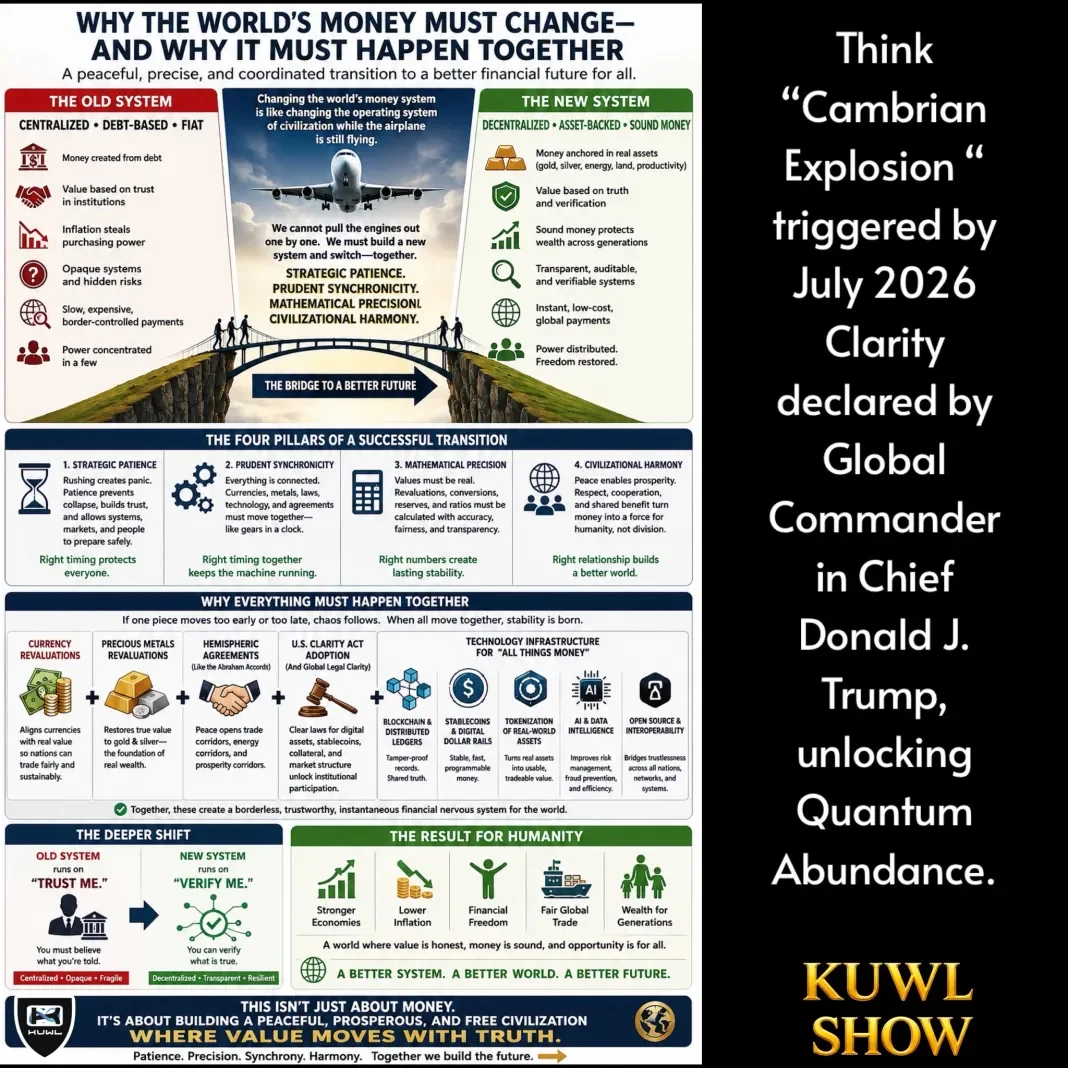
An asset-backed sound money system depends on valuation discipline, verified collateral, transparent settlement, lawful custody, interoperable ledgers, sovereign consent, and mathematical finality.
This kind of transition cannot happen randomly. It requires strategic patience because premature moves could trigger panic, capital flight, bank runs, geopolitical retaliation, or disorderly repricing. It requires prudent synchronicity because currencies, metals, bonds, commodities, payment rails, and digital settlement systems are all connected. Move one gear too early, and the whole machine can seize.
It requires mathematical precision because an asset-backed system must answer hard questions:
What is the real value of gold, silver, oil, land, energy, productive capacity, digital assets, sovereign reserves, and tokenized collateral?
How are currencies revalued without destroying trade?
How are debt obligations converted without social collapse?
How does liquidity keep flowing while trust is transferred from institutions to verifiable systems?
This is why key changes must occur nearly together.
• Currency revaluations without payment modernization create chaos.
• Precious metals revaluation without legal clarity creates speculation.
• Blockchain rails without stablecoins and tokenized collateral create disconnected plumbing.
• AI without lawful monetary guardrails accelerates disorder.
• Stablecoins without sovereign and regulatory clarity become private money empires.
• Tokenization without interoperability creates thousands of new silos.
• Open-source public infrastructure without governance discipline becomes fragile.
The Abraham Accords-type framework matters because money is downstream from peace.
Trade corridors, energy corridors, settlement corridors, and capital corridors all require geopolitical alignment.
Sound money cannot fully function in a world organized around perpetual conflict, sanctions warfare, opaque ledgers, and weaponized dependency.
The U.S. Clarity Act framework matters because law must bless the rails before capital can safely migrate. Institutions need to know what is a security, commodity, payment token, stablecoin, custody asset, collateral instrument, and settlement mechanism. Without legal clarity, trillion-dollar balance sheets wait on the sidelines.
DLT, tokenization, stablecoins, AI, interoperability, and open-source ledgers matter because the new system cannot merely be “gold with better branding.” It needs real-time proof, instant settlement, auditable collateral, programmable compliance, sovereign interoperability, and neutral bridges between nations.
The deeper necessity is this:
A centralized fiat system runs on “trust me.”
A decentralized sound money system runs on “verify me.”
And civilization cannot jump from one to the other in pieces. It must cross the bridge in formation.
This is the case for patience, precision, synchronicity, and harmony. The goal is not just a new money system. The goal is a lawful, peaceful, interoperable, asset-anchored civilization where value moves with truth instead of manipulation.
Our “Cambrian Explosion” moment arrives soon.
Source(s):
• https://x.com/KuwlShow/status/2071240589077512609
https://dinarchronicles.com/2026/06/29/rob-cunningham-changing-the-worlds-broken-money-system/
Gold, Stablecoins & the Coming Financial Reset | Robert Kientz & Andy Schectman
Gold, Stablecoins & the Coming Financial Reset | Robert Kientz & Andy Schectman
Miles Franklin Media: 6-28-2026
Andy Schectman, President & CEO of Miles Franklin Precious Metals, speaks with Robert Kientz, Founder of The Freedom Report, about why he believes the global financial system is moving toward a major reset and why gold, silver, stablecoins, and digital money are all central to what comes next.
Kientz warns that physical demand for gold and silver is far stronger than the paper price reflects, with sovereigns and major players increasingly standing for delivery on COMEX.
Gold, Stablecoins & the Coming Financial Reset | Robert Kientz & Andy Schectman
Miles Franklin Media: 6-28-2026
Andy Schectman, President & CEO of Miles Franklin Precious Metals, speaks with Robert Kientz, Founder of The Freedom Report, about why he believes the global financial system is moving toward a major reset and why gold, silver, stablecoins, and digital money are all central to what comes next.
Kientz warns that physical demand for gold and silver is far stronger than the paper price reflects, with sovereigns and major players increasingly standing for delivery on COMEX.
He explains why China’s push to internationalize the renminbi could be tied to gold, why central banks continue to accumulate the one asset they cannot print, and why the U.S. may be using stablecoins as a bridge into a new digital monetary system.
Kientz also breaks down the risks of programmable money, the difference between stablecoins and CBDCs, and why financial liberty may become one of the defining issues of the next several years.
In this episode of Little by Little with Andy Schectman:
*Why Kientz sees a currency reset and financial reset ahead
*Who may be standing for delivery of massive amounts of gold and silver
*Why China, BRICS, and Asia are building new gold and commodity infrastructure
*How stablecoins could become a backdoor path to a digital dollar system
*Why sound money, trust, and freedom are becoming inseparable
00:00 Coming Up
01:42 Introduction
03:50 Sound Money Mission
08:12 Why Miners Stay Quiet
11:40 Comex Delivery Shock
13:36 Sovereigns Drive Demand
17:25 Central Banks Know
24:34 Paper Markets Explained
30:23 Delivery Breaks Systems
31:58 Genius Act And Tether
35:31 Stablecoins To Cbdc
42:40 Trust Versus Inflation
45:15 How To Follow And Help
48:01 Final Thanks And Signoff
Seeds of Wisdom RV and Economics Updates Monday Afternoon 6-29-26
Housing Affordability Bill Heads to Trump as Congress Clears Major Bipartisan Reform
House Speaker Mike Johnson confirmed the bipartisan housing affordability bill will be delivered to President Donald Trump on Monday, reviving momentum for one of the most significant U.S. housing reform packages in decades.
Overview
House Speaker Mike Johnson announced the housing bill will be sent to President Trump on Monday after a brief delay.
The legislation passed both the House and Senate with overwhelming bipartisan support and aims to expand housing supply while lowering costs.
The bill reflects growing efforts to address America's housing affordability crisis through regulatory reform, increased construction, and limits on institutional home purchases.
Housing Affordability Bill Heads to Trump as Congress Clears Major Bipartisan Reform
House Speaker Mike Johnson confirmed the bipartisan housing affordability bill will be delivered to President Donald Trump on Monday, reviving momentum for one of the most significant U.S. housing reform packages in decades.
Overview
House Speaker Mike Johnson announced the housing bill will be sent to President Trump on Monday after a brief delay.
The legislation passed both the House and Senate with overwhelming bipartisan support and aims to expand housing supply while lowering costs.
The bill reflects growing efforts to address America's housing affordability crisis through regulatory reform, increased construction, and limits on institutional home purchases.
Key Developments
1. Johnson Confirms Bill Will Be Delivered
Speaker Mike Johnson said the House will formally transmit the bipartisan housing affordability legislation to President Donald Trump on Monday.
The bill's delivery follows several days of uncertainty after President Trump postponed a planned signing ceremony while encouraging Congress to advance separate election-related legislation. Despite the delay, Johnson emphasized that the housing package remains a top legislative priority.
2. What the Housing Bill Does
Known as the 21st Century ROAD to Housing Act, the legislation seeks to improve housing affordability through several reforms, including:
Expanding the nation's housing supply.
Reducing regulatory barriers that slow residential construction.
Encouraging affordable housing development.
Limiting large institutional investors from acquiring additional single-family homes.
Modernizing federal housing and community development programs.
3. Why Housing Remains a National Priority
Housing affordability has become one of the nation's largest economic concerns as elevated mortgage rates, limited inventory, and rising construction costs continue to pressure homebuyers.
Lawmakers from both parties have argued that increasing supply while reducing unnecessary regulations could help improve affordability over the long term, although many economists caution that meaningful improvements will likely take time.
4. What Happens Next
Once delivered to the White House, President Trump can sign the legislation into law, allow it to become law without a signature under constitutional procedures, or veto it.
Because the measure received overwhelming bipartisan support in both chambers, it represents one of the most broadly supported pieces of domestic legislation passed during the current Congress.
Why It Matters
Housing affordability affects economic growth, household wealth, inflation, and consumer confidence. Expanding housing supply could improve access to homeownership while supporting construction activity and long-term economic stability.
Why It Matters to Foreign Currency Holders
A healthier U.S. housing market supports broader economic stability, influencing interest rates, capital flows, and confidence in the U.S. dollar. Improvements in housing supply and affordability may also reduce inflationary pressures that affect global monetary policy.
Implications for the Global Reset
Pillar 1 – Debt
Greater housing affordability may ease financial pressure on households while improving long-term economic resilience and reducing borrowing stress.
Pillar 2 – Trade
Expanded residential construction increases demand across manufacturing, building materials, transportation, and supply chains, supporting broader economic activity.
Closing Thoughts
The bipartisan housing legislation represents one of the most significant federal housing initiatives in years and reflects growing recognition that expanding supply is essential to improving affordability. While the bill alone is unlikely to solve America's housing shortage, it establishes a framework for reducing regulatory barriers and encouraging new development.
This is not just about housing—it reflects broader efforts to strengthen the U.S. economy by improving affordability, expanding investment, and modernizing critical domestic infrastructure.
Seeds of Wisdom Team
Newshounds News™ Exclusive
Sources
Reuters — Housing bill will be sent to Trump on Monday, U.S. House speaker says
Reuters — House speaker to send housing bill to White House following meeting with Trump
~~~~~~~~~~
Seeds of Wisdom Team RV Currency Facts Youtube and Rumble
Newshound's News Telegram Room Link
RV Facts with Proof Links Link
RV Updates Proof links - Facts Link
Start Here room with Most Asked Questions Link
Follow the Gold/Silver Rate COMEX
Follow Fast Facts
Seeds of Wisdom Team™ Website
Thank you Dinar Recaps
Monday AM Iraq News Posted by Tishwash at TNT 6-29-2026
TNT:
Tishwash: A high-ranking source: Several individuals accused in corruption cases were arrested based on Al-Jumaili's confessions.
A high-level source reported on Sunday that a number of suspects in corruption cases have been arrested, based on confessions made by the Undersecretary of the Ministry of Oil, Adnan al-Jumaili.
The source told the Iraqi News Agency (INA) that “a number of individuals accused in corruption cases were arrested based on confessions made by the Deputy Minister of Oil, Adnan al-Jumaili,” noting that “the arrests included members of parliament whose immunity had been lifted and officials whose names appeared in those confessions.”
TNT:
Tishwash: A high-ranking source: Several individuals accused in corruption cases were arrested based on Al-Jumaili's confessions.
A high-level source reported on Sunday that a number of suspects in corruption cases have been arrested, based on confessions made by the Undersecretary of the Ministry of Oil, Adnan al-Jumaili.
The source told the Iraqi News Agency (INA) that “a number of individuals accused in corruption cases were arrested based on confessions made by the Deputy Minister of Oil, Adnan al-Jumaili,” noting that “the arrests included members of parliament whose immunity had been lifted and officials whose names appeared in those confessions.”
The source added that “Prime Minister Ali Falih al-Zubaidi will not hesitate to pursue those involved in corruption and the misappropriation of state funds.” link
************
Tishwash: From Baghdad to Ankara: Money laundering networks for corrupt officials in Iraq exposed
A Syrian source revealed on Sunday the existence of money smuggling networks operating between Iraq, Syria, and Turkey.
The source told the Information Agency: "There is a money smuggling network managed by Syrian figures. Smuggled funds are transferred to certain Iraqi political figures accused of corruption, including individuals close to Sarmad al-Khanjar, son of the head of the Sovereignty Alliance, and Mohammed al-Halbousi, head of the Progress Party, as well as other figures associated with Muthanna al-Samarrai."
The source added that "Syrian figures close to Turkish-backed factions, such as the former Hamza Division (which was later integrated into the 76th Division, a unit of the de facto government's Ministry of Defense), are also involved." The source explained that "this division oversees the smuggling of funds from Iraq to Syria, and then their transfer to Turkey."
He confirmed that "the mastermind behind this network is a Syrian man residing in the Aleppo countryside and close to Turkey, named Abdul Rahman al-Mawali," explaining that "this network works to smuggle millions of dollars for corrupt figures linked to corruption cases in Iraq, depositing them in Turkish banks under the names of Syrians." link
************
Tishwash: Government advisor: Recovering looted funds enhances the climate of trust and transparency.
The financial advisor to the Prime Minister, Mazhar Muhammad Salih, confirmed on Sunday that recovering public funds looted due to corruption enhances the climate of trust and transparency.
Saleh said in a press statement that “recovering public funds that have left the economic cycle due to corruption or misappropriation of public funds is not only important in terms of its direct financial value, but also reflects a clear governmental will to combat corruption and restore the rights of the state, which enhances the confidence of citizens and investors in national institutions.”
Recovering stolen funds
He added that “the recovered funds contribute to easing the pressures on the general budget and reducing the need for borrowing, as well as providing additional resources that can be directed towards developing infrastructure and the health, education, housing and basic services sectors.”
He pointed out that “returning these funds to the official cycle of the national economy stimulates economic activity and supports government investment spending, especially if they are employed in productive and developmental projects capable of creating job opportunities and stimulating sustainable growth.”
Saleh explained that “the state’s success in pursuing and recovering looted funds sends reassuring messages to the local and international business community, enhances the climate of trust and transparency, and encourages attracting more investments.”
He explained that “integrating these funds into national development plans and Iraq’s Vision 2050 makes them an effective tool to support economic reform and achieve sustainable development goals.” link
************
Tishwash: Calls for a mutually beneficial economic partnership with Washington
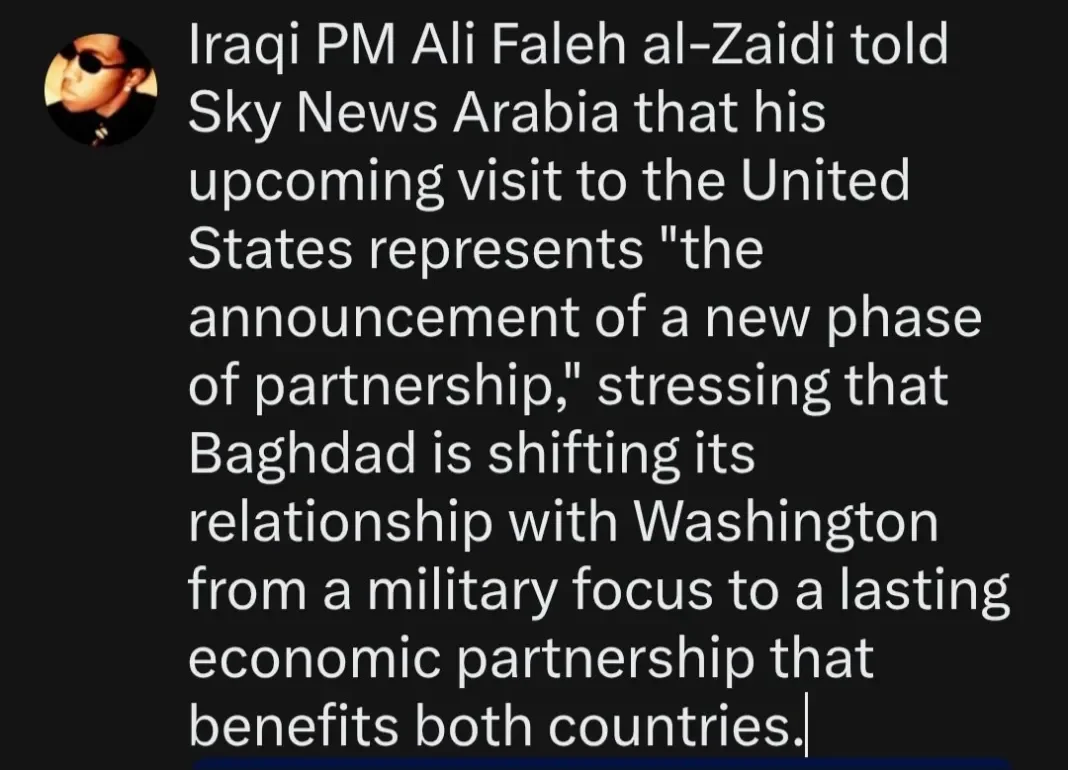
In light of what the Prime Minister has put forward regarding moving towards economic cooperation with the United States of America, economic experts explained that Iraq seeks to invest in the Strategic Framework Agreement with the United States to reduce total dependence on oil revenues, as the visit of the Prime Minister, Ali al-Zaidi, to Washington falls within the efforts to strengthen economic relations and transform them “from military to economic partnership.”
The necessity of partnership
In this regard, international economic expert Dr. Nabil Al-Abadi explained that the economic partnership with America must be economically viable and stem from genuine integration between the two countries, as Iraq possesses the resources and the United States possesses the technology.
Capital and expertise.
Al-Abadi added, in an interview with Al-Sabah, that Iraq, which suffers from a fragile rentier economy and structural inflation, therefore partnership is not a strategic option but a necessity for restructuring it, provided that we read it with the logic of mutual gain and not dependency, pointing out that the benefits are not in loans, but in technology transfer, as America has an energy revolution (associated and shale gas) and water management and smart agriculture technologies, and Iraq needs a technical partnership, not a financial one, that moves it from importing technology to localizing it. Likewise, restructuring the Iraqi banking sector according to FATF standards should not be seen as guardianship, but as a gateway to integration into the global financial system, which will attract non-oil investments.
Partnership pillars
He believed that the partnership should be based on three pillars. The first is that there should be no contract without a binding timetable for completion, and no project without an Iraqi employment rate of no less than 60%. The second pillar is oil for expertise, not oil for debt, meaning we do not accept loans that drain liquidity, but rather partnerships in the field of renewable energy and infrastructure in exchange for facilities for American companies, to balance the trade balance. He added that the third and final pillar is that there should be no signing of comprehensive agreements in haste, but rather the partnership should be sectoral (energy, health, education) and decomposable, so that we are not held hostage to a single file.
The international economist warned against treating this partnership as a "political project," explaining that if the "Deal of the Century" remains merely a declaration of intent, we will lose a golden opportunity. The American market is the largest in the world, but it is unforgiving. We must raise our ambitions from simply being oil suppliers to becoming partners in supply chains (especially for rare earth minerals found in the mountains of Iraq).
Al-Abadi concluded that partnership with America is possible and beneficial, but it has inevitable conditions, and the opportunity exists, but it needs the mindset of a tough negotiator, noting that Iraq has human capital and land, and America has technology and access to markets.
He explained that when the scales are balanced, we can say: we are making a partnership, not an economic surrender treaty, calling for our deal to be a win-win deal, otherwise let the deal be suspended, because a loss in timing is worse than a loss in the deal itself.
Development paths
In a related context, Jassim Al-Aradi, a member of the Baghdad Economic Forum, considered the economic partnership between Iraq and the United States an important opportunity to redirect bilateral relations towards development paths that achieve the highest levels of benefit based on investment, technology transfer and capacity building, instead of being limited to traditional trade relations. He indicated that Iraq possesses great potential that qualifies it to attract major American companies in the energy, industry, infrastructure, digital economy, agriculture and financial services sectors, which contributes to diversifying national income sources and reducing dependence on oil revenues.
Al-Aradi told Al-Sabah that the partnership should be based on the principle of mutual interests, by attracting quality investments that provide job opportunities for Iraqis, support the transfer of knowledge and modern technologies, and enhance local industries and production chains, while giving priority to projects that achieve added value for the national economy and contribute to increasing non-oil exports.
He added that the success of the partnership requires creating a stable investment environment by developing economic legislation, simplifying administrative procedures, enhancing transparency and protecting the investor, in addition to activating the role of the Iraqi private sector as a key partner in implementing projects, in order to ensure that the local economy benefits from foreign investments and that they are not limited to the implementation of contracts only.
Expanding areas of cooperation
For his part, expert and economist Hassan Ali Al-Daghari called for expanding the areas of cooperation to include technical education, vocational training, digital transformation, and energy.
He emphasized the importance of renewable energy and developing the banking sector, noting that these sectors are fundamental pillars for building a more competitive and sustainable economy. He added that the more partnerships are linked to programs for transferring expertise and building national capabilities, the greater their positive impact on development. Economic.
Al-Daghari pointed out, in an interview with Al-Sabah, that the success of the economic partnership with the United States is not measured by the size of the agreements signed, but rather by its ability to achieve tangible results represented in increasing investment, creating job opportunities, developing industry and production, and strengthening Iraq's position as an economic center. And my investment in the region. link
Seeds of Wisdom RV and Economics Updates Sunday Night 6-28-26
Global Trade Enters a New Era as Tariffs Reshape the World Economy
The resurgence of tariffs is transforming international trade, signaling a shift away from decades of globalization toward a more protectionist and strategically competitive global economy.
Overview
Global tariff barriers continue rising as major economies prioritize national security and domestic industries over free trade.
The United States has expanded tariffs beyond geopolitical rivals, affecting many long-standing allies and major trading partners.
The shift is accelerating changes to supply chains, investment decisions, and the future structure of global commerce.
Global Trade Enters a New Era as Tariffs Reshape the World Economy
The resurgence of tariffs is transforming international trade, signaling a shift away from decades of globalization toward a more protectionist and strategically competitive global economy.
Overview
Global tariff barriers continue rising as major economies prioritize national security and domestic industries over free trade.
The United States has expanded tariffs beyond geopolitical rivals, affecting many long-standing allies and major trading partners.
The shift is accelerating changes to supply chains, investment decisions, and the future structure of global commerce.
Key Developments
1. A Turning Point for Global Trade
For decades, the World Trade Organization (WTO) helped reduce tariffs and encouraged expanding global commerce through multilateral trade agreements and dispute resolution mechanisms.
That trend has reversed dramatically. Since 2025, governments have increasingly relied on tariffs and industrial policy to protect strategic industries, marking one of the most significant shifts in global trade policy since the end of World War II.
2. Tariffs Expand Beyond Traditional Rivals
While trade tensions between the United States and China remain central, recent tariff actions have extended well beyond geopolitical competitors.
The United States has imposed or threatened tariffs affecting several long-standing allies, including:
European Union
Japan
Mexico
Canada
United Kingdom
These actions demonstrate that economic policy is increasingly being used as a strategic tool rather than solely a trade instrument.
3. Global Supply Chains Continue to Adjust
Higher tariffs are encouraging companies to diversify manufacturing locations, relocate production, and reduce dependence on individual countries for critical goods.
Businesses are increasingly evaluating supply chain resilience alongside production costs, leading to greater investment in regional manufacturing hubs and "friend-shoring" strategies.
4. Markets Face a New Trading Environment
Financial markets are adjusting to an environment where trade policy can change rapidly in response to geopolitical events.
Investors are closely monitoring tariff negotiations, bilateral agreements, and industrial policy as governments seek to strengthen domestic manufacturing while protecting strategic technologies and critical supply chains.
Why It Matters
The return of tariffs represents a fundamental shift in the global economic landscape. Trade policy is becoming an increasingly important instrument of national security, economic competitiveness, and geopolitical influence, with long-term implications for inflation, investment, and global growth.
Why It Matters to Foreign Currency Holders
Changes in global trade directly affect currency values, capital flows, and economic growth. As nations restructure supply chains and expand regional trade partnerships, currency investors are closely watching how these developments influence reserve currencies, cross-border payments, and international monetary cooperation.
Implications for the Global Reset
Pillar 1 – Trade
The continued rise in tariffs is accelerating the restructuring of global trade relationships, encouraging regional supply chains and reducing dependence on traditional globalization models.
Pillar 2 – Assets
Trade fragmentation is influencing global capital allocation as businesses and investors redirect investments toward domestic manufacturing, strategic industries, and critical infrastructure.
Closing Thoughts
The recent resurgence of tariffs suggests that globalization is entering a new phase, where economic security increasingly outweighs the pursuit of maximum trade efficiency. Governments are placing greater emphasis on resilient supply chains, domestic production, and strategic independence as geopolitical competition intensifies.
This is not just about tariffs—it reflects the ongoing restructuring of global trade, supply chains, and economic power as nations prepare for a more multipolar financial and geopolitical future.
Seeds of Wisdom Team
Newshounds News™ Exclusive
Sources
Modern Diplomacy — Making Tariffs Trendy Again: The New Global Trade Battlefield
World Trade Organization — Trade Monitoring Reports and Global Trade Developments
~~~~~~~~~~
Seeds of Wisdom Team RV Currency Facts Youtube and Rumble
Newshound's News Telegram Room Link
RV Facts with Proof Links Link
RV Updates Proof links - Facts Link
Start Here room with Most Asked Questions Link
Follow the Gold/Silver Rate COMEX
Follow Fast Facts
Seeds of Wisdom Team™ Website
Thank you Dinar Recaps
Ariel: How Long have you been Waiting to Hear this from Iraq?
Ariel: How Long have you been Waiting to Hear this from Iraq?
6-28-2026
If you ever doubted this investment.
If you denounced the investors of IQD.
If you denied that any progress was being made.
Ariel: How Long have you been Waiting to Hear this from Iraq?
6-28-2026
If you ever doubted this investment.
If you denounced the investors of IQD.
If you denied that any progress was being made.
If you proclaimed that this would never happen.
If you wrote the entire thing off as hopium.
If you sold your IQD because of some skeptical rumor.
If you mocked the people stacking dinar like it was toilet paper.
If you trusted the old guard analysts still parroting the static 1,300 rate forever.
Now is the time to double back reconfigure your assessment and ask yourself did you succumb to narratives designed to ensure you remain broke into perpetuity?
~The Window Is Closing But The Blinds Are Opening
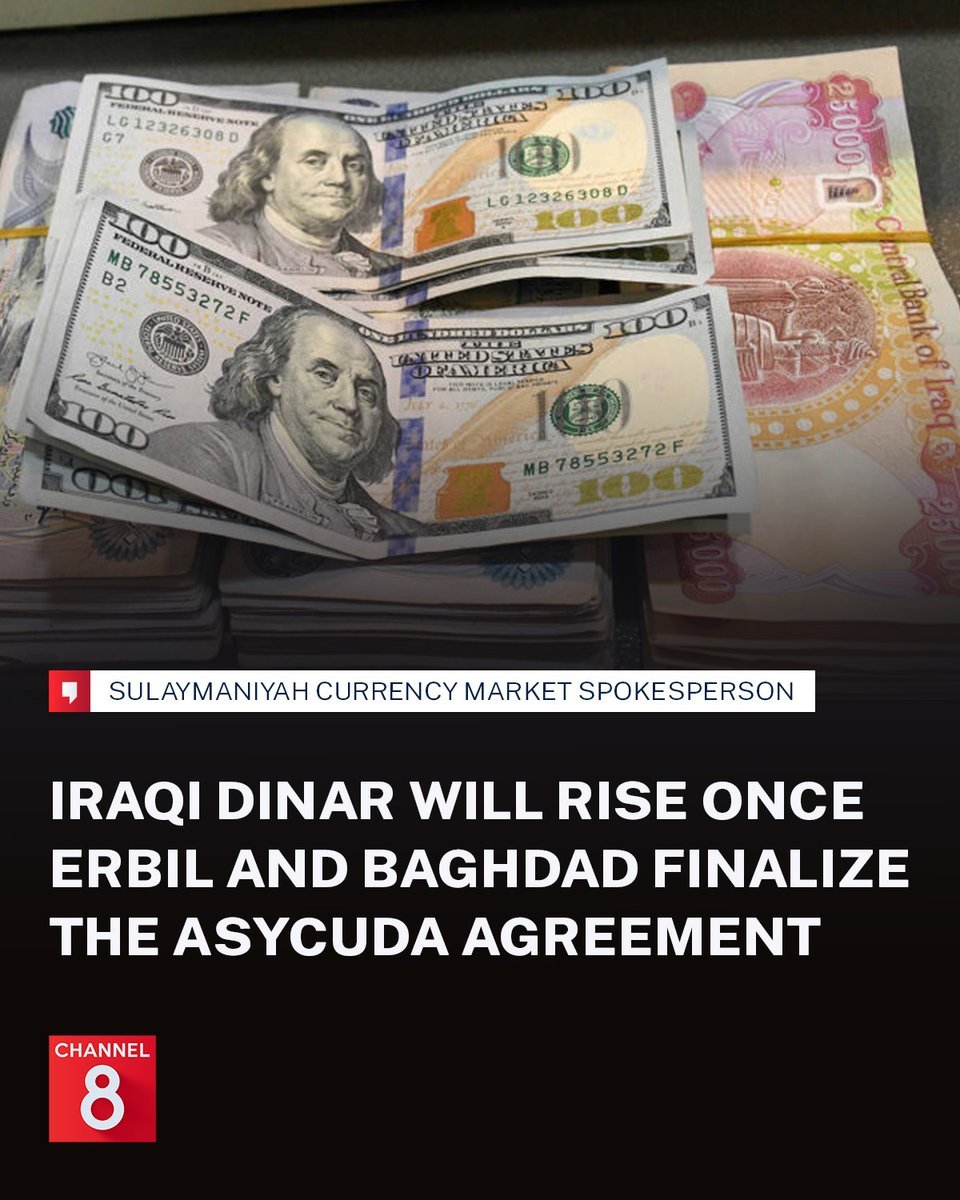
Channel 8 English: A spokesperson for the Sulaymaniyah Currency Exchange Market told Channel8 that the reason for the dinar strengthening—if the deal is finalized—is "because 85% of the dollar demand in the market comes from traders, while the remaining 15% comes from everyday citizens." He added that Iraqi PM al-Zaidi's mid-July Washington visit will bolster the dinar through U.S. economic backing. Read more: https://channel8.com/english/news/60604
You Can Not Do This On A Program Rate
Currency Revaluation Will Start The Process
First Squawk: SCOTT BESSENT: WALL STREET CAN THRIVE, BUT IT’S TIME FOR MAIN STREET TO PROSPER
Source(s):
• https://x.com/Prolotario1/status/2071015197272154391
• https://x.com/Prolotario1/status/2071079872827433083
The US Is Doing Exactly What The British Empire Did In 1921. The Final Economic Reset
The US Is Doing Exactly What The British Empire Did In 1921. The Final Economic Reset
Unfolded finance: 6-28-2026
In February 1921, Chancellor Robert Horne inherited a 7% Bank Rate, two million unemployed, and £4.7 billion in war debt owed to the United States.
Britain had three choices: default, devalue, or defend the pound through deflation and accept whatever pain that defense produced. The Treasury chose deflation.
The US Is Doing Exactly What The British Empire Did In 1921. The Final Economic Reset
Unfolded finance: 6-28-2026
In February 1921, Chancellor Robert Horne inherited a 7% Bank Rate, two million unemployed, and £4.7 billion in war debt owed to the United States.
Britain had three choices: default, devalue, or defend the pound through deflation and accept whatever pain that defense produced. The Treasury chose deflation.
The Geddes Committee was formed to slash government spending department by department, treating the cuts as discipline rather than decline. Nobody in that room believed they were choosing a multi-decade trajectory. They were wrong.
The 1925 gold standard return everyone remembers wasn't the mistake — it was just the formal confirmation of a path Britain had already locked in four years earlier.
America in 2025 carries $36 trillion in debt and just spent two years defending dollar credibility through rates held above 5%. The same three paths sit on the table: restructuring entitlement promises, accepting a managed dollar decline, or fiscal contraction defended as discipline.
A federal spending efficiency review launched in 2025 functions as a direct structural echo of the Geddes Axe — cutting across government department after government department to prove fiscal seriousness to markets asking the same uncomfortable questions Britain faced in 1921. The difference is scale.
Britain's 1921 mistake cost Britain a decade of unemployment. America's version, made from the center of the global financial system instead of its edge, doesn't stay contained to one country.
What You'll Learn:
▸ Why 1921, not 1925, was the actual turning point in Britain's postwar economic decline
▸ What the three real choices were — default, devaluation, or deflation — and why Britain's Treasury ruled out two of them before serious debate even began
▸ How the Geddes Axe became the formal expression of a decision that had already been made months earlier
▸ Why Britain's eventual 1925, 1931, 1949, and 1967 devaluations were all delayed consequences of the 1921 choice, not separate mistakes
▸ How America's 2025 federal spending review structurally mirrors the Geddes Committee's mandate and justification
▸ Why the same three-path decision tree — default, devalue, or defend through deflation — is currently running inside U.S. fiscal policy
▸ Why America's version of this decision carries global consequences Britain's 1921 choice never had to reckon with The Timeline:
1919 — Britain suspends the gold standard; pound begins floating freely for the first time in decades 1920
— Bank Rate raised to 7% to defend sterling's international value February 1921
— Unemployment crosses two million; Robert Horne becomes Chancellor of the Exchequer 1921
— Geddes Committee formed to identify deep cuts across government departments 1922
— Geddes Axe report delivered; education, police, and military spending slashed 1925
— Churchill returns the pound to gold at the prewar parity, confirming the path chosen in 1921 1931
— Britain abandons gold entirely; first devaluation the 1921 policy was meant to avoid 1949, 1967
— Further sterling devaluations; each one a delayed continuation of the same unresolved choice 2022-2024
— Federal Reserve holds rates above 5% to defend dollar credibility against inflation 2025
— Federal spending efficiency review launched; structural echo of the Geddes Axe begins Horne never believed he was choosing decline. He believed he was choosing discipline.
History stopped distinguishing between the two.
Ariel: People will Still Try to Say Nothing is Happening
Ariel: People will Still Try to Say Nothing is Happening
6-28-2026
One of these men who were among the 15 arrested were blocking the currency revaluation. Ziad Al-Janabi. He along with others were Blocking stricter AML controls and HCL (Hydrocarbon Law) finalization kept the leaks open. Most of them had American bank accounts. These were common insurance policies by parking proceeds abroad in anticipation of any major rate adjustment or crackdown that could expose domestic holdings.
Ariel: People will Still Try to Say Nothing is Happening
6-28-2026
One of these men who were among the 15 arrested were blocking the currency revaluation. Ziad Al-Janabi. He along with others were Blocking stricter AML controls and HCL (Hydrocarbon Law) finalization kept the leaks open. Most of them had American bank accounts. These were common insurance policies by parking proceeds abroad in anticipation of any major rate adjustment or crackdown that could expose domestic holdings.
PM al-Zaidi’s mid-July Washington visit is the capstone. U.S. economic backing, tighter Treasury compliance, Starlink backbone for real-time monitoring, HCL progress to lock oil revenue, and the new Governor’s AML DNA all converge. This isn’t coincidence. It’s the infrastructure for a managed strengthening: clean books, transparent rails, gold collateral (170+ tons stacked for a reason), and digital cashless mandates by early July so the old cash-and-smuggle economy d**s.
And People Will Still Try To Say Nothing Is Happening
This is why the process felt glacial every step had to be surgically clean or the old networks would arbitrage the chaos. People get frustrated because they want the lottery ticket tomorrow, but this is structural surgery on a patient that was bleeding out for decades. Starlink gives the connectivity so remote oil fields and ministries can’t hide transactions. The AML Governor enforces it. HCL stabilizes the revenue backbone. Gold provides the sound money anchor. Washington backing via al-Zaidi’s visit seals the international legitimacy.
Mario Nawfal: Heavy arrests REPORTED inside the Iraqi capital, Green Zone, today: -
Bahaa Al-Nouri –
Ziad Al-Janabi –
Muthanna Al-Samarrai –
Alaa Sukkar –
Mohammed Al-Karbouli –
Hassan Al-Khafaji –
Abdul Karim Al-Sudani –
Abbas Al-Sudani - Mohammed Al-Sayhoud
NO OFFICIAL CONFIRMATION YET, but nonetheless, the purge under new PM Ali al-Zaidi is clearly intensifying.
Source: @alrougui / Writer: Claudio
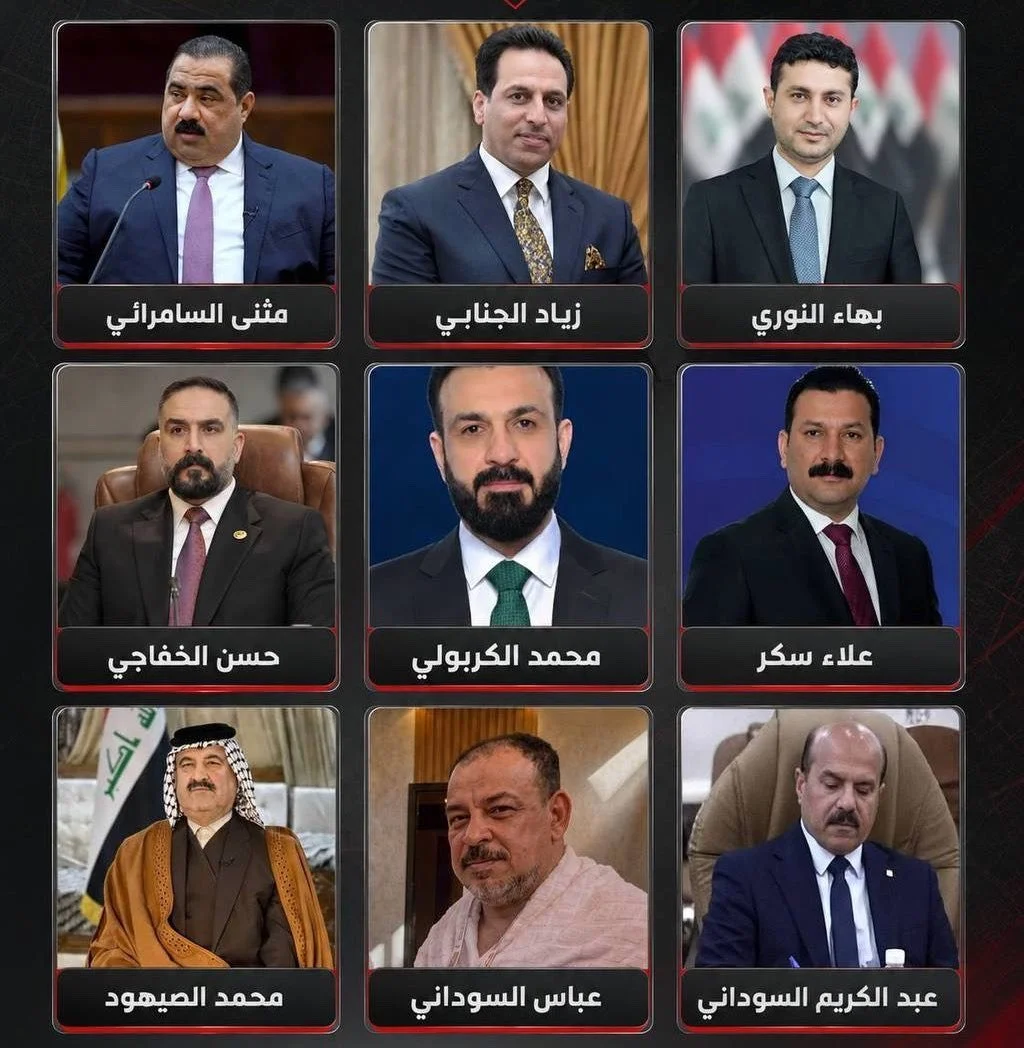
I need you all to pay attention to this one thing. Because it parallels how people see Donald Trump & Israel. When Ali al-Zaidi became Iraq’s new PM in back in May a lot of people looked at him as another Iranian controlled asset with no mind or choice of his own. Abd he would carry out anything Iran would have demanded of him. And they wrote him off and did not look at him as a figure that wouldn’t bring any meaningful change to Iraq.
Then all if sudden people turned on their news and seen armed forces storming the properties of Iranian loyalist. There was no announcement. There was no warning. There was no time for media figures to spin this to confuse the citizens. And all of this is happening while US Military assist in this round up of corrupt figures who sold out their country. This is what POTUS wanted before the meeting with the PM in mid July.
And you are going to have people out there still assuming that POTUS is working against the people. That he does not have America in his best interests. Many of their talking points is predicated upon the gray area concerning Israel where you can’t quite make out who’s playing for what team unless you are really researching & studying. And we have podcasts veos & influencers muddying the waters.
They are making it hard for people to know the difference. This is why Ana Paulina Luna put out that post about upcoming disclosures regarding who is behind these influential online personalities that seem to have been compromised by foreign forces that have ties to Mossad and other factions. People who have mislead you will not make it out of 2026 unscathed. Many of them are nervous. They were never MAGA. And you will find out.
Some of you already have a suspicion as to who will be coming out with some sketchy ties. What will people do when POTUS starts to turn the tables and uproot all the rhetoric about who he is loyal to? Especially when he is directly behind the purging of corruption happening right now in Iraq. You would think he would be trying to remove Ali al-Zaidi himself since he doesn’t support Israel.
Source(s):
• https://x.com/Prolotario1/status/2071098415467893137
• https://x.com/Prolotario1/status/2071145910273286385
https://dinarchronicles.com/2026/06/28/prolotario-people-will-still-try-to-say-nothing-is-happening/