
Thank you to all the subscribers to our Early Access program…we thank you for your continued support.
We are excited to offer this new service to keep you informed and up-to-date on the latest Dinar and currency news.
“News Tidbits From TNT” Thursday 3-26-2026
TNT:
Tishwash: Disruptions in the Strait of Hormuz are putting pressure on sugar supply chains and threatening Iraq's exports.
Traders in global commodity markets warned on Thursday that continued disruptions in the Strait of Hormuz could put increasing pressure on raw and refined sugar supply chains, amid rising shipping and insurance costs and declining supply flexibility through vital sea lanes in the Gulf.
A report by the American company " S&P " stated that the region passes through about 10% of the world's raw sugar trade and 5% of refined sugar, making it a "vital artery" for food commodity flows, at a time when refineries have begun to face operational challenges due to rising energy and transportation costs.
TNT:
Tishwash: Disruptions in the Strait of Hormuz are putting pressure on sugar supply chains and threatening Iraq's exports.
Traders in global commodity markets warned on Thursday that continued disruptions in the Strait of Hormuz could put increasing pressure on raw and refined sugar supply chains, amid rising shipping and insurance costs and declining supply flexibility through vital sea lanes in the Gulf.
A report by the American company " S&P " stated that the region passes through about 10% of the world's raw sugar trade and 5% of refined sugar, making it a "vital artery" for food commodity flows, at a time when refineries have begun to face operational challenges due to rising energy and transportation costs.
He noted that refineries in the Gulf, including those in Iraq, Dubai, Bahrain and Iran, play a role in redistributing white sugar to regional markets, but current pressures could lead to supply restrictions and higher production and distribution costs.
He pointed out that any disruption to the flow of the Strait of Hormuz directly impacts import costs and food supplies in Iraq, especially since the country relies on imports to cover part of the local demand for sugar and basic foodstuffs, which could raise commodity prices in the local market if tensions continue.
Traders added that higher fuel prices and shipping costs resulting from "war risks" are increasing pressure on supply chains, at a time when regional refineries are trying to pass on costs to end markets or reduce operating levels. link
************
The postponed budget and blocked corridors… Iraq between internal paralysis and lost opportunities
At a sensitive regional moment, with global oil prices soaring due to shipping disruptions and threats of closure of vital waterways, Iraq should have been one of the biggest beneficiaries of this boom. However, reality reveals a harsh paradox: a country almost entirely dependent on oil is unable to capitalize on the price surge, hampered by export disruptions and internal administrative chaos.
The budget crisis in Iraq cannot be separated from the broader regional context, particularly given the threats to vital maritime routes and the resulting disruptions or restrictions on oil exports. This highlights the gravity of the situation, where two negative factors converge simultaneously: internal paralysis due to political delays and external pressure stemming from geopolitical crises.
Iraq, which is supposed to have alternative plans for exporting its oil in emergencies, finds itself today shackled as a result of the lack of strategic planning and the delay in settling political entitlements, foremost among them the selection of the presidency of the republic and the presidency of the Council of Ministers, which has directly affected the obstruction of the approval of the budget, and thus the obstruction of the ability to act quickly in the face of crises.
The result is that the state loses twice:
Once its projects and services are disrupted due to budget shortfalls, and again when it misses the opportunity to capitalize on high oil prices due to export difficulties. This dual loss reveals the fragility of the economic structure and underscores that over-reliance on oil, without logistical and strategic alternatives, poses an existential threat to the Iraqi economy.
The continuation of this situation also weakens Iraq's position in regional competition, especially as neighboring countries move to secure alternative energy routes and strengthen their infrastructure, at a time when Iraq remains captive to internal political crises.
The current stage requires a radical shift in thinking, based on separating vital files—foremost among them the budget—from political disputes, and working to build a flexible export system that includes multiple outlets, including land routes and pipelines, to reduce dependence on threatened routes.
In conclusion, Iraq today faces not a single crisis, but a confluence of crises: delayed decision-making, geographical vulnerability, and missed opportunities. Unless this equation is addressed, the country will continue to pay the price for its strategic location instead of capitalizing on it. link
************
Tishwash: Trump: Talks with Iran are serious and we have 15 points for an agreement.
US President Donald Trump confirmed that the US talks with Iran were serious and took place with the participation of Wittkopf and Kushner, describing those talks as exemplary, while indicating that the United States and Iran reached common ground on most of the issues that were raised during the discussions.
Trump said the dispute would be resolved if the anticipated talks between the two sides were successful, indicating that Iran was seeking an agreement with the United States and that Washington shared this position, while also revealing plans to hold a meeting with Iranian officials in the near future.
The US president explained that the talks with Iran focus specifically on Tehran abandoning nuclear weapons and uranium enrichment operations, noting that if an agreement is reached, the United States will take the uranium from the Islamic Republic, stressing that any future agreement must prevent the possibility of new conflicts or the emergence of nuclear weapons in Tehran.
Trump claimed that the contacts between Washington and Tehran were initiated by the Iranian side, while simultaneously threatening to continue the bombing if the ongoing contacts between the two sides failed.
He added, "Any future agreement with Iran must prevent the possibility of new conflicts and the emergence of nuclear weapons, and we have 15 points for an agreement with Iran." link
************
Tishwash: Talabani: Our communication with Baghdad is ongoing, and the war has negatively impacted the economy of the region and Iraq.
The Deputy Prime Minister of the Kurdistan Regional Government, Qubad Talabani, confirmed on Tuesday that communication channels with the federal government in Baghdad are continuing to address the economic and security repercussions resulting from the regional conflict.
During a press conference attended by Shafaq News Agency, Talabani expressed his condolences and sympathy to the families of the victims of the attack that targeted a Peshmerga force at dawn today in the Soran area, wishing a speedy recovery to the wounded.
Talabani said, "Any attack targeting the Kurdistan Region is condemned and rejected," stressing that "the region declared from the beginning of the war that it would not be part of any conflict, and would not pose a threat to any neighboring country."
He added that "the regional government reaffirms its position of not engaging in the ongoing war, and instead seeks to use its relationships to contribute to calming the situation."
Regarding the formation of the new government in the region, Talabani explained that “the passage of a year and five months since the elections did not prevent the continuation of efforts to form the government,” noting that there is “a difference of views with the Kurdistan Democratic Party on this issue, which is normal between two different parties,” while emphasizing at the same time “the need for more consensus at this stage.”
Regarding the relationship with the federal government, the Deputy Prime Minister of the region indicated that "there are ongoing efforts to improve relations with Baghdad and communication with them is continuous," explaining that "the tensions and war in the region have cast a negative shadow on the economy of the region and Iraq," stressing that "the joint committees continue their meetings and dialogues to resolve the outstanding issues between the two sides."
Last week, the Prime Minister of the Kurdistan Region, Masrour Barzani, raised several issues with the Baghdad government, including attacks on the region, oil exports, and the ASYCUDA system, calling on the federal government in Baghdad to prevent attacks and address financial and organizational disputes.
Barzani said that the region supports oil exports, explaining that what is exported from Kurdistan amounts to about 230,000 barrels per day and will not exceed half a million barrels, compared to larger quantities exported by the federal government.
He pointed out that the regional government does not oppose exports, but demands guarantees for oil production in its fields that were damaged as a result of the attacks, calling on Baghdad to stop the targeting of oil fields.
He also demanded the payment of financial dues and salaries of the region's employees, stressing that the Kurdistan government is seeking to find a mechanism to resolve the disputes, and has submitted a proposal to hold meetings with the federal government to end the crisis. link
News, Rumors and Opinions Thursday 3-26-2026
Note: All intel should be considered as "Rumors" until we receive official announcements ...and “Rates and Dates” could change anytime until we get to the banks/redemption centers.
RV Excerpts from the Restored Republic via a GCR Update as of Thurs. 26 March 2026
Compiled Thurs. 26 March 2026 12:01 am EST by Judy Byington
Judy Note: Some of that exposure came out on Wed. 25 March as Federal Chairman Jerome Powell was confronted and asked to explain why we had a fiat US Dollar and there was no gold in Fort Knox. He admitted, “We print money out of nothing.”
Note: All intel should be considered as "Rumors" until we receive official announcements ...and “Rates and Dates” could change anytime until we get to the banks/redemption centers.
RV Excerpts from the Restored Republic via a GCR Update as of Thurs. 26 March 2026
Compiled Thurs. 26 March 2026 12:01 am EST by Judy Byington
Judy Note: Some of that exposure came out on Wed. 25 March as Federal Chairman Jerome Powell was confronted and asked to explain why we had a fiat US Dollar and there was no gold in Fort Knox. He admitted, “We print money out of nothing.”
An imminent Black Swan Financial Event along with the help of the Global Military Alliance, was expected to dismantle their stranglehold and spark 209 countries’ transition to gold/asset-backed XLM and XRP digital currencies.
~~~~~~~~~~~~~~~~
Thurs. 2 April 2026 Notification to set appointments: The overwhelming majority of my bond people are telling me that they will be done between now and April 2nd.The overwhelming majority of my groups and banking contacts believe they will go between the 2nd of April and the 15th of April. I don’t know the timing but that is what they are being told. …MarkZ on Tues. 24 March 2026
Tues. 24 March 2026 Wolvie says that bondholders are receiving notifications. He hopes for Tier 4B notifications today or tomorrow. Payments will start on Wed. 1 April 2026. We were waiting for ISO20022 to happen and it has, and it is working very well Wolvie says. It has been 100% successful! A lady at a bank called Wolvie, crying, saying this is the news we have been waiting for. Wolvie cannot say more due to NDAs. In a few days he will be fully under NDA and will be overseas. … Forwarded from Ginger Doucet
~~~~~~~~~~~~~~
Fri. 27 March 2026 Deadline For The Federal Reserve …Mr. Pool Final Chapter
That’s all that’s left. March 27. The date they don’t want you to circle. Trump didn’t extend the Iran deadline because he’s negotiating. He extended it because the system isn’t ready yet. Let me explain what’s actually happening — and why you need to screenshot this message. Right now, at this very moment, three things are being moved simultaneously:
1. Gold. Central banks bought more gold in the last 90 days than in any quarter since 1967. Not investment banks. Central banks. The ones who WRITE the rules. They’re not buying gold because they’re scared. They’re buying it because they know what’s replacing the dollar.
2. Quantum nodes. The QFS backbone went from 12 active nodes in January to 67 active nodes as of last Friday. Each node processes 1.4 million transactions per second. You don’t build that kind of infrastructure for a system you’re not about to turn on.
3. SWIFT access keys. On March 16 — exactly 11 days before the deadline — Ripple’s partner Thunes quietly announced stablecoin payouts to 11,500 banks through SWIFT. They called it a “Smart Superhighway.” That’s not a partnership. That’s a replacement wearing a disguise.
Three moves. One deadline. March 27. Now here’s the part they’ll never say on television: The Iran war isn’t about Iran. It never was. Every bomb that falls on Tehran is a distraction from what’s happening in the server rooms underneath the Federal Reserve buildings in New York, Chicago, and San Francisco.
They’re migrating the ledger. $23 trillion in U.S. debt. $8 trillion in offshore accounts. Every transaction, every loan, every dark money transfer since 1971 — all of it is being moved from the old system to the new one. And when the migration is complete — the old system gets unplugged. That’s what March 27 is. Not a deadline for Iran. A deadline for the Federal Reserve.
Why do you think gold dropped from $5,595 to $4,384 in 8 weeks? That’s not a crash. That’s a controlled descent. They’re repricing gold for the new system. When QFS goes live, gold doesn’t trade in dollars anymore. It trades in quantum-verified weight.
The price you see today is the last dollar price gold will ever have. TIER 4B notifications are already queued. The 800 numbers have been tested. The redemption centers are staffed. I told you last week — the deals are signed. The gold has moved. The war is the cover. 72 hours.
~~~~~~~~~~~~~
Wed. 25 March 2026 ISO 20022 is a global messaging standard that defines how financial institutions exchange information for transactions (payments, securities, remittances). It replaces outdated, fragmented systems (like the old SWIFT messages) with a unified, data-rich digital language. …Tier4b ISO 20022 on Telegram
Why ISO 20022 Matters to XRP/XLM Investors: The global financial system, including SWIFT, the US Federal Reserve’s Fedwire, and many central banks, is migrating to ISO 20022, with a target date for full implementation by April 1, 2026. This standardization is critical for any crypto asset aiming to integrate with traditional finance.
Compliance is not optional; it is the entry barrier for servicing banks. XRP Ledger (XRPL) and Stellar Network (XLM) have been proactively aligning with this standard for years, giving them a massive head start in the race to modernize cross-border payments.
Read full post here: https://dinarchronicles.com/2026/03/26/restored-republic-via-a-gcr-update-as-of-march-26-2026/
************
Courtesy of Dinar Guru: https://www.dinarguru.com/
Jeff Right now we're waiting for the war to finish. Then when the war finishes, they can finish the formation of the government. Then once the government formation is done the very next step will be the rate change. Then after the rate changes they can do the 150+ laws. After the rate changes they have a lot to do.
Frank26 What is it we need for the monetary reform/the new exchange rate to come out? Security and stability from Iran. We're that close to getting it. That means the United States of America will be paid back...We do have a very good chance to see both governments [formed] maybe by the beginning of next month.
Militia Man First Iraqi oil tanker has crossed the Strait of Hormuz since the outbreak of the war. Two gas tankers successfully crossed towards India...These are clear signs energy infrastructure and trade routes are being actively protected and diversified. I think the light bulb should be coming on right now for all of us. You got liquid natural gas going through the Hormuz. You got Iraq's first ship going through since the war started.
************
States Are Buying Precious Metals As A Hedge Against Economic Turmoil,Gold Destroys The Fed
X22 Report: 3-24-2026
The EU/Germany are realizing that everything changed, the path is no longer green and the great reset, they are now trapped in their decisions.
Trump is preparing the economy to take off, the [CB] has been holding back.
Remove the fraud and balance the budget and remove the income tax.
States are now ramping up on precious metals.
Seeds of Wisdom RV and Economics Updates Thursday Morning 3-26-26
Good Morning Dinar Recaps,
Global Reset Series – Wrap-Up
The New Global Financial System: What We’ve Learned
From gold accumulation to digital currencies and multipolar payment networks, here’s the full picture of the emerging monetary architecture.
Good Morning Dinar Recaps,
Global Reset Series – Wrap-Up
The New Global Financial System: What We’ve Learned
From gold accumulation to digital currencies and multipolar payment networks, here’s the full picture of the emerging monetary architecture.
Overview
Over the past week, we explored a series of developments quietly reshaping the global financial system. Taken together, these trends indicate that the world is gradually moving toward a more multipolar, digital, and resilient monetary framework.
This wrap-up summarizes the most critical insights from the series so readers can understand the structural evolution underway.
1. Central Banks Are Buying Gold Like Never Before
• Global central banks are purchasing more than 1,000 tonnes annually, the fastest pace in modern history.
• Key buyers: China, India, Turkey, Russia, Poland.
• Purpose: diversify reserves, hedge against currency volatility, and strengthen financial stability.
• Significance: Gold remains a universally accepted, no-counterparty-risk asset, serving as a core pillar of monetary resilience.
2. Central Bank Digital Currencies (CBDCs) Are Multiplying
• Over 130 countries are researching or developing digital versions of their national currencies.
• Leading examples: Digital Yuan (China), e-Rupee (India), Digital Euro (EU).
• CBDCs can:
Enable instant transactions
Reduce reliance on traditional banking intermediaries
Improve cross-border payment efficiency
• Interoperability projects among central banks may eventually allow direct international settlements without traditional banking rails.
3. Cross-Border Payment Systems Are Being Redesigned
• International organizations (G20, IMF, BIS, FSB) are coordinating reforms to:
Lower transaction costs
Speed up settlement times
Increase transparency in global payment flows
• Multi-CBDC platforms and alternative payment rails are testing a future where cross-border money moves instantly, independent of SWIFT.
4. Emerging Parallel Financial Networks Are Taking Shape
• Western financial infrastructure remains dominant but is now complemented by alternative networks led by emerging economies.
• BRICS nations and regional alliances are creating redundant payment systems, regional currency trade settlements, and local reserve strategies.
• Purpose: resilience against sanctions, financial autonomy, and geopolitical leverage.
5. Sovereign Debt Pressures Are Driving Strategic Change
• Global debt levels are at record highs, forcing governments and central banks to rethink reserve management, interest rate policy, and risk exposure.
• Rising debt amplifies the need for diversified reserves and robust cross-border settlement systems.
• Impact: Central banks are aligning reserves and payment infrastructure with long-term financial stability.
6. The Multipolar Financial System Is Gradually Emerging
Key Features of the New System:
Component
Role
Gold reserves
Stability and hedge against currency risks
CBDCs
Digital currency infrastructure for instant settlement
Payment system redesign
Faster, cheaper, more transparent cross-border payments
Parallel networks
Resilience and autonomy for emerging economies
Strategic reserve diversification
Protection against shocks and debt stress
• The system is not collapsing; it is evolving.
• Multiple financial centers, digital currencies, and diversified reserves suggest a gradual transition toward a multipolar, digitally-enabled monetary order.
Why This Matters for Readers
Understanding these trends is critical because monetary infrastructure shapes trade, currency flows, and geopolitical influence.
• Investors can anticipate shifts in currency demand and gold markets.
• Policymakers can assess resilience of domestic financial systems.
• Businesses can plan for faster digital settlements and regional currency adoption.
Seeds of Wisdom Team View
The world is quietly building a new global financial architecture.
This is not a sudden reset — it is an incremental, deliberate restructuring of monetary power, payment systems, and reserve strategies.
The “new normal” will likely feature:
• Multiple centers of financial influence
• Digital-first cross-border settlement
• Gold and other tangible assets as core reserve components
• Emerging economies with greater autonomy in trade and finance
By understanding these trends, readers are positioned to see the future of global finance unfold in real time.
Seeds of Wisdom Team
Newshounds News™ Exclusive
Sources
~~~~~~~~~~
A Message to Our Currency Holders
If you’ve been holding foreign currency for many years, you were not foolish.
You were not wrong to believe the global financial system would change.
What failed was not your patience — it was the information you were given.
For years, dates, rumors, and personalities replaced facts, structure, and proof. “This week” predictions created cycles of hope and disappointment that were never based on how currencies actually change.
That is not your failure.
Our mission here is different: • No dates • No rates • No hype • No gurus
Instead, we focus on:
• Verifiable developments • Institutional evidence
• Global financial structure • Where countries actually sit in the process
Currency value changes only come after sovereignty, trade, banking, settlement systems, and fiscal coordination are in place. History and institutions confirm this sequence.
You will see silence. You will see denials. That is not delay — that is discipline.
Protect your identity. Organize your documents. Verify everything.
Never hand your discernment to anyone who cannot show proof.
You deserve truth — not timelines.
Seeds of Wisdom Team
Newshounds News
~~~~~~~~~~
Seeds of Wisdom Team RV Currency Facts Youtube and Rumble
Newshound's News Telegram Room Link
RV Facts with Proof Links Link
RV Updates Proof links - Facts Link
Follow the Gold/Silver Rate COMEX
Follow Fast Facts
Seeds of Wisdom Team™ Website
Thank you Dinar Recaps
Seeds of Wisdom RV and Economics Updates Wednesday Evening 3-25-26
Good Evening Dinar Recaps,
AI Everywhere: How Artificial Intelligence Is Reshaping Every Sector of Life
From healthcare to finance to national security, AI is rapidly becoming the backbone of the modern global system.
Good Evening Dinar Recaps,
AI Everywhere: How Artificial Intelligence Is Reshaping Every Sector of Life
From healthcare to finance to national security, AI is rapidly becoming the backbone of the modern global system.
Overview
Artificial Intelligence is no longer a future concept — it is actively transforming nearly every major sector of the global economy.
From medical breakthroughs and financial systems to transportation and defense, AI is driving a system-wide technological shift that is redefining how industries operate, compete, and evolve.
Key Developments
1. Healthcare Is Entering a New Era of Precision
AI is being used in diagnostics, medical imaging, and drug discovery, enabling faster and more accurate decision-making.
Advanced algorithms can now detect diseases earlier and assist in developing new treatments, signaling a major leap in healthcare efficiency and outcomes.
2. Finance & Banking Are Becoming Algorithm-Driven
Financial institutions are rapidly integrating AI into fraud detection, risk analysis, and trading systems.
This shift is improving security, speed, and predictive capabilities, while also reshaping how capital flows through global markets.
3. Transportation & Logistics Are Being Optimized
AI is powering self-driving technology, route optimization, and supply chain management.
These innovations are helping reduce costs, improve delivery times, and increase efficiency across global trade networks.
4. Defense & National Security Are Rapidly Advancing
Governments are deploying AI in cybersecurity, battlefield analysis, and autonomous systems.
This represents a strategic shift in how nations approach security, with AI becoming a critical component of modern defense infrastructure.
5. Communication & Information Are Being Filtered by AI
AI is now central to search engines, translation services, and content moderation systems.
This influences how information is distributed, consumed, and controlled, making AI a powerful force in shaping public discourse.
6. Manufacturing & Robotics Are Becoming Fully Automated
Factories are adopting AI for automation, robotics, and predictive maintenance.
This is increasing productivity while reducing downtime, marking a shift toward smart, self-optimizing industrial systems.
7. Everyday Consumer Life Is Quietly Transforming
AI is embedded in smartphones, home devices, shopping platforms, and entertainment systems.
Consumers interact with AI daily, often without realizing it, as it enhances convenience, personalization, and user experience.
Why It Matters
AI is not just improving individual industries — it is restructuring the foundation of the global economy.
As adoption accelerates, AI is becoming a core driver of productivity, innovation, and competitive advantage across nations and corporations.
Why It Matters to Foreign Currency Holders
Technological dominance increasingly influences economic strength and currency stability.
Countries leading in AI development may gain advantages in productivity, defense, and financial systems, all of which can impact global currency dynamics and long-term valuation trends.
Implications for the Global Reset
Pillar 1 — Digital Transformation
AI is accelerating the shift toward a fully digital global economy.Pillar 2 — Economic Power Realignment
Nations that lead in AI may gain greater influence in global finance and trade.
Seeds of Wisdom Team View
AI is not just another technological wave — it is a foundational shift in how the world operates.
Its integration across all sectors signals a move toward a more automated, data-driven, and interconnected global system.
This is not just innovation — it is infrastructure for the next financial era.
Seeds of Wisdom Team
Newshounds News™ Exclusive
Sources
• https://www.nature.com/articles/s41746-023-00833-9
• https://www.reuters.com/business/healthcare-pharmaceuticals/ai-transforming-medical-imaging-2024-01-10/
• https://www.fda.gov/medical-devices/software-medical-device-samd/artificial-intelligence-and-machine-learning-software-medical-device
• https://www.reuters.com/technology/finance-firms-ramp-up-ai-2024-03-14/
• https://www.federalreserve.gov/publications/ai-in-financial-services.htm
• https://www.sec.gov/news/statement/peirce-statement-ai-finance
• https://www.nhtsa.gov/vehicle-automation
• https://www.reuters.com/business/autos-transportation/waymo-expands-driverless-service-2024-02-27/
• https://www.bloomberg.com/news/articles/2024-05-12/ai-is-rewiring-global-supply-chains
• https://www.reuters.com/world/us/us-military-expands-ai-battlefield-use-2024-02-20/
• https://www.defense.gov/News/Releases/Release/Article/3669871/
• https://www.darpa.mil/work-with-us/ai
• https://www.ftc.gov/business-guidance/blog/2024/01/ai-content-moderation
• https://www.nature.com/articles/s42256-023-00689-4
• https://www.reuters.com/technology/google-expands-ai-search-2024-03-05/
• https://www.mckinsey.com/capabilities/operations/our-insights/ai-in-manufacturing
• https://www.siemens.com/global/en/company/stories/industry/ai-in-manufacturing.html
• https://www.reuters.com/technology/robotics-ai-transform-factories-2024-01-18/
• https://www.cnet.com/tech/mobile/how-ai-is-changing-your-smartphone/
• https://www.reuters.com/technology/ai-shaping-consumer-tech-2024-01-09/
• https://www.nature.com/articles/s41599-023-01672-0
~~~~~~~~~~
Seeds of Wisdom Team RV Currency Facts Youtube and Rumble
Newshound's News Telegram Room Link
RV Facts with Proof Links Link
RV Updates Proof links - Facts Link
Follow the Gold/Silver Rate COMEX
Follow Fast Facts
Seeds of Wisdom Team™ Website
Thank you Dinar Recaps
Is This the Final Shakeout Before Gold Explodes? | Andy Schectman
Is This the Final Shakeout Before Gold Explodes? | Andy Schectman
Liberty and Finance: 3-24-2026
Gold and silver are plunging during global conflict—but beneath the surface, something doesn’t add up.
Andy Schectman explains why this may be a structural selloff, driven by ETF rebalancing, margin pressure, and large institutional positioning—not weak fundamentals.
At the same time, physical demand is exploding, with massive deliveries and record imports signaling aggressive accumulation by smart money.
Is This the Final Shakeout Before Gold Explodes? | Andy Schectman
Liberty and Finance: 3-24-2026
Gold and silver are plunging during global conflict—but beneath the surface, something doesn’t add up.
Andy Schectman explains why this may be a structural selloff, driven by ETF rebalancing, margin pressure, and large institutional positioning—not weak fundamentals.
At the same time, physical demand is exploding, with massive deliveries and record imports signaling aggressive accumulation by smart money.
Most shocking of all, a whale just placed a $3 million bet on gold reaching $15,000–$20,000, hinting at extreme expectations for the future. Is this a classic “bash and stash” before a major breakout, or the calm before a financial storm?
INTERVIEW TIMELINE:
0:00 Intro
1:30 Market update
25:00 The big players positions
Seeds of Wisdom RV and Economics Updates Wednesday Afternoon 3-25-26
Good Afternoon Dinar Recaps,
Markets React to Ceasefire Signals: Oil Drops as Global Risk Sentiment Shifts
Investor optimism over potential U.S.–Iran de-escalation is driving short-term market relief despite ongoing geopolitical instability
Good Afternoon Dinar Recaps,
Markets React to Ceasefire Signals: Oil Drops as Global Risk Sentiment Shifts
Investor optimism over potential U.S.–Iran de-escalation is driving short-term market relief despite ongoing geopolitical instability
Overview (Key Points)
Global markets responded swiftly to signals of potential diplomacy, as reports of a possible U.S.-led ceasefire effort with Iran triggered a shift in investor sentiment. The reaction highlights how expectations—not confirmed outcomes—are currently driving price action.
European equities moved higher while oil prices declined, reflecting optimism that energy supply disruptions could ease if tensions in the Gulf de-escalate. This comes after weeks of heightened volatility tied to conflict in the region.
Despite Iran publicly rejecting negotiations, markets are pricing in the possibility of backchannel diplomacy or temporary ceasefire arrangements, suggesting investors are positioning ahead of potential policy or geopolitical shifts.
The broader implication is clear: global financial markets remain highly sensitive to geopolitical developments, where even tentative diplomatic signals can influence capital flows, commodities, and currencies.
Key Developments
1. European Markets Rally on Ceasefire Hopes
European equities posted gains as investors reacted to potential de-escalation signals.
• STOXX 600 rose approximately 1.4%, indicating renewed risk appetite
• FTSE 100 gained over 1%, though broader monthly losses remain
2. Oil Prices Pull Back Amid Supply Optimism
Energy markets saw a notable reversal following weeks of sharp increases.
• Brent crude dropped over 5%, falling below $100 per barrel
• Decline reflects expectations that Gulf oil flows could stabilize if tensions ease
3. Strait of Hormuz Remains a Critical Risk Factor
Despite market optimism, physical supply risks remain unresolved.
• Key shipping routes are still partially restricted and vulnerable
• Roughly 20% of global energy supply depends on this corridor
4. Bonds, Currency, and Gold Reflect Mixed Sentiment
Markets are balancing optimism with caution across asset classes.
• Bond yields declined, signaling continued demand for safety
• U.S. dollar strengthened slightly, while the euro weakened
• Gold prices rose, indicating ongoing hedging against uncertainty
5. Economic Risks Persist Beneath Market Optimism
Underlying economic pressures continue to build despite short-term relief.
• German business confidence declined, signaling economic strain
• Rising energy costs still threaten inflation and recession risks globally
Why It Matters
This development illustrates how financial markets are increasingly driven by geopolitical expectations, not just economic fundamentals. Even the suggestion of diplomacy can trigger rapid repricing across global assets.
Energy remains the central variable. Oil price swings directly influence inflation, production costs, and consumer spending, making geopolitical stability a key driver of economic outcomes.
For policymakers, this creates a challenging environment where monetary and fiscal strategies must adapt quickly to external shocks driven by conflict and diplomacy.
Why It Matters to Foreign Currency Holders
• Currency volatility increases as energy prices fluctuate
• Stronger U.S. dollar reflects safe-haven demand during uncertainty
• Oil-dependent economies face shifting trade balances and currency pressure
• Purchasing power is directly impacted by inflation tied to energy costs
Implications for the Global Reset
Pillar 1: Geopolitics Driving Financial System Behavior
Global markets are increasingly reacting to political and military developments, signaling a shift where geopolitical influence rivals traditional economic indicators in shaping financial outcomes.
Pillar 2: Energy Markets as the Core of Financial Stability
Control over energy supply routes like the Strait of Hormuz is emerging as a central lever of global financial power, influencing everything from currency strength to inflation and capital flows.
Conclusion
The market reaction to potential ceasefire discussions highlights a fragile balance between optimism and underlying risk. While investors are quick to price in positive developments, the reality on the ground remains uncertain.
This environment underscores the growing importance of real-time geopolitical developments in shaping financial markets, where sentiment can shift rapidly with each new headline.
As energy markets, currencies, and equities continue to respond to evolving conditions, volatility is likely to remain elevated.
This is not just a market reaction — it’s a reflection of how deeply geopolitics now drives the global financial system.
Seeds of Wisdom Team
Newshounds News™ Exclusive
Sources
~~~~~~~~~~
Seeds of Wisdom Team RV Currency Facts Youtube and Rumble
Newshound's News Telegram Room Link
RV Facts with Proof Links Link
RV Updates Proof links - Facts Link
Follow the Gold/Silver Rate COMEX
Follow Fast Facts
Seeds of Wisdom Team™ Website
Thank you Dinar Recaps
What If This Is All Part Of The Plan?
What If This Is All Part Of The Plan?
Notes From the Field BY James Hickman (Simon Black) March 24 2026
You don’t have to look very hard these days to see widespread criticism of the conflict in Iran.
Obviously, there are the usual suspects like the New York Times and Washington Post who have called it “folly” and “rotten”. But plenty of voices on the right have joined in the criticism as well.
What If This Is All Part Of The Plan?
Notes From the Field BY James Hickman (Simon Black) March 24 2026
You don’t have to look very hard these days to see widespread criticism of the conflict in Iran.
Obviously, there are the usual suspects like the New York Times and Washington Post who have called it “folly” and “rotten”. But plenty of voices on the right have joined in the criticism as well.
Tucker Carlson calls it “absolutely disgusting and evil”. Thomas Massie says it is “not America First”. Joe Rogan says it’s “insane”. Joe Kent, formerly the Director of the National Counterterrorism Center, resigned his post because Iran was not “an imminent threat” and there was no “clear path to a swift victory”.
In short, there are plenty of respectable and informed views that Iran is (1) not going well, and (2) not in America’s interests. And I can certainly understand their points of view.
Personally, I see this from a lot of different angles– some positive, some negative. But at the same time I also think there’s a possibility that what’s happening right now might actually BE the plan.
Just consider: the US national debt is $39 trillion. Deficits are piling on an additional $2 trillion per year. Social Security is only six years away from running out of money. And the vast majority of United States Congressmen couldn’t possibly care less.
It doesn’t make you unpatriotic or unAmerican to understand this simple truth: US government bonds are simply not as attractive as they used to be for foreign investors.
The leadership of every foreign country on this planet recognizes that they could wake up tomorrow morning and find out that their Treasury holdings have been frozen. Or they could be sanctioned. Or there could be another tariff escalation. Or their alliance terminated. Or another military strike.
They also believe that Congress will continue to do nothing about America’s spiraling debt and budget deficit. Interest on the debt already exceeds 22% of federal tax revenue, and the problem is rapidly becoming much worse.
They also know there’s a good chance the Federal Reserve will fail to achieve price stability, and that inflation could easily go much higher from here.
All of that spells plenty of risk, especially for foreign governments and central banks. Given that US Treasury securities pay a measly 4%, it hardly seems worth their investment.
That’s why so many foreign governments and central banks around the world started moving a portion of their strategic financial reserves away from the US dollar… and into gold. This has been a trend for a few years now– central bank gold purchases surged in 2023, 2024, and 2025.
That’s a huge problem for the US government, which critically needs foreign investors to continue buying Treasury bonds. Treasury demand from foreigners helps keep interest rates down and inflation in check.
Conversely, if foreigners ditched the dollar entirely, inflation and interest rates would both skyrocket.
So, what better way to prevent this than to give foreigners an extremely compelling reason to buy US Treasurys and hold US dollars?
Oil is the most widely traded commodity in the world. Every country needs it, and despite the cries of deranged teenagers who superglue themselves to the pavement, demand for oil keeps growing.
Oil has traditionally been bought and sold in US dollars… even when neither buyer nor seller are American. So, when Australia sells oil to India, that transaction takes place in US dollars.
The sheer volume of the oil trade means that every country stockpiles US dollars in order to participate in global energy markets. And they typically hold US dollars by buying Treasury bonds.
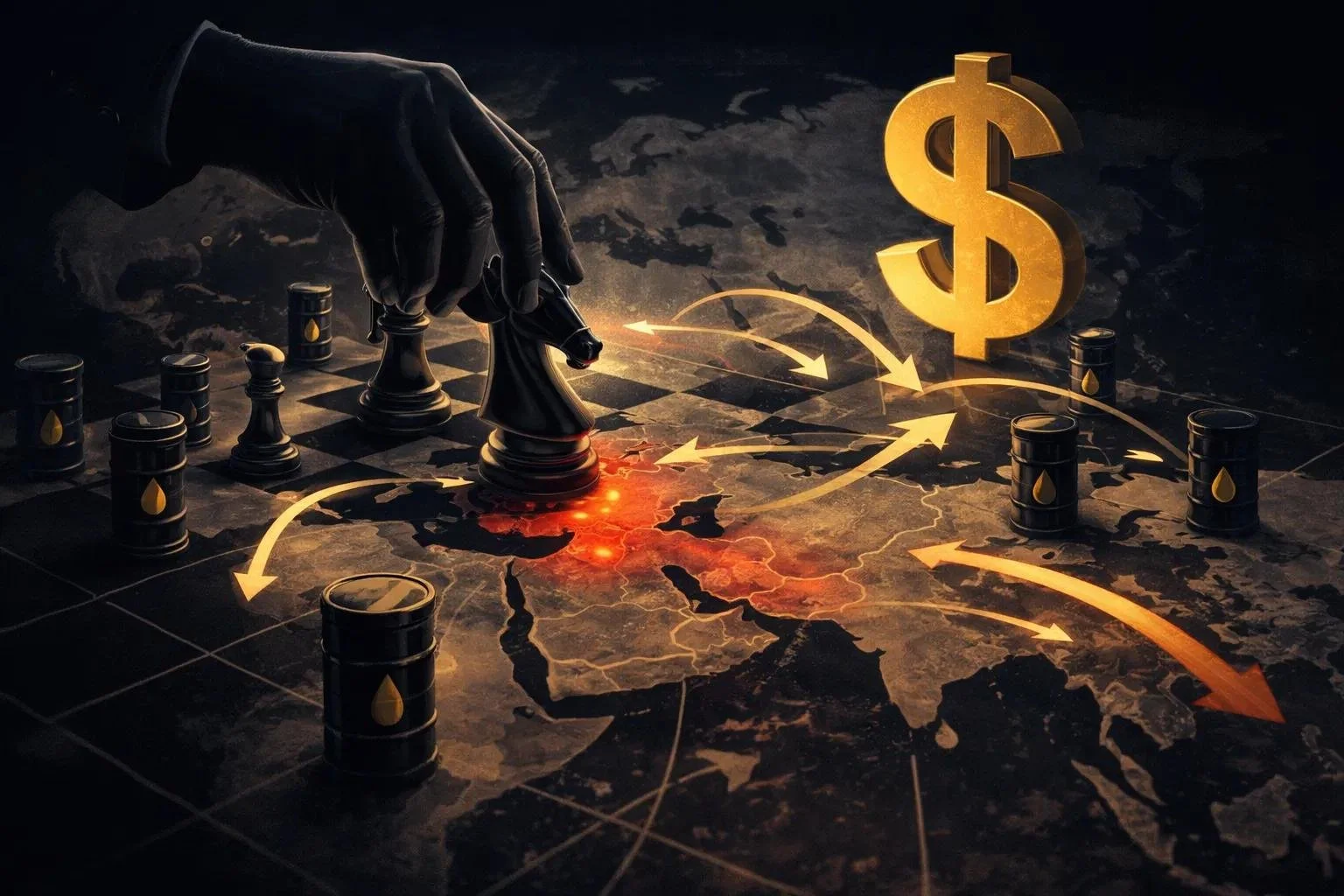
This war might possibly have been a ploy to gain control over Iran’s oil: punch them in the face, decimate their leadership, destroy much of their military capabilities… and then offer a peace deal:
“We will lift sanctions and allow you to sell oil on the global market, and even line up investment to expand your production, as long as everything is denominated in US dollars. No oil will be sold in any other currency. Better yet, we’ll push you to peg your currency to the US dollar, just like other countries in the region.”
Obviously, they would never communicate such a strategy in public; they’d never stand on stage and tell CNN what they’re really trying to accomplish.
But in the end, maybe they don’t really care if there’s true regime change in Iran. Maybe they don’t really care about Israel’s objectives either. Perhaps the singular American goal is to boost foreign demand for the US dollar.
And it’s possible they might just pull that off.
Again, I’m just speculating. The only thing we can say for sure is that there’s a lot riding on this outcome.
If they succeed, the resurgence of the dollar could buy the US enough time to fix its problems. If they fail, it could be the proverbial nail.
That’s why this war in Iran could end up right alongside 9/11, the GFC, and Covid as one of the most consequential events of our time.
To your freedom, James Hickman Co-Founder, Schiff Sovereign LLC
How an Ignored Constitution Foresaw a Tragic Endgame | Matthew Piepenburg
How an Ignored Constitution Foresaw a Tragic Endgame | Matthew Piepenburg
GoldSwitzerland by Von Greyerz: 3-25-2026
From the Founding Fathers to the great monetary thinkers of history, the message has remained unchanged: when money is no longer anchored to something real, it is ultimately debased.
In this clip, Matthew Piepenburg, Partner at VON GREYERZ, explores the slow death of constitutional money, the warnings we chose to ignore, and why gold remains as relevant today as it was centuries ago.
Are you ready to take the next step to protect your loved ones? Watch Matthew’s latest clip to learn everything you need to know about the current monetary cycle and its inevitable conclusion.
How an Ignored Constitution Foresaw a Tragic Endgame | Matthew Piepenburg
GoldSwitzerland by Von Greyerz: 3-25-2026
From the Founding Fathers to the great monetary thinkers of history, the message has remained unchanged: when money is no longer anchored to something real, it is ultimately debased.
In this clip, Matthew Piepenburg, Partner at VON GREYERZ, explores the slow death of constitutional money, the warnings we chose to ignore, and why gold remains as relevant today as it was centuries ago.
Are you ready to take the next step to protect your loved ones? Watch Matthew’s latest clip to learn everything you need to know about the current monetary cycle and its inevitable conclusion.
Gold Telegraph: The Unraveling of the Current Monetary System
Gold Telegraph: The Unraveling of the Current Monetary System
3-25-2026
Gold Telegraph @GoldTelegraph
China has invested over $120 billion into overseas mining and upstream processing since 2023. The United States has announced a $12 billion government-backed fund to stockpile critical minerals for emergencies. The hunt for minerals continues…
Japan’s top currency official says the government will take all possible steps to respond to foreign exchange moves at any time. This is what a managed “floating” system looks like.
Gold Telegraph: The Unraveling of the Current Monetary System
3-25-2026
Gold Telegraph @GoldTelegraph
China has invested over $120 billion into overseas mining and upstream processing since 2023. The United States has announced a $12 billion government-backed fund to stockpile critical minerals for emergencies. The hunt for minerals continues…
Japan’s top currency official says the government will take all possible steps to respond to foreign exchange moves at any time. This is what a managed “floating” system looks like.
China’s central bank just said something BIG. They are signalling that global imbalances aren’t the result of policy failures. They are saying it is the consequence of a system built on a single dominant currency.
When the People’s Bank of China links its surplus to structural flaws in the monetary order, it’s no longer about trade. It’s about the system itself.
A system that the United States once called “temporary” when it suspended the convertibility of the dollar into gold in 1971. This is the structure I’ve been writing about for nearly a decade. And it’s starting to be acknowledged at the highest levels.
Before 1971, the system had discipline because gold acted as the anchor. It didn’t eliminate imbalances but it exposed them quickly and forced a response.
When that link was cut, it wasn’t replaced, it was removed, and what followed wasn’t a new system but the ability to extend imbalances far beyond what was previously possible and allowed its currencies to float against each other in a debasement race.
BREAKING NEWS: JAPAN’S GOVERNMENT IS CONSIDERING INTERVENTION IN CRUDE OIL FUTURES
Of course they are… Circus.
“Reuters reported on Monday that Japan’s government is considering intervening in crude oil futures as the Middle East crisis drives energy prices up sharply…”
Futures market intervention isn’t a show of strength. It’s a confession of desperation.
QatarEnergy declares force majeure on LNG supply to:
• Italy
• Belgium
• South Korea
• China
Energy…
“Governments have no good choices. They can either engineer a depression and cut services and increase taxes, or they can debase the currency… What they like to do is promise more with money they don’t have.” – Pierre Lassonde
Global debt is now $348 trillion.
Watch on X: https://twitter.com/i/status/2036523174284935567
It took the United States over 200 years to reach $1 trillion in debt. Now it pays more than that every single year just in interest. This is just sad…
BREAKING NEWS: CANADA DISCUSSES KEYSTONE XL REVIVAL WITH T******************N OFFICIALS
Energy…
“Canadian officials spoke to Trump Administration representatives about a proposed revival of part of the canceled Keystone XL oil pipeline in a meeting in Houston this week…”
Source: https://globalnews.ca/news/11744221/canada-discusses-keystone-xl-revival-with-trump-administration/
National Bank’s CEO is calling for the revival of Keystone XL, arguing Canada must expand its energy production, strengthen domestic distribution, and scale global exports to be a true energy superpower… Remember, Canada has the 3rd largest proven oil reserves globally.
France has just pulled nearly €13 billion in gains from restructuring its gold reserves while quietly bringing a portion of that gold back from New York to its own vaults.
Gold isn’t formally revalued. It exposes the revaluation of everything else. That is debasement.
Source(s): https://x.com/GoldTelegraph_/status/2035820485863440399
https://dinarchronicles.com/2026/03/25/gold-telegraph-the-unraveling-of-the-current-monetary-system/
News, Rumors and Opinions Wednesday 3-25-2026
KTFA:
Clare: Expectations are that the government's candidate will be decided after the framework meeting within days.
3/24/2026
Political analyst Haider al-Barzanji affirmed that the current circumstances present a significant opportunity for Iraq to take a firm stance regarding the formation of a government. Al-Barzanji told Al-Furat News Agency that "the Shiite political forces bear the greatest responsibility in moving towards the formation of a fully empowered government."
He explained that "expectations indicate that this issue will be resolved after the coordination framework meeting scheduled to be held within a few days
KTFA:
Clare: Expectations are that the government's candidate will be decided after the framework meeting within days.
3/24/2026
Political analyst Haider al-Barzanji affirmed that the current circumstances present a significant opportunity for Iraq to take a firm stance regarding the formation of a government. Al-Barzanji told Al-Furat News Agency that "the Shiite political forces bear the greatest responsibility in moving towards the formation of a fully empowered government."
He explained that "expectations indicate that this issue will be resolved after the coordination framework meeting scheduled to be held within a few days, which will decide on naming the candidate and actually moving towards forming the government," noting that "there are no multiple options that allow for further waiting."
He added that "there is no connection between what is happening in the region and internal entitlements," stressing that "forming the government will give Iraq additional strength in dealing with important and sensitive issues, as well as strengthening the Iraqi position in economic aspects and dealing with the regional situation."
Raghid LINK
************
Clare: Trump touts ‘significant’ Iran ‘present’ linked to Strait of Hormuz as deal talks heat up
Trump says gift arrived Tuesday and was 'very significant,' with negotiations led by Marco Rubio, JD Vance
March 24, 2026
President Donald Trump on Tuesday announced Iran wants to "make a deal" with the U.S., noting the country's leadership gave the U.S. a "significant prize" related to the Strait of Hormuz and the flow of oil.
While speaking to reporters in the White House Oval Office, Trump said Iranian leadership sent the gift on Monday, and it arrived on Tuesday.
"They're going to make a deal. They did something [Monday] that was amazing, actually. They gave us a present," Trump said. "The present arrived today, and it was a very big present worth a tremendous amount of money."
Trump said he could not disclose what the gift was, but said it was "oil and gas-related" and was connected to the Strait of Hormuz.
The Iranian regime was previously charging some tankers millions of dollars to pass through the global shipping choke point, according to a report from Iran International.
Trump added the unspecified present was "very significant."
"That meant one thing to me — we're dealing with the right people," Trump said. "… It was a very nice thing they did. … They said they were going to do it, and it happened. And they're the only ones that could have done it."
When asked about control of the Strait of Hormuz, he said the U.S. will "have control of anything we want."
"They can't have certain things," Trump said. "It starts with no nuclear weapons, and they've agreed to that. … They're not going to have enrichment — any of those things. … We are in about the best bargaining position. We're way ahead of schedule."
Negotiations are being headed by Secretary of State Marco Rubio and Vice President JD Vance, according to the president.
This is a developing story. Please check back for updates.
************
Courtesy of Dinar Guru: https://www.dinarguru.com/
Militia Man The foundation for the next stage, which I believe is going to be a managed REER exchange rate adjustment when it's prudent by the gatekeepers is stronger than ever...Everything is on track and we're watching it unfold...Integration is real, it's advancing and there's no stopping it regardless of what's happening in the world.
Jeff Everything is going in the right direction now for the war to come to an end. The war can definitely end by the end of this month. If it does, there's a good chance we could start to see the quick turnaround of Iraq's government formation...We could see the rate change somewhere around the middle of [April]. Things are looking good for us right now...
Bruce [via WiserNow] ...our...top military people are indicating that everything's going to be wrapped up this...week that is related to the conflict in Iran...and in that is also the fact we as currency and zim holders should be wrapped up this...week, which is still in March, and it Is before Easter, which is on April 5.
************
This Dinar Mistake Will Cost You EVERYTHING
Dinar for Dummies: 3-24-2026
Don't make these financial mistakes.
Seeds of Wisdom RV and Economics Updates Wednesday Morning 3-25-26
Good Morning Dinar Recaps,
Global Reset Series – Visual Timeline Article
From Bretton Woods to a Digital Multipolar Financial System: A Timeline of Global Monetary Evolution
Understanding today’s financial changes is easier when you see the long-term evolution of global money.
Good Morning Dinar Recaps,
Global Reset Series – Visual Timeline Article
From Bretton Woods to a Digital Multipolar Financial System: A Timeline of Global Monetary Evolution
Understanding today’s financial changes is easier when you see the long-term evolution of global money.
Overview
The global financial system has not been static. From Bretton Woods in 1944 to today’s CBDC experiments, major shifts happen over decades.
This visual timeline highlights the most important milestones that led to the emerging multipolar financial system.
Key Milestones
1944 – Bretton Woods Agreement
• Established a U.S. Dollar-centered global monetary system
• Fixed exchange rates tied to the dollar and gold
• Created the IMF and World Bank
1971 – Nixon Shock
• Ended gold convertibility of the U.S. Dollar
• Shifted world to a floating exchange rate system
• Triggered the rise of modern reserve currency strategies
1990s – Rise of Global Payment Networks
• SWIFT becomes the dominant cross-border messaging system
• International banks integrate with centralized U.S. and European infrastructure
2000s – China and Emerging Markets Rise
• China joins WTO and becomes a major trade hub
• Reserve accumulation grows in Asia and Russia
• Calls for more financial autonomy in emerging markets
2014–2020 – BRICS and Alternative Payment Systems
• BRICS develops contingency plans for cross-border payments outside SWIFT
• Local currency trade agreements expand among emerging economies
2020–2023 – Central Bank Digital Currencies (CBDCs) Take Off
• Over 130 countries begin researching or piloting digital currencies
• Projects include China’s Digital Yuan, India’s e-Rupee, and a potential Digital Euro
2022–2025 – Record Gold Accumulation
• Central banks buy more than 1,000 tonnes of gold annually
• China, India, Turkey, and Russia lead purchases to diversify reserves
2024–Present – Cross-Border Payment System Modernization
• G20 and FSB launch initiatives to reduce transaction costs and speed settlement
• Multi-CBDC experiments are underway to test direct international settlement
Why It Matters
The timeline shows that the current structural changes are part of a decades-long evolution:
• Gold accumulation, CBDCs, and payment system redesign are the latest stages in monetary evolution
• The world is moving toward a multipolar and technologically advanced financial system
• Both traditional and emerging networks will coexist, creating redundancy, resilience, and competition in global finance
Seeds of Wisdom Team View
Understanding history provides context for today’s changes.
The current developments are incremental, deliberate, and quietly transformative, not sudden or chaotic.
Seeds of Wisdom Team
Newshounds News™ Exclusive
Sources
~~~~~~~~~~
A Message to Our Currency Holders
If you’ve been holding foreign currency for many years, you were not foolish.
You were not wrong to believe the global financial system would change.
What failed was not your patience — it was the information you were given.
For years, dates, rumors, and personalities replaced facts, structure, and proof. “This week” predictions created cycles of hope and disappointment that were never based on how currencies actually change.
That is not your failure.
Our mission here is different: • No dates • No rates • No hype • No gurus
Instead, we focus on:
• Verifiable developments • Institutional evidence
• Global financial structure • Where countries actually sit in the process
Currency value changes only come after sovereignty, trade, banking, settlement systems, and fiscal coordination are in place. History and institutions confirm this sequence.
You will see silence. You will see denials. That is not delay — that is discipline.
Protect your identity. Organize your documents. Verify everything.
Never hand your discernment to anyone who cannot show proof.
You deserve truth — not timelines.
Seeds of Wisdom Team
Newshounds News
~~~~~~~~~~
Seeds of Wisdom Team RV Currency Facts Youtube and Rumble
Newshound's News Telegram Room Link
RV Facts with Proof Links Link
RV Updates Proof links - Facts Link
Follow the Gold/Silver Rate COMEX
Follow Fast Facts
Seeds of Wisdom Team™ Website
Thank you Dinar Recaps
Iraq Economic News And Points To Ponder Wednesday Morning 3-25-26
Disappointing Results For A $69 Billion US Bond Offering
Money and Business Economy News - Follow-up
The U.S. Treasury Department announced Tuesday the results of its $69 billion two-year bond offering, with demand falling below average, at the start of a week of long-term U.S. Treasury bond sales.
The yield on the two-year bonds was 3.936% of their nominal value, with a coverage ratio of 2.44 times.
Last month, the Treasury sold $69 billion in two-year bonds, with a yield of 3.455% and a coverage ratio of 2.63 times the offering value.
Disappointing Results For A $69 Billion US Bond Offering
Money and Business Economy News - Follow-up
The U.S. Treasury Department announced Tuesday the results of its $69 billion two-year bond offering, with demand falling below average, at the start of a week of long-term U.S. Treasury bond sales.
The yield on the two-year bonds was 3.936% of their nominal value, with a coverage ratio of 2.44 times.
Last month, the Treasury sold $69 billion in two-year bonds, with a yield of 3.455% and a coverage ratio of 2.63 times the offering value.
It is worth noting that the coverage ratio is a measure of demand for bonds, indicating the size of the subscription compared to the size of the offering.
The average coverage ratio for the last 10 two-year bond offerings was 2.62 times.
The Treasury Department is scheduled to announce on Wednesday the results of its $70 billion five-year bond offering and on Thursday the results of its $44 billion seven-year bond offering at the close of the offering week.
https://www.economy-news.net/content.php?id=67107
Sudan’s Parliamentary Bloc: We Pledge To Our People That Iraqi Sovereignty Will Remain An Untouchable Trust
Iraqi state spending Economy News – Baghdad The parliamentary Reconstruction and Development Bloc pledged on Wednesday that Iraqi sovereignty will remain an inviolable trust, and that any transgression against it will not go unanswered without a firm national stance that preserves the country's dignity and the military institution's prestige.
A statement issued by the bloc and received by “Al-Eqtisad News” said: “It condemns the heinous American air attack that targeted the Habbaniyah military clinic this morning, Wednesday, which represents a fully-fledged crime, reflecting a determination to violate Iraqi sovereignty and a blatant challenge to the norms and conventions that govern international relations.”
He added: “It has become clear that the series of attacks targeting our official institutions aims to weaken the state’s ability to extend its control and protect its members. The blood that was shed today in Habbaniyah is the same blood that is being shed in the trenches defending the homeland by the army, the Popular Mobilization Forces, and the police, which necessitates a comprehensive national stance that transcends narrow calculations.”
He continued: “We call for the immediate initiation of internationally available legal avenues and the use of diplomatic leverage to enforce respect for Iraqi sovereignty. We affirm that the unity of the official and popular stance behind the sovereign government decision is the only guarantee to prevent the recurrence of these violations and to preserve the dignity of the military institution in all its formations.”
He added: “While we mourn the martyrs and pray to God for the speedy recovery of the wounded, we pledge to our people that Iraqi sovereignty will remain an inviolable trust, and that any transgression against it will not go unanswered without a firm national stance that preserves the country’s dignity and the military institution’s prestige.”
https://www.economy-news.net/content.php?id=67121
American Company: Closing The Strait Of Hormuz Threatens Iraq's Food Security
Localities Economy News – Baghdad A US company specializing in economic and financial data and market analysis warned on Wednesday of the impact of the turmoil in the Strait of Hormuz and the war in the Middle East on Iraq's food security, noting that Baghdad imports about 70% of its needs for vegetables and fruits.
S&P Global said that Iraq relies on imports for 70% of its fruit and vegetable needs to cover the local market, while Qatar and the UAE need 90% of their fruits and vegetables imported, and Bahrain's reliance on imports is 85% of its fruits and vegetables.
The report indicated that "Kuwait needs to import 95% of its flour, Oman needs to import 75% of its fruits and vegetables, Saudi Arabia needs to import about 85% of its poultry feed and grains, while Iran relies on importing 25% of its wheat."
He explained that “prolonged restrictions in the Strait of Hormuz may force importers to resort to longer sea routes or alternative land routes, leading to higher costs and exacerbating logistical challenges, and directly affecting food prices in Iraqi markets.”
The report added that "the continuation of these disruptions could exacerbate the food security crisis locally and regionally, which calls for finding quick solutions to secure supplies and protect consumers."
The Iranian Foreign Ministry had confirmed earlier this week that the Strait of Hormuz was "not closed" and that the hesitation of ships was due to insurance companies' fears of war, while announcing that navigation would continue while ships linked to "aggressor parties" were barred. https://www.economy-news.net/content.php?id=67118
Oil Slides 4% On US-Iran Ceasefire Hopes
2026-03-25 Shafaq News Oil prices fell around 4% on Wednesday on the prospect of a possible ceasefire easing supply disruptions from the key Middle East producing region after reports the U.S. sent Iran a 15-point plan to end the war between them.
Brent crude futures fell $4.89, or 4.7%, to $99.60 a barrel by 0335 GMT, after declining to as low as $97.57. U.S. West Texas Intermediate (WTI) crude futures were down $3.54, or 3.8%, at $88.81 a barrel, after falling to as low as $86.72.
Both benchmarks rose nearly 5% on Tuesday, before paring gains in volatile post-settlement trading.
"Expectations of a ceasefire have risen slightly and profit-taking is leading the market," said Hiroyuki Kikukawa, chief strategist of Nissan Securities Investment, a unit of Nissan Securities. "But the outlook remains uncertain as to whether negotiations will succeed, limiting selling."
U.S. President Donald Trump said on Tuesday the U.S. was making progress in negotiating an end to the war with Iran, while a source confirmed that Washington had sent Iran a 15-point settlement proposal.
Israel's Channel 2 said the U.S. was seeking a month-long ceasefire to discuss the plan, which includes the dismantling of Iran's nuclear program, ceasing support for proxy groups, and the reopening of the Strait of Hormuz.
Some analysts are sceptical on the progress of such talks, expecting markets to remain volatile.
Phillip Nova's senior market analyst Priyanka Sachdeva said Middle East developments would remain the "dominant price driver" keeping oil prices moving in a wide range in the near term.
The war has all but halted shipments of oil and liquefied natural gas through the Strait, which typically carries about one-fifth of the world's gas and crude supply, causing what the International Energy Agency has called the biggest-ever oil supply disruption.
"The market outlook remains tight notwithstanding the prospects of a war off-ramp," said Saul Kavonic, head of energy research at MST Marquee.
"Even if a ceasefire is implemented this week and flows through Strait of Hormuz resume, it's not clear all shut-in production will resume until there is more clarity on the durability of a ceasefire."
On Tuesday, Pakistan's prime minister said he was willing to host talks between the U.S. and Iran.
Iran has told the United Nations Security Council and the International Maritime Organization that "non-hostile vessels" may transit the Strait of Hormuz if they coordinate with Iranian authorities, according to a note seen by Reuters on Tuesday.
Still, U.S., Israeli and Iranian strikes continued and sources said Washington was preparing to send more troops to the region.
To offset the Strait of Hormuz disruptions, oil exports from Saudi Arabia's Red Sea Yanbu port rose to nearly 4 million barrels per day last week, a sharp increase from before the war broke out, shipping data shows.
In the U.S., crude, gasoline and distillate stocks rose last week, according to market sources who cited American Petroleum Institute figures on Tuesday.
Crude stocks rose by 2.35 million barrels in the week ended March 20, gasoline inventories rose by 528,000 barrels and distillate inventories rose by 1.39 million barrels from a week earlier, the sources said.
(Reuters) https://www.shafaq.com/en/Economy/Oil-slides-4-on-US-Iran-ceasefire-hopes
The Closure Of Iraqi Airspace Has Been Extended For (72) Hours.
{Local: Al-Furat News} The Iraqi Civil Aviation Authority announced today, Wednesday, the extension of the closure of Iraqi airspace to air traffic.
The authority stated in a statement received by Al-Furat News that "it has been decided to extend the closure of Iraqi airspace to all incoming, departing and transiting aircraft for (72) hours, starting from 12:00 noon on Wednesday (09:00 UTC), until 12:00 noon on Saturday, March 28, 2026, as a temporary precautionary measure.
She added that "the decision is based on the ongoing assessment of the security situation and developments in the regional situation, and will be reassessed in light of new developments." She noted that "airlines and relevant parties will be notified of any updates later." LINK
Seeds of Wisdom RV and Economics Updates Tuesday Evening 3-24-26
Good Evening Dinar Recaps,
Global Liquidity Tightens: Central Banks Signal Prolonged High-Rate Era
Coordinated policy signals and persistent inflation risks are reshaping capital flows and delaying monetary easing worldwide
Overview (Key Points)
Central banks across major economies signaled that interest rates will remain higher for longer, reinforcing a global shift toward tight monetary conditions. This stance reflects ongoing concerns that inflation pressures are not fully contained.
Good Evening Dinar Recaps,
Global Liquidity Tightens: Central Banks Signal Prolonged High-Rate Era
Coordinated policy signals and persistent inflation risks are reshaping capital flows and delaying monetary easing worldwide
Overview (Key Points)
Central banks across major economies signaled that interest rates will remain higher for longer, reinforcing a global shift toward tight monetary conditions. This stance reflects ongoing concerns that inflation pressures are not fully contained.
Recent data releases show mixed economic signals, with resilient labor markets and sticky core inflation preventing policymakers from pivoting toward aggressive rate cuts. This creates a prolonged period of restricted liquidity across financial systems.
The U.S. Federal Reserve and global counterparts are aligned in caution, emphasizing data-dependent decision-making while avoiding premature easing that could reignite inflation.
The broader implication is significant: the global system is entering a phase where capital is more expensive, growth is constrained, and financial vulnerabilities are increasingly exposed.
Key Developments
1. Central Banks Reinforce “Higher for Longer” Narrative
Major central banks reiterated their commitment to maintaining restrictive policy levels.
• Rate cuts are being delayed despite market expectations
• Focus remains on ensuring inflation is fully anchored
2. Sticky Inflation Complicates Policy Shifts
Recent data indicates inflation remains persistent in key sectors.
• Services inflation continues to run elevated • Wage pressures are contributing to longer-term inflation risks
3. Global Liquidity Conditions Continue to Tighten
Financial conditions are becoming more restrictive across markets.
• Borrowing costs remain elevated for governments and businesses • Liquidity reduction is impacting credit availability and investment flows
4. Market Expectations Begin to Reset
Investors are adjusting to a slower pace of monetary easing.
• Equity and bond markets are repricing risk • Volatility is increasing as rate-cut timelines are pushed further out
5. Emerging Markets Face Increased Pressure
Tighter global conditions are impacting developing economies more sharply.
• Capital outflows are increasing • Currency stability is challenged by stronger developed-market yields
Why It Matters
This environment represents a structural tightening of the global financial system, where access to capital becomes more limited and more expensive. The era of easy money is being replaced with disciplined monetary control.
Markets must now operate under conditions where liquidity is no longer abundant, increasing the likelihood of asset repricing, credit stress, and economic slowdowns.
From a policy perspective, governments face higher debt servicing costs, limiting fiscal flexibility and increasing pressure on already strained budgets.
Why It Matters to Foreign Currency Holders
• Stronger interest rate environments support major reserve currencies • Currency volatility increases as capital shifts toward higher yields • Emerging market currencies face depreciation risks • Purchasing power may decline in weaker currency regions
Implications for the Global Reset
Pillar 1: End of Easy Money and Debt Expansion
The persistence of high interest rates signals a systemic shift away from debt-fueled growth models. Financial systems must now adjust to sustainable capital allocation and stricter lending conditions.
Pillar 2: Repricing of Global Assets and Currency Power
As liquidity tightens, asset valuations and currency strength are being recalibrated. This creates a new hierarchy where capital efficiency and monetary discipline define economic leadership.
Conclusion
The global financial system is undergoing a measured but significant transformation, driven by the need to restore balance after years of excess liquidity. Central banks are signaling clearly that stability now takes priority over growth acceleration.
This shift is forcing markets, governments, and institutions to adapt to a more disciplined financial environment, where risk is priced more accurately and capital is no longer freely available.
The consequences will unfold across economies and currencies, shaping the next phase of global finance.
This is not just monetary policy — it’s the recalibration of the entire global financial system.
Seeds of Wisdom Team
Newshounds News™ Exclusive
Sources
Reuters — "Global Central Banks Signal Rates to Stay Higher for Longer"
International Monetary Fund (IMF) — "Global Financial Stability Update 2026"
~~~~~~~~~~
Seeds of Wisdom Team RV Currency Facts Youtube and Rumble
Newshound's News Telegram Room Link
RV Facts with Proof Links Link
RV Updates Proof links - Facts Link
Follow the Gold/Silver Rate COMEX
Follow Fast Facts
Seeds of Wisdom Team™ Website
Thank you Dinar Recaps