
Thank you to all the subscribers to our Early Access program…we thank you for your continued support.
We are excited to offer this new service to keep you informed and up-to-date on the latest Dinar and currency news.
Americans Are Worried More About This Money Issue Than Inflation
Americans Are Worried More About This Money Issue Than Inflation — Here’s Why
Dawn Allcot GOBankingRates Sat, January 10, 2026
Americans are more worried about the job market and their job security than they are about inflation, according to the latest Survey of Consumer Expectations from the Federal Reserve Bank of New York.
Survey respondents said they expect inflation to drop to 3% within the next three to five years, the NY Fed reported. Respondents also believe credit is easier to get now than it was in the recent past, and that trend should continue. Although reduced inflation and loosened credit should bode well for the economy, people are still concerned.
Americans Are Worried More About This Money Issue Than Inflation — Here’s Why
Dawn Allcot GOBankingRates Sat, January 10, 2026
Americans are more worried about the job market and their job security than they are about inflation, according to the latest Survey of Consumer Expectations from the Federal Reserve Bank of New York.
Survey respondents said they expect inflation to drop to 3% within the next three to five years, the NY Fed reported. Respondents also believe credit is easier to get now than it was in the recent past, and that trend should continue. Although reduced inflation and loosened credit should bode well for the economy, people are still concerned.
Consumers also predicted unemployment rising in 2026 and believe they may have a harder time finding a job if they are laid off next year. Those under the age of 60 and those who attended “some college” were the most concerned, according to the report.
“People know that if inflation hits, they will feel it, but they can adjust their spending to offset it,” said Melanie Musson, finance expert at Quote.com. “Inflation hurts, but it’s survivable. Meanwhile, losing your job can feel like there is no solution.”
Gen Z Feels Heavy Uncertainty
Sofiya Deva of the AI-powered personal finance app Vera, said these emotions may be especially prevalent in Gen Z.
“They’ve been nicknamed ‘the most anxious generation.’ And I think a lot of that really does carry over into finances,” she said.
Seeking personalized financial advice, and even relying on AI tools, could be part of the solution for any generation, Deva added.
“[Finance is] a very personal topic. In some ways it’s even more taboo than religion and politics,” Deva said. “Having a safe, judgement-free space where you can share where you are financially, plus your anxieties, hopes and fears, can help.”
How To Prepare for Job Loss
To Continue and Read More: https://www.yahoo.com/finance/news/americans-worried-more-money-issue-115512920.html
Paul Gold Eagle: Understanding Tier 4B, Currency RV, and NESARA-GESARA Payments
Paul Gold Eagle: Understanding Tier 4B, Currency RV, and NESARA-GESARA Payments
1-17-2026
Paul White Gold Eagle @PaulGoldEagle
QFS INFORMATION CENTER
UNDERSTANDING TIER 4B, CURRENCY REVALUATION, AND NESARA GESARA PAYMENTS
Paul Gold Eagle: Understanding Tier 4B, Currency RV, and NESARA-GESARA Payments
1-17-2026
Paul White Gold Eagle @PaulGoldEagle
QFS INFORMATION CENTER
UNDERSTANDING TIER 4B, CURRENCY REVALUATION, AND NESARA GESARA PAYMENTS
The global financial system is undergoing a structural transition that most people don’t yet recognize. At the center of this shift are three concepts that keep resurfacing across alternative finance discussions: the Quantum Financial System (QFS), Tier 4B, and NESARA GESARA–related payments. To understand what may be unfolding, it’s critical to separate speculation from structure.
The move underway is a transition from fiat currency systems to asset-backed valuation models.
Fiat currencies, created through debt and leverage, are increasingly unstable. QFS is described as a settlement and verification framework designed to support transparent, asset-guaranteed currencies, removing manipulation, duplication, and unlawful routing.
Much of the confusion surrounds “Tier 4B,” often called the Internet Group.
This does not mean everyone who uses the internet. Tier 4B refers to individuals who actively tracked currency revaluation narratives, prepared by acquiring foreign currencies, followed alternative financial disclosures, and positioned themselves ahead of a potential reset.
In simplified terms, the tier structure is described as follows:
Tier 1–3 involve sovereign, institutional, and historical asset holders.
Tier 4A includes private exchange and secured access participants.
Tier 4B consists of the prepared public community actively following revaluation and QFS developments.
Tier 5 is the general public, who only become aware once changes are announced or visible.
If currency revaluation occurs, Tier 4B participants are expected to receive structured access before the wider public.
This access is commonly associated with Redemption Centers, where foreign currencies would be exchanged under controlled conditions. These centers are not mystical locations.
Rob Cunningham: Wealth and Peace on an Epic Scale
Rob Cunningham: Wealth and Peace on an Epic Scale
1-17-2026
Rob Cunningham | KUWL.show @KuwlShow
Wealth & Peace On An Epic Scale
A new global system architecture is now being implemented – one that rises above individual ledgers to unify them through interoperable Distributed Ledger Technology (DLT).
Rob Cunningham: Wealth and Peace on an Epic Scale
1-17-2026
Rob Cunningham | KUWL.show @KuwlShow
Wealth & Peace On An Epic Scale
A new global system architecture is now being implemented – one that rises above individual ledgers to unify them through interoperable Distributed Ledger Technology (DLT).
This architecture is purpose-built for specific, adequately funded use cases; engineered for perfect transparency; capable of atomic settlement; and anchored in real-world asset authentication, immutable identity absolutes, and verifiable ownership.
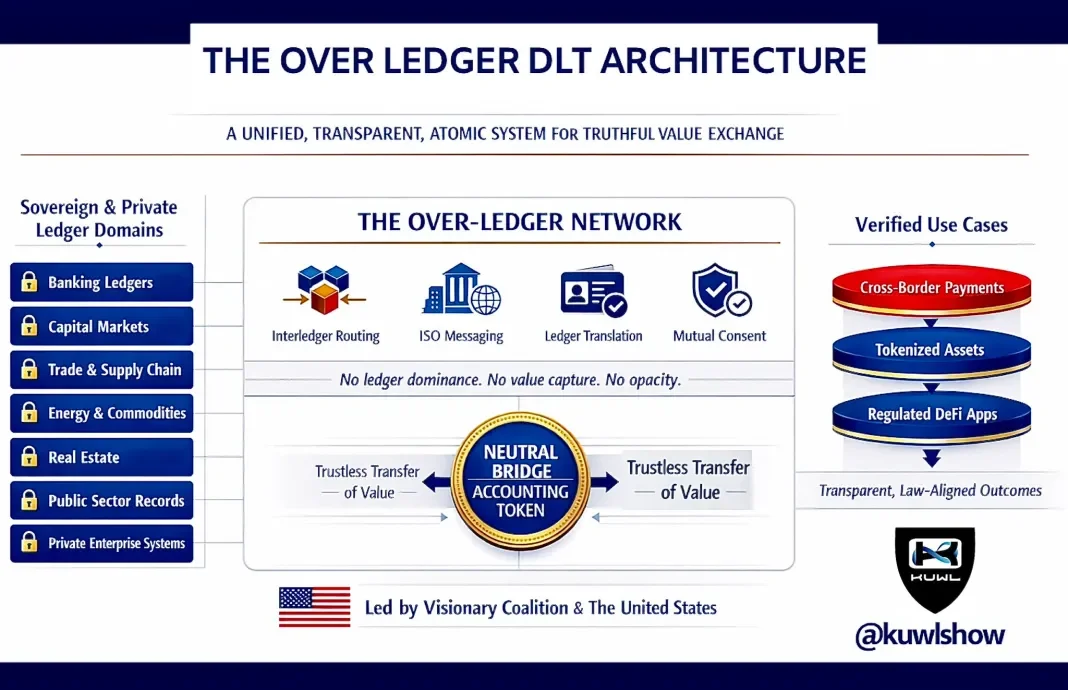
At its core operates a non-sovereign, neutral bridge accounting token – not as money to be hoarded or weaponized, but as a flawless transporter and transcriber of value: unbiased, instantaneous, and exact.
It neither governs, owns nor extracts, but simply moves truthfully between and in alignment with, compliant systems.
This is not a speculative experiment. It is the natural evolution of law-aligned accounting, trustless verification, and honest weights and measures – emerging through a coalition of public and private leadership, with the United States providing the primary visionary, infrastructural, and moral impetus for its realization.
Fear, or fear not. Transparency renders no place for deception to hide.
And the powers behind the Fed are none too happy.
Transparency yields peace.
Opacity concentrates power.
Centralization yields slavery.
Have Faith.
Source(s): https://x.com/KuwlShow/status/2012172417037201785
https://dinarchronicles.com/2026/01/16/rob-cunningham-wealth-and-peace-on-an-epic-scale/
Seeds of Wisdom RV and Economics Updates Saturday Afternoon 1-17-26
Good Afternoon Dinar Recaps,
Central Banks Flee Paper for Gold as Dollar Confidence Erodes
Record gold accumulation signals a silent but structural shift in global reserves
Good Afternoon Dinar Recaps,
Central Banks Flee Paper for Gold as Dollar Confidence Erodes
Record gold accumulation signals a silent but structural shift in global reserves
Overview
Central banks around the world are accelerating gold purchases at a pace not seen in decades, reflecting growing concern over the long-term credibility of the U.S. dollar. Geopolitical fragmentation, sanctions risk, and increasing political pressure on monetary policy have driven reserve managers toward tangible, politically neutral assets. Gold’s share of global central bank reserves has now climbed above 25%, marking a historic inflection point in reserve strategy.
Key Developments
Central banks have increased gold purchases at multi-decade record levels
Gold now accounts for more than one-quarter of global central bank reserves
Prices have surged to historic highs, confirming sustained institutional demand
China alone reportedly holds over 2,000 tonnes of gold
Emerging market central banks are leading the diversification trend
What’s Really Driving the Shift
This move is not about speculation or short-term hedging. It is about systemic risk management.
Gold offers:
No counterparty risk
Immunity from sanctions and payment freezes
Protection against political interference in monetary policy
Universal acceptability outside any single financial system
As trust in fiat governance weakens, central banks are opting for assets that cannot be debased, frozen, or reprogrammed.
Why It Matters
Accelerated gold accumulation is a classic signal of declining confidence in dominant reserve currencies
Reserve diversification weakens the structural demand for dollar-denominated assets
Gold reasserts itself as a neutral anchor in a fragmenting monetary order
This behavior historically precedes monetary regime adjustments, not follows them
When central banks move first, markets follow later.
Why It Matters to Foreign Currency Holders
For foreign currency holders anticipating revaluation during a Global Reset:
Gold accumulation signals preparation for currency realignment
Tangible reserve backing strengthens the case for future repricing
Fiat-heavy systems face pressure as reserve composition shifts
Holders positioned ahead of formal policy changes benefit most
Gold is not replacing currencies — it is redefining what backs them.
Implications for the Global Reset
Pillar 1 – Assets: Gold regains prominence as a reserve foundation
Pillar 2 – Monetary Trust: Confidence migrates from fiat promises to physical backing
Reserve Architecture: Diversification reduces single-currency dominance
Resets are built quietly in vaults before they appear in headlines.
When central banks choose metal over paper, the message is already clear.
Seeds of Wisdom Team
Newshounds News™ Exclusive
Sources
~~~~~~~~~~
Mumbai Emerges as a Hub for Multipolar Economic Coordination
New Global Economic Cooperation Forum signals accelerating shift away from Western-led frameworks
Overview
A new Global Economic Cooperation 2026 Forum has been announced for February 17–19 in Mumbai, bringing together policymakers, economic planners, and institutional leaders to explore alternative models of global collaboration. The forum reflects growing momentum among emerging and middle powers to coordinate trade, investment, and financial policy outside traditional Western-dominated institutions.
Key Developments
The inaugural forum will convene in Mumbai in mid-February
Focus areas include trade integration, investment flows, and economic coordination
Participants are expected from emerging markets and middle powers
The initiative emphasizes multipolar cooperation rather than bloc dependency
Timing aligns with rising global fragmentation in trade and finance systems
Why This Forum Is Different
Unlike legacy institutions shaped after World War II, this forum is structured around pragmatic economic alignment rather than ideology. Its emphasis is on:
Flexible cooperation across regions
Reduced reliance on dollar-centric systems
Strategic alignment among economies navigating sanctions, debt stress, and trade disruption
This is coalition-building by design — not protest, but preparation.
Why It Matters
Signals intentional coordination for alternative economic architecture
Reinforces the decline of single-center economic governance
Creates space for new trade and settlement frameworks
Aligns with broader moves toward regionalization and multipolar finance
Economic resets rarely begin with formal announcements — they begin with forums like this.
Why It Matters to Foreign Currency Holders
For foreign currency holders watching the Global Reset narrative:
Multipolar coordination supports future currency repricing
Trade integration outside Western systems reduces legacy currency dominance
New settlement mechanisms create opportunities for value recalibration
Forums like this often precede policy harmonization and monetary shifts
Currency value changes are negotiated long before they are declared.
Implications for the Global Reset
Pillar 1 – Trade: Expands non-Western trade coordination pathways
Pillar 2 – Finance: Supports diversification away from dollar-centric systems
Institutional Realignment: Signals early-stage restructuring of global governance
This is not a summit for headlines — it is a workshop for the next system.
Global resets don’t start at the G7 — they start where the future is being built.
Seeds of Wisdom Team
Newshounds News™ Exclusive
Sources
Economic Times — Inaugural Global Economic Cooperation Forum to be held in Mumbai Feb 17–19
Observer Research Foundation — Multipolarity and the Future of Global Economic Governance
~~~~~~~~~~
Inside BRICS’ Real De-Dollarization Strategy: Payments Over Politics
Why infrastructure — not a new currency — is quietly reshaping global finance
Overview
For much of 2024 and early 2025, public discussion around BRICS de-dollarization focused on the idea of a new shared currency to rival the U.S. dollar. That narrative missed what was actually happening. Rather than building a euro-style monetary union, BRICS countries pursued a more practical strategy: payment infrastructure, bilateral settlement, and local-currency trade.
The result is a quiet but measurable reduction in dollar usage — achieved not through ideology, but through systems.
Key Developments
BRICS countries prioritized interoperable payment systems instead of a single currency
Russia’s SPFS, China’s CIPS, and India’s UPI were connected through pilot frameworks under BRICS Pay
Russia and China now settle the vast majority of bilateral trade in rubles and yuan
Local-currency trade expanded across energy, commodities, and infrastructure finance
BRICS-backed institutions increased non-dollar lending to Global South projects
This approach sidestepped political resistance while producing tangible outcomes.
Why Payments Became the Strategy
Creating a shared currency would require unified monetary policy, fiscal discipline, and economic convergence — conditions that do not exist inside BRICS. Member economies range from China’s multi-trillion-dollar system to frontier markets still stabilizing basic financial infrastructure.
Instead, BRICS focused on what could be built now:
Clearing systems that bypass dollar settlement
Bilateral trade invoicing in local currencies
Commodity-backed financing structures
Multilateral lending outside Western-dominated institutions
As Russia’s leadership has emphasized publicly, alternatives emerged not as confrontation — but as necessity.
Local Currency Trade and Commodity Finance
Energy trade provided the fastest proof of concept. Oil, gas, and commodities were increasingly settled in yuan, rubles, rupees, and reais, reducing dollar exposure without disrupting supply chains.
Meanwhile, the New Development Bank expanded lending in domestic currencies, supporting infrastructure and development projects without dollar-denominated debt risk. Commodity-backed settlement pilots added further insulation from currency volatility.
Each transaction was incremental — but cumulative impact matters.
Political Limits Still Apply
Despite technical progress, political realities capped ambition. Proposals for a unified BRICS currency were quietly deprioritized in 2025. Leaders acknowledged that monetary integration was premature, particularly amid external trade pressures and tariff threats.
This restraint did not stall de-dollarization — it refined it.
Why It Matters
De-dollarization is happening through systems, not symbols
Payment infrastructure reduces dollar dependency without formal confrontation
Bilateral clearing erodes reserve currency dominance transaction by transaction
This model is scalable beyond BRICS to the wider Global South
The shift is structural, not rhetorical.
Why It Matters to Foreign Currency Holders
For foreign currency holders watching global reset mechanics:
Payment systems matter more than headline currency launches
Local settlement reduces artificial demand for reserve currencies
Commodity-backed finance supports future currency repricing
Infrastructure-first de-dollarization favors measured realignment, not shock events
Currency value changes long before exchange rates move.
Implications for the Global Reset
Pillar 1 – Trade: Local-currency invoicing reshapes global trade flows
Pillar 2 – Finance: Payment rails weaken legacy settlement dominance
Pillar 4 – Assets: Commodities reassert monetary relevance
This is de-dollarization by design — not declaration.
The dollar isn’t being overthrown — it’s being routed around.
Seeds of Wisdom Team
Newshounds News™ Exclusive
Sources
Watcher.Guru — Inside BRICS’ Next De-Dollarization Playbook: Pay Systems Over Politics
Reuters — Russia and China deepen use of local currencies in trade settlements
~~~~~~~~~~
Seeds of Wisdom Team RV Currency Facts Youtube and Rumble
Newshound's News Telegram Room Link
RV Facts with Proof Links Link
RV Updates Proof links - Facts Link
Follow the Gold/Silver Rate COMEX
Follow Fast Facts
Seeds of Wisdom Team™ Website
Thank you Dinar Recaps
Will The Government Confiscate Your Silver?
Will The Government Confiscate Your Silver? Here’s Why It’s Likely
Noel Lorenzana, CPA Jan 17, 2026
Did you know the US government once seized private gold overnight? In 1933, gold was taken by law with a single signature. No warning. No debate. Today, silver has been declared a US strategic mineral, raising urgent questions about silver confiscation, government control, national security, and private ownership.
Will The Government Confiscate Your Silver? Here’s Why It’s Likely
Noel Lorenzana, CPA Jan 17, 2026
Did you know the US government once seized private gold overnight? In 1933, gold was taken by law with a single signature. No warning. No debate. Today, silver has been declared a US strategic mineral, raising urgent questions about silver confiscation, government control, national security, and private ownership.
Silver is no longer just an industrial or precious metal. It is now tied to the power grid, the military, clean energy, and US national defense. In a national emergency, “strategic” does not mean protected. It means prioritized and controlled. Rules can change without a knock on the door or a new law, turning private silver into a public resource.
This video breaks down the historical gold confiscation of 1933, why silver’s new classification matters, how government control really works, and what this could mean for silver owners today. If you think this cannot happen again, or that silver is immune, you need to pay attention.
“Tidbits From TNT” Saturday 1-17-2026
TNT:
Tishwash: Mark Savaya arrives in Erbil
Shafaq News Agency's correspondent reported that Mark Savaya, US President Donald Trump's envoy for Iraq affairs, arrived in Erbil, the capital of the Kurdistan Region, early Saturday morning, as part of a visit that coincides with broader US diplomatic activity related to the Iraq and Syria files.
Tom Barrack, Trump’s envoy for Syria, is scheduled to arrive in Erbil later on Saturday to meet with Mazloum Abdi, the commander of the Syrian Democratic Forces, at a time when the Syrian arena is witnessing a military escalation and international mediation efforts to de-escalate the situation.
TNT:
Tishwash: Mark Savaya arrives in Erbil
Shafaq News Agency's correspondent reported that Mark Savaya, US President Donald Trump's envoy for Iraq affairs, arrived in Erbil, the capital of the Kurdistan Region, early Saturday morning, as part of a visit that coincides with broader US diplomatic activity related to the Iraq and Syria files.
Tom Barrack, Trump’s envoy for Syria, is scheduled to arrive in Erbil later on Saturday to meet with Mazloum Abdi, the commander of the Syrian Democratic Forces, at a time when the Syrian arena is witnessing a military escalation and international mediation efforts to de-escalate the situation.
Trump had appointed Savaya as special envoy for Iraq affairs on October 19, 2025. He is an American businessman of Iraqi origin.
In his latest remarks, attributed to him ahead of the visit, he said he would deal with the "appropriate decision-makers" in Iraq, and had previously hinted that "big changes are coming" with a focus on "actions, not words." link
************
Tishwash: Sudanese advisor: The government has achieved economic success, and the International Monetary Fund is witnessing it.
Despite talk of a severe financial crisis in Iraq and the decline of the dinar against the dollar, the Prime Minister's financial advisor, Mazhar Muhammad Salih, says that the country recorded a low inflation rate of about 1.5% by the end of 2025. He pointed out that inflation in Iraq is the lowest in the Arab world, noting that the government's monetary policy succeeded in maintaining price and exchange rate stability and protecting the purchasing power of the dinar.
Regarding the recent cabinet measures, Salih explained that their aim is to address what is known as "job inflation" as a step to support social stability and improve income levels, as he put it.
Saleh told the official agency, as reported by 964 Network , that “the Iraqi economy is witnessing a remarkable phase of monetary stability, as it recorded a low inflation rate of about 1.5% by the end of 2025, according to estimates by the International Monetary Fund, which is among the lowest rates in the Arab region.” He explained that “this achievement is attributed to the monetary policy that succeeded in maintaining price and exchange rate stability, and protecting the purchasing power of the dinar, which strengthened confidence in the national currency and provided a more favorable environment for investment.”
He added that “the recent Cabinet decisions aim to address what is known as ‘job inflation’ as a step to support social stability and improve income levels,” noting that “these measures achieve positive short-term returns by stimulating domestic demand and enhancing economic confidence, especially if they are financed within the limits of financial sustainability and do not exceed the absorptive capacity of the economy.”
He explained that “the biggest challenge remains in transforming this monetary stability into sustainable productive economic growth, since government employment, if not linked to productivity, may create a gap between public spending and real output, and increase the economy’s vulnerability to fluctuations in oil prices.”
He added that “the solution lies in linking employment to training and qualification programs, empowering the private sector through legislative and financial reforms, as well as diversifying the economic base by focusing on agricultural development, manufacturing, renewable energy, and increasing opportunities in the digital economy.”
He stressed that “Iraq today has a rare dual opportunity represented by low inflation and monetary stability,” adding that “this opportunity can turn into a long-term gain if it is invested in building a solid productive base, which will ensure the continuity of financial and monetary stability in the medium and long term, and move the economy from the cycle of rentier dependency to the path of sustainable growth.” link
**************
Tishwash: Government advisor: Tourism investment is a gateway to stimulating the private sector and diversifying national income.
The Prime Minister’s financial advisor, Mazhar Muhammad Saleh, confirmed on Friday that Iraq has more than 12,000 archaeological sites that form the basis for a comprehensive tourism launch, explaining that tourism investment is a gateway to stimulating the private sector and diversifying national income.
Saleh told the Iraqi News Agency (INA): “Tourism in Iraq is more than just a recreational activity; it is a strategic tool for wealth creation, achieving balanced development, and diversifying national income sources, provided that investment in it is done seriously and with a clear institutional approach.”
He explained that “this sector has the potential to become a major economic pillar, capable of restoring Iraq to its natural civilizational position and contributing to building a more stable and sustainable economic future.”
He added that “tourism in Iraq represents a strategic economic lever capable of reducing the single dependence on oil, opening up broad prospects for diversifying national income, creating direct and indirect job opportunities, revitalizing the service and commercial sectors, as well as providing the economy with important revenues from foreign currency.”
He pointed out that "tourism leads to an increase in demand for local products and services, especially handicrafts, food products, and national cuisine, which strengthens local value chains. At the employment level, it is estimated that a single tourism event in the hotel accommodation sector alone is capable of generating more than 25 job opportunities at once, which highlights the multiplier effect of this sector on the labor market."
He pointed out that "tourism investment contributes to stimulating private sector trends by supporting the growth of small and medium enterprises, such as transport companies, restaurants and shops, and it also has a positive impact on the macroeconomy through the development of infrastructure by investing in roads, airports, hotels and public facilities, which enhances the investment attractiveness of the country as a whole."
Saleh emphasized that “Iraq has more than 12,000 archaeological sites stretching from Babylon, Ur and Nineveh to Baghdad and Samarra, as well as holy religious shrines. These are unique cultural treasures, some of which have been included in UNESCO’s World Heritage List, and they form a solid foundation for a comprehensive tourism initiative with economic, cultural and civilizational dimensions. link
*************
Mot: Simply Can't Win !!! -- Can He!!!???

Mot: Love the Wisdom of the ""Wee Folks""!!!
Seeds of Wisdom RV and Economics Updates Saturday Morning 1-17-26
Good Morning Dinar Recaps,
China-Led Digital Currency Network Quietly Surges — Dollar Rails Face a Parallel System
Cross-border CBDC testing accelerates as trade settlement bypasses traditional banking channels
Good Morning Dinar Recaps,
China-Led Digital Currency Network Quietly Surges — Dollar Rails Face a Parallel System
Cross-border CBDC testing accelerates as trade settlement bypasses traditional banking channels
Overview
China-led cross-border digital currency infrastructure has reached a new milestone, as transaction volumes on a multilateral central bank digital currency platform surged dramatically. What began as a limited experiment has evolved into a functioning settlement network used by sovereign institutions, signaling a structural shift in how international trade can be cleared outside legacy dollar-based systems.
Key Developments
A China-backed cross-border digital currency platform recorded tens of billions of dollars in cumulative transactions
Participating central banks include China, Hong Kong, Thailand, the UAE, and Saudi Arabia
The digital yuan accounts for the vast majority of settlement volume
Government-level wholesale transactions have now occurred on the platform
The system operates outside SWIFT and traditional correspondent banking rails
What’s Actually Changing
This is not a retail crypto story. It is institution-to-institution settlement infrastructure being tested live.
Unlike experimental pilots of the past, this platform:
Settles trade directly between central banks
Reduces reliance on intermediary banks
Shortens settlement times from days to seconds
Limits exposure to sanctions and correspondent risk
The most important shift is architectural: payments are being designed without the dollar as a mandatory bridge asset.
Why It Matters
Parallel payment systems weaken the monopoly power of existing reserve currency rails
Trade can increasingly settle without touching U.S. banking infrastructure
Financial influence moves from enforcement to infrastructure control
Once operational, these systems are difficult to unwind
This is how monetary transitions occur quietly — before headlines, not after them.
Why It Matters to Foreign Currency Holders
Foreign currency holders anticipating revaluation during a Global Reset should note:
Alternative settlement systems reduce forced demand for a single reserve currency
Cross-border CBDCs create conditions for regional currency repricing
Infrastructure precedes valuation changes, not the other way around
When trade no longer needs legacy rails, currency hierarchies begin to adjust
This development does not flip the switch — it installs the wiring.
Implications for the Global Reset
Payments Pillar: Live CBDC settlement outside dollar rails
Trade Pillar: Sovereign trade increasingly bypasses correspondent banking
Monetary Power: Influence shifts from currency dominance to network control
The reset does not arrive as an announcement. It arrives as redundancy.
When the rails change, the destination eventually follows.
Seeds of Wisdom Team
Newshounds News
Sources
Reuters — China-led cross-border digital currency platform sees surge
Bank for International Settlements — mBridge Project Overview
~~~~~~~~~~
Bank of England Warns Populism Is Undermining Monetary Trust — Confidence Becomes the Risk
Central banks defend credibility as political pressure intensifies
Overview
The Governor of the Bank of England issued a blunt warning that rising populism and political interference are eroding trust in financial institutions. The statement reflects growing concern among central bankers that confidence — not inflation — may become the next systemic vulnerability.
Key Developments
The Bank of England warned of political pressure undermining institutional independence
Central bank credibility was framed as a core pillar of financial stability
Trust erosion was linked to market volatility and capital flight risk
Similar concerns are emerging across multiple Western monetary authorities
What the Warning Really Signals
Central banks rarely speak publicly about trust unless it is already being tested.
This warning suggests:
Monetary authority is being challenged politically
Policy credibility increasingly requires communication management
Financial stability now depends as much on perception as policy tools
Institutional legitimacy is no longer assumed
When trust must be defended verbally, it is already under strain.
Why It Matters
Fiat systems function on confidence, not convertibility
Political interference weakens long-term policy credibility
Markets price trust faster than inflation data
History shows currency transitions often follow legitimacy crises, not recessions
This is a confidence signal — not a policy one.
Why It Matters to Foreign Currency Holders
For those holding foreign currencies expecting a Global Reset:
Declining institutional trust accelerates diversification away from legacy systems
Confidence fractures create sudden repricing windows
Reset events often follow legitimacy loss, not official failure
Holders positioned early benefit from disorderly adjustments
Trust is the invisible reserve asset. When it erodes, values shift.
Implications for the Global Reset
Confidence Pillar: Institutional trust becomes a limiting factor
Monetary Pillar: Independence questioned, credibility strained
Capital Flows: Investors hedge against political monetary risk
Resets begin when belief systems crack — not when systems collapse.
When central banks defend trust, the real currency is already moving.
Seeds of Wisdom Team
Newshounds News
Sources
Reuters — Bank of England governor warns against populism and erosion of trust
Financial Stability Board — Central Bank Independence and Financial Stability
~~~~~~~~~~
🌱 A Message to Our Currency Holders🌱
If you’ve been holding foreign currency for many years, you were not foolish.
You were not wrong to believe the global financial system would change.
What failed was not your patience — it was the information you were given.
For years, dates, rumors, and personalities replaced facts, structure, and proof. “This week” predictions created cycles of hope and disappointment that were never based on how currencies actually change.
That is not your failure.
Our mission here is different: • No dates • No rates • No hype • No gurus
Instead, we focus on:
• Verifiable developments • Institutional evidence
• Global financial structure • Where countries actually sit in the process
Currency value changes only come after sovereignty, trade, banking, settlement systems, and fiscal coordination are in place. History and institutions confirm this sequence.
You will see silence. You will see denials. That is not delay — that is discipline.
Protect your identity. Organize your documents. Verify everything.
Never hand your discernment to anyone who cannot show proof.
You deserve truth — not timelines.
Seeds of Wisdom Team
Newshounds News
~~~~~~~~~~
Seeds of Wisdom Team RV Currency Facts Youtube and Rumble
Newshound's News Telegram Room Link
RV Facts with Proof Links Link
RV Updates Proof links - Facts Link
Follow the Gold/Silver Rate COMEX
Follow Fast Facts
Seeds of Wisdom Team™ Website
Thank you Dinar Recaps
The U.S. Mint Has SUSPENDED ALL SALES Of Silver Numismatic Products.
The U.S. Mint has SUSPENDED ALL SALES of silver numismatic products.
The United States Government just blinked. On Wednesday, January 14, 2026, the US Mint officially suspended sales of all silver numismatic products, citing an inability to price the metal during "rapidly rising" market conditions. This is the first signal of a Sovereign Physical Default in modern history.
The U.S. Mint has SUSPENDED ALL SALES of silver numismatic products.
The United States Government just blinked. On Wednesday, January 14, 2026, the US Mint officially suspended sales of all silver numismatic products, citing an inability to price the metal during "rapidly rising" market conditions. This is the first signal of a Sovereign Physical Default in modern history.
The entity that prints the currency can no longer source the metal to back it. In this emergency deep dive, we expose the catastrophic disconnect between the Paper Price and the Physical Reality. While Comex silver just hit a new All-Time High of 91.54, the Shanghai Gold Exchange has already shattered the triple−digit barrier, fixing at 100.15.
There are now two prices for silver on Earth: the fake paper price in New York, and the real physical price in China. We analyze the "Whale Raid" on the commercial vaults that triggered this shutdown. Data confirms that 1.3 Million ounces of silver were drained from the JPMorgan vault in a single day, causing a systemic bleed of "Eligible" inventory.
Strategic entities are bypassing the exchange, taking delivery, and shipping metal East to capture the massive arbitrage spread. We map out the "Endgame" scenario. With the Mint closed, dealers rationing inventory, and the Gold-to-Silver ratio collapsing, the path to $300 silver is mathematically locked in.
We discuss the "Ounces to Acres" exit strategy and why selling for dollars during a currency reset is a fatal mistake. The Mint is closed. The Vault is open. And the price is vertical.
Buy the Everything Bubble or Lose to Inflation?
Buy the Everything Bubble or Lose to Inflation?
Heresy Financial: 1-15-2026
As an investor, you’re likely no stranger to uncertainty. But today’s market conditions have left many of us scratching our heads. With asset classes across the board – from stocks and real estate to gold, silver, and commodities – hovering at or near all-time highs, it’s natural to wonder: are we in an “everything bubble”?
And if so, should you stay invested and risk a potentially devastating market crash, or hold onto cash and watch your purchasing power dwindle as inflation continues to rise?
Buy the Everything Bubble or Lose to Inflation?
Heresy Financial: 1-15-2026
As an investor, you’re likely no stranger to uncertainty. But today’s market conditions have left many of us scratching our heads. With asset classes across the board – from stocks and real estate to gold, silver, and commodities – hovering at or near all-time highs, it’s natural to wonder: are we in an “everything bubble”?
And if so, should you stay invested and risk a potentially devastating market crash, or hold onto cash and watch your purchasing power dwindle as inflation continues to rise?
In a recent video from Heresy Financial, market educator Joe Brown tackles this critical dilemma head-on. Brown, a former stockbroker with a unique perspective on the markets, argues that labeling the current situation a bubble oversimplifies the issue.
Instead, he suggests that the root cause of rising asset prices lies in the significant loss of purchasing power of the U.S. dollar.
Brown’s insight is that when you measure asset prices against other stores of value, like gold, the picture changes dramatically. Many assets that appear expensive in dollar terms are, in fact, becoming cheaper when measured against gold.
This indicates that the rising prices we’re seeing aren’t solely the result of overvaluation, but rather a reflection of the dollar’s declining purchasing power.
The culprit behind this debasement is inflation, fueled by a combination of factors including Federal Reserve policies, quantitative easing (QE), and a surge in the money supply. In this environment, holding cash is a losing proposition, as the value of your money erodes over time.
So, how can investors navigate this challenging landscape? Brown recommends a two-pronged approach. First, he advocates for a diversified portfolio with multiple uncorrelated asset classes.
This allows you to rebalance your portfolio and capitalize on relative mispricings without trying to time the market. By spreading your investments across different asset classes, you can reduce your exposure to any one particular market.
Second, Brown suggests allocating a small portion of your portfolio to an aggressive trading strategy, designed to capitalize on market volatility and chaos. His own method has delivered an impressive 36.4% annualized return over the past five years, outpacing major indices by a significant margin.
Looking to the future, Brown warns that Federal Reserve policies are shifting back toward liquidity and monetary easing, signaling continued inflation and asset price inflation. As a result, investors can expect increased market volatility, with frequent bear markets likely to persist. To thrive in this environment, you’ll need strategies that can handle both growth and risk.
In conclusion, the “everything bubble” dilemma is a complex issue that requires a nuanced approach. By understanding the root causes of rising asset prices and adopting a diversified, proactive investment strategy, you can position yourself for success in a rapidly changing market. Watch the full video from Heresy Financial to learn more and take the first step toward securing your financial future.
TIMECODES
0:00 Assets Are in an Everything Bubble
0:21 Staying in Cash Means Losing Purchasing Power
0:50 Gold Silver and Stocks at All Time Highs
1:23 Commodities Are Breaking Records Too
1:43 The Cost of Living Keeps Rising
2:28 The Most Important Question: Compared to What?
4:21 Why Bubbles Are Usually Isolated to One Asset Class
5:11 The Everything Bubble Is Driven by Currency Debasement
6:08 Gold vs Stocks Shows No Clear Bubble
6:51 Bitcoin Appears Expensive Relative to Gold
7:31 How to Navigate the Everything Bubble
8:11 Diversify Across Uncorrelated Asset Classes
8:52 Rebalancing Between Assets Buys Low Sells High
10:04 The Barbell Approach to Portfolio Allocation
10:44 My 36% Average Annual Return Strategy
11:12 The Federal Reserve Restarted Quantitative Easing
12:00 Banks Will Do QE for the Fed Through Deregulation
12:42 Expect More Volatility and Bear Markets Ahead
13:17 Profit From Chaos Instead of Sitting on Sidelines
The Quiet Money Reset, How the IQD Fits in and What to do
The Quiet Money Reset, How the IQD Fits in and What to do
Edu Matrix: 1-15-2026
The world is witnessing a significant, yet subtle transformation in its monetary systems.
Countries such as Iraq, Venezuela, and even the United States are at the forefront of this change, which is characterized by a gradual move away from debt-based financial systems towards ones that are backed by real assets, transparency, and accountability.
The Quiet Money Reset, How the IQD Fits in and What to do
Edu Matrix: 1-15-2026
The world is witnessing a significant, yet subtle transformation in its monetary systems.
Countries such as Iraq, Venezuela, and even the United States are at the forefront of this change, which is characterized by a gradual move away from debt-based financial systems towards ones that are backed by real assets, transparency, and accountability.
This shift, though not dramatic or abrupt, is profound in its implications for the global economy and individual financial security.
At the heart of this transformation is the recognition that traditional monetary systems, heavily reliant on unlimited debt and trust, are being reevaluated.
The presenter in a recent video discussion highlights that this reliance is being replaced by a new paradigm that emphasizes stronger balance sheets and currencies backed by tangible assets. This change is not occurring in a vacuum but is instead being guided by global regulatory frameworks, such as those set forth by the Bank of International Settlements (BIS).
For individuals, navigating this changing landscape requires a proactive and diversified approach. The advice is clear: to remain protected and flexible, one should consider diversifying their holdings across different currencies, accounts, and types of assets.
Keeping debt levels low is also paramount, as is focusing on real-world value rather than getting caught up in hype. The days of placing all your financial eggs in one basket, or worse, keeping them in a safe deposit box, are behind us. A diversified strategy is key to effective risk management in this new era.
The examples of the Iraqi dinar and the Vietnamese dong are particularly instructive. These currencies are being repositioned in a way that ties their value to real economic production, potentially making them valuable in the long term.
This move underscores the broader trend towards asset-backed currencies and away from fiat currency that is not backed by tangible assets.
As this monetary reset continues to unfold, it is crucial for individuals to stay informed and remain calm.
The complexities behind this global shift are multifaceted, and staying abreast of developments is essential for making informed financial decisions.
In conclusion, the ongoing transformation in global monetary systems represents a significant shift towards a more transparent, accountable, and asset-backed financial framework.
While the journey is complex and gradual, being prepared and adopting a diversified financial strategy can help navigate the changes ahead. For further insights and information, watching the full video from Edu Matrix can provide viewers with a more comprehensive understanding of this quiet revolution and its implications for the future.
Seeds of Wisdom RV and Economics Updates Friday Afternoon 1-16-26
Good Afternoon Dinar Recaps,
Silver Structural Shortage Tests Markets and Physical Supply Limits
Paper pricing cracks as physical silver becomes increasingly scarce
Good Afternoon Dinar Recaps,
Silver Structural Shortage Tests Markets and Physical Supply Limits
Paper pricing cracks as physical silver becomes increasingly scarce
Overview
Physical silver is in persistent structural deficit, with global mine production unable to meet industrial and investment demand for multiple years.
Physical inventories in major markets have plunged, leaving little metal available for immediate delivery.
Lease rates and premiums point to acute physical tightness, even as futures and derivatives pricing continues to lag.
These conditions highlight a disconnect between paper markets and real metal, underscoring long-term upward pressure on physical prices.
Key Developments at a Glance
Physical silver usage for industrial demand now accounts for almost 60% of total global supply, driven by solar, electronics, and tech sectors.
Global supply has been in structural deficit for several years, with cumulative shortfalls deepening.
Available deliverable inventory in Western vaults has fallen sharply, reducing immediate physical liquidity.
Lease rates soared, reflecting high costs to borrow metal and tight availability.
Local physical premiums in some markets trade above futures, signaling real-world supply stress.
Silver’s Structural Deficit: What the Data Shows
According to multiple market analyses:
Persistent deficits: Silver supply has failed to meet demand for several consecutive years, with recent deficits estimated in the tens of millions of ounces annually.
Deliverable scarcity: Registered inventories at major exchanges have declined drastically — COMEX stocks are significantly lower than their peaks.
Small free float: Much of the reported vault totals are allocated to ETFs and long-term holders, leaving only a small percentage truly available for immediate physical settlement.
This combination of supply and inventory realities reflects a market where the cost of obtaining physical metal increasingly diverges from paper quotes.
Backwardation and Lease Rates Point to Tightness
Market pricing behavior reveals real physical stress:
Backwardation — where current spot prices trade above future prices — is observed, indicating urgency for immediate delivery.
Lease rates spiked to extraordinary highs in recent periods, far exceeding normal borrowing costs and exposing difficulty sourcing actual metal.
Such unusual dynamics commonly occur when metal is scarce and participants must pay premiums to access physical supply.
Industrial and Strategic Demand Continues
Industry and strategic holders continue to compete for scarce metal:
Industrial demand, particularly from renewable energy and high-tech manufacturing, remains strong and relatively price-inelastic.
ETF and investment demand adds pressure on inventories, as funds take delivery of physical bars to back shares.
Strategic export controls — such as recent restrictions on silver exports from major producing countries — further tighten available supply.
This mix of demand drivers makes it unlikely that inventories will replenish quickly, absent major production increases.
Why It Matters
Paper and physical markets diverging: Futures prices and physical spot premiums no longer align, indicating emerging real scarcity rather than synthetic pricing.
Inventory exhaustion risk: With deliverable inventories shrinking, paper contracts may increasingly fail to represent actual metal availability.
Short positions become riskier: When physical inventories are low and demand remains high, holders of short positions face rising costs and potential forcing events.
Industrial users face supply constraints: Key sectors like solar energy, electronics, and EVs may confront rising input costs and longer fulfillment times.
This structural imbalance is less about short-term speculation and more about long-term supply dynamics.
Why It Matters to Foreign Currency Holders
For readers holding foreign currency with an eye toward the Global Reset:
Scarcity of essential real assets like silver supports hard asset revaluation narratives.
If physical supply fails to meet demand, prices adjust upward regardless of paper markets.
Currency confidence often weakens when real supply of strategic commodities tightens.
Resets historically favor tangible, scarce assets over fiat claims in periods of monetary stress.
In the context of a reset, assets tied to real industrial and monetary demand can outperform traditional paper benchmarks.
Implications for the Global Reset
Pillar 1 – Real Asset Scarcity: Structural shortfalls in strategic commodities like silver reflect deeper supply constraints in the global economy.
Pillar 2 – Trust Shift in Markets: Divergence between paper pricing and physical reality could accelerate reassessment of traditional financial instruments.
This isn’t just a market anomaly — it’s evidence of increasing structural stress in both real supply chains and financial price discovery.
Seeds of Wisdom Team
Newshounds News™ Exclusive
Sources
FinancialContent – Silver’s Historic Surge Highlights Structural Supply Deficit
Investing.com – Silver Flashes Rare Warning Signal as Physical Market Seizes Up
DiscoveryAlert – Silver Supply Imbalance and Delivery Scarcity Signals
~~~~~~~~~~
IMF Signals Resilience — But the Next Shock Is Already Forming
Global growth holds for now, while structural fault lines quietly widen
Overview
The IMF signaled near-term global economic resilience, despite escalating trade, geopolitical, and financial stress.
Officials warned that future shocks are increasingly likely, not less.
The message underscores a system that is stable on the surface, fragile underneath — a classic late-cycle signal.
Key Developments at a Glance
IMF Managing Director Kristalina Georgieva confirmed the upcoming World Economic Outlook shows continued global growth resilience.
Trade fragmentation, geopolitical tensions, and technology disruption were identified as primary risk vectors.
Policymakers are increasingly relying on financial buffers, liquidity tools, and coordination to prevent cascading shocks.
The IMF emphasized that resilience is uneven and conditional, not structural.
What the IMF Is Really Saying
While markets focus on the word resilient, the IMF’s warning centers on shock transmission risk.
Growth is being supported by policy intervention, not organic balance
Trade disruptions are no longer temporary — they are systemic
Technology and capital flows are concentrating power, liquidity, and risk
The global economy is absorbing shocks, not resolving root causes
This reflects a world where stress is deferred, not eliminated.
Why This Matters
A “resilient” system that requires constant intervention is not stable — it is managed.
The IMF’s framing suggests authorities expect disruptions ahead, even if timing is uncertain.
Historically, periods of declared resilience often precede monetary or currency realignments, not prevent them.
Why It Matters to Foreign Currency Holders
Foreign currency holders are watching for revaluation, reset, or repricing events tied to systemic change.
IMF language implies currency stability is being actively defended, not naturally sustained
Trade fragmentation increases pressure for regional settlement systems and non-dollar flows
When shocks finally surface, currency hierarchies tend to adjust rapidly
Resilience messaging often serves as confidence management ahead of transition
For those holding foreign currencies in anticipation of a Global Reset, this reinforces a key reality:
The system is being held together — not healed.
Implications for the Global Reset
Pillar: Trade — Fragmentation is now normalized, accelerating multipolar settlement paths
Pillar: Assets — Capital concentration masks underlying valuation risk
Pillar: Technology — Digital infrastructure is becoming a shock amplifier, not just an efficiency tool
Pillar: Confidence — Official reassurance suggests concern about sentiment durability
This is not a warning of collapse — it is confirmation of controlled instability.
Bottom Line
The IMF is telling the world that the system still works — but only with constant support.
Resilience today may simply be borrowed stability from tomorrow.
This is not just economic forecasting — it’s stress management in a transitioning global order.
Sources
~~~~~~~~~~
Seeds of Wisdom Team RV Currency Facts Youtube and Rumble
Newshound's News Telegram Room Link
RV Facts with Proof Links Link
RV Updates Proof links - Facts Link
Follow the Gold/Silver Rate COMEX
Follow Fast Facts
Seeds of Wisdom Team™ Website
Thank you Dinar Recaps
News, Rumors and Opinions Friday 1-16-2026
Note: All intel should be considered as "Rumors" until we receive official announcements ...and “Rates and Dates” could change anytime until we get to the banks/redemption centers.
RV Excerpts from the Restored Republic via a GCR Update as of Fri. 16 Jan. 2026
Compiled Fri. 16 2026 12:01 am EST by Judy Byington
Summary:
As we dive into the latest update from Judy Byington, it’s clear that the world is on the cusp of a significant transformation.
The Global Currency Reset (GCR) is (allegedly) underway, and with it, a new financial system is emerging.
Note: All intel should be considered as "Rumors" until we receive official announcements ...and “Rates and Dates” could change anytime until we get to the banks/redemption centers.
RV Excerpts from the Restored Republic via a GCR Update as of Fri. 16 Jan. 2026
Compiled Fri. 16 2026 12:01 am EST by Judy Byington
Summary:
As we dive into the latest update from Judy Byington, it’s clear that the world is on the cusp of a significant transformation.
The Global Currency Reset (GCR) is (allegedly) underway, and with it, a new financial system is emerging.
In this blog post, we’ll break down the key points from Judy’s report and explore what this means for individuals and the global economy.
Judy Byington warns that we should be prepared for ten days of darkness, which could occur anytime soon. This period is expected to be marked by bank closures, non-functional ATMs, and a main stream media blackout.
To navigate this challenging time, it’s essential to have a stockpile of essentials, including food, medicine, water, cash, and other vital supplies, sufficient for at least 2-3 weeks.
The Quantum Financial System (QFS) is now (allegedly) fully operational worldwide, signaling the beginning of the greatest wealth transfer in history.
This new system is (allegedly) backed by gold and precious assets, and it’s designed to restore economic sovereignty to the people.
The QFS ensures transparent and secure transactions, free from Cabal interference, and (allegedly) facilitates the forgiveness of debts under NESARA/GESARA.
Redemption Centers are (allegedly) ready to facilitate the exchange of currencies and the redemption of bonds.
Tier 4B notifications are (allegedly) being sent out, and exchange appointments are accelerating for those holding Iraqi Dinar, Vietnamese Dong, Zimbabwe notes, and other revaluing currencies.
On Sunday, February 1, 2026, Redemption Centers will (allegedly) open to the general public, allowing individuals to set up their personal financial wallets (formerly known as bank accounts) on the new Star Link System.
The RV GCR has (allegedly) been initiated, and it’s irreversible. Bond holders have been meeting with paymasters, and funding is expected to be released over the weekend.
Exchange rates are (allegedly) higher at Redemption Centers than at banks, and 31 currencies are expected to have new rates on the Redemption Center screen by Monday morning.
Dr. Jim Willie’s warning on January 12, 2026, paints a picture of an accelerating collapse of the old fiat dollar system. The deepstate cabal is panicking as their control evaporates, and the hidden shift to XRP and gold-backed settlements is quietly destroying the dollar hegemony.
The COMEX paper scam is on the verge of being shattered by physical delivery demands, and silver is declared a national security metal in multiple nations.
The Global Currency Reset is a significant event that marks the beginning of a new era.
As the old financial system collapses, a new gold-backed system is (allegedly) emerging, promising prosperity and abundance for all.
While there may be challenges ahead, including a potential period of darkness, it’s essential to be prepared and stay informed. By understanding the developments unfolding around us, we can navigate this transition and emerge into a brighter future.
Read full post here: https://dinarchronicles.com/2026/01/16/restored-republic-via-a-gcr-update-as-of-january-16-2026/
************
Courtesy of Dinar Guru: https://www.dinarguru.com/
Jeff Again, my strongest opinion I feel the rate change is waiting on the government formation. That's a critical piece of stability and requirement by the central bank.
Frank26 We got to wait till the smoke clears. I still think we're going to have the prime minister we want. If it is al-Awadi I'm going to be very happy.
Mnt Goat Article: “WHAT DOES FIXING THE DOLLAR EXCHANGE RATE AT 1300 IN THE 2026 BUDGET MEAN? AND DOES THE CENTRAL BANK HAVE A PLAN TO CONTROL EXCHANGE RATE FLUCTUATIONS?...” This is not the “official” rate for investors, the public to buy and sell dinar...It is just an “official exchange rate policy used” to control stability in the dinar and not the “official” rate going forward for 2026 down from 1320...the 1300 rate will be continued to be used in 2026 budgeting and...it was used since 2023. Article quote: "The Central Bank stated that “the official exchange rate that will be adopted in 2026 is (1300) dinars per dollar, which has been in effect since February 2023.”
************
HOLY SH*T! $3T Private Credit Debt is About to BLOW UP!
Steven Van Metre: 1-15-2026
The last time we saw a run up in these risky loans was right before the Global Financial Crisis, and the reason behind it will convince you were are on the cusp of the next financial crisis.
“Tidbits From TNT” Friday 1-16-2025
TNT:
Tishwash: A high-level delegation from the Kurdistan Region is participating in the Davos World Economic Forum.
The head of the Kurdistan Region's Department of Foreign Relations, Safeen Dizayee, announced on Thursday (January 15, 2026) that a high-level delegation from the Kurdistan Region will participate in the Davos Forum this year.
Dziyi told Kurdistan Media Network that the high-level delegation will hold several meetings and discussions with participating delegations during the forum.
TNT:
Tishwash: A high-level delegation from the Kurdistan Region is participating in the Davos World Economic Forum.
The head of the Kurdistan Region's Department of Foreign Relations, Safeen Dizayee, announced on Thursday (January 15, 2026) that a high-level delegation from the Kurdistan Region will participate in the Davos Forum this year.
Dziyi told Kurdistan Media Network that the high-level delegation will hold several meetings and discussions with participating delegations during the forum.
He noted that during the World Economic Forum in Davos in the Swiss Alps, from January 19 to 23, political issues, challenges, regional and international changes, and economic issues will be discussed.
This year's forum will be attended by US President Donald Trump, leading the "largest US delegation" in the history of participation, as announced by the forum's president, Børge Brende, on Tuesday.
This year's forum is expected to be attended by a record 64 heads of state and government, along with 850 global business leaders, as part of a gathering of approximately 3,000 participants from 130 countries. link
************
Tishwash: Dr. Mahmoud Dagher: The current stage requires the adoption of advanced banking methods and applications.
Financial and economic expert, Dr. Mahmoud Dagher, stressed that the current stage requires a serious shift from traditional methods to adopting advanced banking application models that include all operations and services without exception, stressing that it is no longer useful to continue working on traditional banking systems, but rather it is necessary to move to newer systems that are able to keep pace with the rapid developments in the banking sector.
Dagher said that this transformation requires, in parallel, competent human resources who possess the technical expertise and ability to manage and operate systems and applications with high efficiency.
He pointed out that fulfilling these requirements will open the way for providing integrated banking services without the need for direct interaction, in line with the nature of modern banking products, whether Islamic or traditional, which are managed today via mobile phone or computer, and will contribute to improving the quality of services and enhancing customer confidence in the banking sector. link
************
Tishwash: The Central Bank Governor discusses with Oliver Wyman ways to improve Iraq's sovereign and credit ratings.
The National Team and the Technical Committee for Sovereign Rating held a joint meeting with Oliver Wyman Consulting. The meeting was chaired by the head of the National Team, His Excellency the Governor of the Central Bank of Iraq, Mr. Ali Mohsen Al-Alaq, and attended by Dr. Mazhar Mohammed Saleh, Advisor to the Prime Minister and Head of the Technical Committee, along with a group of experts from relevant ministries and the private sector.
The purpose of the meeting was to discuss mechanisms for improving the sovereign and credit ratings of the Republic of Iraq. During the meeting, the most prominent pillars and key issues requiring work in cooperation with international rating agencies S&P, Fitch, and Moody's were discussed.
Emphasis was placed on the importance of applying the five pillars adopted in rating methodologies: institutional quality and financial strength, monetary strength, economic structure and growth prospects, political events and risks, and governance and overall stability.
The meeting also addressed the need to build a comprehensive economic and financial base for Iraq that reflects the reform process, institutional capacities, and future opportunities, ensuring its practical applicability.
Furthermore, the importance of direct and continuous communication with international rating agencies was stressed to enhance mutual understanding and achieve sustainable positive results.
This meeting comes within the framework of the government’s efforts to improve the image of the Iraqi economy and enhance international confidence, as the Iraqi government had announced in September 2025 the formation of the National Team for Improving the Credit Rating, which includes a select group of experts and representatives of various economic sectors, with the aim of raising the sovereign rating and supporting financial and economic stability in the country.
Central Bank of Iraq,
Media Office,
January 14, 2026 link
************
Tishwash: After 19 years, Iraq officially returns its ambassador to Moscow.
The Russian presidency announced on Wednesday that Iraq will reinstate its former ambassador, Abdul Karim Hashim Mustafa, to represent it diplomatically in Moscow, 19 years after Mustafa assumed this position.
According to a statement from the Russian presidency, President Vladimir Putin will receive the credentials of Iraqi Ambassador Abdul Karim Hashim Mustafa, along with a group of other ambassadors, in a ceremony to be held at the Kremlin on Thursday, January 15.
Putin will also receive the credentials of the ambassadors of Somalia, Mohamed Abu Bakr Zubair; Gabon, Sosthene Ndimbe; Sri Lanka, Shobini Kaushala Gunasekera; Senegal, Stephane Sylvain Sambo; Rwanda, Joseph Nzapamoita; and Mauritania, Sidiati Cheikh Ould Ahmed Aicha.
Also, the credentials of the ambassadors of Algeria, Tawfiq Jumaa; Bangladesh, Nasrul Islam; Egypt, Hamdi Shaaban Abdel Halim Mohamed; Ghana, Kuma Stem Jeho Appiah; Namibia, Monica Ndilwaike Nshandi; and South Korea, Lee Seok-bae.
Ambassadors from the Middle East will also present their credentials to the Russian President: Bashir Saleh Azzam from Lebanon and Sami bin Mohammed Al-Saadan from Saudi Arabia.
Putin will also receive the credentials of South Korean Ambassador Lee Seok-bae.
The handover ceremony will take place in the Alexander Hall of the Kremlin Palace, as is customary.
According to the Iraqi Ministry of Foreign Affairs website, Abdul Karim Hashim Mustafa has been Iraq’s permanent representative to the United Nations and other international organizations in Geneva since February 2021.
Prior to his appointment in Geneva, Abdul Karim Hashim Mustafa served as Senior Undersecretary of the Iraqi Ministry of Foreign Affairs and also as Undersecretary of the Ministry of Foreign Affairs for Administrative and Financial Affairs. He also served as an advisor to the Iraqi Prime Minister on international relations and diplomacy.
Mustafa was Iraq’s ambassador to the Kingdom of Morocco and to the People’s Republic of China, and from December 2004 to July 2007, he was Iraq’s ambassador to the Russian Federation.
Abdul Karim Hashim Mustafa holds a PhD in Pharmaceutical Sciences from the University of Grenoble in France, obtained in 1987, and a Diploma of Advanced Studies (Master's) in Pharmaceutical Sciences from the same university, obtained in 1984.
Born in Iraq on March 6, 1959, he is married and has three children. In addition to Arabic, he speaks French and English fluently. link
************
Mot: No Matter What They Say!!!!

Mot: Scariest Thing Just Happened to Me!!!!