
Thank you to all the subscribers to our Early Access program…we thank you for your continued support.
We are excited to offer this new service to keep you informed and up-to-date on the latest Dinar and currency news.
“Tidbits From TNT” Saturday 4-26-2025
TNT:
Tishwash: Automation, economic reforms, and waste management top the agenda at Iraq's meeting with the World Bank and the International Monetary Fund.
A high-level Iraqi delegation held talks with the World Bank and the International Monetary Fund in Washington, D.C., on automation, economic reforms, and waste management.
A statement from the Ministry of Finance received by ( IQ ) stated that "Minister of Finance Taif Sami Mohammed, Governor of the Central Bank Ali Al-Alaq, and the accompanying delegation participated in the annual spring meetings of the World Bank Group and the International Monetary Fund held in the US capital, Washington, to discuss global economic challenges, economic development, financial stability, and other related issues, in addition to plenary sessions, seminars, and side consultations ."
TNT:
Tishwash: Automation, economic reforms, and waste management top the agenda at Iraq's meeting with the World Bank and the International Monetary Fund.
A high-level Iraqi delegation held talks with the World Bank and the International Monetary Fund in Washington, D.C., on automation, economic reforms, and waste management.
A statement from the Ministry of Finance received by ( IQ ) stated that "Minister of Finance Taif Sami Mohammed, Governor of the Central Bank Ali Al-Alaq, and the accompanying delegation participated in the annual spring meetings of the World Bank Group and the International Monetary Fund held in the US capital, Washington, to discuss global economic challenges, economic development, financial stability, and other related issues, in addition to plenary sessions, seminars, and side consultations ."
The statement added that "the Minister of Finance began her participation in the first meeting with the Executive Director of the World Bank, Abdulaziz Al-Mulla, where the economic situation in Iraq and the role of the World Bank in supporting Iraq in its reform programs were discussed, particularly in the areas of maximizing revenues, reducing expenditures, digitization, electronic systems, and infrastructure, energy, and environmental projects ."
He added, "The Minister also met with the Regional Vice President of the International Finance Corporation (IFC), Hela Sheikh Rouhou, and discussed with her the most important obstacles to investment in Iraq, ways to address them, and the most important projects that the corporation is supervising in Iraq in the transportation, energy, and international trade finance sectors . " She explained that "the corporation can support projects of the Iraq Development Fund ."
The Foundation's Deputy Chairman emphasized "supporting the private sector and its projects, and supporting the agricultural and industrial sectors in Iraq ."
The delegation, headed by the Minister of Finance, held a high-level meeting with the World Bank's Vice President for the Middle East, Othman Dawani. The meeting discussed the portfolio of projects funded by the World Bank, particularly the railway project in Iraq. It was also agreed to review this portfolio to monitor the implementation of these projects, identify any obstacles to their implementation, and find solutions to implement and complete these projects within the specified timeframe .
The meeting, according to the statement, discussed "the government's priorities for future projects, for which the World Bank can provide support, including renewable energy, waste management, and transportation projects, particularly the metro, airports, and railways. The minister also discussed with Al-Dawani the issue of human development in Iraq, which is a government priority to be included in the World Bank's plans to allocate support and launch future projects in the education, health, employment, and social protection sectors ."
According to the statement, the Minister and the Governor of the Central Bank of Iraq attended "the ministerial meeting chaired by the Managing Director of the International Monetary Fund, Kristalina Gurevichi, and attended by the Ministers of Finance and Governors of the IMF countries. The discussions focused on the global economic situation, the increasing uncertainty and its economic impacts at the local and global levels, addressing the challenges and measures to be taken to enhance resilience, identifying strategies to maintain the macroeconomy, and managing debt sustainability.
The meeting also focused on exchanging visions and experiences regarding economic reforms, enhancing the performance of government institutions, supporting and strengthening the private sector, and opening them up to be at the forefront of sustaining the economic resilience of the countries of the region ."
For her part, Kristalina explained the Fund's humanitarian support for conflict-affected countries, and that the Fund is committed to supporting the people of Gaza, Yemen, Syria, and Sudan. She emphasized the need for countries to implement medium-term reforms, build economic buffers, and diversify their economies to strengthen their foundations for financial sustainability and macro-stability .
The Iraqi delegation's agenda included "participation in a meeting with International Monetary Fund Managing Director Mohamed Maait, during which the spotlight was placed on specific reforms aimed at improving the performance of Iraq's financial sector, and the exchange of updates between the two sides on activating areas of partnership with the Fund ."
During the ongoing meetings, Finance Minister Taif Sami held a coordination meeting with the head of the International Monetary Fund's mission to Iraq, Jean-Claude. The meeting addressed discussions on the prospects for Iraqi economic growth through the government's reform program aimed at strengthening the oil and non-oil sectors, and how to maintain economic stability in Iraq in light of the global economic conditions .
The Minister, along with the Director of Technical and Financial Affairs and her technical team at the International Monetary Fund, responsible for providing technical support and expertise to the Ministry of Finance, discussed "the steps taken to provide technical support to the General Tax Authority and the General Customs Authority regarding the automation of their electronic systems and reviewing amendments to their laws. The latter expressed its readiness to provide technical support and training on these systems for customs and tax employees ."
The meeting also discussed "completing the requirements for the unified treasury account, reviewing the procedures implemented by the Ministry of Finance regarding this program, and proposing the provision of technical support for retirement and social security. A report on reform proposals for this sector will be submitted to the Iraqi government ."
The delegation discussed a range of economic issues and key financial policy forecasts during a meeting with Jihad Azour, Director of the IMF's Middle East and Asia Department .
For his part, the regional representative stressed "the Fund's commitment to supporting all financial, banking, and monetary reform programs adopted by the Iraqi government ."
It is worth noting that these annual meetings bring together central bank governors, ministers of finance and development, private sector executives, representatives of civil society organizations, and academics to discuss issues of global importance, including the global economic outlook, poverty eradication, economic development, and aid effectiveness .
The event features workshops, regional briefings, press conferences, and other events focusing on the global economy, international development, and the global financial system . link
************
Tishwash: Fuad Hussein holds meetings with US officials in Washington.
US State Department spokeswoman Tammy Bruce announced that Iraqi Foreign Minister Fuad Hussein will hold meetings with US officials in Washington, D.C., on Friday.
Bruce added, during a press conference, that Fuad Hussein will be at the Foreign Ministry on Friday to "hold several meetings," noting that she will participate in one of them.
She noted that she had "no details to provide" about those meetings, but explained that the ministry would issue "media summaries, and there will be some information about those meetings."
The Iraqi Foreign Minister announced, in a post on the X platform, his departure for the United States to hold "a series of bilateral meetings to strengthen Iraqi-American relations and coordinate efforts on regional and international issues."
The meetings will also discuss "ways to enhance common security and cooperation in various fields."
A US congressional delegation visited Baghdad in mid-April, and during their meeting with Prime Minister Mohammed Shia al-Sudani, they emphasized "the importance of the relationship with Iraq as a key partner in the Middle East."
In its meeting with Parliament Speaker Mahmoud al-Mashhadani, the delegation reiterated its country's "commitment" to continuing to support Iraq and strengthening the strategic partnership between the two sides.
It also emphasized the US Congress's "keenness" to maintain effective communication with Iraqi leaders to work together for a better future for both countries. link
***********
Tishwash: The Prime Minister's Financial Advisor talks about gold demand and prices.
The Prime Minister's financial advisor, Mazhar Mohammed Salih, explained the reasons for the increased demand for gold in Iraq, as well as its impact on global prices.
Saleh stated that "local gold is one of the wealth havens most affected by external or international factors and shocks, as it is a commodity imported from gold vaults abroad. The global price of gold exceeded the $3,200 per ounce barrier in April 2025, affected by geopolitical tensions, especially between the United States and China, or the so-called trade war issue represented by the escalation of the mutual tariff war between various countries of the world and its direct and indirect effects on inflation trends and expectations in the global economy."
He pointed out that "this coincided with indicators of the oil asset cycle, the downward trend in global oil prices, as well as the increasing demand for the yellow metal by central banks and investors seeking a safe haven for wealth around the world, as gold is undoubtedly the best store of value." He explained that "the price of gold, which has witnessed a significant and continuous rise, despite its fluctuations towards the decline, has maintained its high price. For example, the price of one ounce on April 17, 2025, reached approximately $3,321.89, after previously reaching a new record high of $3,357.40 per ounce."
Saleh said, "The opening of the local gold market to the global market and the impact of global gold prices on our country's supply has become an immediate reflexive issue. Until the local gold market stabilizes again, it may take a long time to adapt again." He pointed out that "the short-term jumps in gold prices cast a shadow over the tendencies of individuals in our country and the behavior of some to hedge their investments in the yellow metal."
He pointed out that "the demand for gold in Iraq is a traditional means of preserving value, which leads to its purchase as a normal hedge, especially for those with cash surpluses, with the aim of profiting from the external price factors affecting the fluctuations in the international economy, and the impact of this on the level of global prices, and the repercussions of this on thinking about re-diversifying the wealth portfolios of some of them, or according to their beliefs and traditions in investing, preserving the value of their personal financial wealth, or speculating."
He explained that "if the goal of importing is a safe investment, it is preferable to monitor global and local markets to make informed decisions, and to properly diversify their investment portfolios and not rely entirely on a single investment vehicle to preserve value, as gold is also subject to decline.
It is also preferable to consider other national investment options to diversify their investment portfolios, especially investing in interest-bearing sovereign government bonds currently offered to investors through the Iraqi banking system." link
************
Mot: Has She EVER Given YOU -- ""The Look""

Mot: How Close Are YOU

Seeds of Wisdom RV and Economic Updates Saturday Morning 4-26-25
Good Morning Dinar Recaps,
RIPPLE PRESIDENT MONICA LONG STUNS XRP ARMY WITH PRODUCT ADVANCEMENT UPDATES
President Monica Long confirmed Ripple Labs’ $1.25 billion Hidden Road purchase, emphasizing XRP and RLUSD enterprise integration.
Ripple’s acquisition of prime brokerage firm Hidden Road for $1.25 billion is back in the spotlight.
XRP eyes bullish breakout with price holding above key levels.
Derivatives marketplace CME Group is to launch XRP futures on May 19, boosting institutional interest.
Good Morning Dinar Recaps,
RIPPLE PRESIDENT MONICA LONG STUNS XRP ARMY WITH PRODUCT ADVANCEMENT UPDATES
President Monica Long confirmed Ripple Labs’ $1.25 billion Hidden Road purchase, emphasizing XRP and RLUSD enterprise integration.
Ripple’s acquisition of prime brokerage firm Hidden Road for $1.25 billion is back in the spotlight.
XRP eyes bullish breakout with price holding above key levels.
Derivatives marketplace CME Group is to launch XRP futures on May 19, boosting institutional interest.
Monica Long, the President of American blockchain payments firm Ripple Labs Inc, has spurred fresh excitement within the XRP community. She recently stunned the community with updates on the company’s ongoing expansion and its latest acquisition. These developments come as the Ripple Labs-linked cryptocurrency XRP shows steady price gains amidst increasing institutional adoption.
Ripple Strengthens Infrastructure with Hidden Road Deal
In a recent CNBC interview, Monica Long confirmed Ripple’s acquisition of Hidden Road, a global prime brokerage firm that processes over $3 trillion in transactions annually.
In the interview, Long disclosed that the deal, which cost Ripple $1.25 billion, is considered a strategic move. This acquisition is aimed at strengthening the company’s financial infrastructure services, which include global payments, token custody, and asset tokenization, all of which are tailored for enterprise use.
According to the update, Long shared that Ripple Labs has expanded its payments network. She highlighted the company’s strong liquidity management, regulatory compliance with over 60 licenses, and complete control over payment flows.
Long also mentioned that purchasing Hidden Road supports Ripple’s core mission and enhances the integration of XRP, RLUSD (Ripple’s stablecoin), and other digital assets into enterprise-level solutions.
It is essential to add that this development follows Ripple Labs’ decision to delay going public. Long explained that the company remains financially strong, holding billions in cash reserves, and does not need an IPO for capital or visibility.
Commenting on the development, CEO Brad Garlinghouse echoed these remarks, confirming that Ripple will focus on building through acquisitions rather than listing on the stock market.
XRP Holds Key Levels
CoinMarketCap data shows that the fourth-largest cryptocurrency XRP is currently trading at $2.19, up 1.80% in the last 24 hours.
It is worth noting that the price has shown signs of consolidation. Market data shows that it is holding support above $2.11 and pushing through key levels following a mid-week high of $2.30.
Analysts are watching a possible 25% breakout toward $2.74, backed by a bullish inverse head-and-shoulders pattern. According to experts, a move above $2.22, which stands as the short-term resistance, is expected to open the path toward $2.50 and beyond.
It is worth mentioning that Derivatives exchange CME Group’s announcement of XRP futures set to launch on May 19 has only added to the market optimism. As detailed in its announcement, the futures will offer micro and larger contracts targeting institutional and retail investors.
Coinspeaker noted earlier that Coinbase submitted a filing with the CFTC to introduce XRP futures trading. This shows the rising appeal of XRP among Institutional and professional traders.
Reports also show that XRP technical indicators are pointing toward mixed signals. For context, the Relative Strength Index (RSI) is hovering around 55 but trending down toward the midline, indicating a potential shift in sentiment. Meanwhile, long liquidations are outpacing short ones, hinting at growing sell-side pressure. Despite this, XRP remains above the 100-day EMA, keeping the current bullish setup intact.
With continued attention on support at $2.15 and resistance at $2.22, market participants are closely watching Ripple’s next steps.
@ Newshounds News™
Source: CoinSpeaker
~~~~~~~~~
BRICS: GOLDMAN SACHS ANALYST PREDICTS THE US DOLLAR’S FUTURE
Goldman Sachs analyst has provided a gloomy prediction for the US dollar as BRICS aims to topple the US dollar from the world’s reserve currency. The US dollar is the worst-performing currency in the forex markets as the DXY index dipped below the 100 mark.
It hit a low of 98.06 after falling from a high of 109.40 early this year. The greenback has dipped nearly 9% year-to-date and eight out of nine leading currencies outperformed it in 2025.
BRICS: Goldman Sachs on The US Dollar’s Future: ‘Weakness Is Here To Stay,’ Says Analyst
Kamakshya Trivedi, Head of Global FX at Goldman Sachs said that the US dollar’s weakness is here to stay. Trivedi explained that the geopolitical winds have changed as emerging economies are now looking at their own benefits similar to how the US does on foreign policies.
The Goldman Sachs analyst remains bearish on the US dollar as BRICS and other countries are diversifying their reserves.
“The US dollar weakness is here to stay. It’s going to persist, and it’s going to deepen,” said the analyst. He added, “I think the dollar weakness has further to run.” However, the Goldman Sachs analyst explained that the local currencies of BRICS countries do not pose a threat to the US dollar.
He stressed that the euro and Japanese yen could rise as the greenback declines in the charts. “It’s going to be the euro o+r the yen in the lead. That’s your typical ultra-safe haven. And I think that we could be getting back to the low 130s in quick time if the labor market data in the US start to crack.” While BRICS currencies might not pull the US dollar down, the euro and yen could, said the Goldman Sachs analyst.
@ Newshounds News™
Source: Watcher Guru
~~~~~~~~~
Seeds of Wisdom Team RV Currency Facts Youtube and Rumble
Newshound's News Telegram Room Link
Q & A Classroom Link
Follow the Roadmap
Follow the Timeline
Seeds of Wisdom Team™ Website
Thank you Dinar Recaps
America’s “Suez Moment” Has Arrived
America’s “Suez Moment” Has Arrived
Notes From the Field By James Hickman (Simon Black) April 25, 2025
Don Edgar considered himself extremely lucky.
It was early in the morning on November 6, 1956, and the World War II veteran turned journalist for Britain’s Daily Express was one of just two reporters invited to witness Britain’s invasion of Egypt.
Standing on the bridge of a British warship, Edgar wrote that it was “the most impressive military operation the British had put on for many a year, with parachutists, marine commandos, tanks, aircraft, and a naval bombardment.”
America’s “Suez Moment” Has Arrived
Notes From the Field By James Hickman (Simon Black) April 25, 2025
Don Edgar considered himself extremely lucky.
It was early in the morning on November 6, 1956, and the World War II veteran turned journalist for Britain’s Daily Express was one of just two reporters invited to witness Britain’s invasion of Egypt.
Standing on the bridge of a British warship, Edgar wrote that it was “the most impressive military operation the British had put on for many a year, with parachutists, marine commandos, tanks, aircraft, and a naval bombardment.”
Naturally he would say so. Edgar was British.
The rest of the world, however, was not terribly impressed. And the United Nations-- along with the US, Canada, Australia, and more, raced to condemn Great Britain for its aggression.
Britain naturally felt justified. Egypt had recently seized the Suez Canal-- one of the most important waterways in the world linking the Mediterranean and the Red Sea.
For Britain, the Suez Canal was a critical transport route for Saudi oil, not to mention a major asset; the British government had purchased a 44% stake in the canal back in the 1870s for a mere 4 million pounds, and the annual dividend soon exceeded their entire purchase price.
So, when Egyptian President Gamal Nasser nationalized the canal in July 1956, the British weren’t willing to take that lying down. To them it felt like theft.
Prime Minister Anthony Eden called it “piracy”, and he was willing to go to war to take the canal back.
Unfortunately for Eden, he underestimated the Egyptians’ resolve to fight.
Nasser responded by blowing up dozens of transport and cargo ships, effectively clogging up the canal and rendering it useless.
Eden also didn’t count on the immense global backlash… and not just diplomatically.
It was bad enough that pretty much every country on earth, from the United States to the Soviet Union, joined together in denouncing the invasion.
Britain was also severely punished by financial markets. Foreign capital fled the country. The British pound plummeted. Both the stock market and the bond market crashed.
It was absolutely brutal. Britain’s main stock index fell 170 points, roughly 8% in the span of ten days. Bond prices fell by 15% and bond yields surged as a result.
And the British government had to burn through roughly 15% of its total foreign reserves ($279 million at the time) just to keep its economy afloat.
Britain simply didn’t have the economic resources to withstand such intense financial pressure-- much of which was inflicted by the United States. So, the Brits quickly backed down and accepted the ceasefire terms dictated by the UN.
What started as an almost patriotic mission to reclaim British patrimony ended in a humiliating withdrawal-- and one that left no doubt in anyone’s mind that Britain was no longer a major superpower.
Financial markets do crash from time to time, often in reaction to government policy or some exogenous event. But it’s extremely unusual to have the trifecta, i.e. a major decline in the stock, bond, AND currency markets, simultaneously.
For example, if a government announces a major tax increase, then most likely the stock market will suffer a sudden decline. Higher taxes are bad for business, and valuations will take a hit.
But higher taxes would make bonds a more attractive investment (since the additional tax revenue makes the government more creditworthy).
So, stocks would fall, yet bonds would benefit.
As another example, slashing interest rates would typically be perceived as good for business… so stocks would rise. But the reduced rates (which may invite higher inflation) could be perceived as bad for the currency… so the dollar might drop as a result.
There are always trade-offs, and capital tends to move in/out of various asset classes.
But again, it’s extremely unusual for all of these assets to decline, so dramatically, at the same time. And it’s usually a pretty clear sign that capital is fleeing your country, i.e. foreign investors are pulling a lot of money out, quickly.
Usually if this freak occurrence does take place, it happens to some little banana republic. Zimbabwe and Venezuela come to mind.
But for a wealthy, developed country to suffer such financial humiliation is extremely rare… and signals that something has gone terribly wrong.
Again, this happened to Britain during the Suez Crisis. It also happened to Japan after their big crash in the 1980s.
Even the US was humbled in 1971 when the dollar was taken off the gold standard; the Dow Jones Industrial Average fell 7% that August, the bond market fell (i.e. bond yields rose by more than 100 basis points), and the dollar lost 15% against other major currencies.
The US was able to recover back in the 70s, however, because it managed to maintain its position as the global reserve currency-- and even still, it took a decade of stagflation before they managed to right the ship.
This month we witnessed the same pattern. After the Liberation Day nonsense, the US stock, bond, and currency markets all crashed (and gold surged to $3500 as a result). Substantial foreign pressure mounted.
And, at least for the moment, it appears that the US government is capitulating; just like Britain in 1956, the US government lacks the financial sturdiness to withstand the pressure.
Also, just like Britain in 1956, this may be the moment that future historians mark as the end to US global primacy.
It seems naive to think that the rest of the world will simply move on and forget about Liberation Day. Most likely this fiasco will accelerate the US dollar being displaced as the world’s dominant reserve currency.
No one knows yet what that new system will look like. And it’s because of the “I don’t knows” that gold surged to a peak of $3500.
Central banks have been the key driver of that trend, because, while they don’t know what the next reserve currency will be, they do know that they’ll be able to trade for it with gold.
I still believe this long-term trend will hold, i.e. central banks will continue to trade their US dollar reserves for gold.
But at the moment, gold is looking a bit overbought; its surge in price has been nearly a one-way street, and I wouldn’t be surprised if there were a short-term correction.
On that note, it’s very difficult to find anyone today who is bearish on gold… and when everyone has jumped on the same bandwagon, I start getting a bit nervous.
Fortunately, there are still a number of absurdly cheap gold companies, like mining, service, and streaming businesses, that are trading at ridiculously low multiples.
We’ll talk about this more next week.
To your freedom, James Hickman Co-Founder, Schiff Sovereign LLC
Gold to Hit $6,000? Dollar Reset & Bitcoin Boom Ahead | Frank Holmes
Gold to Hit $6,000 ? Dollar Reset & Bitcoin Boom Ahead | Frank Holmes
Kitco News: 4-25-2025
Gold recently hit a record $3,500/oz amid extreme volatility. Now, Frank Holmes — CEO of U.S. Global Investors and Executive Chairman of Hive Digital — says $6,000 gold is coming under Trump’s new term.
With Goldman Sachs projecting a 25%-30% dollar drop and BRICS nations rapidly stockpiling gold, is a global currency reset already underway?
Gold to Hit $6,000 ? Dollar Reset & Bitcoin Boom Ahead | Frank Holmes
Kitco News: 4-25-2025
Gold recently hit a record $3,500/oz amid extreme volatility. Now, Frank Holmes — CEO of U.S. Global Investors and Executive Chairman of Hive Digital — says $6,000 gold is coming under Trump’s new term.
With Goldman Sachs projecting a 25%-30% dollar drop and BRICS nations rapidly stockpiling gold, is a global currency reset already underway?
Frank also shares his forecast for $250,000 Bitcoin, the rise of decentralized assets, and how both gold and crypto are being driven by loss of trust in traditional financial systems.
From central bank gold buying to mining stock cash flows and sovereign reserve shifts, Holmes breaks down the macro forces behind this dual breakout.
00:00 Introduction
00:54 Gold and Economic Insights
02:30 Gold Market Volatility and Government Policies
03:36 China's Economic Strategies and Global Impact
06:55 Gold and Bitcoin: Investment Strategies
10:46 Bitcoin Ecosystem and Market Dynamics
16:40 Gold and Bitcoin: Parallel Investment Opportunities
28:24 Conclusion
“Bits and Pieces” In Dinarland Friday Afternoon 4-25-2025
KTFA:
Clare: Iraqi Deputy PM and FM Fuad Hussein in Washington Today
4/25/2025
WASHINGTON DC, United States
Iraq’s Foreign Minister and Deputy Prime Minister Fuad Hussein is in Washington, and he will meet later today with U.S. Secretary of State Marco Rubio.
Hussein became Iraqi Foreign Minister in 2020, after two years as Finance Minister. A Kurd, Hussein was the long-time Chief of Staff to Masoud Barzani, President of the Kurdistan Region, until his retirement from that position in 2017.
KTFA:
Clare: Iraqi Deputy PM and FM Fuad Hussein in Washington Today
4/25/2025
WASHINGTON DC, United States
Iraq’s Foreign Minister and Deputy Prime Minister Fuad Hussein is in Washington, and he will meet later today with U.S. Secretary of State Marco Rubio.
Hussein became Iraqi Foreign Minister in 2020, after two years as Finance Minister. A Kurd, Hussein was the long-time Chief of Staff to Masoud Barzani, President of the Kurdistan Region, until his retirement from that position in 2017.
Hussein was most recently in Washington in March 2024, in the last year of the Biden administration, to prepare for the first visit to Washington of Iraq’s then newly-elected prime minister, Mohammed Shi’a al-Sudani.
The purpose of Hussein’s current visit is less clear, but it comes as the Trump administration has held a series of high-level meetings and discussions with its Middle Eastern allies.
Indeed, one of those first exchanges was a phone call between Rubio and Sudani in late February. Their discussion appeared to have been quite friendly, while they agreed on the need to resume Kurdish oil exports through the Iraq-Turkish pipeline, even as that has yet to happen.
Other meetings and phone calls between Washington and its allies in the Middle East followed.
They include an April 11 telephone conversation between Rubio and Masrour Barzani, Prime Minister of Iraq’s Kurdistan Region.
The next day, Sudani paid a rare visit to Erbil. In the meeting between the Kurdish and Iraqi prime ministers, almost certainly, Barzani’s exchange with Rubio was among the issues they discussed.
Issues on the Agenda between the U.S. and Iraq
Asked at a press briefing yesterday about Hussein’s visit to Washington, State Department Spokesperson Tammy Bruce confirmed that he “will be here at the State Department tomorrow for various meetings,” and “I will be in one of those meetings.”
But “as far as to the specifics of what will happen, I have nothing to preview for you at this time,” she added.
However, in a post to X, Hussein provided a bit more information.
“We will hold a series of bilateral meetings to strengthen Iraqi-American relations and coordinate efforts on regional and international issues,” Hussein wrote. “We will also discuss ways to enhance mutual security and cooperation in various fields.”
Presumably, that will include Syria and Iran, as well as the status of the campaign against ISIS. In addition, it will be quite interesting to see if there is any significant progress in resuming Kurdish oil exports. LINK
************
Courtesy of Dinar Guru: https://www.dinarguru.com/
Walkingstick [Iraqi bank friend Aki update] Aki cannot own any of the currency of Iraq. He cannot possess any of the lower notes in order to profit. Aki and his boss care about the exchange rate to come out not the lower notes. Aki cannot profiteer from turning in lower notes or 3 zero notes to the CBI...He is interested in the new exchange rate for their investors inside of Iraq and outside where he is at with that bank in Michigan...Aki is angry the lower notes are still waiting for the same thing that you and I are waiting for, the new exchange rate.
Frank26 [Iraq boots-on-the-ground report] FIREFLY: Television says we are way more richer than we thought. FRANK: You have no idea your wealth. You have no idea the power you have, no idea what you can come out with an exchange rate. I know you want your purchasing power but it has to be done perfect just like launching the spaceship to go to the moon... Everything has to work in synchronization and that's what I'm seeing.
***********
Fed’s Desperate Bid to Stop Gold Price - Why it Will Backfire
Daniela Cambone: 4-25-2025
“Gold has become hard to control… Someone's putting pressure on the New York and London process of keeping the gold price mellow,” says E.B. Tucker, bestselling author of Why Gold, Why Now?
In today’s interview with Daniela Cambone, Tucker suggests that—like all cartels—the system was pushed too far and couldn't sustain itself. He argues that the gold futures market became so detached from physical gold that it lost credibility.
He points out that FedCoin, a central bank digital currency, will rise to dominate the financial system, ultimately replacing traditional forms of money.
Additionally, he opposes the idea of returning to the gold standard, warning it would lead to people being “wiped out.” However, Tucker recognizes gold’s critical role in the coming financial transformation.
Key Facts:
-The IMF Warning: should we be concerned?
-Gold is becoming harder to control.
-Instant success in the stock market is a thing of the past
. -A mindset shift can transform your wealth.
-FedCoin is coming—what does this mean for you?
-Where is the middle class headed?
Seeds of Wisdom RV and Economic Updates Friday Morning 4-25-25
Good Morning Dinar Recaps,
XRP NEWS TODAY: RIPPLE REJECTS 2025 IPO DESPITE SEC WIN – HERE’S WHY
▪️Ripple confirms no IPO plans for 2025 despite previous speculation and legal clarity.
▪️Strong financial standing and strategic acquisitions negate Ripple's need for public offering.
▪️Ripple focuses on growth through acquisitions like Hidden Road to expand its financial reach.
Good Morning Dinar Recaps,
XRP NEWS TODAY: RIPPLE REJECTS 2025 IPO DESPITE SEC WIN – HERE’S WHY
▪️Ripple confirms no IPO plans for 2025 despite previous speculation and legal clarity.
▪️Strong financial standing and strategic acquisitions negate Ripple's need for public offering.
▪️Ripple focuses on growth through acquisitions like Hidden Road to expand its financial reach.
XRP News April 25th: Despite years of speculation and growing chatter in the crypto world, Ripple has officially confirmed it will not go public in 2025. The company behind XRP has decided to take a different route—even after settling its long legal battle with the U.S. Securities and Exchange Commission (SEC).
Why Is Ripple’s IPO Delayed?
In a recent interview with CNBC, Ripple’s President Monica Long made it clear: an IPO just isn’t part of the plan. She explained that Ripple is already in a strong financial position, holding billions of dollars in cash.
She added that most companies go public to raise capital or gain more visibility. Ripple doesn’t need either right now.
CEO Brad Garlinghouse echoed her view. He confirmed that Ripple is not seeking outside funding and has no plans to become a publicly traded company anytime soon.
The IPO Talk Has Been Around for Years
The idea of Ripple going public has been a hot topic in the crypto space. Back in 2022, Garlinghouse said an IPO would be considered after the company resolved its legal issues with the SEC.
That moment finally came in late 2023, bringing some much-needed clarity. But even after that, Garlinghouse made it clear: going public is not a top priority for Ripple.
Ripple’s Valuation Has Shifted, But Its Strategy Is Strong
Earlier this year, Ripple repurchased shares at a valuation of $11.3 billion. That’s a drop from its $15 billion high in 2022.
The share buyback raised $285 million, pushing Ripple’s total funding to $318.5 million. The company’s investors include major names like Andreessen Horowitz, Google Ventures, and Founders Fund—proof that confidence in Ripple is still strong.
Acquisitions Over IPOs: Ripple’s New Playbook
Rather than focusing on an IPO, Ripple is expanding through strategic acquisitions. Its biggest move so far is the $1.25 billion purchase of Hidden Road, a prime brokerage firm that handles around $3 trillion in annual transactions.
This deal is expected to strengthen Ripple’s new stablecoin, RLUSD, and help the company grow its role in global finance. It’s a major step toward building Ripple’s influence in the digital payments and blockchain infrastructure space.
Some XRP holders may have been hoping for an IPO boost, but Ripple’s approach shows confidence in its long-term direction. The focus is now on building technology, expanding reach, and leading innovation in cross-border payments and stablecoins.
For those tracking XRP price trends, crypto market news, or stablecoin developments, Ripple’s evolving strategy is worth keeping a close eye on.
@ Newshounds News™
Source: Coinpedia
~~~~~~~~~
FEDERAL RESERVE WITHDRAWS CRYPTO RULES FOR BANKS, ENDING 'CHOKE POINT' PRACTICES
The U.S. central bank will now treat crypto like any other banking service, instead of approaching the industry with particular caution.
The Federal Deposit Insurance Corporation unexpectedly released a trove of documents on Wednesday detailing how the agency regulated banks’ approach to crypto.
Travis Hill, the FDICS’s acting chairman, said the agency is taking steps to enhance transparency as lawmakers move to investigate a plot dubbed “Operation Chokepoint 2.0.”
“The documents that we are releasing today show that requests from these banks were almost universally met with resistance,” he said in a press release. “These and other actions sent the message to banks that it would be extraordinarily difficult—if not impossible—to move forward.”
In December the FDIC published 24 letters detailing the agency’s push to delay or prevent American banks from engaging in crypto-related activities. But this 790-page batch of documents appears to contain correspondence covering banks’ ability to serve crypto firms as well.
In one letter, an FDIC appointee acknowledged that a bank’s board of directors had chosen to close all of an entity’s deposit accounts. While the entity wasn’t explicitly referred to as a crypto firm, the letter also sought additional information on the bank’s internal authorization “to engage with up to a maximum of three additional crypto companies.”
The letter also said that “banking organizations are neither prohibited nor discouraged from providing banking services to customers of any class or type,” but industry advocates have claimed the correspondence was further proof of the FDIC’s debanking plot.
The documents were unveiled shortly before Senate lawmakers began a scheduled hearing on “debanking.” So far, it’s been giving the public a first look at whether the FDIC unlawfully clamped down on the crypto industry.
Bitcoin and ‘reputation risk’
One snippet, highlighted by Coinbase Chief Legal Officer Paul Grewal, showed how a bank was deterred from offering an account to a stablecoin issuer looking to park reserves at the institution.
The bank was told that it “should not proceed with any crypto-asset activity” until the FDIC and another entity—the name is redacted in the document—found the practice was safe and sound.
In one case, Grewal said the FDIC did not raise concerns about “risks to the financial system.” But he did think it deterred a bank from offering a way for customers to purchase Bitcoin. In an excerpt, the FDIC stated that "reputation risk" or the prospect of Bitcoin’s price falling was at issue.
Though the conversation among lawmakers has focused intensely on the FDIC, which insures banking deposits and supervises financial institutions, the Federal Reserve recently weighed in.
A week ago, Fed Chair Powell stated that “banks are perfectly able to serve crypto customers, as long as they understand and can manage the risks.”
Some letters included in Wednesday’s document dump accused banks of false advertising, claiming that they did not include clear and prominent disclaimers that digital assets are not covered by FDIC insurance in advertisements.
On Wednesday, Hill signaled that more documents may be in the pipeline, as the agency moves to reverse practices under the previous administration.
“While this review remains underway, we are releasing a large batch of documents today,” he said. “Looking forward, we are actively reevaluating our supervisory approach to crypto-related activities.”
@ Newshounds News™
Source: Decrypt
~~~~~~~~~
Seeds of Wisdom Team RV Currency Facts Youtube and Rumble
Newshound's News Telegram Room Link
Q & A Classroom Link
Follow the Roadmap
Follow the Timeline
Seeds of Wisdom Team™ Website
Thank you Dinar Recaps
“Tidbits From TNT” Friday Morning 4-25-2025
TNT:
Tishwash: Foreign Minister arrives in Washington
Deputy Prime Minister and Minister of Foreign Affairs Fuad Hussein arrived in Washington, DC, on an official visit.
A statement by the Ministry of Foreign Affairs received by the Iraqi News Agency (INA) stated that “Deputy Prime Minister and Minister of Foreign Affairs,
Fuad Hussein, arrived in the US capital, Washington, on an official visit during which he will hold a series of bilateral meetings with a number of senior officials in the US administration.”
TNT:
Tishwash: Foreign Minister arrives in Washington
Deputy Prime Minister and Minister of Foreign Affairs Fuad Hussein arrived in Washington, DC, on an official visit.
A statement by the Ministry of Foreign Affairs received by the Iraqi News Agency (INA) stated that “Deputy Prime Minister and Minister of Foreign Affairs,
Fuad Hussein, arrived in the US capital, Washington, on an official visit during which he will hold a series of bilateral meetings with a number of senior officials in the US administration.”
The statement added that “this visit comes within the framework of strengthening bilateral relations between the Republic of Iraq and the United States of America, and discussing ways to develop joint cooperation in the political, security and economic fields, as well as discussing regional and international issues of common interest.”
The statement continued, “During his visit, the Minister is scheduled to meet with a number of officials in the US State Department, most notably Marco Rubio, US Secretary of State, in addition to holding meetings with prominent political and economic figures.” link
**************
Tishwash: Al-Sudani: Our goal is to meet the needs of the Iraqi market and stop importing from abroad.
Prime Minister Mohammed Shia al-Sudani stated on Thursday that his government's goals include strengthening public-private sector partnerships, meeting the Iraqi market's need for local production, and halting imports.
This came in a speech he delivered during the inauguration of the executive works, via video conference, for six industrial projects in Muthanna Governorate, at a total financial cost of $1.171 billion.
In his televised address, he said that the private sector is the state's true partner in fulfilling various developmental and service obligations and needs for citizens, adding, "We have great confidence in businesspeople in this field and in the facilities provided by the government."
He added, "Our goal is to meet the needs of the local market and stop importing from abroad," stressing the need to meet the needs of the local market, whether for government projects, ministries, governorates, or others.
Al-Sudani continued, "Iraq is currently witnessing a clear push to implement service and construction projects, which requires more diverse materials to meet the needs of this market, regardless of imports." link
*************
Tishwash: What are the reasons for the decline in the dollar exchange rate against the Iraqi dinar?
On Thursday, April 24, 2025, Professor of International Economics Nawar Al-Saadi revealed the reasons for the decline in the exchange rate of the US dollar against the Iraqi dinar in local markets.
Local stock exchanges in the capital, Baghdad, witnessed a rise in the value of the dinar at closing this afternoon, with the selling price reaching 145,500 dinars per $100, and the buying price reaching 143,500 dinars per $100.
The dollar exchange rate in Iraqi markets rose significantly in the fall of 2024, exceeding 1,550 dinars per dollar, or 155,000 dinars per $100, in some areas.
Trump's policies
Al-Saadi told Al-Jabal, "The current decline in the US dollar's exchange rate cannot be isolated from the global economic and political context, which is undergoing profound transformations. The United States has been facing negative economic indicators for some time, including slowing growth and declining retail sales data, which has reinforced market expectations that the Federal Reserve may move to cut interest rates in the coming period. This trend, by its nature, weakens the dollar's attractiveness as a savings and investment currency and increases pressure on it in foreign exchange markets."
He added, "Furthermore, the economic policies recently adopted by the US administration, most notably the imposition of tariffs on a number of goods, have contributed to raising import costs and increasing inflation rates, which has negatively impacted investor confidence in the performance of the US economy in the medium term."
He continued: "In addition to internal factors, there are also global shifts that are gradually beginning to impact the dollar's standing," noting that "the accelerating trend by some international powers, such as the BRICS countries, toward reducing reliance on the dollar in trade and financial transactions reflects the beginning of the erosion of the monopoly position the dollar has enjoyed for decades. These multipolar policies are beginning to have a clear impact on the balance of monetary power worldwide."
internal factors
Regarding the situation in Iraq, according to the expert, "The recent decline in the dollar exchange rate is due to a decline in local demand during Ramadan, when commercial activity and travel decrease, leading to a temporary decline in demand for hard currency. However, this decline is not sustainable, and the dollar is likely to rise again when demand returns to normal levels, especially with the approach of the summer import seasons, or if obstacles arise in the flow of foreign currency into the Iraqi market."
The professor of international economics concluded his remarks by saying, "The decline in the dollar exchange rate we are seeing reflects a state of economic anxiety and uncertainty rather than a long-term strategic shift."
Al-Saadi stated that "the dollar will not easily lose its global standing, but it is no longer the unrivaled currency, and the world is gradually moving toward new monetary balances that will have profound repercussions for developing economies, including Iraq." link
**************
Tishwash: Soon... Indications of an Oil Discovery in Iraq
Positive indicators are increasing that strengthen the chances of announcing a new oil discovery in southern Iraq, amid active government moves to activate the latest licensing rounds and expand the scope of investment in exploration blocks, which will contribute to raising the country's production capacity in the short and medium term.
According to a statement reviewed by the Washington-based Energy Platform, the Joint Management Committee for the seventh exploration block held its first meeting on Wednesday, April 23, 2025, headed by the Director of the Wasit Oil Authority, Engineer Ahmed Mahdi Sabri, and attended by officials from the Chinese company CNOOC, to which the block was awarded as part of the fifth and sixth supplementary licensing rounds.
This meeting is seen as a first step towards a project that could lead to a confirmed oil discovery in one of the richest potential hydrocarbon reserves.
During the meeting, it was agreed to approve the work program and operating budget for 2025, in addition to affirming the joint commitment to implementing global best practices in exploration and development.
Oil discovery site
According to technical assessments conducted by the operating company, Block 7 shows strong initial indications of promising oil reserves.
The geographic scope of the block includes the governorates of Diwaniyah, Hillah, Muthanna, Wasit, and Najaf, giving the project a strategic dimension, particularly as CNOOC intends to adopt advanced technologies that will contribute to enhancing the chances of a highly economically viable oil discovery.
It's worth noting that this move comes as part of the Iraqi Ministry of Oil's efforts to revitalize recently signed licensing contracts, in line with the goals of the government's program and the state's vision to promote comprehensive development.
Oil exploration in Iraq
Iraq's oil exploration portfolio is witnessing a significant shift. On October 27, 2024, the Ministry of Oil signed the final contracts for the latest licensing rounds, in the presence of Oil Minister Hayan Abdul-Ghani. Abdul-Ghani announced that these agreements will contribute to the addition of 750,000 barrels per day of crude oil, in addition to the production of 850 million standard cubic feet of gas per day.
The minister affirmed that the ministry has ambitious plans to develop new exploration blocks, which constitute a pivotal part of Iraq's oil exploration strategy for the next phase.
The contracts cover vast areas, including the Al-Faw, Jabal Sanam, Sumer, Adan, and Abu Khaima fields, in addition to the Al-Khulaisiyah and Middle Euphrates fields, enhancing the geographical diversity of investment opportunities.
Through these tours, the ministry seeks to attract quality investments that will secure the fuel needed for power plants and manufacturing industries, and open up broad prospects for employing Iraqi personnel, making oil exploration in Iraq an extremely important development tool.
Production challenges and international commitments
In contrast, the Iraqi government is still required to reconcile its investment expansion with its international obligations under the OPEC+ alliance.
In April, Baghdad announced its commitment to reduce oil production by 120,000 barrels per day, with the reduction set to increase to 140,000 barrels in May and June to compensate for production overruns over the past year.
During the Sulaymaniyah Forum on April 16, 2025, the Oil Minister stated that Iraq is seeking to persuade OPEC to increase its production quota, at a time when the market is witnessing increasing pressure to control supplies.
Abdul Ghani indicated that his country intends to extend exclusive invitations to American companies, such as Exxon Mobil and Chevron, to strengthen their presence in oil exploration projects in Iraq. link
**************
Mot: .. Remember!!!! ---- ONE!!!

Mot: . OK -- Thats It!!! -- I ~~~~~
News, Rumors and Opinions Friday AM 4-25-2025
Note: All intel should be considered as "Rumors" until we receive official announcements ...and “Rates and Dates” could change anytime until we get to the banks/redemption centers.
RV Excerpts from the Restored Republic via a GCR: Update as of Fri. 25 April 2025
Compiled Fri. 25 April 2025 12:01 am EST by Judy Byington
Global Currency Reset:
Judy Note: The announcement of the Global Currency Reset has not yet been made and we will not be able to set exchange appointments at Redemption Centers until we are officially notified. However, we appear to be very close.
Note: All intel should be considered as "Rumors" until we receive official announcements ...and “Rates and Dates” could change anytime until we get to the banks/redemption centers.
RV Excerpts from the Restored Republic via a GCR: Update as of Fri. 25 April 2025
Compiled Fri. 25 April 2025 12:01 am EST by Judy Byington
Global Currency Reset:
Judy Note: The announcement of the Global Currency Reset has not yet been made and we will not be able to set exchange appointments at Redemption Centers until we are officially notified. However, we appear to be very close.
Evidently early this morning of Thurs. 24 April 2025 around 2 am EST the Vietnamese Dong began to trade wildly on the market, and within hours, banks closed their sales of the Dong and Dinar. That tells us we are very close.
The below are videos that were made on the RV after that wild market trading began. Most talk of exchanging your currency at banks. Remember, we have been promised higher rates if we exchange at an official Redemption Center.
~~~~~~~~~~~~
Global Currency Reset Underway:
Thurs. 24 April 2025 Bruce The Big Call: Likely Tier4b (us the internet group) will be sent notification to set exchange appointments over the weekend and start appointments on Monday 28 April because that’s when Redemption Center staff has been asked to come in and work. The Contract Rate on the Dinar was in the low 80s, but you must have a humanitarian project to qualify and the contract rate on the Dinar is only available at a Redemption Center.
Thurs. 24 April GCR Revaluation: Dinar Holders ALERT! The Fastest Way to Exchange Your Dinar – Appointment Tips! RV News Iraqi Dinar – YouTube https://youtu.be/jcE5hag-l1U?si=C_O1l2J7Tirbgdcg
Thurs. 24 April 2025 Dong Revaluation Update: Vietnamese Dong CRASHES the Global System? | Massive VND Revaluation Shock Just Hit!
Thurs. 24 April 2025 Dinar Revaluation Update: $4.31 Exchange Rate: Dinar RV CONFIRMED on Live TV – $4.31 Exchange Rate Announced! – Time to Cash In! Iraqi Dinar
Chase Bank Now Exchanging Dinar: Chase Bank Just Changed Everything for Dinar Holders! 25K IQD Accepted Iraqi dinar news today 2025
Thurs. 24 April 2025 Majeed KSA on X from the Iraqi guy @snwse21: “A friend of mine lives in Switzerland called me and said that the digital Iraqi dinar has appeared on electronic trading platforms in the United States. But the exchange rate has not changed.” https://x.com/majeed66224499/status/1915545963604726017?s=57
~~~~~~~~~~~~~~
Thurs. 24 April 2025 BOMBSHELL: TRUMP’S $150 TRILLION PLAN — THE TRUST FUND HIDDEN FOR 161 YEARS …Quantum Financial System on Telegram
While the world scrolls, Trump loads the system. Beneath the chaos of headlines and media theater, the real shift happens in silence. Financial intelligence insider Jim Rickards has revealed that Donald J. Trump is preparing to unlock the largest hidden trust fund in human history:
$150 trillion in untapped natural resources
— copper, lithium, rare earths, energy assets
— buried beneath U.S. soil for 161 years.
This isn’t digital wealth. This is tangible power. And after a pivotal Supreme Court decision, the final legal barrier standing in Trump’s way has been removed. While the media spins distractions, Trump prepares to ignite the age of economic resurrection.
THE $150 TRILLION TRUST — AMERICA’S BURIED INHERITANCE For over a century and a half, America’s hidden treasure has remained locked away. Copper, lithium, uranium, rare earth minerals, gold, oil — valued at over $150 trillion, enough to:
– Erase the national debt
– End foreign energy dependence
– Rebuild infrastructure
– Restore monetary sovereignty
So why has it been suppressed? For decades, federal agencies guarded this wealth behind the Chevron Doctrine — a legal firewall that empowered unelected bureaucrats to dictate access and control over these resources, all while the global elite siphoned value through foreign deals and debt.
THE CHEVRON DOCTRINE FALLS — THE LOCK IS BROKEN Since 1984, the Chevron Doctrine has been the ultimate cage, giving federal agencies unchecked power. But now? The Supreme Court has just overturned it. The legal lock is gone. Trump, or any executive leader, now holds the key to challenge federal overreach and unlock America’s buried inheritance. This isn’t just a legal shift. It’s the trigger for the greatest energy and resource transition in human history.
TRUMP’S RESET — SOVEREIGNTY THROUGH RESOURCES Trump’s promise to “drain the swamp” wasn’t just political. It was economic warfare. With the Chevron Doctrine overturned and $150 trillion in resources at stake, Trump is positioned to:
– Rebuild America from within
– Crush foreign dependency
– Redirect the monetary system to tangible value
– Launch an economic reset grounded in sovereignty.
Trump’s return isn’t just about leading a nation — it’s about flipping the global economic system on its head. And the elites know it.
QUIET MOVEMENTS INTO XRP, GOLD & ENERGY While the public is kept in the dark, the elite are already repositioning:
– XRP — primed as global liquidity for what’s coming
– Gold, silver, uranium — tangible assets for the new standard
– Rare earths and domestic energy — the core of the $150T trust
Elite family offices, BlackRock, and institutional investors are already moving. Legislation is being rewritten. Assets are migrating into tokenized systems, ready for the shift. This isn’t crypto hype. This is the silent reconfiguration of global economic power.
WHY YOU HAVEN’T HEARD ABOUT THIS? Why is this silent? Why the media blackout? Because this isn’t meant for the masses yet. It’s strategic. While they distract with cultural battles and political theater, the foundation for Trump’s return and the activation of this trust is quietly being built.
THIS IS NESARA/GESARA — THE RESET BEHIND THE RESET For years, NESARA and GESARA have been mocked as fantasy. But their blueprint — debt erasure, sovereignty, global economic renewal — is exactly what this $150 trillion trust embodies. This is the architecture of NESARA/GESARA taking form:
– National debt erasure
– Resource-backed value replacing fiat fraud
– Legal barriers collapsing
– Digital infrastructure rising
– Trump returning not just as a politician, but as executor of this plan
Read full post here: https://dinarchronicles.com/2025/04/25/restored-republic-via-a-gcr-update-as-of-april-25-2025/
************
Courtesy of Dinar Guru: https://www.dinarguru.com/
Frank26 [Iraq boots-on-the-ground report] FIREFLY: World Bank is saying Iraq is now economically stable. FRANK: IMO the World Bank is trying to tell the world Iraq has a new exchange rate or they wouldn't make such a bold and stupid statement like that. The WTO doesn't require a new exchange rate but it does require your currency not to have any restrictions on it, therefor allowing it to go up in value when they are ready...
Militia Man Article quote: "The World Gold Council announced Iraq would rank 28th globally and 4th in the Arab world in gold purchases and reserves in 2025. This confirms the central bank is proceeding steadily to achieve the objectives of monetary policy and reducing inflation, controlling the general price level, controlling the money supply, maintaining the dinar exchange rate within the target rate for the public and continuously monitoring and analyzing the interest rate set by the central bank..." Iraq is clearly doing the things right...Whether she's at 1310 today or a new fresh real effective exchange rate, she has the tools used now that will do the same in the future...
*************
Monetary Reset - The Mar a Largo Accords; This is Real
Edu Matrix: 4-24-2025
Monetary Reset - The Mar-a-Largo Accords; This is Real –
In this video, we break down how Trump’s economic adviser, Stephen Miran, is working to reshape the global financial system through a bold new plan called the Mar-a-Largo Accords.
Discover how this strategy, inspired by the 1985 Plaza Accord, could dramatically shift global trade relations, impact the U.S. trade deficit, and influence how currencies are valued worldwide.
Learn how the plan proposes tariffs, currency adjustments, and a deeper link between trade and national security. Is this the start of a new economic era or a risky gamble?
We’ll explain this for investors, policymakers, and global markets.
00:00:00 Edu Matrix Channel Intro
00:00:19 U.S. Re-evaluation of Gold
00:00:35 Sovereign Wealth Fund
00:00:54 Global Investor Behavior
00:01:09 Importance of Information
00:01:23 Disclaimer
00:01:30 Stephen Miran and the Mar-a-Lago Accord
00:01:50 Key Elements of the Accord
00:02:56 Inspiration and Aims
00:03:09 Controversies and Global Reactions
00:03:37 Stephen Miran's Role
00:03:57 Iraq's Economic Position
00:04:25 Final Thoughts on IQD
Seeds of Wisdom RV and Economic Updates Thursday Evening 4-24-25
Good Evening Dinar Recaps,
US SEC DELAYS DECISIONS ON POLKADOT AND HEDERA ETFS AS AGENCY WEIGHS DOZENS OF CRYPTO PROPOSALS
The SEC is extending its deadline to June 11, according to filings published on Thursday.
It will also delay a decision on the Bitwise Bitcoin and Ethereum ETF until June 10.
The U.S. Securities and Exchange Commission is pushing back its deadline for a few proposals to list and trade crypto funds based on Polkadot and Hedera's tokens. The agency is weighing dozens of filings to launch crypto exchange-traded funds.
Good Evening Dinar Recaps,
US SEC DELAYS DECISIONS ON POLKADOT AND HEDERA ETFS AS AGENCY WEIGHS DOZENS OF CRYPTO PROPOSALS
The SEC is extending its deadline to June 11, according to filings published on Thursday.
It will also delay a decision on the Bitwise Bitcoin and Ethereum ETF until June 10.
The U.S. Securities and Exchange Commission is pushing back its deadline for a few proposals to list and trade crypto funds based on Polkadot and Hedera's tokens. The agency is weighing dozens of filings to launch crypto exchange-traded funds.
The SEC is delaying its decision until June 11 to approve or disapprove a proposal from Grayscale to convert its Polkadot Trust as well as one from Canary to list an HBAR ETF, according to filings posted on Thursday. It originally had until the end of this week to make a judgement. The agency is also delaying a decision on the Bitwise Bitcoin and Ethereum ETF until June 10.
"The Commission finds it appropriate to designate a longer period within which to take action on the proposed rule change, as modified by Amendment No. 1, so that it has sufficient time to consider the proposed rule change and the issues raised therein," the agency said in the HBAR filing.
Filings for the Grayscale Polkadot Trust and the Canary HBAR ETF were made in February as firms look to launch a variety of crypto ETFs in what is expected, and is so far, a crypto-friendlier SEC.
Since President Donald Trump took office in January, the SEC has shown an openness to the crypto industry through public crypto roundtables while also dropping several lawsuits against crypto firms. The next roundtable is on Friday and is focused on crypto custody.
Under former SEC Chair Gary Gensler, the agency approved the listing of spot Bitcoin ETFs in January 2024 and spot Ethereum ETFs later in July, following a decisive court ruling brought on by Grayscale.
@ Newshounds News™
Source: The Block
~~~~~~~~~
BRICS: EUROPEAN PARLIAMENT IN FINAL TALKS TO REMOVE CHINA SANCTIONS
The European Parliament is in the “final stages” of discussions with Beijing about removing sanctions on China, according to a Parliament spokesperson. “Discussions with the Chinese authorities are continuing and in their final stages,” the spokesperson said Thursday. The Chinese government put retaliatory sanctions on some MEPs in 2021, after the EU sanctioned some Chinese officials and entities over alleged human rights abuses in Xinjiang.
European Parliament President Roberta Metsola “will first inform group leaders once there is official confirmation from the Chinese authorities that sanctions have been lifted. It has always been the EP’s intention to have sanctions lifted and resume relations with China”, the spokesperson added.
Further sanctions, amounting to a visa ban and asset freezes in mainland China, Hong Kong, and Macau, were applied to a group of EU ambassadors who sat on the powerful European Council’s Political Security Committee, as well as the Mercator Institute for China Studies think tank and several other researchers. It is unclear if those sanctions are also set to be lifted, as representatives have yet to comment on further sanctions being cleared.
More Good News For China
The news is another positive for China, which earlier today also found out that their tariffs from the US may be lowered to 50%.
The Trump administration currently examines different methods for reducing the American trade barrier on Chinese imports, which he imposed in his second term, through possible reductions of 50% to 65%. Ears of political representatives are exploring a plan that duplicates previous House Committee on China recommendations.
China, meanwhile, has embarked on a charm offensive of its own, trying to rally European governments to fight Trump’s duties together. On Tuesday, China’s Foreign Minister Wang Yi spoke by phone with the foreign ministers of Austria and Britain, in an effort to convince them to oppose US moves.
“The US uses tariffs as a weapon to launch indiscriminate attacks on various countries … as a responsible country, China has stood up to stop it, not only to safeguard its own legit rights and interests, but also to safeguard international rules and the multilateral trading system,” Wang said.
@ Newshounds News™
Source: Watcher Guru
~~~~~~~~~
Seeds of Wisdom Team RV Currency Facts Youtube and Rumble
Newshound's News Telegram Room Link
Q & A Classroom Link
Follow the Roadmap
Follow the Timeline
Seeds of Wisdom Team™ Website
Thank you Dinar Recaps
So… Is It Over? And The Surprising Player That Is Holding The Cards
So… Is It Over? And The Surprising Player That Is Holding The Cards
Notes From the Field By James Hickman (Simon Black) April 23, 2025
Franklin Roosevelt pressed the red emergency button to stop the elevator on the way down to his private dining room. The King of Saudi Arabia was waiting for him, but the President wanted to smoke a couple of cigarettes first.
It was 11:30 in the morning on Valentine’s Day, 1945. World War II was nearing its end, and Roosevelt had just come from the famous Yalta Conference with Winston Churchill and Joseph Stalin to discuss what post-war Europe would look like.
So… Is It Over? And The Surprising Player That Is Holding The Cards
Notes From the Field By James Hickman (Simon Black) April 23, 2025
Franklin Roosevelt pressed the red emergency button to stop the elevator on the way down to his private dining room. The King of Saudi Arabia was waiting for him, but the President wanted to smoke a couple of cigarettes first.
It was 11:30 in the morning on Valentine’s Day, 1945. World War II was nearing its end, and Roosevelt had just come from the famous Yalta Conference with Winston Churchill and Joseph Stalin to discuss what post-war Europe would look like.
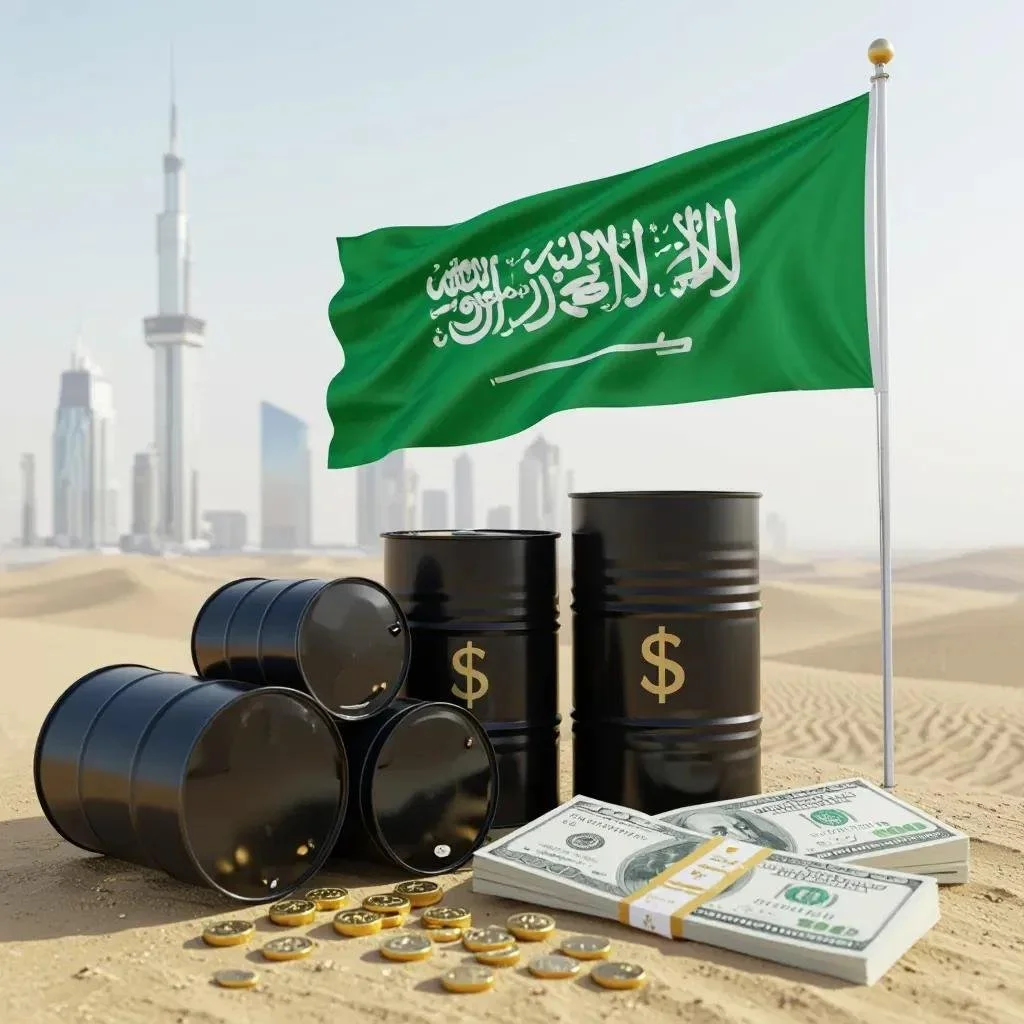
But on the way back home, Roosevelt went out of his way to meet with the Saudis. Legendary amounts of oil had been discovered in the Arabian desert a few years before and knew that such vast energy reserves would be strategically important to the United States after the war.
The problem was that Roosevelt was on death’s door at that point. His doctors had urged him not to go, but the President overruled them, sensing that the trip would solidify American interests.
He was right-- it was a critically important trip. But the doctors were right too-- it was obvious the trip had taken its toll, and a senior aide described FDR as “helpless in fatigue”.
The quick smoke break on his way to the lunch meeting was Roosevelt’s quick moment to relax, gather his wits, and put his game face on before taking on King Abdulaziz.
Apparently, the cigarettes did the trick, because Roosevelt was able to summon enough strength to build great rapport with the King.
As US Marine Colonel William Eddy (who was present at the meeting) later described, “the King and the President got along famously together” and became fast friends.
Roosevelt and Abdulaziz discovered they were the same age, both deeply interested in agriculture, and even shared similar physical handicaps.
In fact, Roosevelt gave one of his own wheelchairs to the King as a goodwill gesture, which Abdulaziz later recalled was “my most precious possession [from] my great and good friend President Roosevelt.”
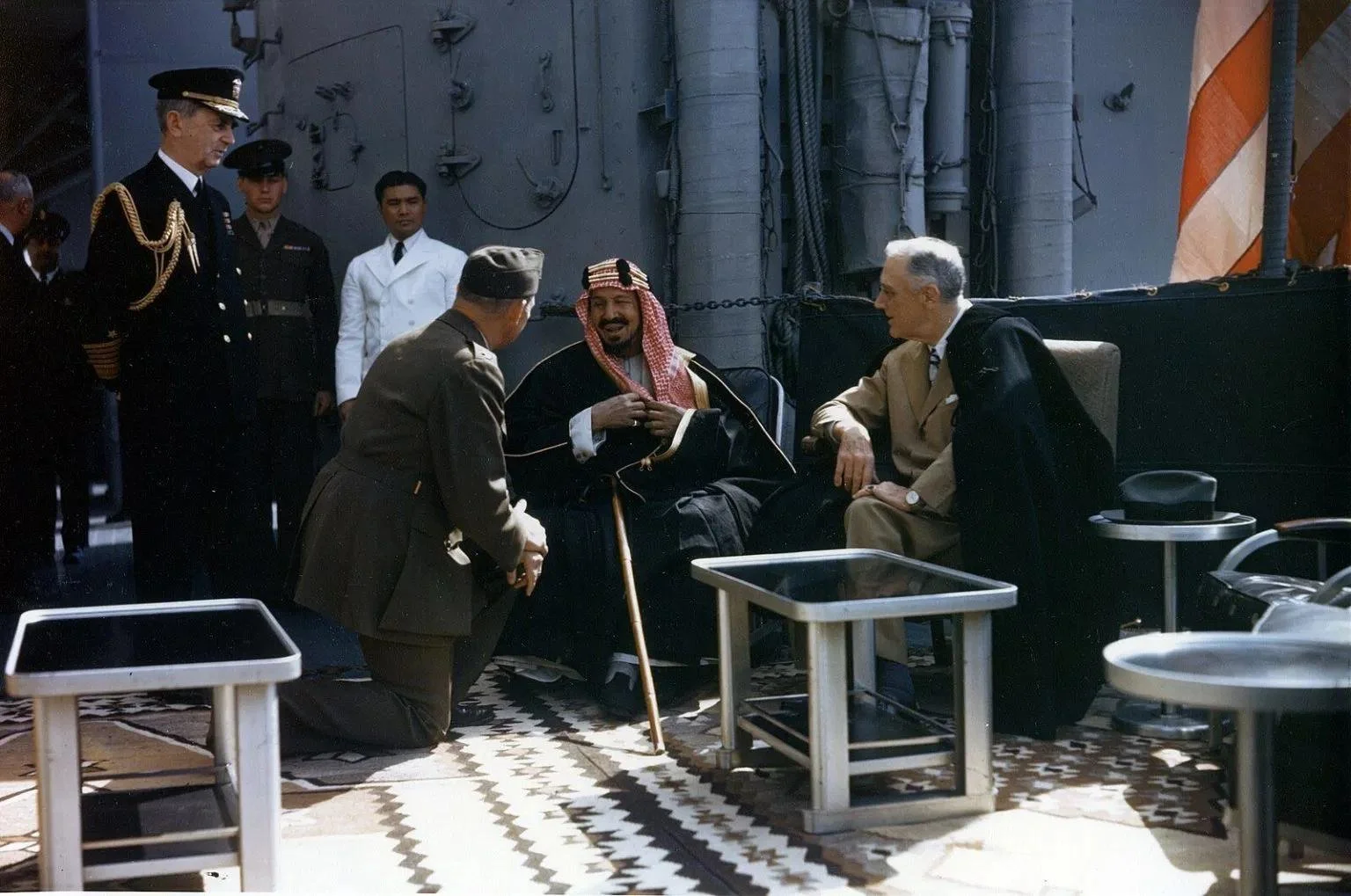
President Roosevelt with King Ibn Saud aboard USS Quincy, 14 February 1945. Naval History & Heritage Command, Public domain, via Wikimedia Commons.
Roosevelt died less than two months later. But he had planted the seeds of a relationship with Saudi Arabia that soon became very important… and eventually critical to the United States.
In the 1940s and 1950s, the US economy grew leaps and bounds and had an insatiable appetite for energy; Saudi oil played a key role in fueling that growth, and both nations prospered from the relationship.
Their amity was put to the test in the 1970s when the US dollar was taken off the gold standard. World leaders revolted, and the dollar’s standing as the global reserve currency could have ended very quickly.
But Saudi Arabia stuck with the dollar. And in 1974, the two countries inked a new economic cooperation deal: the US would provide security and technology, and the Saudis agreed to maintain their currency peg to the dollar… which ultimately meant that oil would still be sold exclusively in US dollars.
If the Saudis had gone the other way and abandoned the dollar, America could have lost its global financial dominance by the end of the 1970s.
Instead, Saudi Arabia’s commitment encouraged (and realistically forced) the rest of the world to continue to hold US dollars, even if just for the sole purpose of buying oil from OPEC.
As a result, the US dollar has remained the global reserve currency through this day-- which is the ONLY reason why America can have a $36+ trillion national debt or run multi-trillion-dollar deficits each year… and yet the world keeps buying US government bonds.
Saudi Arabia could now be poised for another big decision that will have a major impact on America’s future dominance.
But first-- as of today, it appears that the Trump administration may be climbing down from hard-nosed positions they had adopted as recently as Monday.
Suddenly now the President doesn’t want to fire Fed Chairman Jerome Powell. Suddenly the gazillion percent tariffs on China are “too high”. Suddenly Elon thinks that he is spending too much time at DOGE.
Granted, all of this could change by the time I finish writing this article. Such are the times in which we live. However, it seems that the administration is feeling the pressure from the bond market rout, the stock market rout, the currency market rout.
It’s all very Truss-ian, i.e. reminiscent of 2022 when then-British PM Liz Truss had to resign after domestic financial markets crashed and investors vomited all over her economic plan.
Obviously, the guys in the US aren’t going to resign. But it appears that they’re capitulating to investors’ demands: “Go back to the way things were in March… keep hitting the woke universities, keep policing the border, keep doing all the other stuff. Just leave trade alone.”
So, is the economic war already over? Who knows. But even if they really are backing down, it remains to be seen if the rest of the world will simply forget about the past month and move on.
How much trust and confidence will other nations continue to have in the dollar, and in the United States? Already, over the past several years, there has been serious effort from the Usual Suspects (i.e. Russia, China, Iran, etc.) to de-dollarize.
Some of their efforts have been laughable. Others have made great progress.
And Saudi Arabia may once again be the key swing vote.
Saudi’s Crown Prince, Mohammed bin Salman (MBS), knows his kingdom’s oil will eventually run out, and he’s desperately seeking to build a real economy to replace it.
On one hand, Saudi Arabia has a longstanding relationship with the US-- though one that has clearly soured over the years. On the other hand, he has the Chinese offering all sorts of cash and prizes.
China knows that the petrodollar, i.e. selling oil in US dollars, is a key driver for global US dollar demand… which props up the US government and supports America’s gargantuan national debt.
Chipping away at that dollar demand will really hurt the United States. China wants this to happen. And they’ve been pushing Saudi Arabia to start selling oil in Chinese yuan, i.e. petroyuan.
Bottom line, MBS is going to have to make a decision about whether partnership with China or the US is better for his kingdom over the next several decades.
If he sticks with the US and rejects Chinese overtures, it will go a long way in keeping other countries in line, eliminating doubts about America, and maintaining the dollar as the reserve currency-- for now.
On the other hand, if he decides that China is the better option and starts selling oil in yuan, it could be crippling for the US economy.
Foreigners holding trillions of US dollar assets would no longer need to maintain such vast dollar reserves. The dollar would plummet as a result, US government bond yields would skyrocket, and inflation would surge.
Saudi Arabia is holding a lot of cards right now regarding the fate of the dollar… which is a key reason why Donald Trump himself is heading there in a few weeks.
Make no mistake-- this is a monumental story in the making.
To your freedom, James Hickman Co-Founder, Schiff Sovereign LLC
Gold Is Being Remonetized – Why $10K Gold & $50 Silver Are Now in Sight | Florian Grummes
Gold Is Being Remonetized – Why $10K Gold & $50 Silver Are Now in Sight | Florian Grummes
Kitco News: 4-24-2025
Gold is pulling back from record highs above $3,500/oz — but is this just a pause before the next surge?
Silver is up over 3% in a single day, and some analysts say it's finally “waking up.” Azerbaijan’s State Oil Fund just added nearly 19 tonnes of gold in Q1, signaling fresh sovereign accumulation.
Meanwhile, Treasury Secretary Scott Bessent says there's “an opportunity for a big deal” with China on trade. Could this reshape global capital flows — and set the stage for silver to explode?
Gold Is Being Remonetized – Why $10K Gold & $50 Silver Are Now in Sight | Florian Grummes
Kitco News: 4-24-2025
Gold is pulling back from record highs above $3,500/oz — but is this just a pause before the next surge?
Silver is up over 3% in a single day, and some analysts say it's finally “waking up.” Azerbaijan’s State Oil Fund just added nearly 19 tonnes of gold in Q1, signaling fresh sovereign accumulation.
Meanwhile, Treasury Secretary Scott Bessent says there's “an opportunity for a big deal” with China on trade. Could this reshape global capital flows — and set the stage for silver to explode?
Florian Grummes, Managing Director of Midas Touch Consulting, joins Kitco News Anchor Jeremy Szafron to break down silver’s technical breakout, China’s strategic push to internationalize the yuan with gold, and what’s next for precious metals.
They also explore the gold/silver ratio, mining stocks like Silver Tiger Metals and First Mining Gold, and whether silver can really hit $50 this spring.
00:00 Introduction
00:59 Sovereign Gold Accumulation
02:12 Gold Price Predictions and Trends
04:16 US-China Trade Relations Impact
09:33 China's Strategy and Global Gold Flows
16:13 Gold and Silver Market Dynamics
26:18 Mining Stocks and Investment Opportunities
32:06 Conclusion
More News, Rumors and Opinions Thursday PM 4-24-2025
Ariel: 34 Countries Meeting with Trump
4-23-2025
34 countries meeting with Donald Trump.
A New Deal
Fair Trade
Currency Parity
Equal Value
~ Monetary Revaluation
Ariel: 34 Countries Meeting with Trump
4-23-2025
34 countries meeting with Donald Trump.
A New Deal
Fair Trade
Currency Parity
Equal Value
~ Monetary Revaluation
The trade summit between Donald Trump and 34 nations is profoundly significant for humanity, as it holds the potential to liberate global populations from the Deepstate’s oppressive grip, fostering a new era of economic and political sovereignty.
By challenging the entrenched systems of currency manipulation, unfair trade practices, and centralized control, these negotiations could empower nations to prioritize their citizens’ welfare over elite interests, reducing economic exploitation and fostering self-sufficiency.
The potential exposure of covert intelligence operations, secret society networks, and manipulative agendas in energy, technology, climate, and pharmaceuticals could awaken humanity to the hidden forces shaping their lives, sparking demands for transparency and accountability.
This shift threatens to dismantle the unipolar order, replacing it with a multipolar world where nations and individuals reclaim agency, free from the Deepstate’s financial, technological, and narrative stranglehold.
Ultimately, this could pave the way for a fairer, more equitable global system, where humanity’s potential is no longer shackled by orchestrated dependency and deception.
Source(s):
https://x.com/Prolotario1/status/1915168587276574857
https://x.com/Prolotario1/status/1915182335495983589
https://dinarchronicles.com/2025/04/23/ariel-prolotario1-34-countries-meeting-with-trump/
************
Courtesy of Dinar Guru: https://www.dinarguru.com/
Henig IMO Vietnam wants trade with the US immensely, and is willing to be quite flexible to maintain that relationship. Remember that the number one thing that Trump seeks is fairness in the market--and top of the list of enabling factors is a fair exchange rate, with no exchange rate manipulation.
Guru Militia Man Article: "What are the real reasons behind the delay in sending budget tables?" So, the cat is finally out of the bag. They are now saying what we could see...Article 12 of the 2023-2024 Budget is being withheld publicly. It is clearly exchange rate related! What they are saying is now in print that the street knows what we know and this is supporting our view...
Frank26 Article: "Baghdad prepares to receive a Kurdistan delegation...a decisive round to turn the page on disputes" The only dispute is that we don't have a new exchange rate. IMO that's what this conversation is going to be about. It's not about the oil. It's not about flowing the oil. The oil is not about the HCL. It's not about Article 140. It's about a new exchange rate IMO.
************
Bessent Slams IMF - But Real Warning Was About the Dollar
Taylor Kenny: 4-24-2025
U.S. Secretary of the Treasury Scott Bessent publicly challenged the International Monetary Fund (IMF) and the World Bank, accusing them of "mission creep" and calling for a rebalancing of the international financial system.
While the headlines may focus on global policy debates, the deeper message is clear: the dollar system, as we know it, is breaking
As Taylor Kenney explains, the system that holds your savings, retirement, and financial future is undergoing a fundamental transformation—and it's time to prepare.
Gold Hit $3,500 — Then Something Strange Happened
Goldcore TV: 4-24-2025
Gold’s recent surge to $3,500 wasn’t just a price event — it was a warning shot.
A sudden, sharp revaluation not just of gold, but of everything investors thought they understood about the system.
While the media called it a rally, #centralbanks were quietly doing something else: doubling down. Not on yield. Not on growth. But on sovereignty. On protection. On something real, in a financial system increasingly built on hope and hashtags.
This GoldCoreTV episode breaks down what really happened at $3,500 — and why it wasn’t the end of the bull market, but the beginning of something deeper.
We explore: Why gold’s spike wasn’t about inflation — but about institutional panic
How central banks are quietly rebelling, buying over 1,000 tonnes a year
Why #silver’s silence is actually a signal, not a failure
What the gold-silver ratio is telling us about timing and opportunity
Why “buying the dip” isn’t a strategy for central banks — and shouldn’t be for you
This isn’t about timing a trade. It’s about understanding the message behind the move.
Because when trust evaporates, gold doesn’t rise in a frenzy — it rises in silence.
Seeds of Wisdom RV and Economic Updates Thursday Afternoon 4-24-25
Good Afternoon Dinar Recaps,
CME GROUP TO LAUNCH XRP FUTURES IN MAY
Top derivatives firm, CME Group, is set to launch XRP futures in May, offering more options for traders in the digital asset market.
▪️Derivatives marketplace CME Group will launch XRP futures on May 19, pending regulatory approval.
▪️Contracts are available in two sizes, cash-settled with a daily reference rate.
Other firms like ProShares filed for three XRP futures ETFs with the U.S.SEC.
▪️Other firms like ProShares filed for three XRP futures ETFs with the U.S.SEC.
Good Afternoon Dinar Recaps,
CME GROUP TO LAUNCH XRP FUTURES IN MAY
Top derivatives firm, CME Group, is set to launch XRP futures in May, offering more options for traders in the digital asset market.
▪️Derivatives marketplace CME Group will launch XRP futures on May 19, pending regulatory approval.
▪️Contracts are available in two sizes, cash-settled with a daily reference rate.
Other firms like ProShares filed for three XRP futures ETFs with the U.S.SEC.
▪️Other firms like ProShares filed for three XRP futures ETFs with the U.S.SEC.
Global leading derivatives marketplace CME Group has confirmed adding XRP futures to its list of cryptocurrency derivatives products.
The launch is planned for May 19, pending the green light from regulators. This recent development is part of the firm’s continued effort to meet growing demand from investors looking for alternatives in the digital asset market.
Details on the New XRP Futures Contracts
According to CME Group, the XRP futures will be available in two contract sizes. As detailed, one will cover 2,500 XRP while the other will be much larger, representing 50,000 XRP.
It is worth mentioning that both contracts will be cash-settled. Pricing will be based on the CME CF XRP-Dollar reference rate, a daily benchmark calculated at 4:00 p.m. London time.
This rate reflects the value of XRP in U.S. dollars and is used to provide a consistent and fair settlement process. This addition will expand CME Group’s existing digital asset offerings.
The CME Group exchange currently provides futures and options for the most prominent cryptocurrencies, Bitcoin and Ethereum. It also expanded its crypto offerings with the launch of Solana (SOL) futures. With XRP now added to the lineup, CME is ready to provide traders with a broader range of tools to manage their exposure to digital assets.
Since entering the digital asset ecosystem, the exchange has recorded a consistent increase in interest in its crypto products. In the first quarter of 2025, the average daily volume for crypto futures was 198,000 contracts. This represents a notional value of $11.3 billion, showing strong year-over-year growth.
Open interest also grew to an average of 251,000 contracts, equal to $21.8 billion in notional value. SOL futures, which began trading in mid-March, recorded more than 43,000 contracts traded, with a total notional value of $705 million.
Rising Demand for Regulated XRP Offerings
CME Group’s decision to offer XRP futures reveals the increasing role of regulated financial instruments in digital asset trading. Based on market sentiment, as more investors seek alternatives for BTC and ETH, exchanges respond by introducing products linked to other tokens.
XRP, the cryptocurrency associated with Ripple Labs, has gained attention for its practical use in financial transactions. Its speed and low cost have made it popular among everyday users and institutional investors.
With XRP’s inclusion, CME Group is widening access to futures trading in an evolving space. This also signals that traditional financial institutions are paying closer attention to how digital assets can fit into mainstream portfolios.
In addition to CME Group’s announcement of launching XRP futures, the digital asset has made headlines lately following the conclusion of the Ripple vs. SEC case. The settlement with the U.S. Securities and Exchange Commission has arguably renewed confidence in XRP’s position, paving the way for increased institutional interest.
Coinspeaker noted earlier that ProShares has joined the race for the XRP ETF. In a recent SEC filing, the firm revealed plans to launch three XRP futures-based ETFs. This move signals growing competition and a more competitive investment appetite in the XRP space.
@ Newshounds News™
Source: CoinSpeaker\
~~~~~~~~~
BRICS: CHINA OFFICIALLY LAUNCHES PLAN TO PROMOTE ITS OWN PAYMENT SYSTEM
BRICS member China officially rolled out a plan to promote its own payment system to replace SWIFT. The Communist country aims to reduce US dollar dependency to confront Washington’s aggressive stance on trade and tariffs. The new plan was jointly released by the Shanghai municipal government and the People’s Bank of China, the country’s central bank.
The new payment system from BRICS member China will incorporate the Chinese yuan through the Cross-Border Interbank Payment System (CIPS). China wants to leverage its dominance in the manufacturing and trade sector and push the Chinese yuan for settlements.
BRICS: China Will Take on SWIFT Through CIPS Payment System
The BRICS country China revealed that it will “enhance the functionality” of CIPS and challenge the Western-dominated SWIFT payment system. “Promote the use of the renminbi in belt and road partner countries, and build a trade and investment service system based in Shanghai to facilitate the global circulation and use of the renminbi,” the plan stated.
The plan also states that the Xi Jinping administration will strengthen financial support to Chinese enterprises “going global”. “Enabling all types of market players to engage in international competition and cooperation in a safer, more convenient and efficient manner,” read the report.
China will also allow other BRICS members to settle cross-border transactions without the US dollar in the new payment system. Beijing is looking to internationalize the Chinese yuan and make it a common currency for trade among developing nations.
Settling cross-border transactions in the new payment system will not only strengthen the Chinese economy but also uplift the BRICS alliance. The development could cause harm to the US dollar as more countries will stop using it as a form of payment for trade.
@ Newshounds News™
Source: Watcher Guru
~~~~~~~~~
Seeds of Wisdom Team RV Currency Facts Youtube and Rumble
Newshound's News Telegram Room Link
Q & A Classroom Link
Follow the Roadmap
Follow the Timeline
Seeds of Wisdom Team™ Website
Thank you Dinar Recaps